×
Request Free Sample ×

Kindly complete the form below to receive a free sample of this Report

* Please use a valid business email

Leading companies partner with us for data-driven Insights

clients tt-cursor
Hero Background
English
Chinese
French
Japanese
Korean
German
Spanish

Medical Aesthetics Market Trends

ID: MRFR/MED/5343-CR
267 Pages
Rahul Gotadki
September 2025

Medical Aesthetics Market Research Report: Size, Share, Trend Analysis By Product (Facial Aesthetic, (Botulinum Toxin , Dermal Fillers, Microdermabrasion Devices, Others),Body Contouring Devices, (Nonsurgical Fat Reduction Devices, Cellulite Reduction Devices , Liposuction Devices)Cosmetic Implants, ( Breast Implants, Facial Implants, Others) Hair Removal Devices, Skin Aesthetic Devices, (Laser Skin Resurfacing Devices, Nonsurgical Skin Tightening Devices, Micro-Needling Products, Light Therapy Device, Chemical Peel, Skin Lighteners, Aesthetic Threads), Tattoo Removal Devices, And Others), By Technology (Invasive , Non-Invasive, Minimally Invasive), By End Users (Hospitals & Clinics, Dermatology & Cosmetic Centers, Others), and by Region (North America, Europe, Asia-Pacific, Middle East & Africa, and South America) - Growth Outlook & Industry Forecast Till 2035

Share:
Download PDF ×

We do not share your information with anyone. However, we may send you emails based on your report interest from time to time. You may contact us at any time to opt-out.

Medical Aesthetics Market Infographic
Purchase Options

Market Trends

Key Emerging Trends in the Medical Aesthetics Market

The medical tourism market is experiencing robust growth on a global scale. The growing popularity of medical tourism is due to many reasons that include cost-effectiveness, advanced treatments and facilities in popular destinations. There is an increasing demand for specialized medical services through medical tourism. Patients visit other countries for elective surgeries, cosmetic enhancements, fertility treatments and advanced medical procedures that are not easily accessible or expensive in their own country. One of the main motivating factors behind medical tourism is modern technology in medicine and innovative treatments. Medical tourism providers face a competitive market as patients seek destinations that allow them to take advantage of the latest developments in medical science. Integration of digital health solutions and telemedicine is disrupting the industry landscape for medical tourism. Virtual consultations, pre-travel medical assessments, and post treatment follow ups are becoming a norm in the countries attracting attention of Medical tourism offering one uniformed streamlined healthcare experience for medial tourists. Healthcare facilities accreditation and certification are increasingly becoming popular in the medical tourism market. Patients choose destinations and providers with established quality standards, especially Joint Commission International (JCI) accreditation; such services offer a guarantee of trust and confidence. The alliance between the tourism business and healthcare professionals is growing. These packages not only offer medical therapies but also include lodgings, travel facilities and entertainment options for patients supported by their accompanying companions that provide a wholesome escapade. The movement wellness tourism, which entails combining medical care with the philosophy of health and prevention is an ever-increasing trend. Medical tourists look for places that provide not only medical competence but also a complete sense of well-being, including spa treatments and fitness programs as well as nutritional consultation. Governments of leading medical hubs are actively promoting and building up the industry. Medical tourism is enhanced by financial rewards, simplified visa procedures and infrastructural development to countries that understand the economic advantages of healthcare journeys. The medical tourism sector has prominent segments such as dental and cosmetic procedures. Thus, patients choose countries where people come to get excellent dental care, cosmetic surgery and aesthetic procedures for prices which are a few times lower than in their native lands. Healthcare resilience and effective crisis response mechanisms in medical tourism destinations earn the confidence of potential medical tourist. The ability to manage public health crises, such as the COVID-19 pandemic, is becoming a crucial factor in destination selection.

Author
Rahul Gotadki
Research Manager

He holds an experience of about 9+ years in Market Research and Business Consulting, working under the spectrum of Life Sciences and Healthcare domains. Rahul conceptualizes and implements a scalable business strategy and provides strategic leadership to the clients. His expertise lies in market estimation, competitive intelligence, pipeline analysis, customer assessment, etc.

Leave a Comment

FAQs

What is the current valuation of the Medical Aesthetics Market as of 2024?

<p>The Medical Aesthetics Market was valued at 21.45 USD Billion in 2024.</p>

What is the projected market size for the market in 2035?

The market is projected to reach 54.91 USD Billion by 2035.

What is the expected CAGR for the market during the forecast period 2025 - 2035?

The expected CAGR for the market during 2025 - 2035 is 8.92%.

Which segment of the Medical Aesthetics Market is projected to have the highest growth?

<p>Facial Aesthetics is projected to grow from 5.0 USD Billion to 12.0 USD Billion by 2035.</p>

What are the key players in the market?

Key players include Allergan, Galderma, Revance Therapeutics, Medytox, Hugel, Ipsen, and Sientra.

How does the Body Contouring segment perform in terms of market valuation?

<p>The Body Contouring segment was valued at 4.0 USD Billion in 2024 and is expected to reach 10.0 USD Billion by 2035.</p>

What is the market outlook for Injectables in the Medical Aesthetics Market?

Injectables are projected to grow from 8.0 USD Billion in 2024 to 20.0 USD Billion by 2035.

Which end-use segment is expected to show significant growth in the market?

Dermatology Centers are expected to grow from 6.95 USD Billion to 13.91 USD Billion by 2035.

What demographic factors influence the market?

Demographic factors such as age and gender are projected to grow from 5.0 USD Billion and 6.0 USD Billion respectively in 2024 to 12.0 USD Billion and 15.0 USD Billion by 2035.

What treatment types are expected to dominate the market?

Non-invasive treatments are projected to grow from 6.43 USD Billion in 2024 to 16.25 USD Billion by 2035.

Market Summary

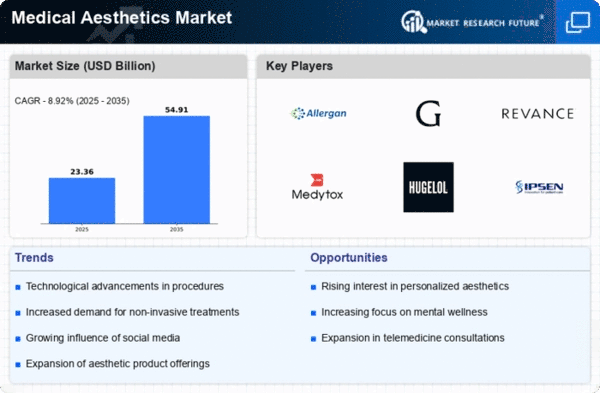
According to Market Research Future analysis, the Medical Aesthetics Market size was valued at USD 21.45 Billion in 2024 and the market is projected to grow from USD 23.36 Billion in 2025 to USD 54.91 Billion by 2035, exhibiting a CAGR of 8.92% during the forecast period 2025–2035. North America led the market with over 50.35% share, generating around USD 10.8 billion in revenue.
 
Rising demand for minimally invasive cosmetic procedures and increasing consumer focus on appearance enhancement are key growth drivers for the medical aesthetics market. Growing social acceptance and technological advancements in aesthetic treatments are further expanding global adoption across diverse age groups.
 
WHO highlights rising global aging population, with over 1 billion people aged 60+ by 2020, increasing aesthetic demand. IHME reports growing emphasis on quality-of-life improvements, while CDC notes increasing cosmetic procedure trends, collectively supporting sustained growth in minimally invasive aesthetic treatments globally.

Key Market Trends & Highlights

The Medical Aesthetics Market is experiencing robust growth driven by technological advancements and increasing consumer engagement.

  • North America holds 50% share, with the United States contributing 82% of regional revenue due to high aesthetic spending. Facial aesthetics leads with 57% share, driven by rising demand for Botox, fillers, and non-invasive facial rejuvenation procedures globally. Injectables dominate with 64% share, supported by strong preference for minimally invasive treatments with immediate visible results. Non-invasive procedures account for 68% share, fueled by increasing consumer preference for low-risk treatments with minimal recovery time.

Market Size & Forecast

2024 Market Size 21.45 (USD Billion)
2035 Market Size 54.91 (USD Billion)
CAGR (2025 - 2035) 8.92%
Largest Regional Market Share in 2024 North America

Major Players

Companies such as Allergan (US), <a title="Galderma" href="https://www.galdermaaesthetics.com/" target="_blank" rel="noopener">Galderma</a> (CH), <a title="Revance Therapeutics" href="https://www.revance.com/portfolio/aesthetics" target="_blank" rel="noopener">Revance Therapeutics</a> (US), Medytox (KR), Hugel (KR), Ipsen (FR), Medytox (KR), Sientra (US), Hugel (KR) are some of the major participants in the global market.

Market Trends

The Medical Aesthetics Market is currently experiencing a dynamic evolution, driven by a confluence of factors that include technological advancements, changing consumer preferences, and an increasing emphasis on self-care and wellness. Innovations in non-invasive procedures, such as laser treatments and injectables, are gaining traction among consumers seeking effective yet minimally invasive solutions.

This shift is further supported by a growing awareness of aesthetic procedures, which are now perceived as accessible and integral to personal grooming and self-esteem enhancement. As a result, the market is witnessing a surge in demand for a diverse range of aesthetic treatments, catering to various demographics and preferences.

Moreover, the market is characterized by a rising trend towards personalized treatments, where practitioners tailor procedures to meet individual needs and desires. This customization not only enhances patient satisfaction but also fosters loyalty towards specific brands and clinics.

Additionally, the integration of digital platforms for marketing and consultation is reshaping how services are delivered and consumed. Social media, in particular, plays a pivotal role in influencing consumer choices, as potential clients seek inspiration and validation from online communities. Overall, the market appears poised for continued growth, driven by innovation, personalization, and the evolving landscape of consumer engagement.

Technological Advancements

The Medical Aesthetics Market is witnessing rapid technological progress, particularly in non-invasive procedures. Innovations such as advanced laser systems and improved injectables are enhancing treatment efficacy and safety. These developments not only attract a broader clientele but also encourage existing consumers to explore new options.

European Centre for Disease Prevention and Control (ECDC) reports increasing adoption of advanced medical technologies improving procedural safety and efficiency. Pan American Health Organization (PAHO) highlights rising integration of laser-based and non-invasive technologies, enhancing treatment outcomes and expanding accessibility of aesthetic procedures globally.

Personalized Treatments

There is a notable shift towards personalized aesthetic solutions, where treatments are customized to align with individual preferences and needs. This trend fosters a deeper connection between practitioners and clients, enhancing satisfaction and encouraging repeat visits.

UNICEF reports growing focus on individualized healthcare approaches to improve patient satisfaction and outcomes. United Nations Population Fund (UNFPA) highlights that personalized care is increasingly important as global life expectancy exceeds 73 years, driving demand for customized aesthetic treatments aligned with patient-specific needs and preferences.

Digital Engagement

The role of digital platforms in the Medical Aesthetics Market is expanding, with social media becoming a crucial tool for marketing and client interaction. This trend allows practitioners to showcase results and engage with potential clients, influencing their decisions and preferences.

The Global Fund highlights increasing use of digital platforms to enhance healthcare awareness and outreach, while Médecins Sans Frontières (MSF) emphasizes digital tools improving patient engagement and access. Growing internet penetration exceeding 60% globally supports expansion of digital marketing and client interaction in aesthetics.

Medical Aesthetics Market Market Drivers

Market Growth Projections

The Global Medical Aesthetics Market is projected to experience substantial growth in the coming years. With a market value of 27.2 USD Billion in 2024, it is anticipated to reach 130.2 USD Billion by 2035. This remarkable growth trajectory indicates a compound annual growth rate (CAGR) of 15.28% from 2025 to 2035.
 
Such projections suggest a robust demand for aesthetic treatments, driven by factors such as technological advancements, increasing consumer awareness, and a growing aging population. This upward trend underscores the industry's potential and highlights the importance of strategic investments and innovations to capitalize on emerging opportunities.

Rising Demand for Non-Invasive Procedures

The Global Medical Aesthetics Market experiences a notable increase in demand for non-invasive aesthetic procedures. This trend is driven by a growing preference among consumers for treatments that offer minimal downtime and reduced risk compared to surgical options. For instance, procedures such as Botox and dermal fillers have gained immense popularity, appealing to a broad demographic.
 
As of 2024, the market is valued at approximately 27.2 USD Billion, reflecting a shift towards less invasive solutions. This consumer inclination suggests a potential for sustained growth in the sector, as more individuals seek accessible and effective aesthetic enhancements.

Increasing Awareness of Aesthetic Treatments

The Global Medical Aesthetics Market benefits from a rising awareness of aesthetic treatments among consumers. Educational campaigns and social media influence have significantly contributed to this trend, as individuals become more informed about the benefits and availability of aesthetic procedures.
 
This heightened awareness encourages more people to consider aesthetic enhancements, thereby expanding the consumer base. Additionally, the portrayal of aesthetic treatments in popular culture and media further normalizes these procedures, making them more accessible. As awareness continues to grow, the market is poised for further expansion, potentially reaching substantial figures in the coming years.

Technological Advancements in Aesthetic Devices

Technological innovations play a pivotal role in shaping the market. The introduction of advanced devices, such as laser technologies and radiofrequency systems, enhances the efficacy and safety of aesthetic treatments. These innovations not only improve patient outcomes but also expand the range of available procedures.
 
For example, the development of fractional laser technology has revolutionized skin resurfacing, providing superior results with minimal side effects. As the industry progresses, these advancements are likely to drive market growth, contributing to an anticipated market value of 130.2 USD Billion by 2035, with a CAGR of 15.28% projected for 2025-2035.

Expansion of Aesthetic Clinics and Accessibility

The Global Medical Aesthetics Market is witnessing an expansion of aesthetic clinics, enhancing accessibility for consumers. The proliferation of these clinics, often located in urban areas, provides individuals with greater opportunities to access aesthetic treatments. This trend is further supported by the increasing number of trained professionals entering the field, ensuring that a diverse range of services is available.
 
As clinics become more widespread, the stigma associated with aesthetic procedures diminishes, encouraging more individuals to seek treatments. This expansion is likely to play a crucial role in driving market growth, as accessibility remains a key factor in consumer decision-making.

Aging Population and Demand for Anti-Aging Solutions

An aging population globally drives the demand for anti-aging solutions within the market. As individuals seek to maintain a youthful appearance, there is an increasing inclination towards aesthetic treatments that address signs of aging.
 
This demographic shift is particularly pronounced in developed countries, where a significant portion of the population is over 50. Treatments such as skin rejuvenation and wrinkle reduction are in high demand, reflecting a societal trend towards prioritizing appearance and self-care. This growing demand is expected to contribute to the industry's robust growth trajectory, aligning with broader demographic trends.

Market Segment Insights

By Application: Facial Aesthetics (Largest) vs. Body Contouring (Fastest-Growing)

The market is prominently driven by the facial aesthetics segment, which holds the largest Medical Aesthetics Market share at 57% among the various applications. This segment encapsulates a wide range of procedures, including Botox injections, dermal fillers, and <a title="facial rejuvenation" href="https://www.marketresearchfuture.com/reports/facial-rejuvenation-market-8811" target="_blank" rel="noopener">facial rejuvenation</a> techniques, thereby establishing itself as a preferred choice for consumers seeking beauty enhancements. In contrast, the <a title="Body Contouring" href="https://www.marketresearchfuture.com/reports/body-contouring-market-1343" target="_blank" rel="noopener">Body Contouring</a> segment is witnessing rapid growth, driven by increasing demand for non-invasive body sculpting procedures. As technology advances, various treatment options have emerged, appealing to a broader customer base, thereby expanding its market presence.

Facial Aesthetics (Dominant) vs. Body Contouring (Emerging)

Facial Aesthetics remains the dominant force in the market share, characterized by its wide array of treatments aimed at enhancing facial features and reducing visible signs of aging. This segment is beloved for its minimal recovery time and immediate visible results, making it a go-to choice for many consumers. Conversely, Body Contouring is an emerging segment that focuses on non-invasive and minimally invasive procedures to reshape and alter the body's contours. As societal acceptance of body modification continues to grow, this segment experiences a surge in popularity, catalyzed by innovative technologies that provide enhanced results, thus enticing consumers to pursue these treatments for improved self-esteem and confidence.

By End Use: Clinics (Largest) vs. Homecare (Fastest-Growing)

Clinics hold the largest Medical Aesthetics Market share at 61% due to their established presence and trusted professional services. Hospitals and Dermatology Centers also contribute significantly to the market, offering specialized treatments and procedures. Spas are popular for non-invasive treatments but occupy a smaller segment of the overall market, appealing primarily to clientele seeking relaxation and cosmetic enhancements.

Clinics: (Dominant) vs. Homecare (Emerging)

Clinics represent the dominant force in the market, providing a wide range of advanced aesthetic procedures conducted by trained professionals. Their reputation for safety and effectiveness drives patient trust and consistent demand. In contrast, the Homecare segment is emerging rapidly, driven by a growing preference for convenience and self-care among consumers. With increased access to at-home treatments and advancements in home-use devices, this segment is appealing to those seeking effective solutions without the need to visit clinics, thereby capturing a significant niche in the market.

By Product Type: Injectables (Largest) vs. Laser Devices (Fastest-Growing)

In the market, the product type segment is primarily dominated by injectables, which hold a significant market share at 64%. These include botulinum toxins, dermal fillers, and other similar products, appealing to consumers for their immediate results and minimally invasive nature. Following injectables, laser devices represent a growing niche, leveraging advanced technology for skin rejuvenation, hair removal, and body contouring, thereby capturing more of the market as consumer awareness increases.

Injectables (Dominant) vs. Laser Devices (Emerging)

Injectables have established themselves as the dominant force in the Medical Aesthetics Market due to their broad consumer acceptance and effectiveness in delivering instant results with minimal downtime. The convenience of these products, combined with aesthetic improvements, has led to a steady increase in their adoption among various age groups. On the other hand, laser devices are emerging as a popular alternative, especially among younger demographics seeking long-term skin solutions. With technological advancements and enhanced efficacy, these devices are quickly gaining traction, particularly in treatments for skincare and body aesthetics, thus positioning themselves as a critical growth area in the segment.

By Demographics: Age (Largest) vs. Gender (Fastest-Growing)

The age demographic plays a crucial role in shaping consumer preferences and spending. The largest proportion of the market comprises individuals aged 30-50, where aesthetic treatments are often considered essential for maintaining youthful appearances. Following this, younger consumers, particularly those aged 18-29, are increasingly participating in medical aesthetics, reflecting a growing acceptance of these treatments among younger demographics. Gender dynamics are also evolving, with the female segment remaining predominant in the market. However, male consumers are emerging as the fastest-growing demographic, driven by increasing awareness and acceptance of aesthetic treatments aimed at enhancing their appearance. This shift signals a broadening of the target market, which may open new avenues for product and service providers in the sector.

Age: 30-50 (Dominant) vs. Gender: Male (Emerging)

Consumers aged 30-50 dominate the market due to their prioritization of appearance and self-care. This demographic is typically more financially stable, allowing for discretionary spending on cosmetic procedures. Their preferences often lean towards solutions like Botox and dermal fillers, creating a strong demand. Meanwhile, the male demographic is emerging as a key player, driven by increasing societal acceptance of male grooming and aesthetic enhancements. Marketers are now tailoring offerings to this growing segment, highlighting products that appeal specifically to men. The intersection of these demographics presents a unique opportunity for market players to innovate and cater to diverse needs within the aesthetic landscape.

By Treatment Type: Non-invasive (Largest) vs. Minimally Invasive (Fastest-Growing)

The treatment type segment reveals a diverse landscape, with non-invasive procedures commanding the largest Medical Aesthetics Market share at 68%. This segment includes treatments like botox and dermal fillers, which are popular among consumers for their immediate results and minimal downtime. Minimally invasive procedures, such as laser therapies, have garnered significant attention, making them the fastest-growing category within the treatment types due to their improved technology and greater patient accessibility. The growth trends in this segment are largely driven by an increasing demand for safer and less invasive options. Consumers are becoming more health-conscious and prefer treatments that require minimal recovery time. The awareness campaigns around aesthetics and the rising influence of social media also play a crucial role in driving growth in the minimally invasive segment.

Non-invasive (Dominant) vs. Preventive (Emerging)

The non-invasive treatment category holds a dominant position in the Medical Aesthetics Market, appealing to a broad demographic of individuals seeking effective aesthetic enhancements without undergoing surgery. This segment comprises techniques such as injectables and chemical peels that offer immediate results with minimal discomfort and downtime. In contrast, the preventive treatment category is emerging as consumers increasingly focus on age management and skin health, opting for proactive measures to delay visible signs of aging. Treatments in this category may include light therapy and skin care regimens that promote long-term skin integrity. The growth in preventive aesthetics reflects a shifting paradigm where clients seek not just interventions but also comprehensive wellness solutions that maintain and enhance skin quality over time.

Get more detailed insights about Medical Aesthetics Market Research Report – Forecast till 2035

Regional Insights

North America : Market Leader in Aesthetics

North America leads in the Medical Aesthetics Market Size, accounting for over 50.35% of the global revenue in 2024. The growth is driven by increasing consumer awareness, technological advancements, and a rising demand for minimally invasive procedures. Regulatory support and favorable reimbursement policies further catalyze market expansion, making it a hub for innovation and investment in aesthetic treatments.

The United States holds 82% share valued at USD 8.79 Billion driven by high consumer spending on aesthetic procedures, while Canada holds 18% share valued at USD 1.93 Billion supported by increasing demand for non-invasive treatments.

The United States of America aesthetics market is the primary contributor to this market, with key players like Allergan and Revance Therapeutics leading the charge. The competitive landscape is characterized by a mix of established bio companies and emerging startups, all vying for market share. The presence of advanced healthcare infrastructure and a high disposable income among consumers also bolster the market's growth prospects.

Europe : Emerging Market Dynamics

Europe Medical Aesthetics Market size was valued at USD 6.44 billion in 2024, making it the second-largest regional market with a 30% share, reflecting a robust growth trajectory fueled by increasing demand for aesthetic treatments and a growing aging population. Regulatory frameworks in countries like Germany and France are evolving to support innovative procedures, enhancing patient safety and treatment efficacy. The rise of social media and beauty influencers also drives consumer interest in aesthetic enhancements, contributing to market growth.

Germany contributing 27% share valued at USD 1.74 Billion driven by strong healthcare infrastructure, while the UK holds 23% share valued at USD 1.48 Billion supported by rising demand for cosmetic enhancements.

Leading countries in this region include Germany, France, and the UK, where key players like Galderma and Ipsen are making significant inroads. The competitive landscape is marked by a blend of local and international companies, all striving to capture a share of the expanding market. The presence of advanced research facilities and a focus on product innovation further enhance the region's attractiveness for investment.

Asia-Pacific : Rapidly Growing Market

The Asia-Pacific Medical Aesthetics Market, valued at 3.8 billion, is witnessing rapid growth, driven by increasing disposable incomes and a rising middle class. Countries like South Korea and Japan are at the forefront, with a strong cultural emphasis on beauty and aesthetics. Regulatory bodies are also becoming more supportive, facilitating the introduction of new technologies and treatments, which is crucial for market expansion.

South Korea stands out as a leader in aesthetic innovations, with companies like Medytox and Hugel leading the charge. The competitive landscape is vibrant, with both local and international players vying for market share. The increasing popularity of non-invasive procedures and a growing awareness of aesthetic treatments among consumers are key factors propelling this market forward.

Middle East and Africa : Emerging Aesthetic Frontier

The Middle East and Africa Medical Aesthetics Market, valued at 0.35 billion, is in its nascent stages but shows significant potential for growth. Factors such as increasing urbanization, rising disposable incomes, and a growing interest in aesthetic procedures are driving demand. Regulatory bodies are beginning to establish frameworks that support the safe introduction of new aesthetic technologies, which is essential for market development.

Countries like the UAE and South Africa are leading the way, with a growing number of clinics offering aesthetic services. The competitive landscape is evolving, with both local and international players entering the market. As consumer awareness increases and more people seek aesthetic enhancements, the region is poised for substantial growth in the coming years.

Key Players and Competitive Insights

The Medical Aesthetics Market is characterized by a dynamic competitive landscape, driven by innovation, technological advancements, and evolving consumer preferences. Key players such as Allergan (US), Galderma (CH), and Revance Therapeutics (US) are at the forefront, each adopting distinct strategies to enhance their market positioning. Allergan (US) continues to leverage its strong brand equity and extensive product portfolio, focusing on expanding its offerings in non-surgical aesthetic procedures.
 
Galderma (CH), on the other hand, emphasizes its commitment to research and development, aiming to introduce novel solutions that cater to diverse consumer needs. Revance Therapeutics (US) appears to be carving a niche through its innovative DaxibotulinumtoxinA injection, which promises longer-lasting results, thereby potentially reshaping consumer expectations in the market.
 
The aesthetics business tactics employed by these aesthetic industry suppliers reflect a concerted effort to optimize operations and enhance market presence. Localizing manufacturing and optimizing supply chains are prevalent strategies, allowing for greater responsiveness to regional demands. The competitive structure of the Medical Aesthetics Market is moderately fragmented, with a mix of established players and emerging top rated medical aesthetics brands vying for market share. This fragmentation fosters a competitive environment where innovation and strategic partnerships play crucial roles in shaping market dynamics.
 
In November Allergan (US) announced a strategic partnership with a leading technology firm to integrate AI-driven solutions into its product development processes. This collaboration is expected to enhance the efficiency of clinical trials and accelerate the introduction of new products to the market. Such a move underscores Allergan's commitment to innovation and its recognition of the growing importance of technology in the aesthetics sector.
 
In October Galderma (CH) launched a new line of sustainable packaging for its dermal fillers, aligning with the increasing consumer demand for environmentally friendly products. This initiative not only enhances Galderma's brand image but also positions the company as a leader in sustainability within the Medical Aesthetics Market. The strategic importance of this move lies in its potential to attract environmentally conscious consumers, thereby expanding Galderma's market reach.
 
In September Revance Therapeutics (US) secured a significant investment to further develop its innovative DaxibotulinumtoxinA product line. This funding is likely to bolster the company's research capabilities and expedite the commercialization of its products. The strategic significance of this investment is profound, as it may enable Revance to solidify its competitive edge in a market increasingly focused on efficacy and patient satisfaction.
 
As of December the market is witnessing trends that emphasize digitalization, sustainability, and the integration of AI technologies. Strategic alliances are becoming increasingly pivotal, as companies seek to leverage complementary strengths to enhance their competitive positioning. The shift from price-based competition to a focus on innovation, technology, and supply chain reliability is evident, suggesting that future differentiation will hinge on the ability to deliver superior products and experiences.

Key Companies in the Medical Aesthetics Market include

Industry Developments

DEC 2025 - The medical aesthetics sector is experiencing robust growth driven by rising demand for non-surgical procedures such as dermal fillers, energy-based skin treatments, and body-contouring technologies. Manufacturers continue to launch advanced devices offering faster recovery and improved results. Consumer preferences are shifting toward personalized treatment plans supported by digital skin-analysis tools. Regulatory agencies are also tightening quality and safety standards, influencing product differentiation strategies.

Future Outlook

Medical Aesthetics Market Future Outlook

The Medical Aesthetics Market size is projected to reach USD 54.91 billion by 2035, growing at a CAGR of 8.92%, driven by technological advancements, increasing consumer awareness, and rising demand for non-invasive procedures.

New opportunities lie in:

  • <p>Expansion of telemedicine platforms for aesthetic consultations. Development of personalized skincare products using AI technology. Investment in training programs for advanced aesthetic procedures.</p>

By 2035, the Medical Aesthetics Market is expected to be robust, reflecting substantial growth and innovation.

Market Segmentation

Medical Aesthetics Market End User Outlook

  • Dermatology Clinics
  • Cosmetic Surgery Centers
  • Spas and Wellness Centers
  • Home Care

Medical Aesthetics Market Application Outlook

  • Facial Aesthetics
  • Body Contouring
  • Hair Restoration
  • Skin Rejuvenation

Medical Aesthetics Market Product Type Outlook

  • Botulinum Toxin
  • Dermal Fillers
  • Laser Devices
  • Chemical Peels

Medical Aesthetics Market Procedure Type Outlook

  • Injectables
  • Laser Treatments
  • Surgical Procedures
  • Non-Surgical Procedures

Report Scope

MARKET SIZE 2024 21.45(USD Billion)
MARKET SIZE 2025 23.36(USD Billion)
MARKET SIZE 2035 54.91(USD Billion)
COMPOUND ANNUAL GROWTH RATE (CAGR) 8.92% (2025 - 2035)
REPORT COVERAGE Revenue Forecast, Competitive Landscape, Growth Factors, and Trends
BASE YEAR 2024
Market Forecast Period 2026 - 2035
Historical Data 2019 - 2024
Market Forecast Units USD Billion
Key Companies Profiled Allergan (US), Galderma (CH), Revance Therapeutics (US), Medytox (KR), Hugel (KR), Ipsen (FR), Medytox (KR), Sientra (US), Hugel (KR)
Segments Covered Application, Procedure Type, End User, Product Type
Key Market Opportunities Integration of advanced technologies in non-invasive procedures enhances patient experience in the market.
Key Market Dynamics Rising consumer demand for non-invasive procedures drives innovation and competition in the market.
Countries Covered North America, Europe, APAC, South America, MEA

FAQs

What is the current valuation of the Medical Aesthetics Market as of 2024?

<p>The Medical Aesthetics Market was valued at 21.45 USD Billion in 2024.</p>

What is the projected market size for the market in 2035?

The market is projected to reach 54.91 USD Billion by 2035.

What is the expected CAGR for the market during the forecast period 2025 - 2035?

The expected CAGR for the market during 2025 - 2035 is 8.92%.

Which segment of the Medical Aesthetics Market is projected to have the highest growth?

<p>Facial Aesthetics is projected to grow from 5.0 USD Billion to 12.0 USD Billion by 2035.</p>

What are the key players in the market?

Key players include Allergan, Galderma, Revance Therapeutics, Medytox, Hugel, Ipsen, and Sientra.

How does the Body Contouring segment perform in terms of market valuation?

<p>The Body Contouring segment was valued at 4.0 USD Billion in 2024 and is expected to reach 10.0 USD Billion by 2035.</p>

What is the market outlook for Injectables in the Medical Aesthetics Market?

Injectables are projected to grow from 8.0 USD Billion in 2024 to 20.0 USD Billion by 2035.

Which end-use segment is expected to show significant growth in the market?

Dermatology Centers are expected to grow from 6.95 USD Billion to 13.91 USD Billion by 2035.

What demographic factors influence the market?

Demographic factors such as age and gender are projected to grow from 5.0 USD Billion and 6.0 USD Billion respectively in 2024 to 12.0 USD Billion and 15.0 USD Billion by 2035.

What treatment types are expected to dominate the market?

Non-invasive treatments are projected to grow from 6.43 USD Billion in 2024 to 16.25 USD Billion by 2035.

  1. SECTION I: EXECUTIVE SUMMARY AND KEY HIGHLIGHTS |
    1. EXECUTIVE SUMMARY | |
      1. Market Overview | |
      2. Key Findings | |
      3. Market Segmentation | |
      4. Competitive Landscape | |
      5. Challenges and Opportunities | |
      6. Future Outlook 2
  2. SECTION II: SCOPING, METHODOLOGY AND MARKET STRUCTURE |
    1. MARKET INTRODUCTION | |
      1. Definition | |
      2. Scope of the study | | |
    2. RESEARCH METHODOLOGY | |
      1. Overview | |
      2. Data Mining | |
      3. Secondary Research | |
      4. Primary Research | | |
      5. Forecasting Model | |
      6. Market Size Estimation | | |
      7. Data Triangulation | |
      8. Validation 3
  3. SECTION III: QUALITATIVE ANALYSIS |
    1. MARKET DYNAMICS | |
      1. Overview | |
      2. Drivers | |
      3. Restraints | |
      4. Opportunities |
    2. MARKET FACTOR ANALYSIS | |
      1. Value chain Analysis | |
      2. Porter's Five Forces Analysis | | |
      3. COVID-19 Impact Analysis | | |
  4. SECTION IV: QUANTITATIVE ANALYSIS |
    1. Healthcare, BY Application (USD Billion) | |
      1. Facial Aesthetics | |
      2. Body Contouring | |
      3. Hair Restoration | |
      4. Skin Rejuvenation | |
      5. Injectables |
    2. Healthcare, BY End Use (USD Billion) | |
      1. Clinics | |
      2. Hospitals | |
      3. Homecare | |
      4. Spas | |
      5. Dermatology Centers |
    3. Healthcare, BY Product Type (USD Billion) | |
      1. Injectables | |
      2. Laser Devices | |
      3. Energy-based Devices | |
      4. Skincare Products | |
      5. Surgical Instruments |
    4. Healthcare, BY Demographics (USD Billion) | |
      1. Age | |
      2. Gender | |
      3. Income Level | |
      4. Skin Type | |
      5. Ethnicity |
    5. Healthcare, BY Treatment Type (USD Billion) | |
      1. Non-invasive | |
      2. Minimally Invasive | |
      3. Surgical | |
      4. Preventive | |
      5. Corrective |
    6. Healthcare, BY Region (USD Billion) | |
      1. North America | | |
      2. Europe | | |
      3. APAC | | |
      4. South America | | |
      5. MEA | | |
  5. SECTION V: COMPETITIVE ANALYSIS |
    1. Competitive Landscape | |
      1. Overview | |
      2. Competitive Analysis | |
      3. Market share Analysis | |
      4. Major Growth Strategy in the Healthcare | |
      5. Competitive Benchmarking | |
      6. Leading Players in Terms of Number of Developments in the Healthcare | |
      7. Key developments and growth strategies | | |
      8. Major Players Financial Matrix | | |
    2. Company Profiles | |
      1. Allergan (US) | | |
      2. Galderma (CH) | | |
      3. Revance Therapeutics (US) | | |
      4. Medytox (KR) | | |
      5. Hugel (KR) | | |
      6. Ipsen (FR) | | |
      7. Medytox (KR) | | |
      8. Sientra (US) | | |
      9. Medytox (KR) | | |
    3. Appendix | |
      1. References | |
      2. Related Reports 6 LIST OF FIGURES |
    4. MARKET SYNOPSIS |
    5. NORTH AMERICA MARKET ANALYSIS |
    6. US MARKET ANALYSIS BY APPLICATION |
    7. US MARKET ANALYSIS BY END USE |
    8. US MARKET ANALYSIS BY PRODUCT TYPE |
    9. US MARKET ANALYSIS BY DEMOGRAPHICS |
    10. US MARKET ANALYSIS BY TREATMENT TYPE |
    11. CANADA MARKET ANALYSIS BY APPLICATION |
    12. CANADA MARKET ANALYSIS BY END USE |
    13. CANADA MARKET ANALYSIS BY PRODUCT TYPE |
    14. CANADA MARKET ANALYSIS BY DEMOGRAPHICS |
    15. CANADA MARKET ANALYSIS BY TREATMENT TYPE |
    16. EUROPE MARKET ANALYSIS |
    17. GERMANY MARKET ANALYSIS BY APPLICATION |
    18. GERMANY MARKET ANALYSIS BY END USE |
    19. GERMANY MARKET ANALYSIS BY PRODUCT TYPE |
    20. GERMANY MARKET ANALYSIS BY DEMOGRAPHICS |
    21. GERMANY MARKET ANALYSIS BY TREATMENT TYPE |
    22. UK MARKET ANALYSIS BY APPLICATION |
    23. UK MARKET ANALYSIS BY END USE |
    24. UK MARKET ANALYSIS BY PRODUCT TYPE |
    25. UK MARKET ANALYSIS BY DEMOGRAPHICS |
    26. UK MARKET ANALYSIS BY TREATMENT TYPE |
    27. FRANCE MARKET ANALYSIS BY APPLICATION |
    28. FRANCE MARKET ANALYSIS BY END USE |
    29. FRANCE MARKET ANALYSIS BY PRODUCT TYPE |
    30. FRANCE MARKET ANALYSIS BY DEMOGRAPHICS |
    31. FRANCE MARKET ANALYSIS BY TREATMENT TYPE |
    32. RUSSIA MARKET ANALYSIS BY APPLICATION |
    33. RUSSIA MARKET ANALYSIS BY END USE |
    34. RUSSIA MARKET ANALYSIS BY PRODUCT TYPE |
    35. RUSSIA MARKET ANALYSIS BY DEMOGRAPHICS |
    36. RUSSIA MARKET ANALYSIS BY TREATMENT TYPE |
    37. ITALY MARKET ANALYSIS BY APPLICATION |
    38. ITALY MARKET ANALYSIS BY END USE |
    39. ITALY MARKET ANALYSIS BY PRODUCT TYPE |
    40. ITALY MARKET ANALYSIS BY DEMOGRAPHICS |
    41. ITALY MARKET ANALYSIS BY TREATMENT TYPE |
    42. SPAIN MARKET ANALYSIS BY APPLICATION |
    43. SPAIN MARKET ANALYSIS BY END USE |
    44. SPAIN MARKET ANALYSIS BY PRODUCT TYPE |
    45. SPAIN MARKET ANALYSIS BY DEMOGRAPHICS |
    46. SPAIN MARKET ANALYSIS BY TREATMENT TYPE |
    47. REST OF EUROPE MARKET ANALYSIS BY APPLICATION |
    48. REST OF EUROPE MARKET ANALYSIS BY END USE |
    49. REST OF EUROPE MARKET ANALYSIS BY PRODUCT TYPE |
    50. REST OF EUROPE MARKET ANALYSIS BY DEMOGRAPHICS |
    51. REST OF EUROPE MARKET ANALYSIS BY TREATMENT TYPE |
    52. APAC MARKET ANALYSIS |
    53. CHINA MARKET ANALYSIS BY APPLICATION |
    54. CHINA MARKET ANALYSIS BY END USE |
    55. CHINA MARKET ANALYSIS BY PRODUCT TYPE |
    56. CHINA MARKET ANALYSIS BY DEMOGRAPHICS |
    57. CHINA MARKET ANALYSIS BY TREATMENT TYPE |
    58. INDIA MARKET ANALYSIS BY APPLICATION |
    59. INDIA MARKET ANALYSIS BY END USE |
    60. INDIA MARKET ANALYSIS BY PRODUCT TYPE |
    61. INDIA MARKET ANALYSIS BY DEMOGRAPHICS |
    62. INDIA MARKET ANALYSIS BY TREATMENT TYPE |
    63. JAPAN MARKET ANALYSIS BY APPLICATION |
    64. JAPAN MARKET ANALYSIS BY END USE |
    65. JAPAN MARKET ANALYSIS BY PRODUCT TYPE |
    66. JAPAN MARKET ANALYSIS BY DEMOGRAPHICS |
    67. JAPAN MARKET ANALYSIS BY TREATMENT TYPE |
    68. SOUTH KOREA MARKET ANALYSIS BY APPLICATION |
    69. SOUTH KOREA MARKET ANALYSIS BY END USE |
    70. SOUTH KOREA MARKET ANALYSIS BY PRODUCT TYPE |
    71. SOUTH KOREA MARKET ANALYSIS BY DEMOGRAPHICS |
    72. SOUTH KOREA MARKET ANALYSIS BY TREATMENT TYPE |
    73. MALAYSIA MARKET ANALYSIS BY APPLICATION |
    74. MALAYSIA MARKET ANALYSIS BY END USE |
    75. MALAYSIA MARKET ANALYSIS BY PRODUCT TYPE |
    76. MALAYSIA MARKET ANALYSIS BY DEMOGRAPHICS |
    77. MALAYSIA MARKET ANALYSIS BY TREATMENT TYPE |
    78. THAILAND MARKET ANALYSIS BY APPLICATION |
    79. THAILAND MARKET ANALYSIS BY END USE |
    80. THAILAND MARKET ANALYSIS BY PRODUCT TYPE |
    81. THAILAND MARKET ANALYSIS BY DEMOGRAPHICS |
    82. THAILAND MARKET ANALYSIS BY TREATMENT TYPE |
    83. INDONESIA MARKET ANALYSIS BY APPLICATION |
    84. INDONESIA MARKET ANALYSIS BY END USE |
    85. INDONESIA MARKET ANALYSIS BY PRODUCT TYPE |
    86. INDONESIA MARKET ANALYSIS BY DEMOGRAPHICS |
    87. INDONESIA MARKET ANALYSIS BY TREATMENT TYPE |
    88. REST OF APAC MARKET ANALYSIS BY APPLICATION |
    89. REST OF APAC MARKET ANALYSIS BY END USE |
    90. REST OF APAC MARKET ANALYSIS BY PRODUCT TYPE |
    91. REST OF APAC MARKET ANALYSIS BY DEMOGRAPHICS |
    92. REST OF APAC MARKET ANALYSIS BY TREATMENT TYPE |
    93. SOUTH AMERICA MARKET ANALYSIS |
    94. BRAZIL MARKET ANALYSIS BY APPLICATION |
    95. BRAZIL MARKET ANALYSIS BY END USE |
    96. BRAZIL MARKET ANALYSIS BY PRODUCT TYPE |
    97. BRAZIL MARKET ANALYSIS BY DEMOGRAPHICS |
    98. BRAZIL MARKET ANALYSIS BY TREATMENT TYPE |
    99. MEXICO MARKET ANALYSIS BY APPLICATION |
    100. MEXICO MARKET ANALYSIS BY END USE |
    101. MEXICO MARKET ANALYSIS BY PRODUCT TYPE |
    102. MEXICO MARKET ANALYSIS BY DEMOGRAPHICS |
    103. MEXICO MARKET ANALYSIS BY TREATMENT TYPE |
    104. ARGENTINA MARKET ANALYSIS BY APPLICATION |
    105. ARGENTINA MARKET ANALYSIS BY END USE |
    106. ARGENTINA MARKET ANALYSIS BY PRODUCT TYPE |
    107. ARGENTINA MARKET ANALYSIS BY DEMOGRAPHICS |
    108. ARGENTINA MARKET ANALYSIS BY TREATMENT TYPE |
    109. REST OF SOUTH AMERICA MARKET ANALYSIS BY APPLICATION |
    110. REST OF SOUTH AMERICA MARKET ANALYSIS BY END USE |
    111. REST OF SOUTH AMERICA MARKET ANALYSIS BY PRODUCT TYPE |
    112. REST OF SOUTH AMERICA MARKET ANALYSIS BY DEMOGRAPHICS |
    113. REST OF SOUTH AMERICA MARKET ANALYSIS BY TREATMENT TYPE |
    114. MEA MARKET ANALYSIS |
    115. GCC COUNTRIES MARKET ANALYSIS BY APPLICATION |
    116. GCC COUNTRIES MARKET ANALYSIS BY END USE |
    117. GCC COUNTRIES MARKET ANALYSIS BY PRODUCT TYPE |
    118. GCC COUNTRIES MARKET ANALYSIS BY DEMOGRAPHICS |
    119. GCC COUNTRIES MARKET ANALYSIS BY TREATMENT TYPE |
    120. SOUTH AFRICA MARKET ANALYSIS BY APPLICATION |
    121. SOUTH AFRICA MARKET ANALYSIS BY END USE |
    122. SOUTH AFRICA MARKET ANALYSIS BY PRODUCT TYPE |
    123. SOUTH AFRICA MARKET ANALYSIS BY DEMOGRAPHICS |
    124. SOUTH AFRICA MARKET ANALYSIS BY TREATMENT TYPE |
    125. REST OF MEA MARKET ANALYSIS BY APPLICATION |
    126. REST OF MEA MARKET ANALYSIS BY END USE |
    127. REST OF MEA MARKET ANALYSIS BY PRODUCT TYPE |
    128. REST OF MEA MARKET ANALYSIS BY DEMOGRAPHICS |
    129. REST OF MEA MARKET ANALYSIS BY TREATMENT TYPE |
    130. KEY BUYING CRITERIA OF HEALTHCARE |
    131. RESEARCH PROCESS OF MRFR |
    132. DRO ANALYSIS OF HEALTHCARE |
    133. DRIVERS IMPACT ANALYSIS: HEALTHCARE |
    134. RESTRAINTS IMPACT ANALYSIS: HEALTHCARE |
    135. SUPPLY / VALUE CHAIN: HEALTHCARE |
    136. HEALTHCARE, BY APPLICATION, 2024 (% SHARE) |
    137. HEALTHCARE, BY APPLICATION, 2024 TO 2035 (USD Billion) |
    138. HEALTHCARE, BY END USE, 2024 (% SHARE) |
    139. HEALTHCARE, BY END USE, 2024 TO 2035 (USD Billion) |
    140. HEALTHCARE, BY PRODUCT TYPE, 2024 (% SHARE) |
    141. HEALTHCARE, BY PRODUCT TYPE, 2024 TO 2035 (USD Billion) |
    142. HEALTHCARE, BY DEMOGRAPHICS, 2024 (% SHARE) |
    143. HEALTHCARE, BY DEMOGRAPHICS, 2024 TO 2035 (USD Billion) |
    144. HEALTHCARE, BY TREATMENT TYPE, 2024 (% SHARE) |
    145. HEALTHCARE, BY TREATMENT TYPE, 2024 TO 2035 (USD Billion) |
    146. BENCHMARKING OF MAJOR COMPETITORS 7 LIST OF TABLES |
    147. LIST OF ASSUMPTIONS | |
      1. |
    148. North America MARKET SIZE ESTIMATES; FORECAST | |
      1. BY APPLICATION, 2025-2035 (USD Billion) | |
      2. BY END USE, 2025-2035 (USD Billion) | |
      3. BY PRODUCT TYPE, 2025-2035 (USD Billion) | |
      4. BY DEMOGRAPHICS, 2025-2035 (USD Billion) | |
      5. BY TREATMENT TYPE, 2025-2035 (USD Billion) |
    149. US MARKET SIZE ESTIMATES; FORECAST | |
      1. BY APPLICATION, 2025-2035 (USD Billion) | |
      2. BY END USE, 2025-2035 (USD Billion) | |
      3. BY PRODUCT TYPE, 2025-2035 (USD Billion) | |
      4. BY DEMOGRAPHICS, 2025-2035 (USD Billion) | |
      5. BY TREATMENT TYPE, 2025-2035 (USD Billion) |
    150. Canada MARKET SIZE ESTIMATES; FORECAST | |
      1. BY APPLICATION, 2025-2035 (USD Billion) | |
      2. BY END USE, 2025-2035 (USD Billion) | |
      3. BY PRODUCT TYPE, 2025-2035 (USD Billion) | |
      4. BY DEMOGRAPHICS, 2025-2035 (USD Billion) | |
      5. BY TREATMENT TYPE, 2025-2035 (USD Billion) |
    151. Europe MARKET SIZE ESTIMATES; FORECAST | |
      1. BY APPLICATION, 2025-2035 (USD Billion) | |
      2. BY END USE, 2025-2035 (USD Billion) | |
      3. BY PRODUCT TYPE, 2025-2035 (USD Billion) | |
      4. BY DEMOGRAPHICS, 2025-2035 (USD Billion) | |
      5. BY TREATMENT TYPE, 2025-2035 (USD Billion) |
    152. Germany MARKET SIZE ESTIMATES; FORECAST | |
      1. BY APPLICATION, 2025-2035 (USD Billion) | |
      2. BY END USE, 2025-2035 (USD Billion) | |
      3. BY PRODUCT TYPE, 2025-2035 (USD Billion) | |
      4. BY DEMOGRAPHICS, 2025-2035 (USD Billion) | |
      5. BY TREATMENT TYPE, 2025-2035 (USD Billion) |
    153. UK MARKET SIZE ESTIMATES; FORECAST | |
      1. BY APPLICATION, 2025-2035 (USD Billion) | |
      2. BY END USE, 2025-2035 (USD Billion) | |
      3. BY PRODUCT TYPE, 2025-2035 (USD Billion) | |
      4. BY DEMOGRAPHICS, 2025-2035 (USD Billion) | |
      5. BY TREATMENT TYPE, 2025-2035 (USD Billion) |
    154. France MARKET SIZE ESTIMATES; FORECAST | |
      1. BY APPLICATION, 2025-2035 (USD Billion) | |
      2. BY END USE, 2025-2035 (USD Billion) | |
      3. BY PRODUCT TYPE, 2025-2035 (USD Billion) | |
      4. BY DEMOGRAPHICS, 2025-2035 (USD Billion) | |
      5. BY TREATMENT TYPE, 2025-2035 (USD Billion) |
    155. Russia MARKET SIZE ESTIMATES; FORECAST | |
      1. BY APPLICATION, 2025-2035 (USD Billion) | |
      2. BY END USE, 2025-2035 (USD Billion) | |
      3. BY PRODUCT TYPE, 2025-2035 (USD Billion) | |
      4. BY DEMOGRAPHICS, 2025-2035 (USD Billion) | |
      5. BY TREATMENT TYPE, 2025-2035 (USD Billion) |
    156. Italy MARKET SIZE ESTIMATES; FORECAST | |
      1. BY APPLICATION, 2025-2035 (USD Billion) | |
      2. BY END USE, 2025-2035 (USD Billion) | |
      3. BY PRODUCT TYPE, 2025-2035 (USD Billion) | |
      4. BY DEMOGRAPHICS, 2025-2035 (USD Billion) | |
      5. BY TREATMENT TYPE, 2025-2035 (USD Billion) |
    157. Spain MARKET SIZE ESTIMATES; FORECAST | |
      1. BY APPLICATION, 2025-2035 (USD Billion) | |
      2. BY END USE, 2025-2035 (USD Billion) | |
      3. BY PRODUCT TYPE, 2025-2035 (USD Billion) | |
      4. BY DEMOGRAPHICS, 2025-2035 (USD Billion) | |
      5. BY TREATMENT TYPE, 2025-2035 (USD Billion) |
    158. Rest of Europe MARKET SIZE ESTIMATES; FORECAST | |
      1. BY APPLICATION, 2025-2035 (USD Billion) | |
      2. BY END USE, 2025-2035 (USD Billion) | |
      3. BY PRODUCT TYPE, 2025-2035 (USD Billion) | |
      4. BY DEMOGRAPHICS, 2025-2035 (USD Billion) | |
      5. BY TREATMENT TYPE, 2025-2035 (USD Billion) |
    159. APAC MARKET SIZE ESTIMATES; FORECAST | |
      1. BY APPLICATION, 2025-2035 (USD Billion) | |
      2. BY END USE, 2025-2035 (USD Billion) | |
      3. BY PRODUCT TYPE, 2025-2035 (USD Billion) | |
      4. BY DEMOGRAPHICS, 2025-2035 (USD Billion) | |
      5. BY TREATMENT TYPE, 2025-2035 (USD Billion) |
    160. China MARKET SIZE ESTIMATES; FORECAST | |
      1. BY APPLICATION, 2025-2035 (USD Billion) | |
      2. BY END USE, 2025-2035 (USD Billion) | |
      3. BY PRODUCT TYPE, 2025-2035 (USD Billion) | |
      4. BY DEMOGRAPHICS, 2025-2035 (USD Billion) | |
      5. BY TREATMENT TYPE, 2025-2035 (USD Billion) |
    161. India MARKET SIZE ESTIMATES; FORECAST | |
      1. BY APPLICATION, 2025-2035 (USD Billion) | |
      2. BY END USE, 2025-2035 (USD Billion) | |
      3. BY PRODUCT TYPE, 2025-2035 (USD Billion) | |
      4. BY DEMOGRAPHICS, 2025-2035 (USD Billion) | |
      5. BY TREATMENT TYPE, 2025-2035 (USD Billion) |
    162. Japan MARKET SIZE ESTIMATES; FORECAST | |
      1. BY APPLICATION, 2025-2035 (USD Billion) | |
      2. BY END USE, 2025-2035 (USD Billion) | |
      3. BY PRODUCT TYPE, 2025-2035 (USD Billion) | |
      4. BY DEMOGRAPHICS, 2025-2035 (USD Billion) | |
      5. BY TREATMENT TYPE, 2025-2035 (USD Billion) |
    163. South Korea MARKET SIZE ESTIMATES; FORECAST | |
      1. BY APPLICATION, 2025-2035 (USD Billion) | |
      2. BY END USE, 2025-2035 (USD Billion) | |
      3. BY PRODUCT TYPE, 2025-2035 (USD Billion) | |
      4. BY DEMOGRAPHICS, 2025-2035 (USD Billion) | |
      5. BY TREATMENT TYPE, 2025-2035 (USD Billion) |
    164. Malaysia MARKET SIZE ESTIMATES; FORECAST | |
      1. BY APPLICATION, 2025-2035 (USD Billion) | |
      2. BY END USE, 2025-2035 (USD Billion) | |
      3. BY PRODUCT TYPE, 2025-2035 (USD Billion) | |
      4. BY DEMOGRAPHICS, 2025-2035 (USD Billion) | |
      5. BY TREATMENT TYPE, 2025-2035 (USD Billion) |
    165. Thailand MARKET SIZE ESTIMATES; FORECAST | |
      1. BY APPLICATION, 2025-2035 (USD Billion) | |
      2. BY END USE, 2025-2035 (USD Billion) | |
      3. BY PRODUCT TYPE, 2025-2035 (USD Billion) | |
      4. BY DEMOGRAPHICS, 2025-2035 (USD Billion) | |
      5. BY TREATMENT TYPE, 2025-2035 (USD Billion) |
    166. Indonesia MARKET SIZE ESTIMATES; FORECAST | |
      1. BY APPLICATION, 2025-2035 (USD Billion) | |
      2. BY END USE, 2025-2035 (USD Billion) | |
      3. BY PRODUCT TYPE, 2025-2035 (USD Billion) | |
      4. BY DEMOGRAPHICS, 2025-2035 (USD Billion) | |
      5. BY TREATMENT TYPE, 2025-2035 (USD Billion) |
    167. Rest of APAC MARKET SIZE ESTIMATES; FORECAST | |
      1. BY APPLICATION, 2025-2035 (USD Billion) | |
      2. BY END USE, 2025-2035 (USD Billion) | |
      3. BY PRODUCT TYPE, 2025-2035 (USD Billion) | |
      4. BY DEMOGRAPHICS, 2025-2035 (USD Billion) | |
      5. BY TREATMENT TYPE, 2025-2035 (USD Billion) |
    168. South America MARKET SIZE ESTIMATES; FORECAST | |
      1. BY APPLICATION, 2025-2035 (USD Billion) | |
      2. BY END USE, 2025-2035 (USD Billion) | |
      3. BY PRODUCT TYPE, 2025-2035 (USD Billion) | |
      4. BY DEMOGRAPHICS, 2025-2035 (USD Billion) | |
      5. BY TREATMENT TYPE, 2025-2035 (USD Billion) |
    169. Brazil MARKET SIZE ESTIMATES; FORECAST | |
      1. BY APPLICATION, 2025-2035 (USD Billion) | |
      2. BY END USE, 2025-2035 (USD Billion) | |
      3. BY PRODUCT TYPE, 2025-2035 (USD Billion) | |
      4. BY DEMOGRAPHICS, 2025-2035 (USD Billion) | |
      5. BY TREATMENT TYPE, 2025-2035 (USD Billion) |
    170. Mexico MARKET SIZE ESTIMATES; FORECAST | |
      1. BY APPLICATION, 2025-2035 (USD Billion) | |
      2. BY END USE, 2025-2035 (USD Billion) | |
      3. BY PRODUCT TYPE, 2025-2035 (USD Billion) | |
      4. BY DEMOGRAPHICS, 2025-2035 (USD Billion) | |
      5. BY TREATMENT TYPE, 2025-2035 (USD Billion) |
    171. Argentina MARKET SIZE ESTIMATES; FORECAST | |
      1. BY APPLICATION, 2025-2035 (USD Billion) | |
      2. BY END USE, 2025-2035 (USD Billion) | |
      3. BY PRODUCT TYPE, 2025-2035 (USD Billion) | |
      4. BY DEMOGRAPHICS, 2025-2035 (USD Billion) | |
      5. BY TREATMENT TYPE, 2025-2035 (USD Billion) |
    172. Rest of South America MARKET SIZE ESTIMATES; FORECAST | |
      1. BY APPLICATION, 2025-2035 (USD Billion) | |
      2. BY END USE, 2025-2035 (USD Billion) | |
      3. BY PRODUCT TYPE, 2025-2035 (USD Billion) | |
      4. BY DEMOGRAPHICS, 2025-2035 (USD Billion) | |
      5. BY TREATMENT TYPE, 2025-2035 (USD Billion) |
    173. MEA MARKET SIZE ESTIMATES; FORECAST | |
      1. BY APPLICATION, 2025-2035 (USD Billion) | |
      2. BY END USE, 2025-2035 (USD Billion) | |
      3. BY PRODUCT TYPE, 2025-2035 (USD Billion) | |
      4. BY DEMOGRAPHICS, 2025-2035 (USD Billion) | |
      5. BY TREATMENT TYPE, 2025-2035 (USD Billion) |
    174. GCC Countries MARKET SIZE ESTIMATES; FORECAST | |
      1. BY APPLICATION, 2025-2035 (USD Billion) | |
      2. BY END USE, 2025-2035 (USD Billion) | |
      3. BY PRODUCT TYPE, 2025-2035 (USD Billion) | |
      4. BY DEMOGRAPHICS, 2025-2035 (USD Billion) | |
      5. BY TREATMENT TYPE, 2025-2035 (USD Billion) |
    175. South Africa MARKET SIZE ESTIMATES; FORECAST | |
      1. BY APPLICATION, 2025-2035 (USD Billion) | |
      2. BY END USE, 2025-2035 (USD Billion) | |
      3. BY PRODUCT TYPE, 2025-2035 (USD Billion) | |
      4. BY DEMOGRAPHICS, 2025-2035 (USD Billion) | |
      5. BY TREATMENT TYPE, 2025-2035 (USD Billion) |
    176. Rest of MEA MARKET SIZE ESTIMATES; FORECAST | |
      1. BY APPLICATION, 2025-2035 (USD Billion) | |
      2. BY END USE, 2025-2035 (USD Billion) | |
      3. BY PRODUCT TYPE, 2025-2035 (USD Billion) | |
      4. BY DEMOGRAPHICS, 2025-2035 (USD Billion) | |
      5. BY TREATMENT TYPE, 2025-2035 (USD Billion) |
    177. PRODUCT LAUNCH/PRODUCT DEVELOPMENT/APPROVAL | |
      1. |
    178. ACQUISITION/PARTNERSHIP | |

Healthcare Market Segmentation

Healthcare By Application (USD Billion, 2025-2035)

  • Facial Aesthetics
  • Body Contouring
  • Hair Restoration
  • Skin Rejuvenation
  • Injectables

Healthcare By End Use (USD Billion, 2025-2035)

  • Clinics
  • Hospitals
  • Homecare
  • Spas
  • Dermatology Centers

Healthcare By Product Type (USD Billion, 2025-2035)

  • Injectables
  • Laser Devices
  • Energy-based Devices
  • Skincare Products
  • Surgical Instruments

Healthcare By Demographics (USD Billion, 2025-2035)

  • Age
  • Gender
  • Income Level
  • Skin Type
  • Ethnicity

Healthcare By Treatment Type (USD Billion, 2025-2035)

  • Non-invasive
  • Minimally Invasive
  • Surgical
  • Preventive
  • Corrective
Infographic

Free Sample Request

Kindly complete the form below to receive a free sample of this Report

Get Free Sample

Customer Strories

Compare Licence

×
Features License Type
Single User Multiuser License Enterprise User
Price $4,950 $5,950 $7,250
Maximum User Access Limit 1 User Upto 10 Users Unrestricted Access Throughout the Organization
Free Customization
Direct Access to Analyst
Deliverable Format
Platform Access
Discount on Next Purchase 10% 15% 15%
Printable Versions