
Request Free Sample ×

Kindly complete the form below to receive a free sample of this Report

* Please use a valid business email

Leading companies partner with us for data-driven Insights

clients tt-cursor
Hero Background
English
Chinese
French
Japanese
Korean
German
Spanish

Mechatronics Robotics Courses Market Share

ID: MRFR/ICT/4234-HCR
100 Pages
Apoorva Priyadarshi
March 2026

Mechatronics and Robotics Courses Market Research Report: Information By Platform (Online and Offline), By Application (Manufacturing, Automotive, Drones, Space and Others), And By Region (North America, Europe, Asia-Pacific, And Rest Of The World) –Market Forecast Till 2035.

Share:
Download PDF ×

We do not share your information with anyone. However, we may send you emails based on your report interest from time to time. You may contact us at any time to opt-out.

Mechatronics Robotics Courses Market Infographic
Purchase Options

Market Share

Mechatronics Robotics Courses Market Share Analysis

Differentiation is a crucial tactic used by universities to set their robotics and mechatronics courses apart from those of rivals. This entails providing particular characteristics that make the program stand out, such industry relationships, cutting-edge research opportunities, or specialty courses. Institutions can draw students looking for a unique educational experience by offering a curriculum that matches the changing demands of the business. Cost leadership is another essential component of market share positioning.

Some educational institutions concentrate on providing robotics and mechatronics courses at a reasonable cost without sacrificing quality. Through maximizing operational effectiveness and taking advantage of economies of scale, these universities are able to draw in a larger student body, which includes students who place a high value on affordability. Cost leadership is especially important in areas where a sizeable portion of the student population is budget concerned. Important factors in market positioning also include strategic partnerships and cooperation with business associates.

Educational providers may improve the practical applicability of their Mechatronics and Robotics Courses by partnering with top robotics businesses, engineering organizations, or research universities. These partnerships not only improve the curriculum but also provide doors for internships, practical projects, and post-graduation job prospects, which increases the appeal of the courses to potential students. Another tactic used by universities to gain market share is flexibility in the way that programs are delivered. Differentiated student preferences and situations are accommodated by providing a combination of online, hybrid, and in-person learning alternatives.

In today's worldwide society, when students may come from different geographical places and have varied timetables, this flexibility is very important. Institutions may reach a wider audience and grow their market share by offering a variety of learning methods. Furthermore, market share positioning strategies require efficient marketing and communication. Institutions must use focused marketing strategies to explain the distinctive value propositions of their robotics and mechatronics courses. This entails stressing the program's conformity to market trends, exhibiting successful graduates, and displaying the faculty's experience. Establishing a strong market presence and fostering trust with prospective students are two benefits of transparent communication regarding course outcomes and rewards.


Author
Author Profile
Apoorva Priyadarshi
Research Analyst

With 4+ years of experience in Market Intelligence and Strategic Research, Apoorv specializes in ICT, Semiconductor, and BFSI markets. Combining strong analytical capabilities with a deep understanding of technology-driven industries, he focuses on delivering data-driven insights that support strategic decision-making. With a background in technology and business research, Apoorv has contributed to numerous global market studies, competitive landscape analyses, and opportunity assessments across sectors such as semiconductors, digital banking, cybersecurity, and telecommunications.

Leave a Comment

FAQs

What is the current market valuation of the Mechatronics and Robotics Courses Market?

<p>As of 2024, the market valuation stands at 5.66 USD Billion.</p>

What is the projected market size for the Mechatronics and Robotics Courses Market by 2035?

<p>The market is projected to reach 19.08 USD Billion by 2035.</p>

What is the expected CAGR for the Mechatronics and Robotics Courses Market during the forecast period?

<p>The expected CAGR from 2025 to 2035 is 11.68%.</p>

Which platforms dominate the Mechatronics and Robotics Courses Market?

<p>The market segments include Online courses valued at 11.5 USD Billion and Offline courses at 7.58 USD Billion.</p>

What applications are driving growth in the Mechatronics and Robotics Courses Market?

<p>Key applications include Manufacturing at 5.7 USD Billion and Automotive at 4.0 USD Billion.</p>

Who are the leading institutions offering Mechatronics and Robotics courses?

<p>Prominent players include Massachusetts Institute of Technology, Stanford University, and ETH Zurich.</p>

How does the market for Drones compare to other applications in the Mechatronics and Robotics Courses Market?

The Drones application is valued at 2.5 USD Billion, indicating a growing interest in this sector.

What is the valuation of the 'Others' segment in the Mechatronics and Robotics Courses Market?

The 'Others' segment is projected to reach 5.38 USD Billion by 2035.

How does the growth of Online courses compare to Offline courses in this market?

Online courses are expected to significantly outpace Offline courses, with a valuation of 11.5 USD Billion compared to 7.58 USD Billion.

What factors contribute to the growth of the Mechatronics and Robotics Courses Market?

Factors include advancements in technology and increasing demand for skilled professionals in various applications.

Market Summary

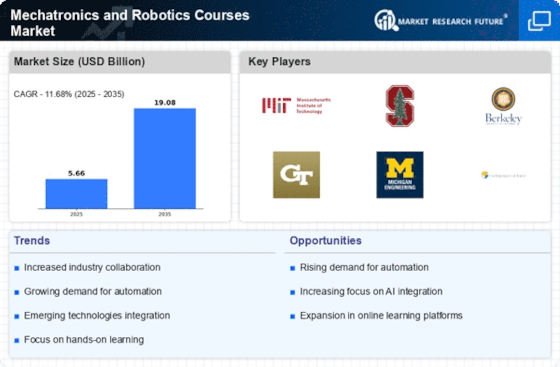
As per Market Research Future analysis, the Mechatronics and Robotics Courses Market Size was estimated at 5.66 USD Billion in 2024. The Mechatronics and Robotics industry is projected to grow from 6.321 USD Billion in 2025 to 19.08 USD Billion by 2035, exhibiting a compound annual growth rate (CAGR) of 11.68% during the forecast period 2025 - 2035

Key Market Trends & Highlights

The Mechatronics and Robotics Courses Market is experiencing a dynamic shift towards online learning and interdisciplinary skill development.

  • The integration of online learning platforms is reshaping course delivery in North America, the largest market. There is a growing emphasis on interdisciplinary skills, particularly in the Asia-Pacific region, which is the fastest-growing market. Emerging technologies are increasingly incorporated into curricula, enhancing the relevance of courses in both manufacturing and automotive segments. Rising demand for automation and government initiatives are driving growth in the market, particularly in the online and automotive segments.

Market Size & Forecast

2024 Market Size 5.66 (USD Billion)
2035 Market Size 19.08 (USD Billion)
CAGR (2025 - 2035) 11.68%
Largest Regional Market Share in 2024 North America

Major Players

Massachusetts Institute of Technology (US), Stanford University (US), University of California, Berkeley (US), Georgia Institute of Technology (US), University of Michigan (US), ETH Zurich (CH), University of Tokyo (JP), Tsinghua University (CN), National University of Singapore (SG)

Market Trends

The Mechatronics and Robotics Courses Market is currently experiencing a dynamic evolution, driven by the increasing integration of automation and advanced technologies across various industries. Educational institutions are adapting their curricula to meet the growing demand for skilled professionals in this field. As industries seek to enhance efficiency and productivity, the necessity for specialized training in mechatronics and robotics becomes more pronounced. This shift indicates a robust interest in interdisciplinary approaches, combining mechanical engineering, electronics, and computer science. Furthermore, the rise of online learning platforms has made these courses more accessible, allowing a broader audience to engage with the subject matter. In addition, the Mechatronics and Robotics Courses Market appears to be influenced by the rapid advancements in artificial intelligence and machine learning. These technologies are increasingly being integrated into mechatronic systems, necessitating a curriculum that encompasses these emerging trends. As a result, educational providers are likely to focus on developing programs that not only cover traditional mechatronics principles but also incorporate cutting-edge technologies. This trend suggests a promising future for the market, as it aligns with the evolving needs of the workforce and the technological landscape.

Integration of Online Learning

The Mechatronics and Robotics Courses Market is witnessing a significant shift towards

. This trend allows learners from diverse backgrounds to access specialized training without geographical constraints. As a result, educational institutions are increasingly offering flexible, self-paced courses that cater to the needs of working professionals and students alike.

Focus on Interdisciplinary Skills

There is a growing emphasis on interdisciplinary skills within the Mechatronics and Robotics Courses Market. Programs are increasingly designed to blend mechanical engineering, electronics, and computer science, reflecting the multifaceted nature of modern technological challenges. This approach prepares students to tackle complex problems in various industries.

Incorporation of Emerging Technologies

The Mechatronics and Robotics Courses Market is adapting to the rapid advancements in emerging technologies such as artificial intelligence and machine learning. Educational institutions are likely to integrate these topics into their curricula, ensuring that students are equipped with the knowledge and skills necessary to thrive in a technology-driven environment.

Mechatronics Robotics Courses Market Market Drivers

Rising Demand for Automation

The increasing demand for automation across various industries appears to be a primary driver for the Mechatronics and Robotics Courses Market. As organizations strive to enhance efficiency and reduce operational costs, the need for skilled professionals in automation technologies has surged. According to recent data, the automation market is projected to grow significantly, with a compound annual growth rate (CAGR) of approximately 9% over the next five years. This growth necessitates a workforce proficient in mechatronics and robotics, thereby propelling educational institutions to expand their course offerings. Consequently, the Mechatronics and Robotics Courses Market is likely to experience heightened enrollment as students seek to acquire the necessary skills to meet industry demands.

Government Initiatives and Funding

Government initiatives and funding aimed at promoting STEM education are likely to play a crucial role in the Mechatronics and Robotics Courses Market. Various governments are recognizing the importance of fostering a skilled workforce in science, technology, engineering, and mathematics. As a result, they are investing in educational programs and partnerships with industry stakeholders. For instance, funding for vocational training and higher education in mechatronics and robotics is on the rise, which could lead to increased course offerings and improved facilities. This support not only enhances the quality of education but also encourages more students to pursue careers in these fields, thereby driving growth in the Mechatronics and Robotics Courses Market.

Technological Advancements in Robotics

Technological advancements in robotics are reshaping the landscape of the Mechatronics and Robotics Courses Market. Innovations such as artificial intelligence, machine learning, and advanced sensors are driving the development of more sophisticated robotic systems. As these technologies evolve, educational programs must adapt to incorporate the latest advancements, ensuring that students are equipped with relevant knowledge and skills. The robotics market is expected to reach a valuation of over 200 billion dollars by 2025, indicating a robust growth trajectory. This trend suggests that educational institutions will increasingly focus on integrating cutting-edge technologies into their curricula, thereby enhancing the appeal of mechatronics and robotics courses.

Industry Collaboration and Partnerships

The trend of industry collaboration and partnerships is emerging as a significant driver for the Mechatronics and Robotics Courses Market. Educational institutions are increasingly forming alliances with technology companies and research organizations to develop curricula that align with industry needs. These partnerships facilitate internships, hands-on training, and real-world projects, providing students with valuable experience. As industries seek to bridge the skills gap, such collaborations are likely to enhance the employability of graduates. This alignment between education and industry requirements may lead to a surge in enrollment in mechatronics and robotics courses, further stimulating growth in the Mechatronics and Robotics Courses Market.

Growing Interest in Sustainable Technologies

The growing interest in sustainable technologies is influencing the Mechatronics and Robotics Courses Market. As environmental concerns become more pressing, industries are increasingly seeking solutions that minimize ecological impact. This shift is prompting educational institutions to incorporate sustainability principles into their mechatronics and robotics programs. Courses that focus on energy-efficient systems, renewable energy applications, and sustainable manufacturing practices are gaining traction. The market for sustainable technologies is projected to expand significantly, suggesting that students with expertise in these areas will be in high demand. Consequently, the Mechatronics and Robotics Courses Market is likely to benefit from this trend as more students enroll in programs that emphasize sustainability.

Market Segment Insights

By Platform: Online (Largest) vs. Offline (Fastest-Growing)

<p>The Mechatronics and Robotics Courses Market is primarily dominated by online platforms, which have captured a significant market share due to their flexibility and accessibility. Online courses cater to a global audience, allowing learners to engage in cutting-edge technology and skills without geographical constraints. Meanwhile, the offline segment is gaining momentum as institutions and corporates seek hands-on, practical training experiences essential for mastering nuanced robotic skills. This growing demand for in-person interaction is gradually shifting market dynamics.</p>

<p>Platform: Online (Dominant) vs. Offline (Emerging)</p>

<p>Online learning has established itself as the dominant platform in the Mechatronics and Robotics Courses Market, offering a wide array of courses that appeal to diverse learner demographics. The flexibility of online education allows students to access up-to-date content at their own pace, making it particularly suitable for working professionals aiming to upskill. On the other hand, the offline segment is emerging rapidly, driven by the increasing preference for hands-on training sessions and live workshops that foster networking and collaboration among peers. This trend towards offline experiences is bolstered by educational institutions and organizations seeking to provide immersive learning environments, which are pivotal for developing practical expertise in complex mechatronic systems.</p>

By Application: Manufacturing (Largest) vs. Automotive (Fastest-Growing)

<p>The Mechatronics and Robotics Courses Market has seen varied distribution of market share among its application segments. Manufacturing stands out as the largest segment, driven by a steady demand for automation and efficiency in production processes. The Automotive sector follows closely, with significant contributions as it integrates advanced robotics into production lines, enhancing the design and manufacturing of vehicles. The educational programs in this field reflect the necessity to equip the workforce with the skills needed to excel in these segments.</p>

<p>Manufacturing (Dominant) vs. Automotive (Emerging)</p>

<p>The Manufacturing sector is characterized by its longstanding history in the integration of mechatronics and robotics, focusing on automated production lines and industrial robotics. This segment plays a crucial role in optimizing production efficiency, reducing labor costs, and enhancing product quality. On the other hand, the Automotive sector is emerging rapidly within the Mechatronics and Robotics Courses Market. As vehicles become increasingly sophisticated with technologies like autonomous driving and AI-driven systems, education in robotics becomes vital to prepare professionals for future demands. This dual dynamic illustrates the balance between a dominant segment steeped in tradition and an emerging one poised for innovation.</p>

Get more detailed insights about Mechatronics and Robotics Courses Market Research Report -Forecast to 2035

Regional Insights

North America : Innovation and Leadership Hub

North America is the largest market for Mechatronics and Robotics courses, holding approximately 45% of the global market share. The region's growth is driven by significant investments in technology education, a strong emphasis on STEM programs, and partnerships between universities and industries. Regulatory support from government initiatives further catalyzes this growth, fostering an environment conducive to innovation and research. The United States leads the market, with prestigious institutions like MIT, Stanford, and UC Berkeley at the forefront of robotics education. These universities not only provide cutting-edge curricula but also collaborate with tech companies to ensure that courses meet industry demands. The competitive landscape is characterized by a mix of established universities and emerging online platforms, enhancing accessibility to quality education in robotics.

Europe : Emerging Robotics Education Powerhouse

Europe is witnessing a rapid expansion in the Mechatronics and Robotics courses market, holding around 30% of the global share. The region benefits from strong governmental support for technological education and research, with initiatives aimed at enhancing workforce skills in robotics. Countries like Germany and the UK are at the forefront, driving demand through their robust engineering sectors and innovative research programs. Leading countries such as Germany, Switzerland, and the UK host top institutions like ETH Zurich, which are pivotal in shaping the robotics curriculum. The competitive landscape is marked by collaboration between universities and industries, ensuring that educational offerings align with market needs. This synergy is crucial for fostering a skilled workforce capable of meeting the demands of the evolving robotics landscape.

Asia-Pacific : Rapidly Growing Education Sector

Asia-Pacific is emerging as a significant player in the Mechatronics and Robotics courses market, accounting for approximately 20% of the global market share. The region's growth is fueled by increasing investments in technology education, government initiatives promoting STEM, and a rising demand for skilled professionals in robotics. Countries like China and Japan are leading this trend, supported by favorable regulatory frameworks. China, Japan, and Singapore are at the forefront, with institutions like Tsinghua University and the University of Tokyo offering specialized programs. The competitive landscape is characterized by a mix of traditional universities and new online platforms, catering to a diverse student base. This dynamic environment is essential for meeting the growing demand for robotics education in the region.

Middle East and Africa : Emerging Market with Potential

The Middle East and Africa region is gradually developing its Mechatronics and Robotics courses market, currently holding about 5% of the global share. The growth is driven by increasing interest in technology education and government initiatives aimed at enhancing STEM skills among the youth. Countries like South Africa and the UAE are making strides in establishing robotics programs, supported by investments in educational infrastructure. In South Africa, universities are beginning to offer specialized courses in robotics, while the UAE is focusing on integrating technology into its educational framework. The competitive landscape is still in its infancy, with opportunities for growth as more institutions recognize the importance of robotics education. This region has the potential to become a significant player in The Mechatronics and Robotics Courses.

Key Players and Competitive Insights

Leading market players are investing heavily in research and development in order to expand their product lines, which will help the Mechatronics and Robotics Courses market grow even more. Market participants are also undertaking a variety of strategic activities to expand their footprint, with important market developments including new product launches, contractual agreements, mergers and acquisitions, higher investments, and collaboration with other organizations. To expand and survive in a more competitive and rising market climate, Mechatronics and Robotics Courses industry must offer cost-effective items. Manufacturing locally to minimize operational costs is one of the key business tactics used by manufacturers in the Mechatronics and Robotics Courses industry to benefit clients and increase the market sector. In recent years, the Mechatronics and Robotics Courses industry has offered some of the most significant advantages to medicine. Major players in the Mechatronics and Robotics Courses market, including Ametek Industries, Novatech Robo Pvt Ltd, Hennepin Technical College, KUKA Robotics, British Columbia Institute of Technology, and Bosch Rexroth, are attempting to increase market demand by investing in research and development operations. Novatech Robo is one of the major robotic companies established in the year 2010 with the motto of training the student community with advanced technology and the latest innovations and among the students of developing and underdeveloped countries on par with developed countries understanding the basic steps of Robot Building which comes from hands-on practice. The aim of the Novatech is to assist every child to upgrade ahead with their dreams and understand the basic concepts of manufacturing that one can excel with practice. The company and STEaM education program make this easier for all school students to become budding Roboteers, Makers, Inventors, and even Entrepreneurs. The Novabot Kit is intelligent startup content for a full STEaM education program Leading to Drone Technology, 3D printing, IoT, Electronics, and Artificial Intelligence. KUKA Robotics is a maker of robotic systems headquartered in Augsburg, Germany, offering a wide range of industrial robots and robot systems. And also offers a vast range of products, including industrial robots; automated manufacturing systems, including system components, tools, and automated manufacturing cells; assembly lines and engine transmission assembly systems for cars; and engineering services to its customers. The company’s wide services are consumed all over the industries, including retail, automotive, energy, metal, electronics, consumer goods, food, and healthcare, among others. It has operations in Europe, the Americas, APAC, and among others.

Key Companies in the Mechatronics Robotics Courses Market include

Industry Developments

May 2022: The Indian Institute of Technology Gandhinagar, together with L and T Technology Services Limited, an engineering services company, is likely to collaborate to incubate and develop solutions in Artificial Intelligence (AI) and mechatronics sector. The delegations from LTTS and IITGN discussed plans to set up labs, carry out joint projects, include students through internships and other mechanisms, and conduct workshops and seminars in smart manufacturing, robotics, bio-mechatronics, and ‘intelligent’ products and systems.

May 2022: Governor Kathy Hochul made an announcement about the grand opening of the Finger Lakes Workforce Development Center on Monroe Community College's Downtown Campus. The $11.4 million, 50,000-square-foot, state-of-the-art Finger Lakes Workforce Development Center focuses on short-term and accelerated, technology-oriented training programs that place individuals in high-demand jobs within advanced manufacturing, information technology, skilled trades, apprenticeship-related instruction, and professional services.

December 2020: Gamma Skills Automation Training Has Launched a Unique Robotics and Automation Career Launch Program for Engineers. This program is optimized for the best output and involves 40 days of intense hands-on practice in a lab equipped with the world's leading Industrial Robots, Collaborative robots, PLC, and & other Automation systems.

Future Outlook

Mechatronics Robotics Courses Market Future Outlook

The Mechatronics and Robotics Courses Market is projected to grow at 11.68% CAGR from 2025 to 2035, driven by technological advancements, increased automation, and rising demand for skilled professionals.

New opportunities lie in:

  • <p>Development of online certification programs for industry professionals. Partnerships with tech companies for hands-on training modules. Creation of specialized courses targeting emerging robotics applications.</p>

By 2035, the market is expected to be robust, reflecting substantial growth and innovation.

Market Segmentation

Mechatronics Robotics Courses Market Platform Outlook

  • Online
  • Offline

Mechatronics Robotics Courses Market Application Outlook

  • Manufacturing
  • Automotive
  • Drones
  • Space
  • Others

Report Scope

MARKET SIZE 2024 5.66(USD Billion)
MARKET SIZE 2025 6.321(USD Billion)
MARKET SIZE 2035 19.08(USD Billion)
COMPOUND ANNUAL GROWTH RATE (CAGR) 11.68% (2025 - 2035)
REPORT COVERAGE Revenue Forecast, Competitive Landscape, Growth Factors, and Trends
BASE YEAR 2024
Market Forecast Period 2025 - 2035
Historical Data 2019 - 2024
Market Forecast Units USD Billion
Key Companies Profiled Massachusetts Institute of Technology (US), Stanford University (US), University of California, Berkeley (US), Georgia Institute of Technology (US), University of Michigan (US), ETH Zurich (CH), University of Tokyo (JP), Tsinghua University (CN), National University of Singapore (SG)
Segments Covered Platform, Application, Region
Key Market Opportunities Growing demand for skilled professionals in automation and artificial intelligence drives Mechatronics and Robotics Courses Market expansion.
Key Market Dynamics Rising demand for skilled professionals drives competition among educational institutions offering Mechatronics and Robotics courses.
Countries Covered North America, Europe, APAC, South America, MEA

FAQs

What is the current market valuation of the Mechatronics and Robotics Courses Market?

<p>As of 2024, the market valuation stands at 5.66 USD Billion.</p>

What is the projected market size for the Mechatronics and Robotics Courses Market by 2035?

<p>The market is projected to reach 19.08 USD Billion by 2035.</p>

What is the expected CAGR for the Mechatronics and Robotics Courses Market during the forecast period?

<p>The expected CAGR from 2025 to 2035 is 11.68%.</p>

Which platforms dominate the Mechatronics and Robotics Courses Market?

<p>The market segments include Online courses valued at 11.5 USD Billion and Offline courses at 7.58 USD Billion.</p>

What applications are driving growth in the Mechatronics and Robotics Courses Market?

<p>Key applications include Manufacturing at 5.7 USD Billion and Automotive at 4.0 USD Billion.</p>

Who are the leading institutions offering Mechatronics and Robotics courses?

<p>Prominent players include Massachusetts Institute of Technology, Stanford University, and ETH Zurich.</p>

How does the market for Drones compare to other applications in the Mechatronics and Robotics Courses Market?

The Drones application is valued at 2.5 USD Billion, indicating a growing interest in this sector.

What is the valuation of the 'Others' segment in the Mechatronics and Robotics Courses Market?

The 'Others' segment is projected to reach 5.38 USD Billion by 2035.

How does the growth of Online courses compare to Offline courses in this market?

Online courses are expected to significantly outpace Offline courses, with a valuation of 11.5 USD Billion compared to 7.58 USD Billion.

What factors contribute to the growth of the Mechatronics and Robotics Courses Market?

Factors include advancements in technology and increasing demand for skilled professionals in various applications.

  1. SECTION I: EXECUTIVE SUMMARY AND KEY HIGHLIGHTS
    1. | 1.1 EXECUTIVE SUMMARY
    2. | | 1.1.1 Market Overview
    3. | | 1.1.2 Key Findings
    4. | | 1.1.3 Market Segmentation
    5. | | 1.1.4 Competitive Landscape
    6. | | 1.1.5 Challenges and Opportunities
    7. | | 1.1.6 Future Outlook
  2. SECTION II: SCOPING, METHODOLOGY AND MARKET STRUCTURE
    1. | 2.1 MARKET INTRODUCTION
    2. | | 2.1.1 Definition
    3. | | 2.1.2 Scope of the study
    4. | | | 2.1.2.1 Research Objective
    5. | | | 2.1.2.2 Assumption
    6. | | | 2.1.2.3 Limitations
    7. | 2.2 RESEARCH METHODOLOGY
    8. | | 2.2.1 Overview
    9. | | 2.2.2 Data Mining
    10. | | 2.2.3 Secondary Research
    11. | | 2.2.4 Primary Research
    12. | | | 2.2.4.1 Primary Interviews and Information Gathering Process
    13. | | | 2.2.4.2 Breakdown of Primary Respondents
    14. | | 2.2.5 Forecasting Model
    15. | | 2.2.6 Market Size Estimation
    16. | | | 2.2.6.1 Bottom-Up Approach
    17. | | | 2.2.6.2 Top-Down Approach
    18. | | 2.2.7 Data Triangulation
    19. | | 2.2.8 Validation
  3. SECTION III: QUALITATIVE ANALYSIS
    1. | 3.1 MARKET DYNAMICS
    2. | | 3.1.1 Overview
    3. | | 3.1.2 Drivers
    4. | | 3.1.3 Restraints
    5. | | 3.1.4 Opportunities
    6. | 3.2 MARKET FACTOR ANALYSIS
    7. | | 3.2.1 Value chain Analysis
    8. | | 3.2.2 Porter's Five Forces Analysis
    9. | | | 3.2.2.1 Bargaining Power of Suppliers
    10. | | | 3.2.2.2 Bargaining Power of Buyers
    11. | | | 3.2.2.3 Threat of New Entrants
    12. | | | 3.2.2.4 Threat of Substitutes
    13. | | | 3.2.2.5 Intensity of Rivalry
    14. | | 3.2.3 COVID-19 Impact Analysis
    15. | | | 3.2.3.1 Market Impact Analysis
    16. | | | 3.2.3.2 Regional Impact
    17. | | | 3.2.3.3 Opportunity and Threat Analysis
  4. SECTION IV: QUANTITATIVE ANALYSIS
    1. | 4.1 Information and Communications Technology, BY Platform (USD Billion)
    2. | | 4.1.1 Online
    3. | | 4.1.2 Offline
    4. | 4.2 Information and Communications Technology, BY Application (USD Billion)
    5. | | 4.2.1 Manufacturing
    6. | | 4.2.2 Automotive
    7. | | 4.2.3 Drones
    8. | | 4.2.4 Space
    9. | | 4.2.5 Others
    10. | 4.3 Information and Communications Technology, BY Region (USD Billion)
    11. | | 4.3.1 North America
    12. | | | 4.3.1.1 US
    13. | | | 4.3.1.2 Canada
    14. | | 4.3.2 Europe
    15. | | | 4.3.2.1 Germany
    16. | | | 4.3.2.2 UK
    17. | | | 4.3.2.3 France
    18. | | | 4.3.2.4 Russia
    19. | | | 4.3.2.5 Italy
    20. | | | 4.3.2.6 Spain
    21. | | | 4.3.2.7 Rest of Europe
    22. | | 4.3.3 APAC
    23. | | | 4.3.3.1 China
    24. | | | 4.3.3.2 India
    25. | | | 4.3.3.3 Japan
    26. | | | 4.3.3.4 South Korea
    27. | | | 4.3.3.5 Malaysia
    28. | | | 4.3.3.6 Thailand
    29. | | | 4.3.3.7 Indonesia
    30. | | | 4.3.3.8 Rest of APAC
    31. | | 4.3.4 South America
    32. | | | 4.3.4.1 Brazil
    33. | | | 4.3.4.2 Mexico
    34. | | | 4.3.4.3 Argentina
    35. | | | 4.3.4.4 Rest of South America
    36. | | 4.3.5 MEA
    37. | | | 4.3.5.1 GCC Countries
    38. | | | 4.3.5.2 South Africa
    39. | | | 4.3.5.3 Rest of MEA
  5. SECTION V: COMPETITIVE ANALYSIS
    1. | 5.1 Competitive Landscape
    2. | | 5.1.1 Overview
    3. | | 5.1.2 Competitive Analysis
    4. | | 5.1.3 Market share Analysis
    5. | | 5.1.4 Major Growth Strategy in the Information and Communications Technology
    6. | | 5.1.5 Competitive Benchmarking
    7. | | 5.1.6 Leading Players in Terms of Number of Developments in the Information and Communications Technology
    8. | | 5.1.7 Key developments and growth strategies
    9. | | | 5.1.7.1 New Product Launch/Service Deployment
    10. | | | 5.1.7.2 Merger & Acquisitions
    11. | | | 5.1.7.3 Joint Ventures
    12. | | 5.1.8 Major Players Financial Matrix
    13. | | | 5.1.8.1 Sales and Operating Income
    14. | | | 5.1.8.2 Major Players R&D Expenditure. 2023
    15. | 5.2 Company Profiles
    16. | | 5.2.1 Massachusetts Institute of Technology (US)
    17. | | | 5.2.1.1 Financial Overview
    18. | | | 5.2.1.2 Products Offered
    19. | | | 5.2.1.3 Key Developments
    20. | | | 5.2.1.4 SWOT Analysis
    21. | | | 5.2.1.5 Key Strategies
    22. | | 5.2.2 Stanford University (US)
    23. | | | 5.2.2.1 Financial Overview
    24. | | | 5.2.2.2 Products Offered
    25. | | | 5.2.2.3 Key Developments
    26. | | | 5.2.2.4 SWOT Analysis
    27. | | | 5.2.2.5 Key Strategies
    28. | | 5.2.3 University of California, Berkeley (US)
    29. | | | 5.2.3.1 Financial Overview
    30. | | | 5.2.3.2 Products Offered
    31. | | | 5.2.3.3 Key Developments
    32. | | | 5.2.3.4 SWOT Analysis
    33. | | | 5.2.3.5 Key Strategies
    34. | | 5.2.4 Georgia Institute of Technology (US)
    35. | | | 5.2.4.1 Financial Overview
    36. | | | 5.2.4.2 Products Offered
    37. | | | 5.2.4.3 Key Developments
    38. | | | 5.2.4.4 SWOT Analysis
    39. | | | 5.2.4.5 Key Strategies
    40. | | 5.2.5 University of Michigan (US)
    41. | | | 5.2.5.1 Financial Overview
    42. | | | 5.2.5.2 Products Offered
    43. | | | 5.2.5.3 Key Developments
    44. | | | 5.2.5.4 SWOT Analysis
    45. | | | 5.2.5.5 Key Strategies
    46. | | 5.2.6 ETH Zurich (CH)
    47. | | | 5.2.6.1 Financial Overview
    48. | | | 5.2.6.2 Products Offered
    49. | | | 5.2.6.3 Key Developments
    50. | | | 5.2.6.4 SWOT Analysis
    51. | | | 5.2.6.5 Key Strategies
    52. | | 5.2.7 University of Tokyo (JP)
    53. | | | 5.2.7.1 Financial Overview
    54. | | | 5.2.7.2 Products Offered
    55. | | | 5.2.7.3 Key Developments
    56. | | | 5.2.7.4 SWOT Analysis
    57. | | | 5.2.7.5 Key Strategies
    58. | | 5.2.8 Tsinghua University (CN)
    59. | | | 5.2.8.1 Financial Overview
    60. | | | 5.2.8.2 Products Offered
    61. | | | 5.2.8.3 Key Developments
    62. | | | 5.2.8.4 SWOT Analysis
    63. | | | 5.2.8.5 Key Strategies
    64. | | 5.2.9 National University of Singapore (SG)
    65. | | | 5.2.9.1 Financial Overview
    66. | | | 5.2.9.2 Products Offered
    67. | | | 5.2.9.3 Key Developments
    68. | | | 5.2.9.4 SWOT Analysis
    69. | | | 5.2.9.5 Key Strategies
    70. | 5.3 Appendix
    71. | | 5.3.1 References
    72. | | 5.3.2 Related Reports
  6. LIST OF FIGURES
    1. | 6.1 MARKET SYNOPSIS
    2. | 6.2 NORTH AMERICA MARKET ANALYSIS
    3. | 6.3 US MARKET ANALYSIS BY PLATFORM
    4. | 6.4 US MARKET ANALYSIS BY APPLICATION
    5. | 6.5 CANADA MARKET ANALYSIS BY PLATFORM
    6. | 6.6 CANADA MARKET ANALYSIS BY APPLICATION
    7. | 6.7 EUROPE MARKET ANALYSIS
    8. | 6.8 GERMANY MARKET ANALYSIS BY PLATFORM
    9. | 6.9 GERMANY MARKET ANALYSIS BY APPLICATION
    10. | 6.10 UK MARKET ANALYSIS BY PLATFORM
    11. | 6.11 UK MARKET ANALYSIS BY APPLICATION
    12. | 6.12 FRANCE MARKET ANALYSIS BY PLATFORM
    13. | 6.13 FRANCE MARKET ANALYSIS BY APPLICATION
    14. | 6.14 RUSSIA MARKET ANALYSIS BY PLATFORM
    15. | 6.15 RUSSIA MARKET ANALYSIS BY APPLICATION
    16. | 6.16 ITALY MARKET ANALYSIS BY PLATFORM
    17. | 6.17 ITALY MARKET ANALYSIS BY APPLICATION
    18. | 6.18 SPAIN MARKET ANALYSIS BY PLATFORM
    19. | 6.19 SPAIN MARKET ANALYSIS BY APPLICATION
    20. | 6.20 REST OF EUROPE MARKET ANALYSIS BY PLATFORM
    21. | 6.21 REST OF EUROPE MARKET ANALYSIS BY APPLICATION
    22. | 6.22 APAC MARKET ANALYSIS
    23. | 6.23 CHINA MARKET ANALYSIS BY PLATFORM
    24. | 6.24 CHINA MARKET ANALYSIS BY APPLICATION
    25. | 6.25 INDIA MARKET ANALYSIS BY PLATFORM
    26. | 6.26 INDIA MARKET ANALYSIS BY APPLICATION
    27. | 6.27 JAPAN MARKET ANALYSIS BY PLATFORM
    28. | 6.28 JAPAN MARKET ANALYSIS BY APPLICATION
    29. | 6.29 SOUTH KOREA MARKET ANALYSIS BY PLATFORM
    30. | 6.30 SOUTH KOREA MARKET ANALYSIS BY APPLICATION
    31. | 6.31 MALAYSIA MARKET ANALYSIS BY PLATFORM
    32. | 6.32 MALAYSIA MARKET ANALYSIS BY APPLICATION
    33. | 6.33 THAILAND MARKET ANALYSIS BY PLATFORM
    34. | 6.34 THAILAND MARKET ANALYSIS BY APPLICATION
    35. | 6.35 INDONESIA MARKET ANALYSIS BY PLATFORM
    36. | 6.36 INDONESIA MARKET ANALYSIS BY APPLICATION
    37. | 6.37 REST OF APAC MARKET ANALYSIS BY PLATFORM
    38. | 6.38 REST OF APAC MARKET ANALYSIS BY APPLICATION
    39. | 6.39 SOUTH AMERICA MARKET ANALYSIS
    40. | 6.40 BRAZIL MARKET ANALYSIS BY PLATFORM
    41. | 6.41 BRAZIL MARKET ANALYSIS BY APPLICATION
    42. | 6.42 MEXICO MARKET ANALYSIS BY PLATFORM
    43. | 6.43 MEXICO MARKET ANALYSIS BY APPLICATION
    44. | 6.44 ARGENTINA MARKET ANALYSIS BY PLATFORM
    45. | 6.45 ARGENTINA MARKET ANALYSIS BY APPLICATION
    46. | 6.46 REST OF SOUTH AMERICA MARKET ANALYSIS BY PLATFORM
    47. | 6.47 REST OF SOUTH AMERICA MARKET ANALYSIS BY APPLICATION
    48. | 6.48 MEA MARKET ANALYSIS
    49. | 6.49 GCC COUNTRIES MARKET ANALYSIS BY PLATFORM
    50. | 6.50 GCC COUNTRIES MARKET ANALYSIS BY APPLICATION
    51. | 6.51 SOUTH AFRICA MARKET ANALYSIS BY PLATFORM
    52. | 6.52 SOUTH AFRICA MARKET ANALYSIS BY APPLICATION
    53. | 6.53 REST OF MEA MARKET ANALYSIS BY PLATFORM
    54. | 6.54 REST OF MEA MARKET ANALYSIS BY APPLICATION
    55. | 6.55 KEY BUYING CRITERIA OF INFORMATION AND COMMUNICATIONS TECHNOLOGY
    56. | 6.56 RESEARCH PROCESS OF MRFR
    57. | 6.57 DRO ANALYSIS OF INFORMATION AND COMMUNICATIONS TECHNOLOGY
    58. | 6.58 DRIVERS IMPACT ANALYSIS: INFORMATION AND COMMUNICATIONS TECHNOLOGY
    59. | 6.59 RESTRAINTS IMPACT ANALYSIS: INFORMATION AND COMMUNICATIONS TECHNOLOGY
    60. | 6.60 SUPPLY / VALUE CHAIN: INFORMATION AND COMMUNICATIONS TECHNOLOGY
    61. | 6.61 INFORMATION AND COMMUNICATIONS TECHNOLOGY, BY PLATFORM, 2024 (% SHARE)
    62. | 6.62 INFORMATION AND COMMUNICATIONS TECHNOLOGY, BY PLATFORM, 2024 TO 2035 (USD Billion)
    63. | 6.63 INFORMATION AND COMMUNICATIONS TECHNOLOGY, BY APPLICATION, 2024 (% SHARE)
    64. | 6.64 INFORMATION AND COMMUNICATIONS TECHNOLOGY, BY APPLICATION, 2024 TO 2035 (USD Billion)
    65. | 6.65 BENCHMARKING OF MAJOR COMPETITORS
  7. LIST OF TABLES
    1. | 7.1 LIST OF ASSUMPTIONS
    2. | | 7.1.1
    3. | 7.2 North America MARKET SIZE ESTIMATES; FORECAST
    4. | | 7.2.1 BY PLATFORM, 2025-2035 (USD Billion)
    5. | | 7.2.2 BY APPLICATION, 2025-2035 (USD Billion)
    6. | 7.3 US MARKET SIZE ESTIMATES; FORECAST
    7. | | 7.3.1 BY PLATFORM, 2025-2035 (USD Billion)
    8. | | 7.3.2 BY APPLICATION, 2025-2035 (USD Billion)
    9. | 7.4 Canada MARKET SIZE ESTIMATES; FORECAST
    10. | | 7.4.1 BY PLATFORM, 2025-2035 (USD Billion)
    11. | | 7.4.2 BY APPLICATION, 2025-2035 (USD Billion)
    12. | 7.5 Europe MARKET SIZE ESTIMATES; FORECAST
    13. | | 7.5.1 BY PLATFORM, 2025-2035 (USD Billion)
    14. | | 7.5.2 BY APPLICATION, 2025-2035 (USD Billion)
    15. | 7.6 Germany MARKET SIZE ESTIMATES; FORECAST
    16. | | 7.6.1 BY PLATFORM, 2025-2035 (USD Billion)
    17. | | 7.6.2 BY APPLICATION, 2025-2035 (USD Billion)
    18. | 7.7 UK MARKET SIZE ESTIMATES; FORECAST
    19. | | 7.7.1 BY PLATFORM, 2025-2035 (USD Billion)
    20. | | 7.7.2 BY APPLICATION, 2025-2035 (USD Billion)
    21. | 7.8 France MARKET SIZE ESTIMATES; FORECAST
    22. | | 7.8.1 BY PLATFORM, 2025-2035 (USD Billion)
    23. | | 7.8.2 BY APPLICATION, 2025-2035 (USD Billion)
    24. | 7.9 Russia MARKET SIZE ESTIMATES; FORECAST
    25. | | 7.9.1 BY PLATFORM, 2025-2035 (USD Billion)
    26. | | 7.9.2 BY APPLICATION, 2025-2035 (USD Billion)
    27. | 7.10 Italy MARKET SIZE ESTIMATES; FORECAST
    28. | | 7.10.1 BY PLATFORM, 2025-2035 (USD Billion)
    29. | | 7.10.2 BY APPLICATION, 2025-2035 (USD Billion)
    30. | 7.11 Spain MARKET SIZE ESTIMATES; FORECAST
    31. | | 7.11.1 BY PLATFORM, 2025-2035 (USD Billion)
    32. | | 7.11.2 BY APPLICATION, 2025-2035 (USD Billion)
    33. | 7.12 Rest of Europe MARKET SIZE ESTIMATES; FORECAST
    34. | | 7.12.1 BY PLATFORM, 2025-2035 (USD Billion)
    35. | | 7.12.2 BY APPLICATION, 2025-2035 (USD Billion)
    36. | 7.13 APAC MARKET SIZE ESTIMATES; FORECAST
    37. | | 7.13.1 BY PLATFORM, 2025-2035 (USD Billion)
    38. | | 7.13.2 BY APPLICATION, 2025-2035 (USD Billion)
    39. | 7.14 China MARKET SIZE ESTIMATES; FORECAST
    40. | | 7.14.1 BY PLATFORM, 2025-2035 (USD Billion)
    41. | | 7.14.2 BY APPLICATION, 2025-2035 (USD Billion)
    42. | 7.15 India MARKET SIZE ESTIMATES; FORECAST
    43. | | 7.15.1 BY PLATFORM, 2025-2035 (USD Billion)
    44. | | 7.15.2 BY APPLICATION, 2025-2035 (USD Billion)
    45. | 7.16 Japan MARKET SIZE ESTIMATES; FORECAST
    46. | | 7.16.1 BY PLATFORM, 2025-2035 (USD Billion)
    47. | | 7.16.2 BY APPLICATION, 2025-2035 (USD Billion)
    48. | 7.17 South Korea MARKET SIZE ESTIMATES; FORECAST
    49. | | 7.17.1 BY PLATFORM, 2025-2035 (USD Billion)
    50. | | 7.17.2 BY APPLICATION, 2025-2035 (USD Billion)
    51. | 7.18 Malaysia MARKET SIZE ESTIMATES; FORECAST
    52. | | 7.18.1 BY PLATFORM, 2025-2035 (USD Billion)
    53. | | 7.18.2 BY APPLICATION, 2025-2035 (USD Billion)
    54. | 7.19 Thailand MARKET SIZE ESTIMATES; FORECAST
    55. | | 7.19.1 BY PLATFORM, 2025-2035 (USD Billion)
    56. | | 7.19.2 BY APPLICATION, 2025-2035 (USD Billion)
    57. | 7.20 Indonesia MARKET SIZE ESTIMATES; FORECAST
    58. | | 7.20.1 BY PLATFORM, 2025-2035 (USD Billion)
    59. | | 7.20.2 BY APPLICATION, 2025-2035 (USD Billion)
    60. | 7.21 Rest of APAC MARKET SIZE ESTIMATES; FORECAST
    61. | | 7.21.1 BY PLATFORM, 2025-2035 (USD Billion)
    62. | | 7.21.2 BY APPLICATION, 2025-2035 (USD Billion)
    63. | 7.22 South America MARKET SIZE ESTIMATES; FORECAST
    64. | | 7.22.1 BY PLATFORM, 2025-2035 (USD Billion)
    65. | | 7.22.2 BY APPLICATION, 2025-2035 (USD Billion)
    66. | 7.23 Brazil MARKET SIZE ESTIMATES; FORECAST
    67. | | 7.23.1 BY PLATFORM, 2025-2035 (USD Billion)
    68. | | 7.23.2 BY APPLICATION, 2025-2035 (USD Billion)
    69. | 7.24 Mexico MARKET SIZE ESTIMATES; FORECAST
    70. | | 7.24.1 BY PLATFORM, 2025-2035 (USD Billion)
    71. | | 7.24.2 BY APPLICATION, 2025-2035 (USD Billion)
    72. | 7.25 Argentina MARKET SIZE ESTIMATES; FORECAST
    73. | | 7.25.1 BY PLATFORM, 2025-2035 (USD Billion)
    74. | | 7.25.2 BY APPLICATION, 2025-2035 (USD Billion)
    75. | 7.26 Rest of South America MARKET SIZE ESTIMATES; FORECAST
    76. | | 7.26.1 BY PLATFORM, 2025-2035 (USD Billion)
    77. | | 7.26.2 BY APPLICATION, 2025-2035 (USD Billion)
    78. | 7.27 MEA MARKET SIZE ESTIMATES; FORECAST
    79. | | 7.27.1 BY PLATFORM, 2025-2035 (USD Billion)
    80. | | 7.27.2 BY APPLICATION, 2025-2035 (USD Billion)
    81. | 7.28 GCC Countries MARKET SIZE ESTIMATES; FORECAST
    82. | | 7.28.1 BY PLATFORM, 2025-2035 (USD Billion)
    83. | | 7.28.2 BY APPLICATION, 2025-2035 (USD Billion)
    84. | 7.29 South Africa MARKET SIZE ESTIMATES; FORECAST
    85. | | 7.29.1 BY PLATFORM, 2025-2035 (USD Billion)
    86. | | 7.29.2 BY APPLICATION, 2025-2035 (USD Billion)
    87. | 7.30 Rest of MEA MARKET SIZE ESTIMATES; FORECAST
    88. | | 7.30.1 BY PLATFORM, 2025-2035 (USD Billion)
    89. | | 7.30.2 BY APPLICATION, 2025-2035 (USD Billion)
    90. | 7.31 PRODUCT LAUNCH/PRODUCT DEVELOPMENT/APPROVAL
    91. | | 7.31.1
    92. | 7.32 ACQUISITION/PARTNERSHIP
    93. | | 7.32.1

Information and Communications Technology Market Segmentation

Information and Communications Technology By Platform (USD Billion, 2025-2035)

  • Online
  • Offline

Information and Communications Technology By Application (USD Billion, 2025-2035)

  • Manufacturing
  • Automotive
  • Drones
  • Space
  • Others
Infographic

Free Sample Request

Kindly complete the form below to receive a free sample of this Report

Get Free Sample

Customer Strories

Compare Licence

×
Features License Type
Single User Multiuser License Enterprise User
Price $4,950 $5,950 $7,250
Maximum User Access Limit 1 User Upto 10 Users Unrestricted Access Throughout the Organization
Free Customization
Direct Access to Analyst
Deliverable Format
Platform Access
Discount on Next Purchase 10% 15% 15%
Printable Versions