
Request Free Sample ×

Kindly complete the form below to receive a free sample of this Report

* Please use a valid business email

Leading companies partner with us for data-driven Insights

clients tt-cursor
Hero Background
English
Chinese
French
Japanese
Korean
German
Spanish

Mass Notification System Market Analysis

ID: MRFR/ICT/2561-HCR
200 Pages
Aarti Dhapte
April 2026

Mass Notification System Market Size, Share and Research Report: By Application (Emergency Management, Business Continuity, Campus Security, Public Safety), By Deployment Type (On-Premise, Cloud-Based, Hybrid), By Organization Size (Small Enterprises, Medium Enterprises, Large Enterprises), By End-use (Government, Healthcare, Education, Transportation), and By Regional (North America, Europe, South America, Asia Pacific, Middle East and Africa) - Industry Forecast to 2035

Share:
Download PDF ×

We do not share your information with anyone. However, we may send you emails based on your report interest from time to time. You may contact us at any time to opt-out.

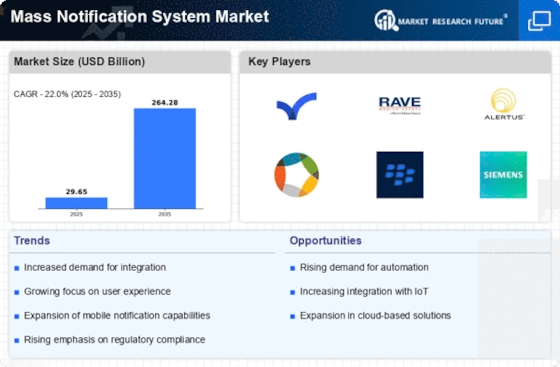
Mass Notification System Market Infographic
Purchase Options

Market Analysis

In-depth Analysis of Mass Notification System Market Industry Landscape

The Mass Notification System (MNS) market has seen huge development as of late, determined by the rising requirement for compelling correspondence and crisis the board in different areas. Market elements assume a urgent part in forming the direction of this market, with a few key variables adding to its development.

One of the essential drivers of the Mass Notification System market is the developing mindfulness and accentuation on open security. In a period set apart by catastrophic events, pandemics, and security dangers, associations across enterprises are progressively perceiving the significance of quick and solid correspondence during crises. Mass Notification Systems act as a fundamental device for scattering basic data to a huge crowd immediately, working with fast reactions and upgrading generally speaking wellbeing measures.

The combination of cutting edge innovations is another key component powering market elements. The consistent progressions in correspondence advancements, including cell phones, web-based entertainment stages, and IoT gadgets, have upset how data is shared. Mass Notification Systems influence these advances to guarantee far reaching and convenient dispersal of cautions and notifications.

Moreover, the corporate area's rising spotlight on worker security and business congruity has driven the reception of Mass Notification Systems. Organizations are perceiving the requirement for an exhaustive correspondence foundation that can rapidly arrive at representatives across various areas. MNS empowers associations to send basic cautions, updates, and departure directions, cultivating a more secure work space and limiting possible dangers.

Unofficial laws and consistence principles likewise assume a crucial part in forming the market elements of Mass Notification Systems. Different enterprises, like medical services, training, and transportation, are dependent upon explicit guidelines that order the execution of hearty crisis correspondence systems.

The worldwide idea of organizations and the rising predominance of remote work have additionally impelled the Mass Notification System market. Associations with scattered labor forces face the test of arriving at representatives situated in various areas quickly. MNS tends to this test by giving a bound together stage to correspondence, independent of geological limits, consequently encouraging a strong and responsive hierarchical climate.

On the cutthroat front, the Mass Notification System market shows a blend of laid out players and arising merchants. Laid out players frequently offer far reaching arrangements with many elements, while more up to date contestants might zero in on specialty functionalities or imaginative methodologies. The opposition encourages persistent development and the improvement of additional savvy arrangements, helping end-clients who have different choices to look over in view of their particular requirements and financial plan imperatives.


Author
Author Profile
Aarti Dhapte
AVP - Research

A consulting professional focused on helping businesses navigate complex markets through structured research and strategic insights. I partner with clients to solve high-impact business problems across market entry strategy, competitive intelligence, and opportunity assessment. Over the course of my experience, I have led and contributed to 100+ market research and consulting engagements, delivering insights across multiple industries and geographies, and supporting strategic decisions linked to $500M+ market opportunities. My core expertise lies in building robust market sizing, forecasting, and commercial models (top-down and bottom-up), alongside deep-dive competitive and industry analysis. I have played a key role in shaping go-to-market strategies, investment cases, and growth roadmaps, enabling clients to make confident, data-backed decisions in dynamic markets.

Leave a Comment

FAQs

What is the current valuation of the Mass Notification System Market?

<p>As of 2024, the Mass Notification System Market was valued at 29.65 USD Billion.</p>

What is the projected market size for the Mass Notification System Market by 2035?

<p>The market is projected to reach 264.28 USD Billion by 2035.</p>

What is the expected CAGR for the Mass Notification System Market during the forecast period 2025 - 2035?

<p>The expected CAGR for the Mass Notification System Market during 2025 - 2035 is 22.0%.</p>

Which application segment holds the highest valuation in the Mass Notification System Market?

<p>The Campus Security application segment was valued at 70.0 USD Billion in 2024.</p>

How does the Cloud-Based deployment type compare to others in terms of market size?

<p>The Cloud-Based deployment type was valued at 140.0 USD Billion in 2024, indicating its dominance.</p>

What is the market valuation for large enterprises in the Mass Notification System Market?

<p>In 2024, the market valuation for large enterprises was 129.28 USD Billion.</p>

Which end-use segment had the highest valuation in 2024?

<p>The Transportation end-use segment was valued at 89.28 USD Billion in 2024.</p>

Who are the key players in the Mass Notification System Market?

<p>Key players include Everbridge, Rave Mobile Safety, Alertus Technologies, and others.</p>

What was the valuation of the Emergency Management application segment in 2024?

<p>The Emergency Management application segment was valued at 45.0 USD Billion in 2024.</p>

What is the projected growth trend for the Mass Notification System Market?

<p>The market is expected to experience substantial growth, reaching 264.28 USD Billion by 2035.</p>

Market Summary

As per Market Research Future analysis, the Mass Notification System Market was estimated at 29.65 USD Billion in 2024. The Mass Notification System industry is projected to grow from 36.17 USD Billion in 2025 to 264.28 USD Billion by 2035, exhibiting a compound annual growth rate (CAGR) of 22.0% during the forecast period 2025 - 2035

Key Market Trends & Highlights

The Mass Notification System Market is experiencing robust growth driven by technological advancements and increasing safety awareness.

  • North America remains the largest market for mass notification systems, driven by a strong emphasis on safety and security. The Asia-Pacific region is emerging as the fastest-growing market, reflecting a rising demand for real-time communication solutions. Emergency management continues to dominate the market, while campus security is rapidly gaining traction as a key segment. Technological advancements and the increasing demand for real-time communication are significant drivers propelling market growth.

Market Size & Forecast

2024 Market Size 29.65 (USD Billion)
2035 Market Size 264.28 (USD Billion)
CAGR (2025 - 2035) 22.0%
Largest Regional Market Share in 2024 North America

Major Players

Everbridge (US), Rave Mobile Safety (US), Alertus Technologies (US), OnSolve (US), BlackBerry (CA), Siemens (DE), Motorola Solutions (US), Honeywell (US), AtHoc (US)

Market Trends

The Mass Notification System Market is currently experiencing a notable evolution, driven by the increasing need for effective communication during emergencies. Organizations across various sectors are recognizing the necessity of timely alerts to ensure safety and security. This market encompasses a range of technologies designed to disseminate critical information swiftly, thereby enhancing situational awareness. As the landscape of threats continues to diversify, the demand for robust notification systems appears to be on the rise. Furthermore, advancements in technology, such as mobile applications and cloud-based solutions, are likely to play a pivotal role in shaping the future of this market. In addition to technological advancements, regulatory frameworks are evolving to support the implementation of mass notification systems.

Governments and institutions are increasingly prioritizing public safety, which may lead to more stringent requirements for emergency communication. This trend suggests that organizations will need to invest in comprehensive solutions that not only meet compliance standards but also address the unique needs of their communities. As the Mass Notification System Market continues to grow, stakeholders must remain vigilant and adaptable to the changing dynamics of communication and safety protocols. The mass notification system plays a critical role in delivering real-time alerts during emergencies, ensuring timely communication across multiple channels. The mass notification systems market is expanding rapidly due to rising safety concerns, regulatory mandates, and advancements in cloud-based communication technologies.

The global mass notification market is expected to witness robust growth, supported by increasing adoption across government, healthcare, and enterprise sectors. A mass notification system for government agencies is essential for coordinating emergency response, public safety alerts, and disaster communication at national and local levels. A mass notification system for business ensures operational continuity by enabling organizations to communicate instantly with employees during disruptions and critical events.

Integration of Advanced Technologies

The Mass Notification System Market is witnessing a trend towards the integration of advanced technologies such as artificial intelligence and machine learning. These innovations enhance the capabilities of notification systems, allowing for more personalized and efficient communication during emergencies. By analyzing data patterns, these systems can predict potential threats and automate alerts, thereby improving response times. Modern enterprises are adopting advanced business notification systems to manage internal alerts, workforce safety, and crisis communication efficiently. Leading mass notification systems companies such as Everbridge, Rave Mobile Safety, and OnSolve are driving innovation through AI-enabled alerting platforms. Global and regional mass notification companies are expanding their offerings to address the growing demand for real-time emergency communication solutions. Emergency notification system vendors are increasingly integrating AI, analytics, and multi-channel delivery to improve alert accuracy and response times. Platforms such as AtHoc mass notification solutions are widely adopted by government and defense organizations for mission-critical communication.

Focus on User-Centric Solutions

There is a growing emphasis on user-centric solutions within the Mass Notification System Market. Organizations are increasingly prioritizing the user experience, ensuring that notification systems are intuitive and accessible. This trend indicates a shift towards designing systems that cater to diverse audiences, including those with disabilities, thereby promoting inclusivity in emergency communications.

Regulatory Compliance and Standards

The Mass Notification System Market is also influenced by evolving regulatory compliance and standards. As governments and regulatory bodies establish more stringent guidelines for emergency communication, organizations are compelled to adopt systems that align with these requirements. This trend suggests a proactive approach to safety, as entities seek to mitigate risks and enhance their preparedness for potential crises.

Mass Notification System Market Market Drivers

Regulatory Compliance and Standards

The Mass Notification System Market is heavily influenced by the need for regulatory compliance and adherence to established standards. Various sectors, including education and healthcare, are mandated to implement notification systems that comply with local and national regulations. This compliance not only ensures the safety of individuals but also protects organizations from potential liabilities. As regulations become more stringent, the demand for compliant notification systems is expected to rise. Market analysis indicates that organizations prioritizing compliance are likely to experience a competitive advantage, further propelling the growth of the Mass Notification System Market. This driver underscores the importance of aligning notification solutions with regulatory requirements.

Rising Awareness of Safety and Security

The Mass Notification System Market is significantly influenced by the rising awareness of safety and security among organizations and individuals. As incidents of natural disasters, terrorist threats, and other emergencies become more prevalent, the demand for robust notification systems intensifies. Organizations are increasingly investing in comprehensive notification solutions to safeguard their personnel and assets. This heightened awareness is reflected in the market's growth trajectory, with estimates suggesting a market value exceeding $5 billion by 2026. Consequently, the emphasis on safety and security is a critical driver, prompting organizations to adopt advanced notification systems to mitigate risks.

Integration of Multi-Channel Communication

The Mass Notification System Market is witnessing a transformative shift towards the integration of multi-channel communication strategies. Organizations are increasingly adopting systems that can disseminate messages across various platforms, including SMS, email, social media, and mobile applications. This multi-faceted approach ensures that critical information reaches a broader audience, enhancing the effectiveness of communication during emergencies. Market data indicates that systems capable of multi-channel integration are gaining traction, with a projected increase in adoption rates by over 30% in the coming years. This trend reflects the necessity for organizations to engage diverse communication channels to ensure comprehensive coverage and timely alerts.

Increasing Demand for Real-Time Communication

The Mass Notification System Market experiences a notable surge in demand for real-time communication solutions. Organizations across various sectors, including education, healthcare, and government, increasingly recognize the necessity of immediate information dissemination during emergencies. This trend is underscored by the growing reliance on digital platforms, which facilitate rapid alerts and updates. According to recent data, the market is projected to expand at a compound annual growth rate of approximately 20% over the next five years. This growth is driven by the need for timely communication to ensure safety and security, thereby enhancing the overall effectiveness of emergency response protocols.

Technological Advancements in Notification Systems

The Mass Notification System Market is significantly shaped by ongoing technological advancements. Innovations such as artificial intelligence, machine learning, and cloud computing are enhancing the capabilities of notification systems. These technologies enable organizations to analyze data more effectively, personalize messages, and automate communication processes. As a result, organizations are increasingly inclined to invest in advanced notification solutions that leverage these technologies. Market forecasts suggest that the integration of AI-driven features could lead to a 25% increase in system efficiency, thereby driving further growth in the market. This technological evolution is pivotal in meeting the dynamic needs of organizations.

Market Segment Insights

By Application: Emergency Management (Largest) vs. Campus Security (Fastest-Growing)

In the Mass Notification System Market, the application segment witnesses a diverse share distribution. Emergency Management holds a significant portion of the market, driven by its critical role in disaster response and public safety. Business Continuity and Public Safety also contribute meaningfully to this sector, catering to organizations' needs for uninterrupted communication during crises. Meanwhile, <a href="https://www.marketresearchfuture.com/reports/school-campus-security-market-2957">Campus Security</a> emerges as a growing focus area, reflecting increased investment in educational institutions' safety measures.

Emergency Management: Dominant vs. Campus Security: Emerging

Emergency Management serves as the dominant application within the Mass Notification System Market, enabling swift communication during crises such as natural disasters or imminent threats. Its established infrastructure and reliance on robust protocols ensure operational efficiency, gaining trust from both public and private sectors. On the other hand, Campus Security is marked as an emerging application, driven by a rising focus on student safety. Educational institutions increasingly adopt mass notification systems to inform students and staff about various safety incidents. This growing awareness highlights innovation and investment opportunities tailored to foster streamlined communication strategies ensuring enhanced safety on campuses.

By Deployment Type: Cloud-Based (Largest) vs. Hybrid (Fastest-Growing)

The Mass Notification System Market exhibits a diverse landscape in terms of deployment type. Cloud-Based solutions hold the largest share, appealing to organizations seeking scalability and accessibility. In contrast, On-Premise deployment continues to retain a sizeable portion of the market, especially among large enterprises requiring heightened control over their systems. Hybrid solutions are also gaining traction, offering the flexibility that many businesses need today. Growth trends indicate a rising preference for Cloud-Based systems due to their cost-effectiveness and ease of integration with existing technologies. As organizations increasingly prioritize remote accessibility and streamlined communication, Hybrid models are emerging as the fastest-growing segment, providing a balanced approach. This shift is driven by the need for redundancy, resilience, and real-time notification capabilities in a rapidly changing environment.

Deployment Type: Cloud-Based (Dominant) vs. On-Premise (Emerging)

Cloud-Based deployment models in the Mass Notification System Market are characterized by their flexibility and ease of access, making them highly suitable for organizations of all sizes. These systems are generally preferred due to lower upfront costs and reduced maintenance burdens. In contrast, On-Premise solutions cater to those entities, particularly larger ones, that require strict compliance and data control. While On-Premise deployments have traditionally been seen as stable, they are currently viewed as an emerging choice as organizations shift toward more adaptable solutions. The evolving needs for real-time alerts and accessible communication solutions are catalyzing a gradual move away from traditional On-Premise systems towards more integrated, Cloud-Based or Hybrid formats.

By Organization Size: Small Enterprises (Largest) vs. Large Enterprises (Fastest-Growing)

In the Mass Notification System Market, the distribution of market share among organization sizes reveals that small enterprises hold the largest segment, driven by their increasing need for effective communication solutions in their operations. These organizations often prioritize budget-friendly options and scalable solutions, leading to a significant adoption rate in this segment. Meanwhile, large enterprises, although a smaller segment in terms of current share, are experiencing rapid growth as they seek comprehensive and integrated notification systems to enhance their crisis management and emergency response strategies. This drive is fueled by the need for enhanced safety protocols and <a href="https://www.marketresearchfuture.com/reports/web-real-time-communications-market-3264">real-time communication</a> capabilities. The growth trends in this sector indicate that small enterprises continue to dominate due to their agility and the ability to quickly implement new technologies. Conversely, large enterprises represent the fastest-growing segment, as they invest substantially in advanced Mass Notification Systems to cater to their extensive operations. The increasing regulatory requirements for safety, cohesive communication, and the integration of AI-driven technologies are also primary drivers influencing this growth. As a result, large enterprises are becoming more responsive and proactive in their approach to disaster management, paving the way for future advancements in the market.

Small Enterprises (Dominant) vs. Large Enterprises (Emerging)

Small enterprises in the Mass Notification System Market are characterized by their focus on cost-effective solutions and ease of implementation. They typically seek systems that can provide key notifications without overwhelming complexity, allowing them to efficiently manage communication during emergencies. These businesses prioritize user-friendly features that facilitate quick deployment and training. In contrast, large enterprises, marked as an emerging segment, are increasingly investing in sophisticated notification systems that encompass multi-channel communication strategies. They recognize the importance of robust systems that can support vast organizational structures and cater to diverse stakeholder needs. This shift is driven by their need to maintain continuous operations and ensure employee safety through reliable communication frameworks, rising the stakes in both sectors.

By End-use: Government (Largest) vs. Healthcare (Fastest-Growing)

The End-use segment of the Mass Notification System Market is characterized by distinct groups, with government applications dominating the market. Government entities utilize these systems to efficiently communicate critical information during emergencies and disasters, ensuring public safety and coordinated response efforts. The healthcare sector is rapidly adopting mass notification systems, particularly driven by the ongoing demand for timely communication during health crises such as pandemics. In educational institutions, notifications are crucial for safety protocols, while transportation systems maintain operational efficiency through notifications.

Government (Dominant) vs. Healthcare (Emerging)

The government sector remains the dominant end-user of mass notification systems, leveraging these technologies to ensure timely dissemination of information during emergencies. These systems facilitate a robust communication framework that is vital for civil protection and crisis management. On the other hand, the healthcare sector emerges as a rapidly growing segment, increasingly reliant on mass notification systems to streamline communications during critical health situations. With rising expectations for immediate information flow, healthcare providers are aiming to enhance patient safety and institutional responsiveness. Both sectors recognize the importance of employing advanced notification technologies to improve operational efficiency and public trust.

Get more detailed insights about Mass Notification System Market Research Report – Forecast till 2035

Regional Insights

North America : Market Leader in Innovation

North America is the largest market for Mass Notification Systems, holding approximately 45% of the global share. The region's growth is driven by increasing demand for emergency communication solutions, regulatory requirements for public safety, and advancements in technology. The U.S. and Canada are the primary contributors, with a strong focus on integrating these systems into existing infrastructure to enhance public safety and emergency response capabilities. The competitive landscape is robust, featuring key players such as Everbridge, Rave Mobile Safety, and Motorola Solutions. These companies are continuously innovating to meet the evolving needs of government agencies and private sectors. The presence of advanced technology and significant investments in public safety initiatives further solidify North America's position as a leader in the Mass Notification System Market.

Europe : Growing Demand for Safety Solutions

Europe is witnessing a significant rise in the adoption of Mass Notification Systems, accounting for about 30% of the global market share. The growth is fueled by increasing awareness of public safety, stringent regulations, and the need for effective communication during emergencies. Countries like Germany and the UK are leading this trend, driven by government initiatives aimed at enhancing disaster preparedness and response capabilities. The competitive landscape in Europe is characterized by the presence of established players such as Siemens and Honeywell, alongside emerging startups. The region is focusing on integrating advanced technologies like AI and IoT into notification systems to improve efficiency and reliability. Regulatory bodies are also emphasizing the importance of these systems in public safety, further propelling market growth.

Asia-Pacific : Rapid Growth in Emerging Markets

Asia-Pacific is rapidly emerging as a key player in the Mass Notification System Market, holding approximately 20% of the global share. The region's growth is driven by urbanization, increasing natural disasters, and government initiatives to enhance public safety. Countries like Japan and Australia are at the forefront, implementing advanced notification systems to address the growing need for effective communication during emergencies. The competitive landscape is evolving, with both The Mass Notification System Market share. Companies are focusing on developing cost-effective solutions tailored to the unique needs of the region. The presence of key players such as BlackBerry and local startups is fostering innovation and driving the adoption of Mass Notification Systems across various sectors, including government and education.

Middle East and Africa : Emerging Market with Potential

The Middle East and Africa region is gradually recognizing the importance of Mass Notification Systems, currently holding about 5% of the global market share. The growth is primarily driven by increasing urbanization, the rise in natural disasters, and government initiatives aimed at improving public safety. Countries like the UAE and South Africa are leading the charge, focusing on enhancing their emergency response capabilities through advanced notification systems. The competitive landscape is still developing, with a mix of international and local players entering the market. Key players are beginning to establish a presence, and there is a growing emphasis on integrating technology to improve communication during emergencies. As governments prioritize public safety, the demand for effective Mass Notification Systems is expected to rise significantly in the coming years.

Key Players and Competitive Insights

The Mass Notification System Market is currently characterized by a dynamic competitive landscape, driven by the increasing need for effective communication during emergencies and critical events. Key players such as Everbridge (US), Rave Mobile Safety (US), and OnSolve (US) are strategically positioned to leverage technological advancements and enhance their service offerings. Everbridge (US) focuses on integrating AI capabilities into its platform, thereby improving response times and decision-making processes. Rave Mobile Safety (US) emphasizes partnerships with local governments to expand its reach and enhance community engagement, while OnSolve (US) is investing in cloud-based solutions to ensure scalability and reliability in its services. Collectively, these strategies indicate a shift towards more integrated and responsive systems that cater to diverse user needs, thereby intensifying competition in the market.In terms of business tactics, companies are increasingly localizing their operations and optimizing supply chains to enhance service delivery. The Mass Notification System Market appears moderately fragmented, with a mix of established players and emerging startups vying for market share. The collective influence of these key players is shaping a competitive structure that encourages innovation and responsiveness to customer demands, as companies seek to differentiate themselves through unique service offerings and technological advancements.
In August Everbridge (US) announced a strategic partnership with a leading AI firm to enhance its notification capabilities, allowing for more personalized and timely alerts. This move is significant as it positions Everbridge (US) at the forefront of technological integration in mass notification systems, potentially improving user engagement and operational efficiency. The partnership underscores the importance of leveraging cutting-edge technology to meet the evolving needs of clients in various sectors.
In July Rave Mobile Safety (US) launched a new feature that integrates real-time data analytics into its notification platform. This feature allows organizations to assess the effectiveness of their communication strategies during emergencies. The introduction of this capability is crucial, as it not only enhances the platform's functionality but also provides users with actionable insights, thereby fostering a more proactive approach to emergency management.
In September OnSolve (US) expanded its global footprint by entering into a strategic alliance with a telecommunications provider in Europe. This collaboration aims to enhance the reach and reliability of its notification services across the continent. Such strategic moves are indicative of OnSolve's commitment to expanding its market presence and ensuring that its solutions are accessible to a broader audience, which is essential in a market that increasingly values global connectivity.
As of October current competitive trends in the Mass Notification System Market are heavily influenced by digitalization, sustainability, and the integration of AI technologies. Strategic alliances are becoming more prevalent, as companies recognize the need to collaborate to enhance their service offerings and market reach. Looking ahead, competitive differentiation is likely to evolve from traditional price-based competition to a focus on innovation, technological advancements, and the reliability of supply chains. This shift suggests that companies that prioritize these aspects will be better positioned to thrive in an increasingly complex and competitive environment.

Key Companies in the Mass Notification System Market include

Industry Developments

  • Q2 2024: Singlewire Software Launches InformaCast Command Center for Mass Notification Singlewire Software announced the launch of InformaCast Command Center, a new solution designed to streamline emergency mass notification and incident management for organizations.
  • Q2 2024: Alertus Technologies Announces Partnership with BlackBerry to Enhance Emergency Mass Notification Alertus Technologies entered a partnership with BlackBerry to integrate BlackBerry's AtHoc platform with Alertus' mass notification solutions, aiming to improve emergency communication capabilities for enterprise clients.
  • Q2 2024: Everbridge Appoints David Meredith as Chief Executive Officer Everbridge, a global provider of critical event management and mass notification solutions, announced the appointment of David Meredith as its new CEO, effective May 2024.
  • Q1 2024: Rave Mobile Safety Wins Multi-Year Contract with State of New Jersey for Statewide Mass Notification System Market Rave Mobile Safety secured a multi-year contract to provide its mass notification platform for emergency communications across the State of New Jersey.
  • Q1 2024: OnSolve Launches AI-Powered Risk Intelligence for Mass Notification Platform OnSolve introduced new AI-powered risk intelligence capabilities to its mass notification platform, enabling organizations to automate threat detection and response.
  • Q2 2024: Regroup Mass Notification Expands Operations with New Office in Toronto Regroup Mass Notification opened a new office in Toronto, Canada, to support its growing customer base and expand its presence in the Canadian market.
  • Q1 2024: Omnilert Announces Integration Partnership with Cisco Webex for Emergency Mass Notification Omnilert announced a partnership with Cisco Webex to integrate its emergency mass notification system with Webex's collaboration platform, enhancing real-time alerting for enterprise users.
  • Q2 2024: Everbridge Wins Contract to Provide Mass Notification System Market for City of Miami Everbridge was awarded a contract to deploy its mass notification system for the City of Miami, supporting emergency communications and public safety initiatives.
  • Q1 2024: AlertMedia Raises $50 Million in Series C Funding to Expand Mass Notification Solutions AlertMedia secured $50 million in Series C funding to accelerate product development and expand its mass notification offerings for global enterprise customers.
  • Q2 2024: Rave Mobile Safety Partners with RapidSOS to Enhance Emergency Mass Notification Rave Mobile Safety formed a partnership with RapidSOS to integrate emergency data into its mass notification platform, improving situational awareness for first responders.
  • Q1 2024: Singlewire Software Acquires Visitor Aware to Strengthen Mass Notification and Safety Solutions Singlewire Software acquired Visitor Aware, a visitor management platform, to enhance its mass notification and safety offerings for schools and enterprises.
  • Q2 2024: OnSolve Appoints Mark Herrington as Chief Executive Officer OnSolve, a provider of mass notification and critical event management solutions, announced the appointment of Mark Herrington as its new CEO.

Future Outlook

Mass Notification System Market Future Outlook

The Mass Notification System Market is projected to grow at a 22.0% CAGR from 2025 to 2035, driven by technological advancements, increasing safety regulations, and rising demand for real-time communication.

New opportunities lie in:

  • <p>Integration of AI-driven analytics for predictive emergency responses.</p>
  • <p> </p>
  • <p>Expansion into smart city infrastructure for enhanced public safety.</p>
  • <p>Development of mobile applications for user-friendly notification systems.</p>

By 2035, the Mass Notification System Market is expected to be robust, reflecting substantial growth and innovation.

Market Segmentation

Mass Notification System Market End-use Outlook

  • Government
  • Healthcare
  • Education
  • Transportation

Mass Notification System Market Application Outlook

  • Emergency Management
  • Business Continuity
  • Campus Security
  • Public Safety

Mass Notification System Market Deployment Type Outlook

  • On-Premise
  • Cloud-Based
  • Hybrid

Mass Notification System Market Organization Size Outlook

  • Small Enterprises
  • Medium Enterprises
  • Large Enterprises

Report Scope

MARKET SIZE 2024 29.65(USD Billion)
MARKET SIZE 2025 36.17(USD Billion)
MARKET SIZE 2035 264.28(USD Billion)
COMPOUND ANNUAL GROWTH RATE (CAGR) 22.0% (2025 - 2035)
REPORT COVERAGE Revenue Forecast, Competitive Landscape, Growth Factors, and Trends
BASE YEAR 2024
Market Forecast Period 2025 - 2035
Historical Data 2019 - 2024
Market Forecast Units USD Billion
Key Companies Profiled Everbridge (US), Rave Mobile Safety (US), Alertus Technologies (US), OnSolve (US), BlackBerry (CA), Siemens (DE), Motorola Solutions (US), Honeywell (US), AtHoc (US)
Segments Covered Application, Deployment Type, Organization Size, End-use, Regional
Key Market Opportunities Integration of artificial intelligence enhances responsiveness in the Mass Notification System Market.
Key Market Dynamics Rising demand for real-time communication drives innovation and competition in the Mass Notification System market.
Countries Covered North America, Europe, APAC, South America, MEA

FAQs

What is the current valuation of the Mass Notification System Market?

<p>As of 2024, the Mass Notification System Market was valued at 29.65 USD Billion.</p>

What is the projected market size for the Mass Notification System Market by 2035?

<p>The market is projected to reach 264.28 USD Billion by 2035.</p>

What is the expected CAGR for the Mass Notification System Market during the forecast period 2025 - 2035?

<p>The expected CAGR for the Mass Notification System Market during 2025 - 2035 is 22.0%.</p>

Which application segment holds the highest valuation in the Mass Notification System Market?

<p>The Campus Security application segment was valued at 70.0 USD Billion in 2024.</p>

How does the Cloud-Based deployment type compare to others in terms of market size?

<p>The Cloud-Based deployment type was valued at 140.0 USD Billion in 2024, indicating its dominance.</p>

What is the market valuation for large enterprises in the Mass Notification System Market?

<p>In 2024, the market valuation for large enterprises was 129.28 USD Billion.</p>

Which end-use segment had the highest valuation in 2024?

<p>The Transportation end-use segment was valued at 89.28 USD Billion in 2024.</p>

Who are the key players in the Mass Notification System Market?

<p>Key players include Everbridge, Rave Mobile Safety, Alertus Technologies, and others.</p>

What was the valuation of the Emergency Management application segment in 2024?

<p>The Emergency Management application segment was valued at 45.0 USD Billion in 2024.</p>

What is the projected growth trend for the Mass Notification System Market?

<p>The market is expected to experience substantial growth, reaching 264.28 USD Billion by 2035.</p>

  1. SECTION I: EXECUTIVE SUMMARY AND KEY HIGHLIGHTS
    1. | 1.1 EXECUTIVE SUMMARY
    2. | | 1.1.1 Market Overview
    3. | | 1.1.2 Key Findings
    4. | | 1.1.3 Market Segmentation
    5. | | 1.1.4 Competitive Landscape
    6. | | 1.1.5 Challenges and Opportunities
    7. | | 1.1.6 Future Outlook
  2. SECTION II: SCOPING, METHODOLOGY AND MARKET STRUCTURE
    1. | 2.1 MARKET INTRODUCTION
    2. | | 2.1.1 Definition
    3. | | 2.1.2 Scope of the study
    4. | | | 2.1.2.1 Research Objective
    5. | | | 2.1.2.2 Assumption
    6. | | | 2.1.2.3 Limitations
    7. | 2.2 RESEARCH METHODOLOGY
    8. | | 2.2.1 Overview
    9. | | 2.2.2 Data Mining
    10. | | 2.2.3 Secondary Research
    11. | | 2.2.4 Primary Research
    12. | | | 2.2.4.1 Primary Interviews and Information Gathering Process
    13. | | | 2.2.4.2 Breakdown of Primary Respondents
    14. | | 2.2.5 Forecasting Model
    15. | | 2.2.6 Market Size Estimation
    16. | | | 2.2.6.1 Bottom-Up Approach
    17. | | | 2.2.6.2 Top-Down Approach
    18. | | 2.2.7 Data Triangulation
    19. | | 2.2.8 Validation
  3. SECTION III: QUALITATIVE ANALYSIS
    1. | 3.1 MARKET DYNAMICS
    2. | | 3.1.1 Overview
    3. | | 3.1.2 Drivers
    4. | | 3.1.3 Restraints
    5. | | 3.1.4 Opportunities
    6. | 3.2 MARKET FACTOR ANALYSIS
    7. | | 3.2.1 Value chain Analysis
    8. | | 3.2.2 Porter's Five Forces Analysis
    9. | | | 3.2.2.1 Bargaining Power of Suppliers
    10. | | | 3.2.2.2 Bargaining Power of Buyers
    11. | | | 3.2.2.3 Threat of New Entrants
    12. | | | 3.2.2.4 Threat of Substitutes
    13. | | | 3.2.2.5 Intensity of Rivalry
    14. | | 3.2.3 COVID-19 Impact Analysis
    15. | | | 3.2.3.1 Market Impact Analysis
    16. | | | 3.2.3.2 Regional Impact
    17. | | | 3.2.3.3 Opportunity and Threat Analysis
  4. SECTION IV: QUANTITATIVE ANALYSIS
    1. | 4.1 Information and Communications Technology, BY Application (USD Billion)
    2. | | 4.1.1 Emergency Management
    3. | | 4.1.2 Business Continuity
    4. | | 4.1.3 Campus Security
    5. | | 4.1.4 Public Safety
    6. | 4.2 Information and Communications Technology, BY Deployment Type (USD Billion)
    7. | | 4.2.1 On-Premise
    8. | | 4.2.2 Cloud-Based
    9. | | 4.2.3 Hybrid
    10. | 4.3 Information and Communications Technology, BY Organization Size (USD Billion)
    11. | | 4.3.1 Small Enterprises
    12. | | 4.3.2 Medium Enterprises
    13. | | 4.3.3 Large Enterprises
    14. | 4.4 Information and Communications Technology, BY End-use (USD Billion)
    15. | | 4.4.1 Government
    16. | | 4.4.2 Healthcare
    17. | | 4.4.3 Education
    18. | | 4.4.4 Transportation
    19. | 4.5 Information and Communications Technology, BY Region (USD Billion)
    20. | | 4.5.1 North America
    21. | | | 4.5.1.1 US
    22. | | | 4.5.1.2 Canada
    23. | | 4.5.2 Europe
    24. | | | 4.5.2.1 Germany
    25. | | | 4.5.2.2 UK
    26. | | | 4.5.2.3 France
    27. | | | 4.5.2.4 Russia
    28. | | | 4.5.2.5 Italy
    29. | | | 4.5.2.6 Spain
    30. | | | 4.5.2.7 Rest of Europe
    31. | | 4.5.3 APAC
    32. | | | 4.5.3.1 China
    33. | | | 4.5.3.2 India
    34. | | | 4.5.3.3 Japan
    35. | | | 4.5.3.4 South Korea
    36. | | | 4.5.3.5 Malaysia
    37. | | | 4.5.3.6 Thailand
    38. | | | 4.5.3.7 Indonesia
    39. | | | 4.5.3.8 Rest of APAC
    40. | | 4.5.4 South America
    41. | | | 4.5.4.1 Brazil
    42. | | | 4.5.4.2 Mexico
    43. | | | 4.5.4.3 Argentina
    44. | | | 4.5.4.4 Rest of South America
    45. | | 4.5.5 MEA
    46. | | | 4.5.5.1 GCC Countries
    47. | | | 4.5.5.2 South Africa
    48. | | | 4.5.5.3 Rest of MEA
  5. SECTION V: COMPETITIVE ANALYSIS
    1. | 5.1 Competitive Landscape
    2. | | 5.1.1 Overview
    3. | | 5.1.2 Competitive Analysis
    4. | | 5.1.3 Market share Analysis
    5. | | 5.1.4 Major Growth Strategy in the Information and Communications Technology
    6. | | 5.1.5 Competitive Benchmarking
    7. | | 5.1.6 Leading Players in Terms of Number of Developments in the Information and Communications Technology
    8. | | 5.1.7 Key developments and growth strategies
    9. | | | 5.1.7.1 New Product Launch/Service Deployment
    10. | | | 5.1.7.2 Merger & Acquisitions
    11. | | | 5.1.7.3 Joint Ventures
    12. | | 5.1.8 Major Players Financial Matrix
    13. | | | 5.1.8.1 Sales and Operating Income
    14. | | | 5.1.8.2 Major Players R&D Expenditure. 2023
    15. | 5.2 Company Profiles
    16. | | 5.2.1 Everbridge (US)
    17. | | | 5.2.1.1 Financial Overview
    18. | | | 5.2.1.2 Products Offered
    19. | | | 5.2.1.3 Key Developments
    20. | | | 5.2.1.4 SWOT Analysis
    21. | | | 5.2.1.5 Key Strategies
    22. | | 5.2.2 Rave Mobile Safety (US)
    23. | | | 5.2.2.1 Financial Overview
    24. | | | 5.2.2.2 Products Offered
    25. | | | 5.2.2.3 Key Developments
    26. | | | 5.2.2.4 SWOT Analysis
    27. | | | 5.2.2.5 Key Strategies
    28. | | 5.2.3 Alertus Technologies (US)
    29. | | | 5.2.3.1 Financial Overview
    30. | | | 5.2.3.2 Products Offered
    31. | | | 5.2.3.3 Key Developments
    32. | | | 5.2.3.4 SWOT Analysis
    33. | | | 5.2.3.5 Key Strategies
    34. | | 5.2.4 OnSolve (US)
    35. | | | 5.2.4.1 Financial Overview
    36. | | | 5.2.4.2 Products Offered
    37. | | | 5.2.4.3 Key Developments
    38. | | | 5.2.4.4 SWOT Analysis
    39. | | | 5.2.4.5 Key Strategies
    40. | | 5.2.5 BlackBerry (CA)
    41. | | | 5.2.5.1 Financial Overview
    42. | | | 5.2.5.2 Products Offered
    43. | | | 5.2.5.3 Key Developments
    44. | | | 5.2.5.4 SWOT Analysis
    45. | | | 5.2.5.5 Key Strategies
    46. | | 5.2.6 Siemens (DE)
    47. | | | 5.2.6.1 Financial Overview
    48. | | | 5.2.6.2 Products Offered
    49. | | | 5.2.6.3 Key Developments
    50. | | | 5.2.6.4 SWOT Analysis
    51. | | | 5.2.6.5 Key Strategies
    52. | | 5.2.7 Motorola Solutions (US)
    53. | | | 5.2.7.1 Financial Overview
    54. | | | 5.2.7.2 Products Offered
    55. | | | 5.2.7.3 Key Developments
    56. | | | 5.2.7.4 SWOT Analysis
    57. | | | 5.2.7.5 Key Strategies
    58. | | 5.2.8 Honeywell (US)
    59. | | | 5.2.8.1 Financial Overview
    60. | | | 5.2.8.2 Products Offered
    61. | | | 5.2.8.3 Key Developments
    62. | | | 5.2.8.4 SWOT Analysis
    63. | | | 5.2.8.5 Key Strategies
    64. | | 5.2.9 AtHoc (US)
    65. | | | 5.2.9.1 Financial Overview
    66. | | | 5.2.9.2 Products Offered
    67. | | | 5.2.9.3 Key Developments
    68. | | | 5.2.9.4 SWOT Analysis
    69. | | | 5.2.9.5 Key Strategies
    70. | 5.3 Appendix
    71. | | 5.3.1 References
    72. | | 5.3.2 Related Reports
  6. LIST OF FIGURES
    1. | 6.1 MARKET SYNOPSIS
    2. | 6.2 NORTH AMERICA MARKET ANALYSIS
    3. | 6.3 US MARKET ANALYSIS BY APPLICATION
    4. | 6.4 US MARKET ANALYSIS BY DEPLOYMENT TYPE
    5. | 6.5 US MARKET ANALYSIS BY ORGANIZATION SIZE
    6. | 6.6 US MARKET ANALYSIS BY END-USE
    7. | 6.7 CANADA MARKET ANALYSIS BY APPLICATION
    8. | 6.8 CANADA MARKET ANALYSIS BY DEPLOYMENT TYPE
    9. | 6.9 CANADA MARKET ANALYSIS BY ORGANIZATION SIZE
    10. | 6.10 CANADA MARKET ANALYSIS BY END-USE
    11. | 6.11 EUROPE MARKET ANALYSIS
    12. | 6.12 GERMANY MARKET ANALYSIS BY APPLICATION
    13. | 6.13 GERMANY MARKET ANALYSIS BY DEPLOYMENT TYPE
    14. | 6.14 GERMANY MARKET ANALYSIS BY ORGANIZATION SIZE
    15. | 6.15 GERMANY MARKET ANALYSIS BY END-USE
    16. | 6.16 UK MARKET ANALYSIS BY APPLICATION
    17. | 6.17 UK MARKET ANALYSIS BY DEPLOYMENT TYPE
    18. | 6.18 UK MARKET ANALYSIS BY ORGANIZATION SIZE
    19. | 6.19 UK MARKET ANALYSIS BY END-USE
    20. | 6.20 FRANCE MARKET ANALYSIS BY APPLICATION
    21. | 6.21 FRANCE MARKET ANALYSIS BY DEPLOYMENT TYPE
    22. | 6.22 FRANCE MARKET ANALYSIS BY ORGANIZATION SIZE
    23. | 6.23 FRANCE MARKET ANALYSIS BY END-USE
    24. | 6.24 RUSSIA MARKET ANALYSIS BY APPLICATION
    25. | 6.25 RUSSIA MARKET ANALYSIS BY DEPLOYMENT TYPE
    26. | 6.26 RUSSIA MARKET ANALYSIS BY ORGANIZATION SIZE
    27. | 6.27 RUSSIA MARKET ANALYSIS BY END-USE
    28. | 6.28 ITALY MARKET ANALYSIS BY APPLICATION
    29. | 6.29 ITALY MARKET ANALYSIS BY DEPLOYMENT TYPE
    30. | 6.30 ITALY MARKET ANALYSIS BY ORGANIZATION SIZE
    31. | 6.31 ITALY MARKET ANALYSIS BY END-USE
    32. | 6.32 SPAIN MARKET ANALYSIS BY APPLICATION
    33. | 6.33 SPAIN MARKET ANALYSIS BY DEPLOYMENT TYPE
    34. | 6.34 SPAIN MARKET ANALYSIS BY ORGANIZATION SIZE
    35. | 6.35 SPAIN MARKET ANALYSIS BY END-USE
    36. | 6.36 REST OF EUROPE MARKET ANALYSIS BY APPLICATION
    37. | 6.37 REST OF EUROPE MARKET ANALYSIS BY DEPLOYMENT TYPE
    38. | 6.38 REST OF EUROPE MARKET ANALYSIS BY ORGANIZATION SIZE
    39. | 6.39 REST OF EUROPE MARKET ANALYSIS BY END-USE
    40. | 6.40 APAC MARKET ANALYSIS
    41. | 6.41 CHINA MARKET ANALYSIS BY APPLICATION
    42. | 6.42 CHINA MARKET ANALYSIS BY DEPLOYMENT TYPE
    43. | 6.43 CHINA MARKET ANALYSIS BY ORGANIZATION SIZE
    44. | 6.44 CHINA MARKET ANALYSIS BY END-USE
    45. | 6.45 INDIA MARKET ANALYSIS BY APPLICATION
    46. | 6.46 INDIA MARKET ANALYSIS BY DEPLOYMENT TYPE
    47. | 6.47 INDIA MARKET ANALYSIS BY ORGANIZATION SIZE
    48. | 6.48 INDIA MARKET ANALYSIS BY END-USE
    49. | 6.49 JAPAN MARKET ANALYSIS BY APPLICATION
    50. | 6.50 JAPAN MARKET ANALYSIS BY DEPLOYMENT TYPE
    51. | 6.51 JAPAN MARKET ANALYSIS BY ORGANIZATION SIZE
    52. | 6.52 JAPAN MARKET ANALYSIS BY END-USE
    53. | 6.53 SOUTH KOREA MARKET ANALYSIS BY APPLICATION
    54. | 6.54 SOUTH KOREA MARKET ANALYSIS BY DEPLOYMENT TYPE
    55. | 6.55 SOUTH KOREA MARKET ANALYSIS BY ORGANIZATION SIZE
    56. | 6.56 SOUTH KOREA MARKET ANALYSIS BY END-USE
    57. | 6.57 MALAYSIA MARKET ANALYSIS BY APPLICATION
    58. | 6.58 MALAYSIA MARKET ANALYSIS BY DEPLOYMENT TYPE
    59. | 6.59 MALAYSIA MARKET ANALYSIS BY ORGANIZATION SIZE
    60. | 6.60 MALAYSIA MARKET ANALYSIS BY END-USE
    61. | 6.61 THAILAND MARKET ANALYSIS BY APPLICATION
    62. | 6.62 THAILAND MARKET ANALYSIS BY DEPLOYMENT TYPE
    63. | 6.63 THAILAND MARKET ANALYSIS BY ORGANIZATION SIZE
    64. | 6.64 THAILAND MARKET ANALYSIS BY END-USE
    65. | 6.65 INDONESIA MARKET ANALYSIS BY APPLICATION
    66. | 6.66 INDONESIA MARKET ANALYSIS BY DEPLOYMENT TYPE
    67. | 6.67 INDONESIA MARKET ANALYSIS BY ORGANIZATION SIZE
    68. | 6.68 INDONESIA MARKET ANALYSIS BY END-USE
    69. | 6.69 REST OF APAC MARKET ANALYSIS BY APPLICATION
    70. | 6.70 REST OF APAC MARKET ANALYSIS BY DEPLOYMENT TYPE
    71. | 6.71 REST OF APAC MARKET ANALYSIS BY ORGANIZATION SIZE
    72. | 6.72 REST OF APAC MARKET ANALYSIS BY END-USE
    73. | 6.73 SOUTH AMERICA MARKET ANALYSIS
    74. | 6.74 BRAZIL MARKET ANALYSIS BY APPLICATION
    75. | 6.75 BRAZIL MARKET ANALYSIS BY DEPLOYMENT TYPE
    76. | 6.76 BRAZIL MARKET ANALYSIS BY ORGANIZATION SIZE
    77. | 6.77 BRAZIL MARKET ANALYSIS BY END-USE
    78. | 6.78 MEXICO MARKET ANALYSIS BY APPLICATION
    79. | 6.79 MEXICO MARKET ANALYSIS BY DEPLOYMENT TYPE
    80. | 6.80 MEXICO MARKET ANALYSIS BY ORGANIZATION SIZE
    81. | 6.81 MEXICO MARKET ANALYSIS BY END-USE
    82. | 6.82 ARGENTINA MARKET ANALYSIS BY APPLICATION
    83. | 6.83 ARGENTINA MARKET ANALYSIS BY DEPLOYMENT TYPE
    84. | 6.84 ARGENTINA MARKET ANALYSIS BY ORGANIZATION SIZE
    85. | 6.85 ARGENTINA MARKET ANALYSIS BY END-USE
    86. | 6.86 REST OF SOUTH AMERICA MARKET ANALYSIS BY APPLICATION
    87. | 6.87 REST OF SOUTH AMERICA MARKET ANALYSIS BY DEPLOYMENT TYPE
    88. | 6.88 REST OF SOUTH AMERICA MARKET ANALYSIS BY ORGANIZATION SIZE
    89. | 6.89 REST OF SOUTH AMERICA MARKET ANALYSIS BY END-USE
    90. | 6.90 MEA MARKET ANALYSIS
    91. | 6.91 GCC COUNTRIES MARKET ANALYSIS BY APPLICATION
    92. | 6.92 GCC COUNTRIES MARKET ANALYSIS BY DEPLOYMENT TYPE
    93. | 6.93 GCC COUNTRIES MARKET ANALYSIS BY ORGANIZATION SIZE
    94. | 6.94 GCC COUNTRIES MARKET ANALYSIS BY END-USE
    95. | 6.95 SOUTH AFRICA MARKET ANALYSIS BY APPLICATION
    96. | 6.96 SOUTH AFRICA MARKET ANALYSIS BY DEPLOYMENT TYPE
    97. | 6.97 SOUTH AFRICA MARKET ANALYSIS BY ORGANIZATION SIZE
    98. | 6.98 SOUTH AFRICA MARKET ANALYSIS BY END-USE
    99. | 6.99 REST OF MEA MARKET ANALYSIS BY APPLICATION
    100. | 6.100 REST OF MEA MARKET ANALYSIS BY DEPLOYMENT TYPE
    101. | 6.101 REST OF MEA MARKET ANALYSIS BY ORGANIZATION SIZE
    102. | 6.102 REST OF MEA MARKET ANALYSIS BY END-USE
    103. | 6.103 KEY BUYING CRITERIA OF INFORMATION AND COMMUNICATIONS TECHNOLOGY
    104. | 6.104 RESEARCH PROCESS OF MRFR
    105. | 6.105 DRO ANALYSIS OF INFORMATION AND COMMUNICATIONS TECHNOLOGY
    106. | 6.106 DRIVERS IMPACT ANALYSIS: INFORMATION AND COMMUNICATIONS TECHNOLOGY
    107. | 6.107 RESTRAINTS IMPACT ANALYSIS: INFORMATION AND COMMUNICATIONS TECHNOLOGY
    108. | 6.108 SUPPLY / VALUE CHAIN: INFORMATION AND COMMUNICATIONS TECHNOLOGY
    109. | 6.109 INFORMATION AND COMMUNICATIONS TECHNOLOGY, BY APPLICATION, 2024 (% SHARE)
    110. | 6.110 INFORMATION AND COMMUNICATIONS TECHNOLOGY, BY APPLICATION, 2024 TO 2035 (USD Billion)
    111. | 6.111 INFORMATION AND COMMUNICATIONS TECHNOLOGY, BY DEPLOYMENT TYPE, 2024 (% SHARE)
    112. | 6.112 INFORMATION AND COMMUNICATIONS TECHNOLOGY, BY DEPLOYMENT TYPE, 2024 TO 2035 (USD Billion)
    113. | 6.113 INFORMATION AND COMMUNICATIONS TECHNOLOGY, BY ORGANIZATION SIZE, 2024 (% SHARE)
    114. | 6.114 INFORMATION AND COMMUNICATIONS TECHNOLOGY, BY ORGANIZATION SIZE, 2024 TO 2035 (USD Billion)
    115. | 6.115 INFORMATION AND COMMUNICATIONS TECHNOLOGY, BY END-USE, 2024 (% SHARE)
    116. | 6.116 INFORMATION AND COMMUNICATIONS TECHNOLOGY, BY END-USE, 2024 TO 2035 (USD Billion)
    117. | 6.117 BENCHMARKING OF MAJOR COMPETITORS
  7. LIST OF TABLES
    1. | 7.1 LIST OF ASSUMPTIONS
    2. | | 7.1.1
    3. | 7.2 North America MARKET SIZE ESTIMATES; FORECAST
    4. | | 7.2.1 BY APPLICATION, 2025-2035 (USD Billion)
    5. | | 7.2.2 BY DEPLOYMENT TYPE, 2025-2035 (USD Billion)
    6. | | 7.2.3 BY ORGANIZATION SIZE, 2025-2035 (USD Billion)
    7. | | 7.2.4 BY END-USE, 2025-2035 (USD Billion)
    8. | 7.3 US MARKET SIZE ESTIMATES; FORECAST
    9. | | 7.3.1 BY APPLICATION, 2025-2035 (USD Billion)
    10. | | 7.3.2 BY DEPLOYMENT TYPE, 2025-2035 (USD Billion)
    11. | | 7.3.3 BY ORGANIZATION SIZE, 2025-2035 (USD Billion)
    12. | | 7.3.4 BY END-USE, 2025-2035 (USD Billion)
    13. | 7.4 Canada MARKET SIZE ESTIMATES; FORECAST
    14. | | 7.4.1 BY APPLICATION, 2025-2035 (USD Billion)
    15. | | 7.4.2 BY DEPLOYMENT TYPE, 2025-2035 (USD Billion)
    16. | | 7.4.3 BY ORGANIZATION SIZE, 2025-2035 (USD Billion)
    17. | | 7.4.4 BY END-USE, 2025-2035 (USD Billion)
    18. | 7.5 Europe MARKET SIZE ESTIMATES; FORECAST
    19. | | 7.5.1 BY APPLICATION, 2025-2035 (USD Billion)
    20. | | 7.5.2 BY DEPLOYMENT TYPE, 2025-2035 (USD Billion)
    21. | | 7.5.3 BY ORGANIZATION SIZE, 2025-2035 (USD Billion)
    22. | | 7.5.4 BY END-USE, 2025-2035 (USD Billion)
    23. | 7.6 Germany MARKET SIZE ESTIMATES; FORECAST
    24. | | 7.6.1 BY APPLICATION, 2025-2035 (USD Billion)
    25. | | 7.6.2 BY DEPLOYMENT TYPE, 2025-2035 (USD Billion)
    26. | | 7.6.3 BY ORGANIZATION SIZE, 2025-2035 (USD Billion)
    27. | | 7.6.4 BY END-USE, 2025-2035 (USD Billion)
    28. | 7.7 UK MARKET SIZE ESTIMATES; FORECAST
    29. | | 7.7.1 BY APPLICATION, 2025-2035 (USD Billion)
    30. | | 7.7.2 BY DEPLOYMENT TYPE, 2025-2035 (USD Billion)
    31. | | 7.7.3 BY ORGANIZATION SIZE, 2025-2035 (USD Billion)
    32. | | 7.7.4 BY END-USE, 2025-2035 (USD Billion)
    33. | 7.8 France MARKET SIZE ESTIMATES; FORECAST
    34. | | 7.8.1 BY APPLICATION, 2025-2035 (USD Billion)
    35. | | 7.8.2 BY DEPLOYMENT TYPE, 2025-2035 (USD Billion)
    36. | | 7.8.3 BY ORGANIZATION SIZE, 2025-2035 (USD Billion)
    37. | | 7.8.4 BY END-USE, 2025-2035 (USD Billion)
    38. | 7.9 Russia MARKET SIZE ESTIMATES; FORECAST
    39. | | 7.9.1 BY APPLICATION, 2025-2035 (USD Billion)
    40. | | 7.9.2 BY DEPLOYMENT TYPE, 2025-2035 (USD Billion)
    41. | | 7.9.3 BY ORGANIZATION SIZE, 2025-2035 (USD Billion)
    42. | | 7.9.4 BY END-USE, 2025-2035 (USD Billion)
    43. | 7.10 Italy MARKET SIZE ESTIMATES; FORECAST
    44. | | 7.10.1 BY APPLICATION, 2025-2035 (USD Billion)
    45. | | 7.10.2 BY DEPLOYMENT TYPE, 2025-2035 (USD Billion)
    46. | | 7.10.3 BY ORGANIZATION SIZE, 2025-2035 (USD Billion)
    47. | | 7.10.4 BY END-USE, 2025-2035 (USD Billion)
    48. | 7.11 Spain MARKET SIZE ESTIMATES; FORECAST
    49. | | 7.11.1 BY APPLICATION, 2025-2035 (USD Billion)
    50. | | 7.11.2 BY DEPLOYMENT TYPE, 2025-2035 (USD Billion)
    51. | | 7.11.3 BY ORGANIZATION SIZE, 2025-2035 (USD Billion)
    52. | | 7.11.4 BY END-USE, 2025-2035 (USD Billion)
    53. | 7.12 Rest of Europe MARKET SIZE ESTIMATES; FORECAST
    54. | | 7.12.1 BY APPLICATION, 2025-2035 (USD Billion)
    55. | | 7.12.2 BY DEPLOYMENT TYPE, 2025-2035 (USD Billion)
    56. | | 7.12.3 BY ORGANIZATION SIZE, 2025-2035 (USD Billion)
    57. | | 7.12.4 BY END-USE, 2025-2035 (USD Billion)
    58. | 7.13 APAC MARKET SIZE ESTIMATES; FORECAST
    59. | | 7.13.1 BY APPLICATION, 2025-2035 (USD Billion)
    60. | | 7.13.2 BY DEPLOYMENT TYPE, 2025-2035 (USD Billion)
    61. | | 7.13.3 BY ORGANIZATION SIZE, 2025-2035 (USD Billion)
    62. | | 7.13.4 BY END-USE, 2025-2035 (USD Billion)
    63. | 7.14 China MARKET SIZE ESTIMATES; FORECAST
    64. | | 7.14.1 BY APPLICATION, 2025-2035 (USD Billion)
    65. | | 7.14.2 BY DEPLOYMENT TYPE, 2025-2035 (USD Billion)
    66. | | 7.14.3 BY ORGANIZATION SIZE, 2025-2035 (USD Billion)
    67. | | 7.14.4 BY END-USE, 2025-2035 (USD Billion)
    68. | 7.15 India MARKET SIZE ESTIMATES; FORECAST
    69. | | 7.15.1 BY APPLICATION, 2025-2035 (USD Billion)
    70. | | 7.15.2 BY DEPLOYMENT TYPE, 2025-2035 (USD Billion)
    71. | | 7.15.3 BY ORGANIZATION SIZE, 2025-2035 (USD Billion)
    72. | | 7.15.4 BY END-USE, 2025-2035 (USD Billion)
    73. | 7.16 Japan MARKET SIZE ESTIMATES; FORECAST
    74. | | 7.16.1 BY APPLICATION, 2025-2035 (USD Billion)
    75. | | 7.16.2 BY DEPLOYMENT TYPE, 2025-2035 (USD Billion)
    76. | | 7.16.3 BY ORGANIZATION SIZE, 2025-2035 (USD Billion)
    77. | | 7.16.4 BY END-USE, 2025-2035 (USD Billion)
    78. | 7.17 South Korea MARKET SIZE ESTIMATES; FORECAST
    79. | | 7.17.1 BY APPLICATION, 2025-2035 (USD Billion)
    80. | | 7.17.2 BY DEPLOYMENT TYPE, 2025-2035 (USD Billion)
    81. | | 7.17.3 BY ORGANIZATION SIZE, 2025-2035 (USD Billion)
    82. | | 7.17.4 BY END-USE, 2025-2035 (USD Billion)
    83. | 7.18 Malaysia MARKET SIZE ESTIMATES; FORECAST
    84. | | 7.18.1 BY APPLICATION, 2025-2035 (USD Billion)
    85. | | 7.18.2 BY DEPLOYMENT TYPE, 2025-2035 (USD Billion)
    86. | | 7.18.3 BY ORGANIZATION SIZE, 2025-2035 (USD Billion)
    87. | | 7.18.4 BY END-USE, 2025-2035 (USD Billion)
    88. | 7.19 Thailand MARKET SIZE ESTIMATES; FORECAST
    89. | | 7.19.1 BY APPLICATION, 2025-2035 (USD Billion)
    90. | | 7.19.2 BY DEPLOYMENT TYPE, 2025-2035 (USD Billion)
    91. | | 7.19.3 BY ORGANIZATION SIZE, 2025-2035 (USD Billion)
    92. | | 7.19.4 BY END-USE, 2025-2035 (USD Billion)
    93. | 7.20 Indonesia MARKET SIZE ESTIMATES; FORECAST
    94. | | 7.20.1 BY APPLICATION, 2025-2035 (USD Billion)
    95. | | 7.20.2 BY DEPLOYMENT TYPE, 2025-2035 (USD Billion)
    96. | | 7.20.3 BY ORGANIZATION SIZE, 2025-2035 (USD Billion)
    97. | | 7.20.4 BY END-USE, 2025-2035 (USD Billion)
    98. | 7.21 Rest of APAC MARKET SIZE ESTIMATES; FORECAST
    99. | | 7.21.1 BY APPLICATION, 2025-2035 (USD Billion)
    100. | | 7.21.2 BY DEPLOYMENT TYPE, 2025-2035 (USD Billion)
    101. | | 7.21.3 BY ORGANIZATION SIZE, 2025-2035 (USD Billion)
    102. | | 7.21.4 BY END-USE, 2025-2035 (USD Billion)
    103. | 7.22 South America MARKET SIZE ESTIMATES; FORECAST
    104. | | 7.22.1 BY APPLICATION, 2025-2035 (USD Billion)
    105. | | 7.22.2 BY DEPLOYMENT TYPE, 2025-2035 (USD Billion)
    106. | | 7.22.3 BY ORGANIZATION SIZE, 2025-2035 (USD Billion)
    107. | | 7.22.4 BY END-USE, 2025-2035 (USD Billion)
    108. | 7.23 Brazil MARKET SIZE ESTIMATES; FORECAST
    109. | | 7.23.1 BY APPLICATION, 2025-2035 (USD Billion)
    110. | | 7.23.2 BY DEPLOYMENT TYPE, 2025-2035 (USD Billion)
    111. | | 7.23.3 BY ORGANIZATION SIZE, 2025-2035 (USD Billion)
    112. | | 7.23.4 BY END-USE, 2025-2035 (USD Billion)
    113. | 7.24 Mexico MARKET SIZE ESTIMATES; FORECAST
    114. | | 7.24.1 BY APPLICATION, 2025-2035 (USD Billion)
    115. | | 7.24.2 BY DEPLOYMENT TYPE, 2025-2035 (USD Billion)
    116. | | 7.24.3 BY ORGANIZATION SIZE, 2025-2035 (USD Billion)
    117. | | 7.24.4 BY END-USE, 2025-2035 (USD Billion)
    118. | 7.25 Argentina MARKET SIZE ESTIMATES; FORECAST
    119. | | 7.25.1 BY APPLICATION, 2025-2035 (USD Billion)
    120. | | 7.25.2 BY DEPLOYMENT TYPE, 2025-2035 (USD Billion)
    121. | | 7.25.3 BY ORGANIZATION SIZE, 2025-2035 (USD Billion)
    122. | | 7.25.4 BY END-USE, 2025-2035 (USD Billion)
    123. | 7.26 Rest of South America MARKET SIZE ESTIMATES; FORECAST
    124. | | 7.26.1 BY APPLICATION, 2025-2035 (USD Billion)
    125. | | 7.26.2 BY DEPLOYMENT TYPE, 2025-2035 (USD Billion)
    126. | | 7.26.3 BY ORGANIZATION SIZE, 2025-2035 (USD Billion)
    127. | | 7.26.4 BY END-USE, 2025-2035 (USD Billion)
    128. | 7.27 MEA MARKET SIZE ESTIMATES; FORECAST
    129. | | 7.27.1 BY APPLICATION, 2025-2035 (USD Billion)
    130. | | 7.27.2 BY DEPLOYMENT TYPE, 2025-2035 (USD Billion)
    131. | | 7.27.3 BY ORGANIZATION SIZE, 2025-2035 (USD Billion)
    132. | | 7.27.4 BY END-USE, 2025-2035 (USD Billion)
    133. | 7.28 GCC Countries MARKET SIZE ESTIMATES; FORECAST
    134. | | 7.28.1 BY APPLICATION, 2025-2035 (USD Billion)
    135. | | 7.28.2 BY DEPLOYMENT TYPE, 2025-2035 (USD Billion)
    136. | | 7.28.3 BY ORGANIZATION SIZE, 2025-2035 (USD Billion)
    137. | | 7.28.4 BY END-USE, 2025-2035 (USD Billion)
    138. | 7.29 South Africa MARKET SIZE ESTIMATES; FORECAST
    139. | | 7.29.1 BY APPLICATION, 2025-2035 (USD Billion)
    140. | | 7.29.2 BY DEPLOYMENT TYPE, 2025-2035 (USD Billion)
    141. | | 7.29.3 BY ORGANIZATION SIZE, 2025-2035 (USD Billion)
    142. | | 7.29.4 BY END-USE, 2025-2035 (USD Billion)
    143. | 7.30 Rest of MEA MARKET SIZE ESTIMATES; FORECAST
    144. | | 7.30.1 BY APPLICATION, 2025-2035 (USD Billion)
    145. | | 7.30.2 BY DEPLOYMENT TYPE, 2025-2035 (USD Billion)
    146. | | 7.30.3 BY ORGANIZATION SIZE, 2025-2035 (USD Billion)
    147. | | 7.30.4 BY END-USE, 2025-2035 (USD Billion)
    148. | 7.31 PRODUCT LAUNCH/PRODUCT DEVELOPMENT/APPROVAL
    149. | | 7.31.1
    150. | 7.32 ACQUISITION/PARTNERSHIP
    151. | | 7.32.1

Information and Communications Technology Market Segmentation

Information and Communications Technology By Application (USD Billion, 2025-2035)

  • Emergency Management
  • Business Continuity
  • Campus Security
  • Public Safety

Information and Communications Technology By Deployment Type (USD Billion, 2025-2035)

  • On-Premise
  • Cloud-Based
  • Hybrid

Information and Communications Technology By Organization Size (USD Billion, 2025-2035)

  • Small Enterprises
  • Medium Enterprises
  • Large Enterprises

Information and Communications Technology By End-use (USD Billion, 2025-2035)

  • Government
  • Healthcare
  • Education
  • Transportation
Infographic

Free Sample Request

Kindly complete the form below to receive a free sample of this Report

Get Free Sample

Customer Strories

Compare Licence

×
Features License Type
Single User Multiuser License Enterprise User
Price $4,950 $5,950 $7,250
Maximum User Access Limit 1 User Upto 10 Users Unrestricted Access Throughout the Organization
Free Customization
Direct Access to Analyst
Deliverable Format
Platform Access
Discount on Next Purchase 10% 15% 15%
Printable Versions
%>