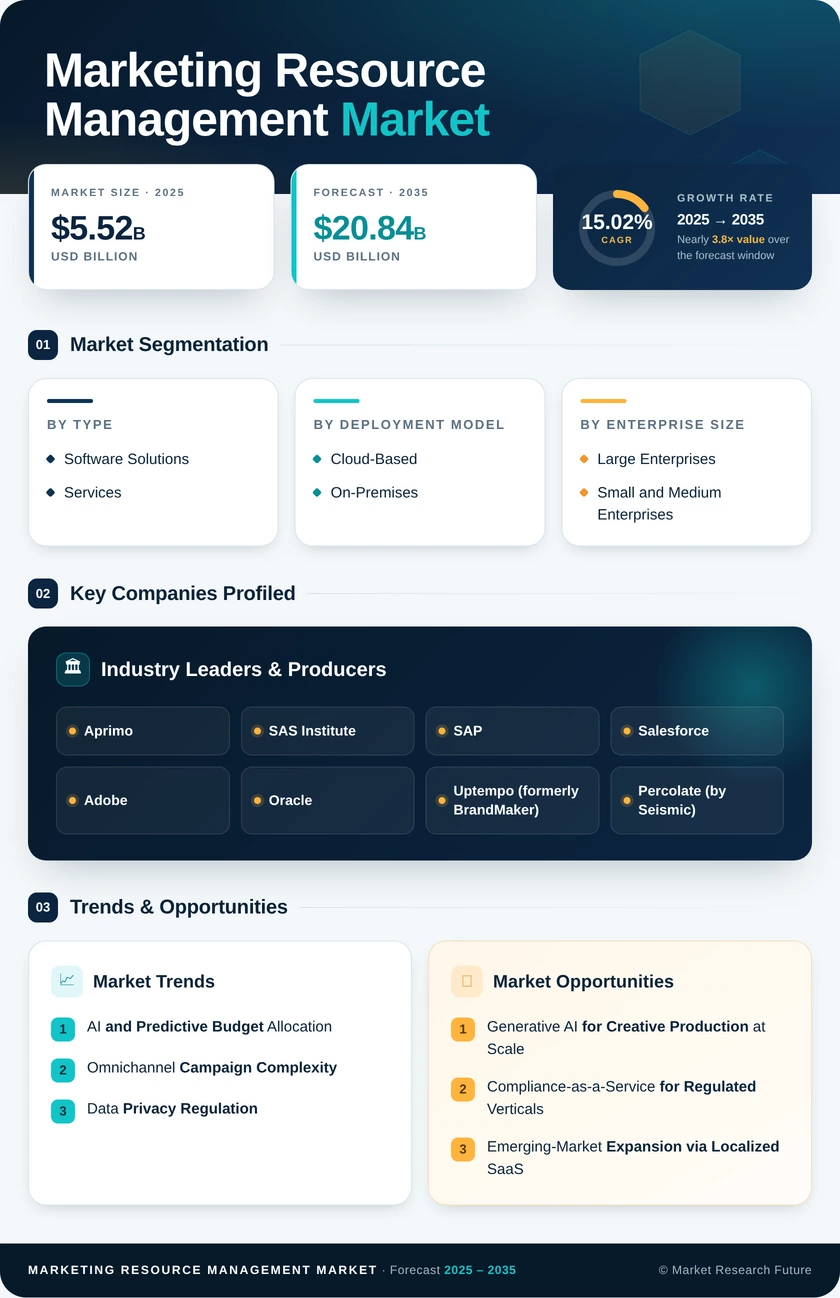
Segmentation Quick Reference
| Dimension | Sub-Segments | Dominant Segment | Fastest Growing Segment |
| Solution Type | Software Solutions, Services | Software Solutions | Services |
| Deployment Model | Cloud-Based, On-Premises | Cloud-Based | Cloud-Based |
| Enterprise Size | Large Enterprises, Small and Medium Enterprises | Large Enterprises | Small and Medium Enterprises |
| End-User Industry | BFSI, IT and Telecom, Consumer Goods and Retail, Travel and Hospitality, Media and Entertainment, Healthcare and Marketing Resource Management Market, Other Industries | BFSI | Healthcare and Marketing Resource Management Market |
| Geography | North America, Europe, Asia-Pacific, South America, Middle East & Africa | North America | Asia-Pacific |
Market Segmentation Overview
By Solution Type
| Sub-Segment | Key Trend |
| Software Solutions | Unified platforms integrating budgeting, creative production, approval, and analytics |
| Services | Growth in managed services and implementation consulting for complex deployments |
Software solutions remain the revenue backbone as enterprises consolidate disparate marketing tools onto single platforms. Services grow faster, driven by the need for specialized integration expertise and ongoing optimization support in multi-brand environments.
By Deployment Model
| Sub-Segment | Key Trend |
| Cloud-Based | SaaS-first procurement and elastic scalability are driving rapid adoption |
| On-Premises | Retained in regulated sectors requiring air-gapped or sovereign data environments |
Cloud-based deployment leads both in current share and growth rate, benefiting from continuous updates and lower upfront costs. On-premises retains a stable but slowly declining niche among organizations with strict data-residency mandates.
By Enterprise Size
| Sub-Segment | Key Trend |
| Large Enterprises | Multi-brand, multi-geography orchestration with full-suite adoption |
| Small and Medium Enterprises | Modular, usage-based platforms are lowering entry barriers |
Large enterprises drive most revenue through comprehensive platform deployments. SMEs represent the fastest-growing segment as affordable tiers and self-service onboarding open the market to first-time buyers.
By End-User Industry
| Sub-Segment | Key Trend |
| BFSI | Stringent compliance requirements fuel brand compliance software adoption |
| IT and Telecom | Rapid product-launch cycles demand agile campaign orchestration |
| Consumer Goods and Retail | Omnichannel proliferation is increasing content volume and workflow complexity |
| Travel and Hospitality | Seasonal campaign peaks requiring scalable resource management |
| Media and Entertainment | Real-time content distribution and rights-management integration |
| Healthcare and Marketing Resource Management Market | FDA/EMA promotional compliance driving fastest vertical growth |
| Other Industries | Education, government, and non-profit digital engagement programs |
BFSI anchors industry adoption with the highest current share, while healthcare is the fastest-growing vertical due to expanding regulatory requirements for promotional content review and approval.
By Geography
| Sub-Segment | Key Trend |
| North America | Mature MarTech ecosystem; enterprise-scale platform consolidation |
| Europe | GDPR and Digital Markets Act compliance accelerating platform demand |
| Asia-Pacific | Mobile-first economies and government digitization subsidies |
| South America | E-commerce expansion is pulling mid-market buyers into SaaS platforms |
| Middle East & Africa | Vision 2030 and fintech growth are driving first-wave adoption |
North America maintains the largest share through deep enterprise penetration, while Asia-Pacific leads growth as emerging economies digitize marketing operations at an accelerating pace.


 Noah Malgeri
Co-Founder
Noah Malgeri
Co-Founder

 Peter Groot koerkamp
Account and Business Manager
Peter Groot koerkamp
Account and Business Manager

 Younghwan Choi
Senior Retail Manager
Younghwan Choi
Senior Retail Manager

 Mark Irwin
Management Consultant
Mark Irwin
Management Consultant

 Akif Moroglu
Strategy & Business Development Director
Akif Moroglu
Strategy & Business Development Director

 Guilherme Gomes Martins
Product Management Director
Guilherme Gomes Martins
Product Management Director

 Joseph Aguayo
Sales Operations & Pricing Manager
Joseph Aguayo
Sales Operations & Pricing Manager

 La Terria Dodd
Program Support Specialist
La Terria Dodd
Program Support Specialist

 Rob Kooiker
Group Product Manager HVAC & Fire Protection GMA
Rob Kooiker
Group Product Manager HVAC & Fire Protection GMA