Request Free Sample ×

Kindly complete the form below to receive a free sample of this Report

* Please use a valid business email

Leading companies partner with us for data-driven Insights

clients tt-cursor
Hero Background
English
Chinese
French
Japanese
Korean
German
Spanish

Maritime Logistics Services Market Size

ID: MRFR/PCM/7286-HCR
111 Pages
Swapnil Palwe
March 2026

Maritime Logistics and Services Market Report Information By Cargo Type (General Cargo {Break Bulk [Drums, Bags, Pallets, Barrels, and Boxes], Neo Bulk [Lumber, Paper, Steel, Vehicles] and Containerized}, and Bulk Cargo {Liquid Bulk [Petroleum, LNG, Chemicals, and Vegetable Oils], Dry Bulk [Coal, Iron Ore, Grains, Bauxite, and Sand]}), By Services (Port & Cargo Handling, Route Surveys, Multimodal Transportation, Lifting Equipment Management, Packing & and Crew Management) By Region – Forecast 2034

Share:
Download PDF ×

We do not share your information with anyone. However, we may send you emails based on your report interest from time to time. You may contact us at any time to opt-out.

Maritime Logistics Services Market Infographic
Purchase Options

Maritime Logistics Services Size

Maritime Logistics Services Market Growth Projections and Opportunities

The Maritime Logistics and Services Market exhibit dynamic characteristics shaped by a myriad of factors influencing the global shipping and maritime industry. Central to this dynamic is the expansive nature of international trade, where maritime logistics play a pivotal role in the movement of goods across the globe. The market dynamics are significantly influenced by the increasing volume of global trade, driven by the interconnectedness of economies and the constant demand for efficient transportation of goods by sea. As international trade continues to expand, the maritime logistics and services sector responds with innovative solutions to meet the escalating demand for reliable and efficient shipping services.

Technological advancements contribute significantly to the dynamics of the Maritime Logistics and Services Market. The industry is undergoing a digital transformation with the integration of technologies like blockchain, Internet of Things (IoT), and advanced analytics. These technologies enhance supply chain visibility, optimize route planning, and improve overall operational efficiency. Automation in port operations, smart container tracking systems, and digital documentation processes are reshaping the landscape, making maritime logistics more streamlined and responsive to the demands of modern trade.

The impact of environmental sustainability is a critical factor influencing the dynamics of the Maritime Logistics and Services Market. The industry faces increasing pressure to reduce its carbon footprint and adopt eco-friendly practices. Consequently, there is a growing emphasis on green shipping solutions, including the use of cleaner fuels, energy-efficient vessels, and sustainable port operations. Environmental regulations and initiatives to mitigate the ecological impact of maritime activities are reshaping market dynamics, driving innovation in green technologies within the sector.

Geopolitical factors significantly shape the dynamics of the Maritime Logistics and Services Market. Political tensions, trade agreements, and international relations impact shipping routes, port operations, and maritime regulations. Changes in geopolitical landscapes, such as shifts in trade alliances or the opening of new shipping routes, influence market dynamics by creating opportunities or challenges for maritime logistics providers. Companies operating in the sector need to navigate and adapt to geopolitical changes, as they can have profound effects on the efficiency and cost-effectiveness of maritime logistics.

The resilience and adaptability of the market are demonstrated through responses to global disruptions, such as the COVID-19 pandemic. The pandemic highlighted vulnerabilities in global supply chains, prompting the maritime logistics and services sector to reassess and reconfigure its operations. The market dynamics saw an increased focus on supply chain resilience, contingency planning, and the adoption of digital technologies to ensure smoother operations even during disruptions.

Collaboration and alliances within the maritime industry contribute to market dynamics. Shipping lines, port operators, logistics providers, and technology companies forge partnerships to create integrated solutions. Such collaborations foster synergies, streamline operations, and enhance the overall efficiency of maritime logistics services. The dynamics of the market are influenced by the ability of stakeholders to collaborate effectively, creating an ecosystem that responds cohesively to the demands and challenges of the global shipping industry.

Regulatory frameworks and compliance requirements also play a significant role in shaping the dynamics of the Maritime Logistics and Services Market. International maritime regulations, safety standards, and environmental mandates influence operational practices and investment decisions. Adherence to regulations ensures the sustainability and safety of maritime logistics operations, but compliance efforts also impact the cost structures and strategies adopted by industry players, thereby influencing market dynamics.
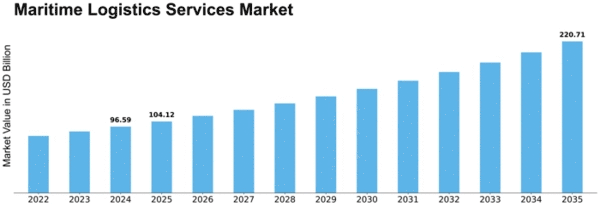
Maritime Logistics Services Market Size Graph
Author
Author Profile
Swapnil Palwe
Team Lead - Research

With a technical background as Bachelor's in Mechanical Engineering, with MBA in Operations Management , Swapnil has 6+ years of experience in market research, consulting and analytics with the tasks of data mining, analysis, and project execution. He is the POC for our clients, for their consulting projects running under the Automotive/A&D domain. Swapnil has worked on major projects in verticals such as Aerospace & Defense, Automotive and many other domain projects. He has worked on projects for fortune 500 companies' syndicate and consulting projects along with several government projects.

Leave a Comment

FAQs

What is the current valuation of the Maritime Logistics Services Market as of 2025?

<p>The Maritime Logistics Services Market is valued at approximately 96.59 USD Billion in 2024.</p>

What is the projected market valuation for the Maritime Logistics Services Market in 2035?

<p>The market is projected to reach a valuation of 220.71 USD Billion by 2035.</p>

What is the expected CAGR for the Maritime Logistics Services Market during the forecast period 2025 - 2035?

<p>The expected CAGR for the Maritime Logistics Services Market during the forecast period 2025 - 2035 is 7.8%.</p>

Which companies are considered key players in the Maritime Logistics Services Market?

<p>Key players in the market include A.P. Moller - Maersk, Mediterranean Shipping Company, CMA CGM, and Hapag-Lloyd.</p>

What are the primary service types in the Maritime Logistics Services Market?

<p>The primary service types include Freight Forwarding, Customs Brokerage, Warehousing, Transportation Management, and Supply Chain Management.</p>

How does the Freight Forwarding segment perform in terms of valuation?

<p>The Freight Forwarding segment was valued between 30.0 and 70.0 USD Billion.</p>

What is the valuation range for the Bulk Carrier vessel type in the Maritime Logistics Services Market?

<p>The Bulk Carrier vessel type is valued between 20.0 and 50.0 USD Billion.</p>

What types of cargo are included in the Maritime Logistics Services Market?

The market includes Liquid Cargo, Dry Cargo, Refrigerated Cargo, Project Cargo, and Hazardous Cargo.

What is the valuation range for Dry Cargo in the Maritime Logistics Services Market?

The Dry Cargo segment is valued between 30.0 and 70.0 USD Billion.

How does the projected growth of the Maritime Logistics Services Market compare to its current valuation?

The market is expected to grow from 96.59 USD Billion in 2024 to 220.71 USD Billion by 2035, indicating substantial growth.

Market Summary

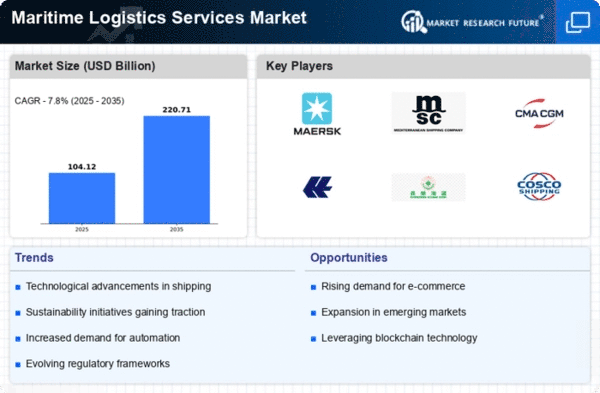
As per MRFR analysis, the Maritime Logistics Services Market was estimated at 96.59 USD Billion in 2024. The maritime logistics industry is projected to grow from 104.13 USD Billion in 2025 to 220.71 USD Billion by 2035, exhibiting a compound annual growth rate (CAGR) of 7.8% during the forecast period 2025 - 2035.

Key Market Trends & Highlights

The Maritime Logistics Services Market is experiencing robust growth driven by digital transformation and sustainability initiatives.

  • North America remains the largest market for maritime logistics services, driven by advanced infrastructure and technological capabilities.
  • The Asia-Pacific region is emerging as the fastest-growing market, fueled by increasing trade activities and e-commerce demand.
  • Freight forwarding continues to dominate the market, while supply chain management is witnessing rapid growth due to evolving consumer expectations.
  • Technological advancements and rising demand for e-commerce are key drivers propelling the maritime logistics services market forward.

Market Size & Forecast

2024 Market Size 96.59 (USD Billion)
2035 Market Size 220.71 (USD Billion)
CAGR (2025 - 2035) 7.8%
Largest Regional Market Share in 2024 North America

Major Players

A.P. Moller - Maersk (DK), Mediterranean Shipping Company (CH), CMA CGM (FR), Hapag-Lloyd (DE), Evergreen Marine Corporation (TW), COSCO Shipping (CN), Yang Ming Marine Transport Corporation (TW), Hanjin Shipping (KR)

Market Trends

The Maritime Logistics Services Market is currently experiencing a transformative phase, driven by advancements in technology and evolving consumer demands. The integration of digital solutions, such as blockchain and artificial intelligence, appears to enhance operational efficiency and transparency within supply chains. Furthermore, the increasing emphasis on sustainability and environmental responsibility is reshaping logistics strategies, compelling companies to adopt greener practices. This shift not only addresses regulatory pressures but also aligns with the growing consumer preference for eco-friendly services. As a result, stakeholders in the Maritime Logistics Services Market are likely to invest in innovative solutions that promote sustainability while optimizing costs. In addition, the globalization of trade continues to influence the Maritime Logistics Services Market, as businesses seek to expand their reach across borders. The rise of e-commerce has further accelerated the demand for efficient logistics solutions, necessitating a reevaluation of traditional shipping methods. Companies are increasingly focusing on enhancing their last-mile delivery capabilities to meet customer expectations for speed and reliability. Overall, the Maritime Logistics Services Market is poised for growth, with a clear trajectory towards modernization and sustainability, reflecting the dynamic nature of global trade and logistics.

Digital Transformation

The Maritime Logistics Services Market is witnessing a significant shift towards digitalization. Technologies such as blockchain and artificial intelligence are being integrated to streamline operations, enhance transparency, and improve decision-making processes. This trend indicates a move towards more efficient and responsive logistics systems.

Sustainability Initiatives

There is a growing focus on sustainability within the Maritime Logistics Services Market. Companies are increasingly adopting eco-friendly practices to reduce their carbon footprint and comply with environmental regulations. This trend suggests a long-term commitment to sustainable logistics solutions that align with consumer preferences.

E-commerce Growth

The expansion of e-commerce is reshaping the Maritime Logistics Services Market. As online shopping continues to rise, logistics providers are adapting their strategies to improve last-mile delivery and overall service efficiency. This trend highlights the need for innovative solutions to meet the demands of a rapidly changing retail landscape.

Maritime Logistics Services Market Market Drivers

Market Growth Projections

The Global Maritime Logistics and Services Market Industry is poised for substantial growth, with projections indicating a market value of 220.7 USD Billion by 2035. This anticipated growth reflects a compound annual growth rate of 7.8% from 2025 to 2035, driven by various factors including increasing global trade, technological advancements, and infrastructure investments. The market's trajectory suggests a robust future, as stakeholders in the maritime logistics sector adapt to evolving demands and challenges. This growth potential underscores the importance of strategic planning and investment in the industry.

Increasing Global Trade Volumes

The Global Maritime Logistics and Services Market Industry is experiencing a surge in demand driven by increasing global trade volumes. As economies recover and expand, the volume of goods transported via maritime routes is projected to rise significantly. In 2024, the market is valued at approximately 96.6 USD Billion, reflecting the growing reliance on maritime logistics for international trade. This trend is likely to continue, with projections indicating that by 2035, the market could reach 220.7 USD Billion. Such growth is indicative of the essential role maritime logistics plays in facilitating global commerce.

Growth of E-commerce and Online Retail

The rise of e-commerce is significantly impacting the Global Maritime Logistics and Services Market Industry. As online retail continues to expand, the demand for efficient maritime logistics services is increasing. Companies are seeking reliable shipping solutions to meet consumer expectations for fast and cost-effective delivery. This trend is evident in the growing number of shipping routes and services tailored to e-commerce needs. The market's expansion is likely to be fueled by this shift, as logistics providers adapt to the evolving landscape of global trade driven by e-commerce.

Technological Advancements in Shipping

Technological innovations are reshaping the Global Maritime Logistics and Services Market Industry. The adoption of automation, artificial intelligence, and blockchain technology is enhancing operational efficiency and transparency in shipping processes. For instance, the implementation of smart shipping solutions allows for real-time tracking of cargo, which improves supply chain management. These advancements not only reduce operational costs but also increase customer satisfaction. As technology continues to evolve, it is expected to drive further growth in the market, aligning with the projected CAGR of 7.8% from 2025 to 2035.

Infrastructure Development and Investment

Infrastructure development plays a crucial role in the Global Maritime Logistics and Services Market Industry. Investments in port facilities, shipping lanes, and logistics hubs are essential for accommodating the increasing volume of maritime trade. Governments and private entities are recognizing the need for modernized infrastructure to enhance efficiency and reduce congestion. For instance, major ports are undergoing expansions to handle larger vessels and increased cargo capacity. Such developments are expected to support the projected growth of the market, ensuring that it can meet the demands of global trade in the coming years.

Sustainability and Environmental Regulations

The Global Maritime Logistics and Services Market Industry is increasingly influenced by sustainability initiatives and environmental regulations. Governments worldwide are implementing stricter emissions standards and promoting greener shipping practices. This shift towards sustainability is compelling shipping companies to invest in eco-friendly vessels and technologies. For example, the International Maritime Organization has set ambitious targets for reducing greenhouse gas emissions from shipping. As a result, companies that adapt to these regulations may gain a competitive edge, potentially driving market growth as consumers and businesses prioritize environmentally responsible logistics solutions.

Market Segment Insights

By Service Type: Freight Forwarding (Largest) vs. Supply Chain Management (Fastest-Growing)

In the Maritime Logistics Services Market, the service type segment is primarily driven by <a href="https://www.marketresearchfuture.com/reports/freight-forwarding-market-two-11579" target="_blank" title="freight forwarding">Freight Forwarding</a>, which accounts for the largest share. This is due to its critical role in global trade, facilitating the movement of goods across international borders efficiently. Other significant contributors include Customs Brokerage and Warehousing, which provide essential services that ensure timely delivery and compliance with trade regulations. As demand for seamless logistics increases, these services play a vital role in enhancing supply chain reliability. On the growth front, <a href="https://www.marketresearchfuture.com/reports/supply-chain-management-market-21742" target="_blank" title="supply chain management">Supply Chain Management</a> is emerging as the fastest-growing segment. The recent focus on optimizing supply chains due to disruptions from global events has led companies to invest in advanced technologies and solutions. Transportation Management is also witnessing considerable transformations with the rise of digitization, leading to enhanced efficiency and transparency, further driving competition within the market.

Freight Forwarding: Dominant vs. Supply Chain Management: Emerging

Freight Forwarding serves as the backbone of the Maritime Logistics Services Market, facilitating the intricate process of transporting goods internationally. This segment leverages comprehensive networks and partnerships to ensure smooth transit and compliance with international trade laws. In contrast, Supply Chain Management is witnessing rapid growth as businesses aim to refine their logistics operations. Companies are increasingly adopting integrated strategies to manage their supply chains in real-time, which enhances responsiveness and productivity. This segment emphasizes the importance of technology in logistics, enabling companies to navigate complexities while reducing costs and improving service delivery. Together, these segments illustrate the dual focus on traditional services and innovative approaches in the maritime logistics landscape.

By Vessel Type: Container Ship (Largest) vs. Tanker (Fastest-Growing)

<p>In the Maritime Logistics Services Market, the distribution among vessel types reveals significant diversity. Container ships hold a predominant share of the market, being the backbone of intermodal transport, while bulk carriers and tankers also represent substantial segments. Roll-on/Roll-off ships cater to specialized cargo, contributing to their niche market share. General cargo ships, although less dominant, continue to play a vital role in diverse logistics operations, adapting to various shipping needs.</p>

<p>Container Ship (Dominant) vs. Tanker (Emerging)</p>

<p>Container ships are the most prevalent vessels in maritime logistics, designed to efficiently transport goods in standardized container units. Their ability to facilitate quick loading and unloading makes them indispensable in global trade networks. On the other hand, tankers are gaining traction as an emerging segment, driven by the increasing demand for transporting liquids, including oil and chemicals. These vessels are optimized for liquid cargo, adhering to stringent safety regulations, and their growth is bolstered by fluctuations in energy markets and changing consumer demands.</p>

By Cargo Type: Dry Cargo (Largest) vs. Liquid Cargo (Fastest-Growing)

<p>The Maritime Logistics Services Market showcases a diverse distribution of cargo types, with dry cargo currently leading in market share due to its broad applicability across various industries. This segment encompasses bulk goods such as textiles, metals, and construction materials, making it a cornerstone of maritime logistics. On the other hand, liquid cargo, which includes chemicals and petroleum, is rapidly gaining traction due to rising global energy demands and increased trade in commodities that require liquid transportation. Emerging trends within the sector indicate a shift towards liquid cargo as industries seek more efficient shipping solutions. This growth is propelled by technological advancements in handling and storage, alongside stricter international regulations promoting safer transportation of hazardous liquids. The push for sustainability is also driving both segments, as companies adapt to changing consumer preferences and environmental considerations, underpinning a resilient future market for both dry and liquid cargo.</p>

<p>Dry Cargo: Dominant vs. Liquid Cargo: Emerging</p>

<p>Dry cargo remains the dominant segment in the Maritime Logistics Services Market, characterized by its vast range that includes essential goods like agricultural products, machinery, and construction materials. This segment benefits from established shipping routes and optimized logistics processes, allowing for efficient transportation and handling. In contrast, liquid cargo is an emerging segment, primarily driven by the rise in global energy consumption and the increasing demand for safe and reliable transportation of chemicals and petroleum products. This segment faces unique challenges, including stringent regulatory compliance and the need for specialized vessels, which are being addressed through innovative shipping technologies. As sustainability becomes more critical, both segments are adapting, but dry cargo continues to be foundational, showcasing resilience in fluctuating market conditions.</p>

Get more detailed insights about Maritime Logistics and Services Market Research Report - Global Forecast till 2035

Regional Insights

North America : Leading Maritime Logistics Hub

North America is poised to maintain its leadership in the Maritime Logistics Services Market, holding a significant market share of 48.3% as of 2024. The region's growth is driven by robust trade agreements, advanced port infrastructure, and increasing demand for efficient shipping solutions. Regulatory support, including streamlined customs processes, further enhances operational efficiency, making it an attractive destination for logistics investments. The competitive landscape is characterized by major players such as A.P. Moller - Maersk and Mediterranean Shipping Company, which dominate the market. The United States and Canada are the leading countries, benefiting from their strategic geographic locations and extensive shipping networks. The presence of key players fosters innovation and service diversification, ensuring that North America remains a pivotal player in global maritime logistics.

Europe : Strategic Maritime Gateway

Europe's Maritime Logistics Services Market is projected to grow, capturing a market share of 28.5% by 2025. The region benefits from a well-established regulatory framework that promotes sustainability and efficiency in shipping operations. Initiatives aimed at reducing carbon emissions and enhancing port facilities are key drivers of growth. The demand for eco-friendly logistics solutions is rising, aligning with the EU's Green Deal objectives, which further catalyze market expansion. Leading countries such as Germany, France, and the Netherlands are at the forefront of this growth, supported by major players like Hapag-Lloyd and CMA CGM. The competitive landscape is marked by innovation in shipping technologies and logistics services, ensuring that Europe remains a vital hub for maritime trade. The presence of advanced logistics infrastructure and a skilled workforce enhances the region's attractiveness for global shipping companies.

Asia-Pacific : Emerging Maritime Powerhouse

The Asia-Pacific region is emerging as a significant player in the Maritime Logistics Services Market, with a market share of 16.0% projected for 2025. The growth is fueled by increasing trade activities, urbanization, and the expansion of e-commerce. Countries in this region are investing heavily in port infrastructure and logistics technology, driven by government initiatives aimed at enhancing trade efficiency and competitiveness in the global market. China, Japan, and South Korea are the leading countries in this sector, with key players like COSCO Shipping and Evergreen Marine Corporation dominating the landscape. The competitive environment is characterized by rapid technological advancements and a focus on improving supply chain resilience. As the region continues to develop, it is expected to play a crucial role in shaping the future of maritime logistics on a global scale.

Middle East and Africa : Growing Logistics Landscape

The Middle East and Africa region, while currently holding a smaller market share of 3.79%, is witnessing a gradual increase in demand for Maritime Logistics Services. This growth is driven by strategic investments in port infrastructure and logistics capabilities, aimed at enhancing trade routes and connectivity. The region's unique geographic position as a bridge between continents offers significant potential for growth in maritime logistics, particularly in emerging markets. Countries like the United Arab Emirates and South Africa are leading the charge, with investments in modernizing port facilities and improving shipping services. The competitive landscape is evolving, with both local and international players seeking to capitalize on the region's growth potential. As logistics services expand, the Middle East and Africa are set to become increasingly important in the global maritime logistics framework.

Key Players and Competitive Insights

The Maritime Logistics Services Market is characterized by a dynamic competitive landscape, driven by factors such as globalization, technological advancements, and increasing demand for efficient supply chain solutions. Major players like A.P. Moller - Maersk (DK), Mediterranean Shipping Company (CH), and CMA CGM (FR) are at the forefront, each adopting distinct strategies to enhance their market positioning. A.P. Moller - Maersk (DK) has focused on digital transformation, investing heavily in technology to streamline operations and improve customer experience. Mediterranean Shipping Company (CH) emphasizes sustainability, integrating eco-friendly practices into its logistics operations, while CMA CGM (FR) pursues aggressive expansion through strategic acquisitions and partnerships, thereby reshaping the competitive environment.In terms of business tactics, companies are increasingly localizing their operations and optimizing supply chains to respond to regional demands effectively. The market appears moderately fragmented, with a few dominant players exerting considerable influence. This structure allows for competitive rivalry, as companies strive to differentiate themselves through innovative solutions and enhanced service offerings.

In November A.P. Moller - Maersk (DK) announced a partnership with a leading tech firm to develop an AI-driven platform aimed at optimizing shipping routes and reducing fuel consumption. This strategic move is likely to enhance operational efficiency and align with the growing emphasis on sustainability within the industry. The integration of AI technology could potentially set a new standard for operational excellence in maritime logistics.

In October Mediterranean Shipping Company (CH) launched a new fleet of eco-friendly vessels designed to minimize carbon emissions. This initiative not only underscores the company's commitment to sustainability but also positions it favorably in a market increasingly driven by environmental considerations. The introduction of these vessels may attract environmentally conscious clients and enhance MSC's competitive edge.

In September CMA CGM (FR) completed the acquisition of a regional logistics provider, significantly expanding its operational footprint in Asia. This strategic acquisition is indicative of CMA CGM's aggressive growth strategy and its intent to leverage regional expertise to enhance service delivery. Such moves are likely to strengthen its market position and provide a robust platform for future growth.

As of December the competitive trends in the Maritime Logistics Services Market are increasingly defined by digitalization, sustainability, and the integration of advanced technologies such as AI. Strategic alliances are becoming pivotal, as companies collaborate to enhance service offerings and operational capabilities. The shift from price-based competition to a focus on innovation, technology, and supply chain reliability is evident, suggesting that future competitive differentiation will hinge on the ability to adapt to these evolving trends.

Key Companies in the Maritime Logistics Services Market include

Industry Developments

For Instance, June 2020 Houston-headquartered OSV owner Seacor Marine Holdings sealed an agreement with Cosco Shipping Group to acquire the Chinese company’s 50% stake in Seacosco Offshore.

Future Outlook

Maritime Logistics Services Market Future Outlook

The Maritime Logistics Services Market is projected to grow at a 7.8% CAGR from 2025 to 2035, driven by technological advancements, increasing global trade, and sustainability initiatives.

New opportunities lie in:

  • Integration of AI-driven route optimization software
  • Expansion of green shipping solutions
  • Development of blockchain-based supply chain transparency tools

By 2035, the market is expected to be robust, driven by innovation and sustainability.

Market Segmentation

Maritime Logistics Services Market Cargo Type Outlook

  • Liquid Cargo
  • Dry Bulk Cargo
  • Containerized Cargo
  • Breakbulk Cargo
  • Project Cargo

Maritime Logistics Services Market Vessel Type Outlook

  • Container Ship
  • Bulk Carrier
  • Tanker Ship
  • Roll-on/Roll-off Ship
  • General Cargo Ship

Maritime Logistics Services Market Service Type Outlook

  • Freight Forwarding
  • Customs Brokerage
  • Warehousing
  • Transportation Management
  • Supply Chain Management

Report Scope

MARKET SIZE 2024 96.59(USD Billion)
MARKET SIZE 2025 104.13(USD Billion)
MARKET SIZE 2035 220.71(USD Billion)
COMPOUND ANNUAL GROWTH RATE (CAGR) 7.8% (2025 - 2035)
REPORT COVERAGE Revenue Forecast, Competitive Landscape, Growth Factors, and Trends
BASE YEAR 2024
Market Forecast Period 2025 - 2035
Historical Data 2019 - 2024
Market Forecast Units USD Billion
Key Companies Profiled A.P. Moller - Maersk (DK), Mediterranean Shipping Company (CH), CMA CGM (FR), Hapag-Lloyd (DE), Evergreen Marine Corporation (TW), COSCO Shipping (CN), Yang Ming Marine Transport Corporation (TW), Hanjin Shipping (KR)
Segments Covered Service Type, Vessel Type, Cargo Type
Key Market Opportunities Integration of advanced digital technologies enhances efficiency in the Maritime Logistics Services Market.
Key Market Dynamics Technological advancements and regulatory changes are reshaping competitive dynamics in the Maritime Logistics Services Market.
Countries Covered North America, Europe, APAC, South America, MEA

FAQs

What is the current valuation of the Maritime Logistics Services Market as of 2025?

<p>The Maritime Logistics Services Market is valued at approximately 96.59 USD Billion in 2024.</p>

What is the projected market valuation for the Maritime Logistics Services Market in 2035?

<p>The market is projected to reach a valuation of 220.71 USD Billion by 2035.</p>

What is the expected CAGR for the Maritime Logistics Services Market during the forecast period 2025 - 2035?

<p>The expected CAGR for the Maritime Logistics Services Market during the forecast period 2025 - 2035 is 7.8%.</p>

Which companies are considered key players in the Maritime Logistics Services Market?

<p>Key players in the market include A.P. Moller - Maersk, Mediterranean Shipping Company, CMA CGM, and Hapag-Lloyd.</p>

What are the primary service types in the Maritime Logistics Services Market?

<p>The primary service types include Freight Forwarding, Customs Brokerage, Warehousing, Transportation Management, and Supply Chain Management.</p>

How does the Freight Forwarding segment perform in terms of valuation?

<p>The Freight Forwarding segment was valued between 30.0 and 70.0 USD Billion.</p>

What is the valuation range for the Bulk Carrier vessel type in the Maritime Logistics Services Market?

<p>The Bulk Carrier vessel type is valued between 20.0 and 50.0 USD Billion.</p>

What types of cargo are included in the Maritime Logistics Services Market?

The market includes Liquid Cargo, Dry Cargo, Refrigerated Cargo, Project Cargo, and Hazardous Cargo.

What is the valuation range for Dry Cargo in the Maritime Logistics Services Market?

The Dry Cargo segment is valued between 30.0 and 70.0 USD Billion.

How does the projected growth of the Maritime Logistics Services Market compare to its current valuation?

The market is expected to grow from 96.59 USD Billion in 2024 to 220.71 USD Billion by 2035, indicating substantial growth.

  1. SECTION I: EXECUTIVE SUMMARY AND KEY HIGHLIGHTS
    1. | 1.1 EXECUTIVE SUMMARY
    2. | | 1.1.1 Market Overview
    3. | | 1.1.2 Key Findings
    4. | | 1.1.3 Market Segmentation
    5. | | 1.1.4 Competitive Landscape
    6. | | 1.1.5 Challenges and Opportunities
    7. | | 1.1.6 Future Outlook
  2. SECTION II: SCOPING, METHODOLOGY AND MARKET STRUCTURE
    1. | 2.1 MARKET INTRODUCTION
    2. | | 2.1.1 Definition
    3. | | 2.1.2 Scope of the study
    4. | | | 2.1.2.1 Research Objective
    5. | | | 2.1.2.2 Assumption
    6. | | | 2.1.2.3 Limitations
    7. | 2.2 RESEARCH METHODOLOGY
    8. | | 2.2.1 Overview
    9. | | 2.2.2 Data Mining
    10. | | 2.2.3 Secondary Research
    11. | | 2.2.4 Primary Research
    12. | | | 2.2.4.1 Primary Interviews and Information Gathering Process
    13. | | | 2.2.4.2 Breakdown of Primary Respondents
    14. | | 2.2.5 Forecasting Model
    15. | | 2.2.6 Market Size Estimation
    16. | | | 2.2.6.1 Bottom-Up Approach
    17. | | | 2.2.6.2 Top-Down Approach
    18. | | 2.2.7 Data Triangulation
    19. | | 2.2.8 Validation
  3. SECTION III: QUALITATIVE ANALYSIS
    1. | 3.1 MARKET DYNAMICS
    2. | | 3.1.1 Overview
    3. | | 3.1.2 Drivers
    4. | | 3.1.3 Restraints
    5. | | 3.1.4 Opportunities
    6. | 3.2 MARKET FACTOR ANALYSIS
    7. | | 3.2.1 Value chain Analysis
    8. | | 3.2.2 Porter's Five Forces Analysis
    9. | | | 3.2.2.1 Bargaining Power of Suppliers
    10. | | | 3.2.2.2 Bargaining Power of Buyers
    11. | | | 3.2.2.3 Threat of New Entrants
    12. | | | 3.2.2.4 Threat of Substitutes
    13. | | | 3.2.2.5 Intensity of Rivalry
    14. | | 3.2.3 COVID-19 Impact Analysis
    15. | | | 3.2.3.1 Market Impact Analysis
    16. | | | 3.2.3.2 Regional Impact
    17. | | | 3.2.3.3 Opportunity and Threat Analysis
  4. SECTION IV: QUANTITATIVE ANALYSIS
    1. | 4.1 Packaging & Transport, BY Service Type (USD Billion)
    2. | | 4.1.1 Freight Forwarding
    3. | | 4.1.2 Customs Brokerage
    4. | | 4.1.3 Warehousing
    5. | | 4.1.4 Transportation Management
    6. | | 4.1.5 Supply Chain Management
    7. | 4.2 Packaging & Transport, BY Vessel Type (USD Billion)
    8. | | 4.2.1 Container Ship
    9. | | 4.2.2 Bulk Carrier
    10. | | 4.2.3 Tanker
    11. | | 4.2.4 Roll-on/Roll-off Ship
    12. | | 4.2.5 General Cargo Ship
    13. | 4.3 Packaging & Transport, BY Cargo Type (USD Billion)
    14. | | 4.3.1 Liquid Cargo
    15. | | 4.3.2 Dry Cargo
    16. | | 4.3.3 Refrigerated Cargo
    17. | | 4.3.4 Project Cargo
    18. | | 4.3.5 Hazardous Cargo
    19. | 4.4 Packaging & Transport, BY Region (USD Billion)
    20. | | 4.4.1 North America
    21. | | | 4.4.1.1 US
    22. | | | 4.4.1.2 Canada
    23. | | 4.4.2 Europe
    24. | | | 4.4.2.1 Germany
    25. | | | 4.4.2.2 UK
    26. | | | 4.4.2.3 France
    27. | | | 4.4.2.4 Russia
    28. | | | 4.4.2.5 Italy
    29. | | | 4.4.2.6 Spain
    30. | | | 4.4.2.7 Rest of Europe
    31. | | 4.4.3 APAC
    32. | | | 4.4.3.1 China
    33. | | | 4.4.3.2 India
    34. | | | 4.4.3.3 Japan
    35. | | | 4.4.3.4 South Korea
    36. | | | 4.4.3.5 Malaysia
    37. | | | 4.4.3.6 Thailand
    38. | | | 4.4.3.7 Indonesia
    39. | | | 4.4.3.8 Rest of APAC
    40. | | 4.4.4 South America
    41. | | | 4.4.4.1 Brazil
    42. | | | 4.4.4.2 Mexico
    43. | | | 4.4.4.3 Argentina
    44. | | | 4.4.4.4 Rest of South America
    45. | | 4.4.5 MEA
    46. | | | 4.4.5.1 GCC Countries
    47. | | | 4.4.5.2 South Africa
    48. | | | 4.4.5.3 Rest of MEA
  5. SECTION V: COMPETITIVE ANALYSIS
    1. | 5.1 Competitive Landscape
    2. | | 5.1.1 Overview
    3. | | 5.1.2 Competitive Analysis
    4. | | 5.1.3 Market share Analysis
    5. | | 5.1.4 Major Growth Strategy in the Packaging & Transport
    6. | | 5.1.5 Competitive Benchmarking
    7. | | 5.1.6 Leading Players in Terms of Number of Developments in the Packaging & Transport
    8. | | 5.1.7 Key developments and growth strategies
    9. | | | 5.1.7.1 New Product Launch/Service Deployment
    10. | | | 5.1.7.2 Merger & Acquisitions
    11. | | | 5.1.7.3 Joint Ventures
    12. | | 5.1.8 Major Players Financial Matrix
    13. | | | 5.1.8.1 Sales and Operating Income
    14. | | | 5.1.8.2 Major Players R&D Expenditure. 2023
    15. | 5.2 Company Profiles
    16. | | 5.2.1 A.P. Moller - Maersk (DK)
    17. | | | 5.2.1.1 Financial Overview
    18. | | | 5.2.1.2 Products Offered
    19. | | | 5.2.1.3 Key Developments
    20. | | | 5.2.1.4 SWOT Analysis
    21. | | | 5.2.1.5 Key Strategies
    22. | | 5.2.2 Mediterranean Shipping Company (CH)
    23. | | | 5.2.2.1 Financial Overview
    24. | | | 5.2.2.2 Products Offered
    25. | | | 5.2.2.3 Key Developments
    26. | | | 5.2.2.4 SWOT Analysis
    27. | | | 5.2.2.5 Key Strategies
    28. | | 5.2.3 CMA CGM (FR)
    29. | | | 5.2.3.1 Financial Overview
    30. | | | 5.2.3.2 Products Offered
    31. | | | 5.2.3.3 Key Developments
    32. | | | 5.2.3.4 SWOT Analysis
    33. | | | 5.2.3.5 Key Strategies
    34. | | 5.2.4 Hapag-Lloyd (DE)
    35. | | | 5.2.4.1 Financial Overview
    36. | | | 5.2.4.2 Products Offered
    37. | | | 5.2.4.3 Key Developments
    38. | | | 5.2.4.4 SWOT Analysis
    39. | | | 5.2.4.5 Key Strategies
    40. | | 5.2.5 Evergreen Marine Corporation (TW)
    41. | | | 5.2.5.1 Financial Overview
    42. | | | 5.2.5.2 Products Offered
    43. | | | 5.2.5.3 Key Developments
    44. | | | 5.2.5.4 SWOT Analysis
    45. | | | 5.2.5.5 Key Strategies
    46. | | 5.2.6 COSCO Shipping (CN)
    47. | | | 5.2.6.1 Financial Overview
    48. | | | 5.2.6.2 Products Offered
    49. | | | 5.2.6.3 Key Developments
    50. | | | 5.2.6.4 SWOT Analysis
    51. | | | 5.2.6.5 Key Strategies
    52. | | 5.2.7 Yang Ming Marine Transport Corporation (TW)
    53. | | | 5.2.7.1 Financial Overview
    54. | | | 5.2.7.2 Products Offered
    55. | | | 5.2.7.3 Key Developments
    56. | | | 5.2.7.4 SWOT Analysis
    57. | | | 5.2.7.5 Key Strategies
    58. | | 5.2.8 Hanjin Shipping (KR)
    59. | | | 5.2.8.1 Financial Overview
    60. | | | 5.2.8.2 Products Offered
    61. | | | 5.2.8.3 Key Developments
    62. | | | 5.2.8.4 SWOT Analysis
    63. | | | 5.2.8.5 Key Strategies
    64. | 5.3 Appendix
    65. | | 5.3.1 References
    66. | | 5.3.2 Related Reports
  6. LIST OF FIGURES
    1. | 6.1 MARKET SYNOPSIS
    2. | 6.2 NORTH AMERICA MARKET ANALYSIS
    3. | 6.3 US MARKET ANALYSIS BY SERVICE TYPE
    4. | 6.4 US MARKET ANALYSIS BY VESSEL TYPE
    5. | 6.5 US MARKET ANALYSIS BY CARGO TYPE
    6. | 6.6 CANADA MARKET ANALYSIS BY SERVICE TYPE
    7. | 6.7 CANADA MARKET ANALYSIS BY VESSEL TYPE
    8. | 6.8 CANADA MARKET ANALYSIS BY CARGO TYPE
    9. | 6.9 EUROPE MARKET ANALYSIS
    10. | 6.10 GERMANY MARKET ANALYSIS BY SERVICE TYPE
    11. | 6.11 GERMANY MARKET ANALYSIS BY VESSEL TYPE
    12. | 6.12 GERMANY MARKET ANALYSIS BY CARGO TYPE
    13. | 6.13 UK MARKET ANALYSIS BY SERVICE TYPE
    14. | 6.14 UK MARKET ANALYSIS BY VESSEL TYPE
    15. | 6.15 UK MARKET ANALYSIS BY CARGO TYPE
    16. | 6.16 FRANCE MARKET ANALYSIS BY SERVICE TYPE
    17. | 6.17 FRANCE MARKET ANALYSIS BY VESSEL TYPE
    18. | 6.18 FRANCE MARKET ANALYSIS BY CARGO TYPE
    19. | 6.19 RUSSIA MARKET ANALYSIS BY SERVICE TYPE
    20. | 6.20 RUSSIA MARKET ANALYSIS BY VESSEL TYPE
    21. | 6.21 RUSSIA MARKET ANALYSIS BY CARGO TYPE
    22. | 6.22 ITALY MARKET ANALYSIS BY SERVICE TYPE
    23. | 6.23 ITALY MARKET ANALYSIS BY VESSEL TYPE
    24. | 6.24 ITALY MARKET ANALYSIS BY CARGO TYPE
    25. | 6.25 SPAIN MARKET ANALYSIS BY SERVICE TYPE
    26. | 6.26 SPAIN MARKET ANALYSIS BY VESSEL TYPE
    27. | 6.27 SPAIN MARKET ANALYSIS BY CARGO TYPE
    28. | 6.28 REST OF EUROPE MARKET ANALYSIS BY SERVICE TYPE
    29. | 6.29 REST OF EUROPE MARKET ANALYSIS BY VESSEL TYPE
    30. | 6.30 REST OF EUROPE MARKET ANALYSIS BY CARGO TYPE
    31. | 6.31 APAC MARKET ANALYSIS
    32. | 6.32 CHINA MARKET ANALYSIS BY SERVICE TYPE
    33. | 6.33 CHINA MARKET ANALYSIS BY VESSEL TYPE
    34. | 6.34 CHINA MARKET ANALYSIS BY CARGO TYPE
    35. | 6.35 INDIA MARKET ANALYSIS BY SERVICE TYPE
    36. | 6.36 INDIA MARKET ANALYSIS BY VESSEL TYPE
    37. | 6.37 INDIA MARKET ANALYSIS BY CARGO TYPE
    38. | 6.38 JAPAN MARKET ANALYSIS BY SERVICE TYPE
    39. | 6.39 JAPAN MARKET ANALYSIS BY VESSEL TYPE
    40. | 6.40 JAPAN MARKET ANALYSIS BY CARGO TYPE
    41. | 6.41 SOUTH KOREA MARKET ANALYSIS BY SERVICE TYPE
    42. | 6.42 SOUTH KOREA MARKET ANALYSIS BY VESSEL TYPE
    43. | 6.43 SOUTH KOREA MARKET ANALYSIS BY CARGO TYPE
    44. | 6.44 MALAYSIA MARKET ANALYSIS BY SERVICE TYPE
    45. | 6.45 MALAYSIA MARKET ANALYSIS BY VESSEL TYPE
    46. | 6.46 MALAYSIA MARKET ANALYSIS BY CARGO TYPE
    47. | 6.47 THAILAND MARKET ANALYSIS BY SERVICE TYPE
    48. | 6.48 THAILAND MARKET ANALYSIS BY VESSEL TYPE
    49. | 6.49 THAILAND MARKET ANALYSIS BY CARGO TYPE
    50. | 6.50 INDONESIA MARKET ANALYSIS BY SERVICE TYPE
    51. | 6.51 INDONESIA MARKET ANALYSIS BY VESSEL TYPE
    52. | 6.52 INDONESIA MARKET ANALYSIS BY CARGO TYPE
    53. | 6.53 REST OF APAC MARKET ANALYSIS BY SERVICE TYPE
    54. | 6.54 REST OF APAC MARKET ANALYSIS BY VESSEL TYPE
    55. | 6.55 REST OF APAC MARKET ANALYSIS BY CARGO TYPE
    56. | 6.56 SOUTH AMERICA MARKET ANALYSIS
    57. | 6.57 BRAZIL MARKET ANALYSIS BY SERVICE TYPE
    58. | 6.58 BRAZIL MARKET ANALYSIS BY VESSEL TYPE
    59. | 6.59 BRAZIL MARKET ANALYSIS BY CARGO TYPE
    60. | 6.60 MEXICO MARKET ANALYSIS BY SERVICE TYPE
    61. | 6.61 MEXICO MARKET ANALYSIS BY VESSEL TYPE
    62. | 6.62 MEXICO MARKET ANALYSIS BY CARGO TYPE
    63. | 6.63 ARGENTINA MARKET ANALYSIS BY SERVICE TYPE
    64. | 6.64 ARGENTINA MARKET ANALYSIS BY VESSEL TYPE
    65. | 6.65 ARGENTINA MARKET ANALYSIS BY CARGO TYPE
    66. | 6.66 REST OF SOUTH AMERICA MARKET ANALYSIS BY SERVICE TYPE
    67. | 6.67 REST OF SOUTH AMERICA MARKET ANALYSIS BY VESSEL TYPE
    68. | 6.68 REST OF SOUTH AMERICA MARKET ANALYSIS BY CARGO TYPE
    69. | 6.69 MEA MARKET ANALYSIS
    70. | 6.70 GCC COUNTRIES MARKET ANALYSIS BY SERVICE TYPE
    71. | 6.71 GCC COUNTRIES MARKET ANALYSIS BY VESSEL TYPE
    72. | 6.72 GCC COUNTRIES MARKET ANALYSIS BY CARGO TYPE
    73. | 6.73 SOUTH AFRICA MARKET ANALYSIS BY SERVICE TYPE
    74. | 6.74 SOUTH AFRICA MARKET ANALYSIS BY VESSEL TYPE
    75. | 6.75 SOUTH AFRICA MARKET ANALYSIS BY CARGO TYPE
    76. | 6.76 REST OF MEA MARKET ANALYSIS BY SERVICE TYPE
    77. | 6.77 REST OF MEA MARKET ANALYSIS BY VESSEL TYPE
    78. | 6.78 REST OF MEA MARKET ANALYSIS BY CARGO TYPE
    79. | 6.79 KEY BUYING CRITERIA OF PACKAGING & TRANSPORT
    80. | 6.80 RESEARCH PROCESS OF MRFR
    81. | 6.81 DRO ANALYSIS OF PACKAGING & TRANSPORT
    82. | 6.82 DRIVERS IMPACT ANALYSIS: PACKAGING & TRANSPORT
    83. | 6.83 RESTRAINTS IMPACT ANALYSIS: PACKAGING & TRANSPORT
    84. | 6.84 SUPPLY / VALUE CHAIN: PACKAGING & TRANSPORT
    85. | 6.85 PACKAGING & TRANSPORT, BY SERVICE TYPE, 2024 (% SHARE)
    86. | 6.86 PACKAGING & TRANSPORT, BY SERVICE TYPE, 2024 TO 2035 (USD Billion)
    87. | 6.87 PACKAGING & TRANSPORT, BY VESSEL TYPE, 2024 (% SHARE)
    88. | 6.88 PACKAGING & TRANSPORT, BY VESSEL TYPE, 2024 TO 2035 (USD Billion)
    89. | 6.89 PACKAGING & TRANSPORT, BY CARGO TYPE, 2024 (% SHARE)
    90. | 6.90 PACKAGING & TRANSPORT, BY CARGO TYPE, 2024 TO 2035 (USD Billion)
    91. | 6.91 BENCHMARKING OF MAJOR COMPETITORS
  7. LIST OF TABLES
    1. | 7.1 LIST OF ASSUMPTIONS
    2. | | 7.1.1
    3. | 7.2 North America MARKET SIZE ESTIMATES; FORECAST
    4. | | 7.2.1 BY SERVICE TYPE, 2025-2035 (USD Billion)
    5. | | 7.2.2 BY VESSEL TYPE, 2025-2035 (USD Billion)
    6. | | 7.2.3 BY CARGO TYPE, 2025-2035 (USD Billion)
    7. | 7.3 US MARKET SIZE ESTIMATES; FORECAST
    8. | | 7.3.1 BY SERVICE TYPE, 2025-2035 (USD Billion)
    9. | | 7.3.2 BY VESSEL TYPE, 2025-2035 (USD Billion)
    10. | | 7.3.3 BY CARGO TYPE, 2025-2035 (USD Billion)
    11. | 7.4 Canada MARKET SIZE ESTIMATES; FORECAST
    12. | | 7.4.1 BY SERVICE TYPE, 2025-2035 (USD Billion)
    13. | | 7.4.2 BY VESSEL TYPE, 2025-2035 (USD Billion)
    14. | | 7.4.3 BY CARGO TYPE, 2025-2035 (USD Billion)
    15. | 7.5 Europe MARKET SIZE ESTIMATES; FORECAST
    16. | | 7.5.1 BY SERVICE TYPE, 2025-2035 (USD Billion)
    17. | | 7.5.2 BY VESSEL TYPE, 2025-2035 (USD Billion)
    18. | | 7.5.3 BY CARGO TYPE, 2025-2035 (USD Billion)
    19. | 7.6 Germany MARKET SIZE ESTIMATES; FORECAST
    20. | | 7.6.1 BY SERVICE TYPE, 2025-2035 (USD Billion)
    21. | | 7.6.2 BY VESSEL TYPE, 2025-2035 (USD Billion)
    22. | | 7.6.3 BY CARGO TYPE, 2025-2035 (USD Billion)
    23. | 7.7 UK MARKET SIZE ESTIMATES; FORECAST
    24. | | 7.7.1 BY SERVICE TYPE, 2025-2035 (USD Billion)
    25. | | 7.7.2 BY VESSEL TYPE, 2025-2035 (USD Billion)
    26. | | 7.7.3 BY CARGO TYPE, 2025-2035 (USD Billion)
    27. | 7.8 France MARKET SIZE ESTIMATES; FORECAST
    28. | | 7.8.1 BY SERVICE TYPE, 2025-2035 (USD Billion)
    29. | | 7.8.2 BY VESSEL TYPE, 2025-2035 (USD Billion)
    30. | | 7.8.3 BY CARGO TYPE, 2025-2035 (USD Billion)
    31. | 7.9 Russia MARKET SIZE ESTIMATES; FORECAST
    32. | | 7.9.1 BY SERVICE TYPE, 2025-2035 (USD Billion)
    33. | | 7.9.2 BY VESSEL TYPE, 2025-2035 (USD Billion)
    34. | | 7.9.3 BY CARGO TYPE, 2025-2035 (USD Billion)
    35. | 7.10 Italy MARKET SIZE ESTIMATES; FORECAST
    36. | | 7.10.1 BY SERVICE TYPE, 2025-2035 (USD Billion)
    37. | | 7.10.2 BY VESSEL TYPE, 2025-2035 (USD Billion)
    38. | | 7.10.3 BY CARGO TYPE, 2025-2035 (USD Billion)
    39. | 7.11 Spain MARKET SIZE ESTIMATES; FORECAST
    40. | | 7.11.1 BY SERVICE TYPE, 2025-2035 (USD Billion)
    41. | | 7.11.2 BY VESSEL TYPE, 2025-2035 (USD Billion)
    42. | | 7.11.3 BY CARGO TYPE, 2025-2035 (USD Billion)
    43. | 7.12 Rest of Europe MARKET SIZE ESTIMATES; FORECAST
    44. | | 7.12.1 BY SERVICE TYPE, 2025-2035 (USD Billion)
    45. | | 7.12.2 BY VESSEL TYPE, 2025-2035 (USD Billion)
    46. | | 7.12.3 BY CARGO TYPE, 2025-2035 (USD Billion)
    47. | 7.13 APAC MARKET SIZE ESTIMATES; FORECAST
    48. | | 7.13.1 BY SERVICE TYPE, 2025-2035 (USD Billion)
    49. | | 7.13.2 BY VESSEL TYPE, 2025-2035 (USD Billion)
    50. | | 7.13.3 BY CARGO TYPE, 2025-2035 (USD Billion)
    51. | 7.14 China MARKET SIZE ESTIMATES; FORECAST
    52. | | 7.14.1 BY SERVICE TYPE, 2025-2035 (USD Billion)
    53. | | 7.14.2 BY VESSEL TYPE, 2025-2035 (USD Billion)
    54. | | 7.14.3 BY CARGO TYPE, 2025-2035 (USD Billion)
    55. | 7.15 India MARKET SIZE ESTIMATES; FORECAST
    56. | | 7.15.1 BY SERVICE TYPE, 2025-2035 (USD Billion)
    57. | | 7.15.2 BY VESSEL TYPE, 2025-2035 (USD Billion)
    58. | | 7.15.3 BY CARGO TYPE, 2025-2035 (USD Billion)
    59. | 7.16 Japan MARKET SIZE ESTIMATES; FORECAST
    60. | | 7.16.1 BY SERVICE TYPE, 2025-2035 (USD Billion)
    61. | | 7.16.2 BY VESSEL TYPE, 2025-2035 (USD Billion)
    62. | | 7.16.3 BY CARGO TYPE, 2025-2035 (USD Billion)
    63. | 7.17 South Korea MARKET SIZE ESTIMATES; FORECAST
    64. | | 7.17.1 BY SERVICE TYPE, 2025-2035 (USD Billion)
    65. | | 7.17.2 BY VESSEL TYPE, 2025-2035 (USD Billion)
    66. | | 7.17.3 BY CARGO TYPE, 2025-2035 (USD Billion)
    67. | 7.18 Malaysia MARKET SIZE ESTIMATES; FORECAST
    68. | | 7.18.1 BY SERVICE TYPE, 2025-2035 (USD Billion)
    69. | | 7.18.2 BY VESSEL TYPE, 2025-2035 (USD Billion)
    70. | | 7.18.3 BY CARGO TYPE, 2025-2035 (USD Billion)
    71. | 7.19 Thailand MARKET SIZE ESTIMATES; FORECAST
    72. | | 7.19.1 BY SERVICE TYPE, 2025-2035 (USD Billion)
    73. | | 7.19.2 BY VESSEL TYPE, 2025-2035 (USD Billion)
    74. | | 7.19.3 BY CARGO TYPE, 2025-2035 (USD Billion)
    75. | 7.20 Indonesia MARKET SIZE ESTIMATES; FORECAST
    76. | | 7.20.1 BY SERVICE TYPE, 2025-2035 (USD Billion)
    77. | | 7.20.2 BY VESSEL TYPE, 2025-2035 (USD Billion)
    78. | | 7.20.3 BY CARGO TYPE, 2025-2035 (USD Billion)
    79. | 7.21 Rest of APAC MARKET SIZE ESTIMATES; FORECAST
    80. | | 7.21.1 BY SERVICE TYPE, 2025-2035 (USD Billion)
    81. | | 7.21.2 BY VESSEL TYPE, 2025-2035 (USD Billion)
    82. | | 7.21.3 BY CARGO TYPE, 2025-2035 (USD Billion)
    83. | 7.22 South America MARKET SIZE ESTIMATES; FORECAST
    84. | | 7.22.1 BY SERVICE TYPE, 2025-2035 (USD Billion)
    85. | | 7.22.2 BY VESSEL TYPE, 2025-2035 (USD Billion)
    86. | | 7.22.3 BY CARGO TYPE, 2025-2035 (USD Billion)
    87. | 7.23 Brazil MARKET SIZE ESTIMATES; FORECAST
    88. | | 7.23.1 BY SERVICE TYPE, 2025-2035 (USD Billion)
    89. | | 7.23.2 BY VESSEL TYPE, 2025-2035 (USD Billion)
    90. | | 7.23.3 BY CARGO TYPE, 2025-2035 (USD Billion)
    91. | 7.24 Mexico MARKET SIZE ESTIMATES; FORECAST
    92. | | 7.24.1 BY SERVICE TYPE, 2025-2035 (USD Billion)
    93. | | 7.24.2 BY VESSEL TYPE, 2025-2035 (USD Billion)
    94. | | 7.24.3 BY CARGO TYPE, 2025-2035 (USD Billion)
    95. | 7.25 Argentina MARKET SIZE ESTIMATES; FORECAST
    96. | | 7.25.1 BY SERVICE TYPE, 2025-2035 (USD Billion)
    97. | | 7.25.2 BY VESSEL TYPE, 2025-2035 (USD Billion)
    98. | | 7.25.3 BY CARGO TYPE, 2025-2035 (USD Billion)
    99. | 7.26 Rest of South America MARKET SIZE ESTIMATES; FORECAST
    100. | | 7.26.1 BY SERVICE TYPE, 2025-2035 (USD Billion)
    101. | | 7.26.2 BY VESSEL TYPE, 2025-2035 (USD Billion)
    102. | | 7.26.3 BY CARGO TYPE, 2025-2035 (USD Billion)
    103. | 7.27 MEA MARKET SIZE ESTIMATES; FORECAST
    104. | | 7.27.1 BY SERVICE TYPE, 2025-2035 (USD Billion)
    105. | | 7.27.2 BY VESSEL TYPE, 2025-2035 (USD Billion)
    106. | | 7.27.3 BY CARGO TYPE, 2025-2035 (USD Billion)
    107. | 7.28 GCC Countries MARKET SIZE ESTIMATES; FORECAST
    108. | | 7.28.1 BY SERVICE TYPE, 2025-2035 (USD Billion)
    109. | | 7.28.2 BY VESSEL TYPE, 2025-2035 (USD Billion)
    110. | | 7.28.3 BY CARGO TYPE, 2025-2035 (USD Billion)
    111. | 7.29 South Africa MARKET SIZE ESTIMATES; FORECAST
    112. | | 7.29.1 BY SERVICE TYPE, 2025-2035 (USD Billion)
    113. | | 7.29.2 BY VESSEL TYPE, 2025-2035 (USD Billion)
    114. | | 7.29.3 BY CARGO TYPE, 2025-2035 (USD Billion)
    115. | 7.30 Rest of MEA MARKET SIZE ESTIMATES; FORECAST
    116. | | 7.30.1 BY SERVICE TYPE, 2025-2035 (USD Billion)
    117. | | 7.30.2 BY VESSEL TYPE, 2025-2035 (USD Billion)
    118. | | 7.30.3 BY CARGO TYPE, 2025-2035 (USD Billion)
    119. | 7.31 PRODUCT LAUNCH/PRODUCT DEVELOPMENT/APPROVAL
    120. | | 7.31.1
    121. | 7.32 ACQUISITION/PARTNERSHIP
    122. | | 7.32.1

Packaging & Transport Market Segmentation

Packaging & Transport By Service Type (USD Billion, 2025-2035)

  • Freight Forwarding
  • Customs Brokerage
  • Warehousing
  • Transportation Management
  • Supply Chain Management

Packaging & Transport By Vessel Type (USD Billion, 2025-2035)

  • Container Ship
  • Bulk Carrier
  • Tanker
  • Roll-on/Roll-off Ship
  • General Cargo Ship

Packaging & Transport By Cargo Type (USD Billion, 2025-2035)

  • Liquid Cargo
  • Dry Cargo
  • Refrigerated Cargo
  • Project Cargo
  • Hazardous Cargo
Infographic

Free Sample Request

Kindly complete the form below to receive a free sample of this Report

Get Free Sample

Customer Strories

Compare Licence

×
Features License Type
Single User Multiuser License Enterprise User
Price $4,950 $5,950 $7,250
Maximum User Access Limit 1 User Upto 10 Users Unrestricted Access Throughout the Organization
Free Customization
Direct Access to Analyst
Deliverable Format
Platform Access
Discount on Next Purchase 10% 15% 15%
Printable Versions