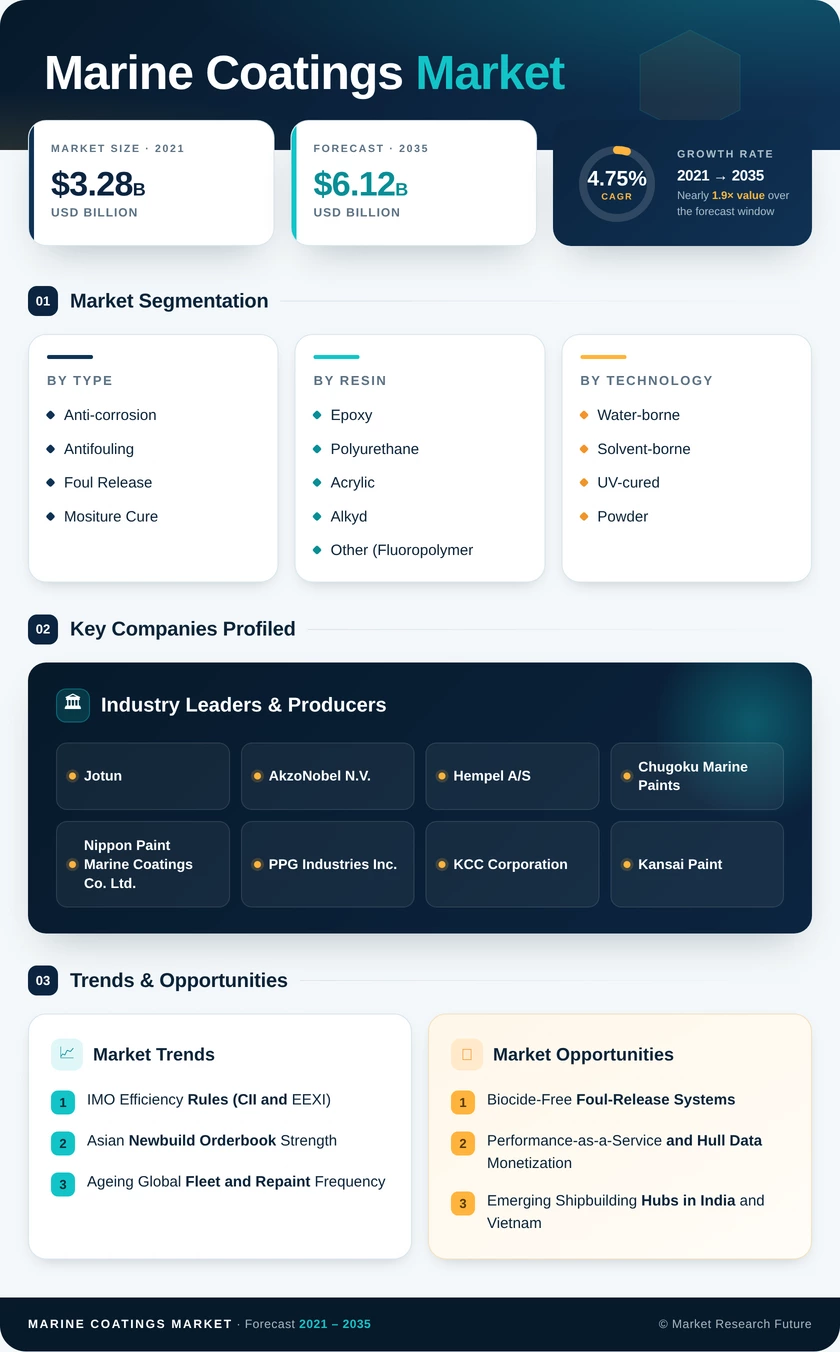
Marine coatings Market (2026 - 2035)

ID: MRFR/CnM/3905-HCR 139 Pages Chitranshi Jaiswal Last Updated: November 18, 2026
Marine Coatings Market Research Report Information By Type (Anti-Corrosion, Antifouling, Foul Release, and Moisture Cure), By Resin (Epoxy, Polyurethane, Acrylic, Alkyd, and Others), By Technology (Water-Borne, Solvent-Borne, UV-Cured, and Powder), By Application (Marine OEM and Marine Aftermarket), And By Region (North America, Europe, Asia-Pacific, and Rest of the World) – Market Forecast Till 2035.
Marine coatings Market
Market Size
Forecast Period2026-2035
CAGR (2026-2035)4.75%
2025 Market SizeUSD 3.86 Billion
2035 Market SizeUSD 6.12 Billion
Key Players
Jotun
AkzoNobel N.V.
Hempel A/S
Chugoku Marine Paints
Nippon Paint Marine Coatings Co. Ltd.
PPG Industries Inc.
Opportunities
  • Biocide-Free Foul-Release Systems
  • Performance-as-a-Service and Hull Data Monetization
  • Emerging Shipbuilding Hubs in India and Vietnam
  1. 1 Market Summary | |
  2. 2 Key Report Takeaways | |
    1. 2.1 By Type | |
    2. 2.2 By Resin | |
    3. 2.3 By Technology | |
    4. 2.4 By Application | |
    5. 2.5 By Region | |
  3. 3 Market Size and Forecast (2021–2035) | |
    1. 3.1 Historical Market Size (2021–2025) | |
    2. 3.2 Forecast Market Size (2026–2035) | |
    3. 3.3 Year-over-Year Growth Analysis | |
  4. 4 Driver Impact Analysis | |
    1. 4.1 IMO Efficiency Rules (CII and EEXI) | |
    2. 4.2 Asian Newbuild Orderbook Strength | |
    3. 4.3 Ageing Global Fleet and Repaint Frequency | |
    4. 4.4 EU Carbon Pricing and FuelEU Maritime | |
    5. 4.5 Biofouling Management and Biosecurity Rules | |
    6. 4.6 Offshore Wind and Energy Infrastructure | |
  5. 5 Restraints Impact Analysis | |
    1. 5.1 VOC Emission Limits and Compliance Costs | |
    2. 5.2 Biocide and PFAS Restrictions | |
    3. 5.3 Raw-Material Price Volatility | |
    4. 5.4 Skilled Applicator Shortages | |
    5. 5.5 Shipbuilding Cyclicality and Trade Disruption | |
  6. 6 Opportunities | |
    1. 6.1 Biocide-Free Foul-Release Systems | |
    2. 6.2 Performance-as-a-Service and Hull Data Monetization | |
    3. 6.3 Emerging Shipbuilding Hubs in India and Vietnam | |
    4. 6.4 Offshore Wind Coating Systems | |
    5. 6.5 Low-VOC Water-borne and UV-cured Systems | |
  7. 7 Regional Market Share and Country-Level Analysis | |
    1. 7.1 Asia Pacific | | |
      1. 7.1.1 China | | |
      2. 7.1.2 Japan | | |
      3. 7.1.3 South Korea | | |
      4. 7.1.4 India | | |
      5. 7.1.5 Malaysia | | |
      6. 7.1.6 Vietnam | | |
      7. 7.1.7 Rest of Asia Pacific | |
    2. 7.2 North America | | |
      1. 7.2.1 United States | | |
      2. 7.2.2 Canada | | |
      3. 7.2.3 Mexico | |
    3. 7.3 Europe | | |
      1. 7.3.1 Germany | | |
      2. 7.3.2 United Kingdom | | |
      3. 7.3.3 France | | |
      4. 7.3.4 Italy | | |
      5. 7.3.5 Spain | | |
      6. 7.3.6 Rest of Europe | |
    4. 7.4 South America | | |
      1. 7.4.1 Brazil | | |
      2. 7.4.2 Argentina | | |
      3. 7.4.3 Rest of South America | |
    5. 7.5 Middle East and Africa | | |
      1. 7.5.1 Saudi Arabia | | |
      2. 7.5.2 UAE | | |
      3. 7.5.3 South Africa | | |
      4. 7.5.4 Nigeria | | |
      5. 7.5.5 Rest of Middle east and Africa | |
  8. 8 Future Outlook (2026–2035) | |
    1. 8.1 Digital Hull Monitoring and AI-Driven Maintenance | |
    2. 8.2 Alternative-Fuel Fleet Renewal | |
    3. 8.3 ESG Reporting and Sustainable Chemistry | |
    4. 8.4 Biosecurity and Next-Generation Fouling Control | |
  9. 9 Segmentation Analysis | |
    1. 9.1 By Type | | |
      1. 9.1.1 Anti-corrosion | | |
      2. 9.1.2 Antifouling | | |
      3. 9.1.3 Foul Release | | |
      4. 9.1.4 Moisture Cure | |
    2. 9.2 By Resin | | |
      1. 9.2.1 Epoxy | | |
      2. 9.2.2 Polyurethane | | |
      3. 9.2.3 Acrylic | | |
      4. 9.2.4 Alkyd | | |
      5. 9.2.5 Other (Fluoropolymer, Polyester, etc) | |
    3. 9.3 By Technology | | |
      1. 9.3.1 Water-borne | | |
      2. 9.3.2 Solvent-borne | | |
      3. 9.3.3 UV-cured | | |
      4. 9.3.4 Powder | |
    4. 9.4 By Application | | |
      1. 9.4.1 Marine OEM | | |
      2. 9.4.2 Marine Aftermarket | |
  10. 10 Competitive Landscape | |
    1. 10.1 Market Concentration Analysis | |
    2. 10.2 Competitive Benchmarking Matrix | |
    3. 10.3 Company Profiles | | |
      1. 10.3.1 Jotun | | |
      2. 10.3.2 AkzoNobel N.V. | | |
      3. 10.3.3 Hempel A/S | | |
      4. 10.3.4 Chugoku Marine Paints | | |
      5. 10.3.5 Nippon Paint Marine Coatings Co. Ltd. | | |
      6. 10.3.6 PPG Industries Inc. | | |
      7. 10.3.7 KCC Corporation | | |
      8. 10.3.8 Kansai Paint | | |
      9. 10.3.9 Sherwin-Williams | | |
      10. 10.3.10 Boero Bartolomeo | |
  11. 11 Recent News & Developments | |
  12. 12 Report Scope and Methodology | |
  13. 13 Detailed Sources and Citations | |
  14. 14 Frequently Asked Questions (FAQs) | | LIST OF TABLES | |
  15. TABLE 1 Global Market Snapshot, 2025–2035 | |
  16. TABLE 2 Global Market Size & Forecast, by Value (USD Billion), 2021–2035 | |
  17. TABLE 3 Driver Impact Analysis | |
  18. TABLE 4 Restraints Impact Analysis | |
  19. TABLE 5 Regional Summary, 2025 | |
  20. TABLE 6 Asia Pacific Market, by Country, 2025 | |
  21. TABLE 7 North America Market, by Country, 2025 | |
  22. TABLE 8 Europe Market, by Country, 2025 | |
  23. TABLE 9 South America Market, by Country, 2025 | |
  24. TABLE 10 Middle East and Africa Market, by Country, 2025 | |
  25. TABLE 11 Global Market, by Type, 2025 | |
  26. TABLE 12 Global Market, by Resin, 2025 | |
  27. TABLE 13 Global Market, by Technology, 2025 | |
  28. TABLE 14 Global Market, by Application, 2025 | |
  29. TABLE 15 Competitive Benchmarking Matrix, 2025 | |
  30. TABLE 16 Report Scope and Methodology | |
  31. TABLE 17 Detailed Sources and Citations | |
  32. TABLE 18 Segmentation Quick Reference | | LIST OF FIGURES | |
  33. FIGURE 1 Market Dynamics Overview (Drivers, Restraints, Opportunities) | |
  34. FIGURE 2 Industry Value Chain Analysis | |
  35. FIGURE 3 Porter's Five Forces Analysis | |
  36. FIGURE 4 Global Market Size Trend, 2021–2035 (USD Billion) | |
  37. FIGURE 5 Market Share by Type, 2025 | |
  38. FIGURE 6 Market Share by Resin, 2025 | |
  39. FIGURE 7 Market Share by Technology, 2025 | |
  40. FIGURE 8 Market Share by Application, 2025 | |
  41. FIGURE 9 Regional Market Share, 2025 | |
  42. FIGURE 10 Asia Pacific Country Share, 2025 | |
  43. FIGURE 11 Competitive Landscape — Estimated Revenue Share Ranges, 2025 | |
  44. FIGURE 12 Market Concentration Analysis

Segmentation Quick Reference

DimensionSub-SegmentsDominant SegmentFastest Growing Segment
By TypeAnti-corrosion; Antifouling; Foul Release; Mositure CureAntifouling (44.0% share)Foul Release (5.1% CAGR)
By ResinEpoxy; Polyurethane; Acrylic; Alkyd; Other (Fluoropolymer, Polyester etc)Alkyd (51.0% share)Polyurethane (4.9% CAGR)
By TechnologyWater-borne; Solvent-borne; UV-cured; PowderSolvent-borne (85.5% share)UV-cured (4.85% CAGR)
By ApplicationMarine OEM; Marine AftermarketMarine OEM (54.5% share)Marine Aftermarket (5.6% CAGR)
By RegionAsia Pacific; North America; Europe; South America; Middle East and AfricaAsia Pacific (58.5% share)Asia Pacific (58.5% share)

Market Segmentation Overview

By Type

Sub-SegmentKey Trend
Anti-corrosionGrowing use in LNG containment and ballast tanks
AntifoulingCopper self-polishing remains the fleet default
Foul ReleaseBiocide-free silicone adoption for CII gains
Moisture CureHumidity-cured spot repairs in tight dockings

Antifouling leads the type dimension because copper self-polishing systems give slow-steaming bulk and tanker fleets dependable protection at low cost. Foul Release grows fastest as owners trade a higher upfront price for drag reduction that improves CII ratings and avoids biocide review risk. Anti-corrosion and Moisture Cure fill protective and fast-repair roles rather than competing for hull bottoms.

By Resin

Sub-SegmentKey Trend
EpoxyPrimer and immersion-zone standard
PolyurethaneLong-life gloss for cruise and yacht topsides
AcrylicExpanding with water-borne formulations
AlkydLow-cost decks and superstructures
Other (Fluoropolymer, Polyester etc)Chemical resistance under PFAS scrutiny

Alkyd leads on volume because it is cheap and easy to apply on decks and superstructures with legacy equipment. Polyurethane grows fastest because cruise operators specify long cosmetic durability on newbuild topsides. Epoxy keeps primers and immersion zones, while fluoropolymer grades within Other (Fluoropolymer, Polyester, etc.) face reformulation pressure from PFAS proposals.

By Technology

Sub-SegmentKey Trend
Water-borneVOC-driven adoption in regulated yards
Solvent-borneProven cure reliability in humid climates
UV-curedRapid-cure repairs that save dock days
PowderConfined to interior fittings

Solvent-borne systems lead because they cure reliably in humid Asian yards and suit large hull areas sprayed under time pressure. UV-cured coatings grow fastest by allowing one-day repair cycles that save expensive dock time. Water-borne adoption rises with VOC rules, while Powder stays limited by oven-curing needs.

By Application

Sub-SegmentKey Trend
Marine OEMFull coating stacks on record Asian newbuilds
Marine AftermarketEfficiency-driven repaints on an ageing fleet

Marine OEM leads because every newbuild from busy Chinese and Korean yards takes a full primer-to-topcoat system during block construction. Marine Aftermarket grows faster as an ageing fleet and annual CII ratings push owners into more frequent and higher-specification repaints.


Download PDF ×

We do not share your information with anyone. However, we may send you emails based on your report interest from time to time. You may contact us at any time to opt-out.