Request Free Sample ×

Kindly complete the form below to receive a free sample of this Report

* Please use a valid business email

Leading companies partner with us for data-driven Insights

clients tt-cursor
Hero Background
English
Chinese
French
Japanese
Korean
German
Spanish

Malabsorption Syndrome Market Share

ID: MRFR/Pharma/4014-HCR
85 Pages
Vikita Thakur
April 2026

Malabsorption Syndrome Market Trends And Share Analysis By Diagnosis (Tests, Imaging), Causative Diseases (Lactose Intolerance, Sprue, Cystic Fibrosis), Treatment (Gluten-Free Diet, Antidiarrheal Agents, Anti-Inflammatory Drugs), End User – Global Forecast Till 2035

Share:
Download PDF ×

We do not share your information with anyone. However, we may send you emails based on your report interest from time to time. You may contact us at any time to opt-out.

Malabsorption Syndrome Market Infographic
Purchase Options

Market Share

Malabsorption Syndrome Market Share Analysis

The market dynamics of Malabsorption Syndrome reflect a multifaceted landscape shaped by various factors that influence the diagnosis, treatment, and management of this gastrointestinal disorder. Malabsorption Syndrome is characterized by the inadequate absorption of nutrients in the small intestine, leading to a range of nutritional deficiencies and digestive challenges. One key driver of market dynamics is the increasing prevalence of gastrointestinal disorders and related conditions, raising awareness among healthcare professionals and patients alike. As the incidence of conditions such as celiac disease, Crohn's disease, and pancreatic insufficiency rises, the demand for effective diagnostic tools and therapeutic interventions for Malabsorption Syndrome follows suit.

Technological advancements in diagnostic modalities contribute significantly to the market dynamics of Malabsorption Syndrome. Innovations in imaging techniques, such as magnetic resonance enterography (MRE) and capsule endoscopy, enhance the accuracy and efficiency of diagnosing malabsorption-related disorders. These technological developments empower healthcare providers to identify the root causes of malabsorption, facilitating timely and targeted treatment strategies. The continuous evolution of diagnostic tools also underscores the commitment of the healthcare industry to improve patient outcomes and enhance the overall quality of care for individuals with Malabsorption Syndrome.

The pharmaceutical sector plays a crucial role in shaping the market dynamics of Malabsorption Syndrome, with a focus on developing therapeutic interventions to manage and alleviate symptoms. The advent of novel drugs and treatment options, including enzyme replacement therapies and innovative medications, addresses the specific challenges associated with malabsorption-related conditions. The pharmaceutical industry's response to the diverse needs of patients with Malabsorption Syndrome contributes to the overall growth and competitiveness of the market.

Another significant aspect of the market dynamics is the emphasis on personalized medicine and tailored treatment approaches. Recognizing the heterogeneity of Malabsorption Syndrome and its underlying causes, healthcare providers increasingly adopt personalized treatment plans that consider individual patient characteristics and responses. This trend fosters the development of targeted therapies, leading to better patient outcomes and improved quality of life for those affected by Malabsorption Syndrome.

Collaboration and partnerships between healthcare organizations, research institutions, and pharmaceutical companies are instrumental in advancing the understanding and management of Malabsorption Syndrome. These collaborative efforts promote knowledge exchange, facilitate clinical trials, and drive research initiatives aimed at developing innovative solutions. The synergy between different stakeholders in the healthcare ecosystem contributes to a more comprehensive and holistic approach to addressing the complexities of Malabsorption Syndrome.

Market dynamics are also influenced by the regulatory landscape governing the diagnosis and treatment of Malabsorption Syndrome. Adherence to stringent regulations ensures the safety and efficacy of diagnostic tests and therapeutic interventions. Regulatory frameworks guide the development and approval of new drugs, diagnostic devices, and treatment protocols, providing a framework for healthcare providers to navigate in their efforts to address Malabsorption Syndrome.

Economic factors, including healthcare spending and reimbursement policies, significantly impact the market dynamics of Malabsorption Syndrome. The economic feasibility of diagnostic tests, medications, and treatment options influences their accessibility and adoption within healthcare systems. As stakeholders seek cost-effective solutions that align with budgetary constraints, the market responds with a focus on delivering value-based care for individuals affected by Malabsorption Syndrome.


Author
Author Profile
Vikita Thakur
Senior Research Analyst

She holds an experience of about 5+ years in market research and business consulting projects for sectors such as life sciences, medical devices, and healthcare IT. She possesses a robust background in data analysis, market estimation, competitive intelligence, pipeline analysis market trend identification, and consumer behavior insights. Her expertise lies in technical Sales support, client interaction and project management, designing and implementing market research studies, conducting competitive analysis, and synthesizing complex data into actionable recommendations that drive business growth.

Leave a Comment

FAQs

What is the current valuation of the Malabsorption Syndrome Market?

<p>The Malabsorption Syndrome Market was valued at approximately 3044.32 USD Million in 2024.</p>

What is the projected market size for the Malabsorption Syndrome Market by 2035?

<p>The market is expected to reach around 5424.61 USD Million by 2035.</p>

What is the expected CAGR for the Malabsorption Syndrome Market during the forecast period?

<p>The anticipated CAGR for the Malabsorption Syndrome Market from 2025 to 2035 is 5.35%.</p>

Which companies are the key players in the Malabsorption Syndrome Market?

Key players include AbbVie, Takeda Pharmaceutical Company, Nestle Health Science, Danone, Johnson &amp; Johnson, Pfizer, Bristol-Myers Squibb, Merck &amp; Co., and Amgen.

What are the main types of malabsorption syndromes contributing to market growth?

<p>Celiac Disease, Lactose Intolerance, Pancreatic Insufficiency, and Short Bowel Syndrome are the primary types driving market performance.</p>

How does the market segment by symptoms affect its overall valuation?

The symptoms segment includes Diarrhea, Weight Loss, Abdominal Pain, and Bloating, with valuations ranging from 400.0 to 1200.0 USD Million.

What diagnostic methods are utilized in the Malabsorption Syndrome Market?

Diagnostic methods include Blood Tests, Stool Tests, Endoscopy, and Imaging Tests, with valuations between 500.0 and 1924.61 USD Million.

What treatment approaches are prevalent in the Malabsorption Syndrome Market?

Treatment approaches encompass Dietary Management, Enzyme Replacement Therapy, Medications, and Nutritional Supplements, with valuations from 744.32 to 1600.0 USD Million.

How does the market segment by age group influence its dynamics?

The age group segment includes Children, Adults, and the Elderly, with valuations ranging from 500.0 to 2500.0 USD Million.

What trends are expected to shape the Malabsorption Syndrome Market in the coming years?

Trends suggest a steady growth trajectory, driven by advancements in treatment options and increasing awareness of malabsorption syndromes.

Market Summary

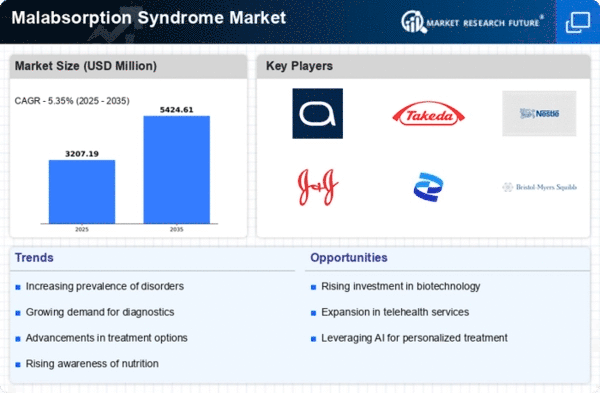
As per MRFR analysis, the Malabsorption Syndrome Market Size was estimated at 3044.32 USD Million in 2024. The Malabsorption Syndrome industry is projected to grow from 3242.08 USD Million in 2025 to 5424.61 USD Million by 2035, exhibiting a compound annual growth rate (CAGR) of 5.35% during the forecast period 2025 - 2035.

Key Market Trends & Highlights

The Malabsorption Syndrome Market is experiencing a dynamic shift towards personalized treatment and technological integration.

  • Rising awareness and diagnosis of malabsorption disorders are enhancing patient identification, particularly in North America. Personalized treatment approaches are gaining traction, especially for Celiac Disease, which remains the largest segment. The integration of technology in management is becoming increasingly prevalent, particularly in the Asia-Pacific region, which is the fastest-growing market. The increasing prevalence of malabsorption disorders and advancements in diagnostic techniques are driving market growth across various segments.

Market Size & Forecast

2024 Market Size 3044.32 (USD Million)
2035 Market Size 5424.61 (USD Million)
CAGR (2025 - 2035) 5.35%
Largest Regional Market Share in 2024 North America

Major Players

<a href="https://www.abbvie.com/patients/products.html">AbbVie</a> (US), Takeda Pharmaceutical Company Limited (JP), Nestle S.A. (CH), Johnson &amp; Johnson (US), Pfizer Inc. (US), Bristol-Myers Squibb Company (US), Merck &amp; Co., Inc. (US), Amgen Inc. (US), Sanofi (FR)

Market Trends

The Malabsorption Syndrome Market is currently experiencing notable developments, driven by a combination of increasing awareness regarding gastrointestinal disorders and advancements in diagnostic technologies, similar to innovation patterns seen in the global mammography market. As healthcare professionals gain a deeper understanding of malabsorption conditions, there is a growing emphasis on early detection and personalized treatment approaches. This shift is likely to enhance patient outcomes and improve quality of life for those affected by these syndromes. Furthermore, the integration of innovative therapies and nutritional interventions appears to be gaining traction, suggesting a potential transformation in management strategies within this market.

In addition, the Malabsorption Syndrome Market is influenced by the rising prevalence of related conditions, such as celiac disease and lactose intolerance. This trend indicates a need for more comprehensive treatment options and support systems for patients. The increasing focus on research and development, alongside collaborations between pharmaceutical companies and healthcare providers, may lead to the introduction of novel therapies, with regional advancements also aligning with developments in the india mammography market. Overall, the market seems poised for growth, with a strong emphasis on enhancing patient care and expanding therapeutic options.

Rising Awareness and Education

There is a growing recognition of malabsorption syndromes among healthcare professionals and the general public, mirroring awareness initiatives in the global mammography market. This trend is fostering better understanding and earlier diagnosis, which may lead to improved treatment outcomes.

Advancements in Diagnostic Technologies

Innovations in diagnostic tools are enhancing the ability to identify malabsorption syndromes more accurately and efficiently, similar to progress observed in the japan mammography market. These advancements could facilitate timely interventions and personalized treatment plans.

Integration of Nutritional Interventions

The incorporation of tailored nutritional strategies into treatment regimens is becoming more prevalent. This approach may help address the specific dietary needs of patients, potentially improving their overall health.

Malabsorption Syndrome Market Market Drivers

Increased Awareness and Education

The Global Malabsorption Syndrome Market Industry benefits from heightened awareness and education regarding malabsorption disorders. Campaigns by health organizations and patient advocacy groups are instrumental in informing the public about symptoms and treatment options. This increased awareness leads to more individuals seeking medical advice, resulting in higher diagnosis rates. As the market evolves, the focus on patient education is likely to enhance treatment adherence and improve health outcomes. The projected growth from 0.21 USD Billion in 2024 to 4.61 USD Billion by 2035 underscores the potential impact of awareness initiatives on market expansion.

Advancements in Diagnostic Technologies

Technological advancements in diagnostic tools are significantly impacting the Global Malabsorption Syndrome Market Industry. Innovations such as non-invasive tests, genetic screening, and advanced imaging techniques enhance the accuracy of diagnosing malabsorption syndromes. These improvements facilitate earlier detection and treatment, which is crucial for patient outcomes. As healthcare providers adopt these technologies, the market is expected to grow substantially. The anticipated CAGR of 32.42% from 2025 to 2035 indicates a robust expansion driven by enhanced diagnostic capabilities, ultimately leading to better management of malabsorption disorders.

Growing Demand for Nutritional Supplements

There is a growing demand for nutritional supplements tailored for individuals with malabsorption syndromes within the Global Malabsorption Syndrome Market Industry. Patients often require specialized diets and supplements to compensate for nutrient deficiencies caused by their conditions. As awareness of these dietary needs increases, manufacturers are developing innovative products to meet this demand. The market's expansion is reflected in the projected growth from 0.21 USD Billion in 2024 to 4.61 USD Billion by 2035. This trend indicates a shift towards personalized nutrition solutions, which are likely to play a crucial role in managing malabsorption disorders.

Regulatory Support for Treatment Innovations

Regulatory bodies are increasingly supportive of innovations in treatments for malabsorption syndromes, positively influencing the Global Malabsorption Syndrome Market Industry. Initiatives aimed at expediting the approval process for new therapies and nutritional products are emerging. This regulatory environment encourages research and development, fostering the introduction of novel treatment options. As the market evolves, the anticipated CAGR of 32.42% from 2025 to 2035 suggests that regulatory support will be a key driver of growth, enabling companies to bring effective solutions to patients more rapidly.

Rising Prevalence of Malabsorption Disorders

The Global Malabsorption Syndrome Market Industry is witnessing a notable increase in the prevalence of malabsorption disorders. Factors such as dietary changes, increased awareness, and improved diagnostic techniques contribute to this trend. For instance, conditions like celiac disease and lactose intolerance are becoming more recognized, leading to higher diagnosis rates. As of 2024, the market is valued at 0.21 USD Billion, reflecting the growing need for effective treatment options. This rise in prevalence is likely to drive demand for specialized therapies and nutritional products, thereby expanding the market further.

Market Segment Insights

By Type of Malabsorption Syndrome: Celiac Disease (Largest) vs. Lactose Intolerance (Fastest-Growing)

In the Malabsorption Syndrome Market, Celiac Disease holds the largest share due to its widespread recognition and diagnosis compared to other types. Lactose Intolerance, while significant, is experiencing a rapid growth trend as awareness increases regarding the condition and its symptoms. Both Pancreatic Insufficiency and Short Bowel Syndrome contribute to the overall market, yet they lag behind the former two in terms of share and recognition among healthcare providers and patients. The growth drivers for Celiac Disease are largely due to rising awareness among consumers and healthcare professionals, leading to increased testing and diagnosis rates. Lactose Intolerance is becoming an area of focus as more people become conscious about digestive health and adopt lactose-free diets. The overall trend shows a positive outlook for both conditions with advancements in dietary management and treatment options.

Celiac Disease (Dominant) vs. Lactose Intolerance (Emerging)

Celiac Disease is currently the dominant segment in the Malabsorption Syndrome market. This condition leads to significant intestinal damage when gluten is consumed, instigating a rising demand for gluten-free products and lifestyle changes among affected patients. On the other hand, Lactose Intolerance is emerging rapidly as a growing segment; it affects a considerable portion of the population and is often underestimated. With consumers increasingly seeking lactose-free alternatives in dairy products, there is a notable shift towards more options in the market. Although Celiac Disease is well-established, Lactose Intolerance is gaining traction due to the health conscious consumer base that values dietary inclusivity and variety.

By Symptoms: Diarrhea (Largest) vs. Weight Loss (Fastest-Growing)

The Malabsorption Syndrome market showcases a diverse array of symptoms with diarrhea holding the largest market share. This symptom, commonly linked to various digestive disorders, remains prevalent among patients leading to significant market representation. In contrast, weight loss emerges as a crucial symptom that is increasingly recognized for its severe impact on patient health, resulting in its rapid expansion within the market. This shift signifies changing awareness and diagnosis capabilities among healthcare providers, contributing to the observed distribution of market shares.

Diarrhea (Dominant) vs. Weight Loss (Emerging)

Diarrhea stands prominently as the dominant symptom in the Malabsorption Syndrome market, reflecting its immediate and distressing nature which drives patients to seek medical attention. This segment is characterized by various underlying conditions affecting nutrient absorption, leading to excretion of unabsorbed food materials. In contrast, weight loss, while considered an emerging category, is gaining recognition due to its significant implications on patient health and quality of life. It reflects chronic malabsorption scenarios and is frequently correlated with other serious health conditions. As healthcare providers enhance diagnostic techniques, the focus on the weight loss segment is anticipated to grow, affirming its position as a key player in future market dynamics.

By Diagnosis Method: Blood Tests (Largest) vs. Endoscopy (Fastest-Growing)

In the Malabsorption Syndrome Market, the Diagnosis Method segment is primarily dominated by Blood Tests, which are the most prevalent method for diagnosing malabsorption issues due to their non-invasive nature and broader acceptance among healthcare providers. Following Blood Tests, Stool Tests also hold a substantial market share as they provide critical insights about nutrient absorption, while Endoscopy and Imaging Tests are utilized less frequently, primarily in more complex cases or where detailed visualization is required. Growth trends within this segment indicate a significant increase in the adoption of Endoscopy as a diagnostic method for malabsorption syndrome, driven by advancements in technology and the ability to gather more accurate diagnostic information. Additionally, a growing awareness about digestive health and the importance of early diagnosis are contributing to the rising demand for various diagnostic methods, reflecting an evolving landscape where healthcare priorities shift towards patient-centric approaches and personalized medicine.

Blood Tests (Dominant) vs. Stool Tests (Emerging)

Blood Tests stand out as the dominant diagnostic method in the Malabsorption Syndrome Market, favored for their ability to efficiently assess various nutrient deficiencies and indicate possible malabsorption causes through a simple blood draw. They represent a cornerstone of diagnosis due to their non-invasive nature and rapid results. Conversely, Stool Tests are emerging as essential tools in this market space, providing deeper insight into gastrointestinal function and enabling healthcare professionals to detect malabsorption issues linked to specific malabsorption conditions. As advancements in testing technologies continue, Stool Tests are expected to grow in prominence, particularly among clinicians seeking comprehensive evaluations of their patients' digestive health.

By Treatment Approach: Dietary Management (Largest) vs. Enzyme Replacement Therapy (Fastest-Growing)

In the Malabsorption Syndrome Market, the primary treatment approaches include Dietary Management, Enzyme Replacement Therapy, Medications, and Nutritional Supplements. Dietary Management holds the largest share, as patients primarily focus on modifying their diets to manage symptoms effectively. Enzyme Replacement Therapy, though currently smaller in share, is recognized as the fastest growing segment, highlighting the increasing reliance on this therapy among healthcare providers and patients.

Dietary Management (Dominant) vs. Enzyme Replacement Therapy (Emerging)

Dietary Management is a dominant approach in the Malabsorption Syndrome Market, relying on tailored diets to alleviate symptoms and enhance nutrient absorption. This method is well-established, empowering patients to manage their condition through lifestyle changes. In contrast, Enzyme Replacement Therapy is emerging rapidly, driven by advancements in enzyme formulations that improve patient outcomes. This therapy offers a supplemental approach for those with specific enzyme deficiencies, showcasing a shift towards more targeted treatment options that align with personalized medicine trends in healthcare.

By Age Group: Children (Largest) vs. Elderly (Fastest-Growing)

The Malabsorption Syndrome Market showcases a distinct distribution among age groups. Children represent the largest segment, primarily due to childhood diseases and conditions that lead to malabsorption, such as celiac disease and cystic fibrosis. Adult patients also constitute a significant share, but their malabsorption issues stem largely from a variety of chronic diseases and dietary habits. In contrast, the elderly demographic is recognized as the fastest-growing segment in this market, driven by an increase in age-related gastrointestinal disorders and a greater awareness of malabsorption symptoms among older adults. Factors such as the growing geriatric population and advancements in diagnostic techniques further stimulate market growth in this segment, prompting healthcare providers to offer tailored solutions for effective management and support.

Children: Dominant vs. Elderly: Emerging

In the context of the Malabsorption Syndrome Market, children remain the dominant age group, primarily due to congenital and developmental conditions that make them vulnerable to malabsorption. Their market presence is further emphasized by the focus on pediatric healthcare and specialized treatment options available for this demographic. Meanwhile, the elderly population emerges as a significant segment, characterized by a rising incidence of malabsorption issues related to chronic illnesses such as diabetes and gastrointestinal disorders. This group is increasingly recognized for its unique healthcare needs, which include a focus on nutritional intake and management strategies that align with aging-related challenges. The growing awareness and demand for specific treatment protocols for this age group are reshaping service delivery in the market.

Get more detailed insights about Malabsorption Syndrome Market Research Report– Global Forecast till 2035

Regional Insights

North America : Market Leader in Innovation

North America is poised to maintain its leadership in the Malabsorption Syndrome market, holding a significant share of $1522.16M in 2024. The region's growth is driven by increasing awareness of gastrointestinal disorders, advancements in diagnostic technologies, and a robust healthcare infrastructure, similar to developments in the global mammography market. The region's growth is driven by increasing awareness of gastrointestinal disorders, advancements in diagnostic technologies, and a robust healthcare infrastructure. Regulatory support for innovative therapies further fuels demand, making it a key player in the global market. The United States stands out as the leading country, with major pharmaceutical companies like AbbVie, Johnson & Johnson, and Pfizer actively investing in research and development. The competitive landscape is characterized by a focus on personalized medicine and nutritional therapies, with key players striving to enhance treatment outcomes for patients suffering from malabsorption syndromes. The presence of established healthcare systems supports the rapid adoption of new therapies, ensuring continued market growth.

Europe : Emerging Market with Growth Potential

Europe's Malabsorption Syndrome market is valued at $1015.0M, reflecting a growing demand for effective treatments. Key growth drivers include an aging population, rising healthcare expenditure, and increased awareness of malabsorption disorders. Regulatory bodies are actively promoting research and development, which is expected to enhance market dynamics and patient access to innovative therapies. Leading countries such as Germany, France, and the UK are at the forefront of this market, with a competitive landscape featuring key players like Takeda and Nestle. The European market is characterized by a mix of established pharmaceutical companies and emerging biotech firms, all striving to address the unmet needs of patients suffering from malabsorption syndromes. "The European Medicines Agency is committed to ensuring that patients have access to safe and effective treatments for gastrointestinal disorders," stated a recent report.

Asia-Pacific : Rapidly Growing Healthcare Sector

The Asia-Pacific region is witnessing a burgeoning Malabsorption Syndrome market, projected to reach $405.0M by 2025. This growth is fueled by increasing awareness of malabsorption disorders, improving healthcare infrastructure, and rising disposable incomes, with notable parallels to the india mammography market and japan mammography market. Regulatory bodies are also enhancing support for innovative treatments, which is expected to drive market expansion in the coming years. Countries like Japan, China, and India are leading the charge, with a growing number of healthcare providers focusing on gastrointestinal health. The competitive landscape features both local and international players, including Takeda Pharmaceutical Company, who are investing in research to develop effective therapies. The region's diverse population and varying dietary habits present unique challenges and opportunities for tailored treatment solutions, making it a dynamic market for malabsorption therapies.

Middle East and Africa : Untapped Market Potential

The Middle East and Africa region, valued at $107.16M, presents significant growth potential in the Malabsorption Syndrome market. The region is experiencing an increase in healthcare investments, driven by government initiatives aimed at improving healthcare infrastructure and access. Rising awareness of malabsorption disorders is also contributing to market growth, as more patients seek diagnosis and treatment options. Countries such as South Africa and the UAE are emerging as key players in this market, with a growing number of healthcare facilities and pharmaceutical companies entering the space. The competitive landscape is evolving, with both local and international firms looking to capitalize on the increasing demand for effective treatments for malabsorption syndromes. The region's unique challenges also present opportunities for innovative solutions.

Key Players and Competitive Insights

The Malabsorption Syndrome Market is characterized by a competitive landscape that is increasingly shaped by innovation, strategic partnerships, and a focus on patient-centric solutions. Key players such as AbbVie (US), Takeda Pharmaceutical Company Limited (JP), and Nestle S.A. (CH) are actively engaged in enhancing their market positions through various strategic initiatives. AbbVie (US) has been focusing on expanding its product portfolio, particularly in the realm of gastrointestinal disorders, which aligns with the growing demand for specialized treatments. Meanwhile, Takeda Pharmaceutical Company Limited (JP) has been investing in research and development to innovate therapies that address the underlying causes of malabsorption, thereby enhancing its competitive edge. Nestle S.A. (CH) is leveraging its expertise in nutrition to develop specialized dietary products aimed at patients with malabsorption syndromes, indicating a trend towards holistic treatment approaches. The business tactics employed by these companies reflect a concerted effort to optimize supply chains and localize manufacturing processes. The Malabsorption Syndrome Market appears to be moderately fragmented, with a mix of established players and emerging companies vying for market share. The collective influence of these key players is significant, as they not only drive innovation but also set industry standards that smaller companies often follow. In November 2025, AbbVie (US) announced a strategic partnership with a leading biotechnology firm to co-develop a novel therapeutic agent targeting malabsorption syndromes. This collaboration is expected to enhance AbbVie’s research capabilities and accelerate the development of new treatments, thereby reinforcing its position in the market. The strategic importance of this partnership lies in its potential to bring innovative solutions to patients more rapidly, addressing unmet medical needs in this niche area. In October 2025, Takeda Pharmaceutical Company Limited (JP) launched a new clinical trial for a groundbreaking therapy aimed at treating malabsorption due to inflammatory bowel disease. This initiative underscores Takeda's commitment to addressing complex gastrointestinal disorders and reflects a broader trend towards personalized medicine. The trial's outcomes could significantly influence treatment protocols and establish Takeda as a leader in this therapeutic area. In September 2025, Nestle S.A. (CH) unveiled a new line of nutritional supplements specifically designed for individuals with malabsorption issues. This product launch not only diversifies Nestle's portfolio but also highlights the company's strategic focus on nutrition as a critical component of managing malabsorption syndromes. The introduction of these supplements is likely to enhance patient adherence to dietary recommendations, thereby improving overall health outcomes. As of December 2025, the competitive trends within the Malabsorption Syndrome Market are increasingly defined by digitalization, sustainability, and the integration of artificial intelligence (AI) in product development and patient management. Strategic alliances are becoming more prevalent, as companies recognize the value of collaboration in driving innovation and enhancing operational efficiencies. Looking ahead, competitive differentiation is expected to evolve from traditional price-based strategies to a focus on innovation, technological advancements, and supply chain reliability, positioning companies to better meet the complex needs of patients.

Key Companies in the Malabsorption Syndrome Market include

Industry Developments

  • Many of the key players of the market are adopting various initiatives such as product launches, advancements in equipment technology, and others. Moreover, they are investing a lot in the research and development of the market.

Future Outlook

Malabsorption Syndrome Market Future Outlook

The Malabsorption Syndrome Market is projected to grow at a 5.35% CAGR from 2025 to 2035, driven by increasing prevalence, advancements in diagnostics, and rising awareness.

New opportunities lie in:

  • <p>Development of personalized nutrition plans for patients Expansion of telehealth services for remote patient monitoring Investment in innovative drug delivery systems for enhanced treatment efficacy</p>

By 2035, the Malabsorption Syndrome Market is expected to achieve substantial growth and innovation.

Market Segmentation

Malabsorption Syndrome Market Symptoms Outlook

  • Diarrhea
  • Weight Loss
  • Abdominal Pain
  • Bloating

Malabsorption Syndrome Market Diagnosis Method Outlook

  • Blood Tests
  • Stool Tests
  • Endoscopy
  • Imaging Tests

Malabsorption Syndrome Market Treatment Approach Outlook

  • Dietary Management
  • Enzyme Replacement Therapy
  • Medications
  • Nutritional Supplements

Malabsorption Syndrome Market Type of Malabsorption Syndrome Outlook

  • Celiac Disease
  • Lactose Intolerance
  • Pancreatic Insufficiency
  • Short Bowel Syndrome

Report Scope

MARKET SIZE 2024 3044.32(USD Million)
MARKET SIZE 2025 3242.08(USD Million)
MARKET SIZE 2035 5424.61(USD Million)
COMPOUND ANNUAL GROWTH RATE (CAGR) 5.35% (2025 - 2035)
REPORT COVERAGE Revenue Forecast, Competitive Landscape, Growth Factors, and Trends
BASE YEAR 2024
Market Forecast Period 2025 - 2035
Historical Data 2019 - 2024
Market Forecast Units USD Million
Key Companies Profiled AbbVie (US), Takeda Pharmaceutical Company Limited (JP), Nestle S.A. (CH), Johnson & Johnson (US), Pfizer Inc. (US), Bristol-Myers Squibb Company (US), Merck & Co., Inc. (US), Amgen Inc. (US), Sanofi (FR)
Segments Covered Type of Malabsorption Syndrome, Symptoms, Diagnosis Method, Treatment Approach
Key Market Opportunities Advancements in diagnostic technologies enhance early detection and treatment options in the Malabsorption Syndrome Market.
Key Market Dynamics Rising prevalence of malabsorption disorders drives demand for innovative diagnostic and therapeutic solutions in the market.
Countries Covered North America, Europe, APAC, South America, MEA

FAQs

What is the current valuation of the Malabsorption Syndrome Market?

<p>The Malabsorption Syndrome Market was valued at approximately 3044.32 USD Million in 2024.</p>

What is the projected market size for the Malabsorption Syndrome Market by 2035?

<p>The market is expected to reach around 5424.61 USD Million by 2035.</p>

What is the expected CAGR for the Malabsorption Syndrome Market during the forecast period?

<p>The anticipated CAGR for the Malabsorption Syndrome Market from 2025 to 2035 is 5.35%.</p>

Which companies are the key players in the Malabsorption Syndrome Market?

Key players include AbbVie, Takeda Pharmaceutical Company, Nestle Health Science, Danone, Johnson &amp; Johnson, Pfizer, Bristol-Myers Squibb, Merck &amp; Co., and Amgen.

What are the main types of malabsorption syndromes contributing to market growth?

<p>Celiac Disease, Lactose Intolerance, Pancreatic Insufficiency, and Short Bowel Syndrome are the primary types driving market performance.</p>

How does the market segment by symptoms affect its overall valuation?

The symptoms segment includes Diarrhea, Weight Loss, Abdominal Pain, and Bloating, with valuations ranging from 400.0 to 1200.0 USD Million.

What diagnostic methods are utilized in the Malabsorption Syndrome Market?

Diagnostic methods include Blood Tests, Stool Tests, Endoscopy, and Imaging Tests, with valuations between 500.0 and 1924.61 USD Million.

What treatment approaches are prevalent in the Malabsorption Syndrome Market?

Treatment approaches encompass Dietary Management, Enzyme Replacement Therapy, Medications, and Nutritional Supplements, with valuations from 744.32 to 1600.0 USD Million.

How does the market segment by age group influence its dynamics?

The age group segment includes Children, Adults, and the Elderly, with valuations ranging from 500.0 to 2500.0 USD Million.

What trends are expected to shape the Malabsorption Syndrome Market in the coming years?

Trends suggest a steady growth trajectory, driven by advancements in treatment options and increasing awareness of malabsorption syndromes.

  1. SECTION I: EXECUTIVE SUMMARY AND KEY HIGHLIGHTS |
    1. EXECUTIVE SUMMARY | |
      1. Market Overview | |
      2. Key Findings | |
      3. Market Segmentation | |
      4. Competitive Landscape | |
      5. Challenges and Opportunities | |
      6. Future Outlook 2
  2. SECTION II: SCOPING, METHODOLOGY AND MARKET STRUCTURE |
    1. MARKET INTRODUCTION | |
      1. Definition | |
      2. Scope of the study | | |
    2. RESEARCH METHODOLOGY | |
      1. Overview | |
      2. Data Mining | |
      3. Secondary Research | |
      4. Primary Research | | |
      5. Forecasting Model | |
      6. Market Size Estimation | | |
      7. Data Triangulation | |
      8. Validation 3
  3. SECTION III: QUALITATIVE ANALYSIS |
    1. MARKET DYNAMICS | |
      1. Overview | |
      2. Drivers | |
      3. Restraints | |
      4. Opportunities |
    2. MARKET FACTOR ANALYSIS | |
      1. Value chain Analysis | |
      2. Porter's Five Forces Analysis | | |
      3. COVID-19 Impact Analysis | | |
  4. SECTION IV: QUANTITATIVE ANALYSIS |
    1. Healthcare, BY Type of Malabsorption Syndrome (USD Million) | |
      1. Celiac Disease | |
      2. Lactose Intolerance | |
      3. Pancreatic Insufficiency | |
      4. Short Bowel Syndrome |
    2. Healthcare, BY Symptoms (USD Million) | |
      1. Diarrhea | |
      2. Weight Loss | |
      3. Abdominal Pain | |
      4. Bloating |
    3. Healthcare, BY Diagnosis Method (USD Million) | |
      1. Blood Tests | |
      2. Stool Tests | |
      3. Endoscopy | |
      4. Imaging Tests |
    4. Healthcare, BY Treatment Approach (USD Million) | |
      1. Dietary Management | |
      2. Enzyme Replacement Therapy | |
      3. Medications | |
      4. Nutritional Supplements |
    5. Healthcare, BY Age Group (USD Million) | |
      1. Children | |
      2. Adults | |
      3. Elderly |
    6. Healthcare, BY Region (USD Million) | |
      1. North America | | |
      2. Europe | | |
      3. APAC | | |
      4. South America | | |
      5. MEA | | |
  5. SECTION V: COMPETITIVE ANALYSIS |
    1. Competitive Landscape | |
      1. Overview | |
      2. Competitive Analysis | |
      3. Market share Analysis | |
      4. Major Growth Strategy in the Healthcare | |
      5. Competitive Benchmarking | |
      6. Leading Players in Terms of Number of Developments in the Healthcare | |
      7. Key developments and growth strategies | | |
      8. Major Players Financial Matrix | | |
    2. Company Profiles | |
      1. AbbVie (US) | | |
      2. Takeda Pharmaceutical Company (JP) | | |
      3. Nestle Health Science (CH) | | |
      4. Danone (FR) | | |
      5. Johnson & Johnson (US) | | |
      6. Pfizer (US) | | |
      7. Bristol-Myers Squibb (US) | | |
      8. Merck & Co. (US) | | |
      9. Amgen (US) | | |
    3. Appendix | |
      1. References | |
      2. Related Reports 6 LIST OF FIGURES |
    4. MARKET SYNOPSIS |
    5. NORTH AMERICA MARKET ANALYSIS |
    6. US MARKET ANALYSIS BY TYPE OF MALABSORPTION SYNDROME |
    7. US MARKET ANALYSIS BY SYMPTOMS |
    8. US MARKET ANALYSIS BY DIAGNOSIS METHOD |
    9. US MARKET ANALYSIS BY TREATMENT APPROACH |
    10. US MARKET ANALYSIS BY AGE GROUP |
    11. CANADA MARKET ANALYSIS BY TYPE OF MALABSORPTION SYNDROME |
    12. CANADA MARKET ANALYSIS BY SYMPTOMS |
    13. CANADA MARKET ANALYSIS BY DIAGNOSIS METHOD |
    14. CANADA MARKET ANALYSIS BY TREATMENT APPROACH |
    15. CANADA MARKET ANALYSIS BY AGE GROUP |
    16. EUROPE MARKET ANALYSIS |
    17. GERMANY MARKET ANALYSIS BY TYPE OF MALABSORPTION SYNDROME |
    18. GERMANY MARKET ANALYSIS BY SYMPTOMS |
    19. GERMANY MARKET ANALYSIS BY DIAGNOSIS METHOD |
    20. GERMANY MARKET ANALYSIS BY TREATMENT APPROACH |
    21. GERMANY MARKET ANALYSIS BY AGE GROUP |
    22. UK MARKET ANALYSIS BY TYPE OF MALABSORPTION SYNDROME |
    23. UK MARKET ANALYSIS BY SYMPTOMS |
    24. UK MARKET ANALYSIS BY DIAGNOSIS METHOD |
    25. UK MARKET ANALYSIS BY TREATMENT APPROACH |
    26. UK MARKET ANALYSIS BY AGE GROUP |
    27. FRANCE MARKET ANALYSIS BY TYPE OF MALABSORPTION SYNDROME |
    28. FRANCE MARKET ANALYSIS BY SYMPTOMS |
    29. FRANCE MARKET ANALYSIS BY DIAGNOSIS METHOD |
    30. FRANCE MARKET ANALYSIS BY TREATMENT APPROACH |
    31. FRANCE MARKET ANALYSIS BY AGE GROUP |
    32. RUSSIA MARKET ANALYSIS BY TYPE OF MALABSORPTION SYNDROME |
    33. RUSSIA MARKET ANALYSIS BY SYMPTOMS |
    34. RUSSIA MARKET ANALYSIS BY DIAGNOSIS METHOD |
    35. RUSSIA MARKET ANALYSIS BY TREATMENT APPROACH |
    36. RUSSIA MARKET ANALYSIS BY AGE GROUP |
    37. ITALY MARKET ANALYSIS BY TYPE OF MALABSORPTION SYNDROME |
    38. ITALY MARKET ANALYSIS BY SYMPTOMS |
    39. ITALY MARKET ANALYSIS BY DIAGNOSIS METHOD |
    40. ITALY MARKET ANALYSIS BY TREATMENT APPROACH |
    41. ITALY MARKET ANALYSIS BY AGE GROUP |
    42. SPAIN MARKET ANALYSIS BY TYPE OF MALABSORPTION SYNDROME |
    43. SPAIN MARKET ANALYSIS BY SYMPTOMS |
    44. SPAIN MARKET ANALYSIS BY DIAGNOSIS METHOD |
    45. SPAIN MARKET ANALYSIS BY TREATMENT APPROACH |
    46. SPAIN MARKET ANALYSIS BY AGE GROUP |
    47. REST OF EUROPE MARKET ANALYSIS BY TYPE OF MALABSORPTION SYNDROME |
    48. REST OF EUROPE MARKET ANALYSIS BY SYMPTOMS |
    49. REST OF EUROPE MARKET ANALYSIS BY DIAGNOSIS METHOD |
    50. REST OF EUROPE MARKET ANALYSIS BY TREATMENT APPROACH |
    51. REST OF EUROPE MARKET ANALYSIS BY AGE GROUP |
    52. APAC MARKET ANALYSIS |
    53. CHINA MARKET ANALYSIS BY TYPE OF MALABSORPTION SYNDROME |
    54. CHINA MARKET ANALYSIS BY SYMPTOMS |
    55. CHINA MARKET ANALYSIS BY DIAGNOSIS METHOD |
    56. CHINA MARKET ANALYSIS BY TREATMENT APPROACH |
    57. CHINA MARKET ANALYSIS BY AGE GROUP |
    58. INDIA MARKET ANALYSIS BY TYPE OF MALABSORPTION SYNDROME |
    59. INDIA MARKET ANALYSIS BY SYMPTOMS |
    60. INDIA MARKET ANALYSIS BY DIAGNOSIS METHOD |
    61. INDIA MARKET ANALYSIS BY TREATMENT APPROACH |
    62. INDIA MARKET ANALYSIS BY AGE GROUP |
    63. JAPAN MARKET ANALYSIS BY TYPE OF MALABSORPTION SYNDROME |
    64. JAPAN MARKET ANALYSIS BY SYMPTOMS |
    65. JAPAN MARKET ANALYSIS BY DIAGNOSIS METHOD |
    66. JAPAN MARKET ANALYSIS BY TREATMENT APPROACH |
    67. JAPAN MARKET ANALYSIS BY AGE GROUP |
    68. SOUTH KOREA MARKET ANALYSIS BY TYPE OF MALABSORPTION SYNDROME |
    69. SOUTH KOREA MARKET ANALYSIS BY SYMPTOMS |
    70. SOUTH KOREA MARKET ANALYSIS BY DIAGNOSIS METHOD |
    71. SOUTH KOREA MARKET ANALYSIS BY TREATMENT APPROACH |
    72. SOUTH KOREA MARKET ANALYSIS BY AGE GROUP |
    73. MALAYSIA MARKET ANALYSIS BY TYPE OF MALABSORPTION SYNDROME |
    74. MALAYSIA MARKET ANALYSIS BY SYMPTOMS |
    75. MALAYSIA MARKET ANALYSIS BY DIAGNOSIS METHOD |
    76. MALAYSIA MARKET ANALYSIS BY TREATMENT APPROACH |
    77. MALAYSIA MARKET ANALYSIS BY AGE GROUP |
    78. THAILAND MARKET ANALYSIS BY TYPE OF MALABSORPTION SYNDROME |
    79. THAILAND MARKET ANALYSIS BY SYMPTOMS |
    80. THAILAND MARKET ANALYSIS BY DIAGNOSIS METHOD |
    81. THAILAND MARKET ANALYSIS BY TREATMENT APPROACH |
    82. THAILAND MARKET ANALYSIS BY AGE GROUP |
    83. INDONESIA MARKET ANALYSIS BY TYPE OF MALABSORPTION SYNDROME |
    84. INDONESIA MARKET ANALYSIS BY SYMPTOMS |
    85. INDONESIA MARKET ANALYSIS BY DIAGNOSIS METHOD |
    86. INDONESIA MARKET ANALYSIS BY TREATMENT APPROACH |
    87. INDONESIA MARKET ANALYSIS BY AGE GROUP |
    88. REST OF APAC MARKET ANALYSIS BY TYPE OF MALABSORPTION SYNDROME |
    89. REST OF APAC MARKET ANALYSIS BY SYMPTOMS |
    90. REST OF APAC MARKET ANALYSIS BY DIAGNOSIS METHOD |
    91. REST OF APAC MARKET ANALYSIS BY TREATMENT APPROACH |
    92. REST OF APAC MARKET ANALYSIS BY AGE GROUP |
    93. SOUTH AMERICA MARKET ANALYSIS |
    94. BRAZIL MARKET ANALYSIS BY TYPE OF MALABSORPTION SYNDROME |
    95. BRAZIL MARKET ANALYSIS BY SYMPTOMS |
    96. BRAZIL MARKET ANALYSIS BY DIAGNOSIS METHOD |
    97. BRAZIL MARKET ANALYSIS BY TREATMENT APPROACH |
    98. BRAZIL MARKET ANALYSIS BY AGE GROUP |
    99. MEXICO MARKET ANALYSIS BY TYPE OF MALABSORPTION SYNDROME |
    100. MEXICO MARKET ANALYSIS BY SYMPTOMS |
    101. MEXICO MARKET ANALYSIS BY DIAGNOSIS METHOD |
    102. MEXICO MARKET ANALYSIS BY TREATMENT APPROACH |
    103. MEXICO MARKET ANALYSIS BY AGE GROUP |
    104. ARGENTINA MARKET ANALYSIS BY TYPE OF MALABSORPTION SYNDROME |
    105. ARGENTINA MARKET ANALYSIS BY SYMPTOMS |
    106. ARGENTINA MARKET ANALYSIS BY DIAGNOSIS METHOD |
    107. ARGENTINA MARKET ANALYSIS BY TREATMENT APPROACH |
    108. ARGENTINA MARKET ANALYSIS BY AGE GROUP |
    109. REST OF SOUTH AMERICA MARKET ANALYSIS BY TYPE OF MALABSORPTION SYNDROME |
    110. REST OF SOUTH AMERICA MARKET ANALYSIS BY SYMPTOMS |
    111. REST OF SOUTH AMERICA MARKET ANALYSIS BY DIAGNOSIS METHOD |
    112. REST OF SOUTH AMERICA MARKET ANALYSIS BY TREATMENT APPROACH |
    113. REST OF SOUTH AMERICA MARKET ANALYSIS BY AGE GROUP |
    114. MEA MARKET ANALYSIS |
    115. GCC COUNTRIES MARKET ANALYSIS BY TYPE OF MALABSORPTION SYNDROME |
    116. GCC COUNTRIES MARKET ANALYSIS BY SYMPTOMS |
    117. GCC COUNTRIES MARKET ANALYSIS BY DIAGNOSIS METHOD |
    118. GCC COUNTRIES MARKET ANALYSIS BY TREATMENT APPROACH |
    119. GCC COUNTRIES MARKET ANALYSIS BY AGE GROUP |
    120. SOUTH AFRICA MARKET ANALYSIS BY TYPE OF MALABSORPTION SYNDROME |
    121. SOUTH AFRICA MARKET ANALYSIS BY SYMPTOMS |
    122. SOUTH AFRICA MARKET ANALYSIS BY DIAGNOSIS METHOD |
    123. SOUTH AFRICA MARKET ANALYSIS BY TREATMENT APPROACH |
    124. SOUTH AFRICA MARKET ANALYSIS BY AGE GROUP |
    125. REST OF MEA MARKET ANALYSIS BY TYPE OF MALABSORPTION SYNDROME |
    126. REST OF MEA MARKET ANALYSIS BY SYMPTOMS |
    127. REST OF MEA MARKET ANALYSIS BY DIAGNOSIS METHOD |
    128. REST OF MEA MARKET ANALYSIS BY TREATMENT APPROACH |
    129. REST OF MEA MARKET ANALYSIS BY AGE GROUP |
    130. KEY BUYING CRITERIA OF HEALTHCARE |
    131. RESEARCH PROCESS OF MRFR |
    132. DRO ANALYSIS OF HEALTHCARE |
    133. DRIVERS IMPACT ANALYSIS: HEALTHCARE |
    134. RESTRAINTS IMPACT ANALYSIS: HEALTHCARE |
    135. SUPPLY / VALUE CHAIN: HEALTHCARE |
    136. HEALTHCARE, BY TYPE OF MALABSORPTION SYNDROME, 2024 (% SHARE) |
    137. HEALTHCARE, BY TYPE OF MALABSORPTION SYNDROME, 2024 TO 2035 (USD Million) |
    138. HEALTHCARE, BY SYMPTOMS, 2024 (% SHARE) |
    139. HEALTHCARE, BY SYMPTOMS, 2024 TO 2035 (USD Million) |
    140. HEALTHCARE, BY DIAGNOSIS METHOD, 2024 (% SHARE) |
    141. HEALTHCARE, BY DIAGNOSIS METHOD, 2024 TO 2035 (USD Million) |
    142. HEALTHCARE, BY TREATMENT APPROACH, 2024 (% SHARE) |
    143. HEALTHCARE, BY TREATMENT APPROACH, 2024 TO 2035 (USD Million) |
    144. HEALTHCARE, BY AGE GROUP, 2024 (% SHARE) |
    145. HEALTHCARE, BY AGE GROUP, 2024 TO 2035 (USD Million) |
    146. BENCHMARKING OF MAJOR COMPETITORS 7 LIST OF TABLES |
    147. LIST OF ASSUMPTIONS | |
      1. |
    148. North America MARKET SIZE ESTIMATES; FORECAST | |
      1. BY TYPE OF MALABSORPTION SYNDROME, 2025-2035 (USD Million) | |
      2. BY SYMPTOMS, 2025-2035 (USD Million) | |
      3. BY DIAGNOSIS METHOD, 2025-2035 (USD Million) | |
      4. BY TREATMENT APPROACH, 2025-2035 (USD Million) | |
      5. BY AGE GROUP, 2025-2035 (USD Million) |
    149. US MARKET SIZE ESTIMATES; FORECAST | |
      1. BY TYPE OF MALABSORPTION SYNDROME, 2025-2035 (USD Million) | |
      2. BY SYMPTOMS, 2025-2035 (USD Million) | |
      3. BY DIAGNOSIS METHOD, 2025-2035 (USD Million) | |
      4. BY TREATMENT APPROACH, 2025-2035 (USD Million) | |
      5. BY AGE GROUP, 2025-2035 (USD Million) |
    150. Canada MARKET SIZE ESTIMATES; FORECAST | |
      1. BY TYPE OF MALABSORPTION SYNDROME, 2025-2035 (USD Million) | |
      2. BY SYMPTOMS, 2025-2035 (USD Million) | |
      3. BY DIAGNOSIS METHOD, 2025-2035 (USD Million) | |
      4. BY TREATMENT APPROACH, 2025-2035 (USD Million) | |
      5. BY AGE GROUP, 2025-2035 (USD Million) |
    151. Europe MARKET SIZE ESTIMATES; FORECAST | |
      1. BY TYPE OF MALABSORPTION SYNDROME, 2025-2035 (USD Million) | |
      2. BY SYMPTOMS, 2025-2035 (USD Million) | |
      3. BY DIAGNOSIS METHOD, 2025-2035 (USD Million) | |
      4. BY TREATMENT APPROACH, 2025-2035 (USD Million) | |
      5. BY AGE GROUP, 2025-2035 (USD Million) |
    152. Germany MARKET SIZE ESTIMATES; FORECAST | |
      1. BY TYPE OF MALABSORPTION SYNDROME, 2025-2035 (USD Million) | |
      2. BY SYMPTOMS, 2025-2035 (USD Million) | |
      3. BY DIAGNOSIS METHOD, 2025-2035 (USD Million) | |
      4. BY TREATMENT APPROACH, 2025-2035 (USD Million) | |
      5. BY AGE GROUP, 2025-2035 (USD Million) |
    153. UK MARKET SIZE ESTIMATES; FORECAST | |
      1. BY TYPE OF MALABSORPTION SYNDROME, 2025-2035 (USD Million) | |
      2. BY SYMPTOMS, 2025-2035 (USD Million) | |
      3. BY DIAGNOSIS METHOD, 2025-2035 (USD Million) | |
      4. BY TREATMENT APPROACH, 2025-2035 (USD Million) | |
      5. BY AGE GROUP, 2025-2035 (USD Million) |
    154. France MARKET SIZE ESTIMATES; FORECAST | |
      1. BY TYPE OF MALABSORPTION SYNDROME, 2025-2035 (USD Million) | |
      2. BY SYMPTOMS, 2025-2035 (USD Million) | |
      3. BY DIAGNOSIS METHOD, 2025-2035 (USD Million) | |
      4. BY TREATMENT APPROACH, 2025-2035 (USD Million) | |
      5. BY AGE GROUP, 2025-2035 (USD Million) |
    155. Russia MARKET SIZE ESTIMATES; FORECAST | |
      1. BY TYPE OF MALABSORPTION SYNDROME, 2025-2035 (USD Million) | |
      2. BY SYMPTOMS, 2025-2035 (USD Million) | |
      3. BY DIAGNOSIS METHOD, 2025-2035 (USD Million) | |
      4. BY TREATMENT APPROACH, 2025-2035 (USD Million) | |
      5. BY AGE GROUP, 2025-2035 (USD Million) |
    156. Italy MARKET SIZE ESTIMATES; FORECAST | |
      1. BY TYPE OF MALABSORPTION SYNDROME, 2025-2035 (USD Million) | |
      2. BY SYMPTOMS, 2025-2035 (USD Million) | |
      3. BY DIAGNOSIS METHOD, 2025-2035 (USD Million) | |
      4. BY TREATMENT APPROACH, 2025-2035 (USD Million) | |
      5. BY AGE GROUP, 2025-2035 (USD Million) |
    157. Spain MARKET SIZE ESTIMATES; FORECAST | |
      1. BY TYPE OF MALABSORPTION SYNDROME, 2025-2035 (USD Million) | |
      2. BY SYMPTOMS, 2025-2035 (USD Million) | |
      3. BY DIAGNOSIS METHOD, 2025-2035 (USD Million) | |
      4. BY TREATMENT APPROACH, 2025-2035 (USD Million) | |
      5. BY AGE GROUP, 2025-2035 (USD Million) |
    158. Rest of Europe MARKET SIZE ESTIMATES; FORECAST | |
      1. BY TYPE OF MALABSORPTION SYNDROME, 2025-2035 (USD Million) | |
      2. BY SYMPTOMS, 2025-2035 (USD Million) | |
      3. BY DIAGNOSIS METHOD, 2025-2035 (USD Million) | |
      4. BY TREATMENT APPROACH, 2025-2035 (USD Million) | |
      5. BY AGE GROUP, 2025-2035 (USD Million) |
    159. APAC MARKET SIZE ESTIMATES; FORECAST | |
      1. BY TYPE OF MALABSORPTION SYNDROME, 2025-2035 (USD Million) | |
      2. BY SYMPTOMS, 2025-2035 (USD Million) | |
      3. BY DIAGNOSIS METHOD, 2025-2035 (USD Million) | |
      4. BY TREATMENT APPROACH, 2025-2035 (USD Million) | |
      5. BY AGE GROUP, 2025-2035 (USD Million) |
    160. China MARKET SIZE ESTIMATES; FORECAST | |
      1. BY TYPE OF MALABSORPTION SYNDROME, 2025-2035 (USD Million) | |
      2. BY SYMPTOMS, 2025-2035 (USD Million) | |
      3. BY DIAGNOSIS METHOD, 2025-2035 (USD Million) | |
      4. BY TREATMENT APPROACH, 2025-2035 (USD Million) | |
      5. BY AGE GROUP, 2025-2035 (USD Million) |
    161. India MARKET SIZE ESTIMATES; FORECAST | |
      1. BY TYPE OF MALABSORPTION SYNDROME, 2025-2035 (USD Million) | |
      2. BY SYMPTOMS, 2025-2035 (USD Million) | |
      3. BY DIAGNOSIS METHOD, 2025-2035 (USD Million) | |
      4. BY TREATMENT APPROACH, 2025-2035 (USD Million) | |
      5. BY AGE GROUP, 2025-2035 (USD Million) |
    162. Japan MARKET SIZE ESTIMATES; FORECAST | |
      1. BY TYPE OF MALABSORPTION SYNDROME, 2025-2035 (USD Million) | |
      2. BY SYMPTOMS, 2025-2035 (USD Million) | |
      3. BY DIAGNOSIS METHOD, 2025-2035 (USD Million) | |
      4. BY TREATMENT APPROACH, 2025-2035 (USD Million) | |
      5. BY AGE GROUP, 2025-2035 (USD Million) |
    163. South Korea MARKET SIZE ESTIMATES; FORECAST | |
      1. BY TYPE OF MALABSORPTION SYNDROME, 2025-2035 (USD Million) | |
      2. BY SYMPTOMS, 2025-2035 (USD Million) | |
      3. BY DIAGNOSIS METHOD, 2025-2035 (USD Million) | |
      4. BY TREATMENT APPROACH, 2025-2035 (USD Million) | |
      5. BY AGE GROUP, 2025-2035 (USD Million) |
    164. Malaysia MARKET SIZE ESTIMATES; FORECAST | |
      1. BY TYPE OF MALABSORPTION SYNDROME, 2025-2035 (USD Million) | |
      2. BY SYMPTOMS, 2025-2035 (USD Million) | |
      3. BY DIAGNOSIS METHOD, 2025-2035 (USD Million) | |
      4. BY TREATMENT APPROACH, 2025-2035 (USD Million) | |
      5. BY AGE GROUP, 2025-2035 (USD Million) |
    165. Thailand MARKET SIZE ESTIMATES; FORECAST | |
      1. BY TYPE OF MALABSORPTION SYNDROME, 2025-2035 (USD Million) | |
      2. BY SYMPTOMS, 2025-2035 (USD Million) | |
      3. BY DIAGNOSIS METHOD, 2025-2035 (USD Million) | |
      4. BY TREATMENT APPROACH, 2025-2035 (USD Million) | |
      5. BY AGE GROUP, 2025-2035 (USD Million) |
    166. Indonesia MARKET SIZE ESTIMATES; FORECAST | |
      1. BY TYPE OF MALABSORPTION SYNDROME, 2025-2035 (USD Million) | |
      2. BY SYMPTOMS, 2025-2035 (USD Million) | |
      3. BY DIAGNOSIS METHOD, 2025-2035 (USD Million) | |
      4. BY TREATMENT APPROACH, 2025-2035 (USD Million) | |
      5. BY AGE GROUP, 2025-2035 (USD Million) |
    167. Rest of APAC MARKET SIZE ESTIMATES; FORECAST | |
      1. BY TYPE OF MALABSORPTION SYNDROME, 2025-2035 (USD Million) | |
      2. BY SYMPTOMS, 2025-2035 (USD Million) | |
      3. BY DIAGNOSIS METHOD, 2025-2035 (USD Million) | |
      4. BY TREATMENT APPROACH, 2025-2035 (USD Million) | |
      5. BY AGE GROUP, 2025-2035 (USD Million) |
    168. South America MARKET SIZE ESTIMATES; FORECAST | |
      1. BY TYPE OF MALABSORPTION SYNDROME, 2025-2035 (USD Million) | |
      2. BY SYMPTOMS, 2025-2035 (USD Million) | |
      3. BY DIAGNOSIS METHOD, 2025-2035 (USD Million) | |
      4. BY TREATMENT APPROACH, 2025-2035 (USD Million) | |
      5. BY AGE GROUP, 2025-2035 (USD Million) |
    169. Brazil MARKET SIZE ESTIMATES; FORECAST | |
      1. BY TYPE OF MALABSORPTION SYNDROME, 2025-2035 (USD Million) | |
      2. BY SYMPTOMS, 2025-2035 (USD Million) | |
      3. BY DIAGNOSIS METHOD, 2025-2035 (USD Million) | |
      4. BY TREATMENT APPROACH, 2025-2035 (USD Million) | |
      5. BY AGE GROUP, 2025-2035 (USD Million) |
    170. Mexico MARKET SIZE ESTIMATES; FORECAST | |
      1. BY TYPE OF MALABSORPTION SYNDROME, 2025-2035 (USD Million) | |
      2. BY SYMPTOMS, 2025-2035 (USD Million) | |
      3. BY DIAGNOSIS METHOD, 2025-2035 (USD Million) | |
      4. BY TREATMENT APPROACH, 2025-2035 (USD Million) | |
      5. BY AGE GROUP, 2025-2035 (USD Million) |
    171. Argentina MARKET SIZE ESTIMATES; FORECAST | |
      1. BY TYPE OF MALABSORPTION SYNDROME, 2025-2035 (USD Million) | |
      2. BY SYMPTOMS, 2025-2035 (USD Million) | |
      3. BY DIAGNOSIS METHOD, 2025-2035 (USD Million) | |
      4. BY TREATMENT APPROACH, 2025-2035 (USD Million) | |
      5. BY AGE GROUP, 2025-2035 (USD Million) |
    172. Rest of South America MARKET SIZE ESTIMATES; FORECAST | |
      1. BY TYPE OF MALABSORPTION SYNDROME, 2025-2035 (USD Million) | |
      2. BY SYMPTOMS, 2025-2035 (USD Million) | |
      3. BY DIAGNOSIS METHOD, 2025-2035 (USD Million) | |
      4. BY TREATMENT APPROACH, 2025-2035 (USD Million) | |
      5. BY AGE GROUP, 2025-2035 (USD Million) |
    173. MEA MARKET SIZE ESTIMATES; FORECAST | |
      1. BY TYPE OF MALABSORPTION SYNDROME, 2025-2035 (USD Million) | |
      2. BY SYMPTOMS, 2025-2035 (USD Million) | |
      3. BY DIAGNOSIS METHOD, 2025-2035 (USD Million) | |
      4. BY TREATMENT APPROACH, 2025-2035 (USD Million) | |
      5. BY AGE GROUP, 2025-2035 (USD Million) |
    174. GCC Countries MARKET SIZE ESTIMATES; FORECAST | |
      1. BY TYPE OF MALABSORPTION SYNDROME, 2025-2035 (USD Million) | |
      2. BY SYMPTOMS, 2025-2035 (USD Million) | |
      3. BY DIAGNOSIS METHOD, 2025-2035 (USD Million) | |
      4. BY TREATMENT APPROACH, 2025-2035 (USD Million) | |
      5. BY AGE GROUP, 2025-2035 (USD Million) |
    175. South Africa MARKET SIZE ESTIMATES; FORECAST | |
      1. BY TYPE OF MALABSORPTION SYNDROME, 2025-2035 (USD Million) | |
      2. BY SYMPTOMS, 2025-2035 (USD Million) | |
      3. BY DIAGNOSIS METHOD, 2025-2035 (USD Million) | |
      4. BY TREATMENT APPROACH, 2025-2035 (USD Million) | |
      5. BY AGE GROUP, 2025-2035 (USD Million) |
    176. Rest of MEA MARKET SIZE ESTIMATES; FORECAST | |
      1. BY TYPE OF MALABSORPTION SYNDROME, 2025-2035 (USD Million) | |
      2. BY SYMPTOMS, 2025-2035 (USD Million) | |
      3. BY DIAGNOSIS METHOD, 2025-2035 (USD Million) | |
      4. BY TREATMENT APPROACH, 2025-2035 (USD Million) | |
      5. BY AGE GROUP, 2025-2035 (USD Million) |
    177. PRODUCT LAUNCH/PRODUCT DEVELOPMENT/APPROVAL | |
      1. |
    178. ACQUISITION/PARTNERSHIP | |

Healthcare Market Segmentation

Healthcare By Type of Malabsorption Syndrome (USD Million, 2025-2035)

  • Celiac Disease
  • Lactose Intolerance
  • Pancreatic Insufficiency
  • Short Bowel Syndrome

Healthcare By Symptoms (USD Million, 2025-2035)

  • Diarrhea
  • Weight Loss
  • Abdominal Pain
  • Bloating

Healthcare By Diagnosis Method (USD Million, 2025-2035)

  • Blood Tests
  • Stool Tests
  • Endoscopy
  • Imaging Tests

Healthcare By Treatment Approach (USD Million, 2025-2035)

  • Dietary Management
  • Enzyme Replacement Therapy
  • Medications
  • Nutritional Supplements

Healthcare By Age Group (USD Million, 2025-2035)

  • Children
  • Adults
  • Elderly
Infographic

Free Sample Request

Kindly complete the form below to receive a free sample of this Report

Get Free Sample

Customer Strories

Compare Licence

×
Features License Type
Single User Multiuser License Enterprise User
Price $4,950 $5,950 $7,250
Maximum User Access Limit 1 User Upto 10 Users Unrestricted Access Throughout the Organization
Free Customization
Direct Access to Analyst
Deliverable Format
Platform Access
Discount on Next Purchase 10% 15% 15%
Printable Versions
%>