Request Free Sample ×

Kindly complete the form below to receive a free sample of this Report

* Please use a valid business email

Leading companies partner with us for data-driven Insights

clients tt-cursor
Hero Background
English
Chinese
French
Japanese
Korean
German
Spanish

Magnetic Resonance Imaging MRI Robot-Assisted Surgeries Market Size

ID: MRFR/MED/9958-HCR
128 Pages
Rahul Gotadki
Last Updated: April 06, 2026

Magnetic Resonance Imaging (MRI) Robot-Assisted Surgeries Market Research Report Information by Product (Sensors, Actuators, and Robots), By Application (Oncology Surgery (Prostate Biopsy & Brachytherapy, Brain Biopsy & Intervention, Breast Cancer Diagnosis & Intervention, and Liver Cancer Diagnosis & Intervention), Neurological Surgery, and Cardiovascular Surgery), By End User (Hospitals, Ambulatory Research Centers, and Specialty Clinics) and by Region (North America, Europe, Asia-Pacific, and Rest of the World) - Forecast till 2035

Share:
Download PDF ×

We do not share your information with anyone. However, we may send you emails based on your report interest from time to time. You may contact us at any time to opt-out.

Magnetic Resonance Imaging MRI Robot-Assisted Surgeries Market Infographic
Purchase Options

Magnetic Resonance Imaging Mri Robot Assisted Surgeries Size

Magnetic Resonance Imaging MRI Robot-Assisted Surgeries Market Growth Projections and Opportunities

Technological advances in MRI-specific robotic systems affect the market for robot-assisted surgery. This market grows due to robotic instrument accuracy, agility, and real-time image input. MRI robots are needed for more complex medical treatments, especially in neurosurgery and orthopedics. Robotic systems' ability to navigate complicated anatomical features with real-time MRI makes them essential in difficult surgeries. Higher surgical accuracy and safety standards affect the market. Precision in MRI-guided robotic surgery reduces complications and improves patient outcomes. More surgeons are using these technology for complicated surgeries. Growing popularity of MRI robot-assisted neurosurgery operations affects the market. MRI-guided robotic devices are precise and flexible for complex neurosurgery operations. MRI robots in orthopedic treatments including joint replacements and spine surgeries are driving market growth. Robotic aid helps surgeons perform complicated surgeries more precisely, improving patient outcomes. Global minimally invasive intervention trends affect the market. In accordance with this, MRI robot-assisted surgeries provide less invasive options, faster recovery, and better surgical experiences. Increased financing and robotic surgical research and development drive market growth. Research on MRI-compatible robotic systems improves their functionality and practicality. Healthcare institutions and medical equipment makers must collaborate to advance MRI robot-assisted procedures. Innovative robotic systems are developed, evaluated, and sold via these partnerships. The strong rivalry between medical device makers and technology suppliers affects market dynamics. Competition in MRI robot-assisted operations fosters smart pricing, cost-effective solutions, and innovation. Regulations greatly affect the MRI robot-assisted surgery sector. The high regulatory criteria that control the safety and efficacy of these cutting-edge technologies affect the velocity of new product introduction. Access to surgical education and training affects the market. Training healthcare workers to operate robotic systems compatible with magnetic resonance imaging (MRI) increases robot-assisted surgery use and skill. International medical knowledge and healthcare services affect the MRI robot-assisted surgery industry. Advanced technology and standardized methods are advanced via cross-border partnerships and information sharing. Patient preferences for less invasive treatments and robotic surgery adoption affect market dynamics. Healthcare practitioners may use MRI-guided robotic systems in surgery if they consider patient wishes. Costs and reimbursement policies affect MRI robot-assisted surgery uptake. Harmonizing prices with improved results and fewer issues may affect advanced surgical treatments' accessibility.
Magnetic Resonance Imaging MRI Robot-Assisted Surgeries Market Size Graph
Author
Author Profile
Rahul Gotadki
Research Manager

He holds an experience of about 9+ years in Market Research and Business Consulting, working under the spectrum of Life Sciences and Healthcare domains. Rahul conceptualizes and implements a scalable business strategy and provides strategic leadership to the clients. His expertise lies in market estimation, competitive intelligence, pipeline analysis, customer assessment, etc.

Leave a Comment

FAQs

What is the projected market valuation for the Magnetic Resonance Imaging (MRI) Robot-Assisted Surgeries Market by 2035?

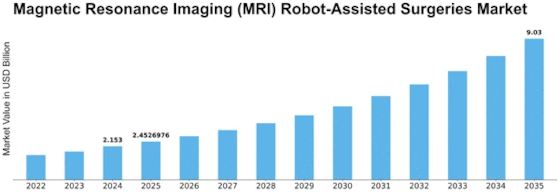
<p>The market is projected to reach a valuation of 9.03 USD Billion by 2035.</p>

What was the market valuation for the MRI Robot-Assisted Surgeries Market in 2024?

<p>The market valuation was 2.153 USD Billion in 2024.</p>

What is the expected CAGR for the MRI Robot-Assisted Surgeries Market during the forecast period 2025 - 2035?

<p>The expected CAGR for the market during this period is 13.92%.</p>

Which companies are considered key players in the MRI Robot-Assisted Surgeries Market?

<p>Key players include Siemens Healthineers, GE Healthcare, Philips Healthcare, and Canon Medical Systems.</p>

What are the main product segments in the MRI Robot-Assisted Surgeries Market?

<p>The main product segments include Sensors, Actuators, and Robots, with Robots valued at 1.076 USD Billion in 2024.</p>

Which application segments are driving growth in the MRI Robot-Assisted Surgeries Market?

<p>Oncology Surgery, Neurological Surgery, and Cardiovascular Surgery are the primary application segments, with Oncology Surgery valued at 0.861 USD Billion in 2024.</p>

What end-user segments are prominent in the MRI Robot-Assisted Surgeries Market?

Prominent end-user segments include Hospitals, Ambulatory Surgical Centers, and Specialty Clinics, with Hospitals valued at 0.865 USD Billion in 2024.

How does the market for MRI Robot-Assisted Surgeries compare across different applications?

In 2024, Oncology Surgery led the market with a valuation of 0.861 USD Billion, followed by Neurological Surgery at 0.645 USD Billion.

What is the anticipated growth trajectory for the Sensors segment in the MRI Robot-Assisted Surgeries Market?

The Sensors segment is expected to grow from 0.646 USD Billion in 2024 to 2.73 USD Billion by 2035.

How are advancements in technology influencing the MRI Robot-Assisted Surgeries Market?

Advancements in technology, particularly from key players like GE Healthcare and Siemens Healthineers, are likely to enhance the efficiency and effectiveness of surgeries.

Market Summary

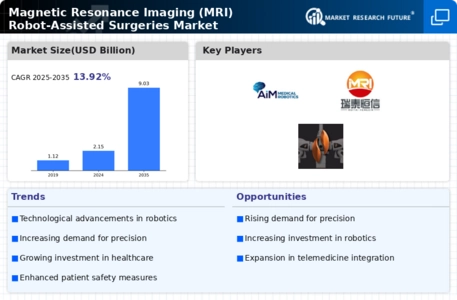
As per Market Research Future analysis, the Magnetic Resonance Imaging (MRI) Robot-Assisted Surgeries Market was estimated at 2.153 USD Billion in 2024. The MRI Robot-Assisted Surgeries industry is projected to grow from 2.453 USD Billion in 2025 to 9.03 USD Billion by 2035, exhibiting a compound annual growth rate (CAGR) of 13.92% during the forecast period 2025 - 2035

Key Market Trends & Highlights

The Magnetic Resonance Imaging (MRI) Robot-Assisted Surgeries Market is poised for substantial growth driven by technological advancements and increasing demand for minimally invasive procedures.

  • North America remains the largest market for MRI robot-assisted surgeries, reflecting a robust healthcare infrastructure. The Asia-Pacific region is emerging as the fastest-growing market, fueled by rising investments in healthcare technology. Robots dominate the market as the largest segment, while sensors are rapidly gaining traction as the fastest-growing segment. Technological advancements in MRI robotics and the rising demand for minimally invasive procedures are key drivers propelling market growth.

Market Size & Forecast

2024 Market Size 2.153 (USD Billion)
2035 Market Size 9.03 (USD Billion)
CAGR (2025 - 2035) 13.92%
Largest Regional Market Share in 2024 North America

Major Players

Siemens Healthineers (DE), GE Healthcare (US), Philips Healthcare (NL), Canon Medical Systems (JP), Hitachi Medical Systems (JP), Esaote S.p.A. (IT), Fujifilm Holdings Corporation (JP), Bracco Imaging S.p.A. (IT), Medtronic (IE)

Market Trends

The Magnetic Resonance Imaging (MRI) Robot-Assisted Surgeries Market is currently experiencing a transformative phase, characterized by advancements in technology and increasing demand for precision in surgical procedures. The integration of robotic systems with MRI capabilities appears to enhance the accuracy of surgical interventions, potentially leading to improved patient outcomes. As healthcare providers seek to adopt innovative solutions, the market is likely to witness a surge in the development and implementation of these sophisticated systems. Furthermore, the growing emphasis on minimally invasive techniques suggests a shift in surgical practices, where MRI-guided robotic assistance may play a pivotal role in various medical specialties. In addition, the rising prevalence of chronic diseases and the aging population may further drive the adoption of MRI robot-assisted surgeries. This trend indicates a broader acceptance of advanced surgical technologies among healthcare professionals and patients alike. As the market evolves, collaboration between technology developers and healthcare institutions seems essential to address the challenges of integration and training. Overall, the Magnetic Resonance Imaging (MRI) Robot-Assisted Surgeries Market is poised for growth, reflecting a commitment to enhancing surgical precision and patient care.

Technological Advancements

Recent innovations in robotic systems and imaging technologies are reshaping the Magnetic Resonance Imaging (MRI) Robot-Assisted Surgeries Market. Enhanced imaging capabilities and improved robotic precision are likely to facilitate more complex surgical procedures, thereby expanding the scope of applications.

Minimally Invasive Techniques

There is a noticeable trend towards minimally invasive surgical methods within the Magnetic Resonance Imaging (MRI) Robot-Assisted Surgeries Market. These techniques, which often result in reduced recovery times and lower complication rates, are becoming increasingly favored by both surgeons and patients.

Collaborative Approaches

The importance of collaboration between technology developers and healthcare providers is becoming more pronounced in the Magnetic Resonance Imaging (MRI) Robot-Assisted Surgeries Market. Such partnerships may enhance the integration of robotic systems into clinical practice, ensuring that advancements are effectively utilized in patient care.

Magnetic Resonance Imaging MRI Robot-Assisted Surgeries Market Market Drivers

Technological Advancements in MRI Robotics

The Magnetic Resonance Imaging (MRI) Robot-Assisted Surgeries Market is experiencing a surge in technological advancements that enhance surgical precision and patient outcomes. Innovations such as real-time imaging and advanced robotic systems are transforming traditional surgical practices. For instance, the integration of artificial intelligence in MRI robotics allows for improved image analysis and decision-making during surgeries. According to recent data, the market for MRI robotics is projected to grow at a compound annual growth rate of over 15% in the coming years, driven by these technological innovations. Furthermore, the development of hybrid systems that combine MRI with other imaging modalities is likely to expand the capabilities of robot-assisted surgeries, making them more versatile and effective.

Growing Awareness of Advanced Surgical Options

The growing awareness of advanced surgical options is significantly impacting the Magnetic Resonance Imaging (MRI) Robot-Assisted Surgeries Market. As patients become more informed about their treatment choices, there is a noticeable shift towards seeking out innovative surgical techniques that offer better outcomes. Educational initiatives and marketing efforts by healthcare providers are contributing to this awareness, highlighting the benefits of MRI robot-assisted surgeries. Data suggests that patient inquiries about robotic-assisted procedures have increased, reflecting a broader trend towards embracing technology in healthcare. This heightened awareness is likely to drive demand for MRI robotics, as patients actively seek out facilities that offer these advanced surgical options.

Rising Demand for Minimally Invasive Procedures

The demand for minimally invasive procedures is a key driver in the Magnetic Resonance Imaging (MRI) Robot-Assisted Surgeries Market. Patients increasingly prefer surgeries that promise reduced recovery times, less pain, and minimal scarring. MRI robot-assisted surgeries align perfectly with this trend, offering enhanced precision while minimizing tissue damage. Market data indicates that minimally invasive surgeries are expected to account for a significant portion of the surgical market, with MRI-guided techniques gaining traction. This shift towards less invasive options is likely to propel the adoption of MRI robotics, as healthcare providers seek to meet patient expectations and improve surgical outcomes. As a result, the market for MRI robot-assisted surgeries is poised for substantial growth.

Increased Investment in Healthcare Infrastructure

Investment in healthcare infrastructure is a crucial factor influencing the Magnetic Resonance Imaging (MRI) Robot-Assisted Surgeries Market. Governments and private entities are allocating substantial resources to enhance healthcare facilities, particularly in developing regions. This investment often includes the acquisition of advanced medical technologies, such as MRI robotics, to improve surgical capabilities. Recent reports suggest that healthcare spending is on the rise, with a focus on integrating cutting-edge technologies into surgical practices. As healthcare systems evolve, the demand for MRI robot-assisted surgeries is likely to increase, driven by the need for improved patient care and operational efficiency. This trend indicates a promising future for the MRI robotics market.

Regulatory Support for Advanced Medical Technologies

Regulatory support for advanced medical technologies plays a pivotal role in shaping the Magnetic Resonance Imaging (MRI) Robot-Assisted Surgeries Market. Regulatory bodies are increasingly recognizing the potential benefits of MRI robotics in enhancing surgical precision and patient safety. Streamlined approval processes for innovative medical devices are encouraging manufacturers to invest in research and development. Recent regulatory changes have facilitated faster market entry for new MRI robotic systems, which is likely to stimulate competition and innovation within the industry. As regulatory frameworks evolve to support advanced surgical technologies, the MRI robot-assisted surgeries market is expected to expand, providing healthcare providers with more options to improve patient care.

Market Segment Insights

By Product: Robots (Largest) vs. Sensors (Fastest-Growing)

<p>In the Magnetic Resonance Imaging (MRI) Robot-Assisted Surgeries Market, the product segment is primarily dominated by robots, which account for the largest share due to their increasing adoption in surgical procedures. Robots enhance precision and efficiency, leading to better patient outcomes. Sensors, while smaller in market share, are rapidly gaining traction, particularly as advancements in technology continue to improve their efficacy. The integration of smart sensors with MRI systems is becoming a critical factor in enhancing imaging capabilities and enhancing safety during surgeries.</p>

<p>Robots (Dominant) vs. Sensors (Emerging)</p>

<p>Robots represent the dominant technology in the MRI Robot-Assisted Surgeries Market, characterized by their capability to perform complex surgical tasks with precision and minimal invasiveness. These systems enhance surgical workflows and are increasingly recognized for their ability to reduce recovery times for patients. On the other hand, sensors are emerging as a significant component in the market, driven by innovations in real-time data acquisition and feedback mechanisms. As healthcare providers strive for better patient management and outcomes, the demand for advanced sensor technologies is on the rise. The combination of robots and advanced sensors is poised to revolutionize the way MRI-assisted surgeries are performed, providing enhanced accuracy and efficiency.</p>

By Application: Oncology Surgery (Largest) vs. Neurological Surgery (Fastest-Growing)

<p>In the Magnetic Resonance Imaging (MRI) Robot-Assisted Surgeries Market, Oncology Surgery stands out as the largest segment, accounting for the majority market share. This dominance is attributed to the high prevalence of cancer and the increasing need for advanced surgical interventions. Neurological Surgery, while currently smaller, is rapidly gaining traction among healthcare providers due to advancements in technology and rising incidences of neurological disorders, reflecting the market's expanding focus on comprehensive patient care. The growth trends in these application segments are driven by a combination of technological innovation and rising patient demand for effective surgical options. Oncology Surgery is benefitting from an increased diagnostic capability and treatment precision, while Neurological Surgery is experiencing the fastest growth, spurred by increasing research funding and the development of novel robotic-assisted surgical techniques that enhance patient outcomes. This dual growth trajectory indicates a robust and evolving specialty within the MRI robot-assisted surgery landscape.</p>

<p>Oncology Surgery (Dominant) vs. Neurological Surgery (Emerging)</p>

<p>Oncology Surgery represents a dominant force in the MRI Robot-Assisted Surgeries Market, characterized by its established protocols and widespread adoption among healthcare facilities. This segment leverages sophisticated imaging technologies to enhance surgical precision, improve oncological outcomes, and reduce recovery times. In contrast, Neurological Surgery is emerging as a rapidly growing segment, characterized by innovative robotic systems that facilitate complex brain surgeries. The increasing occurrence of neurological conditions and the effectiveness of minimally invasive approaches are driving its expansion. The evolution of robotic technologies tailored for neurological applications positions this segment as a crucial player in redefining surgical standards, promising significant advancements in both technique and patient care.</p>

By End User: Hospitals (Largest) vs. Ambulatory Surgical Centers (Fastest-Growing)

<p>In the Magnetic Resonance Imaging (MRI) Robot-Assisted Surgeries Market, hospitals hold the largest share, reflecting their central role in patient care and surgical innovations. These facilities are equipped with advanced technologies and have a significant patient volume, which facilitates the adoption of MRI robot-assisted systems. Ambulatory Surgical Centers (ASCs), while smaller in market share, are rapidly gaining ground due to their focus on outpatient procedures and cost-effective care, responding to the growing demand for minimally invasive surgeries.</p>

<p>Hospitals (Dominant) vs. Ambulatory Surgical Centers (Emerging)</p>

<p>Hospitals are the dominant end-user segment in the MRI robot-assisted surgeries market, offering comprehensive surgical services and advanced imaging technologies. They are characterized by higher surgical capacities and integrated care pathways, which enhance patient outcomes. Conversely, Ambulatory Surgical Centers are emerging as a significant segment, thriving on convenience and reduced healthcare costs. They are attracting patients seeking quicker recovery times. This sector appeals to patients preferring outpatient services, thus driving demand for innovative MRI technologies that streamline surgical processes and enhance efficiency.</p>

Magnetic Resonance Imaging (MRI) Robot-Assisted Surgeries End User Insights

Based on end user, the global magnetic resonance imaging (MRI) robot-assisted surgeries industry has been segmented into the hospitals, ambulatory surgical centers, and specialty clinics. The hospital's segment is held the largest market share in 2022, owing to the growing preference for minimally invasive surgery (MIS) in hospitals among patients, which has significant advantages over other modalities such as open surgery, and the rising prevalence of cancer. Moreover, cancer patients are well tolerated by the methods used by magnetic resonance imaging (MRI) robots.

The procedure time and MRI time decrease as physicians gain experience using the MRI-assisted robot, increases efficiency in the procedure room.

Get more detailed insights about Magnetic Resonance Imaging (MRI) Robot-Assisted Surgeries Market Research Report—Global Forecast till 2035

Regional Insights

North America : Healthcare Innovation Leader

North America is the largest market for MRI robot-assisted surgeries, holding approximately 45% of the global market share. The region benefits from advanced healthcare infrastructure, high investment in medical technology, and a growing aging population that demands sophisticated surgical solutions. Regulatory support from agencies like the FDA further accelerates market growth by ensuring safety and efficacy in new technologies. The United States leads the North American market, driven by key players such as GE Healthcare and Siemens Healthineers. The competitive landscape is characterized by continuous innovation and strategic partnerships among major companies. Canada also contributes significantly, focusing on enhancing healthcare delivery through robotic-assisted technologies, thereby fostering a robust market environment.

Europe : Emerging Market with Growth Potential

Europe is the second-largest market for MRI robot-assisted surgeries, accounting for approximately 30% of the global market share. The region's growth is driven by increasing healthcare expenditure, advancements in medical imaging technologies, and a rising prevalence of chronic diseases. Regulatory frameworks, such as the EU Medical Device Regulation, play a crucial role in ensuring the safety and effectiveness of new robotic systems, thereby boosting market confidence. Leading countries in Europe include Germany, France, and the UK, where significant investments in healthcare technology are evident. Major players like Philips Healthcare and Siemens Healthineers are actively involved in research and development, enhancing their competitive edge. The presence of a well-established healthcare system and a focus on innovative surgical solutions further solidify Europe's position in the market.

Asia-Pacific : Rapidly Growing Healthcare Sector

Asia-Pacific is witnessing rapid growth in the MRI robot-assisted surgeries market, holding approximately 20% of the global market share. Factors such as increasing healthcare investments, a growing population, and rising awareness of advanced surgical techniques are driving demand. Countries like China and India are focusing on enhancing their healthcare infrastructure, supported by government initiatives aimed at improving medical technology access and affordability. China is the largest market in the region, with significant contributions from local manufacturers and international players like Canon Medical Systems and Fujifilm Holdings. The competitive landscape is evolving, with a surge in partnerships and collaborations aimed at advancing robotic technologies. As the region continues to invest in healthcare, the demand for innovative surgical solutions is expected to rise significantly.

Middle East and Africa : Emerging Market with Challenges

The Middle East and Africa represent a nascent market for MRI robot-assisted surgeries, holding about 5% of the global market share. The region's growth is hindered by limited healthcare infrastructure and varying levels of regulatory support. However, increasing investments in healthcare and a rising prevalence of chronic diseases are driving demand for advanced surgical technologies. Countries like the UAE and South Africa are making strides in improving healthcare access and technology adoption. In the Middle East, the UAE is leading the market, with significant investments in healthcare technology and partnerships with global players. South Africa is also emerging as a key player, focusing on enhancing its healthcare system. The competitive landscape is characterized by a mix of local and international companies, aiming to address the growing demand for robotic-assisted surgeries in the region.

Key Players and Competitive Insights

Major market players are spending a lot of money on R&D to increase their product lines, which will help the magnetic resonance imaging (MRI) robot-assisted surgeries grow even more. Market participants are also taking a range of strategic initiatives to grow their worldwide footprint, including new product launches, contractual agreements, mergers and acquisitions, increased investments, and collaboration with other organizations. Competitors in the magnetic resonance imaging (MRI) robot-assisted surgeries industry must offer cost-effective products to expand and survive in an increasingly competitive and rising market environment.AiM Medical Robotics (US) is a neurosurgical robotics company dedicated to bringing high levels of precision, automation, and efficiency to the neurosurgery world. It is working on a portable, MRI-compatible surgical robot for use in MRI suites and operating rooms.
In March the company was selected as a featured innovator at the LSI (Life Science Intelligence) 2022 Medtech Investor Summit. Moreover, in March 2022, the company raised USD 3.4 million, which was led by IQ Capital (US) and Surrey Capital (US). This funding has been used to accelerate the development of its industry-first MRI-compatible robotics platform.

Key Companies in the Magnetic Resonance Imaging MRI Robot-Assisted Surgeries Market include

Industry Developments

  • In March 2022 AiM Medical Robotics (US) raised USD 3.4 million, which was led by IQ Capital (US) and Surrey Capital (US). This funding has been used to accelerate the development of its industry-first MRI-compatible robotics platform.
  • July 2021: neuro42, Inc. (US) raised USD 6.5 million in Series A financing. The fund has been used to advance the development of an MRI-assisted robot.

Future Outlook

Magnetic Resonance Imaging MRI Robot-Assisted Surgeries Market Future Outlook

The Magnetic Resonance Imaging (MRI) Robot-Assisted Surgeries Market is projected to grow at a 13.92% CAGR from 2025 to 2035, driven by technological advancements and increasing demand for minimally invasive procedures.

New opportunities lie in:

  • <p>Development of AI-driven MRI software for enhanced surgical precision.</p>
  • <p> </p>
  • <p>Expansion of robotic-assisted systems in outpatient surgical centers.</p>
  • <p>Partnerships with healthcare providers for integrated MRI solutions.</p>

By 2035, the market is expected to be robust, reflecting substantial growth and innovation.

Market Segmentation

Magnetic Resonance Imaging MRI Robot-Assisted Surgeries Market Product Outlook

  • Sensors
  • Actuators
  • Robots

Magnetic Resonance Imaging MRI Robot-Assisted Surgeries Market End User Outlook

  • Hospitals
  • Ambulatory Surgical Centers
  • Specialty Clinics

Magnetic Resonance Imaging MRI Robot-Assisted Surgeries Market Application Outlook

  • Oncology Surgery
  • Neurological Surgery
  • Cardiovascular Surgery

Report Scope

MARKET SIZE 2024 2.153(USD Billion)
MARKET SIZE 2025 2.453(USD Billion)
MARKET SIZE 2035 9.03(USD Billion)
COMPOUND ANNUAL GROWTH RATE (CAGR) 13.92% (2025 - 2035)
REPORT COVERAGE Revenue Forecast, Competitive Landscape, Growth Factors, and Trends
BASE YEAR 2024
Market Forecast Period 2025 - 2035
Historical Data 2019 - 2024
Market Forecast Units USD Billion
Key Companies Profiled Siemens Healthineers (DE), GE Healthcare (US), Philips Healthcare (NL), Canon Medical Systems (JP), Hitachi Medical Systems (JP), Esaote S.p.A. (IT), Fujifilm Holdings Corporation (JP), Bracco Imaging S.p.A. (IT), Medtronic (IE)
Segments Covered Product, Application, End User, Region
Key Market Opportunities Integration of artificial intelligence in Magnetic Resonance Imaging (MRI) Robot-Assisted Surgeries enhances precision and efficiency.
Key Market Dynamics Technological advancements in imaging and robotics drive innovation in Magnetic Resonance Imaging Robot-Assisted Surgeries.
Countries Covered North America, Europe, APAC, South America, MEA

FAQs

What is the projected market valuation for the Magnetic Resonance Imaging (MRI) Robot-Assisted Surgeries Market by 2035?

<p>The market is projected to reach a valuation of 9.03 USD Billion by 2035.</p>

What was the market valuation for the MRI Robot-Assisted Surgeries Market in 2024?

<p>The market valuation was 2.153 USD Billion in 2024.</p>

What is the expected CAGR for the MRI Robot-Assisted Surgeries Market during the forecast period 2025 - 2035?

<p>The expected CAGR for the market during this period is 13.92%.</p>

Which companies are considered key players in the MRI Robot-Assisted Surgeries Market?

<p>Key players include Siemens Healthineers, GE Healthcare, Philips Healthcare, and Canon Medical Systems.</p>

What are the main product segments in the MRI Robot-Assisted Surgeries Market?

<p>The main product segments include Sensors, Actuators, and Robots, with Robots valued at 1.076 USD Billion in 2024.</p>

Which application segments are driving growth in the MRI Robot-Assisted Surgeries Market?

<p>Oncology Surgery, Neurological Surgery, and Cardiovascular Surgery are the primary application segments, with Oncology Surgery valued at 0.861 USD Billion in 2024.</p>

What end-user segments are prominent in the MRI Robot-Assisted Surgeries Market?

Prominent end-user segments include Hospitals, Ambulatory Surgical Centers, and Specialty Clinics, with Hospitals valued at 0.865 USD Billion in 2024.

How does the market for MRI Robot-Assisted Surgeries compare across different applications?

In 2024, Oncology Surgery led the market with a valuation of 0.861 USD Billion, followed by Neurological Surgery at 0.645 USD Billion.

What is the anticipated growth trajectory for the Sensors segment in the MRI Robot-Assisted Surgeries Market?

The Sensors segment is expected to grow from 0.646 USD Billion in 2024 to 2.73 USD Billion by 2035.

How are advancements in technology influencing the MRI Robot-Assisted Surgeries Market?

Advancements in technology, particularly from key players like GE Healthcare and Siemens Healthineers, are likely to enhance the efficiency and effectiveness of surgeries.

  1. SECTION I: EXECUTIVE SUMMARY AND KEY HIGHLIGHTS
    1. | 1.1 EXECUTIVE SUMMARY
    2. | | 1.1.1 Market Overview
    3. | | 1.1.2 Key Findings
    4. | | 1.1.3 Market Segmentation
    5. | | 1.1.4 Competitive Landscape
    6. | | 1.1.5 Challenges and Opportunities
    7. | | 1.1.6 Future Outlook
  2. SECTION II: SCOPING, METHODOLOGY AND MARKET STRUCTURE
    1. | 2.1 MARKET INTRODUCTION
    2. | | 2.1.1 Definition
    3. | | 2.1.2 Scope of the study
    4. | | | 2.1.2.1 Research Objective
    5. | | | 2.1.2.2 Assumption
    6. | | | 2.1.2.3 Limitations
    7. | 2.2 RESEARCH METHODOLOGY
    8. | | 2.2.1 Overview
    9. | | 2.2.2 Data Mining
    10. | | 2.2.3 Secondary Research
    11. | | 2.2.4 Primary Research
    12. | | | 2.2.4.1 Primary Interviews and Information Gathering Process
    13. | | | 2.2.4.2 Breakdown of Primary Respondents
    14. | | 2.2.5 Forecasting Model
    15. | | 2.2.6 Market Size Estimation
    16. | | | 2.2.6.1 Bottom-Up Approach
    17. | | | 2.2.6.2 Top-Down Approach
    18. | | 2.2.7 Data Triangulation
    19. | | 2.2.8 Validation
  3. SECTION III: QUALITATIVE ANALYSIS
    1. | 3.1 MARKET DYNAMICS
    2. | | 3.1.1 Overview
    3. | | 3.1.2 Drivers
    4. | | 3.1.3 Restraints
    5. | | 3.1.4 Opportunities
    6. | 3.2 MARKET FACTOR ANALYSIS
    7. | | 3.2.1 Value chain Analysis
    8. | | 3.2.2 Porter's Five Forces Analysis
    9. | | | 3.2.2.1 Bargaining Power of Suppliers
    10. | | | 3.2.2.2 Bargaining Power of Buyers
    11. | | | 3.2.2.3 Threat of New Entrants
    12. | | | 3.2.2.4 Threat of Substitutes
    13. | | | 3.2.2.5 Intensity of Rivalry
    14. | | 3.2.3 COVID-19 Impact Analysis
    15. | | | 3.2.3.1 Market Impact Analysis
    16. | | | 3.2.3.2 Regional Impact
    17. | | | 3.2.3.3 Opportunity and Threat Analysis
  4. SECTION IV: QUANTITATIVE ANALYSIS
    1. | 4.1 Healthcare, BY Product (USD Billion)
    2. | | 4.1.1 Sensors
    3. | | 4.1.2 Actuators
    4. | | 4.1.3 Robots
    5. | 4.2 Healthcare, BY Application (USD Billion)
    6. | | 4.2.1 Oncology Surgery
    7. | | 4.2.2 Neurological Surgery
    8. | | 4.2.3 Cardiovascular Surgery
    9. | 4.3 Healthcare, BY End User (USD Billion)
    10. | | 4.3.1 Hospitals
    11. | | 4.3.2 Ambulatory Surgical Centers
    12. | | 4.3.3 Specialty Clinics
    13. | 4.4 Healthcare, BY Region (USD Billion)
    14. | | 4.4.1 North America
    15. | | | 4.4.1.1 US
    16. | | | 4.4.1.2 Canada
    17. | | 4.4.2 Europe
    18. | | | 4.4.2.1 Germany
    19. | | | 4.4.2.2 UK
    20. | | | 4.4.2.3 France
    21. | | | 4.4.2.4 Russia
    22. | | | 4.4.2.5 Italy
    23. | | | 4.4.2.6 Spain
    24. | | | 4.4.2.7 Rest of Europe
    25. | | 4.4.3 APAC
    26. | | | 4.4.3.1 China
    27. | | | 4.4.3.2 India
    28. | | | 4.4.3.3 Japan
    29. | | | 4.4.3.4 South Korea
    30. | | | 4.4.3.5 Malaysia
    31. | | | 4.4.3.6 Thailand
    32. | | | 4.4.3.7 Indonesia
    33. | | | 4.4.3.8 Rest of APAC
    34. | | 4.4.4 South America
    35. | | | 4.4.4.1 Brazil
    36. | | | 4.4.4.2 Mexico
    37. | | | 4.4.4.3 Argentina
    38. | | | 4.4.4.4 Rest of South America
    39. | | 4.4.5 MEA
    40. | | | 4.4.5.1 GCC Countries
    41. | | | 4.4.5.2 South Africa
    42. | | | 4.4.5.3 Rest of MEA
  5. SECTION V: COMPETITIVE ANALYSIS
    1. | 5.1 Competitive Landscape
    2. | | 5.1.1 Overview
    3. | | 5.1.2 Competitive Analysis
    4. | | 5.1.3 Market share Analysis
    5. | | 5.1.4 Major Growth Strategy in the Healthcare
    6. | | 5.1.5 Competitive Benchmarking
    7. | | 5.1.6 Leading Players in Terms of Number of Developments in the Healthcare
    8. | | 5.1.7 Key developments and growth strategies
    9. | | | 5.1.7.1 New Product Launch/Service Deployment
    10. | | | 5.1.7.2 Merger & Acquisitions
    11. | | | 5.1.7.3 Joint Ventures
    12. | | 5.1.8 Major Players Financial Matrix
    13. | | | 5.1.8.1 Sales and Operating Income
    14. | | | 5.1.8.2 Major Players R&D Expenditure. 2023
    15. | 5.2 Company Profiles
    16. | | 5.2.1 Siemens Healthineers (DE)
    17. | | | 5.2.1.1 Financial Overview
    18. | | | 5.2.1.2 Products Offered
    19. | | | 5.2.1.3 Key Developments
    20. | | | 5.2.1.4 SWOT Analysis
    21. | | | 5.2.1.5 Key Strategies
    22. | | 5.2.2 GE Healthcare (US)
    23. | | | 5.2.2.1 Financial Overview
    24. | | | 5.2.2.2 Products Offered
    25. | | | 5.2.2.3 Key Developments
    26. | | | 5.2.2.4 SWOT Analysis
    27. | | | 5.2.2.5 Key Strategies
    28. | | 5.2.3 Philips Healthcare (NL)
    29. | | | 5.2.3.1 Financial Overview
    30. | | | 5.2.3.2 Products Offered
    31. | | | 5.2.3.3 Key Developments
    32. | | | 5.2.3.4 SWOT Analysis
    33. | | | 5.2.3.5 Key Strategies
    34. | | 5.2.4 Canon Medical Systems (JP)
    35. | | | 5.2.4.1 Financial Overview
    36. | | | 5.2.4.2 Products Offered
    37. | | | 5.2.4.3 Key Developments
    38. | | | 5.2.4.4 SWOT Analysis
    39. | | | 5.2.4.5 Key Strategies
    40. | | 5.2.5 Hitachi Medical Systems (JP)
    41. | | | 5.2.5.1 Financial Overview
    42. | | | 5.2.5.2 Products Offered
    43. | | | 5.2.5.3 Key Developments
    44. | | | 5.2.5.4 SWOT Analysis
    45. | | | 5.2.5.5 Key Strategies
    46. | | 5.2.6 Esaote S.p.A. (IT)
    47. | | | 5.2.6.1 Financial Overview
    48. | | | 5.2.6.2 Products Offered
    49. | | | 5.2.6.3 Key Developments
    50. | | | 5.2.6.4 SWOT Analysis
    51. | | | 5.2.6.5 Key Strategies
    52. | | 5.2.7 Fujifilm Holdings Corporation (JP)
    53. | | | 5.2.7.1 Financial Overview
    54. | | | 5.2.7.2 Products Offered
    55. | | | 5.2.7.3 Key Developments
    56. | | | 5.2.7.4 SWOT Analysis
    57. | | | 5.2.7.5 Key Strategies
    58. | | 5.2.8 Bracco Imaging S.p.A. (IT)
    59. | | | 5.2.8.1 Financial Overview
    60. | | | 5.2.8.2 Products Offered
    61. | | | 5.2.8.3 Key Developments
    62. | | | 5.2.8.4 SWOT Analysis
    63. | | | 5.2.8.5 Key Strategies
    64. | | 5.2.9 Medtronic (IE)
    65. | | | 5.2.9.1 Financial Overview
    66. | | | 5.2.9.2 Products Offered
    67. | | | 5.2.9.3 Key Developments
    68. | | | 5.2.9.4 SWOT Analysis
    69. | | | 5.2.9.5 Key Strategies
    70. | 5.3 Appendix
    71. | | 5.3.1 References
    72. | | 5.3.2 Related Reports
  6. LIST OF FIGURES
    1. | 6.1 MARKET SYNOPSIS
    2. | 6.2 NORTH AMERICA MARKET ANALYSIS
    3. | 6.3 US MARKET ANALYSIS BY PRODUCT
    4. | 6.4 US MARKET ANALYSIS BY APPLICATION
    5. | 6.5 US MARKET ANALYSIS BY END USER
    6. | 6.6 CANADA MARKET ANALYSIS BY PRODUCT
    7. | 6.7 CANADA MARKET ANALYSIS BY APPLICATION
    8. | 6.8 CANADA MARKET ANALYSIS BY END USER
    9. | 6.9 EUROPE MARKET ANALYSIS
    10. | 6.10 GERMANY MARKET ANALYSIS BY PRODUCT
    11. | 6.11 GERMANY MARKET ANALYSIS BY APPLICATION
    12. | 6.12 GERMANY MARKET ANALYSIS BY END USER
    13. | 6.13 UK MARKET ANALYSIS BY PRODUCT
    14. | 6.14 UK MARKET ANALYSIS BY APPLICATION
    15. | 6.15 UK MARKET ANALYSIS BY END USER
    16. | 6.16 FRANCE MARKET ANALYSIS BY PRODUCT
    17. | 6.17 FRANCE MARKET ANALYSIS BY APPLICATION
    18. | 6.18 FRANCE MARKET ANALYSIS BY END USER
    19. | 6.19 RUSSIA MARKET ANALYSIS BY PRODUCT
    20. | 6.20 RUSSIA MARKET ANALYSIS BY APPLICATION
    21. | 6.21 RUSSIA MARKET ANALYSIS BY END USER
    22. | 6.22 ITALY MARKET ANALYSIS BY PRODUCT
    23. | 6.23 ITALY MARKET ANALYSIS BY APPLICATION
    24. | 6.24 ITALY MARKET ANALYSIS BY END USER
    25. | 6.25 SPAIN MARKET ANALYSIS BY PRODUCT
    26. | 6.26 SPAIN MARKET ANALYSIS BY APPLICATION
    27. | 6.27 SPAIN MARKET ANALYSIS BY END USER
    28. | 6.28 REST OF EUROPE MARKET ANALYSIS BY PRODUCT
    29. | 6.29 REST OF EUROPE MARKET ANALYSIS BY APPLICATION
    30. | 6.30 REST OF EUROPE MARKET ANALYSIS BY END USER
    31. | 6.31 APAC MARKET ANALYSIS
    32. | 6.32 CHINA MARKET ANALYSIS BY PRODUCT
    33. | 6.33 CHINA MARKET ANALYSIS BY APPLICATION
    34. | 6.34 CHINA MARKET ANALYSIS BY END USER
    35. | 6.35 INDIA MARKET ANALYSIS BY PRODUCT
    36. | 6.36 INDIA MARKET ANALYSIS BY APPLICATION
    37. | 6.37 INDIA MARKET ANALYSIS BY END USER
    38. | 6.38 JAPAN MARKET ANALYSIS BY PRODUCT
    39. | 6.39 JAPAN MARKET ANALYSIS BY APPLICATION
    40. | 6.40 JAPAN MARKET ANALYSIS BY END USER
    41. | 6.41 SOUTH KOREA MARKET ANALYSIS BY PRODUCT
    42. | 6.42 SOUTH KOREA MARKET ANALYSIS BY APPLICATION
    43. | 6.43 SOUTH KOREA MARKET ANALYSIS BY END USER
    44. | 6.44 MALAYSIA MARKET ANALYSIS BY PRODUCT
    45. | 6.45 MALAYSIA MARKET ANALYSIS BY APPLICATION
    46. | 6.46 MALAYSIA MARKET ANALYSIS BY END USER
    47. | 6.47 THAILAND MARKET ANALYSIS BY PRODUCT
    48. | 6.48 THAILAND MARKET ANALYSIS BY APPLICATION
    49. | 6.49 THAILAND MARKET ANALYSIS BY END USER
    50. | 6.50 INDONESIA MARKET ANALYSIS BY PRODUCT
    51. | 6.51 INDONESIA MARKET ANALYSIS BY APPLICATION
    52. | 6.52 INDONESIA MARKET ANALYSIS BY END USER
    53. | 6.53 REST OF APAC MARKET ANALYSIS BY PRODUCT
    54. | 6.54 REST OF APAC MARKET ANALYSIS BY APPLICATION
    55. | 6.55 REST OF APAC MARKET ANALYSIS BY END USER
    56. | 6.56 SOUTH AMERICA MARKET ANALYSIS
    57. | 6.57 BRAZIL MARKET ANALYSIS BY PRODUCT
    58. | 6.58 BRAZIL MARKET ANALYSIS BY APPLICATION
    59. | 6.59 BRAZIL MARKET ANALYSIS BY END USER
    60. | 6.60 MEXICO MARKET ANALYSIS BY PRODUCT
    61. | 6.61 MEXICO MARKET ANALYSIS BY APPLICATION
    62. | 6.62 MEXICO MARKET ANALYSIS BY END USER
    63. | 6.63 ARGENTINA MARKET ANALYSIS BY PRODUCT
    64. | 6.64 ARGENTINA MARKET ANALYSIS BY APPLICATION
    65. | 6.65 ARGENTINA MARKET ANALYSIS BY END USER
    66. | 6.66 REST OF SOUTH AMERICA MARKET ANALYSIS BY PRODUCT
    67. | 6.67 REST OF SOUTH AMERICA MARKET ANALYSIS BY APPLICATION
    68. | 6.68 REST OF SOUTH AMERICA MARKET ANALYSIS BY END USER
    69. | 6.69 MEA MARKET ANALYSIS
    70. | 6.70 GCC COUNTRIES MARKET ANALYSIS BY PRODUCT
    71. | 6.71 GCC COUNTRIES MARKET ANALYSIS BY APPLICATION
    72. | 6.72 GCC COUNTRIES MARKET ANALYSIS BY END USER
    73. | 6.73 SOUTH AFRICA MARKET ANALYSIS BY PRODUCT
    74. | 6.74 SOUTH AFRICA MARKET ANALYSIS BY APPLICATION
    75. | 6.75 SOUTH AFRICA MARKET ANALYSIS BY END USER
    76. | 6.76 REST OF MEA MARKET ANALYSIS BY PRODUCT
    77. | 6.77 REST OF MEA MARKET ANALYSIS BY APPLICATION
    78. | 6.78 REST OF MEA MARKET ANALYSIS BY END USER
    79. | 6.79 KEY BUYING CRITERIA OF HEALTHCARE
    80. | 6.80 RESEARCH PROCESS OF MRFR
    81. | 6.81 DRO ANALYSIS OF HEALTHCARE
    82. | 6.82 DRIVERS IMPACT ANALYSIS: HEALTHCARE
    83. | 6.83 RESTRAINTS IMPACT ANALYSIS: HEALTHCARE
    84. | 6.84 SUPPLY / VALUE CHAIN: HEALTHCARE
    85. | 6.85 HEALTHCARE, BY PRODUCT, 2024 (% SHARE)
    86. | 6.86 HEALTHCARE, BY PRODUCT, 2024 TO 2035 (USD Billion)
    87. | 6.87 HEALTHCARE, BY APPLICATION, 2024 (% SHARE)
    88. | 6.88 HEALTHCARE, BY APPLICATION, 2024 TO 2035 (USD Billion)
    89. | 6.89 HEALTHCARE, BY END USER, 2024 (% SHARE)
    90. | 6.90 HEALTHCARE, BY END USER, 2024 TO 2035 (USD Billion)
    91. | 6.91 BENCHMARKING OF MAJOR COMPETITORS
  7. LIST OF TABLES
    1. | 7.1 LIST OF ASSUMPTIONS
    2. | | 7.1.1
    3. | 7.2 North America MARKET SIZE ESTIMATES; FORECAST
    4. | | 7.2.1 BY PRODUCT, 2025-2035 (USD Billion)
    5. | | 7.2.2 BY APPLICATION, 2025-2035 (USD Billion)
    6. | | 7.2.3 BY END USER, 2025-2035 (USD Billion)
    7. | 7.3 US MARKET SIZE ESTIMATES; FORECAST
    8. | | 7.3.1 BY PRODUCT, 2025-2035 (USD Billion)
    9. | | 7.3.2 BY APPLICATION, 2025-2035 (USD Billion)
    10. | | 7.3.3 BY END USER, 2025-2035 (USD Billion)
    11. | 7.4 Canada MARKET SIZE ESTIMATES; FORECAST
    12. | | 7.4.1 BY PRODUCT, 2025-2035 (USD Billion)
    13. | | 7.4.2 BY APPLICATION, 2025-2035 (USD Billion)
    14. | | 7.4.3 BY END USER, 2025-2035 (USD Billion)
    15. | 7.5 Europe MARKET SIZE ESTIMATES; FORECAST
    16. | | 7.5.1 BY PRODUCT, 2025-2035 (USD Billion)
    17. | | 7.5.2 BY APPLICATION, 2025-2035 (USD Billion)
    18. | | 7.5.3 BY END USER, 2025-2035 (USD Billion)
    19. | 7.6 Germany MARKET SIZE ESTIMATES; FORECAST
    20. | | 7.6.1 BY PRODUCT, 2025-2035 (USD Billion)
    21. | | 7.6.2 BY APPLICATION, 2025-2035 (USD Billion)
    22. | | 7.6.3 BY END USER, 2025-2035 (USD Billion)
    23. | 7.7 UK MARKET SIZE ESTIMATES; FORECAST
    24. | | 7.7.1 BY PRODUCT, 2025-2035 (USD Billion)
    25. | | 7.7.2 BY APPLICATION, 2025-2035 (USD Billion)
    26. | | 7.7.3 BY END USER, 2025-2035 (USD Billion)
    27. | 7.8 France MARKET SIZE ESTIMATES; FORECAST
    28. | | 7.8.1 BY PRODUCT, 2025-2035 (USD Billion)
    29. | | 7.8.2 BY APPLICATION, 2025-2035 (USD Billion)
    30. | | 7.8.3 BY END USER, 2025-2035 (USD Billion)
    31. | 7.9 Russia MARKET SIZE ESTIMATES; FORECAST
    32. | | 7.9.1 BY PRODUCT, 2025-2035 (USD Billion)
    33. | | 7.9.2 BY APPLICATION, 2025-2035 (USD Billion)
    34. | | 7.9.3 BY END USER, 2025-2035 (USD Billion)
    35. | 7.10 Italy MARKET SIZE ESTIMATES; FORECAST
    36. | | 7.10.1 BY PRODUCT, 2025-2035 (USD Billion)
    37. | | 7.10.2 BY APPLICATION, 2025-2035 (USD Billion)
    38. | | 7.10.3 BY END USER, 2025-2035 (USD Billion)
    39. | 7.11 Spain MARKET SIZE ESTIMATES; FORECAST
    40. | | 7.11.1 BY PRODUCT, 2025-2035 (USD Billion)
    41. | | 7.11.2 BY APPLICATION, 2025-2035 (USD Billion)
    42. | | 7.11.3 BY END USER, 2025-2035 (USD Billion)
    43. | 7.12 Rest of Europe MARKET SIZE ESTIMATES; FORECAST
    44. | | 7.12.1 BY PRODUCT, 2025-2035 (USD Billion)
    45. | | 7.12.2 BY APPLICATION, 2025-2035 (USD Billion)
    46. | | 7.12.3 BY END USER, 2025-2035 (USD Billion)
    47. | 7.13 APAC MARKET SIZE ESTIMATES; FORECAST
    48. | | 7.13.1 BY PRODUCT, 2025-2035 (USD Billion)
    49. | | 7.13.2 BY APPLICATION, 2025-2035 (USD Billion)
    50. | | 7.13.3 BY END USER, 2025-2035 (USD Billion)
    51. | 7.14 China MARKET SIZE ESTIMATES; FORECAST
    52. | | 7.14.1 BY PRODUCT, 2025-2035 (USD Billion)
    53. | | 7.14.2 BY APPLICATION, 2025-2035 (USD Billion)
    54. | | 7.14.3 BY END USER, 2025-2035 (USD Billion)
    55. | 7.15 India MARKET SIZE ESTIMATES; FORECAST
    56. | | 7.15.1 BY PRODUCT, 2025-2035 (USD Billion)
    57. | | 7.15.2 BY APPLICATION, 2025-2035 (USD Billion)
    58. | | 7.15.3 BY END USER, 2025-2035 (USD Billion)
    59. | 7.16 Japan MARKET SIZE ESTIMATES; FORECAST
    60. | | 7.16.1 BY PRODUCT, 2025-2035 (USD Billion)
    61. | | 7.16.2 BY APPLICATION, 2025-2035 (USD Billion)
    62. | | 7.16.3 BY END USER, 2025-2035 (USD Billion)
    63. | 7.17 South Korea MARKET SIZE ESTIMATES; FORECAST
    64. | | 7.17.1 BY PRODUCT, 2025-2035 (USD Billion)
    65. | | 7.17.2 BY APPLICATION, 2025-2035 (USD Billion)
    66. | | 7.17.3 BY END USER, 2025-2035 (USD Billion)
    67. | 7.18 Malaysia MARKET SIZE ESTIMATES; FORECAST
    68. | | 7.18.1 BY PRODUCT, 2025-2035 (USD Billion)
    69. | | 7.18.2 BY APPLICATION, 2025-2035 (USD Billion)
    70. | | 7.18.3 BY END USER, 2025-2035 (USD Billion)
    71. | 7.19 Thailand MARKET SIZE ESTIMATES; FORECAST
    72. | | 7.19.1 BY PRODUCT, 2025-2035 (USD Billion)
    73. | | 7.19.2 BY APPLICATION, 2025-2035 (USD Billion)
    74. | | 7.19.3 BY END USER, 2025-2035 (USD Billion)
    75. | 7.20 Indonesia MARKET SIZE ESTIMATES; FORECAST
    76. | | 7.20.1 BY PRODUCT, 2025-2035 (USD Billion)
    77. | | 7.20.2 BY APPLICATION, 2025-2035 (USD Billion)
    78. | | 7.20.3 BY END USER, 2025-2035 (USD Billion)
    79. | 7.21 Rest of APAC MARKET SIZE ESTIMATES; FORECAST
    80. | | 7.21.1 BY PRODUCT, 2025-2035 (USD Billion)
    81. | | 7.21.2 BY APPLICATION, 2025-2035 (USD Billion)
    82. | | 7.21.3 BY END USER, 2025-2035 (USD Billion)
    83. | 7.22 South America MARKET SIZE ESTIMATES; FORECAST
    84. | | 7.22.1 BY PRODUCT, 2025-2035 (USD Billion)
    85. | | 7.22.2 BY APPLICATION, 2025-2035 (USD Billion)
    86. | | 7.22.3 BY END USER, 2025-2035 (USD Billion)
    87. | 7.23 Brazil MARKET SIZE ESTIMATES; FORECAST
    88. | | 7.23.1 BY PRODUCT, 2025-2035 (USD Billion)
    89. | | 7.23.2 BY APPLICATION, 2025-2035 (USD Billion)
    90. | | 7.23.3 BY END USER, 2025-2035 (USD Billion)
    91. | 7.24 Mexico MARKET SIZE ESTIMATES; FORECAST
    92. | | 7.24.1 BY PRODUCT, 2025-2035 (USD Billion)
    93. | | 7.24.2 BY APPLICATION, 2025-2035 (USD Billion)
    94. | | 7.24.3 BY END USER, 2025-2035 (USD Billion)
    95. | 7.25 Argentina MARKET SIZE ESTIMATES; FORECAST
    96. | | 7.25.1 BY PRODUCT, 2025-2035 (USD Billion)
    97. | | 7.25.2 BY APPLICATION, 2025-2035 (USD Billion)
    98. | | 7.25.3 BY END USER, 2025-2035 (USD Billion)
    99. | 7.26 Rest of South America MARKET SIZE ESTIMATES; FORECAST
    100. | | 7.26.1 BY PRODUCT, 2025-2035 (USD Billion)
    101. | | 7.26.2 BY APPLICATION, 2025-2035 (USD Billion)
    102. | | 7.26.3 BY END USER, 2025-2035 (USD Billion)
    103. | 7.27 MEA MARKET SIZE ESTIMATES; FORECAST
    104. | | 7.27.1 BY PRODUCT, 2025-2035 (USD Billion)
    105. | | 7.27.2 BY APPLICATION, 2025-2035 (USD Billion)
    106. | | 7.27.3 BY END USER, 2025-2035 (USD Billion)
    107. | 7.28 GCC Countries MARKET SIZE ESTIMATES; FORECAST
    108. | | 7.28.1 BY PRODUCT, 2025-2035 (USD Billion)
    109. | | 7.28.2 BY APPLICATION, 2025-2035 (USD Billion)
    110. | | 7.28.3 BY END USER, 2025-2035 (USD Billion)
    111. | 7.29 South Africa MARKET SIZE ESTIMATES; FORECAST
    112. | | 7.29.1 BY PRODUCT, 2025-2035 (USD Billion)
    113. | | 7.29.2 BY APPLICATION, 2025-2035 (USD Billion)
    114. | | 7.29.3 BY END USER, 2025-2035 (USD Billion)
    115. | 7.30 Rest of MEA MARKET SIZE ESTIMATES; FORECAST
    116. | | 7.30.1 BY PRODUCT, 2025-2035 (USD Billion)
    117. | | 7.30.2 BY APPLICATION, 2025-2035 (USD Billion)
    118. | | 7.30.3 BY END USER, 2025-2035 (USD Billion)
    119. | 7.31 PRODUCT LAUNCH/PRODUCT DEVELOPMENT/APPROVAL
    120. | | 7.31.1
    121. | 7.32 ACQUISITION/PARTNERSHIP
    122. | | 7.32.1

Healthcare Market Segmentation

Healthcare By Product (USD Billion, 2025-2035)

  • Sensors
  • Actuators
  • Robots

Healthcare By Application (USD Billion, 2025-2035)

  • Oncology Surgery
  • Neurological Surgery
  • Cardiovascular Surgery

Healthcare By End User (USD Billion, 2025-2035)

  • Hospitals
  • Ambulatory Surgical Centers
  • Specialty Clinics
Infographic

Free Sample Request

Kindly complete the form below to receive a free sample of this Report

Get Free Sample

Customer Strories

Compare Licence

×
Features License Type
Single User Multiuser License Enterprise User
Price $4,950 $5,950 $7,250
Maximum User Access Limit 1 User Upto 10 Users Unrestricted Access Throughout the Organization
Free Customization
Direct Access to Analyst
Deliverable Format
Platform Access
Discount on Next Purchase 10% 15% 15%
Printable Versions