×
Request Free Sample ×

Kindly complete the form below to receive a free sample of this Report

* Please use a valid business email

Leading companies partner with us for data-driven Insights

clients tt-cursor
Hero Background
English
Chinese
French
Japanese
Korean
German
Spanish

Low Rolling Resistance Tire Market Trends

ID: MRFR/AT/6805-HCR
100 Pages
Sejal Akre
October 2025

Low Rolling Resistance Tire Market Research Report Information by Application (On-road and Off-road), Vehicle Type (Two-Wheeler, Passenger Car, Light Commercial Vehicle, Heavy Commercial Vehicle and others), sales channel (OEM and Aftermarket) and Region (North America, Europe, Asia-Pacific and the Rest of the World) - Global Industry Size, Share, Growth, Trends and Forecast To 2035

Share:
Download PDF ×

We do not share your information with anyone. However, we may send you emails based on your report interest from time to time. You may contact us at any time to opt-out.

Low Rolling Resistance Tire Market Infographic
×
Low Rolling Resistance Tire Market Infographic Full View
Purchase Options

Market Trends

Key Emerging Trends in the Low Rolling Resistance Tire Market

Technological advancements in agricultural machinery have ushered in a new era of increased farm mechanization activities worldwide. Recognized as a cornerstone for the commercialization and modernization of agriculture, farm mechanization plays a pivotal role in enhancing productivity and operational efficiency. Additionally, it facilitates value addition in agricultural activities by reducing cultivation costs and enabling climate change adaptation. The vehicles essential for farming purposes are now equipped with off-road tires, a feature that enhances overall operations and effectiveness. The escalating adoption of these vehicles in farm mechanization is poised to fuel the growth of off-road tires throughout the forecast period.

Government authorities across the globe are taking proactive measures to stimulate farm mechanization activities, recognizing their potential to boost economic growth. An exemplary initiative is seen in the Indian government's implementation of the Sub Mission on Agricultural Mechanization (SMAM). This initiative encompasses multiple schemes and policies designed to enhance the mechanization of agriculture in India. The increasing momentum of farm mechanization is anticipated to have a positive cascading effect on the adoption of agricultural vehicles, thereby providing robust support to the market share of off-road tires over the projected period.

The surging demand for food products, coupled with the imperative to stimulate agricultural goods' production, is driving the adoption of advanced farm machinery. Agricultural equipment such as cultivators, tractors, and harvesters now come equipped with off-road tires, enhancing traction during various farming activities. The agricultural industry's growing inclination towards sophisticated machinery to augment production capacity positions off-road tires favorably in the market landscape. The confluence of government support, technological advancements in machinery, and the integration of off-road tires is poised to be a significant driving force for the global market. This symbiotic relationship is expected to propel the market's growth trajectory across diverse geographical regions.

Author
Sejal Akre
Senior Research Analyst

She has over 5 years of rich experience, in market research and consulting providing valuable market insights to client. Hands on expertise in management consulting, and extensive knowledge in domain including ICT, Automotive & Transportation and Aerospace & Defense. She is skilled in Go-to market strategy, industry analysis, market sizing, in depth company profiling, competitive intelligence & benchmarking and value chain amongst others.

Leave a Comment

FAQs

What is the expected CAGR of the market?

The Global Low Rolling Resistance Tire Market will be witnessing ~15.85% CAGR.

What are the main key players of the market?

Apollo Tyres Ltd. (India), Kumho Tire (South Korea), Yokohama Rubber Co. Ltd. (Japan), Cheng Shin Rubber Industry Co. (China) are the main key players of the market.

What is the growth period of the market?

2022–2030 is the growth period of the market.

What are the four important regions of the market?

The four important regions are North America, Europe, Asia-Pacific, and the Rest of the world.

Market Summary

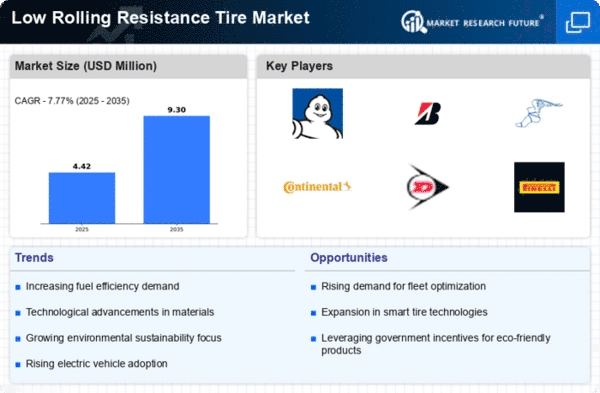
As per MRFR analysis, the Low Rolling Resistance Tire Market Size was estimated at 4.1 USD Million in 2024. The Low Rolling Resistance Tire industry is projected to grow from 4.4 in 2025 to 9.3 by 2035, exhibiting a compound annual growth rate (CAGR) of 7.77 during the forecast period 2025 - 2035.

Key Market Trends & Highlights

The Low Rolling Resistance Tire Market is poised for substantial growth driven by sustainability and technological advancements.

  • The market is increasingly influenced by a strong focus on sustainability, particularly in North America, which remains the largest market. Technological advancements are enhancing tire performance, leading to greater adoption in the passenger vehicle segment, the largest segment overall. Asia-Pacific is emerging as the fastest-growing region, driven by rising demand for low rolling resistance tires in commercial vehicles. Key market drivers include environmental regulations and heightened consumer awareness regarding fuel efficiency, which are shaping purchasing decisions.

Market Size & Forecast

2024 Market Size 4.1 (USD Million)
2035 Market Size 9.3 (USD Million)
CAGR (2025 - 2035) 7.77%
Largest Regional Market Share in 2024 North America

Major Players

<a href="https://www.michelin.in/auto/advice/tyre-basics/rolling-resistance">Michelin</a> (FR), Bridgestone (JP), Goodyear (US), Continental (DE), Dunlop (GB), Pirelli (IT), <a href="https://www.hankooktire.com/global/en/tech-in-motion/ev-tire.html">Hankook</a> (KR), Toyo (JP), Yokohama (JP)

Market Trends

The Low Rolling Resistance Tire Market is currently experiencing a notable transformation, driven by a confluence of environmental concerns and advancements in tire technology. Manufacturers are increasingly focusing on developing tires that not only enhance fuel efficiency but also reduce greenhouse gas emissions. This shift is indicative of a broader trend towards sustainability within the automotive sector, as consumers and regulatory bodies alike demand more eco-friendly solutions. Furthermore, the integration of innovative materials and design methodologies appears to be enhancing the performance characteristics of these tires, making them more appealing to a wider audience. In addition to environmental considerations, the Low Rolling Resistance Tire Market is also influenced by the growing emphasis on cost savings. As fuel prices fluctuate, the economic advantages of utilizing low rolling resistance tires become more pronounced. Fleet operators and individual consumers are likely to recognize the long-term financial benefits associated with reduced fuel consumption. Consequently, this market segment is poised for growth as awareness of these advantages spreads. Overall, the Low Rolling Resistance Tire Market seems to be on a trajectory of expansion, characterized by a blend of technological innovation and a commitment to sustainability.

Sustainability Focus

The Low Rolling Resistance Tire Market is increasingly aligning with global sustainability initiatives. Manufacturers are prioritizing eco-friendly materials and production processes, reflecting a commitment to reducing environmental impact. This trend is likely to resonate with consumers who are becoming more environmentally conscious.

Technological Advancements

Innovations in tire design and materials are shaping the Low Rolling Resistance Tire Market. Enhanced manufacturing techniques and the use of advanced polymers are contributing to improved performance and durability. These advancements may attract a broader customer base seeking high-quality, efficient tires.

Economic Incentives

The financial benefits associated with low rolling resistance tires are becoming more apparent. As fuel efficiency becomes a priority for both consumers and businesses, the market is likely to see increased demand. This trend suggests that economic considerations will play a crucial role in driving market growth.

Low Rolling Resistance Tire Market Market Drivers

Market Growth Projections

The Global Low Rolling Resistance Tire Market Industry is poised for remarkable growth, with projections indicating a substantial increase from 10.4 USD Billion in 2024 to 63.3 USD Billion by 2035. This growth trajectory reflects a compound annual growth rate (CAGR) of 17.85% from 2025 to 2035, driven by various factors including technological advancements, regulatory support, and rising consumer demand for fuel-efficient and sustainable products. The market's expansion is indicative of a broader trend towards eco-friendly transportation solutions, as stakeholders across the automotive industry recognize the importance of low rolling resistance tires in achieving sustainability goals.

Rising Electric Vehicle Adoption

The increasing adoption of electric vehicles (EVs) is a significant driver for the Global Low Rolling Resistance Tire Market Industry. EVs require tires that optimize energy efficiency to maximize their range and performance. Consequently, tire manufacturers are focusing on producing low rolling resistance tires specifically designed for electric vehicles. This trend aligns with the broader shift towards sustainable transportation solutions, as consumers seek to reduce their carbon footprint. The market's growth trajectory is expected to be robust, with projections indicating a rise to 63.3 USD Billion by 2035, driven by the growing popularity of EVs and the demand for compatible tire solutions.

Growing Demand for Fuel Efficiency

The Global Low Rolling Resistance Tire Market Industry is experiencing a surge in demand driven by the increasing need for fuel efficiency among consumers and manufacturers. As fuel prices remain volatile, consumers are more inclined to invest in tires that enhance vehicle performance while reducing fuel consumption. This trend is particularly evident in the automotive sector, where manufacturers are integrating low rolling resistance tires into their vehicles to meet regulatory standards and consumer expectations. The market is projected to reach 10.4 USD Billion in 2024, reflecting a significant shift towards sustainable driving solutions that align with global environmental goals.

Regulatory Support for Emission Reduction

Government regulations aimed at reducing carbon emissions are playing a pivotal role in shaping the Global Low Rolling Resistance Tire Market Industry. Many countries are implementing stringent emission standards that necessitate the adoption of technologies promoting lower fuel consumption. This regulatory landscape encourages tire manufacturers to innovate and develop low rolling resistance tires that comply with these standards. As a result, the market is likely to witness substantial growth, with projections indicating an increase to 63.3 USD Billion by 2035. This regulatory push not only benefits the environment but also drives consumer awareness and demand for eco-friendly tire options.

Consumer Awareness and Sustainability Trends

Consumer awareness regarding sustainability and environmental impact is increasingly influencing the Global Low Rolling Resistance Tire Market Industry. As individuals become more conscious of their ecological footprint, there is a growing preference for products that contribute to energy conservation and reduced emissions. This shift in consumer behavior is prompting tire manufacturers to promote low rolling resistance tires as a viable option for environmentally conscious drivers. The market is poised for growth, with expectations of reaching 10.4 USD Billion in 2024, as consumers actively seek out sustainable tire solutions that align with their values.

Technological Advancements in Tire Manufacturing

Technological advancements in tire manufacturing are significantly influencing the Global Low Rolling Resistance Tire Market Industry. Innovations in materials and design have led to the development of tires that minimize energy loss while maintaining performance and safety. For instance, the use of advanced polymers and tread patterns has improved the efficiency of low rolling resistance tires, making them more appealing to consumers. This trend is expected to contribute to a compound annual growth rate (CAGR) of 17.85% from 2025 to 2035, as manufacturers continue to invest in research and development to enhance tire performance and sustainability.

Market Segment Insights

By Application: Passenger Vehicle (Largest) vs. Commercial Vehicle (Fastest-Growing)

In the Low Rolling Resistance Tire Market, the 'Passenger Vehicle' segment holds the largest market share, significantly influencing overall market dynamics. This segment benefits from the increasing focus on fuel efficiency, as consumers opt for tires that offer improved performance at a lower rolling resistance. Moreover, the growing trend towards sustainable and eco-friendly transportation options positions this segment favorably within the market landscape. On the other hand, the 'Commercial Vehicle' segment is emerging as the fastest-growing sector within the Low Rolling Resistance Tire Market. The expansion of e-commerce and logistics sectors is driving demand for innovative tire solutions that enhance fuel efficiency and reduce operating costs for fleet operators. Additionally, the rise in transportation regulations emphasizing lower emissions fuels the growth of tires tailored for commercial applications.

Passenger Vehicle (Dominant) vs. Commercial Vehicle (Emerging)

The 'Passenger Vehicle' segment is characterized by its dominance in the Low Rolling Resistance Tire Market, primarily due to its extensive consumer base and focus on enhancing fuel efficiency. These tires are designed to minimize energy loss as they roll, contributing to improved mileage and lower fuel consumption—a crucial consideration for many drivers today. With advancements in tire technology and material science, manufacturers are offering an array of options tailored to different driving conditions, promoting broader market adoption. Meanwhile, the 'Commercial Vehicle' segment, while emerging, is rapidly gaining traction as fleets seek to optimize operational efficiency. The integration of rolling resistance tires within commercial applications not only lowers operational costs but also addresses environmental concerns, making it an appealing choice for modern businesses aiming for sustainability.

By End Use: Original Equipment Manufacturer (Largest) vs. Aftermarket (Fastest-Growing)

The Low Rolling Resistance Tire Market is notably characterized by its distribution between the Original Equipment Manufacturer (OEM) and Aftermarket segments. The OEM segment holds a significant share, driven by the increasing integration of low rolling resistance tires in new vehicle models due to stringent fuel efficiency regulations and the growing emphasis on sustainability among manufacturers. This segment benefits from partnerships with automakers, which fosters a stable demand for these tires as a key component in vehicle production. Conversely, the Aftermarket segment, while smaller in overall size, demonstrates a dynamic growth trajectory as consumers increasingly recognize the benefits of low rolling resistance tires in terms of fuel savings and environmental impact, especially for existing vehicles needing replacements.

End Use: OEM (Dominant) vs. Aftermarket (Emerging)

In the Low Rolling Resistance Tire Market, the Original Equipment Manufacturer (OEM) segment is dominant due to its established relationships with vehicle manufacturers who prioritize efficiency and environmental sustainability. These tires are designed to optimize fuel economy, making them a preferred choice for new vehicles hitting the market. On the other hand, the Aftermarket segment emerges as a more flexible and rapidly growing entity, fueled by rising consumer awareness and demand for improved fuel efficiency in existing vehicles. This sector appeals to cost-conscious consumers looking to enhance vehicle performance and reduce running costs, making low rolling resistance tires an increasingly attractive option for replacement. Together, these segments reflect the growing importance of efficiency in the tire market.

By Tire Type: Radial Tire (Largest) vs. Bias Tire (Fastest-Growing)

The low rolling resistance tire market is significantly influenced by two primary tire types: Radial and Bias tires. Currently, Radial tires dominate this market segment due to their superior performance characteristics in terms of fuel efficiency and tread wear. Their widespread adoption across various vehicle segments contributes to their substantial market share, making them the preferred choice for consumers and manufacturers alike. Conversely, Bias tires, while holding a smaller share, are experiencing a positive shift in market dynamics, primarily driven by their growing acceptance in specialized applications and emerging markets.

Tire Types: Radial (Dominant) vs. Bias (Emerging)

Radial tires are characterized by their construction, where the tire's ply cords run at a 90-degree angle to the direction of travel. This design facilitates greater flexibility, leading to lower rolling resistance and improved fuel efficiency. They are widely recognized for their durability and performance, making them the dominant choice in the low rolling resistance tire market. On the other hand, Bias tires feature ply cords that run diagonally, providing a sturdier construction suited for specific applications, such as agricultural and off-road vehicles. While Bias tires are considered emerging players in the segment, their growth is supported by increasing demand in niche markets, where their unique characteristics offer essential advantages.

By Material Type: Natural Rubber (Largest) vs. Synthetic Rubber (Fastest-Growing)

The Low Rolling Resistance Tire Market exhibits a diverse material composition, with Natural Rubber commanding the largest share due to its superior elasticity and performance characteristics. It remains the preferred choice for many manufacturers aiming for enhanced fuel efficiency while ensuring durability. In contrast, Synthetic Rubber is rapidly gaining traction as it provides a cost-effective alternative with considerable performance benefits, appealing to both manufacturers and consumers alike. Growth trends indicate that the demand for Synthetic Rubber is on the rise, propelled by advancements in technology that enhance its performance attributes. As automakers increasingly focus on sustainability and environmental concerns, the shift towards low rolling resistance tires made from innovative materials is fueling this segment's growth. Key drivers include the growing electric vehicle market and heightened regulations on fuel efficiency.

Natural Rubber (Dominant) vs. Polyester (Emerging)

<a href="https://www.marketresearchfuture.com/reports/natural-rubber-market-25509">Natural Rubber</a> remains the dominant material in the Low Rolling Resistance Tire Market due to its inherent advantages such as superior grip and flexibility, which directly contribute to enhanced driving performance. It is highly valued for its ability to provide lower rolling resistance and better performance in various weather conditions. Meanwhile, Polyester is emerging as a strong contender because of its lightweight characteristics and ability to reduce tire weight while maintaining structural integrity. This characteristic aligns well with the industry’s push towards lighter and more fuel-efficient vehicles. Polyester also offers flexibility in manufacturing, allowing for innovations that can adapt to changing market demands. Overall, both materials play vital roles in shaping the future landscape of the tire market.

Get more detailed insights about Low Rolling Resistance Tire Market Research Report - Global Forecast till 2035

Regional Insights

North America : Market Leader in Innovation

North America is poised to maintain its leadership in the Low Rolling Resistance Tire Market, holding a market size of $1.6 billion in 2025. The region's growth is driven by increasing fuel efficiency regulations and a rising demand for eco-friendly transportation solutions. The automotive sector's shift towards electric vehicles (EVs) further propels this trend, as low rolling resistance tires are essential for maximizing EV range and performance. The competitive landscape in North America is robust, featuring key players such as Goodyear, Michelin, and Bridgestone. These companies are investing heavily in R&D to innovate tire technologies that enhance fuel efficiency and reduce emissions. The presence of advanced manufacturing facilities and a strong distribution network also contribute to the region's market dominance, ensuring that consumers have access to high-quality low rolling resistance tires.

Europe : Sustainability and Regulation Focus

Europe's Low Rolling Resistance Tire Market is projected to reach $1.2 billion by 2025, driven by stringent environmental regulations and a strong consumer preference for sustainable products. The European Union's commitment to reducing CO2 emissions has led to increased demand for tires that improve fuel efficiency. This regulatory environment is a significant catalyst for market growth, as manufacturers adapt to meet these standards and consumer expectations. Leading countries in this region include Germany, France, and the UK, where major players like Continental and Pirelli are actively innovating. The competitive landscape is characterized by a focus on sustainability, with companies investing in eco-friendly materials and production processes. The presence of a well-established automotive industry further supports the demand for low rolling resistance tires, making Europe a key player in this market.

Asia-Pacific : Emerging Market Potential

The Asia-Pacific region is witnessing significant growth in the Low Rolling Resistance Tire Market, with a projected size of $1.0 billion by 2025. This growth is fueled by increasing vehicle production and a rising middle class that demands more fuel-efficient vehicles. Countries like China and India are at the forefront, where government initiatives to promote electric vehicles and reduce emissions are driving demand for low rolling resistance tires. The competitive landscape is evolving, with key players such as Bridgestone and Yokohama expanding their presence in the region. Local manufacturers are also emerging, focusing on cost-effective solutions to cater to the growing automotive market. The combination of regulatory support and increasing consumer awareness about fuel efficiency is expected to further boost the market in Asia-Pacific, making it a vital area for future growth.

Middle East and Africa : Untapped Market Opportunities

The Middle East and Africa region represents an emerging market for Low Rolling Resistance Tires, with a market size of $0.3 billion projected for 2025. The growth in this region is primarily driven by increasing vehicle ownership and a growing awareness of fuel efficiency among consumers. Additionally, government initiatives aimed at improving transportation infrastructure are expected to create further demand for innovative tire solutions that enhance fuel economy. Countries like South Africa and the UAE are leading the way in adopting low rolling resistance technologies. The competitive landscape is still developing, with both international and local players vying for market share. As the automotive sector continues to expand, the demand for low rolling resistance tires is anticipated to rise, presenting significant opportunities for manufacturers and suppliers in the region.

Key Players and Competitive Insights

The Low Rolling Resistance Tire Market is currently characterized by a competitive landscape that is both dynamic and multifaceted. Key growth drivers include the increasing demand for fuel-efficient vehicles and stringent environmental regulations aimed at reducing carbon emissions. Major players such as Michelin (FR), Bridgestone (JP), and Goodyear (US) are strategically positioned to leverage innovation and sustainability in their product offerings. Michelin (FR) focuses on enhancing tire performance through advanced materials and technology, while Bridgestone (JP) emphasizes partnerships with automotive manufacturers to integrate low rolling resistance tires into new vehicle models. Goodyear (US) is also investing in digital transformation to optimize tire performance monitoring, thereby enhancing customer engagement and operational efficiency. Collectively, these strategies shape a competitive environment that prioritizes technological advancement and sustainability.
In terms of business tactics, companies are increasingly localizing manufacturing to reduce supply chain vulnerabilities and enhance responsiveness to regional market demands. The market structure appears moderately fragmented, with several key players exerting considerable influence. This fragmentation allows for niche players to emerge, yet the collective strength of major companies like Continental (DE) and Pirelli (IT) ensures that competition remains robust and innovation-driven.
In November 2025, Continental (DE) announced the launch of a new line of low rolling resistance tires designed specifically for electric vehicles. This strategic move not only aligns with the growing trend towards electrification in the automotive sector but also positions Continental (DE) as a leader in sustainable tire technology. The introduction of these tires is expected to enhance vehicle range and efficiency, thereby appealing to environmentally conscious consumers and manufacturers alike.
In October 2025, Pirelli (IT) revealed a partnership with a leading automotive manufacturer to co-develop a new tire technology that reduces rolling resistance while maintaining high performance. This collaboration underscores Pirelli's commitment to innovation and its strategic focus on aligning with automotive trends. By working closely with manufacturers, Pirelli (IT) aims to ensure that its products meet the evolving needs of the market, thereby solidifying its competitive edge.
In September 2025, Goodyear (US) launched a digital platform that utilizes AI to analyze tire performance data in real-time. This initiative not only enhances customer experience but also allows for proactive maintenance and optimization of tire usage. By integrating AI into its operations, Goodyear (US) is likely to improve its service offerings and operational efficiency, setting a new standard in the industry.
As of December 2025, current competitive trends indicate a strong shift towards digitalization, sustainability, and AI integration within the Low Rolling Resistance Tire Market. Strategic alliances are increasingly shaping the landscape, enabling companies to pool resources and expertise to drive innovation. Looking ahead, competitive differentiation is expected to evolve from traditional price-based competition to a focus on technological innovation, supply chain reliability, and sustainable practices. This shift suggests that companies that prioritize these areas will likely emerge as leaders in the market.

Key Companies in the Low Rolling Resistance Tire Market include

Industry Developments

  • Q2 2024: Goodyear Unveils New Range of Low Rolling Resistance Tires for Electric Vehicles Goodyear announced the launch of a new line of low rolling resistance tires specifically designed for electric vehicles, aiming to improve energy efficiency and extend driving range. The new product line will be available in North America and Europe starting in Q3 2024.
  • Q1 2024: Michelin Launches e.Primacy 2, Its Latest Low Rolling Resistance Tire Market for Passenger Cars Michelin introduced the e.Primacy 2 tire, an updated low rolling resistance model for passenger vehicles, targeting improved fuel efficiency and reduced CO2 emissions. The tire will be rolled out across European markets in 2024.
  • Q2 2024: Continental Expands Low Rolling Resistance Tire Market Production at Portugal Facility Continental announced the expansion of its tire manufacturing facility in Lousado, Portugal, to increase production capacity for low rolling resistance tires, supporting growing demand from European automakers.
  • Q2 2024: Bridgestone and EV Startup Fisker Announce Partnership for Low Rolling Resistance Tire Market Supply Bridgestone entered into a partnership with Fisker to supply low rolling resistance tires for Fisker's upcoming electric SUV models, with deliveries scheduled to begin in late 2024.
  • Q1 2024: Sumitomo Rubber Industries to Open New R&D Center Focused on Low Rolling Resistance Tire Market Technology Sumitomo Rubber Industries announced the opening of a new research and development center in Japan dedicated to advancing low rolling resistance tire technologies, with a focus on sustainable materials and improved performance.
  • Q3 2024: Pirelli Launches Cinturato P7 Blue, a New Low Rolling Resistance Tire Market for Hybrid Vehicles Pirelli introduced the Cinturato P7 Blue, a low rolling resistance tire designed for hybrid vehicles, aiming to enhance fuel efficiency and reduce environmental impact. The tire will be available in select global markets starting September 2024.
  • Q2 2024: Hankook Tire Wins OEM Contract to Supply Low Rolling Resistance Tires for Volkswagen ID.4 Hankook Tire secured an original equipment manufacturer (OEM) contract to supply low rolling resistance tires for the Volkswagen ID.4 electric SUV, with production and deliveries commencing in mid-2024.
  • Q1 2024: Yokohama Rubber Co. Announces Investment in New Low Rolling Resistance Tire Market Production Line Yokohama Rubber Co. announced a significant investment to establish a new production line for low rolling resistance tires at its plant in Thailand, aiming to meet rising global demand.
  • Q2 2024: Apollo Tyres Launches Low Rolling Resistance Tire Market Range for Commercial Vehicles in India Apollo Tyres launched a new range of low rolling resistance tires for commercial vehicles in India, targeting improved fuel efficiency for fleet operators.
  • Q2 2024: Nokian Tyres Introduces Low Rolling Resistance Tire Market for Nordic Markets Nokian Tyres unveiled a new low rolling resistance tire designed for the Nordic climate, focusing on energy efficiency and safety in winter conditions.
  • Q1 2024: Toyo Tire Corporation Opens New Facility for Low Rolling Resistance Tire Market Production in Malaysia Toyo Tire Corporation inaugurated a new manufacturing facility in Malaysia dedicated to the production of low rolling resistance tires, expanding its global supply capabilities.
  • Q2 2024: Kumho Tire Partners with Hyundai to Develop Low Rolling Resistance Tires for Next-Gen EVs Kumho Tire announced a partnership with Hyundai Motor Company to co-develop low rolling resistance tires for Hyundai's next-generation electric vehicles, with prototypes expected by the end of 2024.

Intended Audience:

    • Low rolling resistance tire producers
    • Automotive OEM’s
    • Individual vehicle owners
    • Rubber suppliers
    • Fleet owners
    • Government bodies
    • Other raw material suppliers

The low rolling resistance tire manufacturing companies are working to develop low rolling resistance tires specifically for electric vehicles as Hankook Tire developed Enfren Eco tire, which combines a special silica compound and structural design to reduce energy loss and enhance fuel efficiency for electric vehicles.

Additionally, increasing vehicle sales, aftermarket growth, lower production costs, and favorable government schemes are encouraging global players to invest heavily in this region, which is further expected to drive the market growth during the forecast period.

Low rolling resistance tires are made with a hard rubber compound and stiff sidewalls to reduce friction and flex. Some tire companies are working on developing the advanced tire material combinations with new tire compounds, such as those based on silica and alternative oils to achieve good rolling-resistance properties while maintaining a pleasant ride and better grip.

Such tires are designed to have low tire rolling resistance with the help of improved tire thread design without affecting skid and tread abrasion resistance, traction and other aspects of tire performance that are vital to the operating smoothness, as well as they are designed to reduce the noise generated by the tire and ultimately improve the vehicle fuel efficiency.

In 2010, Japan began implementing a voluntary tire labeling system for passenger cars. Similarly, the South Korean government initiated a voluntary tire-labeling program for passenger cars in November 2011, which was then made compulsory in November 2012. Furthermore, in November 2016, South Korea started implementing mandatory tire labeling regulations such government regulations regarding tire labelling is expected to further boost the growth of the low rolling resistance tire market.

Low rolling resistance tire manufacturers, considering the potential of the commercial vehicles, have started focusing on them by investing in the development of tread compounds that can reduce tire rolling resistance while maintaining the treadwear and durability of truck tires. For instance, The Goodyear Tire & Rubber Company is developing low rolling resistance tires that provide maximum fuel saving with low heat generation and low rolling resistance for long-haul applications. In 2018, it planned to launch its most fuel-efficient tire range.

According to the data provided by the company, these new tires are manufactured using a silica compound that can help save a 100-vehicle fleet more than USD 338,000 in fuel costs, annually, and help truck manufacturers meet future emission targets. Thus, the rise in demand for low rolling resistance tires, especially within fleets, is an opportunity for low rolling resistance tires during the forecast period.

The Market Research Future report on the global low rolling resistance tire industry covers extensive primary research. This is accompanied by a detailed analysis of qualitative and quantitative aspects by various industry experts and key opinion leaders to gain deeper insights into the market and industry performance. The report gives a clear picture of the current market scenario, which includes the historical and forecasted market size, in terms of value and volume, technological advancement, macroeconomic, and governing factors of the market.

The report provides comprehensive information about the strategies of the top companies in the industry, along with a broad study of the different market segments and regions.


Future Outlook

Low Rolling Resistance Tire Market Future Outlook

The Low Rolling Resistance Tire Market is projected to grow at a 7.77% CAGR from 2025 to 2035, driven by increasing fuel efficiency regulations and consumer demand for sustainable transportation solutions.

New opportunities lie in:

  • Development of advanced tire recycling programs
  • Integration of smart tire technology for real-time performance monitoring
  • Expansion into emerging markets with tailored product offerings

By 2035, the market is expected to achieve substantial growth, positioning itself as a leader in sustainable tire solutions.

Market Segmentation

Low Rolling Resistance Tire Market End Use Outlook

  • Original Equipment Manufacturer
  • Aftermarket

Low Rolling Resistance Tire Market Tire Type Outlook

  • Radial Tire
  • Bias Tire

Low Rolling Resistance Tire Market Application Outlook

  • Passenger Vehicle
  • Commercial Vehicle
  • Two-Wheeler
  • Light Truck

Low Rolling Resistance Tire Market Material Type Outlook

  • Natural Rubber
  • Synthetic Rubber
  • Polyester
  • Steel

Report Scope

MARKET SIZE 2024 4.1(USD Million)
MARKET SIZE 2025 4.4(USD Million)
MARKET SIZE 2035 9.3(USD Million)
COMPOUND ANNUAL GROWTH RATE (CAGR) 7.77% (2025 - 2035)
REPORT COVERAGE Revenue Forecast, Competitive Landscape, Growth Factors, and Trends
BASE YEAR 2024
Market Forecast Period 2025 - 2035
Historical Data 2019 - 2024
Market Forecast Units USD Million
Key Companies Profiled Michelin (FR), Bridgestone (JP), Goodyear (US), Continental (DE), Dunlop (GB), Pirelli (IT), Hankook (KR), Toyo (JP), Yokohama (JP)
Segments Covered Application, End Use, Tire Type, Material Type
Key Market Opportunities Growing demand for fuel-efficient vehicles drives innovation in the Low Rolling Resistance Tire Market.
Key Market Dynamics Rising consumer demand for fuel efficiency drives innovation in low rolling resistance tire technology and design.
Countries Covered North America, Europe, APAC, South America, MEA

FAQs

What is the expected CAGR of the market?

The Global Low Rolling Resistance Tire Market will be witnessing ~15.85% CAGR.

What are the main key players of the market?

Apollo Tyres Ltd. (India), Kumho Tire (South Korea), Yokohama Rubber Co. Ltd. (Japan), Cheng Shin Rubber Industry Co. (China) are the main key players of the market.

What is the growth period of the market?

2022–2030 is the growth period of the market.

What are the four important regions of the market?

The four important regions are North America, Europe, Asia-Pacific, and the Rest of the world.

  1. SECTION I: EXECUTIVE SUMMARY AND KEY HIGHLIGHTS
    1. | 1.1 EXECUTIVE SUMMARY
    2. | 1.1.1 Market Overview
    3. | 1.1.2 Key Findings
    4. | 1.1.3 Market Segmentation
    5. | 1.1.4 Competitive Landscape
    6. | 1.1.5 Challenges and Opportunities
    7. | 1.1.6 Future Outlook
  2. SECTION II: SCOPING, METHODOLOGY AND MARKET STRUCTURE
    1. | 2.1 MARKET INTRODUCTION
    2. | 2.1.1 Definition
    3. | 2.1.2 Scope of the study
    4. |-- 2.1.2.1 Research Objective
    5. |-- 2.1.2.2 Assumption
    6. |-- 2.1.2.3 Limitations
    7. | 2.2 RESEARCH METHODOLOGY
    8. | 2.2.1 Overview
    9. | 2.2.2 Data Mining
    10. | 2.2.3 Secondary Research
    11. | 2.2.4 Primary Research
    12. |-- 2.2.4.1 Primary Interviews and Information Gathering Process
    13. |-- 2.2.4.2 Breakdown of Primary Respondents
    14. | 2.2.5 Forecasting Model
    15. | 2.2.6 Market Size Estimation
    16. |-- 2.2.6.1 Bottom-Up Approach
    17. |-- 2.2.6.2 Top-Down Approach
    18. | 2.2.7 Data Triangulation
    19. | 2.2.8 Validation
  3. SECTION III: QUALITATIVE ANALYSIS
    1. | 3.1 MARKET DYNAMICS
    2. | 3.1.1 Overview
    3. | 3.1.2 Drivers
    4. | 3.1.3 Restraints
    5. | 3.1.4 Opportunities
    6. | 3.2 MARKET FACTOR ANALYSIS
    7. | 3.2.1 Value chain Analysis
    8. | 3.2.2 Porter's Five Forces Analysis
    9. |-- 3.2.2.1 Bargaining Power of Suppliers
    10. |-- 3.2.2.2 Bargaining Power of Buyers
    11. |-- 3.2.2.3 Threat of New Entrants
    12. |-- 3.2.2.4 Threat of Substitutes
    13. |-- 3.2.2.5 Intensity of Rivalry
    14. | 3.2.3 COVID-19 Impact Analysis
    15. |-- 3.2.3.1 Market Impact Analysis
    16. |-- 3.2.3.2 Regional Impact
    17. |-- 3.2.3.3 Opportunity and Threat Analysis
  4. SECTION IV: QUANTITATIVE ANALYSIS
    1. | 4.1 Automobile, BY Application (USD Million)
    2. | 4.1.1 Passenger Vehicle
    3. | 4.1.2 Commercial Vehicle
    4. | 4.1.3 Two-Wheeler
    5. | 4.1.4 Light Truck
    6. | 4.2 Automobile, BY End Use (USD Million)
    7. | 4.2.1 Original Equipment Manufacturer
    8. | 4.2.2 Aftermarket
    9. | 4.3 Automobile, BY Tire Type (USD Million)
    10. | 4.3.1 Radial Tire
    11. | 4.3.2 Bias Tire
    12. | 4.4 Automobile, BY Material Type (USD Million)
    13. | 4.4.1 Natural Rubber
    14. | 4.4.2 Synthetic Rubber
    15. | 4.4.3 Polyester
    16. | 4.4.4 Steel
    17. | 4.5 Automobile, BY Region (USD Million)
    18. | 4.5.1 North America
    19. |-- 4.5.1.1 US
    20. |-- 4.5.1.2 Canada
    21. | 4.5.2 Europe
    22. |-- 4.5.2.1 Germany
    23. |-- 4.5.2.2 UK
    24. |-- 4.5.2.3 France
    25. |-- 4.5.2.4 Russia
    26. |-- 4.5.2.5 Italy
    27. |-- 4.5.2.6 Spain
    28. |-- 4.5.2.7 Rest of Europe
    29. | 4.5.3 APAC
    30. |-- 4.5.3.1 China
    31. |-- 4.5.3.2 India
    32. |-- 4.5.3.3 Japan
    33. |-- 4.5.3.4 South Korea
    34. |-- 4.5.3.5 Malaysia
    35. |-- 4.5.3.6 Thailand
    36. |-- 4.5.3.7 Indonesia
    37. |-- 4.5.3.8 Rest of APAC
    38. | 4.5.4 South America
    39. |-- 4.5.4.1 Brazil
    40. |-- 4.5.4.2 Mexico
    41. |-- 4.5.4.3 Argentina
    42. |-- 4.5.4.4 Rest of South America
    43. | 4.5.5 MEA
    44. |-- 4.5.5.1 GCC Countries
    45. |-- 4.5.5.2 South Africa
    46. |-- 4.5.5.3 Rest of MEA
  5. SECTION V: COMPETITIVE ANALYSIS
    1. | 5.1 Competitive Landscape
    2. | 5.1.1 Overview
    3. | 5.1.2 Competitive Analysis
    4. | 5.1.3 Market share Analysis
    5. | 5.1.4 Major Growth Strategy in the Automobile
    6. | 5.1.5 Competitive Benchmarking
    7. | 5.1.6 Leading Players in Terms of Number of Developments in the Automobile
    8. | 5.1.7 Key developments and growth strategies
    9. |-- 5.1.7.1 New Product Launch/Service Deployment
    10. |-- 5.1.7.2 Merger & Acquisitions
    11. |-- 5.1.7.3 Joint Ventures
    12. | 5.1.8 Major Players Financial Matrix
    13. |-- 5.1.8.1 Sales and Operating Income
    14. |-- 5.1.8.2 Major Players R&D Expenditure. 2023
    15. | 5.2 Company Profiles
    16. | 5.2.1 Michelin (FR)
    17. |-- 5.2.1.1 Financial Overview
    18. |-- 5.2.1.2 Products Offered
    19. |-- 5.2.1.3 Key Developments
    20. |-- 5.2.1.4 SWOT Analysis
    21. |-- 5.2.1.5 Key Strategies
    22. | 5.2.2 Bridgestone (JP)
    23. |-- 5.2.2.1 Financial Overview
    24. |-- 5.2.2.2 Products Offered
    25. |-- 5.2.2.3 Key Developments
    26. |-- 5.2.2.4 SWOT Analysis
    27. |-- 5.2.2.5 Key Strategies
    28. | 5.2.3 Goodyear (US)
    29. |-- 5.2.3.1 Financial Overview
    30. |-- 5.2.3.2 Products Offered
    31. |-- 5.2.3.3 Key Developments
    32. |-- 5.2.3.4 SWOT Analysis
    33. |-- 5.2.3.5 Key Strategies
    34. | 5.2.4 Continental (DE)
    35. |-- 5.2.4.1 Financial Overview
    36. |-- 5.2.4.2 Products Offered
    37. |-- 5.2.4.3 Key Developments
    38. |-- 5.2.4.4 SWOT Analysis
    39. |-- 5.2.4.5 Key Strategies
    40. | 5.2.5 Dunlop (GB)
    41. |-- 5.2.5.1 Financial Overview
    42. |-- 5.2.5.2 Products Offered
    43. |-- 5.2.5.3 Key Developments
    44. |-- 5.2.5.4 SWOT Analysis
    45. |-- 5.2.5.5 Key Strategies
    46. | 5.2.6 Pirelli (IT)
    47. |-- 5.2.6.1 Financial Overview
    48. |-- 5.2.6.2 Products Offered
    49. |-- 5.2.6.3 Key Developments
    50. |-- 5.2.6.4 SWOT Analysis
    51. |-- 5.2.6.5 Key Strategies
    52. | 5.2.7 Hankook (KR)
    53. |-- 5.2.7.1 Financial Overview
    54. |-- 5.2.7.2 Products Offered
    55. |-- 5.2.7.3 Key Developments
    56. |-- 5.2.7.4 SWOT Analysis
    57. |-- 5.2.7.5 Key Strategies
    58. | 5.2.8 Toyo (JP)
    59. |-- 5.2.8.1 Financial Overview
    60. |-- 5.2.8.2 Products Offered
    61. |-- 5.2.8.3 Key Developments
    62. |-- 5.2.8.4 SWOT Analysis
    63. |-- 5.2.8.5 Key Strategies
    64. | 5.2.9 Yokohama (JP)
    65. |-- 5.2.9.1 Financial Overview
    66. |-- 5.2.9.2 Products Offered
    67. |-- 5.2.9.3 Key Developments
    68. |-- 5.2.9.4 SWOT Analysis
    69. |-- 5.2.9.5 Key Strategies
    70. | 5.3 Appendix
    71. | 5.3.1 References
    72. | 5.3.2 Related Reports

Automobile Market Segmentation

Automobile By Application (USD Million, 2025-2035)

  • Passenger Vehicle
  • Commercial Vehicle
  • Two-Wheeler
  • Light Truck

Automobile By End Use (USD Million, 2025-2035)

  • Original Equipment Manufacturer
  • Aftermarket

Automobile By Tire Type (USD Million, 2025-2035)

  • Radial Tire
  • Bias Tire

Automobile By Material Type (USD Million, 2025-2035)

  • Natural Rubber
  • Synthetic Rubber
  • Polyester
  • Steel
Infographic

Free Sample Request

Kindly complete the form below to receive a free sample of this Report

Get Free Sample

Customer Strories

Compare Licence

×
Features License Type
Single User Multiuser License Enterprise User
Price $4,950 $5,950 $7,250
Maximum User Access Limit 1 User Upto 10 Users Unrestricted Access Throughout the Organization
Free Customization
Direct Access to Analyst
Deliverable Format
Platform Access
Discount on Next Purchase 10% 15% 15%
Printable Versions