
Request Free Sample ×

Kindly complete the form below to receive a free sample of this Report

* Please use a valid business email

Leading companies partner with us for data-driven Insights

clients tt-cursor
Hero Background
English
Chinese
French
Japanese
Korean
German
Spanish

Location based Ambient Intelligence Market Share

ID: MRFR/ICT/10411-HCR
128 Pages
Ankit Gupta
April 2026

Location-based Ambient Intelligence Market Research Report Information By Component (Virtual Reality, Hardware, Software, Wearables, Smart Homes, Lighting controls, Security and Access Control, HVAC Controls, Entertainment Controls), Technology (Bluetooth Low Energy, RFID, Sensors Ambient Light Sensor, Software Agents, Affective Computing, Nanotechnology, Biometrics), End User (Residential, Retail, Healthcare, Industrial, Office Building, Automotive), Regions (North America, Europe, Asia-Pacific, and Rest Of The World) - Forecast Till 2035

Share:
Download PDF ×

We do not share your information with anyone. However, we may send you emails based on your report interest from time to time. You may contact us at any time to opt-out.

Location based Ambient Intelligence Market Infographic
Purchase Options

Market Share

Location based Ambient Intelligence Market Share Analysis

In the bustling landscape of the Location-based Ambient Intelligence market, companies are deploying a diverse array of strategies to position themselves effectively and secure market share. One pivotal strategy is differentiation, where companies strive to set themselves apart from competitors by offering unique features, innovative technologies, or specialized services tailored to the evolving needs of consumers and businesses. By providing distinct and advanced solutions, companies can attract customers seeking personalized experiences, enhanced convenience, and seamless integration of ambient intelligence technologies, thereby gaining a competitive advantage and increasing their market share.

Cost leadership is another critical strategy within the Location-based Ambient Intelligence market. Companies leveraging this approach focus on delivering cost-effective solutions without compromising on quality or performance. By optimizing their operational processes, negotiating favorable deals with suppliers, and utilizing efficient technologies, companies can offer competitive pricing to appeal to budget-conscious clients. Providing affordable Location-based Ambient Intelligence solutions enables companies to broaden their customer base and capture market share in a highly competitive environment.

Moreover, targeting specific niches or customer segments is a strategic move for many companies in the Location-based Ambient Intelligence market. By tailoring their solutions to meet the unique requirements of particular industries or user groups, such as retail, hospitality, or smart cities, companies can address specific use cases, regulatory requirements, or consumer preferences. This targeted approach allows companies to establish themselves as leaders within specific market segments, build strong relationships with customers, and gain a competitive edge in the market.

Strategic partnerships and alliances play a pivotal role in market share positioning within the Location-based Ambient Intelligence market. Collaborations with technology providers, data aggregators, or industry stakeholders enable companies to leverage complementary strengths and resources. These partnerships can facilitate access to new data sources, enhance solution capabilities, and integrate Location-based Ambient Intelligence technologies with complementary services or platforms, driving growth and increasing market share.

Furthermore, mergers and acquisitions (M&A) are prevalent strategies for companies in the Location-based Ambient Intelligence market aiming to consolidate their position and expand market share rapidly. Through strategic acquisitions, companies can gain access to new technologies, talent, or customer bases, thereby enhancing their competitive position and capabilities. M&A activities provide opportunities for companies to scale their operations, enter new markets, or eliminate competitors, contributing to solidifying their position in the Location-based Ambient Intelligence market.

Effective marketing and branding strategies are essential for companies looking to establish a strong market position in the Location-based Ambient Intelligence sector. Building a compelling brand identity and effectively communicating the value proposition of their solutions are critical components of these strategies. Marketing efforts may include targeted advertising campaigns, participation in industry events, and partnerships with key stakeholders to position the company as a trusted provider of Location-based Ambient Intelligence solutions.

Continuous innovation is vital for companies seeking to maintain or improve their market share in the rapidly evolving Location-based Ambient Intelligence market. Investment in research and development allows companies to stay ahead of emerging trends, technologies, and consumer preferences. Continuous innovation enables companies to enhance their solutions, introduce new features, and adapt to evolving market requirements, ultimately driving market share growth.

Customer service and support are also crucial for market share positioning within the Location-based Ambient Intelligence market. Providing exceptional customer service, offering timely support, and delivering ongoing training and updates are essential for building customer loyalty and satisfaction. Satisfied customers are more likely to recommend a company's solutions to others, contributing to positive word-of-mouth marketing and aiding in the expansion of market share.


Author
Author Profile
Ankit Gupta
Team Lead - Research

Ankit Gupta is a seasoned market intelligence and strategic research professional with over six plus years of experience in the ICT and Semiconductor industries. With academic roots in Telecom, Marketing, and Electronics, he blends technical insight with business strategy. Ankit has led 200+ projects, including work for Fortune 500 clients like Microsoft and Rio Tinto, covering market sizing, tech forecasting, and go-to-market strategies. Known for bridging engineering and enterprise decision-making, his insights support growth, innovation, and investment planning across diverse technology markets.

Leave a Comment

FAQs

What is the projected market valuation for the Location-based Ambient Intelligence Market in 2035?

<p>The projected market valuation for the Location-based Ambient Intelligence Market in 2035 is 2374.32 USD Billion.</p>

What was the overall market valuation for the Location-based Ambient Intelligence Market in 2024?

<p>The overall market valuation for the Location-based Ambient Intelligence Market in 2024 was 268.79 USD Billion.</p>

What is the expected CAGR for the Location-based Ambient Intelligence Market during the forecast period 2025 - 2035?

<p>The expected CAGR for the Location-based Ambient Intelligence Market during the forecast period 2025 - 2035 is 21.9%.</p>

Which companies are considered key players in the Location-based Ambient Intelligence Market?

<p>Key players in the Location-based Ambient Intelligence Market include Google, Apple, Microsoft, IBM, Amazon, Cisco, Qualcomm, Samsung, Huawei, and Siemens.</p>

What segment is projected to have the highest valuation in the Location-based Ambient Intelligence Market by 2035?

<p>The Software segment is projected to reach a valuation of 600.0 USD Billion by 2035.</p>

How does the valuation of the Retail segment compare to the Healthcare segment in 2035?

<p>By 2035, the Retail segment is projected to reach 600.0 USD Billion, whereas the Healthcare segment is expected to reach 500.0 USD Billion.</p>

What is the projected valuation for the Hardware segment in 2035?

The Hardware segment is projected to reach a valuation of 450.0 USD Billion by 2035.

Which technology segment is expected to show substantial growth in the Location-based Ambient Intelligence Market?

The Bluetooth Low Energy technology segment is expected to grow significantly, reaching a valuation of 400.0 USD Billion by 2035.

What is the anticipated valuation for the Smart Homes segment by 2035?

The Smart Homes segment is anticipated to reach a valuation of 350.0 USD Billion by 2035.

How does the valuation of the mHealth segment compare to the Wearables segment in 2035?

In 2035, the mHealth segment is projected to reach 200.0 USD Billion, while the Wearables segment is expected to reach 250.0 USD Billion.

Market Summary

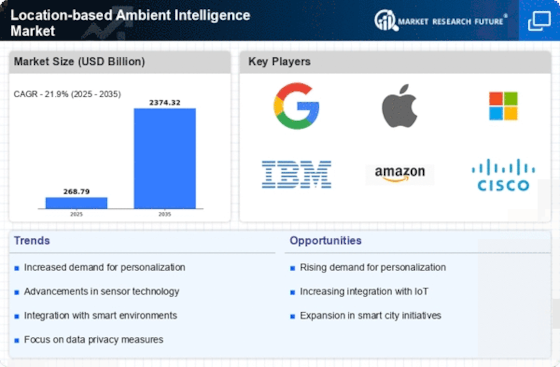
As per Market Research Future analysis, the Location-based Ambient Intelligence Market was estimated at 268.79 USD Billion in 2024. The Location-based Ambient Intelligence industry is projected to grow from 327.67 USD Billion in 2025 to 2374.32 USD Billion by 2035, exhibiting a compound annual growth rate (CAGR) of 21.9% during the forecast period 2025 - 2035

Key Market Trends & Highlights

The Location-based Ambient Intelligence Market is poised for substantial growth driven by technological advancements and increasing consumer expectations.

  • The integration of AI and Machine Learning is transforming the capabilities of location-based services, enhancing user experiences. North America remains the largest market, while the Asia-Pacific region is emerging as the fastest-growing area for ambient intelligence solutions. Virtual Reality leads the market segments, whereas Wearables are rapidly gaining traction due to their innovative applications. Rising demand for personalized experiences and advancements in IoT technologies are key drivers propelling market expansion.

Market Size & Forecast

2024 Market Size 268.79 (USD Billion)
2035 Market Size 2374.32 (USD Billion)
CAGR (2025 - 2035) 21.9%
Largest Regional Market Share in 2024 North America

Major Players

Google (US), Apple (US), Microsoft (US), IBM (US), Amazon (US), Cisco (US), Qualcomm (US), Samsung (KR), Huawei (CN), Siemens (DE)

Market Trends

The Location-based Ambient Intelligence Market is currently experiencing a transformative phase, driven by advancements in technology and an increasing demand for personalized experiences. This market encompasses a range of applications, including smart cities, retail environments, and healthcare settings, where location data is utilized to enhance user interactions and improve operational efficiency. The integration of artificial intelligence and machine learning into location-based services appears to be a key factor in this evolution, enabling systems to learn from user behavior and adapt accordingly. As organizations seek to leverage data for strategic decision-making, the potential for growth in this sector seems substantial. Moreover, the emphasis on privacy and data security is becoming increasingly pronounced within the Location-based Ambient Intelligence Market. Stakeholders are navigating the delicate balance between harnessing valuable insights and ensuring user trust. This focus on ethical data usage may lead to the development of more robust frameworks and regulations, which could shape the future landscape of the market. As technology continues to advance, the interplay between user experience and data governance will likely play a pivotal role in determining the trajectory of this dynamic market.

Integration of AI and Machine Learning

The incorporation of artificial intelligence and machine learning technologies is reshaping the Location-based Ambient Intelligence Market. These innovations enable systems to analyze vast amounts of location data, facilitating personalized user experiences and enhancing operational efficiency. As organizations increasingly adopt these technologies, the market is likely to witness a surge in applications that leverage real-time data for improved decision-making.

Focus on Privacy and Data Security

As the Location-based Ambient Intelligence Market expands, the emphasis on privacy and data security is becoming more pronounced. Stakeholders are increasingly aware of the need to protect user information while still deriving valuable insights from location data. This growing concern may lead to the establishment of stricter regulations and ethical guidelines, influencing how companies operate within this space.

Expansion of Smart City Initiatives

The rise of smart city initiatives is significantly impacting the Location-based Ambient Intelligence Market. Urban areas are increasingly adopting technologies that utilize location data to enhance public services, improve infrastructure, and promote sustainability. This trend suggests a growing recognition of the potential benefits of integrating ambient intelligence into urban planning and management.

Location based Ambient Intelligence Market Market Drivers

Advancements in IoT Technologies

The Location-based Ambient Intelligence Market is significantly influenced by the rapid advancements in Internet of Things (IoT) technologies. The proliferation of connected devices and sensors facilitates the collection of real-time location data, which is essential for creating intelligent environments. As of October 2025, the number of IoT devices is expected to surpass 30 billion, providing a vast amount of data for analysis. This influx of information allows businesses to optimize operations, improve resource management, and enhance user experiences. Furthermore, the integration of IoT with ambient intelligence systems is likely to drive innovation and create new applications, thereby expanding the market's potential.

Enhanced Security and Safety Measures

The Location-based Ambient Intelligence Market is experiencing a heightened focus on security and safety measures, particularly in public spaces and commercial establishments. The integration of location-based technologies with ambient intelligence systems can significantly enhance surveillance and emergency response capabilities. As of October 2025, the demand for advanced security solutions is projected to grow, driven by concerns over public safety and crime prevention. Technologies such as real-time location tracking and predictive analytics can help organizations respond more effectively to incidents. This trend not only addresses safety concerns but also fosters consumer trust, thereby contributing to the overall growth of the location-based ambient intelligence market.

Rising Demand for Personalized Experiences

The Location-based Ambient Intelligence Market is witnessing a surge in demand for personalized experiences across various sectors, including retail, hospitality, and healthcare. Consumers increasingly expect tailored services that cater to their individual preferences and behaviors. This trend is driven by advancements in data analytics and machine learning, which enable businesses to gather and analyze location-specific data effectively. According to recent estimates, the market for personalized services is projected to grow significantly, with a compound annual growth rate of over 20% in the coming years. Companies that leverage location-based ambient intelligence can enhance customer engagement and satisfaction, thereby gaining a competitive edge in their respective markets.

Increased Investment in Smart Infrastructure

The Location-based Ambient Intelligence Market is benefiting from increased investment in smart infrastructure initiatives. Governments and private entities are recognizing the importance of developing intelligent urban environments that utilize location-based technologies to improve efficiency and sustainability. As of October 2025, investments in smart city projects are projected to reach over 500 billion dollars, reflecting a growing commitment to enhancing urban living through technology. These initiatives often incorporate ambient intelligence solutions to manage traffic, energy consumption, and public safety more effectively. Consequently, the demand for location-based ambient intelligence solutions is likely to rise as cities strive to become more connected and responsive to the needs of their inhabitants.

Growing Awareness of Environmental Sustainability

The Location-based Ambient Intelligence Market is increasingly shaped by the growing awareness of environmental sustainability among consumers and businesses alike. There is a rising expectation for companies to adopt eco-friendly practices and technologies that minimize their environmental impact. Location-based ambient intelligence can play a crucial role in this transition by optimizing resource usage and reducing waste. For instance, smart energy management systems can analyze location data to enhance energy efficiency in buildings. As sustainability becomes a priority, the market for location-based solutions that support green initiatives is expected to expand, potentially leading to innovative applications that align with environmental goals.

Market Segment Insights

By Component: Virtual Reality (Largest) vs. Wearables (Fastest-Growing)

The Location-based Ambient Intelligence Market showcases a diverse array of components, with Virtual Reality capturing the largest market share. Virtual Reality technologies have been widely adopted in various sectors, including healthcare and education, enhancing user engagement and experience. Following closely, the market for Wearables is expanding rapidly, driven by technological advancements and a growing consumer inclination towards personal health monitoring. Other components such as Hardware, Software, and Smart Homes also contribute significantly to the overall market dynamics.

Component Insights: Hardware (Dominant) vs. mHealth (Emerging)

In the Location-based Ambient Intelligence Market, Hardware remains the dominant component due to its foundational role in the deployment of AI technologies and smart solutions. Hardware devices, including sensors, controllers, and processors, are crucial for seamless operation in applications ranging from smart homes to security systems. Conversely, mHealth is an emerging segment that has gained traction owing to increased mobile health applications, enabling real-time health monitoring and improving patient engagement. As telemedicine and health apps evolve, mHealth is poised to capture a notable share, reflecting a shift towards integrated healthcare solutions.

By Technology: Bluetooth Low Energy (Largest) vs. RFID (Fastest-Growing)

In the Location-based Ambient Intelligence Market, <a title="Bluetooth Low Energy (BLE)" href="https://www.marketresearchfuture.com/press-release/bluetooth-low-energy-in-automotive-market" target="_blank" rel="noopener">Bluetooth Low Energy (BLE)</a> holds the largest market share, leveraging its versatility in various applications like health monitoring and smart homes. Meanwhile, RFID technology is emerging as the fastest-growing segment, driven by increased adoption in supply chain management and inventory tracking. As advancements continue, Bluetooth Low Energy benefits from low power consumption and widespread integration in mobile devices, whereas RFID is witnessing growth due to its enhanced tracking capabilities and the rise of smart inventory systems. The convergence of these technologies with Internet of Things (IoT) solutions further stimulates market expansion and innovation.

Bluetooth Low Energy (Dominant) vs. RFID (Emerging)

Bluetooth Low Energy (BLE) is at the forefront of the Location-based Ambient Intelligence Market, distinguished by its low energy requirements and high compatibility with numerous devices. BLE provides a seamless experience in applications ranging from location tracking to health monitoring. In contrast, RFID technology, although a relatively newer player within this context, is rapidly emerging due to its efficiency in real-time data collection and automated identification processes. RFID's integration into sectors like retail and logistics highlights its potential to revolutionize inventory management. As businesses seek to optimize their operations, both BLE and RFID showcase unique advantages, catering to a growing demand for innovative ambient intelligence applications.

By End User: Residential (Largest) vs. Automotive (Fastest-Growing)

In the Location-based Ambient Intelligence Market, the distribution of market share is predominantly led by the residential segment. This sector benefits from advancements in smart home technologies, which integrate location-based services to enhance user convenience and energy efficiency. Following closely is the retail segment, where businesses leverage ambient intelligence to personalize customer experiences and optimize store layouts. Other significant segments include healthcare, which employs these technologies for patient monitoring, and industrial applications that enhance operational efficiencies.

Retail (Dominant) vs. Healthcare (Emerging)

The retail segment stands as a dominant force in the Location-based Ambient Intelligence Market, utilizing advanced technologies to provide personalized shopping experiences and enhance consumer engagement. Retailers are increasingly adopting location-based services to gather data on customer behavior and preferences, allowing for targeted promotions and layout optimizations. On the other hand, healthcare is an emerging segment where ambient intelligence is gaining traction. The use of location-based technologies for monitoring patients and managing facilities is becoming increasingly vital, especially in smart hospitals. Together, these segments illustrate the diverse applications and opportunities within the market.

Get more detailed insights about Location-based Ambient Intelligence Market Research Report - Global Forecast till 2035

Regional Insights

North America : Innovation and Technology Hub

North America is the largest market for location-based ambient intelligence, holding approximately 45% of the global share. The region's growth is driven by rapid technological advancements, increasing demand for smart devices, and supportive regulatory frameworks. The U.S. government has been actively promoting smart city initiatives, which further catalyze market expansion. The second largest market is Europe, accounting for around 30% of the share, driven by similar trends in technology adoption and urbanization. The competitive landscape in North America is dominated by major players such as Google, Apple, and Microsoft, which are continuously innovating to enhance user experiences. The presence of tech giants fosters a robust ecosystem for startups and smaller companies, creating a dynamic market environment. Additionally, the region benefits from significant investments in research and development, ensuring a steady flow of innovative solutions in ambient intelligence.

Europe : Regulatory Support and Growth

Europe is witnessing significant growth in the location-based ambient intelligence market, holding approximately 30% of the global share. The region's expansion is fueled by stringent regulations promoting data privacy and security, which enhance consumer trust. Countries like Germany and the UK are at the forefront, leveraging their technological infrastructure to implement smart city projects. The European Union's Digital Single Market strategy is a key regulatory catalyst, aiming to harmonize digital services across member states, thus boosting market potential. Leading countries in Europe include Germany, the UK, and France, with a competitive landscape featuring key players like Siemens and various startups. The presence of established companies alongside innovative newcomers creates a vibrant ecosystem. The region's focus on sustainability and smart technologies aligns with global trends, positioning Europe as a significant player in the ambient intelligence market.

Asia-Pacific : Rapid Growth and Adoption

Asia-Pacific is rapidly emerging as a significant player in the location-based ambient intelligence market, holding approximately 20% of the global share. The region's growth is driven by increasing urbanization, a rising middle class, and government initiatives promoting smart city developments. Countries like China and Japan are leading the charge, with substantial investments in technology infrastructure and innovation. The demand for smart devices and IoT solutions is also on the rise, further propelling market growth. China is a key player in the region, with companies like Huawei and Xiaomi driving advancements in ambient intelligence. Japan follows closely, with a strong focus on robotics and automation. The competitive landscape is characterized by a mix of established firms and emerging startups, fostering innovation. As governments continue to support technological advancements, Asia-Pacific is poised for significant growth in the ambient intelligence sector.

Middle East and Africa : Emerging Market Potential

The Middle East and Africa region is gradually emerging in the location-based ambient intelligence market, holding approximately 5% of the global share. The growth is primarily driven by rapid urbanization, increasing smartphone penetration, and government initiatives aimed at enhancing smart city infrastructure. Countries like the UAE and South Africa are leading the way, with investments in technology and innovation to improve urban living conditions. The region's potential is further supported by international collaborations and investments in technology sectors. In the competitive landscape, the presence of both local and international players is notable, with companies like Cisco and IBM establishing a foothold. The region is witnessing a surge in startups focusing on ambient intelligence solutions, driven by the need for smart urban planning and efficient resource management. As the market matures, the Middle East and Africa are expected to see significant advancements in ambient intelligence technologies.

Key Players and Competitive Insights

Leading market players are investing heavily in research and development in order to expand their product lines, which will help the Location-based Ambient Intelligence market, grow even more. Market participants are also undertaking a variety of strategic activities to expand their global footprint, with important market developments including new product launches, contractual agreements, mergers and acquisitions, higher investments, and collaboration with other organizations. To expand and survive in a more competitive and rising market climate, Location-based Ambient Intelligence Industry must offer cost-effective items. Manufacturing locally to minimize operational costs is one of the key business tactics used by manufacturers in the global Location-based Ambient Intelligence Industry to benefit clients and increase the market sector. In recent years, the Location-based Ambient Intelligence Industry has offered some of the most significant advantages to medicine. Major players in the Location-based Ambient Intelligence market, including Infosys Limited, Huawei Technologies Co., Ltd., SAMSUNG, ABB, Honeywell International Inc., Medic4all, Assisted Living Technologies, Inc., Vita Group Holdings Limited, Johnson Controls., Chubb Fire & Security, Doro AB, Nokia, Google, HTC Corporation, HTC GLOBAL SERVICES, Schneider Electric, and Siemens, are attempting to increase market demand by investing in research and development operations. BioIntellisense developed a clinical intelligence platform with the goal of providing algorithmic clinical insights, predictive analytics, and constant health monitoring. Through the use of a sensor-enabled skin-wearing device that performs advanced analytics and data services for early detection of skin temperature, heart rate, respiratory rate, fall detection, coughing sneezing, and vomiting frequency to channel real-time data to the platform, the company's platform offers medical-grade monitoring services. This enables hospitals to assess patients' vital signs, physiological biometrics, and symptomatic events. In January 2023, BioIntelliSense, Inc. partnered with care.ai to improve the delivery of patient care by supplying continuous biometric data and ambient intelligent tracking. By seamlessly integrating the complementing services of these transformational technologies, the collaboration addresses the main challenges that the overworked medical staff is confronting while also enhancing client satisfaction, streamlining clinical procedures, and optimising clinical outcomes. Microsoft Corp. (Microsoft) offers a variety of software-related services, including development, licencing, and support. The company offers a wide range of server applications, desktop and server administration tools, video games, cross-device productivity tools, business solution tools, and operating systems. It also offers training and certification services. It also develops, manufactures, and sells hardware products like PCs, tablets, game consoles, and other cutting-edge technology. Among the many services the business provides are consulting, cloud-based solutions, and solution support. Microsoft markets, distributes, and sells its goods through original equipment manufacturers, distributors, resellers, online marketplaces, Microsoft stores, and other partner channels. The business has operations in the Americas, Europe, Asia-Pacific, Middle East, and Africa. Microsoft's headquarters are in Redmond, Washington, a city in the US. According to Microsoft, the era of mobile and cloud computing is giving way to the era of pervasive computing and ambient intelligence in November 2021. Over the next ten years, this time period will experience more digitisation. The event in question was Ignite 2021.

Key Companies in the Location based Ambient Intelligence Market include

Industry Developments

January 2022: Lockheed Martin, Amazon, and Cisco teamed up to integrate human-machine interaction technologies into NASA's Orion ship. This provided researchers with the opportunity to learn how far-field speech technology, artificial intelligence, and tablet-based video communication can benefit astronauts in the future.

Future Outlook

Location based Ambient Intelligence Market Future Outlook

The Location-based Ambient Intelligence Market is projected to grow at a 21.9% CAGR from 2025 to 2035, driven by advancements in IoT, AI integration, and increasing demand for personalized user experiences.

New opportunities lie in:

  • <p>Development of AI-driven location analytics platforms for retail optimization. Integration of smart sensors in urban infrastructure for real-time data collection. Creation of personalized marketing solutions leveraging geolocation data.</p>

By 2035, the market is expected to be robust, driven by innovative applications and widespread adoption.

Market Segmentation

Location based Ambient Intelligence Market End User Outlook

  • Residential
  • Retail
  • Healthcare
  • Industrial
  • Office Building
  • Automotive
  • Others

Location based Ambient Intelligence Market Component Outlook

  • Virtual Reality
  • Hardware
  • Software
  • Wearables
  • mHealth
  • Smart Homes
  • Lighting controls
  • Security and Access control
  • HVAC Controls
  • Entertainment controls
  • Others

Location based Ambient Intelligence Market Technology Outlook

  • Bluetooth Low Energy
  • RFID
  • Sensors Ambient Light Sensor
  • Software agents
  • Affective computing
  • Nanotechnology
  • Biometrics
  • Others

Report Scope

MARKET SIZE 2024 268.79(USD Billion)
MARKET SIZE 2025 327.67(USD Billion)
MARKET SIZE 2035 2374.32(USD Billion)
COMPOUND ANNUAL GROWTH RATE (CAGR) 21.9% (2025 - 2035)
REPORT COVERAGE Revenue Forecast, Competitive Landscape, Growth Factors, and Trends
BASE YEAR 2024
Market Forecast Period 2025 - 2035
Historical Data 2019 - 2024
Market Forecast Units USD Billion
Key Companies Profiled Google (US), Apple (US), Microsoft (US), IBM (US), Amazon (US), Cisco (US), Qualcomm (US), Samsung (KR), Huawei (CN), Siemens (DE)
Segments Covered Component
Key Market Opportunities Integration of artificial intelligence with location-based services enhances user experience and operational efficiency.
Key Market Dynamics Rising demand for personalized experiences drives innovation in Location-based Ambient Intelligence technologies and applications.
Countries Covered North America, Europe, APAC, South America, MEA

FAQs

What is the projected market valuation for the Location-based Ambient Intelligence Market in 2035?

<p>The projected market valuation for the Location-based Ambient Intelligence Market in 2035 is 2374.32 USD Billion.</p>

What was the overall market valuation for the Location-based Ambient Intelligence Market in 2024?

<p>The overall market valuation for the Location-based Ambient Intelligence Market in 2024 was 268.79 USD Billion.</p>

What is the expected CAGR for the Location-based Ambient Intelligence Market during the forecast period 2025 - 2035?

<p>The expected CAGR for the Location-based Ambient Intelligence Market during the forecast period 2025 - 2035 is 21.9%.</p>

Which companies are considered key players in the Location-based Ambient Intelligence Market?

<p>Key players in the Location-based Ambient Intelligence Market include Google, Apple, Microsoft, IBM, Amazon, Cisco, Qualcomm, Samsung, Huawei, and Siemens.</p>

What segment is projected to have the highest valuation in the Location-based Ambient Intelligence Market by 2035?

<p>The Software segment is projected to reach a valuation of 600.0 USD Billion by 2035.</p>

How does the valuation of the Retail segment compare to the Healthcare segment in 2035?

<p>By 2035, the Retail segment is projected to reach 600.0 USD Billion, whereas the Healthcare segment is expected to reach 500.0 USD Billion.</p>

What is the projected valuation for the Hardware segment in 2035?

The Hardware segment is projected to reach a valuation of 450.0 USD Billion by 2035.

Which technology segment is expected to show substantial growth in the Location-based Ambient Intelligence Market?

The Bluetooth Low Energy technology segment is expected to grow significantly, reaching a valuation of 400.0 USD Billion by 2035.

What is the anticipated valuation for the Smart Homes segment by 2035?

The Smart Homes segment is anticipated to reach a valuation of 350.0 USD Billion by 2035.

How does the valuation of the mHealth segment compare to the Wearables segment in 2035?

In 2035, the mHealth segment is projected to reach 200.0 USD Billion, while the Wearables segment is expected to reach 250.0 USD Billion.

  1. SECTION I: EXECUTIVE SUMMARY AND KEY HIGHLIGHTS
    1. | 1.1 EXECUTIVE SUMMARY
    2. | | 1.1.1 Market Overview
    3. | | 1.1.2 Key Findings
    4. | | 1.1.3 Market Segmentation
    5. | | 1.1.4 Competitive Landscape
    6. | | 1.1.5 Challenges and Opportunities
    7. | | 1.1.6 Future Outlook
  2. SECTION II: SCOPING, METHODOLOGY AND MARKET STRUCTURE
    1. | 2.1 MARKET INTRODUCTION
    2. | | 2.1.1 Definition
    3. | | 2.1.2 Scope of the study
    4. | | | 2.1.2.1 Research Objective
    5. | | | 2.1.2.2 Assumption
    6. | | | 2.1.2.3 Limitations
    7. | 2.2 RESEARCH METHODOLOGY
    8. | | 2.2.1 Overview
    9. | | 2.2.2 Data Mining
    10. | | 2.2.3 Secondary Research
    11. | | 2.2.4 Primary Research
    12. | | | 2.2.4.1 Primary Interviews and Information Gathering Process
    13. | | | 2.2.4.2 Breakdown of Primary Respondents
    14. | | 2.2.5 Forecasting Model
    15. | | 2.2.6 Market Size Estimation
    16. | | | 2.2.6.1 Bottom-Up Approach
    17. | | | 2.2.6.2 Top-Down Approach
    18. | | 2.2.7 Data Triangulation
    19. | | 2.2.8 Validation
  3. SECTION III: QUALITATIVE ANALYSIS
    1. | 3.1 MARKET DYNAMICS
    2. | | 3.1.1 Overview
    3. | | 3.1.2 Drivers
    4. | | 3.1.3 Restraints
    5. | | 3.1.4 Opportunities
    6. | 3.2 MARKET FACTOR ANALYSIS
    7. | | 3.2.1 Value chain Analysis
    8. | | 3.2.2 Porter's Five Forces Analysis
    9. | | | 3.2.2.1 Bargaining Power of Suppliers
    10. | | | 3.2.2.2 Bargaining Power of Buyers
    11. | | | 3.2.2.3 Threat of New Entrants
    12. | | | 3.2.2.4 Threat of Substitutes
    13. | | | 3.2.2.5 Intensity of Rivalry
    14. | | 3.2.3 COVID-19 Impact Analysis
    15. | | | 3.2.3.1 Market Impact Analysis
    16. | | | 3.2.3.2 Regional Impact
    17. | | | 3.2.3.3 Opportunity and Threat Analysis
  4. SECTION IV: QUANTITATIVE ANALYSIS
    1. | 4.1 Information and Communications Technology, BY Component (USD Billion)
    2. | | 4.1.1 Virtual Reality
    3. | | 4.1.2 Hardware
    4. | | 4.1.3 Software
    5. | | 4.1.4 Wearables
    6. | | 4.1.5 mHealth
    7. | | 4.1.6 Smart Homes
    8. | | 4.1.7 Lighting controls
    9. | | 4.1.8 Security and Access control
    10. | | 4.1.9 HVAC Controls
    11. | | 4.1.10 Entertainment controls
    12. | | 4.1.11 Others
    13. | 4.2 Information and Communications Technology, BY Technology (USD Billion)
    14. | | 4.2.1 Bluetooth Low Energy
    15. | | 4.2.2 RFID
    16. | | 4.2.3 Sensors Ambient Light Sensor
    17. | | 4.2.4 Software agents
    18. | | 4.2.5 Affective computing
    19. | | 4.2.6 Nanotechnology
    20. | | 4.2.7 Biometrics
    21. | | 4.2.8 Others
    22. | 4.3 Information and Communications Technology, BY End User (USD Billion)
    23. | | 4.3.1 Residential
    24. | | 4.3.2 Retail
    25. | | 4.3.3 Healthcare
    26. | | 4.3.4 Industrial
    27. | | 4.3.5 Office Building
    28. | | 4.3.6 Automotive
    29. | | 4.3.7 Others
    30. | 4.4 Information and Communications Technology, BY Region (USD Billion)
    31. | | 4.4.1 North America
    32. | | | 4.4.1.1 US
    33. | | | 4.4.1.2 Canada
    34. | | 4.4.2 Europe
    35. | | | 4.4.2.1 Germany
    36. | | | 4.4.2.2 UK
    37. | | | 4.4.2.3 France
    38. | | | 4.4.2.4 Russia
    39. | | | 4.4.2.5 Italy
    40. | | | 4.4.2.6 Spain
    41. | | | 4.4.2.7 Rest of Europe
    42. | | 4.4.3 APAC
    43. | | | 4.4.3.1 China
    44. | | | 4.4.3.2 India
    45. | | | 4.4.3.3 Japan
    46. | | | 4.4.3.4 South Korea
    47. | | | 4.4.3.5 Malaysia
    48. | | | 4.4.3.6 Thailand
    49. | | | 4.4.3.7 Indonesia
    50. | | | 4.4.3.8 Rest of APAC
    51. | | 4.4.4 South America
    52. | | | 4.4.4.1 Brazil
    53. | | | 4.4.4.2 Mexico
    54. | | | 4.4.4.3 Argentina
    55. | | | 4.4.4.4 Rest of South America
    56. | | 4.4.5 MEA
    57. | | | 4.4.5.1 GCC Countries
    58. | | | 4.4.5.2 South Africa
    59. | | | 4.4.5.3 Rest of MEA
  5. SECTION V: COMPETITIVE ANALYSIS
    1. | 5.1 Competitive Landscape
    2. | | 5.1.1 Overview
    3. | | 5.1.2 Competitive Analysis
    4. | | 5.1.3 Market share Analysis
    5. | | 5.1.4 Major Growth Strategy in the Information and Communications Technology
    6. | | 5.1.5 Competitive Benchmarking
    7. | | 5.1.6 Leading Players in Terms of Number of Developments in the Information and Communications Technology
    8. | | 5.1.7 Key developments and growth strategies
    9. | | | 5.1.7.1 New Product Launch/Service Deployment
    10. | | | 5.1.7.2 Merger & Acquisitions
    11. | | | 5.1.7.3 Joint Ventures
    12. | | 5.1.8 Major Players Financial Matrix
    13. | | | 5.1.8.1 Sales and Operating Income
    14. | | | 5.1.8.2 Major Players R&D Expenditure. 2023
    15. | 5.2 Company Profiles
    16. | | 5.2.1 Google (US)
    17. | | | 5.2.1.1 Financial Overview
    18. | | | 5.2.1.2 Products Offered
    19. | | | 5.2.1.3 Key Developments
    20. | | | 5.2.1.4 SWOT Analysis
    21. | | | 5.2.1.5 Key Strategies
    22. | | 5.2.2 Apple (US)
    23. | | | 5.2.2.1 Financial Overview
    24. | | | 5.2.2.2 Products Offered
    25. | | | 5.2.2.3 Key Developments
    26. | | | 5.2.2.4 SWOT Analysis
    27. | | | 5.2.2.5 Key Strategies
    28. | | 5.2.3 Microsoft (US)
    29. | | | 5.2.3.1 Financial Overview
    30. | | | 5.2.3.2 Products Offered
    31. | | | 5.2.3.3 Key Developments
    32. | | | 5.2.3.4 SWOT Analysis
    33. | | | 5.2.3.5 Key Strategies
    34. | | 5.2.4 IBM (US)
    35. | | | 5.2.4.1 Financial Overview
    36. | | | 5.2.4.2 Products Offered
    37. | | | 5.2.4.3 Key Developments
    38. | | | 5.2.4.4 SWOT Analysis
    39. | | | 5.2.4.5 Key Strategies
    40. | | 5.2.5 Amazon (US)
    41. | | | 5.2.5.1 Financial Overview
    42. | | | 5.2.5.2 Products Offered
    43. | | | 5.2.5.3 Key Developments
    44. | | | 5.2.5.4 SWOT Analysis
    45. | | | 5.2.5.5 Key Strategies
    46. | | 5.2.6 Cisco (US)
    47. | | | 5.2.6.1 Financial Overview
    48. | | | 5.2.6.2 Products Offered
    49. | | | 5.2.6.3 Key Developments
    50. | | | 5.2.6.4 SWOT Analysis
    51. | | | 5.2.6.5 Key Strategies
    52. | | 5.2.7 Qualcomm (US)
    53. | | | 5.2.7.1 Financial Overview
    54. | | | 5.2.7.2 Products Offered
    55. | | | 5.2.7.3 Key Developments
    56. | | | 5.2.7.4 SWOT Analysis
    57. | | | 5.2.7.5 Key Strategies
    58. | | 5.2.8 Samsung (KR)
    59. | | | 5.2.8.1 Financial Overview
    60. | | | 5.2.8.2 Products Offered
    61. | | | 5.2.8.3 Key Developments
    62. | | | 5.2.8.4 SWOT Analysis
    63. | | | 5.2.8.5 Key Strategies
    64. | | 5.2.9 Huawei (CN)
    65. | | | 5.2.9.1 Financial Overview
    66. | | | 5.2.9.2 Products Offered
    67. | | | 5.2.9.3 Key Developments
    68. | | | 5.2.9.4 SWOT Analysis
    69. | | | 5.2.9.5 Key Strategies
    70. | | 5.2.10 Siemens (DE)
    71. | | | 5.2.10.1 Financial Overview
    72. | | | 5.2.10.2 Products Offered
    73. | | | 5.2.10.3 Key Developments
    74. | | | 5.2.10.4 SWOT Analysis
    75. | | | 5.2.10.5 Key Strategies
    76. | 5.3 Appendix
    77. | | 5.3.1 References
    78. | | 5.3.2 Related Reports
  6. LIST OF FIGURES
    1. | 6.1 MARKET SYNOPSIS
    2. | 6.2 NORTH AMERICA MARKET ANALYSIS
    3. | 6.3 US MARKET ANALYSIS BY COMPONENT
    4. | 6.4 US MARKET ANALYSIS BY TECHNOLOGY
    5. | 6.5 US MARKET ANALYSIS BY END USER
    6. | 6.6 CANADA MARKET ANALYSIS BY COMPONENT
    7. | 6.7 CANADA MARKET ANALYSIS BY TECHNOLOGY
    8. | 6.8 CANADA MARKET ANALYSIS BY END USER
    9. | 6.9 EUROPE MARKET ANALYSIS
    10. | 6.10 GERMANY MARKET ANALYSIS BY COMPONENT
    11. | 6.11 GERMANY MARKET ANALYSIS BY TECHNOLOGY
    12. | 6.12 GERMANY MARKET ANALYSIS BY END USER
    13. | 6.13 UK MARKET ANALYSIS BY COMPONENT
    14. | 6.14 UK MARKET ANALYSIS BY TECHNOLOGY
    15. | 6.15 UK MARKET ANALYSIS BY END USER
    16. | 6.16 FRANCE MARKET ANALYSIS BY COMPONENT
    17. | 6.17 FRANCE MARKET ANALYSIS BY TECHNOLOGY
    18. | 6.18 FRANCE MARKET ANALYSIS BY END USER
    19. | 6.19 RUSSIA MARKET ANALYSIS BY COMPONENT
    20. | 6.20 RUSSIA MARKET ANALYSIS BY TECHNOLOGY
    21. | 6.21 RUSSIA MARKET ANALYSIS BY END USER
    22. | 6.22 ITALY MARKET ANALYSIS BY COMPONENT
    23. | 6.23 ITALY MARKET ANALYSIS BY TECHNOLOGY
    24. | 6.24 ITALY MARKET ANALYSIS BY END USER
    25. | 6.25 SPAIN MARKET ANALYSIS BY COMPONENT
    26. | 6.26 SPAIN MARKET ANALYSIS BY TECHNOLOGY
    27. | 6.27 SPAIN MARKET ANALYSIS BY END USER
    28. | 6.28 REST OF EUROPE MARKET ANALYSIS BY COMPONENT
    29. | 6.29 REST OF EUROPE MARKET ANALYSIS BY TECHNOLOGY
    30. | 6.30 REST OF EUROPE MARKET ANALYSIS BY END USER
    31. | 6.31 APAC MARKET ANALYSIS
    32. | 6.32 CHINA MARKET ANALYSIS BY COMPONENT
    33. | 6.33 CHINA MARKET ANALYSIS BY TECHNOLOGY
    34. | 6.34 CHINA MARKET ANALYSIS BY END USER
    35. | 6.35 INDIA MARKET ANALYSIS BY COMPONENT
    36. | 6.36 INDIA MARKET ANALYSIS BY TECHNOLOGY
    37. | 6.37 INDIA MARKET ANALYSIS BY END USER
    38. | 6.38 JAPAN MARKET ANALYSIS BY COMPONENT
    39. | 6.39 JAPAN MARKET ANALYSIS BY TECHNOLOGY
    40. | 6.40 JAPAN MARKET ANALYSIS BY END USER
    41. | 6.41 SOUTH KOREA MARKET ANALYSIS BY COMPONENT
    42. | 6.42 SOUTH KOREA MARKET ANALYSIS BY TECHNOLOGY
    43. | 6.43 SOUTH KOREA MARKET ANALYSIS BY END USER
    44. | 6.44 MALAYSIA MARKET ANALYSIS BY COMPONENT
    45. | 6.45 MALAYSIA MARKET ANALYSIS BY TECHNOLOGY
    46. | 6.46 MALAYSIA MARKET ANALYSIS BY END USER
    47. | 6.47 THAILAND MARKET ANALYSIS BY COMPONENT
    48. | 6.48 THAILAND MARKET ANALYSIS BY TECHNOLOGY
    49. | 6.49 THAILAND MARKET ANALYSIS BY END USER
    50. | 6.50 INDONESIA MARKET ANALYSIS BY COMPONENT
    51. | 6.51 INDONESIA MARKET ANALYSIS BY TECHNOLOGY
    52. | 6.52 INDONESIA MARKET ANALYSIS BY END USER
    53. | 6.53 REST OF APAC MARKET ANALYSIS BY COMPONENT
    54. | 6.54 REST OF APAC MARKET ANALYSIS BY TECHNOLOGY
    55. | 6.55 REST OF APAC MARKET ANALYSIS BY END USER
    56. | 6.56 SOUTH AMERICA MARKET ANALYSIS
    57. | 6.57 BRAZIL MARKET ANALYSIS BY COMPONENT
    58. | 6.58 BRAZIL MARKET ANALYSIS BY TECHNOLOGY
    59. | 6.59 BRAZIL MARKET ANALYSIS BY END USER
    60. | 6.60 MEXICO MARKET ANALYSIS BY COMPONENT
    61. | 6.61 MEXICO MARKET ANALYSIS BY TECHNOLOGY
    62. | 6.62 MEXICO MARKET ANALYSIS BY END USER
    63. | 6.63 ARGENTINA MARKET ANALYSIS BY COMPONENT
    64. | 6.64 ARGENTINA MARKET ANALYSIS BY TECHNOLOGY
    65. | 6.65 ARGENTINA MARKET ANALYSIS BY END USER
    66. | 6.66 REST OF SOUTH AMERICA MARKET ANALYSIS BY COMPONENT
    67. | 6.67 REST OF SOUTH AMERICA MARKET ANALYSIS BY TECHNOLOGY
    68. | 6.68 REST OF SOUTH AMERICA MARKET ANALYSIS BY END USER
    69. | 6.69 MEA MARKET ANALYSIS
    70. | 6.70 GCC COUNTRIES MARKET ANALYSIS BY COMPONENT
    71. | 6.71 GCC COUNTRIES MARKET ANALYSIS BY TECHNOLOGY
    72. | 6.72 GCC COUNTRIES MARKET ANALYSIS BY END USER
    73. | 6.73 SOUTH AFRICA MARKET ANALYSIS BY COMPONENT
    74. | 6.74 SOUTH AFRICA MARKET ANALYSIS BY TECHNOLOGY
    75. | 6.75 SOUTH AFRICA MARKET ANALYSIS BY END USER
    76. | 6.76 REST OF MEA MARKET ANALYSIS BY COMPONENT
    77. | 6.77 REST OF MEA MARKET ANALYSIS BY TECHNOLOGY
    78. | 6.78 REST OF MEA MARKET ANALYSIS BY END USER
    79. | 6.79 KEY BUYING CRITERIA OF INFORMATION AND COMMUNICATIONS TECHNOLOGY
    80. | 6.80 RESEARCH PROCESS OF MRFR
    81. | 6.81 DRO ANALYSIS OF INFORMATION AND COMMUNICATIONS TECHNOLOGY
    82. | 6.82 DRIVERS IMPACT ANALYSIS: INFORMATION AND COMMUNICATIONS TECHNOLOGY
    83. | 6.83 RESTRAINTS IMPACT ANALYSIS: INFORMATION AND COMMUNICATIONS TECHNOLOGY
    84. | 6.84 SUPPLY / VALUE CHAIN: INFORMATION AND COMMUNICATIONS TECHNOLOGY
    85. | 6.85 INFORMATION AND COMMUNICATIONS TECHNOLOGY, BY COMPONENT, 2024 (% SHARE)
    86. | 6.86 INFORMATION AND COMMUNICATIONS TECHNOLOGY, BY COMPONENT, 2024 TO 2035 (USD Billion)
    87. | 6.87 INFORMATION AND COMMUNICATIONS TECHNOLOGY, BY TECHNOLOGY, 2024 (% SHARE)
    88. | 6.88 INFORMATION AND COMMUNICATIONS TECHNOLOGY, BY TECHNOLOGY, 2024 TO 2035 (USD Billion)
    89. | 6.89 INFORMATION AND COMMUNICATIONS TECHNOLOGY, BY END USER, 2024 (% SHARE)
    90. | 6.90 INFORMATION AND COMMUNICATIONS TECHNOLOGY, BY END USER, 2024 TO 2035 (USD Billion)
    91. | 6.91 BENCHMARKING OF MAJOR COMPETITORS
  7. LIST OF TABLES
    1. | 7.1 LIST OF ASSUMPTIONS
    2. | | 7.1.1
    3. | 7.2 North America MARKET SIZE ESTIMATES; FORECAST
    4. | | 7.2.1 BY COMPONENT, 2025-2035 (USD Billion)
    5. | | 7.2.2 BY TECHNOLOGY, 2025-2035 (USD Billion)
    6. | | 7.2.3 BY END USER, 2025-2035 (USD Billion)
    7. | 7.3 US MARKET SIZE ESTIMATES; FORECAST
    8. | | 7.3.1 BY COMPONENT, 2025-2035 (USD Billion)
    9. | | 7.3.2 BY TECHNOLOGY, 2025-2035 (USD Billion)
    10. | | 7.3.3 BY END USER, 2025-2035 (USD Billion)
    11. | 7.4 Canada MARKET SIZE ESTIMATES; FORECAST
    12. | | 7.4.1 BY COMPONENT, 2025-2035 (USD Billion)
    13. | | 7.4.2 BY TECHNOLOGY, 2025-2035 (USD Billion)
    14. | | 7.4.3 BY END USER, 2025-2035 (USD Billion)
    15. | 7.5 Europe MARKET SIZE ESTIMATES; FORECAST
    16. | | 7.5.1 BY COMPONENT, 2025-2035 (USD Billion)
    17. | | 7.5.2 BY TECHNOLOGY, 2025-2035 (USD Billion)
    18. | | 7.5.3 BY END USER, 2025-2035 (USD Billion)
    19. | 7.6 Germany MARKET SIZE ESTIMATES; FORECAST
    20. | | 7.6.1 BY COMPONENT, 2025-2035 (USD Billion)
    21. | | 7.6.2 BY TECHNOLOGY, 2025-2035 (USD Billion)
    22. | | 7.6.3 BY END USER, 2025-2035 (USD Billion)
    23. | 7.7 UK MARKET SIZE ESTIMATES; FORECAST
    24. | | 7.7.1 BY COMPONENT, 2025-2035 (USD Billion)
    25. | | 7.7.2 BY TECHNOLOGY, 2025-2035 (USD Billion)
    26. | | 7.7.3 BY END USER, 2025-2035 (USD Billion)
    27. | 7.8 France MARKET SIZE ESTIMATES; FORECAST
    28. | | 7.8.1 BY COMPONENT, 2025-2035 (USD Billion)
    29. | | 7.8.2 BY TECHNOLOGY, 2025-2035 (USD Billion)
    30. | | 7.8.3 BY END USER, 2025-2035 (USD Billion)
    31. | 7.9 Russia MARKET SIZE ESTIMATES; FORECAST
    32. | | 7.9.1 BY COMPONENT, 2025-2035 (USD Billion)
    33. | | 7.9.2 BY TECHNOLOGY, 2025-2035 (USD Billion)
    34. | | 7.9.3 BY END USER, 2025-2035 (USD Billion)
    35. | 7.10 Italy MARKET SIZE ESTIMATES; FORECAST
    36. | | 7.10.1 BY COMPONENT, 2025-2035 (USD Billion)
    37. | | 7.10.2 BY TECHNOLOGY, 2025-2035 (USD Billion)
    38. | | 7.10.3 BY END USER, 2025-2035 (USD Billion)
    39. | 7.11 Spain MARKET SIZE ESTIMATES; FORECAST
    40. | | 7.11.1 BY COMPONENT, 2025-2035 (USD Billion)
    41. | | 7.11.2 BY TECHNOLOGY, 2025-2035 (USD Billion)
    42. | | 7.11.3 BY END USER, 2025-2035 (USD Billion)
    43. | 7.12 Rest of Europe MARKET SIZE ESTIMATES; FORECAST
    44. | | 7.12.1 BY COMPONENT, 2025-2035 (USD Billion)
    45. | | 7.12.2 BY TECHNOLOGY, 2025-2035 (USD Billion)
    46. | | 7.12.3 BY END USER, 2025-2035 (USD Billion)
    47. | 7.13 APAC MARKET SIZE ESTIMATES; FORECAST
    48. | | 7.13.1 BY COMPONENT, 2025-2035 (USD Billion)
    49. | | 7.13.2 BY TECHNOLOGY, 2025-2035 (USD Billion)
    50. | | 7.13.3 BY END USER, 2025-2035 (USD Billion)
    51. | 7.14 China MARKET SIZE ESTIMATES; FORECAST
    52. | | 7.14.1 BY COMPONENT, 2025-2035 (USD Billion)
    53. | | 7.14.2 BY TECHNOLOGY, 2025-2035 (USD Billion)
    54. | | 7.14.3 BY END USER, 2025-2035 (USD Billion)
    55. | 7.15 India MARKET SIZE ESTIMATES; FORECAST
    56. | | 7.15.1 BY COMPONENT, 2025-2035 (USD Billion)
    57. | | 7.15.2 BY TECHNOLOGY, 2025-2035 (USD Billion)
    58. | | 7.15.3 BY END USER, 2025-2035 (USD Billion)
    59. | 7.16 Japan MARKET SIZE ESTIMATES; FORECAST
    60. | | 7.16.1 BY COMPONENT, 2025-2035 (USD Billion)
    61. | | 7.16.2 BY TECHNOLOGY, 2025-2035 (USD Billion)
    62. | | 7.16.3 BY END USER, 2025-2035 (USD Billion)
    63. | 7.17 South Korea MARKET SIZE ESTIMATES; FORECAST
    64. | | 7.17.1 BY COMPONENT, 2025-2035 (USD Billion)
    65. | | 7.17.2 BY TECHNOLOGY, 2025-2035 (USD Billion)
    66. | | 7.17.3 BY END USER, 2025-2035 (USD Billion)
    67. | 7.18 Malaysia MARKET SIZE ESTIMATES; FORECAST
    68. | | 7.18.1 BY COMPONENT, 2025-2035 (USD Billion)
    69. | | 7.18.2 BY TECHNOLOGY, 2025-2035 (USD Billion)
    70. | | 7.18.3 BY END USER, 2025-2035 (USD Billion)
    71. | 7.19 Thailand MARKET SIZE ESTIMATES; FORECAST
    72. | | 7.19.1 BY COMPONENT, 2025-2035 (USD Billion)
    73. | | 7.19.2 BY TECHNOLOGY, 2025-2035 (USD Billion)
    74. | | 7.19.3 BY END USER, 2025-2035 (USD Billion)
    75. | 7.20 Indonesia MARKET SIZE ESTIMATES; FORECAST
    76. | | 7.20.1 BY COMPONENT, 2025-2035 (USD Billion)
    77. | | 7.20.2 BY TECHNOLOGY, 2025-2035 (USD Billion)
    78. | | 7.20.3 BY END USER, 2025-2035 (USD Billion)
    79. | 7.21 Rest of APAC MARKET SIZE ESTIMATES; FORECAST
    80. | | 7.21.1 BY COMPONENT, 2025-2035 (USD Billion)
    81. | | 7.21.2 BY TECHNOLOGY, 2025-2035 (USD Billion)
    82. | | 7.21.3 BY END USER, 2025-2035 (USD Billion)
    83. | 7.22 South America MARKET SIZE ESTIMATES; FORECAST
    84. | | 7.22.1 BY COMPONENT, 2025-2035 (USD Billion)
    85. | | 7.22.2 BY TECHNOLOGY, 2025-2035 (USD Billion)
    86. | | 7.22.3 BY END USER, 2025-2035 (USD Billion)
    87. | 7.23 Brazil MARKET SIZE ESTIMATES; FORECAST
    88. | | 7.23.1 BY COMPONENT, 2025-2035 (USD Billion)
    89. | | 7.23.2 BY TECHNOLOGY, 2025-2035 (USD Billion)
    90. | | 7.23.3 BY END USER, 2025-2035 (USD Billion)
    91. | 7.24 Mexico MARKET SIZE ESTIMATES; FORECAST
    92. | | 7.24.1 BY COMPONENT, 2025-2035 (USD Billion)
    93. | | 7.24.2 BY TECHNOLOGY, 2025-2035 (USD Billion)
    94. | | 7.24.3 BY END USER, 2025-2035 (USD Billion)
    95. | 7.25 Argentina MARKET SIZE ESTIMATES; FORECAST
    96. | | 7.25.1 BY COMPONENT, 2025-2035 (USD Billion)
    97. | | 7.25.2 BY TECHNOLOGY, 2025-2035 (USD Billion)
    98. | | 7.25.3 BY END USER, 2025-2035 (USD Billion)
    99. | 7.26 Rest of South America MARKET SIZE ESTIMATES; FORECAST
    100. | | 7.26.1 BY COMPONENT, 2025-2035 (USD Billion)
    101. | | 7.26.2 BY TECHNOLOGY, 2025-2035 (USD Billion)
    102. | | 7.26.3 BY END USER, 2025-2035 (USD Billion)
    103. | 7.27 MEA MARKET SIZE ESTIMATES; FORECAST
    104. | | 7.27.1 BY COMPONENT, 2025-2035 (USD Billion)
    105. | | 7.27.2 BY TECHNOLOGY, 2025-2035 (USD Billion)
    106. | | 7.27.3 BY END USER, 2025-2035 (USD Billion)
    107. | 7.28 GCC Countries MARKET SIZE ESTIMATES; FORECAST
    108. | | 7.28.1 BY COMPONENT, 2025-2035 (USD Billion)
    109. | | 7.28.2 BY TECHNOLOGY, 2025-2035 (USD Billion)
    110. | | 7.28.3 BY END USER, 2025-2035 (USD Billion)
    111. | 7.29 South Africa MARKET SIZE ESTIMATES; FORECAST
    112. | | 7.29.1 BY COMPONENT, 2025-2035 (USD Billion)
    113. | | 7.29.2 BY TECHNOLOGY, 2025-2035 (USD Billion)
    114. | | 7.29.3 BY END USER, 2025-2035 (USD Billion)
    115. | 7.30 Rest of MEA MARKET SIZE ESTIMATES; FORECAST
    116. | | 7.30.1 BY COMPONENT, 2025-2035 (USD Billion)
    117. | | 7.30.2 BY TECHNOLOGY, 2025-2035 (USD Billion)
    118. | | 7.30.3 BY END USER, 2025-2035 (USD Billion)
    119. | 7.31 PRODUCT LAUNCH/PRODUCT DEVELOPMENT/APPROVAL
    120. | | 7.31.1
    121. | 7.32 ACQUISITION/PARTNERSHIP
    122. | | 7.32.1

Information and Communications Technology Market Segmentation

Information and Communications Technology By Component (USD Billion, 2025-2035)

  • Virtual Reality
  • Hardware
  • Software
  • Wearables
  • mHealth
  • Smart Homes
  • Lighting controls
  • Security and Access control
  • HVAC Controls
  • Entertainment controls
  • Others

Information and Communications Technology By Technology (USD Billion, 2025-2035)

  • Bluetooth Low Energy
  • RFID
  • Sensors Ambient Light Sensor
  • Software agents
  • Affective computing
  • Nanotechnology
  • Biometrics
  • Others

Information and Communications Technology By End User (USD Billion, 2025-2035)

  • Residential
  • Retail
  • Healthcare
  • Industrial
  • Office Building
  • Automotive
  • Others
Infographic

Free Sample Request

Kindly complete the form below to receive a free sample of this Report

Get Free Sample

Customer Strories

Compare Licence

×
Features License Type
Single User Multiuser License Enterprise User
Price $4,950 $5,950 $7,250
Maximum User Access Limit 1 User Upto 10 Users Unrestricted Access Throughout the Organization
Free Customization
Direct Access to Analyst
Deliverable Format
Platform Access
Discount on Next Purchase 10% 15% 15%
Printable Versions
%>