
×
  • Cat-intel
  • MedIntelliX
  • Resources
  • About Us
  • Hero Background
    English
    Chinese
    French
    Japanese
    Korean
    German
    Spanish

    Load Break Switch Market Analysis

    ID: MRFR/E&P/4433-HCR
    100 Pages
    Anshula Mandaokar
    October 2025

    Load Break Switch Market Research Report Information By Type (Gas-Insulated, Vacuum-Insulated, Air-Insulated, Oil-Immersed), By Voltage Type (Below 11 kV, 11-33 kV, 33-60 kV), By Installation Type (Outdoor, Indoor), By End-Use (Utilities, Industrial, Commercial) And By Region (North America, Europe, Asia-Pacific, And Rest Of The World) –Market Forecast Till 2035

    Share:
    Download PDF ×

    We do not share your information with anyone. However, we may send you emails based on your report interest from time to time. You may contact us at any time to opt-out.

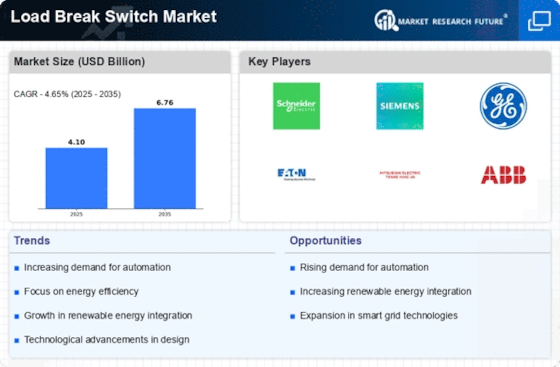
    Load Break Switch Market Infographic
    Purchase Options

    Market Analysis

    In-depth Analysis of Load Break Switch Market Industry Landscape

    Many variables affect the Load Break Switch (LBS) market's dynamics and growth. Demand for dependable and efficient power distribution systems worldwide is a major driving. Power distribution networks use Load Break Switches to isolate and stop electrical circuits, improving grid safety and efficiency. Demand for Load Break Switches is driven by the requirement for uninterrupted power supply and the growth and upgrading of energy networks, especially in developing economies.

    The Load Break Switch industry is also driven by the shift to renewable energy. Solar and wind power are becoming more important in the energy mix, requiring robust and adaptable grid infrastructure to integrate them. Distribution grids may be managed effectively with load break switches to isolate defective parts and integrate renewable energy into power networks.

    Government laws and regulations also affect Load Break Switch sales. Utilities and industry invest in innovative switching technology to meet grid reliability and efficiency safety criteria. Smart grid development, which integrates digital technology for real-time monitoring and control, promotes smart Load Break Switches, improving electricity distribution efficiency and reliability.

    Rapid urbanization and industrialization in emerging economies drive Load Break Switch demand. Power distribution infrastructure must be upgraded to accommodate urban growth and new industrial zones. Load Break Switches help meet urban and industrial energy demand by offering efficient switching and management in increasing networks.

    Technological advances in Load Break Switch design and functioning boost the industry. To suit utility and industry demands, manufacturers are designing small, dependable, and technologically advanced switches. New Load Break Switches are being used due to their remote monitoring, automation, and smart grid connection.

    Industry collaborations and strategic alliances affect Load Break Switch market dynamics. Companies are forming partnerships to combine capabilities, improve product portfolios, and grow geographically. These collaborations promote innovation and cutting-edge technology, strengthening the Load Break Switch market's competitive environment.

    Despite the benefits, modern Load Break Switch systems are expensive and need extensive installation and maintenance training. Manufacturers, utilities, and regulators must collaborate to provide cost-effective solutions, training programs, and industry standards to address these issues.

    The worldwide need for dependable power distribution, the move to renewable energy, government restrictions, urbanization, technical breakthroughs, and industry partnerships affect the Load Break Switch market. Load Break Switches become essential to power distribution network safety, efficiency, and reliability as the energy environment changes. Technology, regulatory frameworks, and power industry collaboration will shape the market.


    Author
    Anshula Mandaokar
    Team Lead - Research

    Anshula Mandaokar holds an academic degree in Chemical Engineering and has been contributing to the field for more than 5 years. She has expertise in Market Research and Business Consulting and serves as a Team Lead for a reputed Market Research firm under the Chemicals and Materials domain spectrum. She has worked on multiple projects, generating explicit results in a quick turnaround time. Her understanding of data interpretation justifies her role as a leader.

    Leave a Comment

    FAQs

    What is the current valuation of the Load Break Switch Market as of 2024?

    The Load Break Switch Market was valued at 4.1 USD Billion in 2024.

    What is the projected market size for the Load Break Switch Market by 2035?

    The market is expected to reach a valuation of 6.761 USD Billion by 2035.

    What is the expected CAGR for the Load Break Switch Market during the forecast period 2025 - 2035?

    The anticipated CAGR for the Load Break Switch Market during 2025 - 2035 is 4.65%.

    Which companies are considered key players in the Load Break Switch Market?

    Key players in the market include Schneider Electric, Siemens, General Electric, Eaton, Mitsubishi Electric, ABB, Hitachi, Toshiba, and Crompton Greaves.

    What are the different types of Load Break Switches and their market valuations?

    The market valuations for types include Gas-Insulated at 1.5 to 2.5 USD Billion, Vacuum-Insulated at 1.0 to 1.6 USD Billion, Air-Insulated at 1.2 to 2.0 USD Billion, and Oil-Immersed at 0.4 to 0.661 USD Billion.

    How does the Load Break Switch Market segment by voltage type?

    Voltage type segments include Below 11 kV at 1.5 to 2.5 USD Billion, 11-33 kV at 2.0 to 3.2 USD Billion, and 33-60 kV at 0.6 to 1.0 USD Billion.

    Market Summary

    As per MRFR analysis, the Load Break Switch Market Size was estimated at 4.1 USD Billion in 2024. The Load Break Switch industry is projected to grow from 4.291 in 2025 to 6.761 by 2035, exhibiting a compound annual growth rate (CAGR) of 4.65 during the forecast period 2025 - 2035.

    Key Market Trends & Highlights

    The Load Break Switch Market is poised for substantial growth driven by technological advancements and increasing regulatory compliance.

    • North America remains the largest market for load break switches, driven by robust infrastructure development initiatives.
    • The Asia-Pacific region is emerging as the fastest-growing market, fueled by rapid urbanization and industrialization.
    • Gas-insulated load break switches dominate the market, while vacuum-insulated switches are experiencing the fastest growth due to their efficiency.
    • Rising demand for renewable energy and increased focus on safety standards are key drivers propelling market expansion.

    Market Size & Forecast

    2024 Market Size 4.1 (USD Billion)
    2035 Market Size 6.761 (USD Billion)
    CAGR (2025 - 2035) 4.65%
    Largest Regional Market Share in 2024 North America

    Major Players

    <p>Schneider Electric (FR), Siemens (DE), General Electric (US), Eaton (US), Mitsubishi Electric (JP), ABB (CH), Hitachi (JP), Toshiba (JP), Crompton Greaves (IN)</p>

    Market Trends

    The Load Break Switch Market is currently experiencing a dynamic evolution, driven by the increasing demand for reliable and efficient electrical distribution systems. This market encompasses devices that facilitate the safe interruption of electrical circuits, thereby enhancing operational safety and reliability. As industries and utilities strive to modernize their infrastructure, the adoption of advanced load break switches is becoming more prevalent. This trend is further supported by the growing emphasis on renewable energy sources, which necessitate robust switching solutions to manage variable loads effectively. Additionally, the integration of smart grid technologies is likely to propel the market forward, as these innovations require sophisticated switching mechanisms to ensure seamless energy flow and distribution. Moreover, the Load Break Switch Market is influenced by regulatory frameworks that promote safety and efficiency in electrical installations. Governments worldwide are increasingly mandating the use of advanced switching devices to minimize risks associated with electrical failures. This regulatory push, combined with technological advancements, appears to create a favorable environment for market growth. Furthermore, the rising awareness of energy conservation and sustainability is prompting industries to invest in more efficient electrical solutions. As a result, the Load Break Switch Market is poised for continued expansion, with opportunities emerging across various sectors, including utilities, manufacturing, and renewable energy.

    Technological Advancements

    The Load Break Switch Market is witnessing a surge in technological innovations, particularly in the realm of smart grid integration. These advancements enable enhanced monitoring and control of electrical systems, thereby improving operational efficiency and reliability.

    Regulatory Compliance

    Increasing regulatory requirements are shaping the Load Break Switch Market, as governments enforce stricter safety and efficiency standards. This trend compels industries to adopt advanced switching solutions to comply with evolving regulations.

    Sustainability Initiatives

    The growing focus on sustainability is influencing the Load Break Switch Market, as organizations seek to implement energy-efficient solutions. This shift towards greener technologies is driving demand for innovative load break switches that support renewable energy integration.

    Load Break Switch Market Market Drivers

    Rising Demand for Renewable Energy

    The increasing shift towards renewable energy sources is a pivotal driver for the Load Break Switch Market. As countries strive to meet energy transition goals, the integration of solar, wind, and other renewable sources into the grid necessitates reliable switching solutions. Load break switches play a crucial role in ensuring the safe operation of these energy systems. According to recent data, the renewable energy sector is projected to grow at a compound annual growth rate of over 8% in the coming years. This growth directly correlates with the demand for load break switches, as they are essential for managing the complexities of distributed energy resources. The Load Break Switch Market is thus positioned to benefit significantly from this trend, as utilities and energy providers seek to enhance grid reliability and safety.

    Increased Focus on Safety Standards

    The heightened emphasis on safety standards within the electrical distribution sector is a critical driver for the Load Break Switch Market. Regulatory bodies are continuously updating safety protocols to mitigate risks associated with electrical failures. This trend is particularly evident in regions where aging infrastructure poses significant safety challenges. The implementation of stringent safety regulations necessitates the adoption of reliable load break switches, which are designed to interrupt electrical circuits safely. Market data suggests that compliance with these safety standards could lead to a surge in demand for load break switches, as utilities and industries prioritize safety in their operations. Consequently, the Load Break Switch Market is likely to experience growth as organizations invest in compliant and advanced switching technologies.

    Infrastructure Development Initiatives

    Infrastructure development initiatives across various regions are significantly influencing the Load Break Switch Market. Governments and private sectors are investing heavily in modernizing electrical grids and expanding transmission networks. This investment is driven by the need for improved energy efficiency and reliability. For instance, the International Energy Agency has indicated that investments in grid infrastructure could reach trillions of dollars over the next decade. Load break switches are integral components in these upgrades, facilitating safe and efficient operations. As new projects emerge, the demand for advanced load break switches is likely to rise, reflecting the industry's adaptation to evolving infrastructure needs. The Load Break Switch Market stands to gain from these developments, as enhanced infrastructure will require more sophisticated switching solutions.

    Expansion of Electric Vehicle Infrastructure

    The expansion of electric vehicle (EV) infrastructure is emerging as a significant driver for the Load Break Switch Market. As the adoption of electric vehicles accelerates, the need for robust charging infrastructure becomes paramount. Load break switches are essential in managing the electrical loads associated with EV charging stations, ensuring safe and efficient operations. Recent estimates indicate that the number of public charging stations is expected to increase substantially in the next few years, creating a corresponding demand for load break switches. This trend highlights the intersection of the automotive and electrical sectors, where the Load Break Switch Market can capitalize on the growing need for reliable switching solutions in EV infrastructure. The integration of load break switches into this expanding network is likely to enhance the overall safety and efficiency of electric vehicle charging systems.

    Technological Innovations in Switching Solutions

    Technological innovations are reshaping the Load Break Switch Market, driving the development of more efficient and reliable switching solutions. Advances in materials science and engineering have led to the creation of load break switches that offer enhanced performance and durability. For example, the introduction of smart load break switches equipped with monitoring capabilities allows for real-time data analysis and improved operational efficiency. Market analysts project that the adoption of such technologies will increase, as industries seek to optimize their electrical systems. This trend not only enhances the functionality of load break switches but also aligns with the broader movement towards smart grid technologies. As a result, the Load Break Switch Market is poised for growth, driven by the demand for innovative and intelligent switching solutions.

    Market Segment Insights

    By Type: Gas-Insulated (Largest) vs. Vacuum-Insulated (Fastest-Growing)

    <p>The Load Break Switch Market is characterized by a diverse range of types, including Gas-Insulated, Vacuum-Insulated, Air-Insulated, and Oil-Immersed switches. Gas-Insulated switches hold the largest share in this segment due to their compact design and superior performance in high voltage applications. Meanwhile, Vacuum-Insulated switches are experiencing rapid growth, driven by increasing demand for reliable and efficient power distribution solutions across various industries. In contrast, Air-Insulated and Oil-Immersed switches are also significant but lag behind in terms of growth and market shares. Recent trends indicate a shift towards more environmentally friendly technologies and improved operational efficiencies. Factors such as urbanization and the expansion of renewable energy sources are driving demand for Gas-Insulated and Vacuum-Insulated switches, which are favored for their reliability and lower maintenance requirements. As industries increasingly adopt smart grid solutions, the growth of these technologies indicates a promising future for the Load Break Switch Market, particularly for the fastest-growing Vacuum-Insulated segment.</p>

    <p>Gas-Insulated (Dominant) vs. Oil-Immersed (Emerging)</p>

    <p>Gas-Insulated switches are the dominant player in the Load Break Switch Market, known for their compact construction and high reliability, making them ideal for urban settings and limited spaces. They excel in high-voltage applications, providing a safe and efficient solution for power distribution. On the other hand, Oil-Immersed switches, while considered as an emerging segment, exhibit unique thermal management properties that allow for different operational environments. Although they are less favored compared to Gas-Insulated solutions, their ability to function effectively under extreme conditions provides a niche market. The popularity of each switch type varies across industries, with Gas-Insulated options leading in market traction and Oil-Immersed switches gradually carving out their position.</p>

    By Voltage Type: Below 11 kV (Largest) vs. 11-33 kV (Fastest-Growing)

    <p>In the Load Break Switch Market, the voltage type segment is characterized by distinct market shares among three primary values: Below 11 kV, 11-33 kV, and 33-60 kV. Below 11 kV holds the largest share, driven largely by the increasing demand for low-voltage solutions in urban utilities and residential applications. Meanwhile, the 11-33 kV segment is experiencing rapid growth, as utility companies upgrade their infrastructure to meet the rising energy consumption and reliability standards. On the other hand, the 33-60 kV segment remains vital for industrial applications but does not currently match the momentum of its lower-voltage counterparts.</p>

    <p>Voltage Type: Below 11 kV (Dominant) vs. 11-33 kV (Emerging)</p>

    <p>The Below 11 kV segment serves as the cornerstone of the Load Break Switch Market, largely due to its widespread applicability in low-voltage distribution networks. This segment is favored in residential areas and small commercial setups where maintaining consistent power supply is critical. Emerging from this landscape is the 11-33 kV segment, which is rapidly gaining traction as utility providers invest heavily in smart grid technologies. Its growth is propelled by a necessity for enhanced reliability in distribution systems and the integration of renewable energy sources, making these switches increasingly essential for mid-voltage applications.</p>

    By Installation Type: Outdoor (Largest) vs. Indoor (Fastest-Growing)

    <p>In the Load Break Switch Market, the installation type segment shows a clear distribution of market share between outdoor and indoor applications. Outdoor load break switches hold the largest share due to their extensive utilization in overhead power lines, outdoor substations, and transmission networks. This preference is driven by the need for robust and weather-resistant electrical solutions that can withstand environmental stressors. Meanwhile, indoor load break switches, although currently smaller in market share, are rapidly gaining traction in commercial buildings and industrial settings due to their compact design and safety features.</p>

    <p>Installation Type: Outdoor (Dominant) vs. Indoor (Emerging)</p>

    <p>Outdoor load break switches are characterized by their ability to handle higher load requirements and their resilience against harsh weather conditions, making them the preferred choice in utility applications and outdoor installations. Their dominance in the market reflects a well-established infrastructure designed to support high voltage systems and prevent outages. Conversely, indoor load break switches are designed for compactness and enhanced safety, catering to the needs of modern buildings that prioritize space efficiency and safety protocols. They are becoming increasingly essential in environments where space is limited, showing an upward trend in adoption as energy needs evolve.</p>

    By End-Use: Utilities (Largest) vs. Industrial (Fastest-Growing)

    <p>The Load Break Switch Market is predominantly led by the utilities sector, which accounts for the largest share of the market. This segment's robust infrastructure and consistent demand for reliable electrical distribution contribute substantially to its market leadership. In comparison, the industrial segment is also significant but displays rapid growth due to the expansion of industrial activities and the rising need for efficient electrical management solutions in manufacturing processes.</p>

    <p>Utilities: Dominant vs. Industrial: Emerging</p>

    <p>In the Load Break Switch Market, utilities represent the dominant segment, characterized by mature systems and extensive networks ensuring high reliability in power distribution. This sector prioritizes advanced switch technologies to enhance grid stability and efficiency. On the other hand, the industrial sector is emerging vigorously, driven by increased investments in automation and energy-efficient solutions. As industries modernize their electrical infrastructure, the demand for load break switches that cater to high-current applications grows, positioning this segment as a pivotal player in the market.</p>

    Get more detailed insights about Load Break Switch Market Research Report – Forecast to 2035

    Regional Insights

    North America : Innovation and Demand Surge

    North America is witnessing significant growth in the Load Break Switch market, driven by increasing investments in renewable energy and smart grid technologies. The region holds the largest market share at approximately 40%, with the United States being the primary contributor. Regulatory support for infrastructure upgrades and energy efficiency initiatives further fuels demand, making it a key player in the global market. The competitive landscape is dominated by major players such as General Electric, Eaton, and Schneider Electric, which are leveraging advanced technologies to enhance product offerings. The U.S. market is characterized by a strong focus on innovation and sustainability, with companies investing heavily in R&D to meet evolving consumer needs. This competitive environment is expected to drive further growth in the coming years.

    Europe : Regulatory Framework and Growth

    Europe is emerging as a significant player in the Load Break Switch market, driven by stringent regulations aimed at enhancing energy efficiency and sustainability. The region holds the second-largest market share at around 30%. The European Union's commitment to reducing carbon emissions and promoting renewable energy sources acts as a catalyst for market growth, encouraging investments in modern electrical infrastructure. Leading countries such as Germany, France, and the UK are at the forefront of this market, with key players like Siemens and ABB actively participating. The competitive landscape is characterized by innovation and collaboration, as companies seek to develop advanced solutions that comply with regulatory standards. The presence of robust manufacturing capabilities and a skilled workforce further strengthens Europe's position in the global market.

    Asia-Pacific : Rapid Industrialization and Demand

    The Asia-Pacific region is experiencing rapid industrialization, leading to a surge in demand for Load Break Switches. This region is projected to hold a market share of approximately 25%, with countries like China and India driving growth through extensive infrastructure development. Government initiatives aimed at enhancing power distribution networks and increasing electricity access are key growth drivers in this market. China stands out as a leader in the Load Break Switch market, with significant investments in renewable energy and smart grid technologies. Major players such as Mitsubishi Electric and Toshiba are expanding their presence in the region, focusing on innovation and cost-effective solutions. The competitive landscape is evolving, with local manufacturers also emerging to meet the growing demand, further intensifying competition in the market.

    Middle East and Africa : Emerging Markets and Opportunities

    The Middle East and Africa region is witnessing emerging opportunities in the Load Break Switch market, driven by increasing urbanization and infrastructure development. The market share is estimated to be around 5%, with countries like South Africa and the UAE leading the way. Government initiatives aimed at improving electrical infrastructure and energy efficiency are key factors propelling market growth in this region. The competitive landscape is characterized by a mix of local and international players, with companies like Crompton Greaves and Schneider Electric actively participating. The region's unique challenges, such as varying regulatory environments and economic conditions, create both opportunities and hurdles for market players. As investments in energy projects increase, the Load Break Switch market is expected to grow steadily in the coming years.

    Key Players and Competitive Insights

    The Load Break Switch Market is currently characterized by a dynamic competitive landscape, driven by increasing demand for reliable electrical infrastructure and the growing emphasis on safety and efficiency in power distribution. Key players such as Schneider Electric (France), Siemens (Germany), and General Electric (United States) are strategically positioned to leverage their technological expertise and extensive product portfolios. Schneider Electric (France) focuses on digital transformation and sustainability, aiming to enhance energy efficiency through innovative solutions. Siemens (Germany) emphasizes regional expansion and strategic partnerships, particularly in emerging markets, to bolster its market presence. General Electric (United States) is actively pursuing mergers and acquisitions to enhance its technological capabilities and expand its product offerings, thereby shaping a competitive environment that is increasingly reliant on innovation and strategic collaborations.

    The Load Break Switch Market exhibits a moderately fragmented structure, with several key players competing for market share. Companies are adopting various business tactics, such as localizing manufacturing and optimizing supply chains, to enhance operational efficiency and reduce costs. This localized approach not only caters to regional demands but also mitigates supply chain disruptions, which have become increasingly pertinent in recent years. The collective influence of these key players fosters a competitive atmosphere where agility and responsiveness to market changes are paramount.

    In August 2025, Siemens (Germany) announced a strategic partnership with a leading renewable energy firm to develop advanced load break switch technologies tailored for solar and wind applications. This collaboration is expected to enhance Siemens' product offerings in the renewable sector, aligning with global sustainability goals and positioning the company as a leader in green technology solutions. The strategic importance of this partnership lies in its potential to capture a growing market segment that prioritizes environmentally friendly energy solutions.

    In September 2025, Schneider Electric (France) launched a new line of smart load break switches equipped with IoT capabilities, aimed at enhancing grid reliability and operational efficiency. This innovation reflects Schneider's commitment to digitalization and positions the company to meet the increasing demand for smart grid solutions. The introduction of IoT-enabled devices is likely to provide Schneider with a competitive edge, as utilities and industries seek to modernize their infrastructure.

    In October 2025, General Electric (United States) completed the acquisition of a technology startup specializing in AI-driven predictive maintenance solutions for load break switches. This acquisition is poised to enhance GE's capabilities in predictive analytics, allowing for improved maintenance strategies and reduced downtime for customers. The strategic significance of this move lies in GE's ability to integrate advanced technologies into its product offerings, thereby enhancing customer value and operational efficiency.

    As of October 2025, the Load Break Switch Market is witnessing a pronounced shift towards digitalization, sustainability, and AI integration. These trends are reshaping competitive dynamics, as companies increasingly prioritize innovation over traditional price-based competition. Strategic alliances are becoming more prevalent, enabling firms to pool resources and expertise to address complex market challenges. Looking ahead, competitive differentiation is likely to evolve, with a focus on technological advancements, supply chain reliability, and the ability to deliver sustainable solutions that meet the demands of a rapidly changing energy landscape.

    Key Companies in the Load Break Switch Market market include

    Industry Developments

    In October 2023, LyondellBasell announced that it had entered into a power purchase agreement (PPA) to secure 149 megawatts (MW) of renewable electricity capacity from Lightsource bp’s solar project in Spain.

    NextEra introduced the Integrated 5 V Load Switch NPS4053 to its portfolio in August 2023. NPS4053 is NextEra’s first integrated load switch for 5V, which can control a wide range of operating voltages from 2.5V-5.5V. NextEra said that its most recent power chip occupies up to only fifteen percent of the PCB area required by competitors, having several discrete components.

    In May 2023 - ABB announced that it had reached an agreement to acquire Siemens's low-voltage NEMA motor business. The business’ revenues amounted to around $63 million in 2021.

    In April 2023- Eaton (An intelligent power management company) said that it has finished purchasing a forty-nine percent stake in Jiangsu Ryan Electrical Co., Ltd. (Ryan), a manufacturer of power distribution and sub-transmission transformers based out of China with approximately $100 million revenue generated in the year ended December,31st 2022.

    Fuji Electric Co., Ltd. revealed in December 2022 that they have released a globally competitive switchgear saving area and reducing footprint.

    Schneider Electric launched its new SureSeT MV switchgear for the North American market, featuring EvoPacT advanced circuit protection devices in May 2022. This technology upgrade replaces Masterclad for primary electrical switchgear applications, thereby providing a more compact, durable and intelligent solution for digital day-to-day operations.

    ABB launched environmentally friendly switchgear solutions with groundbreaking load break switch (LBS) for load break switch applications in Dec 2020. The new ring main unit (RMU) uses a unique puffer interrupter load break switch technology, which operates on sustainable alternative gases to SF6, thus enhancing environmental friendliness.

    .webp

    Future Outlook

    Load Break Switch Market Future Outlook

    <p>The Load Break Switch Market is projected to grow at a 4.65% CAGR from 2024 to 2035, driven by increasing demand for reliable power distribution and advancements in smart grid technologies.</p>

    New opportunities lie in:

    • <p>Development of smart load break switches with IoT integration</p>
    • <p>Expansion into renewable energy sectors for grid stability</p>
    • <p>Partnerships with utility companies for enhanced service offerings</p>

    <p>By 2035, the Load Break Switch Market is expected to achieve robust growth and innovation.</p>

    Market Segmentation

    Load Break Switch Market Type Outlook

    • Gas-Insulated
    • Vacuum-Insulated
    • Air-Insulated
    • Oil-Immersed

    Load Break Switch Market End-Use Outlook

    • Utilities
    • Industrial
    • Commercial

    Load Break Switch Market Voltage Type Outlook

    • Below 11 kV
    • 11-33 kV
    • 33-60 kV

    Load Break Switch Market Installation Type Outlook

    • Outdoor
    • Indoor

    Report Scope

    MARKET SIZE 20244.1(USD Billion)
    MARKET SIZE 20254.291(USD Billion)
    MARKET SIZE 20356.761(USD Billion)
    COMPOUND ANNUAL GROWTH RATE (CAGR)4.65% (2024 - 2035)
    REPORT COVERAGERevenue Forecast, Competitive Landscape, Growth Factors, and Trends
    BASE YEAR2024
    Market Forecast Period2025 - 2035
    Historical Data2019 - 2024
    Market Forecast UnitsUSD Billion
    Key Companies ProfiledMarket analysis in progress
    Segments CoveredMarket segmentation analysis in progress
    Key Market OpportunitiesIntegration of smart grid technologies enhances efficiency in the Load Break Switch Market.
    Key Market DynamicsTechnological advancements and regulatory changes drive innovation and competition in the Load Break Switch Market.
    Countries CoveredNorth America, Europe, APAC, South America, MEA

    FAQs

    What is the current valuation of the Load Break Switch Market as of 2024?

    The Load Break Switch Market was valued at 4.1 USD Billion in 2024.

    What is the projected market size for the Load Break Switch Market by 2035?

    The market is expected to reach a valuation of 6.761 USD Billion by 2035.

    What is the expected CAGR for the Load Break Switch Market during the forecast period 2025 - 2035?

    The anticipated CAGR for the Load Break Switch Market during 2025 - 2035 is 4.65%.

    Which companies are considered key players in the Load Break Switch Market?

    Key players in the market include Schneider Electric, Siemens, General Electric, Eaton, Mitsubishi Electric, ABB, Hitachi, Toshiba, and Crompton Greaves.

    What are the different types of Load Break Switches and their market valuations?

    The market valuations for types include Gas-Insulated at 1.5 to 2.5 USD Billion, Vacuum-Insulated at 1.0 to 1.6 USD Billion, Air-Insulated at 1.2 to 2.0 USD Billion, and Oil-Immersed at 0.4 to 0.661 USD Billion.

    How does the Load Break Switch Market segment by voltage type?

    Voltage type segments include Below 11 kV at 1.5 to 2.5 USD Billion, 11-33 kV at 2.0 to 3.2 USD Billion, and 33-60 kV at 0.6 to 1.0 USD Billion.

    1. SECTION I: EXECUTIVE SUMMARY AND KEY HIGHLIGHTS
      1. | 1.1 EXECUTIVE SUMMARY
      2. | | 1.1.1 Market Overview
      3. | | 1.1.2 Key Findings
      4. | | 1.1.3 Market Segmentation
      5. | | 1.1.4 Competitive Landscape
      6. | | 1.1.5 Challenges and Opportunities
      7. | | 1.1.6 Future Outlook
    2. SECTION II: SCOPING, METHODOLOGY AND MARKET STRUCTURE
      1. | 2.1 MARKET INTRODUCTION
      2. | | 2.1.1 Definition
      3. | | 2.1.2 Scope of the study
      4. | | | 2.1.2.1 Research Objective
      5. | | | 2.1.2.2 Assumption
      6. | | | 2.1.2.3 Limitations
      7. | 2.2 RESEARCH METHODOLOGY
      8. | | 2.2.1 Overview
      9. | | 2.2.2 Data Mining
      10. | | 2.2.3 Secondary Research
      11. | | 2.2.4 Primary Research
      12. | | | 2.2.4.1 Primary Interviews and Information Gathering Process
      13. | | | 2.2.4.2 Breakdown of Primary Respondents
      14. | | 2.2.5 Forecasting Model
      15. | | 2.2.6 Market Size Estimation
      16. | | | 2.2.6.1 Bottom-Up Approach
      17. | | | 2.2.6.2 Top-Down Approach
      18. | | 2.2.7 Data Triangulation
      19. | | 2.2.8 Validation
    3. SECTION III: QUALITATIVE ANALYSIS
      1. | 3.1 MARKET DYNAMICS
      2. | | 3.1.1 Overview
      3. | | 3.1.2 Drivers
      4. | | 3.1.3 Restraints
      5. | | 3.1.4 Opportunities
      6. | 3.2 MARKET FACTOR ANALYSIS
      7. | | 3.2.1 Value chain Analysis
      8. | | 3.2.2 Porter's Five Forces Analysis
      9. | | | 3.2.2.1 Bargaining Power of Suppliers
      10. | | | 3.2.2.2 Bargaining Power of Buyers
      11. | | | 3.2.2.3 Threat of New Entrants
      12. | | | 3.2.2.4 Threat of Substitutes
      13. | | | 3.2.2.5 Intensity of Rivalry
      14. | | 3.2.3 COVID-19 Impact Analysis
      15. | | | 3.2.3.1 Market Impact Analysis
      16. | | | 3.2.3.2 Regional Impact
      17. | | | 3.2.3.3 Opportunity and Threat Analysis
    4. SECTION IV: QUANTITATIVE ANALYSIS
      1. | 4.1 Energy & Power, BY Type (USD Billion)
      2. | | 4.1.1 Gas-Insulated
      3. | | 4.1.2 Vacuum-Insulated
      4. | | 4.1.3 Air-Insulated
      5. | | 4.1.4 Oil-Immersed
      6. | 4.2 Energy & Power, BY Voltage Type (USD Billion)
      7. | | 4.2.1 Below 11 kV
      8. | | 4.2.2 11-33 kV
      9. | | 4.2.3 33-60 kV
      10. | 4.3 Energy & Power, BY Installation Type (USD Billion)
      11. | | 4.3.1 Outdoor
      12. | | 4.3.2 Indoor
      13. | 4.4 Energy & Power, BY End-Use (USD Billion)
      14. | | 4.4.1 Utilities
      15. | | 4.4.2 Industrial
      16. | | 4.4.3 Commercial
      17. | 4.5 Energy & Power, BY Region (USD Billion)
      18. | | 4.5.1 North America
      19. | | | 4.5.1.1 US
      20. | | | 4.5.1.2 Canada
      21. | | 4.5.2 Europe
      22. | | | 4.5.2.1 Germany
      23. | | | 4.5.2.2 UK
      24. | | | 4.5.2.3 France
      25. | | | 4.5.2.4 Russia
      26. | | | 4.5.2.5 Italy
      27. | | | 4.5.2.6 Spain
      28. | | | 4.5.2.7 Rest of Europe
      29. | | 4.5.3 APAC
      30. | | | 4.5.3.1 China
      31. | | | 4.5.3.2 India
      32. | | | 4.5.3.3 Japan
      33. | | | 4.5.3.4 South Korea
      34. | | | 4.5.3.5 Malaysia
      35. | | | 4.5.3.6 Thailand
      36. | | | 4.5.3.7 Indonesia
      37. | | | 4.5.3.8 Rest of APAC
      38. | | 4.5.4 South America
      39. | | | 4.5.4.1 Brazil
      40. | | | 4.5.4.2 Mexico
      41. | | | 4.5.4.3 Argentina
      42. | | | 4.5.4.4 Rest of South America
      43. | | 4.5.5 MEA
      44. | | | 4.5.5.1 GCC Countries
      45. | | | 4.5.5.2 South Africa
      46. | | | 4.5.5.3 Rest of MEA
    5. SECTION V: COMPETITIVE ANALYSIS
      1. | 5.1 Competitive Landscape
      2. | | 5.1.1 Overview
      3. | | 5.1.2 Competitive Analysis
      4. | | 5.1.3 Market share Analysis
      5. | | 5.1.4 Major Growth Strategy in the Energy & Power
      6. | | 5.1.5 Competitive Benchmarking
      7. | | 5.1.6 Leading Players in Terms of Number of Developments in the Energy & Power
      8. | | 5.1.7 Key developments and growth strategies
      9. | | | 5.1.7.1 New Product Launch/Service Deployment
      10. | | | 5.1.7.2 Merger & Acquisitions
      11. | | | 5.1.7.3 Joint Ventures
      12. | | 5.1.8 Major Players Financial Matrix
      13. | | | 5.1.8.1 Sales and Operating Income
      14. | | | 5.1.8.2 Major Players R&D Expenditure. 2023
      15. | 5.2 Company Profiles
      16. | | 5.2.1 Schneider Electric (FR)
      17. | | | 5.2.1.1 Financial Overview
      18. | | | 5.2.1.2 Products Offered
      19. | | | 5.2.1.3 Key Developments
      20. | | | 5.2.1.4 SWOT Analysis
      21. | | | 5.2.1.5 Key Strategies
      22. | | 5.2.2 Siemens (DE)
      23. | | | 5.2.2.1 Financial Overview
      24. | | | 5.2.2.2 Products Offered
      25. | | | 5.2.2.3 Key Developments
      26. | | | 5.2.2.4 SWOT Analysis
      27. | | | 5.2.2.5 Key Strategies
      28. | | 5.2.3 General Electric (US)
      29. | | | 5.2.3.1 Financial Overview
      30. | | | 5.2.3.2 Products Offered
      31. | | | 5.2.3.3 Key Developments
      32. | | | 5.2.3.4 SWOT Analysis
      33. | | | 5.2.3.5 Key Strategies
      34. | | 5.2.4 Eaton (US)
      35. | | | 5.2.4.1 Financial Overview
      36. | | | 5.2.4.2 Products Offered
      37. | | | 5.2.4.3 Key Developments
      38. | | | 5.2.4.4 SWOT Analysis
      39. | | | 5.2.4.5 Key Strategies
      40. | | 5.2.5 Mitsubishi Electric (JP)
      41. | | | 5.2.5.1 Financial Overview
      42. | | | 5.2.5.2 Products Offered
      43. | | | 5.2.5.3 Key Developments
      44. | | | 5.2.5.4 SWOT Analysis
      45. | | | 5.2.5.5 Key Strategies
      46. | | 5.2.6 ABB (CH)
      47. | | | 5.2.6.1 Financial Overview
      48. | | | 5.2.6.2 Products Offered
      49. | | | 5.2.6.3 Key Developments
      50. | | | 5.2.6.4 SWOT Analysis
      51. | | | 5.2.6.5 Key Strategies
      52. | | 5.2.7 Hitachi (JP)
      53. | | | 5.2.7.1 Financial Overview
      54. | | | 5.2.7.2 Products Offered
      55. | | | 5.2.7.3 Key Developments
      56. | | | 5.2.7.4 SWOT Analysis
      57. | | | 5.2.7.5 Key Strategies
      58. | | 5.2.8 Toshiba (JP)
      59. | | | 5.2.8.1 Financial Overview
      60. | | | 5.2.8.2 Products Offered
      61. | | | 5.2.8.3 Key Developments
      62. | | | 5.2.8.4 SWOT Analysis
      63. | | | 5.2.8.5 Key Strategies
      64. | | 5.2.9 Crompton Greaves (IN)
      65. | | | 5.2.9.1 Financial Overview
      66. | | | 5.2.9.2 Products Offered
      67. | | | 5.2.9.3 Key Developments
      68. | | | 5.2.9.4 SWOT Analysis
      69. | | | 5.2.9.5 Key Strategies
      70. | 5.3 Appendix
      71. | | 5.3.1 References
      72. | | 5.3.2 Related Reports
    6. LIST OF FIGURES
      1. | 6.1 MARKET SYNOPSIS
      2. | 6.2 NORTH AMERICA MARKET ANALYSIS
      3. | 6.3 US MARKET ANALYSIS BY TYPE
      4. | 6.4 US MARKET ANALYSIS BY VOLTAGE TYPE
      5. | 6.5 US MARKET ANALYSIS BY INSTALLATION TYPE
      6. | 6.6 US MARKET ANALYSIS BY END-USE
      7. | 6.7 CANADA MARKET ANALYSIS BY TYPE
      8. | 6.8 CANADA MARKET ANALYSIS BY VOLTAGE TYPE
      9. | 6.9 CANADA MARKET ANALYSIS BY INSTALLATION TYPE
      10. | 6.10 CANADA MARKET ANALYSIS BY END-USE
      11. | 6.11 EUROPE MARKET ANALYSIS
      12. | 6.12 GERMANY MARKET ANALYSIS BY TYPE
      13. | 6.13 GERMANY MARKET ANALYSIS BY VOLTAGE TYPE
      14. | 6.14 GERMANY MARKET ANALYSIS BY INSTALLATION TYPE
      15. | 6.15 GERMANY MARKET ANALYSIS BY END-USE
      16. | 6.16 UK MARKET ANALYSIS BY TYPE
      17. | 6.17 UK MARKET ANALYSIS BY VOLTAGE TYPE
      18. | 6.18 UK MARKET ANALYSIS BY INSTALLATION TYPE
      19. | 6.19 UK MARKET ANALYSIS BY END-USE
      20. | 6.20 FRANCE MARKET ANALYSIS BY TYPE
      21. | 6.21 FRANCE MARKET ANALYSIS BY VOLTAGE TYPE
      22. | 6.22 FRANCE MARKET ANALYSIS BY INSTALLATION TYPE
      23. | 6.23 FRANCE MARKET ANALYSIS BY END-USE
      24. | 6.24 RUSSIA MARKET ANALYSIS BY TYPE
      25. | 6.25 RUSSIA MARKET ANALYSIS BY VOLTAGE TYPE
      26. | 6.26 RUSSIA MARKET ANALYSIS BY INSTALLATION TYPE
      27. | 6.27 RUSSIA MARKET ANALYSIS BY END-USE
      28. | 6.28 ITALY MARKET ANALYSIS BY TYPE
      29. | 6.29 ITALY MARKET ANALYSIS BY VOLTAGE TYPE
      30. | 6.30 ITALY MARKET ANALYSIS BY INSTALLATION TYPE
      31. | 6.31 ITALY MARKET ANALYSIS BY END-USE
      32. | 6.32 SPAIN MARKET ANALYSIS BY TYPE
      33. | 6.33 SPAIN MARKET ANALYSIS BY VOLTAGE TYPE
      34. | 6.34 SPAIN MARKET ANALYSIS BY INSTALLATION TYPE
      35. | 6.35 SPAIN MARKET ANALYSIS BY END-USE
      36. | 6.36 REST OF EUROPE MARKET ANALYSIS BY TYPE
      37. | 6.37 REST OF EUROPE MARKET ANALYSIS BY VOLTAGE TYPE
      38. | 6.38 REST OF EUROPE MARKET ANALYSIS BY INSTALLATION TYPE
      39. | 6.39 REST OF EUROPE MARKET ANALYSIS BY END-USE
      40. | 6.40 APAC MARKET ANALYSIS
      41. | 6.41 CHINA MARKET ANALYSIS BY TYPE
      42. | 6.42 CHINA MARKET ANALYSIS BY VOLTAGE TYPE
      43. | 6.43 CHINA MARKET ANALYSIS BY INSTALLATION TYPE
      44. | 6.44 CHINA MARKET ANALYSIS BY END-USE
      45. | 6.45 INDIA MARKET ANALYSIS BY TYPE
      46. | 6.46 INDIA MARKET ANALYSIS BY VOLTAGE TYPE
      47. | 6.47 INDIA MARKET ANALYSIS BY INSTALLATION TYPE
      48. | 6.48 INDIA MARKET ANALYSIS BY END-USE
      49. | 6.49 JAPAN MARKET ANALYSIS BY TYPE
      50. | 6.50 JAPAN MARKET ANALYSIS BY VOLTAGE TYPE
      51. | 6.51 JAPAN MARKET ANALYSIS BY INSTALLATION TYPE
      52. | 6.52 JAPAN MARKET ANALYSIS BY END-USE
      53. | 6.53 SOUTH KOREA MARKET ANALYSIS BY TYPE
      54. | 6.54 SOUTH KOREA MARKET ANALYSIS BY VOLTAGE TYPE
      55. | 6.55 SOUTH KOREA MARKET ANALYSIS BY INSTALLATION TYPE
      56. | 6.56 SOUTH KOREA MARKET ANALYSIS BY END-USE
      57. | 6.57 MALAYSIA MARKET ANALYSIS BY TYPE
      58. | 6.58 MALAYSIA MARKET ANALYSIS BY VOLTAGE TYPE
      59. | 6.59 MALAYSIA MARKET ANALYSIS BY INSTALLATION TYPE
      60. | 6.60 MALAYSIA MARKET ANALYSIS BY END-USE
      61. | 6.61 THAILAND MARKET ANALYSIS BY TYPE
      62. | 6.62 THAILAND MARKET ANALYSIS BY VOLTAGE TYPE
      63. | 6.63 THAILAND MARKET ANALYSIS BY INSTALLATION TYPE
      64. | 6.64 THAILAND MARKET ANALYSIS BY END-USE
      65. | 6.65 INDONESIA MARKET ANALYSIS BY TYPE
      66. | 6.66 INDONESIA MARKET ANALYSIS BY VOLTAGE TYPE
      67. | 6.67 INDONESIA MARKET ANALYSIS BY INSTALLATION TYPE
      68. | 6.68 INDONESIA MARKET ANALYSIS BY END-USE
      69. | 6.69 REST OF APAC MARKET ANALYSIS BY TYPE
      70. | 6.70 REST OF APAC MARKET ANALYSIS BY VOLTAGE TYPE
      71. | 6.71 REST OF APAC MARKET ANALYSIS BY INSTALLATION TYPE
      72. | 6.72 REST OF APAC MARKET ANALYSIS BY END-USE
      73. | 6.73 SOUTH AMERICA MARKET ANALYSIS
      74. | 6.74 BRAZIL MARKET ANALYSIS BY TYPE
      75. | 6.75 BRAZIL MARKET ANALYSIS BY VOLTAGE TYPE
      76. | 6.76 BRAZIL MARKET ANALYSIS BY INSTALLATION TYPE
      77. | 6.77 BRAZIL MARKET ANALYSIS BY END-USE
      78. | 6.78 MEXICO MARKET ANALYSIS BY TYPE
      79. | 6.79 MEXICO MARKET ANALYSIS BY VOLTAGE TYPE
      80. | 6.80 MEXICO MARKET ANALYSIS BY INSTALLATION TYPE
      81. | 6.81 MEXICO MARKET ANALYSIS BY END-USE
      82. | 6.82 ARGENTINA MARKET ANALYSIS BY TYPE
      83. | 6.83 ARGENTINA MARKET ANALYSIS BY VOLTAGE TYPE
      84. | 6.84 ARGENTINA MARKET ANALYSIS BY INSTALLATION TYPE
      85. | 6.85 ARGENTINA MARKET ANALYSIS BY END-USE
      86. | 6.86 REST OF SOUTH AMERICA MARKET ANALYSIS BY TYPE
      87. | 6.87 REST OF SOUTH AMERICA MARKET ANALYSIS BY VOLTAGE TYPE
      88. | 6.88 REST OF SOUTH AMERICA MARKET ANALYSIS BY INSTALLATION TYPE
      89. | 6.89 REST OF SOUTH AMERICA MARKET ANALYSIS BY END-USE
      90. | 6.90 MEA MARKET ANALYSIS
      91. | 6.91 GCC COUNTRIES MARKET ANALYSIS BY TYPE
      92. | 6.92 GCC COUNTRIES MARKET ANALYSIS BY VOLTAGE TYPE
      93. | 6.93 GCC COUNTRIES MARKET ANALYSIS BY INSTALLATION TYPE
      94. | 6.94 GCC COUNTRIES MARKET ANALYSIS BY END-USE
      95. | 6.95 SOUTH AFRICA MARKET ANALYSIS BY TYPE
      96. | 6.96 SOUTH AFRICA MARKET ANALYSIS BY VOLTAGE TYPE
      97. | 6.97 SOUTH AFRICA MARKET ANALYSIS BY INSTALLATION TYPE
      98. | 6.98 SOUTH AFRICA MARKET ANALYSIS BY END-USE
      99. | 6.99 REST OF MEA MARKET ANALYSIS BY TYPE
      100. | 6.100 REST OF MEA MARKET ANALYSIS BY VOLTAGE TYPE
      101. | 6.101 REST OF MEA MARKET ANALYSIS BY INSTALLATION TYPE
      102. | 6.102 REST OF MEA MARKET ANALYSIS BY END-USE
      103. | 6.103 KEY BUYING CRITERIA OF ENERGY & POWER
      104. | 6.104 RESEARCH PROCESS OF MRFR
      105. | 6.105 DRO ANALYSIS OF ENERGY & POWER
      106. | 6.106 DRIVERS IMPACT ANALYSIS: ENERGY & POWER
      107. | 6.107 RESTRAINTS IMPACT ANALYSIS: ENERGY & POWER
      108. | 6.108 SUPPLY / VALUE CHAIN: ENERGY & POWER
      109. | 6.109 ENERGY & POWER, BY TYPE, 2024 (% SHARE)
      110. | 6.110 ENERGY & POWER, BY TYPE, 2024 TO 2035 (USD Billion)
      111. | 6.111 ENERGY & POWER, BY VOLTAGE TYPE, 2024 (% SHARE)
      112. | 6.112 ENERGY & POWER, BY VOLTAGE TYPE, 2024 TO 2035 (USD Billion)
      113. | 6.113 ENERGY & POWER, BY INSTALLATION TYPE, 2024 (% SHARE)
      114. | 6.114 ENERGY & POWER, BY INSTALLATION TYPE, 2024 TO 2035 (USD Billion)
      115. | 6.115 ENERGY & POWER, BY END-USE, 2024 (% SHARE)
      116. | 6.116 ENERGY & POWER, BY END-USE, 2024 TO 2035 (USD Billion)
      117. | 6.117 BENCHMARKING OF MAJOR COMPETITORS
    7. LIST OF TABLES
      1. | 7.1 LIST OF ASSUMPTIONS
      2. | | 7.1.1
      3. | 7.2 North America MARKET SIZE ESTIMATES; FORECAST
      4. | | 7.2.1 BY TYPE, 2025-2035 (USD Billion)
      5. | | 7.2.2 BY VOLTAGE TYPE, 2025-2035 (USD Billion)
      6. | | 7.2.3 BY INSTALLATION TYPE, 2025-2035 (USD Billion)
      7. | | 7.2.4 BY END-USE, 2025-2035 (USD Billion)
      8. | 7.3 US MARKET SIZE ESTIMATES; FORECAST
      9. | | 7.3.1 BY TYPE, 2025-2035 (USD Billion)
      10. | | 7.3.2 BY VOLTAGE TYPE, 2025-2035 (USD Billion)
      11. | | 7.3.3 BY INSTALLATION TYPE, 2025-2035 (USD Billion)
      12. | | 7.3.4 BY END-USE, 2025-2035 (USD Billion)
      13. | 7.4 Canada MARKET SIZE ESTIMATES; FORECAST
      14. | | 7.4.1 BY TYPE, 2025-2035 (USD Billion)
      15. | | 7.4.2 BY VOLTAGE TYPE, 2025-2035 (USD Billion)
      16. | | 7.4.3 BY INSTALLATION TYPE, 2025-2035 (USD Billion)
      17. | | 7.4.4 BY END-USE, 2025-2035 (USD Billion)
      18. | 7.5 Europe MARKET SIZE ESTIMATES; FORECAST
      19. | | 7.5.1 BY TYPE, 2025-2035 (USD Billion)
      20. | | 7.5.2 BY VOLTAGE TYPE, 2025-2035 (USD Billion)
      21. | | 7.5.3 BY INSTALLATION TYPE, 2025-2035 (USD Billion)
      22. | | 7.5.4 BY END-USE, 2025-2035 (USD Billion)
      23. | 7.6 Germany MARKET SIZE ESTIMATES; FORECAST
      24. | | 7.6.1 BY TYPE, 2025-2035 (USD Billion)
      25. | | 7.6.2 BY VOLTAGE TYPE, 2025-2035 (USD Billion)
      26. | | 7.6.3 BY INSTALLATION TYPE, 2025-2035 (USD Billion)
      27. | | 7.6.4 BY END-USE, 2025-2035 (USD Billion)
      28. | 7.7 UK MARKET SIZE ESTIMATES; FORECAST
      29. | | 7.7.1 BY TYPE, 2025-2035 (USD Billion)
      30. | | 7.7.2 BY VOLTAGE TYPE, 2025-2035 (USD Billion)
      31. | | 7.7.3 BY INSTALLATION TYPE, 2025-2035 (USD Billion)
      32. | | 7.7.4 BY END-USE, 2025-2035 (USD Billion)
      33. | 7.8 France MARKET SIZE ESTIMATES; FORECAST
      34. | | 7.8.1 BY TYPE, 2025-2035 (USD Billion)
      35. | | 7.8.2 BY VOLTAGE TYPE, 2025-2035 (USD Billion)
      36. | | 7.8.3 BY INSTALLATION TYPE, 2025-2035 (USD Billion)
      37. | | 7.8.4 BY END-USE, 2025-2035 (USD Billion)
      38. | 7.9 Russia MARKET SIZE ESTIMATES; FORECAST
      39. | | 7.9.1 BY TYPE, 2025-2035 (USD Billion)
      40. | | 7.9.2 BY VOLTAGE TYPE, 2025-2035 (USD Billion)
      41. | | 7.9.3 BY INSTALLATION TYPE, 2025-2035 (USD Billion)
      42. | | 7.9.4 BY END-USE, 2025-2035 (USD Billion)
      43. | 7.10 Italy MARKET SIZE ESTIMATES; FORECAST
      44. | | 7.10.1 BY TYPE, 2025-2035 (USD Billion)
      45. | | 7.10.2 BY VOLTAGE TYPE, 2025-2035 (USD Billion)
      46. | | 7.10.3 BY INSTALLATION TYPE, 2025-2035 (USD Billion)
      47. | | 7.10.4 BY END-USE, 2025-2035 (USD Billion)
      48. | 7.11 Spain MARKET SIZE ESTIMATES; FORECAST
      49. | | 7.11.1 BY TYPE, 2025-2035 (USD Billion)
      50. | | 7.11.2 BY VOLTAGE TYPE, 2025-2035 (USD Billion)
      51. | | 7.11.3 BY INSTALLATION TYPE, 2025-2035 (USD Billion)
      52. | | 7.11.4 BY END-USE, 2025-2035 (USD Billion)
      53. | 7.12 Rest of Europe MARKET SIZE ESTIMATES; FORECAST
      54. | | 7.12.1 BY TYPE, 2025-2035 (USD Billion)
      55. | | 7.12.2 BY VOLTAGE TYPE, 2025-2035 (USD Billion)
      56. | | 7.12.3 BY INSTALLATION TYPE, 2025-2035 (USD Billion)
      57. | | 7.12.4 BY END-USE, 2025-2035 (USD Billion)
      58. | 7.13 APAC MARKET SIZE ESTIMATES; FORECAST
      59. | | 7.13.1 BY TYPE, 2025-2035 (USD Billion)
      60. | | 7.13.2 BY VOLTAGE TYPE, 2025-2035 (USD Billion)
      61. | | 7.13.3 BY INSTALLATION TYPE, 2025-2035 (USD Billion)
      62. | | 7.13.4 BY END-USE, 2025-2035 (USD Billion)
      63. | 7.14 China MARKET SIZE ESTIMATES; FORECAST
      64. | | 7.14.1 BY TYPE, 2025-2035 (USD Billion)
      65. | | 7.14.2 BY VOLTAGE TYPE, 2025-2035 (USD Billion)
      66. | | 7.14.3 BY INSTALLATION TYPE, 2025-2035 (USD Billion)
      67. | | 7.14.4 BY END-USE, 2025-2035 (USD Billion)
      68. | 7.15 India MARKET SIZE ESTIMATES; FORECAST
      69. | | 7.15.1 BY TYPE, 2025-2035 (USD Billion)
      70. | | 7.15.2 BY VOLTAGE TYPE, 2025-2035 (USD Billion)
      71. | | 7.15.3 BY INSTALLATION TYPE, 2025-2035 (USD Billion)
      72. | | 7.15.4 BY END-USE, 2025-2035 (USD Billion)
      73. | 7.16 Japan MARKET SIZE ESTIMATES; FORECAST
      74. | | 7.16.1 BY TYPE, 2025-2035 (USD Billion)
      75. | | 7.16.2 BY VOLTAGE TYPE, 2025-2035 (USD Billion)
      76. | | 7.16.3 BY INSTALLATION TYPE, 2025-2035 (USD Billion)
      77. | | 7.16.4 BY END-USE, 2025-2035 (USD Billion)
      78. | 7.17 South Korea MARKET SIZE ESTIMATES; FORECAST
      79. | | 7.17.1 BY TYPE, 2025-2035 (USD Billion)
      80. | | 7.17.2 BY VOLTAGE TYPE, 2025-2035 (USD Billion)
      81. | | 7.17.3 BY INSTALLATION TYPE, 2025-2035 (USD Billion)
      82. | | 7.17.4 BY END-USE, 2025-2035 (USD Billion)
      83. | 7.18 Malaysia MARKET SIZE ESTIMATES; FORECAST
      84. | | 7.18.1 BY TYPE, 2025-2035 (USD Billion)
      85. | | 7.18.2 BY VOLTAGE TYPE, 2025-2035 (USD Billion)
      86. | | 7.18.3 BY INSTALLATION TYPE, 2025-2035 (USD Billion)
      87. | | 7.18.4 BY END-USE, 2025-2035 (USD Billion)
      88. | 7.19 Thailand MARKET SIZE ESTIMATES; FORECAST
      89. | | 7.19.1 BY TYPE, 2025-2035 (USD Billion)
      90. | | 7.19.2 BY VOLTAGE TYPE, 2025-2035 (USD Billion)
      91. | | 7.19.3 BY INSTALLATION TYPE, 2025-2035 (USD Billion)
      92. | | 7.19.4 BY END-USE, 2025-2035 (USD Billion)
      93. | 7.20 Indonesia MARKET SIZE ESTIMATES; FORECAST
      94. | | 7.20.1 BY TYPE, 2025-2035 (USD Billion)
      95. | | 7.20.2 BY VOLTAGE TYPE, 2025-2035 (USD Billion)
      96. | | 7.20.3 BY INSTALLATION TYPE, 2025-2035 (USD Billion)
      97. | | 7.20.4 BY END-USE, 2025-2035 (USD Billion)
      98. | 7.21 Rest of APAC MARKET SIZE ESTIMATES; FORECAST
      99. | | 7.21.1 BY TYPE, 2025-2035 (USD Billion)
      100. | | 7.21.2 BY VOLTAGE TYPE, 2025-2035 (USD Billion)
      101. | | 7.21.3 BY INSTALLATION TYPE, 2025-2035 (USD Billion)
      102. | | 7.21.4 BY END-USE, 2025-2035 (USD Billion)
      103. | 7.22 South America MARKET SIZE ESTIMATES; FORECAST
      104. | | 7.22.1 BY TYPE, 2025-2035 (USD Billion)
      105. | | 7.22.2 BY VOLTAGE TYPE, 2025-2035 (USD Billion)
      106. | | 7.22.3 BY INSTALLATION TYPE, 2025-2035 (USD Billion)
      107. | | 7.22.4 BY END-USE, 2025-2035 (USD Billion)
      108. | 7.23 Brazil MARKET SIZE ESTIMATES; FORECAST
      109. | | 7.23.1 BY TYPE, 2025-2035 (USD Billion)
      110. | | 7.23.2 BY VOLTAGE TYPE, 2025-2035 (USD Billion)
      111. | | 7.23.3 BY INSTALLATION TYPE, 2025-2035 (USD Billion)
      112. | | 7.23.4 BY END-USE, 2025-2035 (USD Billion)
      113. | 7.24 Mexico MARKET SIZE ESTIMATES; FORECAST
      114. | | 7.24.1 BY TYPE, 2025-2035 (USD Billion)
      115. | | 7.24.2 BY VOLTAGE TYPE, 2025-2035 (USD Billion)
      116. | | 7.24.3 BY INSTALLATION TYPE, 2025-2035 (USD Billion)
      117. | | 7.24.4 BY END-USE, 2025-2035 (USD Billion)
      118. | 7.25 Argentina MARKET SIZE ESTIMATES; FORECAST
      119. | | 7.25.1 BY TYPE, 2025-2035 (USD Billion)
      120. | | 7.25.2 BY VOLTAGE TYPE, 2025-2035 (USD Billion)
      121. | | 7.25.3 BY INSTALLATION TYPE, 2025-2035 (USD Billion)
      122. | | 7.25.4 BY END-USE, 2025-2035 (USD Billion)
      123. | 7.26 Rest of South America MARKET SIZE ESTIMATES; FORECAST
      124. | | 7.26.1 BY TYPE, 2025-2035 (USD Billion)
      125. | | 7.26.2 BY VOLTAGE TYPE, 2025-2035 (USD Billion)
      126. | | 7.26.3 BY INSTALLATION TYPE, 2025-2035 (USD Billion)
      127. | | 7.26.4 BY END-USE, 2025-2035 (USD Billion)
      128. | 7.27 MEA MARKET SIZE ESTIMATES; FORECAST
      129. | | 7.27.1 BY TYPE, 2025-2035 (USD Billion)
      130. | | 7.27.2 BY VOLTAGE TYPE, 2025-2035 (USD Billion)
      131. | | 7.27.3 BY INSTALLATION TYPE, 2025-2035 (USD Billion)
      132. | | 7.27.4 BY END-USE, 2025-2035 (USD Billion)
      133. | 7.28 GCC Countries MARKET SIZE ESTIMATES; FORECAST
      134. | | 7.28.1 BY TYPE, 2025-2035 (USD Billion)
      135. | | 7.28.2 BY VOLTAGE TYPE, 2025-2035 (USD Billion)
      136. | | 7.28.3 BY INSTALLATION TYPE, 2025-2035 (USD Billion)
      137. | | 7.28.4 BY END-USE, 2025-2035 (USD Billion)
      138. | 7.29 South Africa MARKET SIZE ESTIMATES; FORECAST
      139. | | 7.29.1 BY TYPE, 2025-2035 (USD Billion)
      140. | | 7.29.2 BY VOLTAGE TYPE, 2025-2035 (USD Billion)
      141. | | 7.29.3 BY INSTALLATION TYPE, 2025-2035 (USD Billion)
      142. | | 7.29.4 BY END-USE, 2025-2035 (USD Billion)
      143. | 7.30 Rest of MEA MARKET SIZE ESTIMATES; FORECAST
      144. | | 7.30.1 BY TYPE, 2025-2035 (USD Billion)
      145. | | 7.30.2 BY VOLTAGE TYPE, 2025-2035 (USD Billion)
      146. | | 7.30.3 BY INSTALLATION TYPE, 2025-2035 (USD Billion)
      147. | | 7.30.4 BY END-USE, 2025-2035 (USD Billion)
      148. | 7.31 PRODUCT LAUNCH/PRODUCT DEVELOPMENT/APPROVAL
      149. | | 7.31.1
      150. | 7.32 ACQUISITION/PARTNERSHIP
      151. | | 7.32.1

    Load Break Switch Market Segmentation

    Load Break Switch Market By Type Outlook (USD Billion, 2018-2032)

    • Gas-Insulated
    • Vacuum-Insulated
    • Air-Insulated
    • Oil-Immersed

    Load Break Switch Market By Voltage Type Outlook (USD Billion, 2018-2032)

    • Below 11 kV
    • 11-33 kV
    • 33-60 kV

    Load Break Switch Market By Installation Type Outlook (USD Billion, 2018-2032)

    • Outdoor
    • Indoor

    Load Break Switch Market By End-Use Outlook (USD Billion, 2018-2032)

    • Utilities
    • Industrial
    • Commercial

    Load Break Switch Market By Type (USD Billion, 2018-2032)

    • North America Outlook (USD Billion, 2018-2032)

    • North America Load Break Switch Market By Type

    • Gas-Insulated
    • Vacuum-Insulated
    • Air-Insulated
    • Oil-Immersed
    • North America Load Break Switch Market By Voltage Type

    • Below 11 kV
    • 11-33 kV
    • 33-60 kV
    • North America Load Break Switch Market By Installation Type

    • Outdoor
    • Indoor
    • North America Load Break Switch Market By End-Use

    • Utilities
    • Industrial
    • Commercial
    • US Outlook (USD Billion, 2018-2032)

    • US Load Break Switch Market By Type

    • Gas-Insulated
    • Vacuum-Insulated
    • Air-Insulated
    • Oil-Immersed
    • US Load Break Switch Market By Voltage Type

    • Below 11 kV
    • 11-33 kV
    • 33-60 kV
    • US Load Break Switch Market By Installation Type

    • Outdoor
    • Indoor
    • US Load Break Switch Market By End-Use

    • Utilities
    • Industrial
    • Commercial
    • CANADA Outlook (USD Billion, 2018-2032)

    • CANADA Load Break Switch Market By Type

    • Gas-Insulated
    • Vacuum-Insulated
    • Air-Insulated
    • Oil-Immersed
    • CANADA Load Break Switch Market By Voltage Type

    • Below 11 kV
    • 11-33 kV
    • 33-60 kV
    • CANADA Load Break Switch Market By Installation Type

    • Outdoor
    • Indoor
    • CANADA Load Break Switch Market By End-Use

    • Utilities
    • Industrial
    • Commercial
    • Europe Outlook (USD Billion, 2018-2032)

    • Europe Load Break Switch Market By Type

    • Gas-Insulated
    • Vacuum-Insulated
    • Air-Insulated
    • Oil-Immersed
    • Europe Load Break Switch Market By Voltage Type

    • Below 11 kV
    • 11-33 kV
    • 33-60 kV
    • Europe Load Break Switch Market By Installation Type

    • Outdoor
    • Indoor
    • Europe Load Break Switch Market By End-Use

    • Utilities
    • Industrial
    • Commercial
    • Germany Outlook (USD Billion, 2018-2032)

    • Germany Load Break Switch Market By Type

    • Gas-Insulated
    • Vacuum-Insulated
    • Air-Insulated
    • Oil-Immersed
    • Germany Load Break Switch Market By Voltage Type

    • Below 11 kV
    • 11-33 kV
    • 33-60 kV
    • Germany Load Break Switch Market By Installation Type

    • Outdoor
    • Indoor
    • Germany Load Break Switch Market By End-Use

    • Utilities
    • Industrial
    • Commercial
    • France Outlook (USD Billion, 2018-2032)

    • France Load Break Switch Market By Type

    • Gas-Insulated
    • Vacuum-Insulated
    • Air-Insulated
    • Oil-Immersed
    • France Load Break Switch Market By Voltage Type

    • Below 11 kV
    • 11-33 kV
    • 33-60 kV
    • France Load Break Switch Market By Installation Type

    • Outdoor
    • Indoor
    • France Load Break Switch Market By End-Use

    • Utilities
    • Industrial
    • Commercial
    • UK Outlook (USD Billion, 2018-2032)

    • UK Load Break Switch Market By Type

    • Gas-Insulated
    • Vacuum-Insulated
    • Air-Insulated
    • Oil-Immersed
    • UK Load Break Switch Market By Voltage Type

    • Below 11 kV
    • 11-33 kV
    • 33-60 kV
    • UK Load Break Switch Market By Installation Type

    • Outdoor
    • Indoor
    • UK Load Break Switch Market By End-Use

    • Utilities
    • Industrial
    • Commercial
    • ITALY Outlook (USD Billion, 2018-2032)

    • ITALY Load Break Switch Market By Type

    • Gas-Insulated
    • Vacuum-Insulated
    • Air-Insulated
    • Oil-Immersed
    • ITALY Load Break Switch Market By Voltage Type

    • Below 11 kV
    • 11-33 kV
    • 33-60 kV
    • ITALY Load Break Switch Market By Installation Type

    • Outdoor
    • Indoor
    • ITALY Load Break Switch Market By End-Use

    • Utilities
    • Industrial
    • Commercial
    • SPAIN Outlook (USD Billion, 2018-2032)

    • Spain Load Break Switch Market By Type

    • Gas-Insulated
    • Vacuum-Insulated
    • Air-Insulated
    • Oil-Immersed
    • Spain Load Break Switch Market By Voltage Type

    • Below 11 kV
    • 11-33 kV
    • 33-60 kV
    • Spain Load Break Switch Market By Installation Type

    • Outdoor
    • Indoor
    • Spain Load Break Switch Market By End-Use

    • Utilities
    • Industrial
    • Commercial
    • Rest Of Europe Outlook (USD Billion, 2018-2032)

    • Rest Of Europe Load Break Switch Market By Type

    • Gas-Insulated
    • Vacuum-Insulated
    • Air-Insulated
    • Oil-Immersed
    • REST OF EUROPE Load Break Switch Market By Voltage Type

    • Below 11 kV
    • 11-33 kV
    • 33-60 kV
    • REST OF EUROPE Load Break Switch Market By Installation Type

    • Outdoor
    • Indoor
    • REST OF EUROPE Load Break Switch Market By End-Use

    • Utilities
    • Industrial
    • Commercial
    • Asia-Pacific Outlook (USD Billion, 2018-2032)

    • Asia-Pacific Load Break Switch Market By Type

    • Gas-Insulated
    • Vacuum-Insulated
    • Air-Insulated
    • Oil-Immersed
    • Asia-Pacific Load Break Switch Market By Voltage Type

    • Below 11 kV
    • 11-33 kV
    • 33-60 kV
    • Asia-Pacific Load Break Switch Market By Installation Type

    • Outdoor
    • Indoor
    • Asia-Pacific Load Break Switch Market By End-Use

    • Utilities
    • Industrial
    • Commercial
    • China Outlook (USD Billion, 2018-2032)

    • China Load Break Switch Market By Type

    • Gas-Insulated
    • Vacuum-Insulated
    • Air-Insulated
    • Oil-Immersed
    • China Load Break Switch Market By Voltage Type

    • Below 11 kV
    • 11-33 kV
    • 33-60 kV
    • China Load Break Switch Market By Installation Type

    • Outdoor
    • Indoor
    • China Load Break Switch Market By End-Use

    • Utilities
    • Industrial
    • Commercial
    • Japan Outlook (USD Billion, 2018-2032)

    • Japan Load Break Switch Market By Type

    • Gas-Insulated
    • Vacuum-Insulated
    • Air-Insulated
    • Oil-Immersed
    • Japan Load Break Switch Market By Voltage Type

    • Below 11 kV
    • 11-33 kV
    • 33-60 kV
    • Japan Load Break Switch Market By Installation Type

    • Outdoor
    • Indoor
    • Japan Load Break Switch Market By End-Use

    • Utilities
    • Industrial
    • Commercial
    • India Outlook (USD Billion, 2018-2032)

    • India Load Break Switch Market By Type

    • Gas-Insulated
    • Vacuum-Insulated
    • Air-Insulated
    • Oil-Immersed
    • India Load Break Switch Market By Voltage Type

    • Below 11 kV
    • 11-33 kV
    • 33-60 kV
    • India Load Break Switch Market By Installation Type

    • Outdoor
    • Indoor
    • India Load Break Switch Market By End-Use

    • Utilities
    • Industrial
    • Commercial
    • Australia Outlook (USD Billion, 2018-2032)

    • Australia Load Break Switch Market By Type

    • Gas-Insulated
    • Vacuum-Insulated
    • Air-Insulated
    • Oil-Immersed
    • Australia Load Break Switch Market By Voltage Type

    • Below 11 kV
    • 11-33 kV
    • 33-60 kV
    • Australia Load Break Switch Market By Installation Type

    • Outdoor
    • Indoor
    • Australia Load Break Switch Market By End-Use

    • Utilities
    • Industrial
    • Commercial
    • Rest of Asia-Pacific Outlook (USD Billion, 2018-2032)

    • Rest of Asia-Pacific Load Break Switch Market By Type

    • Gas-Insulated
    • Vacuum-Insulated
    • Air-Insulated
    • Oil-Immersed
    • Rest of Asia-Pacific Load Break Switch Market By Voltage Type

    • Below 11 kV
    • 11-33 kV
    • 33-60 kV
    • Rest of Asia-Pacific Load Break Switch Market By Installation Type

    • Outdoor
    • Indoor
    • Rest of Asia-Pacific Load Break Switch Market By End-Use

    • Utilities
    • Industrial
    • Commercial
    • Rest of the World Outlook (USD Billion, 2018-2032)

    • Rest of the World Load Break Switch Market By Type

    • Gas-Insulated
    • Vacuum-Insulated
    • Air-Insulated
    • Oil-Immersed
    • Rest of the World Load Break Switch Market By Voltage Type

    • Below 11 kV
    • 11-33 kV
    • 33-60 kV
    • Rest of the World Load Break Switch Market By Installation Type

    • Outdoor
    • Indoor
    • Rest of the World Load Break Switch Market By End-Use

    • Utilities
    • Industrial
    • Commercial

    Middle East Outlook (USD Billion, 2018-2032)

    • Middle East Load Break Switch Market By Type

    • Gas-Insulated
    • Vacuum-Insulated
    • Air-Insulated
    • Oil-Immersed
    • Middle East Load Break Switch Market By Voltage Type

    • Below 11 kV
    • 11-33 kV
    • 33-60 kV
    • Middle East Load Break Switch Market By Installation Type

    • Outdoor
    • Indoor
    • Middle East Load Break Switch Market By End-Use

    • Utilities
    • Industrial
    • Commercial
    • Africa Outlook (USD Billion, 2018-2032)

    • Africa Load Break Switch Market By Type

    • Gas-Insulated
    • Vacuum-Insulated
    • Air-Insulated
    • Oil-Immersed
    • Africa Load Break Switch Market By Voltage Type

    • Below 11 kV
    • 11-33 kV
    • 33-60 kV
    • Africa Load Break Switch Market By Installation Type

    • Outdoor
    • Indoor
    • Africa Load Break Switch Market By End-Use

    • Utilities
    • Industrial
    • Commercial
    • Latin America Outlook (USD Billion, 2018-2032)

    • Latin America Load Break Switch Market By Type

    • Gas-Insulated
    • Vacuum-Insulated
    • Air-Insulated
    • Oil-Immersed
    • Latin America Load Break Switch Market By Voltage Type

    • Below 11 kV
    • 11-33 kV
    • 33-60 kV
    • Latin America Load Break Switch Market By Installation Type

    • Outdoor
    • Indoor
    • Latin America Load Break Switch Market By End-Use

    • Utilities
    • Industrial
    • Commercial
    Infographic

    Free Sample Request

    Kindly complete the form below to receive a free sample of this Report

    Get Free Sample

    Customer Strories

    “I am very pleased with how market segments have been defined in a relevant way for my purposes (such as "Portable Freezers & refrigerators" and "last-mile"). In general the report is well structured. Thanks very much for your efforts.”

    Victoria Milne

    Founder
    Case Study
    Chemicals and Materials

    Compare Licence

    ×
    Features License Type
    Single User Multiuser License Enterprise User
    Price $4,950 $5,950 $7,250
    Maximum User Access Limit 1 User Upto 10 Users Unrestricted Access Throughout the Organization
    Free Customization
    Direct Access to Analyst
    Deliverable Format
    Platform Access
    Discount on Next Purchase 10% 15% 15%
    Printable Versions