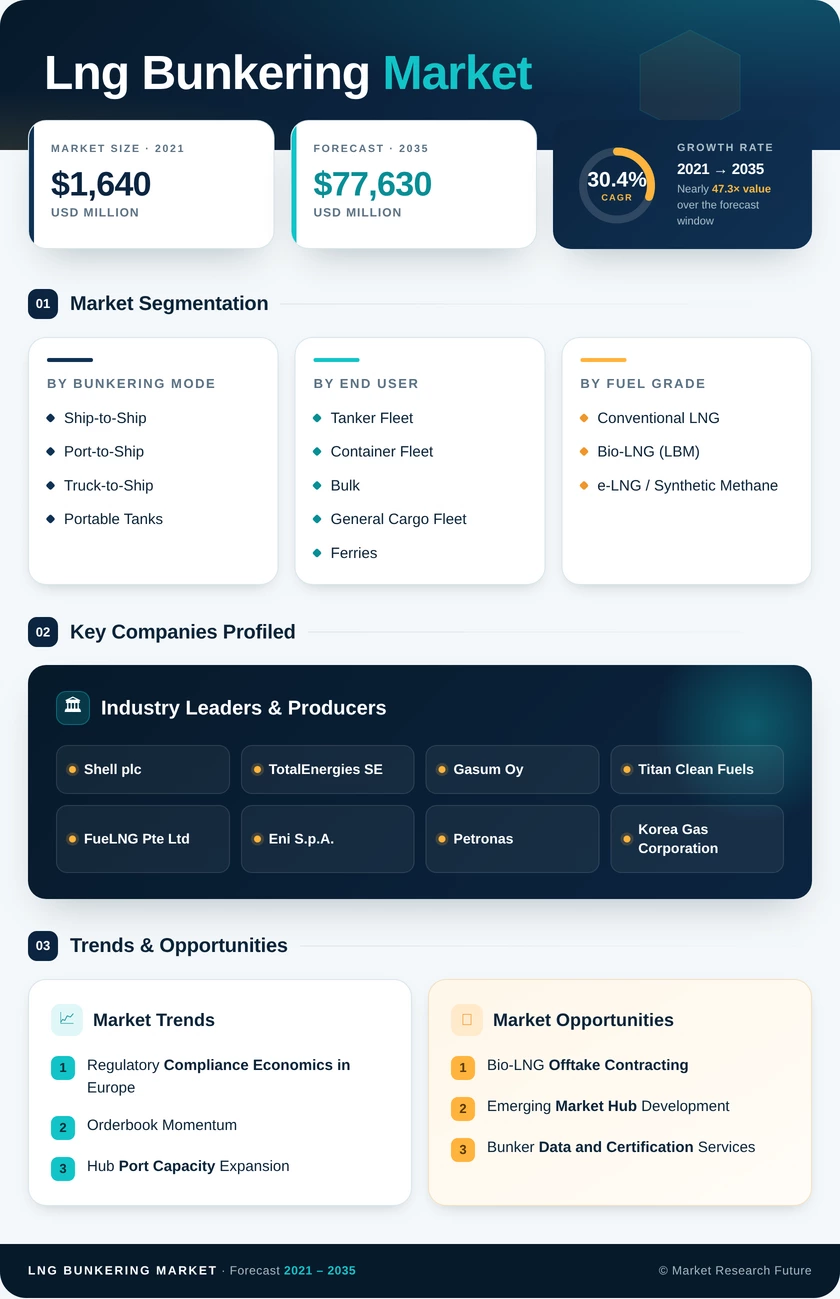
Segmentation Quick Reference
| Dimension | Sub-Segments | Dominant Segment | Fastest Growing Segment |
| By Bunkering Mode | Ship-to-Ship; Port-to-Ship; Truck-to-Ship; Portable Tanks | Ship-to-Ship | Truck-to-Ship |
| By End User | Tanker Fleet; Container Fleet; Bulk and General Cargo Fleet; Ferries and OSV; Other End-Users | Container Fleet | Ferries and OSV |
| By Fuel Grade | Conventional LNG; Bio-LNG (LBM); e-LNG / Synthetic Methane | Conventional LNG | Bio-LNG (LBM) |
| By Region | North America; Europe; Asia-Pacific; South America; Middle East & Africa | Europe | Asia-Pacific |
Market Segmentation Overview
By Bunkering Mode
| Sub-Segment | Key Trend |
| Ship-to-Ship | Simultaneous cargo and fuel transfer preserves berth productivity for deep-sea tonnage |
| Port-to-Ship | Fixed cryogenic tankage concentrates in hub ports with guaranteed anchor traffic |
| Truck-to-Ship | Lowest-capex route enabling new ports to enter service without vessel investment |
| Portable Tanks | Niche solution for inland waterway and small coastal vessels |
Mode selection follows vessel economics rather than technology preference. Large boxships and tankers cannot afford idle berth time, which pushes them toward vessel-based transfer; smaller regional operators find road delivery entirely adequate. Expect the mode mix to shift gradually toward fixed terminals as volumes at individual ports cross the threshold that justifies permanent tankage.
By End User
| Sub-Segment | Key Trend |
| Tanker Fleet | Dual-fuel specification is a marginal change for owners already handling cryogenic cargo |
| Container Fleet | Fixed routes and Scope 3 disclosure pressure make liners the earliest adopters |
| Bulk and General Cargo Fleet | Charterer emissions clauses are pulling tramp tonnage into gas conversion |
| Ferries and OSV | National mandates and offshore operator commitments drive steady replacement demand |
| Other End-Users | Cruise, dredging and government fleets adopting selectively on flagship assets |
Container operators set the pace because their commercial exposure to European regulation is direct and their route predictability makes bunker scheduling straightforward. Ferries and offshore support vessels grow fastest in percentage terms from a smaller base, reflecting concentrated policy mandates in Norway and steady fleet renewal in the Gulf of Mexico.
By Fuel Grade
| Sub-Segment | Key Trend |
| Conventional LNG | Baseline product delivering sulphur, NOx, and particulate compliance |
| Bio-LNG (LBM) | Drop-in blend earning lifecycle credits without engine modification |
| e-LNG / Synthetic Methane | Pilot-stage power-to-gas volumes awaiting renewable electricity cost declines |
Grade is where the long-term margin story sits. Conventional gas solves today's air-quality rules but offers a finite lifecycle benefit; blended renewable methane extends the compliance runway of the same physical assets well beyond 2035. Suppliers securing renewable feedstock now are effectively buying option value on future regulation.
By Region
| Sub-Segment | Key Trend |
| North America | Vessel-specific demand centred on Gulf Coast offshore support and Jones Act tonnage |
| Europe | Regulatory pull from FuelEU and EU ETS reinforcing existing hub concentration |
| Asia-Pacific | Licensing expansion and domestic shipbuilding capacity driving fastest growth |
| South America | Offshore support demand concentrated in Brazilian pre-salt operations |
| Middle East & Africa | Liquefaction adjacency and transit-route positioning at Fujairah and Red Sea ports |
Geographic structure remains far more concentrated than conventional bunkering because cryogenic capability cannot be improvised. The competitive question through 2035 is whether Asia-Pacific hub build-out proceeds fast enough to rebalance a market that Europe currently dominates by a wide margin.


 Noah Malgeri
Co-Founder

 Peter Groot koerkamp
Account and Business Manager

 Younghwan Choi
Senior Retail Manager

 Mark Irwin
Management Consultant

 Akif Moroglu
Strategy & Business Development Director

 Guilherme Gomes Martins
Product Management Director

 Joseph Aguayo
Sales Operations & Pricing Manager

 La Terria Dodd
Program Support Specialist

 Rob Kooiker
Group Product Manager HVAC & Fire Protection GMA