Request Free Sample ×

Kindly complete the form below to receive a free sample of this Report

* Please use a valid business email

Leading companies partner with us for data-driven Insights

clients tt-cursor
Hero Background
English
Chinese
French
Japanese
Korean
German
Spanish

Liver Biopsy Market Analysis

ID: MRFR/MED/4087-HCR
110 Pages
Rahul Gotadki
Last Updated: April 06, 2026

Liver Biopsy Market Research Report Information By Type (Percutaneous, Transjugular, Laparoscopic), Indication (Nonalcoholic Fatty Liver Disease, Chronic Hepatitis B Or C), End User (Hospitals & Clinics, Diagnostic Centers) -Forecast Till 2035

Share:
Download PDF ×

We do not share your information with anyone. However, we may send you emails based on your report interest from time to time. You may contact us at any time to opt-out.

Liver Biopsy Market Infographic
Purchase Options

Market Analysis

In-depth Analysis of Liver Biopsy Market Industry Landscape

The Liver Biopsy Market is going through powerful changes driven by variables like the rising predominance of liver diseases, mechanical progressions in biopsy techniques, and a developing emphasis on early disease finding. These elements are forming the scene of liver biopsy-related items and administrations. The market is overall impacted by the raising worldwide rate of liver diseases, including hepatitis, cirrhosis, and non-alcoholic fatty liver disease (NAFLD). As the frequency of these circumstances keeps on rising, the interest for precise demonstrative instruments like liver biopsy systems is expanding, driving market growth. The market elements are affected by the rise of non-invasive alternatives to conventional liver biopsy strategies, for example, elastography and imaging techniques. The interest for non-invasive choices is ascending because of their diminished risk, faster recuperation times, and expanded patient acknowledgment, affecting the decisions made by medical services suppliers and patients. The market is driven by the steady quest for improved indicative exactness and accuracy. Organizations putting resources into innovative work to work on the responsiveness and explicitness of liver biopsy techniques are acquiring an upper hand. Precise analysis is vital for proper treatment choices, affecting market patterns. The liver biopsy market is not restricted to explicit geographic locales. Globalization and the commonness of liver diseases overall add to market extension. Organizations are growing their market presence through essential associations, coordinated efforts, and consolidations, answering the worldwide interest for liver biopsy administrations. The expense of liver biopsy methods and related administrations is a basic element impacting market elements. Moderateness stays a concern for patients, influencing the reception of biopsy techniques. Organizations focusing in on creating practical arrangements add to making liver biopsy benefits more open to a more extensive patient population.

Author
Author Profile
Rahul Gotadki
Research Manager

He holds an experience of about 9+ years in Market Research and Business Consulting, working under the spectrum of Life Sciences and Healthcare domains. Rahul conceptualizes and implements a scalable business strategy and provides strategic leadership to the clients. His expertise lies in market estimation, competitive intelligence, pipeline analysis, customer assessment, etc.

Leave a Comment

FAQs

What is the projected market valuation of the Liver Biopsy Market by 2035?

<p>The Liver Biopsy Market is projected to reach a valuation of 2.04 USD Billion by 2035.</p>

What was the market valuation of the Liver Biopsy Market in 2024?

<p>In 2024, the Liver Biopsy Market was valued at 0.92 USD Billion.</p>

What is the expected CAGR for the Liver Biopsy Market during the forecast period 2025 - 2035?

<p>The expected CAGR for the Liver Biopsy Market during the forecast period 2025 - 2035 is 7.51%.</p>

Which companies are considered key players in the Liver Biopsy Market?

<p>Key players in the Liver Biopsy Market include F. Hoffmann-La Roche Ltd, Abbott Laboratories, and Thermo Fisher Scientific Inc.</p>

What are the primary types of liver biopsy procedures and their market values?

The primary types of liver biopsy procedures include percutaneous biopsy valued at 0.9 USD Billion and transjugular biopsy valued at 0.7 USD Billion.

What indications are driving the Liver Biopsy Market?

Indications driving the market include chronic hepatitis B or C, projected to reach 0.7 USD Billion by 2035.

How do hospitals and clinics contribute to the Liver Biopsy Market?

Hospitals and clinics are expected to contribute significantly, with a market value projected at 0.9 USD Billion by 2035.

What is the market value for laparoscopic biopsy procedures?

The market value for laparoscopic biopsy procedures is projected to reach 0.44 USD Billion by 2035.

What role do tertiary care centers play in the Liver Biopsy Market?

Tertiary care centers are projected to have a market value of 0.5 USD Billion by 2035.

What is the market outlook for autoimmune hepatitis in the Liver Biopsy Market?

The market outlook for autoimmune hepatitis indicates a potential growth to 0.25 USD Billion by 2035.

Market Summary

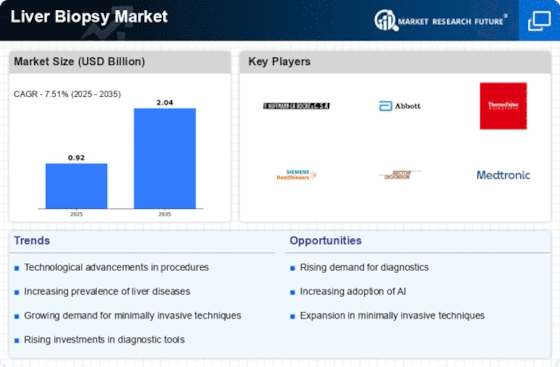
As per Market Research Future analysis, the Liver Biopsy Market Size was estimated at 0.92 USD Billion in 2024. The Liver Biopsy industry is projected to grow from USD 0.9891 Billion in 2025 to USD 2.04 Billion by 2035, exhibiting a compound annual growth rate (CAGR) of 7.51% during the forecast period 2025 - 2035

Key Market Trends & Highlights

The Liver Biopsy Market is experiencing a transformative shift towards minimally invasive techniques and advanced imaging integration.

  • Minimally invasive techniques are gaining traction, enhancing patient comfort and recovery times. The integration of imaging technologies is improving the accuracy and efficiency of liver biopsies. North America remains the largest market, while Asia-Pacific is emerging as the fastest-growing region in this sector. The increasing prevalence of liver diseases and rising demand for personalized medicine are driving market growth.

Market Size & Forecast

2024 Market Size 0.92 (USD Billion)
2035 Market Size 2.04 (USD Billion)
CAGR (2025 - 2035) 7.51%
Largest Regional Market Share in 2024 Americas

Major Players

F. Hoffmann-La Roche Ltd (CH), <a href="https://www.abbott.in/media-center/press-releases/liver-health-and-hepatitis-c-awareness.html">Abbott Laboratories</a> (US), Thermo Fisher Scientific Inc. (US), Siemens Healthineers (DE), Becton, Dickinson and Company (US), Medtronic plc (IE), Hologic, Inc. (US), PerkinElmer, Inc. (US)

Market Trends

The Liver Biopsy Market is currently experiencing a transformation driven by advancements in technology and an increasing prevalence of liver diseases. As healthcare systems evolve, there is a growing emphasis on minimally invasive procedures, which are perceived to enhance patient comfort and reduce recovery times. This shift is likely to influence the demand for liver biopsy techniques, as practitioners seek to adopt methods that align with contemporary medical practices. Furthermore, the integration of imaging technologies into biopsy procedures appears to improve diagnostic accuracy, thereby fostering greater confidence among healthcare providers and patients alike. In addition to technological advancements, the Liver Biopsy Market is also shaped by the rising awareness of liver health and the importance of early diagnosis. Educational initiatives and public health campaigns are likely to contribute to an increase in screening and diagnostic procedures, which may further drive market growth. As the global population ages, the incidence of liver-related conditions is expected to rise, necessitating more effective diagnostic tools. Overall, the Liver Biopsy Market seems poised for growth, with innovations and heightened awareness playing pivotal roles in its evolution.

Minimally Invasive Techniques

The trend towards minimally invasive liver biopsy techniques is gaining traction, as these methods are associated with reduced patient discomfort and quicker recovery times. This shift reflects a broader movement within the healthcare sector towards procedures that prioritize patient well-being while maintaining diagnostic efficacy.

Integration of Imaging Technologies

The incorporation of advanced imaging technologies into liver biopsy procedures is becoming increasingly prevalent. Techniques such as ultrasound and MRI guidance are enhancing the precision of biopsies, which may lead to improved diagnostic outcomes and greater acceptance among healthcare professionals.

Rising Awareness of Liver Health

There is a noticeable increase in public awareness regarding liver health, driven by educational campaigns and advocacy efforts. This heightened awareness is likely to result in more individuals seeking diagnostic evaluations, thereby expanding the market for liver biopsy procedures.

Liver Biopsy Market Market Drivers

Increasing Prevalence of Liver Diseases

The rising incidence of liver diseases, including hepatitis and cirrhosis, is a primary driver of the Liver Biopsy Market. According to recent data, liver diseases affect millions worldwide, leading to a heightened demand for diagnostic procedures. This trend is particularly evident in regions with high rates of viral hepatitis, where liver biopsies are essential for assessing disease progression. The need for accurate diagnosis and monitoring of liver conditions propels the market forward, as healthcare providers seek reliable methods to evaluate liver health. Furthermore, the increasing burden of non-alcoholic fatty liver disease (NAFLD) is contributing to the demand for liver biopsies, as clinicians require precise information to guide treatment decisions. As awareness of liver health continues to grow, the Liver Biopsy Market is likely to expand to meet the needs of patients and healthcare systems.

Rising Demand for Personalized Medicine

The shift towards personalized medicine is emerging as a significant driver in the Liver Biopsy Market. As healthcare moves away from a one-size-fits-all approach, the need for tailored treatment plans based on individual patient profiles becomes increasingly important. Liver biopsies play a crucial role in this paradigm shift, providing essential information about liver pathology that informs personalized treatment strategies. The ability to assess liver tissue at a molecular level allows clinicians to make more informed decisions regarding therapy options, particularly in the context of liver cancer and chronic liver diseases. This trend is likely to enhance the demand for liver biopsies, as healthcare providers seek to optimize patient outcomes through individualized care. Consequently, the Liver Biopsy Market is poised for growth as the focus on personalized medicine continues to gain traction.

Regulatory Support for Diagnostic Procedures

Regulatory support for diagnostic procedures is an essential factor driving the Liver Biopsy Market. Governments and health organizations are increasingly recognizing the importance of accurate diagnostic tools in managing liver diseases. This recognition has led to the establishment of guidelines and frameworks that promote the use of liver biopsies as a standard practice in clinical settings. Additionally, regulatory bodies are working to streamline the approval processes for new biopsy technologies, encouraging innovation and adoption within the market. As a result, healthcare providers are more likely to incorporate liver biopsy procedures into their diagnostic protocols, thereby increasing demand. The ongoing support from regulatory agencies is expected to foster a favorable environment for the Liver Biopsy Market, ultimately enhancing patient outcomes through improved diagnostic accuracy.

Growing Investment in Healthcare Infrastructure

Investment in healthcare infrastructure is a vital driver of the Liver Biopsy Market. As countries prioritize the enhancement of healthcare systems, the availability of advanced diagnostic tools, including liver biopsy procedures, is expected to increase. This trend is particularly pronounced in emerging economies, where governments and private sectors are collaborating to improve healthcare access and quality. The establishment of specialized liver clinics and diagnostic centers is likely to facilitate the adoption of liver biopsy techniques, thereby expanding the market. Furthermore, increased funding for research and development in liver disease diagnostics is anticipated to lead to innovative solutions that enhance the efficacy of liver biopsies. As healthcare infrastructure continues to evolve, the Liver Biopsy Market is expected to benefit from improved access to diagnostic services and enhanced patient care.

Technological Advancements in Biopsy Techniques

Technological innovations in biopsy techniques are significantly influencing the Liver Biopsy Market. The development of minimally invasive procedures, such as ultrasound-guided liver biopsies, has improved patient outcomes and reduced complications. These advancements not only enhance the accuracy of liver disease diagnosis but also increase patient comfort, leading to higher acceptance rates of biopsy procedures. Moreover, the integration of imaging technologies, such as MRI and CT scans, with biopsy techniques allows for more precise targeting of liver lesions. This synergy between technology and clinical practice is expected to drive market growth, as healthcare providers adopt these advanced methods to improve diagnostic accuracy. As the industry continues to evolve, the introduction of new technologies may further transform the landscape of liver biopsies, making them safer and more effective.


Market Segment Insights

By Type: Percutaneous Biopsy (Largest) vs. Laparoscopic Biopsy (Fastest-Growing)

In the Liver Biopsy Market, the percutaneous biopsy segment dominates in terms of market share, primarily due to its minimally invasive nature and widespread acceptance among healthcare professionals. This method accounts for a significant portion of liver biopsy procedures, as it is generally well-tolerated by patients and offers quick recovery times. Conversely, the transjugular biopsy segment, while essential, holds a smaller market share, appealing primarily to patients with specific medical conditions that make other methods less viable. The growth trends in the liver biopsy segment are driven by increasing awareness of liver diseases and the need for accurate diagnosis. The laparoscopic biopsy is emerging as the fastest-growing technique, thanks to advancements in technology and surgical methods that enhance safety and effectiveness. These trends indicate an ongoing evolution in biopsy techniques, with telemedicine and robotic-assisted procedures also gaining traction in the coming years.

Percutaneous Biopsy (Dominant) vs. Transjugular Biopsy (Emerging)

Percutaneous biopsy is recognized as the dominant approach in the liver biopsy market, favored for its simplicity and lower risk of complications. It typically involves the insertion of a needle through the skin to obtain liver tissue samples, making it suitable for outpatients. In contrast, transjugular biopsy, while less common, offers advantages for patients with underlying conditions such as coagulopathy or ascites, as it provides access to the liver via the jugular vein. Despite its emerging status, the transjugular approach is gaining prominence, particularly in specialized settings, due to the increased focus on patient safety and precision in liver disease diagnosis.

By Indication: Nonalcoholic Fatty Liver Disease (Largest) vs. Chronic Hepatitis B or C (Fastest-Growing)

The liver biopsy market, categorized by indication, reveals a significant distribution in favor of nonalcoholic fatty liver disease (NAFLD), which has emerged as the largest segment due to the rising prevalence of obesity and metabolic disorders. In contrast, chronic hepatitis B and C are witnessing increased attention, promising substantial growth as diagnostic and treatment methods advance. Other segments like autoimmune hepatitis and alcoholic liver disease also contribute to the market dynamics but do not match the scale of NAFLD or the growth rate of hepatitis cases.

Nonalcoholic Fatty Liver Disease (Dominant) vs. Chronic Hepatitis B or C (Emerging)

Nonalcoholic fatty liver disease (NAFLD) remains the dominant indication in the liver biopsy market, attributed to its link with widespread lifestyle-related health issues. NAFLD's growing prevalence necessitates effective diagnosis, thus fueling demand for liver biopsies. On the other hand, chronic hepatitis B and C are emerging as fast-growing segments, primarily driven by increased awareness about viral hepatitis and advancements in treatment options. While NAFLD is primarily linked to lifestyle factors, hepatitis B and C cases are driven by infectious pathogens, representing diverse underlying causes for liver damage. Both segments have distinct clinical implications, influencing their management strategies and the overall landscape of liver health care.

By End User: Hospitals & Clinics (Largest) vs. Tertiary Care Centers (Fastest-Growing)

The Liver Biopsy Market shows a diverse distribution among its end users, with Hospitals &amp; Clinics leading the way as the dominant segment. They account for a significant portion of the market share due to their extensive resources and increasing patient referrals for liver-related ailments. Tertiary Care Centers, while currently smaller in share, are experiencing rapid growth driven by specialized treatments and advanced technologies attracting more patients requiring liver biopsy procedures.

Hospitals &amp; Clinics (Dominant) vs. Tertiary Care Centers (Emerging)

Hospitals &amp; Clinics have solidified their position as the dominant players in the Liver Biopsy Market by providing comprehensive care that includes biopsy procedures among a wide array of hospital services. These facilities are equipped with advanced diagnostic tools and have a steady influx of patients, making them vital in managing liver diseases. In contrast, Tertiary Care Centers are emerging as significant contributors to the market due to their specialized focus and capacity to handle complex cases. Their cutting-edge technologies and expert teams cater to higher-tier patients, allowing for innovative biopsy techniques and treatments, thus driving their growth within this sector.

Get more detailed insights about Liver Biopsy Market Research Report–Forecast till 2035

Regional Insights

North America : Leading Innovation and Demand

The North American liver biopsy market is driven by increasing prevalence of liver diseases, advancements in biopsy techniques, and supportive regulatory frameworks. The region holds the largest market share at approximately 45%, with the U.S. being the primary contributor due to its advanced healthcare infrastructure and high demand for diagnostic procedures. Regulatory support from agencies like the FDA further catalyzes market growth, ensuring safety and efficacy in liver biopsy procedures. In North America, the competitive landscape is characterized by the presence of major players such as Abbott Laboratories, Thermo Fisher Scientific, and Medtronic. These companies are continuously innovating and expanding their product offerings to meet the growing demand. The U.S. market is particularly strong, with a focus on minimally invasive techniques and enhanced patient outcomes, positioning it as a leader in The Liver Biopsy.

Europe : Emerging Market with Potential

Europe is witnessing a significant rise in the liver biopsy market, driven by increasing awareness of liver diseases and advancements in diagnostic technologies. The region holds the second-largest market share at around 30%. Countries like Germany and the UK are leading the charge, supported by favorable healthcare policies and a growing emphasis on early diagnosis and treatment of liver conditions. Regulatory bodies are also promoting innovative biopsy techniques, enhancing market growth. The competitive landscape in Europe features key players such as Siemens Healthineers and F. Hoffmann-La Roche Ltd, who are investing in research and development to introduce cutting-edge solutions. The presence of well-established healthcare systems in countries like France and Italy further supports market expansion. Collaborative efforts among healthcare providers and technology firms are expected to drive innovation and improve patient outcomes in liver biopsy procedures.

Asia-Pacific : Rapidly Expanding Market

The Asia-Pacific region is emerging as a significant player in the liver biopsy market, driven by rising incidences of liver diseases and increasing healthcare expenditure. The market is expected to grow rapidly, with countries like China and India leading the way. The region's market share is estimated to be around 15%, supported by government initiatives aimed at improving healthcare access and quality. Regulatory bodies are also working to streamline approval processes for new diagnostic technologies, further boosting market potential. In Asia-Pacific, the competitive landscape is evolving, with both local and international players vying for market share. Companies like Hologic, Inc. and PerkinElmer, Inc. are expanding their presence in the region, focusing on innovative solutions tailored to local needs. The growing awareness of liver health and the push for advanced diagnostic methods are expected to drive significant growth in the liver biopsy market across this diverse region.

Middle East and Africa : Untapped Potential and Growth

The Middle East and Africa region presents untapped potential in the liver biopsy market, driven by increasing healthcare investments and rising awareness of liver diseases. The market share is currently around 10%, with countries like South Africa and the UAE showing promising growth trends. Government initiatives aimed at enhancing healthcare infrastructure and access to diagnostic services are expected to catalyze market expansion in the coming years. The competitive landscape in this region is characterized by a mix of local and international players. Companies are focusing on establishing partnerships and collaborations to enhance their market presence. The growing emphasis on improving healthcare quality and access in countries like Kenya and Nigeria is likely to drive demand for advanced liver biopsy solutions, positioning the region for future growth.

Key Players and Competitive Insights

The Liver Biopsy Market is currently characterized by a dynamic competitive landscape, driven by advancements in diagnostic technologies and an increasing prevalence of liver diseases globally. Key players such as F. Hoffmann-La Roche Ltd (CH), Abbott Laboratories (US), and Thermo Fisher Scientific Inc. (US) are strategically positioned to leverage innovation and partnerships to enhance their market presence. Roche, for instance, focuses on integrating digital solutions into its diagnostic processes, while Abbott emphasizes the development of minimally invasive biopsy techniques. These strategies collectively foster a competitive environment that prioritizes technological advancement and patient-centric solutions.

In terms of business tactics, companies are increasingly localizing manufacturing to reduce costs and optimize supply chains. The Liver Biopsy Market appears moderately fragmented, with several players vying for market share. The collective influence of major companies shapes the market structure, as they engage in strategic collaborations and mergers to enhance their operational capabilities and expand their geographical reach.

In August 2025, F. Hoffmann-La Roche Ltd (CH) announced a partnership with a leading telehealth provider to enhance remote diagnostic capabilities for liver biopsies. This strategic move is likely to improve patient access to diagnostic services, particularly in underserved regions, thereby expanding Roche's market footprint and reinforcing its commitment to innovative healthcare solutions.

In September 2025, Abbott Laboratories (US) launched a new line of biopsy devices designed to minimize patient discomfort and improve diagnostic accuracy. This product introduction not only reflects Abbott's focus on innovation but also positions the company to capture a larger share of the market by addressing the growing demand for less invasive procedures. The emphasis on patient experience is expected to resonate well with healthcare providers and patients alike.

In October 2025, Thermo Fisher Scientific Inc. (US) unveiled a new AI-driven platform aimed at enhancing the analysis of liver biopsy samples. This technological advancement signifies a shift towards integrating artificial intelligence in diagnostic processes, potentially increasing the efficiency and accuracy of liver disease diagnoses. Such innovations may provide Thermo Fisher with a competitive edge in a market that increasingly values precision and speed in diagnostics.

As of October 2025, current competitive trends in the Liver Biopsy Market are heavily influenced by digitalization, sustainability, and the integration of AI technologies. Strategic alliances among key players are shaping the landscape, fostering innovation and enhancing service delivery. Looking ahead, it is anticipated that competitive differentiation will increasingly pivot from price-based strategies to a focus on technological innovation, reliability in supply chains, and the overall enhancement of patient care experiences.

Key Companies in the Liver Biopsy Market include

Industry Developments

Future Outlook

Liver Biopsy Market Future Outlook

The Liver Biopsy Market is projected to grow at a 7.51% CAGR from 2025 to 2035, driven by advancements in diagnostic technologies and increasing prevalence of liver diseases.

New opportunities lie in:

  • <p>Development of minimally invasive biopsy devices for outpatient settings. Integration of AI-driven analytics for enhanced diagnostic accuracy. Expansion of telemedicine platforms for remote biopsy consultations.</p>

By 2035, the Liver Biopsy Market is expected to achieve substantial growth, reflecting evolving healthcare demands.

Market Segmentation

Liver Biopsy Market Type Outlook

  • Percutaneous biopsy
  • Transjugular biopsy
  • Laparoscopic biopsy

Liver Biopsy Market End User Outlook

  • Hospitals & Clinics
  • Tertiary Care Centers
  • Urology Centers
  • Others

Liver Biopsy Market Indication Outlook

  • Nonalcoholic fatty liver disease
  • Chronic hepatitis B or C
  • Autoimmune hepatitis
  • Alcoholic liver disease
  • Others

Report Scope

MARKET SIZE 2024 0.92(USD Billion)
MARKET SIZE 2025 0.9891(USD Billion)
MARKET SIZE 2035 2.04(USD Billion)
COMPOUND ANNUAL GROWTH RATE (CAGR) 7.51% (2025 - 2035)
REPORT COVERAGE Revenue Forecast, Competitive Landscape, Growth Factors, and Trends
BASE YEAR 2024
Market Forecast Period 2025 - 2035
Historical Data 2019 - 2024
Market Forecast Units USD Billion
Key Companies Profiled F. Hoffmann-La Roche Ltd (CH), Abbott Laboratories (US), Thermo Fisher Scientific Inc. (US), Siemens Healthineers (DE), Becton, Dickinson and Company (US), Medtronic plc (IE), Hologic, Inc. (US), PerkinElmer, Inc. (US)
Segments Covered Type
Key Market Opportunities Advancements in minimally invasive techniques enhance patient outcomes in the Liver Biopsy Market.
Key Market Dynamics Technological advancements in imaging and needle techniques enhance accuracy and safety in liver biopsy procedures.
Countries Covered North America, Europe, APAC, South America, MEA

FAQs

What is the projected market valuation of the Liver Biopsy Market by 2035?

<p>The Liver Biopsy Market is projected to reach a valuation of 2.04 USD Billion by 2035.</p>

What was the market valuation of the Liver Biopsy Market in 2024?

<p>In 2024, the Liver Biopsy Market was valued at 0.92 USD Billion.</p>

What is the expected CAGR for the Liver Biopsy Market during the forecast period 2025 - 2035?

<p>The expected CAGR for the Liver Biopsy Market during the forecast period 2025 - 2035 is 7.51%.</p>

Which companies are considered key players in the Liver Biopsy Market?

<p>Key players in the Liver Biopsy Market include F. Hoffmann-La Roche Ltd, Abbott Laboratories, and Thermo Fisher Scientific Inc.</p>

What are the primary types of liver biopsy procedures and their market values?

The primary types of liver biopsy procedures include percutaneous biopsy valued at 0.9 USD Billion and transjugular biopsy valued at 0.7 USD Billion.

What indications are driving the Liver Biopsy Market?

Indications driving the market include chronic hepatitis B or C, projected to reach 0.7 USD Billion by 2035.

How do hospitals and clinics contribute to the Liver Biopsy Market?

Hospitals and clinics are expected to contribute significantly, with a market value projected at 0.9 USD Billion by 2035.

What is the market value for laparoscopic biopsy procedures?

The market value for laparoscopic biopsy procedures is projected to reach 0.44 USD Billion by 2035.

What role do tertiary care centers play in the Liver Biopsy Market?

Tertiary care centers are projected to have a market value of 0.5 USD Billion by 2035.

What is the market outlook for autoimmune hepatitis in the Liver Biopsy Market?

The market outlook for autoimmune hepatitis indicates a potential growth to 0.25 USD Billion by 2035.

  1. SECTION I: EXECUTIVE SUMMARY AND KEY HIGHLIGHTS
    1. | 1.1 EXECUTIVE SUMMARY
    2. | | 1.1.1 Market Overview
    3. | | 1.1.2 Key Findings
    4. | | 1.1.3 Market Segmentation
    5. | | 1.1.4 Competitive Landscape
    6. | | 1.1.5 Challenges and Opportunities
    7. | | 1.1.6 Future Outlook
  2. SECTION II: SCOPING, METHODOLOGY AND MARKET STRUCTURE
    1. | 2.1 MARKET INTRODUCTION
    2. | | 2.1.1 Definition
    3. | | 2.1.2 Scope of the study
    4. | | | 2.1.2.1 Research Objective
    5. | | | 2.1.2.2 Assumption
    6. | | | 2.1.2.3 Limitations
    7. | 2.2 RESEARCH METHODOLOGY
    8. | | 2.2.1 Overview
    9. | | 2.2.2 Data Mining
    10. | | 2.2.3 Secondary Research
    11. | | 2.2.4 Primary Research
    12. | | | 2.2.4.1 Primary Interviews and Information Gathering Process
    13. | | | 2.2.4.2 Breakdown of Primary Respondents
    14. | | 2.2.5 Forecasting Model
    15. | | 2.2.6 Market Size Estimation
    16. | | | 2.2.6.1 Bottom-Up Approach
    17. | | | 2.2.6.2 Top-Down Approach
    18. | | 2.2.7 Data Triangulation
    19. | | 2.2.8 Validation
  3. SECTION III: QUALITATIVE ANALYSIS
    1. | 3.1 MARKET DYNAMICS
    2. | | 3.1.1 Overview
    3. | | 3.1.2 Drivers
    4. | | 3.1.3 Restraints
    5. | | 3.1.4 Opportunities
    6. | 3.2 MARKET FACTOR ANALYSIS
    7. | | 3.2.1 Value chain Analysis
    8. | | 3.2.2 Porter's Five Forces Analysis
    9. | | | 3.2.2.1 Bargaining Power of Suppliers
    10. | | | 3.2.2.2 Bargaining Power of Buyers
    11. | | | 3.2.2.3 Threat of New Entrants
    12. | | | 3.2.2.4 Threat of Substitutes
    13. | | | 3.2.2.5 Intensity of Rivalry
    14. | | 3.2.3 COVID-19 Impact Analysis
    15. | | | 3.2.3.1 Market Impact Analysis
    16. | | | 3.2.3.2 Regional Impact
    17. | | | 3.2.3.3 Opportunity and Threat Analysis
  4. SECTION IV: QUANTITATIVE ANALYSIS
    1. | 4.1 Healthcare, BY Type (USD Billion)
    2. | | 4.1.1 Percutaneous biopsy
    3. | | 4.1.2 Transjugular biopsy
    4. | | 4.1.3 Laparoscopic biopsy
    5. | 4.2 Healthcare, BY Indication (USD Billion)
    6. | | 4.2.1 Nonalcoholic fatty liver disease
    7. | | 4.2.2 Chronic hepatitis B or C
    8. | | 4.2.3 Autoimmune hepatitis
    9. | | 4.2.4 Alcoholic liver disease
    10. | | 4.2.5 Others
    11. | 4.3 Healthcare, BY End User (USD Billion)
    12. | | 4.3.1 Hospitals & Clinics
    13. | | 4.3.2 Tertiary Care Centers
    14. | | 4.3.3 Urology Centers
    15. | | 4.3.4 Others
    16. | 4.4 Healthcare, BY Region (USD Billion)
    17. | | 4.4.1 North America
    18. | | | 4.4.1.1 US
    19. | | | 4.4.1.2 Canada
    20. | | 4.4.2 Europe
    21. | | | 4.4.2.1 Germany
    22. | | | 4.4.2.2 UK
    23. | | | 4.4.2.3 France
    24. | | | 4.4.2.4 Russia
    25. | | | 4.4.2.5 Italy
    26. | | | 4.4.2.6 Spain
    27. | | | 4.4.2.7 Rest of Europe
    28. | | 4.4.3 APAC
    29. | | | 4.4.3.1 China
    30. | | | 4.4.3.2 India
    31. | | | 4.4.3.3 Japan
    32. | | | 4.4.3.4 South Korea
    33. | | | 4.4.3.5 Malaysia
    34. | | | 4.4.3.6 Thailand
    35. | | | 4.4.3.7 Indonesia
    36. | | | 4.4.3.8 Rest of APAC
    37. | | 4.4.4 South America
    38. | | | 4.4.4.1 Brazil
    39. | | | 4.4.4.2 Mexico
    40. | | | 4.4.4.3 Argentina
    41. | | | 4.4.4.4 Rest of South America
    42. | | 4.4.5 MEA
    43. | | | 4.4.5.1 GCC Countries
    44. | | | 4.4.5.2 South Africa
    45. | | | 4.4.5.3 Rest of MEA
  5. SECTION V: COMPETITIVE ANALYSIS
    1. | 5.1 Competitive Landscape
    2. | | 5.1.1 Overview
    3. | | 5.1.2 Competitive Analysis
    4. | | 5.1.3 Market share Analysis
    5. | | 5.1.4 Major Growth Strategy in the Healthcare
    6. | | 5.1.5 Competitive Benchmarking
    7. | | 5.1.6 Leading Players in Terms of Number of Developments in the Healthcare
    8. | | 5.1.7 Key developments and growth strategies
    9. | | | 5.1.7.1 New Product Launch/Service Deployment
    10. | | | 5.1.7.2 Merger & Acquisitions
    11. | | | 5.1.7.3 Joint Ventures
    12. | | 5.1.8 Major Players Financial Matrix
    13. | | | 5.1.8.1 Sales and Operating Income
    14. | | | 5.1.8.2 Major Players R&D Expenditure. 2023
    15. | 5.2 Company Profiles
    16. | | 5.2.1 F. Hoffmann-La Roche Ltd (CH)
    17. | | | 5.2.1.1 Financial Overview
    18. | | | 5.2.1.2 Products Offered
    19. | | | 5.2.1.3 Key Developments
    20. | | | 5.2.1.4 SWOT Analysis
    21. | | | 5.2.1.5 Key Strategies
    22. | | 5.2.2 Abbott Laboratories (US)
    23. | | | 5.2.2.1 Financial Overview
    24. | | | 5.2.2.2 Products Offered
    25. | | | 5.2.2.3 Key Developments
    26. | | | 5.2.2.4 SWOT Analysis
    27. | | | 5.2.2.5 Key Strategies
    28. | | 5.2.3 Thermo Fisher Scientific Inc. (US)
    29. | | | 5.2.3.1 Financial Overview
    30. | | | 5.2.3.2 Products Offered
    31. | | | 5.2.3.3 Key Developments
    32. | | | 5.2.3.4 SWOT Analysis
    33. | | | 5.2.3.5 Key Strategies
    34. | | 5.2.4 Siemens Healthineers (DE)
    35. | | | 5.2.4.1 Financial Overview
    36. | | | 5.2.4.2 Products Offered
    37. | | | 5.2.4.3 Key Developments
    38. | | | 5.2.4.4 SWOT Analysis
    39. | | | 5.2.4.5 Key Strategies
    40. | | 5.2.5 Becton, Dickinson and Company (US)
    41. | | | 5.2.5.1 Financial Overview
    42. | | | 5.2.5.2 Products Offered
    43. | | | 5.2.5.3 Key Developments
    44. | | | 5.2.5.4 SWOT Analysis
    45. | | | 5.2.5.5 Key Strategies
    46. | | 5.2.6 Medtronic plc (IE)
    47. | | | 5.2.6.1 Financial Overview
    48. | | | 5.2.6.2 Products Offered
    49. | | | 5.2.6.3 Key Developments
    50. | | | 5.2.6.4 SWOT Analysis
    51. | | | 5.2.6.5 Key Strategies
    52. | | 5.2.7 Hologic, Inc. (US)
    53. | | | 5.2.7.1 Financial Overview
    54. | | | 5.2.7.2 Products Offered
    55. | | | 5.2.7.3 Key Developments
    56. | | | 5.2.7.4 SWOT Analysis
    57. | | | 5.2.7.5 Key Strategies
    58. | | 5.2.8 PerkinElmer, Inc. (US)
    59. | | | 5.2.8.1 Financial Overview
    60. | | | 5.2.8.2 Products Offered
    61. | | | 5.2.8.3 Key Developments
    62. | | | 5.2.8.4 SWOT Analysis
    63. | | | 5.2.8.5 Key Strategies
    64. | 5.3 Appendix
    65. | | 5.3.1 References
    66. | | 5.3.2 Related Reports
  6. LIST OF FIGURES
    1. | 6.1 MARKET SYNOPSIS
    2. | 6.2 NORTH AMERICA MARKET ANALYSIS
    3. | 6.3 US MARKET ANALYSIS BY TYPE
    4. | 6.4 US MARKET ANALYSIS BY INDICATION
    5. | 6.5 US MARKET ANALYSIS BY END USER
    6. | 6.6 CANADA MARKET ANALYSIS BY TYPE
    7. | 6.7 CANADA MARKET ANALYSIS BY INDICATION
    8. | 6.8 CANADA MARKET ANALYSIS BY END USER
    9. | 6.9 EUROPE MARKET ANALYSIS
    10. | 6.10 GERMANY MARKET ANALYSIS BY TYPE
    11. | 6.11 GERMANY MARKET ANALYSIS BY INDICATION
    12. | 6.12 GERMANY MARKET ANALYSIS BY END USER
    13. | 6.13 UK MARKET ANALYSIS BY TYPE
    14. | 6.14 UK MARKET ANALYSIS BY INDICATION
    15. | 6.15 UK MARKET ANALYSIS BY END USER
    16. | 6.16 FRANCE MARKET ANALYSIS BY TYPE
    17. | 6.17 FRANCE MARKET ANALYSIS BY INDICATION
    18. | 6.18 FRANCE MARKET ANALYSIS BY END USER
    19. | 6.19 RUSSIA MARKET ANALYSIS BY TYPE
    20. | 6.20 RUSSIA MARKET ANALYSIS BY INDICATION
    21. | 6.21 RUSSIA MARKET ANALYSIS BY END USER
    22. | 6.22 ITALY MARKET ANALYSIS BY TYPE
    23. | 6.23 ITALY MARKET ANALYSIS BY INDICATION
    24. | 6.24 ITALY MARKET ANALYSIS BY END USER
    25. | 6.25 SPAIN MARKET ANALYSIS BY TYPE
    26. | 6.26 SPAIN MARKET ANALYSIS BY INDICATION
    27. | 6.27 SPAIN MARKET ANALYSIS BY END USER
    28. | 6.28 REST OF EUROPE MARKET ANALYSIS BY TYPE
    29. | 6.29 REST OF EUROPE MARKET ANALYSIS BY INDICATION
    30. | 6.30 REST OF EUROPE MARKET ANALYSIS BY END USER
    31. | 6.31 APAC MARKET ANALYSIS
    32. | 6.32 CHINA MARKET ANALYSIS BY TYPE
    33. | 6.33 CHINA MARKET ANALYSIS BY INDICATION
    34. | 6.34 CHINA MARKET ANALYSIS BY END USER
    35. | 6.35 INDIA MARKET ANALYSIS BY TYPE
    36. | 6.36 INDIA MARKET ANALYSIS BY INDICATION
    37. | 6.37 INDIA MARKET ANALYSIS BY END USER
    38. | 6.38 JAPAN MARKET ANALYSIS BY TYPE
    39. | 6.39 JAPAN MARKET ANALYSIS BY INDICATION
    40. | 6.40 JAPAN MARKET ANALYSIS BY END USER
    41. | 6.41 SOUTH KOREA MARKET ANALYSIS BY TYPE
    42. | 6.42 SOUTH KOREA MARKET ANALYSIS BY INDICATION
    43. | 6.43 SOUTH KOREA MARKET ANALYSIS BY END USER
    44. | 6.44 MALAYSIA MARKET ANALYSIS BY TYPE
    45. | 6.45 MALAYSIA MARKET ANALYSIS BY INDICATION
    46. | 6.46 MALAYSIA MARKET ANALYSIS BY END USER
    47. | 6.47 THAILAND MARKET ANALYSIS BY TYPE
    48. | 6.48 THAILAND MARKET ANALYSIS BY INDICATION
    49. | 6.49 THAILAND MARKET ANALYSIS BY END USER
    50. | 6.50 INDONESIA MARKET ANALYSIS BY TYPE
    51. | 6.51 INDONESIA MARKET ANALYSIS BY INDICATION
    52. | 6.52 INDONESIA MARKET ANALYSIS BY END USER
    53. | 6.53 REST OF APAC MARKET ANALYSIS BY TYPE
    54. | 6.54 REST OF APAC MARKET ANALYSIS BY INDICATION
    55. | 6.55 REST OF APAC MARKET ANALYSIS BY END USER
    56. | 6.56 SOUTH AMERICA MARKET ANALYSIS
    57. | 6.57 BRAZIL MARKET ANALYSIS BY TYPE
    58. | 6.58 BRAZIL MARKET ANALYSIS BY INDICATION
    59. | 6.59 BRAZIL MARKET ANALYSIS BY END USER
    60. | 6.60 MEXICO MARKET ANALYSIS BY TYPE
    61. | 6.61 MEXICO MARKET ANALYSIS BY INDICATION
    62. | 6.62 MEXICO MARKET ANALYSIS BY END USER
    63. | 6.63 ARGENTINA MARKET ANALYSIS BY TYPE
    64. | 6.64 ARGENTINA MARKET ANALYSIS BY INDICATION
    65. | 6.65 ARGENTINA MARKET ANALYSIS BY END USER
    66. | 6.66 REST OF SOUTH AMERICA MARKET ANALYSIS BY TYPE
    67. | 6.67 REST OF SOUTH AMERICA MARKET ANALYSIS BY INDICATION
    68. | 6.68 REST OF SOUTH AMERICA MARKET ANALYSIS BY END USER
    69. | 6.69 MEA MARKET ANALYSIS
    70. | 6.70 GCC COUNTRIES MARKET ANALYSIS BY TYPE
    71. | 6.71 GCC COUNTRIES MARKET ANALYSIS BY INDICATION
    72. | 6.72 GCC COUNTRIES MARKET ANALYSIS BY END USER
    73. | 6.73 SOUTH AFRICA MARKET ANALYSIS BY TYPE
    74. | 6.74 SOUTH AFRICA MARKET ANALYSIS BY INDICATION
    75. | 6.75 SOUTH AFRICA MARKET ANALYSIS BY END USER
    76. | 6.76 REST OF MEA MARKET ANALYSIS BY TYPE
    77. | 6.77 REST OF MEA MARKET ANALYSIS BY INDICATION
    78. | 6.78 REST OF MEA MARKET ANALYSIS BY END USER
    79. | 6.79 KEY BUYING CRITERIA OF HEALTHCARE
    80. | 6.80 RESEARCH PROCESS OF MRFR
    81. | 6.81 DRO ANALYSIS OF HEALTHCARE
    82. | 6.82 DRIVERS IMPACT ANALYSIS: HEALTHCARE
    83. | 6.83 RESTRAINTS IMPACT ANALYSIS: HEALTHCARE
    84. | 6.84 SUPPLY / VALUE CHAIN: HEALTHCARE
    85. | 6.85 HEALTHCARE, BY TYPE, 2024 (% SHARE)
    86. | 6.86 HEALTHCARE, BY TYPE, 2024 TO 2035 (USD Billion)
    87. | 6.87 HEALTHCARE, BY INDICATION, 2024 (% SHARE)
    88. | 6.88 HEALTHCARE, BY INDICATION, 2024 TO 2035 (USD Billion)
    89. | 6.89 HEALTHCARE, BY END USER, 2024 (% SHARE)
    90. | 6.90 HEALTHCARE, BY END USER, 2024 TO 2035 (USD Billion)
    91. | 6.91 BENCHMARKING OF MAJOR COMPETITORS
  7. LIST OF TABLES
    1. | 7.1 LIST OF ASSUMPTIONS
    2. | | 7.1.1
    3. | 7.2 North America MARKET SIZE ESTIMATES; FORECAST
    4. | | 7.2.1 BY TYPE, 2025-2035 (USD Billion)
    5. | | 7.2.2 BY INDICATION, 2025-2035 (USD Billion)
    6. | | 7.2.3 BY END USER, 2025-2035 (USD Billion)
    7. | 7.3 US MARKET SIZE ESTIMATES; FORECAST
    8. | | 7.3.1 BY TYPE, 2025-2035 (USD Billion)
    9. | | 7.3.2 BY INDICATION, 2025-2035 (USD Billion)
    10. | | 7.3.3 BY END USER, 2025-2035 (USD Billion)
    11. | 7.4 Canada MARKET SIZE ESTIMATES; FORECAST
    12. | | 7.4.1 BY TYPE, 2025-2035 (USD Billion)
    13. | | 7.4.2 BY INDICATION, 2025-2035 (USD Billion)
    14. | | 7.4.3 BY END USER, 2025-2035 (USD Billion)
    15. | 7.5 Europe MARKET SIZE ESTIMATES; FORECAST
    16. | | 7.5.1 BY TYPE, 2025-2035 (USD Billion)
    17. | | 7.5.2 BY INDICATION, 2025-2035 (USD Billion)
    18. | | 7.5.3 BY END USER, 2025-2035 (USD Billion)
    19. | 7.6 Germany MARKET SIZE ESTIMATES; FORECAST
    20. | | 7.6.1 BY TYPE, 2025-2035 (USD Billion)
    21. | | 7.6.2 BY INDICATION, 2025-2035 (USD Billion)
    22. | | 7.6.3 BY END USER, 2025-2035 (USD Billion)
    23. | 7.7 UK MARKET SIZE ESTIMATES; FORECAST
    24. | | 7.7.1 BY TYPE, 2025-2035 (USD Billion)
    25. | | 7.7.2 BY INDICATION, 2025-2035 (USD Billion)
    26. | | 7.7.3 BY END USER, 2025-2035 (USD Billion)
    27. | 7.8 France MARKET SIZE ESTIMATES; FORECAST
    28. | | 7.8.1 BY TYPE, 2025-2035 (USD Billion)
    29. | | 7.8.2 BY INDICATION, 2025-2035 (USD Billion)
    30. | | 7.8.3 BY END USER, 2025-2035 (USD Billion)
    31. | 7.9 Russia MARKET SIZE ESTIMATES; FORECAST
    32. | | 7.9.1 BY TYPE, 2025-2035 (USD Billion)
    33. | | 7.9.2 BY INDICATION, 2025-2035 (USD Billion)
    34. | | 7.9.3 BY END USER, 2025-2035 (USD Billion)
    35. | 7.10 Italy MARKET SIZE ESTIMATES; FORECAST
    36. | | 7.10.1 BY TYPE, 2025-2035 (USD Billion)
    37. | | 7.10.2 BY INDICATION, 2025-2035 (USD Billion)
    38. | | 7.10.3 BY END USER, 2025-2035 (USD Billion)
    39. | 7.11 Spain MARKET SIZE ESTIMATES; FORECAST
    40. | | 7.11.1 BY TYPE, 2025-2035 (USD Billion)
    41. | | 7.11.2 BY INDICATION, 2025-2035 (USD Billion)
    42. | | 7.11.3 BY END USER, 2025-2035 (USD Billion)
    43. | 7.12 Rest of Europe MARKET SIZE ESTIMATES; FORECAST
    44. | | 7.12.1 BY TYPE, 2025-2035 (USD Billion)
    45. | | 7.12.2 BY INDICATION, 2025-2035 (USD Billion)
    46. | | 7.12.3 BY END USER, 2025-2035 (USD Billion)
    47. | 7.13 APAC MARKET SIZE ESTIMATES; FORECAST
    48. | | 7.13.1 BY TYPE, 2025-2035 (USD Billion)
    49. | | 7.13.2 BY INDICATION, 2025-2035 (USD Billion)
    50. | | 7.13.3 BY END USER, 2025-2035 (USD Billion)
    51. | 7.14 China MARKET SIZE ESTIMATES; FORECAST
    52. | | 7.14.1 BY TYPE, 2025-2035 (USD Billion)
    53. | | 7.14.2 BY INDICATION, 2025-2035 (USD Billion)
    54. | | 7.14.3 BY END USER, 2025-2035 (USD Billion)
    55. | 7.15 India MARKET SIZE ESTIMATES; FORECAST
    56. | | 7.15.1 BY TYPE, 2025-2035 (USD Billion)
    57. | | 7.15.2 BY INDICATION, 2025-2035 (USD Billion)
    58. | | 7.15.3 BY END USER, 2025-2035 (USD Billion)
    59. | 7.16 Japan MARKET SIZE ESTIMATES; FORECAST
    60. | | 7.16.1 BY TYPE, 2025-2035 (USD Billion)
    61. | | 7.16.2 BY INDICATION, 2025-2035 (USD Billion)
    62. | | 7.16.3 BY END USER, 2025-2035 (USD Billion)
    63. | 7.17 South Korea MARKET SIZE ESTIMATES; FORECAST
    64. | | 7.17.1 BY TYPE, 2025-2035 (USD Billion)
    65. | | 7.17.2 BY INDICATION, 2025-2035 (USD Billion)
    66. | | 7.17.3 BY END USER, 2025-2035 (USD Billion)
    67. | 7.18 Malaysia MARKET SIZE ESTIMATES; FORECAST
    68. | | 7.18.1 BY TYPE, 2025-2035 (USD Billion)
    69. | | 7.18.2 BY INDICATION, 2025-2035 (USD Billion)
    70. | | 7.18.3 BY END USER, 2025-2035 (USD Billion)
    71. | 7.19 Thailand MARKET SIZE ESTIMATES; FORECAST
    72. | | 7.19.1 BY TYPE, 2025-2035 (USD Billion)
    73. | | 7.19.2 BY INDICATION, 2025-2035 (USD Billion)
    74. | | 7.19.3 BY END USER, 2025-2035 (USD Billion)
    75. | 7.20 Indonesia MARKET SIZE ESTIMATES; FORECAST
    76. | | 7.20.1 BY TYPE, 2025-2035 (USD Billion)
    77. | | 7.20.2 BY INDICATION, 2025-2035 (USD Billion)
    78. | | 7.20.3 BY END USER, 2025-2035 (USD Billion)
    79. | 7.21 Rest of APAC MARKET SIZE ESTIMATES; FORECAST
    80. | | 7.21.1 BY TYPE, 2025-2035 (USD Billion)
    81. | | 7.21.2 BY INDICATION, 2025-2035 (USD Billion)
    82. | | 7.21.3 BY END USER, 2025-2035 (USD Billion)
    83. | 7.22 South America MARKET SIZE ESTIMATES; FORECAST
    84. | | 7.22.1 BY TYPE, 2025-2035 (USD Billion)
    85. | | 7.22.2 BY INDICATION, 2025-2035 (USD Billion)
    86. | | 7.22.3 BY END USER, 2025-2035 (USD Billion)
    87. | 7.23 Brazil MARKET SIZE ESTIMATES; FORECAST
    88. | | 7.23.1 BY TYPE, 2025-2035 (USD Billion)
    89. | | 7.23.2 BY INDICATION, 2025-2035 (USD Billion)
    90. | | 7.23.3 BY END USER, 2025-2035 (USD Billion)
    91. | 7.24 Mexico MARKET SIZE ESTIMATES; FORECAST
    92. | | 7.24.1 BY TYPE, 2025-2035 (USD Billion)
    93. | | 7.24.2 BY INDICATION, 2025-2035 (USD Billion)
    94. | | 7.24.3 BY END USER, 2025-2035 (USD Billion)
    95. | 7.25 Argentina MARKET SIZE ESTIMATES; FORECAST
    96. | | 7.25.1 BY TYPE, 2025-2035 (USD Billion)
    97. | | 7.25.2 BY INDICATION, 2025-2035 (USD Billion)
    98. | | 7.25.3 BY END USER, 2025-2035 (USD Billion)
    99. | 7.26 Rest of South America MARKET SIZE ESTIMATES; FORECAST
    100. | | 7.26.1 BY TYPE, 2025-2035 (USD Billion)
    101. | | 7.26.2 BY INDICATION, 2025-2035 (USD Billion)
    102. | | 7.26.3 BY END USER, 2025-2035 (USD Billion)
    103. | 7.27 MEA MARKET SIZE ESTIMATES; FORECAST
    104. | | 7.27.1 BY TYPE, 2025-2035 (USD Billion)
    105. | | 7.27.2 BY INDICATION, 2025-2035 (USD Billion)
    106. | | 7.27.3 BY END USER, 2025-2035 (USD Billion)
    107. | 7.28 GCC Countries MARKET SIZE ESTIMATES; FORECAST
    108. | | 7.28.1 BY TYPE, 2025-2035 (USD Billion)
    109. | | 7.28.2 BY INDICATION, 2025-2035 (USD Billion)
    110. | | 7.28.3 BY END USER, 2025-2035 (USD Billion)
    111. | 7.29 South Africa MARKET SIZE ESTIMATES; FORECAST
    112. | | 7.29.1 BY TYPE, 2025-2035 (USD Billion)
    113. | | 7.29.2 BY INDICATION, 2025-2035 (USD Billion)
    114. | | 7.29.3 BY END USER, 2025-2035 (USD Billion)
    115. | 7.30 Rest of MEA MARKET SIZE ESTIMATES; FORECAST
    116. | | 7.30.1 BY TYPE, 2025-2035 (USD Billion)
    117. | | 7.30.2 BY INDICATION, 2025-2035 (USD Billion)
    118. | | 7.30.3 BY END USER, 2025-2035 (USD Billion)
    119. | 7.31 PRODUCT LAUNCH/PRODUCT DEVELOPMENT/APPROVAL
    120. | | 7.31.1
    121. | 7.32 ACQUISITION/PARTNERSHIP
    122. | | 7.32.1

Healthcare Market Segmentation

Healthcare By Type (USD Billion, 2025-2035)

  • Percutaneous biopsy
  • Transjugular biopsy
  • Laparoscopic biopsy

Healthcare By Indication (USD Billion, 2025-2035)

  • Nonalcoholic fatty liver disease
  • Chronic hepatitis B or C
  • Autoimmune hepatitis
  • Alcoholic liver disease
  • Others

Healthcare By End User (USD Billion, 2025-2035)

  • Hospitals & Clinics
  • Tertiary Care Centers
  • Urology Centers
  • Others
Infographic

Free Sample Request

Kindly complete the form below to receive a free sample of this Report

Get Free Sample

Customer Strories

Compare Licence

×
Features License Type
Single User Multiuser License Enterprise User
Price $4,950 $5,950 $7,250
Maximum User Access Limit 1 User Upto 10 Users Unrestricted Access Throughout the Organization
Free Customization
Direct Access to Analyst
Deliverable Format
Platform Access
Discount on Next Purchase 10% 15% 15%
Printable Versions