×
Request Free Sample ×

Kindly complete the form below to receive a free sample of this Report

* Please use a valid business email

Leading companies partner with us for data-driven Insights

clients tt-cursor
Hero Background
English
Chinese
French
Japanese
Korean
German
Spanish

Lithium Hexafluorophosphate Market Share

ID: MRFR/CnM/0259-HCR
143 Pages
Priya Nagrale
October 2025

Lithium Hexafluorophosphate Market Research Report Information by Applications (Automotive Industries, Ceramic Industries, Chemical Industries & Others) - Forecast to 2035

Share:
Download PDF ×

We do not share your information with anyone. However, we may send you emails based on your report interest from time to time. You may contact us at any time to opt-out.

Lithium Hexafluorophosphate Market Infographic
×
Lithium Hexafluorophosphate Market Infographic Full View
Purchase Options

Market Share

Lithium Hexafluorophosphate Market Share Analysis

To start with: The market for lithium hexafluorophosphate is going through quick changes because of moving shopper inclinations and mechanical advancement. Situating procedures for piece of the pie are vital for organizations working in this industry, as they decide their upper hand and development possibilities. To separate themselves in the commercial center, organizations regularly endeavor to separate their lithium hexafluorophosphate items. This might involve the joining of unmistakable traits, the upgrade of value, or the improvement of execution factors. By giving an extraordinary item, organizations can lay out a market specialty and appeal to a particular buyer section. An extra solid methodology is cost initiative, by which associations focus on assembling lithium hexafluorophosphate at a decreased cost comparative with their opponents. This goal can be acknowledged by means of the execution of economies of scale, smoothed out creation processes, and sharp natural substance obtaining. Cost authority empowers associations to give serious estimating, consequently drawing in buyers who focus on cost awareness and possibly growing their market presence. Market Division: Basic to the Lithium Hexafluorophosphate market is the cognizance of the differed prerequisites of clients. To execute a market division system, organizations might modify their items to fulfill the specific requirements of particular purchaser portions. By embracing this procedure, organizations can take special care of the particular inclinations of different market portions, consequently expanding customer dedication and fulfillment. Geographic Development: A common way to deal with expanding piece of the pie is through geological extension. Associations might wander into neglected markets or locales where the interest in lithium hexafluorophosphate is on the ascent. Through the venture into undiscovered business sectors, organizations can develop their customer base and lessen dependence on specific areas, consequently alleviating risk and expanding their general market strength. Vital collusions and organizations are valuable coordinated efforts that can essentially add to the procurement of an upper hand for a business. Organizations and vital coalitions can concede admittance to conveyance channels, integral assets, and aptitude. Associations participating in the Lithium Hexafluorophosphate market can upgrade their standing and pool a more significant piece of the pie by shaping key unions with conspicuous players in related areas. Advancement and Exploration and Improvement (Research and development): Associations trying to acquire an upper hand should make significant interests in advancement and Research and development. By reliably refining their ongoing contributions or making novel definitions, organizations can keep an upper hand in the commercial center and satisfy steadily changing purchaser requests. By laying out a market position in light of development, an organization can draw in clients looking for cutting edge lithium hexafluorophosphate arrangements.

Author
Priya Nagrale
Senior Research Analyst

With an experience of over five years in market research industry (Chemicals & Materials domain), I gather and analyze market data from diverse sources to produce results, which are then presented back to a client. Also, provide recommendations based on the findings. As a Senior Research Analyst, I perform quality checks (QC) for market estimations, QC for reports, and handle queries and work extensively on client customizations. Also, handle the responsibilities of client proposals, report planning, report finalization, and execution

Leave a Comment

FAQs

What are the major product types in the market?

Major product types in the market include PAN-based, pitch-based, and rayon-based.

What are the key applications of lithium hexafluorophosphate?

Leading applications of the chemical include construction, automotive, sports, defense and aerospace, wind energy, and others.

What is the major driver for the market?

Increasing adoption of lithium in automotive batteries is the major driver for the market.

Which is the leading regional market?

North America is the leading regional market, with Europe also expected to hold a strong share in the market.

What are the key players in the market?

Leading players in the global lithium hexafluorophosphate market include FPC, Tianjin Jinniu, and Foosung, among others.

Market Summary

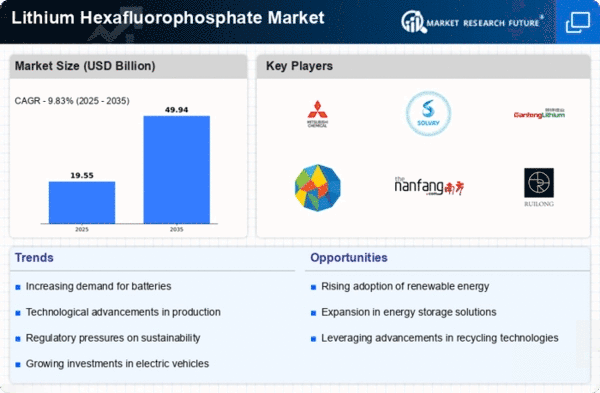
As per MRFR analysis, the Lithium Hexafluorophosphate Market Size was estimated at 17.8 USD Billion in 2024. The Lithium Hexafluorophosphate industry is projected to grow from 19.55 USD Billion in 2025 to 49.94 USD Billion by 2035, exhibiting a compound annual growth rate (CAGR) of 9.83 during the forecast period 2025 - 2035.

Key Market Trends & Highlights

The Lithium Hexafluorophosphate Market is poised for robust growth driven by technological advancements and increasing demand across various sectors.

  • The market is experiencing a surge in demand for lithium hexafluorophosphate, primarily fueled by the growing electric vehicle sector in North America. Technological advancements in battery production are enhancing the efficiency and performance of lithium-ion batteries, particularly in the Asia-Pacific region. The electrolyte segment remains the largest contributor to the market, while the additive segment is witnessing the fastest growth due to evolving battery technologies. Key market drivers include the rising adoption of renewable energy sources and increased investment in electric vehicle infrastructure, which are shaping the future of the industry.

Market Size & Forecast

2024 Market Size 17.8 (USD Billion)
2035 Market Size 49.94 (USD Billion)
CAGR (2025 - 2035) 9.83%
Largest Regional Market Share in 2024 Asia-Pacific

Major Players

<p>Mitsubishi Chemical (JP), Solvay (BE), Ganfeng Lithium (CN), Ferroglobe (ES), Tianjin Jinniu (CN), Hubei Nanfang (CN), Shenzhen Ruilong (CN), Hunan Nonferrous (CN)</p>

Market Trends

The Lithium Hexafluorophosphate Market is currently experiencing notable growth, driven by the increasing demand for advanced battery technologies. This compound serves as a crucial electrolyte salt in lithium-ion batteries, which are widely utilized in electric vehicles and portable electronic devices. As the global push for sustainable energy solutions intensifies, the need for efficient and high-performance batteries becomes paramount. Consequently, manufacturers are focusing on enhancing the quality and performance of lithium hexafluorophosphate to meet the evolving requirements of the energy storage sector. Furthermore, the expansion of renewable energy sources is likely to bolster the market, as energy storage systems become essential for managing intermittent power generation. In addition to the rising demand from the automotive and electronics industries, the Lithium Hexafluorophosphate Market is also influenced by advancements in production technologies. Innovations in synthesis methods may lead to improved purity and reduced production costs, thereby enhancing the overall market landscape. Moreover, regulatory frameworks aimed at promoting environmentally friendly materials could further stimulate market growth. As stakeholders navigate these dynamics, the Lithium Hexafluorophosphate Market appears poised for continued expansion, reflecting broader trends in energy transition and technological advancement.

Growing Demand for Electric Vehicles

The increasing adoption of electric vehicles is a primary driver for the Lithium Hexafluorophosphate Market. As consumers and manufacturers prioritize sustainable transportation, the need for efficient battery solutions becomes critical.

Technological Advancements in Battery Production

Innovations in battery manufacturing processes are likely to enhance the performance and efficiency of lithium hexafluorophosphate. These advancements may lead to higher purity levels and lower production costs.

Regulatory Support for Sustainable Materials

Government initiatives promoting the use of environmentally friendly materials could positively impact the Lithium Hexafluorophosphate Market. Such regulations may encourage manufacturers to adopt sustainable practices.

Lithium Hexafluorophosphate Market Market Drivers

Market Segment Insights

By Application: Electrolyte (Largest) vs. Additive (Fastest-Growing)

<p>In the Lithium Hexafluorophosphate Market, the application segment reveals a diverse array of uses, with Electrolyte dominating the share. This segment is pivotal in applications within lithium-ion batteries, which are widely used in consumer electronics and electric vehicles, driving significant market presence. Following closely, the Additive segment is gaining traction, adapting to advances in battery technology and the need for improved performance and stability in various applications.</p>

<p>Electrolyte: Dominant vs. Additive: Emerging</p>

<p>The Electrolyte application represents a cornerstone of the Lithium Hexafluorophosphate Market, providing the necessary ionic conductivity for lithium-ion batteries. Its established position is marked by comprehensive use in high-energy density batteries, crucial for consumer electronics and electric vehicles. Conversely, the Additive segment is emerging rapidly, as companies innovate to enhance battery functionality. Additives developed for improved thermal stability and efficiency are becoming increasingly relevant, especially in next-generation batteries, thus carving out a significant position within the market.</p>

By End Use: Electric Vehicles (Largest) vs. Consumer Electronics (Fastest-Growing)

<p>The Lithium Hexafluorophosphate market is significantly influenced by its end-use segments. Leading the market is the electric vehicles segment, which has capitalized on the growing demand for sustainable transportation solutions. In contrast, consumer electronics, fueled by the miniaturization and proliferation of smart devices, has emerged as the fastest-growing segment. Each segment plays a unique role by contributing to the overall dynamics of lithium hexafluorophosphate uptake in diverse applications. Growth in the electric vehicle sector is driven by stringent regulations aimed at reducing carbon emissions and the rising popularity of eco-friendly alternatives to traditional combustion engines. Meanwhile, the consumer electronics segment is being propelled by advancements in battery technology, enhancing performance, and the continuous launch of cutting-edge gadgets. Hence, both segments not only showcase robust growth but also exhibit distinct needs for lithium hexafluorophosphate, reinforcing its significance in various industries.</p>

<p>Electric Vehicles: Dominant vs. Consumer Electronics: Emerging</p>

<p>The electric vehicle segment stands as the dominant force in the Lithium Hexafluorophosphate market, primarily attributed to the increased shift towards electric mobility and government incentives for EV adoption. This segment benefits from advancements in battery chemistry, which allows for higher efficiency and longer ranges, making it attractive to consumers and manufacturers alike. In contrast, the consumer electronics segment is emerging strongly, characterized by rapid technological innovation and demand for improved battery performance in devices such as smartphones, laptops, and tablets. This segment is influenced by the trend towards larger battery capacities and faster charging capabilities, leading to a burgeoning need for high-quality lithium hexafluorophosphate. Both segments play vital roles in the overall trajectory of the market.</p>

By Purity Level: High Purity (Largest) vs. Standard Purity (Fastest-Growing)

<p>In the Lithium Hexafluorophosphate Market, the distribution of market share among purity levels reveals high purity as the dominant segment, favored primarily in high-performance applications like electric vehicle batteries. Standard purity follows as a robust segment, appealing to various industrial uses, while low purity holds a minor market share, finding its place in less critical applications. This segmentation underscores the preferences of manufacturers focusing on quality and reliability in lithium-ion battery production. Overall, growth trends for purity levels indicate a significant increase in demand for high-purity lithium hexafluorophosphate, driven by the burgeoning electric vehicle market and advancements in battery technology. Furthermore, standard purity is emerging rapidly due to its compatibility with different applications, showcasing an upward trajectory as manufacturers seek cost-effective solutions without compromising on performance. These dynamics position the purity segment in a favorable growth landscape.</p>

<p>High Purity (Dominant) vs. Standard Purity (Emerging)</p>

<p>High purity lithium hexafluorophosphate represents the pinnacle of quality, primarily used in advanced lithium-ion batteries, particularly for electric vehicles and high-end devices. This segment's dominance is attributed to the critical need for superior performance and safety in energy storage solutions. On the other hand, standard purity lithium hexafluorophosphate serves as a versatile alternative for various applications, balancing cost and performance. While it may not meet the stringent requirements of high-performance batteries, its increasing adoption in less demanding scenarios showcases its potential as an emerging option among manufacturers, providing essential flexibility in sourcing materials.</p>

By Form: Powder (Largest) vs. Liquid (Fastest-Growing)

<p>In the Lithium Hexafluorophosphate Market, the 'Form' segment is characterized by its division into Powder, Liquid, and Granular forms. Powder is the largest segment, holding major market share due to its widespread applications in battery production, especially in electric vehicles and energy storage systems. Liquid is also prominent but is growing at a faster pace as it offers enhanced solubility, making it preferable for specific industrial processes. Granular form remains a consistent option but does not lead in market share or growth.</p>

<p>Powder (Dominant) vs. Liquid (Emerging)</p>

<p>The Powder form of Lithium Hexafluorophosphate is recognized as the dominant player in the market, primarily due to its established applications and compatibility with various manufacturing processes. It is favored for stability and effective performance in high-energy environments, especially in lithium-ion batteries. In contrast, Liquid form, labeled as emerging, is gaining attention for its improved efficiency and ease of handling in production processes. As industries shift towards more sophisticated solutions, Liquid's rapid growth is propelled by the increasing demand for more versatile and efficient lithium compounds in advanced battery technologies, positioning it as a key player for the near future.</p>

By Production Method: Chemical Synthesis (Largest) vs. Electrochemical Synthesis (Fastest-Growing)

<p>In the Lithium Hexafluorophosphate Market, the production method segment is diversifying among three primary techniques: Chemical Synthesis, Electrochemical Synthesis, and Recycling. Among these, Chemical Synthesis holds the largest market share, driven by its established processes and reliability in producing high-quality lithium hexafluorophosphate. Meanwhile, Electrochemical Synthesis, though currently smaller, is gaining traction due to advancements in technology and the increasing emphasis on sustainable production methods. Recycling is also present, but it plays a lesser role compared to the other two methods, focusing mainly on resource recovery.</p>

<p>Production Method: Chemical Synthesis (Dominant) vs. Electrochemical Synthesis (Emerging)</p>

<p>Chemical Synthesis remains dominant in the Lithium Hexafluorophosphate market due to its mature infrastructure and extensive operational efficiencies, enabling consistent product quality and scale. This method leverages well-established chemical processes which have been optimized over time, making it the go-to choice for manufacturers. On the other hand, Electrochemical Synthesis is considered an emerging technique, characterized by its innovative approach that offers environmentally friendly alternatives to traditional methods. This production method is witnessing rapid growth as companies seek to lower their carbon footprints and enhance sustainability practices. The shift towards Electrochemical Synthesis is fueled by the rising demand for cleaner production technologies and the integration of advanced technologies in manufacturing.</p>

Get more detailed insights about Lithium Hexafluorophosphate Market Research Report - Forecast to 2035

Regional Insights

North America : Growing Demand for Lithium Solutions

The North American Lithium Hexafluorophosphate market is projected to grow significantly, driven by increasing demand from the electric vehicle (EV) sector and energy storage applications. With a market size of $4.5 million, the region is witnessing a surge in investments aimed at enhancing production capabilities and sustainability practices. Regulatory support for clean energy initiatives further catalyzes this growth, positioning North America as a key player in the global market. Leading countries such as the USA and Canada are at the forefront of this market, with major companies like Mitsubishi Chemical and Solvay establishing strong footholds. The competitive landscape is characterized by strategic partnerships and technological advancements aimed at improving product efficiency. As the region continues to innovate, it is expected to capture a larger share of the global market, reinforcing its position as a critical hub for lithium production.

Europe : Innovation and Sustainability Focus

Europe's Lithium Hexafluorophosphate market is evolving rapidly, with a market size of €3.8 million. The region is driven by stringent environmental regulations and a strong push towards sustainable energy solutions. The European Union's Green Deal and various national policies are fostering innovation in battery technologies, which is expected to significantly boost demand for lithium compounds. This regulatory environment is crucial for attracting investments and enhancing production capabilities. Countries like Germany, France, and the UK are leading the charge, with key players such as Solvay and Ferroglobe actively participating in the market. The competitive landscape is marked by collaborations between automotive manufacturers and chemical producers to develop advanced battery technologies. As Europe aims for carbon neutrality, the lithium market is set to play a pivotal role in achieving these ambitious goals.

Asia-Pacific : Dominating The Lithium Hexafluorophosphate

The Asia-Pacific region is the largest market for Lithium Hexafluorophosphate, boasting a market size of $8.5 million. This dominance is fueled by the rapid growth of the electric vehicle industry and increasing investments in renewable energy storage solutions. Countries like China and Japan are leading the charge, supported by favorable government policies and substantial investments in battery technology. The region's robust manufacturing capabilities further enhance its market position, making it a critical player in the global supply chain. China, in particular, is home to major players such as Ganfeng Lithium and Tianjin Jinniu, which are driving innovation and production efficiency. The competitive landscape is characterized by aggressive expansion strategies and technological advancements aimed at meeting the surging demand. As the region continues to innovate, it is expected to maintain its leadership in The Lithium Hexafluorophosphate, significantly influencing pricing and supply dynamics.

Middle East and Africa : Emerging Market Potential

The Middle East and Africa region is emerging as a potential market for Lithium Hexafluorophosphate, with a market size of $0.8 million. While still in its nascent stages, the region is witnessing growing interest in lithium production driven by the global shift towards renewable energy and electric vehicles. Governments are beginning to recognize the strategic importance of lithium resources, which could lead to favorable policies and investments in the sector. Countries like South Africa and Morocco are exploring opportunities to develop lithium resources, with a focus on attracting foreign investments. The competitive landscape is currently limited, but as awareness of lithium's importance grows, more players are expected to enter the market. This could pave the way for significant growth in the coming years, positioning the region as a new frontier in the global lithium supply chain.

Key Players and Competitive Insights

The Lithium Hexafluorophosphate Market is currently characterized by a dynamic competitive landscape, driven by the increasing demand for high-performance batteries, particularly in electric vehicles (EVs) and renewable energy storage systems. Key players such as Mitsubishi Chemical (Japan), Solvay (Belgium), and Ganfeng Lithium (China) are strategically positioned to leverage their technological advancements and production capabilities. Mitsubishi Chemical (Japan) focuses on innovation in material science, aiming to enhance the efficiency of lithium-ion batteries. Solvay (Belgium) emphasizes sustainability in its operations, aligning with global environmental standards, while Ganfeng Lithium (China) is expanding its production capacity to meet the surging demand from the EV sector. Collectively, these strategies contribute to a competitive environment that is increasingly focused on technological innovation and sustainability.In terms of business tactics, companies are localizing manufacturing to reduce supply chain vulnerabilities and optimize logistics. The market structure appears moderately fragmented, with several players vying for market share. However, the influence of major companies is significant, as they set industry standards and drive technological advancements. This competitive structure fosters an environment where smaller firms may struggle to keep pace with the rapid innovations and scale of operations exhibited by larger entities.


In November Ganfeng Lithium (China) announced the opening of a new production facility in Jiangxi province, aimed at increasing its output of lithium hexafluorophosphate by 30%. This strategic move is likely to enhance Ganfeng's market position, allowing it to better serve the growing demand from battery manufacturers. The facility is expected to incorporate advanced production technologies, which may further improve efficiency and reduce environmental impact, aligning with global sustainability trends.


In October Solvay (Belgium) launched a new line of eco-friendly lithium hexafluorophosphate, which is produced using a proprietary process that minimizes waste and energy consumption. This initiative not only strengthens Solvay's commitment to sustainability but also positions the company as a leader in environmentally responsible manufacturing practices. The introduction of this product line could attract customers who prioritize sustainability in their supply chain decisions, thereby enhancing Solvay's competitive edge.


In September Mitsubishi Chemical (Japan) entered into a strategic partnership with a leading EV manufacturer to develop next-generation battery materials. This collaboration is expected to accelerate the development of high-performance batteries, which could significantly impact the market dynamics. By aligning with a major player in the EV sector, Mitsubishi Chemical may enhance its visibility and influence in the lithium hexafluorophosphate market, potentially leading to increased sales and market share.


As of December current competitive trends indicate a strong shift towards digitalization, sustainability, and the integration of artificial intelligence in production processes. Strategic alliances are becoming increasingly important, as companies seek to pool resources and expertise to drive innovation. The competitive differentiation is likely to evolve from traditional price-based competition to a focus on technological advancements, supply chain reliability, and sustainable practices. This shift suggests that companies that prioritize innovation and sustainability will be better positioned to thrive in the future.

Key Companies in the Lithium Hexafluorophosphate Market include

Industry Developments

  • Q2 2024: Orbia Advance to Build North America’s First Lithium Hexafluorophosphate Market (LiPF6) Facility in Louisiana with $100 Million DOE Grant Orbia Advance announced the construction of North America's first LiPF6 production facility in St. Gabriel, Louisiana, supported by a $100 million grant from the U.S. Department of Energy to strengthen the domestic EV battery supply chain.
  • Q2 2024: BASF and Foosung Announce Joint Venture for Lithium Hexafluorophosphate Market Production in China and U.S. BASF and South Korea’s Foosung Co. announced a joint venture to build and operate lithium hexafluorophosphate production plants in China and the United States, aiming to secure supply for battery manufacturers.
  • Q3 2024: Guangzhou Tinci Advanced Materials Expands Lithium Hexafluorophosphate Market Production Capacity Guangzhou Tinci Advanced Materials announced the completion and commissioning of a new production line, increasing its annual LiPF6 output to meet rising demand from the global battery sector.
  • Q1 2025: Morita Chemical Industries Launches High-Purity Lithium Hexafluorophosphate Market for Next-Gen Batteries Morita Chemical Industries introduced a new high-purity grade of lithium hexafluorophosphate designed for advanced lithium-ion battery applications, targeting electric vehicle and energy storage markets.
  • Q2 2025: Merck KGaA Opens New Electrolyte Materials R&D Center in Germany Merck KGaA inaugurated a new research and development center focused on lithium hexafluorophosphate and other battery electrolyte materials to accelerate innovation for European battery manufacturers.
  • Q2 2025: Stella Chemifa Announces Expansion of Lithium Hexafluorophosphate Market Plant in Japan Stella Chemifa revealed a major expansion of its Japanese LiPF6 facility, aiming to double production capacity by 2026 to address surging demand from the Asian electric vehicle market.
  • Q1 2024: Central Glass Co. Ltd. Signs Long-Term Supply Agreement with Major EV Battery Manufacturer Central Glass Co. Ltd. entered into a multi-year contract to supply lithium hexafluorophosphate to a leading global electric vehicle battery producer, securing a stable revenue stream.
  • Q3 2024: Mitsubishi Chemical Group Invests in New Lithium Hexafluorophosphate Market Production Line Mitsubishi Chemical Group announced a significant investment in a new LiPF6 production line at its Japanese facility, expected to boost output for domestic and international battery clients.
  • Q2 2025: Lanxess AG Appoints New Head of Battery Chemicals Division Lanxess AG named a new executive to lead its battery chemicals division, including lithium hexafluorophosphate operations, as part of its strategy to expand in the energy storage sector.
  • Q1 2025: ANHUI MEISENBAO TECHNOLOGY CO., LTD. Launches Automated LiPF6 Production Facility ANHUI MEISENBAO TECHNOLOGY CO., LTD. commenced operations at a fully automated lithium hexafluorophosphate plant, increasing efficiency and output for the growing battery market.
  • Q2 2024: Hexa Fluor Chem Inc. Secures Major Contract to Supply LiPF6 to U.S. Battery Manufacturer Hexa Fluor Chem Inc. announced a new supply agreement with a prominent U.S. battery manufacturer, marking a significant win in the North American battery materials market.
  • Q3 2025: FUJIFILM Wako Pure Chemical Corporation Expands LiPF6 Exports to Europe FUJIFILM Wako Pure Chemical Corporation reported a substantial increase in lithium hexafluorophosphate exports to European battery makers, responding to heightened demand from the region’s EV sector.

Future Outlook

Lithium Hexafluorophosphate Market Future Outlook

<p>The Lithium Hexafluorophosphate Market is projected to grow at a 9.83% CAGR from 2024 to 2035, driven by increasing demand in electric vehicle batteries and energy storage systems.</p>

New opportunities lie in:

  • <p>Expansion into emerging markets with tailored product offerings. Development of high-purity lithium hexafluorophosphate for advanced battery applications. Strategic partnerships with battery manufacturers for integrated supply solutions.</p>

<p>By 2035, the market is expected to solidify its position as a key player in the energy storage sector.</p>

Market Segmentation

Lithium Hexafluorophosphate Market Form Outlook

  • Powder
  • Liquid
  • Granular

Lithium Hexafluorophosphate Market End Use Outlook

  • Consumer Electronics
  • Electric Vehicles
  • Energy Storage Systems
  • Aerospace
  • Industrial Equipment

Lithium Hexafluorophosphate Market Application Outlook

  • Electrolyte
  • Additive
  • Conductive Salt
  • Lithium Battery
  • Supercapacitor

Lithium Hexafluorophosphate Market Purity Level Outlook

  • High Purity
  • Standard Purity
  • Low Purity

Lithium Hexafluorophosphate Market Production Method Outlook

  • Chemical Synthesis
  • Electrochemical Synthesis
  • Recycling

Report Scope

MARKET SIZE 2024 17.8(USD Billion)
MARKET SIZE 2025 19.55(USD Billion)
MARKET SIZE 2035 49.94(USD Billion)
COMPOUND ANNUAL GROWTH RATE (CAGR) 9.83% (2025 - 2035)
REPORT COVERAGE Revenue Forecast, Competitive Landscape, Growth Factors, and Trends
BASE YEAR 2024
Market Forecast Period 2025 - 2035
Historical Data 2019 - 2024
Market Forecast Units USD Billion
Key Companies Profiled Mitsubishi Chemical (JP), Solvay (BE), Ganfeng Lithium (CN), Ferroglobe (ES), Tianjin Jinniu (CN), Hubei Nanfang (CN), Shenzhen Ruilong (CN), Hunan Nonferrous (CN)
Segments Covered Application, End Use, Purity Level, Form, Production Method
Key Market Opportunities Growing demand for electric vehicles drives expansion in the Lithium Hexafluorophosphate Market.
Key Market Dynamics Rising demand for electric vehicles drives growth in Lithium Hexafluorophosphate, influencing supply chain dynamics and competitive landscape.
Countries Covered North America, Europe, APAC, South America, MEA

FAQs

What are the major product types in the market?

Major product types in the market include PAN-based, pitch-based, and rayon-based.

What are the key applications of lithium hexafluorophosphate?

Leading applications of the chemical include construction, automotive, sports, defense and aerospace, wind energy, and others.

What is the major driver for the market?

Increasing adoption of lithium in automotive batteries is the major driver for the market.

Which is the leading regional market?

North America is the leading regional market, with Europe also expected to hold a strong share in the market.

What are the key players in the market?

Leading players in the global lithium hexafluorophosphate market include FPC, Tianjin Jinniu, and Foosung, among others.

  1. SECTION I: EXECUTIVE SUMMARY AND KEY HIGHLIGHTS |
    1. EXECUTIVE SUMMARY 2
  2. SECTION II: SCOPING, METHODOLOGY AND MARKET STRUCTURE |
    1. MARKET INTRODUCTION |
    2. RESEARCH METHODOLOGY 3
  3. SECTION III: QUALITATIVE ANALYSIS |
    1. MARKET DYNAMICS |
    2. MARKET FACTOR ANALYSIS 4
  4. SECTION IV: QUANTITATIVE ANALYSIS |
    1. Chemicals and Materials, BY Application (USD Billion) |
    2. Chemicals and Materials, BY End Use (USD Billion) |
    3. Chemicals and Materials, BY Purity Level (USD Billion) |
    4. Chemicals and Materials, BY Form (USD Billion) |
    5. Chemicals and Materials, BY Production Method (USD Billion) |
    6. Chemicals and Materials, BY Region (USD Billion) 5
  5. SECTION V: COMPETITIVE ANALYSIS |
    1. Competitive Landscape |
    2. Company Profiles |
    3. Appendix

Lithium Hexafluorophosphate Market Segmentation

Market Segmentation Overview

  • Detailed segmentation data will be available in the full report
  • Comprehensive analysis by multiple parameters
  • Regional and country-level breakdowns
  • Market size forecasts by segment
Infographic

Free Sample Request

Kindly complete the form below to receive a free sample of this Report

Get Free Sample

Customer Strories

Compare Licence

×
Features License Type
Single User Multiuser License Enterprise User
Price $4,950 $5,950 $7,250
Maximum User Access Limit 1 User Upto 10 Users Unrestricted Access Throughout the Organization
Free Customization
Direct Access to Analyst
Deliverable Format
Platform Access
Discount on Next Purchase 10% 15% 15%
Printable Versions