
×
Hero Background
English
Chinese
French
Japanese
Korean
German
Spanish

Linux Operating System Market Size

ID: MRFR/ICT/6228-CR
87 Pages
Ankit Gupta
April 2019

Linux Operating System Market Research Report: By Distribution Channel (Direct Sales, Online Sales, Retail Sales), By Deployment Type (On-Premises, Cloud-Based), By End User (Individual Users, Small and Medium Enterprises, Large Enterprises, Government), By Application (Server Operating System, Desktop Operating System, Embedded Operating System) and By Regional (North America, Europe, South America, Asia Pacific, Middle East and Africa) - Forecast to 2035

Share:
Download PDF ×

We do not share your information with anyone. However, we may send you emails based on your report interest from time to time. You may contact us at any time to opt-out.

Linux Operating System Market Infographic
Purchase Options

Linux Operating System Size

Linux Operating System Market Growth Projections and Opportunities

The market for the Linux operating system is growing at a dynamic pace, encouraged by the adoption of open-source solutions, the dominance of cloud computing, and escalations in demand for cost-efficient, customized OSs. The robustness and flexibility of Linux-secured computing create distinctive market dynamics. One of the market drivers is that Linux has been embraced on a large scale as an effective alternative to proprietary operating systems. This new era has seen the rise of cloud computing together with containerization technologies like Docker and Kubernetes, which have major implications for how Linux OS operates. For instance, numerous cloud servers are run on infrastructure that uses Linux as well as services. This sector contains various distributions, including Ubuntu and Red Hat, among others, that are widely used because they cater to different user needs, ranging from general desktop purposes to special enterprise environments. The use of this platform in emerging industries such as IoT, edge computing, and AI is also changing the landscape of it. Its compatibility with restricted environment devices makes it suitable for small gadgets with limited resources where it can be utilized efficiently in IoT applications or edge computing platforms. With the growth in the number of IoT devices alongside more architectures adopting edge computing approaches, managing data processing at the edge will require operating systems such as LINUX. Looking into the future, therefore, organizations should emphasize open-source systems digitization activities and adopt cloud-based strategies if they need to grow their business while remaining competitive in upcoming years. Based on cybersecurity concerns alone amid increasing cases of data breaches, LINUX remains very attractive since it boasts strong security features, making it relevant to any place where hackers might want to break into customer files. It remains ahead even though other options may come up through its continuous improvement efforts toward accommodating new attributes, performance advancements, and newly developed hardware architectures.
Linux Operating System Market Size Graph
Author
Ankit Gupta
Senior Research Analyst

Ankit Gupta is an analyst in market research industry in ICT and SEMI industry. With post-graduation in "Telecom and Marketing Management" and graduation in "Electronics and Telecommunication" vertical he is well versed with recent development in ICT industry as a whole. Having worked on more than 150+ reports including consultation for fortune 500 companies such as Microsoft and Rio Tinto in identifying solutions with respect to business problems his opinions are inclined towards mixture of technical and managerial aspects.

Leave a Comment

FAQs

What is the current valuation of the Linux Operating System Market as of 2024?

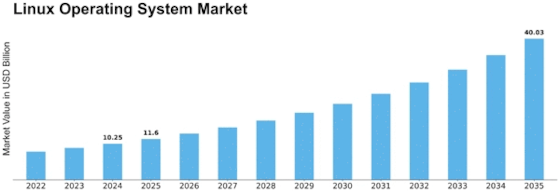
The Linux Operating System Market was valued at 10.25 USD Billion in 2024.

What is the projected market size for the Linux Operating System Market in 2035?

The market is projected to reach 40.03 USD Billion by 2035.

What is the expected CAGR for the Linux Operating System Market during the forecast period 2025 - 2035?

The expected CAGR for the Linux Operating System Market during 2025 - 2035 is 13.18%.

Which companies are considered key players in the Linux Operating System Market?

Key players include Red Hat, Canonical, SUSE, Oracle, IBM, Debian, Alpine Linux, Arch Linux, and Linux Mint.

How do distribution channels impact the Linux Operating System Market?

In 2024, direct sales accounted for 3.07 USD Billion, while online sales reached 4.09 USD Billion.

What are the primary deployment types in the Linux Operating System Market?

The market segments include On-Premises, valued at 4.1 USD Billion, and Cloud-Based, valued at 6.15 USD Billion in 2024.

What is the market segmentation by end users in the Linux Operating System Market?

End users include Individual Users at 1.5 USD Billion, Small and Medium Enterprises at 2.0 USD Billion, and Large Enterprises at 4.0 USD Billion.

What applications dominate the Linux Operating System Market?

The market applications include Server Operating Systems at 4.1 USD Billion and Desktop Operating Systems at 3.0 USD Billion.

How does the Linux Operating System Market cater to government entities?

Government entities represented a market segment valued at 2.75 USD Billion in 2024.

What trends are anticipated for the Linux Operating System Market in the coming years?

The market is likely to experience robust growth, driven by increasing adoption and innovation, particularly in cloud-based solutions.

Market Summary

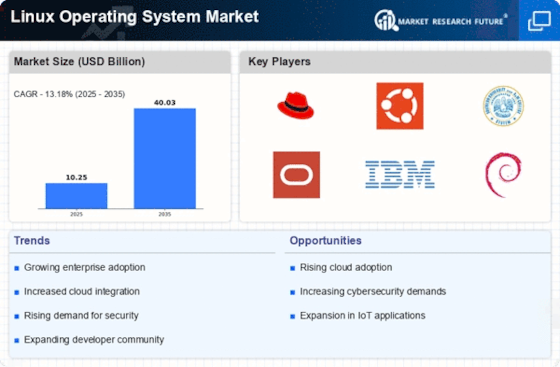
As per MRFR analysis, the Linux Operating System Market Size was estimated at 10.25 USD Billion in 2024. The Linux industry is projected to grow from 11.61 USD Billion in 2025 to 40.03 USD Billion by 2035, exhibiting a compound annual growth rate (CAGR) of 13.18 during the forecast period 2025 - 2035.

Key Market Trends & Highlights

The Linux Operating System Market is experiencing robust growth driven by enterprise adoption and technological advancements.

  • The market witnesses increased adoption in enterprises, particularly in North America, which remains the largest market. Cloud computing is emerging as a key growth area, especially in the Asia-Pacific region, which is the fastest-growing market. Direct sales dominate the market, while online sales are rapidly gaining traction as consumer preferences shift. Rising demand for open source solutions and the expansion of IoT are significant drivers propelling market growth.

Market Size & Forecast

2024 Market Size 10.25 (USD Billion)
2035 Market Size 40.03 (USD Billion)
CAGR (2025 - 2035) 13.18%
Largest Regional Market Share in 2024 North America

Major Players

<p>Red Hat (US), Canonical (GB), SUSE (DE), Oracle (US), IBM (US), Debian (FR), Alpine Linux (US), Arch Linux (US), Linux Mint (US)</p>

Market Trends

The Linux Operating System Market is currently experiencing a dynamic evolution, characterized by a growing adoption across various sectors. Organizations are increasingly recognizing the advantages of utilizing Linux due to its open-source nature, which fosters innovation and customization. This trend is particularly evident in enterprise environments, where businesses seek to enhance their operational efficiency and reduce costs. Furthermore, the rise of cloud computing and virtualization technologies has propelled the demand for Linux-based solutions, as they offer robust performance and scalability. As companies navigate the complexities of digital transformation, the Linux Operating System Market appears poised for continued growth, driven by the need for flexible and secure computing environments. In addition to enterprise adoption, the Linux Operating System Market is witnessing a surge in interest from educational institutions and developers. The emphasis on open-source education and the availability of extensive resources for learning Linux are contributing to its popularity among students and professionals alike. This trend suggests a potential shift in the workforce, as more individuals become proficient in Linux, thereby enhancing their employability in a technology-driven job market. Overall, the Linux Operating System Market is likely to thrive as it adapts to the evolving needs of users and organizations, fostering a culture of collaboration and innovation.

Increased Adoption in Enterprises

Organizations are increasingly integrating Linux into their IT infrastructure, driven by the need for cost-effective and customizable solutions. This trend reflects a broader shift towards open-source technologies, as businesses seek to enhance their operational efficiency.

Growth in Cloud Computing

The rise of cloud services has significantly influenced the Linux Operating System Market. Many cloud providers utilize Linux-based systems, which offer scalability and reliability, making them attractive options for businesses transitioning to cloud environments.

Focus on Education and Training

Educational institutions are placing greater emphasis on teaching Linux skills, recognizing its importance in the tech industry. This trend is likely to cultivate a new generation of professionals proficient in Linux, further driving its adoption.

Linux Operating System Market Market Drivers

Increased Focus on Cybersecurity

The Linux Operating System Market is witnessing an intensified focus on cybersecurity, driven by the rising frequency of cyber threats. Organizations are increasingly adopting Linux-based systems due to their inherent security advantages, such as robust user permissions and a strong community of developers dedicated to addressing vulnerabilities. Recent statistics reveal that Linux servers account for approximately 70% of web servers globally, underscoring their critical role in secure computing environments. As businesses prioritize data protection and compliance with regulatory standards, the demand for secure operating systems like Linux is likely to grow, positioning it as a preferred choice for enterprises seeking to bolster their cybersecurity posture.

Adoption of Linux in Edge Computing

The Linux Operating System Market is experiencing a shift towards edge computing, where data processing occurs closer to the source of data generation. This trend is driven by the need for real-time data processing and reduced latency in various applications, including autonomous vehicles and smart cities. Linux's adaptability and performance make it an ideal choice for edge computing environments. Industry forecasts indicate that the edge computing market could reach a valuation of 15 billion dollars by 2027, presenting significant opportunities for Linux-based solutions. As organizations seek to harness the power of edge computing, the demand for Linux operating systems is likely to increase, further entrenching Linux's position in the technology landscape.

Expansion of Internet of Things (IoT)

The proliferation of Internet of Things (IoT) devices significantly influences the Linux Operating System Market. As more devices become interconnected, the need for robust, scalable, and secure operating systems becomes paramount. Linux, with its modular architecture and strong security features, is well-positioned to support the diverse requirements of IoT applications. Industry reports indicate that the IoT market is expected to reach a valuation of over 1 trillion dollars by 2026, creating substantial opportunities for Linux-based solutions. This expansion not only fosters innovation but also encourages the development of specialized Linux distributions tailored for IoT environments, further solidifying Linux's role in this burgeoning sector.

Growth of Containerization Technologies

The emergence of containerization technologies, such as Docker and Kubernetes, significantly impacts the Linux Operating System Market. These technologies enable developers to create, deploy, and manage applications in isolated environments, enhancing efficiency and scalability. Linux serves as the foundation for most containerization platforms, owing to its lightweight nature and compatibility with various cloud environments. Market analysis suggests that the container orchestration market is projected to grow at a CAGR of over 25% in the coming years. This growth is likely to drive further adoption of Linux-based systems, as organizations increasingly leverage containerization to streamline their development processes and improve resource utilization.

Rising Demand for Open Source Solutions

The Linux Operating System Market experiences a notable surge in demand for open source solutions. Organizations increasingly recognize the benefits of open source software, including cost-effectiveness, flexibility, and community support. This trend is particularly pronounced among small to medium-sized enterprises that seek to minimize licensing costs while maximizing customization options. According to recent data, the open source software market is projected to grow at a compound annual growth rate of approximately 20% over the next five years. This growth is likely to drive further adoption of Linux-based systems, as businesses leverage the advantages of open source technologies to enhance their operational efficiency and innovation capabilities.

Market Segment Insights

By Distribution Channel: Direct Sales (Largest) vs. Online Sales (Fastest-Growing)

<p>In the Linux Operating System Market, the distribution channel landscape is marked by varied performance across different segments. Direct Sales currently dominate the market, leveraging strong relationships with enterprise clients and providing tailored solutions. This channel benefits from direct engagement, allowing for higher-level support and customization, thus maintaining a robust share in overall sales. Conversely, Online Sales are rapidly gaining traction due to the increasing preference for e-commerce platforms and the convenience they offer to users, particularly individual developers and small businesses.</p>

<p>Direct Sales (Dominant) vs. Online Sales (Emerging)</p>

<p>Direct Sales in the Linux Operating System Market represent a well-established channel with a strong historical presence. This method is characterized by personalized customer interactions, extensive support options, and the ability to offer comprehensive solutions. Businesses looking for tailor-made services often lean towards Direct Sales, appreciating the attention to their specific needs. In contrast, Online Sales have emerged as a dynamic alternative, appealing to a broader audience by providing instant access to software downloads and flexible pricing options. This channel benefits from the growing trend of digital transactions, making it an attractive option for new users drawn to the flexibility and availability it offers.</p>

By Deployment Type: On-Premises (Largest) vs. Cloud-Based (Fastest-Growing)

<p>The Linux Operating System Market is divided into two primary deployment types: On-Premises and Cloud-Based solutions. On-Premises deployments currently hold the largest market share, as many enterprises prefer to host their Linux environments internally for enhanced security, control, and customization. Meanwhile, the Cloud-Based solutions are rapidly gaining traction, appealing to organizations looking for scalable and cost-effective alternatives that require less maintenance and provide greater flexibility.</p>

<p>Deployment Type: On-Premises (Dominant) vs. Cloud-Based (Emerging)</p>

<p>On-Premises deployment remains the dominant choice in the Linux Operating System Market, favored by industries needing robust security and control over their IT environments. This deployment type allows businesses to manage their servers and software locally, which is essential for organizations dealing with sensitive data and requiring strict compliance with regulations. In contrast, Cloud-Based solutions have emerged as the fastest-growing segment, driven by a surge in demand for agility and scalability. These solutions are particularly attractive for startups and enterprises wanting to minimize overhead costs while maximizing resource allocation. As<a href="https://www.marketresearchfuture.com/reports/cloud-computing-market-1013"> cloud technologies</a> advance, the adoption of Cloud-Based Linux Operating Systems is expected to accelerate, shaping future market paradigms.</p>

By End User: Individual Users (Largest) vs. Small and Medium Enterprises (Fastest-Growing)

<p>In the Linux Operating System Market, the distribution of market share among end users reveals that individual users hold the largest segment, driven by the accessibility and customization Linux provides. This segment includes tech enthusiasts and casual users who leverage Linux for personal computing and development purposes. Meanwhile, small and medium enterprises (SMEs) are rapidly gaining traction, as they increasingly adopt Linux for its cost-effective solutions and robust security features, making it a preferred choice for small organizations looking to optimize their IT resources. The growth trends indicate that individual users will continue to dominate in the foreseeable future, yet small and medium enterprises are expected to experience the highest growth rate. The transition to digital transformation initiatives within SMEs is boosting Linux adoption due to its flexible infrastructure and ability to support cloud solutions. Furthermore, the prevailing trend towards open-source technologies contributes to the rapid growth within the SME sector, as these organizations seek to reduce costs and enhance operational efficiencies.</p>

<p>Individual Users (Dominant) vs. Large Enterprises (Emerging)</p>

<p>The individual users segment in the Linux Operating System Market is characterized by a broad and diverse demographic, including hobbyists, students, and developers who favor open-source platforms. This segment serves as the backbone of the Linux community, driving innovation and support for various distributions. On the other hand, large enterprises are identified as an emerging segment, recognizing the potential of Linux for enterprise-level solutions. These organizations are increasingly considering Linux for its reliability, scalability, and security features amidst growing cybersecurity concerns. Large enterprises are gradually transitioning to Linux-based environments to leverage its high performance in server and cloud computing, providing them a competitive edge in operational efficiency while maintaining substantial cost savings in licensing.</p>

By Application: Server Operating System (Largest) vs. Desktop Operating System (Fastest-Growing)

<p>The Linux Operating System Market showcases a diverse application segment, with Server Operating Systems holding the largest share. These systems are integral to data centers and enterprises, thanks to their reliability, security, and cost-effectiveness. Meanwhile, Desktop Operating Systems, although smaller in share compared to servers, are rapidly gaining popularity among individual users and organizations seeking an alternative to mainstream operating systems. Embedded Operating Systems, while significant, cater to niche markets such as IoT devices and specialized hardware configurations, contributing to the overall landscape distinctively.</p>

<p>Application: Server Operating System (Dominant) vs. Desktop Operating System (Emerging)</p>

<p>Server Operating Systems are the backbone of many enterprise infrastructures, focusing on providing stability, performance, and security for critical applications. They dominate the market due to their widespread deployment in web servers, cloud environments, and corporate networks, characterized by their robustness and extensive support. Conversely, Desktop Operating Systems, which are gaining traction, cater to user-centric needs with enhanced graphical interfaces and user experience features, showcasing their potential to become a more significant player. As flexible and customizable solutions, they appeal to both tech-savvy individuals and organizations transitioning to Linux-based environments, indicating a shift in preferences towards open-source solutions in the desktop space.</p>

Get more detailed insights about Linux Operating System Market Research Report - Global Forecast to 2035

Regional Insights

The Global Linux Operating System Market is witnessing considerable growth across various regions, with North America leading the way, holding a value of 3.25 USD Billion in 2023 and projected to grow to 9.85 USD Billion by 2032. This region dominates due to its robust technology infrastructure and high adoption rates of Linux OS in enterprises. Europe follows closely with a current valuation of 2.8 USD Billion, expected to rise to 8.5 USD Billion, driven by ongoing digital transformation initiatives among businesses.

The APAC region, valued at 2.0 USD Billion in 2023 and anticipated to reach 6.1 USD Billion, is experiencing significant momentum due to the rapid growth of the tech sector and increasing startup culture.South America and MEA represent smaller segments with valuations of 0.7 USD Billion and 0.31 USD Billion in 2023, respectively, yet they hold potential for growth as the demand for open-source solutions expands.

The overall landscape showcases evolving trends, building opportunities, and growing challenges influenced by varying degrees of technological adoption and market maturity across these regions, contributing to the diverse Global Linux Operating System Market data and industry dynamics.

Fig 3: Linux Operating System Market Regional Insights

Linux Operating System Market Regional Insights

Source: Primary Research, Secondary Research, Market Research Future Database and Analyst Review

Key Players and Competitive Insights

The Global Linux Operating System Market has emerged as a dynamic and competitive landscape, reflecting the increasing adoption of open-source solutions across various sectors. This market benefits from the collaboration of numerous players who contribute to the development and enhancement of Linux distributions. As businesses and organizations seek reliable, scalable, and cost-effective operating systems, the demand for Linux solutions rises. The competition is primarily driven by factors such as innovation in technology, quality of customer support, the versatility of platform offerings, and strategic partnerships.

Major competitors in this market focus on enhancing user experience while ensuring compatibility across cloud environments, servers, and desktop machines. The ongoing evolution of Linux as a critical component of both enterprise solutions and individual use signifies a pivotal trend, allowing for continuous improvements and adaptations that cater to a wide array of customer needs.HP has established a significant presence in the Global Linux Operating System Market through its robust suite of hardware and software solutions tailored to various business needs.

HP's strengths in this realm include an extensive portfolio of reliable servers and workstations that are optimized for Linux performance. This compatibility facilitates seamless integration of the Linux operating system, specifically catering to enterprise applications and development operations. The company's commitment to providing comprehensive support and regular updates for its Linux offerings enhances its appeal among IT professionals seeking stability and security. Furthermore, HP's strategic focus on collaborating with open-source communities and participating in initiatives to enhance Linux functionalities adds to its credibility as a key player in this sector.

The synergy between HP's hardware and Linux solutions allows businesses to leverage the power of open-source technology while benefiting from the reliability and innovation associated with HP's branding.Canonical has emerged as a prominent entity in the Global Linux Operating System Market, primarily recognized for its flagship product, Ubuntu. The company excels in its ability to provide an intuitive user experience while delivering cutting-edge features and updates that cater to diverse user needs, from individual developers to large enterprises. Canonical's strengths lie in its commitment to the open-source movement, actively engaging with communities to foster collaboration and innovation.

The company's strong focus on cloud computing and Internet of Things (IoT) solutions positions it strategically in the market, making Ubuntu a preferred choice for a wide range of applications. Canonical's collaborative partnerships and its ability to offer comprehensive training and support enhance user confidence in its products. This proactive approach not only boosts user satisfaction but also solidifies Canonical's role as a leader in promoting the adoption of Linux-based systems across multiple industries.

Key Companies in the Linux Operating System Market market include

Industry Developments

  • Q2 2025: Linux surpasses 5% market share on US desktops for the first time Linux achieved a new milestone in June 2025, breaking the 5 percent barrier for desktop operating system market share in the United States for the first time, according to StatCounter's Global Stats.

Future Outlook

Linux Operating System Market Future Outlook

<p>The Linux Operating System Market is projected to grow at a 13.18% CAGR from 2024 to 2035, driven by cloud adoption, IoT integration, and enterprise demand for open-source solutions.</p>

New opportunities lie in:

  • <p>Development of tailored Linux distributions for specific industries</p><p>Expansion of Linux-based cloud services and platforms</p><p>Creation of training programs for Linux system administration and development</p>

<p>By 2035, the Linux Operating System Market is expected to solidify its position as a leader in open-source technology.</p>

Market Segmentation

Linux Operating System Market End User Outlook

  • Individual Users
  • Small and Medium Enterprises
  • Large Enterprises
  • Government

Linux Operating System Market Application Outlook

  • Server Operating System
  • Desktop Operating System
  • Embedded Operating System

Linux Operating System Market Deployment Type Outlook

  • On-Premises
  • Cloud-Based

Linux Operating System Market Distribution Channel Outlook

  • Direct Sales
  • Online Sales
  • Retail Sales

Report Scope

MARKET SIZE 202410.25(USD Billion)
MARKET SIZE 202511.61(USD Billion)
MARKET SIZE 203540.03(USD Billion)
COMPOUND ANNUAL GROWTH RATE (CAGR)13.18% (2024 - 2035)
REPORT COVERAGERevenue Forecast, Competitive Landscape, Growth Factors, and Trends
BASE YEAR2024
Market Forecast Period2025 - 2035
Historical Data2019 - 2024
Market Forecast UnitsUSD Billion
Key Companies ProfiledMarket analysis in progress
Segments CoveredMarket segmentation analysis in progress
Key Market OpportunitiesGrowing demand for cloud computing solutions enhances opportunities in the Linux Operating System Market.
Key Market DynamicsRising demand for open-source solutions drives competition and innovation in the Linux Operating System market.
Countries CoveredNorth America, Europe, APAC, South America, MEA

FAQs

What is the current valuation of the Linux Operating System Market as of 2024?

The Linux Operating System Market was valued at 10.25 USD Billion in 2024.

What is the projected market size for the Linux Operating System Market in 2035?

The market is projected to reach 40.03 USD Billion by 2035.

What is the expected CAGR for the Linux Operating System Market during the forecast period 2025 - 2035?

The expected CAGR for the Linux Operating System Market during 2025 - 2035 is 13.18%.

Which companies are considered key players in the Linux Operating System Market?

Key players include Red Hat, Canonical, SUSE, Oracle, IBM, Debian, Alpine Linux, Arch Linux, and Linux Mint.

How do distribution channels impact the Linux Operating System Market?

In 2024, direct sales accounted for 3.07 USD Billion, while online sales reached 4.09 USD Billion.

What are the primary deployment types in the Linux Operating System Market?

The market segments include On-Premises, valued at 4.1 USD Billion, and Cloud-Based, valued at 6.15 USD Billion in 2024.

What is the market segmentation by end users in the Linux Operating System Market?

End users include Individual Users at 1.5 USD Billion, Small and Medium Enterprises at 2.0 USD Billion, and Large Enterprises at 4.0 USD Billion.

What applications dominate the Linux Operating System Market?

The market applications include Server Operating Systems at 4.1 USD Billion and Desktop Operating Systems at 3.0 USD Billion.

How does the Linux Operating System Market cater to government entities?

Government entities represented a market segment valued at 2.75 USD Billion in 2024.

What trends are anticipated for the Linux Operating System Market in the coming years?

The market is likely to experience robust growth, driven by increasing adoption and innovation, particularly in cloud-based solutions.

  1. SECTION I: EXECUTIVE SUMMARY AND KEY HIGHLIGHTS
    1. EXECUTIVE SUMMARY
      1. Market Overview
      2. Key Findings
      3. Market Segmentation
      4. Competitive Landscape
      5. Challenges and Opportunities
      6. Future Outlook 2
  2. SECTION II: SCOPING, METHODOLOGY AND MARKET STRUCTURE
    1. MARKET INTRODUCTION
      1. Definition
      2. Scope of the study
    2. RESEARCH METHODOLOGY
      1. Overview
      2. Data Mining
      3. Secondary Research
      4. Primary Research
      5. Forecasting Model
      6. Market Size Estimation
      7. Data Triangulation
      8. Validation 3
  3. SECTION III: QUALITATIVE ANALYSIS
    1. MARKET DYNAMICS
      1. Overview
      2. Drivers
      3. Restraints
      4. Opportunities
    2. MARKET FACTOR ANALYSIS
      1. Value chain Analysis
      2. Porter's Five Forces Analysis
      3. COVID-19 Impact Analysis
  4. SECTION IV: QUANTITATIVE ANALYSIS
    1. Information and Communications Technology, BY Distribution Channel (USD Billion)
      1. Direct Sales
      2. Online Sales
      3. Retail Sales
    2. Information and Communications Technology, BY Deployment Type (USD Billion)
      1. On-Premises
      2. Cloud-Based
    3. Information and Communications Technology, BY End User (USD Billion)
      1. Individual Users
      2. Small and Medium Enterprises
      3. Large Enterprises
      4. Government
    4. Information and Communications Technology, BY Application (USD Billion)
      1. Server Operating System
      2. Desktop Operating System
      3. Embedded Operating System
    5. Information and Communications Technology, BY Region (USD Billion)
      1. North America
      2. Europe
      3. APAC
      4. South America
      5. MEA
  5. SECTION V: COMPETITIVE ANALYSIS
    1. Competitive Landscape
      1. Overview
      2. Competitive Analysis
      3. Market share Analysis
      4. Major Growth Strategy in the Information and Communications Technology
      5. Competitive Benchmarking
      6. Leading Players in Terms of Number of Developments in the Information and Communications Technology
      7. Key developments and growth strategies
      8. Major Players Financial Matrix
    2. Company Profiles
      1. Red Hat (US)
      2. Canonical (GB)
      3. SUSE (DE)
      4. Oracle (US)
      5. IBM (US)
      6. Debian (FR)
      7. Alpine Linux (US)
      8. Arch Linux (US)
      9. Linux Mint (US)
    3. Appendix
      1. References
      2. Related Reports 6 LIST OF FIGURES
    4. MARKET SYNOPSIS
    5. NORTH AMERICA MARKET ANALYSIS
    6. US MARKET ANALYSIS BY DISTRIBUTION CHANNEL
    7. US MARKET ANALYSIS BY DEPLOYMENT TYPE
    8. US MARKET ANALYSIS BY END USER
    9. US MARKET ANALYSIS BY APPLICATION
    10. CANADA MARKET ANALYSIS BY DISTRIBUTION CHANNEL
    11. CANADA MARKET ANALYSIS BY DEPLOYMENT TYPE
    12. CANADA MARKET ANALYSIS BY END USER
    13. CANADA MARKET ANALYSIS BY APPLICATION
    14. EUROPE MARKET ANALYSIS
    15. GERMANY MARKET ANALYSIS BY DISTRIBUTION CHANNEL
    16. GERMANY MARKET ANALYSIS BY DEPLOYMENT TYPE
    17. GERMANY MARKET ANALYSIS BY END USER
    18. GERMANY MARKET ANALYSIS BY APPLICATION
    19. UK MARKET ANALYSIS BY DISTRIBUTION CHANNEL
    20. UK MARKET ANALYSIS BY DEPLOYMENT TYPE
    21. UK MARKET ANALYSIS BY END USER
    22. UK MARKET ANALYSIS BY APPLICATION
    23. FRANCE MARKET ANALYSIS BY DISTRIBUTION CHANNEL
    24. FRANCE MARKET ANALYSIS BY DEPLOYMENT TYPE
    25. FRANCE MARKET ANALYSIS BY END USER
    26. FRANCE MARKET ANALYSIS BY APPLICATION
    27. RUSSIA MARKET ANALYSIS BY DISTRIBUTION CHANNEL
    28. RUSSIA MARKET ANALYSIS BY DEPLOYMENT TYPE
    29. RUSSIA MARKET ANALYSIS BY END USER
    30. RUSSIA MARKET ANALYSIS BY APPLICATION
    31. ITALY MARKET ANALYSIS BY DISTRIBUTION CHANNEL
    32. ITALY MARKET ANALYSIS BY DEPLOYMENT TYPE
    33. ITALY MARKET ANALYSIS BY END USER
    34. ITALY MARKET ANALYSIS BY APPLICATION
    35. SPAIN MARKET ANALYSIS BY DISTRIBUTION CHANNEL
    36. SPAIN MARKET ANALYSIS BY DEPLOYMENT TYPE
    37. SPAIN MARKET ANALYSIS BY END USER
    38. SPAIN MARKET ANALYSIS BY APPLICATION
    39. REST OF EUROPE MARKET ANALYSIS BY DISTRIBUTION CHANNEL
    40. REST OF EUROPE MARKET ANALYSIS BY DEPLOYMENT TYPE
    41. REST OF EUROPE MARKET ANALYSIS BY END USER
    42. REST OF EUROPE MARKET ANALYSIS BY APPLICATION
    43. APAC MARKET ANALYSIS
    44. CHINA MARKET ANALYSIS BY DISTRIBUTION CHANNEL
    45. CHINA MARKET ANALYSIS BY DEPLOYMENT TYPE
    46. CHINA MARKET ANALYSIS BY END USER
    47. CHINA MARKET ANALYSIS BY APPLICATION
    48. INDIA MARKET ANALYSIS BY DISTRIBUTION CHANNEL
    49. INDIA MARKET ANALYSIS BY DEPLOYMENT TYPE
    50. INDIA MARKET ANALYSIS BY END USER
    51. INDIA MARKET ANALYSIS BY APPLICATION
    52. JAPAN MARKET ANALYSIS BY DISTRIBUTION CHANNEL
    53. JAPAN MARKET ANALYSIS BY DEPLOYMENT TYPE
    54. JAPAN MARKET ANALYSIS BY END USER
    55. JAPAN MARKET ANALYSIS BY APPLICATION
    56. SOUTH KOREA MARKET ANALYSIS BY DISTRIBUTION CHANNEL
    57. SOUTH KOREA MARKET ANALYSIS BY DEPLOYMENT TYPE
    58. SOUTH KOREA MARKET ANALYSIS BY END USER
    59. SOUTH KOREA MARKET ANALYSIS BY APPLICATION
    60. MALAYSIA MARKET ANALYSIS BY DISTRIBUTION CHANNEL
    61. MALAYSIA MARKET ANALYSIS BY DEPLOYMENT TYPE
    62. MALAYSIA MARKET ANALYSIS BY END USER
    63. MALAYSIA MARKET ANALYSIS BY APPLICATION
    64. THAILAND MARKET ANALYSIS BY DISTRIBUTION CHANNEL
    65. THAILAND MARKET ANALYSIS BY DEPLOYMENT TYPE
    66. THAILAND MARKET ANALYSIS BY END USER
    67. THAILAND MARKET ANALYSIS BY APPLICATION
    68. INDONESIA MARKET ANALYSIS BY DISTRIBUTION CHANNEL
    69. INDONESIA MARKET ANALYSIS BY DEPLOYMENT TYPE
    70. INDONESIA MARKET ANALYSIS BY END USER
    71. INDONESIA MARKET ANALYSIS BY APPLICATION
    72. REST OF APAC MARKET ANALYSIS BY DISTRIBUTION CHANNEL
    73. REST OF APAC MARKET ANALYSIS BY DEPLOYMENT TYPE
    74. REST OF APAC MARKET ANALYSIS BY END USER
    75. REST OF APAC MARKET ANALYSIS BY APPLICATION
    76. SOUTH AMERICA MARKET ANALYSIS
    77. BRAZIL MARKET ANALYSIS BY DISTRIBUTION CHANNEL
    78. BRAZIL MARKET ANALYSIS BY DEPLOYMENT TYPE
    79. BRAZIL MARKET ANALYSIS BY END USER
    80. BRAZIL MARKET ANALYSIS BY APPLICATION
    81. MEXICO MARKET ANALYSIS BY DISTRIBUTION CHANNEL
    82. MEXICO MARKET ANALYSIS BY DEPLOYMENT TYPE
    83. MEXICO MARKET ANALYSIS BY END USER
    84. MEXICO MARKET ANALYSIS BY APPLICATION
    85. ARGENTINA MARKET ANALYSIS BY DISTRIBUTION CHANNEL
    86. ARGENTINA MARKET ANALYSIS BY DEPLOYMENT TYPE
    87. ARGENTINA MARKET ANALYSIS BY END USER
    88. ARGENTINA MARKET ANALYSIS BY APPLICATION
    89. REST OF SOUTH AMERICA MARKET ANALYSIS BY DISTRIBUTION CHANNEL
    90. REST OF SOUTH AMERICA MARKET ANALYSIS BY DEPLOYMENT TYPE
    91. REST OF SOUTH AMERICA MARKET ANALYSIS BY END USER
    92. REST OF SOUTH AMERICA MARKET ANALYSIS BY APPLICATION
    93. MEA MARKET ANALYSIS
    94. GCC COUNTRIES MARKET ANALYSIS BY DISTRIBUTION CHANNEL
    95. GCC COUNTRIES MARKET ANALYSIS BY DEPLOYMENT TYPE
    96. GCC COUNTRIES MARKET ANALYSIS BY END USER
    97. GCC COUNTRIES MARKET ANALYSIS BY APPLICATION
    98. SOUTH AFRICA MARKET ANALYSIS BY DISTRIBUTION CHANNEL
    99. SOUTH AFRICA MARKET ANALYSIS BY DEPLOYMENT TYPE
    100. SOUTH AFRICA MARKET ANALYSIS BY END USER
    101. SOUTH AFRICA MARKET ANALYSIS BY APPLICATION
    102. REST OF MEA MARKET ANALYSIS BY DISTRIBUTION CHANNEL
    103. REST OF MEA MARKET ANALYSIS BY DEPLOYMENT TYPE
    104. REST OF MEA MARKET ANALYSIS BY END USER
    105. REST OF MEA MARKET ANALYSIS BY APPLICATION
    106. KEY BUYING CRITERIA OF INFORMATION AND COMMUNICATIONS TECHNOLOGY
    107. RESEARCH PROCESS OF MRFR
    108. DRO ANALYSIS OF INFORMATION AND COMMUNICATIONS TECHNOLOGY
    109. DRIVERS IMPACT ANALYSIS: INFORMATION AND COMMUNICATIONS TECHNOLOGY
    110. RESTRAINTS IMPACT ANALYSIS: INFORMATION AND COMMUNICATIONS TECHNOLOGY
    111. SUPPLY / VALUE CHAIN: INFORMATION AND COMMUNICATIONS TECHNOLOGY
    112. INFORMATION AND COMMUNICATIONS TECHNOLOGY, BY DISTRIBUTION CHANNEL, 2024 (% SHARE)
    113. INFORMATION AND COMMUNICATIONS TECHNOLOGY, BY DISTRIBUTION CHANNEL, 2024 TO 2035 (USD Billion)
    114. INFORMATION AND COMMUNICATIONS TECHNOLOGY, BY DEPLOYMENT TYPE, 2024 (% SHARE)
    115. INFORMATION AND COMMUNICATIONS TECHNOLOGY, BY DEPLOYMENT TYPE, 2024 TO 2035 (USD Billion)
    116. INFORMATION AND COMMUNICATIONS TECHNOLOGY, BY END USER, 2024 (% SHARE)
    117. INFORMATION AND COMMUNICATIONS TECHNOLOGY, BY END USER, 2024 TO 2035 (USD Billion)
    118. INFORMATION AND COMMUNICATIONS TECHNOLOGY, BY APPLICATION, 2024 (% SHARE)
    119. INFORMATION AND COMMUNICATIONS TECHNOLOGY, BY APPLICATION, 2024 TO 2035 (USD Billion)
    120. BENCHMARKING OF MAJOR COMPETITORS 7 LIST OF TABLES
    121. LIST OF ASSUMPTIONS
    122. North America MARKET SIZE ESTIMATES; FORECAST
      1. BY DISTRIBUTION CHANNEL, 2025-2035 (USD Billion)
      2. BY DEPLOYMENT TYPE, 2025-2035 (USD Billion)
      3. BY END USER, 2025-2035 (USD Billion)
      4. BY APPLICATION, 2025-2035 (USD Billion)
    123. US MARKET SIZE ESTIMATES; FORECAST
      1. BY DISTRIBUTION CHANNEL, 2025-2035 (USD Billion)
      2. BY DEPLOYMENT TYPE, 2025-2035 (USD Billion)
      3. BY END USER, 2025-2035 (USD Billion)
      4. BY APPLICATION, 2025-2035 (USD Billion)
    124. Canada MARKET SIZE ESTIMATES; FORECAST
      1. BY DISTRIBUTION CHANNEL, 2025-2035 (USD Billion)
      2. BY DEPLOYMENT TYPE, 2025-2035 (USD Billion)
      3. BY END USER, 2025-2035 (USD Billion)
      4. BY APPLICATION, 2025-2035 (USD Billion)
    125. Europe MARKET SIZE ESTIMATES; FORECAST
      1. BY DISTRIBUTION CHANNEL, 2025-2035 (USD Billion)
      2. BY DEPLOYMENT TYPE, 2025-2035 (USD Billion)
      3. BY END USER, 2025-2035 (USD Billion)
      4. BY APPLICATION, 2025-2035 (USD Billion)
    126. Germany MARKET SIZE ESTIMATES; FORECAST
      1. BY DISTRIBUTION CHANNEL, 2025-2035 (USD Billion)
      2. BY DEPLOYMENT TYPE, 2025-2035 (USD Billion)
      3. BY END USER, 2025-2035 (USD Billion)
      4. BY APPLICATION, 2025-2035 (USD Billion)
    127. UK MARKET SIZE ESTIMATES; FORECAST
      1. BY DISTRIBUTION CHANNEL, 2025-2035 (USD Billion)
      2. BY DEPLOYMENT TYPE, 2025-2035 (USD Billion)
      3. BY END USER, 2025-2035 (USD Billion)
      4. BY APPLICATION, 2025-2035 (USD Billion)
    128. France MARKET SIZE ESTIMATES; FORECAST
      1. BY DISTRIBUTION CHANNEL, 2025-2035 (USD Billion)
      2. BY DEPLOYMENT TYPE, 2025-2035 (USD Billion)
      3. BY END USER, 2025-2035 (USD Billion)
      4. BY APPLICATION, 2025-2035 (USD Billion)
    129. Russia MARKET SIZE ESTIMATES; FORECAST
      1. BY DISTRIBUTION CHANNEL, 2025-2035 (USD Billion)
      2. BY DEPLOYMENT TYPE, 2025-2035 (USD Billion)
      3. BY END USER, 2025-2035 (USD Billion)
      4. BY APPLICATION, 2025-2035 (USD Billion)
    130. Italy MARKET SIZE ESTIMATES; FORECAST
      1. BY DISTRIBUTION CHANNEL, 2025-2035 (USD Billion)
      2. BY DEPLOYMENT TYPE, 2025-2035 (USD Billion)
      3. BY END USER, 2025-2035 (USD Billion)
      4. BY APPLICATION, 2025-2035 (USD Billion)
    131. Spain MARKET SIZE ESTIMATES; FORECAST
      1. BY DISTRIBUTION CHANNEL, 2025-2035 (USD Billion)
      2. BY DEPLOYMENT TYPE, 2025-2035 (USD Billion)
      3. BY END USER, 2025-2035 (USD Billion)
      4. BY APPLICATION, 2025-2035 (USD Billion)
    132. Rest of Europe MARKET SIZE ESTIMATES; FORECAST
      1. BY DISTRIBUTION CHANNEL, 2025-2035 (USD Billion)
      2. BY DEPLOYMENT TYPE, 2025-2035 (USD Billion)
      3. BY END USER, 2025-2035 (USD Billion)
      4. BY APPLICATION, 2025-2035 (USD Billion)
    133. APAC MARKET SIZE ESTIMATES; FORECAST
      1. BY DISTRIBUTION CHANNEL, 2025-2035 (USD Billion)
      2. BY DEPLOYMENT TYPE, 2025-2035 (USD Billion)
      3. BY END USER, 2025-2035 (USD Billion)
      4. BY APPLICATION, 2025-2035 (USD Billion)
    134. China MARKET SIZE ESTIMATES; FORECAST
      1. BY DISTRIBUTION CHANNEL, 2025-2035 (USD Billion)
      2. BY DEPLOYMENT TYPE, 2025-2035 (USD Billion)
      3. BY END USER, 2025-2035 (USD Billion)
      4. BY APPLICATION, 2025-2035 (USD Billion)
    135. India MARKET SIZE ESTIMATES; FORECAST
      1. BY DISTRIBUTION CHANNEL, 2025-2035 (USD Billion)
      2. BY DEPLOYMENT TYPE, 2025-2035 (USD Billion)
      3. BY END USER, 2025-2035 (USD Billion)
      4. BY APPLICATION, 2025-2035 (USD Billion)
    136. Japan MARKET SIZE ESTIMATES; FORECAST
      1. BY DISTRIBUTION CHANNEL, 2025-2035 (USD Billion)
      2. BY DEPLOYMENT TYPE, 2025-2035 (USD Billion)
      3. BY END USER, 2025-2035 (USD Billion)
      4. BY APPLICATION, 2025-2035 (USD Billion)
    137. South Korea MARKET SIZE ESTIMATES; FORECAST
      1. BY DISTRIBUTION CHANNEL, 2025-2035 (USD Billion)
      2. BY DEPLOYMENT TYPE, 2025-2035 (USD Billion)
      3. BY END USER, 2025-2035 (USD Billion)
      4. BY APPLICATION, 2025-2035 (USD Billion)
    138. Malaysia MARKET SIZE ESTIMATES; FORECAST
      1. BY DISTRIBUTION CHANNEL, 2025-2035 (USD Billion)
      2. BY DEPLOYMENT TYPE, 2025-2035 (USD Billion)
      3. BY END USER, 2025-2035 (USD Billion)
      4. BY APPLICATION, 2025-2035 (USD Billion)
    139. Thailand MARKET SIZE ESTIMATES; FORECAST
      1. BY DISTRIBUTION CHANNEL, 2025-2035 (USD Billion)
      2. BY DEPLOYMENT TYPE, 2025-2035 (USD Billion)
      3. BY END USER, 2025-2035 (USD Billion)
      4. BY APPLICATION, 2025-2035 (USD Billion)
    140. Indonesia MARKET SIZE ESTIMATES; FORECAST
      1. BY DISTRIBUTION CHANNEL, 2025-2035 (USD Billion)
      2. BY DEPLOYMENT TYPE, 2025-2035 (USD Billion)
      3. BY END USER, 2025-2035 (USD Billion)
      4. BY APPLICATION, 2025-2035 (USD Billion)
    141. Rest of APAC MARKET SIZE ESTIMATES; FORECAST
      1. BY DISTRIBUTION CHANNEL, 2025-2035 (USD Billion)
      2. BY DEPLOYMENT TYPE, 2025-2035 (USD Billion)
      3. BY END USER, 2025-2035 (USD Billion)
      4. BY APPLICATION, 2025-2035 (USD Billion)
    142. South America MARKET SIZE ESTIMATES; FORECAST
      1. BY DISTRIBUTION CHANNEL, 2025-2035 (USD Billion)
      2. BY DEPLOYMENT TYPE, 2025-2035 (USD Billion)
      3. BY END USER, 2025-2035 (USD Billion)
      4. BY APPLICATION, 2025-2035 (USD Billion)
    143. Brazil MARKET SIZE ESTIMATES; FORECAST
      1. BY DISTRIBUTION CHANNEL, 2025-2035 (USD Billion)
      2. BY DEPLOYMENT TYPE, 2025-2035 (USD Billion)
      3. BY END USER, 2025-2035 (USD Billion)
      4. BY APPLICATION, 2025-2035 (USD Billion)
    144. Mexico MARKET SIZE ESTIMATES; FORECAST
      1. BY DISTRIBUTION CHANNEL, 2025-2035 (USD Billion)
      2. BY DEPLOYMENT TYPE, 2025-2035 (USD Billion)
      3. BY END USER, 2025-2035 (USD Billion)
      4. BY APPLICATION, 2025-2035 (USD Billion)
    145. Argentina MARKET SIZE ESTIMATES; FORECAST
      1. BY DISTRIBUTION CHANNEL, 2025-2035 (USD Billion)
      2. BY DEPLOYMENT TYPE, 2025-2035 (USD Billion)
      3. BY END USER, 2025-2035 (USD Billion)
      4. BY APPLICATION, 2025-2035 (USD Billion)
    146. Rest of South America MARKET SIZE ESTIMATES; FORECAST
      1. BY DISTRIBUTION CHANNEL, 2025-2035 (USD Billion)
      2. BY DEPLOYMENT TYPE, 2025-2035 (USD Billion)
      3. BY END USER, 2025-2035 (USD Billion)
      4. BY APPLICATION, 2025-2035 (USD Billion)
    147. MEA MARKET SIZE ESTIMATES; FORECAST
      1. BY DISTRIBUTION CHANNEL, 2025-2035 (USD Billion)
      2. BY DEPLOYMENT TYPE, 2025-2035 (USD Billion)
      3. BY END USER, 2025-2035 (USD Billion)
      4. BY APPLICATION, 2025-2035 (USD Billion)
    148. GCC Countries MARKET SIZE ESTIMATES; FORECAST
      1. BY DISTRIBUTION CHANNEL, 2025-2035 (USD Billion)
      2. BY DEPLOYMENT TYPE, 2025-2035 (USD Billion)
      3. BY END USER, 2025-2035 (USD Billion)
      4. BY APPLICATION, 2025-2035 (USD Billion)
    149. South Africa MARKET SIZE ESTIMATES; FORECAST
      1. BY DISTRIBUTION CHANNEL, 2025-2035 (USD Billion)
      2. BY DEPLOYMENT TYPE, 2025-2035 (USD Billion)
      3. BY END USER, 2025-2035 (USD Billion)
      4. BY APPLICATION, 2025-2035 (USD Billion)
    150. Rest of MEA MARKET SIZE ESTIMATES; FORECAST
      1. BY DISTRIBUTION CHANNEL, 2025-2035 (USD Billion)
      2. BY DEPLOYMENT TYPE, 2025-2035 (USD Billion)
      3. BY END USER, 2025-2035 (USD Billion)
      4. BY APPLICATION, 2025-2035 (USD Billion)
    151. PRODUCT LAUNCH/PRODUCT DEVELOPMENT/APPROVAL
    152. ACQUISITION/PARTNERSHIP

Linux Operating System Market Segmentation


Linux Operating System Market By Distribution Channel (USD Billion, 2019-2032)

Direct Sales

Online Sales

Retail Sales


Linux Operating System Market By Deployment Type (USD Billion, 2019-2032)

On-Premises

Cloud-Based


Linux Operating System Market By End User (USD Billion, 2019-2032)

Individual Users

Small and Medium Enterprises

Large Enterprises

Government


Linux Operating System Market By Application (USD Billion, 2019-2032)

Server Operating System

Desktop Operating System

Embedded Operating System


Linux Operating System Market By Regional (USD Billion, 2019-2032)

North America

Europe

South America

Asia Pacific

Middle East and Africa


Linux Operating System Market Regional Outlook (USD Billion, 2019-2032)


North America Outlook (USD Billion, 2019-2032)

North America Linux Operating System Market by Distribution Channel Type

Direct Sales

Online Sales

Retail Sales

North America Linux Operating System Market by Deployment Type

On-Premises

Cloud-Based

North America Linux Operating System Market by End User Type

Individual Users

Small and Medium Enterprises

Large Enterprises

Government

North America Linux Operating System Market by Application Type

Server Operating System

Desktop Operating System

Embedded Operating System

North America Linux Operating System Market by Regional Type

US

Canada

US Outlook (USD Billion, 2019-2032)

US Linux Operating System Market by Distribution Channel Type

Direct Sales

Online Sales

Retail Sales

US Linux Operating System Market by Deployment Type

On-Premises

Cloud-Based

US Linux Operating System Market by End User Type

Individual Users

Small and Medium Enterprises

Large Enterprises

Government

US Linux Operating System Market by Application Type

Server Operating System

Desktop Operating System

Embedded Operating System

CANADA Outlook (USD Billion, 2019-2032)

CANADA Linux Operating System Market by Distribution Channel Type

Direct Sales

Online Sales

Retail Sales

CANADA Linux Operating System Market by Deployment Type

On-Premises

Cloud-Based

CANADA Linux Operating System Market by End User Type

Individual Users

Small and Medium Enterprises

Large Enterprises

Government

CANADA Linux Operating System Market by Application Type

Server Operating System

Desktop Operating System

Embedded Operating System

Europe Outlook (USD Billion, 2019-2032)

Europe Linux Operating System Market by Distribution Channel Type

Direct Sales

Online Sales

Retail Sales

Europe Linux Operating System Market by Deployment Type

On-Premises

Cloud-Based

Europe Linux Operating System Market by End User Type

Individual Users

Small and Medium Enterprises

Large Enterprises

Government

Europe Linux Operating System Market by Application Type

Server Operating System

Desktop Operating System

Embedded Operating System

Europe Linux Operating System Market by Regional Type

Germany

UK

France

Russia

Italy

Spain

Rest of Europe

GERMANY Outlook (USD Billion, 2019-2032)

GERMANY Linux Operating System Market by Distribution Channel Type

Direct Sales

Online Sales

Retail Sales

GERMANY Linux Operating System Market by Deployment Type

On-Premises

Cloud-Based

GERMANY Linux Operating System Market by End User Type

Individual Users

Small and Medium Enterprises

Large Enterprises

Government

GERMANY Linux Operating System Market by Application Type

Server Operating System

Desktop Operating System

Embedded Operating System

UK Outlook (USD Billion, 2019-2032)

UK Linux Operating System Market by Distribution Channel Type

Direct Sales

Online Sales

Retail Sales

UK Linux Operating System Market by Deployment Type

On-Premises

Cloud-Based

UK Linux Operating System Market by End User Type

Individual Users

Small and Medium Enterprises

Large Enterprises

Government

UK Linux Operating System Market by Application Type

Server Operating System

Desktop Operating System

Embedded Operating System

FRANCE Outlook (USD Billion, 2019-2032)

FRANCE Linux Operating System Market by Distribution Channel Type

Direct Sales

Online Sales

Retail Sales

FRANCE Linux Operating System Market by Deployment Type

On-Premises

Cloud-Based

FRANCE Linux Operating System Market by End User Type

Individual Users

Small and Medium Enterprises

Large Enterprises

Government

FRANCE Linux Operating System Market by Application Type

Server Operating System

Desktop Operating System

Embedded Operating System

RUSSIA Outlook (USD Billion, 2019-2032)

RUSSIA Linux Operating System Market by Distribution Channel Type

Direct Sales

Online Sales

Retail Sales

RUSSIA Linux Operating System Market by Deployment Type

On-Premises

Cloud-Based

RUSSIA Linux Operating System Market by End User Type

Individual Users

Small and Medium Enterprises

Large Enterprises

Government

RUSSIA Linux Operating System Market by Application Type

Server Operating System

Desktop Operating System

Embedded Operating System

ITALY Outlook (USD Billion, 2019-2032)

ITALY Linux Operating System Market by Distribution Channel Type

Direct Sales

Online Sales

Retail Sales

ITALY Linux Operating System Market by Deployment Type

On-Premises

Cloud-Based

ITALY Linux Operating System Market by End User Type

Individual Users

Small and Medium Enterprises

Large Enterprises

Government

ITALY Linux Operating System Market by Application Type

Server Operating System

Desktop Operating System

Embedded Operating System

SPAIN Outlook (USD Billion, 2019-2032)

SPAIN Linux Operating System Market by Distribution Channel Type

Direct Sales

Online Sales

Retail Sales

SPAIN Linux Operating System Market by Deployment Type

On-Premises

Cloud-Based

SPAIN Linux Operating System Market by End User Type

Individual Users

Small and Medium Enterprises

Large Enterprises

Government

SPAIN Linux Operating System Market by Application Type

Server Operating System

Desktop Operating System

Embedded Operating System

REST OF EUROPE Outlook (USD Billion, 2019-2032)

REST OF EUROPE Linux Operating System Market by Distribution Channel Type

Direct Sales

Online Sales

Retail Sales

REST OF EUROPE Linux Operating System Market by Deployment Type

On-Premises

Cloud-Based

REST OF EUROPE Linux Operating System Market by End User Type

Individual Users

Small and Medium Enterprises

Large Enterprises

Government

REST OF EUROPE Linux Operating System Market by Application Type

Server Operating System

Desktop Operating System

Embedded Operating System

APAC Outlook (USD Billion, 2019-2032)

APAC Linux Operating System Market by Distribution Channel Type

Direct Sales

Online Sales

Retail Sales

APAC Linux Operating System Market by Deployment Type

On-Premises

Cloud-Based

APAC Linux Operating System Market by End User Type

Individual Users

Small and Medium Enterprises

Large Enterprises

Government

APAC Linux Operating System Market by Application Type

Server Operating System

Desktop Operating System

Embedded Operating System

APAC Linux Operating System Market by Regional Type

China

India

Japan

South Korea

Malaysia

Thailand

Indonesia

Rest of APAC

CHINA Outlook (USD Billion, 2019-2032)

CHINA Linux Operating System Market by Distribution Channel Type

Direct Sales

Online Sales

Retail Sales

CHINA Linux Operating System Market by Deployment Type

On-Premises

Cloud-Based

CHINA Linux Operating System Market by End User Type

Individual Users

Small and Medium Enterprises

Large Enterprises

Government

CHINA Linux Operating System Market by Application Type

Server Operating System

Desktop Operating System

Embedded Operating System

INDIA Outlook (USD Billion, 2019-2032)

INDIA Linux Operating System Market by Distribution Channel Type

Direct Sales

Online Sales

Retail Sales

INDIA Linux Operating System Market by Deployment Type

On-Premises

Cloud-Based

INDIA Linux Operating System Market by End User Type

Individual Users

Small and Medium Enterprises

Large Enterprises

Government

INDIA Linux Operating System Market by Application Type

Server Operating System

Desktop Operating System

Embedded Operating System

JAPAN Outlook (USD Billion, 2019-2032)

JAPAN Linux Operating System Market by Distribution Channel Type

Direct Sales

Online Sales

Retail Sales

JAPAN Linux Operating System Market by Deployment Type

On-Premises

Cloud-Based

JAPAN Linux Operating System Market by End User Type

Individual Users

Small and Medium Enterprises

Large Enterprises

Government

JAPAN Linux Operating System Market by Application Type

Server Operating System

Desktop Operating System

Embedded Operating System

SOUTH KOREA Outlook (USD Billion, 2019-2032)

SOUTH KOREA Linux Operating System Market by Distribution Channel Type

Direct Sales

Online Sales

Retail Sales

SOUTH KOREA Linux Operating System Market by Deployment Type

On-Premises

Cloud-Based

SOUTH KOREA Linux Operating System Market by End User Type

Individual Users

Small and Medium Enterprises

Large Enterprises

Government

SOUTH KOREA Linux Operating System Market by Application Type

Server Operating System

Desktop Operating System

Embedded Operating System

MALAYSIA Outlook (USD Billion, 2019-2032)

MALAYSIA Linux Operating System Market by Distribution Channel Type

Direct Sales

Online Sales

Retail Sales

MALAYSIA Linux Operating System Market by Deployment Type

On-Premises

Cloud-Based

MALAYSIA Linux Operating System Market by End User Type

Individual Users

Small and Medium Enterprises

Large Enterprises

Government

MALAYSIA Linux Operating System Market by Application Type

Server Operating System

Desktop Operating System

Embedded Operating System

THAILAND Outlook (USD Billion, 2019-2032)

THAILAND Linux Operating System Market by Distribution Channel Type

Direct Sales

Online Sales

Retail Sales

THAILAND Linux Operating System Market by Deployment Type

On-Premises

Cloud-Based

THAILAND Linux Operating System Market by End User Type

Individual Users

Small and Medium Enterprises

Large Enterprises

Government

THAILAND Linux Operating System Market by Application Type

Server Operating System

Desktop Operating System

Embedded Operating System

INDONESIA Outlook (USD Billion, 2019-2032)

INDONESIA Linux Operating System Market by Distribution Channel Type

Direct Sales

Online Sales

Retail Sales

INDONESIA Linux Operating System Market by Deployment Type

On-Premises

Cloud-Based

INDONESIA Linux Operating System Market by End User Type

Individual Users

Small and Medium Enterprises

Large Enterprises

Government

INDONESIA Linux Operating System Market by Application Type

Server Operating System

Desktop Operating System

Embedded Operating System

REST OF APAC Outlook (USD Billion, 2019-2032)

REST OF APAC Linux Operating System Market by Distribution Channel Type

Direct Sales

Online Sales

Retail Sales

REST OF APAC Linux Operating System Market by Deployment Type

On-Premises

Cloud-Based

REST OF APAC Linux Operating System Market by End User Type

Individual Users

Small and Medium Enterprises

Large Enterprises

Government

REST OF APAC Linux Operating System Market by Application Type

Server Operating System

Desktop Operating System

Embedded Operating System

South America Outlook (USD Billion, 2019-2032)

South America Linux Operating System Market by Distribution Channel Type

Direct Sales

Online Sales

Retail Sales

South America Linux Operating System Market by Deployment Type

On-Premises

Cloud-Based

South America Linux Operating System Market by End User Type

Individual Users

Small and Medium Enterprises

Large Enterprises

Government

South America Linux Operating System Market by Application Type

Server Operating System

Desktop Operating System

Embedded Operating System

South America Linux Operating System Market by Regional Type

Brazil

Mexico

Argentina

Rest of South America

BRAZIL Outlook (USD Billion, 2019-2032)

BRAZIL Linux Operating System Market by Distribution Channel Type

Direct Sales

Online Sales

Retail Sales

BRAZIL Linux Operating System Market by Deployment Type

On-Premises

Cloud-Based

BRAZIL Linux Operating System Market by End User Type

Individual Users

Small and Medium Enterprises

Large Enterprises

Government

BRAZIL Linux Operating System Market by Application Type

Server Operating System

Desktop Operating System

Embedded Operating System

MEXICO Outlook (USD Billion, 2019-2032)

MEXICO Linux Operating System Market by Distribution Channel Type

Direct Sales

Online Sales

Retail Sales

MEXICO Linux Operating System Market by Deployment Type

On-Premises

Cloud-Based

MEXICO Linux Operating System Market by End User Type

Individual Users

Small and Medium Enterprises

Large Enterprises

Government

MEXICO Linux Operating System Market by Application Type

Server Operating System

Desktop Operating System

Embedded Operating System

ARGENTINA Outlook (USD Billion, 2019-2032)

ARGENTINA Linux Operating System Market by Distribution Channel Type

Direct Sales

Online Sales

Retail Sales

ARGENTINA Linux Operating System Market by Deployment Type

On-Premises

Cloud-Based

ARGENTINA Linux Operating System Market by End User Type

Individual Users

Small and Medium Enterprises

Large Enterprises

Government

ARGENTINA Linux Operating System Market by Application Type

Server Operating System

Desktop Operating System

Embedded Operating System

REST OF SOUTH AMERICA Outlook (USD Billion, 2019-2032)

REST OF SOUTH AMERICA Linux Operating System Market by Distribution Channel Type

Direct Sales

Online Sales

Retail Sales

REST OF SOUTH AMERICA Linux Operating System Market by Deployment Type

On-Premises

Cloud-Based

REST OF SOUTH AMERICA Linux Operating System Market by End User Type

Individual Users

Small and Medium Enterprises

Large Enterprises

Government

REST OF SOUTH AMERICA Linux Operating System Market by Application Type

Server Operating System

Desktop Operating System

Embedded Operating System

MEA Outlook (USD Billion, 2019-2032)

MEA Linux Operating System Market by Distribution Channel Type

Direct Sales

Online Sales

Retail Sales

MEA Linux Operating System Market by Deployment Type

On-Premises

Cloud-Based

MEA Linux Operating System Market by End User Type

Individual Users

Small and Medium Enterprises

Large Enterprises

Government

MEA Linux Operating System Market by Application Type

Server Operating System

Desktop Operating System

Embedded Operating System

MEA Linux Operating System Market by Regional Type

GCC Countries

South Africa

Rest of MEA

GCC COUNTRIES Outlook (USD Billion, 2019-2032)

GCC COUNTRIES Linux Operating System Market by Distribution Channel Type

Direct Sales

Online Sales

Retail Sales

GCC COUNTRIES Linux Operating System Market by Deployment Type

On-Premises

Cloud-Based

GCC COUNTRIES Linux Operating System Market by End User Type

Individual Users

Small and Medium Enterprises

Large Enterprises

Government

GCC COUNTRIES Linux Operating System Market by Application Type

Server Operating System

Desktop Operating System

Embedded Operating System

SOUTH AFRICA Outlook (USD Billion, 2019-2032)

SOUTH AFRICA Linux Operating System Market by Distribution Channel Type

Direct Sales

Online Sales

Retail Sales

SOUTH AFRICA Linux Operating System Market by Deployment Type

On-Premises

Cloud-Based

SOUTH AFRICA Linux Operating System Market by End User Type

Individual Users

Small and Medium Enterprises

Large Enterprises

Government

SOUTH AFRICA Linux Operating System Market by Application Type

Server Operating System

Desktop Operating System

Embedded Operating System

REST OF MEA Outlook (USD Billion, 2019-2032)

REST OF MEA Linux Operating System Market by Distribution Channel Type

Direct Sales

Online Sales

Retail Sales

REST OF MEA Linux Operating System Market by Deployment Type

On-Premises

Cloud-Based

REST OF MEA Linux Operating System Market by End User Type

Individual Users

Small and Medium Enterprises

Large Enterprises

Government

REST OF MEA Linux Operating System Market by Application Type

Server Operating System

Desktop Operating System

Embedded Operating System

Infographic

Free Sample Request

Kindly complete the form below to receive a free sample of this Report

Get Free Sample

Customer Strories

Compare Licence

×
Features License Type
Single User Multiuser License Enterprise User
Price $4,950 $5,950 $7,250
Maximum User Access Limit 1 User Upto 10 Users Unrestricted Access Throughout the Organization
Free Customization
Direct Access to Analyst
Deliverable Format
Platform Access
Discount on Next Purchase 10% 15% 15%
Printable Versions