×
Hero Background
English
Chinese
French
Japanese
Korean
German
Spanish

Lighting Control System Market Share

ID: MRFR/SEM/2534-HCR
100 Pages
Ankit Gupta
October 2025

Lighting Control System Market Research Report Information By Component (Hardware, Software, Services), By Technology (Bluetooth, Wi-Fi, PLC), By Application (Residential, Commercial, Highways)- Industry Size, Share and Forecast 2032

Share:
Download PDF ×

We do not share your information with anyone. However, we may send you emails based on your report interest from time to time. You may contact us at any time to opt-out.

Lighting Control System Market Infographic
Purchase Options

Market Share

Lighting Control System Market Share Analysis

One way for companies to get a bigger piece of the market is to come up with new products. For a business to stand out from the others, its lighting control systems need to have the newest and most advanced features and technologies. To give customers more choices than just managing their lights, it might be necessary to add IoT features, advanced devices, and easy-to-use interfaces. Businesses can find their own spot in the market and attract customers who want the newest and most cutting-edge lighting solutions by consistently coming up with new products. Pricing tactics play a big role in how you place your market share. Some companies focus on making their products and services cheap to attract customers who care about price. The goal of this approach is to meet the needs of businesses and customers who want reliable and effective lighting control systems while also keeping costs low. Acquiring and merging companies in the lighting control system business is a smart way to get a bigger part of the market. Businesses may buy out competitors to get rid of them, use their new ideas, or get more customers. Synergies happen when two companies that have similar skills and traits join to make a stronger market player. Businesses anticipate that these well-thought-out strategies will help them get savings of scale and move up in the market. There is a lot of competition in the market for lighting control systems, and businesses use a variety of methods to stay ahead. There are many ways for a business to stand out in the lighting control system market and shape its share of it. These include new technologies, strategic partnerships, price strategies, geographic growth, marketing campaigns, customer-focused strategies, and mergers and acquisitions.

Author
Ankit Gupta
Senior Research Analyst

Ankit Gupta is an analyst in market research industry in ICT and SEMI industry. With post-graduation in "Telecom and Marketing Management" and graduation in "Electronics and Telecommunication" vertical he is well versed with recent development in ICT industry as a whole. Having worked on more than 150+ reports including consultation for fortune 500 companies such as Microsoft and Rio Tinto in identifying solutions with respect to business problems his opinions are inclined towards mixture of technical and managerial aspects.

Leave a Comment

FAQs

What is the assessment period for the Global Lighting control system Market?

2024-2032 is the assessment period for the Global Lighting control system Market.

Mention the grossing factor influencing the market for Lighting control system globally.

The high implementation various smart lighting and energy efficiency are the grossing factors influencing the market for Lighting control system globally.

Regionally, which region has occupied the highest market share currently?

Asia-Pacific has occupied the highest market share currently in the global lighting control system market, as per the analysis.

What is the valuation recorded for the Global Lighting control system Market?

USD 34.2 Billion is the valuation recorded for the Global Lighting control system Market.

Mention the top 4 key players actively functional in the Global Lighting control system Market.

Philips Lighting N.V. (Netherlands), General Electric Company (GE) (US), Legrand S.A. (France), Eaton Corporation (Ireland), Acuity Brands Inc. (US) are the top 4 key players actively functional in the Global Lighting control system Market.

Market Summary

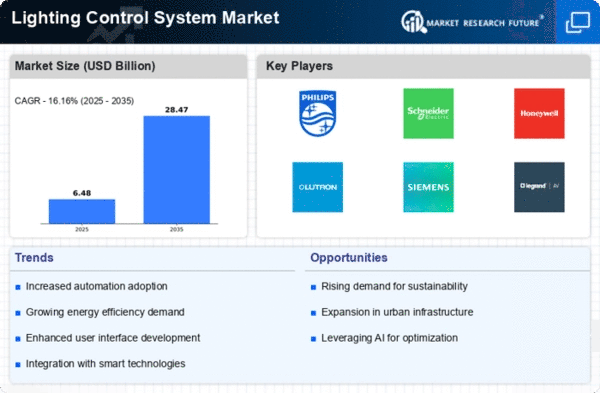
As per MRFR analysis, the Lighting Control System Market Size was estimated at 5.58 USD Billion in 2024. The Lighting Control System industry is projected to grow from 6.36 in 2025 to 28.47 by 2035, exhibiting a compound annual growth rate (CAGR) of 16.16 during the forecast period 2025 - 2035.

Key Market Trends & Highlights

The Lighting Control System Market is poised for substantial growth driven by technological advancements and increasing energy efficiency demands.

  • The integration of smart technologies is transforming the Lighting Control System Market, particularly in North America.
  • Energy efficiency remains a focal point, with residential applications leading the market in terms of demand.
  • Asia-Pacific emerges as the fastest-growing region, driven by rapid urbanization and smart city initiatives.
  • Rising demand for energy efficiency and government incentives are key drivers propelling market expansion.

Market Size & Forecast

2024 Market Size 5.58 (USD Billion)
2035 Market Size 28.47 (USD Billion)
CAGR (2025 - 2035) 16.16%
Largest Regional Market Share in 2024 North America

Major Players

<p>Schneider Electric (FR), Philips Lighting (NL), Honeywell (US), Lutron Electronics (US), Siemens (DE), Legrand (FR), Crestron Electronics (US), Johnson Controls (IE), Osram (DE)</p>

Market Trends

The Lighting Control System Market is currently experiencing a transformative phase, driven by advancements in technology and a growing emphasis on energy efficiency. As organizations and individuals alike become increasingly aware of the environmental impact of energy consumption, the demand for sophisticated lighting control solutions appears to be on the rise. These systems not only enhance user convenience but also contribute to significant reductions in energy usage, aligning with global sustainability goals. Furthermore, the integration of smart technologies, such as the Internet of Things (IoT), is reshaping the landscape of lighting control, enabling users to manage their lighting environments with unprecedented precision and flexibility. In addition to technological advancements, regulatory frameworks are evolving to support the adoption of energy-efficient lighting solutions. Governments worldwide are implementing policies that encourage the use of intelligent lighting systems, which may further stimulate market growth. The Lighting Control System Market is likely to witness increased competition as new players enter the field, offering innovative solutions tailored to diverse consumer needs. As the market continues to mature, it seems poised for substantial growth, driven by a combination of technological innovation, regulatory support, and heightened consumer awareness regarding energy efficiency and sustainability.

Integration of Smart Technologies

The incorporation of smart technologies, particularly IoT, is revolutionizing the Lighting Control System Market. This trend enables users to control lighting remotely, enhancing convenience and energy management.

Focus on Energy Efficiency

There is a growing emphasis on energy efficiency within the Lighting Control System Market. Consumers and businesses are increasingly seeking solutions that reduce energy consumption and lower operational costs.

Regulatory Support for Sustainable Solutions

Government policies are evolving to promote the adoption of energy-efficient lighting systems. This regulatory support is likely to drive market growth and encourage innovation in lighting control technologies.

Lighting Control System Market Market Drivers

Technological Advancements

The Global Lighting Control System Market Industry is experiencing rapid technological advancements, particularly in smart lighting and IoT integration. These innovations enable users to control lighting remotely, optimize energy consumption, and enhance user experience. For instance, the proliferation of smart home devices has led to increased demand for sophisticated lighting control systems. As of 2024, the market is valued at approximately 5.63 USD Billion, reflecting a growing consumer preference for automation and energy efficiency. This trend is likely to continue, with advancements in sensor technology and artificial intelligence further driving market growth.

Market Segment Insights

By Application: Residential (Largest) vs. Smart Lighting (Fastest-Growing)

<p>The Lighting Control System Market is diversified across multiple applications. Among these segments, the Residential sector claims the largest market share, driven by the increasing demand for energy-efficient solutions and enhanced user convenience. This sector has seen substantial investments in home automation systems, resulting in a stronger consumer inclination towards integrated lighting solutions. Conversely, Smart Lighting is emerging as the fastest-growing application, with rising consumer awareness regarding smart home technologies and IoT-based products providing significant opportunities for innovation.</p>

<p>Residential (Dominant) vs. Smart Lighting (Emerging)</p>

<p>The Residential segment holds a significant advantage in the Lighting Control System Market, characterized by its widespread adoption of automated lighting solutions, energy-saving capabilities, and the integration of smart technologies. Consumers prioritize ease of use and customization, fueling the growth of smart lighting solutions tailored for homes. Meanwhile, the Smart Lighting segment is presenting itself as the most dynamic force in the market, appealing to technologically savvy homeowners who favor systems that provide convenience, efficiency, and advanced functionalities like remote operation and mood setting. As these two segments evolve, they remain interlinked, with Smart Lighting solutions increasingly penetrating the residential landscape.</p>

By End Use: Retail (Largest) vs. Healthcare (Fastest-Growing)

<p>The Lighting Control System Market is segmented by end use into various sectors, including retail, hospitality, healthcare, education, and transportation. Among these, retail holds the largest market share due to increasing demand for enhanced customer experiences through improved lighting solutions. This segment benefits from a significant rise in smart lighting technologies that cater to retail environments, aiming to influence consumer behavior and enhance sales performance. Healthcare is emerging as the fastest-growing segment, driven by the need for advanced lighting solutions that can aid in patient recovery and create environments conducive to care. Innovations in LED and automated lighting technologies are pushing this growth.</p>

<p>Retail (Dominant) vs. Healthcare (Emerging)</p>

<p>The retail sector remains dominant in the Lighting Control System Market, with a strong emphasis on creating inviting atmospheres that enhance product presentation and customer interaction. Retailers are increasingly adopting advanced lighting technologies to achieve flexibility in showcasing products, optimizing energy efficiency, and integrating with smart systems for real-time control. On the other hand, the healthcare sector is rapidly emerging, focusing on the incorporation of lighting systems designed to support the well-being of patients and staff. Innovative lighting solutions in healthcare settings are being developed to aid in mood enhancement, the normalization of circadian rhythms, and specific clinical environments. This position reflects the growing importance of lighting in improving health outcomes and operational efficiency.</p>

By Technology: Wireless (Largest) vs. Hybrid (Fastest-Growing)

<p>The Lighting Control System Market is witnessing a significant share distribution among the key technology segments. Wireless technology has emerged as the largest segment due to its ease of installation and flexibility, accounting for a substantial portion of the market. In contrast, wired technology remains relevant but is gradually being overshadowed by the convenience offered by wireless systems. Hybrid systems, which combine the benefits of wired and wireless technologies, are experiencing increasing adoption rates, marking a shift in consumer preferences towards adaptable solutions. Growth trends in the Lighting Control System Market are heavily influenced by technological advancements and energy efficiency demands. Factors such as the increasing integration of smart technologies and Internet of Things (IoT) functionalities are driving interest in wireless and hybrid solutions. These technologies facilitate advanced features like remote control, automated lighting, and data analytics, which enhance user experience and operational efficiency. As energy regulations become stringent, the market is poised for growth, particularly in the hybrid segment, which is seen as a bridge between traditional and modern control solutions.</p>

<p>Technology: Wireless (Dominant) vs. Dimming Control (Emerging)</p>

<p>Wireless technology dominates the Lighting Control System Market, characterized by its high adaptability and user-friendly features. It allows for easy installation and scalability, making it a preferred choice for both residential and commercial applications. The proliferation of smart devices has further fueled the demand for wireless solutions that offer enhanced control and connectivity. On the other hand, dimming control is an emerging segment that is gaining traction as consumers increasingly value energy efficiency and customizable lighting experiences. Dimming technologies not only contribute to reducing energy consumption but also enhance the ambiance of spaces. As consumers seek more personalized and eco-friendly lighting options, dimming control solutions are becoming essential components of modern lighting systems, driving innovation and market growth.</p>

By Component: Lighting Fixtures (Largest) vs. Software (Fastest-Growing)

<p>In the Lighting Control System Market, the distribution of market share among various components reveals that Lighting Fixtures hold the largest share due to their essential role in delivering optimal lighting experiences. Control Panels follow closely, serving as interface hubs that manage the interactions among all components. Sensors, while crucial, occupy a smaller segment of the market but are growing steadily. Meanwhile, Software solutions are gaining traction, representing the fastest growth as they enable smart integrations and enhanced functionalities within control systems.</p>

<p>Lighting Fixtures (Dominant) vs. Software (Emerging)</p>

<p>Lighting Fixtures are the dominant component in the Lighting Control System Market, primarily due to their foundational role in providing effective illumination solutions. These fixtures encompass a range of products that integrate seamlessly with control systems to deliver adjustable lighting options tailored to user preferences. On the other hand, Software solutions represent an emerging component, driving innovation with smart control capabilities such as remote access and automated settings. While Lighting Fixtures offer stability and continuity, the rapid advancement in Software is reshaping market dynamics, positioning it as a significant player in enhancing user experience and system efficiencies.</p>

By Installation Type: New Installation (Largest) vs. Retrofit (Fastest-Growing)

<p>In the Lighting Control System Market, New Installation holds the largest market share due to its necessity in newly constructed properties and modernized infrastructure. This segment encompasses a variety of applications, from commercial spaces to smart homes where lighting control is integral to overall energy management. Retrofit systems, on the other hand, cater to existing buildings seeking upgrades. This segment is rapidly gaining traction as older facilities look to enhance energy efficiency and comply with evolving regulations, leading to an increased preference for advanced lighting control technologies. Growth trends indicate a significant rise in the Retrofit segment as businesses and government initiatives drive the demand for sustainable solutions. Advances in technology have made these systems more accessible, promoting faster adoption rates. Moreover, environmental concerns are escalating the urgency for energy-efficient solutions, making retrofit options particularly appealing for property owners wanting to reduce operational costs. The integration of wireless systems further propels this growth by allowing seamless installation and maintenance, making retrofits an attractive option for enhancing existing systems.</p>

<p>New Installation (Dominant) vs. Retrofit (Emerging)</p>

<p>New Installation and Retrofit segments are pivotal in the Lighting Control System Market. As the dominant segment, New Installation is characterized by its focus on modern properties featuring cutting-edge technologies that improve energy efficiency and user control. Its position is bolstered by new residential developments and commercial projects embracing smart systems to enhance functionality. Meanwhile, the Retrofit segment is emerging swiftly, appealing to existing structures looking to modernize their lighting control without full replacements. Retrofit technologies often integrate seamlessly with older systems, providing a cost-effective way to upgrade. Both segments reflect the market's evolution towards advanced building automation solutions.</p>

Get more detailed insights about Lighting Control System Market Research Report- Forecast 2035

Regional Insights

North America : Market Leader in Innovation

North America is poised to maintain its leadership in the Lighting Control System market, holding a significant share of 2.79B in 2025. The region's growth is driven by increasing demand for energy-efficient solutions and smart building technologies. Regulatory support, such as energy efficiency standards, further catalyzes market expansion. The integration of IoT in lighting systems is also a key trend, enhancing user experience and operational efficiency. The competitive landscape in North America is robust, featuring key players like Honeywell, Lutron Electronics, and Schneider Electric. The U.S. stands out as the largest market, driven by technological advancements and a strong focus on sustainability. Companies are increasingly investing in R&D to innovate and meet the evolving needs of consumers, ensuring a dynamic market environment.

Europe : Sustainable Growth and Innovation

Europe's Lighting Control System market is projected to reach 1.67B by 2025, driven by stringent energy regulations and a growing emphasis on sustainability. The European Union's directives on energy efficiency and carbon reduction are significant catalysts for market growth. Additionally, the rise in smart city initiatives and the adoption of advanced technologies are shaping demand trends, making the region a hub for innovation in lighting solutions. Leading countries such as Germany, France, and the Netherlands are at the forefront of this market, with major players like Philips Lighting and Osram leading the charge. The competitive landscape is characterized by a mix of established firms and innovative startups, all vying for market share. The focus on smart lighting solutions and integration with renewable energy sources is expected to further enhance market dynamics.

Asia-Pacific : Rapid Growth and Adoption

The Asia-Pacific region is witnessing rapid growth in the Lighting Control System market, projected to reach 1.05B by 2025. This growth is fueled by urbanization, increasing disposable incomes, and a rising demand for energy-efficient solutions. Governments are implementing policies to promote smart lighting technologies, which are expected to drive market expansion. The region's focus on sustainable development and smart city projects is also a significant growth driver. Countries like China, Japan, and India are leading the charge in this market, with a competitive landscape featuring both local and international players. Companies such as Schneider Electric and Philips Lighting are investing heavily in R&D to cater to the growing demand. The increasing adoption of IoT and automation in lighting systems is expected to further enhance market opportunities in the region.

Middle East and Africa : Emerging Market Potential

The Middle East and Africa (MEA) region represents an emerging market for Lighting Control Systems, with a projected size of 0.07B by 2025. The growth in this region is primarily driven by increasing urbanization and infrastructure development. Governments are investing in smart city initiatives, which are expected to boost demand for advanced lighting solutions. Additionally, the focus on energy efficiency and sustainability is becoming more pronounced, creating opportunities for market players. Countries like the UAE and South Africa are leading the market, with a growing presence of international players. The competitive landscape is evolving, with local companies also entering the fray. As the region continues to develop, the demand for innovative lighting solutions is expected to rise, presenting significant growth opportunities for stakeholders.


Key Players and Competitive Insights

The Lighting Control System Market is currently characterized by a dynamic competitive landscape, driven by technological advancements and increasing demand for energy-efficient solutions. Key players such as Schneider Electric (FR), Philips Lighting (NL), and Honeywell (US) are strategically positioned to leverage innovation and digital transformation to enhance their market presence. Schneider Electric (FR) focuses on integrating IoT capabilities into its lighting control systems, thereby promoting smart building solutions. Philips Lighting (NL) emphasizes sustainability through its energy-efficient products, while Honeywell (US) is enhancing its portfolio through strategic partnerships and acquisitions, which collectively shape a competitive environment that prioritizes innovation and customer-centric solutions.

In terms of business tactics, companies are increasingly localizing manufacturing and optimizing supply chains to enhance operational efficiency. The market appears moderately fragmented, with several key players exerting influence over various segments. This fragmentation allows for niche players to thrive, while larger companies consolidate their positions through strategic maneuvers. The collective influence of these key players fosters a competitive structure that encourages continuous improvement and adaptation to market demands.

In November 2025, Philips Lighting (NL) announced a partnership with a leading tech firm to develop AI-driven lighting solutions aimed at enhancing user experience and energy management. This strategic move underscores Philips' commitment to innovation and positions it favorably in a market that increasingly values smart technology integration. The collaboration is expected to yield products that not only improve energy efficiency but also provide users with personalized lighting experiences, thereby enhancing customer satisfaction and loyalty.

In October 2025, Schneider Electric (FR) launched a new line of smart lighting control systems designed for commercial applications, incorporating advanced analytics and machine learning capabilities. This initiative reflects Schneider's focus on digital transformation and its intent to lead in the smart building sector. By leveraging data analytics, the company aims to optimize energy consumption and reduce operational costs for its clients, which could significantly enhance its competitive edge in the market.

In September 2025, Honeywell (US) completed the acquisition of a prominent lighting control technology firm, further expanding its capabilities in the smart building domain. This acquisition is likely to enhance Honeywell's product offerings and strengthen its position in the market by integrating advanced lighting control technologies into its existing portfolio. The strategic importance of this move lies in the potential for cross-selling opportunities and the ability to provide comprehensive solutions to customers seeking integrated building management systems.

As of December 2025, current trends in the Lighting Control System Market are heavily influenced by digitalization, sustainability, and the integration of AI technologies. Strategic alliances are increasingly shaping the competitive landscape, enabling companies to pool resources and expertise to innovate more effectively. The shift from price-based competition to a focus on innovation, technology, and supply chain reliability is evident, suggesting that future competitive differentiation will hinge on the ability to deliver cutting-edge solutions that meet evolving customer needs.

Key Companies in the Lighting Control System Market market include

Industry Developments

Philips Lighting N.V.:

  • October 2023, Launched a new series of cloud-based lighting control systems with advanced data analytics and insights for improved building performance.
  • December 2023, Partnered with a leading building automation company to offer integrated lighting and HVAC control solutions for enhanced energy efficiency and occupant comfort.

General Electric Company (GE):

  • September 2023, Introduced a new line of cost-effective lighting control systems targeting small and medium-sized businesses for easy retrofitting and energy savings.
  • November 2023, Collaborated with a major city government to implement a large-scale LED street lighting project with integrated control systems for improved public safety and energy savings.

Legrand S.A.:

  • August 2023, Developed a new voice-activated lighting control system for seamless integration with smart home assistants like Amazon Alexa and Google Home.
  • December 2023, Expanded their global distribution network for lighting control systems, reaching new markets and customer segments.

Eaton Corporation:

  • October 2023, Focused on developing lighting control systems with integrated daylight harvesting capabilities for maximizing natural light usage and energy savings.
  • June 2023, Partnered with a leading lighting manufacturer to offer pre-configured lighting control solutions for specific industry applications.

Future Outlook

Lighting Control System Market Future Outlook

<p>The Lighting Control System Market is projected to grow at a 16.16% CAGR from 2024 to 2035, driven by advancements in smart technology, energy efficiency demands, and regulatory support.</p>

New opportunities lie in:

  • <p>Integration of IoT-enabled lighting solutions for smart cities</p>
  • <p>Development of energy-efficient retrofitting services for existing infrastructures</p>
  • <p>Expansion into emerging markets with tailored lighting control systems</p>

<p>By 2035, the market is expected to be robust, driven by innovation and increasing adoption of smart technologies.</p>

Market Segmentation

Lighting Control System Market End Use Outlook

  • Retail
  • Hospitality
  • Healthcare
  • Education
  • Transportation

Lighting Control System Market Component Outlook

  • Lighting Fixtures
  • Control Panels
  • Sensors
  • Software
  • Actuators

Lighting Control System Market Technology Outlook

  • Wired
  • Wireless
  • Hybrid
  • Dimming Control
  • Occupancy Sensors

Lighting Control System Market Application Outlook

  • Residential
  • Commercial
  • Industrial
  • Outdoor
  • Smart Lighting

Lighting Control System Market Installation Type Outlook

  • New Installation
  • Retrofit
  • Integrated Systems
  • Standalone Systems
  • Wireless Systems

Report Scope

MARKET SIZE 20245.58(USD Billion)
MARKET SIZE 20256.36(USD Billion)
MARKET SIZE 203528.47(USD Billion)
COMPOUND ANNUAL GROWTH RATE (CAGR)16.16% (2024 - 2035)
REPORT COVERAGERevenue Forecast, Competitive Landscape, Growth Factors, and Trends
BASE YEAR2024
Market Forecast Period2025 - 2035
Historical Data2019 - 2024
Market Forecast UnitsUSD Billion
Key Companies ProfiledSchneider Electric (FR), Philips Lighting (NL), Honeywell (US), Lutron Electronics (US), Siemens (DE), Legrand (FR), Crestron Electronics (US), Johnson Controls (IE), Osram (DE)
Segments CoveredApplication, End Use, Technology, Component, Installation Type
Key Market OpportunitiesIntegration of smart technologies enhances energy efficiency in the Lighting Control System Market.
Key Market DynamicsTechnological advancements and regulatory changes drive innovation and adoption in the Lighting Control System Market.
Countries CoveredNorth America, Europe, APAC, South America, MEA

FAQs

What is the assessment period for the Global Lighting control system Market?

2024-2032 is the assessment period for the Global Lighting control system Market.

Mention the grossing factor influencing the market for Lighting control system globally.

The high implementation various smart lighting and energy efficiency are the grossing factors influencing the market for Lighting control system globally.

Regionally, which region has occupied the highest market share currently?

Asia-Pacific has occupied the highest market share currently in the global lighting control system market, as per the analysis.

What is the valuation recorded for the Global Lighting control system Market?

USD 34.2 Billion is the valuation recorded for the Global Lighting control system Market.

Mention the top 4 key players actively functional in the Global Lighting control system Market.

Philips Lighting N.V. (Netherlands), General Electric Company (GE) (US), Legrand S.A. (France), Eaton Corporation (Ireland), Acuity Brands Inc. (US) are the top 4 key players actively functional in the Global Lighting control system Market.

  1. MARKET INTRODUCTION
    1. INTRODUCTION
    2. SCOPE OF STUDY
      1. RESEARCH OBJECTIVE
      2. ASSUMPTIONS
      3. LIMITATIONS
    3. MARKET STRUCTURE
  2. RESEARCH METHODOLOGY
    1. RESEARCH NETWORK COMPONENT
    2. PRIMARY RESEARCH
    3. SECONDARY RESEARCH
    4. FORECAST MODEL
      1. MARKET DATA COLLECTION, ANALYSIS & FORECAST
      2. MARKET SIZE ESTIMATION
  3. MARKET DYNAMICS
    1. INTRODUCTION
    2. MARKET DRIVERS
    3. MARKET CHALLENGES
    4. MARKET OPPORTUNITIES
    5. MARKET RESTRAINTS
  4. EXECUTIVE SUMMARY
  5. MARKET FACTOR ANALYSIS
    1. PORTER’S FIVE FORCES ANALYSIS
    2. SUPPLY CHAIN ANALYSIS
  6. LIGHTING CONTROL SYSTEM MARKET, BY SEGMENTS
    1. INTRODUCTION
    2. MARKET STATISTICS
      1. BY COMPONENT
      2. BY TECHNOLOGY
      3. BY APPLICATION
      4. BY GEOGRAPHY
  7. COMPETITIVE ANALYSIS
    1. MARKET SHARE ANALYSIS
    2. COMPANY PROFILES
      1. PHILIPS LIGHTING N.V. (NETHERLANDS)
      2. GENERAL ELECTRIC COMPANY (GE) (US)
      3. LEGRAND S.A. (FRANCE)
      4. EATON CORPORATION (IRELAND)
      5. ACUITY BRANDS INC. (US)
      6. OSRAM LICHT AG (GERMANY)
      7. CREE, INC. (US)
      8. Lutron Electronics Co. Inc. (US)
      9. Leviton Manufacturing Company, Inc. (US)
      10. OTHERS
  8. LIST OF TABLES
  9. LIGHTING CONTROL SYSTEM MARKET, BY COMPONENT
  10. LIGHTING CONTROL SYSTEM MARKET, BY TECHNOLOGY
  11. LIGHTING CONTROL SYSTEM MARKET, BY APPLICATION
  12. LIGHTING CONTROL SYSTEM MARKET, BY GEOGRAPHY
  13. NORTH AMERICA LIGHTING CONTROL SYSTEM MARKET, BY COMPONENT
  14. NORTH AMERICA LIGHTING CONTROL SYSTEM MARKET, BY TECHNOLOGY
  15. NORTH AMERICA LIGHTING CONTROL SYSTEM MARKET, BY APPLICATION
  16. U.S LIGHTING CONTROL SYSTEM MARKET, BY COMPONENT
  17. U.S. LIGHTING CONTROL SYSTEM MARKET, BY TECHNOLOGY
  18. U.S. LIGHTING CONTROL SYSTEM MARKET, BY APPLICATION
  19. CANADA LIGHTING CONTROL SYSTEM MARKET, BY COMPONENT
  20. CANADA LIGHTING CONTROL SYSTEM MARKET, BY TECHNOLOGY
  21. CANADA LIGHTING CONTROL SYSTEM MARKET, BY APPLICATION
  22. EUROPE LIGHTING CONTROL SYSTEM MARKET, BY COMPONENT
  23. EUROPE LIGHTING CONTROL SYSTEM MARKET, BY TECHNOLOGY
  24. EUROPE LIGHTING CONTROL SYSTEM MARKET, BY APPLICATION
  25. GERMANY LIGHTING CONTROL SYSTEM MARKET, BY COMPONENT
  26. GERMANY LIGHTING CONTROL SYSTEM MARKET, BY TECHNOLOGY
  27. GERMANY LIGHTING CONTROL SYSTEM MARKET, BY APPLICATION
  28. FRANCE LIGHTING CONTROL SYSTEM MARKET, BY COMPONENT
  29. FRANCE LIGHTING CONTROL SYSTEM MARKET, BY TECHNOLOGY
  30. 2 FRANCE LIGHTING CONTROL SYSTEM MARKET, BY APPLICATION
  31. U.K. LIGHTING CONTROL SYSTEM MARKET, BY COMPONENT
  32. U.K. LIGHTING CONTROL SYSTEM MARKET, BY TECHNOLOGY
  33. 5 U.K LIGHTING CONTROL SYSTEM MARKET, BY APPLICATION
  34. REST OF EUROPE LIGHTING CONTROL SYSTEM MARKET, BY COMPONENT
  35. REST OF EUROPE LIGHTING CONTROL SYSTEM MARKET, BY TECHNOLOGY
  36. 8 REST OF EUROPE LIGHTING CONTROL SYSTEM MARKET, BY APPLICATION
  37. ASIA-PACIFIC LIGHTING CONTROL SYSTEM MARKET, BY COMPONENT
  38. ASIA-PACIFIC LIGHTING CONTROL SYSTEM MARKET, BY TECHNOLOGY
  39. ASIA-PACIFIC LIGHTING CONTROL SYSTEM MARKET, BY APPLICATION
  40. REST OF THE WORLD LIGHTING CONTROL SYSTEM MARKET, BY COMPONENT
  41. REST OF THE WORLD LIGHTING CONTROL SYSTEM MARKET, BY TECHNOLOGY
  42. REST OF THE WORLD LIGHTING CONTROL SYSTEM MARKET, BY APPLICATION
  43. LIST OF FIGURES
  44. RESEARCH METHODOLOGY
  45. LIGHTING CONTROL SYSTEM MARKET, BY COMPONENT (%)
  46. LIGHTING CONTROL SYSTEM MARKET, BY TECHNOLOGY (%)
  47. LIGHTING CONTROL SYSTEM MARKET, BY APPLICATION (%)
  48. LIGHTING CONTROL SYSTEM MARKET, BY REGIONS (%)
  49. NORTH AMERICA LIGHTING CONTROL SYSTEM MARKET, BY COMPONENT (%)
  50. NORTH AMERICA LIGHTING CONTROL SYSTEM MARKET, BY TECHNOLOGY (%)
  51. NORTH AMERICA LIGHTING CONTROL SYSTEM MARKET, BY APPLICATION (%)
  52. EUROPE LIGHTING CONTROL SYSTEM MARKET, BY COMPONENT (%)
  53. EUROPE LIGHTING CONTROL SYSTEM MARKET, BY TECHNOLOGY (%)
  54. EUROPE LIGHTING CONTROL SYSTEM MARKET, BY APPLICATION (%)
  55. ASIA-PACIFIC LIGHTING CONTROL SYSTEM MARKET, BY COMPONENT (%)
  56. ASIA-PACIFIC LIGHTING CONTROL SYSTEM MARKET, BY TECHNOLOGY (%)
  57. ASIA-PACIFIC LIGHTING CONTROL SYSTEM MARKET, BY APPLICATION (%)
  58. REST OF THE WORLD LIGHTING CONTROL SYSTEM MARKET, BY COMPONENT (%)
  59. REST OF THE WORLD LIGHTING CONTROL SYSTEM MARKET, BY TECHNOLOGY (%)
  60. REST OF THE WORLD LIGHTING CONTROL SYSTEM MARKET, BY APPLICATION (%)

Lighting Control System Market Segmentation

Market Segmentation Overview

  • Detailed segmentation data will be available in the full report
  • Comprehensive analysis by multiple parameters
  • Regional and country-level breakdowns
  • Market size forecasts by segment
Infographic

Free Sample Request

Kindly complete the form below to receive a free sample of this Report

Get Free Sample

Customer Strories

Compare Licence

×
Features License Type
Single User Multiuser License Enterprise User
Price $4,950 $5,950 $7,250
Maximum User Access Limit 1 User Upto 10 Users Unrestricted Access Throughout the Organization
Free Customization
Direct Access to Analyst
Deliverable Format
Platform Access
Discount on Next Purchase 10% 15% 15%
Printable Versions