Request Free Sample ×

Kindly complete the form below to receive a free sample of this Report

* Please use a valid business email

Leading companies partner with us for data-driven Insights

clients tt-cursor
Hero Background
English
Chinese
French
Japanese
Korean
German
Spanish

Light olefin market Analysis

ID: MRFR/CnM/0531-CR
115 Pages
Anshula Mandaokar
February 2021

Light Olefins Market Research Report Information: By Type (Ethylene, Propylene), Derivatives (Polypropylene, Propylene Oxide, Acrylonitrile, Cumene, Acrylic Acid, Oxo Alcohols, Polyethylene), Application (Chemical Commodities, Refinery), And By Region – Forecast Till 2030

Share:
Download PDF ×

We do not share your information with anyone. However, we may send you emails based on your report interest from time to time. You may contact us at any time to opt-out.

Light olefin market Infographic
Purchase Options

Market Analysis

In-depth Analysis of Light olefin market Industry Landscape

Light olefins, crucial components in the petrochemical industry, rely on diverse raw materials, encompassing naphtha, ethane, propane, butane, and biomass. Naphtha, a vital component in oil production, serves as a key feedstock, while ethane, propane, and butane contribute significantly to gas production. In a notable trend, biomass has emerged as a contemporary and sought-after source of feedstock for the production of natural gas.

Among the prominent suppliers of these essential feedstocks are industry giants such as Saudi Arabian Oil Co., Sinopec, PetroChina, ExxonMobil, Gazprom, and Royal Dutch Shell, to name a few. These suppliers play a pivotal role in the global supply chain, ensuring a steady availability of diverse raw materials for the production of light olefins.

These feedstock suppliers offer a spectrum of raw materials, each characterized by unique qualities. The range includes heavy and light variants, low sulfur content, diluent properties, and other distinct features. This variety in feedstock quality allows for tailored approaches in the production processes, accommodating the specific requirements of diverse applications within the petrochemical industry.

Saudi Arabian Oil Co., often referred to as Saudi Aramco, stands as a major contributor to the global supply of feedstock for light olefins. Its extensive resources and capabilities in providing various types of feedstock contribute significantly to the dynamic landscape of the petrochemical industry. Similarly, Sinopec, PetroChina, ExxonMobil, Gazprom, and Royal Dutch Shell bring their expertise and resources to the forefront, ensuring a reliable and diverse supply chain for the production of light olefins.

As the demand for light olefins continues to grow, the role of feedstock suppliers becomes increasingly critical. Their ability to deliver high-quality raw materials in varying specifications aligns with the evolving needs of the petrochemical industry. The utilization of biomass as a trending source for natural gas production reflects a broader industry shift towards sustainable and environmentally conscious practices.


Author
Author Profile
Anshula Mandaokar
Team Lead - Research

Anshula Mandaokar holds an academic degree in Chemical Engineering and has been contributing to the field for more than 5 years. She has expertise in Market Research and Business Consulting and serves as a Team Lead for a reputed Market Research firm under the Chemicals and Materials domain spectrum. She has worked on multiple projects, generating explicit results in a quick turnaround time. Her understanding of data interpretation justifies her role as a leader.

Leave a Comment

FAQs

What is the projected market valuation of the Light olefin market by 2035?

<p>The projected market valuation for the Light olefin market is 33.24 USD Million by 2035.</p>

What was the overall market valuation of the Light olefin market in 2024?

<p>The overall market valuation of the Light olefin market was 8.23 USD Million in 2024.</p>

What is the expected CAGR for the Light olefin market during the forecast period 2025 - 2035?

<p>The expected CAGR for the Light olefin market during the forecast period 2025 - 2035 is 13.53%.</p>

Which companies are considered key players in the Light olefin market?

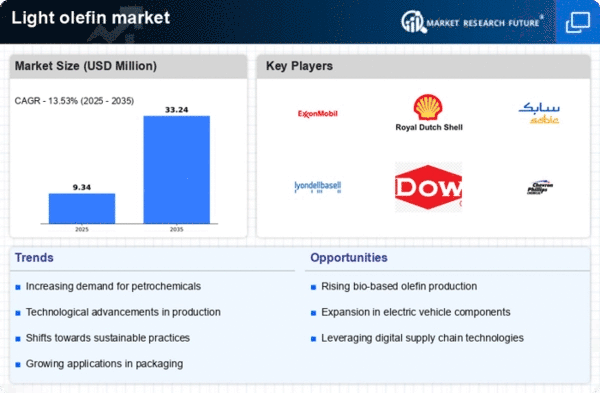
Key players in the Light olefin market include ExxonMobil, Royal Dutch Shell, SABIC, LyondellBasell Industries, and Chevron Phillips Chemical.

What are the primary applications of Light olefins in the market?

The primary applications of Light olefins include polyethylene production, polypropylene production, chemical intermediates, and fuel additives.

How does the Light olefin market perform in the automotive sector?

In the automotive sector, the Light olefin market was valued at 1.65 USD Million in 2024 and is projected to reach 6.75 USD Million by 2035.

What production processes are utilized in the Light olefin market?

The production processes utilized in the Light olefin market include steam cracking, fluid catalytic cracking, dehydrogenation, and metathesis.

What types of Light olefins are produced in the market?

The types of Light olefins produced in the market include ethylene, propylene, butylene, and isobutylene.

What was the valuation of polyethylene production in the Light olefin market in 2024?

The valuation of polyethylene production in the Light olefin market was 3.5 USD Million in 2024.

How does the packaging industry contribute to the Light olefin market?

The packaging industry contributed 2.5 USD Million to the Light olefin market in 2024, with projections of 10.5 USD Million by 2035.

Market Summary

As per MRFR analysis, the Light olefin market size was estimated at 8.23 USD Million in 2024. The Light olefin industry is projected to grow from 9.34 USD Million in 2025 to 33.24 USD Million by 2035, exhibiting a compound annual growth rate (CAGR) of 13.53% during the forecast period 2025 - 2035.

Key Market Trends & Highlights

The Light olefin market is poised for growth driven by sustainability and technological advancements.

  • North America remains the largest market for light olefins, primarily due to its robust petrochemical industry.
  • Asia-Pacific is emerging as the fastest-growing region, fueled by increasing industrialization and urbanization.
  • Polyethylene production continues to dominate the market, while polypropylene production is experiencing rapid growth.
  • Rising demand for petrochemicals and innovations in production technologies are key drivers propelling market expansion.

Market Size & Forecast

2024 Market Size 8.23 (USD Million)
2035 Market Size 33.24 (USD Million)
CAGR (2025 - 2035) 13.53%
Largest Regional Market Share in 2024 Asia-Pacific

Major Players

ExxonMobil (US), Royal Dutch Shell (NL), SABIC (SA), LyondellBasell Industries (US), Dow Chemical Company (US), Chevron Phillips Chemical Company (US), Ineos (GB), Mitsubishi Chemical Corporation (JP), Formosa Plastics Corporation (TW)

Market Trends

The Light olefin market is currently experiencing a dynamic phase characterized by evolving demand patterns and technological advancements. The increasing utilization of light olefins in various applications, such as petrochemicals and plastics, appears to drive growth. Furthermore, the shift towards sustainable practices and the adoption of innovative production methods suggest a potential transformation in how these compounds are manufactured and utilized. As industries seek to reduce their carbon footprint, the emphasis on eco-friendly processes may reshape the competitive landscape of the Light olefin market. In addition, the geopolitical landscape and regulatory frameworks are likely influencing the Light olefin market. Trade policies and environmental regulations may create both challenges and opportunities for market participants. Companies are adapting to these changes by investing in research and development to enhance efficiency and sustainability. Overall, the Light olefin market seems poised for continued evolution, with a focus on innovation and adaptability in response to external pressures and internal demands.

Sustainability Initiatives

The Light olefin market is witnessing a growing emphasis on sustainability initiatives. Companies are increasingly adopting eco-friendly production methods to align with global environmental goals. This trend indicates a shift towards greener practices, which may enhance the market's appeal to environmentally conscious consumers.

Technological Advancements

Technological advancements are playing a crucial role in shaping the Light olefin market. Innovations in production techniques and catalysts are likely improving efficiency and reducing costs. This trend suggests that companies are investing in cutting-edge technologies to maintain competitiveness and meet rising demand.

Regulatory Influences

Regulatory influences are becoming more pronounced in the Light olefin market. Governments are implementing stricter environmental regulations, which may compel companies to adapt their operations. This trend indicates that compliance with evolving policies could drive innovation and reshape market dynamics.

Light olefin market Market Drivers

Market Growth Projections

The Global Light Olefins Market Industry is projected to experience substantial growth over the coming years. With a market value expected to reach 321.2 USD Million in 2024 and further expand to 624.2 USD Million by 2035, the industry is poised for a robust trajectory. The anticipated compound annual growth rate of 6.23% from 2025 to 2035 reflects the increasing demand for light olefins across various sectors. This growth is underpinned by technological advancements, expanding applications, and supportive regulatory frameworks that collectively enhance the market's potential.

Expansion of End-Use Industries

The expansion of end-use industries such as packaging, textiles, and consumer goods is a key driver for the Global Light Olefins Market Industry. As these sectors grow, the demand for light olefins, particularly ethylene and propylene, is expected to rise correspondingly. The versatility of light olefins in producing various materials, including films, fibers, and containers, positions them as essential raw materials in these industries. This growth trajectory is likely to be supported by increasing consumer preferences for sustainable and recyclable products, further enhancing the market's potential. The ongoing expansion of these industries is anticipated to significantly contribute to the overall market dynamics.

Rising Demand for Petrochemicals

The Global Light Olefins Market Industry is experiencing a surge in demand for petrochemicals, driven by their extensive applications in various sectors such as automotive, construction, and consumer goods. As industries increasingly rely on light olefins for the production of plastics and synthetic fibers, the market is projected to reach 321.2 USD Million in 2024. This growth is indicative of the broader trend towards lightweight materials that enhance fuel efficiency and reduce emissions, aligning with global sustainability goals. The increasing adoption of light olefins in manufacturing processes is likely to further bolster market expansion.

Technological Advancements in Production

Technological innovations in the production of light olefins are significantly influencing the Global Light Olefins Market Industry. Advanced catalytic processes and improved cracking technologies enhance yield and reduce production costs. For instance, the development of more efficient steam cracking methods allows for higher output of ethylene and propylene, which are key components in various chemical products. These advancements not only improve profitability for manufacturers but also contribute to meeting the growing global demand. As a result, the market is expected to witness a compound annual growth rate of 6.23% from 2025 to 2035, reflecting the positive impact of these technological improvements.

Growing Applications in Automotive Sector

The automotive sector is increasingly adopting light olefins for the production of lightweight materials, which are essential for enhancing fuel efficiency and reducing carbon emissions. The Global Light Olefins Market Industry benefits from this trend, as manufacturers seek to incorporate materials derived from light olefins into vehicle components. This shift is driven by stringent regulations aimed at reducing environmental impact, prompting automakers to innovate. As the automotive industry evolves, the demand for light olefins is likely to escalate, contributing to the projected market growth to 624.2 USD Million by 2035. This trend underscores the pivotal role of light olefins in sustainable automotive manufacturing.

Regulatory Support for Sustainable Practices

Regulatory frameworks promoting sustainable practices are increasingly shaping the Global Light Olefins Market Industry. Governments worldwide are implementing policies that encourage the use of environmentally friendly materials and processes, which often include light olefins. These regulations aim to reduce carbon footprints and promote recycling, thereby enhancing the appeal of light olefins in various applications. As industries adapt to these regulations, the demand for light olefins is expected to rise, aligning with global sustainability initiatives. This supportive regulatory environment is likely to drive market growth, as companies seek to comply with evolving standards and consumer expectations.

Market Segment Insights

By Application: Polyethylene Production (Largest) vs. Polypropylene Production (Fastest-Growing)

In the Light olefin market, the application segment is primarily dominated by <a href="https://www.marketresearchfuture.com/reports/polyethylene-market-1056" target="_blank" title="polyethylene">Polyethylene</a> Production, which holds the largest share due to its extensive use in packaging, construction, and consumer goods. This dominance is followed closely by Polypropylene Production, which is emerging as a significant player. The growth in demand for lightweight and durable materials is driving the expansion of these applications, contributing to their competitive share within the market.

Polyethylene Production (Dominant) vs. Polypropylene Production (Emerging)

Polyethylene Production is characterized by its versatile applications, serving as a foundation for packaging materials, pipes, and containers, thus establishing its dominant position in the Light olefin market. Its adaptability and cost-effectiveness make it the material of choice for many sectors. Conversely, Polypropylene Production is gaining traction as an emerging segment, appealing to industries due to its unique properties such as higher temperature resistance and transparency. As consumer preferences shift towards sustainable and efficient materials, Polypropylene is poised for rapid growth, aided by innovations in processing technology that enhance its functionality.

By End Use Industry: Packaging (Largest) vs. Automotive (Fastest-Growing)

<p>In the light olefin market, the end use industries exhibit varied market share distributions, with Packaging emerging as the largest segment. The essential nature of olefins in creating packaging materials heavily contributes to its significant market share. Conversely, Automotive is identified as the fastest-growing segment due to the rising demand for lightweight and fuel-efficient vehicles, which leverage olefins for manufacturing advanced composite materials. This growth is propelled by stringent regulations on emissions and a continuous push towards sustainability in automotive manufacturing. The growth trends within these end use industries indicate strong future performance, especially for Automotive, driven by technological advancements and eco-friendly innovations. As the automotive industry evolves, the adaptation of light olefins for various applications, including vehicle components and fuel systems, is expected to surge. This upward trajectory is supported by increasing consumer preference for sustainable solutions in both automotive design and packaging, ensuring a dynamic interplay between these two segments in the light olefin market.</p>

<p>Packaging: Dominant vs. Automotive: Emerging</p>

<p>In the light olefin market, Packaging stands as the dominant end use industry, primarily due to its extensive applications across food, consumer goods, and industrial sectors. Light olefins play a critical role in producing various forms of packaging, including films, bottles, and containers. The large-scale adoption of recyclable packaging materials has further solidified its market position. On the other hand, Automotive represents an emerging segment, characterized by rapid growth driven by the automotive industry's shift towards lightweight materials and innovative manufacturing processes. As this sector increasingly incorporates olefins into its design strategies for components, the demand for olefins in automotive applications is anticipated to grow significantly. This emerging profile suggests that while packaging remains the leader, automotive is on a trajectory of becoming a major competitor.</p>

By Production Process: Steam Cracking (Largest) vs. Fluid Catalytic Cracking (Fastest-Growing)

<p>In the Light olefin market, the production processes are segmented into Steam Cracking, Fluid Catalytic Cracking, Dehydrogenation, and Metathesis. Steam Cracking holds the largest share of the market due to its established technology and vast application in producing ethylene and propylene. Fluid Catalytic Cracking, while smaller, is rapidly gaining traction thanks to its efficiency and suitability for heavier feedstocks, appealing to refineries looking to optimize their operations.</p>

<p>Steam Cracking (Dominant) vs. Fluid Catalytic Cracking (Emerging)</p>

<p>Steam Crackings dominance lies in its ability to produce high yields of light olefins from hydrocarbon feedstock, making it the mainstay of ethylene production. Its reliability and established infrastructure provide a competitive advantage in meeting the consistent demand for light olefins. Conversely, Fluid Catalytic Cracking represents a growing opportunity as refiners embrace newer technologies to enhance output and adapt to changing market dynamics. This process is particularly attractive for industries seeking to maximize output from diverse feedstock, thereby leading to its recognition as the fastest growing segment in the market.</p>

By Type: Ethylene (Largest) vs. Propylene (Fastest-Growing)

In the Light olefin market, Ethylene holds the largest market share among the available types, solidifying its position as a staple in the industry. Following Ethylene, Propylene has emerged as a significant player, capturing a notable portion of the market, while Butylene and Isobutylene represent smaller segments, each contributing to the overall diversity of light olefins. The distribution reflects the essential roles these olefins play in various applications, from plastics to chemicals, with Ethylene dominating due to its foundational importance.

Ethylene (Dominant) vs. Propylene (Emerging)

Ethylene is the dominant light olefin, renowned for its versatility and widespread use in the production of ethylene glycol, polyethylene, and other essential chemicals. Its established position in the market is backed by a well-developed supply chain and production infrastructure, making it a key resource in many industries. On the other hand, Propylene is recognized as an emerging segment within the light olefin market, driven by growing demand for polypropylene in packaging, automotive, and textile applications. This demand is accelerated by the trend towards lightweight materials and sustainable practices. While Ethylene remains a cornerstone, Propylene's rapid growth trajectory indicates a shifting focus in material preferences, paving the way for innovative applications.

Get more detailed insights about Light Olefins Market Research Report – Forecast to 2035

Regional Insights

North America : Innovation and Sustainability Focus

The North American light olefin market is poised for growth, driven by increasing demand for petrochemicals and a shift towards sustainable practices. With a market size of $2.47 billion, the region is focusing on innovative technologies and regulatory support to enhance production efficiency. The rise in natural gas production is also a significant catalyst, providing a cost-effective feedstock for olefin production. Leading countries like the US and Canada are home to major players such as ExxonMobil and Dow Chemical Company, which are investing heavily in R&D to maintain competitive advantages. The competitive landscape is characterized by a mix of established firms and emerging players, all vying for market share in a rapidly evolving industry. The focus on reducing carbon emissions is shaping strategic decisions across the sector.

Europe : Regulatory Framework and Innovation

Europe's light olefin market, valued at $1.84 billion, is significantly influenced by stringent environmental regulations and a push for sustainable production methods. The region is witnessing a shift towards bio-based feedstocks and circular economy initiatives, which are expected to drive growth. Regulatory frameworks are encouraging innovation, making it essential for companies to adapt to changing market dynamics. Countries like Germany, the Netherlands, and France are leading the charge, with key players such as Royal Dutch Shell and SABIC investing in advanced technologies. The competitive landscape is marked by collaborations and partnerships aimed at enhancing production capabilities and sustainability. As Europe aims to reduce its carbon footprint, the light olefin market is expected to evolve rapidly, aligning with broader environmental goals.

Asia-Pacific : Emerging Powerhouse in Production

The Asia-Pacific region is the largest market for light olefins, with a market size of $3.93 billion, driven by robust industrial growth and increasing demand for petrochemicals. The region's growth is fueled by rapid urbanization, rising disposable incomes, and a strong manufacturing base. Countries like China and India are leading the charge, supported by favorable government policies and investments in infrastructure. The competitive landscape is dominated by major players such as Mitsubishi Chemical Corporation and Formosa Plastics Corporation, which are expanding their production capacities to meet growing demand. The region's focus on innovation and technology adoption is enhancing production efficiency, making it a key player in The Light olefin market. As the demand for sustainable solutions rises, the industry is also exploring eco-friendly production methods.

Middle East and Africa : Resource-Rich Frontier for Growth

The Middle East and Africa region, with a market size of $0.99 billion, is emerging as a significant player in the light olefin market, driven by abundant natural resources and strategic investments. The region's growth is supported by government initiatives aimed at diversifying economies and enhancing petrochemical production capabilities. Countries like Saudi Arabia and the UAE are at the forefront, leveraging their oil and gas reserves to boost production. The competitive landscape is characterized by a mix of state-owned enterprises and private companies, with key players such as SABIC leading the market. The region's focus on expanding its petrochemical sector is expected to attract foreign investments, further enhancing its position in The Light olefin market. As the industry evolves, the emphasis on sustainability and innovation will play a crucial role in shaping future growth.

Key Players and Competitive Insights

The Light olefin market is characterized by a dynamic competitive landscape, driven by increasing demand for petrochemicals and the ongoing transition towards sustainable practices. Key players such as ExxonMobil (US), Royal Dutch Shell (NL), and SABIC (SA) are strategically positioned to leverage their extensive resources and technological capabilities. ExxonMobil (US) focuses on innovation in production processes, particularly in enhancing the efficiency of its steam cracking technologies. Meanwhile, Royal Dutch Shell (NL) emphasizes partnerships and joint ventures to expand its market reach, particularly in emerging economies. SABIC (SA) is actively pursuing digital transformation initiatives to optimize its operations and improve supply chain resilience, thereby shaping a competitive environment that is increasingly reliant on technological advancements and strategic collaborations.In terms of business tactics, companies are localizing manufacturing to reduce transportation costs and enhance supply chain efficiency. The market structure appears moderately fragmented, with several key players exerting considerable influence. This fragmentation allows for a variety of competitive strategies, as companies seek to differentiate themselves through innovation and operational excellence.

In November LyondellBasell Industries (US) announced a significant investment in a new light olefins production facility in Texas, aimed at increasing its output capacity by 20%. This strategic move is likely to enhance LyondellBasell's competitive positioning in the North American market, allowing it to meet the growing demand for ethylene and propylene derivatives. The investment underscores the company's commitment to expanding its operational footprint and responding to market dynamics effectively.

In October Dow Chemical Company (US) launched a new line of sustainable light olefins derived from bio-based feedstocks. This initiative not only aligns with global sustainability trends but also positions Dow as a leader in the transition towards greener chemical production. The introduction of bio-based products may attract environmentally conscious customers and enhance Dow's market share in the light olefin segment.

In September Chevron Phillips Chemical Company (US) entered into a strategic partnership with a leading technology firm to develop advanced AI-driven solutions for optimizing its production processes. This collaboration is expected to enhance operational efficiency and reduce costs, thereby strengthening Chevron Phillips' competitive edge in the market. The integration of AI technologies reflects a broader trend within the industry towards digitalization and smart manufacturing.

As of December the Light olefin market is witnessing trends that emphasize digitalization, sustainability, and technological integration. Strategic alliances are increasingly shaping the competitive landscape, enabling companies to pool resources and share expertise. The shift from price-based competition to a focus on innovation, technology, and supply chain reliability is becoming more pronounced. Companies that can effectively differentiate themselves through these avenues are likely to thrive in an evolving market characterized by rapid change and increasing consumer expectations.

Key Companies in the Light olefin market include

Industry Developments

August 2021- Lummus Technology has disclosed that the start-up of company’s CDAlky alkylation unit located at Zhejiang Petroleum & Chemical Co. Ltd's refinery in Zhejiang Province, China. The latest facility will have a capacity of over 45 000 bpsd of alkylate product, resulting it to be the largest alkylation unit across the globe certified by Lummus.The latest alkylation unit deals with C4s from upstream refining and petrochemical units, causing an extremely high isobutylene concentration in the net olefins mixture while manufacturing a greater alkylate quality.

October 2021- Siemens Energy and Technip Energies have announced the signing of an exclusive contract to collaboratively build, commercialize, and license the Rotating Olefins Cracker (ROC) technology to make the olefin production process carbon-free. The ROC technology uses a dynamic reactor system, which replaces traditional furnaces used for pyrolysis while producing light olefins- the raw material for chemical products used in everyday materials.

November 2021- The Board of Reliance Industries Ltd (RIL) has planned to deploy a Scheme of Arrangement to turn over Gasification Enterprise into a Wholly Owned Subsidiary (WOS). The Jamnagar Gasification project was established to manufacture syngas to fulfill the needs as refinery off-gases that catered as fuel in the past were redesigned into feedstock for the Refinery Off Gas Cracker (ROGC). The company stated that this deployment allows olefins manufacturing at competitive capital and operating costs. The statement further revealed that Syngas as a fuel guarantees supply reliability and aid lower volatility in the energy costs.

In 2018, Exxon Mobil collaborated with Saudi Basic Industries Corporation (SABIC) to build the world’s largest plant for ethylene production. This collaboration was more than 1.4 billion US dollars of worth. 

In June 2018, a Cumene unit was built in Germany by a leading light olefin market player i.e. INEOS Phenol (UK) to maintain continuity between customer's demand and supply. This construction helped the company's plants in Gladbeck and Antwerp to improve the security of this supply and demand by the year 2020. 

Future Outlook

Light olefin market Future Outlook

The Light olefin market is projected to grow at a 13.53% CAGR from 2025 to 2035, driven by increasing demand in petrochemicals, automotive, and packaging sectors.

New opportunities lie in:

  • Development of advanced catalysts for enhanced olefin production efficiency.
  • Expansion into emerging markets with tailored product offerings.
  • Investment in sustainable production technologies to meet regulatory demands.

By 2035, the Light olefin market is expected to achieve robust growth, solidifying its position as a key industry segment.

Market Segmentation

Light olefin market Type Outlook

  • Ethylene
  • Propylene
  • Butylene
  • Isobutylene

Light olefin market End Use Outlook

  • Automotive
  • Construction
  • Packaging
  • Textiles

Light olefin market Application Outlook

  • Polyethylene Production
  • Polypropylene Production
  • Chemical Intermediates
  • Fuel Additives

Light olefin market Production Method Outlook

  • Steam Cracking
  • Fluid Catalytic Cracking
  • Metathesis
  • Dehydrogenation

Report Scope

MARKET SIZE 2024 8.23(USD Million)
MARKET SIZE 2025 9.34(USD Million)
MARKET SIZE 2035 33.24(USD Million)
COMPOUND ANNUAL GROWTH RATE (CAGR) 13.53% (2025 - 2035)
REPORT COVERAGE Revenue Forecast, Competitive Landscape, Growth Factors, and Trends
BASE YEAR 2024
Market Forecast Period 2025 - 2035
Historical Data 2019 - 2024
Market Forecast Units USD Million
Key Companies Profiled ExxonMobil (US), Royal Dutch Shell (NL), SABIC (SA), LyondellBasell Industries (US), Dow Chemical Company (US), Chevron Phillips Chemical Company (US), Ineos (GB), Mitsubishi Chemical Corporation (JP), Formosa Plastics Corporation (TW)
Segments Covered Application, End Use, Production Method, Type
Key Market Opportunities Advancements in sustainable production methods drive growth in the Light olefin market.
Key Market Dynamics Rising demand for sustainable materials drives innovation and competition in the light olefin market.
Countries Covered North America, Europe, APAC, South America, MEA

FAQs

What is the projected market valuation of the Light olefin market by 2035?

<p>The projected market valuation for the Light olefin market is 33.24 USD Million by 2035.</p>

What was the overall market valuation of the Light olefin market in 2024?

<p>The overall market valuation of the Light olefin market was 8.23 USD Million in 2024.</p>

What is the expected CAGR for the Light olefin market during the forecast period 2025 - 2035?

<p>The expected CAGR for the Light olefin market during the forecast period 2025 - 2035 is 13.53%.</p>

Which companies are considered key players in the Light olefin market?

Key players in the Light olefin market include ExxonMobil, Royal Dutch Shell, SABIC, LyondellBasell Industries, and Chevron Phillips Chemical.

What are the primary applications of Light olefins in the market?

The primary applications of Light olefins include polyethylene production, polypropylene production, chemical intermediates, and fuel additives.

How does the Light olefin market perform in the automotive sector?

In the automotive sector, the Light olefin market was valued at 1.65 USD Million in 2024 and is projected to reach 6.75 USD Million by 2035.

What production processes are utilized in the Light olefin market?

The production processes utilized in the Light olefin market include steam cracking, fluid catalytic cracking, dehydrogenation, and metathesis.

What types of Light olefins are produced in the market?

The types of Light olefins produced in the market include ethylene, propylene, butylene, and isobutylene.

What was the valuation of polyethylene production in the Light olefin market in 2024?

The valuation of polyethylene production in the Light olefin market was 3.5 USD Million in 2024.

How does the packaging industry contribute to the Light olefin market?

The packaging industry contributed 2.5 USD Million to the Light olefin market in 2024, with projections of 10.5 USD Million by 2035.

  1. SECTION I: EXECUTIVE SUMMARY AND KEY HIGHLIGHTS
    1. | 1.1 EXECUTIVE SUMMARY
    2. | | 1.1.1 Market Overview
    3. | | 1.1.2 Key Findings
    4. | | 1.1.3 Market Segmentation
    5. | | 1.1.4 Competitive Landscape
    6. | | 1.1.5 Challenges and Opportunities
    7. | | 1.1.6 Future Outlook
  2. SECTION II: SCOPING, METHODOLOGY AND MARKET STRUCTURE
    1. | 2.1 MARKET INTRODUCTION
    2. | | 2.1.1 Definition
    3. | | 2.1.2 Scope of the study
    4. | | | 2.1.2.1 Research Objective
    5. | | | 2.1.2.2 Assumption
    6. | | | 2.1.2.3 Limitations
    7. | 2.2 RESEARCH METHODOLOGY
    8. | | 2.2.1 Overview
    9. | | 2.2.2 Data Mining
    10. | | 2.2.3 Secondary Research
    11. | | 2.2.4 Primary Research
    12. | | | 2.2.4.1 Primary Interviews and Information Gathering Process
    13. | | | 2.2.4.2 Breakdown of Primary Respondents
    14. | | 2.2.5 Forecasting Model
    15. | | 2.2.6 Market Size Estimation
    16. | | | 2.2.6.1 Bottom-Up Approach
    17. | | | 2.2.6.2 Top-Down Approach
    18. | | 2.2.7 Data Triangulation
    19. | | 2.2.8 Validation
  3. SECTION III: QUALITATIVE ANALYSIS
    1. | 3.1 MARKET DYNAMICS
    2. | | 3.1.1 Overview
    3. | | 3.1.2 Drivers
    4. | | 3.1.3 Restraints
    5. | | 3.1.4 Opportunities
    6. | 3.2 MARKET FACTOR ANALYSIS
    7. | | 3.2.1 Value chain Analysis
    8. | | 3.2.2 Porter's Five Forces Analysis
    9. | | | 3.2.2.1 Bargaining Power of Suppliers
    10. | | | 3.2.2.2 Bargaining Power of Buyers
    11. | | | 3.2.2.3 Threat of New Entrants
    12. | | | 3.2.2.4 Threat of Substitutes
    13. | | | 3.2.2.5 Intensity of Rivalry
    14. | | 3.2.3 COVID-19 Impact Analysis
    15. | | | 3.2.3.1 Market Impact Analysis
    16. | | | 3.2.3.2 Regional Impact
    17. | | | 3.2.3.3 Opportunity and Threat Analysis
  4. SECTION IV: QUANTITATIVE ANALYSIS
    1. | 4.1 Chemicals and Materials, BY Application (USD Million)
    2. | | 4.1.1 Polyethylene Production
    3. | | 4.1.2 Polypropylene Production
    4. | | 4.1.3 Chemical Intermediates
    5. | | 4.1.4 Fuel Additives
    6. | 4.2 Chemicals and Materials, BY End Use Industry (USD Million)
    7. | | 4.2.1 Automotive
    8. | | 4.2.2 Construction
    9. | | 4.2.3 Packaging
    10. | | 4.2.4 Textiles
    11. | 4.3 Chemicals and Materials, BY Production Process (USD Million)
    12. | | 4.3.1 Steam Cracking
    13. | | 4.3.2 Fluid Catalytic Cracking
    14. | | 4.3.3 Dehydrogenation
    15. | | 4.3.4 Metathesis
    16. | 4.4 Chemicals and Materials, BY Type (USD Million)
    17. | | 4.4.1 Ethylene
    18. | | 4.4.2 Propylene
    19. | | 4.4.3 Butylene
    20. | | 4.4.4 Isobutylene
    21. | 4.5 Chemicals and Materials, BY Region (USD Million)
    22. | | 4.5.1 North America
    23. | | | 4.5.1.1 US
    24. | | | 4.5.1.2 Canada
    25. | | 4.5.2 Europe
    26. | | | 4.5.2.1 Germany
    27. | | | 4.5.2.2 UK
    28. | | | 4.5.2.3 France
    29. | | | 4.5.2.4 Russia
    30. | | | 4.5.2.5 Italy
    31. | | | 4.5.2.6 Spain
    32. | | | 4.5.2.7 Rest of Europe
    33. | | 4.5.3 APAC
    34. | | | 4.5.3.1 China
    35. | | | 4.5.3.2 India
    36. | | | 4.5.3.3 Japan
    37. | | | 4.5.3.4 South Korea
    38. | | | 4.5.3.5 Malaysia
    39. | | | 4.5.3.6 Thailand
    40. | | | 4.5.3.7 Indonesia
    41. | | | 4.5.3.8 Rest of APAC
    42. | | 4.5.4 South America
    43. | | | 4.5.4.1 Brazil
    44. | | | 4.5.4.2 Mexico
    45. | | | 4.5.4.3 Argentina
    46. | | | 4.5.4.4 Rest of South America
    47. | | 4.5.5 MEA
    48. | | | 4.5.5.1 GCC Countries
    49. | | | 4.5.5.2 South Africa
    50. | | | 4.5.5.3 Rest of MEA
  5. SECTION V: COMPETITIVE ANALYSIS
    1. | 5.1 Competitive Landscape
    2. | | 5.1.1 Overview
    3. | | 5.1.2 Competitive Analysis
    4. | | 5.1.3 Market share Analysis
    5. | | 5.1.4 Major Growth Strategy in the Chemicals and Materials
    6. | | 5.1.5 Competitive Benchmarking
    7. | | 5.1.6 Leading Players in Terms of Number of Developments in the Chemicals and Materials
    8. | | 5.1.7 Key developments and growth strategies
    9. | | | 5.1.7.1 New Product Launch/Service Deployment
    10. | | | 5.1.7.2 Merger & Acquisitions
    11. | | | 5.1.7.3 Joint Ventures
    12. | | 5.1.8 Major Players Financial Matrix
    13. | | | 5.1.8.1 Sales and Operating Income
    14. | | | 5.1.8.2 Major Players R&D Expenditure. 2023
    15. | 5.2 Company Profiles
    16. | | 5.2.1 ExxonMobil (US)
    17. | | | 5.2.1.1 Financial Overview
    18. | | | 5.2.1.2 Products Offered
    19. | | | 5.2.1.3 Key Developments
    20. | | | 5.2.1.4 SWOT Analysis
    21. | | | 5.2.1.5 Key Strategies
    22. | | 5.2.2 Royal Dutch Shell (NL)
    23. | | | 5.2.2.1 Financial Overview
    24. | | | 5.2.2.2 Products Offered
    25. | | | 5.2.2.3 Key Developments
    26. | | | 5.2.2.4 SWOT Analysis
    27. | | | 5.2.2.5 Key Strategies
    28. | | 5.2.3 SABIC (SA)
    29. | | | 5.2.3.1 Financial Overview
    30. | | | 5.2.3.2 Products Offered
    31. | | | 5.2.3.3 Key Developments
    32. | | | 5.2.3.4 SWOT Analysis
    33. | | | 5.2.3.5 Key Strategies
    34. | | 5.2.4 LyondellBasell Industries (US)
    35. | | | 5.2.4.1 Financial Overview
    36. | | | 5.2.4.2 Products Offered
    37. | | | 5.2.4.3 Key Developments
    38. | | | 5.2.4.4 SWOT Analysis
    39. | | | 5.2.4.5 Key Strategies
    40. | | 5.2.5 Chevron Phillips Chemical (US)
    41. | | | 5.2.5.1 Financial Overview
    42. | | | 5.2.5.2 Products Offered
    43. | | | 5.2.5.3 Key Developments
    44. | | | 5.2.5.4 SWOT Analysis
    45. | | | 5.2.5.5 Key Strategies
    46. | | 5.2.6 Ineos (GB)
    47. | | | 5.2.6.1 Financial Overview
    48. | | | 5.2.6.2 Products Offered
    49. | | | 5.2.6.3 Key Developments
    50. | | | 5.2.6.4 SWOT Analysis
    51. | | | 5.2.6.5 Key Strategies
    52. | | 5.2.7 Mitsubishi Chemical (JP)
    53. | | | 5.2.7.1 Financial Overview
    54. | | | 5.2.7.2 Products Offered
    55. | | | 5.2.7.3 Key Developments
    56. | | | 5.2.7.4 SWOT Analysis
    57. | | | 5.2.7.5 Key Strategies
    58. | | 5.2.8 Braskem (BR)
    59. | | | 5.2.8.1 Financial Overview
    60. | | | 5.2.8.2 Products Offered
    61. | | | 5.2.8.3 Key Developments
    62. | | | 5.2.8.4 SWOT Analysis
    63. | | | 5.2.8.5 Key Strategies
    64. | | 5.2.9 TotalEnergies (FR)
    65. | | | 5.2.9.1 Financial Overview
    66. | | | 5.2.9.2 Products Offered
    67. | | | 5.2.9.3 Key Developments
    68. | | | 5.2.9.4 SWOT Analysis
    69. | | | 5.2.9.5 Key Strategies
    70. | 5.3 Appendix
    71. | | 5.3.1 References
    72. | | 5.3.2 Related Reports
  6. LIST OF FIGURES
    1. | 6.1 MARKET SYNOPSIS
    2. | 6.2 NORTH AMERICA MARKET ANALYSIS
    3. | 6.3 US MARKET ANALYSIS BY APPLICATION
    4. | 6.4 US MARKET ANALYSIS BY END USE INDUSTRY
    5. | 6.5 US MARKET ANALYSIS BY PRODUCTION PROCESS
    6. | 6.6 US MARKET ANALYSIS BY TYPE
    7. | 6.7 CANADA MARKET ANALYSIS BY APPLICATION
    8. | 6.8 CANADA MARKET ANALYSIS BY END USE INDUSTRY
    9. | 6.9 CANADA MARKET ANALYSIS BY PRODUCTION PROCESS
    10. | 6.10 CANADA MARKET ANALYSIS BY TYPE
    11. | 6.11 EUROPE MARKET ANALYSIS
    12. | 6.12 GERMANY MARKET ANALYSIS BY APPLICATION
    13. | 6.13 GERMANY MARKET ANALYSIS BY END USE INDUSTRY
    14. | 6.14 GERMANY MARKET ANALYSIS BY PRODUCTION PROCESS
    15. | 6.15 GERMANY MARKET ANALYSIS BY TYPE
    16. | 6.16 UK MARKET ANALYSIS BY APPLICATION
    17. | 6.17 UK MARKET ANALYSIS BY END USE INDUSTRY
    18. | 6.18 UK MARKET ANALYSIS BY PRODUCTION PROCESS
    19. | 6.19 UK MARKET ANALYSIS BY TYPE
    20. | 6.20 FRANCE MARKET ANALYSIS BY APPLICATION
    21. | 6.21 FRANCE MARKET ANALYSIS BY END USE INDUSTRY
    22. | 6.22 FRANCE MARKET ANALYSIS BY PRODUCTION PROCESS
    23. | 6.23 FRANCE MARKET ANALYSIS BY TYPE
    24. | 6.24 RUSSIA MARKET ANALYSIS BY APPLICATION
    25. | 6.25 RUSSIA MARKET ANALYSIS BY END USE INDUSTRY
    26. | 6.26 RUSSIA MARKET ANALYSIS BY PRODUCTION PROCESS
    27. | 6.27 RUSSIA MARKET ANALYSIS BY TYPE
    28. | 6.28 ITALY MARKET ANALYSIS BY APPLICATION
    29. | 6.29 ITALY MARKET ANALYSIS BY END USE INDUSTRY
    30. | 6.30 ITALY MARKET ANALYSIS BY PRODUCTION PROCESS
    31. | 6.31 ITALY MARKET ANALYSIS BY TYPE
    32. | 6.32 SPAIN MARKET ANALYSIS BY APPLICATION
    33. | 6.33 SPAIN MARKET ANALYSIS BY END USE INDUSTRY
    34. | 6.34 SPAIN MARKET ANALYSIS BY PRODUCTION PROCESS
    35. | 6.35 SPAIN MARKET ANALYSIS BY TYPE
    36. | 6.36 REST OF EUROPE MARKET ANALYSIS BY APPLICATION
    37. | 6.37 REST OF EUROPE MARKET ANALYSIS BY END USE INDUSTRY
    38. | 6.38 REST OF EUROPE MARKET ANALYSIS BY PRODUCTION PROCESS
    39. | 6.39 REST OF EUROPE MARKET ANALYSIS BY TYPE
    40. | 6.40 APAC MARKET ANALYSIS
    41. | 6.41 CHINA MARKET ANALYSIS BY APPLICATION
    42. | 6.42 CHINA MARKET ANALYSIS BY END USE INDUSTRY
    43. | 6.43 CHINA MARKET ANALYSIS BY PRODUCTION PROCESS
    44. | 6.44 CHINA MARKET ANALYSIS BY TYPE
    45. | 6.45 INDIA MARKET ANALYSIS BY APPLICATION
    46. | 6.46 INDIA MARKET ANALYSIS BY END USE INDUSTRY
    47. | 6.47 INDIA MARKET ANALYSIS BY PRODUCTION PROCESS
    48. | 6.48 INDIA MARKET ANALYSIS BY TYPE
    49. | 6.49 JAPAN MARKET ANALYSIS BY APPLICATION
    50. | 6.50 JAPAN MARKET ANALYSIS BY END USE INDUSTRY
    51. | 6.51 JAPAN MARKET ANALYSIS BY PRODUCTION PROCESS
    52. | 6.52 JAPAN MARKET ANALYSIS BY TYPE
    53. | 6.53 SOUTH KOREA MARKET ANALYSIS BY APPLICATION
    54. | 6.54 SOUTH KOREA MARKET ANALYSIS BY END USE INDUSTRY
    55. | 6.55 SOUTH KOREA MARKET ANALYSIS BY PRODUCTION PROCESS
    56. | 6.56 SOUTH KOREA MARKET ANALYSIS BY TYPE
    57. | 6.57 MALAYSIA MARKET ANALYSIS BY APPLICATION
    58. | 6.58 MALAYSIA MARKET ANALYSIS BY END USE INDUSTRY
    59. | 6.59 MALAYSIA MARKET ANALYSIS BY PRODUCTION PROCESS
    60. | 6.60 MALAYSIA MARKET ANALYSIS BY TYPE
    61. | 6.61 THAILAND MARKET ANALYSIS BY APPLICATION
    62. | 6.62 THAILAND MARKET ANALYSIS BY END USE INDUSTRY
    63. | 6.63 THAILAND MARKET ANALYSIS BY PRODUCTION PROCESS
    64. | 6.64 THAILAND MARKET ANALYSIS BY TYPE
    65. | 6.65 INDONESIA MARKET ANALYSIS BY APPLICATION
    66. | 6.66 INDONESIA MARKET ANALYSIS BY END USE INDUSTRY
    67. | 6.67 INDONESIA MARKET ANALYSIS BY PRODUCTION PROCESS
    68. | 6.68 INDONESIA MARKET ANALYSIS BY TYPE
    69. | 6.69 REST OF APAC MARKET ANALYSIS BY APPLICATION
    70. | 6.70 REST OF APAC MARKET ANALYSIS BY END USE INDUSTRY
    71. | 6.71 REST OF APAC MARKET ANALYSIS BY PRODUCTION PROCESS
    72. | 6.72 REST OF APAC MARKET ANALYSIS BY TYPE
    73. | 6.73 SOUTH AMERICA MARKET ANALYSIS
    74. | 6.74 BRAZIL MARKET ANALYSIS BY APPLICATION
    75. | 6.75 BRAZIL MARKET ANALYSIS BY END USE INDUSTRY
    76. | 6.76 BRAZIL MARKET ANALYSIS BY PRODUCTION PROCESS
    77. | 6.77 BRAZIL MARKET ANALYSIS BY TYPE
    78. | 6.78 MEXICO MARKET ANALYSIS BY APPLICATION
    79. | 6.79 MEXICO MARKET ANALYSIS BY END USE INDUSTRY
    80. | 6.80 MEXICO MARKET ANALYSIS BY PRODUCTION PROCESS
    81. | 6.81 MEXICO MARKET ANALYSIS BY TYPE
    82. | 6.82 ARGENTINA MARKET ANALYSIS BY APPLICATION
    83. | 6.83 ARGENTINA MARKET ANALYSIS BY END USE INDUSTRY
    84. | 6.84 ARGENTINA MARKET ANALYSIS BY PRODUCTION PROCESS
    85. | 6.85 ARGENTINA MARKET ANALYSIS BY TYPE
    86. | 6.86 REST OF SOUTH AMERICA MARKET ANALYSIS BY APPLICATION
    87. | 6.87 REST OF SOUTH AMERICA MARKET ANALYSIS BY END USE INDUSTRY
    88. | 6.88 REST OF SOUTH AMERICA MARKET ANALYSIS BY PRODUCTION PROCESS
    89. | 6.89 REST OF SOUTH AMERICA MARKET ANALYSIS BY TYPE
    90. | 6.90 MEA MARKET ANALYSIS
    91. | 6.91 GCC COUNTRIES MARKET ANALYSIS BY APPLICATION
    92. | 6.92 GCC COUNTRIES MARKET ANALYSIS BY END USE INDUSTRY
    93. | 6.93 GCC COUNTRIES MARKET ANALYSIS BY PRODUCTION PROCESS
    94. | 6.94 GCC COUNTRIES MARKET ANALYSIS BY TYPE
    95. | 6.95 SOUTH AFRICA MARKET ANALYSIS BY APPLICATION
    96. | 6.96 SOUTH AFRICA MARKET ANALYSIS BY END USE INDUSTRY
    97. | 6.97 SOUTH AFRICA MARKET ANALYSIS BY PRODUCTION PROCESS
    98. | 6.98 SOUTH AFRICA MARKET ANALYSIS BY TYPE
    99. | 6.99 REST OF MEA MARKET ANALYSIS BY APPLICATION
    100. | 6.100 REST OF MEA MARKET ANALYSIS BY END USE INDUSTRY
    101. | 6.101 REST OF MEA MARKET ANALYSIS BY PRODUCTION PROCESS
    102. | 6.102 REST OF MEA MARKET ANALYSIS BY TYPE
    103. | 6.103 KEY BUYING CRITERIA OF CHEMICALS AND MATERIALS
    104. | 6.104 RESEARCH PROCESS OF MRFR
    105. | 6.105 DRO ANALYSIS OF CHEMICALS AND MATERIALS
    106. | 6.106 DRIVERS IMPACT ANALYSIS: CHEMICALS AND MATERIALS
    107. | 6.107 RESTRAINTS IMPACT ANALYSIS: CHEMICALS AND MATERIALS
    108. | 6.108 SUPPLY / VALUE CHAIN: CHEMICALS AND MATERIALS
    109. | 6.109 CHEMICALS AND MATERIALS, BY APPLICATION, 2024 (% SHARE)
    110. | 6.110 CHEMICALS AND MATERIALS, BY APPLICATION, 2024 TO 2035 (USD Million)
    111. | 6.111 CHEMICALS AND MATERIALS, BY END USE INDUSTRY, 2024 (% SHARE)
    112. | 6.112 CHEMICALS AND MATERIALS, BY END USE INDUSTRY, 2024 TO 2035 (USD Million)
    113. | 6.113 CHEMICALS AND MATERIALS, BY PRODUCTION PROCESS, 2024 (% SHARE)
    114. | 6.114 CHEMICALS AND MATERIALS, BY PRODUCTION PROCESS, 2024 TO 2035 (USD Million)
    115. | 6.115 CHEMICALS AND MATERIALS, BY TYPE, 2024 (% SHARE)
    116. | 6.116 CHEMICALS AND MATERIALS, BY TYPE, 2024 TO 2035 (USD Million)
    117. | 6.117 BENCHMARKING OF MAJOR COMPETITORS
  7. LIST OF TABLES
    1. | 7.1 LIST OF ASSUMPTIONS
    2. | | 7.1.1
    3. | 7.2 North America MARKET SIZE ESTIMATES; FORECAST
    4. | | 7.2.1 BY APPLICATION, 2025-2035 (USD Million)
    5. | | 7.2.2 BY END USE INDUSTRY, 2025-2035 (USD Million)
    6. | | 7.2.3 BY PRODUCTION PROCESS, 2025-2035 (USD Million)
    7. | | 7.2.4 BY TYPE, 2025-2035 (USD Million)
    8. | 7.3 US MARKET SIZE ESTIMATES; FORECAST
    9. | | 7.3.1 BY APPLICATION, 2025-2035 (USD Million)
    10. | | 7.3.2 BY END USE INDUSTRY, 2025-2035 (USD Million)
    11. | | 7.3.3 BY PRODUCTION PROCESS, 2025-2035 (USD Million)
    12. | | 7.3.4 BY TYPE, 2025-2035 (USD Million)
    13. | 7.4 Canada MARKET SIZE ESTIMATES; FORECAST
    14. | | 7.4.1 BY APPLICATION, 2025-2035 (USD Million)
    15. | | 7.4.2 BY END USE INDUSTRY, 2025-2035 (USD Million)
    16. | | 7.4.3 BY PRODUCTION PROCESS, 2025-2035 (USD Million)
    17. | | 7.4.4 BY TYPE, 2025-2035 (USD Million)
    18. | 7.5 Europe MARKET SIZE ESTIMATES; FORECAST
    19. | | 7.5.1 BY APPLICATION, 2025-2035 (USD Million)
    20. | | 7.5.2 BY END USE INDUSTRY, 2025-2035 (USD Million)
    21. | | 7.5.3 BY PRODUCTION PROCESS, 2025-2035 (USD Million)
    22. | | 7.5.4 BY TYPE, 2025-2035 (USD Million)
    23. | 7.6 Germany MARKET SIZE ESTIMATES; FORECAST
    24. | | 7.6.1 BY APPLICATION, 2025-2035 (USD Million)
    25. | | 7.6.2 BY END USE INDUSTRY, 2025-2035 (USD Million)
    26. | | 7.6.3 BY PRODUCTION PROCESS, 2025-2035 (USD Million)
    27. | | 7.6.4 BY TYPE, 2025-2035 (USD Million)
    28. | 7.7 UK MARKET SIZE ESTIMATES; FORECAST
    29. | | 7.7.1 BY APPLICATION, 2025-2035 (USD Million)
    30. | | 7.7.2 BY END USE INDUSTRY, 2025-2035 (USD Million)
    31. | | 7.7.3 BY PRODUCTION PROCESS, 2025-2035 (USD Million)
    32. | | 7.7.4 BY TYPE, 2025-2035 (USD Million)
    33. | 7.8 France MARKET SIZE ESTIMATES; FORECAST
    34. | | 7.8.1 BY APPLICATION, 2025-2035 (USD Million)
    35. | | 7.8.2 BY END USE INDUSTRY, 2025-2035 (USD Million)
    36. | | 7.8.3 BY PRODUCTION PROCESS, 2025-2035 (USD Million)
    37. | | 7.8.4 BY TYPE, 2025-2035 (USD Million)
    38. | 7.9 Russia MARKET SIZE ESTIMATES; FORECAST
    39. | | 7.9.1 BY APPLICATION, 2025-2035 (USD Million)
    40. | | 7.9.2 BY END USE INDUSTRY, 2025-2035 (USD Million)
    41. | | 7.9.3 BY PRODUCTION PROCESS, 2025-2035 (USD Million)
    42. | | 7.9.4 BY TYPE, 2025-2035 (USD Million)
    43. | 7.10 Italy MARKET SIZE ESTIMATES; FORECAST
    44. | | 7.10.1 BY APPLICATION, 2025-2035 (USD Million)
    45. | | 7.10.2 BY END USE INDUSTRY, 2025-2035 (USD Million)
    46. | | 7.10.3 BY PRODUCTION PROCESS, 2025-2035 (USD Million)
    47. | | 7.10.4 BY TYPE, 2025-2035 (USD Million)
    48. | 7.11 Spain MARKET SIZE ESTIMATES; FORECAST
    49. | | 7.11.1 BY APPLICATION, 2025-2035 (USD Million)
    50. | | 7.11.2 BY END USE INDUSTRY, 2025-2035 (USD Million)
    51. | | 7.11.3 BY PRODUCTION PROCESS, 2025-2035 (USD Million)
    52. | | 7.11.4 BY TYPE, 2025-2035 (USD Million)
    53. | 7.12 Rest of Europe MARKET SIZE ESTIMATES; FORECAST
    54. | | 7.12.1 BY APPLICATION, 2025-2035 (USD Million)
    55. | | 7.12.2 BY END USE INDUSTRY, 2025-2035 (USD Million)
    56. | | 7.12.3 BY PRODUCTION PROCESS, 2025-2035 (USD Million)
    57. | | 7.12.4 BY TYPE, 2025-2035 (USD Million)
    58. | 7.13 APAC MARKET SIZE ESTIMATES; FORECAST
    59. | | 7.13.1 BY APPLICATION, 2025-2035 (USD Million)
    60. | | 7.13.2 BY END USE INDUSTRY, 2025-2035 (USD Million)
    61. | | 7.13.3 BY PRODUCTION PROCESS, 2025-2035 (USD Million)
    62. | | 7.13.4 BY TYPE, 2025-2035 (USD Million)
    63. | 7.14 China MARKET SIZE ESTIMATES; FORECAST
    64. | | 7.14.1 BY APPLICATION, 2025-2035 (USD Million)
    65. | | 7.14.2 BY END USE INDUSTRY, 2025-2035 (USD Million)
    66. | | 7.14.3 BY PRODUCTION PROCESS, 2025-2035 (USD Million)
    67. | | 7.14.4 BY TYPE, 2025-2035 (USD Million)
    68. | 7.15 India MARKET SIZE ESTIMATES; FORECAST
    69. | | 7.15.1 BY APPLICATION, 2025-2035 (USD Million)
    70. | | 7.15.2 BY END USE INDUSTRY, 2025-2035 (USD Million)
    71. | | 7.15.3 BY PRODUCTION PROCESS, 2025-2035 (USD Million)
    72. | | 7.15.4 BY TYPE, 2025-2035 (USD Million)
    73. | 7.16 Japan MARKET SIZE ESTIMATES; FORECAST
    74. | | 7.16.1 BY APPLICATION, 2025-2035 (USD Million)
    75. | | 7.16.2 BY END USE INDUSTRY, 2025-2035 (USD Million)
    76. | | 7.16.3 BY PRODUCTION PROCESS, 2025-2035 (USD Million)
    77. | | 7.16.4 BY TYPE, 2025-2035 (USD Million)
    78. | 7.17 South Korea MARKET SIZE ESTIMATES; FORECAST
    79. | | 7.17.1 BY APPLICATION, 2025-2035 (USD Million)
    80. | | 7.17.2 BY END USE INDUSTRY, 2025-2035 (USD Million)
    81. | | 7.17.3 BY PRODUCTION PROCESS, 2025-2035 (USD Million)
    82. | | 7.17.4 BY TYPE, 2025-2035 (USD Million)
    83. | 7.18 Malaysia MARKET SIZE ESTIMATES; FORECAST
    84. | | 7.18.1 BY APPLICATION, 2025-2035 (USD Million)
    85. | | 7.18.2 BY END USE INDUSTRY, 2025-2035 (USD Million)
    86. | | 7.18.3 BY PRODUCTION PROCESS, 2025-2035 (USD Million)
    87. | | 7.18.4 BY TYPE, 2025-2035 (USD Million)
    88. | 7.19 Thailand MARKET SIZE ESTIMATES; FORECAST
    89. | | 7.19.1 BY APPLICATION, 2025-2035 (USD Million)
    90. | | 7.19.2 BY END USE INDUSTRY, 2025-2035 (USD Million)
    91. | | 7.19.3 BY PRODUCTION PROCESS, 2025-2035 (USD Million)
    92. | | 7.19.4 BY TYPE, 2025-2035 (USD Million)
    93. | 7.20 Indonesia MARKET SIZE ESTIMATES; FORECAST
    94. | | 7.20.1 BY APPLICATION, 2025-2035 (USD Million)
    95. | | 7.20.2 BY END USE INDUSTRY, 2025-2035 (USD Million)
    96. | | 7.20.3 BY PRODUCTION PROCESS, 2025-2035 (USD Million)
    97. | | 7.20.4 BY TYPE, 2025-2035 (USD Million)
    98. | 7.21 Rest of APAC MARKET SIZE ESTIMATES; FORECAST
    99. | | 7.21.1 BY APPLICATION, 2025-2035 (USD Million)
    100. | | 7.21.2 BY END USE INDUSTRY, 2025-2035 (USD Million)
    101. | | 7.21.3 BY PRODUCTION PROCESS, 2025-2035 (USD Million)
    102. | | 7.21.4 BY TYPE, 2025-2035 (USD Million)
    103. | 7.22 South America MARKET SIZE ESTIMATES; FORECAST
    104. | | 7.22.1 BY APPLICATION, 2025-2035 (USD Million)
    105. | | 7.22.2 BY END USE INDUSTRY, 2025-2035 (USD Million)
    106. | | 7.22.3 BY PRODUCTION PROCESS, 2025-2035 (USD Million)
    107. | | 7.22.4 BY TYPE, 2025-2035 (USD Million)
    108. | 7.23 Brazil MARKET SIZE ESTIMATES; FORECAST
    109. | | 7.23.1 BY APPLICATION, 2025-2035 (USD Million)
    110. | | 7.23.2 BY END USE INDUSTRY, 2025-2035 (USD Million)
    111. | | 7.23.3 BY PRODUCTION PROCESS, 2025-2035 (USD Million)
    112. | | 7.23.4 BY TYPE, 2025-2035 (USD Million)
    113. | 7.24 Mexico MARKET SIZE ESTIMATES; FORECAST
    114. | | 7.24.1 BY APPLICATION, 2025-2035 (USD Million)
    115. | | 7.24.2 BY END USE INDUSTRY, 2025-2035 (USD Million)
    116. | | 7.24.3 BY PRODUCTION PROCESS, 2025-2035 (USD Million)
    117. | | 7.24.4 BY TYPE, 2025-2035 (USD Million)
    118. | 7.25 Argentina MARKET SIZE ESTIMATES; FORECAST
    119. | | 7.25.1 BY APPLICATION, 2025-2035 (USD Million)
    120. | | 7.25.2 BY END USE INDUSTRY, 2025-2035 (USD Million)
    121. | | 7.25.3 BY PRODUCTION PROCESS, 2025-2035 (USD Million)
    122. | | 7.25.4 BY TYPE, 2025-2035 (USD Million)
    123. | 7.26 Rest of South America MARKET SIZE ESTIMATES; FORECAST
    124. | | 7.26.1 BY APPLICATION, 2025-2035 (USD Million)
    125. | | 7.26.2 BY END USE INDUSTRY, 2025-2035 (USD Million)
    126. | | 7.26.3 BY PRODUCTION PROCESS, 2025-2035 (USD Million)
    127. | | 7.26.4 BY TYPE, 2025-2035 (USD Million)
    128. | 7.27 MEA MARKET SIZE ESTIMATES; FORECAST
    129. | | 7.27.1 BY APPLICATION, 2025-2035 (USD Million)
    130. | | 7.27.2 BY END USE INDUSTRY, 2025-2035 (USD Million)
    131. | | 7.27.3 BY PRODUCTION PROCESS, 2025-2035 (USD Million)
    132. | | 7.27.4 BY TYPE, 2025-2035 (USD Million)
    133. | 7.28 GCC Countries MARKET SIZE ESTIMATES; FORECAST
    134. | | 7.28.1 BY APPLICATION, 2025-2035 (USD Million)
    135. | | 7.28.2 BY END USE INDUSTRY, 2025-2035 (USD Million)
    136. | | 7.28.3 BY PRODUCTION PROCESS, 2025-2035 (USD Million)
    137. | | 7.28.4 BY TYPE, 2025-2035 (USD Million)
    138. | 7.29 South Africa MARKET SIZE ESTIMATES; FORECAST
    139. | | 7.29.1 BY APPLICATION, 2025-2035 (USD Million)
    140. | | 7.29.2 BY END USE INDUSTRY, 2025-2035 (USD Million)
    141. | | 7.29.3 BY PRODUCTION PROCESS, 2025-2035 (USD Million)
    142. | | 7.29.4 BY TYPE, 2025-2035 (USD Million)
    143. | 7.30 Rest of MEA MARKET SIZE ESTIMATES; FORECAST
    144. | | 7.30.1 BY APPLICATION, 2025-2035 (USD Million)
    145. | | 7.30.2 BY END USE INDUSTRY, 2025-2035 (USD Million)
    146. | | 7.30.3 BY PRODUCTION PROCESS, 2025-2035 (USD Million)
    147. | | 7.30.4 BY TYPE, 2025-2035 (USD Million)
    148. | 7.31 PRODUCT LAUNCH/PRODUCT DEVELOPMENT/APPROVAL
    149. | | 7.31.1
    150. | 7.32 ACQUISITION/PARTNERSHIP
    151. | | 7.32.1

Chemicals and Materials Market Segmentation

Chemicals and Materials By Application (USD Million, 2025-2035)

  • Polyethylene Production
  • Polypropylene Production
  • Chemical Intermediates
  • Fuel Additives

Chemicals and Materials By End Use Industry (USD Million, 2025-2035)

  • Automotive
  • Construction
  • Packaging
  • Textiles

Chemicals and Materials By Production Process (USD Million, 2025-2035)

  • Steam Cracking
  • Fluid Catalytic Cracking
  • Dehydrogenation
  • Metathesis

Chemicals and Materials By Type (USD Million, 2025-2035)

  • Ethylene
  • Propylene
  • Butylene
  • Isobutylene
Infographic

Free Sample Request

Kindly complete the form below to receive a free sample of this Report

Get Free Sample

Customer Strories

Compare Licence

×
Features License Type
Single User Multiuser License Enterprise User
Price $4,950 $5,950 $7,250
Maximum User Access Limit 1 User Upto 10 Users Unrestricted Access Throughout the Organization
Free Customization
Direct Access to Analyst
Deliverable Format
Platform Access
Discount on Next Purchase 10% 15% 15%
Printable Versions
%>