Request Free Sample ×

Kindly complete the form below to receive a free sample of this Report

* Please use a valid business email

Leading companies partner with us for data-driven Insights

clients tt-cursor
Hero Background

Level Transmitter Market

ID: MRFR/SEM/4199-CR
127 Pages
Ankit Gupta
April 2020

Level Transmitter Market Size, Share and Research Report By Product (Magnetic level transmitter, Capacitance level transmitter, Radar level transmitter, Ultrasonic level sensor or transmitter, Digital level transmitter, Hydrostatic level transmitter, Displacer level transmitter), By End-User (Power Generation, Oil & Gas, Chemical industry, Metals & Mining, Food & beverages, Others), And By Region (North America, Europe, Asia-Pacific, And Rest Of The World) – Industry Forecast Till 2035

Share:
Download PDF ×

We do not share your information with anyone. However, we may send you emails based on your report interest from time to time. You may contact us at any time to opt-out.

Level Transmitter Market Infographic
Purchase Options

Level Transmitter Market Summary

As per Market Research Future analysis, the Level Transmitter Market Size was estimated at 3.428 USD Billion in 2024. The Level Transmitter industry is projected to grow from USD 3.507 Billion in 2025 to USD 4.411 Billion by 2035, exhibiting a compound annual growth rate (CAGR) of 2.32% during the forecast period 2025 - 2035

Key Market Trends & Highlights

The Level Transmitter Market is poised for substantial growth driven by technological advancements and increasing demand across various sectors.

  • Technological advancements are enhancing the accuracy and reliability of level measurement systems.
  • The focus on sustainability is driving the adoption of eco-friendly level transmitters in various industries.
  • North America remains the largest market, while Asia-Pacific is emerging as the fastest-growing region for level transmitters.
  • Rising demand in the oil and gas sector and growth in water and wastewater management are key drivers of market expansion.

Market Size & Forecast

2024 Market Size 3.428 (USD Billion)
2035 Market Size 4.411 (USD Billion)
CAGR (2025 - 2035) 2.32%

Major Players

Emerson Electric Co (US), Endress+Hauser AG (CH), Siemens AG (DE), Honeywell International Inc (US), VEGA Grieshaber KG (DE), KROHNE Group (DE), Yokogawa Electric Corporation (JP), ABB Ltd (CH), Level Measurement Solutions (US)

Our Impact
Enabled $4.3B Revenue Impact for Fortune 500 and Leading Multinationals
Partnering with 2000+ Global Organizations Each Year
30K+ Citations by Top-Tier Firms in the Industry

Level Transmitter Market Trends

The Level Transmitter Market is currently experiencing a dynamic evolution, driven by advancements in technology and increasing demand across various industries. The integration of smart technologies and automation is reshaping the landscape, as industries seek more efficient and reliable solutions for level measurement. This shift is particularly evident in sectors such as oil and gas, water and wastewater management, and food and beverage, where precise level monitoring is crucial for operational efficiency and safety. Furthermore, the growing emphasis on sustainability and environmental regulations is prompting companies to adopt innovative level measurement solutions that minimize waste and enhance resource management.

In addition to technological advancements, the Level Transmitter Market is witnessing a rise in the adoption of wireless and remote monitoring systems. These systems offer enhanced flexibility and real-time data access, allowing organizations to make informed decisions swiftly. As industries continue to prioritize operational efficiency and safety, the demand for advanced level transmitters is likely to grow. The Level Transmitter Market appears poised for further expansion, with ongoing research and development efforts aimed at improving accuracy, reliability, and ease of integration into existing systems. Overall, the Level Transmitter Market reflects a trend towards smarter, more efficient solutions that align with contemporary industrial needs.

Technological Advancements

The Level Transmitter Market is increasingly influenced by rapid technological innovations. Enhanced sensor technologies and digital interfaces are enabling more accurate and reliable level measurements. This trend is likely to continue as manufacturers invest in research and development to create smarter devices that integrate seamlessly with existing systems.

Sustainability Focus

There is a growing emphasis on sustainability within the Level Transmitter Market. Companies are seeking solutions that not only improve efficiency but also reduce environmental impact. This trend suggests a shift towards eco-friendly materials and energy-efficient technologies, aligning with global sustainability goals.

Wireless Monitoring Systems

The adoption of wireless monitoring systems is gaining traction in the Level Transmitter Market. These systems provide real-time data access and flexibility, allowing for better decision-making. As industries prioritize operational efficiency, the demand for such advanced monitoring solutions is expected to rise.

Level Transmitter Market Drivers

Rising Demand in Oil and Gas Sector

The Level Transmitter Market is experiencing a notable surge in demand, particularly within the oil and gas sector. This industry relies heavily on precise level measurement for various applications, including storage tanks and process vessels. As exploration and production activities expand, the need for reliable level transmitters becomes increasingly critical. According to recent data, the oil and gas sector accounts for a substantial portion of the overall market, with projections indicating a compound annual growth rate of approximately 5% over the next few years. This growth is driven by the necessity for enhanced safety and efficiency in operations, which level transmitters facilitate by providing accurate and real-time data.

Growth in Water and Wastewater Management

The Level Transmitter Market is significantly influenced by the increasing focus on water and wastewater management. As urbanization accelerates, the demand for effective water treatment solutions rises, necessitating advanced level measurement technologies. Level transmitters play a vital role in monitoring water levels in treatment plants, ensuring optimal operation and compliance with environmental regulations. Recent statistics suggest that the water and wastewater management sector is projected to grow at a rate of around 6% annually, driven by the need for sustainable practices and efficient resource management. This trend underscores the importance of level transmitters in maintaining operational efficiency and environmental stewardship.

Regulatory Compliance and Safety Standards

The Level Transmitter Market is significantly impacted by the increasing emphasis on regulatory compliance and safety standards across various sectors. Industries such as chemicals, pharmaceuticals, and food processing are subject to stringent regulations that mandate accurate level measurement to prevent spills and ensure safety. Level transmitters are integral to meeting these compliance requirements, providing reliable data that helps organizations adhere to safety protocols. The market is expected to grow as companies invest in technologies that enhance safety and compliance, with projections indicating a steady increase in demand for level transmitters in regulated industries. This trend underscores the critical role of level transmitters in maintaining operational integrity and safety.

Industrial Automation and Smart Manufacturing

The Level Transmitter Market is poised for growth due to the increasing adoption of industrial automation and smart manufacturing practices. Industries are increasingly integrating advanced technologies to enhance productivity and reduce operational costs. Level transmitters are essential components in automated systems, providing critical data for process control and inventory management. The market for industrial automation is expected to expand at a compound annual growth rate of approximately 7% in the coming years, driven by the need for real-time monitoring and data analytics. This trend highlights the pivotal role of level transmitters in facilitating seamless operations and improving overall efficiency.

Emerging Applications in Food and Beverage Industry

The Level Transmitter Market is witnessing growth due to emerging applications in the food and beverage sector. This industry requires stringent quality control and compliance with safety standards, making accurate level measurement essential. Level transmitters are utilized in various processes, including fermentation, storage, and packaging, to ensure product consistency and safety. The food and beverage sector is projected to grow at a rate of around 5% annually, driven by changing consumer preferences and the demand for high-quality products. This growth presents opportunities for level transmitter manufacturers to innovate and cater to the specific needs of this sector.

Market Segment Insights

By Product: Radar Level Transmitter (Largest) vs. Ultrasonic Level Sensor (Fastest-Growing)

In the Level Transmitter Market, the magnetic level transmitter and capacitance level transmitter have established themselves as foundational technologies, contributing significantly to the overall market share. However, the radar level transmitter stands out as the largest segment, cherished for its precision and reliability in challenging environments. It accounts for a substantial portion of the market, while ultrasonic level sensors are quickly gaining traction, especially in emerging industries, thus changing the competitive landscape significantly.

Radar Level Transmitter (Dominant) vs. Ultrasonic Level Sensor (Emerging)

The radar level transmitter is recognized for its ability to operate in harsh conditions and its high accuracy, making it the dominant player in the Level Transmitter Market. Its non-contact measurement capabilities enhance its appeal in diverse applications, including oil and gas, chemicals, and food & beverage sectors. On the other hand, the ultrasonic level sensor is an emerging technology that is rapidly gaining popularity due to its cost-effectiveness and ease of installation. As industries increasingly demand more economical and efficient solutions for level measurement, ultrasonic sensors are becoming the go-to choice for various applications, thus driving their market growth.

By End-User: Oil & Gas (Largest) vs. Power Generation (Fastest-Growing)

In the Level Transmitter Market, the 'End-User' segment is predominantly led by the Oil & Gas industry, which captures the largest market share due to its extensive use of advanced level measurement technologies for process monitoring and safety management. Following closely are sectors like Power Generation and Chemical industry, which also hold significant portions but are currently outpaced by the ever-expanding applications within the Oil & Gas sector. Industries such as Food & Beverages and Metals & Mining contribute to Level Transmitter Market landscape, although they account for smaller shares. The growth trends in the Level Transmitter Market's End-User segment reveal a dynamic shift, with Power Generation emerging as the fastest-growing application area. The rise in renewable energy projects and the need for effective monitoring systems in power plants drive this growth. Additionally, the increasing regulatory focus on safety and efficiency in Oil & Gas operations continues to propel investments in level transmitter technology, further solidifying the Oil & Gas sector as a market leader while creating new avenues for growth across other industries.

Oil & Gas (Dominant) vs. Food & Beverages (Emerging)

The Oil & Gas sector stands as the dominant end-user for level transmitters, leveraging sophisticated measurement solutions to enhance safety, operational efficiency, and compliance with stringent industry regulations. Its extensive infrastructure requirements necessitate highly reliable and precise level measurement systems. Conversely, the Food & Beverages industry is an emerging end-user, characterized by an increasing demand for hygienic and accurate level measuring equipment to maintain product quality and safety standards. As consumer preferences shift towards sustainability and less environmental impact, food processing plants recognize the importance of efficient operations, driving their adoption of advanced level transmitter technologies. This juxtaposition highlights the critical need for innovation and adaptation across different sectors.

Get more detailed insights about Level Transmitter Market

Regional Insights

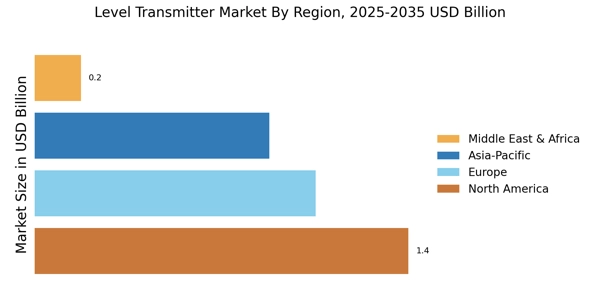
By region, the study provides market insights into North America, Europe, Asia-Pacific, and the Rest of the World. North America is a major market for level transmitters and is expected to dominate the Level Transmitter Market. The region has a strong presence of key players in the process automation industry, which drives the demand for level transmitters in various applications, such as power generation, oil and gas, chemical, and water and wastewater treatment. In North America, the U.S. is the largest market for level transmitters, driven by the presence of a large number of power generation facilities, chemical plants, and oil refineries.

The increasing demand for process automation and the need to improve operational efficiency and safety in these industries is driving the growth of the Level Transmitter Market in the region.

Level Transmitter Market Regional Image

Key Players and Competitive Insights

The major market players are investing a lot of money in R&D to expand their product lines, which will spur further market growth. With significant market development such as new product releases, contractual agreements, mergers and acquisitions, increased investments, and collaboration with other organizations, market participants are also undertaking various strategic activities to expand their  presence. To grow and thrive in a market climate that is becoming more competitive and growing, competitors in the Level Transmitter industry must offer affordable products. Manufacturing locally to cut operating costs is one of the main business tactics manufacturers use in the  Level Transmitter industry to benefit customers and expand the market sector. Major market players, including ABB Ltd, Fuji Electric Co, Magnetrol International Inc, and Endress+Hauser Management, are attempting to increase market demand by funding R&D initiatives. Fuji Electric offers power electronic and semiconductor products. It provides servo systems, motors, inverters, controllers, measurement devices, etc. To allow process automation in industries, the business also links its power electronics products with measurement devices and the internet of things (IoT). Magnetrol produces a range of technological solutions for measuring and controlling. It provides goods including thermal mass flow meters, liquid level transmitters, displacer switches, magnetic level indicators, and more. The business serves a variety of industries, including the chemical, food, renewable energy, and power-generating sectors.

Key Companies in the Level Transmitter Market include

Industry Developments

August 2022: Magnetrol announced the launch of its Pulsar Model R80 – 80 GHz radar level transmitter.

September 2020: Endress+Hauser Management announced it had expanded its presence in the Middle East. The company will support all regional solutions, sales, and service activities.

Future Outlook

Level Transmitter Market Future Outlook

The Level Transmitter Market is projected to grow at a 2.32% CAGR from 2025 to 2035, driven by advancements in automation, increasing demand for precision measurement, and expanding industrial applications.

New opportunities lie in:

  • Integration of IoT technology for real-time monitoring solutions. Development of customized level transmitters for niche industries. Expansion into emerging markets with tailored product offerings.

By 2035, the Level Transmitter Market is expected to achieve robust growth and enhanced market positioning.

Market Segmentation

Level Transmitter Market Product Outlook

  • Magnetic level transmitter
  • Capacitance level transmitter
  • Radar level transmitter
  • Ultrasonic level sensor or transmitter
  • Digital level transmitter
  • Hydrostatic level transmitter
  • Displacer level transmitter

Level Transmitter Market End-User Outlook

  • Power Generation
  • Oil & Gas
  • Chemical industry
  • Metals & Mining
  • Food & beverages
  • Others

Report Scope

MARKET SIZE 2024 3.428(USD Billion)
MARKET SIZE 2025 3.507(USD Billion)
MARKET SIZE 2035 4.411(USD Billion)
COMPOUND ANNUAL GROWTH RATE (CAGR) 2.32% (2025 - 2035)
REPORT COVERAGE Revenue Forecast, Competitive Landscape, Growth Factors, and Trends
BASE YEAR 2024
Market Forecast Period 2025 - 2035
Historical Data 2019 - 2024
Market Forecast Units USD Billion
Key Companies Profiled Emerson Electric Co (US), Endress+Hauser AG (CH), Siemens AG (DE), Honeywell International Inc (US), VEGA Grieshaber KG (DE), KROHNE Group (DE), Yokogawa Electric Corporation (JP), ABB Ltd (CH), Level Measurement Solutions (US)
Segments Covered Product, End-User, Region
Key Market Opportunities Integration of advanced IoT solutions enhances real-time monitoring in the Level Transmitter Market.
Key Market Dynamics Technological advancements drive innovation in level transmitters, enhancing accuracy and efficiency across various industries.
Countries Covered North America, Europe, APAC, South America, MEA

Market Highlights

Author
Author
Author Profile
Ankit Gupta LinkedIn
Team Lead - Research
Ankit Gupta is a seasoned market intelligence and strategic research professional with over six plus years of experience in the ICT and Semiconductor industries. With academic roots in Telecom, Marketing, and Electronics, he blends technical insight with business strategy. Ankit has led 200+ projects, including work for Fortune 500 clients like Microsoft and Rio Tinto, covering market sizing, tech forecasting, and go-to-market strategies. Known for bridging engineering and enterprise decision-making, his insights support growth, innovation, and investment planning across diverse technology markets.
Leave a Comment

FAQs

What is the projected market valuation of the Level Transmitter Market in 2035?

The projected market valuation for the Level Transmitter Market in 2035 is 4.411 USD Billion.

What was the overall market valuation of the Level Transmitter Market in 2024?

The overall market valuation of the Level Transmitter Market was 3.428 USD Billion in 2024.

What is the expected CAGR for the Level Transmitter Market during the forecast period 2025 - 2035?

The expected CAGR for the Level Transmitter Market during the forecast period 2025 - 2035 is 2.32%.

Which segment is projected to have the highest valuation in the Level Transmitter Market by 2035?

The Oil & Gas segment is projected to have the highest valuation, reaching between 0.9 and 1.1 USD Billion.

What are the key players in the Level Transmitter Market?

Key players in the Level Transmitter Market include Emerson Electric Co, Endress+Hauser AG, Siemens AG, and Honeywell International Inc.

How does the valuation of Magnetic level transmitters compare to Ultrasonic level sensors in 2025?

In 2025, the valuation of Magnetic level transmitters is expected to be between 0.686 and 0.845 USD Billion, while Ultrasonic level sensors are projected to be between 0.343 and 0.422 USD Billion.

What is the projected valuation for the Chemical industry segment in the Level Transmitter Market by 2035?

The projected valuation for the Chemical industry segment in the Level Transmitter Market by 2035 is between 0.6 and 0.75 USD Billion.

Which end-user segment is expected to show growth in the Level Transmitter Market?

The Power Generation segment is expected to show growth, with a projected valuation of 0.8 to 0.95 USD Billion.

What is the valuation range for Digital level transmitters in 2025?

The valuation range for Digital level transmitters in 2025 is expected to be between 0.686 and 0.845 USD Billion.

How does the Metals & Mining segment's valuation compare to the Food & Beverages segment in 2025?

In 2025, the Metals & Mining segment is projected to have a valuation of 0.5 to 0.6 USD Billion, compared to the Food & Beverages segment's valuation of 0.4 to 0.5 USD Billion.

Research Approach

Secondary Research

The secondary research process involved comprehensive analysis of regulatory databases, industry standards repositories, peer-reviewed engineering journals, technical publications, and authoritative industrial organizations. Key sources included:

Regulatory & Standards Bodies:

International Electrotechnical Commission (IEC) – Standards for process control equipment and instrumentation (IEC 61508, IEC 61511 for functional safety)

International Organization for Standardization (ISO) – ISO 9001 (quality management), ISO/IEC 17025 (calibration laboratories)

American National Standards Institute (ANSI) – ISA standards for process instrumentation (ISA-5.1, ISA-84.00.01)

European Committee for Electrotechnical Standardization (CENELEC) – ATEX directives for hazardous area equipment (2014/34/EU)

National Electrical Manufacturers Association (NEMA) – Enclosure standards and electrical equipment ratings

Factory Mutual (FM) Global – Equipment safety certifications and approvals

Underwriters Laboratories (UL) – Product safety certifications for industrial instrumentation

Canadian Standards Association (CSA Group) – Standards for electrical and industrial equipment

Government & Industry Associations:

International Energy Agency (IEA) – Power generation statistics and industrial automation trends

U.S. Energy Information Administration (EIA) – Power plant operational data and infrastructure investments

European Environment Agency (EEA) – Industrial emissions monitoring requirements driving level measurement adoption

U.S. Environmental Protection Agency (EPA) – Regulations on industrial wastewater and chemical storage (Clean Water Act, RCRA)

Occupational Safety and Health Administration (OSHA) – Process safety management regulations (29 CFR 1910.119)

American Petroleum Institute (API) – Standards for oil and gas storage and processing (API 2350, API 653)

International Association of Oil & Gas Producers (IOGP) – Instrumentation and safety guidelines for upstream/downstream operations

National Association of Manufacturers (NAM) – Industrial automation adoption trends and capital expenditure data

VDMA (German Mechanical Engineering Industry Association) – Process automation and instrumentation market data

China Instrument Manufacturers Association (CIMA) – Domestic instrumentation production and deployment statistics

Technical & Research Databases:

IEEE Xplore Digital Library – Technical papers on radar, ultrasonic, and capacitance sensing technologies

ScienceDirect (Elsevier) – Process control and instrumentation engineering research

SpringerLink – Industrial automation and sensor technology publications

Engineering Village (Compendex) – Technical literature on level measurement technologies

Google Scholar – Academic research on industrial IoT integration and smart instrumentation

Market Intelligence & Trade Publications:

Control Engineering Magazine – Industrial automation market analysis and technology trends

Process Instrumentation & Control News – Product launches and industry developments

Automation World – End-user adoption patterns and digital transformation in process industries

Hydrocarbon Processing – Oil & gas industry instrumentation requirements and investments

Power Engineering International – Power generation sector technology deployments

Chemical Engineering Magazine – Process industry instrumentation standards and market sizing

Financial & Economic Data:

Organisation for Economic Co-operation and Development (OECD) – Industrial production indices and manufacturing value-added by country

World Bank Open Data – Industrial sector GDP contributions and infrastructure investments

United Nations Industrial Development Organization (UNIDO) – Global manufacturing statistics by sector

Bureau of Economic Analysis (BEA) – U.S. industrial equipment investment data

Eurostat – European industrial production statistics and capital goods trade data

National Bureau of Statistics of China – Industrial automation equipment production and sales volumes

These sources were used to collect technology adoption statistics, certification requirements, safety regulation impacts, industrial production trends, and competitive landscape analysis for radar level transmitters, ultrasonic sensors, capacitance transmitters, hydrostatic transmitters, magnetic level gauges, and displacer transmitters.

Primary Research

In order to gather both qualitative and quantitative insights, supply-side and demand-side stakeholders were interviewed during the primary research process. CEOs, VPs of Engineering, heads of product development, and global sales directors from level transmitter producers, component suppliers, and system integrators were examples of supply-side sources. Plant managers, instrumentation engineers, maintenance supervisors, and procurement leads from power generation utilities, oil and gas operators, chemical processing facilities, water treatment plants, and food and beverage manufacturers were examples of demand-side suppliers. Technology segmentation, product development roadmaps, installation preferences, total cost of ownership variables, and aftermarket service dynamics were all confirmed by primary research.

Primary Respondent Breakdown:

By Designation: C-level Primaries (28%), Director Level (32%), Others (40%)

By Region: North America (31%), Europe (29%), Asia-Pacific (33%), Rest of World (7%)

Market Size Estimation

Global market valuation was derived through revenue mapping and unit shipment analysis. The methodology included:

Identification of 50+ key manufacturers across North America, Europe, Asia-Pacific, and Middle East

Technology mapping across radar (guided wave and non-contact), ultrasonic, capacitance, hydrostatic, magnetic, displacer, and digital level transmitter categories

Analysis of reported and modeled annual revenues specific to level measurement portfolios

Coverage of manufacturers representing 75-80% of global market share in 2024

Extrapolation using bottom-up (unit shipments × ASP by technology and end-user vertical) and top-down (manufacturer revenue validation and industry spend analysis) approaches to derive segment-specific valuations

Cross-validation against automation vendor consolidated financial reports and industry association shipment data

Data Triangulation & Validation

Research findings were validated through:

Triangulation: Cross-referencing primary interview data with secondary source statistics and analyst proprietary databases

Expert Review: Consultation with independent instrumentation consultants and retired industry executives for market reality checks

Feedback Loops: Circulation of draft findings to primary respondents for factual verification and refinement

Sensitivity Analysis: Testing assumptions around growth rates, pricing erosion, and technology substitution effects

This methodology ensures robust, defensible market sizing and trend analysis for the global level transmitter market across all product segments and geographic regions.

Download Free Sample

Kindly complete the form below to receive a free sample of this Report

Compare Licence

×
Features License Type
Single User Multiuser License Enterprise User
Price $4,950 $5,950 $7,250
Maximum User Access Limit 1 User Upto 10 Users Unrestricted Access Throughout the Organization
Free Customization
Direct Access to Analyst
Deliverable Format
Platform Access
Discount on Next Purchase 10% 15% 15%
Printable Versions