
×
Request Free Sample ×

Kindly complete the form below to receive a free sample of this Report

* Please use a valid business email

Leading companies partner with us for data-driven Insights

clients tt-cursor
Hero Background
English
Chinese
French
Japanese
Korean
German
Spanish

Less Lethal Ammunition Market Trends

ID: MRFR/AD/8228-HCR
168 Pages
Sejal Akre
February 2026

Less Lethal Ammunition Market Size, Share, Industry Trend & Analysis Research Report Information by Product (Rubber Bullets, Bean Bag Rounds, Polyethylene/Plastic Bullets, OC/CS & Smoke Munitions, Flash Bang Rounds, Paintballs And Others), By Weapon Type (Shotguns, Launchers And Others), By End-Users (Law Enforcement, Military, Self Defense And Others) And By Region (North America, Europe, Asia-Pacific, And Rest Of The World) – Forecast Till 2032

Share:
Download PDF ×

We do not share your information with anyone. However, we may send you emails based on your report interest from time to time. You may contact us at any time to opt-out.

Less Lethal Ammunition Market Infographic
Purchase Options

Market Trends

Key Emerging Trends in the Less Lethal Ammunition Market

The Less Lethal Ammunition market is witnessing significant developments as law enforcement agencies, military forces, and civilian security organizations increasingly seek alternatives to traditional lethal ammunition. This market addresses the growing demand for non-lethal options that can effectively incapacitate or deter targets while minimizing the risk of fatal injuries. As of the latest trends, there is a noticeable emphasis on technological innovations, improved effectiveness, and the expansion of less lethal ammunition applications in various operational scenarios.

One key trend in the Less Lethal Ammunition market is the development of advanced technologies to enhance the accuracy and efficacy of less lethal projectiles. Manufacturers are focusing on innovations such as fin-stabilized rounds, precision-guided munitions, and smart projectiles with integrated electronics. These technologies aim to provide more accurate targeting, reduce the risk of collateral damage, and improve overall operational effectiveness in both law enforcement and military applications.

The market is witnessing a surge in demand for less lethal ammunition in crowd control and civil unrest situations. As concerns about public safety and human rights grow, there is an increased recognition of the importance of non-lethal options for maintaining order and managing protests. Less lethal ammunition, including rubber bullets, bean bag rounds, and pepper spray projectiles, is being widely adopted by law enforcement agencies worldwide to address these challenges while minimizing the risk of severe injuries.

Less lethal ammunition is evolving to offer a broader range of options for various scenarios. Beyond traditional riot control applications, less lethal ammunition is finding use in scenarios such as home defense, maritime security, and border control. This trend reflects a recognition of the versatility of less lethal options in addressing a diverse range of security challenges without resorting to deadly force.

The market is witnessing advancements in less lethal technology that focus on reducing the potential for unintended injuries. Manufacturers are exploring designs that minimize the risk of penetration, enhance projectile stability, and optimize the energy transfer upon impact. These innovations aim to strike a balance between effectiveness and safety, addressing concerns about the potential harm caused by less lethal ammunition.

International regulations and standards are influencing Less Lethal Ammunition market trends. Governments and law enforcement agencies are increasingly adopting guidelines that define the acceptable use and deployment of less lethal options. This trend emphasizes the importance of ethical considerations, human rights, and accountability in the development and deployment of less lethal ammunition, contributing to a more responsible and transparent market.

The market is witnessing increased collaboration between less lethal ammunition manufacturers and technology providers. Partnerships aim to integrate emerging technologies, such as sensors, communication devices, and non-lethal deterrents, into less lethal ammunition systems. These collaborations contribute to the development of integrated solutions that enhance the capabilities of less lethal options while providing additional functionalities for tactical operations.

A focus on less lethal ammunition training and education is becoming integral to market trends. Law enforcement and military agencies recognize the importance of proper training in the effective and responsible use of less lethal options. Training programs are being developed to ensure that personnel are well-equipped to deploy less lethal ammunition accurately and judiciously, emphasizing de-escalation and conflict resolution.

Market trends in Less Lethal Ammunition also include a shift towards environmentally friendly options. Manufacturers are exploring less toxic and biodegradable materials for less lethal projectiles to minimize the environmental impact. This trend aligns with broader sustainability goals and regulatory considerations, reflecting an industry commitment to responsible manufacturing practices.


Author
Sejal Akre
Senior Research Analyst

She has over 5 years of rich experience, in market research and consulting providing valuable market insights to client. Hands on expertise in management consulting, and extensive knowledge in domain including ICT, Automotive & Transportation and Aerospace & Defense. She is skilled in Go-to market strategy, industry analysis, market sizing, in depth company profiling, competitive intelligence & benchmarking and value chain amongst others.

Leave a Comment

FAQs

What is the current valuation of the Less Lethal Ammunition Market as of 2024?

<p>The market valuation was 0.89 USD Billion in 2024.</p>

What is the projected market size for the Less Lethal Ammunition Market by 2035?

<p>The market is projected to reach 4.668 USD Billion by 2035.</p>

What is the expected CAGR for the Less Lethal Ammunition Market during the forecast period 2025 - 2035?

<p>The expected CAGR for the market is 16.26% during the forecast period.</p>

Which product segment is anticipated to have the highest valuation in 2035?

<p>Rubber Bullets are expected to have the highest valuation, projected at 1.335 USD Billion in 2035.</p>

How do Bean Bag Rounds perform in terms of market valuation from 2024 to 2035?

<p>Bean Bag Rounds are projected to grow from 0.178 USD Billion in 2024 to 0.89 USD Billion by 2035.</p>

What are the key players in the Less Lethal Ammunition Market?

<p>Key players include Axon Enterprise, Taser International, and Defense Technology among others.</p>

What is the projected valuation for Shotguns in the Less Lethal Ammunition Market by 2035?

<p>Shotguns are projected to reach a valuation of 1.85 USD Billion by 2035.</p>

Which end-user segment is expected to dominate the market by 2035?

<p>The Law Enforcement segment is expected to dominate, projected at 1.85 USD Billion in 2035.</p>

What is the anticipated growth for Polyethylene/Plastic Bullets from 2024 to 2035?

<p>Polyethylene/Plastic Bullets are expected to grow from 0.089 USD Billion in 2024 to 0.445 USD Billion by 2035.</p>

How does the market for Less Lethal Ammunition compare across different weapon types?

<p>By 2035, Shotguns are projected to lead with 1.85 USD Billion, followed by Launchers at 1.25 USD Billion.</p>

Market Summary

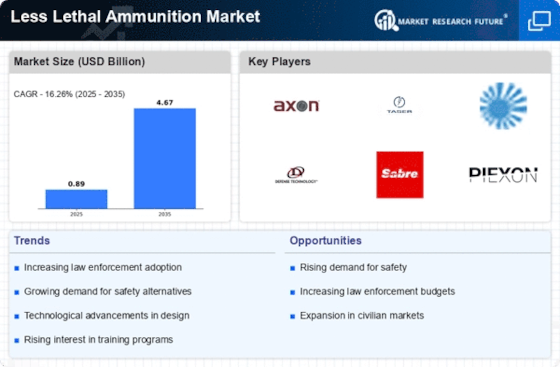
As per Market Research Future analysis, the Less Lethal Ammunition Market Size was estimated at 0.89 USD Billion in 2024. The Less Lethal Ammunition industry is projected to grow from USD 1.035 Billion in 2025 to USD 4.668 Billion by 2035, exhibiting a compound annual growth rate (CAGR) of 16.26% during the forecast period 2025 - 2035

Key Market Trends & Highlights

The Less Lethal Ammunition Market is experiencing robust growth driven by technological advancements and increasing adoption across various sectors.

  • Technological advancements are enhancing the effectiveness and safety of less lethal ammunition options.
  • North America remains the largest market, while the Asia-Pacific region is emerging as the fastest-growing area for less lethal solutions.
  • Rubber bullets dominate the market, whereas bean bag rounds are witnessing the fastest growth in demand.
  • The growing focus on public safety and regulatory support for non-lethal options are key drivers propelling market expansion.

Market Size & Forecast

2024 Market Size 0.89 (USD Billion)
2035 Market Size 4.668 (USD Billion)
CAGR (2025 - 2035) 16.26%
Largest Regional Market Share in 2024 North America

Major Players

Axon Enterprise (US), Taser International (US), Nonlethal Technologies (US), Defense Technology (US), SABRE (US), Piexon AG (CH), Condor Non-Lethal Technologies (US), Rheinmetall AG (DE), BolaWrap (US)

Market Trends

The Less Lethal Ammunition Market is currently experiencing a notable evolution, driven by various factors including advancements in technology and changing law enforcement practices. As public safety concerns rise, there is an increasing demand for alternatives to traditional firearms. This shift is prompting manufacturers to innovate and develop more effective less lethal options that can incapacitate without causing permanent harm. The market appears to be expanding as both governmental and private sectors recognize the potential benefits of these products in crowd control and law enforcement scenarios. Moreover, the growing emphasis on human rights and the need for de-escalation techniques in policing are influencing the adoption of less lethal ammunition. This trend suggests a broader acceptance of these tools as viable options for maintaining order while minimizing the risk of fatal outcomes. As the Less Lethal Ammunition Market continues to evolve, it is likely that regulatory frameworks will adapt to accommodate these innovations, further shaping the landscape of non-lethal options available to security forces and civilians alike.

Technological Advancements

Recent innovations in materials and design are enhancing the effectiveness and safety of less lethal ammunition. Manufacturers are focusing on creating projectiles that minimize injury while maximizing incapacitation, which could lead to broader acceptance in various sectors.

Increased Adoption by Law Enforcement

There is a growing trend among law enforcement agencies to incorporate less lethal options into their standard operating procedures. This shift may reflect a desire to reduce fatalities during confrontations, indicating a potential long-term commitment to non-lethal strategies.

Regulatory Changes

As the Less Lethal Ammunition Market matures, regulatory bodies are likely to establish clearer guidelines governing the use and distribution of these products. Such developments could influence market dynamics and encourage responsible usage among consumers.

Less Lethal Ammunition Market Market Drivers

Increased Focus on Public Safety

The heightened focus on public safety and community relations is emerging as a crucial driver for the Less Lethal Ammunition Market. In recent years, there has been a notable shift in law enforcement strategies towards community-oriented policing, which emphasizes building trust and cooperation with the public. This paradigm shift necessitates the use of less lethal options to mitigate the risk of fatal encounters during law enforcement operations. Market analysis indicates that regions prioritizing community safety initiatives are likely to see a 7% increase in the adoption of less lethal ammunition. As police departments seek to enhance their operational effectiveness while maintaining public trust, the Less Lethal Ammunition Market is expected to benefit from this evolving landscape.

Growing Demand for Non-Lethal Options

The increasing demand for non-lethal options in various sectors appears to be a primary driver for the Less Lethal Ammunition Market. As concerns regarding public safety and the potential for lethal force escalate, law enforcement agencies and private security firms are increasingly seeking alternatives that minimize fatal outcomes. This trend is reflected in the market data, which indicates a projected growth rate of approximately 5.5% annually over the next five years. The shift towards non-lethal solutions is not only a response to societal pressures but also aligns with evolving policies that favor de-escalation tactics. Consequently, the Less Lethal Ammunition Market is likely to experience heightened interest from both governmental and private entities, further solidifying its position in the broader security landscape.

Rising Awareness of Human Rights Issues

The rising awareness of human rights issues is increasingly influencing the Less Lethal Ammunition Market. As global conversations around police brutality and the use of excessive force gain traction, there is a growing demand for alternatives that prioritize human rights and minimize harm. This societal shift is prompting law enforcement agencies to reconsider their use of lethal force and explore less lethal options. Market data indicates that regions with heightened human rights advocacy are likely to see a 5% increase in the adoption of less lethal ammunition. As public sentiment continues to evolve, the Less Lethal Ammunition Market is expected to adapt, providing solutions that align with the principles of accountability and responsible policing.

Technological Innovations in Ammunition

Technological innovations in ammunition design and delivery systems are significantly influencing the Less Lethal Ammunition Market. Advances in materials science and engineering have led to the development of more effective and reliable less lethal options, such as bean bag rounds and rubber bullets. These innovations enhance the accuracy and effectiveness of less lethal ammunition, making it a more attractive choice for law enforcement and military applications. Market data suggests that the segment for technologically advanced less lethal ammunition is expected to grow by 6% annually, driven by the need for improved performance and safety. As manufacturers continue to invest in research and development, the Less Lethal Ammunition Market is poised for substantial growth, catering to the evolving needs of security forces worldwide.

Regulatory Support for Less Lethal Solutions

Regulatory support for less lethal solutions is becoming increasingly prominent, serving as a significant driver for the Less Lethal Ammunition Market. Governments are recognizing the need for policies that promote the use of non-lethal options in law enforcement and crowd control scenarios. This regulatory environment is fostering an atmosphere conducive to the development and deployment of less lethal ammunition. Recent legislative measures in various jurisdictions have encouraged police departments to adopt these alternatives, resulting in a projected market growth of 4.5% over the next few years. As regulations evolve to support the use of less lethal options, the Less Lethal Ammunition Market is likely to expand, providing law enforcement agencies with the tools necessary to address public safety concerns effectively.

Market Segment Insights

By Product: Rubber Bullets (Largest) vs. Bean Bag Rounds (Fastest-Growing)

<p>In the Less Lethal Ammunition Market, Rubber Bullets significantly lead the segment, owing to their widespread application in law enforcement and crowd control scenarios. Their adaptability and effectiveness in various situations have made them the largest contributor to market share. Following closely are Bean Bag Rounds, which are gaining recognition for their non-lethal approach to deterrence in policing and security operations, thus capturing an increasing share of the market as their use becomes more standardized. The growth trends in this segment are driven by a rising demand for non-lethal options that minimize fatalities while ensuring compliance with safety regulations. Increasing awareness and integration of less lethal options in tactical training for law enforcement and military have also spurred demand. Additionally, innovations in materials and manufacturing processes aim to enhance the efficacy and safety of these products, enabling them to meet the evolving needs of diverse applications, from riot control to wildlife management.</p>

<p>Rubber Bullets (Dominant) vs. Bean Bag Rounds (Emerging)</p>

<p>Rubber Bullets have established themselves as the dominant force in the less lethal ammunition space, largely due to their versatility in various operational contexts. Used extensively in crowd control situations, they offer a balance between effectiveness and safety, garnering trust from law enforcement agencies. The innovation in designs, including improved accuracy and reduced potential for injury, has further solidified their position in the market. On the other hand, Bean Bag Rounds are emerging as a significant player, increasingly favored for their capacity to incapacitate subjects without causing permanent harm. Their appeal lies in their increasing acceptance as a standard option for soft impact projectiles, driven by rigorous testing and endorsement from police departments for tactical operations. This duality showcases the varied approaches within the segment, catering to distinct operational needs while emphasizing a commitment to minimizing harm.</p>

By Weapon Type: Shotguns (Largest) vs. Launchers (Fastest-Growing)

<p>In the Less Lethal Ammunition Market, the weapon type segment is witnessing a diverse distribution among its key players. Shotguns dominate the market landscape, gaining significant traction due to their reliability and user-friendliness in crowd control and law enforcement scenarios. Their established presence and historical usage contribute to their large market share, appealing to both military and civilian users. Conversely, launchers are emerging as a promising segment, capturing a growing share of the market as they offer innovative solutions for non-lethal engagements. The growth trends in this segment are driven by increasing demand for less lethal options across various applications. Law enforcement agencies and military organizations are increasingly seeking alternatives to traditional ammunition to minimize fatalities while ensuring effective control during operations. The continuous advancements in technology and safety standards are further propelling the adoption of launchers, positioning them as the fastest-growing category within the market. The overall trend indicates a shift towards versatile and adaptable weapon systems that meet the evolving needs of users.</p>

<p>Shotguns (Dominant) vs. Launchers (Emerging)</p>

<p>Shotguns serve as the dominant force in the Less Lethal Ammunition Market, revered for their versatility and effectiveness in various scenarios including crowd dispersal and personal defense. Their capability to deploy a range of less lethal munitions makes them a preferred choice among law enforcement and security personnel. In contrast, launchers, while currently classified as an emerging segment, are swiftly gaining popularity due to their ability to deliver non-lethal munitions over greater distances and with enhanced accuracy. The innovative design of launchers allows for greater tactical flexibility, catering to specialized units that require precision and less lethal options for various operational contexts. As the market evolves, both shotguns and launchers will continue to play pivotal roles in the landscape of less lethal ammunition.</p>

By End-User: Law Enforcement (Largest) vs. Self Defense (Fastest-Growing)

<p>The less lethal ammunition market is primarily segmented into law enforcement, military, self-defense, and others. Law enforcement remains the largest segment, driven by its widespread application in various police operations and incident management. The military segment, while significant, has seen more stable demand due to its controlled usage conditions. Self-defense is emerging as a robust segment, reflecting a growing consumer interest in personal protection and associated training programs. Growth trends in this market are driven largely by increasing urban violence, changes in law enforcement policies, and rising awareness of less lethal options among civilians. The self-defense segment is experiencing significant traction, fueled by heightened concerns about personal safety and proactive security measures among individuals. In contrast, law enforcement remains steady but is adapting to innovate technologies that improve the effectiveness of less lethal rounds.</p>

<p>Law Enforcement (Dominant) vs. Self Defense (Emerging)</p>

<p>In the less lethal ammunition market, law enforcement represents the dominant segment due to its extensive adoption and reliance on non-lethal options for crowd control and conflict de-escalation. This segment is characterized by partnerships between ammunition manufacturers and police departments to enhance training and efficacy in real-world applications. Meanwhile, the self-defense segment is rapidly emerging, appealing to civilian users who are increasingly investing in personal security measures. This growth is propelled by increased awareness of legal self-defense options and a rising willingness to engage in safety training, resulting in a more informed and responsible consumer base. The dual focus on effectiveness and safety defines the dynamics of these segments as they cater to different but overlapping user needs.</p>

Get more detailed insights about Less Lethal Ammunition Market Research Report - Global Forecast till 2035

Regional Insights

North America : Market Leader in Innovation

North America is the largest market for less lethal ammunition, holding approximately 45% of the global share. The region's growth is driven by increasing law enforcement adoption, rising public safety concerns, and advancements in technology. Regulatory support from government agencies further catalyzes market expansion, with a focus on non-lethal options for crowd control and policing. The United States is the primary contributor, with key players like Axon Enterprise and Taser International leading the market. The competitive landscape is characterized by innovation and a strong emphasis on research and development. The presence of established companies ensures a robust supply chain and distribution network, enhancing market accessibility.

Europe : Emerging Market with Regulations

Europe is witnessing significant growth in the less lethal ammunition market, accounting for about 30% of the global share. The demand is driven by increasing concerns over public safety and the need for non-lethal options in law enforcement. Regulatory frameworks across various countries are evolving to support the use of less lethal technologies, enhancing market potential and adoption rates. Leading countries include Germany and the UK, where companies like Rheinmetall AG are prominent. The competitive landscape is marked by a mix of established firms and emerging players, fostering innovation. The presence of stringent regulations ensures that products meet safety and efficacy standards, further driving market growth.

Asia-Pacific : Rapid Growth in Demand

Asia-Pacific is rapidly emerging as a significant market for less lethal ammunition, holding approximately 20% of the global share. The growth is fueled by increasing urbanization, rising crime rates, and a growing emphasis on public safety. Governments are increasingly adopting non-lethal options for law enforcement, supported by favorable regulations and initiatives aimed at reducing violence in public spaces. Countries like Japan and Australia are leading the charge, with a growing number of local manufacturers entering the market. The competitive landscape is evolving, with both domestic and international players vying for market share. The presence of key companies like Piexon AG enhances the region's capabilities in less lethal technologies, driving innovation and accessibility.

Middle East and Africa : Untapped Potential in Security

The Middle East and Africa region is gradually recognizing the importance of less lethal ammunition, currently holding about 5% of the global market share. The growth is driven by increasing security concerns, particularly in conflict-prone areas, and a shift towards non-lethal options for crowd control and law enforcement. Governments are beginning to explore regulatory frameworks to support the adoption of these technologies, indicating a positive trend for future growth. Countries like South Africa and the UAE are at the forefront, with a growing interest in non-lethal solutions. The competitive landscape is still developing, with opportunities for both local and international players to establish a presence. The market is characterized by a need for innovative solutions tailored to regional security challenges, paving the way for future investments.

Key Players and Competitive Insights

Leading market players are extensively spending in R&D to extend their product lines, which will help the less lethal ammunition market grow even more. Market participants are also engaging in a number of strategic initiatives to grow their worldwide presence, with significant market developments including new product launches, contractual agreements, mergers and acquisitions, increased investments, and collaboration with other organizations. Less lethal munitions industry must produce cost-effective things to expand and thrive in a more competitive and expanding market climate.Producing locally to reduce operational costs is one of the primary business strategies adopted by manufacturers in the worldwide less lethal ammunition industry to assist clients and expand the market sector. In recent years, the less lethal munitions industry has provided some of the most significant benefits to medicine. The Safariland Group (US), Combined Systems, Inc. (US), Federal Ammunition (US), Nonlethal Technologies (US), Rheinmetall AG (Germany), ST Engineering (Singapore), Security Device International, Inc. (US), Lemperd Less Lethal, Inc. (Canada), and others are among the major players in the less lethal ammunition market.Mergers and acquisitions amongst industry participants have recently helped the corporations enhance their market presence.Rheinmetall AG, located in Düsseldorf, Germany, is a German automobile and armaments company. Its stock is listed on the Frankfurt stock exchange. In 1889, the Hörder Verein founded the Rheinische Metallwaaren- und Maschinenfabrik Aktiengesellschaft. Lorenz Zuckermandel (1847-1928), a banker and investor, was one of the founders and the first chairman of the supervisory board. Steel items, notably armaments, were manufactured by the business. Rheinmetall diversified during Germany's post-World War I disarmament, but by the 1930s, military production had resumed.It purchased A. Borsig GmbH, a locomotive manufacturer, in 1933.

In September The Rheinmetall Dermalog SensorTec GmbH will make its public debut at the InCabin tradeshow in Brussels on September 15, 2022. Rheinmetall Dermalog SensorTec GmbH is a joint venture between Rheinmetall AG, a technology company, and the largest biometrics company in Germany. The joint venture will present opportunities for collaboration with clients and industry experts while showcasing its initial innovations.A TASER is a Conducted Energy Device that is used to immobilize persons so that they can be approached and handled in an unresisting and hence safe manner. Axon, previously TASER International, sells it. At 55 m/s (120 mph; 200 km/h), it releases two small barbed darts designed to pierce the flesh and remain attached to the target. Non-Law Enforcement Tasers have a range of 4.5 m (15 ft), while Law Enforcement Tasers have a range of 10.5 m (34 ft).The darts are linked to the main unit by a thin insulated copper wire and produce a modulated electric current that disrupts voluntary muscle control, resulting in "neuromuscular incapacitation.

In February  The San Jose (California, US) police declared the use of less lethal weaponry to control crowds in place of guns, rubber bullets, and batons. New TASER types, pepper spray, and tether launchers are among the new weapons that can be used to subdue attackers.

Key Companies in the Less Lethal Ammunition Market include

Industry Developments

For instance, In October 2021, Non-lethal weapons were developed by an Indian company, Apasteron Pvt Ltd, to aid in warfare in situations where lethal weapons and ammunition are prohibited. The security forces from India stationed in the border areas will utilize the weaponry.

For instance, In September 2022, A strategic partnership to transform land defence capabilities has been announced by Helsing, the top European supplier of software and hardware for defence systems, and Rheinmetall, a seasoned, trusted partner of digitalized armed forces worldwide.

In October 2019, Rubber bullets were also deployed by Gauteng police to restrain union employees protesting outside Dis-office Chem's in Johannesburg.


Future Outlook

Less Lethal Ammunition Market Future Outlook

The Less Lethal Ammunition Market is projected to grow at a 16.26% CAGR from 2025 to 2035, driven by increasing law enforcement demand and advancements in technology.

New opportunities lie in:

  • Development of smart ammunition with integrated tracking systems.
  • Expansion into emerging markets with tailored product offerings.
  • Partnerships with law enforcement agencies for training and product integration.

By 2035, the market is expected to solidify its position as a leader in non-lethal defense solutions.

Market Segmentation

Less Lethal Ammunition Market Product Outlook

  • Rubber Bullets
  • Bean Bag Rounds
  • Polyethylene/Plastic Bullets
  • OC/CS & Smoke Munitions
  • Flash Bang Rounds
  • Paintballs
  • Others

Less Lethal Ammunition Market End-User Outlook

  • Law Enforcement
  • Military
  • Self Defense
  • Others

Less Lethal Ammunition Market Weapon Type Outlook

  • Shotguns
  • Launchers
  • Others

Report Scope

MARKET SIZE 2024 0.89(USD Billion)
MARKET SIZE 2025 1.035(USD Billion)
MARKET SIZE 2035 4.668(USD Billion)
COMPOUND ANNUAL GROWTH RATE (CAGR) 16.26% (2025 - 2035)
REPORT COVERAGE Revenue Forecast, Competitive Landscape, Growth Factors, and Trends
BASE YEAR 2024
Market Forecast Period 2025 - 2035
Historical Data 2019 - 2024
Market Forecast Units USD Billion
Key Companies Profiled Axon Enterprise (US), Taser International (US), Nonlethal Technologies (US), Defense Technology (US), SABRE (US), Piexon AG (CH), Condor Non-Lethal Technologies (US), Rheinmetall AG (DE), BolaWrap (US)
Segments Covered Product, Weapon Type, End-Users, Region
Key Market Opportunities Growing demand for non-lethal options in law enforcement and crowd control enhances Less Lethal Ammunition Market potential.
Key Market Dynamics Rising demand for non-lethal options drives innovation and regulatory scrutiny in the less lethal ammunition market.
Countries Covered North America, Europe, APAC, South America, MEA

FAQs

What is the current valuation of the Less Lethal Ammunition Market as of 2024?

<p>The market valuation was 0.89 USD Billion in 2024.</p>

What is the projected market size for the Less Lethal Ammunition Market by 2035?

<p>The market is projected to reach 4.668 USD Billion by 2035.</p>

What is the expected CAGR for the Less Lethal Ammunition Market during the forecast period 2025 - 2035?

<p>The expected CAGR for the market is 16.26% during the forecast period.</p>

Which product segment is anticipated to have the highest valuation in 2035?

<p>Rubber Bullets are expected to have the highest valuation, projected at 1.335 USD Billion in 2035.</p>

How do Bean Bag Rounds perform in terms of market valuation from 2024 to 2035?

<p>Bean Bag Rounds are projected to grow from 0.178 USD Billion in 2024 to 0.89 USD Billion by 2035.</p>

What are the key players in the Less Lethal Ammunition Market?

<p>Key players include Axon Enterprise, Taser International, and Defense Technology among others.</p>

What is the projected valuation for Shotguns in the Less Lethal Ammunition Market by 2035?

<p>Shotguns are projected to reach a valuation of 1.85 USD Billion by 2035.</p>

Which end-user segment is expected to dominate the market by 2035?

<p>The Law Enforcement segment is expected to dominate, projected at 1.85 USD Billion in 2035.</p>

What is the anticipated growth for Polyethylene/Plastic Bullets from 2024 to 2035?

<p>Polyethylene/Plastic Bullets are expected to grow from 0.089 USD Billion in 2024 to 0.445 USD Billion by 2035.</p>

How does the market for Less Lethal Ammunition compare across different weapon types?

<p>By 2035, Shotguns are projected to lead with 1.85 USD Billion, followed by Launchers at 1.25 USD Billion.</p>

  1. SECTION I: EXECUTIVE SUMMARY AND KEY HIGHLIGHTS
    1. | 1.1 EXECUTIVE SUMMARY
    2. | | 1.1.1 Market Overview
    3. | | 1.1.2 Key Findings
    4. | | 1.1.3 Market Segmentation
    5. | | 1.1.4 Competitive Landscape
    6. | | 1.1.5 Challenges and Opportunities
    7. | | 1.1.6 Future Outlook
  2. SECTION II: SCOPING, METHODOLOGY AND MARKET STRUCTURE
    1. | 2.1 MARKET INTRODUCTION
    2. | | 2.1.1 Definition
    3. | | 2.1.2 Scope of the study
    4. | | | 2.1.2.1 Research Objective
    5. | | | 2.1.2.2 Assumption
    6. | | | 2.1.2.3 Limitations
    7. | 2.2 RESEARCH METHODOLOGY
    8. | | 2.2.1 Overview
    9. | | 2.2.2 Data Mining
    10. | | 2.2.3 Secondary Research
    11. | | 2.2.4 Primary Research
    12. | | | 2.2.4.1 Primary Interviews and Information Gathering Process
    13. | | | 2.2.4.2 Breakdown of Primary Respondents
    14. | | 2.2.5 Forecasting Model
    15. | | 2.2.6 Market Size Estimation
    16. | | | 2.2.6.1 Bottom-Up Approach
    17. | | | 2.2.6.2 Top-Down Approach
    18. | | 2.2.7 Data Triangulation
    19. | | 2.2.8 Validation
  3. SECTION III: QUALITATIVE ANALYSIS
    1. | 3.1 MARKET DYNAMICS
    2. | | 3.1.1 Overview
    3. | | 3.1.2 Drivers
    4. | | 3.1.3 Restraints
    5. | | 3.1.4 Opportunities
    6. | 3.2 MARKET FACTOR ANALYSIS
    7. | | 3.2.1 Value chain Analysis
    8. | | 3.2.2 Porter's Five Forces Analysis
    9. | | | 3.2.2.1 Bargaining Power of Suppliers
    10. | | | 3.2.2.2 Bargaining Power of Buyers
    11. | | | 3.2.2.3 Threat of New Entrants
    12. | | | 3.2.2.4 Threat of Substitutes
    13. | | | 3.2.2.5 Intensity of Rivalry
    14. | | 3.2.3 COVID-19 Impact Analysis
    15. | | | 3.2.3.1 Market Impact Analysis
    16. | | | 3.2.3.2 Regional Impact
    17. | | | 3.2.3.3 Opportunity and Threat Analysis
  4. SECTION IV: QUANTITATIVE ANALYSIS
    1. | 4.1 Aerospace & Defense, BY Product (USD Billion)
    2. | | 4.1.1 Rubber Bullets
    3. | | 4.1.2 Bean Bag Rounds
    4. | | 4.1.3 Polyethylene/Plastic Bullets
    5. | | 4.1.4 OC/CS & Smoke Munitions
    6. | | 4.1.5 Flash Bang Rounds
    7. | | 4.1.6 Paintballs
    8. | | 4.1.7 Others
    9. | 4.2 Aerospace & Defense, BY Weapon Type (USD Billion)
    10. | | 4.2.1 Shotguns
    11. | | 4.2.2 Launchers
    12. | | 4.2.3 Others
    13. | 4.3 Aerospace & Defense, BY End-User (USD Billion)
    14. | | 4.3.1 Law Enforcement
    15. | | 4.3.2 Military
    16. | | 4.3.3 Self Defense
    17. | | 4.3.4 Others
    18. | 4.4 Aerospace & Defense, BY Region (USD Billion)
    19. | | 4.4.1 North America
    20. | | | 4.4.1.1 US
    21. | | | 4.4.1.2 Canada
    22. | | 4.4.2 Europe
    23. | | | 4.4.2.1 Germany
    24. | | | 4.4.2.2 UK
    25. | | | 4.4.2.3 France
    26. | | | 4.4.2.4 Russia
    27. | | | 4.4.2.5 Italy
    28. | | | 4.4.2.6 Spain
    29. | | | 4.4.2.7 Rest of Europe
    30. | | 4.4.3 APAC
    31. | | | 4.4.3.1 China
    32. | | | 4.4.3.2 India
    33. | | | 4.4.3.3 Japan
    34. | | | 4.4.3.4 South Korea
    35. | | | 4.4.3.5 Malaysia
    36. | | | 4.4.3.6 Thailand
    37. | | | 4.4.3.7 Indonesia
    38. | | | 4.4.3.8 Rest of APAC
    39. | | 4.4.4 South America
    40. | | | 4.4.4.1 Brazil
    41. | | | 4.4.4.2 Mexico
    42. | | | 4.4.4.3 Argentina
    43. | | | 4.4.4.4 Rest of South America
    44. | | 4.4.5 MEA
    45. | | | 4.4.5.1 GCC Countries
    46. | | | 4.4.5.2 South Africa
    47. | | | 4.4.5.3 Rest of MEA
  5. SECTION V: COMPETITIVE ANALYSIS
    1. | 5.1 Competitive Landscape
    2. | | 5.1.1 Overview
    3. | | 5.1.2 Competitive Analysis
    4. | | 5.1.3 Market share Analysis
    5. | | 5.1.4 Major Growth Strategy in the Aerospace & Defense
    6. | | 5.1.5 Competitive Benchmarking
    7. | | 5.1.6 Leading Players in Terms of Number of Developments in the Aerospace & Defense
    8. | | 5.1.7 Key developments and growth strategies
    9. | | | 5.1.7.1 New Product Launch/Service Deployment
    10. | | | 5.1.7.2 Merger & Acquisitions
    11. | | | 5.1.7.3 Joint Ventures
    12. | | 5.1.8 Major Players Financial Matrix
    13. | | | 5.1.8.1 Sales and Operating Income
    14. | | | 5.1.8.2 Major Players R&D Expenditure. 2023
    15. | 5.2 Company Profiles
    16. | | 5.2.1 Axon Enterprise (US)
    17. | | | 5.2.1.1 Financial Overview
    18. | | | 5.2.1.2 Products Offered
    19. | | | 5.2.1.3 Key Developments
    20. | | | 5.2.1.4 SWOT Analysis
    21. | | | 5.2.1.5 Key Strategies
    22. | | 5.2.2 Taser International (US)
    23. | | | 5.2.2.1 Financial Overview
    24. | | | 5.2.2.2 Products Offered
    25. | | | 5.2.2.3 Key Developments
    26. | | | 5.2.2.4 SWOT Analysis
    27. | | | 5.2.2.5 Key Strategies
    28. | | 5.2.3 Nonlethal Technologies (US)
    29. | | | 5.2.3.1 Financial Overview
    30. | | | 5.2.3.2 Products Offered
    31. | | | 5.2.3.3 Key Developments
    32. | | | 5.2.3.4 SWOT Analysis
    33. | | | 5.2.3.5 Key Strategies
    34. | | 5.2.4 Defense Technology (US)
    35. | | | 5.2.4.1 Financial Overview
    36. | | | 5.2.4.2 Products Offered
    37. | | | 5.2.4.3 Key Developments
    38. | | | 5.2.4.4 SWOT Analysis
    39. | | | 5.2.4.5 Key Strategies
    40. | | 5.2.5 SABRE (US)
    41. | | | 5.2.5.1 Financial Overview
    42. | | | 5.2.5.2 Products Offered
    43. | | | 5.2.5.3 Key Developments
    44. | | | 5.2.5.4 SWOT Analysis
    45. | | | 5.2.5.5 Key Strategies
    46. | | 5.2.6 Piexon AG (CH)
    47. | | | 5.2.6.1 Financial Overview
    48. | | | 5.2.6.2 Products Offered
    49. | | | 5.2.6.3 Key Developments
    50. | | | 5.2.6.4 SWOT Analysis
    51. | | | 5.2.6.5 Key Strategies
    52. | | 5.2.7 Condor Non-Lethal Technologies (US)
    53. | | | 5.2.7.1 Financial Overview
    54. | | | 5.2.7.2 Products Offered
    55. | | | 5.2.7.3 Key Developments
    56. | | | 5.2.7.4 SWOT Analysis
    57. | | | 5.2.7.5 Key Strategies
    58. | | 5.2.8 Rheinmetall AG (DE)
    59. | | | 5.2.8.1 Financial Overview
    60. | | | 5.2.8.2 Products Offered
    61. | | | 5.2.8.3 Key Developments
    62. | | | 5.2.8.4 SWOT Analysis
    63. | | | 5.2.8.5 Key Strategies
    64. | | 5.2.9 BolaWrap (US)
    65. | | | 5.2.9.1 Financial Overview
    66. | | | 5.2.9.2 Products Offered
    67. | | | 5.2.9.3 Key Developments
    68. | | | 5.2.9.4 SWOT Analysis
    69. | | | 5.2.9.5 Key Strategies
    70. | 5.3 Appendix
    71. | | 5.3.1 References
    72. | | 5.3.2 Related Reports
  6. LIST OF FIGURES
    1. | 6.1 MARKET SYNOPSIS
    2. | 6.2 NORTH AMERICA MARKET ANALYSIS
    3. | 6.3 US MARKET ANALYSIS BY PRODUCT
    4. | 6.4 US MARKET ANALYSIS BY WEAPON TYPE
    5. | 6.5 US MARKET ANALYSIS BY END-USER
    6. | 6.6 CANADA MARKET ANALYSIS BY PRODUCT
    7. | 6.7 CANADA MARKET ANALYSIS BY WEAPON TYPE
    8. | 6.8 CANADA MARKET ANALYSIS BY END-USER
    9. | 6.9 EUROPE MARKET ANALYSIS
    10. | 6.10 GERMANY MARKET ANALYSIS BY PRODUCT
    11. | 6.11 GERMANY MARKET ANALYSIS BY WEAPON TYPE
    12. | 6.12 GERMANY MARKET ANALYSIS BY END-USER
    13. | 6.13 UK MARKET ANALYSIS BY PRODUCT
    14. | 6.14 UK MARKET ANALYSIS BY WEAPON TYPE
    15. | 6.15 UK MARKET ANALYSIS BY END-USER
    16. | 6.16 FRANCE MARKET ANALYSIS BY PRODUCT
    17. | 6.17 FRANCE MARKET ANALYSIS BY WEAPON TYPE
    18. | 6.18 FRANCE MARKET ANALYSIS BY END-USER
    19. | 6.19 RUSSIA MARKET ANALYSIS BY PRODUCT
    20. | 6.20 RUSSIA MARKET ANALYSIS BY WEAPON TYPE
    21. | 6.21 RUSSIA MARKET ANALYSIS BY END-USER
    22. | 6.22 ITALY MARKET ANALYSIS BY PRODUCT
    23. | 6.23 ITALY MARKET ANALYSIS BY WEAPON TYPE
    24. | 6.24 ITALY MARKET ANALYSIS BY END-USER
    25. | 6.25 SPAIN MARKET ANALYSIS BY PRODUCT
    26. | 6.26 SPAIN MARKET ANALYSIS BY WEAPON TYPE
    27. | 6.27 SPAIN MARKET ANALYSIS BY END-USER
    28. | 6.28 REST OF EUROPE MARKET ANALYSIS BY PRODUCT
    29. | 6.29 REST OF EUROPE MARKET ANALYSIS BY WEAPON TYPE
    30. | 6.30 REST OF EUROPE MARKET ANALYSIS BY END-USER
    31. | 6.31 APAC MARKET ANALYSIS
    32. | 6.32 CHINA MARKET ANALYSIS BY PRODUCT
    33. | 6.33 CHINA MARKET ANALYSIS BY WEAPON TYPE
    34. | 6.34 CHINA MARKET ANALYSIS BY END-USER
    35. | 6.35 INDIA MARKET ANALYSIS BY PRODUCT
    36. | 6.36 INDIA MARKET ANALYSIS BY WEAPON TYPE
    37. | 6.37 INDIA MARKET ANALYSIS BY END-USER
    38. | 6.38 JAPAN MARKET ANALYSIS BY PRODUCT
    39. | 6.39 JAPAN MARKET ANALYSIS BY WEAPON TYPE
    40. | 6.40 JAPAN MARKET ANALYSIS BY END-USER
    41. | 6.41 SOUTH KOREA MARKET ANALYSIS BY PRODUCT
    42. | 6.42 SOUTH KOREA MARKET ANALYSIS BY WEAPON TYPE
    43. | 6.43 SOUTH KOREA MARKET ANALYSIS BY END-USER
    44. | 6.44 MALAYSIA MARKET ANALYSIS BY PRODUCT
    45. | 6.45 MALAYSIA MARKET ANALYSIS BY WEAPON TYPE
    46. | 6.46 MALAYSIA MARKET ANALYSIS BY END-USER
    47. | 6.47 THAILAND MARKET ANALYSIS BY PRODUCT
    48. | 6.48 THAILAND MARKET ANALYSIS BY WEAPON TYPE
    49. | 6.49 THAILAND MARKET ANALYSIS BY END-USER
    50. | 6.50 INDONESIA MARKET ANALYSIS BY PRODUCT
    51. | 6.51 INDONESIA MARKET ANALYSIS BY WEAPON TYPE
    52. | 6.52 INDONESIA MARKET ANALYSIS BY END-USER
    53. | 6.53 REST OF APAC MARKET ANALYSIS BY PRODUCT
    54. | 6.54 REST OF APAC MARKET ANALYSIS BY WEAPON TYPE
    55. | 6.55 REST OF APAC MARKET ANALYSIS BY END-USER
    56. | 6.56 SOUTH AMERICA MARKET ANALYSIS
    57. | 6.57 BRAZIL MARKET ANALYSIS BY PRODUCT
    58. | 6.58 BRAZIL MARKET ANALYSIS BY WEAPON TYPE
    59. | 6.59 BRAZIL MARKET ANALYSIS BY END-USER
    60. | 6.60 MEXICO MARKET ANALYSIS BY PRODUCT
    61. | 6.61 MEXICO MARKET ANALYSIS BY WEAPON TYPE
    62. | 6.62 MEXICO MARKET ANALYSIS BY END-USER
    63. | 6.63 ARGENTINA MARKET ANALYSIS BY PRODUCT
    64. | 6.64 ARGENTINA MARKET ANALYSIS BY WEAPON TYPE
    65. | 6.65 ARGENTINA MARKET ANALYSIS BY END-USER
    66. | 6.66 REST OF SOUTH AMERICA MARKET ANALYSIS BY PRODUCT
    67. | 6.67 REST OF SOUTH AMERICA MARKET ANALYSIS BY WEAPON TYPE
    68. | 6.68 REST OF SOUTH AMERICA MARKET ANALYSIS BY END-USER
    69. | 6.69 MEA MARKET ANALYSIS
    70. | 6.70 GCC COUNTRIES MARKET ANALYSIS BY PRODUCT
    71. | 6.71 GCC COUNTRIES MARKET ANALYSIS BY WEAPON TYPE
    72. | 6.72 GCC COUNTRIES MARKET ANALYSIS BY END-USER
    73. | 6.73 SOUTH AFRICA MARKET ANALYSIS BY PRODUCT
    74. | 6.74 SOUTH AFRICA MARKET ANALYSIS BY WEAPON TYPE
    75. | 6.75 SOUTH AFRICA MARKET ANALYSIS BY END-USER
    76. | 6.76 REST OF MEA MARKET ANALYSIS BY PRODUCT
    77. | 6.77 REST OF MEA MARKET ANALYSIS BY WEAPON TYPE
    78. | 6.78 REST OF MEA MARKET ANALYSIS BY END-USER
    79. | 6.79 KEY BUYING CRITERIA OF AEROSPACE & DEFENSE
    80. | 6.80 RESEARCH PROCESS OF MRFR
    81. | 6.81 DRO ANALYSIS OF AEROSPACE & DEFENSE
    82. | 6.82 DRIVERS IMPACT ANALYSIS: AEROSPACE & DEFENSE
    83. | 6.83 RESTRAINTS IMPACT ANALYSIS: AEROSPACE & DEFENSE
    84. | 6.84 SUPPLY / VALUE CHAIN: AEROSPACE & DEFENSE
    85. | 6.85 AEROSPACE & DEFENSE, BY PRODUCT, 2024 (% SHARE)
    86. | 6.86 AEROSPACE & DEFENSE, BY PRODUCT, 2024 TO 2035 (USD Billion)
    87. | 6.87 AEROSPACE & DEFENSE, BY WEAPON TYPE, 2024 (% SHARE)
    88. | 6.88 AEROSPACE & DEFENSE, BY WEAPON TYPE, 2024 TO 2035 (USD Billion)
    89. | 6.89 AEROSPACE & DEFENSE, BY END-USER, 2024 (% SHARE)
    90. | 6.90 AEROSPACE & DEFENSE, BY END-USER, 2024 TO 2035 (USD Billion)
    91. | 6.91 BENCHMARKING OF MAJOR COMPETITORS
  7. LIST OF TABLES
    1. | 7.1 LIST OF ASSUMPTIONS
    2. | | 7.1.1
    3. | 7.2 North America MARKET SIZE ESTIMATES; FORECAST
    4. | | 7.2.1 BY PRODUCT, 2025-2035 (USD Billion)
    5. | | 7.2.2 BY WEAPON TYPE, 2025-2035 (USD Billion)
    6. | | 7.2.3 BY END-USER, 2025-2035 (USD Billion)
    7. | 7.3 US MARKET SIZE ESTIMATES; FORECAST
    8. | | 7.3.1 BY PRODUCT, 2025-2035 (USD Billion)
    9. | | 7.3.2 BY WEAPON TYPE, 2025-2035 (USD Billion)
    10. | | 7.3.3 BY END-USER, 2025-2035 (USD Billion)
    11. | 7.4 Canada MARKET SIZE ESTIMATES; FORECAST
    12. | | 7.4.1 BY PRODUCT, 2025-2035 (USD Billion)
    13. | | 7.4.2 BY WEAPON TYPE, 2025-2035 (USD Billion)
    14. | | 7.4.3 BY END-USER, 2025-2035 (USD Billion)
    15. | 7.5 Europe MARKET SIZE ESTIMATES; FORECAST
    16. | | 7.5.1 BY PRODUCT, 2025-2035 (USD Billion)
    17. | | 7.5.2 BY WEAPON TYPE, 2025-2035 (USD Billion)
    18. | | 7.5.3 BY END-USER, 2025-2035 (USD Billion)
    19. | 7.6 Germany MARKET SIZE ESTIMATES; FORECAST
    20. | | 7.6.1 BY PRODUCT, 2025-2035 (USD Billion)
    21. | | 7.6.2 BY WEAPON TYPE, 2025-2035 (USD Billion)
    22. | | 7.6.3 BY END-USER, 2025-2035 (USD Billion)
    23. | 7.7 UK MARKET SIZE ESTIMATES; FORECAST
    24. | | 7.7.1 BY PRODUCT, 2025-2035 (USD Billion)
    25. | | 7.7.2 BY WEAPON TYPE, 2025-2035 (USD Billion)
    26. | | 7.7.3 BY END-USER, 2025-2035 (USD Billion)
    27. | 7.8 France MARKET SIZE ESTIMATES; FORECAST
    28. | | 7.8.1 BY PRODUCT, 2025-2035 (USD Billion)
    29. | | 7.8.2 BY WEAPON TYPE, 2025-2035 (USD Billion)
    30. | | 7.8.3 BY END-USER, 2025-2035 (USD Billion)
    31. | 7.9 Russia MARKET SIZE ESTIMATES; FORECAST
    32. | | 7.9.1 BY PRODUCT, 2025-2035 (USD Billion)
    33. | | 7.9.2 BY WEAPON TYPE, 2025-2035 (USD Billion)
    34. | | 7.9.3 BY END-USER, 2025-2035 (USD Billion)
    35. | 7.10 Italy MARKET SIZE ESTIMATES; FORECAST
    36. | | 7.10.1 BY PRODUCT, 2025-2035 (USD Billion)
    37. | | 7.10.2 BY WEAPON TYPE, 2025-2035 (USD Billion)
    38. | | 7.10.3 BY END-USER, 2025-2035 (USD Billion)
    39. | 7.11 Spain MARKET SIZE ESTIMATES; FORECAST
    40. | | 7.11.1 BY PRODUCT, 2025-2035 (USD Billion)
    41. | | 7.11.2 BY WEAPON TYPE, 2025-2035 (USD Billion)
    42. | | 7.11.3 BY END-USER, 2025-2035 (USD Billion)
    43. | 7.12 Rest of Europe MARKET SIZE ESTIMATES; FORECAST
    44. | | 7.12.1 BY PRODUCT, 2025-2035 (USD Billion)
    45. | | 7.12.2 BY WEAPON TYPE, 2025-2035 (USD Billion)
    46. | | 7.12.3 BY END-USER, 2025-2035 (USD Billion)
    47. | 7.13 APAC MARKET SIZE ESTIMATES; FORECAST
    48. | | 7.13.1 BY PRODUCT, 2025-2035 (USD Billion)
    49. | | 7.13.2 BY WEAPON TYPE, 2025-2035 (USD Billion)
    50. | | 7.13.3 BY END-USER, 2025-2035 (USD Billion)
    51. | 7.14 China MARKET SIZE ESTIMATES; FORECAST
    52. | | 7.14.1 BY PRODUCT, 2025-2035 (USD Billion)
    53. | | 7.14.2 BY WEAPON TYPE, 2025-2035 (USD Billion)
    54. | | 7.14.3 BY END-USER, 2025-2035 (USD Billion)
    55. | 7.15 India MARKET SIZE ESTIMATES; FORECAST
    56. | | 7.15.1 BY PRODUCT, 2025-2035 (USD Billion)
    57. | | 7.15.2 BY WEAPON TYPE, 2025-2035 (USD Billion)
    58. | | 7.15.3 BY END-USER, 2025-2035 (USD Billion)
    59. | 7.16 Japan MARKET SIZE ESTIMATES; FORECAST
    60. | | 7.16.1 BY PRODUCT, 2025-2035 (USD Billion)
    61. | | 7.16.2 BY WEAPON TYPE, 2025-2035 (USD Billion)
    62. | | 7.16.3 BY END-USER, 2025-2035 (USD Billion)
    63. | 7.17 South Korea MARKET SIZE ESTIMATES; FORECAST
    64. | | 7.17.1 BY PRODUCT, 2025-2035 (USD Billion)
    65. | | 7.17.2 BY WEAPON TYPE, 2025-2035 (USD Billion)
    66. | | 7.17.3 BY END-USER, 2025-2035 (USD Billion)
    67. | 7.18 Malaysia MARKET SIZE ESTIMATES; FORECAST
    68. | | 7.18.1 BY PRODUCT, 2025-2035 (USD Billion)
    69. | | 7.18.2 BY WEAPON TYPE, 2025-2035 (USD Billion)
    70. | | 7.18.3 BY END-USER, 2025-2035 (USD Billion)
    71. | 7.19 Thailand MARKET SIZE ESTIMATES; FORECAST
    72. | | 7.19.1 BY PRODUCT, 2025-2035 (USD Billion)
    73. | | 7.19.2 BY WEAPON TYPE, 2025-2035 (USD Billion)
    74. | | 7.19.3 BY END-USER, 2025-2035 (USD Billion)
    75. | 7.20 Indonesia MARKET SIZE ESTIMATES; FORECAST
    76. | | 7.20.1 BY PRODUCT, 2025-2035 (USD Billion)
    77. | | 7.20.2 BY WEAPON TYPE, 2025-2035 (USD Billion)
    78. | | 7.20.3 BY END-USER, 2025-2035 (USD Billion)
    79. | 7.21 Rest of APAC MARKET SIZE ESTIMATES; FORECAST
    80. | | 7.21.1 BY PRODUCT, 2025-2035 (USD Billion)
    81. | | 7.21.2 BY WEAPON TYPE, 2025-2035 (USD Billion)
    82. | | 7.21.3 BY END-USER, 2025-2035 (USD Billion)
    83. | 7.22 South America MARKET SIZE ESTIMATES; FORECAST
    84. | | 7.22.1 BY PRODUCT, 2025-2035 (USD Billion)
    85. | | 7.22.2 BY WEAPON TYPE, 2025-2035 (USD Billion)
    86. | | 7.22.3 BY END-USER, 2025-2035 (USD Billion)
    87. | 7.23 Brazil MARKET SIZE ESTIMATES; FORECAST
    88. | | 7.23.1 BY PRODUCT, 2025-2035 (USD Billion)
    89. | | 7.23.2 BY WEAPON TYPE, 2025-2035 (USD Billion)
    90. | | 7.23.3 BY END-USER, 2025-2035 (USD Billion)
    91. | 7.24 Mexico MARKET SIZE ESTIMATES; FORECAST
    92. | | 7.24.1 BY PRODUCT, 2025-2035 (USD Billion)
    93. | | 7.24.2 BY WEAPON TYPE, 2025-2035 (USD Billion)
    94. | | 7.24.3 BY END-USER, 2025-2035 (USD Billion)
    95. | 7.25 Argentina MARKET SIZE ESTIMATES; FORECAST
    96. | | 7.25.1 BY PRODUCT, 2025-2035 (USD Billion)
    97. | | 7.25.2 BY WEAPON TYPE, 2025-2035 (USD Billion)
    98. | | 7.25.3 BY END-USER, 2025-2035 (USD Billion)
    99. | 7.26 Rest of South America MARKET SIZE ESTIMATES; FORECAST
    100. | | 7.26.1 BY PRODUCT, 2025-2035 (USD Billion)
    101. | | 7.26.2 BY WEAPON TYPE, 2025-2035 (USD Billion)
    102. | | 7.26.3 BY END-USER, 2025-2035 (USD Billion)
    103. | 7.27 MEA MARKET SIZE ESTIMATES; FORECAST
    104. | | 7.27.1 BY PRODUCT, 2025-2035 (USD Billion)
    105. | | 7.27.2 BY WEAPON TYPE, 2025-2035 (USD Billion)
    106. | | 7.27.3 BY END-USER, 2025-2035 (USD Billion)
    107. | 7.28 GCC Countries MARKET SIZE ESTIMATES; FORECAST
    108. | | 7.28.1 BY PRODUCT, 2025-2035 (USD Billion)
    109. | | 7.28.2 BY WEAPON TYPE, 2025-2035 (USD Billion)
    110. | | 7.28.3 BY END-USER, 2025-2035 (USD Billion)
    111. | 7.29 South Africa MARKET SIZE ESTIMATES; FORECAST
    112. | | 7.29.1 BY PRODUCT, 2025-2035 (USD Billion)
    113. | | 7.29.2 BY WEAPON TYPE, 2025-2035 (USD Billion)
    114. | | 7.29.3 BY END-USER, 2025-2035 (USD Billion)
    115. | 7.30 Rest of MEA MARKET SIZE ESTIMATES; FORECAST
    116. | | 7.30.1 BY PRODUCT, 2025-2035 (USD Billion)
    117. | | 7.30.2 BY WEAPON TYPE, 2025-2035 (USD Billion)
    118. | | 7.30.3 BY END-USER, 2025-2035 (USD Billion)
    119. | 7.31 PRODUCT LAUNCH/PRODUCT DEVELOPMENT/APPROVAL
    120. | | 7.31.1
    121. | 7.32 ACQUISITION/PARTNERSHIP
    122. | | 7.32.1

Aerospace & Defense Market Segmentation

Aerospace & Defense By Product (USD Billion, 2025-2035)

  • Rubber Bullets
  • Bean Bag Rounds
  • Polyethylene/Plastic Bullets
  • OC/CS & Smoke Munitions
  • Flash Bang Rounds
  • Paintballs
  • Others

Aerospace & Defense By Weapon Type (USD Billion, 2025-2035)

  • Shotguns
  • Launchers
  • Others

Aerospace & Defense By End-User (USD Billion, 2025-2035)

  • Law Enforcement
  • Military
  • Self Defense
  • Others
Infographic

Free Sample Request

Kindly complete the form below to receive a free sample of this Report

Get Free Sample

Customer Strories

Compare Licence

×
Features License Type
Single User Multiuser License Enterprise User
Price $4,950 $5,950 $7,250
Maximum User Access Limit 1 User Upto 10 Users Unrestricted Access Throughout the Organization
Free Customization
Direct Access to Analyst
Deliverable Format
Platform Access
Discount on Next Purchase 10% 15% 15%
Printable Versions