×
Hero Background
English
Chinese
French
Japanese
Korean
German
Spanish

Latex Allergy Market Trends

ID: MRFR/MED/1161-HCR
80 Pages
Kinjoll Dey
October 2025

Latex Allergy Market Research Report Information, by exposure type (latex gloves, food containing latex substances, others), by diagnosis type (skin test, allergy test), by reaction type (Systemic Reaction, Allergic contact dermatitis, others), by treatment type (Epinephrine injection, Allergy medication), by region type - Forecast to 2035

Share:
Download PDF ×

We do not share your information with anyone. However, we may send you emails based on your report interest from time to time. You may contact us at any time to opt-out.

Latex Allergy Market Infographic
Purchase Options

Market Trends

Key Emerging Trends in the Latex Allergy Market

The Latex Allergy market is witnessing a surge in awareness and diagnosis of latex allergies. Healthcare professionals and patients alike are becoming more informed about the risks and symptoms associated with latex exposure, leading to early detection and better management of latex allergies. With the advancement of the market, one has to note that a large percentage of latex allergy is traditionally found in the health care facilities. A special group of people include health care workers, patients during the surgical procedures, as well as those who have been numerous contacts with latex-containing medical apparatuses show significant risks for developing reactions to AM. This trend confirms the essence and need of preventive actions in comparison to other products, used in healthcare setups. One of the changes occurring in the market is the high demand for latex-free products from different fields of production. Allergy developments have promoted a move from standard glove, medical and customer merchandise materials towards alternative products due to the reduction of items in these occupational environments. With changes in the trend of the market, innovation is observed on various means for latex allergy testing that will improve the accuracy of the giving diagnosis. Modern diagnostic technique increased the accuracy of the detection of latex allergies because it comprises specific IgE blood tests and skin prick tests where they are able to identify latex allergy at an early stage, when precautions can be taken. The patient education and initiatives aimed at public advocacy are helping to alter the market dynamics. The individuals with latex allergies and patient advocacy groups are also doing everything within their power to sensitize the public, promote safer practices as well as demand for earlier alternative methods or have been used in various sectors that influence one’s products of choice and policies. The area of interest for the Latex Allergy market has been enlarged, and now reac up beyond healthcare to elements like food service establishments, factories and consumer products. This indicative is value-added wider market growth due to latex allergy risks in various work environments, as well as activities of daily living; development of latex-free methods. Technological advancements are contributing to the development of innovative latex-free materials. These materials aim to replicate the desirable properties of latex without causing allergic reactions, offering alternatives for manufacturers seeking safe and effective substitutes for latex-containing products.


Author
Kinjoll Dey
Research Analyst Level I

He is an extremely curious individual currently working in Healthcare and Medical Devices Domain. Kinjoll is comfortably versed in data centric research backed by healthcare educational background. He leverages extensive data mining and analytics tools such as Primary and Secondary Research, Statistical Analysis, Machine Learning, Data Modelling. His key role also involves Technical Sales Support, Client Interaction and Project management within the Healthcare team. Lastly, he showcases extensive affinity towards learning new skills and remain fascinated in implementing them.

Leave a Comment

FAQs

What is the current valuation of the Latex Allergy Market as of 2024?

The overall market valuation was 1.698 USD Billion in 2024.

What is the projected market size for the Latex Allergy Market in 2035?

The projected valuation for the Latex Allergy Market is 3.738 USD Billion in 2035.

What is the expected CAGR for the Latex Allergy Market during the forecast period 2025 - 2035?

The expected CAGR for the Latex Allergy Market during the forecast period 2025 - 2035 is 7.44%.

Which companies are considered key players in the Latex Allergy Market?

Key players in the market include Cardinal Health, Medline Industries, B. Braun Melsungen AG, Halyard Health, Ansell Limited, Mölnlycke Health Care, Kimberly-Clark Corporation, Smith & Nephew, and 3M Company.

What are the main segments of the Latex Allergy Market?

The main segments include Exposure, Diagnosis type, Reaction type, and Treatment type.

Market Summary

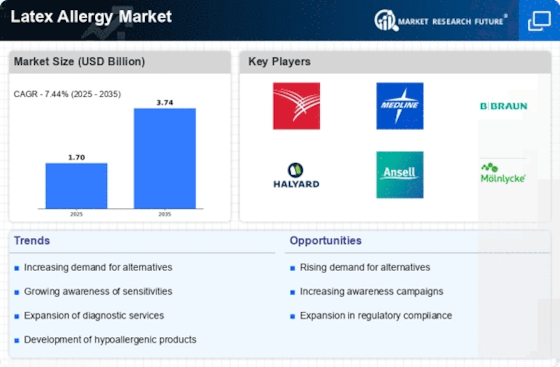
As per MRFR analysis, the Latex Allergy Market Size was estimated at 1.698 USD Billion in 2024. The Latex Allergy industry is projected to grow from 1.824 USD Billion in 2025 to 3.738 USD Billion by 2035, exhibiting a compound annual growth rate (CAGR) of 7.44 during the forecast period 2025 - 2035.

Key Market Trends & Highlights

The Latex Allergy Market is experiencing a notable shift towards increased awareness and innovation in product development.

  • Rising awareness of latex allergies is driving demand for safer alternatives in North America, the largest market.
  • Innovation in product development is evident in the latex gloves segment, which remains the largest within the market.
  • Educational initiatives and advocacy are crucial in the Asia-Pacific region, recognized as the fastest-growing market.
  • The increasing prevalence of latex allergies and growing demand for safe healthcare practices are significant market drivers.

Market Size & Forecast

2024 Market Size 1.698 (USD Billion)
2035 Market Size 3.738 (USD Billion)
CAGR (2025 - 2035) 7.44%
Largest Regional Market Share in 2024 North America

Major Players

<p>Cardinal Health (US), Medline Industries (US), B. Braun Melsungen AG (DE), Halyard Health (US), Ansell Limited (AU), Mölnlycke Health Care (SE), Kimberly-Clark Corporation (US), Smith & Nephew (GB), 3M Company (US)</p>

Market Trends

The Latex Allergy Market is currently experiencing notable shifts driven by increasing awareness of health issues associated with latex exposure. As more individuals and healthcare professionals recognize the potential risks, there is a growing demand for latex-free alternatives. This trend is particularly evident in medical settings, where the use of non-latex gloves and other protective equipment is becoming more prevalent. Additionally, educational initiatives aimed at informing the public about latex allergies are gaining traction, further influencing consumer behavior and preferences. Moreover, the Latex Allergy Market is likely to see advancements in product innovation as manufacturers respond to the rising demand for safer options. Companies are exploring new materials and technologies to create effective substitutes that do not compromise on quality or performance. This focus on innovation may lead to a broader range of products available to consumers, enhancing market competitiveness. As awareness continues to grow, the market appears poised for expansion, with potential opportunities for both established players and new entrants to capitalize on the evolving landscape.

Rising Awareness of Latex Allergies

There is an increasing recognition of latex allergies among healthcare professionals and the general public. This heightened awareness is driving demand for latex-free products, particularly in medical environments.

Innovation in Product Development

Manufacturers are actively pursuing new materials and technologies to create latex-free alternatives. This trend suggests a commitment to enhancing product safety and performance, potentially expanding the range of available options.

Educational Initiatives and Advocacy

Various organizations are implementing educational programs to inform individuals about the risks associated with latex exposure. These initiatives may influence consumer choices and promote the adoption of safer alternatives.

Latex Allergy Market Market Drivers

Consumer Awareness and Education

Consumer awareness regarding latex allergies is on the rise, which is influencing the Latex Allergy Market. Educational initiatives aimed at informing the public about the risks associated with latex exposure are becoming more prevalent. As individuals become more knowledgeable about the potential dangers of latex products, they are increasingly seeking out alternatives. This shift in consumer behavior is prompting manufacturers to enhance their marketing strategies and product offerings to cater to this informed audience. The Latex Allergy Market is likely to see a significant impact from these educational efforts, as they not only drive demand for latex-free products but also foster a culture of safety and awareness in various sectors.

Regulatory Changes and Compliance

Regulatory frameworks surrounding health and safety are evolving, which significantly impacts the Latex Allergy Market. Governments and health organizations are increasingly mandating the use of latex-free products in healthcare settings to protect patients and staff from allergic reactions. For instance, the introduction of stringent regulations regarding the use of latex gloves in hospitals has led to a marked increase in the adoption of alternative materials. This shift not only enhances safety but also drives market growth as manufacturers align their products with these regulations. The Latex Allergy Market is thus witnessing a transformation, with compliance becoming a key factor in product development and marketing strategies.

Increasing Prevalence of Latex Allergies

The rising incidence of latex allergies is a notable driver in the Latex Allergy Market. Studies indicate that approximately 1 to 6% of the population may be affected by latex allergies, particularly among healthcare workers and individuals with frequent exposure to latex products. This increasing prevalence necessitates the development and availability of alternative products, thereby expanding the market. The Latex Allergy Market is responding to this trend by promoting non-latex alternatives, which are becoming more widely accepted in various sectors, including healthcare and consumer goods. As awareness grows, the demand for latex-free products is likely to surge, compelling manufacturers to innovate and adapt their offerings to meet consumer needs.

Growing Demand for Safe Healthcare Practices

The increasing emphasis on safe healthcare practices is a critical driver for the Latex Allergy Market. Healthcare facilities are prioritizing patient safety and staff well-being, leading to a heightened demand for latex-free medical supplies. This trend is particularly evident in surgical settings, where the risk of allergic reactions can have serious consequences. As hospitals and clinics adopt policies favoring non-latex products, the market for latex-free alternatives is expected to grow substantially. The Latex Allergy Market is thus positioned to capitalize on this demand, with manufacturers focusing on producing high-quality, safe, and effective latex-free options to meet the needs of healthcare providers.

Technological Advancements in Material Science

Technological innovations in material science are propelling the Latex Allergy Market forward. The development of synthetic materials that mimic the properties of latex without the associated allergens is gaining traction. These advancements allow for the production of high-quality, latex-free products that meet the demands of various industries, including medical, automotive, and consumer goods. As these technologies evolve, they are likely to enhance product performance while ensuring safety for individuals with latex allergies. The Latex Allergy Market stands to benefit from these innovations, as they not only provide viable alternatives but also open new avenues for market expansion and consumer acceptance.

Market Segment Insights

By Exposure: Latex Gloves (Largest) vs. Food Containing Latex Substances (Fastest-Growing)

<p>In the Latex Allergy Market, latex gloves constitute the largest segment, significantly dominating the market share due to their extensive use in healthcare and other industries. They are essential for maintaining hygiene and safety, resulting in high demand. On the other hand, food containing latex substances, while currently smaller in share, is rapidly gaining attention as allergens and sensitivities are increasingly recognized. This is prompting more awareness and testing in food products, leading to heightened market interest.</p>

<p>Latex Gloves (Dominant) vs. Food Containing Latex Substances (Emerging)</p>

<p>Latex gloves are the dominant product in the Latex Allergy Market, primarily due to their critical role in medical settings, where they serve to protect both healthcare providers and patients from contamination and infection. They offer a high degree of flexibility and sensitivity, making them an essential tool in surgeries and examinations. In contrast, food containing latex substances is an emerging segment, characterized by growing consumer awareness regarding potential allergens in food products. As more studies reveal the correlation between latex allergy and certain food items, manufacturers are being prompted to address labeling and formulation changes. This shift is leading to steady growth in the food segment as consumers become increasingly cautious.</p>

By Diagnosis type: Skin test (Largest) vs. Allergy test (Fastest-Growing)

<p>In the Latex Allergy Market, the diagnosis type segment is primarily divided into skin tests and allergy tests. Skin tests currently hold the largest share of the market, as they are the most traditional method for diagnosing latex allergies, thanks to their quick results and high reliability. Allergy tests, while smaller in share, are gaining traction due to advancements in technology and increasing awareness among healthcare professionals regarding the importance of accurate diagnosis in allergic reactions.</p>

<p>Skin test (Dominant) vs. Allergy test (Emerging)</p>

<p>The skin test dominates the diagnosis type segment of the Latex Allergy Market due to its straightforward methodology and effectiveness in identifying allergic reactions promptly. It involves applying latex to the skin and observing reactions, providing immediate feedback. In contrast, the allergy test represents an emerging trend, utilizing newer techniques such as blood tests and component-resolved diagnostics. These methods offer increased specificity and can help differentiate between latex allergies and cross-reactivity, making them highly valuable as awareness increases. As more healthcare providers adopt these modern approaches, the allergy test segment is projected to grow rapidly, catering to a more informed patient population.</p>

By Reaction type: Anaphylaxis (Largest) vs. Systemic Reaction (Fastest-Growing)

<p>The Latex Allergy Market is witnessing significant distribution among various reaction types, with Anaphylaxis taking the largest share. Anaphylaxis represents a critical and severe response to latex exposure, making it a primary focus for healthcare professionals and market stakeholders. Following Anaphylaxis, Systemic Reactions also show a notable presence along with Allergic Contact Dermatitis, Asthma, Irritant Contact Dermatitis, and Rhinitis contributing to the overall character of the market. These reaction types highlight the diverse spectrum of sensitization and allergy responses to latex, emphasizing the importance of awareness and management in this niche market. In terms of growth trends, Systemic Reactions are emerging as the fastest-growing segment, driven by an increasing number of latex allergy cases reported in clinical settings. The rise in allergic conditions, heightened awareness, and education around latex allergies are key drivers of this trend. Systemic reactions result in a systemic effect that requires immediate medical attention, making their growth vital for thorough allergy management in healthcare settings. As medical professionals and patients become more informed about the variety of allergies, the market for reaction types within latex allergies is expected to expand significantly to meet healthcare demands.</p>

<p>Anaphylaxis (Dominant) vs. Allergic Contact Dermatitis (Emerging)</p>

<p>Anaphylaxis is recognized as the dominant reaction type in the Latex Allergy Market due to its severe implications and the urgency it demands in management and treatment. This serious allergic reaction can be life-threatening, making it a primary area of focus for healthcare providers. It is characterized by rapid onset and can occur after even minimal exposure to latex, necessitating immediate access to emergency care. In contrast, Allergic Contact Dermatitis is emerging as a significant segment, often presenting with less acute symptoms but still requiring proper diagnosis and treatment. While Anaphylaxis drives urgency in latex management protocols, Allergic Contact Dermatitis underscores the importance of comprehensive immersion in allergy prevention and education, highlighting the layered complexities of latex allergies.</p>

By Treatment type: Epinephrine injection (Largest) vs. Antihistamine (Fastest-Growing)

<p>The treatment type segment in the Latex Allergy Market is characterized by diverse options catering to various allergic reactions triggered by latex exposure. Currently, the Epinephrine injection dominates this segment, as it serves as the first line of defense in severe cases of anaphylaxis, making it a critical component in emergency response. In contrast, antihistamines are gaining traction among consumers due to their effectiveness in alleviating mild to moderate allergic symptoms, thus representing a growing share within this domain. Several factors are driving growth in the Latex Allergy Treatment segment, such as increased awareness of latex allergies and the availability of advanced allergy medications. Furthermore, the rising prevalence of asthma and other respiratory conditions is propelling demand for asthma medications, while the convenience of inhalers and albuterol adds to their popularity. The rapid development of innovative treatments, alongside expanding patient access to medical therapies, positions antihistamines as the fastest-growing segment in this market, indicating a shift in consumer preferences toward more manageable allergy solutions.</p>

<p>Epinephrine injection (Dominant) vs. Antihistamine (Emerging)</p>

<p>The Epinephrine injection stands as the dominant treatment in the Latex Allergy Market, primarily utilized for its life-saving potential in cases of severe allergic reactions, including anaphylaxis. Its prominence is supported by recommendations from healthcare professionals for immediate use during emergency situations, solidifying its role as an essential treatment option. Conversely, antihistamines, as an emerging treatment, are increasingly popular for their ability to manage symptoms such as hives, itching, and nasal congestion, thereby enhancing the quality of life for those with latex allergies. Their over-the-counter availability and ease of use contribute to growing consumer interest, bolstered by rising awareness of allergy management. This dynamic indicates shifting market trends where consumers are seeking more preventative and manageable treatment options.</p>

Get more detailed insights about Latex Allergy Market Research Report – Global Forecast to 2035

Regional Insights

North America : Leading Market for Latex Allergy Market

North America is the largest market for latex allergy products, accounting for approximately 45% of the global market share. The region's growth is driven by increasing awareness of latex allergies, stringent regulations on medical products, and a rising number of healthcare facilities adopting latex-free alternatives. The demand for safer medical supplies is further fueled by the growing prevalence of latex allergies among healthcare workers and patients. The United States is the primary contributor to this market, with key players like Cardinal Health, Medline Industries, and Halyard Health leading the competitive landscape. The presence of advanced healthcare infrastructure and a strong regulatory framework supports the growth of latex allergy solutions. Additionally, ongoing research and development efforts by companies such as 3M and Kimberly-Clark Corporation are enhancing product offerings, ensuring a robust market environment.

Europe : Regulatory Focus on Health Safety

Europe is the second-largest market for latex allergy products, holding around 30% of the global market share. The region's growth is propelled by increasing regulations aimed at improving health safety standards, particularly in healthcare settings. The European Union's directives on medical devices and personal protective equipment are significant catalysts for the adoption of latex-free alternatives, as they emphasize the need for safer products to protect both patients and healthcare professionals. Germany and the United Kingdom are the leading countries in this market, with a strong presence of key players like B. Braun Melsungen AG and Ansell Limited. The competitive landscape is characterized by innovation and collaboration among manufacturers to develop advanced latex-free solutions. The focus on sustainability and eco-friendly products is also shaping market dynamics, as consumers increasingly demand safer and environmentally responsible options.

Asia-Pacific : Rapid Growth in Emerging Markets

Asia-Pacific is witnessing rapid growth in the latex allergy market, accounting for approximately 20% of the global share. The region's expansion is driven by increasing healthcare expenditures, rising awareness of latex allergies, and a growing number of healthcare facilities. Countries like China and India are experiencing significant demand for latex-free products due to the rising prevalence of allergies and the need for safer medical supplies in hospitals and clinics. Australia and Japan are also key players in this market, with a competitive landscape featuring companies like Ansell Limited and Mölnlycke Health Care. The presence of established healthcare systems and increasing regulatory support for latex-free alternatives are enhancing market opportunities. Additionally, local manufacturers are emerging, contributing to a diverse product range and competitive pricing, further driving market growth.

Middle East and Africa : Emerging Market with Potential

The Middle East and Africa region is gradually emerging in the latex allergy market, holding about 5% of the global share. The growth is primarily driven by increasing healthcare investments, rising awareness of latex allergies, and the need for improved healthcare standards. Countries like South Africa and the UAE are leading the way, with initiatives aimed at enhancing healthcare infrastructure and promoting safer medical practices. The competitive landscape is still developing, with both international and local players vying for market share. Key players such as Kimberly-Clark Corporation and Smith & Nephew are establishing a presence in the region, focusing on education and awareness campaigns to promote latex-free products. The potential for growth is significant, as the region continues to invest in healthcare improvements and regulatory frameworks that support the adoption of safer medical supplies.

Key Companies in the Latex Allergy Market market include

Industry Developments

Europe is emerging as the second-largest region in terms of growth in the latex allergy market during the ongoing forecast period due to rising healthcare expenditures among the people in the region.

Also, other prominent market regions are gearing up for the expansion of the market operations during the period. The Asia-Pacific is expecting to emerge as a prominently functioning region in terms of growth in the market due to an increase in the use of latex disposables in its regional areas like India, and China.

Moreover, the rapid demand for the increasing modernization and technological advancements in both the healthcare systems and outcomes followed by rising demand from the emerging economies will further help to create a massive number of new opportunities for the latex allergy market in the forecasted period of 2024-2035.

Intended Audience

  • Research and Development firms and companies
  • Government Research Institutes and Laboratories
  • Independent Research and Development Laboratories
  • Government Sector
  • Independent Regulatory Authorities
  • Market Research and Consulting Service Providers
  • Medical Research Laboratories
  • Academic Medical Institutes and Universities


Future Outlook

Latex Allergy Market Future Outlook

<p>The Latex Allergy Market is projected to grow at a 7.44% CAGR from 2024 to 2035, driven by increasing awareness, regulatory changes, and advancements in alternative materials.</p>

New opportunities lie in:

  • <p>Development of hypoallergenic latex alternatives for medical applications.</p>
  • <p>Expansion of educational programs for healthcare professionals on latex allergy management.</p>
  • <p>Investment in innovative diagnostic tools for early detection of latex allergies.</p>

<p>By 2035, the market is expected to achieve substantial growth, driven by innovation and increased consumer awareness.</p>

Market Segmentation

Latex Allergy Market Exposure Outlook

  • Latex gloves
  • Food containing latex substances

Latex Allergy Market Reaction type Outlook

  • Systemic Reaction
  • Allergic contact dermatitis
  • Irritant Contact dermatitis
  • Asthma
  • Anaphylaxis
  • Rhinitis

Latex Allergy Market Diagnosis type Outlook

  • Skin test
  • Allergy test

Latex Allergy Market Treatment type Outlook

  • Epinephrine injection
  • Allergy medications: Inhaler or albuterol
  • Antihistamine
  • Asthma medication
  • Corticosteroids

Report Scope

MARKET SIZE 20241.698(USD Billion)
MARKET SIZE 20251.824(USD Billion)
MARKET SIZE 20353.738(USD Billion)
COMPOUND ANNUAL GROWTH RATE (CAGR)7.44% (2024 - 2035)
REPORT COVERAGERevenue Forecast, Competitive Landscape, Growth Factors, and Trends
BASE YEAR2024
Market Forecast Period2025 - 2035
Historical Data2019 - 2024
Market Forecast UnitsUSD Billion
Key Companies ProfiledMarket analysis in progress
Segments CoveredMarket segmentation analysis in progress
Key Market OpportunitiesEmerging biocompatible alternatives to latex products present growth opportunities in the Latex Allergy Market.
Key Market DynamicsRising awareness of latex allergies drives demand for alternative materials and regulatory changes in healthcare settings.
Countries CoveredNorth America, Europe, APAC, South America, MEA

FAQs

What is the current valuation of the Latex Allergy Market as of 2024?

The overall market valuation was 1.698 USD Billion in 2024.

What is the projected market size for the Latex Allergy Market in 2035?

The projected valuation for the Latex Allergy Market is 3.738 USD Billion in 2035.

What is the expected CAGR for the Latex Allergy Market during the forecast period 2025 - 2035?

The expected CAGR for the Latex Allergy Market during the forecast period 2025 - 2035 is 7.44%.

Which companies are considered key players in the Latex Allergy Market?

Key players in the market include Cardinal Health, Medline Industries, B. Braun Melsungen AG, Halyard Health, Ansell Limited, Mölnlycke Health Care, Kimberly-Clark Corporation, Smith & Nephew, and 3M Company.

What are the main segments of the Latex Allergy Market?

The main segments include Exposure, Diagnosis type, Reaction type, and Treatment type.

  1. SECTION I: EXECUTIVE SUMMARY AND KEY HIGHLIGHTS
    1. EXECUTIVE SUMMARY
      1. Market Overview
      2. Key Findings
      3. Market Segmentation
      4. Competitive Landscape
      5. Challenges and Opportunities
      6. Future Outlook
  2. SECTION II: SCOPING, METHODOLOGY AND MARKET STRUCTURE
    1. MARKET INTRODUCTION
      1. Definition
      2. Scope of the study
    2. RESEARCH METHODOLOGY
      1. Overview
      2. Data Mining
      3. Secondary Research
      4. Primary Research
      5. Forecasting Model
      6. Market Size Estimation
      7. Data Triangulation
      8. Validation
  3. SECTION III: QUALITATIVE ANALYSIS
    1. MARKET DYNAMICS
      1. Overview
      2. Drivers
      3. Restraints
      4. Opportunities
    2. MARKET FACTOR ANALYSIS
      1. Value chain Analysis
      2. Porter's Five Forces Analysis
      3. COVID-19 Impact Analysis
  4. SECTION IV: QUANTITATIVE ANALYSIS
    1. Healthcare, BY Exposure (USD Billion)
      1. Latex gloves
      2. Food containing latex substances
    2. Healthcare, BY Diagnosis type (USD Billion)
      1. Skin test
      2. Allergy test
    3. Healthcare, BY Reaction type (USD Billion)
      1. Systemic Reaction
      2. Allergic contact dermatitis
      3. Irritant Contact dermatitis
      4. Asthma
      5. Anaphylaxis
      6. Rhinitis
    4. Healthcare, BY Treatment type (USD Billion)
      1. Epinephrine injection
      2. Allergy medications: Inhaler or albuterol
      3. Antihistamine
      4. Asthma medication
      5. Corticosteroids
    5. Healthcare, BY Region (USD Billion)
      1. North America
      2. Europe
      3. APAC
      4. South America
      5. MEA
  5. SECTION V: COMPETITIVE ANALYSIS
    1. Competitive Landscape
      1. Overview
      2. Competitive Analysis
      3. Market share Analysis
      4. Major Growth Strategy in the Healthcare
      5. Competitive Benchmarking
      6. Leading Players in Terms of Number of Developments in the Healthcare
      7. Key developments and growth strategies
      8. Major Players Financial Matrix
    2. Company Profiles
      1. Cardinal Health (US)
      2. Medline Industries (US)
      3. B. Braun Melsungen AG (DE)
      4. Halyard Health (US)
      5. Ansell Limited (AU)
      6. Mölnlycke Health Care (SE)
      7. Kimberly-Clark Corporation (US)
      8. Smith & Nephew (GB)
      9. 3M Company (US)
    3. Appendix
      1. References
      2. Related Reports
  6. LIST OF FIGURES
    1. MARKET SYNOPSIS
    2. NORTH AMERICA MARKET ANALYSIS
    3. US MARKET ANALYSIS BY EXPOSURE
    4. US MARKET ANALYSIS BY DIAGNOSIS TYPE
    5. US MARKET ANALYSIS BY REACTION TYPE
    6. US MARKET ANALYSIS BY TREATMENT TYPE
    7. CANADA MARKET ANALYSIS BY EXPOSURE
    8. CANADA MARKET ANALYSIS BY DIAGNOSIS TYPE
    9. CANADA MARKET ANALYSIS BY REACTION TYPE
    10. CANADA MARKET ANALYSIS BY TREATMENT TYPE
    11. EUROPE MARKET ANALYSIS
    12. GERMANY MARKET ANALYSIS BY EXPOSURE
    13. GERMANY MARKET ANALYSIS BY DIAGNOSIS TYPE
    14. GERMANY MARKET ANALYSIS BY REACTION TYPE
    15. GERMANY MARKET ANALYSIS BY TREATMENT TYPE
    16. UK MARKET ANALYSIS BY EXPOSURE
    17. UK MARKET ANALYSIS BY DIAGNOSIS TYPE
    18. UK MARKET ANALYSIS BY REACTION TYPE
    19. UK MARKET ANALYSIS BY TREATMENT TYPE
    20. FRANCE MARKET ANALYSIS BY EXPOSURE
    21. FRANCE MARKET ANALYSIS BY DIAGNOSIS TYPE
    22. FRANCE MARKET ANALYSIS BY REACTION TYPE
    23. FRANCE MARKET ANALYSIS BY TREATMENT TYPE
    24. RUSSIA MARKET ANALYSIS BY EXPOSURE
    25. RUSSIA MARKET ANALYSIS BY DIAGNOSIS TYPE
    26. RUSSIA MARKET ANALYSIS BY REACTION TYPE
    27. RUSSIA MARKET ANALYSIS BY TREATMENT TYPE
    28. ITALY MARKET ANALYSIS BY EXPOSURE
    29. ITALY MARKET ANALYSIS BY DIAGNOSIS TYPE
    30. ITALY MARKET ANALYSIS BY REACTION TYPE
    31. ITALY MARKET ANALYSIS BY TREATMENT TYPE
    32. SPAIN MARKET ANALYSIS BY EXPOSURE
    33. SPAIN MARKET ANALYSIS BY DIAGNOSIS TYPE
    34. SPAIN MARKET ANALYSIS BY REACTION TYPE
    35. SPAIN MARKET ANALYSIS BY TREATMENT TYPE
    36. REST OF EUROPE MARKET ANALYSIS BY EXPOSURE
    37. REST OF EUROPE MARKET ANALYSIS BY DIAGNOSIS TYPE
    38. REST OF EUROPE MARKET ANALYSIS BY REACTION TYPE
    39. REST OF EUROPE MARKET ANALYSIS BY TREATMENT TYPE
    40. APAC MARKET ANALYSIS
    41. CHINA MARKET ANALYSIS BY EXPOSURE
    42. CHINA MARKET ANALYSIS BY DIAGNOSIS TYPE
    43. CHINA MARKET ANALYSIS BY REACTION TYPE
    44. CHINA MARKET ANALYSIS BY TREATMENT TYPE
    45. INDIA MARKET ANALYSIS BY EXPOSURE
    46. INDIA MARKET ANALYSIS BY DIAGNOSIS TYPE
    47. INDIA MARKET ANALYSIS BY REACTION TYPE
    48. INDIA MARKET ANALYSIS BY TREATMENT TYPE
    49. JAPAN MARKET ANALYSIS BY EXPOSURE
    50. JAPAN MARKET ANALYSIS BY DIAGNOSIS TYPE
    51. JAPAN MARKET ANALYSIS BY REACTION TYPE
    52. JAPAN MARKET ANALYSIS BY TREATMENT TYPE
    53. SOUTH KOREA MARKET ANALYSIS BY EXPOSURE
    54. SOUTH KOREA MARKET ANALYSIS BY DIAGNOSIS TYPE
    55. SOUTH KOREA MARKET ANALYSIS BY REACTION TYPE
    56. SOUTH KOREA MARKET ANALYSIS BY TREATMENT TYPE
    57. MALAYSIA MARKET ANALYSIS BY EXPOSURE
    58. MALAYSIA MARKET ANALYSIS BY DIAGNOSIS TYPE
    59. MALAYSIA MARKET ANALYSIS BY REACTION TYPE
    60. MALAYSIA MARKET ANALYSIS BY TREATMENT TYPE
    61. THAILAND MARKET ANALYSIS BY EXPOSURE
    62. THAILAND MARKET ANALYSIS BY DIAGNOSIS TYPE
    63. THAILAND MARKET ANALYSIS BY REACTION TYPE
    64. THAILAND MARKET ANALYSIS BY TREATMENT TYPE
    65. INDONESIA MARKET ANALYSIS BY EXPOSURE
    66. INDONESIA MARKET ANALYSIS BY DIAGNOSIS TYPE
    67. INDONESIA MARKET ANALYSIS BY REACTION TYPE
    68. INDONESIA MARKET ANALYSIS BY TREATMENT TYPE
    69. REST OF APAC MARKET ANALYSIS BY EXPOSURE
    70. REST OF APAC MARKET ANALYSIS BY DIAGNOSIS TYPE
    71. REST OF APAC MARKET ANALYSIS BY REACTION TYPE
    72. REST OF APAC MARKET ANALYSIS BY TREATMENT TYPE
    73. SOUTH AMERICA MARKET ANALYSIS
    74. BRAZIL MARKET ANALYSIS BY EXPOSURE
    75. BRAZIL MARKET ANALYSIS BY DIAGNOSIS TYPE
    76. BRAZIL MARKET ANALYSIS BY REACTION TYPE
    77. BRAZIL MARKET ANALYSIS BY TREATMENT TYPE
    78. MEXICO MARKET ANALYSIS BY EXPOSURE
    79. MEXICO MARKET ANALYSIS BY DIAGNOSIS TYPE
    80. MEXICO MARKET ANALYSIS BY REACTION TYPE
    81. MEXICO MARKET ANALYSIS BY TREATMENT TYPE
    82. ARGENTINA MARKET ANALYSIS BY EXPOSURE
    83. ARGENTINA MARKET ANALYSIS BY DIAGNOSIS TYPE
    84. ARGENTINA MARKET ANALYSIS BY REACTION TYPE
    85. ARGENTINA MARKET ANALYSIS BY TREATMENT TYPE
    86. REST OF SOUTH AMERICA MARKET ANALYSIS BY EXPOSURE
    87. REST OF SOUTH AMERICA MARKET ANALYSIS BY DIAGNOSIS TYPE
    88. REST OF SOUTH AMERICA MARKET ANALYSIS BY REACTION TYPE
    89. REST OF SOUTH AMERICA MARKET ANALYSIS BY TREATMENT TYPE
    90. MEA MARKET ANALYSIS
    91. GCC COUNTRIES MARKET ANALYSIS BY EXPOSURE
    92. GCC COUNTRIES MARKET ANALYSIS BY DIAGNOSIS TYPE
    93. GCC COUNTRIES MARKET ANALYSIS BY REACTION TYPE
    94. GCC COUNTRIES MARKET ANALYSIS BY TREATMENT TYPE
    95. SOUTH AFRICA MARKET ANALYSIS BY EXPOSURE
    96. SOUTH AFRICA MARKET ANALYSIS BY DIAGNOSIS TYPE
    97. SOUTH AFRICA MARKET ANALYSIS BY REACTION TYPE
    98. SOUTH AFRICA MARKET ANALYSIS BY TREATMENT TYPE
    99. REST OF MEA MARKET ANALYSIS BY EXPOSURE
    100. REST OF MEA MARKET ANALYSIS BY DIAGNOSIS TYPE
    101. REST OF MEA MARKET ANALYSIS BY REACTION TYPE
    102. REST OF MEA MARKET ANALYSIS BY TREATMENT TYPE
    103. KEY BUYING CRITERIA OF HEALTHCARE
    104. RESEARCH PROCESS OF MRFR
    105. DRO ANALYSIS OF HEALTHCARE
    106. DRIVERS IMPACT ANALYSIS: HEALTHCARE
    107. RESTRAINTS IMPACT ANALYSIS: HEALTHCARE
    108. SUPPLY / VALUE CHAIN: HEALTHCARE
    109. HEALTHCARE, BY EXPOSURE, 2024 (% SHARE)
    110. HEALTHCARE, BY EXPOSURE, 2024 TO 2035 (USD Billion)
    111. HEALTHCARE, BY DIAGNOSIS TYPE, 2024 (% SHARE)
    112. HEALTHCARE, BY DIAGNOSIS TYPE, 2024 TO 2035 (USD Billion)
    113. HEALTHCARE, BY REACTION TYPE, 2024 (% SHARE)
    114. HEALTHCARE, BY REACTION TYPE, 2024 TO 2035 (USD Billion)
    115. HEALTHCARE, BY TREATMENT TYPE, 2024 (% SHARE)
    116. HEALTHCARE, BY TREATMENT TYPE, 2024 TO 2035 (USD Billion)
    117. BENCHMARKING OF MAJOR COMPETITORS
  7. LIST OF TABLES
    1. LIST OF ASSUMPTIONS
    2. North America MARKET SIZE ESTIMATES; FORECAST
      1. BY EXPOSURE, 2025-2035 (USD Billion)
      2. BY DIAGNOSIS TYPE, 2025-2035 (USD Billion)
      3. BY REACTION TYPE, 2025-2035 (USD Billion)
      4. BY TREATMENT TYPE, 2025-2035 (USD Billion)
    3. US MARKET SIZE ESTIMATES; FORECAST
      1. BY EXPOSURE, 2025-2035 (USD Billion)
      2. BY DIAGNOSIS TYPE, 2025-2035 (USD Billion)
      3. BY REACTION TYPE, 2025-2035 (USD Billion)
      4. BY TREATMENT TYPE, 2025-2035 (USD Billion)
    4. Canada MARKET SIZE ESTIMATES; FORECAST
      1. BY EXPOSURE, 2025-2035 (USD Billion)
      2. BY DIAGNOSIS TYPE, 2025-2035 (USD Billion)
      3. BY REACTION TYPE, 2025-2035 (USD Billion)
      4. BY TREATMENT TYPE, 2025-2035 (USD Billion)
    5. Europe MARKET SIZE ESTIMATES; FORECAST
      1. BY EXPOSURE, 2025-2035 (USD Billion)
      2. BY DIAGNOSIS TYPE, 2025-2035 (USD Billion)
      3. BY REACTION TYPE, 2025-2035 (USD Billion)
      4. BY TREATMENT TYPE, 2025-2035 (USD Billion)
    6. Germany MARKET SIZE ESTIMATES; FORECAST
      1. BY EXPOSURE, 2025-2035 (USD Billion)
      2. BY DIAGNOSIS TYPE, 2025-2035 (USD Billion)
      3. BY REACTION TYPE, 2025-2035 (USD Billion)
      4. BY TREATMENT TYPE, 2025-2035 (USD Billion)
    7. UK MARKET SIZE ESTIMATES; FORECAST
      1. BY EXPOSURE, 2025-2035 (USD Billion)
      2. BY DIAGNOSIS TYPE, 2025-2035 (USD Billion)
      3. BY REACTION TYPE, 2025-2035 (USD Billion)
      4. BY TREATMENT TYPE, 2025-2035 (USD Billion)
    8. France MARKET SIZE ESTIMATES; FORECAST
      1. BY EXPOSURE, 2025-2035 (USD Billion)
      2. BY DIAGNOSIS TYPE, 2025-2035 (USD Billion)
      3. BY REACTION TYPE, 2025-2035 (USD Billion)
      4. BY TREATMENT TYPE, 2025-2035 (USD Billion)
    9. Russia MARKET SIZE ESTIMATES; FORECAST
      1. BY EXPOSURE, 2025-2035 (USD Billion)
      2. BY DIAGNOSIS TYPE, 2025-2035 (USD Billion)
      3. BY REACTION TYPE, 2025-2035 (USD Billion)
      4. BY TREATMENT TYPE, 2025-2035 (USD Billion)
    10. Italy MARKET SIZE ESTIMATES; FORECAST
      1. BY EXPOSURE, 2025-2035 (USD Billion)
      2. BY DIAGNOSIS TYPE, 2025-2035 (USD Billion)
      3. BY REACTION TYPE, 2025-2035 (USD Billion)
      4. BY TREATMENT TYPE, 2025-2035 (USD Billion)
    11. Spain MARKET SIZE ESTIMATES; FORECAST
      1. BY EXPOSURE, 2025-2035 (USD Billion)
      2. BY DIAGNOSIS TYPE, 2025-2035 (USD Billion)
      3. BY REACTION TYPE, 2025-2035 (USD Billion)
      4. BY TREATMENT TYPE, 2025-2035 (USD Billion)
    12. Rest of Europe MARKET SIZE ESTIMATES; FORECAST
      1. BY EXPOSURE, 2025-2035 (USD Billion)
      2. BY DIAGNOSIS TYPE, 2025-2035 (USD Billion)
      3. BY REACTION TYPE, 2025-2035 (USD Billion)
      4. BY TREATMENT TYPE, 2025-2035 (USD Billion)
    13. APAC MARKET SIZE ESTIMATES; FORECAST
      1. BY EXPOSURE, 2025-2035 (USD Billion)
      2. BY DIAGNOSIS TYPE, 2025-2035 (USD Billion)
      3. BY REACTION TYPE, 2025-2035 (USD Billion)
      4. BY TREATMENT TYPE, 2025-2035 (USD Billion)
    14. China MARKET SIZE ESTIMATES; FORECAST
      1. BY EXPOSURE, 2025-2035 (USD Billion)
      2. BY DIAGNOSIS TYPE, 2025-2035 (USD Billion)
      3. BY REACTION TYPE, 2025-2035 (USD Billion)
      4. BY TREATMENT TYPE, 2025-2035 (USD Billion)
    15. India MARKET SIZE ESTIMATES; FORECAST
      1. BY EXPOSURE, 2025-2035 (USD Billion)
      2. BY DIAGNOSIS TYPE, 2025-2035 (USD Billion)
      3. BY REACTION TYPE, 2025-2035 (USD Billion)
      4. BY TREATMENT TYPE, 2025-2035 (USD Billion)
    16. Japan MARKET SIZE ESTIMATES; FORECAST
      1. BY EXPOSURE, 2025-2035 (USD Billion)
      2. BY DIAGNOSIS TYPE, 2025-2035 (USD Billion)
      3. BY REACTION TYPE, 2025-2035 (USD Billion)
      4. BY TREATMENT TYPE, 2025-2035 (USD Billion)
    17. South Korea MARKET SIZE ESTIMATES; FORECAST
      1. BY EXPOSURE, 2025-2035 (USD Billion)
      2. BY DIAGNOSIS TYPE, 2025-2035 (USD Billion)
      3. BY REACTION TYPE, 2025-2035 (USD Billion)
      4. BY TREATMENT TYPE, 2025-2035 (USD Billion)
    18. Malaysia MARKET SIZE ESTIMATES; FORECAST
      1. BY EXPOSURE, 2025-2035 (USD Billion)
      2. BY DIAGNOSIS TYPE, 2025-2035 (USD Billion)
      3. BY REACTION TYPE, 2025-2035 (USD Billion)
      4. BY TREATMENT TYPE, 2025-2035 (USD Billion)
    19. Thailand MARKET SIZE ESTIMATES; FORECAST
      1. BY EXPOSURE, 2025-2035 (USD Billion)
      2. BY DIAGNOSIS TYPE, 2025-2035 (USD Billion)
      3. BY REACTION TYPE, 2025-2035 (USD Billion)
      4. BY TREATMENT TYPE, 2025-2035 (USD Billion)
    20. Indonesia MARKET SIZE ESTIMATES; FORECAST
      1. BY EXPOSURE, 2025-2035 (USD Billion)
      2. BY DIAGNOSIS TYPE, 2025-2035 (USD Billion)
      3. BY REACTION TYPE, 2025-2035 (USD Billion)
      4. BY TREATMENT TYPE, 2025-2035 (USD Billion)
    21. Rest of APAC MARKET SIZE ESTIMATES; FORECAST
      1. BY EXPOSURE, 2025-2035 (USD Billion)
      2. BY DIAGNOSIS TYPE, 2025-2035 (USD Billion)
      3. BY REACTION TYPE, 2025-2035 (USD Billion)
      4. BY TREATMENT TYPE, 2025-2035 (USD Billion)
    22. South America MARKET SIZE ESTIMATES; FORECAST
      1. BY EXPOSURE, 2025-2035 (USD Billion)
      2. BY DIAGNOSIS TYPE, 2025-2035 (USD Billion)
      3. BY REACTION TYPE, 2025-2035 (USD Billion)
      4. BY TREATMENT TYPE, 2025-2035 (USD Billion)
    23. Brazil MARKET SIZE ESTIMATES; FORECAST
      1. BY EXPOSURE, 2025-2035 (USD Billion)
      2. BY DIAGNOSIS TYPE, 2025-2035 (USD Billion)
      3. BY REACTION TYPE, 2025-2035 (USD Billion)
      4. BY TREATMENT TYPE, 2025-2035 (USD Billion)
    24. Mexico MARKET SIZE ESTIMATES; FORECAST
      1. BY EXPOSURE, 2025-2035 (USD Billion)
      2. BY DIAGNOSIS TYPE, 2025-2035 (USD Billion)
      3. BY REACTION TYPE, 2025-2035 (USD Billion)
      4. BY TREATMENT TYPE, 2025-2035 (USD Billion)
    25. Argentina MARKET SIZE ESTIMATES; FORECAST
      1. BY EXPOSURE, 2025-2035 (USD Billion)
      2. BY DIAGNOSIS TYPE, 2025-2035 (USD Billion)
      3. BY REACTION TYPE, 2025-2035 (USD Billion)
      4. BY TREATMENT TYPE, 2025-2035 (USD Billion)
    26. Rest of South America MARKET SIZE ESTIMATES; FORECAST
      1. BY EXPOSURE, 2025-2035 (USD Billion)
      2. BY DIAGNOSIS TYPE, 2025-2035 (USD Billion)
      3. BY REACTION TYPE, 2025-2035 (USD Billion)
      4. BY TREATMENT TYPE, 2025-2035 (USD Billion)
    27. MEA MARKET SIZE ESTIMATES; FORECAST
      1. BY EXPOSURE, 2025-2035 (USD Billion)
      2. BY DIAGNOSIS TYPE, 2025-2035 (USD Billion)
      3. BY REACTION TYPE, 2025-2035 (USD Billion)
      4. BY TREATMENT TYPE, 2025-2035 (USD Billion)
    28. GCC Countries MARKET SIZE ESTIMATES; FORECAST
      1. BY EXPOSURE, 2025-2035 (USD Billion)
      2. BY DIAGNOSIS TYPE, 2025-2035 (USD Billion)
      3. BY REACTION TYPE, 2025-2035 (USD Billion)
      4. BY TREATMENT TYPE, 2025-2035 (USD Billion)
    29. South Africa MARKET SIZE ESTIMATES; FORECAST
      1. BY EXPOSURE, 2025-2035 (USD Billion)
      2. BY DIAGNOSIS TYPE, 2025-2035 (USD Billion)
      3. BY REACTION TYPE, 2025-2035 (USD Billion)
      4. BY TREATMENT TYPE, 2025-2035 (USD Billion)
    30. Rest of MEA MARKET SIZE ESTIMATES; FORECAST
      1. BY EXPOSURE, 2025-2035 (USD Billion)
      2. BY DIAGNOSIS TYPE, 2025-2035 (USD Billion)
      3. BY REACTION TYPE, 2025-2035 (USD Billion)
      4. BY TREATMENT TYPE, 2025-2035 (USD Billion)
    31. PRODUCT LAUNCH/PRODUCT DEVELOPMENT/APPROVAL
    32. ACQUISITION/PARTNERSHIP

Latex Allergy Market Segmentation

Market Segmentation Overview

  • Detailed segmentation data will be available in the full report
  • Comprehensive analysis by multiple parameters
  • Regional and country-level breakdowns
  • Market size forecasts by segment
Infographic

Free Sample Request

Kindly complete the form below to receive a free sample of this Report

Get Free Sample

Customer Strories

Compare Licence

×
Features License Type
Single User Multiuser License Enterprise User
Price $4,950 $5,950 $7,250
Maximum User Access Limit 1 User Upto 10 Users Unrestricted Access Throughout the Organization
Free Customization
Direct Access to Analyst
Deliverable Format
Platform Access
Discount on Next Purchase 10% 15% 15%
Printable Versions