Request Free Sample ×

Kindly complete the form below to receive a free sample of this Report

* Please use a valid business email

Leading companies partner with us for data-driven Insights

clients tt-cursor
Hero Background
English
Chinese
French
Japanese
Korean
German
Spanish

Laser Technology Market Trends

ID: MRFR/ICT/3673-HCR
200 Pages
Ankit Gupta
April 2026

Laser Technology Market Size, Share and Research Report: By Technology (Fiber Laser, Solid-State Laser, Gas Laser, Semiconductor Laser), By Application (Material Processing, Medical, Communication, Defense, Aerospace), By End-use Industry (Manufacturing, Healthcare, Telecommunications, Automotive, Defense), By Laser Type (Continuous Wave Laser, Pulsed Laser, Ultrafast Laser), and By Regional (North America, Europe, South America, Asia Pacific, Middle East and Africa) - Industry Forecast to 2035

Share:
Download PDF ×

We do not share your information with anyone. However, we may send you emails based on your report interest from time to time. You may contact us at any time to opt-out.

Laser Technology Market Infographic
Purchase Options

Market Trends

Key Emerging Trends in the Laser Technology Market

The market for laser technology has expanded significantly in recent years, and changing trends have shaped the structure of many different businesses. The growing use of lasers in a variety of applications is a significant trend propelling this market. Lasers were first created for scientific and military use, but they are now used in everything from consumer electronics to medical operations. The market has progressed due to the expanding range of applications, leading to a significant increase in demand for laser-based technologies.

Lasers have revolutionized surgical operations, diagnostics, and cosmetic treatments in the healthcare industry, making them crucial instruments. Increased investment and research in the field of medicine are a result of laser technology's preference for numerous medical applications due to its minimally invasive nature and precision. Modern laser systems made especially for medical applications have entered the market, promising faster recovery times and increased precision. Furthermore, laser technology is being used by the industrial sector for innovative production processes.

Because laser cutting, welding, and labeling offer unmatched precision and efficiency, they have become essential elements of contemporary production. Lasers are now essential to accomplishing the increased automation and efficiency that companies are aiming for. A trend toward the incorporation of laser technology into smart factories and Industry 4.0 projects is reflected in the spike in demand for high-power lasers for industrial applications. The growing usage of lasers in information technology and communication is another noteworthy industry development. The development of laser-based communication systems has been fueled by the need for dependable and fast data transfer.

Thanks to laser technology, fiber optics are now the main component of contemporary telecom networks. The market for lasers in the communication industry has been driven by the unwavering quest for more bandwidth and quicker data transmission rates, with breakthroughs like quantum key distribution systems and free-space optical communication gaining traction. In addition, the automotive sector has seen an increase in the use of lasers for a variety of purposes, from industrial processes like welding and cutting to LiDAR (Light Detection and Ranging) systems for self-driving cars. Because laser-based sensors provide precise and timely data for obstacle identification and navigation, they are essential to the advancement of autonomous vehicles. The need for laser technology is expected to increase as the automobile industry continues to shift toward electrification and autonomy, affecting growth dynamics of market.


Author
Author Profile
Ankit Gupta
Team Lead - Research

Ankit Gupta is a seasoned market intelligence and strategic research professional with over six plus years of experience in the ICT and Semiconductor industries. With academic roots in Telecom, Marketing, and Electronics, he blends technical insight with business strategy. Ankit has led 200+ projects, including work for Fortune 500 clients like Microsoft and Rio Tinto, covering market sizing, tech forecasting, and go-to-market strategies. Known for bridging engineering and enterprise decision-making, his insights support growth, innovation, and investment planning across diverse technology markets.

Leave a Comment

FAQs

What is the projected market valuation of the Laser Technology Market by 2035?

<p>The Laser Technology Market is projected to reach a valuation of 24.99 USD Billion by 2035.</p>

What was the market valuation of the Laser Technology Market in 2024?

<p>In 2024, the Laser Technology Market was valued at 11.62 USD Billion.</p>

What is the expected CAGR for the Laser Technology Market during the forecast period 2025 - 2035?

<p>The expected CAGR for the Laser Technology Market during the forecast period 2025 - 2035 is 7.21%.</p>

Which segment of the Laser Technology Market is projected to grow the most by 2035?

<p>The Fiber Laser segment is projected to grow from 3.0 USD Billion in 2024 to 7.0 USD Billion by 2035.</p>

What are the key applications driving growth in the Laser Technology Market?

<p>Key applications include Material Processing, Medical, and Communication, with Material Processing expected to grow from 4.0 USD Billion to 8.5 USD Billion by 2035.</p>

Who are the leading companies in the Laser Technology Market?

<p>Leading companies in the Laser Technology Market include Coherent Inc, IPG Photonics Corporation, and TRUMPF GmbH + Co. KG.</p>

What is the projected growth for the Solid-State Laser segment by 2035?

<p>The Solid-State Laser segment is expected to grow from 4.0 USD Billion in 2024 to 9.0 USD Billion by 2035.</p>

How does the Defense sector contribute to the Laser Technology Market?

<p>The Defense sector is projected to grow from 1.5 USD Billion in 2024 to 3.5 USD Billion by 2035.</p>

What is the anticipated growth for the Ultrafast Laser segment by 2035?

<p>The Ultrafast Laser segment is anticipated to grow from 3.49 USD Billion in 2024 to 7.24 USD Billion by 2035.</p>

What end-use industries are expected to drive the Laser Technology Market's growth?

<p>End-use industries such as Manufacturing, Healthcare, and Telecommunications are expected to drive growth, with Manufacturing projected to grow from 3.0 USD Billion to 7.0 USD Billion by 2035.</p>

Market Summary

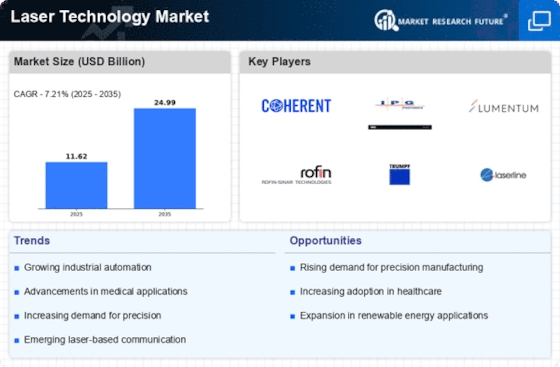
As per Market Research Future analysis, the Laser Technology Market Size was estimated at 11.62 USD Billion in 2024. The Laser Technology industry is projected to grow from 12.46 USD Billion in 2025 to 24.99 USD Billion by 2035, exhibiting a compound annual growth rate (CAGR) of 7.21% during the forecast period 2025 - 2035

Key Market Trends & Highlights

The Laser Technology Market is poised for substantial growth driven by advancements across various sectors.

  • North America remains the largest market for laser technology, showcasing robust demand across multiple applications. The Asia-Pacific region is emerging as the fastest-growing market, fueled by rapid industrialization and technological adoption. Fiber lasers dominate the market, while solid-state lasers are experiencing the fastest growth due to their versatility and efficiency. Key drivers include rising demand in telecommunications and innovations in manufacturing processes, particularly in the medical and material processing segments.

Market Size & Forecast

2024 Market Size 11.62 (USD Billion)
2035 Market Size 24.99 (USD Billion)
CAGR (2025 - 2035) 7.21%
Largest Regional Market Share in 2024 North America

Major Players

Coherent Inc (US), IPG Photonics Corporation (US), <a title="Lumentum Holdings Inc" href="https://investor.lumentum.com/overview/default.aspx" target="_blank" rel="noopener">Lumentum Holdings Inc</a> (US), Rofin-Sinar Technologies Inc (US), <a title="TRUMPF GmbH + Co. KG" href="https://www.trumpf.com/en_US/products/lasers/" target="_blank" rel="noopener">TRUMPF GmbH + Co. KG</a> (DE), Laserline GmbH (DE), NKT Photonics A/S (DK), MKS Instruments Inc (US)

Market Trends

The Laser Technology Market is currently experiencing a dynamic evolution, driven by advancements in various sectors such as healthcare, manufacturing, and telecommunications. The integration of laser systems into medical procedures has revolutionized surgical techniques, enhancing precision and reducing recovery times. In manufacturing, lasers are increasingly utilized for cutting, welding, and engraving, offering superior efficiency and quality. Furthermore, the telecommunications sector benefits from laser technology through improved data transmission capabilities, which are essential for the growing demand for high-speed internet and communication services. As industries continue to innovate, the Laser Technology Market is poised for substantial growth, reflecting the increasing reliance on laser applications across diverse fields. In addition to these developments, the market is also witnessing a surge in research and development activities aimed at creating more efficient and versatile laser systems. This trend is likely to foster collaborations between academic institutions and industry players, leading to the emergence of novel applications and technologies.

Moreover, the rising focus on sustainability and energy efficiency may drive the adoption of laser technologies that minimize waste and enhance operational performance. Overall, the Laser Technology Market appears to be on a trajectory of continuous advancement, with significant implications for various industries in the near future. The global laser technology market is expanding steadily as industries increasingly adopt high-precision laser systems across manufacturing, healthcare, and telecommunications applications. Emerging interdisciplinary applications — sometimes grouped under laser marketing technologies — highlight how laser systems are being adapted for advanced visualization, branding, and precision marking solutions within industrial environments.

Advancements in Medical Applications

The integration of laser technology in healthcare is transforming surgical practices, enabling minimally invasive procedures that enhance patient outcomes. Innovations in laser systems are facilitating precise tissue targeting, which reduces complications and accelerates recovery.

Growth in Industrial Automation

The Laser Technology Market is witnessing increased adoption in Industrial Automation, where lasers are employed for cutting, welding, and marking. This trend reflects a broader shift towards automation, enhancing productivity and operational efficiency.

Emergence of Green Laser Technologies

There is a growing emphasis on sustainability within the Laser Technology Market, with a focus on developing eco-friendly laser systems. These technologies aim to reduce energy consumption and minimize environmental impact, aligning with global sustainability goals.

Laser Technology Market Market Drivers

Rising Demand in Telecommunications

The Laser Technology Market is experiencing a notable surge in demand due to the increasing reliance on fiber optic communication systems. Lasers play a crucial role in transmitting data over long distances with minimal loss. As the need for high-speed internet and efficient communication networks escalates, the adoption of laser technologies in telecommunications is expected to grow significantly. According to recent data, the fiber optic segment is projected to witness a compound annual growth rate of over 10% in the coming years. This trend indicates that investments in laser technology for telecommunications will likely continue to rise, further propelling the Laser Technology Market.

Innovations in Manufacturing Processes

The Laser Technology Market is being driven by innovations in manufacturing processes, particularly in sectors such as automotive and aerospace. Lasers are increasingly utilized for cutting, welding, and engraving materials with precision and efficiency. The adoption of laser-based manufacturing techniques has been shown to enhance productivity and reduce waste, aligning with the industry's push for sustainability. Recent statistics suggest that the use of laser technology in manufacturing could lead to a reduction in production costs by up to 30%. This potential for cost savings and efficiency improvements is likely to attract more manufacturers to invest in laser technologies, thereby boosting the Laser Technology Market.

Advancements in Laser Medical Treatments

The Laser Technology Market is significantly influenced by advancements in medical treatments, particularly in fields such as dermatology, ophthalmology, and surgery. Lasers are utilized for a variety of medical procedures, including laser eye surgery and skin resurfacing, due to their precision and minimal invasiveness. The increasing prevalence of chronic diseases and the aging population are contributing to the rising demand for laser-based medical treatments. Recent data indicates that the medical laser market is projected to grow at a compound annual growth rate of approximately 8% over the next few years. This growth trajectory suggests that the Laser Technology Market will continue to benefit from innovations in medical applications.

Expansion of Defense and Security Applications

The Laser Technology Market is witnessing growth driven by the expansion of defense and security applications. Lasers are employed in various military applications, including target designation, range finding, and directed energy weapons. The increasing focus on national security and defense modernization programs has led to heightened investments in laser technologies. Recent reports indicate that defense spending is expected to rise, with a significant portion allocated to advanced laser systems. This trend suggests that the demand for laser technologies in defense applications will likely continue to grow, further enhancing the Laser Technology Market.

Integration of Laser Technologies in Consumer Electronics

The Laser Technology Market is being propelled by the integration of laser technologies in consumer electronics. Lasers are increasingly used in devices such as printers, scanners, and projectors, enhancing performance and user experience. The demand for high-quality imaging and printing solutions is driving manufacturers to adopt laser technologies, which offer superior resolution and speed. Recent market analysis indicates that the consumer electronics segment is expected to grow at a rate of around 6% annually, reflecting the increasing reliance on laser technologies. This trend suggests that the Laser Technology Market will continue to expand as consumer electronics manufacturers increasingly incorporate laser solutions into their products.

Market Segment Insights

By Technology: Fiber Laser (Largest) vs. Solid-State Laser (Fastest-Growing)

The Laser Technology Market showcases distinct segments with varying market shares. <a href="https://www.marketresearchfuture.com/reports/fiber-laser-market-21707">Fiber lasers</a> currently dominate the market, renowned for their efficiency and versatility across industrial applications. Solid-state lasers, while not as widely adopted as fiber lasers, are rapidly gaining market share due to their advancements in performance and decreasing costs, establishing themselves as a critical segment within the industry.

Technology: Fiber Laser (Dominant) vs. Solid-State Laser (Emerging)

Fiber lasers have emerged as the dominant technology due to their high quality and efficiency in materials processing, making them suitable for various industries, including automotive and aerospace. Their ability to offer precise and clean cuts has set a high standard. In contrast,<a href="https://www.marketresearchfuture.com/reports/solid-state-laser-market-24422"> solid-state lasers</a> are experiencing rapid growth, primarily driven by innovations that enhance their performance and affordability. This emerging segment is becoming increasingly popular in applications such as medical technology and manufacturing, reflecting a shift in market dynamics as users seek more cost-effective solutions.

By Application: Material Processing (Largest) vs. Medical (Fastest-Growing)

In the Laser Technology Market, the application of lasers spans various industries, with material processing leading the market share. This segment plays a crucial role in manufacturing processes, including cutting, welding, and engraving, thereby contributing significantly to overall market dynamics. The medical sector follows closely, leveraging laser technology for surgical procedures, diagnostics, and therapeutic applications. This diversification across applications ensures a robust market landscape, catering to diverse demands from different sectors.

Material Processing: Dominant vs. Medical: Emerging

Material processing stands out as the dominant application in the Laser Technology Market, contributing heavily to industrial advancements thanks to its efficiency and precision. This segment encompasses a wide range of processes including laser cutting, engraving, and welding. On the other hand, the medical sector is emerging rapidly, utilizing laser applications for innovative treatments and procedures like laser surgery and skin therapy. The growth in the medical field is fueled by advancements in laser technology, increasing demand for non-invasive procedures, and heightened awareness regarding advanced medical treatments. This contrast portrays material processing as a stronghold while medical applications are on the rise with substantial potential.

By End-use Industry: Manufacturing (Largest) vs. Healthcare (Fastest-Growing)

In the Laser Technology Market, the end-use industries exhibit varied dynamics with manufacturing taking a dominant position. This sector utilizes laser technology for precision cutting, welding, and engraving, leading to a significant market share. Following closely, healthcare has emerged as a critical sector for laser applications, particularly in surgeries and diagnostics, marking it as the fastest-growing segment due to technological advancements.

Manufacturing: This sector is Dominant vs. Healthcare: This sector is Emerging

The manufacturing end-use industry remains a dominant force in the Laser Technology Market, driven by increasing demand for automation and precision. Industries such as aerospace, electronics, and metal fabrication leverage laser technology for its accuracy and efficiency. Contrastingly, the healthcare sector is an emerging player, experiencing rapid growth fueled by innovations in minimally invasive procedures and laser-based therapies. The surge in laser applications in cosmetic surgery, ophthalmology, and dental procedures indicates a robust demand trajectory, signaling the need for advanced laser systems that cater to specific medical requirements.

By Laser Type: Continuous Wave Laser (Largest) vs. Ultrafast Laser (Fastest-Growing)

The laser technology market is witnessing a dynamic distribution of shares among various types of lasers. Continuous Wave lasers dominate the segment, primarily due to their widespread applications in industrial processes and medical fields. In contrast, Ultrafast lasers, though smaller in market share, are rapidly gaining traction because of their unique capabilities in precision cutting and material processing. Pulsed Lasers also maintain a significant presence, catering to niche applications in scientific research and high-energy physics experiments.

Laser Type: Continuous Wave (Dominant) vs. Ultrafast (Emerging)

Continuous Wave lasers are characterized by a steady output of laser light, making them ideal for continuous operations in industries such as manufacturing and healthcare. They are renowned for their reliability and efficiency, which has cemented their status as the dominant technology in the laser market. On the other hand, <a href="https://www.marketresearchfuture.com/reports/ultrafast-laser-market-5591">Ultrafast lasers</a> represent an emerging force, distinguished by their capability to deliver exceptionally short pulses of light. This allows for advanced applications in fields such as micro-machining and spectroscopy. The growth of this segment is attributed to ongoing advancements in technology that enhance precision and reduce thermal damage to materials.

Get more detailed insights about Laser Technology Market Research Report - Global Forecast to 2035

Regional Insights

The Laser Technology Market exhibited significant regional diversity, with North America leading with a valuation of 4.2 USD Billion in 2024 and projected to reach 9.05 USD Billion by 2035, showcasing its dominance due to advanced technology adoption and industrial utilization. The Canada laser technology market is witnessing gradual growth, supported by investments in advanced manufacturing, medical research, and photonics innovation initiatives.

Europe followed as a strong contender, valued at 2.9 USD Billion in 2024 and expected to grow to 6.3 USD Billion by 2035, driven by its robust manufacturing and healthcare sectors. The Asia Pacific region, valued at 3.5 USD Billion and anticipated to reach 7.1 USD Billion, reflects rapid industrialization and technological advancements in countries like China and India.

South America represented a smaller segment with a value of 0.8 USD Billion in 2024 and approaching 1.7 USD Billion, yet held growth potential due to its emerging markets. The Middle East and Africa, in contrast, reflected a modest valuation starting at 0.22 USD Billion and reaching 0.45 USD Billion, indicating an underdeveloped market that could see future investments in technology.

Collectively, these regional insights contributed substantially to the overall Laser Technology Market revenue and highlighted the varying degrees of market maturity and opportunities across the globe.

Key Players and Competitive Insights

The Laser Technology Market has witnessed significant growth and transformation, driven by advancements in laser applications across various industries, including manufacturing, healthcare, and telecommunications.In this competitive landscape, companies are increasingly focusing on innovation and technological development to maintain a competitive edge. The market is characterized by a mix of established players and emerging entrants, each vying for market share through strategic partnerships, product launches, and expansions. Intense competition necessitates a continuous assessment of market trends, customer demands, and technological advancements, as companies aim to offer superior products and solutions that cater to diverse applications.Additionally, the global reach of these companies allows them to tap into emerging markets while addressing the needs of established regions, making competitive insights essential for navigating this dynamic landscape. Amada Holdings has established a strong presence in the Laser Technology Market, showcasing its commitment to innovation and quality in laser solutions. The company is recognized for its advanced laser processing technologies, particularly in sheet metal fabrication. Amada Holdings has leveraged its extensive experience to enhance its product offerings, focusing on systems that provide reliability and precision. This strength in technology and manufacturing capabilities has positioned the company favorably within the competitive framework of the market. Its robust research and development activities have facilitated the launch of cutting-edge laser machines and systems that cater to the evolving needs of customers across various sectors. Amada Holdings’ emphasis on customer service and tailored solutions further strengthens its standing as a prominent player in the global landscape. Nikon has carved out a significant niche in the Laser Technology Market, blending its expertise in imaging and precision optics with laser technology applications. The company is known for its range of innovative products and solutions tailored to various industries, especially in semiconductor manufacturing and material processing. Nikon’s key offerings include high-performance laser systems that utilize advanced technologies, enabling high accuracy and efficiency in processes such as photolithography and laser machining. The company’s strong research and development strategy, coupled with its strategic partnerships and acquisitions, has fortified its position in the market, enabling it to leverage emerging technologies. Nikon’s ongoing commitment to enhancing product performance and expanding its application range underscores its strengths in the competitive landscape of global laser technology, allowing it to build a robust portfolio that meets the diverse needs of its clientele.

Key Companies in the Laser Technology Market include

Industry Developments

The new YLS‑RI high-power fiber laser platform and advanced ultrafast lasers, including dual-beam Adjustable Mode Beam (AMB) systems, for micro-machining, welding, cleaning, and quantum applications were demonstrated by IPG Photonics at Photonics West in January 2025. The platform has improved stability, next-generation pump diodes, and a compact design.

In August 2023, IPG unveiled their AMB dual-beam laser, which doubles speeds and minimizes faults. It has a 3 kW single-mode core power and is ideal for welding EV batteries. IPG and UCL teamed together in December 2024 to create dual-beam laser technology for advanced material research.

Trumpf, a prominent German laser tool maker, maintained its position as the world leader in precision laser modules in 2025 by further growing its high-power ultrashort-pulse and disc laser solutions for semiconductor and microfabrication.The next-generation Engage Series CO₂ lasers from Coherent (which combined with II‑VI) were introduced in 2024. These lasers have greater beam quality and throughput for industrial cutting and engraving.

Trotec Laser's Speedy 700 fiber laser, which was showcased at the LIGNA expo, was introduced in 2024 and is capable of high-precision engraving and branding on metals, plastics, and ceramics. Han's Laser debuted their SmartFab laser cell in 2024, which combines multi-axis control and vision-AI for automated welding and additive manufacturing processes.

Future Outlook

Laser Technology Market Future Outlook

The Laser Technology Market is projected to grow at a 7.21% CAGR from 2025 to 2035, driven by advancements in manufacturing, healthcare applications, and telecommunications.

New opportunities lie in:

  • <p>Development of high-precision laser cutting systems for aerospace manufacturing. Expansion of laser-based medical devices for minimally invasive surgeries. Integration of laser technology in renewable energy solutions for efficient energy conversion.</p>

By 2035, the Laser Technology Market is expected to achieve substantial growth, reflecting its critical role in various industries.

Market Segmentation

Laser Technology Market Laser Type Outlook

  • Continuous Wave Laser
  • Pulsed Laser
  • Ultrafast Laser

Laser Technology Market Technology Outlook

  • Fiber Laser
  • Solid-State Laser
  • Gas Laser
  • Semiconductor Laser

Laser Technology Market Application Outlook

  • Material Processing
  • Medical
  • Communication
  • Defense
  • Aerospace

Laser Technology Market End-use Industry Outlook

  • Manufacturing
  • Healthcare
  • Telecommunications
  • Automotive
  • Defense

Report Scope

MARKET SIZE 2024 11.62(USD Billion)
MARKET SIZE 2025 12.46(USD Billion)
MARKET SIZE 2035 24.99(USD Billion)
COMPOUND ANNUAL GROWTH RATE (CAGR) 7.21% (2025 - 2035)
REPORT COVERAGE Revenue Forecast, Competitive Landscape, Growth Factors, and Trends
BASE YEAR 2024
Market Forecast Period 2025 - 2035
Historical Data 2019 - 2024
Market Forecast Units USD Billion
Key Companies Profiled Coherent Inc (US), IPG Photonics Corporation (US), Lumentum Holdings Inc (US), Rofin-Sinar Technologies Inc (US), TRUMPF GmbH + Co. KG (DE), Laserline GmbH (DE), NKT Photonics A/S (DK), MKS Instruments Inc (US)
Segments Covered Technology, Application, End-use Industry, Laser Type, Regional
Key Market Opportunities Advancements in laser applications for medical and industrial sectors drive growth in the Laser Technology Market.
Key Market Dynamics Rising demand for precision applications drives innovation and competition in the Laser Technology Market.
Countries Covered North America, Europe, APAC, South America, MEA

FAQs

What is the projected market valuation of the Laser Technology Market by 2035?

<p>The Laser Technology Market is projected to reach a valuation of 24.99 USD Billion by 2035.</p>

What was the market valuation of the Laser Technology Market in 2024?

<p>In 2024, the Laser Technology Market was valued at 11.62 USD Billion.</p>

What is the expected CAGR for the Laser Technology Market during the forecast period 2025 - 2035?

<p>The expected CAGR for the Laser Technology Market during the forecast period 2025 - 2035 is 7.21%.</p>

Which segment of the Laser Technology Market is projected to grow the most by 2035?

<p>The Fiber Laser segment is projected to grow from 3.0 USD Billion in 2024 to 7.0 USD Billion by 2035.</p>

What are the key applications driving growth in the Laser Technology Market?

<p>Key applications include Material Processing, Medical, and Communication, with Material Processing expected to grow from 4.0 USD Billion to 8.5 USD Billion by 2035.</p>

Who are the leading companies in the Laser Technology Market?

<p>Leading companies in the Laser Technology Market include Coherent Inc, IPG Photonics Corporation, and TRUMPF GmbH + Co. KG.</p>

What is the projected growth for the Solid-State Laser segment by 2035?

<p>The Solid-State Laser segment is expected to grow from 4.0 USD Billion in 2024 to 9.0 USD Billion by 2035.</p>

How does the Defense sector contribute to the Laser Technology Market?

<p>The Defense sector is projected to grow from 1.5 USD Billion in 2024 to 3.5 USD Billion by 2035.</p>

What is the anticipated growth for the Ultrafast Laser segment by 2035?

<p>The Ultrafast Laser segment is anticipated to grow from 3.49 USD Billion in 2024 to 7.24 USD Billion by 2035.</p>

What end-use industries are expected to drive the Laser Technology Market's growth?

<p>End-use industries such as Manufacturing, Healthcare, and Telecommunications are expected to drive growth, with Manufacturing projected to grow from 3.0 USD Billion to 7.0 USD Billion by 2035.</p>

  1. SECTION I: EXECUTIVE SUMMARY AND KEY HIGHLIGHTS
    1. | 1.1 EXECUTIVE SUMMARY
    2. | | 1.1.1 Market Overview
    3. | | 1.1.2 Key Findings
    4. | | 1.1.3 Market Segmentation
    5. | | 1.1.4 Competitive Landscape
    6. | | 1.1.5 Challenges and Opportunities
    7. | | 1.1.6 Future Outlook
  2. SECTION II: SCOPING, METHODOLOGY AND MARKET STRUCTURE
    1. | 2.1 MARKET INTRODUCTION
    2. | | 2.1.1 Definition
    3. | | 2.1.2 Scope of the study
    4. | | | 2.1.2.1 Research Objective
    5. | | | 2.1.2.2 Assumption
    6. | | | 2.1.2.3 Limitations
    7. | 2.2 RESEARCH METHODOLOGY
    8. | | 2.2.1 Overview
    9. | | 2.2.2 Data Mining
    10. | | 2.2.3 Secondary Research
    11. | | 2.2.4 Primary Research
    12. | | | 2.2.4.1 Primary Interviews and Information Gathering Process
    13. | | | 2.2.4.2 Breakdown of Primary Respondents
    14. | | 2.2.5 Forecasting Model
    15. | | 2.2.6 Market Size Estimation
    16. | | | 2.2.6.1 Bottom-Up Approach
    17. | | | 2.2.6.2 Top-Down Approach
    18. | | 2.2.7 Data Triangulation
    19. | | 2.2.8 Validation
  3. SECTION III: QUALITATIVE ANALYSIS
    1. | 3.1 MARKET DYNAMICS
    2. | | 3.1.1 Overview
    3. | | 3.1.2 Drivers
    4. | | 3.1.3 Restraints
    5. | | 3.1.4 Opportunities
    6. | 3.2 MARKET FACTOR ANALYSIS
    7. | | 3.2.1 Value chain Analysis
    8. | | 3.2.2 Porter's Five Forces Analysis
    9. | | | 3.2.2.1 Bargaining Power of Suppliers
    10. | | | 3.2.2.2 Bargaining Power of Buyers
    11. | | | 3.2.2.3 Threat of New Entrants
    12. | | | 3.2.2.4 Threat of Substitutes
    13. | | | 3.2.2.5 Intensity of Rivalry
    14. | | 3.2.3 COVID-19 Impact Analysis
    15. | | | 3.2.3.1 Market Impact Analysis
    16. | | | 3.2.3.2 Regional Impact
    17. | | | 3.2.3.3 Opportunity and Threat Analysis
  4. SECTION IV: QUANTITATIVE ANALYSIS
    1. | 4.1 Information and Communications Technology, BY Technology (USD Billion)
    2. | | 4.1.1 Fiber Laser
    3. | | 4.1.2 Solid-State Laser
    4. | | 4.1.3 Gas Laser
    5. | | 4.1.4 Semiconductor Laser
    6. | 4.2 Information and Communications Technology, BY Application (USD Billion)
    7. | | 4.2.1 Material Processing
    8. | | 4.2.2 Medical
    9. | | 4.2.3 Communication
    10. | | 4.2.4 Defense
    11. | | 4.2.5 Aerospace
    12. | 4.3 Information and Communications Technology, BY End-use Industry (USD Billion)
    13. | | 4.3.1 Manufacturing
    14. | | 4.3.2 Healthcare
    15. | | 4.3.3 Telecommunications
    16. | | 4.3.4 Automotive
    17. | | 4.3.5 Defense
    18. | 4.4 Information and Communications Technology, BY Laser Type (USD Billion)
    19. | | 4.4.1 Continuous Wave Laser
    20. | | 4.4.2 Pulsed Laser
    21. | | 4.4.3 Ultrafast Laser
    22. | 4.5 Information and Communications Technology, BY Region (USD Billion)
    23. | | 4.5.1 North America
    24. | | | 4.5.1.1 US
    25. | | | 4.5.1.2 Canada
    26. | | 4.5.2 Europe
    27. | | | 4.5.2.1 Germany
    28. | | | 4.5.2.2 UK
    29. | | | 4.5.2.3 France
    30. | | | 4.5.2.4 Russia
    31. | | | 4.5.2.5 Italy
    32. | | | 4.5.2.6 Spain
    33. | | | 4.5.2.7 Rest of Europe
    34. | | 4.5.3 APAC
    35. | | | 4.5.3.1 China
    36. | | | 4.5.3.2 India
    37. | | | 4.5.3.3 Japan
    38. | | | 4.5.3.4 South Korea
    39. | | | 4.5.3.5 Malaysia
    40. | | | 4.5.3.6 Thailand
    41. | | | 4.5.3.7 Indonesia
    42. | | | 4.5.3.8 Rest of APAC
    43. | | 4.5.4 South America
    44. | | | 4.5.4.1 Brazil
    45. | | | 4.5.4.2 Mexico
    46. | | | 4.5.4.3 Argentina
    47. | | | 4.5.4.4 Rest of South America
    48. | | 4.5.5 MEA
    49. | | | 4.5.5.1 GCC Countries
    50. | | | 4.5.5.2 South Africa
    51. | | | 4.5.5.3 Rest of MEA
  5. SECTION V: COMPETITIVE ANALYSIS
    1. | 5.1 Competitive Landscape
    2. | | 5.1.1 Overview
    3. | | 5.1.2 Competitive Analysis
    4. | | 5.1.3 Market share Analysis
    5. | | 5.1.4 Major Growth Strategy in the Information and Communications Technology
    6. | | 5.1.5 Competitive Benchmarking
    7. | | 5.1.6 Leading Players in Terms of Number of Developments in the Information and Communications Technology
    8. | | 5.1.7 Key developments and growth strategies
    9. | | | 5.1.7.1 New Product Launch/Service Deployment
    10. | | | 5.1.7.2 Merger & Acquisitions
    11. | | | 5.1.7.3 Joint Ventures
    12. | | 5.1.8 Major Players Financial Matrix
    13. | | | 5.1.8.1 Sales and Operating Income
    14. | | | 5.1.8.2 Major Players R&D Expenditure. 2023
    15. | 5.2 Company Profiles
    16. | | 5.2.1 Coherent Inc (US)
    17. | | | 5.2.1.1 Financial Overview
    18. | | | 5.2.1.2 Products Offered
    19. | | | 5.2.1.3 Key Developments
    20. | | | 5.2.1.4 SWOT Analysis
    21. | | | 5.2.1.5 Key Strategies
    22. | | 5.2.2 IPG Photonics Corporation (US)
    23. | | | 5.2.2.1 Financial Overview
    24. | | | 5.2.2.2 Products Offered
    25. | | | 5.2.2.3 Key Developments
    26. | | | 5.2.2.4 SWOT Analysis
    27. | | | 5.2.2.5 Key Strategies
    28. | | 5.2.3 Lumentum Holdings Inc (US)
    29. | | | 5.2.3.1 Financial Overview
    30. | | | 5.2.3.2 Products Offered
    31. | | | 5.2.3.3 Key Developments
    32. | | | 5.2.3.4 SWOT Analysis
    33. | | | 5.2.3.5 Key Strategies
    34. | | 5.2.4 Rofin-Sinar Technologies Inc (US)
    35. | | | 5.2.4.1 Financial Overview
    36. | | | 5.2.4.2 Products Offered
    37. | | | 5.2.4.3 Key Developments
    38. | | | 5.2.4.4 SWOT Analysis
    39. | | | 5.2.4.5 Key Strategies
    40. | | 5.2.5 TRUMPF GmbH + Co. KG (DE)
    41. | | | 5.2.5.1 Financial Overview
    42. | | | 5.2.5.2 Products Offered
    43. | | | 5.2.5.3 Key Developments
    44. | | | 5.2.5.4 SWOT Analysis
    45. | | | 5.2.5.5 Key Strategies
    46. | | 5.2.6 Laserline GmbH (DE)
    47. | | | 5.2.6.1 Financial Overview
    48. | | | 5.2.6.2 Products Offered
    49. | | | 5.2.6.3 Key Developments
    50. | | | 5.2.6.4 SWOT Analysis
    51. | | | 5.2.6.5 Key Strategies
    52. | | 5.2.7 NKT Photonics A/S (DK)
    53. | | | 5.2.7.1 Financial Overview
    54. | | | 5.2.7.2 Products Offered
    55. | | | 5.2.7.3 Key Developments
    56. | | | 5.2.7.4 SWOT Analysis
    57. | | | 5.2.7.5 Key Strategies
    58. | | 5.2.8 MKS Instruments Inc (US)
    59. | | | 5.2.8.1 Financial Overview
    60. | | | 5.2.8.2 Products Offered
    61. | | | 5.2.8.3 Key Developments
    62. | | | 5.2.8.4 SWOT Analysis
    63. | | | 5.2.8.5 Key Strategies
    64. | 5.3 Appendix
    65. | | 5.3.1 References
    66. | | 5.3.2 Related Reports
  6. LIST OF FIGURES
    1. | 6.1 MARKET SYNOPSIS
    2. | 6.2 NORTH AMERICA MARKET ANALYSIS
    3. | 6.3 US MARKET ANALYSIS BY TECHNOLOGY
    4. | 6.4 US MARKET ANALYSIS BY APPLICATION
    5. | 6.5 US MARKET ANALYSIS BY END-USE INDUSTRY
    6. | 6.6 US MARKET ANALYSIS BY LASER TYPE
    7. | 6.7 CANADA MARKET ANALYSIS BY TECHNOLOGY
    8. | 6.8 CANADA MARKET ANALYSIS BY APPLICATION
    9. | 6.9 CANADA MARKET ANALYSIS BY END-USE INDUSTRY
    10. | 6.10 CANADA MARKET ANALYSIS BY LASER TYPE
    11. | 6.11 EUROPE MARKET ANALYSIS
    12. | 6.12 GERMANY MARKET ANALYSIS BY TECHNOLOGY
    13. | 6.13 GERMANY MARKET ANALYSIS BY APPLICATION
    14. | 6.14 GERMANY MARKET ANALYSIS BY END-USE INDUSTRY
    15. | 6.15 GERMANY MARKET ANALYSIS BY LASER TYPE
    16. | 6.16 UK MARKET ANALYSIS BY TECHNOLOGY
    17. | 6.17 UK MARKET ANALYSIS BY APPLICATION
    18. | 6.18 UK MARKET ANALYSIS BY END-USE INDUSTRY
    19. | 6.19 UK MARKET ANALYSIS BY LASER TYPE
    20. | 6.20 FRANCE MARKET ANALYSIS BY TECHNOLOGY
    21. | 6.21 FRANCE MARKET ANALYSIS BY APPLICATION
    22. | 6.22 FRANCE MARKET ANALYSIS BY END-USE INDUSTRY
    23. | 6.23 FRANCE MARKET ANALYSIS BY LASER TYPE
    24. | 6.24 RUSSIA MARKET ANALYSIS BY TECHNOLOGY
    25. | 6.25 RUSSIA MARKET ANALYSIS BY APPLICATION
    26. | 6.26 RUSSIA MARKET ANALYSIS BY END-USE INDUSTRY
    27. | 6.27 RUSSIA MARKET ANALYSIS BY LASER TYPE
    28. | 6.28 ITALY MARKET ANALYSIS BY TECHNOLOGY
    29. | 6.29 ITALY MARKET ANALYSIS BY APPLICATION
    30. | 6.30 ITALY MARKET ANALYSIS BY END-USE INDUSTRY
    31. | 6.31 ITALY MARKET ANALYSIS BY LASER TYPE
    32. | 6.32 SPAIN MARKET ANALYSIS BY TECHNOLOGY
    33. | 6.33 SPAIN MARKET ANALYSIS BY APPLICATION
    34. | 6.34 SPAIN MARKET ANALYSIS BY END-USE INDUSTRY
    35. | 6.35 SPAIN MARKET ANALYSIS BY LASER TYPE
    36. | 6.36 REST OF EUROPE MARKET ANALYSIS BY TECHNOLOGY
    37. | 6.37 REST OF EUROPE MARKET ANALYSIS BY APPLICATION
    38. | 6.38 REST OF EUROPE MARKET ANALYSIS BY END-USE INDUSTRY
    39. | 6.39 REST OF EUROPE MARKET ANALYSIS BY LASER TYPE
    40. | 6.40 APAC MARKET ANALYSIS
    41. | 6.41 CHINA MARKET ANALYSIS BY TECHNOLOGY
    42. | 6.42 CHINA MARKET ANALYSIS BY APPLICATION
    43. | 6.43 CHINA MARKET ANALYSIS BY END-USE INDUSTRY
    44. | 6.44 CHINA MARKET ANALYSIS BY LASER TYPE
    45. | 6.45 INDIA MARKET ANALYSIS BY TECHNOLOGY
    46. | 6.46 INDIA MARKET ANALYSIS BY APPLICATION
    47. | 6.47 INDIA MARKET ANALYSIS BY END-USE INDUSTRY
    48. | 6.48 INDIA MARKET ANALYSIS BY LASER TYPE
    49. | 6.49 JAPAN MARKET ANALYSIS BY TECHNOLOGY
    50. | 6.50 JAPAN MARKET ANALYSIS BY APPLICATION
    51. | 6.51 JAPAN MARKET ANALYSIS BY END-USE INDUSTRY
    52. | 6.52 JAPAN MARKET ANALYSIS BY LASER TYPE
    53. | 6.53 SOUTH KOREA MARKET ANALYSIS BY TECHNOLOGY
    54. | 6.54 SOUTH KOREA MARKET ANALYSIS BY APPLICATION
    55. | 6.55 SOUTH KOREA MARKET ANALYSIS BY END-USE INDUSTRY
    56. | 6.56 SOUTH KOREA MARKET ANALYSIS BY LASER TYPE
    57. | 6.57 MALAYSIA MARKET ANALYSIS BY TECHNOLOGY
    58. | 6.58 MALAYSIA MARKET ANALYSIS BY APPLICATION
    59. | 6.59 MALAYSIA MARKET ANALYSIS BY END-USE INDUSTRY
    60. | 6.60 MALAYSIA MARKET ANALYSIS BY LASER TYPE
    61. | 6.61 THAILAND MARKET ANALYSIS BY TECHNOLOGY
    62. | 6.62 THAILAND MARKET ANALYSIS BY APPLICATION
    63. | 6.63 THAILAND MARKET ANALYSIS BY END-USE INDUSTRY
    64. | 6.64 THAILAND MARKET ANALYSIS BY LASER TYPE
    65. | 6.65 INDONESIA MARKET ANALYSIS BY TECHNOLOGY
    66. | 6.66 INDONESIA MARKET ANALYSIS BY APPLICATION
    67. | 6.67 INDONESIA MARKET ANALYSIS BY END-USE INDUSTRY
    68. | 6.68 INDONESIA MARKET ANALYSIS BY LASER TYPE
    69. | 6.69 REST OF APAC MARKET ANALYSIS BY TECHNOLOGY
    70. | 6.70 REST OF APAC MARKET ANALYSIS BY APPLICATION
    71. | 6.71 REST OF APAC MARKET ANALYSIS BY END-USE INDUSTRY
    72. | 6.72 REST OF APAC MARKET ANALYSIS BY LASER TYPE
    73. | 6.73 SOUTH AMERICA MARKET ANALYSIS
    74. | 6.74 BRAZIL MARKET ANALYSIS BY TECHNOLOGY
    75. | 6.75 BRAZIL MARKET ANALYSIS BY APPLICATION
    76. | 6.76 BRAZIL MARKET ANALYSIS BY END-USE INDUSTRY
    77. | 6.77 BRAZIL MARKET ANALYSIS BY LASER TYPE
    78. | 6.78 MEXICO MARKET ANALYSIS BY TECHNOLOGY
    79. | 6.79 MEXICO MARKET ANALYSIS BY APPLICATION
    80. | 6.80 MEXICO MARKET ANALYSIS BY END-USE INDUSTRY
    81. | 6.81 MEXICO MARKET ANALYSIS BY LASER TYPE
    82. | 6.82 ARGENTINA MARKET ANALYSIS BY TECHNOLOGY
    83. | 6.83 ARGENTINA MARKET ANALYSIS BY APPLICATION
    84. | 6.84 ARGENTINA MARKET ANALYSIS BY END-USE INDUSTRY
    85. | 6.85 ARGENTINA MARKET ANALYSIS BY LASER TYPE
    86. | 6.86 REST OF SOUTH AMERICA MARKET ANALYSIS BY TECHNOLOGY
    87. | 6.87 REST OF SOUTH AMERICA MARKET ANALYSIS BY APPLICATION
    88. | 6.88 REST OF SOUTH AMERICA MARKET ANALYSIS BY END-USE INDUSTRY
    89. | 6.89 REST OF SOUTH AMERICA MARKET ANALYSIS BY LASER TYPE
    90. | 6.90 MEA MARKET ANALYSIS
    91. | 6.91 GCC COUNTRIES MARKET ANALYSIS BY TECHNOLOGY
    92. | 6.92 GCC COUNTRIES MARKET ANALYSIS BY APPLICATION
    93. | 6.93 GCC COUNTRIES MARKET ANALYSIS BY END-USE INDUSTRY
    94. | 6.94 GCC COUNTRIES MARKET ANALYSIS BY LASER TYPE
    95. | 6.95 SOUTH AFRICA MARKET ANALYSIS BY TECHNOLOGY
    96. | 6.96 SOUTH AFRICA MARKET ANALYSIS BY APPLICATION
    97. | 6.97 SOUTH AFRICA MARKET ANALYSIS BY END-USE INDUSTRY
    98. | 6.98 SOUTH AFRICA MARKET ANALYSIS BY LASER TYPE
    99. | 6.99 REST OF MEA MARKET ANALYSIS BY TECHNOLOGY
    100. | 6.100 REST OF MEA MARKET ANALYSIS BY APPLICATION
    101. | 6.101 REST OF MEA MARKET ANALYSIS BY END-USE INDUSTRY
    102. | 6.102 REST OF MEA MARKET ANALYSIS BY LASER TYPE
    103. | 6.103 KEY BUYING CRITERIA OF INFORMATION AND COMMUNICATIONS TECHNOLOGY
    104. | 6.104 RESEARCH PROCESS OF MRFR
    105. | 6.105 DRO ANALYSIS OF INFORMATION AND COMMUNICATIONS TECHNOLOGY
    106. | 6.106 DRIVERS IMPACT ANALYSIS: INFORMATION AND COMMUNICATIONS TECHNOLOGY
    107. | 6.107 RESTRAINTS IMPACT ANALYSIS: INFORMATION AND COMMUNICATIONS TECHNOLOGY
    108. | 6.108 SUPPLY / VALUE CHAIN: INFORMATION AND COMMUNICATIONS TECHNOLOGY
    109. | 6.109 INFORMATION AND COMMUNICATIONS TECHNOLOGY, BY TECHNOLOGY, 2024 (% SHARE)
    110. | 6.110 INFORMATION AND COMMUNICATIONS TECHNOLOGY, BY TECHNOLOGY, 2024 TO 2035 (USD Billion)
    111. | 6.111 INFORMATION AND COMMUNICATIONS TECHNOLOGY, BY APPLICATION, 2024 (% SHARE)
    112. | 6.112 INFORMATION AND COMMUNICATIONS TECHNOLOGY, BY APPLICATION, 2024 TO 2035 (USD Billion)
    113. | 6.113 INFORMATION AND COMMUNICATIONS TECHNOLOGY, BY END-USE INDUSTRY, 2024 (% SHARE)
    114. | 6.114 INFORMATION AND COMMUNICATIONS TECHNOLOGY, BY END-USE INDUSTRY, 2024 TO 2035 (USD Billion)
    115. | 6.115 INFORMATION AND COMMUNICATIONS TECHNOLOGY, BY LASER TYPE, 2024 (% SHARE)
    116. | 6.116 INFORMATION AND COMMUNICATIONS TECHNOLOGY, BY LASER TYPE, 2024 TO 2035 (USD Billion)
    117. | 6.117 BENCHMARKING OF MAJOR COMPETITORS
  7. LIST OF TABLES
    1. | 7.1 LIST OF ASSUMPTIONS
    2. | | 7.1.1
    3. | 7.2 North America MARKET SIZE ESTIMATES; FORECAST
    4. | | 7.2.1 BY TECHNOLOGY, 2025-2035 (USD Billion)
    5. | | 7.2.2 BY APPLICATION, 2025-2035 (USD Billion)
    6. | | 7.2.3 BY END-USE INDUSTRY, 2025-2035 (USD Billion)
    7. | | 7.2.4 BY LASER TYPE, 2025-2035 (USD Billion)
    8. | 7.3 US MARKET SIZE ESTIMATES; FORECAST
    9. | | 7.3.1 BY TECHNOLOGY, 2025-2035 (USD Billion)
    10. | | 7.3.2 BY APPLICATION, 2025-2035 (USD Billion)
    11. | | 7.3.3 BY END-USE INDUSTRY, 2025-2035 (USD Billion)
    12. | | 7.3.4 BY LASER TYPE, 2025-2035 (USD Billion)
    13. | 7.4 Canada MARKET SIZE ESTIMATES; FORECAST
    14. | | 7.4.1 BY TECHNOLOGY, 2025-2035 (USD Billion)
    15. | | 7.4.2 BY APPLICATION, 2025-2035 (USD Billion)
    16. | | 7.4.3 BY END-USE INDUSTRY, 2025-2035 (USD Billion)
    17. | | 7.4.4 BY LASER TYPE, 2025-2035 (USD Billion)
    18. | 7.5 Europe MARKET SIZE ESTIMATES; FORECAST
    19. | | 7.5.1 BY TECHNOLOGY, 2025-2035 (USD Billion)
    20. | | 7.5.2 BY APPLICATION, 2025-2035 (USD Billion)
    21. | | 7.5.3 BY END-USE INDUSTRY, 2025-2035 (USD Billion)
    22. | | 7.5.4 BY LASER TYPE, 2025-2035 (USD Billion)
    23. | 7.6 Germany MARKET SIZE ESTIMATES; FORECAST
    24. | | 7.6.1 BY TECHNOLOGY, 2025-2035 (USD Billion)
    25. | | 7.6.2 BY APPLICATION, 2025-2035 (USD Billion)
    26. | | 7.6.3 BY END-USE INDUSTRY, 2025-2035 (USD Billion)
    27. | | 7.6.4 BY LASER TYPE, 2025-2035 (USD Billion)
    28. | 7.7 UK MARKET SIZE ESTIMATES; FORECAST
    29. | | 7.7.1 BY TECHNOLOGY, 2025-2035 (USD Billion)
    30. | | 7.7.2 BY APPLICATION, 2025-2035 (USD Billion)
    31. | | 7.7.3 BY END-USE INDUSTRY, 2025-2035 (USD Billion)
    32. | | 7.7.4 BY LASER TYPE, 2025-2035 (USD Billion)
    33. | 7.8 France MARKET SIZE ESTIMATES; FORECAST
    34. | | 7.8.1 BY TECHNOLOGY, 2025-2035 (USD Billion)
    35. | | 7.8.2 BY APPLICATION, 2025-2035 (USD Billion)
    36. | | 7.8.3 BY END-USE INDUSTRY, 2025-2035 (USD Billion)
    37. | | 7.8.4 BY LASER TYPE, 2025-2035 (USD Billion)
    38. | 7.9 Russia MARKET SIZE ESTIMATES; FORECAST
    39. | | 7.9.1 BY TECHNOLOGY, 2025-2035 (USD Billion)
    40. | | 7.9.2 BY APPLICATION, 2025-2035 (USD Billion)
    41. | | 7.9.3 BY END-USE INDUSTRY, 2025-2035 (USD Billion)
    42. | | 7.9.4 BY LASER TYPE, 2025-2035 (USD Billion)
    43. | 7.10 Italy MARKET SIZE ESTIMATES; FORECAST
    44. | | 7.10.1 BY TECHNOLOGY, 2025-2035 (USD Billion)
    45. | | 7.10.2 BY APPLICATION, 2025-2035 (USD Billion)
    46. | | 7.10.3 BY END-USE INDUSTRY, 2025-2035 (USD Billion)
    47. | | 7.10.4 BY LASER TYPE, 2025-2035 (USD Billion)
    48. | 7.11 Spain MARKET SIZE ESTIMATES; FORECAST
    49. | | 7.11.1 BY TECHNOLOGY, 2025-2035 (USD Billion)
    50. | | 7.11.2 BY APPLICATION, 2025-2035 (USD Billion)
    51. | | 7.11.3 BY END-USE INDUSTRY, 2025-2035 (USD Billion)
    52. | | 7.11.4 BY LASER TYPE, 2025-2035 (USD Billion)
    53. | 7.12 Rest of Europe MARKET SIZE ESTIMATES; FORECAST
    54. | | 7.12.1 BY TECHNOLOGY, 2025-2035 (USD Billion)
    55. | | 7.12.2 BY APPLICATION, 2025-2035 (USD Billion)
    56. | | 7.12.3 BY END-USE INDUSTRY, 2025-2035 (USD Billion)
    57. | | 7.12.4 BY LASER TYPE, 2025-2035 (USD Billion)
    58. | 7.13 APAC MARKET SIZE ESTIMATES; FORECAST
    59. | | 7.13.1 BY TECHNOLOGY, 2025-2035 (USD Billion)
    60. | | 7.13.2 BY APPLICATION, 2025-2035 (USD Billion)
    61. | | 7.13.3 BY END-USE INDUSTRY, 2025-2035 (USD Billion)
    62. | | 7.13.4 BY LASER TYPE, 2025-2035 (USD Billion)
    63. | 7.14 China MARKET SIZE ESTIMATES; FORECAST
    64. | | 7.14.1 BY TECHNOLOGY, 2025-2035 (USD Billion)
    65. | | 7.14.2 BY APPLICATION, 2025-2035 (USD Billion)
    66. | | 7.14.3 BY END-USE INDUSTRY, 2025-2035 (USD Billion)
    67. | | 7.14.4 BY LASER TYPE, 2025-2035 (USD Billion)
    68. | 7.15 India MARKET SIZE ESTIMATES; FORECAST
    69. | | 7.15.1 BY TECHNOLOGY, 2025-2035 (USD Billion)
    70. | | 7.15.2 BY APPLICATION, 2025-2035 (USD Billion)
    71. | | 7.15.3 BY END-USE INDUSTRY, 2025-2035 (USD Billion)
    72. | | 7.15.4 BY LASER TYPE, 2025-2035 (USD Billion)
    73. | 7.16 Japan MARKET SIZE ESTIMATES; FORECAST
    74. | | 7.16.1 BY TECHNOLOGY, 2025-2035 (USD Billion)
    75. | | 7.16.2 BY APPLICATION, 2025-2035 (USD Billion)
    76. | | 7.16.3 BY END-USE INDUSTRY, 2025-2035 (USD Billion)
    77. | | 7.16.4 BY LASER TYPE, 2025-2035 (USD Billion)
    78. | 7.17 South Korea MARKET SIZE ESTIMATES; FORECAST
    79. | | 7.17.1 BY TECHNOLOGY, 2025-2035 (USD Billion)
    80. | | 7.17.2 BY APPLICATION, 2025-2035 (USD Billion)
    81. | | 7.17.3 BY END-USE INDUSTRY, 2025-2035 (USD Billion)
    82. | | 7.17.4 BY LASER TYPE, 2025-2035 (USD Billion)
    83. | 7.18 Malaysia MARKET SIZE ESTIMATES; FORECAST
    84. | | 7.18.1 BY TECHNOLOGY, 2025-2035 (USD Billion)
    85. | | 7.18.2 BY APPLICATION, 2025-2035 (USD Billion)
    86. | | 7.18.3 BY END-USE INDUSTRY, 2025-2035 (USD Billion)
    87. | | 7.18.4 BY LASER TYPE, 2025-2035 (USD Billion)
    88. | 7.19 Thailand MARKET SIZE ESTIMATES; FORECAST
    89. | | 7.19.1 BY TECHNOLOGY, 2025-2035 (USD Billion)
    90. | | 7.19.2 BY APPLICATION, 2025-2035 (USD Billion)
    91. | | 7.19.3 BY END-USE INDUSTRY, 2025-2035 (USD Billion)
    92. | | 7.19.4 BY LASER TYPE, 2025-2035 (USD Billion)
    93. | 7.20 Indonesia MARKET SIZE ESTIMATES; FORECAST
    94. | | 7.20.1 BY TECHNOLOGY, 2025-2035 (USD Billion)
    95. | | 7.20.2 BY APPLICATION, 2025-2035 (USD Billion)
    96. | | 7.20.3 BY END-USE INDUSTRY, 2025-2035 (USD Billion)
    97. | | 7.20.4 BY LASER TYPE, 2025-2035 (USD Billion)
    98. | 7.21 Rest of APAC MARKET SIZE ESTIMATES; FORECAST
    99. | | 7.21.1 BY TECHNOLOGY, 2025-2035 (USD Billion)
    100. | | 7.21.2 BY APPLICATION, 2025-2035 (USD Billion)
    101. | | 7.21.3 BY END-USE INDUSTRY, 2025-2035 (USD Billion)
    102. | | 7.21.4 BY LASER TYPE, 2025-2035 (USD Billion)
    103. | 7.22 South America MARKET SIZE ESTIMATES; FORECAST
    104. | | 7.22.1 BY TECHNOLOGY, 2025-2035 (USD Billion)
    105. | | 7.22.2 BY APPLICATION, 2025-2035 (USD Billion)
    106. | | 7.22.3 BY END-USE INDUSTRY, 2025-2035 (USD Billion)
    107. | | 7.22.4 BY LASER TYPE, 2025-2035 (USD Billion)
    108. | 7.23 Brazil MARKET SIZE ESTIMATES; FORECAST
    109. | | 7.23.1 BY TECHNOLOGY, 2025-2035 (USD Billion)
    110. | | 7.23.2 BY APPLICATION, 2025-2035 (USD Billion)
    111. | | 7.23.3 BY END-USE INDUSTRY, 2025-2035 (USD Billion)
    112. | | 7.23.4 BY LASER TYPE, 2025-2035 (USD Billion)
    113. | 7.24 Mexico MARKET SIZE ESTIMATES; FORECAST
    114. | | 7.24.1 BY TECHNOLOGY, 2025-2035 (USD Billion)
    115. | | 7.24.2 BY APPLICATION, 2025-2035 (USD Billion)
    116. | | 7.24.3 BY END-USE INDUSTRY, 2025-2035 (USD Billion)
    117. | | 7.24.4 BY LASER TYPE, 2025-2035 (USD Billion)
    118. | 7.25 Argentina MARKET SIZE ESTIMATES; FORECAST
    119. | | 7.25.1 BY TECHNOLOGY, 2025-2035 (USD Billion)
    120. | | 7.25.2 BY APPLICATION, 2025-2035 (USD Billion)
    121. | | 7.25.3 BY END-USE INDUSTRY, 2025-2035 (USD Billion)
    122. | | 7.25.4 BY LASER TYPE, 2025-2035 (USD Billion)
    123. | 7.26 Rest of South America MARKET SIZE ESTIMATES; FORECAST
    124. | | 7.26.1 BY TECHNOLOGY, 2025-2035 (USD Billion)
    125. | | 7.26.2 BY APPLICATION, 2025-2035 (USD Billion)
    126. | | 7.26.3 BY END-USE INDUSTRY, 2025-2035 (USD Billion)
    127. | | 7.26.4 BY LASER TYPE, 2025-2035 (USD Billion)
    128. | 7.27 MEA MARKET SIZE ESTIMATES; FORECAST
    129. | | 7.27.1 BY TECHNOLOGY, 2025-2035 (USD Billion)
    130. | | 7.27.2 BY APPLICATION, 2025-2035 (USD Billion)
    131. | | 7.27.3 BY END-USE INDUSTRY, 2025-2035 (USD Billion)
    132. | | 7.27.4 BY LASER TYPE, 2025-2035 (USD Billion)
    133. | 7.28 GCC Countries MARKET SIZE ESTIMATES; FORECAST
    134. | | 7.28.1 BY TECHNOLOGY, 2025-2035 (USD Billion)
    135. | | 7.28.2 BY APPLICATION, 2025-2035 (USD Billion)
    136. | | 7.28.3 BY END-USE INDUSTRY, 2025-2035 (USD Billion)
    137. | | 7.28.4 BY LASER TYPE, 2025-2035 (USD Billion)
    138. | 7.29 South Africa MARKET SIZE ESTIMATES; FORECAST
    139. | | 7.29.1 BY TECHNOLOGY, 2025-2035 (USD Billion)
    140. | | 7.29.2 BY APPLICATION, 2025-2035 (USD Billion)
    141. | | 7.29.3 BY END-USE INDUSTRY, 2025-2035 (USD Billion)
    142. | | 7.29.4 BY LASER TYPE, 2025-2035 (USD Billion)
    143. | 7.30 Rest of MEA MARKET SIZE ESTIMATES; FORECAST
    144. | | 7.30.1 BY TECHNOLOGY, 2025-2035 (USD Billion)
    145. | | 7.30.2 BY APPLICATION, 2025-2035 (USD Billion)
    146. | | 7.30.3 BY END-USE INDUSTRY, 2025-2035 (USD Billion)
    147. | | 7.30.4 BY LASER TYPE, 2025-2035 (USD Billion)
    148. | 7.31 PRODUCT LAUNCH/PRODUCT DEVELOPMENT/APPROVAL
    149. | | 7.31.1
    150. | 7.32 ACQUISITION/PARTNERSHIP
    151. | | 7.32.1

Information and Communications Technology Market Segmentation

Information and Communications Technology By Technology (USD Billion, 2025-2035)

  • Fiber Laser
  • Solid-State Laser
  • Gas Laser
  • Semiconductor Laser

Information and Communications Technology By Application (USD Billion, 2025-2035)

  • Material Processing
  • Medical
  • Communication
  • Defense
  • Aerospace

Information and Communications Technology By End-use Industry (USD Billion, 2025-2035)

  • Manufacturing
  • Healthcare
  • Telecommunications
  • Automotive
  • Defense

Information and Communications Technology By Laser Type (USD Billion, 2025-2035)

  • Continuous Wave Laser
  • Pulsed Laser
  • Ultrafast Laser
Infographic

Free Sample Request

Kindly complete the form below to receive a free sample of this Report

Get Free Sample

Customer Strories

Compare Licence

×
Features License Type
Single User Multiuser License Enterprise User
Price $4,950 $5,950 $7,250
Maximum User Access Limit 1 User Upto 10 Users Unrestricted Access Throughout the Organization
Free Customization
Direct Access to Analyst
Deliverable Format
Platform Access
Discount on Next Purchase 10% 15% 15%
Printable Versions