×
Hero Background
English
Chinese
French
Japanese
Korean
German
Spanish

Lactose Free Butter Market Analysis

ID: MRFR/FnB/9193-HCR
99 Pages
Snehal Singh
October 2025

Lactose-Free Butter Market Research Report Information by Product Type (Salted Butter and Unsalted Butter), by Category (Conventional and Organic), by Distribution Channel (Store-Based [Supermarkets & Hypermarkets, Convenience Stores, and Others] and Non-Store-Based), and by Region (North America, Asia-Pacific, Europe, and the Rest of the World)-Forecast till 2035

Share:
Download PDF ×

We do not share your information with anyone. However, we may send you emails based on your report interest from time to time. You may contact us at any time to opt-out.

Lactose Free Butter Market Infographic
Purchase Options

Market Analysis

In-depth Analysis of Lactose Free Butter Market Industry Landscape

The lactose-free butter market is subject to a dynamic interplay of various factors that collectively influence its trajectory and growth. A key driver of this market is the increasing prevalence of lactose intolerance and the growing awareness of this condition among consumers As the awareness develops about lactose levels in milk, other alternatives like butter free of this substance are becoming more and more popular. This is not only about those suffering from lactose intolerance, but also people who make dairy-free choices based on their health and lifestyle.

Market forces are also rather significant and largely depend on consumer preferences, dietary trends for lactose-free butter. It increases interest in dairy substitutes like lactose free butter due to the growing popularity of veganism and plant-based diets. It has prompted manufacturers to come up with new plant-based formulas that emulate the taste and feel of common butter, which attracts more people.

Moreover, the regulatory framework of this market is another significant factor impacting its development. In this regulatory framework, clear and precise communication about the product being lactose free along with appropriate nutritional information becomes very important.

The dynamics of the market for lactose-free butter is also influenced by its competitive environment. there are various products from the price issue for both established dairy companies and newcomers when they fight against each other in order to grab space of markets.

Consumer education plays a crucial role in development of the lactose-free butter market. ⁃ Consumers become more selective in the buying products as awareness of lactose intolerance grows. Manufacturers would be wise to invest their funds into public education programs in an attempt to help consumers understand the possible benefits of getting lactose free butter and have some myths about other types of dairy substitutes dispelled. This education approach fosters the ability to influence consumer perceptions and choices.

Economic factors also influence the development of market forces. In addition, changes in prices of raw materials used for production such as plant-based products that are being processed to make lactose free butter can also influence the cost involved. Variations in consumer spending habits due to their disposable income and purchasing power significantly impact overall demand for lactose-free butter. Manufacturers are doing their best to develop the taste and texture of their products, which will be attractive for consumers. Lactose-free butter market is a global scale and as such influenced by the international trend and cultural factors. The demand for dairy alternatives may differ regionally and market players should adjust their strategies to respond to the local preferences. Cultural attitudes towards plant-based diets and lactose intolerance also impact the acceptance and growth of the lactose-free butter market in different parts of the world.

Author
Snehal Singh
Assistant Manager - Research

High acumen in analyzing complex macro & micro markets with more than 6 years of work experience in the field of market research. By implementing her analytical skills in forecasting and estimation into market research reports, she has expertise in Packaging, Construction, and Equipment domains. She handles a team size of 20-25 resources and ensures smooth running of the projects, associated marketing activities, and client servicing.

Leave a Comment

FAQs

Who are the leading key players in the Lactose-Free Butter Market?

Arla Foods amba (Denmark), Conagra Brands Inc. (US), Green Valley Creamery (US), California Dairies Inc. (US), Valio Ltd (Finland), Upfield (Netherlands), Johnson & Johnson Services Inc. (US), Lactalis Canada (Canada), OMIRA GmbH (Germany), Prosperity Organic Foods Inc. (US)

How big will the Lactose-Free Butter Industry be in the 2035?

Lactose-Free Butter Industry Size expected to reach USD 551.9 million By 2035

What is the growth rate of the Lactose-Free Butter Market during the forecast period of 2021–2028?

Lactose-Free Butter Market is anticipated to grow at a 8.02% CAGR during the forecast period of 2025–2035

Which region will be dominant in the lactose-free butter market?

Europe will be dominant in the lactose-free butter market

Market Summary

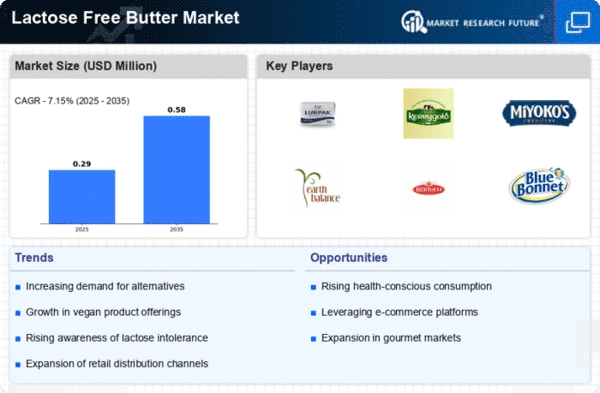
As per MRFR analysis, the Lactose Free Butter Market Size was estimated at 0.271 USD Million in 2024. The Lactose Free Butter industry is projected to grow from 0.294 in 2025 to 0.582 by 2035, exhibiting a compound annual growth rate (CAGR) of 7.15 during the forecast period 2025 - 2035.

Key Market Trends & Highlights

The Lactose Free Butter Market is experiencing robust growth driven by health trends and consumer preferences.

  • Health consciousness continues to drive demand for lactose free butter, particularly in North America, the largest market.
  • The clean label movement is gaining traction, with consumers seeking transparency in ingredient sourcing and production.
  • Spreading remains the largest segment, while baking is emerging as the fastest-growing segment in the lactose free butter market.
  • Rising lactose intolerance and health and wellness trends are key drivers propelling market expansion, alongside increased availability in retail channels.

Market Size & Forecast

2024 Market Size 0.271 (USD Million)
2035 Market Size 0.582 (USD Million)
CAGR (2025 - 2035) 7.15%
Largest Regional Market Share in 2024 North America

Major Players

<p>Lurpak (DK), Kerrygold (IE), Miyoko's Creamery (US), Earth Balance (US), Bertolli (IT), Blue Bonnet (US), Country Crock (US), Flora (GB)</p>

Market Trends

The Lactose Free Butter Market is currently experiencing a notable transformation, driven by an increasing awareness of lactose intolerance among consumers. This condition, which affects a significant portion of the population, has led to a growing demand for dairy alternatives that do not compromise on taste or quality. As a result, manufacturers are innovating to create lactose free butter products that cater to the needs of health-conscious individuals. The market appears to be expanding as more consumers seek options that align with their dietary preferences, thus fostering a competitive landscape among producers. Moreover, the rise of plant-based diets and the emphasis on clean label products are influencing the Lactose Free Butter Market. Consumers are increasingly scrutinizing ingredient lists, favoring products that are perceived as natural and free from artificial additives. This trend suggests that companies may need to adapt their offerings to meet evolving consumer expectations. Additionally, the growing popularity of lactose free butter in culinary applications, such as baking and cooking, indicates a shift in how these products are utilized in everyday meal preparation. Overall, the Lactose Free Butter Market is poised for continued growth as it aligns with broader dietary trends and consumer preferences.

Health Consciousness

The Lactose Free Butter Market is witnessing a surge in demand due to heightened health awareness among consumers. Individuals with lactose intolerance are increasingly seeking alternatives that do not compromise on flavor or texture. This trend indicates a shift towards products that cater to specific dietary needs, suggesting that manufacturers may need to innovate to capture this growing segment.

Clean Label Movement

A significant trend within the Lactose Free Butter Market is the clean label movement, where consumers prefer products with simple, recognizable ingredients. This inclination towards transparency in food labeling suggests that companies may need to reformulate their offerings to align with consumer expectations for natural and minimally processed items.

Culinary Versatility

The versatility of lactose free butter in various culinary applications is becoming more pronounced. As consumers explore diverse cooking methods, the demand for lactose free butter in baking and cooking is likely to increase. This trend indicates that the market may expand as more individuals incorporate these products into their daily meal preparations.

Lactose Free Butter Market Market Drivers

Innovations in Dairy Processing

Advancements in dairy processing technology play a crucial role in the expansion of the Global Lactose-Free Butter Industry. Innovative techniques, such as enzyme treatment and ultrafiltration, enable manufacturers to produce high-quality lactose-free butter that retains the desirable characteristics of traditional butter. These technological improvements not only enhance product quality but also increase production efficiency, allowing for a broader range of lactose-free products to enter the market. As consumer preferences evolve, the ability to offer diverse and appealing lactose-free options becomes essential for market growth, potentially leading to a compound annual growth rate of 8.02% from 2025 to 2035.

Health Conscious Consumer Trends

A notable shift towards health-conscious eating habits among consumers is influencing the Global Lactose-Free Butter Industry. Individuals are increasingly prioritizing dietary choices that align with their health goals, leading to a preference for lactose-free options. Lactose-free butter is perceived as a healthier alternative, appealing to those looking to reduce dairy intake without sacrificing flavor. This trend is further supported by the rise of plant-based diets and the growing awareness of the benefits of lactose-free products. As a result, the market is expected to grow significantly, with projections indicating a value of 551.9 USD Million by 2035.

Rising Lactose Intolerance Prevalence

The increasing prevalence of lactose intolerance globally drives demand for lactose-free products, including lactose-free butter. It is estimated that around 68% of the world's population experiences some form of lactose malabsorption. This condition is particularly common in regions such as Asia and Africa, where dairy consumption is traditionally lower. As awareness of lactose intolerance grows, consumers are actively seeking alternatives that do not compromise on taste or quality. Consequently, the Global Lactose-Free Butter Industry is witnessing a surge in demand, contributing to its projected market value of 236.2 USD Million in 2024.

Regulatory Support for Healthier Food Options

Government initiatives and regulations promoting healthier food choices contribute to the growth of the Global Lactose-Free Butter Industry. Many countries are implementing policies aimed at reducing lactose consumption and encouraging the production of lactose-free alternatives. These regulations often include subsidies for manufacturers producing lactose-free products, thereby incentivizing innovation and market entry. As a result, the lactose-free butter segment is expected to benefit from such supportive measures, fostering a conducive environment for growth and expansion in the coming years.

Increased Availability of Lactose-Free Products

The growing availability of lactose-free products in retail and foodservice sectors significantly impacts the Global Lactose-Free Butter Industry. Supermarkets and specialty stores are increasingly stocking lactose-free butter, making it more accessible to consumers. Additionally, foodservice establishments are incorporating lactose-free options into their menus to cater to the rising demand. This increased availability not only enhances consumer choice but also encourages trial and adoption of lactose-free butter. As more consumers become aware of these options, the market is likely to expand, reflecting the changing landscape of dietary preferences.

Market Segment Insights

By Application: Spreading (Largest) vs. Baking (Fastest-Growing)

<p>In the Lactose Free Butter Market, the application segment showcases a diverse distribution. Spreading commands the largest share due to its popularity among consumers seeking an easy, convenient alternative to traditional butter. This segment has resonated well with health-conscious individuals and those with lactose intolerance, further strengthening its position in the market. Baking and cooking applications also hold significant shares, reflecting consumer preferences for versatile cooking ingredients. The fastest-growing application within this segment is baking, driven by a rising trend in home baking and a growing awareness of lactose intolerance among consumers. Products catering specifically to bakers are increasingly being developed, creating opportunities for innovation and niche marketing. This growth is supported by an uptick in wellness trends, promoting dairy-free lifestyles and the demand for lactose-free options in baked goods.</p>

<p>Spreading (Dominant) vs. Baking (Emerging)</p>

<p>The spreading application of lactose free butter stands out as the dominant force within this segment, thanks to its widespread acceptance and convenience. Consumers prioritize easy spreading over traditional options, driving market growth through heightened demand for health-conscious alternatives. In contrast, the baking application represents an emerging opportunity, capturing the interest of both amateur and professional bakers who are increasingly seeking lactose-free ingredients. The rising trend of baking at home and catering for dietary restrictions has positioned baking as an attractive venture in the lactose-free space. Both applications target distinct consumer needs, with spreading focusing on simplicity and convenience, while baking emphasizes culinary versatility and health-conscious choices.</p>

By Distribution Channel: Supermarkets (Largest) vs. Online Retail (Fastest-Growing)

<p>In the Lactose Free Butter Market, distribution through supermarkets holds the largest market share, dominating the product availability for consumers in both urban and suburban areas. These retail giants provide extensive selections under various brands, making them a one-stop-shop for lactose-intolerant customers looking for dairy alternatives. Meanwhile, online retail, though currently smaller in share, has been experiencing rapid growth as consumers increasingly prefer the convenience of home delivery and the wide variety of options available online.</p>

<p>Supermarkets (Dominant) vs. Online Retail (Emerging)</p>

<p>Supermarkets serve as the dominant channel for lactose-free butter, offering competitive pricing, effective promotions, and easy accessibility to a broad audience. Their established infrastructure enables them to have a substantial inventory and influence on consumer purchasing decisions. In contrast, online retail is emerging quickly as a formidable contender, buoyed by the growing trend towards e-commerce and enhanced online shopping experiences. This channel attracts younger consumers who seek convenience, exclusive online brands, and flexible purchasing options, allowing them to browse a wider range of lactose-free products without geographical limitations.</p>

By End User: Households (Largest) vs. Food Service Industry (Fastest-Growing)

<p>In the Lactose Free Butter Market, the 'Households' segment commands the largest share due to the growing awareness of lactose intolerance and the increasing demand for lactose-free products among consumers. Households seeking healthier dietary options are actively converting to lactose-free substitutes. On the other hand, the 'Food Service Industry' is witnessing rapid growth as more eateries and restaurants are starting to incorporate lactose-free products into their menus to cater to changing consumer preferences and dietary restrictions. This segment’s expansion is driven by the rising trend of inclusivity in dining experiences for individuals who are lactose intolerant. The growth trends in the Lactose Free Butter Market are significantly influenced by changing consumer behavior and enhanced product offerings. Households are consistently increasing their consumption of dairy alternatives, leading to a substantial shift in purchasing patterns. Meanwhile, the Food Service Industry's focus on accommodating lactose intolerant patrons is prompting a surge in demand for lactose-free butter in professional kitchens. Catering services and bakeries are also adapting, leading to a dynamic landscape that enhances product innovation and marketing strategies to tap into these evolving needs.</p>

<p>Households (Dominant) vs. Catering Services (Emerging)</p>

<p>The 'Households' segment is the dominant force in the Lactose Free Butter Market, characterized by a strong preference for lactose-free alternatives due to increasing awareness of food allergies and health-conscious eating. This segment exhibits robust sales driven by consumer advocacy for healthier lifestyles and the expansion of product availability in grocery stores. In contrast, 'Catering Services' represents an emerging segment as these businesses adapt to consumer demands for lactose-free options at events and gatherings. Catering services play a crucial role in promoting lactose-free butter, particularly in customized menus that accommodate dietary restrictions, driving growth through heightened awareness and service diversification. Both segments reflect the ongoing shift in consumer preferences towards more inclusive and health-focused dietary options.</p>

By Form: Block (Largest) vs. Spreadable (Fastest-Growing)

<p>In the Lactose Free Butter Market, the distribution of forms reveals that Block butter commands the largest market share due to its traditional use and versatility in both culinary applications and baking. It appeals to consumers looking for a familiar and reliable product, maintaining a strong presence in the market. Spreadable butter, on the other hand, has emerged as a popular alternative for consumers seeking convenience, which has and will continue to support its growth trajectory.</p>

<p>Spreadable (Emerging) vs. Liquid (Dominant)</p>

<p>Spreadable lactose-free butter is becoming increasingly popular among consumers who prioritize ease of use and versatility. Its creamy texture allows it to be easily spread on bread and other products without the need for warming, making it a favored choice for those with busy lifestyles. On the other hand, Liquid lactose-free butter, while dominant in some applications, primarily serves niche markets, such as those catering to specific culinary techniques and recipes. With health-conscious consumers driving the adoption of lactose-free alternatives, both forms are positioned to capture market interest. Spreadable butter's emerging status is underpinned by its adaptability and commitment to meeting modern consumer demands.</p>

Get more detailed insights about Lactose-Free Butter Market Research Report-Global Forecast till 2035

Regional Insights

North America : Market Leader in Lactose Free

North America is poised to maintain its leadership in the lactose free butter market, holding a significant market share of 135 million in 2024. The growth is driven by increasing health awareness, rising lactose intolerance rates, and a shift towards plant-based diets. Regulatory support for lactose free products further fuels demand, as consumers seek healthier alternatives. The market is expected to expand as more retailers stock lactose free options, catering to a growing demographic of health-conscious consumers. The competitive landscape in North America is robust, featuring key players such as Miyoko's Creamery, Earth Balance, and Kerrygold. These brands are innovating with new flavors and formulations to attract diverse consumer segments. The U.S. leads the market, followed by Canada, where lactose free products are gaining traction. The presence of established brands and increasing consumer acceptance of lactose free options are pivotal in shaping the market dynamics.

Europe : Emerging Market for Alternatives

Europe is witnessing a notable rise in the lactose free butter market, with a market size of 85 million in 2024. This growth is attributed to increasing consumer awareness regarding lactose intolerance and a growing preference for healthier dietary options. Regulatory initiatives promoting lactose free products are also contributing to market expansion. The European market is characterized by a diverse range of products, catering to various dietary needs and preferences, which is expected to drive further growth in the coming years. Leading countries in this region include Germany, France, and the UK, where lactose free products are becoming mainstream. Key players such as Lurpak and Flora are actively expanding their product lines to meet consumer demand. The competitive landscape is marked by innovation and strategic partnerships, as brands seek to enhance their market presence. The increasing availability of lactose free options in retail outlets is further supporting market growth.

Asia-Pacific : Emerging Powerhouse in Dairy

Asia-Pacific is emerging as a significant player in the lactose free butter market, with a market size of 45 million in 2024. The region's growth is driven by rising health consciousness and increasing lactose intolerance among populations. As consumers become more aware of dietary options, the demand for lactose free products is expected to rise. Regulatory frameworks supporting health and wellness products are also contributing to market growth, making lactose free butter more accessible to consumers across the region. Countries like Australia and Japan are leading the charge in adopting lactose free alternatives, with local brands and international players like Kerrygold entering the market. The competitive landscape is evolving, with companies focusing on product innovation and marketing strategies to capture the growing consumer base. The increasing penetration of lactose free products in supermarkets and online platforms is expected to further boost market growth in the region.

Middle East and Africa : Niche Market with Growth Potential

The Middle East and Africa region is gradually developing its lactose free butter market, currently valued at 6 million in 2024. The growth is primarily driven by increasing awareness of lactose intolerance and a shift towards healthier eating habits. Regulatory support for health-focused products is also playing a crucial role in promoting lactose free options. As consumers become more health-conscious, the demand for lactose free butter is expected to rise, albeit at a slower pace compared to other regions. Countries like South Africa and the UAE are leading the market, with local and international brands beginning to offer lactose free alternatives. The competitive landscape is still in its infancy, but key players are starting to recognize the potential of this niche market. As awareness grows and more products become available, the lactose free butter market in this region is poised for gradual expansion.

Key Players and Competitive Insights

The Lactose Free Butter Market is currently characterized by a dynamic competitive landscape, driven by increasing consumer demand for lactose-free products and a growing awareness of dietary restrictions. Key players such as Lurpak (DK), Kerrygold (IE), and Miyoko's Creamery (US) are strategically positioning themselves through innovation and product diversification. Lurpak (DK) has focused on enhancing its product line with organic and plant-based options, while Kerrygold (IE) emphasizes its premium quality and heritage, appealing to health-conscious consumers. Miyoko's Creamery (US) has carved a niche in the vegan segment, leveraging its commitment to sustainability and ethical sourcing, which collectively shapes a competitive environment that prioritizes quality and consumer preferences.

In terms of business tactics, companies are increasingly localizing manufacturing to reduce supply chain complexities and enhance responsiveness to market demands. The Lactose Free Butter Market appears moderately fragmented, with several key players exerting influence while also facing competition from smaller, niche brands. This structure allows for a diverse range of products, catering to various consumer segments, and encourages innovation as companies strive to differentiate themselves.

In November 2025, Lurpak (DK) announced the launch of a new line of lactose-free butter spreads infused with natural flavors, aiming to attract younger consumers seeking variety in their dietary choices. This strategic move not only enhances Lurpak's product portfolio but also aligns with current trends favoring flavor innovation, potentially increasing market share among health-conscious demographics.

In October 2025, Kerrygold (IE) expanded its distribution channels by partnering with major online grocery platforms, thereby enhancing accessibility for consumers. This initiative reflects a growing trend towards e-commerce, allowing Kerrygold to reach a broader audience and adapt to changing shopping behaviors, which is crucial in maintaining competitive advantage in a rapidly evolving market.

In September 2025, Miyoko's Creamery (US) secured a partnership with a leading plant-based food distributor, significantly increasing its market penetration. This collaboration is strategically important as it not only amplifies brand visibility but also aligns with the rising consumer preference for plant-based alternatives, positioning Miyoko's as a frontrunner in the lactose-free segment.

As of December 2025, the Lactose Free Butter Market is witnessing trends such as digitalization, sustainability, and the integration of AI in production processes. Strategic alliances are increasingly shaping the competitive landscape, enabling companies to leverage shared resources and expertise. The shift from price-based competition to a focus on innovation, technology, and supply chain reliability is evident, suggesting that future competitive differentiation will hinge on the ability to adapt to consumer preferences and technological advancements.

Key Companies in the Lactose Free Butter Market market include

Industry Developments

Future Outlook

Lactose Free Butter Market Future Outlook

<p>The Lactose Free Butter Market is projected to grow at a 7.15% CAGR from 2024 to 2035, driven by rising health awareness and increasing lactose intolerance prevalence.</p>

New opportunities lie in:

  • <p>Expansion into plant-based lactose free butter alternatives</p>
  • <p>Development of premium lactose free butter products for gourmet markets</p>
  • <p>Strategic partnerships with health-focused retailers for exclusive product lines</p>

<p>By 2035, the Lactose Free Butter Market is expected to achieve substantial growth and diversification.</p>

Market Segmentation

Lactose Free Butter Market Form Outlook

  • Block
  • Spreadable
  • Liquid

Lactose Free Butter Market End User Outlook

  • Households
  • Food Service Industry
  • Catering Services
  • Bakeries

Lactose Free Butter Market Application Outlook

  • Cooking
  • Baking
  • Spreading
  • Sauces
  • Confectionery

Lactose Free Butter Market Distribution Channel Outlook

  • Supermarkets
  • Online Retail
  • Specialty Stores
  • Health Food Stores

Report Scope

MARKET SIZE 20240.271(USD Million)
MARKET SIZE 20250.294(USD Million)
MARKET SIZE 20350.582(USD Million)
COMPOUND ANNUAL GROWTH RATE (CAGR)7.15% (2024 - 2035)
REPORT COVERAGERevenue Forecast, Competitive Landscape, Growth Factors, and Trends
BASE YEAR2024
Market Forecast Period2025 - 2035
Historical Data2019 - 2024
Market Forecast UnitsUSD Million
Key Companies ProfiledLurpak (DK), Kerrygold (IE), Miyoko's Creamery (US), Earth Balance (US), Bertolli (IT), Blue Bonnet (US), Country Crock (US), Flora (GB)
Segments CoveredApplication, Distribution Channel, End User, Form
Key Market OpportunitiesGrowing consumer demand for lactose-free products drives innovation in the Lactose Free Butter Market.
Key Market DynamicsRising consumer demand for lactose-free products drives innovation and competition in the lactose free butter market.
Countries CoveredNorth America, Europe, APAC, South America, MEA

FAQs

Who are the leading key players in the Lactose-Free Butter Market?

Arla Foods amba (Denmark), Conagra Brands Inc. (US), Green Valley Creamery (US), California Dairies Inc. (US), Valio Ltd (Finland), Upfield (Netherlands), Johnson &amp; Johnson Services Inc. (US), Lactalis Canada (Canada), OMIRA GmbH (Germany), Prosperity Organic Foods Inc. (US)

How big will the Lactose-Free Butter Industry be in the 2035?

Lactose-Free Butter Industry Size expected to reach USD 551.9 million By 2035

What is the growth rate of the Lactose-Free Butter Market during the forecast period of 2021–2028?

Lactose-Free Butter Market is anticipated to grow at a 8.02% CAGR during the forecast period of 2025–2035

Which region will be dominant in the lactose-free butter market?

Europe will be dominant in the lactose-free butter market

  1. EXECUTIVE SUMMARY
  2. MARKET INTRODUCTION
    1. Market Definition
    2. Scope of the Study
      1. Research Objectives
      2. Assumptions & Limitations
    3. Market Structure
  3. RESEARCH METHODOLOGY
    1. Research Process
    2. Secondary Research
    3. Primary Research
    4. Forecast Model
  4. MARKET FACTOR ANALYSIS
    1. Supply Chain Analysis
      1. Raw Material Suppliers
      2. Manufacturers/Producers
      3. Distributors, Retailers, and Wholesalers
      4. End Users
    2. Porter''s Five Forces Analysis
      1. Threat of New Entrants
      2. Bargaining Power of Buyers
      3. Bargaining Power of Suppliers
      4. Threat of Substitutes
      5. Intensity of Rivalry
    3. Impact of COVID-19 on Global Lactose-free Butter Market
      1. Impact on Retail Sales
      2. Impact on Raw Material Availability
      3. Impact on Consumer Buying Behavior
      4. Impact on Store Vs. Online Sales
      5. Others
  5. MARKET DYNAMICS
    1. Introduction
    2. Drivers
    3. Restraints
    4. Opportunities
    5. Challenges
  6. GLOBAL LACTOSE-FREE BUTTERMARKET, BY PRODUCT TYPE
    1. Introduction
    2. Salted Butter
      1. Market Estimates & Forecast, 2021-2028
      2. Market Estimates & Forecast, by Region, 2021-2028
    3. UnsaltedSalted Butter
      1. Market Estimates & Forecast, 2021-2028
      2. Market Estimates & Forecast, by Region, 2021-2028
  7. GLOBAL LACTOSE-FREE BUTTERMARKET, BY CATEGORY
    1. Introduction
    2. Conventional
      1. Market Estimates & Forecast, 2021-2028
      2. Market Estimates & Forecast, by Region, 2021-2028
    3. Organic
      1. Market Estimates & Forecast, 2021-2028
      2. Market Estimates & Forecast, by Region, 2021-2028
  8. GLOBAL LACTOSE-FREE BUTTERMARKET, BY DISTRIBUTION CHANNEL
    1. Introduction
    2. Store-Based
      1. Market Estimates & Forecast, 2021-2028
      2. Market Estimates & Forecast, by Region, 2021-2028
      3. Supermarkets&Hypermarkets
      4. ConvenienceStores
      5. Others
    3. Non-Store-Based
      1. Market Estimates & Forecast,2021-2028
      2. Market Estimates & Forecast, by Region, 2021-2028
  9. GLOBAL LACTOSE-FREE BUTTERMARKET, BY REGION
    1. Introduction
    2. North America
      1. Market Estimates & Forecast, 2021-2028
      2. Market Estimates & Forecast, by Product Type, 2021-2028
      3. Market Estimates & Forecast, by Category, 2021-2028
      4. Market Estimates & Forecast, by Distribution Channel, 2021-2028
      5. Market Estimates & Forecast, by Country, 2021-2028
      6. US
      7. Canada
      8. Mexico
    3. Europe
      1. Market Estimates & Forecast, 2021-2028
      2. Market Estimates & Forecast, by Product Type, 2021-2028
      3. Market Estimates & Forecast, by Category, 2021-2028
      4. Market Estimates & Forecast, by Distribution Channel, 2021-2028
      5. Market Estimates & Forecast, by Country, 2021-2028
      6. Germany
      7. UK
      8. France
      9. Spain
      10. Italy
      11. Rest of Europe
    4. Asia-Pacific
      1. Market Estimates & Forecast, 2021-2028
      2. Market Estimates & Forecast, by Product Type, 2021-2028
      3. Market Estimates & Forecast, by Category, 2021-2028
      4. Market Estimates & Forecast, by Distribution Channel, 2021-2028
      5. Market Estimates & Forecast, by Country, 2021-2028
      6. China
      7. Japan
      8. India
      9. Australia & New Zealand
      10. Rest of Asia-Pacific
    5. Rest of the World
      1. Market Estimates & Forecast, 2021-2028
      2. Market Estimates & Forecast, by Product Type, 2021-2028
      3. Market Estimates & Forecast, by Category, 2021-2028
      4. Market Estimates & Forecast, by Distribution Channel, 2021-2028
      5. Market Estimates & Forecast, by Region, 2021-2028
      6. South America
      7. Middle East
      8. Africa
  10. COMPETITIVE LANDSCAPE
    1. Introduction
    2. Market Strategy
    3. Key Development Analysis
    4. (Expansions/Mergers& Acquisitions/JointVentures/New ProductDevelopments/Agreements/Investments)
  11. COMPANY PROFILES
    1. Arla Foods amba
      1. Company Overview
      2. Key Financials
      3. Products Offerred
      4. Key Developments
      5. SWOT Analysis
      6. Key Strategies
    2. Conagra Brands, Inc.
      1. Company Overview
      2. Key Financials
      3. Products Offered
      4. Key Developments
      5. SWOT Analysis
      6. Key Strategies
    3. Green Valley Creamery
      1. Company Overview
      2. Key Financials
      3. Products Offerred
      4. Key Developments
      5. SWOT Analysis
      6. Key Strategies
    4. California Dairies, Inc. (Challenge Dairy)
      1. Company Overview
      2. Key Financials
      3. Products Offerred
      4. Key Developments
      5. SWOT Analysis
      6. Key Strategies
    5. Valio Ltd
      1. Company Overview
      2. Key Financials
      3. Products Offerred
      4. Key Developments
      5. SWOT Analysis
      6. Key Strategies
    6. Upfield (Shedd''s Country Crock)
      1. Company Overview
      2. Key Financials
      3. Products Offerred
      4. Key Developments
      5. SWOT Analysis
      6. Key Strategies
    7. Johnson & Johnson Services, Inc(McNeil Nutritionals – LACTAID)
      1. Company Overview
      2. Key Financials
      3. Products Offerred
      4. Key Developments
      5. SWOT Analysis
      6. Key Strategies
    8. Lactalis Canada
      1. Company Overview
      2. Key Financials
      3. Products Offerred
      4. Key Developments
      5. SWOT Analysis
      6. Key Strategies
    9. OMIRA GmbH
      1. Company Overview
      2. Key Financials
      3. Products Offerred
      4. Key Developments
      5. SWOT Analysis
      6. Key Strategies
    10. Prosperity Organic Foods, Inc.
      1. Company Overview
      2. Key Financials
      3. Products Offerred
      4. Key Developments
      5. SWOT Analysis
      6. Key Strategies
  12. CONCLUSION
  13. LIST OF TABLES
    1. TABLE 1Global Lactose-free ButterMarket, by Region, 2020-2030(USD Million)
  14. Global Lactose-free ButterMarket, by ProductType, 2020-2030(USD Million)
  15. Global Lactose-free ButterMarket, by Category, 2020-2030(USD Million)
  16. Global Lactose-free ButterMarket, by Distribution Channel, 2020-2030(USD Million)
  17. North America: Lactose-free ButterMarket, by Country, 2020-2030(USD Million)
  18. North America: Lactose-free ButterMarket, by Product Type, 2020-2030(USD Million)
  19. North America: Lactose-free ButterMarket, by Category, 2020-2030(USD Million)
  20. North America: Lactose-free ButterMarket, by Distribution Channel, 2020-2030(USD Million)
  21. US: Lactose-free ButterMarket, by Product Type, 2020-2030(USD Million)
  22. US: Lactose-free ButterMarket, by Category, 2020-2030(USD Million)
  23. US: Lactose-free ButterMarket, by Distribution Channel, 2020-2030(USD Million)
  24. Canada: Lactose-free ButterMarket, by Product Type, 2020-2030(USD Million)
  25. Canada: Lactose-free ButterMarket, by Category, 2020-2030(USD Million)
  26. Canada: Lactose-free ButterMarket, by Distribution Channel, 2020-2030(USD Million)
  27. Mexico: Lactose-free ButterMarket, by Product Type, 2020-2030(USD Million)
  28. Mexico: Lactose-free ButterMarket, by Category, 2020-2030(USD Million)
  29. Mexico: Lactose-free ButterMarket, by Distribution Channel, 2020-2030(USD Million)
  30. Europe: Lactose-free ButterMarket, by Country, 2020-2030(USD Million)
  31. Europe: Lactose-free ButterMarket, by Product Type, 2020-2030(USD Million)
  32. Europe: Lactose-free ButterMarket, by Category, 2020-2030(USD Million)
  33. Europe: Lactose-free ButterMarket, by Distribution Channel, 2020-2030(USD Million)
  34. Germany: Lactose-free ButterMarket, by ProductType, 2020-2030(USD Million)
  35. Germany: Lactose-free ButterMarket, by Category, 2020-2030(USD Million)
  36. Germany: Lactose-free ButterMarket, by Distribution Channel, 2020-2030(USD Million)
  37. France: Lactose-free ButterMarket, by ProductType, 2020-2030(USD Million)
  38. France: Lactose-free ButterMarket, by Category, 2020-2030(USD Million)
  39. France: Lactose-free ButterMarket, by Distribution Channel, 2020-2030(USD Million)
  40. Italy: Lactose-free ButterMarket, by Product Type, 2020-2030(USD Million)
  41. Italy: Lactose-free ButterMarket, by Category, 2020-2030(USD Million)
  42. Italy: Lactose-free ButterMarket, by Distribution Channel, 2020-2030(USD Million)
  43. Spain: Lactose-free ButterMarket, by Product Type, 2020-2030(USD Million)
  44. Spain: Lactose-free ButterMarket, by Category, 2020-2030(USD Million)
  45. Spain: Lactose-free ButterMarket, by Distribution Channel, 2020-2030(USD Million)
  46. UK: Lactose-free ButterMarket, by Product Type, 2020-2030(USD Million)
  47. UK: Lactose-free ButterMarket, by Category, 2020-2030(USD Million)
  48. UK: Lactose-free ButterMarket, by Distribution Channel, 2020-2030(USD Million)
  49. Rest of Europe: Lactose-free ButterMarket, by Product Type, 2020-2030(USD Million)
  50. Rest of Europe: Lactose-free ButterMarket, by Category, 2020-2030(USD Million)
  51. Rest of Europe: Lactose-free ButterMarket, by Distribution Channel, 2020-2030(USD Million)
  52. Asia-Pacific: Lactose-free ButterMarket, by Country, 2020-2030(USD Million)
  53. Asia-Pacific: Lactose-free ButterMarket, by Product Type, 2020-2030(USD Million)
  54. Asia-Pacific: Lactose-free ButterMarket, by Category, 2020-2030(USD Million)
  55. Asia-Pacific: Lactose-free ButterMarket, by Distribution Channel, 2020-2030(USD Million)
  56. China: Lactose-free ButterMarket, by Product Type, 2020-2030(USD Million)
  57. China: Lactose-free ButterMarket, by Category, 2020-2030(USD Million)
  58. China: Lactose-free ButterMarket, by Distribution Channel, 2020-2030(USD Million)
  59. India: Lactose-free ButterMarket, by Product Type, 2020-2030(USD Million)
  60. India: Lactose-free ButterMarket, by Category, 2020-2030(USD Million)
  61. India: Lactose-free ButterMarket, by Distribution Channel, 2020-2030(USD Million)
  62. Japan: Lactose-free ButterMarket, by Product Type, 2020-2030(USD Million)
  63. Japan: Lactose-free ButterMarket, by Category, 2020-2030(USD Million)
  64. Japan: Lactose-free ButterMarket, by Distribution Channel, 2020-2030(USD Million)
  65. Rest of Asia-Pacific: Lactose-free ButterMarket, by Product Type, 2020-2030(USD Million)
  66. Rest of Asia-Pacific: Lactose-free ButterMarket, by Category, 2020-2030(USD Million)
  67. Rest of Asia-Pacific: Lactose-free ButterMarket, by Distribution Channel, 2020-2030(USD Million)
  68. Rest of the World (RoW): Lactose-free ButterMarket, by Region, 2020-2030(USD Million)
  69. Rest of the World (RoW): Lactose-free ButterMarket, by Product Type, 2020-2030(USD Million)
  70. Rest of the World (RoW): Lactose-free ButterMarket, by Category, 2020-2030(USD Million)
  71. Rest of the World (RoW): Lactose-free ButterMarket, by Distribution Channel, 2020-2030(USD Million)
  72. South America: Lactose-free ButterMarket, by ProductType, 2020-2030(USD Million)
  73. South America: Lactose-free ButterMarket, by Category, 2020-2030(USD Million)
  74. South America: Lactose-free ButterMarket, by Distribution Channel, 2020-2030(USD Million)
  75. Middle East: Lactose-free ButterMarket, by Product Type, 2020-2030(USD Million)
  76. Middle East: Lactose-free ButterMarket, by Category, 2020-2030(USD Million)
  77. Middle East: Lactose-free ButterMarket, by Distribution Channel, 2020-2030(USD Million)
  78. Africa: Lactose-free ButterMarket, by ProductType, 2020-2030(USD Million)
  79. Africa: Lactose-free ButterMarket, by Category, 2020-2030(USD Million)
  80. Africa: Lactose-free ButterMarket, by Distribution Channel, 2020-2030(USD Million)
  81. LIST OF FIGURES
  82. Global Lactose-free ButterMarket Segmentation
  83. Forecast Research Methodology
  84. Porters Five Forces Analysis of the Global Lactose-free ButterMarket
  85. Value Chain of the Global Lactose-free ButterMarket
  86. Share of the Global Lactose-free ButterMarket in 2019, by Country (%)
  87. Global Lactose-free ButterMarket, by Region, 2019–2028 (USD Million)
  88. Global Lactose-free ButterMarket Size, by Product Type, 2020 (USD Million)
  89. Share of the Global Lactose-free ButterMarket, by Product Type, 2019–2028(%)
  90. Global Lactose-free ButterMarket Size, by Category, 2020 (USD Million)
  91. Share of the Global Lactose-free ButterMarket, by Category, 2019–2028(%)
  92. Global Lactose-free ButterMarket Size, by Distribution Channel, 2020 (USD Million)
  93. Share of the Global Lactose-free ButterMarket, by Distribution Channel, 2019–2028(%)

Lactose-Free Butter Market Segmentation

Market Segmentation Overview

  • Detailed segmentation data will be available in the full report
  • Comprehensive analysis by multiple parameters
  • Regional and country-level breakdowns
  • Market size forecasts by segment
Infographic

Free Sample Request

Kindly complete the form below to receive a free sample of this Report

Get Free Sample

Customer Strories

Compare Licence

×
Features License Type
Single User Multiuser License Enterprise User
Price $4,950 $5,950 $7,250
Maximum User Access Limit 1 User Upto 10 Users Unrestricted Access Throughout the Organization
Free Customization
Direct Access to Analyst
Deliverable Format
Platform Access
Discount on Next Purchase 10% 15% 15%
Printable Versions