Request Free Sample ×

Kindly complete the form below to receive a free sample of this Report

* Please use a valid business email

Leading companies partner with us for data-driven Insights

clients tt-cursor
Hero Background
English
Chinese
French
Japanese
Korean
German
Spanish

Laboratory Automation Market Size

ID: MRFR/HC/10309-CR
200 Pages
Rahul Gotadki
April 2025

Global Laboratory Automation Market Research Report By Application (Sample Preparation, Liquid Handling, Automated Workflow, Data Management, Analysis and Testing), By Product Type (Automated Workstations, Robotic Systems, Software, Consumables, Analyzers), By End Use (Pharmaceuticals, Biotechnology, Clinical Laboratories, Academic Research, Environmental Testing), By Region (North America, Europe, Asia-Pacific, Latin America, Middle East and Africa) and By Regional (North America, Europe, South America, Asia Pacific, Middle East and Africa) -Forecast to 2035

Share:
Download PDF ×

We do not share your information with anyone. However, we may send you emails based on your report interest from time to time. You may contact us at any time to opt-out.

Laboratory Automation Market Infographic
Purchase Options

Laboratory Automation Size

Laboratory Automation Market Growth Projections and Opportunities

The expansion of the worldwide laboratory automation market can be linked to a surge in investments directed towards research and development (R&D) endeavors and the escalating embrace of laboratory automation systems. Nevertheless, there is a potential impediment to market growth in the form of substantial initial capital investments required for the automation of laboratory infrastructure. Additionally, the positive trajectory of the market is anticipated to be influenced by factors such as the ongoing enhancement of healthcare infrastructure in emerging economies.

A significant catalyst propelling the global laboratory automation market is the increased allocation of funds towards R&D activities. This heightened investment underscores the global commitment to advancing scientific research and technological innovation. Laboratories, across various industries and sectors, are increasingly adopting automation systems to streamline and enhance their operational processes. This growing adoption is emblematic of the recognition of the efficiency and precision that laboratory automation brings to scientific workflows.

However, despite the evident advantages of laboratory automation, there exists a notable challenge that could impede the market's expansion — the considerable initial capital investments required for automating laboratory infrastructure. The implementation of automation systems demands a significant financial commitment upfront. This capital-intensive nature can be a deterrent for some organizations, especially smaller enterprises or those operating on tighter budgets. The initial costs associated with acquiring and integrating automated solutions may be perceived as a barrier, hindering the widespread adoption of laboratory automation across various sectors.

On a positive note, the future growth of the laboratory automation market is anticipated to be driven by factors such as the ongoing enhancements in healthcare infrastructure, particularly in emerging economies. As nations across the globe strive to improve their healthcare facilities and services, there is a parallel emphasis on incorporating advanced technologies to elevate the standards of healthcare delivery. Laboratory automation systems play a pivotal role in this context, offering enhanced efficiency, accuracy, and speed in diagnostic and research processes. The modernization of healthcare infrastructure, especially in emerging markets, is creating a conducive environment for the growth of the laboratory automation market.
Laboratory Automation Market Size Graph
Author
Author Profile
Rahul Gotadki
Research Manager

He holds an experience of about 9+ years in Market Research and Business Consulting, working under the spectrum of Life Sciences and Healthcare domains. Rahul conceptualizes and implements a scalable business strategy and provides strategic leadership to the clients. His expertise lies in market estimation, competitive intelligence, pipeline analysis, customer assessment, etc.

Leave a Comment

FAQs

What is the projected market valuation of the Laboratory Automation Market by 2035?

<p>The Laboratory Automation Market is projected to reach a valuation of 10.0 USD Billion by 2035.</p>

What was the market valuation of the Laboratory Automation Market in 2024?

<p>In 2024, the Laboratory Automation Market was valued at 5.33 USD Billion.</p>

What is the expected CAGR for the Laboratory Automation Market from 2025 to 2035?

<p>The expected CAGR for the Laboratory Automation Market during the forecast period 2025 - 2035 is 5.89%.</p>

Which companies are considered key players in the Laboratory Automation Market?

<p>Key players in the Laboratory Automation Market include Thermo Fisher Scientific, Abbott Laboratories, Siemens Healthineers, and Roche Diagnostics.</p>

What segment of the Laboratory Automation Market is expected to grow the most by 2035?

<p>The Sample Preparation segment is expected to grow from 1.07 USD Billion in 2024 to 2.0 USD Billion by 2035.</p>

How does the Liquid Handling segment perform in the Laboratory Automation Market?

<p>The Liquid Handling segment was valued at 1.33 USD Billion in 2024 and is projected to reach 2.5 USD Billion by 2035.</p>

What is the anticipated growth for Automated Workstations in the Laboratory Automation Market?

<p>Automated Workstations are expected to grow from 1.5 USD Billion in 2024 to 2.8 USD Billion by 2035.</p>

What is the expected performance of the Pharmaceuticals end-use segment by 2035?

<p>The Pharmaceuticals end-use segment is projected to increase from 1.6 USD Billion in 2024 to 3.0 USD Billion by 2035.</p>

What role do software solutions play in the Laboratory Automation Market?

<p>Software solutions are anticipated to grow from 0.8 USD Billion in 2024 to 1.5 USD Billion by 2035.</p>

How does the market for Environmental Testing compare to other end-use segments?

<p>The Environmental Testing segment is expected to grow from 0.73 USD Billion in 2024 to 1.5 USD Billion by 2035, indicating a steady increase.</p>

Market Summary

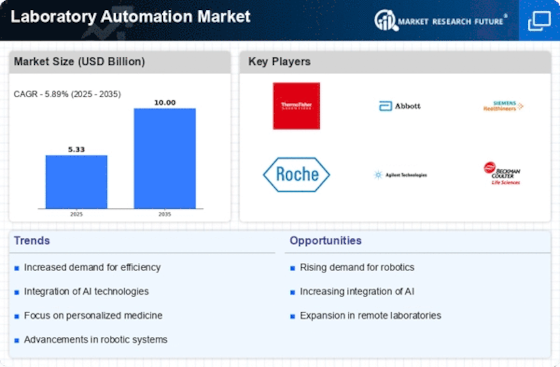
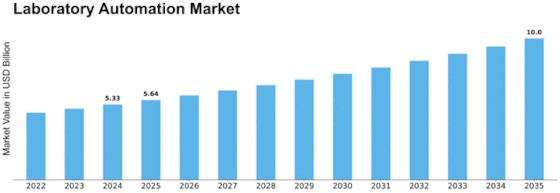
As per MRFR analysis, the Laboratory Automation Market size was valued at USD 5.33 Billion in 2024. The market is projected to grow from USD 5.644 Billion in 2025 to USD 10.0 Billion by 2035, exhibiting a CAGR of 5.89% during the forecast period 2025-2035. North America led the market with over 45.03% share, generating around USD 2.4 billion in revenue.
 
The Laboratory Automation Market is expanding rapidly due to rising demand for efficiency, precision, and high-throughput testing in research, diagnostics, and pharmaceuticals. Key trends include integration of robotics, artificial intelligence, and data analytics to streamline workflows, reduce human error, and enhance compliance. Customized and scalable automation solutions are increasingly adopted across global laboratories.
 
Adoption of automated systems is driven by the need for higher throughput, reduced errors, and enhanced reproducibility, especially in pharmaceutical and biotech research.

Key Market Trends & Highlights

The Laboratory Automation Market is poised for substantial growth driven by technological advancements and evolving industry needs.

  • The integration of Artificial Intelligence is transforming laboratory processes, enhancing efficiency and accuracy. Customization is increasingly prioritized, allowing laboratories to tailor automation solutions to specific workflows. Sustainability initiatives are gaining traction, reflecting a broader commitment to environmentally responsible practices in laboratory settings. Rising demand for high-throughput screening and advancements in robotics are key drivers propelling market expansion, particularly in North America and the Asia-Pacific region.

Market Size & Forecast

2024 Market Size 5.33 (USD Billion)
2035 Market Size 10.0 (USD Billion)
CAGR (2025 - 2035) 5.89%
Largest Regional Market Share in 2024 North America

Major Players

Companies such as Thermo Fisher Scientific (US), <a href="https://www.abbott.com/product-list.html">Abbott </a>Laboratories (US), <a href="https://www.siemens-healthineers.com/en-in/laboratory-automation">Siemens Healthineers</a> (DE), Roche Diagnostics (CH), Agilent Technologies (US), Beckman Coulter (US), PerkinElmer (US), Tecan Group (CH), Eppendorf (DE), Hamilton Company (US) are some of the major participants in the global market.

Market Trends

The Laboratory Automation Market is currently experiencing a transformative phase, driven by advancements in technology and increasing demand for efficiency in laboratory processes. Automation solutions are being integrated into various sectors, including pharmaceuticals, biotechnology, and clinical diagnostics.

This shift is largely influenced by the need for higher throughput, reduced human error, and enhanced reproducibility in experimental results. As laboratories strive to optimize workflows, the adoption of automated systems appears to be a strategic response to these challenges, fostering innovation and improving overall productivity. Moreover, the growing emphasis on data management and analysis is reshaping the landscape of the Laboratory Automation Market.

Laboratories are increasingly seeking solutions that not only automate routine tasks but also facilitate data integration and real-time monitoring. This trend suggests a movement towards more intelligent systems capable of adapting to complex experimental requirements.

As the market evolves, stakeholders are likely to focus on developing versatile automation platforms that can cater to diverse applications, thereby enhancing the operational capabilities of laboratories across various fields.

Integration of Artificial Intelligence

The incorporation of artificial intelligence into lab automation systems is becoming more prevalent. AI technologies are enhancing data analysis, enabling predictive maintenance, and optimizing workflows. This trend indicates a shift towards smarter laboratories that can adapt to changing conditions and improve decision-making processes.

According to the World Health Organization, the adoption of AI in laboratory diagnostics and research is accelerating, with over 70% of advanced laboratories globally integrating AI-based data analysis tools to enhance predictive modeling and workflow optimization.

Increased Focus on Customization

There is a growing demand for customized automation solutions tailored to specific laboratory needs. This trend reflects the recognition that one-size-fits-all approaches may not suffice in addressing the unique challenges faced by different sectors. Customization allows laboratories to enhance efficiency and achieve better results.

The World Health Organization reports that laboratory adoption of tailored automation solutions is rising, with over 60% of laboratories seeking modular and customizable systems to meet specific research and diagnostic needs.

Sustainability Initiatives

Sustainability is emerging as a key consideration in the Laboratory Automation Market. Companies are increasingly prioritizing eco-friendly practices, such as reducing waste and energy consumption. This trend suggests a broader commitment to environmental responsibility, which may influence product development and operational strategies.

Global health organizations including the Global Fund and the World Health Organization indicate that laboratories are increasingly prioritizing eco-friendly practices, with energy-efficient equipment and waste reduction programs adopted by over 55% of major research facilities.

Laboratory Automation Market Market Drivers

Rising Demand for High-Throughput Screening

The Laboratory Automation Market is experiencing a notable increase in demand for high-throughput screening technologies. This surge is primarily driven by the need for rapid and efficient testing in drug discovery and development processes. As pharmaceutical companies strive to accelerate their research timelines, the adoption of automated systems that can handle large volumes of samples is becoming essential.
 
Reports indicate that the market for high-throughput screening is projected to grow significantly, with estimates suggesting a compound annual growth rate of over 10% in the coming years. This trend underscores the critical role that automation plays in enhancing productivity and reducing time-to-market for new therapeutics, thereby shaping the future landscape of the Laboratory Automation Market.

Increasing Regulatory Compliance Requirements

The Laboratory Automation Market is significantly influenced by the increasing regulatory compliance requirements across various sectors, including pharmaceuticals, biotechnology, and clinical laboratories. Regulatory bodies are imposing stringent guidelines to ensure the accuracy and reliability of laboratory results, which necessitates the adoption of automated systems that can provide consistent and reproducible outcomes.
 
Automation technologies facilitate compliance by minimizing human error and enhancing data integrity through advanced tracking and documentation capabilities. As laboratories strive to meet these regulatory standards, the demand for automated solutions is expected to rise. This trend not only supports compliance efforts but also positions laboratories to operate more efficiently within the constraints of regulatory frameworks, thereby fostering growth in the Laboratory Automation Market.

Expansion of Personalized Medicine Initiatives

The Laboratory Automation Market is witnessing a notable expansion driven by the rise of personalized medicine initiatives. As healthcare shifts towards more tailored treatment approaches, laboratories are required to conduct a greater number of tests to identify specific patient needs. This trend necessitates the implementation of automated systems that can efficiently process and analyze diverse biological samples.
 
The increasing prevalence of chronic diseases and the demand for targeted therapies are propelling laboratories to adopt automation technologies that enhance throughput and accuracy. Furthermore, the market is expected to see a rise in partnerships between technology providers and healthcare institutions to develop customized automation solutions that cater to the unique requirements of personalized medicine. This alignment is likely to foster innovation and growth within the Laboratory Automation Market.

Growing Focus on Data Management and Analytics

In the Laboratory Automation Market, there is a growing emphasis on data management and analytics as laboratories seek to harness the power of data for informed decision-making. The integration of automation with data analytics tools allows laboratories to collect, analyze, and interpret vast amounts of data generated during experiments. This capability is particularly crucial in research and development settings, where insights derived from data can lead to breakthroughs in scientific understanding and innovation.
 
Moreover, the ability to visualize and manage data effectively enhances collaboration among research teams and accelerates the pace of discovery. As laboratories increasingly recognize the value of data-driven approaches, the demand for automated systems that incorporate advanced analytics is likely to expand, further propelling the Laboratory Automation Market.

Advancements in Robotics and Automation Technologies

Technological advancements in robotics and automation are transforming the Laboratory Automation Market. Innovations in robotic systems, such as improved precision and flexibility, are enabling laboratories to automate complex tasks that were previously labor-intensive. The integration of sophisticated robotic arms and automated liquid handling systems is streamlining workflows, thereby enhancing efficiency and accuracy in laboratory processes.
 
Furthermore, the market is witnessing a shift towards modular automation solutions that allow for easy scalability and customization. This adaptability is particularly appealing to laboratories of varying sizes, as it enables them to optimize their operations without significant upfront investments. As these technologies continue to evolve, they are likely to drive further growth in the Laboratory Automation Market.

Market Segment Insights

By Application: Sample Preparation (Largest) vs. Liquid Handling (Fastest-Growing)

The laboratory automation market is experiencing a diverse spread of application areas, where sample prep automation currently holds the largest share. Its significance in streamlining the preparatory processes for various assays and tests makes it crucial in laboratories worldwide. On the other hand, Liquid Handling has emerged as the fastest-growing segment, primarily driven by advancements in robotics and the need for precision in liquid transfers, enhancing efficiency and reducing human error in laboratories. As laboratories continue to focus on improving operational efficiency, the demand for automated solutions in Analysis and Testing is also swelling. The growth of Automated Workflow systems complements this trend, as laboratories seek integrated solutions. Data Management applications are critical in this segment, helping manage large datasets and streamline reporting processes, leading to enhanced laboratory output and compliance with regulatory standards.

Sample Preparation (Dominant) vs. Automated Workflow (Emerging)

Sample prep automation stands out as the dominant application in the laboratory automation market due to its vital role in preparing samples for analytical processes. This segment encompasses various tasks such as dilution, extraction, and filtration, which are essential in achieving accurate and reliable test results. Meanwhile, Automated Workflow is an emerging application that facilitates the seamless integration of different laboratory processes, minimizing manual intervention. This segment's growth is fueled by the demand for more efficient workflows that can enhance throughput and optimize resource allocation. As laboratories adapt to these technologies, the demand for customizable automation solutions is likely to increase, reflecting a shift towards a more integrated approach in laboratory operations.

By Product Type: Automated Workstations (Largest) vs. Robotic Systems (Fastest-Growing)

The Laboratory Automation Market exhibits a diverse distribution of product types, with Automated Workstations holding the largest market share. This segment appeals to laboratories seeking efficiency and high throughput, making it a preferred choice among users. In contrast, Robotic Systems have emerged as a notable contender, gaining traction due to advancements in technology and automation capabilities, positioning itself as the fastest-growing segment in the automated plate handlers market. The growth trends within this segment are significantly influenced by the increasing demand for automation solutions that enhance accuracy and productivity in laboratory settings. Factors such as the rising adoption of robotic systems for complex tasks, the integration of software that streamlines operations, and the growing focus on reducing human error are key drivers for these product types. As laboratories continue to adapt to new challenges, the shift towards automation is set to accelerate, suggesting a promising outlook for both Automated Workstations and Robotic Systems.

Automated Workstations (Dominant) vs. Software (Emerging)

Automated Workstations represent the dominant force in the market share, characterized by their comprehensive features that combine various laboratory processes into a single integrated platform. These systems are designed to optimize workflow, reduce manual labor, and enhance data accuracy, making them a vital investment for laboratories aiming for operational excellence. On the other hand, Software solutions are emerging as a crucial component, enabling users to manage and control lab operations effectively. With the growing complexity of laboratory tasks, software solutions are increasingly being sought after for their ability to provide analytical insights and streamline data management processes. Together, these segments play complementary roles in driving the evolution of clinical laboratory automation systems.

By End-Use: Pharmaceuticals (Largest) vs. Biotechnology (Fastest-Growing)

The Laboratory Automation Market is experiencing significant growth across various end-use segments, with the Pharmaceuticals sector holding the largest share due to its extensive demand for automation in <a title="drug development" href="https://www.marketresearchfuture.com/reports/drug-development-market-66529" target="_blank" rel="noopener">drug development</a> and production processes. This segment benefits from the increasing adoption of robotic solutions and automated workflows that enhance productivity and accuracy in laboratory settings. Following closely is the Biotechnology sector, which is rapidly gaining traction as more biotech companies leverage automation for research and development, thus increasing efficiency and reducing time-to-market for novel therapies.

Pharmaceuticals (Dominant) vs. Biotechnology (Emerging)

In the Laboratory Automation Market, Pharmaceuticals is recognized as the dominant segment, driven by the incessant need for efficiency, accuracy, and scalability in drug development processes. Automation technologies such as liquid handling systems and robotic arms play a crucial role in streamlining lab operations, thereby reducing human error and expediting research timelines. In contrast, the Biotechnology sector is emerging as a significant player, catalyzed by advancements in biomanufacturing and personalized <a href="https://www.marketresearchfuture.com/reports/homeopathic-veterinary-medicine-market-26181">medicine</a>. While still developing, this segment is gaining momentum as biopharmaceutical companies increasingly adopt automation to enhance experimental reproducibility and accelerate the innovation cycle.

Get more detailed insights about Laboratory Automation Market Research Report-Forecast to 2035

Regional Insights

The Global Laboratory Automation Market is projected to showcase significant regional dynamics, with North America leading in market value and demonstrating a robust growth trend. In 2024, North America is valued at 1.768 USD Billion. It is anticipated to rise to 3.163 USD Billion by 2035, thus holding the majority share and reflecting a strong emphasis on technological advancements in scientific research and healthcare sectors. Europe follows closely, with valuations of 1.347 USD Billion in 2024 and an expected increase to 2.414 USD Billion in 2035, signifying the growing adoption of automation in laboratories to enhance efficiency and productivity.

The APAC region is also a vital player, with an estimated market valuation of 1.095 USD Billion in 2024, growing to 1.915 USD Billion by 2035, driven by expanding pharmaceutical and biotechnology sectors. South America, with a valuation of 0.589 USD Billion in 2024, and MEA, with 0.53 USD Billion, show emerging opportunities. Still, their growth potential is less dominant, reflective of lower investment levels in laboratory automation systems.

Each region’s growth is fueled by rising investments in Research and Development, increasing focus on precision and accuracy in laboratory processes, but faces challenges including infrastructure limitations and automated plate handlers market awareness.Understanding these regional insights is crucial for stakeholders in capitalizing on various opportunities across the Global Laboratory Automation Market.

Key Players and Competitive Insights

Rapid technological advancements, a heightened focus on efficiency and accuracy in laboratory processes, and an increasing emphasis on cost-effectiveness characterize the Global Laboratory Automation Market. The competitive landscape is shaped by both established players and emerging laboratory automation companies that are continuously innovating to meet the dynamic needs of laboratories across various sectors, including pharmaceuticals, biotechnology, and clinical diagnostics. Companies compete not only on product offerings, such as robotic systems, software solutions, and integrated platforms but also on factors like service capabilities and the ability to deliver customized automation solutions.
 
The lab automation market has seen significant consolidation, with strategic partnerships and mergers enhancing companies' market reach and technological capabilities. As laboratories strive for improved productivity and throughput, the demand for sophisticated automation solutions is expected to grow, intensifying competition among lab automation market players.Abbott Laboratories has positioned itself as a formidable player in the Global Laboratory Automation Market, driven by its commitment to innovation and quality.
 
The company focuses on advancing its lab automation systems that enhance the efficiency of laboratory operations while ensuring high accuracy in testing and analysis. With a global presence that spans various regions, Abbott Laboratories leverages its strong distribution network and customer relationships to meet diverse customer needs, thus securing its competitive edge in a rapidly evolving lab automation market.Thermo Fisher Scientific continues to strengthen its position in the Global Laboratory Automation Market through a robust portfolio of lab automation systems and technologies designed to streamline laboratory workflows.
 
The company offers a wide range of key products and services, including robotic sample handlers, liquid handling systems, and laboratory information management systems (LIMS). With a significant market presence globally, Thermo Fisher Scientific emphasizes its strengths in innovation and customization, enabling laboratories to optimize their processes effectively.
 
The company has pursued strategic mergers and acquisitions to enhance its capabilities and broaden its product offerings, further solidifying its role as a leader in lab automation systems. By focusing on cutting-edge research and development, Thermo Fisher Scientific caters to the growing demand for advanced automation solutions, driving improved outcomes across laboratory environments worldwide.

Key Companies in the Laboratory Automation Market include

Industry Developments

Recent developments in the Global Laboratory Automation Market indicate a robust growth trajectory driven by advancements in technology and increasing demand for streamlined laboratory operations. Laboratory automation companies like Thermo Fisher Scientific and Agilent Technologies are making significant investments to enhance their automation capabilities, reflecting a broader trend toward sophisticated solutions in biopharma and clinical environments. In September 2023, Abbott Laboratories announced the expansion of its automation solutions aimed at improving efficiency in clinical laboratories.

The market has also seen notable mergers and acquisitions, such as the acquisition of a small biotech firm by BioTek Instruments in July 2023, aimed at enhancing its portfolio in clinical laboratory automation systems.

Meanwhile, the global demand for automated solutions has spurred market valuations to rise, with Hudson Robotics and Tecan Group reporting increased revenue streams attributed to their automation platforms. Looking back, in early 2022, QIAGEN launched a new automated platform to streamline nucleic extraction processes, marking a significant leap in laboratory efficiency. The overall landscape is dynamic, with continuous innovations shaping the future of clinical laboratory automation systems across various sectors, including healthcare and research institutions.

Future Outlook

Laboratory Automation Market Future Outlook

The Laboratory Automation Market size is projected to reach USD 10.0 Billion by 2035, growing at a CAGR of 5.89%

New opportunities lie in:

  • <p>Integration of AI-driven robotic systems for enhanced precision Development of modular automation solutions for diverse laboratory needs Expansion of cloud-based data management platforms for real-time analytics</p>

By 2035, the market is expected to achieve substantial growth, reflecting evolving laboratory demands.

Market Segmentation

Laboratory Automation Market End-Use Outlook

  • Pharmaceuticals
  • Biotechnology
  • Clinical Laboratories
  • Academic Research
  • Environmental Testing

Laboratory Automation Market Application Outlook

  • Sample Preparation
  • Liquid Handling
  • Automated Workflow
  • Data Management
  • Analysis and Testing

Laboratory Automation Market Product Type Outlook

  • Automated Workstations
  • Robotic Systems
  • Software
  • Consumables
  • Analyzers

Report Scope

MARKET SIZE 2024 5.33(USD Billion)
MARKET SIZE 2025 5.644(USD Billion)
MARKET SIZE 2035 10.0(USD Billion)
COMPOUND ANNUAL GROWTH RATE (CAGR) 5.89% (2025 - 2035)
REPORT COVERAGE Revenue Forecast, Competitive Landscape, Growth Factors, and Trends
BASE YEAR 2024
Market Forecast Period 2025 - 2035
Historical Data 2019 - 2024
Market Forecast Units USD Billion
Key Companies Profiled Thermo Fisher Scientific (US), Abbott Laboratories (US), Siemens Healthineers (DE), Roche Diagnostics (CH), Agilent Technologies (US), Beckman Coulter (US), PerkinElmer (US), Tecan Group (CH), Eppendorf (DE), Hamilton Company (US)
Segments Covered Application, Product Type, End Use, Region, Regional
Key Market Opportunities Integration of artificial intelligence in Laboratory Automation Market enhances efficiency and accuracy in laboratory processes.
Key Market Dynamics Rising demand for efficiency drives technological advancements and competitive consolidation in the Laboratory Automation Market.
Countries Covered North America, Europe, APAC, South America, MEA

FAQs

What is the projected market valuation of the Laboratory Automation Market by 2035?

<p>The Laboratory Automation Market is projected to reach a valuation of 10.0 USD Billion by 2035.</p>

What was the market valuation of the Laboratory Automation Market in 2024?

<p>In 2024, the Laboratory Automation Market was valued at 5.33 USD Billion.</p>

What is the expected CAGR for the Laboratory Automation Market from 2025 to 2035?

<p>The expected CAGR for the Laboratory Automation Market during the forecast period 2025 - 2035 is 5.89%.</p>

Which companies are considered key players in the Laboratory Automation Market?

<p>Key players in the Laboratory Automation Market include Thermo Fisher Scientific, Abbott Laboratories, Siemens Healthineers, and Roche Diagnostics.</p>

What segment of the Laboratory Automation Market is expected to grow the most by 2035?

<p>The Sample Preparation segment is expected to grow from 1.07 USD Billion in 2024 to 2.0 USD Billion by 2035.</p>

How does the Liquid Handling segment perform in the Laboratory Automation Market?

<p>The Liquid Handling segment was valued at 1.33 USD Billion in 2024 and is projected to reach 2.5 USD Billion by 2035.</p>

What is the anticipated growth for Automated Workstations in the Laboratory Automation Market?

<p>Automated Workstations are expected to grow from 1.5 USD Billion in 2024 to 2.8 USD Billion by 2035.</p>

What is the expected performance of the Pharmaceuticals end-use segment by 2035?

<p>The Pharmaceuticals end-use segment is projected to increase from 1.6 USD Billion in 2024 to 3.0 USD Billion by 2035.</p>

What role do software solutions play in the Laboratory Automation Market?

<p>Software solutions are anticipated to grow from 0.8 USD Billion in 2024 to 1.5 USD Billion by 2035.</p>

How does the market for Environmental Testing compare to other end-use segments?

<p>The Environmental Testing segment is expected to grow from 0.73 USD Billion in 2024 to 1.5 USD Billion by 2035, indicating a steady increase.</p>

  1. SECTION I: EXECUTIVE SUMMARY AND KEY HIGHLIGHTS
    1. | 1.1 EXECUTIVE SUMMARY
    2. | | 1.1.1 Market Overview
    3. | | 1.1.2 Key Findings
    4. | | 1.1.3 Market Segmentation
    5. | | 1.1.4 Competitive Landscape
    6. | | 1.1.5 Challenges and Opportunities
    7. | | 1.1.6 Future Outlook
  2. SECTION II: SCOPING, METHODOLOGY AND MARKET STRUCTURE
    1. | 2.1 MARKET INTRODUCTION
    2. | | 2.1.1 Definition
    3. | | 2.1.2 Scope of the study
    4. | | | 2.1.2.1 Research Objective
    5. | | | 2.1.2.2 Assumption
    6. | | | 2.1.2.3 Limitations
    7. | 2.2 RESEARCH METHODOLOGY
    8. | | 2.2.1 Overview
    9. | | 2.2.2 Data Mining
    10. | | 2.2.3 Secondary Research
    11. | | 2.2.4 Primary Research
    12. | | | 2.2.4.1 Primary Interviews and Information Gathering Process
    13. | | | 2.2.4.2 Breakdown of Primary Respondents
    14. | | 2.2.5 Forecasting Model
    15. | | 2.2.6 Market Size Estimation
    16. | | | 2.2.6.1 Bottom-Up Approach
    17. | | | 2.2.6.2 Top-Down Approach
    18. | | 2.2.7 Data Triangulation
    19. | | 2.2.8 Validation
  3. SECTION III: QUALITATIVE ANALYSIS
    1. | 3.1 MARKET DYNAMICS
    2. | | 3.1.1 Overview
    3. | | 3.1.2 Drivers
    4. | | 3.1.3 Restraints
    5. | | 3.1.4 Opportunities
    6. | 3.2 MARKET FACTOR ANALYSIS
    7. | | 3.2.1 Value chain Analysis
    8. | | 3.2.2 Porter's Five Forces Analysis
    9. | | | 3.2.2.1 Bargaining Power of Suppliers
    10. | | | 3.2.2.2 Bargaining Power of Buyers
    11. | | | 3.2.2.3 Threat of New Entrants
    12. | | | 3.2.2.4 Threat of Substitutes
    13. | | | 3.2.2.5 Intensity of Rivalry
    14. | | 3.2.3 COVID-19 Impact Analysis
    15. | | | 3.2.3.1 Market Impact Analysis
    16. | | | 3.2.3.2 Regional Impact
    17. | | | 3.2.3.3 Opportunity and Threat Analysis
  4. SECTION IV: QUANTITATIVE ANALYSIS
    1. | 4.1 Healthcare, BY Application (USD Billion)
    2. | | 4.1.1 Sample Preparation
    3. | | 4.1.2 Liquid Handling
    4. | | 4.1.3 Automated Workflow
    5. | | 4.1.4 Data Management
    6. | | 4.1.5 Analysis and Testing
    7. | 4.2 Healthcare, BY Product Type (USD Billion)
    8. | | 4.2.1 Automated Workstations
    9. | | 4.2.2 Robotic Systems
    10. | | 4.2.3 Software
    11. | | 4.2.4 Consumables
    12. | | 4.2.5 Analyzers
    13. | 4.3 Healthcare, BY End-Use (USD Billion)
    14. | | 4.3.1 Pharmaceuticals
    15. | | 4.3.2 Biotechnology
    16. | | 4.3.3 Clinical Laboratories
    17. | | 4.3.4 Academic Research
    18. | | 4.3.5 Environmental Testing
    19. | 4.4 Healthcare, BY Region (USD Billion)
    20. | | 4.4.1 North America
    21. | | | 4.4.1.1 US
    22. | | | 4.4.1.2 Canada
    23. | | 4.4.2 Europe
    24. | | | 4.4.2.1 Germany
    25. | | | 4.4.2.2 UK
    26. | | | 4.4.2.3 France
    27. | | | 4.4.2.4 Russia
    28. | | | 4.4.2.5 Italy
    29. | | | 4.4.2.6 Spain
    30. | | | 4.4.2.7 Rest of Europe
    31. | | 4.4.3 APAC
    32. | | | 4.4.3.1 China
    33. | | | 4.4.3.2 India
    34. | | | 4.4.3.3 Japan
    35. | | | 4.4.3.4 South Korea
    36. | | | 4.4.3.5 Malaysia
    37. | | | 4.4.3.6 Thailand
    38. | | | 4.4.3.7 Indonesia
    39. | | | 4.4.3.8 Rest of APAC
    40. | | 4.4.4 South America
    41. | | | 4.4.4.1 Brazil
    42. | | | 4.4.4.2 Mexico
    43. | | | 4.4.4.3 Argentina
    44. | | | 4.4.4.4 Rest of South America
    45. | | 4.4.5 MEA
    46. | | | 4.4.5.1 GCC Countries
    47. | | | 4.4.5.2 South Africa
    48. | | | 4.4.5.3 Rest of MEA
  5. SECTION V: COMPETITIVE ANALYSIS
    1. | 5.1 Competitive Landscape
    2. | | 5.1.1 Overview
    3. | | 5.1.2 Competitive Analysis
    4. | | 5.1.3 Market share Analysis
    5. | | 5.1.4 Major Growth Strategy in the Healthcare
    6. | | 5.1.5 Competitive Benchmarking
    7. | | 5.1.6 Leading Players in Terms of Number of Developments in the Healthcare
    8. | | 5.1.7 Key developments and growth strategies
    9. | | | 5.1.7.1 New Product Launch/Service Deployment
    10. | | | 5.1.7.2 Merger & Acquisitions
    11. | | | 5.1.7.3 Joint Ventures
    12. | | 5.1.8 Major Players Financial Matrix
    13. | | | 5.1.8.1 Sales and Operating Income
    14. | | | 5.1.8.2 Major Players R&D Expenditure. 2023
    15. | 5.2 Company Profiles
    16. | | 5.2.1 Thermo Fisher Scientific (US)
    17. | | | 5.2.1.1 Financial Overview
    18. | | | 5.2.1.2 Products Offered
    19. | | | 5.2.1.3 Key Developments
    20. | | | 5.2.1.4 SWOT Analysis
    21. | | | 5.2.1.5 Key Strategies
    22. | | 5.2.2 Abbott Laboratories (US)
    23. | | | 5.2.2.1 Financial Overview
    24. | | | 5.2.2.2 Products Offered
    25. | | | 5.2.2.3 Key Developments
    26. | | | 5.2.2.4 SWOT Analysis
    27. | | | 5.2.2.5 Key Strategies
    28. | | 5.2.3 Siemens Healthineers (DE)
    29. | | | 5.2.3.1 Financial Overview
    30. | | | 5.2.3.2 Products Offered
    31. | | | 5.2.3.3 Key Developments
    32. | | | 5.2.3.4 SWOT Analysis
    33. | | | 5.2.3.5 Key Strategies
    34. | | 5.2.4 Roche Diagnostics (CH)
    35. | | | 5.2.4.1 Financial Overview
    36. | | | 5.2.4.2 Products Offered
    37. | | | 5.2.4.3 Key Developments
    38. | | | 5.2.4.4 SWOT Analysis
    39. | | | 5.2.4.5 Key Strategies
    40. | | 5.2.5 Agilent Technologies (US)
    41. | | | 5.2.5.1 Financial Overview
    42. | | | 5.2.5.2 Products Offered
    43. | | | 5.2.5.3 Key Developments
    44. | | | 5.2.5.4 SWOT Analysis
    45. | | | 5.2.5.5 Key Strategies
    46. | | 5.2.6 Beckman Coulter (US)
    47. | | | 5.2.6.1 Financial Overview
    48. | | | 5.2.6.2 Products Offered
    49. | | | 5.2.6.3 Key Developments
    50. | | | 5.2.6.4 SWOT Analysis
    51. | | | 5.2.6.5 Key Strategies
    52. | | 5.2.7 PerkinElmer (US)
    53. | | | 5.2.7.1 Financial Overview
    54. | | | 5.2.7.2 Products Offered
    55. | | | 5.2.7.3 Key Developments
    56. | | | 5.2.7.4 SWOT Analysis
    57. | | | 5.2.7.5 Key Strategies
    58. | | 5.2.8 Tecan Group (CH)
    59. | | | 5.2.8.1 Financial Overview
    60. | | | 5.2.8.2 Products Offered
    61. | | | 5.2.8.3 Key Developments
    62. | | | 5.2.8.4 SWOT Analysis
    63. | | | 5.2.8.5 Key Strategies
    64. | | 5.2.9 Eppendorf (DE)
    65. | | | 5.2.9.1 Financial Overview
    66. | | | 5.2.9.2 Products Offered
    67. | | | 5.2.9.3 Key Developments
    68. | | | 5.2.9.4 SWOT Analysis
    69. | | | 5.2.9.5 Key Strategies
    70. | | 5.2.10 Hamilton Company (US)
    71. | | | 5.2.10.1 Financial Overview
    72. | | | 5.2.10.2 Products Offered
    73. | | | 5.2.10.3 Key Developments
    74. | | | 5.2.10.4 SWOT Analysis
    75. | | | 5.2.10.5 Key Strategies
    76. | 5.3 Appendix
    77. | | 5.3.1 References
    78. | | 5.3.2 Related Reports
  6. LIST OF FIGURES
    1. | 6.1 MARKET SYNOPSIS
    2. | 6.2 NORTH AMERICA MARKET ANALYSIS
    3. | 6.3 US MARKET ANALYSIS BY APPLICATION
    4. | 6.4 US MARKET ANALYSIS BY PRODUCT TYPE
    5. | 6.5 US MARKET ANALYSIS BY END-USE
    6. | 6.6 CANADA MARKET ANALYSIS BY APPLICATION
    7. | 6.7 CANADA MARKET ANALYSIS BY PRODUCT TYPE
    8. | 6.8 CANADA MARKET ANALYSIS BY END-USE
    9. | 6.9 EUROPE MARKET ANALYSIS
    10. | 6.10 GERMANY MARKET ANALYSIS BY APPLICATION
    11. | 6.11 GERMANY MARKET ANALYSIS BY PRODUCT TYPE
    12. | 6.12 GERMANY MARKET ANALYSIS BY END-USE
    13. | 6.13 UK MARKET ANALYSIS BY APPLICATION
    14. | 6.14 UK MARKET ANALYSIS BY PRODUCT TYPE
    15. | 6.15 UK MARKET ANALYSIS BY END-USE
    16. | 6.16 FRANCE MARKET ANALYSIS BY APPLICATION
    17. | 6.17 FRANCE MARKET ANALYSIS BY PRODUCT TYPE
    18. | 6.18 FRANCE MARKET ANALYSIS BY END-USE
    19. | 6.19 RUSSIA MARKET ANALYSIS BY APPLICATION
    20. | 6.20 RUSSIA MARKET ANALYSIS BY PRODUCT TYPE
    21. | 6.21 RUSSIA MARKET ANALYSIS BY END-USE
    22. | 6.22 ITALY MARKET ANALYSIS BY APPLICATION
    23. | 6.23 ITALY MARKET ANALYSIS BY PRODUCT TYPE
    24. | 6.24 ITALY MARKET ANALYSIS BY END-USE
    25. | 6.25 SPAIN MARKET ANALYSIS BY APPLICATION
    26. | 6.26 SPAIN MARKET ANALYSIS BY PRODUCT TYPE
    27. | 6.27 SPAIN MARKET ANALYSIS BY END-USE
    28. | 6.28 REST OF EUROPE MARKET ANALYSIS BY APPLICATION
    29. | 6.29 REST OF EUROPE MARKET ANALYSIS BY PRODUCT TYPE
    30. | 6.30 REST OF EUROPE MARKET ANALYSIS BY END-USE
    31. | 6.31 APAC MARKET ANALYSIS
    32. | 6.32 CHINA MARKET ANALYSIS BY APPLICATION
    33. | 6.33 CHINA MARKET ANALYSIS BY PRODUCT TYPE
    34. | 6.34 CHINA MARKET ANALYSIS BY END-USE
    35. | 6.35 INDIA MARKET ANALYSIS BY APPLICATION
    36. | 6.36 INDIA MARKET ANALYSIS BY PRODUCT TYPE
    37. | 6.37 INDIA MARKET ANALYSIS BY END-USE
    38. | 6.38 JAPAN MARKET ANALYSIS BY APPLICATION
    39. | 6.39 JAPAN MARKET ANALYSIS BY PRODUCT TYPE
    40. | 6.40 JAPAN MARKET ANALYSIS BY END-USE
    41. | 6.41 SOUTH KOREA MARKET ANALYSIS BY APPLICATION
    42. | 6.42 SOUTH KOREA MARKET ANALYSIS BY PRODUCT TYPE
    43. | 6.43 SOUTH KOREA MARKET ANALYSIS BY END-USE
    44. | 6.44 MALAYSIA MARKET ANALYSIS BY APPLICATION
    45. | 6.45 MALAYSIA MARKET ANALYSIS BY PRODUCT TYPE
    46. | 6.46 MALAYSIA MARKET ANALYSIS BY END-USE
    47. | 6.47 THAILAND MARKET ANALYSIS BY APPLICATION
    48. | 6.48 THAILAND MARKET ANALYSIS BY PRODUCT TYPE
    49. | 6.49 THAILAND MARKET ANALYSIS BY END-USE
    50. | 6.50 INDONESIA MARKET ANALYSIS BY APPLICATION
    51. | 6.51 INDONESIA MARKET ANALYSIS BY PRODUCT TYPE
    52. | 6.52 INDONESIA MARKET ANALYSIS BY END-USE
    53. | 6.53 REST OF APAC MARKET ANALYSIS BY APPLICATION
    54. | 6.54 REST OF APAC MARKET ANALYSIS BY PRODUCT TYPE
    55. | 6.55 REST OF APAC MARKET ANALYSIS BY END-USE
    56. | 6.56 SOUTH AMERICA MARKET ANALYSIS
    57. | 6.57 BRAZIL MARKET ANALYSIS BY APPLICATION
    58. | 6.58 BRAZIL MARKET ANALYSIS BY PRODUCT TYPE
    59. | 6.59 BRAZIL MARKET ANALYSIS BY END-USE
    60. | 6.60 MEXICO MARKET ANALYSIS BY APPLICATION
    61. | 6.61 MEXICO MARKET ANALYSIS BY PRODUCT TYPE
    62. | 6.62 MEXICO MARKET ANALYSIS BY END-USE
    63. | 6.63 ARGENTINA MARKET ANALYSIS BY APPLICATION
    64. | 6.64 ARGENTINA MARKET ANALYSIS BY PRODUCT TYPE
    65. | 6.65 ARGENTINA MARKET ANALYSIS BY END-USE
    66. | 6.66 REST OF SOUTH AMERICA MARKET ANALYSIS BY APPLICATION
    67. | 6.67 REST OF SOUTH AMERICA MARKET ANALYSIS BY PRODUCT TYPE
    68. | 6.68 REST OF SOUTH AMERICA MARKET ANALYSIS BY END-USE
    69. | 6.69 MEA MARKET ANALYSIS
    70. | 6.70 GCC COUNTRIES MARKET ANALYSIS BY APPLICATION
    71. | 6.71 GCC COUNTRIES MARKET ANALYSIS BY PRODUCT TYPE
    72. | 6.72 GCC COUNTRIES MARKET ANALYSIS BY END-USE
    73. | 6.73 SOUTH AFRICA MARKET ANALYSIS BY APPLICATION
    74. | 6.74 SOUTH AFRICA MARKET ANALYSIS BY PRODUCT TYPE
    75. | 6.75 SOUTH AFRICA MARKET ANALYSIS BY END-USE
    76. | 6.76 REST OF MEA MARKET ANALYSIS BY APPLICATION
    77. | 6.77 REST OF MEA MARKET ANALYSIS BY PRODUCT TYPE
    78. | 6.78 REST OF MEA MARKET ANALYSIS BY END-USE
    79. | 6.79 KEY BUYING CRITERIA OF HEALTHCARE
    80. | 6.80 RESEARCH PROCESS OF MRFR
    81. | 6.81 DRO ANALYSIS OF HEALTHCARE
    82. | 6.82 DRIVERS IMPACT ANALYSIS: HEALTHCARE
    83. | 6.83 RESTRAINTS IMPACT ANALYSIS: HEALTHCARE
    84. | 6.84 SUPPLY / VALUE CHAIN: HEALTHCARE
    85. | 6.85 HEALTHCARE, BY APPLICATION, 2024 (% SHARE)
    86. | 6.86 HEALTHCARE, BY APPLICATION, 2024 TO 2035 (USD Billion)
    87. | 6.87 HEALTHCARE, BY PRODUCT TYPE, 2024 (% SHARE)
    88. | 6.88 HEALTHCARE, BY PRODUCT TYPE, 2024 TO 2035 (USD Billion)
    89. | 6.89 HEALTHCARE, BY END-USE, 2024 (% SHARE)
    90. | 6.90 HEALTHCARE, BY END-USE, 2024 TO 2035 (USD Billion)
    91. | 6.91 BENCHMARKING OF MAJOR COMPETITORS
  7. LIST OF TABLES
    1. | 7.1 LIST OF ASSUMPTIONS
    2. | | 7.1.1
    3. | 7.2 North America MARKET SIZE ESTIMATES; FORECAST
    4. | | 7.2.1 BY APPLICATION, 2025-2035 (USD Billion)
    5. | | 7.2.2 BY PRODUCT TYPE, 2025-2035 (USD Billion)
    6. | | 7.2.3 BY END-USE, 2025-2035 (USD Billion)
    7. | 7.3 US MARKET SIZE ESTIMATES; FORECAST
    8. | | 7.3.1 BY APPLICATION, 2025-2035 (USD Billion)
    9. | | 7.3.2 BY PRODUCT TYPE, 2025-2035 (USD Billion)
    10. | | 7.3.3 BY END-USE, 2025-2035 (USD Billion)
    11. | 7.4 Canada MARKET SIZE ESTIMATES; FORECAST
    12. | | 7.4.1 BY APPLICATION, 2025-2035 (USD Billion)
    13. | | 7.4.2 BY PRODUCT TYPE, 2025-2035 (USD Billion)
    14. | | 7.4.3 BY END-USE, 2025-2035 (USD Billion)
    15. | 7.5 Europe MARKET SIZE ESTIMATES; FORECAST
    16. | | 7.5.1 BY APPLICATION, 2025-2035 (USD Billion)
    17. | | 7.5.2 BY PRODUCT TYPE, 2025-2035 (USD Billion)
    18. | | 7.5.3 BY END-USE, 2025-2035 (USD Billion)
    19. | 7.6 Germany MARKET SIZE ESTIMATES; FORECAST
    20. | | 7.6.1 BY APPLICATION, 2025-2035 (USD Billion)
    21. | | 7.6.2 BY PRODUCT TYPE, 2025-2035 (USD Billion)
    22. | | 7.6.3 BY END-USE, 2025-2035 (USD Billion)
    23. | 7.7 UK MARKET SIZE ESTIMATES; FORECAST
    24. | | 7.7.1 BY APPLICATION, 2025-2035 (USD Billion)
    25. | | 7.7.2 BY PRODUCT TYPE, 2025-2035 (USD Billion)
    26. | | 7.7.3 BY END-USE, 2025-2035 (USD Billion)
    27. | 7.8 France MARKET SIZE ESTIMATES; FORECAST
    28. | | 7.8.1 BY APPLICATION, 2025-2035 (USD Billion)
    29. | | 7.8.2 BY PRODUCT TYPE, 2025-2035 (USD Billion)
    30. | | 7.8.3 BY END-USE, 2025-2035 (USD Billion)
    31. | 7.9 Russia MARKET SIZE ESTIMATES; FORECAST
    32. | | 7.9.1 BY APPLICATION, 2025-2035 (USD Billion)
    33. | | 7.9.2 BY PRODUCT TYPE, 2025-2035 (USD Billion)
    34. | | 7.9.3 BY END-USE, 2025-2035 (USD Billion)
    35. | 7.10 Italy MARKET SIZE ESTIMATES; FORECAST
    36. | | 7.10.1 BY APPLICATION, 2025-2035 (USD Billion)
    37. | | 7.10.2 BY PRODUCT TYPE, 2025-2035 (USD Billion)
    38. | | 7.10.3 BY END-USE, 2025-2035 (USD Billion)
    39. | 7.11 Spain MARKET SIZE ESTIMATES; FORECAST
    40. | | 7.11.1 BY APPLICATION, 2025-2035 (USD Billion)
    41. | | 7.11.2 BY PRODUCT TYPE, 2025-2035 (USD Billion)
    42. | | 7.11.3 BY END-USE, 2025-2035 (USD Billion)
    43. | 7.12 Rest of Europe MARKET SIZE ESTIMATES; FORECAST
    44. | | 7.12.1 BY APPLICATION, 2025-2035 (USD Billion)
    45. | | 7.12.2 BY PRODUCT TYPE, 2025-2035 (USD Billion)
    46. | | 7.12.3 BY END-USE, 2025-2035 (USD Billion)
    47. | 7.13 APAC MARKET SIZE ESTIMATES; FORECAST
    48. | | 7.13.1 BY APPLICATION, 2025-2035 (USD Billion)
    49. | | 7.13.2 BY PRODUCT TYPE, 2025-2035 (USD Billion)
    50. | | 7.13.3 BY END-USE, 2025-2035 (USD Billion)
    51. | 7.14 China MARKET SIZE ESTIMATES; FORECAST
    52. | | 7.14.1 BY APPLICATION, 2025-2035 (USD Billion)
    53. | | 7.14.2 BY PRODUCT TYPE, 2025-2035 (USD Billion)
    54. | | 7.14.3 BY END-USE, 2025-2035 (USD Billion)
    55. | 7.15 India MARKET SIZE ESTIMATES; FORECAST
    56. | | 7.15.1 BY APPLICATION, 2025-2035 (USD Billion)
    57. | | 7.15.2 BY PRODUCT TYPE, 2025-2035 (USD Billion)
    58. | | 7.15.3 BY END-USE, 2025-2035 (USD Billion)
    59. | 7.16 Japan MARKET SIZE ESTIMATES; FORECAST
    60. | | 7.16.1 BY APPLICATION, 2025-2035 (USD Billion)
    61. | | 7.16.2 BY PRODUCT TYPE, 2025-2035 (USD Billion)
    62. | | 7.16.3 BY END-USE, 2025-2035 (USD Billion)
    63. | 7.17 South Korea MARKET SIZE ESTIMATES; FORECAST
    64. | | 7.17.1 BY APPLICATION, 2025-2035 (USD Billion)
    65. | | 7.17.2 BY PRODUCT TYPE, 2025-2035 (USD Billion)
    66. | | 7.17.3 BY END-USE, 2025-2035 (USD Billion)
    67. | 7.18 Malaysia MARKET SIZE ESTIMATES; FORECAST
    68. | | 7.18.1 BY APPLICATION, 2025-2035 (USD Billion)
    69. | | 7.18.2 BY PRODUCT TYPE, 2025-2035 (USD Billion)
    70. | | 7.18.3 BY END-USE, 2025-2035 (USD Billion)
    71. | 7.19 Thailand MARKET SIZE ESTIMATES; FORECAST
    72. | | 7.19.1 BY APPLICATION, 2025-2035 (USD Billion)
    73. | | 7.19.2 BY PRODUCT TYPE, 2025-2035 (USD Billion)
    74. | | 7.19.3 BY END-USE, 2025-2035 (USD Billion)
    75. | 7.20 Indonesia MARKET SIZE ESTIMATES; FORECAST
    76. | | 7.20.1 BY APPLICATION, 2025-2035 (USD Billion)
    77. | | 7.20.2 BY PRODUCT TYPE, 2025-2035 (USD Billion)
    78. | | 7.20.3 BY END-USE, 2025-2035 (USD Billion)
    79. | 7.21 Rest of APAC MARKET SIZE ESTIMATES; FORECAST
    80. | | 7.21.1 BY APPLICATION, 2025-2035 (USD Billion)
    81. | | 7.21.2 BY PRODUCT TYPE, 2025-2035 (USD Billion)
    82. | | 7.21.3 BY END-USE, 2025-2035 (USD Billion)
    83. | 7.22 South America MARKET SIZE ESTIMATES; FORECAST
    84. | | 7.22.1 BY APPLICATION, 2025-2035 (USD Billion)
    85. | | 7.22.2 BY PRODUCT TYPE, 2025-2035 (USD Billion)
    86. | | 7.22.3 BY END-USE, 2025-2035 (USD Billion)
    87. | 7.23 Brazil MARKET SIZE ESTIMATES; FORECAST
    88. | | 7.23.1 BY APPLICATION, 2025-2035 (USD Billion)
    89. | | 7.23.2 BY PRODUCT TYPE, 2025-2035 (USD Billion)
    90. | | 7.23.3 BY END-USE, 2025-2035 (USD Billion)
    91. | 7.24 Mexico MARKET SIZE ESTIMATES; FORECAST
    92. | | 7.24.1 BY APPLICATION, 2025-2035 (USD Billion)
    93. | | 7.24.2 BY PRODUCT TYPE, 2025-2035 (USD Billion)
    94. | | 7.24.3 BY END-USE, 2025-2035 (USD Billion)
    95. | 7.25 Argentina MARKET SIZE ESTIMATES; FORECAST
    96. | | 7.25.1 BY APPLICATION, 2025-2035 (USD Billion)
    97. | | 7.25.2 BY PRODUCT TYPE, 2025-2035 (USD Billion)
    98. | | 7.25.3 BY END-USE, 2025-2035 (USD Billion)
    99. | 7.26 Rest of South America MARKET SIZE ESTIMATES; FORECAST
    100. | | 7.26.1 BY APPLICATION, 2025-2035 (USD Billion)
    101. | | 7.26.2 BY PRODUCT TYPE, 2025-2035 (USD Billion)
    102. | | 7.26.3 BY END-USE, 2025-2035 (USD Billion)
    103. | 7.27 MEA MARKET SIZE ESTIMATES; FORECAST
    104. | | 7.27.1 BY APPLICATION, 2025-2035 (USD Billion)
    105. | | 7.27.2 BY PRODUCT TYPE, 2025-2035 (USD Billion)
    106. | | 7.27.3 BY END-USE, 2025-2035 (USD Billion)
    107. | 7.28 GCC Countries MARKET SIZE ESTIMATES; FORECAST
    108. | | 7.28.1 BY APPLICATION, 2025-2035 (USD Billion)
    109. | | 7.28.2 BY PRODUCT TYPE, 2025-2035 (USD Billion)
    110. | | 7.28.3 BY END-USE, 2025-2035 (USD Billion)
    111. | 7.29 South Africa MARKET SIZE ESTIMATES; FORECAST
    112. | | 7.29.1 BY APPLICATION, 2025-2035 (USD Billion)
    113. | | 7.29.2 BY PRODUCT TYPE, 2025-2035 (USD Billion)
    114. | | 7.29.3 BY END-USE, 2025-2035 (USD Billion)
    115. | 7.30 Rest of MEA MARKET SIZE ESTIMATES; FORECAST
    116. | | 7.30.1 BY APPLICATION, 2025-2035 (USD Billion)
    117. | | 7.30.2 BY PRODUCT TYPE, 2025-2035 (USD Billion)
    118. | | 7.30.3 BY END-USE, 2025-2035 (USD Billion)
    119. | 7.31 PRODUCT LAUNCH/PRODUCT DEVELOPMENT/APPROVAL
    120. | | 7.31.1
    121. | 7.32 ACQUISITION/PARTNERSHIP
    122. | | 7.32.1

Healthcare Market Segmentation

Healthcare By Application (USD Billion, 2025-2035)

  • Sample Preparation
  • Liquid Handling
  • Automated Workflow
  • Data Management
  • Analysis and Testing

Healthcare By Product Type (USD Billion, 2025-2035)

  • Automated Workstations
  • Robotic Systems
  • Software
  • Consumables
  • Analyzers

Healthcare By End-Use (USD Billion, 2025-2035)

  • Pharmaceuticals
  • Biotechnology
  • Clinical Laboratories
  • Academic Research
  • Environmental Testing
Infographic

Free Sample Request

Kindly complete the form below to receive a free sample of this Report

Get Free Sample

Customer Strories

Compare Licence

×
Features License Type
Single User Multiuser License Enterprise User
Price $4,950 $5,950 $7,250
Maximum User Access Limit 1 User Upto 10 Users Unrestricted Access Throughout the Organization
Free Customization
Direct Access to Analyst
Deliverable Format
Platform Access
Discount on Next Purchase 10% 15% 15%
Printable Versions
%>