
Request Free Sample ×

Kindly complete the form below to receive a free sample of this Report

* Please use a valid business email

Leading companies partner with us for data-driven Insights

clients tt-cursor
Hero Background
English
Chinese
French
Japanese
Korean
German
Spanish

Lab Based Meat Market Analysis

ID: MRFR/FnB/6731-HCR
200 Pages
Snehal Singh
December 2024

Lab-Based Meat Market Size, Share, Industry Trend & Analysis Research Report By Product Type (Beef, Pork, Chicken, Seafood), By Production Method (Cell Culture, Tissue Engineering, 3D Bioprinting), By Application (Food Products, Food Ingredients, Nutritional Supplements), By Distribution Channel (Online Retail, Supermarkets, Restaurants) and By Regional (North America, Europe, South America, Asia Pacific, Middle East and Africa) - Forecast to 2035

Share:
Download PDF ×

We do not share your information with anyone. However, we may send you emails based on your report interest from time to time. You may contact us at any time to opt-out.

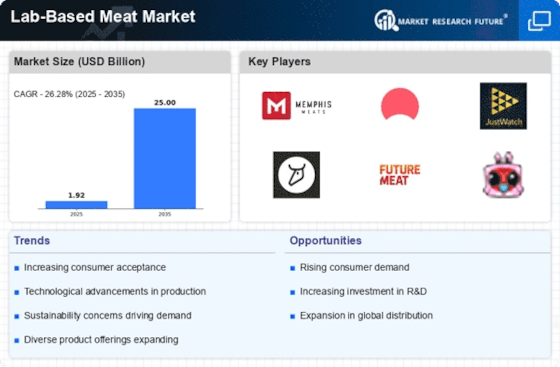
Lab Based Meat Market Infographic
Purchase Options

Market Analysis

In-depth Analysis of Lab Based Meat Market Industry Landscape

The lab-based meat market is experiencing a dynamic evolution shaped by a confluence of factors that underscore the growing interest in sustainable and alternative food sources. One of the main drivers pushing the lab-based meat industry is growing environmental consciousness and animal welfare concerns on a global level. Lab-based meat becomes a potential alternative to traditional livestock farming as consumers become more aware of the environmental impact and look for cruelty-free options. With this technological innovation, meat can be produced without relying on large areas of land ate best

Lab-based meat market has been significantly influenced by changing dietary preferences and a growing population. There are ways in which the typical live animal meat production faces challenges to meet demand sustainably as global demands for meat continue to rise. Lab-grown meat, also known as cultured or cellular meat is a potential answer because it represents an economical and environmentally friendly alternative to conventional animal raising. This is in line with the demands of an increasing number of consumers who want to consume ethically produced, environmentally friendly and healthy food sources.

The developments in cellular agriculture and biotechnology have a critical role to play as far the trends of making meat in labs are concerned. Developments in tissue engineering and cell cultivation technologies are enabling manufacturers to design lab-made meat that closely resembles the flavor, consistency and nutritional value typical of animal flesh. Research and development efforts continue to improve the production processes, minimize costs, increase available meat products with a view of improving consumer acceptance.

Challenges with lab-based meat market include regulatory factors, consumer acceptance and scalability of the markets. Regulatory bodies are putting in place guidelines for safety and labeling of meat products produced through lab to mirror the strict standards applied on conventionally raised meats. Consumer acceptance plays a vital role, as some people voice concerns about the novelty and safety of laboratory-produced meat. By having effective communication, transparency and education will compensate for these challenges to build trust and acceptance among consumers. This is clear as evidenced by the growing trend of traditional meat producers partnering with and investing in lab-based meat startups. Development in technologies, biotech firms and food manufacturers need to collaborate for innovations facilitating the process of producing lab-based meat products at competitive rates. The dynamics of the market are also significantly supported through government support and policies on sustainability and alternative protein sources. Incentives, research funding as well as regulatory frame works that encourage the process of formulating lab-based meat are critical for fostering growth in this industry. Governments play an essential role in creating the climate conducive to innovation and investment in sustainable food technologies.


Author
Author Profile
Snehal Singh
Manager - Research

High acumen in analyzing complex macro & micro markets with more than 6 years of work experience in the field of market research. By implementing her analytical skills in forecasting and estimation into market research reports, she has expertise in Packaging, Construction, and Equipment domains. She handles a team size of 20-25 resources and ensures smooth running of the projects, associated marketing activities, and client servicing.

Leave a Comment

FAQs

What is the current valuation of the Lab-Based Meat Market as of 2024?

<p>The Lab-Based Meat Market was valued at 1.92 USD Billion in 2024.</p>

What is the projected market size for the Lab-Based Meat Market by 2035?

<p>The market is projected to reach 25.0 USD Billion by 2035.</p>

What is the expected CAGR for the Lab-Based Meat Market during the forecast period 2025 - 2035?

<p>The expected CAGR for the Lab-Based Meat Market during 2025 - 2035 is 26.28%.</p>

Which type of lab-based meat segment holds the highest valuation in 2024?

<p>In 2024, the Chicken segment held the highest valuation at 0.64 USD Billion.</p>

What are the key production methods in the Lab-Based Meat Market?

<p>The key production methods include Cell Culture, Tissue Engineering, and 3D Bioprinting, with Cell Culture valued at 0.96 USD Billion in 2024.</p>

How do the distribution channels for lab-based meat products compare in 2024?

<p>In 2024, Supermarkets led the distribution channels with a valuation of 0.768 USD Billion.</p>

What applications are driving growth in the Lab-Based Meat Market?

<p>The primary applications driving growth include Food Products, valued at 0.96 USD Billion in 2024.</p>

Who are the leading companies in the Lab-Based Meat Market?

<p>Key players in the market include Memphis Meats, Mosa Meat, Just, Aleph Farms, and Future Meat Technologies.</p>

What is the valuation of the Pork segment in the Lab-Based Meat Market as of 2024?

<p>The Pork segment was valued at 0.36 USD Billion in 2024.</p>

What is the projected growth trend for the Seafood segment in the Lab-Based Meat Market?

<p>The Seafood segment is projected to grow, having been valued at 0.44 USD Billion in 2024.</p>

Market Summary

As per Market Research Future analysis, the Lab-Based Meat Market was estimated at 1.92 USD Billion in 2024. The Lab-Based Meat industry is projected to grow from 2.425 USD Billion in 2025 to 25.0 USD Billion by 2035, exhibiting a compound annual growth rate (CAGR) of 26.28% during the forecast period 2025 - 2035

Key Market Trends & Highlights

The Lab-Based Meat Market is poised for substantial growth driven by technological advancements and shifting consumer preferences.

  • North America remains the largest market for lab-based meat, reflecting a strong consumer base and investment in innovation. The Asia-Pacific region is emerging as the fastest-growing market, driven by increasing urbanization and changing dietary habits. Beef continues to dominate as the largest segment, while chicken is rapidly gaining traction as the fastest-growing category. Sustainability concerns and health trends are significant drivers, influencing consumer choices and regulatory support in the market.

Market Size & Forecast

2024 Market Size 1.92 (USD Billion)
2035 Market Size 25.0 (USD Billion)
CAGR (2025 - 2035) 26.28%
Largest Regional Market Share in 2024 North America

Major Players

Memphis Meats (US), Mosa Meat (NL), Just (US), Aleph Farms (IL), Future Meat Technologies (IL), SuperMeat (IL), Eat Just (US), Upside Foods (US)

Market Trends

The Lab-Based Meat Market is currently experiencing a notable transformation, driven by a confluence of technological advancements and shifting consumer preferences. As awareness regarding environmental sustainability and animal welfare continues to grow, more individuals are gravitating towards alternatives that align with their values. This market appears to be on the cusp of significant expansion, as innovations in cellular agriculture and bioprocessing techniques enhance the feasibility and appeal of lab-grown products. Furthermore, regulatory frameworks are evolving, potentially facilitating smoother pathways for product approvals and market entry. In addition to technological progress, the Lab-Based Meat Market is witnessing a diversification of product offerings. Companies are increasingly exploring various types of meat substitutes, catering to a broader range of culinary preferences and dietary needs. This diversification may not only attract a wider consumer base but also stimulate competition among producers, fostering further innovation. As the market matures, it seems likely that partnerships between traditional meat producers and lab-based companies could emerge, creating synergies that enhance distribution and consumer acceptance. Overall, the Lab-Based Meat Market is poised for growth, reflecting a dynamic interplay of consumer demand, technological innovation, and regulatory developments.

Technological Advancements

Recent innovations in cellular agriculture and bioprocessing are enhancing the production efficiency and quality of lab-grown meat. These advancements may lead to improved taste and texture, making lab-based products more appealing to consumers.

Consumer Awareness

Growing concerns about environmental sustainability and animal welfare are driving consumers towards lab-based meat alternatives. This heightened awareness appears to be influencing purchasing decisions, as more individuals seek products that align with their ethical values.

Product Diversification

The Lab-Based Meat Market is witnessing an increase in the variety of meat substitutes available. Companies are exploring different types of lab-grown products, which could cater to diverse dietary preferences and expand the consumer base.

Lab Based Meat Market Market Drivers

Regulatory Support

Regulatory frameworks are increasingly becoming a driving force in the Lab-Based Meat Market. Governments and regulatory bodies are beginning to establish guidelines and standards for the production and sale of lab-based meat products. This regulatory support is crucial for ensuring food safety and consumer confidence, which are essential for market acceptance. As more countries recognize the potential benefits of lab-based meat, including reduced environmental impact and improved food security, they are likely to implement favorable regulations. This could lead to a more streamlined approval process for lab-based meat products, facilitating their entry into the market. Consequently, the Lab-Based Meat Market stands to benefit from enhanced legitimacy and consumer trust, which may accelerate its growth trajectory.

Sustainability Concerns

The Lab-Based Meat Market is increasingly driven by growing concerns regarding environmental sustainability. Traditional meat production is associated with significant greenhouse gas emissions, deforestation, and water usage. In contrast, lab-based meat production is perceived as a more sustainable alternative, potentially reducing the carbon footprint by up to 96% compared to conventional meat. As consumers become more environmentally conscious, they are likely to seek out products that align with their values. This shift in consumer behavior is prompting companies within the Lab-Based Meat Market to innovate and develop sustainable practices, thereby enhancing their market appeal. Furthermore, regulatory bodies are beginning to recognize the importance of sustainability, which may lead to supportive policies that favor lab-based meat production. Consequently, the Lab-Based Meat Market is poised for growth as it addresses these pressing environmental issues.

Technological Innovations

Technological advancements play a pivotal role in shaping the Lab-Based Meat Market. Innovations in cellular agriculture and tissue engineering are enabling the production of lab-based meat that closely mimics the taste and texture of traditional meat. These technologies are not only enhancing product quality but also reducing production costs, making lab-based meat more accessible to consumers. Market analysis suggests that the lab-grown meat sector could reach a valuation of several billion dollars in the coming years, driven by these technological breakthroughs. As research and development continue to progress, the Lab-Based Meat Market is likely to witness an influx of new products that cater to diverse consumer preferences, further solidifying its position in the food industry.

Health and Nutrition Trends

The Lab-Based Meat Market is also influenced by evolving health and nutrition trends. As consumers become more health-conscious, they are increasingly scrutinizing the nutritional content of their food. Lab-based meat products often offer a healthier alternative to traditional meat, as they can be engineered to contain lower levels of saturated fats and higher levels of beneficial nutrients. For instance, some lab-based meats are fortified with vitamins and minerals, appealing to health-oriented consumers. Market data indicates that the demand for healthier food options is on the rise, with a significant percentage of consumers willing to pay a premium for products that promote better health. This trend is likely to drive innovation within the Lab-Based Meat Market, as companies strive to meet the nutritional preferences of their target audience.

Changing Consumer Preferences

The Lab-Based Meat Market is significantly influenced by changing consumer preferences. A growing segment of the population is shifting towards plant-based and lab-grown alternatives due to ethical concerns surrounding animal welfare and the desire for more sustainable food sources. Market Research Future indicates that a substantial number of consumers are open to trying lab-based meat, with many expressing a willingness to incorporate it into their diets. This shift in preferences is prompting food manufacturers to diversify their offerings, leading to an increase in the availability of lab-based meat products. As consumer demand evolves, the Lab-Based Meat Market is likely to expand, driven by the need to cater to a more diverse and health-conscious consumer base.

Market Segment Insights

By Type: Beef (Largest) vs. Chicken (Fastest-Growing)

In the Lab-Based Meat Market, the segment values show a distinct hierarchy in market share. Beef currently stands as the largest segment, driven by its established consumer base and the strong cultural association with beef products in various cuisines worldwide. Meanwhile, chicken is rapidly gaining traction, appealing to health-conscious consumers looking for leaner protein options and lower environmental impact compared to traditional meat sources.

Beef: Dominant vs. Chicken: Emerging

Beef dominates the Lab-Based Meat Market due to its wide acceptance and popularity, often seen as a staple in many diets. Its appeal lies in flavor, texture, and versatility in cooking. Conversely, chicken has emerged as a strong competitor, particularly among health-oriented consumers, as it is perceived as a cleaner, lower-calorie meat alternative. With advancements in lab-based technology, chicken alternatives are becoming more appealing, mimicking the taste and texture of traditional chicken. With the rise of flexitarian and vegetarian diets, both segments are positioned uniquely within the market, serving different consumer needs.

By Production Method: Cell Culture (Largest) vs. Tissue Engineering (Fastest-Growing)

The 'Production Method' segment in the Lab-Based Meat Market is currently defined primarily by three significant methodologies: Cell Culture, Tissue Engineering, and 3D Bioprinting. Among these, Cell Culture stands out as the largest segment, commanding a significant share of market attention and investment. Tissue Engineering, while smaller, showcases promising growth potential, attracting interest due to its innovative approaches to meat production. Although <a href="https://www.marketresearchfuture.com/reports/3d-bioprinting-market-869">3D Bioprinting</a> offers unique capabilities, it remains in the nascent stages compared to its more established counterparts.

Production Methods: Cell Culture (Dominant) vs. 3D Bioprinting (Emerging)

Cell Culture technology represents the dominant force in lab-based meat production, leveraging scalable techniques that allow for the growth of animal tissues in controlled environments. The advancements in bioprocessing and nutrient formulations propel this method as the preferred choice among industries aiming for efficiency and sustainability. Conversely, 3D Bioprinting, as an emerging technique, is gaining traction due to its potential to create complex meat structures layer by layer. While still in development stages, this method is celebrated for its ability to tailor textures and designs, making it an exciting frontier in the lab-based meat sector, appealing to both consumers and innovators.

By Application: Food Products (Largest) vs. Nutritional Supplements (Fastest-Growing)

The Lab-Based Meat Market's application segment is primarily dominated by food products, which account for the largest share of the market. Food products encompass a wide array of lab-grown meats that cater to evolving consumer preferences for sustainable and ethical meat alternatives. In contrast, nutritional supplements, while smaller in market share, are gaining traction as they align with growing health trends and dietary needs stemming from vegetarianism and veganism. This dynamic creates a competitive landscape among the application categories as consumers increasingly seek alternative protein sources. Growth trends in the lab-based meat application segment indicate a significant rise in nutritional supplements as health-conscious consumers turn to fortified lab-grown meat options. There is a notable shift towards integrating lab-based meat into functional foods, which enhance nutrition and support dietary lifestyles. Additionally, increasing consumer awareness regarding sustainability and health benefits of lab-grown meat contributes to the escalating demand in the nutritional supplement segment, marking it as the fastest-growing area in this market.

Food Products: Dominant vs. Nutritional Supplements: Emerging

Food products represent the dominant force in the lab-based meat application segment, featuring a diverse range of offerings from burgers to sausages that attract a broad customer base. These products are often designed to replicate the taste and texture of traditional meats, appealing particularly to flexitarians and meat lovers looking for healthier choices. In contrast, nutritional supplements are emerging with a focus on providing essential nutrients through innovative formulations that integrate lab-based meats. These products cater to the growing consumer demographic seeking protein-rich supplementation to support active lifestyles. The interplay between these two segments showcases a blending of culinary experience with nutritional enhancement, positioning both as vital players in the future growth of the lab-based meat market.

By Distribution Channel: Supermarkets (Largest) vs. Online Retail (Fastest-Growing)

In the Lab-Based Meat Market, supermarkets hold the largest share among distribution channels, serving as primary points for consumer purchases. This traditional channel harnesses customer trust and has a well-established infrastructure that makes lab-based meat products readily accessible to a broad audience. Meanwhile, online retail has emerged as a significant contender, gradually carving out its segment of the market and appealing to tech-savvy consumers looking for convenience and variety in their food choices.

Supermarkets (Dominant) vs. Online Retail (Emerging)

Supermarkets stand as the dominant distribution channel for lab-based meat products due to their extensive reach and ability to cater to a diverse customer base. They provide a space for consumers to physically engage with products, enhancing trust and encouraging impulse purchases. On the other hand, online retail represents an emerging channel, rapidly gaining popularity as consumers shift towards more digital shopping experiences. This segment thrives on convenience, offering detailed product information and larger assortments not always found in brick-and-mortar stores. The shift towards e-commerce signifies changing consumer preferences, with online platforms increasingly becoming vital in distributing lab-based meat products.

Get more detailed insights about Lab-Based Meat Market Research Report - Global Forecast till 2035

Regional Insights

The  Lab-Based Meat Market is poised for significant expansion across various regions, reflecting diverse trends in consumer preferences and regulatory environments. By 2024, the market in North America is valued at 0.9 USD Billion, demonstrating a strong foothold as it contributes a majority share to the overall market, projected to reach 12.5 USD billion by 2035.

Europe, valued at 0.5 USD Billion in 2024, follows closely with expectations of achieving 7.0 USD Billion, emphasizing the region's focus on sustainability and regulatory support for lab-grown products.Meanwhile, South America and Asia Pacific, with valuations of 0.15 USD Billion and 0.25 USD Billion in 2024, respectively, are emerging players, forecasting growth to 2.0 USD Billion and 3.5 USD Billion by 2035 as awareness around lab-based meat rises within these markets. The Middle East and Africa, with an initial valuation of 0.12 USD billion, is also set to grow, reaching 0.9 USD Billion, backed by investments in food technology.

The increasing demand for sustainable and ethical food sources drives innovation in these regions, further shaping the  Lab-Based Meat Market landscape.

Key Players and Competitive Insights

The competitive insights of the  Lab-Based Meat Market highlight a rapidly evolving landscape characterized by innovation, sustainability, and shifting consumer preferences. As alternatives to conventional meat products gain traction, companies in this sector are leveraging technological advancements to create lab-grown meat that not only mimics traditional flavors and textures but also addresses health and environmental concerns. This market is witnessing significant competition as various players strive to establish their brand identity and capture market share through unique offerings, strategic partnerships, and targeted marketing campaigns.The growing demand for plant-based and lab-grown meat solutions indicates that the competition will intensify as producers work to differentiate themselves and meet the expectations of increasingly health-conscious consumers.Vow Foods has carved a prominent position within the  Lab-Based Meat Market, primarily due to its innovative approach to creating cultured meat products. The company focuses on harnessing biotechnology to develop unique and diverse meat alternatives that emphasize flavor and sustainability. Its strong presence in the market is bolstered by a commitment to environmental responsibility and ethical food production practices, which resonate with a growing demographic of eco-conscious consumers.Vow Foods is recognized for its pioneering research and development efforts, allowing the company to push the boundaries of lab-grown meat and offer an impressive product range. The distinct advantage of Vow Foods lies in its ability to adapt and innovate rapidly, making it well-positioned to respond to evolving market demands and maintain a competitive edge in the lab-based meat sector.Culture Biosciences is another key player in the  Lab-Based Meat Market, with a focus on leveraging cutting-edge biotechnological solutions to produce sustainable meat alternatives.The company is renowned for its expertise in cell culture and fermentation techniques, enabling it to create high-quality lab-grown meat products that appeal to a diverse consumer base. Culture Biosciences has established a notable market presence through strategic partnerships and collaborations, enhancing its capability to innovate and expand product offerings. The strengths of Culture Biosciences lie in its advanced research methodologies and a commitment to sustainability, which align well with  trends toward eco-friendly food production.As part of its strategic growth, the company is keen on facilitating mergers and acquisitions that bolster its technological capabilities and market reach, positioning itself for success in the competitive landscape of lab-based meats on a  scale.

Key Companies in the Lab Based Meat Market include

Industry Developments

The  Lab-Based Meat Market has seen a lot of changes in the last few months. For example, companies like Vow Foods, BlueNalu, and SuperMeat have improved their production capabilities and gotten more involved with regulations. In October 2023, companies like Eat Just (through its cultivated meat division Good Meat) and Upside Foods (formerly Memphis Meats) kept getting money and making deals with food retailers and foodservice providers to help them grow their businesses. The market is benefiting from more people wanting to invest, as seen in 2023 and early 2024.

Several major companies are increasing their research and development efforts to improve product quality and lower production costs. SuperMeat, which is based in Israel, has gotten a lot of attention for its cultivated chicken.

Vow Foods, on the other hand, has looked into new species like kangaroo and quail using advanced cellular agriculture methods. Also, countries like Singapore, the United States, and Israel have made changes to their laws to make it safe to sell cultivated meat. This shows that governments are becoming more supportive. These changes in the rules are making it easier for lab-grown meat products to enter the mainstream market, which is happening slowly but surely.

As the market matures, new ideas, partnerships between businesses and the government, and teaching consumers about the market are all expected to be very important in shaping its future.

Future Outlook

Lab Based Meat Market Future Outlook

The Lab-Based Meat Market is projected to grow at a 26.28% CAGR from 2025 to 2035, driven by technological advancements, sustainability concerns, and changing consumer preferences.

New opportunities lie in:

  • <p>Development of scalable bioreactor systems for mass production Partnerships with food service providers for exclusive product offerings Investment in consumer education campaigns to enhance market acceptance</p>

By 2035, the Lab-Based Meat Market is expected to achieve substantial growth and widespread consumer adoption.

Market Segmentation

Lab Based Meat Market Type Outlook

  • Beef
  • Pork
  • Chicken
  • Seafood

Lab Based Meat Market Application Outlook

  • Food Products
  • Food Ingredients
  • Nutritional Supplements

Lab Based Meat Market Production Method Outlook

  • Cell Culture
  • Tissue Engineering
  • 3D Bioprinting

Lab Based Meat Market Distribution Channel Outlook

  • Online Retail
  • Supermarkets
  • Restaurants

Report Scope

MARKET SIZE 2024 1.92(USD Billion)
MARKET SIZE 2025 2.425(USD Billion)
MARKET SIZE 2035 25.0(USD Billion)
COMPOUND ANNUAL GROWTH RATE (CAGR) 26.28% (2025 - 2035)
REPORT COVERAGE Revenue Forecast, Competitive Landscape, Growth Factors, and Trends
BASE YEAR 2024
Market Forecast Period 2025 - 2035
Historical Data 2019 - 2024
Market Forecast Units USD Billion
Key Companies Profiled Memphis Meats (US), Mosa Meat (NL), Just (US), Aleph Farms (IL), Future Meat Technologies (IL), SuperMeat (IL), Eat Just (US), Upside Foods (US)
Segments Covered Product Type, Production Method, Application, Distribution Channel, Regional
Key Market Opportunities Growing consumer demand for sustainable protein sources drives innovation in the Lab-Based Meat Market.
Key Market Dynamics Rising consumer demand for sustainable protein sources drives innovation and competition in the lab-based meat sector.
Countries Covered North America, Europe, APAC, South America, MEA

FAQs

What is the current valuation of the Lab-Based Meat Market as of 2024?

<p>The Lab-Based Meat Market was valued at 1.92 USD Billion in 2024.</p>

What is the projected market size for the Lab-Based Meat Market by 2035?

<p>The market is projected to reach 25.0 USD Billion by 2035.</p>

What is the expected CAGR for the Lab-Based Meat Market during the forecast period 2025 - 2035?

<p>The expected CAGR for the Lab-Based Meat Market during 2025 - 2035 is 26.28%.</p>

Which type of lab-based meat segment holds the highest valuation in 2024?

<p>In 2024, the Chicken segment held the highest valuation at 0.64 USD Billion.</p>

What are the key production methods in the Lab-Based Meat Market?

<p>The key production methods include Cell Culture, Tissue Engineering, and 3D Bioprinting, with Cell Culture valued at 0.96 USD Billion in 2024.</p>

How do the distribution channels for lab-based meat products compare in 2024?

<p>In 2024, Supermarkets led the distribution channels with a valuation of 0.768 USD Billion.</p>

What applications are driving growth in the Lab-Based Meat Market?

<p>The primary applications driving growth include Food Products, valued at 0.96 USD Billion in 2024.</p>

Who are the leading companies in the Lab-Based Meat Market?

<p>Key players in the market include Memphis Meats, Mosa Meat, Just, Aleph Farms, and Future Meat Technologies.</p>

What is the valuation of the Pork segment in the Lab-Based Meat Market as of 2024?

<p>The Pork segment was valued at 0.36 USD Billion in 2024.</p>

What is the projected growth trend for the Seafood segment in the Lab-Based Meat Market?

<p>The Seafood segment is projected to grow, having been valued at 0.44 USD Billion in 2024.</p>

  1. SECTION I: EXECUTIVE SUMMARY AND KEY HIGHLIGHTS
    1. | 1.1 EXECUTIVE SUMMARY
    2. | | 1.1.1 Market Overview
    3. | | 1.1.2 Key Findings
    4. | | 1.1.3 Market Segmentation
    5. | | 1.1.4 Competitive Landscape
    6. | | 1.1.5 Challenges and Opportunities
    7. | | 1.1.6 Future Outlook
  2. SECTION II: SCOPING, METHODOLOGY AND MARKET STRUCTURE
    1. | 2.1 MARKET INTRODUCTION
    2. | | 2.1.1 Definition
    3. | | 2.1.2 Scope of the study
    4. | | | 2.1.2.1 Research Objective
    5. | | | 2.1.2.2 Assumption
    6. | | | 2.1.2.3 Limitations
    7. | 2.2 RESEARCH METHODOLOGY
    8. | | 2.2.1 Overview
    9. | | 2.2.2 Data Mining
    10. | | 2.2.3 Secondary Research
    11. | | 2.2.4 Primary Research
    12. | | | 2.2.4.1 Primary Interviews and Information Gathering Process
    13. | | | 2.2.4.2 Breakdown of Primary Respondents
    14. | | 2.2.5 Forecasting Model
    15. | | 2.2.6 Market Size Estimation
    16. | | | 2.2.6.1 Bottom-Up Approach
    17. | | | 2.2.6.2 Top-Down Approach
    18. | | 2.2.7 Data Triangulation
    19. | | 2.2.8 Validation
  3. SECTION III: QUALITATIVE ANALYSIS
    1. | 3.1 MARKET DYNAMICS
    2. | | 3.1.1 Overview
    3. | | 3.1.2 Drivers
    4. | | 3.1.3 Restraints
    5. | | 3.1.4 Opportunities
    6. | 3.2 MARKET FACTOR ANALYSIS
    7. | | 3.2.1 Value chain Analysis
    8. | | 3.2.2 Porter's Five Forces Analysis
    9. | | | 3.2.2.1 Bargaining Power of Suppliers
    10. | | | 3.2.2.2 Bargaining Power of Buyers
    11. | | | 3.2.2.3 Threat of New Entrants
    12. | | | 3.2.2.4 Threat of Substitutes
    13. | | | 3.2.2.5 Intensity of Rivalry
    14. | | 3.2.3 COVID-19 Impact Analysis
    15. | | | 3.2.3.1 Market Impact Analysis
    16. | | | 3.2.3.2 Regional Impact
    17. | | | 3.2.3.3 Opportunity and Threat Analysis
  4. SECTION IV: QUANTITATIVE ANALYSIS
    1. | 4.1 Food, Beverages & Nutrition, BY Type (USD Billion)
    2. | | 4.1.1 Beef
    3. | | 4.1.2 Pork
    4. | | 4.1.3 Chicken
    5. | | 4.1.4 Seafood
    6. | 4.2 Food, Beverages & Nutrition, BY Production Method (USD Billion)
    7. | | 4.2.1 Cell Culture
    8. | | 4.2.2 Tissue Engineering
    9. | | 4.2.3 3D Bioprinting
    10. | 4.3 Food, Beverages & Nutrition, BY Application (USD Billion)
    11. | | 4.3.1 Food Products
    12. | | 4.3.2 Food Ingredients
    13. | | 4.3.3 Nutritional Supplements
    14. | 4.4 Food, Beverages & Nutrition, BY Distribution Channel (USD Billion)
    15. | | 4.4.1 Online Retail
    16. | | 4.4.2 Supermarkets
    17. | | 4.4.3 Restaurants
    18. | 4.5 Food, Beverages & Nutrition, BY Region (USD Billion)
    19. | | 4.5.1 North America
    20. | | | 4.5.1.1 US
    21. | | | 4.5.1.2 Canada
    22. | | 4.5.2 Europe
    23. | | | 4.5.2.1 Germany
    24. | | | 4.5.2.2 UK
    25. | | | 4.5.2.3 France
    26. | | | 4.5.2.4 Russia
    27. | | | 4.5.2.5 Italy
    28. | | | 4.5.2.6 Spain
    29. | | | 4.5.2.7 Rest of Europe
    30. | | 4.5.3 APAC
    31. | | | 4.5.3.1 China
    32. | | | 4.5.3.2 India
    33. | | | 4.5.3.3 Japan
    34. | | | 4.5.3.4 South Korea
    35. | | | 4.5.3.5 Malaysia
    36. | | | 4.5.3.6 Thailand
    37. | | | 4.5.3.7 Indonesia
    38. | | | 4.5.3.8 Rest of APAC
    39. | | 4.5.4 South America
    40. | | | 4.5.4.1 Brazil
    41. | | | 4.5.4.2 Mexico
    42. | | | 4.5.4.3 Argentina
    43. | | | 4.5.4.4 Rest of South America
    44. | | 4.5.5 MEA
    45. | | | 4.5.5.1 GCC Countries
    46. | | | 4.5.5.2 South Africa
    47. | | | 4.5.5.3 Rest of MEA
  5. SECTION V: COMPETITIVE ANALYSIS
    1. | 5.1 Competitive Landscape
    2. | | 5.1.1 Overview
    3. | | 5.1.2 Competitive Analysis
    4. | | 5.1.3 Market share Analysis
    5. | | 5.1.4 Major Growth Strategy in the Food, Beverages & Nutrition
    6. | | 5.1.5 Competitive Benchmarking
    7. | | 5.1.6 Leading Players in Terms of Number of Developments in the Food, Beverages & Nutrition
    8. | | 5.1.7 Key developments and growth strategies
    9. | | | 5.1.7.1 New Product Launch/Service Deployment
    10. | | | 5.1.7.2 Merger & Acquisitions
    11. | | | 5.1.7.3 Joint Ventures
    12. | | 5.1.8 Major Players Financial Matrix
    13. | | | 5.1.8.1 Sales and Operating Income
    14. | | | 5.1.8.2 Major Players R&D Expenditure. 2023
    15. | 5.2 Company Profiles
    16. | | 5.2.1 Memphis Meats (US)
    17. | | | 5.2.1.1 Financial Overview
    18. | | | 5.2.1.2 Products Offered
    19. | | | 5.2.1.3 Key Developments
    20. | | | 5.2.1.4 SWOT Analysis
    21. | | | 5.2.1.5 Key Strategies
    22. | | 5.2.2 Mosa Meat (NL)
    23. | | | 5.2.2.1 Financial Overview
    24. | | | 5.2.2.2 Products Offered
    25. | | | 5.2.2.3 Key Developments
    26. | | | 5.2.2.4 SWOT Analysis
    27. | | | 5.2.2.5 Key Strategies
    28. | | 5.2.3 Just (US)
    29. | | | 5.2.3.1 Financial Overview
    30. | | | 5.2.3.2 Products Offered
    31. | | | 5.2.3.3 Key Developments
    32. | | | 5.2.3.4 SWOT Analysis
    33. | | | 5.2.3.5 Key Strategies
    34. | | 5.2.4 Aleph Farms (IL)
    35. | | | 5.2.4.1 Financial Overview
    36. | | | 5.2.4.2 Products Offered
    37. | | | 5.2.4.3 Key Developments
    38. | | | 5.2.4.4 SWOT Analysis
    39. | | | 5.2.4.5 Key Strategies
    40. | | 5.2.5 Future Meat Technologies (IL)
    41. | | | 5.2.5.1 Financial Overview
    42. | | | 5.2.5.2 Products Offered
    43. | | | 5.2.5.3 Key Developments
    44. | | | 5.2.5.4 SWOT Analysis
    45. | | | 5.2.5.5 Key Strategies
    46. | | 5.2.6 SuperMeat (IL)
    47. | | | 5.2.6.1 Financial Overview
    48. | | | 5.2.6.2 Products Offered
    49. | | | 5.2.6.3 Key Developments
    50. | | | 5.2.6.4 SWOT Analysis
    51. | | | 5.2.6.5 Key Strategies
    52. | | 5.2.7 Eat Just (US)
    53. | | | 5.2.7.1 Financial Overview
    54. | | | 5.2.7.2 Products Offered
    55. | | | 5.2.7.3 Key Developments
    56. | | | 5.2.7.4 SWOT Analysis
    57. | | | 5.2.7.5 Key Strategies
    58. | | 5.2.8 Upside Foods (US)
    59. | | | 5.2.8.1 Financial Overview
    60. | | | 5.2.8.2 Products Offered
    61. | | | 5.2.8.3 Key Developments
    62. | | | 5.2.8.4 SWOT Analysis
    63. | | | 5.2.8.5 Key Strategies
    64. | 5.3 Appendix
    65. | | 5.3.1 References
    66. | | 5.3.2 Related Reports
  6. LIST OF FIGURES
    1. | 6.1 MARKET SYNOPSIS
    2. | 6.2 NORTH AMERICA MARKET ANALYSIS
    3. | 6.3 US MARKET ANALYSIS BY TYPE
    4. | 6.4 US MARKET ANALYSIS BY PRODUCTION METHOD
    5. | 6.5 US MARKET ANALYSIS BY APPLICATION
    6. | 6.6 US MARKET ANALYSIS BY DISTRIBUTION CHANNEL
    7. | 6.7 CANADA MARKET ANALYSIS BY TYPE
    8. | 6.8 CANADA MARKET ANALYSIS BY PRODUCTION METHOD
    9. | 6.9 CANADA MARKET ANALYSIS BY APPLICATION
    10. | 6.10 CANADA MARKET ANALYSIS BY DISTRIBUTION CHANNEL
    11. | 6.11 EUROPE MARKET ANALYSIS
    12. | 6.12 GERMANY MARKET ANALYSIS BY TYPE
    13. | 6.13 GERMANY MARKET ANALYSIS BY PRODUCTION METHOD
    14. | 6.14 GERMANY MARKET ANALYSIS BY APPLICATION
    15. | 6.15 GERMANY MARKET ANALYSIS BY DISTRIBUTION CHANNEL
    16. | 6.16 UK MARKET ANALYSIS BY TYPE
    17. | 6.17 UK MARKET ANALYSIS BY PRODUCTION METHOD
    18. | 6.18 UK MARKET ANALYSIS BY APPLICATION
    19. | 6.19 UK MARKET ANALYSIS BY DISTRIBUTION CHANNEL
    20. | 6.20 FRANCE MARKET ANALYSIS BY TYPE
    21. | 6.21 FRANCE MARKET ANALYSIS BY PRODUCTION METHOD
    22. | 6.22 FRANCE MARKET ANALYSIS BY APPLICATION
    23. | 6.23 FRANCE MARKET ANALYSIS BY DISTRIBUTION CHANNEL
    24. | 6.24 RUSSIA MARKET ANALYSIS BY TYPE
    25. | 6.25 RUSSIA MARKET ANALYSIS BY PRODUCTION METHOD
    26. | 6.26 RUSSIA MARKET ANALYSIS BY APPLICATION
    27. | 6.27 RUSSIA MARKET ANALYSIS BY DISTRIBUTION CHANNEL
    28. | 6.28 ITALY MARKET ANALYSIS BY TYPE
    29. | 6.29 ITALY MARKET ANALYSIS BY PRODUCTION METHOD
    30. | 6.30 ITALY MARKET ANALYSIS BY APPLICATION
    31. | 6.31 ITALY MARKET ANALYSIS BY DISTRIBUTION CHANNEL
    32. | 6.32 SPAIN MARKET ANALYSIS BY TYPE
    33. | 6.33 SPAIN MARKET ANALYSIS BY PRODUCTION METHOD
    34. | 6.34 SPAIN MARKET ANALYSIS BY APPLICATION
    35. | 6.35 SPAIN MARKET ANALYSIS BY DISTRIBUTION CHANNEL
    36. | 6.36 REST OF EUROPE MARKET ANALYSIS BY TYPE
    37. | 6.37 REST OF EUROPE MARKET ANALYSIS BY PRODUCTION METHOD
    38. | 6.38 REST OF EUROPE MARKET ANALYSIS BY APPLICATION
    39. | 6.39 REST OF EUROPE MARKET ANALYSIS BY DISTRIBUTION CHANNEL
    40. | 6.40 APAC MARKET ANALYSIS
    41. | 6.41 CHINA MARKET ANALYSIS BY TYPE
    42. | 6.42 CHINA MARKET ANALYSIS BY PRODUCTION METHOD
    43. | 6.43 CHINA MARKET ANALYSIS BY APPLICATION
    44. | 6.44 CHINA MARKET ANALYSIS BY DISTRIBUTION CHANNEL
    45. | 6.45 INDIA MARKET ANALYSIS BY TYPE
    46. | 6.46 INDIA MARKET ANALYSIS BY PRODUCTION METHOD
    47. | 6.47 INDIA MARKET ANALYSIS BY APPLICATION
    48. | 6.48 INDIA MARKET ANALYSIS BY DISTRIBUTION CHANNEL
    49. | 6.49 JAPAN MARKET ANALYSIS BY TYPE
    50. | 6.50 JAPAN MARKET ANALYSIS BY PRODUCTION METHOD
    51. | 6.51 JAPAN MARKET ANALYSIS BY APPLICATION
    52. | 6.52 JAPAN MARKET ANALYSIS BY DISTRIBUTION CHANNEL
    53. | 6.53 SOUTH KOREA MARKET ANALYSIS BY TYPE
    54. | 6.54 SOUTH KOREA MARKET ANALYSIS BY PRODUCTION METHOD
    55. | 6.55 SOUTH KOREA MARKET ANALYSIS BY APPLICATION
    56. | 6.56 SOUTH KOREA MARKET ANALYSIS BY DISTRIBUTION CHANNEL
    57. | 6.57 MALAYSIA MARKET ANALYSIS BY TYPE
    58. | 6.58 MALAYSIA MARKET ANALYSIS BY PRODUCTION METHOD
    59. | 6.59 MALAYSIA MARKET ANALYSIS BY APPLICATION
    60. | 6.60 MALAYSIA MARKET ANALYSIS BY DISTRIBUTION CHANNEL
    61. | 6.61 THAILAND MARKET ANALYSIS BY TYPE
    62. | 6.62 THAILAND MARKET ANALYSIS BY PRODUCTION METHOD
    63. | 6.63 THAILAND MARKET ANALYSIS BY APPLICATION
    64. | 6.64 THAILAND MARKET ANALYSIS BY DISTRIBUTION CHANNEL
    65. | 6.65 INDONESIA MARKET ANALYSIS BY TYPE
    66. | 6.66 INDONESIA MARKET ANALYSIS BY PRODUCTION METHOD
    67. | 6.67 INDONESIA MARKET ANALYSIS BY APPLICATION
    68. | 6.68 INDONESIA MARKET ANALYSIS BY DISTRIBUTION CHANNEL
    69. | 6.69 REST OF APAC MARKET ANALYSIS BY TYPE
    70. | 6.70 REST OF APAC MARKET ANALYSIS BY PRODUCTION METHOD
    71. | 6.71 REST OF APAC MARKET ANALYSIS BY APPLICATION
    72. | 6.72 REST OF APAC MARKET ANALYSIS BY DISTRIBUTION CHANNEL
    73. | 6.73 SOUTH AMERICA MARKET ANALYSIS
    74. | 6.74 BRAZIL MARKET ANALYSIS BY TYPE
    75. | 6.75 BRAZIL MARKET ANALYSIS BY PRODUCTION METHOD
    76. | 6.76 BRAZIL MARKET ANALYSIS BY APPLICATION
    77. | 6.77 BRAZIL MARKET ANALYSIS BY DISTRIBUTION CHANNEL
    78. | 6.78 MEXICO MARKET ANALYSIS BY TYPE
    79. | 6.79 MEXICO MARKET ANALYSIS BY PRODUCTION METHOD
    80. | 6.80 MEXICO MARKET ANALYSIS BY APPLICATION
    81. | 6.81 MEXICO MARKET ANALYSIS BY DISTRIBUTION CHANNEL
    82. | 6.82 ARGENTINA MARKET ANALYSIS BY TYPE
    83. | 6.83 ARGENTINA MARKET ANALYSIS BY PRODUCTION METHOD
    84. | 6.84 ARGENTINA MARKET ANALYSIS BY APPLICATION
    85. | 6.85 ARGENTINA MARKET ANALYSIS BY DISTRIBUTION CHANNEL
    86. | 6.86 REST OF SOUTH AMERICA MARKET ANALYSIS BY TYPE
    87. | 6.87 REST OF SOUTH AMERICA MARKET ANALYSIS BY PRODUCTION METHOD
    88. | 6.88 REST OF SOUTH AMERICA MARKET ANALYSIS BY APPLICATION
    89. | 6.89 REST OF SOUTH AMERICA MARKET ANALYSIS BY DISTRIBUTION CHANNEL
    90. | 6.90 MEA MARKET ANALYSIS
    91. | 6.91 GCC COUNTRIES MARKET ANALYSIS BY TYPE
    92. | 6.92 GCC COUNTRIES MARKET ANALYSIS BY PRODUCTION METHOD
    93. | 6.93 GCC COUNTRIES MARKET ANALYSIS BY APPLICATION
    94. | 6.94 GCC COUNTRIES MARKET ANALYSIS BY DISTRIBUTION CHANNEL
    95. | 6.95 SOUTH AFRICA MARKET ANALYSIS BY TYPE
    96. | 6.96 SOUTH AFRICA MARKET ANALYSIS BY PRODUCTION METHOD
    97. | 6.97 SOUTH AFRICA MARKET ANALYSIS BY APPLICATION
    98. | 6.98 SOUTH AFRICA MARKET ANALYSIS BY DISTRIBUTION CHANNEL
    99. | 6.99 REST OF MEA MARKET ANALYSIS BY TYPE
    100. | 6.100 REST OF MEA MARKET ANALYSIS BY PRODUCTION METHOD
    101. | 6.101 REST OF MEA MARKET ANALYSIS BY APPLICATION
    102. | 6.102 REST OF MEA MARKET ANALYSIS BY DISTRIBUTION CHANNEL
    103. | 6.103 KEY BUYING CRITERIA OF FOOD, BEVERAGES & NUTRITION
    104. | 6.104 RESEARCH PROCESS OF MRFR
    105. | 6.105 DRO ANALYSIS OF FOOD, BEVERAGES & NUTRITION
    106. | 6.106 DRIVERS IMPACT ANALYSIS: FOOD, BEVERAGES & NUTRITION
    107. | 6.107 RESTRAINTS IMPACT ANALYSIS: FOOD, BEVERAGES & NUTRITION
    108. | 6.108 SUPPLY / VALUE CHAIN: FOOD, BEVERAGES & NUTRITION
    109. | 6.109 FOOD, BEVERAGES & NUTRITION, BY TYPE, 2024 (% SHARE)
    110. | 6.110 FOOD, BEVERAGES & NUTRITION, BY TYPE, 2024 TO 2035 (USD Billion)
    111. | 6.111 FOOD, BEVERAGES & NUTRITION, BY PRODUCTION METHOD, 2024 (% SHARE)
    112. | 6.112 FOOD, BEVERAGES & NUTRITION, BY PRODUCTION METHOD, 2024 TO 2035 (USD Billion)
    113. | 6.113 FOOD, BEVERAGES & NUTRITION, BY APPLICATION, 2024 (% SHARE)
    114. | 6.114 FOOD, BEVERAGES & NUTRITION, BY APPLICATION, 2024 TO 2035 (USD Billion)
    115. | 6.115 FOOD, BEVERAGES & NUTRITION, BY DISTRIBUTION CHANNEL, 2024 (% SHARE)
    116. | 6.116 FOOD, BEVERAGES & NUTRITION, BY DISTRIBUTION CHANNEL, 2024 TO 2035 (USD Billion)
    117. | 6.117 BENCHMARKING OF MAJOR COMPETITORS
  7. LIST OF TABLES
    1. | 7.1 LIST OF ASSUMPTIONS
    2. | | 7.1.1
    3. | 7.2 North America MARKET SIZE ESTIMATES; FORECAST
    4. | | 7.2.1 BY TYPE, 2025-2035 (USD Billion)
    5. | | 7.2.2 BY PRODUCTION METHOD, 2025-2035 (USD Billion)
    6. | | 7.2.3 BY APPLICATION, 2025-2035 (USD Billion)
    7. | | 7.2.4 BY DISTRIBUTION CHANNEL, 2025-2035 (USD Billion)
    8. | 7.3 US MARKET SIZE ESTIMATES; FORECAST
    9. | | 7.3.1 BY TYPE, 2025-2035 (USD Billion)
    10. | | 7.3.2 BY PRODUCTION METHOD, 2025-2035 (USD Billion)
    11. | | 7.3.3 BY APPLICATION, 2025-2035 (USD Billion)
    12. | | 7.3.4 BY DISTRIBUTION CHANNEL, 2025-2035 (USD Billion)
    13. | 7.4 Canada MARKET SIZE ESTIMATES; FORECAST
    14. | | 7.4.1 BY TYPE, 2025-2035 (USD Billion)
    15. | | 7.4.2 BY PRODUCTION METHOD, 2025-2035 (USD Billion)
    16. | | 7.4.3 BY APPLICATION, 2025-2035 (USD Billion)
    17. | | 7.4.4 BY DISTRIBUTION CHANNEL, 2025-2035 (USD Billion)
    18. | 7.5 Europe MARKET SIZE ESTIMATES; FORECAST
    19. | | 7.5.1 BY TYPE, 2025-2035 (USD Billion)
    20. | | 7.5.2 BY PRODUCTION METHOD, 2025-2035 (USD Billion)
    21. | | 7.5.3 BY APPLICATION, 2025-2035 (USD Billion)
    22. | | 7.5.4 BY DISTRIBUTION CHANNEL, 2025-2035 (USD Billion)
    23. | 7.6 Germany MARKET SIZE ESTIMATES; FORECAST
    24. | | 7.6.1 BY TYPE, 2025-2035 (USD Billion)
    25. | | 7.6.2 BY PRODUCTION METHOD, 2025-2035 (USD Billion)
    26. | | 7.6.3 BY APPLICATION, 2025-2035 (USD Billion)
    27. | | 7.6.4 BY DISTRIBUTION CHANNEL, 2025-2035 (USD Billion)
    28. | 7.7 UK MARKET SIZE ESTIMATES; FORECAST
    29. | | 7.7.1 BY TYPE, 2025-2035 (USD Billion)
    30. | | 7.7.2 BY PRODUCTION METHOD, 2025-2035 (USD Billion)
    31. | | 7.7.3 BY APPLICATION, 2025-2035 (USD Billion)
    32. | | 7.7.4 BY DISTRIBUTION CHANNEL, 2025-2035 (USD Billion)
    33. | 7.8 France MARKET SIZE ESTIMATES; FORECAST
    34. | | 7.8.1 BY TYPE, 2025-2035 (USD Billion)
    35. | | 7.8.2 BY PRODUCTION METHOD, 2025-2035 (USD Billion)
    36. | | 7.8.3 BY APPLICATION, 2025-2035 (USD Billion)
    37. | | 7.8.4 BY DISTRIBUTION CHANNEL, 2025-2035 (USD Billion)
    38. | 7.9 Russia MARKET SIZE ESTIMATES; FORECAST
    39. | | 7.9.1 BY TYPE, 2025-2035 (USD Billion)
    40. | | 7.9.2 BY PRODUCTION METHOD, 2025-2035 (USD Billion)
    41. | | 7.9.3 BY APPLICATION, 2025-2035 (USD Billion)
    42. | | 7.9.4 BY DISTRIBUTION CHANNEL, 2025-2035 (USD Billion)
    43. | 7.10 Italy MARKET SIZE ESTIMATES; FORECAST
    44. | | 7.10.1 BY TYPE, 2025-2035 (USD Billion)
    45. | | 7.10.2 BY PRODUCTION METHOD, 2025-2035 (USD Billion)
    46. | | 7.10.3 BY APPLICATION, 2025-2035 (USD Billion)
    47. | | 7.10.4 BY DISTRIBUTION CHANNEL, 2025-2035 (USD Billion)
    48. | 7.11 Spain MARKET SIZE ESTIMATES; FORECAST
    49. | | 7.11.1 BY TYPE, 2025-2035 (USD Billion)
    50. | | 7.11.2 BY PRODUCTION METHOD, 2025-2035 (USD Billion)
    51. | | 7.11.3 BY APPLICATION, 2025-2035 (USD Billion)
    52. | | 7.11.4 BY DISTRIBUTION CHANNEL, 2025-2035 (USD Billion)
    53. | 7.12 Rest of Europe MARKET SIZE ESTIMATES; FORECAST
    54. | | 7.12.1 BY TYPE, 2025-2035 (USD Billion)
    55. | | 7.12.2 BY PRODUCTION METHOD, 2025-2035 (USD Billion)
    56. | | 7.12.3 BY APPLICATION, 2025-2035 (USD Billion)
    57. | | 7.12.4 BY DISTRIBUTION CHANNEL, 2025-2035 (USD Billion)
    58. | 7.13 APAC MARKET SIZE ESTIMATES; FORECAST
    59. | | 7.13.1 BY TYPE, 2025-2035 (USD Billion)
    60. | | 7.13.2 BY PRODUCTION METHOD, 2025-2035 (USD Billion)
    61. | | 7.13.3 BY APPLICATION, 2025-2035 (USD Billion)
    62. | | 7.13.4 BY DISTRIBUTION CHANNEL, 2025-2035 (USD Billion)
    63. | 7.14 China MARKET SIZE ESTIMATES; FORECAST
    64. | | 7.14.1 BY TYPE, 2025-2035 (USD Billion)
    65. | | 7.14.2 BY PRODUCTION METHOD, 2025-2035 (USD Billion)
    66. | | 7.14.3 BY APPLICATION, 2025-2035 (USD Billion)
    67. | | 7.14.4 BY DISTRIBUTION CHANNEL, 2025-2035 (USD Billion)
    68. | 7.15 India MARKET SIZE ESTIMATES; FORECAST
    69. | | 7.15.1 BY TYPE, 2025-2035 (USD Billion)
    70. | | 7.15.2 BY PRODUCTION METHOD, 2025-2035 (USD Billion)
    71. | | 7.15.3 BY APPLICATION, 2025-2035 (USD Billion)
    72. | | 7.15.4 BY DISTRIBUTION CHANNEL, 2025-2035 (USD Billion)
    73. | 7.16 Japan MARKET SIZE ESTIMATES; FORECAST
    74. | | 7.16.1 BY TYPE, 2025-2035 (USD Billion)
    75. | | 7.16.2 BY PRODUCTION METHOD, 2025-2035 (USD Billion)
    76. | | 7.16.3 BY APPLICATION, 2025-2035 (USD Billion)
    77. | | 7.16.4 BY DISTRIBUTION CHANNEL, 2025-2035 (USD Billion)
    78. | 7.17 South Korea MARKET SIZE ESTIMATES; FORECAST
    79. | | 7.17.1 BY TYPE, 2025-2035 (USD Billion)
    80. | | 7.17.2 BY PRODUCTION METHOD, 2025-2035 (USD Billion)
    81. | | 7.17.3 BY APPLICATION, 2025-2035 (USD Billion)
    82. | | 7.17.4 BY DISTRIBUTION CHANNEL, 2025-2035 (USD Billion)
    83. | 7.18 Malaysia MARKET SIZE ESTIMATES; FORECAST
    84. | | 7.18.1 BY TYPE, 2025-2035 (USD Billion)
    85. | | 7.18.2 BY PRODUCTION METHOD, 2025-2035 (USD Billion)
    86. | | 7.18.3 BY APPLICATION, 2025-2035 (USD Billion)
    87. | | 7.18.4 BY DISTRIBUTION CHANNEL, 2025-2035 (USD Billion)
    88. | 7.19 Thailand MARKET SIZE ESTIMATES; FORECAST
    89. | | 7.19.1 BY TYPE, 2025-2035 (USD Billion)
    90. | | 7.19.2 BY PRODUCTION METHOD, 2025-2035 (USD Billion)
    91. | | 7.19.3 BY APPLICATION, 2025-2035 (USD Billion)
    92. | | 7.19.4 BY DISTRIBUTION CHANNEL, 2025-2035 (USD Billion)
    93. | 7.20 Indonesia MARKET SIZE ESTIMATES; FORECAST
    94. | | 7.20.1 BY TYPE, 2025-2035 (USD Billion)
    95. | | 7.20.2 BY PRODUCTION METHOD, 2025-2035 (USD Billion)
    96. | | 7.20.3 BY APPLICATION, 2025-2035 (USD Billion)
    97. | | 7.20.4 BY DISTRIBUTION CHANNEL, 2025-2035 (USD Billion)
    98. | 7.21 Rest of APAC MARKET SIZE ESTIMATES; FORECAST
    99. | | 7.21.1 BY TYPE, 2025-2035 (USD Billion)
    100. | | 7.21.2 BY PRODUCTION METHOD, 2025-2035 (USD Billion)
    101. | | 7.21.3 BY APPLICATION, 2025-2035 (USD Billion)
    102. | | 7.21.4 BY DISTRIBUTION CHANNEL, 2025-2035 (USD Billion)
    103. | 7.22 South America MARKET SIZE ESTIMATES; FORECAST
    104. | | 7.22.1 BY TYPE, 2025-2035 (USD Billion)
    105. | | 7.22.2 BY PRODUCTION METHOD, 2025-2035 (USD Billion)
    106. | | 7.22.3 BY APPLICATION, 2025-2035 (USD Billion)
    107. | | 7.22.4 BY DISTRIBUTION CHANNEL, 2025-2035 (USD Billion)
    108. | 7.23 Brazil MARKET SIZE ESTIMATES; FORECAST
    109. | | 7.23.1 BY TYPE, 2025-2035 (USD Billion)
    110. | | 7.23.2 BY PRODUCTION METHOD, 2025-2035 (USD Billion)
    111. | | 7.23.3 BY APPLICATION, 2025-2035 (USD Billion)
    112. | | 7.23.4 BY DISTRIBUTION CHANNEL, 2025-2035 (USD Billion)
    113. | 7.24 Mexico MARKET SIZE ESTIMATES; FORECAST
    114. | | 7.24.1 BY TYPE, 2025-2035 (USD Billion)
    115. | | 7.24.2 BY PRODUCTION METHOD, 2025-2035 (USD Billion)
    116. | | 7.24.3 BY APPLICATION, 2025-2035 (USD Billion)
    117. | | 7.24.4 BY DISTRIBUTION CHANNEL, 2025-2035 (USD Billion)
    118. | 7.25 Argentina MARKET SIZE ESTIMATES; FORECAST
    119. | | 7.25.1 BY TYPE, 2025-2035 (USD Billion)
    120. | | 7.25.2 BY PRODUCTION METHOD, 2025-2035 (USD Billion)
    121. | | 7.25.3 BY APPLICATION, 2025-2035 (USD Billion)
    122. | | 7.25.4 BY DISTRIBUTION CHANNEL, 2025-2035 (USD Billion)
    123. | 7.26 Rest of South America MARKET SIZE ESTIMATES; FORECAST
    124. | | 7.26.1 BY TYPE, 2025-2035 (USD Billion)
    125. | | 7.26.2 BY PRODUCTION METHOD, 2025-2035 (USD Billion)
    126. | | 7.26.3 BY APPLICATION, 2025-2035 (USD Billion)
    127. | | 7.26.4 BY DISTRIBUTION CHANNEL, 2025-2035 (USD Billion)
    128. | 7.27 MEA MARKET SIZE ESTIMATES; FORECAST
    129. | | 7.27.1 BY TYPE, 2025-2035 (USD Billion)
    130. | | 7.27.2 BY PRODUCTION METHOD, 2025-2035 (USD Billion)
    131. | | 7.27.3 BY APPLICATION, 2025-2035 (USD Billion)
    132. | | 7.27.4 BY DISTRIBUTION CHANNEL, 2025-2035 (USD Billion)
    133. | 7.28 GCC Countries MARKET SIZE ESTIMATES; FORECAST
    134. | | 7.28.1 BY TYPE, 2025-2035 (USD Billion)
    135. | | 7.28.2 BY PRODUCTION METHOD, 2025-2035 (USD Billion)
    136. | | 7.28.3 BY APPLICATION, 2025-2035 (USD Billion)
    137. | | 7.28.4 BY DISTRIBUTION CHANNEL, 2025-2035 (USD Billion)
    138. | 7.29 South Africa MARKET SIZE ESTIMATES; FORECAST
    139. | | 7.29.1 BY TYPE, 2025-2035 (USD Billion)
    140. | | 7.29.2 BY PRODUCTION METHOD, 2025-2035 (USD Billion)
    141. | | 7.29.3 BY APPLICATION, 2025-2035 (USD Billion)
    142. | | 7.29.4 BY DISTRIBUTION CHANNEL, 2025-2035 (USD Billion)
    143. | 7.30 Rest of MEA MARKET SIZE ESTIMATES; FORECAST
    144. | | 7.30.1 BY TYPE, 2025-2035 (USD Billion)
    145. | | 7.30.2 BY PRODUCTION METHOD, 2025-2035 (USD Billion)
    146. | | 7.30.3 BY APPLICATION, 2025-2035 (USD Billion)
    147. | | 7.30.4 BY DISTRIBUTION CHANNEL, 2025-2035 (USD Billion)
    148. | 7.31 PRODUCT LAUNCH/PRODUCT DEVELOPMENT/APPROVAL
    149. | | 7.31.1
    150. | 7.32 ACQUISITION/PARTNERSHIP
    151. | | 7.32.1

Food, Beverages & Nutrition Market Segmentation

Food, Beverages & Nutrition By Type (USD Billion, 2025-2035)

  • Beef
  • Pork
  • Chicken
  • Seafood

Food, Beverages & Nutrition By Production Method (USD Billion, 2025-2035)

  • Cell Culture
  • Tissue Engineering
  • 3D Bioprinting

Food, Beverages & Nutrition By Application (USD Billion, 2025-2035)

  • Food Products
  • Food Ingredients
  • Nutritional Supplements

Food, Beverages & Nutrition By Distribution Channel (USD Billion, 2025-2035)

  • Online Retail
  • Supermarkets
  • Restaurants
Infographic

Free Sample Request

Kindly complete the form below to receive a free sample of this Report

Get Free Sample

Customer Strories

Compare Licence

×
Features License Type
Single User Multiuser License Enterprise User
Price $4,950 $5,950 $7,250
Maximum User Access Limit 1 User Upto 10 Users Unrestricted Access Throughout the Organization
Free Customization
Direct Access to Analyst
Deliverable Format
Platform Access
Discount on Next Purchase 10% 15% 15%
Printable Versions