Japan Membrane Chromatography Market

ID: MRFR/HC/49892-HCR 200 Pages Vikita Thakur Last Updated: September 17, 2026
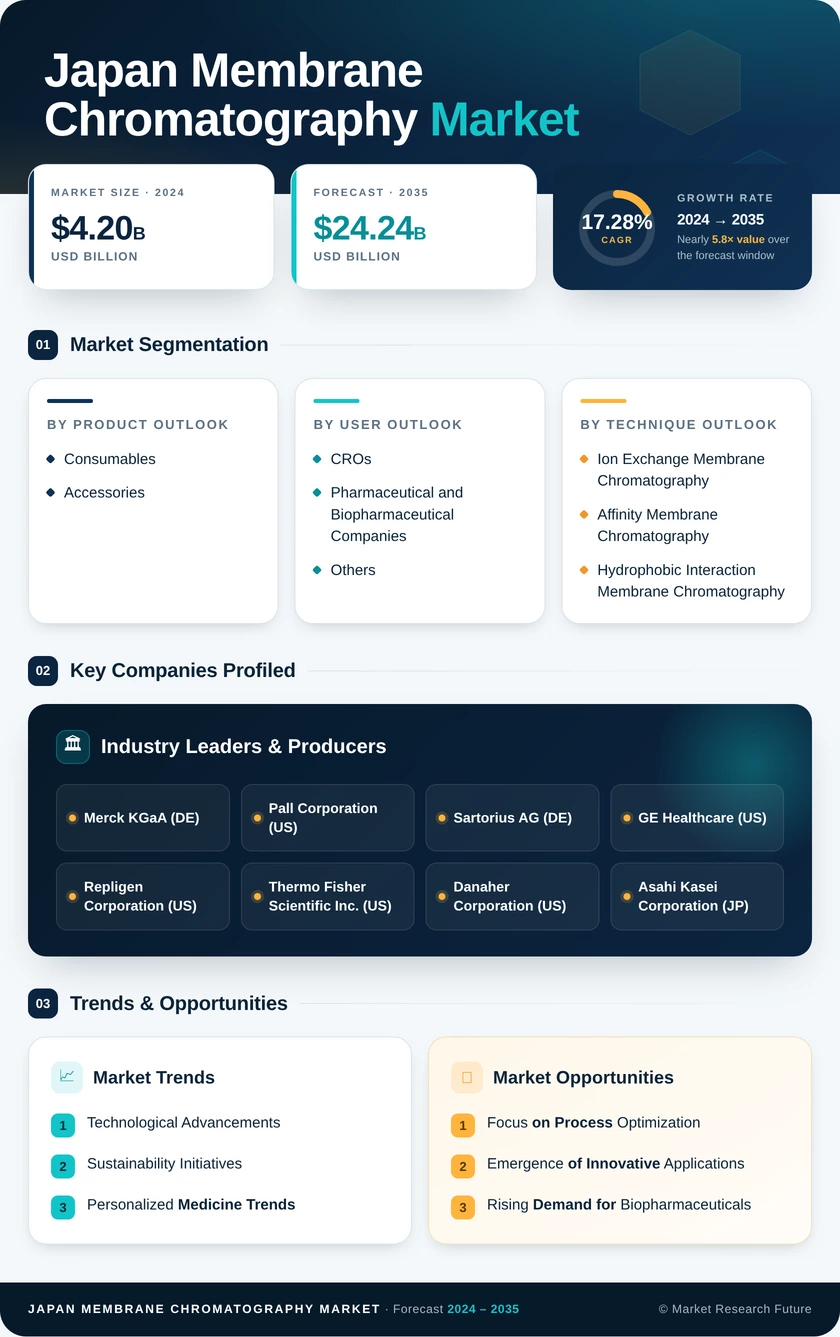
Japan Membrane Chromatography Market Research Report: Size, Share, Trend Analysis By Product (Consumables, Accessories), By End Users (CROs, Pharmaceutical and Biopharmaceutical Companies, Others) andBy Technique (Ion Exchange Membrane Chromatography, Affinity Membrane Chromatography, Hydrophobic Interaction Membrane Chromatography) - Growth Outlook & Industry Forecast 2025 To 2035
Japan Membrane Chromatography Market
Market Size
Forecast Period2025 - 2035
CAGR (2025 - 2035)17.28%
2024 Market Size$ 4.2 Million
2025 Market Size$ 4.93 Million
2035 Market Size$ 24.24 Million
Key Players
Merck KGaA
Pall Corporation
Sartorius AG
GE Healthcare
Repligen Corporation
Thermo Fisher Scientific Inc.
Opportunities
  • Focus on Process Optimization
  • Emergence of Innovative Applications
  • Rising Demand for Biopharmaceuticals
  1. 1 SECTION I: EXECUTIVE SUMMARY AND KEY HIGHLIGHTS
    1. 1.1 EXECUTIVE SUMMARY
      1. 1.1.1 Market Overview
      2. 1.1.2 Key Findings
      3. 1.1.3 Market Segmentation
      4. 1.1.4 Competitive Landscape
      5. 1.1.5 Challenges and Opportunities
      6. 1.1.6 Future Outlook
  2. 2 SECTION II: SCOPING, METHODOLOGY AND MARKET STRUCTURE
    1. 2.1 MARKET INTRODUCTION
      1. 2.1.1 Definition
      2. 2.1.2 Scope of the study
        1. 2.1.2.1 Research Objective
        2. 2.1.2.2 Assumption
        3. 2.1.2.3 Limitations
    2. 2.2 RESEARCH METHODOLOGY
      1. 2.2.1 Overview
      2. 2.2.2 Data Mining
      3. 2.2.3 Secondary Research
      4. 2.2.4 Primary Research
        1. 2.2.4.1 Primary Interviews and Information Gathering Process
        2. 2.2.4.2 Breakdown of Primary Respondents
      5. 2.2.5 Forecasting Model
      6. 2.2.6 Market Size Estimation
        1. 2.2.6.1 Bottom-Up Approach
        2. 2.2.6.2 Top-Down Approach
      7. 2.2.7 Data Triangulation
      8. 2.2.8 Validation
  3. 3 SECTION III: QUALITATIVE ANALYSIS
    1. 3.1 MARKET DYNAMICS
      1. 3.1.1 Overview
      2. 3.1.2 Drivers
      3. 3.1.3 Restraints
      4. 3.1.4 Opportunities
    2. 3.2 MARKET FACTOR ANALYSIS
      1. 3.2.1 Value chain Analysis
      2. 3.2.2 Porter's Five Forces Analysis
        1. 3.2.2.1 Bargaining Power of Suppliers
        2. 3.2.2.2 Bargaining Power of Buyers
        3. 3.2.2.3 Threat of New Entrants
        4. 3.2.2.4 Threat of Substitutes
        5. 3.2.2.5 Intensity of Rivalry
      3. 3.2.3 COVID-19 Impact Analysis
        1. 3.2.3.1 Market Impact Analysis
        2. 3.2.3.2 Regional Impact
        3. 3.2.3.3 Opportunity and Threat Analysis
  4. 4 SECTION IV: QUANTITATIVE ANALYSIS
    1. 4.1 Industrial Automation & Equipment, BY Product (USD Million)
      1. 4.1.1 Consumables
      2. 4.1.2 Accessories
    2. 4.2 Industrial Automation & Equipment, BY End User (USD Million)
      1. 4.2.1 CROs
      2. 4.2.2 Pharmaceutical and Biopharmaceutical Companies
      3. 4.2.3 Others
    3. 4.3 Industrial Automation & Equipment, BY Technique (USD Million)
      1. 4.3.1 Ion Exchange Membrane Chromatography
      2. 4.3.2 Affinity Membrane Chromatography
      3. 4.3.3 Hydrophobic Interaction Membrane Chromatography

  5. 5 SECTION V: COMPETITIVE ANALYSIS
    1. 5.1 Competitive Landscape
      1. 5.1.1 Overview
      2. 5.1.2 Competitive Analysis
      3. 5.1.3 Market share Analysis
      4. 5.1.4 Major Growth Strategy in the Industrial Automation & Equipment
      5. 5.1.5 Competitive Benchmarking
      6. 5.1.6 Leading Players in Terms of Number of Developments in the Industrial Automation & Equipment
      7. 5.1.7 Key developments and growth strategies
        1. 5.1.7.1 New Product Launch/Service Deployment
        2. 5.1.7.2 Merger & Acquisitions
        3. 5.1.7.3 Joint Ventures
      8. 5.1.8 Major Players Financial Matrix
        1. 5.1.8.1 Sales and Operating Income
        2. 5.1.8.2 Major Players R&D Expenditure. 2023
    2. 5.2 Company Profiles
      1. 5.2.1 Merck KGaA (DE)
        1. 5.2.1.1 Financial Overview
        2. 5.2.1.2 Products Offered
        3. 5.2.1.3 Key Developments
        4. 5.2.1.4 SWOT Analysis
        5. 5.2.1.5 Key Strategies
      2. 5.2.2 Pall Corporation (US)
        1. 5.2.2.1 Financial Overview
        2. 5.2.2.2 Products Offered
        3. 5.2.2.3 Key Developments
        4. 5.2.2.4 SWOT Analysis
        5. 5.2.2.5 Key Strategies
      3. 5.2.3 Sartorius AG (DE)
        1. 5.2.3.1 Financial Overview
        2. 5.2.3.2 Products Offered
        3. 5.2.3.3 Key Developments
        4. 5.2.3.4 SWOT Analysis
        5. 5.2.3.5 Key Strategies
      4. 5.2.4 GE Healthcare (US)
        1. 5.2.4.1 Financial Overview
        2. 5.2.4.2 Products Offered
        3. 5.2.4.3 Key Developments
        4. 5.2.4.4 SWOT Analysis
        5. 5.2.4.5 Key Strategies
      5. 5.2.5 Repligen Corporation (US)
        1. 5.2.5.1 Financial Overview
        2. 5.2.5.2 Products Offered
        3. 5.2.5.3 Key Developments
        4. 5.2.5.4 SWOT Analysis
        5. 5.2.5.5 Key Strategies
      6. 5.2.6 Thermo Fisher Scientific Inc. (US)
        1. 5.2.6.1 Financial Overview
        2. 5.2.6.2 Products Offered
        3. 5.2.6.3 Key Developments
        4. 5.2.6.4 SWOT Analysis
        5. 5.2.6.5 Key Strategies
      7. 5.2.7 Danaher Corporation (US)
        1. 5.2.7.1 Financial Overview
        2. 5.2.7.2 Products Offered
        3. 5.2.7.3 Key Developments
        4. 5.2.7.4 SWOT Analysis
        5. 5.2.7.5 Key Strategies
      8. 5.2.8 Asahi Kasei Corporation (JP)
        1. 5.2.8.1 Financial Overview
        2. 5.2.8.2 Products Offered
        3. 5.2.8.3 Key Developments
        4. 5.2.8.4 SWOT Analysis
        5. 5.2.8.5 Key Strategies
    3. 5.3 Appendix
      1. 5.3.1 References
      2. 5.3.2 Related Reports
  6. 6 LIST OF FIGURES
    1. 6.1 MARKET SYNOPSIS
    2. 6.2 JAPAN MARKET ANALYSIS BY PRODUCT
    3. 6.3 JAPAN MARKET ANALYSIS BY END USER
    4. 6.4 JAPAN MARKET ANALYSIS BY TECHNIQUE
    5. 6.5 KEY BUYING CRITERIA OF INDUSTRIAL AUTOMATION & EQUIPMENT
    6. 6.6 RESEARCH PROCESS OF MRFR
    7. 6.7 DRO ANALYSIS OF INDUSTRIAL AUTOMATION & EQUIPMENT
    8. 6.8 DRIVERS IMPACT ANALYSIS: INDUSTRIAL AUTOMATION & EQUIPMENT
    9. 6.9 RESTRAINTS IMPACT ANALYSIS: INDUSTRIAL AUTOMATION & EQUIPMENT
    10. 6.10 SUPPLY / VALUE CHAIN: INDUSTRIAL AUTOMATION & EQUIPMENT
    11. 6.11 INDUSTRIAL AUTOMATION & EQUIPMENT, BY PRODUCT, 2024 (% SHARE)
    12. 6.12 INDUSTRIAL AUTOMATION & EQUIPMENT, BY PRODUCT, 2024 TO 2035 (USD Million)
    13. 6.13 INDUSTRIAL AUTOMATION & EQUIPMENT, BY END USER, 2024 (% SHARE)
    14. 6.14 INDUSTRIAL AUTOMATION & EQUIPMENT, BY END USER, 2024 TO 2035 (USD Million)
    15. 6.15 INDUSTRIAL AUTOMATION & EQUIPMENT, BY TECHNIQUE, 2024 (% SHARE)
    16. 6.16 INDUSTRIAL AUTOMATION & EQUIPMENT, BY TECHNIQUE, 2024 TO 2035 (USD Million)
    17. 6.17 BENCHMARKING OF MAJOR COMPETITORS
  7. 7 LIST OF TABLES
    1. 7.1 LIST OF ASSUMPTIONS
  8. 7.1.1
    1. 7.2 Japan MARKET SIZE ESTIMATES; FORECAST
      1. 7.2.1 BY PRODUCT, 2025-2035 (USD Million)
      2. 7.2.2 BY END USER, 2025-2035 (USD Million)
      3. 7.2.3 BY TECHNIQUE, 2025-2035 (USD Million)
    2. 7.3 PRODUCT LAUNCH/PRODUCT DEVELOPMENT/APPROVAL
  9. 7.3.1
    1. 7.4 ACQUISITION/PARTNERSHIP
  10. 7.4.1

Japan Membrane Chromatography Market Segmentation

Japan Membrane Chromatography Market By Product (USD Million, 2025-2035)

  • Consumables
  • Accessories

Japan Membrane Chromatography Market By End User (USD Million, 2025-2035)

  • CROs
  • Pharmaceutical and Biopharmaceutical Companies
  • Others

Japan Membrane Chromatography Market By Technique (USD Million, 2025-2035)

  • Ion Exchange Membrane Chromatography
  • Affinity Membrane Chromatography
  • Hydrophobic Interaction Membrane Chromatography

Download PDF ×

We do not share your information with anyone. However, we may send you emails based on your report interest from time to time. You may contact us at any time to opt-out.