

Request Free Sample ×

Kindly complete the form below to receive a free sample of this Report

* Please use a valid business email

Leading companies partner with us for data-driven Insights

clients tt-cursor
Hero Background
English
Chinese
French
Japanese
Korean
German
Spanish

IoT Operating Systems Market Analysis

ID: MRFR/ICT/4468-HCR
100 Pages
Ankit Gupta
March 2026

IoT Operating Systems Market Research Report Information By Services (Professional and Managed), Organization Size (SMEs and Large Enterprises), Verticals (Information Technology (IT), Manufacturing, Consumer Electronics, Industrial Automation, Transportation & Logistics), Operating System Type (Windows 10 IoT, WindRiver VxWorks 10 IoT, Embedded Apple iOS and OSK, Green Hills Integrity, and Nuclear RTOS), Application ( Digital Signage, Smart Buildings & Home Automation, Smart Factories, IoT Wearables, Others), Regions – Forecast Till 2035.

Share:
Download PDF ×

We do not share your information with anyone. However, we may send you emails based on your report interest from time to time. You may contact us at any time to opt-out.

IoT Operating Systems Market Infographic
Purchase Options

Market Analysis

In-depth Analysis of IoT Operating Systems Market Industry Landscape

The market dynamics of the Internet of Things (IoT) operating systems reflect a complex interaction of technological advancements, evolving consumer demands, and aggressive landscapes. As the IoT ecosystem keeps amplifying, operating systems, in particular, designed for those interconnected devices, have turned out to be pivotal in ensuring seamless verbal exchange, facts control, and common system efficiency. One key motive force shaping the market dynamics is the speedy proliferation of IoT devices throughout numerous industries. From smart houses and commercial automation to healthcare and transportation, the demand for specialized operating systems tailor-made to the precise necessities of IoT applications has surged. This surge is fueled by the need for optimized aid utilization, low-latency communique, and strong security capabilities to safeguard sensitive statistics transmitted through interconnected gadgets. Interoperability stands proud as a vital component influencing the dynamics of the IoT operating systems market. With a mess of gadgets from specific manufacturers, operating systems have to ensure compatibility and smooth communication among disparate factors of the IoT atmosphere. Security issues constitute some other huge component shaping market dynamics. As IoT devices turn out to be extra integrated into everyday lifestyles, the risk of cyber threats and attacks escalates. Operating systems designed with robust security capabilities, inclusive of encryption protocols and stable boot mechanisms, are gaining traction. This emphasis on security isn't always the simplest pushed by means of the want to shield touchy information; however, it is also via regulatory frameworks mandating stringent security measures in IoT deployments. Furthermore, the role of cloud integration in IoT operating systems can't be overstated. Cloud services play a pivotal role in enhancing the functionality of IoT gadgets via offering garage, analytics, and far-off management abilities. Operating systems that seamlessly combine with cloud structures have an aggressive aspect, permitting customers to harness the total potential of IoT programs and services. As the market matures, strategic partnerships and collaborations are becoming increasingly widespread. Operating system carriers are forging alliances with hardware manufacturers, connectivity solution carriers, and alertness developers to create comprehensive and incorporated IoT solutions. These collaborations intend to cope with end-to-end necessities, from hardware compatibility to software improvement, fostering a more cohesive and streamlined IoT atmosphere.

Author
Author Profile
Ankit Gupta
Team Lead - Research

Ankit Gupta is a seasoned market intelligence and strategic research professional with over six plus years of experience in the ICT and Semiconductor industries. With academic roots in Telecom, Marketing, and Electronics, he blends technical insight with business strategy. Ankit has led 200+ projects, including work for Fortune 500 clients like Microsoft and Rio Tinto, covering market sizing, tech forecasting, and go-to-market strategies. Known for bridging engineering and enterprise decision-making, his insights support growth, innovation, and investment planning across diverse technology markets.

Leave a Comment

FAQs

What is the projected market valuation of the IoT Operating Systems Market by 2035?

<p>The IoT Operating Systems Market is projected to reach a valuation of 5.784 USD Billion by 2035.</p>

What was the market valuation of the IoT Operating Systems Market in 2024?

<p>In 2024, the IoT Operating Systems Market had a valuation of 0.7401 USD Billion.</p>

What is the expected CAGR for the IoT Operating Systems Market during the forecast period 2025 - 2035?

<p>The expected CAGR for the IoT Operating Systems Market during the forecast period 2025 - 2035 is 20.55%.</p>

Which companies are considered key players in the IoT Operating Systems Market?

<p>Key players in the IoT Operating Systems Market include Microsoft, Amazon, Google, IBM, Oracle, Siemens, Samsung, Cisco, Bosch, and Huawei.</p>

What segment of the IoT Operating Systems Market had a valuation of 2.892 USD Billion in 2025?

<p>The Services segment of the IoT Operating Systems Market is expected to have a valuation of 2.892 USD Billion in 2025.</p>

How do large enterprises compare to SMEs in the IoT Operating Systems Market?

<p>In 2025, large enterprises are projected to have a valuation of 2.8916 USD Billion, while SMEs are expected to reach 2.8924 USD Billion.</p>

What are the primary verticals contributing to the IoT Operating Systems Market?

<p>The primary verticals include Information Technology, Manufacturing, Consumer Electronics, Industrial Automation, and Transportation & Logistics, each valued at 1.1574 USD Billion in 2025.</p>

Which operating system types are expected to dominate the IoT Operating Systems Market?

<p>Windows 10 IoT, WindRiver VxWorks 10 IoT, and Embedded Apple iOS are among the operating system types expected to dominate, each valued at 1.1484 USD Billion in 2025.</p>

What applications are driving growth in the IoT Operating Systems Market?

<p>Applications such as Smart Buildings & Home Automation and IoT wearables are driving growth, with valuations of 1.4405 USD Billion and 1.1584 USD Billion respectively in 2025.</p>

How does the IoT Operating Systems Market's growth potential compare to its current size?

The IoT Operating Systems Market's growth potential appears substantial, with a projected increase from 0.7401 USD Billion in 2024 to 5.784 USD Billion by 2035.

Market Summary

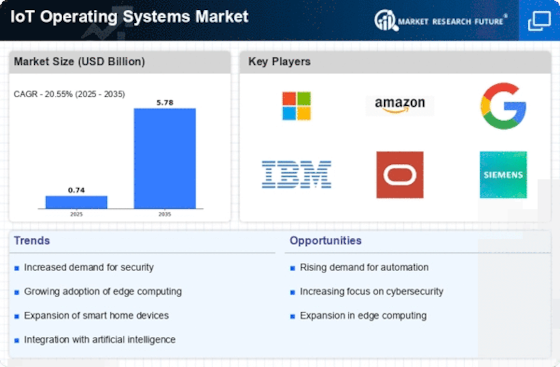
As per Market Research Future analysis, the IoT Operating Systems Market Size was estimated at 0.7401 USD Billion in 2024. The IoT Operating Systems industry is projected to grow from USD 0.8922 Billion in 2025 to USD 5.784 Billion by 2035, exhibiting a compound annual growth rate (CAGR) of 20.55% during the forecast period 2025 - 2035

Key Market Trends & Highlights

The IoT Operating Systems Market is poised for substantial growth driven by technological advancements and increasing demand for smart solutions.

  • The market exhibits an increased focus on security measures to protect connected devices and data. Interoperability and standardization are becoming critical as diverse IoT devices proliferate across various sectors. The integration of AI and machine learning is enhancing the functionality and efficiency of IoT operating systems. Rising demand for smart devices and advancements in edge computing are key drivers propelling market expansion, particularly in North America and the Asia-Pacific region.

Market Size & Forecast

2024 Market Size 0.7401 (USD Billion)
2035 Market Size 5.784 (USD Billion)
CAGR (2025 - 2035) 20.55%
Largest Regional Market Share in 2024 North America

Major Players

<p>Microsoft (US), Amazon (US), Google (US), IBM (US), Oracle (US), Siemens (DE), Samsung (KR), Cisco (US), Bosch (DE), Huawei (CN)</p>

Market Trends

The IoT Operating Systems Market is currently experiencing a transformative phase, characterized by rapid advancements in technology and increasing adoption across various sectors. This market encompasses a diverse range of operating systems designed specifically for Internet of Things devices, facilitating seamless connectivity and efficient data management. As industries recognize the potential of IoT solutions, the demand for specialized operating systems is likely to grow, driven by the need for enhanced security, interoperability, and scalability. Furthermore, the integration of artificial intelligence and machine learning into IoT operating systems appears to be a pivotal trend, enabling smarter decision-making and automation in real-time applications. In addition to technological advancements, regulatory frameworks and standards are evolving to support the growth of the IoT Operating Systems Market. Governments and organizations are increasingly focusing on establishing guidelines that ensure data privacy and security, which may influence the development and deployment of IoT solutions. As the market continues to mature, collaboration among stakeholders, including software developers, hardware manufacturers, and service providers, is essential for fostering innovation and addressing challenges. Overall, the IoT Operating Systems Market is poised for significant growth, with numerous opportunities for stakeholders to capitalize on emerging trends and technologies.

Increased Focus on Security

As the number of connected devices rises, the emphasis on security within the IoT Operating Systems Market intensifies. Stakeholders are prioritizing the development of robust security protocols to safeguard sensitive data and protect against cyber threats. This trend indicates a shift towards more secure operating systems that can withstand potential vulnerabilities.

Interoperability and Standardization

The need for seamless communication between diverse IoT devices drives the trend towards interoperability and standardization in the IoT Operating Systems Market. Efforts to create common protocols and frameworks are underway, which may enhance compatibility and facilitate smoother integration across various platforms.

Integration of AI and Machine Learning

The incorporation of artificial intelligence and machine learning technologies into IoT operating systems is gaining traction. This trend suggests that operating systems will increasingly leverage these advanced technologies to enable smarter analytics, predictive maintenance, and enhanced automation, thereby improving overall system efficiency.

IoT Operating Systems Market Market Drivers

Emergence of 5G Technology

The rollout of 5G technology is poised to revolutionize the IoT Operating Systems Market Industry. With its promise of ultra-fast data transfer speeds and low latency, 5G enables a new wave of IoT applications that require real-time communication. As industries such as automotive, healthcare, and logistics adopt 5G, the demand for IoT operating systems that can leverage these capabilities is expected to surge. In 2025, the 5G market is projected to grow exponentially, further driving the need for advanced operating systems that can support high-bandwidth applications. This technological advancement suggests that the IoT Operating Systems Market Industry will experience significant transformation, as developers strive to create solutions that fully exploit the potential of 5G connectivity.

Advancements in Edge Computing

Edge computing is emerging as a pivotal factor influencing the IoT Operating Systems Market Industry. By processing data closer to the source, edge computing reduces latency and bandwidth usage, which is crucial for real-time applications. As industries such as manufacturing and healthcare increasingly adopt edge computing solutions, the demand for specialized IoT operating systems that can efficiently manage edge devices is expected to rise. In 2025, the edge computing market is anticipated to grow significantly, further propelling the IoT Operating Systems Market Industry. This trend suggests that operating systems must evolve to support distributed architectures, enabling seamless integration and communication between edge devices and cloud services.

Rising Demand for Smart Devices

The proliferation of smart devices is a primary driver of the IoT Operating Systems Market Industry. As consumers increasingly adopt smart home technologies, wearables, and connected appliances, the need for robust operating systems to manage these devices intensifies. In 2025, the number of connected devices is projected to reach over 30 billion, necessitating efficient and scalable IoT operating systems. This surge in device connectivity creates a substantial market opportunity for developers and manufacturers, as they seek to provide seamless user experiences and enhanced functionalities. Consequently, the IoT Operating Systems Market Industry is likely to witness significant growth, driven by the demand for innovative solutions that can support diverse applications across various sectors.

Growing Emphasis on Data Analytics

The increasing emphasis on data analytics is reshaping the IoT Operating Systems Market Industry. Organizations are recognizing the value of data generated by IoT devices, leading to a surge in demand for operating systems that can facilitate data collection, processing, and analysis. In 2025, The IoT Operating Systems Market is projected to exceed 200 billion, indicating a robust growth trajectory. This trend necessitates the development of IoT operating systems that can efficiently handle large volumes of data while ensuring security and compliance. As businesses seek to leverage insights from IoT data, the IoT Operating Systems Market Industry is likely to expand, driven by the need for advanced analytics capabilities integrated within operating systems.

Increased Investment in Smart Cities

Investment in smart city initiatives is significantly driving the IoT Operating Systems Market Industry. Governments and municipalities are increasingly allocating resources to develop smart infrastructure, which relies heavily on IoT technologies. In 2025, the smart city market is expected to reach over 500 billion, creating a substantial demand for IoT operating systems that can support various applications, from traffic management to energy efficiency. This trend indicates a growing need for operating systems that can integrate diverse IoT devices and systems, ensuring interoperability and scalability. As smart city projects proliferate, the IoT Operating Systems Market Industry is poised for considerable growth, fueled by the demand for innovative solutions that enhance urban living.

Market Segment Insights

By Services: Professional (Largest) vs. Managed (Fastest-Growing)

<p>In the IoT Operating Systems Market, the distribution of market share between the Professional and Managed services segments reveals a significant landscape. Professional services currently hold a dominant position, often being the first choice for organizations seeking tailored solutions that address their specific IoT implementation needs. Conversely, Managed services are capturing attention rapidly, appealing to enterprises looking for outsourced management and operational efficiency, leading to their burgeoning market presence.</p>

<p>Services: Professional (Dominant) vs. Managed (Emerging)</p>

<p>Professional services are characterized by their bespoke offerings, which cater directly to client requirements for IoT solutions, including integration, consultancy, and deployment strategies. As organizations embark on their IoT journeys, the necessity for such specialized services has solidified its role as a dominant force in the market. Meanwhile, Managed services represent an emerging segment, leveraging cloud computing and remote monitoring to provide scalable and efficient management of IoT ecosystems. This trend is driven by the increasing need for businesses to streamline operations, reduce overhead costs, and enhance security and compliance, positioning Managed services as a key player in the future of IoT systems.</p>

By Organization Size: SMEs (Largest) vs. Large Enterprises (Fastest-Growing)

<p>The IoT Operating Systems Market is significantly influenced by organization size, showcasing a clear distribution of share between Small and Medium-sized Enterprises (SMEs) and Large Enterprises. SMEs dominate this market segment due to their agility and ability to implement IoT solutions quickly, accounting for a significant chunk of the overall market share. In contrast, large enterprises, while initially slower to adopt IoT operating systems, are catching up due to their resource availability and need for enhanced operational efficiencies, driving their market share in the upwards direction.</p>

<p>SMEs (Dominant) vs. Large Enterprises (Emerging)</p>

<p>SMEs play a dominant role in the IoT Operating Systems Market, primarily due to their innovative cultures and the need for cost-effective solutions that IoT systems provide. They are often first movers in deploying IoT technologies, leveraging their flexibility to adapt quickly. On the other hand, Large Enterprises are emerging as critical players, embracing IoT solutions to enhance their scalability and improve operational efficiencies. While they face challenges such as legacy systems integration and the complexity of deploying IoT on a larger scale, their investment in IoT technologies signifies a strong commitment to leveraging these systems for competitive advantage. Their growing adoption is projected to rapidly transform their market presence.</p>

By Verticals: Information Technology (Largest) vs. Industrial Automation (Fastest-Growing)

<p>The IoT Operating Systems Market exhibits a diverse array of segment values, with the Information Technology (IT) sector holding the largest market share. This segment is integral in driving the adoption of IoT solutions across various applications, as businesses increasingly rely on data analytics and connectivity to optimize operations. In contrast, the Industrial Automation segment is emerging rapidly, fueled by advancements in smart manufacturing and the push for enhanced efficiency and productivity. As companies embrace automation technologies, this segment is positioned to capture more attention and investment. Growth trends in the IoT Operating Systems Market are significantly influenced by the increasing integration of IoT solutions within various verticals. The demand for connected devices and systems has been propelled by the need for real-time data insights, operational efficiency, and predictive maintenance. In particular, the Industrial Automation sector is witnessing accelerated growth due to the implementation of Industry 4.0 principles, which leverage IoT applications to enhance operational capabilities. Meanwhile, the IT segment continues to solidify its position as the backbone of IoT implementations, driving innovation and scalability across the ecosystem.</p>

<p>Information Technology: IT (Dominant) vs. Industrial Automation (Emerging)</p>

<p>The Information Technology sector remains dominant in the IoT Operating Systems Market due to its pivotal role in managing and analyzing data for connected devices. IT systems are essential for ensuring interoperability among various IoT components, enabling seamless communication and data exchange. Companies operating within this vertical are focused on creating robust cybersecurity measures, enhancing cloud connectivity, and developing scalable solutions to meet the demands of rapidly evolving IoT applications. On the other hand, the Industrial Automation sector is emerging as a strong competitor, leveraging IoT technologies to streamline operations and improve productivity. Enterprises are adopting smart sensors and control systems that provide actionable insights from real-time data. As automation technologies continue to advance, this sector is expected to grow exponentially, driving further adoption of IoT operating systems and services.</p>

By Operating System Type: Windows 10 IoT (Largest) vs. WindRiver VxWorks 10 IoT (Fastest-Growing)

<p>In the IoT Operating Systems Market, Windows 10 IoT holds the largest market share due to its widespread adoption across various industries, offering reliability and a familiar interface for developers. Meanwhile, WindRiver VxWorks 10 IoT is gaining traction among high-performance applications, positioning itself as a competitive alternative with rapid increases in its user base. The distribution showcases a strong demand for robust and efficient operating systems tailored for IoT devices. As industries increasingly rely on Internet of Things technologies, this segment is experiencing substantial growth driven by the rise of smart devices and automation. WindRiver's focus on real-time applications positions it as the fastest-growing option, appealing to sectors like automotive and healthcare. The trend of edge computing is also fueling the demand for specialized IoT operating systems, highlighting the need for optimized and tailored solutions.</p>

<p>Windows 10 IoT (Dominant) vs. WindRiver VxWorks 10 IoT (Emerging)</p>

<p>Windows 10 IoT is recognized as the dominant force within the IoT Operating Systems Market due to its integration capabilities with the broader Windows ecosystem, making it a preferred choice for enterprises looking for flexibility and support. Its extensive development tools and familiar user interface ease the adoption curve for businesses transitioning to IoT solutions. Conversely, WindRiver VxWorks 10 IoT, while emerging, appeals to sectors requiring real-time data processing and high reliability, such as aerospace and defense. Its unique architecture is designed for mission-critical applications, providing enhanced performance and security features that are crucial for handling IoT deployments. This contrast between a mature solution like Windows 10 IoT and a specialized emerging player like WindRiver illustrates the diverse needs of the IoT landscape.</p>

By Application: Smart Buildings & Home Automation (Largest) vs. IoT Wearables (Fastest-Growing)

<p>In the IoT Operating Systems Market, the application segment showcases a dynamic distribution, with Smart Buildings and Home Automation capturing the largest market share. These applications are experiencing robust adoption due to increasing demand for energy efficiency and automation in both residential and commercial spaces. Following closely, Smart Factories and Digital Signage also contribute significantly, demonstrating a trend towards industrial automation and enhanced customer engagement. IoT wearables, although a smaller segment currently, are rapidly gaining traction, reflecting changing consumer preferences towards personalized health and fitness monitoring. Growth trends in this segment are propelled by advances in technology and societal shifts towards digital solutions. The push for smart city initiatives directs investments into Smart Buildings, while the demand for real-time health data makes IoT wearables a focal point of innovation. Emerging technologies, such as AI and machine learning, also fuel the growth of Smart Factories, as they require sophisticated operating systems to optimize production processes. Overall, an increasing interconnectedness across applications suggests a vibrant future for the IoT Operating Systems Market.</p>

<p>Smart Buildings & Home Automation (Dominant) vs. IoT Wearables (Emerging)</p>

<p>Smart Buildings and Home Automation represent a dominant force within the IoT Operating Systems Market, characterized by their integration of advanced technologies to enhance energy management, security, and convenience. These systems leverage interconnected devices to create environments that respond to user needs and preferences. In contrast, IoT wearables, classified as an emerging segment, focus on personal health, fitness, and connectivity. Though currently smaller in market share, wearables are rapidly evolving, driven by consumer interest in health monitoring and fitness tracking. Innovations in miniaturization and sensor technology are enhancing the capabilities of wearables, making them appealing to a broader audience. As both segments evolve, their interaction with other IoT applications could foster new market opportunities and synergies.</p>

Get more detailed insights about IoT Operating Systems Market Research Report – Forecast to 2035

Regional Insights

North America : Innovation and Leadership Hub

North America is the largest market for IoT operating systems, holding approximately 45% of the global market share. The region's growth is driven by rapid technological advancements, increased adoption of smart devices, and supportive government regulations promoting IoT innovation. The demand for enhanced connectivity and automation in various sectors, including healthcare and manufacturing, further fuels this growth. The United States leads the market, with major players like Microsoft, Amazon, and Google driving competition. The presence of established tech giants and a robust startup ecosystem fosters innovation. Canada also plays a significant role, focusing on smart city initiatives and IoT applications in agriculture. This competitive landscape ensures continuous advancements in IoT technologies, positioning North America as a leader in the global market.

Europe : Regulatory Framework and Growth

Europe is the second-largest market for IoT operating systems, accounting for around 30% of the global share. The region's growth is propelled by stringent regulations aimed at enhancing data security and privacy, such as the General Data Protection Regulation (GDPR). Additionally, the European Union's commitment to digital transformation and sustainability initiatives drives demand for IoT solutions across various sectors. Germany and the United Kingdom are the leading countries in this market, with significant investments in smart manufacturing and connected devices. Key players like Siemens and Bosch are at the forefront, leveraging their expertise to develop innovative IoT solutions. The competitive landscape is characterized by a mix of established companies and emerging startups, fostering a dynamic environment for growth and collaboration.

Asia-Pacific : Rapid Growth and Adoption

Asia-Pacific is witnessing rapid growth in the IoT operating systems market, holding approximately 20% of the global share. The region's expansion is driven by increasing urbanization, rising disposable incomes, and a growing demand for smart devices. Government initiatives promoting digital transformation and smart city projects further catalyze this growth, making it a key player in the global IoT landscape. China and Japan are the leading countries in this market, with significant investments in IoT infrastructure and technology. Companies like Huawei and Samsung are pivotal in driving innovation and competition. The competitive landscape is marked by a mix of local and international players, fostering a vibrant ecosystem that supports the development of advanced IoT solutions tailored to regional needs.

Middle East and Africa : Emerging Market Potential

The Middle East and Africa region is gradually emerging in the IoT operating systems market, currently holding about 5% of the global share. The growth is primarily driven by increasing investments in smart infrastructure and a rising demand for automation across various sectors. Government initiatives aimed at enhancing digital connectivity and economic diversification are also significant catalysts for market expansion in this region. Countries like the United Arab Emirates and South Africa are leading the charge, focusing on smart city developments and IoT applications in sectors such as energy and transportation. The competitive landscape is evolving, with both local and international players entering the market, creating opportunities for innovation and collaboration in IoT technologies.

Key Players and Competitive Insights

Leading market players are investing heavily in research and development in order to expand their product lines, which will help the IoT Operating Systems Market grow even more. Market participants are also undertaking a variety of strategic activities to expand their footprint, with important market developments including new product launches, contractual agreements, mergers and acquisitions, higher investments, and collaboration with other organizations. To expand and survive in a more competitive and rising market climate, the IoT Operating Systems industry must offer cost-effective items.Manufacturing locally to minimize operational costs is one of the key business tactics used by manufacturers in the IoT Operating Systems industry to benefit clients and increase the market sector. In recent years, the IoT Operating Systems industry has offered some of the most significant advantages to medicine. Major players in the IoT Operating Systems Market, including Google Inc. (U.S.), Apple Inc (U.S.), ESOL Co. Ltd. (Japan), BlackBerry Limited (Canada), and others, are attempting to increase market demand by investing in research and development operations.Apple was founded as Apple Computer Company on April 1, 1976, by Steve Wozniak, Steve Jobs, and Ronald Wayne to develop and sell Wozniak's Apple I personal computer. It was incorporated by Jobs and Wozniak as Apple Computer, Inc. in 1977. After hurdles and continuous struggle, it became a publically traded company in 2018, enjoying high brand loyalty. Apple deals in iPhone, Mac, iPod, iPad, Apple T.V., Apple Watch, and professional software applications such as iOS, macOS, watchOS, and more. The company sells its products through Apple Arcade and App Store.It offers advertising services, payment services, cloud services, software applications, and related services.


In June Apple became the second-largest mobile phone manufacturer and fourth-largest personal computer vendor by unit sales in the world. It is now one of the Big Five American information technology companies, alongside Alphabet, Meta Platforms, Amazon, and Microsoft.BlackBerry Limited (Canada) was Founded in 1984 as RIM (Research in Motion). The company’s headquarter is in Waterloo, Ontario, Canada. The company provides businesses, government agencies, and safety-critical institutions of all sizes to secure the Internet of Things (IoT). And also offers enterprise services, mobile devices, messaging services, and embedded services, which include Cybersecurity services, Cloud-based services, Enterprise mobility management (EMM) solutions, and many more.

Key Companies in the IoT Operating Systems Market include

Industry Developments

As of November 2023, Fire OS, an Android fork is presently being used by Amazon on its Fire TVs and tablets. However, since the operating system is based on the Android Open-Source Project (AOSP), you can use any app that runs on Android with the device. Nonetheless, this online retail giant could be looking to distance itself from Google's OS, as per a new report. The company intends to replace the current Android-based Fire OS that runs on Fire TVs and other devices with a new one, according to news reports.

The present work reveals that this fresh software is already in an advanced stage of development and can be made available in supported equipment from 2024 onward. Amazon has started replacing its existing smartphones’ operating systems, including Android OS, with another brand-new operating system.

In November 2023, another milestone that SIM technology reached was the iSIM. In fact, G+D Mobile Security, together with PassTime, has been instrumental in developing this concept and is now launching the first commercially viable large-scale solution backed by AT&T and Sony Semiconductor Israel, respectively. To make its next-generation compact GPS locater more energy efficient but also more versatile at reduced manufacturing complexity for use across diverse market verticals in IoT solutions.

In April 2024, Telefónica, together with IDEMIA Secure Transactions, announced Quside's Quantum-Safe connection for industrial IoT devices. This pioneering initiative will enable advances in quantum computing for Internet of Things (IoT) devices through the introduction of Quantum-safe SIM cards and Transport Layer Security (TLS). This cryptographic protocol allows deployment without changes at the hardware level, and it has strong quantum randomness technology that increases the security of connections and makes them much more effective.

In August 2023, Samsung Electronics revealed that they had globally released KMC-W – an updated version of Samsung Kiosk running Windows after winning the ISE Best of Show award by AV Technology during Integrated Systems Europe 2023. The new version of this Kiosk has a 24-inch touch screen, which extends its software compatibility to advanced self-service display technology for food & beverage, retail, travel, and healthcare sectors. Different industries and applications like bill payments, drive-thru services, self-ordering in restaurants, coffee houses, and unmanned fitting rooms require the convenience of contactless technology.

Future Outlook

IoT Operating Systems Market Future Outlook

<p>The IoT Operating Systems Market is poised for robust growth at 20.55% CAGR from 2025 to 2035, driven by advancements in connectivity, data analytics, and automation.</p>

New opportunities lie in:

  • <p>Development of edge computing solutions for real-time data processing. Integration of AI-driven analytics for predictive maintenance. Expansion into smart city infrastructure management systems.</p>

<p>By 2035, the market is expected to achieve substantial growth, reflecting its critical role in digital transformation.</p>

Market Segmentation

IoT Operating Systems Market Services Outlook

  • Professional
  • Managed

IoT Operating Systems Market Verticals Outlook

  • Information Technology (IT)
  • Manufacturing
  • Consumer Electronics
  • Industrial Automation
  • Transportation & Logistics
  • Others

IoT Operating Systems Market Application Outlook

  • Digital Signage
  • Smart Buildings & Home Automation
  • Smart Factories
  • IoT wearables
  • Others

IoT Operating Systems Market Organization Size Outlook

  • SMEs
  • Large Enterprises

IoT Operating Systems Market Operating System Type Outlook

  • Windows 10 IoT
  • WindRiver VxWorks 10 IoT
  • Embedded Apple iOS and OSK
  • Green Hills Integrity
  • Nuclear RTOS

Report Scope

MARKET SIZE 2024 0.7401(USD Billion)
MARKET SIZE 2025 0.8922(USD Billion)
MARKET SIZE 2035 5.784(USD Billion)
COMPOUND ANNUAL GROWTH RATE (CAGR) 20.55% (2025 - 2035)
REPORT COVERAGE Revenue Forecast, Competitive Landscape, Growth Factors, and Trends
BASE YEAR 2024
Market Forecast Period 2025 - 2035
Historical Data 2019 - 2024
Market Forecast Units USD Billion
Key Companies Profiled Microsoft (US), Amazon (US), Google (US), IBM (US), Oracle (US), Siemens (DE), Samsung (KR), Cisco (US), Bosch (DE), Huawei (CN)
Segments Covered Services
Key Market Opportunities Integration of artificial intelligence in IoT Operating Systems Market enhances automation and data processing capabilities.
Key Market Dynamics Rising demand for interoperability drives innovation and competition among IoT operating system providers.
Countries Covered North America, Europe, APAC, South America, MEA

FAQs

What is the projected market valuation of the IoT Operating Systems Market by 2035?

<p>The IoT Operating Systems Market is projected to reach a valuation of 5.784 USD Billion by 2035.</p>

What was the market valuation of the IoT Operating Systems Market in 2024?

<p>In 2024, the IoT Operating Systems Market had a valuation of 0.7401 USD Billion.</p>

What is the expected CAGR for the IoT Operating Systems Market during the forecast period 2025 - 2035?

<p>The expected CAGR for the IoT Operating Systems Market during the forecast period 2025 - 2035 is 20.55%.</p>

Which companies are considered key players in the IoT Operating Systems Market?

<p>Key players in the IoT Operating Systems Market include Microsoft, Amazon, Google, IBM, Oracle, Siemens, Samsung, Cisco, Bosch, and Huawei.</p>

What segment of the IoT Operating Systems Market had a valuation of 2.892 USD Billion in 2025?

<p>The Services segment of the IoT Operating Systems Market is expected to have a valuation of 2.892 USD Billion in 2025.</p>

How do large enterprises compare to SMEs in the IoT Operating Systems Market?

<p>In 2025, large enterprises are projected to have a valuation of 2.8916 USD Billion, while SMEs are expected to reach 2.8924 USD Billion.</p>

What are the primary verticals contributing to the IoT Operating Systems Market?

<p>The primary verticals include Information Technology, Manufacturing, Consumer Electronics, Industrial Automation, and Transportation & Logistics, each valued at 1.1574 USD Billion in 2025.</p>

Which operating system types are expected to dominate the IoT Operating Systems Market?

<p>Windows 10 IoT, WindRiver VxWorks 10 IoT, and Embedded Apple iOS are among the operating system types expected to dominate, each valued at 1.1484 USD Billion in 2025.</p>

What applications are driving growth in the IoT Operating Systems Market?

<p>Applications such as Smart Buildings & Home Automation and IoT wearables are driving growth, with valuations of 1.4405 USD Billion and 1.1584 USD Billion respectively in 2025.</p>

How does the IoT Operating Systems Market's growth potential compare to its current size?

The IoT Operating Systems Market's growth potential appears substantial, with a projected increase from 0.7401 USD Billion in 2024 to 5.784 USD Billion by 2035.

  1. SECTION I: EXECUTIVE SUMMARY AND KEY HIGHLIGHTS
    1. | 1.1 EXECUTIVE SUMMARY
    2. | | 1.1.1 Market Overview
    3. | | 1.1.2 Key Findings
    4. | | 1.1.3 Market Segmentation
    5. | | 1.1.4 Competitive Landscape
    6. | | 1.1.5 Challenges and Opportunities
    7. | | 1.1.6 Future Outlook
  2. SECTION II: SCOPING, METHODOLOGY AND MARKET STRUCTURE
    1. | 2.1 MARKET INTRODUCTION
    2. | | 2.1.1 Definition
    3. | | 2.1.2 Scope of the study
    4. | | | 2.1.2.1 Research Objective
    5. | | | 2.1.2.2 Assumption
    6. | | | 2.1.2.3 Limitations
    7. | 2.2 RESEARCH METHODOLOGY
    8. | | 2.2.1 Overview
    9. | | 2.2.2 Data Mining
    10. | | 2.2.3 Secondary Research
    11. | | 2.2.4 Primary Research
    12. | | | 2.2.4.1 Primary Interviews and Information Gathering Process
    13. | | | 2.2.4.2 Breakdown of Primary Respondents
    14. | | 2.2.5 Forecasting Model
    15. | | 2.2.6 Market Size Estimation
    16. | | | 2.2.6.1 Bottom-Up Approach
    17. | | | 2.2.6.2 Top-Down Approach
    18. | | 2.2.7 Data Triangulation
    19. | | 2.2.8 Validation
  3. SECTION III: QUALITATIVE ANALYSIS
    1. | 3.1 MARKET DYNAMICS
    2. | | 3.1.1 Overview
    3. | | 3.1.2 Drivers
    4. | | 3.1.3 Restraints
    5. | | 3.1.4 Opportunities
    6. | 3.2 MARKET FACTOR ANALYSIS
    7. | | 3.2.1 Value chain Analysis
    8. | | 3.2.2 Porter's Five Forces Analysis
    9. | | | 3.2.2.1 Bargaining Power of Suppliers
    10. | | | 3.2.2.2 Bargaining Power of Buyers
    11. | | | 3.2.2.3 Threat of New Entrants
    12. | | | 3.2.2.4 Threat of Substitutes
    13. | | | 3.2.2.5 Intensity of Rivalry
    14. | | 3.2.3 COVID-19 Impact Analysis
    15. | | | 3.2.3.1 Market Impact Analysis
    16. | | | 3.2.3.2 Regional Impact
    17. | | | 3.2.3.3 Opportunity and Threat Analysis
  4. SECTION IV: QUANTITATIVE ANALYSIS
    1. | 4.1 Information and Communications Technology, BY Services (USD Billion)
    2. | | 4.1.1 Professional
    3. | | 4.1.2 Managed
    4. | 4.2 Information and Communications Technology, BY Organization Size (USD Billion)
    5. | | 4.2.1 SMEs
    6. | | 4.2.2 Large Enterprises
    7. | 4.3 Information and Communications Technology, BY Verticals (USD Billion)
    8. | | 4.3.1 Information Technology (IT)
    9. | | 4.3.2 Manufacturing
    10. | | 4.3.3 Consumer Electronics
    11. | | 4.3.4 Industrial Automation
    12. | | 4.3.5 Transportation & Logistics
    13. | | 4.3.6 Others
    14. | 4.4 Information and Communications Technology, BY Operating System Type (USD Billion)
    15. | | 4.4.1 Windows 10 IoT
    16. | | 4.4.2 WindRiver VxWorks 10 IoT
    17. | | 4.4.3 Embedded Apple iOS and OSK
    18. | | 4.4.4 Green Hills Integrity
    19. | | 4.4.5 Nuclear RTOS
    20. | 4.5 Information and Communications Technology, BY Application (USD Billion)
    21. | | 4.5.1 Digital Signage
    22. | | 4.5.2 Smart Buildings & Home Automation
    23. | | 4.5.3 Smart Factories
    24. | | 4.5.4 IoT wearables
    25. | | 4.5.5 Others
    26. | 4.6 Information and Communications Technology, BY Region (USD Billion)
    27. | | 4.6.1 North America
    28. | | | 4.6.1.1 US
    29. | | | 4.6.1.2 Canada
    30. | | 4.6.2 Europe
    31. | | | 4.6.2.1 Germany
    32. | | | 4.6.2.2 UK
    33. | | | 4.6.2.3 France
    34. | | | 4.6.2.4 Russia
    35. | | | 4.6.2.5 Italy
    36. | | | 4.6.2.6 Spain
    37. | | | 4.6.2.7 Rest of Europe
    38. | | 4.6.3 APAC
    39. | | | 4.6.3.1 China
    40. | | | 4.6.3.2 India
    41. | | | 4.6.3.3 Japan
    42. | | | 4.6.3.4 South Korea
    43. | | | 4.6.3.5 Malaysia
    44. | | | 4.6.3.6 Thailand
    45. | | | 4.6.3.7 Indonesia
    46. | | | 4.6.3.8 Rest of APAC
    47. | | 4.6.4 South America
    48. | | | 4.6.4.1 Brazil
    49. | | | 4.6.4.2 Mexico
    50. | | | 4.6.4.3 Argentina
    51. | | | 4.6.4.4 Rest of South America
    52. | | 4.6.5 MEA
    53. | | | 4.6.5.1 GCC Countries
    54. | | | 4.6.5.2 South Africa
    55. | | | 4.6.5.3 Rest of MEA
  5. SECTION V: COMPETITIVE ANALYSIS
    1. | 5.1 Competitive Landscape
    2. | | 5.1.1 Overview
    3. | | 5.1.2 Competitive Analysis
    4. | | 5.1.3 Market share Analysis
    5. | | 5.1.4 Major Growth Strategy in the Information and Communications Technology
    6. | | 5.1.5 Competitive Benchmarking
    7. | | 5.1.6 Leading Players in Terms of Number of Developments in the Information and Communications Technology
    8. | | 5.1.7 Key developments and growth strategies
    9. | | | 5.1.7.1 New Product Launch/Service Deployment
    10. | | | 5.1.7.2 Merger & Acquisitions
    11. | | | 5.1.7.3 Joint Ventures
    12. | | 5.1.8 Major Players Financial Matrix
    13. | | | 5.1.8.1 Sales and Operating Income
    14. | | | 5.1.8.2 Major Players R&D Expenditure. 2023
    15. | 5.2 Company Profiles
    16. | | 5.2.1 Microsoft (US)
    17. | | | 5.2.1.1 Financial Overview
    18. | | | 5.2.1.2 Products Offered
    19. | | | 5.2.1.3 Key Developments
    20. | | | 5.2.1.4 SWOT Analysis
    21. | | | 5.2.1.5 Key Strategies
    22. | | 5.2.2 Amazon (US)
    23. | | | 5.2.2.1 Financial Overview
    24. | | | 5.2.2.2 Products Offered
    25. | | | 5.2.2.3 Key Developments
    26. | | | 5.2.2.4 SWOT Analysis
    27. | | | 5.2.2.5 Key Strategies
    28. | | 5.2.3 Google (US)
    29. | | | 5.2.3.1 Financial Overview
    30. | | | 5.2.3.2 Products Offered
    31. | | | 5.2.3.3 Key Developments
    32. | | | 5.2.3.4 SWOT Analysis
    33. | | | 5.2.3.5 Key Strategies
    34. | | 5.2.4 IBM (US)
    35. | | | 5.2.4.1 Financial Overview
    36. | | | 5.2.4.2 Products Offered
    37. | | | 5.2.4.3 Key Developments
    38. | | | 5.2.4.4 SWOT Analysis
    39. | | | 5.2.4.5 Key Strategies
    40. | | 5.2.5 Oracle (US)
    41. | | | 5.2.5.1 Financial Overview
    42. | | | 5.2.5.2 Products Offered
    43. | | | 5.2.5.3 Key Developments
    44. | | | 5.2.5.4 SWOT Analysis
    45. | | | 5.2.5.5 Key Strategies
    46. | | 5.2.6 Siemens (DE)
    47. | | | 5.2.6.1 Financial Overview
    48. | | | 5.2.6.2 Products Offered
    49. | | | 5.2.6.3 Key Developments
    50. | | | 5.2.6.4 SWOT Analysis
    51. | | | 5.2.6.5 Key Strategies
    52. | | 5.2.7 Samsung (KR)
    53. | | | 5.2.7.1 Financial Overview
    54. | | | 5.2.7.2 Products Offered
    55. | | | 5.2.7.3 Key Developments
    56. | | | 5.2.7.4 SWOT Analysis
    57. | | | 5.2.7.5 Key Strategies
    58. | | 5.2.8 Cisco (US)
    59. | | | 5.2.8.1 Financial Overview
    60. | | | 5.2.8.2 Products Offered
    61. | | | 5.2.8.3 Key Developments
    62. | | | 5.2.8.4 SWOT Analysis
    63. | | | 5.2.8.5 Key Strategies
    64. | | 5.2.9 Bosch (DE)
    65. | | | 5.2.9.1 Financial Overview
    66. | | | 5.2.9.2 Products Offered
    67. | | | 5.2.9.3 Key Developments
    68. | | | 5.2.9.4 SWOT Analysis
    69. | | | 5.2.9.5 Key Strategies
    70. | | 5.2.10 Huawei (CN)
    71. | | | 5.2.10.1 Financial Overview
    72. | | | 5.2.10.2 Products Offered
    73. | | | 5.2.10.3 Key Developments
    74. | | | 5.2.10.4 SWOT Analysis
    75. | | | 5.2.10.5 Key Strategies
    76. | 5.3 Appendix
    77. | | 5.3.1 References
    78. | | 5.3.2 Related Reports
  6. LIST OF FIGURES
    1. | 6.1 MARKET SYNOPSIS
    2. | 6.2 NORTH AMERICA MARKET ANALYSIS
    3. | 6.3 US MARKET ANALYSIS BY SERVICES
    4. | 6.4 US MARKET ANALYSIS BY ORGANIZATION SIZE
    5. | 6.5 US MARKET ANALYSIS BY VERTICALS
    6. | 6.6 US MARKET ANALYSIS BY OPERATING SYSTEM TYPE
    7. | 6.7 US MARKET ANALYSIS BY APPLICATION
    8. | 6.8 CANADA MARKET ANALYSIS BY SERVICES
    9. | 6.9 CANADA MARKET ANALYSIS BY ORGANIZATION SIZE
    10. | 6.10 CANADA MARKET ANALYSIS BY VERTICALS
    11. | 6.11 CANADA MARKET ANALYSIS BY OPERATING SYSTEM TYPE
    12. | 6.12 CANADA MARKET ANALYSIS BY APPLICATION
    13. | 6.13 EUROPE MARKET ANALYSIS
    14. | 6.14 GERMANY MARKET ANALYSIS BY SERVICES
    15. | 6.15 GERMANY MARKET ANALYSIS BY ORGANIZATION SIZE
    16. | 6.16 GERMANY MARKET ANALYSIS BY VERTICALS
    17. | 6.17 GERMANY MARKET ANALYSIS BY OPERATING SYSTEM TYPE
    18. | 6.18 GERMANY MARKET ANALYSIS BY APPLICATION
    19. | 6.19 UK MARKET ANALYSIS BY SERVICES
    20. | 6.20 UK MARKET ANALYSIS BY ORGANIZATION SIZE
    21. | 6.21 UK MARKET ANALYSIS BY VERTICALS
    22. | 6.22 UK MARKET ANALYSIS BY OPERATING SYSTEM TYPE
    23. | 6.23 UK MARKET ANALYSIS BY APPLICATION
    24. | 6.24 FRANCE MARKET ANALYSIS BY SERVICES
    25. | 6.25 FRANCE MARKET ANALYSIS BY ORGANIZATION SIZE
    26. | 6.26 FRANCE MARKET ANALYSIS BY VERTICALS
    27. | 6.27 FRANCE MARKET ANALYSIS BY OPERATING SYSTEM TYPE
    28. | 6.28 FRANCE MARKET ANALYSIS BY APPLICATION
    29. | 6.29 RUSSIA MARKET ANALYSIS BY SERVICES
    30. | 6.30 RUSSIA MARKET ANALYSIS BY ORGANIZATION SIZE
    31. | 6.31 RUSSIA MARKET ANALYSIS BY VERTICALS
    32. | 6.32 RUSSIA MARKET ANALYSIS BY OPERATING SYSTEM TYPE
    33. | 6.33 RUSSIA MARKET ANALYSIS BY APPLICATION
    34. | 6.34 ITALY MARKET ANALYSIS BY SERVICES
    35. | 6.35 ITALY MARKET ANALYSIS BY ORGANIZATION SIZE
    36. | 6.36 ITALY MARKET ANALYSIS BY VERTICALS
    37. | 6.37 ITALY MARKET ANALYSIS BY OPERATING SYSTEM TYPE
    38. | 6.38 ITALY MARKET ANALYSIS BY APPLICATION
    39. | 6.39 SPAIN MARKET ANALYSIS BY SERVICES
    40. | 6.40 SPAIN MARKET ANALYSIS BY ORGANIZATION SIZE
    41. | 6.41 SPAIN MARKET ANALYSIS BY VERTICALS
    42. | 6.42 SPAIN MARKET ANALYSIS BY OPERATING SYSTEM TYPE
    43. | 6.43 SPAIN MARKET ANALYSIS BY APPLICATION
    44. | 6.44 REST OF EUROPE MARKET ANALYSIS BY SERVICES
    45. | 6.45 REST OF EUROPE MARKET ANALYSIS BY ORGANIZATION SIZE
    46. | 6.46 REST OF EUROPE MARKET ANALYSIS BY VERTICALS
    47. | 6.47 REST OF EUROPE MARKET ANALYSIS BY OPERATING SYSTEM TYPE
    48. | 6.48 REST OF EUROPE MARKET ANALYSIS BY APPLICATION
    49. | 6.49 APAC MARKET ANALYSIS
    50. | 6.50 CHINA MARKET ANALYSIS BY SERVICES
    51. | 6.51 CHINA MARKET ANALYSIS BY ORGANIZATION SIZE
    52. | 6.52 CHINA MARKET ANALYSIS BY VERTICALS
    53. | 6.53 CHINA MARKET ANALYSIS BY OPERATING SYSTEM TYPE
    54. | 6.54 CHINA MARKET ANALYSIS BY APPLICATION
    55. | 6.55 INDIA MARKET ANALYSIS BY SERVICES
    56. | 6.56 INDIA MARKET ANALYSIS BY ORGANIZATION SIZE
    57. | 6.57 INDIA MARKET ANALYSIS BY VERTICALS
    58. | 6.58 INDIA MARKET ANALYSIS BY OPERATING SYSTEM TYPE
    59. | 6.59 INDIA MARKET ANALYSIS BY APPLICATION
    60. | 6.60 JAPAN MARKET ANALYSIS BY SERVICES
    61. | 6.61 JAPAN MARKET ANALYSIS BY ORGANIZATION SIZE
    62. | 6.62 JAPAN MARKET ANALYSIS BY VERTICALS
    63. | 6.63 JAPAN MARKET ANALYSIS BY OPERATING SYSTEM TYPE
    64. | 6.64 JAPAN MARKET ANALYSIS BY APPLICATION
    65. | 6.65 SOUTH KOREA MARKET ANALYSIS BY SERVICES
    66. | 6.66 SOUTH KOREA MARKET ANALYSIS BY ORGANIZATION SIZE
    67. | 6.67 SOUTH KOREA MARKET ANALYSIS BY VERTICALS
    68. | 6.68 SOUTH KOREA MARKET ANALYSIS BY OPERATING SYSTEM TYPE
    69. | 6.69 SOUTH KOREA MARKET ANALYSIS BY APPLICATION
    70. | 6.70 MALAYSIA MARKET ANALYSIS BY SERVICES
    71. | 6.71 MALAYSIA MARKET ANALYSIS BY ORGANIZATION SIZE
    72. | 6.72 MALAYSIA MARKET ANALYSIS BY VERTICALS
    73. | 6.73 MALAYSIA MARKET ANALYSIS BY OPERATING SYSTEM TYPE
    74. | 6.74 MALAYSIA MARKET ANALYSIS BY APPLICATION
    75. | 6.75 THAILAND MARKET ANALYSIS BY SERVICES
    76. | 6.76 THAILAND MARKET ANALYSIS BY ORGANIZATION SIZE
    77. | 6.77 THAILAND MARKET ANALYSIS BY VERTICALS
    78. | 6.78 THAILAND MARKET ANALYSIS BY OPERATING SYSTEM TYPE
    79. | 6.79 THAILAND MARKET ANALYSIS BY APPLICATION
    80. | 6.80 INDONESIA MARKET ANALYSIS BY SERVICES
    81. | 6.81 INDONESIA MARKET ANALYSIS BY ORGANIZATION SIZE
    82. | 6.82 INDONESIA MARKET ANALYSIS BY VERTICALS
    83. | 6.83 INDONESIA MARKET ANALYSIS BY OPERATING SYSTEM TYPE
    84. | 6.84 INDONESIA MARKET ANALYSIS BY APPLICATION
    85. | 6.85 REST OF APAC MARKET ANALYSIS BY SERVICES
    86. | 6.86 REST OF APAC MARKET ANALYSIS BY ORGANIZATION SIZE
    87. | 6.87 REST OF APAC MARKET ANALYSIS BY VERTICALS
    88. | 6.88 REST OF APAC MARKET ANALYSIS BY OPERATING SYSTEM TYPE
    89. | 6.89 REST OF APAC MARKET ANALYSIS BY APPLICATION
    90. | 6.90 SOUTH AMERICA MARKET ANALYSIS
    91. | 6.91 BRAZIL MARKET ANALYSIS BY SERVICES
    92. | 6.92 BRAZIL MARKET ANALYSIS BY ORGANIZATION SIZE
    93. | 6.93 BRAZIL MARKET ANALYSIS BY VERTICALS
    94. | 6.94 BRAZIL MARKET ANALYSIS BY OPERATING SYSTEM TYPE
    95. | 6.95 BRAZIL MARKET ANALYSIS BY APPLICATION
    96. | 6.96 MEXICO MARKET ANALYSIS BY SERVICES
    97. | 6.97 MEXICO MARKET ANALYSIS BY ORGANIZATION SIZE
    98. | 6.98 MEXICO MARKET ANALYSIS BY VERTICALS
    99. | 6.99 MEXICO MARKET ANALYSIS BY OPERATING SYSTEM TYPE
    100. | 6.100 MEXICO MARKET ANALYSIS BY APPLICATION
    101. | 6.101 ARGENTINA MARKET ANALYSIS BY SERVICES
    102. | 6.102 ARGENTINA MARKET ANALYSIS BY ORGANIZATION SIZE
    103. | 6.103 ARGENTINA MARKET ANALYSIS BY VERTICALS
    104. | 6.104 ARGENTINA MARKET ANALYSIS BY OPERATING SYSTEM TYPE
    105. | 6.105 ARGENTINA MARKET ANALYSIS BY APPLICATION
    106. | 6.106 REST OF SOUTH AMERICA MARKET ANALYSIS BY SERVICES
    107. | 6.107 REST OF SOUTH AMERICA MARKET ANALYSIS BY ORGANIZATION SIZE
    108. | 6.108 REST OF SOUTH AMERICA MARKET ANALYSIS BY VERTICALS
    109. | 6.109 REST OF SOUTH AMERICA MARKET ANALYSIS BY OPERATING SYSTEM TYPE
    110. | 6.110 REST OF SOUTH AMERICA MARKET ANALYSIS BY APPLICATION
    111. | 6.111 MEA MARKET ANALYSIS
    112. | 6.112 GCC COUNTRIES MARKET ANALYSIS BY SERVICES
    113. | 6.113 GCC COUNTRIES MARKET ANALYSIS BY ORGANIZATION SIZE
    114. | 6.114 GCC COUNTRIES MARKET ANALYSIS BY VERTICALS
    115. | 6.115 GCC COUNTRIES MARKET ANALYSIS BY OPERATING SYSTEM TYPE
    116. | 6.116 GCC COUNTRIES MARKET ANALYSIS BY APPLICATION
    117. | 6.117 SOUTH AFRICA MARKET ANALYSIS BY SERVICES
    118. | 6.118 SOUTH AFRICA MARKET ANALYSIS BY ORGANIZATION SIZE
    119. | 6.119 SOUTH AFRICA MARKET ANALYSIS BY VERTICALS
    120. | 6.120 SOUTH AFRICA MARKET ANALYSIS BY OPERATING SYSTEM TYPE
    121. | 6.121 SOUTH AFRICA MARKET ANALYSIS BY APPLICATION
    122. | 6.122 REST OF MEA MARKET ANALYSIS BY SERVICES
    123. | 6.123 REST OF MEA MARKET ANALYSIS BY ORGANIZATION SIZE
    124. | 6.124 REST OF MEA MARKET ANALYSIS BY VERTICALS
    125. | 6.125 REST OF MEA MARKET ANALYSIS BY OPERATING SYSTEM TYPE
    126. | 6.126 REST OF MEA MARKET ANALYSIS BY APPLICATION
    127. | 6.127 KEY BUYING CRITERIA OF INFORMATION AND COMMUNICATIONS TECHNOLOGY
    128. | 6.128 RESEARCH PROCESS OF MRFR
    129. | 6.129 DRO ANALYSIS OF INFORMATION AND COMMUNICATIONS TECHNOLOGY
    130. | 6.130 DRIVERS IMPACT ANALYSIS: INFORMATION AND COMMUNICATIONS TECHNOLOGY
    131. | 6.131 RESTRAINTS IMPACT ANALYSIS: INFORMATION AND COMMUNICATIONS TECHNOLOGY
    132. | 6.132 SUPPLY / VALUE CHAIN: INFORMATION AND COMMUNICATIONS TECHNOLOGY
    133. | 6.133 INFORMATION AND COMMUNICATIONS TECHNOLOGY, BY SERVICES, 2024 (% SHARE)
    134. | 6.134 INFORMATION AND COMMUNICATIONS TECHNOLOGY, BY SERVICES, 2024 TO 2035 (USD Billion)
    135. | 6.135 INFORMATION AND COMMUNICATIONS TECHNOLOGY, BY ORGANIZATION SIZE, 2024 (% SHARE)
    136. | 6.136 INFORMATION AND COMMUNICATIONS TECHNOLOGY, BY ORGANIZATION SIZE, 2024 TO 2035 (USD Billion)
    137. | 6.137 INFORMATION AND COMMUNICATIONS TECHNOLOGY, BY VERTICALS, 2024 (% SHARE)
    138. | 6.138 INFORMATION AND COMMUNICATIONS TECHNOLOGY, BY VERTICALS, 2024 TO 2035 (USD Billion)
    139. | 6.139 INFORMATION AND COMMUNICATIONS TECHNOLOGY, BY OPERATING SYSTEM TYPE, 2024 (% SHARE)
    140. | 6.140 INFORMATION AND COMMUNICATIONS TECHNOLOGY, BY OPERATING SYSTEM TYPE, 2024 TO 2035 (USD Billion)
    141. | 6.141 INFORMATION AND COMMUNICATIONS TECHNOLOGY, BY APPLICATION, 2024 (% SHARE)
    142. | 6.142 INFORMATION AND COMMUNICATIONS TECHNOLOGY, BY APPLICATION, 2024 TO 2035 (USD Billion)
    143. | 6.143 BENCHMARKING OF MAJOR COMPETITORS
  7. LIST OF TABLES
    1. | 7.1 LIST OF ASSUMPTIONS
    2. | | 7.1.1
    3. | 7.2 North America MARKET SIZE ESTIMATES; FORECAST
    4. | | 7.2.1 BY SERVICES, 2025-2035 (USD Billion)
    5. | | 7.2.2 BY ORGANIZATION SIZE, 2025-2035 (USD Billion)
    6. | | 7.2.3 BY VERTICALS, 2025-2035 (USD Billion)
    7. | | 7.2.4 BY OPERATING SYSTEM TYPE, 2025-2035 (USD Billion)
    8. | | 7.2.5 BY APPLICATION, 2025-2035 (USD Billion)
    9. | 7.3 US MARKET SIZE ESTIMATES; FORECAST
    10. | | 7.3.1 BY SERVICES, 2025-2035 (USD Billion)
    11. | | 7.3.2 BY ORGANIZATION SIZE, 2025-2035 (USD Billion)
    12. | | 7.3.3 BY VERTICALS, 2025-2035 (USD Billion)
    13. | | 7.3.4 BY OPERATING SYSTEM TYPE, 2025-2035 (USD Billion)
    14. | | 7.3.5 BY APPLICATION, 2025-2035 (USD Billion)
    15. | 7.4 Canada MARKET SIZE ESTIMATES; FORECAST
    16. | | 7.4.1 BY SERVICES, 2025-2035 (USD Billion)
    17. | | 7.4.2 BY ORGANIZATION SIZE, 2025-2035 (USD Billion)
    18. | | 7.4.3 BY VERTICALS, 2025-2035 (USD Billion)
    19. | | 7.4.4 BY OPERATING SYSTEM TYPE, 2025-2035 (USD Billion)
    20. | | 7.4.5 BY APPLICATION, 2025-2035 (USD Billion)
    21. | 7.5 Europe MARKET SIZE ESTIMATES; FORECAST
    22. | | 7.5.1 BY SERVICES, 2025-2035 (USD Billion)
    23. | | 7.5.2 BY ORGANIZATION SIZE, 2025-2035 (USD Billion)
    24. | | 7.5.3 BY VERTICALS, 2025-2035 (USD Billion)
    25. | | 7.5.4 BY OPERATING SYSTEM TYPE, 2025-2035 (USD Billion)
    26. | | 7.5.5 BY APPLICATION, 2025-2035 (USD Billion)
    27. | 7.6 Germany MARKET SIZE ESTIMATES; FORECAST
    28. | | 7.6.1 BY SERVICES, 2025-2035 (USD Billion)
    29. | | 7.6.2 BY ORGANIZATION SIZE, 2025-2035 (USD Billion)
    30. | | 7.6.3 BY VERTICALS, 2025-2035 (USD Billion)
    31. | | 7.6.4 BY OPERATING SYSTEM TYPE, 2025-2035 (USD Billion)
    32. | | 7.6.5 BY APPLICATION, 2025-2035 (USD Billion)
    33. | 7.7 UK MARKET SIZE ESTIMATES; FORECAST
    34. | | 7.7.1 BY SERVICES, 2025-2035 (USD Billion)
    35. | | 7.7.2 BY ORGANIZATION SIZE, 2025-2035 (USD Billion)
    36. | | 7.7.3 BY VERTICALS, 2025-2035 (USD Billion)
    37. | | 7.7.4 BY OPERATING SYSTEM TYPE, 2025-2035 (USD Billion)
    38. | | 7.7.5 BY APPLICATION, 2025-2035 (USD Billion)
    39. | 7.8 France MARKET SIZE ESTIMATES; FORECAST
    40. | | 7.8.1 BY SERVICES, 2025-2035 (USD Billion)
    41. | | 7.8.2 BY ORGANIZATION SIZE, 2025-2035 (USD Billion)
    42. | | 7.8.3 BY VERTICALS, 2025-2035 (USD Billion)
    43. | | 7.8.4 BY OPERATING SYSTEM TYPE, 2025-2035 (USD Billion)
    44. | | 7.8.5 BY APPLICATION, 2025-2035 (USD Billion)
    45. | 7.9 Russia MARKET SIZE ESTIMATES; FORECAST
    46. | | 7.9.1 BY SERVICES, 2025-2035 (USD Billion)
    47. | | 7.9.2 BY ORGANIZATION SIZE, 2025-2035 (USD Billion)
    48. | | 7.9.3 BY VERTICALS, 2025-2035 (USD Billion)
    49. | | 7.9.4 BY OPERATING SYSTEM TYPE, 2025-2035 (USD Billion)
    50. | | 7.9.5 BY APPLICATION, 2025-2035 (USD Billion)
    51. | 7.10 Italy MARKET SIZE ESTIMATES; FORECAST
    52. | | 7.10.1 BY SERVICES, 2025-2035 (USD Billion)
    53. | | 7.10.2 BY ORGANIZATION SIZE, 2025-2035 (USD Billion)
    54. | | 7.10.3 BY VERTICALS, 2025-2035 (USD Billion)
    55. | | 7.10.4 BY OPERATING SYSTEM TYPE, 2025-2035 (USD Billion)
    56. | | 7.10.5 BY APPLICATION, 2025-2035 (USD Billion)
    57. | 7.11 Spain MARKET SIZE ESTIMATES; FORECAST
    58. | | 7.11.1 BY SERVICES, 2025-2035 (USD Billion)
    59. | | 7.11.2 BY ORGANIZATION SIZE, 2025-2035 (USD Billion)
    60. | | 7.11.3 BY VERTICALS, 2025-2035 (USD Billion)
    61. | | 7.11.4 BY OPERATING SYSTEM TYPE, 2025-2035 (USD Billion)
    62. | | 7.11.5 BY APPLICATION, 2025-2035 (USD Billion)
    63. | 7.12 Rest of Europe MARKET SIZE ESTIMATES; FORECAST
    64. | | 7.12.1 BY SERVICES, 2025-2035 (USD Billion)
    65. | | 7.12.2 BY ORGANIZATION SIZE, 2025-2035 (USD Billion)
    66. | | 7.12.3 BY VERTICALS, 2025-2035 (USD Billion)
    67. | | 7.12.4 BY OPERATING SYSTEM TYPE, 2025-2035 (USD Billion)
    68. | | 7.12.5 BY APPLICATION, 2025-2035 (USD Billion)
    69. | 7.13 APAC MARKET SIZE ESTIMATES; FORECAST
    70. | | 7.13.1 BY SERVICES, 2025-2035 (USD Billion)
    71. | | 7.13.2 BY ORGANIZATION SIZE, 2025-2035 (USD Billion)
    72. | | 7.13.3 BY VERTICALS, 2025-2035 (USD Billion)
    73. | | 7.13.4 BY OPERATING SYSTEM TYPE, 2025-2035 (USD Billion)
    74. | | 7.13.5 BY APPLICATION, 2025-2035 (USD Billion)
    75. | 7.14 China MARKET SIZE ESTIMATES; FORECAST
    76. | | 7.14.1 BY SERVICES, 2025-2035 (USD Billion)
    77. | | 7.14.2 BY ORGANIZATION SIZE, 2025-2035 (USD Billion)
    78. | | 7.14.3 BY VERTICALS, 2025-2035 (USD Billion)
    79. | | 7.14.4 BY OPERATING SYSTEM TYPE, 2025-2035 (USD Billion)
    80. | | 7.14.5 BY APPLICATION, 2025-2035 (USD Billion)
    81. | 7.15 India MARKET SIZE ESTIMATES; FORECAST
    82. | | 7.15.1 BY SERVICES, 2025-2035 (USD Billion)
    83. | | 7.15.2 BY ORGANIZATION SIZE, 2025-2035 (USD Billion)
    84. | | 7.15.3 BY VERTICALS, 2025-2035 (USD Billion)
    85. | | 7.15.4 BY OPERATING SYSTEM TYPE, 2025-2035 (USD Billion)
    86. | | 7.15.5 BY APPLICATION, 2025-2035 (USD Billion)
    87. | 7.16 Japan MARKET SIZE ESTIMATES; FORECAST
    88. | | 7.16.1 BY SERVICES, 2025-2035 (USD Billion)
    89. | | 7.16.2 BY ORGANIZATION SIZE, 2025-2035 (USD Billion)
    90. | | 7.16.3 BY VERTICALS, 2025-2035 (USD Billion)
    91. | | 7.16.4 BY OPERATING SYSTEM TYPE, 2025-2035 (USD Billion)
    92. | | 7.16.5 BY APPLICATION, 2025-2035 (USD Billion)
    93. | 7.17 South Korea MARKET SIZE ESTIMATES; FORECAST
    94. | | 7.17.1 BY SERVICES, 2025-2035 (USD Billion)
    95. | | 7.17.2 BY ORGANIZATION SIZE, 2025-2035 (USD Billion)
    96. | | 7.17.3 BY VERTICALS, 2025-2035 (USD Billion)
    97. | | 7.17.4 BY OPERATING SYSTEM TYPE, 2025-2035 (USD Billion)
    98. | | 7.17.5 BY APPLICATION, 2025-2035 (USD Billion)
    99. | 7.18 Malaysia MARKET SIZE ESTIMATES; FORECAST
    100. | | 7.18.1 BY SERVICES, 2025-2035 (USD Billion)
    101. | | 7.18.2 BY ORGANIZATION SIZE, 2025-2035 (USD Billion)
    102. | | 7.18.3 BY VERTICALS, 2025-2035 (USD Billion)
    103. | | 7.18.4 BY OPERATING SYSTEM TYPE, 2025-2035 (USD Billion)
    104. | | 7.18.5 BY APPLICATION, 2025-2035 (USD Billion)
    105. | 7.19 Thailand MARKET SIZE ESTIMATES; FORECAST
    106. | | 7.19.1 BY SERVICES, 2025-2035 (USD Billion)
    107. | | 7.19.2 BY ORGANIZATION SIZE, 2025-2035 (USD Billion)
    108. | | 7.19.3 BY VERTICALS, 2025-2035 (USD Billion)
    109. | | 7.19.4 BY OPERATING SYSTEM TYPE, 2025-2035 (USD Billion)
    110. | | 7.19.5 BY APPLICATION, 2025-2035 (USD Billion)
    111. | 7.20 Indonesia MARKET SIZE ESTIMATES; FORECAST
    112. | | 7.20.1 BY SERVICES, 2025-2035 (USD Billion)
    113. | | 7.20.2 BY ORGANIZATION SIZE, 2025-2035 (USD Billion)
    114. | | 7.20.3 BY VERTICALS, 2025-2035 (USD Billion)
    115. | | 7.20.4 BY OPERATING SYSTEM TYPE, 2025-2035 (USD Billion)
    116. | | 7.20.5 BY APPLICATION, 2025-2035 (USD Billion)
    117. | 7.21 Rest of APAC MARKET SIZE ESTIMATES; FORECAST
    118. | | 7.21.1 BY SERVICES, 2025-2035 (USD Billion)
    119. | | 7.21.2 BY ORGANIZATION SIZE, 2025-2035 (USD Billion)
    120. | | 7.21.3 BY VERTICALS, 2025-2035 (USD Billion)
    121. | | 7.21.4 BY OPERATING SYSTEM TYPE, 2025-2035 (USD Billion)
    122. | | 7.21.5 BY APPLICATION, 2025-2035 (USD Billion)
    123. | 7.22 South America MARKET SIZE ESTIMATES; FORECAST
    124. | | 7.22.1 BY SERVICES, 2025-2035 (USD Billion)
    125. | | 7.22.2 BY ORGANIZATION SIZE, 2025-2035 (USD Billion)
    126. | | 7.22.3 BY VERTICALS, 2025-2035 (USD Billion)
    127. | | 7.22.4 BY OPERATING SYSTEM TYPE, 2025-2035 (USD Billion)
    128. | | 7.22.5 BY APPLICATION, 2025-2035 (USD Billion)
    129. | 7.23 Brazil MARKET SIZE ESTIMATES; FORECAST
    130. | | 7.23.1 BY SERVICES, 2025-2035 (USD Billion)
    131. | | 7.23.2 BY ORGANIZATION SIZE, 2025-2035 (USD Billion)
    132. | | 7.23.3 BY VERTICALS, 2025-2035 (USD Billion)
    133. | | 7.23.4 BY OPERATING SYSTEM TYPE, 2025-2035 (USD Billion)
    134. | | 7.23.5 BY APPLICATION, 2025-2035 (USD Billion)
    135. | 7.24 Mexico MARKET SIZE ESTIMATES; FORECAST
    136. | | 7.24.1 BY SERVICES, 2025-2035 (USD Billion)
    137. | | 7.24.2 BY ORGANIZATION SIZE, 2025-2035 (USD Billion)
    138. | | 7.24.3 BY VERTICALS, 2025-2035 (USD Billion)
    139. | | 7.24.4 BY OPERATING SYSTEM TYPE, 2025-2035 (USD Billion)
    140. | | 7.24.5 BY APPLICATION, 2025-2035 (USD Billion)
    141. | 7.25 Argentina MARKET SIZE ESTIMATES; FORECAST
    142. | | 7.25.1 BY SERVICES, 2025-2035 (USD Billion)
    143. | | 7.25.2 BY ORGANIZATION SIZE, 2025-2035 (USD Billion)
    144. | | 7.25.3 BY VERTICALS, 2025-2035 (USD Billion)
    145. | | 7.25.4 BY OPERATING SYSTEM TYPE, 2025-2035 (USD Billion)
    146. | | 7.25.5 BY APPLICATION, 2025-2035 (USD Billion)
    147. | 7.26 Rest of South America MARKET SIZE ESTIMATES; FORECAST
    148. | | 7.26.1 BY SERVICES, 2025-2035 (USD Billion)
    149. | | 7.26.2 BY ORGANIZATION SIZE, 2025-2035 (USD Billion)
    150. | | 7.26.3 BY VERTICALS, 2025-2035 (USD Billion)
    151. | | 7.26.4 BY OPERATING SYSTEM TYPE, 2025-2035 (USD Billion)
    152. | | 7.26.5 BY APPLICATION, 2025-2035 (USD Billion)
    153. | 7.27 MEA MARKET SIZE ESTIMATES; FORECAST
    154. | | 7.27.1 BY SERVICES, 2025-2035 (USD Billion)
    155. | | 7.27.2 BY ORGANIZATION SIZE, 2025-2035 (USD Billion)
    156. | | 7.27.3 BY VERTICALS, 2025-2035 (USD Billion)
    157. | | 7.27.4 BY OPERATING SYSTEM TYPE, 2025-2035 (USD Billion)
    158. | | 7.27.5 BY APPLICATION, 2025-2035 (USD Billion)
    159. | 7.28 GCC Countries MARKET SIZE ESTIMATES; FORECAST
    160. | | 7.28.1 BY SERVICES, 2025-2035 (USD Billion)
    161. | | 7.28.2 BY ORGANIZATION SIZE, 2025-2035 (USD Billion)
    162. | | 7.28.3 BY VERTICALS, 2025-2035 (USD Billion)
    163. | | 7.28.4 BY OPERATING SYSTEM TYPE, 2025-2035 (USD Billion)
    164. | | 7.28.5 BY APPLICATION, 2025-2035 (USD Billion)
    165. | 7.29 South Africa MARKET SIZE ESTIMATES; FORECAST
    166. | | 7.29.1 BY SERVICES, 2025-2035 (USD Billion)
    167. | | 7.29.2 BY ORGANIZATION SIZE, 2025-2035 (USD Billion)
    168. | | 7.29.3 BY VERTICALS, 2025-2035 (USD Billion)
    169. | | 7.29.4 BY OPERATING SYSTEM TYPE, 2025-2035 (USD Billion)
    170. | | 7.29.5 BY APPLICATION, 2025-2035 (USD Billion)
    171. | 7.30 Rest of MEA MARKET SIZE ESTIMATES; FORECAST
    172. | | 7.30.1 BY SERVICES, 2025-2035 (USD Billion)
    173. | | 7.30.2 BY ORGANIZATION SIZE, 2025-2035 (USD Billion)
    174. | | 7.30.3 BY VERTICALS, 2025-2035 (USD Billion)
    175. | | 7.30.4 BY OPERATING SYSTEM TYPE, 2025-2035 (USD Billion)
    176. | | 7.30.5 BY APPLICATION, 2025-2035 (USD Billion)
    177. | 7.31 PRODUCT LAUNCH/PRODUCT DEVELOPMENT/APPROVAL
    178. | | 7.31.1
    179. | 7.32 ACQUISITION/PARTNERSHIP
    180. | | 7.32.1

Information and Communications Technology Market Segmentation

Information and Communications Technology By Services (USD Billion, 2025-2035)

  • Professional
  • Managed

Information and Communications Technology By Organization Size (USD Billion, 2025-2035)

  • SMEs
  • Large Enterprises

Information and Communications Technology By Verticals (USD Billion, 2025-2035)

  • Information Technology (IT)
  • Manufacturing
  • Consumer Electronics
  • Industrial Automation
  • Transportation & Logistics
  • Others

Information and Communications Technology By Operating System Type (USD Billion, 2025-2035)

  • Windows 10 IoT
  • WindRiver VxWorks 10 IoT
  • Embedded Apple iOS and OSK
  • Green Hills Integrity
  • Nuclear RTOS

Information and Communications Technology By Application (USD Billion, 2025-2035)

  • Digital Signage
  • Smart Buildings & Home Automation
  • Smart Factories
  • IoT wearables
  • Others
Infographic

Free Sample Request

Kindly complete the form below to receive a free sample of this Report

Get Free Sample

Customer Strories

Compare Licence

×
Features License Type
Single User Multiuser License Enterprise User
Price $4,950 $5,950 $7,250
Maximum User Access Limit 1 User Upto 10 Users Unrestricted Access Throughout the Organization
Free Customization
Direct Access to Analyst
Deliverable Format
Platform Access
Discount on Next Purchase 10% 15% 15%
Printable Versions















