×
Request Free Sample ×

Kindly complete the form below to receive a free sample of this Report

* Please use a valid business email

Leading companies partner with us for data-driven Insights

clients tt-cursor
Hero Background
English
Chinese
French
Japanese
Korean
German
Spanish

IO Link Market Share

ID: MRFR/SEM/10376-CR
203 Pages
Shubham Munde
July 2025

IO Link Market Size, Share and Research Report By Type (IO-Link Wired and IO-Link Wireless), by Component (IO-Link Masters (PROFINET, EtherNeVIP, Modbus-TCP, EtherCAT, Multiprotocol, Others), IO-Link Devices (Sensor Nodes (Sensor Nodes (Position Sensors, Temperature Sensors, Pressure Sensors, Vibration Sensors, Others), Modules, Actuators, RFID Read Heads and Others)), by Industry (Process Industries (Oil & Gas, Chemicals, Energy & Power), Discrete Industries (Automotive, Aerospace & Defense, Semiconductors & Electronics, Mac... read more

Share:
Download PDF ×

We do not share your information with anyone. However, we may send you emails based on your report interest from time to time. You may contact us at any time to opt-out.

IO Link Market Infographic
×
IO Link Market Infographic Full View
Purchase Options

Market Share

IO Link Market Share Analysis

In the dynamic landscape of the IO-Link market, companies deploy various market share positioning strategies to carve out their niche and gain a competitive edge. One prevalent strategy is differentiation through product innovation. Companies aim to develop IO-Link solutions with unique features, enhanced capabilities, and improved performance to stand out in a crowded market. This not only attracts new customers but also helps retain existing ones, fostering a positive reputation for the brand.

Additionally, a focus on cost leadership is a crucial market share positioning strategy. Some companies strive to become the go-to choice for cost-effective IO-Link solutions, targeting a broader customer base. By optimizing manufacturing processes, sourcing components efficiently, and streamlining operations, these companies can offer competitive pricing without compromising on quality. This strategy is particularly effective in price-sensitive markets and industries.

Collaboration and partnerships represent another key positioning strategy in the IO-Link market. Companies may seek alliances with other industry players, sensor manufacturers, or system integrators to create integrated solutions. By aligning with complementary technologies, companies can provide end-to-end solutions that address a broader spectrum of customer needs. This collaborative approach enhances market reach and can result in a more comprehensive and attractive IO-Link ecosystem.

Market penetration is a strategy often employed by companies aiming to expand their presence within existing markets. This involves intensifying marketing efforts, enhancing distribution channels, and sometimes offering promotional pricing to capture a larger share of the market. By strategically targeting specific customer segments and regions, companies can increase their market share and solidify their position as leaders in the IO-Link space.

Geographic expansion is another noteworthy market share positioning strategy. Companies may choose to enter new geographical markets where there is a growing demand for IO-Link technology. This expansion allows them to tap into emerging opportunities, diversify their customer base, and reduce dependence on specific regions. Adapting products and marketing strategies to cater to the unique needs of different regions is crucial for success in this strategy.

Customer-centric approaches play a vital role in market share positioning within the IO-Link market. Companies focusing on understanding and addressing the specific needs of their customers can build strong relationships and brand loyalty. This involves offering customized solutions, providing excellent customer support, and actively seeking feedback for continuous improvement. A satisfied customer base can act as a powerful advocate, contributing to positive word-of-mouth and brand reputation.

Strategic acquisitions are employed by some companies as a means to bolster their market share. By acquiring or merging with other firms in the IO-Link ecosystem, companies can gain access to complementary technologies, expand their product offerings, and consolidate their position in the market. This strategy requires careful integration planning to ensure a seamless transition and maximize the benefits of the acquisition.

Finally, a commitment to sustainability and corporate responsibility is increasingly becoming a market share positioning strategy. Companies that prioritize environmentally friendly practices, ethical sourcing, and social responsibility resonate with a growing segment of conscious consumers. This strategy not only contributes to positive brand image but also aligns with the broader societal trend towards sustainable and responsible business practices.

Author
Shubham Munde
Research Analyst Level II

With a technical background in information technology & semiconductors, Shubham has 4.5+ years of experience in market research and analytics with the tasks of data mining, analysis, and project execution. He is the POC for our clients, for their consulting projects running under the ICT/Semiconductor domain. Shubham holds a Bachelor’s in Information and Technology and a Master of Business Administration (MBA). Shubham has executed over 150 research projects for our clients under the brand name Market Research Future in the last 2 years. His core skill is building the research respondent relation for gathering the primary information from industry and market estimation for niche markets. He is having expertise in conducting secondary & primary research, market estimations, market projections, competitive analysis, analysing current market trends and market dynamics, deep-dive analysis on market scenarios, consumer behaviour, technological impact analysis, consulting, analytics, etc. He has worked on fortune 500 companies' syndicate and consulting projects along with several government projects. He has worked on the projects of top tech brands such as IBM, Google, Microsoft, AWS, Meta, Oracle, Cisco Systems, Samsung, Accenture, VMware, Schneider Electric, Dell, HP, Ericsson, and so many others. He has worked on Metaverse, Web 3.0, Zero-Trust security, cyber-security, blockchain, quantum computing, robotics, 5G technology, High-Performance computing, data centers, AI, automation, IT equipment, sensors, semiconductors, consumer electronics and so many tech domain projects.

Leave a Comment

FAQs

How much is IO Link Market?

USD 17.81 Billion is the IO Link Market in 2024

Which Type holds the largest market share?

The IO-Link Wired segment by Type holds the largest market share and grows at a CAGR of 18.7 % during the forecast period.

Which region holds the largest market share in the IO Link Market?

Asia-Pacific holds the largest market share in the IO Link Market.

Who are the prominent players in the IO Link Market?

Turck India Automation Pvt Ltd, IFM electronic, OMRON, Siemens, Festo, Sensata Technologies, Endress+Hauser, Banner Corporation, Rockwell Automation, Pepperl+Fuchs, SMC Corporation, Belden Inc, STMicroelectronics, Analog Devices, Inc, SICK AG are prominent players in the IO Link Market.

Which Component segment led the IO Link Market?

The IO-Link Masters segment dominated the market in 2024.

Market Summary

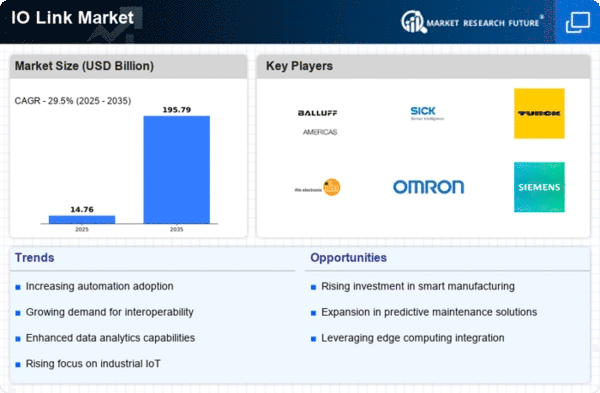
As per MRFR analysis, the IO Link Market Size was estimated at 11.4 USD Billion in 2024. The IO Link industry is projected to grow from 14.76 USD Billion in 2025 to 195.79 USD Billion by 2035, exhibiting a compound annual growth rate (CAGR) of 29.5 during the forecast period 2025 - 2035.

Key Market Trends & Highlights

The IO Link Market is experiencing robust growth driven by technological advancements and increasing automation demands.

  • The market witnesses increased adoption of smart manufacturing practices, particularly in North America. Data-driven decision making is becoming a focal point for organizations, enhancing operational efficiency. Interoperability and standardization efforts are gaining traction, especially in the factory automation segment. Rising demand for automation solutions and enhanced data analytics capabilities are key drivers propelling growth in both the manufacturing and automotive sectors.

Market Size & Forecast

2024 Market Size 11.4 (USD Billion)
2035 Market Size 195.79 (USD Billion)
CAGR (2025 - 2035) 29.5%
Largest Regional Market Share in 2024 Europe

Major Players

Balluff (DE), Sick (DE), Turck (DE), IFM Electronic (DE), Pepperl+Fuchs (DE), Omron (JP), Siemens (DE), Rockwell Automation (US), Schneider Electric (FR)

Market Trends

The IO Link Market is currently experiencing a transformative phase characterized by the integration of advanced technologies and the increasing demand for automation solutions. This market appears to be driven by the need for enhanced connectivity and interoperability among industrial devices. As industries strive for greater efficiency and productivity, the adoption of IO Link technology is likely to facilitate seamless communication between sensors, actuators, and control systems. Furthermore, the emphasis on Industry Four Point Zero initiatives suggests a growing inclination towards smart manufacturing practices, which may further propel the market's expansion. In addition, the rising focus on data analytics and real-time monitoring is shaping the landscape of the IO Link Market. Companies are increasingly recognizing the value of harnessing data generated from connected devices to optimize operations and improve decision-making processes. This trend indicates a shift towards more intelligent systems that can adapt to changing conditions and enhance overall performance. As the market evolves, it seems poised to attract investments and innovations that will redefine the future of industrial automation and connectivity.

Increased Adoption of Smart Manufacturing

The IO Link Market is witnessing a surge in the adoption of smart manufacturing practices. This trend is driven by the need for enhanced efficiency and productivity in industrial operations. Companies are increasingly integrating IO Link technology to facilitate seamless communication between devices, thereby optimizing processes and reducing downtime.

Focus on Data-Driven Decision Making

There is a growing emphasis on data analytics within the IO Link Market. Organizations are leveraging data generated from connected devices to make informed decisions. This trend highlights the importance of real-time monitoring and analysis, enabling companies to enhance operational performance and respond swiftly to market demands.

Interoperability and Standardization Efforts

The IO Link Market is experiencing a push towards interoperability and standardization among industrial devices. This trend aims to create a cohesive ecosystem where various devices can communicate effectively. Such efforts are likely to simplify integration processes and enhance the overall functionality of automation systems.

IO Link Market Market Drivers

Market Segment Insights

By Application: Factory Automation (Largest) vs. Logistics Automation (Fastest-Growing)

The IO Link market is significantly influenced by its application segments, with Factory Automation leading the way in market share. This sector has thrived due to a robust focus on enhancing production efficiency and the integration of smart technologies. Logistics Automation is gaining momentum as companies seek more automated solutions for inventory management and distribution processes, resulting in substantial investments in this area. The growth trajectory for the IO Link market is largely driven by advancements in IoT and <a href="https://www.marketresearchfuture.com/reports/industry-4-0-market-2375">Industry 4.0, </a>prompting increased adoption across various applications. Factory Automation continues to benefit from the need for streamlined operations, while Logistics Automation emerges as a key player, propelled by e-commerce growth and the demand for cost-effective supply chain solutions.

Factory Automation (Dominant) vs. Process Automation (Emerging)

Factory Automation stands as a dominant force in the IO Link market, characterized by its extensive utilization of <a href="https://www.marketresearchfuture.com/reports/smart-sensors-market-2768">smart sensors</a> and actuators to boost manufacturing efficiencies. Companies within this segment focus on automating their production lines to achieve higher throughput and reduced downtime. In contrast, Process Automation is an emerging segment, driven by the need for precision and reliability in sectors like chemicals and pharmaceuticals. While Factory Automation exemplifies robustness and stability, Process Automation presents opportunities for growth as organizations increasingly seek integrated solutions to enhance operational control and optimize processes.

By End Use: Manufacturing (Largest) vs. Automotive (Fastest-Growing)

The IO Link market demonstrates significant diversity in its end-use applications, with manufacturing holding the largest market share. This segment benefits from the increasing demand for automation and the integration of advanced technologies in production lines. In contrast, the automotive sector is experiencing rapid growth as manufacturers seek to enhance operational efficiency and connectivity within vehicles. Such trends propel the adoption of IO Link solutions across various automotive processes and systems. Growth trends within the IO Link market for the end-use sector are compelling. The manufacturing industry continues to leverage IO Link technology for process optimization and real-time data analytics, driving its dominance. Meanwhile, the automotive segment is cultivating a fast-growing landscape, attributed to the rise of electric vehicles and smart technology. These factors create competitive advantages and propel further investment into IO Link adoption.

Manufacturing (Dominant) vs. Automotive (Emerging)

The manufacturing sector stands as the dominant force within the IO Link market, characterized by its extensive application of automation technologies and IoT solutions. Manufacturers increasingly implement IO Link to enhance communication among systems and optimize production processes. This segment benefits from substantial investments in smart factories and Industry 4.0 strategies. Conversely, the automotive industry is emerging as a vital component of the IO Link landscape, with a focus on connectivity and real-time data. This industry's shift towards smart vehicles and intelligent transportation systems is fueling demand for IO Link solutions, promoting growth in areas such as diagnostic tools and enhanced safety features. Both segments exhibit unique characteristics that underpin their respective positions in the market.

By Component Type: Sensors (Largest) vs. Actuators (Fastest-Growing)

In the IO Link market, Sensors hold the largest market share among component types, reflecting their critical role in automation and data acquisition processes. Their ability to provide precise, real-time data makes them indispensable in various applications, from manufacturing to logistics. Meanwhile, Actuators are identified as the fastest-growing segment, driven by the increasing demand for automation and control solutions in diverse industries. Their capability to convert control signals into physical action has led to a rapid adoption, further enhancing their market presence.

Sensors (Dominant) vs. Actuators (Emerging)

Sensors have established themselves as a dominant force in the IO Link market due to their reliability and versatility in different applications. They ensure precise monitoring and control within automation systems, making them a preferred choice for industries aiming to enhance efficiency and performance. In contrast, Actuators are emerging with increasing innovation and technological advancements. As industries focus on automation, the demand for various Actuator types, including electric, pneumatic, and hydraulic, is on the rise. Their integration in smart manufacturing solutions positions them as key players in the industry, set to grow substantially in the coming years.

By Technology: Wired Technology (Largest) vs. Wireless Technology (Fastest-Growing)

The 'Technology' segment within the IO Link Market is characterized by its classification into Wired, Wireless, and Hybrid technologies. Wired technology dominates the segment, accounting for the largest share in the market. This technology is often preferred due to its reliability, lower latency, and established infrastructure in industrial settings. Meanwhile, wireless technology is gaining rapid traction, appealing to industries seeking flexibility and reduced installation costs. As industries continue to evolve towards automation, the shift from traditional wired systems to more versatile wireless solutions underlines the dynamic nature of technology in this segment.

Technology: Wired (Dominant) vs. Wireless (Emerging)

Wired technology remains the dominant player in the IO Link Market, known for its robust performance and reliability. Industries utilizing wired solutions often benefit from minimal interference and seamless integration with existing systems. The stability of wired connections makes it an ideal choice for critical applications. On the other hand, wireless technology is emerging rapidly, driven by innovations that enhance connectivity and interoperability. It offers significant advantages like reduced wiring costs and easier deployment in various environments. As manufacturers seek to harness the Internet of Things (IoT) and Industry 4.0 principles, wireless technology's ability to adapt to rapidly changing demands positions it as a compelling alternative to traditional wired systems.

By Industry: Industrial Manufacturing (Largest) vs. Oil and Gas (Fastest-Growing)

In the IO Link Market, the industrial manufacturing sector holds the largest market share due to its extensive adoption of automation and digital transformation initiatives. This sector is pivotal as manufacturers seek to enhance efficiency, reduce downtime, and implement smart manufacturing practices. Meanwhile, the oil and gas sector has emerged as a rapidly evolving market, driven by the need for operational efficiency, safety enhancements, and sustainability initiatives, thereby capturing a growing share of the overall market.

Industrial Manufacturing (Dominant) vs. Oil and Gas (Emerging)

The industrial manufacturing segment remains dominant in the IO Link Market, characterized by its adoption of advanced automation technologies and robust supply chain management. Firms in this sector leverage IO Link technology to interconnect various components, facilitating real-time data exchange and improving overall process efficiency. In contrast, the oil and gas sector is an emerging contender, propelled by the increasing focus on minimizing operational risks, enhancing safety protocols, and embracing smart technology solutions for better asset management. Despite being smaller in market share, the oil and gas sector's growth potential relies heavily on the transition to smarter operational frameworks.

Get more detailed insights about IO Link Market Research Report – Forecast Till 2035

Regional Insights

North America : Technological Innovation Leader

The North American IO Link market is projected to reach $3.42 billion by December 2025, driven by rapid technological advancements and increasing automation across industries. The demand for smart manufacturing solutions and Industry 4.0 initiatives are key growth drivers. Regulatory support for automation technologies further enhances market potential, as companies seek to improve efficiency and reduce operational costs. Leading the market are the United States and Canada, where major players like Rockwell Automation and Siemens are actively investing in innovative solutions. The competitive landscape is characterized by a mix of established firms and emerging startups, all vying for market share. The presence of key players ensures a robust supply chain and fosters collaboration, enhancing the overall market dynamics.

Europe : Market Share Dominance

Europe holds the largest share of the IO Link market, valued at €5.7 billion in 2024. The region benefits from strong industrial infrastructure and a high adoption rate of automation technologies. Regulatory frameworks promoting digital transformation and sustainability are significant catalysts for growth. The increasing demand for interconnected devices in manufacturing processes is driving the expansion of the IO Link ecosystem. Germany, France, and the UK are the leading countries in this market, with key players like Siemens, Sick, and Pepperl+Fuchs dominating the landscape. The competitive environment is robust, with a focus on innovation and collaboration among industry leaders. The presence of advanced manufacturing facilities and research institutions further strengthens Europe's position as a hub for IO Link technology.

Asia-Pacific : Emerging Market Potential

The Asia-Pacific IO Link market is expected to reach $2.88 billion by December 2025, fueled by rapid industrialization and increasing investments in automation technologies. Countries like China and Japan are leading the charge, with significant government initiatives aimed at enhancing manufacturing capabilities. The growing emphasis on smart factories and IoT integration is driving demand for IO Link solutions across various sectors. China, Japan, and South Korea are the primary markets in this region, with key players such as Omron and Turck making substantial contributions. The competitive landscape is evolving, with both local and international companies striving to capture market share. The region's focus on technological advancements and infrastructure development positions it as a promising area for future growth in the IO Link market.

Middle East and Africa : Untapped Market Opportunities

The Middle East and Africa (MEA) IO Link market is valued at $0.4 billion, representing significant untapped potential. The region is witnessing a gradual shift towards automation, driven by increasing investments in industrial infrastructure and technology. Governments are promoting initiatives to enhance manufacturing capabilities, which is expected to boost demand for IO Link solutions in the coming years. Countries like South Africa and the UAE are at the forefront of this transformation, with key players beginning to establish a presence. The competitive landscape is still developing, with opportunities for both local and international firms to enter the market. As awareness of automation benefits grows, the MEA region is poised for substantial growth in the IO Link sector.

Key Players and Competitive Insights

The IO Link Market is currently characterized by a dynamic competitive landscape, driven by technological advancements and increasing demand for automation solutions across various industries. Key players such as Balluff (DE), Sick (DE), and Turck (DE) are strategically positioned to leverage their expertise in sensor technology and connectivity solutions. These companies focus on innovation and digital transformation, which are essential for maintaining competitive advantage. Their operational strategies, including partnerships and regional expansions, contribute to shaping a robust competitive environment, where collaboration and technological integration are paramount.
In terms of business tactics, companies are increasingly localizing manufacturing and optimizing supply chains to enhance efficiency and responsiveness to market demands. The competitive structure of the IO Link Market appears moderately fragmented, with several key players exerting influence. This fragmentation allows for a diverse range of solutions and innovations, fostering a competitive atmosphere that encourages continuous improvement and adaptation.
In November 2025, Sick (DE) announced the launch of a new line of IO Link-enabled sensors designed to enhance data acquisition and processing capabilities. This strategic move is significant as it aligns with the growing trend towards smart manufacturing, where real-time data is crucial for operational efficiency. By expanding its product portfolio, Sick (DE) positions itself to capture a larger market share and meet the evolving needs of its customers.
In October 2025, Turck (DE) entered into a strategic partnership with a leading software provider to integrate AI capabilities into its IO Link solutions. This collaboration is indicative of the increasing importance of AI in industrial automation, suggesting that Turck (DE) is keen on enhancing its technological offerings. The integration of AI could potentially lead to improved predictive maintenance and operational insights, thereby providing a competitive edge in the market.
In September 2025, Balluff (DE) expanded its global footprint by establishing a new manufacturing facility in Asia. This expansion is likely to enhance its production capabilities and reduce lead times for customers in the region. By localizing production, Balluff (DE) not only optimizes its supply chain but also strengthens its position in a rapidly growing market, reflecting a strategic focus on regional demand.
As of December 2025, the IO Link Market is witnessing trends such as digitalization, sustainability, and the integration of AI technologies. These trends are reshaping competitive dynamics, with strategic alliances becoming increasingly vital for innovation and market penetration. The shift from price-based competition to a focus on technological advancement and supply chain reliability is evident. Companies that prioritize innovation and adaptability are likely to thrive in this evolving landscape, suggesting a future where competitive differentiation hinges on the ability to deliver cutting-edge solutions.

Key Companies in the IO Link Market include

Industry Developments

  • Q2 2024: Siemens expands IO-Link portfolio with new IO-Link Master modules for SIMATIC ET 200 Siemens announced the launch of new IO-Link Master modules for its SIMATIC ET 200 series, enabling enhanced connectivity and diagnostics for industrial automation applications.
  • Q2 2024: Rockwell Automation introduces new Allen-Bradley IO-Link Master modules Rockwell Automation launched new Allen-Bradley IO-Link Master modules, designed to improve data integration and device-level diagnostics in smart manufacturing environments.
  • Q2 2024: Balluff opens new production facility for IO-Link devices in Hungary Balluff inaugurated a new manufacturing facility in Hungary dedicated to the production of IO-Link sensors and devices, aiming to meet growing demand in Europe.
  • Q3 2024: Pepperl+Fuchs launches new IO-Link inductive sensors for harsh environments Pepperl+Fuchs introduced a new line of IO-Link-enabled inductive sensors designed for use in harsh industrial environments, expanding their automation solutions portfolio.
  • Q3 2024: Turck and Banner Engineering announce strategic partnership to develop next-generation IO-Link solutions Turck and Banner Engineering entered a strategic partnership to co-develop advanced IO-Link solutions for industrial automation, focusing on interoperability and ease of integration.
  • Q3 2024: SICK AG unveils new IO-Link-enabled photoelectric sensors for logistics automation SICK AG launched a new series of IO-Link-enabled photoelectric sensors aimed at improving efficiency and data transparency in logistics and material handling applications.
  • Q4 2024: ifm electronic introduces compact IO-Link master modules for decentralized automation ifm electronic released compact IO-Link master modules designed for decentralized automation architectures, supporting flexible installation and simplified wiring.
  • Q4 2024: Omron launches IO-Link-enabled proximity sensors for predictive maintenance Omron introduced a new range of IO-Link-enabled proximity sensors with advanced diagnostic capabilities to support predictive maintenance strategies in manufacturing.
  • Q1 2025: Schneider Electric debuts Modicon IO-Link master modules for industrial edge applications Schneider Electric announced the launch of Modicon IO-Link master modules, targeting industrial edge computing and real-time data acquisition in smart factories.
  • Q1 2025: Leuze electronic expands IO-Link sensor portfolio with new optical sensors Leuze electronic expanded its IO-Link sensor lineup by introducing new optical sensors designed for high-speed and high-precision industrial automation tasks.
  • Q2 2025: Beckhoff Automation launches EtherCAT IO-Link master terminals for modular machine design Beckhoff Automation released new EtherCAT IO-Link master terminals, enabling modular and scalable machine design for advanced automation systems.
  • Q2 2025: Festo introduces IO-Link-enabled pneumatic valve terminals for smart manufacturing Festo launched a new series of IO-Link-enabled pneumatic valve terminals, enhancing connectivity and diagnostics for smart manufacturing environments.

IO Link Market Segmentation

IO Link Market by Type Outlook

  • IO-Link Wired
  • IO-Link Wireless

IO Link Market by Component Outlook

  • IO-Link Masters
    • PROFINET
    • EtherNeVIP
    • Modbus-TCP
    • EtherCAT
    • Multiprotocol
    • Others
  • IO-Link Devices
    • Sensor Nodes
      • Position Sensors
      • Temperature Sensors
      • Pressure Sensors
      • Vibration Sensors
      • Others
  • Actuators
  • RFID Read Heads and Others

IO Link Market by Industry Outlook

  • Process Industries
    • Oil & Gas
    • Chemicals
    • Energy & Power
  • Discrete Industries
    • Automotive
    • Aerospace & Defense
    • Semiconductors & Electronics
    • Machine Manufacturing
    • Packaging
  • Hybrid Industries
    • Pharmaceuticals
    • Metals & Mining
    • Food & Beverages
    • Cement and Glass

IO Link Market by Application Outlook

  • Machine Tools
  • Handling and Assembly Automation Systems
  • Intralogistics Solutions
  • Packaging Automation Solutions

IO Link Market Regional Outlook

  • North America
    • US
    • Canada
    • Mexico
  • Europe
    • Germany
    • UK
    • France
    • Russia
    • Italy
    • Spain
    • Rest of Europe
  • Asia-Pacific
    • China
    • India
    • Japan
    • South Korea
    • Malaysia
    • Thailand
    • Indonesia
    • Rest of Asia-Pacific
  • South America
    • Brazil
    • Argentina
    • Rest of South America
  • Middle East & Africa
    • GCC Countries
    • South Africa
    • Rest of Middle East & Africa

Future Outlook

IO Link Market Future Outlook

The IO Link Market is projected to grow at a 29.5% CAGR from 2025 to 2035, driven by automation advancements, increased connectivity, and demand for real-time data analytics.

New opportunities lie in:

  • Development of integrated sensor solutions for smart factories.
  • Expansion into emerging markets with tailored IO Link products.
  • Creation of subscription-based data analytics services for manufacturers.

By 2035, the IO Link Market is expected to be a pivotal component of industrial automation.

Market Segmentation

IO Link Market End Use Outlook

  • Manufacturing
  • Automotive
  • Food and Beverage
  • Pharmaceutical

IO Link Market Industry Outlook

  • Industrial Manufacturing
  • Oil and Gas
  • Water and Wastewater
  • Mining

IO Link Market Technology Outlook

  • Wired Technology
  • Wireless Technology
  • Hybrid Technology

IO Link Market Application Outlook

  • Factory Automation
  • Process Automation
  • Logistics Automation
  • Machine Tool Automation

IO Link Market Component Type Outlook

  • Sensors
  • Actuators
  • Cables
  • Connectors

Report Scope

MARKET SIZE 2024 11.4(USD Billion)
MARKET SIZE 2025 14.76(USD Billion)
MARKET SIZE 2035 195.79(USD Billion)
COMPOUND ANNUAL GROWTH RATE (CAGR) 29.5% (2025 - 2035)
REPORT COVERAGE Revenue Forecast, Competitive Landscape, Growth Factors, and Trends
BASE YEAR 2024
Market Forecast Period 2025 - 2035
Historical Data 2019 - 2024
Market Forecast Units USD Billion
Key Companies Profiled Balluff (DE), Sick (DE), Turck (DE), IFM Electronic (DE), Pepperl+Fuchs (DE), Omron (JP), Siemens (DE), Rockwell Automation (US), Schneider Electric (FR)
Segments Covered Application, End Use, Component Type, Technology, Industry
Key Market Opportunities Integration of advanced sensors and automation technologies enhances efficiency in the IO Link Market.
Key Market Dynamics Rising demand for smart manufacturing drives adoption of IO Link technology across various industrial sectors.
Countries Covered North America, Europe, APAC, South America, MEA

FAQs

How much is IO Link Market?

USD 17.81 Billion is the IO Link Market in 2024

Which Type holds the largest market share?

The IO-Link Wired segment by Type holds the largest market share and grows at a CAGR of 18.7 % during the forecast period.

Which region holds the largest market share in the IO Link Market?

Asia-Pacific holds the largest market share in the IO Link Market.

Who are the prominent players in the IO Link Market?

Turck India Automation Pvt Ltd, IFM electronic, OMRON, Siemens, Festo, Sensata Technologies, Endress+Hauser, Banner Corporation, Rockwell Automation, Pepperl+Fuchs, SMC Corporation, Belden Inc, STMicroelectronics, Analog Devices, Inc, SICK AG are prominent players in the IO Link Market.

Which Component segment led the IO Link Market?

The IO-Link Masters segment dominated the market in 2024.

  1. SECTION I: EXECUTIVE SUMMARY AND KEY HIGHLIGHTS
    1. | 1.1 EXECUTIVE SUMMARY
    2. | 1.1.1 Market Overview
    3. | 1.1.2 Key Findings
    4. | 1.1.3 Market Segmentation
    5. | 1.1.4 Competitive Landscape
    6. | 1.1.5 Challenges and Opportunities
    7. | 1.1.6 Future Outlook
  2. SECTION II: SCOPING, METHODOLOGY AND MARKET STRUCTURE
    1. | 2.1 MARKET INTRODUCTION
    2. | 2.1.1 Definition
    3. | 2.1.2 Scope of the study
    4. |-- 2.1.2.1 Research Objective
    5. |-- 2.1.2.2 Assumption
    6. |-- 2.1.2.3 Limitations
    7. | 2.2 RESEARCH METHODOLOGY
    8. | 2.2.1 Overview
    9. | 2.2.2 Data Mining
    10. | 2.2.3 Secondary Research
    11. | 2.2.4 Primary Research
    12. |-- 2.2.4.1 Primary Interviews and Information Gathering Process
    13. |-- 2.2.4.2 Breakdown of Primary Respondents
    14. | 2.2.5 Forecasting Model
    15. | 2.2.6 Market Size Estimation
    16. |-- 2.2.6.1 Bottom-Up Approach
    17. |-- 2.2.6.2 Top-Down Approach
    18. | 2.2.7 Data Triangulation
    19. | 2.2.8 Validation
  3. SECTION III: QUALITATIVE ANALYSIS
    1. | 3.1 MARKET DYNAMICS
    2. | 3.1.1 Overview
    3. | 3.1.2 Drivers
    4. | 3.1.3 Restraints
    5. | 3.1.4 Opportunities
    6. | 3.2 MARKET FACTOR ANALYSIS
    7. | 3.2.1 Value chain Analysis
    8. | 3.2.2 Porter's Five Forces Analysis
    9. |-- 3.2.2.1 Bargaining Power of Suppliers
    10. |-- 3.2.2.2 Bargaining Power of Buyers
    11. |-- 3.2.2.3 Threat of New Entrants
    12. |-- 3.2.2.4 Threat of Substitutes
    13. |-- 3.2.2.5 Intensity of Rivalry
    14. | 3.2.3 COVID-19 Impact Analysis
    15. |-- 3.2.3.1 Market Impact Analysis
    16. |-- 3.2.3.2 Regional Impact
    17. |-- 3.2.3.3 Opportunity and Threat Analysis
  4. SECTION IV: QUANTITATIVE ANALYSIS
    1. | 4.1 Semiconductor & Electronics, BY Application (USD Billion)
    2. | 4.1.1 Factory Automation
    3. | 4.1.2 Process Automation
    4. | 4.1.3 Logistics Automation
    5. | 4.1.4 Machine Tool Automation
    6. | 4.2 Semiconductor & Electronics, BY End Use (USD Billion)
    7. | 4.2.1 Manufacturing
    8. | 4.2.2 Automotive
    9. | 4.2.3 Food and Beverage
    10. | 4.2.4 Pharmaceutical
    11. | 4.3 Semiconductor & Electronics, BY Component Type (USD Billion)
    12. | 4.3.1 Sensors
    13. | 4.3.2 Actuators
    14. | 4.3.3 Cables
    15. | 4.3.4 Connectors
    16. | 4.4 Semiconductor & Electronics, BY Technology (USD Billion)
    17. | 4.4.1 Wired Technology
    18. | 4.4.2 Wireless Technology
    19. | 4.4.3 Hybrid Technology
    20. | 4.5 Semiconductor & Electronics, BY Industry (USD Billion)
    21. | 4.5.1 Industrial Manufacturing
    22. | 4.5.2 Oil and Gas
    23. | 4.5.3 Water and Wastewater
    24. | 4.5.4 Mining
    25. | 4.6 Semiconductor & Electronics, BY Region (USD Billion)
    26. | 4.6.1 North America
    27. |-- 4.6.1.1 US
    28. |-- 4.6.1.2 Canada
    29. | 4.6.2 Europe
    30. |-- 4.6.2.1 Germany
    31. |-- 4.6.2.2 UK
    32. |-- 4.6.2.3 France
    33. |-- 4.6.2.4 Russia
    34. |-- 4.6.2.5 Italy
    35. |-- 4.6.2.6 Spain
    36. |-- 4.6.2.7 Rest of Europe
    37. | 4.6.3 APAC
    38. |-- 4.6.3.1 China
    39. |-- 4.6.3.2 India
    40. |-- 4.6.3.3 Japan
    41. |-- 4.6.3.4 South Korea
    42. |-- 4.6.3.5 Malaysia
    43. |-- 4.6.3.6 Thailand
    44. |-- 4.6.3.7 Indonesia
    45. |-- 4.6.3.8 Rest of APAC
    46. | 4.6.4 South America
    47. |-- 4.6.4.1 Brazil
    48. |-- 4.6.4.2 Mexico
    49. |-- 4.6.4.3 Argentina
    50. |-- 4.6.4.4 Rest of South America
    51. | 4.6.5 MEA
    52. |-- 4.6.5.1 GCC Countries
    53. |-- 4.6.5.2 South Africa
    54. |-- 4.6.5.3 Rest of MEA
  5. SECTION V: COMPETITIVE ANALYSIS
    1. | 5.1 Competitive Landscape
    2. | 5.1.1 Overview
    3. | 5.1.2 Competitive Analysis
    4. | 5.1.3 Market share Analysis
    5. | 5.1.4 Major Growth Strategy in the Semiconductor & Electronics
    6. | 5.1.5 Competitive Benchmarking
    7. | 5.1.6 Leading Players in Terms of Number of Developments in the Semiconductor & Electronics
    8. | 5.1.7 Key developments and growth strategies
    9. |-- 5.1.7.1 New Product Launch/Service Deployment
    10. |-- 5.1.7.2 Merger & Acquisitions
    11. |-- 5.1.7.3 Joint Ventures
    12. | 5.1.8 Major Players Financial Matrix
    13. |-- 5.1.8.1 Sales and Operating Income
    14. |-- 5.1.8.2 Major Players R&D Expenditure. 2023
    15. | 5.2 Company Profiles
    16. | 5.2.1 Balluff (DE)
    17. |-- 5.2.1.1 Financial Overview
    18. |-- 5.2.1.2 Products Offered
    19. |-- 5.2.1.3 Key Developments
    20. |-- 5.2.1.4 SWOT Analysis
    21. |-- 5.2.1.5 Key Strategies
    22. | 5.2.2 Sick (DE)
    23. |-- 5.2.2.1 Financial Overview
    24. |-- 5.2.2.2 Products Offered
    25. |-- 5.2.2.3 Key Developments
    26. |-- 5.2.2.4 SWOT Analysis
    27. |-- 5.2.2.5 Key Strategies
    28. | 5.2.3 Turck (DE)
    29. |-- 5.2.3.1 Financial Overview
    30. |-- 5.2.3.2 Products Offered
    31. |-- 5.2.3.3 Key Developments
    32. |-- 5.2.3.4 SWOT Analysis
    33. |-- 5.2.3.5 Key Strategies
    34. | 5.2.4 IFM Electronic (DE)
    35. |-- 5.2.4.1 Financial Overview
    36. |-- 5.2.4.2 Products Offered
    37. |-- 5.2.4.3 Key Developments
    38. |-- 5.2.4.4 SWOT Analysis
    39. |-- 5.2.4.5 Key Strategies
    40. | 5.2.5 Pepperl+Fuchs (DE)
    41. |-- 5.2.5.1 Financial Overview
    42. |-- 5.2.5.2 Products Offered
    43. |-- 5.2.5.3 Key Developments
    44. |-- 5.2.5.4 SWOT Analysis
    45. |-- 5.2.5.5 Key Strategies
    46. | 5.2.6 Omron (JP)
    47. |-- 5.2.6.1 Financial Overview
    48. |-- 5.2.6.2 Products Offered
    49. |-- 5.2.6.3 Key Developments
    50. |-- 5.2.6.4 SWOT Analysis
    51. |-- 5.2.6.5 Key Strategies
    52. | 5.2.7 Siemens (DE)
    53. |-- 5.2.7.1 Financial Overview
    54. |-- 5.2.7.2 Products Offered
    55. |-- 5.2.7.3 Key Developments
    56. |-- 5.2.7.4 SWOT Analysis
    57. |-- 5.2.7.5 Key Strategies
    58. | 5.2.8 Rockwell Automation (US)
    59. |-- 5.2.8.1 Financial Overview
    60. |-- 5.2.8.2 Products Offered
    61. |-- 5.2.8.3 Key Developments
    62. |-- 5.2.8.4 SWOT Analysis
    63. |-- 5.2.8.5 Key Strategies
    64. | 5.2.9 Schneider Electric (FR)
    65. |-- 5.2.9.1 Financial Overview
    66. |-- 5.2.9.2 Products Offered
    67. |-- 5.2.9.3 Key Developments
    68. |-- 5.2.9.4 SWOT Analysis
    69. |-- 5.2.9.5 Key Strategies
    70. | 5.3 Appendix
    71. | 5.3.1 References
    72. | 5.3.2 Related Reports

Semiconductor & Electronics Market Segmentation

Semiconductor & Electronics By Application (USD Billion, 2025-2035)

  • Factory Automation
  • Process Automation
  • Logistics Automation
  • Machine Tool Automation

Semiconductor & Electronics By End Use (USD Billion, 2025-2035)

  • Manufacturing
  • Automotive
  • Food and Beverage
  • Pharmaceutical

Semiconductor & Electronics By Component Type (USD Billion, 2025-2035)

  • Sensors
  • Actuators
  • Cables
  • Connectors

Semiconductor & Electronics By Technology (USD Billion, 2025-2035)

  • Wired Technology
  • Wireless Technology
  • Hybrid Technology

Semiconductor & Electronics By Industry (USD Billion, 2025-2035)

  • Industrial Manufacturing
  • Oil and Gas
  • Water and Wastewater
  • Mining
Infographic

Free Sample Request

Kindly complete the form below to receive a free sample of this Report

Get Free Sample

Customer Strories

Compare Licence

×
Features License Type
Single User Multiuser License Enterprise User
Price $4,950 $5,950 $7,250
Maximum User Access Limit 1 User Upto 10 Users Unrestricted Access Throughout the Organization
Free Customization
Direct Access to Analyst
Deliverable Format
Platform Access
Discount on Next Purchase 10% 15% 15%
Printable Versions