Request Free Sample ×

Kindly complete the form below to receive a free sample of this Report

* Please use a valid business email

Leading companies partner with us for data-driven Insights

clients tt-cursor
Hero Background
English
Chinese
French
Japanese
Korean
German
Spanish

Intraoral cameras Market Trends

ID: MRFR/MED/0712-HCR
80 Pages
Satyendra Maurya
March 2026

Intraoral cameras Market Research Report Information By Type (USB Camera, Fiber Optic Camera, And Wireless Camera), By Software Types (X-Ray Software, And Button Capture Software), By End Users (Hospitals and Dental Clinics), And By Region (North America, Europe, Asia-Pacific, And Rest Of The World) - Growth & Industry Forecast 2025 To 2035

Share:
Download PDF ×

We do not share your information with anyone. However, we may send you emails based on your report interest from time to time. You may contact us at any time to opt-out.

Intraoral cameras Market Infographic
Purchase Options

Market Trends

Introduction

The Intraoral Cameras Market will be going through a transformation by 2024. Technological advancements, particularly in terms of the quality of the image and the integration of the digital workflow, are changing the way dental professionals diagnose and treat patients. Also, regulatory pressures are affecting the market as compliance with stringent health and safety standards becomes a priority. In addition, changes in patient behavior, where patients are demanding more transparency and involvement in their dental care, are driving dental practices to adopt more advanced diagnostic tools. These trends are strategic for stakeholders as they not only improve patient outcomes but also enhance operational efficiencies and position themselves strategically in a rapidly changing landscape.

Top Trends

  1. Integration with AI Technology
    AI is increasing the diagnostic accuracy of intraoral cameras. There is a development of image analysis software for the early detection of dental disorders. In a study, the diagnostic accuracy of the image analysis increased by 30 percent. Industry leaders are investing in AI, resulting in improved patient outcomes and efficiencies. Future developments may include real-time analysis of procedures, further streamlining workflows.
  2. Tele-dentistry Adoption
    Teledentistry has given rise to the demand for a televising camera that can be inserted into the mouth to enable a remote consultation. A recent survey revealed that seventy per cent of dental practices are now equipped with teledentistry equipment that allows them to examine their patients virtually. This trend is reshaping both the business and the patient relationship models, and it is also reducing the cost of overheads. The future ramifications of this trend are likely to include the possibility of remote patient monitoring and follow-up care.
  3. Enhanced Imaging Quality
    Advances in imaging technology have resulted in a greater resolution and clarity in intraoral cameras. There are now companies that produce cameras with a 4K resolution that can increase diagnostic accuracy by up to 25%. This trend is essential for dentists wishing to provide a superior level of care. Future developments could include miniaturization and portability, which would make high-quality imaging available in more settings.
  4. Wireless Connectivity Features
    The trend towards wireless intraoral cameras is gaining momentum, with 60% of new models featuring either Bluetooth or Wi-Fi technology. This trend makes it possible to improve work efficiency, enabling easy integration with practice management software. As dental practices are increasingly focused on mobility and ease of use, the demand for wireless solutions is set to grow. Eventually, the cloud may even be used to store and share patient data.
  5. Focus on Ergonomics and Design
    The manufacturers are increasingly concerned with the comfort and ease of use of their intraoral cameras. A study showed that a reduction of up to 40 per cent in the fatigue of the operator by means of an appropriate instrument was accompanied by an increase in overall productivity. This trend is reflected in the development of products and is aimed at achieving a better user experience. Future devices may have features that can be adapted to the individual requirements of the operator.
  6. Increased Regulatory Compliance
    The regulatory authorities have tightened the standards for dental imaging devices, which has forced the manufacturers to improve their compliance measures. The recent guidelines have put the emphasis on safety and performance, and this has resulted in an increase in compliance costs of about twenty per cent. The trend has changed the product development cycle and the commercial strategy. There may be further increases in the costs of testing and certification of new products.
  7. Sustainability Initiatives
    The market for intraoral cameras is also increasingly concerned with the environment. Companies are increasingly using materials and processes that are more sustainable. A survey found that 50% of consumers prefer to buy from companies that are committed to protecting the environment. This trend is having a major influence on the strategies of companies, which are trying to be in line with what consumers want. In the future, we may see innovations in recyclability and energy-efficient production processes.
  8. Integration with Practice Management Software
    Intraoral cameras in combination with dental practice management software are making the working process in dental practices easier and more efficient. Some 65 percent of practices report an increase in efficiency, and almost all of them cite improved patient records management as a result of this combination. This trend is creating a growing demand for multifunction devices that offer increased efficiency. In the future, further developments may well focus on interoperability with different software platforms to increase usability.
  9. Training and Education Programs
    Training programmes for dental professionals on the effective use of intraoral cameras are being developed. According to a survey of industry members, 75% of dental professionals feel more confident after attending such courses. This trend is helping to create a culture of lifelong learning and improving the quality of care for patients. Further initiatives will include the introduction of online training and certification to increase access.
  10. Customization and Personalization Options
    Customization of intraoral cameras is increasingly gaining popularity, enabling practices to optimize their devices for their individual needs. According to a study, 40 percent of dental practices are looking for features that are tailored to their specific work processes. This trend has influenced product offerings, with manufacturers now addressing the varied requirements of individual practices. Future developments may include a modular design that makes it easy to modify or expand the device.

Conclusion: Navigating the Intraoral Camera Landscape

In the market for intraoral cameras, the competition is strong and the fragmentation is considerable. The trend is to increase demand in North America and Europe, driven by technological progress in the dental field and increasing patient awareness. The vendors must strategically position themselves by using the potential of artificial intelligence to enhance the quality of images, automation to optimize processes and sustainability to meet the growing expectations of consumers. In addition, the product range must be flexible so that the dental practice can adapt to the changing needs of the patient. The companies that focus on these three abilities are likely to be the ones that shape the future of intraoral photography.


Author
Author Profile
Satyendra Maurya
Research Analyst

An accomplished research analyst with high proficiency in market forecasting, data visualization, competitive benchmarking, and others. He holds a pronounced track record in research and consulting projects for sectors such as life sciences, medical devices, and healthcare IT. His capabilities in qualitative and quantitative analysis have resulted in positive client outcomes. Working on niche market trends, opportunities, sales, and forecasted value is part of his skill set.

Leave a Comment

FAQs

What is the current market valuation of the intraoral camera market?

<p>The intraoral camera market was valued at 1.8 USD Billion in 2024.</p>

What is the projected market size for the intraoral camera market by 2035?

<p>The market is projected to reach 4.5 USD Billion by 2035.</p>

What is the expected CAGR for the intraoral camera market during the forecast period?

<p>The expected CAGR for the intraoral camera market from 2025 to 2035 is 8.69%.</p>

Which companies are considered key players in the intraoral camera market?

<p>Key players include Planmeca, Carestream Dental, Dentsply Sirona, and 3Shape, among others.</p>

What are the main application segments of the intraoral camera market?

<p>The main application segments include Diagnostic, Therapeutic, Educational, and Research.</p>

How does the market perform in the diagnostic application segment?

<p>The diagnostic application segment was valued at 0.72 USD Billion in 2024 and is projected to reach 1.8 USD Billion by 2035.</p>

What is the valuation of the intraoral camera market in dental clinics?

<p>In 2024, the market valuation for dental clinics was 0.72 USD Billion, with a projection of 1.8 USD Billion by 2035.</p>

What technology types are included in the intraoral camera market?

<p>The technology types include Digital, Analog, Wireless, and Portable.</p>

What is the expected growth in the handheld product type segment?

<p>The handheld product type segment was valued at 0.72 USD Billion in 2024 and is expected to grow to 1.8 USD Billion by 2035.</p>

What image capture methods are utilized in the intraoral camera market?

<p>The image capture methods include Video Capture, Still Image Capture, and 3D Imaging.</p>

Market Summary

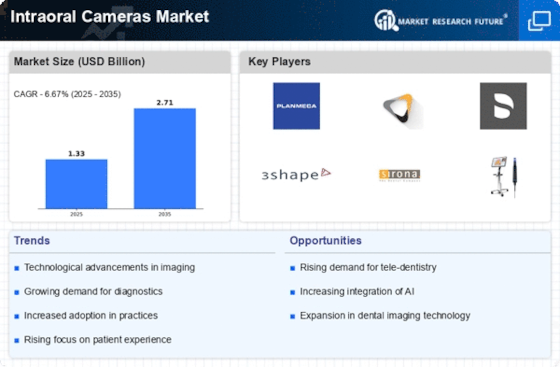
As per Market Research Future analysis, the Intraoral Cameras Market Size was estimated at 1.33 USD Billion in 2024. The Intraoral Cameras industry is projected to grow from USD 1.419 Billion in 2025 to USD 2.706 Billion by 2035, exhibiting a compound annual growth rate (CAGR) of 6.67% during the forecast period 2025 - 2035

Key Market Trends & Highlights

The Intraoral Cameras Market is experiencing robust growth driven by technological advancements and increasing patient engagement.

  • Technological advancements are enhancing image quality and functionality in intraoral cameras. North America remains the largest market, while Asia-Pacific is emerging as the fastest-growing region. USB cameras dominate the market, whereas wireless cameras are witnessing rapid growth. The rising demand for preventive dentistry and the expansion of dental practices are key drivers propelling market growth.

Market Size & Forecast

2024 Market Size 1.33 (USD Billion)
2035 Market Size 2.706 (USD Billion)
CAGR (2025 - 2035) 6.67%
Largest Regional Market Share in 2024 North America

Major Players

<a title="Planmeca" href="https://www.planmeca.com/cadcam-dentistry/intraoral-scanners/" target="_blank" rel="noopener">Planmeca</a> (FI), Carestream Dental (US), Dentsply Sirona (US), 3Shape (DK), <a title="Sirona Dental Systems" href="https://www.dentsplysirona.com/en-in/discover/discover-by-category/intraoral-scanners.html" target="_blank" rel="noopener">Sirona Dental Systems</a> (US), Intraoral Imaging (US), Kavo Kerr (US), Align Technology (US), Vatech (KR)

Market Trends

The Intraoral Cameras Market is currently experiencing a notable transformation, driven by advancements in dental technology and an increasing emphasis on patient engagement. These devices, which allow for high-resolution imaging of the oral cavity, are becoming integral to modern dental practices. The growing awareness of oral health and the demand for preventive care are propelling the adoption of intraoral cameras. Furthermore, the integration of these cameras with digital imaging systems enhances diagnostic accuracy and treatment planning, thereby improving patient outcomes. As dental professionals seek to provide more comprehensive care, the role of intraoral cameras is likely to expand, fostering a more interactive experience between practitioners and patients. In addition, the Intraoral Cameras Market is witnessing a shift towards more compact and user-friendly designs. Manufacturers are focusing on creating devices that are not only efficient but also easy to operate, which may lead to increased usage in various Dental Sleep Medicine. The trend towards tele-dentistry is also influencing the market, as remote consultations become more prevalent. This evolution suggests that intraoral cameras will continue to play a pivotal role in enhancing dental practices, making them more accessible and effective for both practitioners and patients.

Technological Advancements

The Intraoral Cameras Market is benefiting from rapid technological innovations. Enhanced imaging capabilities, such as improved resolution and real-time video streaming, are becoming standard features. These advancements facilitate better diagnosis and treatment planning, making intraoral cameras indispensable tools in modern dentistry.

Increased Patient Engagement

There is a growing trend towards patient involvement in dental care. Intraoral cameras Market allow patients to visualize their oral health conditions, fostering a better understanding of treatment options. This transparency is likely to enhance patient satisfaction and compliance with recommended procedures.

Shift Towards Compact Designs

Manufacturers are increasingly focusing on developing smaller, more ergonomic intraoral cameras. These designs not only improve usability but also enhance portability, making it easier for dental professionals to incorporate these devices into their practices.

Intraoral cameras Market Market Drivers

Growing Aesthetic Dentistry Sector

The aesthetic dentistry sector is expanding rapidly, contributing significantly to the Intraoral Cameras Market. As more individuals prioritize cosmetic enhancements, the demand for procedures such as teeth whitening, veneers, and orthodontics is on the rise. Intraoral cameras Market are essential in this context, as they provide clear visualizations that aid in treatment planning and patient education. Market data suggests that the aesthetic dentistry segment is expected to witness a growth rate of around 10% annually, further propelling the adoption of intraoral cameras. This trend underscores the importance of visual aids in communicating treatment options and outcomes to patients, thereby enhancing their overall experience.

Increased Focus on Patient Education

The Intraoral Cameras Market is significantly influenced by the growing emphasis on patient education. Dentists are increasingly utilizing intraoral cameras to visually demonstrate dental conditions to patients, fostering a better understanding of their oral health. This approach not only enhances patient engagement but also encourages informed decision-making regarding treatment options. Research indicates that patients who are actively involved in their treatment process are more likely to adhere to recommended care plans. As a result, the demand for intraoral cameras is likely to rise, as they serve as effective tools for enhancing communication and education within dental practices.

Technological Innovations in Imaging

Technological advancements play a pivotal role in shaping the Intraoral Cameras Market. Innovations such as high-definition imaging, enhanced lighting, and wireless connectivity are transforming the capabilities of intraoral cameras. These advancements enable dentists to capture detailed images of oral structures, facilitating better diagnosis and treatment planning. The market is projected to grow at a compound annual growth rate (CAGR) of approximately 8% over the next five years, driven by these technological improvements. Furthermore, the integration of artificial intelligence in imaging analysis is expected to enhance diagnostic precision, making intraoral cameras indispensable tools in modern dental practices.

Rising Demand for Preventive Dentistry

The Intraoral Cameras Market is experiencing a notable increase in demand for preventive dentistry. As awareness regarding oral health continues to grow, patients are seeking more proactive approaches to dental care. Intraoral cameras Market facilitate early detection of dental issues, allowing for timely intervention. This trend is supported by data indicating that preventive dental care can reduce overall treatment costs by up to 40%. Consequently, dental practitioners are increasingly adopting intraoral cameras to enhance diagnostic accuracy and improve patient outcomes. The integration of these devices into routine examinations not only fosters patient trust but also encourages regular visits, thereby driving the growth of the Intraoral Cameras Market.

Expansion of Dental Practices and Clinics

The expansion of dental practices and clinics is a driving force behind the growth of the Intraoral Cameras Market. As the number of dental facilities increases, so does the need for advanced diagnostic tools. Intraoral cameras Market are becoming standard equipment in new dental practices, as they enhance the quality of care provided. Market analysis reveals that the number of dental clinics is projected to grow by approximately 5% annually, leading to a higher adoption rate of intraoral cameras. This trend reflects a broader movement towards modernizing dental practices, ensuring that they are equipped with the latest technology to meet patient expectations and improve treatment outcomes.

Market Segment Insights

By Application: Diagnostic (Largest) vs. Therapeutic (Fastest-Growing)

<p>In the intraoral camera market, the 'Application' segment is primarily composed of Diagnostic, Therapeutic, Educational, and Research categories. Diagnostic applications hold the largest share as they are crucial for real-time visualization and assessment of oral conditions. This segment benefits from the increasing demand for accurate diagnostics in dental practices as these cameras enhance patient evaluations and contribute to more effective treatment planning. On the other hand, the Therapeutic applications are emerging rapidly, driven by advancements in technology and an increased focus on patient care. These applications are gaining traction as dental professionals adopt intraoral cameras to aid in various therapeutic procedures. The rise of minimally invasive dentistry is further propelling the growth of therapeutic applications within the market, highlighting a shift toward integrated patient treatment solutions.</p>

<p>Diagnostic (Dominant) vs. Therapeutic (Emerging)</p>

<p>The Diagnostic application segment of the intraoral camera market stands as the dominant force, playing a critical role in diagnosing dental issues through high-quality imaging. This segment's primary strength lies in its ability to deliver clear and accurate visual feedback, making it invaluable for patient consultations and treatment decisions. In contrast, the Therapeutic application is gaining attention as an emerging segment, leveraging advanced camera technology to enhance treatment precision and patient outcomes. As dentists increasingly adopt innovative treatments influenced by visualization technology, the Therapeutic segment demonstrates significant potential for expansion. Together, these segments are redefining dental practices by promoting more effective approaches to care.</p>

By End Use: Dental Clinics (Largest) vs. Dental Hospitals (Fastest-Growing)

<p>The intraoral camera market is significantly influenced by its end-use applications, notably in Dental Clinics, Dental Hospitals, Academic Institutions, and Research Laboratories. Dental Clinics hold the largest share in this market, primarily due to their widespread adoption of intraoral cameras for routine check-ups and patient consultations. This technology enhances diagnostic accuracy and helps in patient education, leading to greater acceptance and usage in clinical practices. Conversely, Dental Hospitals are emerging as the fastest-growing segment in the intraoral camera market. The increasing complexity of dental procedures and the growing emphasis on advanced diagnostic tools contribute to this trend. Moreover, the expansion of dental hospital facilities, incorporation of the latest technologies, and investment in training for healthcare professionals are driving the demand for intraoral cameras in this setting.</p>

<p>Dental Clinics (Dominant) vs. Academic Institutions (Emerging)</p>

<p>Dental Clinics are the dominant players in the intraoral camera market, characterized by their high frequency of use and patient-centered approaches. These clinics leverage intraoral cameras to improve diagnosis and enhance the quality of care provided. Their market position is bolstered by the need for effective communication with patients regarding their dental health, which the cameras facilitate through real-time video feedback. On the other hand, Academic Institutions represent an emerging segment with growing relevance. They are increasingly employing intraoral cameras in educational settings to train future dental professionals. This segment is characterized by its focus on research and development, integrating new technologies into the dental curriculum, and preparing students for state-of-the-art practices in the field.</p>

By Technology: Digital (Largest) vs. Wireless (Fastest-Growing)

<p>The intraoral camera market is segmented into digital, analog, wireless, and portable technologies. Among these, digital intraoral cameras hold the largest market share due to their superior image quality and integration with digital workflows in dental practices. Analog cameras, while still in use, are gradually being replaced by more advanced digital solutions. Wireless cameras are gaining traction for their ease of use and flexibility, appealing particularly to mobile dental professionals.</p>

<p>Technology: Digital (Dominant) vs. Wireless (Emerging)</p>

<p>Digital intraoral cameras are characterized by their high-resolution imaging and ability to seamlessly integrate with dental practice management software. They enable better diagnostics, efficient patient communication, and enhanced treatment planning. Meanwhile, wireless intraoral cameras are emerging as a significant trend due to their convenience and portability. Dental practices are increasingly adopting these devices to enhance patient comfort and facilitate better access in various clinical settings. As technology advances, the demand for both digital and wireless cameras is expected to rise, with digital maintaining dominance and wireless continuing to grow.</p>

By Product Type: Handheld (Largest) vs. Intraoral Scanner (Fastest-Growing)

<p>The intraoral camera market is primarily segmented into three product types: handheld, wall-mounted, and intraoral scanners. Among these, handheld intraoral cameras hold the largest market share due to their portability and ease of use in various clinical settings. In contrast, wall-mounted models, while effective, tend to be less popular among practitioners seeking flexibility in examinations. Intraoral scanners are rapidly gaining traction, appealing to a growing demand for digital dentistry, and offering enhanced patient comfort and accuracy in diagnostics.</p>

<p>Handheld (Dominant) vs. Intraoral Scanner (Emerging)</p>

<p>Handheld intraoral cameras are characterized by their compact design, making them the preferred choice for many dental practitioners due to their versatility and mobility. These devices allow for easy capturing of images or videos from various angles, significantly improving patient consultations. On the other hand, intraoral scanners, while still emerging, are becoming increasingly popular due to advances in technology that provide real-time imaging, improved accuracy, and a streamlined workflow for dental procedures. This transition towards digital solutions signifies a shift in the market dynamics, with intraoral scanners poised to capture a larger share as dentists prioritize high-tech diagnostics for enhanced patient outcomes.</p>

By Image Capture Method: Video Capture (Largest) vs. Still Image Capture (Fastest-Growing)

<p>The intraoral camera market is primarily segmented into three distinct image capture methods: video capture, still image capture, and 3D imaging. Among these, video capture holds the largest market share due to its ability to provide real-time visualization during dental procedures, enhancing diagnostic accuracy and patient engagement. Still image capture is also significant but is witnessing rapid growth as advancements in technology make high-resolution still images increasingly accessible and effective for detailed analysis and record-keeping. Growth trends in the intraoral camera market are driven by an increasing emphasis on minimally invasive dental practices and the rising demand for digital solutions in dentistry. As dental professionals seek more efficient tools for diagnostics and education, the importance of video capture continues to be emphasized. Concurrently, still image capture technology is evolving with innovations that support portability, user-friendliness, and enhanced imaging quality, positioning it as the fastest-growing segment in this market.</p>

<p>Still Image Capture (Dominant) vs. 3D Imaging (Emerging)</p>

<p>In the intraoral camera market, still image capture is recognized as the dominant segment, providing high-resolution images that facilitate clear communication between dentists and patients as well as comprehensive record-keeping. This method's user-friendly nature ensures accessibility for dental professionals, leading to its prevalent use. On the other hand, 3D imaging is an emerging technology that is gaining traction due to its potential to offer detailed visualizations of tooth structures and oral cavities in a three-dimensional format. While it is not yet as widely adopted as still image capture, the introduction of cost-effective 3D imaging solutions is expected to propel its growth in the coming years, appealing to forward-thinking dental practices that embrace cutting-edge technology.</p>

Get more detailed insights about Intraoral Cameras Market Research Report- Forecast To 2035

Regional Insights

The analysis offers market insights for North America, Europe, Asia-Pacific, and the rest of the world, organised by region. The market for intraoral cameras in North America reached USD 0.5038 billion in 2022 and is anticipated to increase at a substantial CAGR over the research period. One of the main factors boosting the market in this region is the high frequency of oral illnesses such as caries, gingivitis, and periodontics. Also, a rise in dental clinics and a more technologically advanced healthcare infrastructure in North America's developed regions are anticipated to open up new prospects for market expansion.

Further, the significant countries studied in the market report are The U.S., Canada, Germany, France, the UK, Italy, Spain, China, Japan, India, Australia, South Korea, and Brazil.

Asia Pacific Intraoral Cameras market accounts for the second-largest, The market in the region is being driven by the expanding medical sector in developing economies. The region's expanding dental and medical tourism as well as rising oral hygiene demand are also anticipated to fuel market expansion. Further, the China Intraoral Cameras market held the largest market share, and China Intraoral Cameras market is the fastest growing market.

From 2022 to 2030, the Europe Intraoral Cameras Market is anticipated to see the fastest CAGR growth.  market It is primarily attributable to insufficient fluoride exposure, limited access to dental care, and high intakes of sweets, cigarettes, and alcohol. In addition, the development of the healthcare infrastructure, increased technological breakthroughs in dental services like tooth whitening, and more financial rewards for dental professionals are anticipated to propel regional market growth.  Moreover, Germany Intraoral Cameras market held the largest market share, and the UK Intraoral Cameras market was the fastest growing market in the European region.

Key Players and Competitive Insights

The major market players are investing a lot of money in R&D to expand their product portfolios, which would spur further market growth for intraoral cameras. In addition, market participants are launching new products, entering contracts, acquiring other companies, market development, increasing investments, and working with other organizations, among other essential market changes, to expand their global footprint. To grow and survive in a more cutthroat and competitive market, competitors in the intraoral cameras industry must provide affordable products.

Manufacturing locally to cut operational expenses is one of the leading business strategies suppliers use in the global Intraoral Cameras industry to benefit customers and expand the market sector. The Intraoral Cameras sector has recently given medicine some of the most important advantages. Major players in the intraoral camera market include Sirona Dental System, Imagin Systems Corporation, and others are putting money into R&D to increase market demand.

The largest dental equipment provider and global manufacturer, Sirona Dental Systems Inc., was formerly a division of Siemens. It was purchased by Dentsply on September 15, 2015, and changed its name to Dentsply Sirona. In the year 199, it went independent.

In January Dentsply Sirona rejoined the Corporate Round Table1 at a Platinum-level cooperation arrangement, strengthening its relationship with the National Dental Association (NDA) in the US.

The NDA is a nonprofit organization that advocates for the concerns of and mentors dental students of color while also boosting awareness of the field in local communities to advance oral health equity for persons of color.

Also, Imagin Systems Corporation produces high-end intraoral and private-label dental cameras for regular dental practices. Versions include UVC / USB level type systems that can be integrated into the chair's systems or put chairside. Moreover, Imagin creates and manufactures specialized, high-level surveillance camera systems for traffic, school bus, and public weapons detection observation.

Key Companies in the Intraoral cameras Market include

Industry Developments

  • Q1 2024: Dentsply Sirona Launches Primescan Connect, a New Intraoral Scanner Solution for Dental Practices Dentsply Sirona announced the launch of Primescan Connect, a new intraoral scanner designed to enhance digital workflows for dental professionals. The product aims to improve diagnostic accuracy and patient experience through advanced imaging capabilities.
  • Q2 2024: Carestream Dental Introduces CS 3800 Wireless Intraoral Scanner Carestream Dental unveiled the CS 3800, a wireless intraoral scanner, expanding its portfolio of digital dental imaging solutions. The device offers improved mobility and faster scanning for dental practitioners.
  • Q2 2024: Acteon Group Announces Partnership with Dentalcorp to Supply Intraoral Cameras Across Canadian Clinics Acteon Group entered a partnership with Dentalcorp, Canada's largest network of dental practices, to supply intraoral cameras and imaging solutions to hundreds of clinics nationwide.
  • Q3 2024: Planmeca Opens New Manufacturing Facility for Intraoral Imaging Devices in Finland Planmeca inaugurated a new manufacturing facility dedicated to intraoral imaging devices, including cameras and scanners, to meet growing global demand and support innovation in dental technology.
  • Q3 2024: MouthWatch Appoints New CEO to Drive Expansion in Intraoral Camera Market MouthWatch, a provider of intraoral cameras and teledentistry solutions, announced the appointment of a new CEO to lead the company's growth strategy and product development initiatives.
  • Q4 2024: Align Technology Acquires Intraoral Camera Startup DentalVue for $75 Million Align Technology completed the acquisition of DentalVue, a startup specializing in advanced intraoral camera technology, to strengthen its digital dentistry portfolio and accelerate innovation.
  • Q4 2024: 3Shape Receives FDA Clearance for TRIOS 5 Wireless Intraoral Scanner 3Shape announced FDA clearance for its TRIOS 5 wireless intraoral scanner, enabling expanded use in U.S. dental practices and supporting digital workflow integration.
  • Q1 2025: Owandy Radiology Launches QuickVision Pro Intraoral Camera in Europe Owandy Radiology introduced the QuickVision Pro intraoral camera to the European market, featuring enhanced image quality and integration with dental software platforms.
  • Q1 2025: Midmark Announces Strategic Partnership with Patterson Dental to Distribute Intraoral Imaging Solutions Midmark entered a strategic partnership with Patterson Dental to distribute its intraoral imaging solutions, aiming to expand market reach and improve access to advanced dental technology.
  • Q2 2025: Vatech Wins Major Contract to Supply Intraoral Cameras to NHS Dental Clinics in the UK Vatech secured a significant contract to supply intraoral cameras to NHS dental clinics across the United Kingdom, supporting modernization of dental imaging infrastructure.
  • Q2 2025: Dental Monitoring Raises $40 Million in Series C Funding to Expand AI-Powered Intraoral Imaging Platform Dental Monitoring closed a $40 million Series C funding round to accelerate development and global expansion of its AI-powered intraoral imaging and monitoring platform.
  • Q3 2025: Shofu Dental Launches EyeSpecial C-V Intraoral Camera in North America Shofu Dental announced the launch of the EyeSpecial C-V intraoral camera in North America, offering advanced imaging features for dental professionals.

Future Outlook

Intraoral cameras Market Future Outlook

The Intraoral Cameras Market is projected to grow at a 6.67% CAGR from 2025 to 2035, driven by technological advancements, increasing dental procedures, and rising demand for patient engagement.

New opportunities lie in:

  • Integration of AI for enhanced diagnostic capabilities
  • Development of portable intraoral cameras for remote consultations
  • Expansion into emerging markets with tailored product offerings

By 2035, the market is expected to achieve substantial growth, driven by innovation and strategic expansion.

Market Segmentation

Intraoral cameras Market Type Outlook

  • USB Camera
  • Fiber Optic Camera
  • Wireless Camera

Intraoral cameras Market End User Outlook

  • Hospitals
  • Dental Clinics

Intraoral cameras Market Software Types Outlook

  • X-Ray Software
  • Button Capture Software

Report Scope

MARKET SIZE 2024 1.33(USD Billion)
MARKET SIZE 2025 1.419(USD Billion)
MARKET SIZE 2035 2.706(USD Billion)
COMPOUND ANNUAL GROWTH RATE (CAGR) 6.67% (2025 - 2035)
REPORT COVERAGE Revenue Forecast, Competitive Landscape, Growth Factors, and Trends
BASE YEAR 2024
Market Forecast Period 2025 - 2035
Historical Data 2019 - 2024
Market Forecast Units USD Billion
Key Companies Profiled Planmeca (FI), Carestream Dental (US), Dentsply Sirona (US), 3Shape (DK), Sirona Dental Systems (US), Intraoral Imaging (US), Kavo Kerr (US), Align Technology (US), Vatech (KR)
Segments Covered Type, Software Types, End Users, Region
Key Market Opportunities Integration of artificial intelligence in Intraoral Cameras Market enhances diagnostic accuracy and patient engagement.
Key Market Dynamics Rising demand for advanced imaging technology drives innovation and competition in the intraoral cameras market.
Countries Covered North America, Europe, APAC, South America, MEA

FAQs

What is the current market valuation of the intraoral camera market?

<p>The intraoral camera market was valued at 1.8 USD Billion in 2024.</p>

What is the projected market size for the intraoral camera market by 2035?

<p>The market is projected to reach 4.5 USD Billion by 2035.</p>

What is the expected CAGR for the intraoral camera market during the forecast period?

<p>The expected CAGR for the intraoral camera market from 2025 to 2035 is 8.69%.</p>

Which companies are considered key players in the intraoral camera market?

<p>Key players include Planmeca, Carestream Dental, Dentsply Sirona, and 3Shape, among others.</p>

What are the main application segments of the intraoral camera market?

<p>The main application segments include Diagnostic, Therapeutic, Educational, and Research.</p>

How does the market perform in the diagnostic application segment?

<p>The diagnostic application segment was valued at 0.72 USD Billion in 2024 and is projected to reach 1.8 USD Billion by 2035.</p>

What is the valuation of the intraoral camera market in dental clinics?

<p>In 2024, the market valuation for dental clinics was 0.72 USD Billion, with a projection of 1.8 USD Billion by 2035.</p>

What technology types are included in the intraoral camera market?

<p>The technology types include Digital, Analog, Wireless, and Portable.</p>

What is the expected growth in the handheld product type segment?

<p>The handheld product type segment was valued at 0.72 USD Billion in 2024 and is expected to grow to 1.8 USD Billion by 2035.</p>

What image capture methods are utilized in the intraoral camera market?

<p>The image capture methods include Video Capture, Still Image Capture, and 3D Imaging.</p>

  1. SECTION I: EXECUTIVE SUMMARY AND KEY HIGHLIGHTS
    1. | 1.1 EXECUTIVE SUMMARY
    2. | | 1.1.1 Market Overview
    3. | | 1.1.2 Key Findings
    4. | | 1.1.3 Market Segmentation
    5. | | 1.1.4 Competitive Landscape
    6. | | 1.1.5 Challenges and Opportunities
    7. | | 1.1.6 Future Outlook
  2. SECTION II: SCOPING, METHODOLOGY AND MARKET STRUCTURE
    1. | 2.1 MARKET INTRODUCTION
    2. | | 2.1.1 Definition
    3. | | 2.1.2 Scope of the study
    4. | | | 2.1.2.1 Research Objective
    5. | | | 2.1.2.2 Assumption
    6. | | | 2.1.2.3 Limitations
    7. | 2.2 RESEARCH METHODOLOGY
    8. | | 2.2.1 Overview
    9. | | 2.2.2 Data Mining
    10. | | 2.2.3 Secondary Research
    11. | | 2.2.4 Primary Research
    12. | | | 2.2.4.1 Primary Interviews and Information Gathering Process
    13. | | | 2.2.4.2 Breakdown of Primary Respondents
    14. | | 2.2.5 Forecasting Model
    15. | | 2.2.6 Market Size Estimation
    16. | | | 2.2.6.1 Bottom-Up Approach
    17. | | | 2.2.6.2 Top-Down Approach
    18. | | 2.2.7 Data Triangulation
    19. | | 2.2.8 Validation
  3. SECTION III: QUALITATIVE ANALYSIS
    1. | 3.1 MARKET DYNAMICS
    2. | | 3.1.1 Overview
    3. | | 3.1.2 Drivers
    4. | | 3.1.3 Restraints
    5. | | 3.1.4 Opportunities
    6. | 3.2 MARKET FACTOR ANALYSIS
    7. | | 3.2.1 Value chain Analysis
    8. | | 3.2.2 Porter's Five Forces Analysis
    9. | | | 3.2.2.1 Bargaining Power of Suppliers
    10. | | | 3.2.2.2 Bargaining Power of Buyers
    11. | | | 3.2.2.3 Threat of New Entrants
    12. | | | 3.2.2.4 Threat of Substitutes
    13. | | | 3.2.2.5 Intensity of Rivalry
    14. | | 3.2.3 COVID-19 Impact Analysis
    15. | | | 3.2.3.1 Market Impact Analysis
    16. | | | 3.2.3.2 Regional Impact
    17. | | | 3.2.3.3 Opportunity and Threat Analysis
  4. SECTION IV: QUANTITATIVE ANALYSIS
    1. | 4.1 Healthcare, BY Application (USD Billion)
    2. | | 4.1.1 Diagnostic
    3. | | 4.1.2 Therapeutic
    4. | | 4.1.3 Educational
    5. | | 4.1.4 Research
    6. | 4.2 Healthcare, BY End Use (USD Billion)
    7. | | 4.2.1 Dental Clinics
    8. | | 4.2.2 Dental Hospitals
    9. | | 4.2.3 Academic Institutions
    10. | | 4.2.4 Research Laboratories
    11. | 4.3 Healthcare, BY Technology (USD Billion)
    12. | | 4.3.1 Digital
    13. | | 4.3.2 Analog
    14. | | 4.3.3 Wireless
    15. | | 4.3.4 Portable
    16. | 4.4 Healthcare, BY Product Type (USD Billion)
    17. | | 4.4.1 Handheld
    18. | | 4.4.2 Wall-mounted
    19. | | 4.4.3 Intraoral Scanner
    20. | 4.5 Healthcare, BY Image Capture Method (USD Billion)
    21. | | 4.5.1 Video Capture
    22. | | 4.5.2 Still Image Capture
    23. | | 4.5.3 3D Imaging
    24. | 4.6 Healthcare, BY Region (USD Billion)
    25. | | 4.6.1 North America
    26. | | | 4.6.1.1 US
    27. | | | 4.6.1.2 Canada
    28. | | 4.6.2 Europe
    29. | | | 4.6.2.1 Germany
    30. | | | 4.6.2.2 UK
    31. | | | 4.6.2.3 France
    32. | | | 4.6.2.4 Russia
    33. | | | 4.6.2.5 Italy
    34. | | | 4.6.2.6 Spain
    35. | | | 4.6.2.7 Rest of Europe
    36. | | 4.6.3 APAC
    37. | | | 4.6.3.1 China
    38. | | | 4.6.3.2 India
    39. | | | 4.6.3.3 Japan
    40. | | | 4.6.3.4 South Korea
    41. | | | 4.6.3.5 Malaysia
    42. | | | 4.6.3.6 Thailand
    43. | | | 4.6.3.7 Indonesia
    44. | | | 4.6.3.8 Rest of APAC
    45. | | 4.6.4 South America
    46. | | | 4.6.4.1 Brazil
    47. | | | 4.6.4.2 Mexico
    48. | | | 4.6.4.3 Argentina
    49. | | | 4.6.4.4 Rest of South America
    50. | | 4.6.5 MEA
    51. | | | 4.6.5.1 GCC Countries
    52. | | | 4.6.5.2 South Africa
    53. | | | 4.6.5.3 Rest of MEA
  5. SECTION V: COMPETITIVE ANALYSIS
    1. | 5.1 Competitive Landscape
    2. | | 5.1.1 Overview
    3. | | 5.1.2 Competitive Analysis
    4. | | 5.1.3 Market share Analysis
    5. | | 5.1.4 Major Growth Strategy in the Healthcare
    6. | | 5.1.5 Competitive Benchmarking
    7. | | 5.1.6 Leading Players in Terms of Number of Developments in the Healthcare
    8. | | 5.1.7 Key developments and growth strategies
    9. | | | 5.1.7.1 New Product Launch/Service Deployment
    10. | | | 5.1.7.2 Merger & Acquisitions
    11. | | | 5.1.7.3 Joint Ventures
    12. | | 5.1.8 Major Players Financial Matrix
    13. | | | 5.1.8.1 Sales and Operating Income
    14. | | | 5.1.8.2 Major Players R&D Expenditure. 2023
    15. | 5.2 Company Profiles
    16. | | 5.2.1 Planmeca (FI)
    17. | | | 5.2.1.1 Financial Overview
    18. | | | 5.2.1.2 Products Offered
    19. | | | 5.2.1.3 Key Developments
    20. | | | 5.2.1.4 SWOT Analysis
    21. | | | 5.2.1.5 Key Strategies
    22. | | 5.2.2 Carestream Dental (US)
    23. | | | 5.2.2.1 Financial Overview
    24. | | | 5.2.2.2 Products Offered
    25. | | | 5.2.2.3 Key Developments
    26. | | | 5.2.2.4 SWOT Analysis
    27. | | | 5.2.2.5 Key Strategies
    28. | | 5.2.3 Dentsply Sirona (US)
    29. | | | 5.2.3.1 Financial Overview
    30. | | | 5.2.3.2 Products Offered
    31. | | | 5.2.3.3 Key Developments
    32. | | | 5.2.3.4 SWOT Analysis
    33. | | | 5.2.3.5 Key Strategies
    34. | | 5.2.4 3Shape (DK)
    35. | | | 5.2.4.1 Financial Overview
    36. | | | 5.2.4.2 Products Offered
    37. | | | 5.2.4.3 Key Developments
    38. | | | 5.2.4.4 SWOT Analysis
    39. | | | 5.2.4.5 Key Strategies
    40. | | 5.2.5 Sirona Dental Systems (US)
    41. | | | 5.2.5.1 Financial Overview
    42. | | | 5.2.5.2 Products Offered
    43. | | | 5.2.5.3 Key Developments
    44. | | | 5.2.5.4 SWOT Analysis
    45. | | | 5.2.5.5 Key Strategies
    46. | | 5.2.6 Intraoral Imaging (US)
    47. | | | 5.2.6.1 Financial Overview
    48. | | | 5.2.6.2 Products Offered
    49. | | | 5.2.6.3 Key Developments
    50. | | | 5.2.6.4 SWOT Analysis
    51. | | | 5.2.6.5 Key Strategies
    52. | | 5.2.7 Kavo Kerr (DE)
    53. | | | 5.2.7.1 Financial Overview
    54. | | | 5.2.7.2 Products Offered
    55. | | | 5.2.7.3 Key Developments
    56. | | | 5.2.7.4 SWOT Analysis
    57. | | | 5.2.7.5 Key Strategies
    58. | | 5.2.8 Align Technology (US)
    59. | | | 5.2.8.1 Financial Overview
    60. | | | 5.2.8.2 Products Offered
    61. | | | 5.2.8.3 Key Developments
    62. | | | 5.2.8.4 SWOT Analysis
    63. | | | 5.2.8.5 Key Strategies
    64. | | 5.2.9 Dental Wings (CA)
    65. | | | 5.2.9.1 Financial Overview
    66. | | | 5.2.9.2 Products Offered
    67. | | | 5.2.9.3 Key Developments
    68. | | | 5.2.9.4 SWOT Analysis
    69. | | | 5.2.9.5 Key Strategies
    70. | 5.3 Appendix
    71. | | 5.3.1 References
    72. | | 5.3.2 Related Reports
  6. LIST OF FIGURES
    1. | 6.1 MARKET SYNOPSIS
    2. | 6.2 NORTH AMERICA MARKET ANALYSIS
    3. | 6.3 US MARKET ANALYSIS BY APPLICATION
    4. | 6.4 US MARKET ANALYSIS BY END USE
    5. | 6.5 US MARKET ANALYSIS BY TECHNOLOGY
    6. | 6.6 US MARKET ANALYSIS BY PRODUCT TYPE
    7. | 6.7 US MARKET ANALYSIS BY IMAGE CAPTURE METHOD
    8. | 6.8 CANADA MARKET ANALYSIS BY APPLICATION
    9. | 6.9 CANADA MARKET ANALYSIS BY END USE
    10. | 6.10 CANADA MARKET ANALYSIS BY TECHNOLOGY
    11. | 6.11 CANADA MARKET ANALYSIS BY PRODUCT TYPE
    12. | 6.12 CANADA MARKET ANALYSIS BY IMAGE CAPTURE METHOD
    13. | 6.13 EUROPE MARKET ANALYSIS
    14. | 6.14 GERMANY MARKET ANALYSIS BY APPLICATION
    15. | 6.15 GERMANY MARKET ANALYSIS BY END USE
    16. | 6.16 GERMANY MARKET ANALYSIS BY TECHNOLOGY
    17. | 6.17 GERMANY MARKET ANALYSIS BY PRODUCT TYPE
    18. | 6.18 GERMANY MARKET ANALYSIS BY IMAGE CAPTURE METHOD
    19. | 6.19 UK MARKET ANALYSIS BY APPLICATION
    20. | 6.20 UK MARKET ANALYSIS BY END USE
    21. | 6.21 UK MARKET ANALYSIS BY TECHNOLOGY
    22. | 6.22 UK MARKET ANALYSIS BY PRODUCT TYPE
    23. | 6.23 UK MARKET ANALYSIS BY IMAGE CAPTURE METHOD
    24. | 6.24 FRANCE MARKET ANALYSIS BY APPLICATION
    25. | 6.25 FRANCE MARKET ANALYSIS BY END USE
    26. | 6.26 FRANCE MARKET ANALYSIS BY TECHNOLOGY
    27. | 6.27 FRANCE MARKET ANALYSIS BY PRODUCT TYPE
    28. | 6.28 FRANCE MARKET ANALYSIS BY IMAGE CAPTURE METHOD
    29. | 6.29 RUSSIA MARKET ANALYSIS BY APPLICATION
    30. | 6.30 RUSSIA MARKET ANALYSIS BY END USE
    31. | 6.31 RUSSIA MARKET ANALYSIS BY TECHNOLOGY
    32. | 6.32 RUSSIA MARKET ANALYSIS BY PRODUCT TYPE
    33. | 6.33 RUSSIA MARKET ANALYSIS BY IMAGE CAPTURE METHOD
    34. | 6.34 ITALY MARKET ANALYSIS BY APPLICATION
    35. | 6.35 ITALY MARKET ANALYSIS BY END USE
    36. | 6.36 ITALY MARKET ANALYSIS BY TECHNOLOGY
    37. | 6.37 ITALY MARKET ANALYSIS BY PRODUCT TYPE
    38. | 6.38 ITALY MARKET ANALYSIS BY IMAGE CAPTURE METHOD
    39. | 6.39 SPAIN MARKET ANALYSIS BY APPLICATION
    40. | 6.40 SPAIN MARKET ANALYSIS BY END USE
    41. | 6.41 SPAIN MARKET ANALYSIS BY TECHNOLOGY
    42. | 6.42 SPAIN MARKET ANALYSIS BY PRODUCT TYPE
    43. | 6.43 SPAIN MARKET ANALYSIS BY IMAGE CAPTURE METHOD
    44. | 6.44 REST OF EUROPE MARKET ANALYSIS BY APPLICATION
    45. | 6.45 REST OF EUROPE MARKET ANALYSIS BY END USE
    46. | 6.46 REST OF EUROPE MARKET ANALYSIS BY TECHNOLOGY
    47. | 6.47 REST OF EUROPE MARKET ANALYSIS BY PRODUCT TYPE
    48. | 6.48 REST OF EUROPE MARKET ANALYSIS BY IMAGE CAPTURE METHOD
    49. | 6.49 APAC MARKET ANALYSIS
    50. | 6.50 CHINA MARKET ANALYSIS BY APPLICATION
    51. | 6.51 CHINA MARKET ANALYSIS BY END USE
    52. | 6.52 CHINA MARKET ANALYSIS BY TECHNOLOGY
    53. | 6.53 CHINA MARKET ANALYSIS BY PRODUCT TYPE
    54. | 6.54 CHINA MARKET ANALYSIS BY IMAGE CAPTURE METHOD
    55. | 6.55 INDIA MARKET ANALYSIS BY APPLICATION
    56. | 6.56 INDIA MARKET ANALYSIS BY END USE
    57. | 6.57 INDIA MARKET ANALYSIS BY TECHNOLOGY
    58. | 6.58 INDIA MARKET ANALYSIS BY PRODUCT TYPE
    59. | 6.59 INDIA MARKET ANALYSIS BY IMAGE CAPTURE METHOD
    60. | 6.60 JAPAN MARKET ANALYSIS BY APPLICATION
    61. | 6.61 JAPAN MARKET ANALYSIS BY END USE
    62. | 6.62 JAPAN MARKET ANALYSIS BY TECHNOLOGY
    63. | 6.63 JAPAN MARKET ANALYSIS BY PRODUCT TYPE
    64. | 6.64 JAPAN MARKET ANALYSIS BY IMAGE CAPTURE METHOD
    65. | 6.65 SOUTH KOREA MARKET ANALYSIS BY APPLICATION
    66. | 6.66 SOUTH KOREA MARKET ANALYSIS BY END USE
    67. | 6.67 SOUTH KOREA MARKET ANALYSIS BY TECHNOLOGY
    68. | 6.68 SOUTH KOREA MARKET ANALYSIS BY PRODUCT TYPE
    69. | 6.69 SOUTH KOREA MARKET ANALYSIS BY IMAGE CAPTURE METHOD
    70. | 6.70 MALAYSIA MARKET ANALYSIS BY APPLICATION
    71. | 6.71 MALAYSIA MARKET ANALYSIS BY END USE
    72. | 6.72 MALAYSIA MARKET ANALYSIS BY TECHNOLOGY
    73. | 6.73 MALAYSIA MARKET ANALYSIS BY PRODUCT TYPE
    74. | 6.74 MALAYSIA MARKET ANALYSIS BY IMAGE CAPTURE METHOD
    75. | 6.75 THAILAND MARKET ANALYSIS BY APPLICATION
    76. | 6.76 THAILAND MARKET ANALYSIS BY END USE
    77. | 6.77 THAILAND MARKET ANALYSIS BY TECHNOLOGY
    78. | 6.78 THAILAND MARKET ANALYSIS BY PRODUCT TYPE
    79. | 6.79 THAILAND MARKET ANALYSIS BY IMAGE CAPTURE METHOD
    80. | 6.80 INDONESIA MARKET ANALYSIS BY APPLICATION
    81. | 6.81 INDONESIA MARKET ANALYSIS BY END USE
    82. | 6.82 INDONESIA MARKET ANALYSIS BY TECHNOLOGY
    83. | 6.83 INDONESIA MARKET ANALYSIS BY PRODUCT TYPE
    84. | 6.84 INDONESIA MARKET ANALYSIS BY IMAGE CAPTURE METHOD
    85. | 6.85 REST OF APAC MARKET ANALYSIS BY APPLICATION
    86. | 6.86 REST OF APAC MARKET ANALYSIS BY END USE
    87. | 6.87 REST OF APAC MARKET ANALYSIS BY TECHNOLOGY
    88. | 6.88 REST OF APAC MARKET ANALYSIS BY PRODUCT TYPE
    89. | 6.89 REST OF APAC MARKET ANALYSIS BY IMAGE CAPTURE METHOD
    90. | 6.90 SOUTH AMERICA MARKET ANALYSIS
    91. | 6.91 BRAZIL MARKET ANALYSIS BY APPLICATION
    92. | 6.92 BRAZIL MARKET ANALYSIS BY END USE
    93. | 6.93 BRAZIL MARKET ANALYSIS BY TECHNOLOGY
    94. | 6.94 BRAZIL MARKET ANALYSIS BY PRODUCT TYPE
    95. | 6.95 BRAZIL MARKET ANALYSIS BY IMAGE CAPTURE METHOD
    96. | 6.96 MEXICO MARKET ANALYSIS BY APPLICATION
    97. | 6.97 MEXICO MARKET ANALYSIS BY END USE
    98. | 6.98 MEXICO MARKET ANALYSIS BY TECHNOLOGY
    99. | 6.99 MEXICO MARKET ANALYSIS BY PRODUCT TYPE
    100. | 6.100 MEXICO MARKET ANALYSIS BY IMAGE CAPTURE METHOD
    101. | 6.101 ARGENTINA MARKET ANALYSIS BY APPLICATION
    102. | 6.102 ARGENTINA MARKET ANALYSIS BY END USE
    103. | 6.103 ARGENTINA MARKET ANALYSIS BY TECHNOLOGY
    104. | 6.104 ARGENTINA MARKET ANALYSIS BY PRODUCT TYPE
    105. | 6.105 ARGENTINA MARKET ANALYSIS BY IMAGE CAPTURE METHOD
    106. | 6.106 REST OF SOUTH AMERICA MARKET ANALYSIS BY APPLICATION
    107. | 6.107 REST OF SOUTH AMERICA MARKET ANALYSIS BY END USE
    108. | 6.108 REST OF SOUTH AMERICA MARKET ANALYSIS BY TECHNOLOGY
    109. | 6.109 REST OF SOUTH AMERICA MARKET ANALYSIS BY PRODUCT TYPE
    110. | 6.110 REST OF SOUTH AMERICA MARKET ANALYSIS BY IMAGE CAPTURE METHOD
    111. | 6.111 MEA MARKET ANALYSIS
    112. | 6.112 GCC COUNTRIES MARKET ANALYSIS BY APPLICATION
    113. | 6.113 GCC COUNTRIES MARKET ANALYSIS BY END USE
    114. | 6.114 GCC COUNTRIES MARKET ANALYSIS BY TECHNOLOGY
    115. | 6.115 GCC COUNTRIES MARKET ANALYSIS BY PRODUCT TYPE
    116. | 6.116 GCC COUNTRIES MARKET ANALYSIS BY IMAGE CAPTURE METHOD
    117. | 6.117 SOUTH AFRICA MARKET ANALYSIS BY APPLICATION
    118. | 6.118 SOUTH AFRICA MARKET ANALYSIS BY END USE
    119. | 6.119 SOUTH AFRICA MARKET ANALYSIS BY TECHNOLOGY
    120. | 6.120 SOUTH AFRICA MARKET ANALYSIS BY PRODUCT TYPE
    121. | 6.121 SOUTH AFRICA MARKET ANALYSIS BY IMAGE CAPTURE METHOD
    122. | 6.122 REST OF MEA MARKET ANALYSIS BY APPLICATION
    123. | 6.123 REST OF MEA MARKET ANALYSIS BY END USE
    124. | 6.124 REST OF MEA MARKET ANALYSIS BY TECHNOLOGY
    125. | 6.125 REST OF MEA MARKET ANALYSIS BY PRODUCT TYPE
    126. | 6.126 REST OF MEA MARKET ANALYSIS BY IMAGE CAPTURE METHOD
    127. | 6.127 KEY BUYING CRITERIA OF HEALTHCARE
    128. | 6.128 RESEARCH PROCESS OF MRFR
    129. | 6.129 DRO ANALYSIS OF HEALTHCARE
    130. | 6.130 DRIVERS IMPACT ANALYSIS: HEALTHCARE
    131. | 6.131 RESTRAINTS IMPACT ANALYSIS: HEALTHCARE
    132. | 6.132 SUPPLY / VALUE CHAIN: HEALTHCARE
    133. | 6.133 HEALTHCARE, BY APPLICATION, 2024 (% SHARE)
    134. | 6.134 HEALTHCARE, BY APPLICATION, 2024 TO 2035 (USD Billion)
    135. | 6.135 HEALTHCARE, BY END USE, 2024 (% SHARE)
    136. | 6.136 HEALTHCARE, BY END USE, 2024 TO 2035 (USD Billion)
    137. | 6.137 HEALTHCARE, BY TECHNOLOGY, 2024 (% SHARE)
    138. | 6.138 HEALTHCARE, BY TECHNOLOGY, 2024 TO 2035 (USD Billion)
    139. | 6.139 HEALTHCARE, BY PRODUCT TYPE, 2024 (% SHARE)
    140. | 6.140 HEALTHCARE, BY PRODUCT TYPE, 2024 TO 2035 (USD Billion)
    141. | 6.141 HEALTHCARE, BY IMAGE CAPTURE METHOD, 2024 (% SHARE)
    142. | 6.142 HEALTHCARE, BY IMAGE CAPTURE METHOD, 2024 TO 2035 (USD Billion)
    143. | 6.143 BENCHMARKING OF MAJOR COMPETITORS
  7. LIST OF TABLES
    1. | 7.1 LIST OF ASSUMPTIONS
    2. | | 7.1.1
    3. | 7.2 North America MARKET SIZE ESTIMATES; FORECAST
    4. | | 7.2.1 BY APPLICATION, 2025-2035 (USD Billion)
    5. | | 7.2.2 BY END USE, 2025-2035 (USD Billion)
    6. | | 7.2.3 BY TECHNOLOGY, 2025-2035 (USD Billion)
    7. | | 7.2.4 BY PRODUCT TYPE, 2025-2035 (USD Billion)
    8. | | 7.2.5 BY IMAGE CAPTURE METHOD, 2025-2035 (USD Billion)
    9. | 7.3 US MARKET SIZE ESTIMATES; FORECAST
    10. | | 7.3.1 BY APPLICATION, 2025-2035 (USD Billion)
    11. | | 7.3.2 BY END USE, 2025-2035 (USD Billion)
    12. | | 7.3.3 BY TECHNOLOGY, 2025-2035 (USD Billion)
    13. | | 7.3.4 BY PRODUCT TYPE, 2025-2035 (USD Billion)
    14. | | 7.3.5 BY IMAGE CAPTURE METHOD, 2025-2035 (USD Billion)
    15. | 7.4 Canada MARKET SIZE ESTIMATES; FORECAST
    16. | | 7.4.1 BY APPLICATION, 2025-2035 (USD Billion)
    17. | | 7.4.2 BY END USE, 2025-2035 (USD Billion)
    18. | | 7.4.3 BY TECHNOLOGY, 2025-2035 (USD Billion)
    19. | | 7.4.4 BY PRODUCT TYPE, 2025-2035 (USD Billion)
    20. | | 7.4.5 BY IMAGE CAPTURE METHOD, 2025-2035 (USD Billion)
    21. | 7.5 Europe MARKET SIZE ESTIMATES; FORECAST
    22. | | 7.5.1 BY APPLICATION, 2025-2035 (USD Billion)
    23. | | 7.5.2 BY END USE, 2025-2035 (USD Billion)
    24. | | 7.5.3 BY TECHNOLOGY, 2025-2035 (USD Billion)
    25. | | 7.5.4 BY PRODUCT TYPE, 2025-2035 (USD Billion)
    26. | | 7.5.5 BY IMAGE CAPTURE METHOD, 2025-2035 (USD Billion)
    27. | 7.6 Germany MARKET SIZE ESTIMATES; FORECAST
    28. | | 7.6.1 BY APPLICATION, 2025-2035 (USD Billion)
    29. | | 7.6.2 BY END USE, 2025-2035 (USD Billion)
    30. | | 7.6.3 BY TECHNOLOGY, 2025-2035 (USD Billion)
    31. | | 7.6.4 BY PRODUCT TYPE, 2025-2035 (USD Billion)
    32. | | 7.6.5 BY IMAGE CAPTURE METHOD, 2025-2035 (USD Billion)
    33. | 7.7 UK MARKET SIZE ESTIMATES; FORECAST
    34. | | 7.7.1 BY APPLICATION, 2025-2035 (USD Billion)
    35. | | 7.7.2 BY END USE, 2025-2035 (USD Billion)
    36. | | 7.7.3 BY TECHNOLOGY, 2025-2035 (USD Billion)
    37. | | 7.7.4 BY PRODUCT TYPE, 2025-2035 (USD Billion)
    38. | | 7.7.5 BY IMAGE CAPTURE METHOD, 2025-2035 (USD Billion)
    39. | 7.8 France MARKET SIZE ESTIMATES; FORECAST
    40. | | 7.8.1 BY APPLICATION, 2025-2035 (USD Billion)
    41. | | 7.8.2 BY END USE, 2025-2035 (USD Billion)
    42. | | 7.8.3 BY TECHNOLOGY, 2025-2035 (USD Billion)
    43. | | 7.8.4 BY PRODUCT TYPE, 2025-2035 (USD Billion)
    44. | | 7.8.5 BY IMAGE CAPTURE METHOD, 2025-2035 (USD Billion)
    45. | 7.9 Russia MARKET SIZE ESTIMATES; FORECAST
    46. | | 7.9.1 BY APPLICATION, 2025-2035 (USD Billion)
    47. | | 7.9.2 BY END USE, 2025-2035 (USD Billion)
    48. | | 7.9.3 BY TECHNOLOGY, 2025-2035 (USD Billion)
    49. | | 7.9.4 BY PRODUCT TYPE, 2025-2035 (USD Billion)
    50. | | 7.9.5 BY IMAGE CAPTURE METHOD, 2025-2035 (USD Billion)
    51. | 7.10 Italy MARKET SIZE ESTIMATES; FORECAST
    52. | | 7.10.1 BY APPLICATION, 2025-2035 (USD Billion)
    53. | | 7.10.2 BY END USE, 2025-2035 (USD Billion)
    54. | | 7.10.3 BY TECHNOLOGY, 2025-2035 (USD Billion)
    55. | | 7.10.4 BY PRODUCT TYPE, 2025-2035 (USD Billion)
    56. | | 7.10.5 BY IMAGE CAPTURE METHOD, 2025-2035 (USD Billion)
    57. | 7.11 Spain MARKET SIZE ESTIMATES; FORECAST
    58. | | 7.11.1 BY APPLICATION, 2025-2035 (USD Billion)
    59. | | 7.11.2 BY END USE, 2025-2035 (USD Billion)
    60. | | 7.11.3 BY TECHNOLOGY, 2025-2035 (USD Billion)
    61. | | 7.11.4 BY PRODUCT TYPE, 2025-2035 (USD Billion)
    62. | | 7.11.5 BY IMAGE CAPTURE METHOD, 2025-2035 (USD Billion)
    63. | 7.12 Rest of Europe MARKET SIZE ESTIMATES; FORECAST
    64. | | 7.12.1 BY APPLICATION, 2025-2035 (USD Billion)
    65. | | 7.12.2 BY END USE, 2025-2035 (USD Billion)
    66. | | 7.12.3 BY TECHNOLOGY, 2025-2035 (USD Billion)
    67. | | 7.12.4 BY PRODUCT TYPE, 2025-2035 (USD Billion)
    68. | | 7.12.5 BY IMAGE CAPTURE METHOD, 2025-2035 (USD Billion)
    69. | 7.13 APAC MARKET SIZE ESTIMATES; FORECAST
    70. | | 7.13.1 BY APPLICATION, 2025-2035 (USD Billion)
    71. | | 7.13.2 BY END USE, 2025-2035 (USD Billion)
    72. | | 7.13.3 BY TECHNOLOGY, 2025-2035 (USD Billion)
    73. | | 7.13.4 BY PRODUCT TYPE, 2025-2035 (USD Billion)
    74. | | 7.13.5 BY IMAGE CAPTURE METHOD, 2025-2035 (USD Billion)
    75. | 7.14 China MARKET SIZE ESTIMATES; FORECAST
    76. | | 7.14.1 BY APPLICATION, 2025-2035 (USD Billion)
    77. | | 7.14.2 BY END USE, 2025-2035 (USD Billion)
    78. | | 7.14.3 BY TECHNOLOGY, 2025-2035 (USD Billion)
    79. | | 7.14.4 BY PRODUCT TYPE, 2025-2035 (USD Billion)
    80. | | 7.14.5 BY IMAGE CAPTURE METHOD, 2025-2035 (USD Billion)
    81. | 7.15 India MARKET SIZE ESTIMATES; FORECAST
    82. | | 7.15.1 BY APPLICATION, 2025-2035 (USD Billion)
    83. | | 7.15.2 BY END USE, 2025-2035 (USD Billion)
    84. | | 7.15.3 BY TECHNOLOGY, 2025-2035 (USD Billion)
    85. | | 7.15.4 BY PRODUCT TYPE, 2025-2035 (USD Billion)
    86. | | 7.15.5 BY IMAGE CAPTURE METHOD, 2025-2035 (USD Billion)
    87. | 7.16 Japan MARKET SIZE ESTIMATES; FORECAST
    88. | | 7.16.1 BY APPLICATION, 2025-2035 (USD Billion)
    89. | | 7.16.2 BY END USE, 2025-2035 (USD Billion)
    90. | | 7.16.3 BY TECHNOLOGY, 2025-2035 (USD Billion)
    91. | | 7.16.4 BY PRODUCT TYPE, 2025-2035 (USD Billion)
    92. | | 7.16.5 BY IMAGE CAPTURE METHOD, 2025-2035 (USD Billion)
    93. | 7.17 South Korea MARKET SIZE ESTIMATES; FORECAST
    94. | | 7.17.1 BY APPLICATION, 2025-2035 (USD Billion)
    95. | | 7.17.2 BY END USE, 2025-2035 (USD Billion)
    96. | | 7.17.3 BY TECHNOLOGY, 2025-2035 (USD Billion)
    97. | | 7.17.4 BY PRODUCT TYPE, 2025-2035 (USD Billion)
    98. | | 7.17.5 BY IMAGE CAPTURE METHOD, 2025-2035 (USD Billion)
    99. | 7.18 Malaysia MARKET SIZE ESTIMATES; FORECAST
    100. | | 7.18.1 BY APPLICATION, 2025-2035 (USD Billion)
    101. | | 7.18.2 BY END USE, 2025-2035 (USD Billion)
    102. | | 7.18.3 BY TECHNOLOGY, 2025-2035 (USD Billion)
    103. | | 7.18.4 BY PRODUCT TYPE, 2025-2035 (USD Billion)
    104. | | 7.18.5 BY IMAGE CAPTURE METHOD, 2025-2035 (USD Billion)
    105. | 7.19 Thailand MARKET SIZE ESTIMATES; FORECAST
    106. | | 7.19.1 BY APPLICATION, 2025-2035 (USD Billion)
    107. | | 7.19.2 BY END USE, 2025-2035 (USD Billion)
    108. | | 7.19.3 BY TECHNOLOGY, 2025-2035 (USD Billion)
    109. | | 7.19.4 BY PRODUCT TYPE, 2025-2035 (USD Billion)
    110. | | 7.19.5 BY IMAGE CAPTURE METHOD, 2025-2035 (USD Billion)
    111. | 7.20 Indonesia MARKET SIZE ESTIMATES; FORECAST
    112. | | 7.20.1 BY APPLICATION, 2025-2035 (USD Billion)
    113. | | 7.20.2 BY END USE, 2025-2035 (USD Billion)
    114. | | 7.20.3 BY TECHNOLOGY, 2025-2035 (USD Billion)
    115. | | 7.20.4 BY PRODUCT TYPE, 2025-2035 (USD Billion)
    116. | | 7.20.5 BY IMAGE CAPTURE METHOD, 2025-2035 (USD Billion)
    117. | 7.21 Rest of APAC MARKET SIZE ESTIMATES; FORECAST
    118. | | 7.21.1 BY APPLICATION, 2025-2035 (USD Billion)
    119. | | 7.21.2 BY END USE, 2025-2035 (USD Billion)
    120. | | 7.21.3 BY TECHNOLOGY, 2025-2035 (USD Billion)
    121. | | 7.21.4 BY PRODUCT TYPE, 2025-2035 (USD Billion)
    122. | | 7.21.5 BY IMAGE CAPTURE METHOD, 2025-2035 (USD Billion)
    123. | 7.22 South America MARKET SIZE ESTIMATES; FORECAST
    124. | | 7.22.1 BY APPLICATION, 2025-2035 (USD Billion)
    125. | | 7.22.2 BY END USE, 2025-2035 (USD Billion)
    126. | | 7.22.3 BY TECHNOLOGY, 2025-2035 (USD Billion)
    127. | | 7.22.4 BY PRODUCT TYPE, 2025-2035 (USD Billion)
    128. | | 7.22.5 BY IMAGE CAPTURE METHOD, 2025-2035 (USD Billion)
    129. | 7.23 Brazil MARKET SIZE ESTIMATES; FORECAST
    130. | | 7.23.1 BY APPLICATION, 2025-2035 (USD Billion)
    131. | | 7.23.2 BY END USE, 2025-2035 (USD Billion)
    132. | | 7.23.3 BY TECHNOLOGY, 2025-2035 (USD Billion)
    133. | | 7.23.4 BY PRODUCT TYPE, 2025-2035 (USD Billion)
    134. | | 7.23.5 BY IMAGE CAPTURE METHOD, 2025-2035 (USD Billion)
    135. | 7.24 Mexico MARKET SIZE ESTIMATES; FORECAST
    136. | | 7.24.1 BY APPLICATION, 2025-2035 (USD Billion)
    137. | | 7.24.2 BY END USE, 2025-2035 (USD Billion)
    138. | | 7.24.3 BY TECHNOLOGY, 2025-2035 (USD Billion)
    139. | | 7.24.4 BY PRODUCT TYPE, 2025-2035 (USD Billion)
    140. | | 7.24.5 BY IMAGE CAPTURE METHOD, 2025-2035 (USD Billion)
    141. | 7.25 Argentina MARKET SIZE ESTIMATES; FORECAST
    142. | | 7.25.1 BY APPLICATION, 2025-2035 (USD Billion)
    143. | | 7.25.2 BY END USE, 2025-2035 (USD Billion)
    144. | | 7.25.3 BY TECHNOLOGY, 2025-2035 (USD Billion)
    145. | | 7.25.4 BY PRODUCT TYPE, 2025-2035 (USD Billion)
    146. | | 7.25.5 BY IMAGE CAPTURE METHOD, 2025-2035 (USD Billion)
    147. | 7.26 Rest of South America MARKET SIZE ESTIMATES; FORECAST
    148. | | 7.26.1 BY APPLICATION, 2025-2035 (USD Billion)
    149. | | 7.26.2 BY END USE, 2025-2035 (USD Billion)
    150. | | 7.26.3 BY TECHNOLOGY, 2025-2035 (USD Billion)
    151. | | 7.26.4 BY PRODUCT TYPE, 2025-2035 (USD Billion)
    152. | | 7.26.5 BY IMAGE CAPTURE METHOD, 2025-2035 (USD Billion)
    153. | 7.27 MEA MARKET SIZE ESTIMATES; FORECAST
    154. | | 7.27.1 BY APPLICATION, 2025-2035 (USD Billion)
    155. | | 7.27.2 BY END USE, 2025-2035 (USD Billion)
    156. | | 7.27.3 BY TECHNOLOGY, 2025-2035 (USD Billion)
    157. | | 7.27.4 BY PRODUCT TYPE, 2025-2035 (USD Billion)
    158. | | 7.27.5 BY IMAGE CAPTURE METHOD, 2025-2035 (USD Billion)
    159. | 7.28 GCC Countries MARKET SIZE ESTIMATES; FORECAST
    160. | | 7.28.1 BY APPLICATION, 2025-2035 (USD Billion)
    161. | | 7.28.2 BY END USE, 2025-2035 (USD Billion)
    162. | | 7.28.3 BY TECHNOLOGY, 2025-2035 (USD Billion)
    163. | | 7.28.4 BY PRODUCT TYPE, 2025-2035 (USD Billion)
    164. | | 7.28.5 BY IMAGE CAPTURE METHOD, 2025-2035 (USD Billion)
    165. | 7.29 South Africa MARKET SIZE ESTIMATES; FORECAST
    166. | | 7.29.1 BY APPLICATION, 2025-2035 (USD Billion)
    167. | | 7.29.2 BY END USE, 2025-2035 (USD Billion)
    168. | | 7.29.3 BY TECHNOLOGY, 2025-2035 (USD Billion)
    169. | | 7.29.4 BY PRODUCT TYPE, 2025-2035 (USD Billion)
    170. | | 7.29.5 BY IMAGE CAPTURE METHOD, 2025-2035 (USD Billion)
    171. | 7.30 Rest of MEA MARKET SIZE ESTIMATES; FORECAST
    172. | | 7.30.1 BY APPLICATION, 2025-2035 (USD Billion)
    173. | | 7.30.2 BY END USE, 2025-2035 (USD Billion)
    174. | | 7.30.3 BY TECHNOLOGY, 2025-2035 (USD Billion)
    175. | | 7.30.4 BY PRODUCT TYPE, 2025-2035 (USD Billion)
    176. | | 7.30.5 BY IMAGE CAPTURE METHOD, 2025-2035 (USD Billion)
    177. | 7.31 PRODUCT LAUNCH/PRODUCT DEVELOPMENT/APPROVAL
    178. | | 7.31.1
    179. | 7.32 ACQUISITION/PARTNERSHIP
    180. | | 7.32.1

Healthcare Market Segmentation

Healthcare By Application (USD Billion, 2025-2035)

  • Diagnostic
  • Therapeutic
  • Educational
  • Research

Healthcare By End Use (USD Billion, 2025-2035)

  • Dental Clinics
  • Dental Hospitals
  • Academic Institutions
  • Research Laboratories

Healthcare By Technology (USD Billion, 2025-2035)

  • Digital
  • Analog
  • Wireless
  • Portable

Healthcare By Product Type (USD Billion, 2025-2035)

  • Handheld
  • Wall-mounted
  • Intraoral Scanner

Healthcare By Image Capture Method (USD Billion, 2025-2035)

  • Video Capture
  • Still Image Capture
  • 3D Imaging
Infographic

Free Sample Request

Kindly complete the form below to receive a free sample of this Report

Get Free Sample

Customer Strories

Compare Licence

×
Features License Type
Single User Multiuser License Enterprise User
Price $4,950 $5,950 $7,250
Maximum User Access Limit 1 User Upto 10 Users Unrestricted Access Throughout the Organization
Free Customization
Direct Access to Analyst
Deliverable Format
Platform Access
Discount on Next Purchase 10% 15% 15%
Printable Versions