×
Request Free Sample ×

Kindly complete the form below to receive a free sample of this Report

* Please use a valid business email

Leading companies partner with us for data-driven Insights

clients tt-cursor
Hero Background
English
Chinese
French
Japanese
Korean
German
Spanish

Intraoperative Neurophysiological Monitoring Market Share

ID: MRFR/MED/0258-CR
114 Pages
Rahul Gotadki
August 2019

Intraoperative Neurophysiological Monitoring Market Research Report Information By Surgical Procedure (Orthopedic, Urology, Spinal, Neurovascular, and Otolaryngology Surgery), By Type (Electroencephalography, Evoked Potentials, and Electromyography), By Methods (Outsourced, In-House, and Tele-Health), And By Region (North America, Europe, Asia-Pacific, And Rest Of The World) - Growth & Industry Forecast 2025 To 2035

Share:
Download PDF ×

We do not share your information with anyone. However, we may send you emails based on your report interest from time to time. You may contact us at any time to opt-out.

Intraoperative Neurophysiological Monitoring Market Infographic
Purchase Options

Market Share

Intraoperative Neurophysiological Monitoring Market Share Analysis

The growing awareness of Intraoperative Neurophysiological Monitoring (IONM) can be attributed to the concerted efforts of leading professional organizations and the endorsement of IONM as the standard of care by esteemed medical institutions. These professional organizations, consisting of prominent physicians and other medical experts, are actively engaged in fostering a heightened understanding of IONM. Renowned medical institutions, including the Mayo Clinic, are actively championing the adoption of IONM techniques, solidifying its place in modern medical practices. To cultivate expertise in IONM, specialized training programs and educational courses are being developed, aiming to nurture a cadre of skilled professionals proficient in these techniques. The dissemination of knowledge and awareness about IONM is further facilitated through seminars and conferences. Educational resources are being made readily available to the medical community and patients, offering insights into IONM and its manifold benefits. The collective impact of these initiatives is evident in the increasing awareness among the general population, leading to a greater adoption of IONM techniques and, consequently, contributing to the overall growth of the IONM market.

IONM emerges as a highly advantageous technique, enabling the real-time acquisition of information about electrical signals in the brain and nerve function through continuous monitoring throughout surgical procedures. This continuous monitoring serves as a valuable tool for surgeons to gauge the severity of a case, enabling them to take prompt actions and avert potential complications. Given that many diseases pose a significant threat to life when not treated promptly, IONM plays a pivotal role in preventing such critical situations, mitigating severe complications, and averting fatalities—all without introducing additional risks to the surgical procedure. As IONM exhibits a substantial impact on morbidity and mortality rates, it is poised to garner wider acceptance among the general populace. Its positive influence on patient outcomes and healthcare efficacy contributes to the burgeoning growth of the IONM market.

In conclusion, the escalating awareness of IONM is a result of comprehensive efforts by professional organizations, medical institutions, and educational initiatives. The practical benefits of IONM in obtaining real-time information during surgeries, preventing complications, and enhancing patient safety position it as a crucial component of modern medical practices. The increased awareness among healthcare professionals and the general public is driving a greater adoption of IONM techniques, underscoring its pivotal role in the evolving landscape of medical care. The positive trajectory of IONM not only enhances surgical precision but also augments patient outcomes, reinforcing its significance in the broader realm of healthcare solutions.


Author
Rahul Gotadki
Assistant Manager

He holds an experience of about 7+ years in Market Research and Business Consulting, working under the spectrum of Life Sciences and Healthcare domains. Rahul conceptualizes and implements a scalable business strategy and provides strategic leadership to the clients. His expertise lies in market estimation, competitive intelligence, pipeline analysis, customer assessment, etc. In addition to the above, his other responsibility includes strategic tracking of high growth markets & advising clients on the potential areas of focus they could direct their business initiatives

Leave a Comment

FAQs

What is the projected growth of the Intraoperative Neurophysiological Monitoring market?

The Intraoperative Neurophysiological Monitoring market is the expected increase in total market value of 5.46 USD billion over a defined forecast period 2025–2035. It is driven by factors such as demand trends, technological advances, regulatory changes, and geographic expansion.

What is the size of the Intraoperative Neurophysiological Monitoring market?

Intraoperative Neurophysiological Monitoring market size was valued at approximately 2.13 billion USD in 2024. This figure will reach 5.46 billion USD covering all regions (America, Europe, Asia, MEA and ROW), focusing its segments / services / distribution channels till 2035.

What is the CAGR of the Intraoperative Neurophysiological Monitoring market?

Intraoperative Neurophysiological Monitoring market is expected to grow at a CAGR of 8.92% between 2025 and 2035.

How much will the Intraoperative Neurophysiological Monitoring market be worth by 2035?

Intraoperative Neurophysiological Monitoring market is expected to be worth of 5.46 billion USD, reflecting growth driven by usage, technology and global demands by the end of 2035.

How will the Intraoperative Neurophysiological Monitoring market perform over the next 10 years?

Over the next 10 years the Intraoperative Neurophysiological Monitoring market is expected to shift from usd billion 2.13 to 5.46 billion USD, led by adoption of advanced tech, demographic trends, regulatory approvals, with potential headwinds from 2025 to 2035.

Which region held the largest market share in the Intraoperative Neurophysiological Monitoring market?

North America had the largest share of the Global market

Market Summary

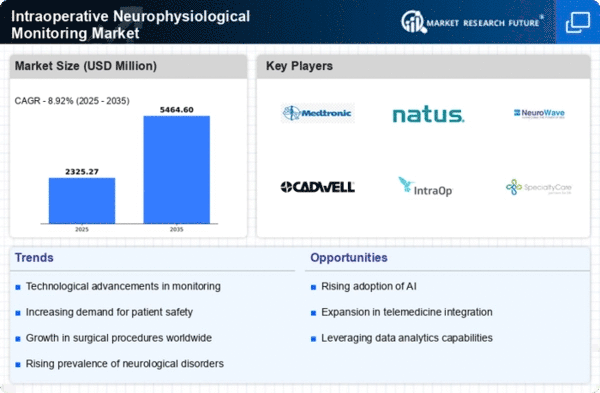
As per MRFR analysis, the Intraoperative Neurophysiological Monitoring Market Size was estimated at 2134.84 USD Million in 2024. The Intraoperative Neurophysiological Monitoring industry is projected to grow from 2325.27 USD Million in 2025 to 5464.6 USD Million by 2035, exhibiting a compound annual growth rate (CAGR) of 8.92 during the forecast period 2025 - 2035.

Key Market Trends & Highlights

The Intraoperative Neurophysiological Monitoring Market is poised for substantial growth driven by technological advancements and increasing patient safety awareness.

  • Technological advancements are enhancing the efficacy and precision of intraoperative monitoring systems.
  • North America remains the largest market, while Asia-Pacific is emerging as the fastest-growing region in this sector.
  • Neurosurgery represents the largest segment, whereas spinal surgery is witnessing the fastest growth in demand.
  • The rising incidence of neurological disorders and the surge in surgical procedures are key drivers propelling market expansion.

Market Size & Forecast

2024 Market Size 2134.84 (USD Million)
2035 Market Size 5464.6 (USD Million)
CAGR (2025 - 2035) 8.92%
Largest Regional Market Share in 2024 North America

Major Players

Medtronic (US), Natus Medical Incorporated (US), NeuroWave Systems (US), Cadwell Industries (US), IntraOp Medical (US), SpecialtyCare (US), Neurodiagnostic Services (US), BrainScope Company (US)

Market Trends

The Intraoperative Neurophysiological Monitoring Market is currently experiencing a notable evolution, driven by advancements in technology and an increasing emphasis on patient safety during surgical procedures. This market encompasses a range of techniques aimed at monitoring the nervous system's functionality in real-time, thereby minimizing the risk of neurological damage during operations. Surgeons and anesthesiologists are increasingly relying on these monitoring systems to enhance surgical outcomes, which appears to be fostering a growing demand for innovative solutions. Furthermore, the integration of artificial intelligence and machine learning into monitoring systems is likely to enhance their accuracy and efficiency, potentially transforming the landscape of intraoperative care. In addition to technological advancements, the Intraoperative Neurophysiological Monitoring Market is influenced by a rising awareness of the importance of neuroprotection in surgical settings. As healthcare providers prioritize patient-centric approaches, the demand for comprehensive monitoring solutions is expected to increase. This trend may lead to the development of more sophisticated devices that not only monitor but also provide real-time feedback to surgical teams. Moreover, regulatory bodies are likely to play a crucial role in shaping the market by establishing guidelines that ensure the safety and efficacy of these monitoring systems, thereby fostering trust among healthcare professionals and patients alike.

Technological Advancements

The Intraoperative Neurophysiological Monitoring Market is witnessing rapid technological progress, with innovations such as advanced imaging techniques and real-time data analytics. These developments enhance the precision of monitoring, allowing for immediate interventions during surgeries.

Increased Focus on Patient Safety

There is a growing emphasis on patient safety within surgical environments, leading to heightened demand for intraoperative monitoring solutions. This trend reflects a broader shift towards ensuring optimal outcomes and minimizing risks associated with neurological injuries.

Integration of AI and Machine Learning

The incorporation of artificial intelligence and machine learning into monitoring systems is emerging as a transformative trend. These technologies promise to improve the accuracy of neurophysiological assessments, potentially revolutionizing intraoperative practices.

Intraoperative Neurophysiological Monitoring Market Market Drivers

Regulatory Support and Guidelines

Regulatory bodies are increasingly recognizing the importance of intraoperative neurophysiological monitoring, leading to the establishment of supportive guidelines that promote its use in surgical settings. This regulatory support is crucial for the Global Intraoperative Neurophysiological Monitoring Market Industry, as it encourages healthcare facilities to adopt these monitoring techniques. Enhanced regulations ensure that monitoring practices meet safety and efficacy standards, thereby boosting confidence among healthcare providers. As a result, the market is poised for growth, with the potential for increased investments in monitoring technologies and training programs for surgical teams.

Rising Demand for Surgical Procedures

The Global Intraoperative Neurophysiological Monitoring Market Industry experiences a notable surge in demand due to the increasing number of surgical procedures performed worldwide. As healthcare systems evolve, the integration of advanced monitoring techniques becomes essential for ensuring patient safety and optimal surgical outcomes. For instance, the market is projected to reach 2.13 USD Billion in 2024, reflecting a growing recognition of the importance of intraoperative neurophysiological monitoring in complex surgeries. This trend is likely to continue, driven by advancements in surgical technologies and an increasing focus on minimizing neurological complications during operations.

Expansion of Healthcare Infrastructure

The expansion of healthcare infrastructure, particularly in emerging economies, is a significant driver for the Global Intraoperative Neurophysiological Monitoring Market Industry. As hospitals and surgical centers upgrade their facilities and invest in advanced technologies, the demand for intraoperative monitoring solutions is likely to rise. This trend is particularly evident in regions where access to quality surgical care is improving, leading to a greater emphasis on patient safety and outcomes. The ongoing development of healthcare infrastructure suggests a robust future for the market, as more facilities integrate neurophysiological monitoring into their surgical protocols.

Technological Advancements in Monitoring Equipment

Technological innovations play a pivotal role in shaping the Global Intraoperative Neurophysiological Monitoring Market Industry. The development of sophisticated monitoring devices, such as portable and real-time neurophysiological monitoring systems, enhances the accuracy and reliability of intraoperative assessments. These advancements not only improve surgical outcomes but also facilitate quicker recovery times for patients. As a result, the market is expected to grow significantly, with projections indicating a rise to 5.47 USD Billion by 2035. The continuous evolution of technology in this field suggests a promising future for both healthcare providers and patients.

Increasing Awareness of Neurophysiological Monitoring Benefits

There is a growing awareness among healthcare professionals and patients regarding the benefits of intraoperative neurophysiological monitoring, which is significantly influencing the Global Intraoperative Neurophysiological Monitoring Market Industry. This awareness is driven by educational initiatives and clinical evidence demonstrating the effectiveness of monitoring techniques in reducing postoperative complications. As more surgeons adopt these practices, the market is likely to expand, supported by a projected compound annual growth rate of 8.95% from 2025 to 2035. This trend indicates a shift towards more proactive approaches in surgical care, emphasizing the importance of real-time monitoring.

Market Segment Insights

By Application: Neurosurgery (Largest) vs. Spinal Surgery (Fastest-Growing)

The Intraoperative Neurophysiological Monitoring Market showcases a diverse application spectrum where neurosurgery emerges as the leading segment, maintaining a substantial market share. Additionally, spinal surgery is gaining momentum, reflecting robust adoption of monitoring techniques aimed at enhancing patient outcomes. The application of these monitoring systems has become integral in ensuring real-time data and safety during complex surgical procedures, thus solidifying neurosurgery's dominance while revealing spinal surgery's upward trajectory.

Neurosurgery (Dominant) vs. Spinal Surgery (Emerging)

Neurosurgery serves as the dominant application in the intraoperative neurophysiological monitoring realm, characterized by its critical role in managing complex neural procedures. Its strategic utilization helps mitigate risks associated with neurological impairments. Conversely, spinal surgery, while emerging, showcases rapid growth as surgeons increasingly rely on monitoring technologies to prevent potential complications. This segment focuses on improving patient safety and surgical effectiveness through real-time assessments, creating a pivotal shift in operational practices. As surgical methodologies evolve, both segments highlight the essential nature of intraoperative monitoring in enhancing surgical precision across varying complexities.

By Type of Monitoring: Electromyography (Largest) vs. Electroencephalography (Fastest-Growing)

The intraoperative neurophysiological monitoring market is predominantly driven by electromyography (EMG), which holds the largest share among the various monitoring types. EMG is favored for its capability to provide real-time feedback during surgeries, ensuring neuromuscular function is maintained. Electroencephalography (EEG) has been gaining significant traction, especially in neurosurgical procedures, contributing to its rapid growth within the sector. Other segments, such as evoked potentials and nerve conduction studies, also contribute to the market but remain comparatively smaller in share and growth rate. Growth in the intraoperative monitoring sector is primarily influenced by increased awareness of patient safety and advancements in monitoring technologies. Surgeons are increasingly adopting advanced monitoring techniques, particularly EEG, due to its efficacy in preventing neurological complications during complex procedures. Rising healthcare expenditure and a growing elderly population, which is more susceptible to neurological disorders, are expected to further enhance the market dynamics for these monitoring types in the future.

Electromyography (Dominant) vs. Electroencephalography (Emerging)

Electromyography (EMG) remains the dominant monitoring technique in intraoperative neurophysiological monitoring due to its unparalleled ability to assess and confirm the health of motor pathways in real time. Surgeons rely heavily on EMG for its accuracy in detecting muscular abnormalities, allowing for immediate interventions when necessary. In contrast, Electroencephalography (EEG) is emerging as a paramount procedure, particularly in surgeries involving the brain, thanks to its capability of monitoring cerebral function. The technological advancements in EEG, such as higher resolution and improved signal processing, have significantly enhanced its adoption. As surgical procedures become more complex, the demand for both methodologies is likely to rise, fostering a competitive landscape where EMG holds dominance while EEG showcases remarkable growth potential.

By End User: Hospitals (Largest) vs. Ambulatory Surgical Centers (Fastest-Growing)

The Intraoperative Neurophysiological Monitoring Market is notably led by hospitals, which account for the largest share among end users. Their extensive infrastructure, advanced technology, and a high volume of surgeries contribute to this dominance. Hospitals provide a wide range of surgical procedures requiring real-time monitoring, thereby driving substantial demand in this sector. Conversely, ambulatory surgical centers are emerging as a dynamic segment, capitalizing on the trend towards outpatient care and minimizing hospital stays.

Hospitals (Dominant) vs. Ambulatory Surgical Centers (Emerging)

Hospitals play a pivotal role in the Intraoperative Neurophysiological Monitoring Market due to their comprehensive range of services and advanced technology integration. They offer a conducive environment for complex surgeries that require meticulous monitoring, attracting a diverse patient demographic. Ambulatory surgical centers, on the other hand, are gaining traction as an emerging segment, catering to the rising preference for outpatient procedures. These facilities focus on efficiency and patient comfort, enabling quicker recovery times and lower costs, which are increasingly appealing to patients seeking alternatives to traditional hospital settings.

Get more detailed insights about Intraoperative Neurophysiological Monitoring Market Research Report - Global Forecast to 2035

Regional Insights

North America : Market Leader in Innovation

North America continues to lead the Intraoperative Neurophysiological Monitoring (IONM) market, holding a significant share of 1060.0M in 2024. The growth is driven by increasing surgical procedures, advancements in technology, and a strong regulatory framework that supports innovation. The demand for real-time monitoring during surgeries is rising, fueled by the need for improved patient outcomes and reduced complications. The United States is the primary contributor to this market, with key players like Medtronic, Natus Medical, and SpecialtyCare dominating the landscape. The competitive environment is characterized by continuous innovation and strategic partnerships among leading companies. The presence of advanced healthcare infrastructure further enhances the market's growth potential, making North America a hub for IONM advancements.

Europe : Emerging Market with Growth Potential

Europe's Intraoperative Neurophysiological Monitoring market is valued at 600.0M, reflecting a growing demand for IONM services. The region benefits from stringent regulations that ensure high standards of patient safety and efficacy in surgical procedures. The increasing prevalence of neurological disorders and the rising number of surgeries are key drivers of market growth, supported by government initiatives promoting advanced healthcare technologies. Leading countries in this region include Germany, France, and the UK, where a robust healthcare system and significant investments in medical technology are evident. Major players like Natus Medical and Cadwell Industries are actively expanding their presence. The competitive landscape is marked by collaborations and innovations aimed at enhancing monitoring techniques, positioning Europe as a promising market for IONM.

Asia-Pacific : Rapidly Growing Healthcare Sector

The Asia-Pacific region is witnessing rapid growth in the Intraoperative Neurophysiological Monitoring market, valued at 400.0M. This growth is driven by increasing healthcare expenditure, a rising number of surgical procedures, and a growing awareness of the benefits of IONM. Countries like China and India are investing heavily in healthcare infrastructure, which is expected to further boost market demand in the coming years. China and Japan are leading the market, with significant contributions from local and international players. The competitive landscape is evolving, with companies focusing on technological advancements and partnerships to enhance service delivery. The presence of key players like NeuroWave Systems and IntraOp Medical is strengthening the market, making Asia-Pacific a vital region for IONM growth.

Middle East and Africa : Emerging Market with Challenges

The Middle East and Africa region, with a market size of 74.84M, is gradually emerging in the Intraoperative Neurophysiological Monitoring sector. The growth is primarily driven by increasing healthcare investments and a rising number of surgical procedures. However, challenges such as regulatory hurdles and limited access to advanced technologies hinder rapid market expansion. Governments are working to improve healthcare infrastructure, which is expected to support future growth. Countries like South Africa and the UAE are leading the market, with a focus on enhancing healthcare services. The competitive landscape is characterized by a mix of local and international players, striving to establish a foothold in this developing market. Key players are exploring partnerships and collaborations to navigate regulatory challenges and expand their reach in the region.

Key Players and Competitive Insights

The Intraoperative Neurophysiological Monitoring Market is characterized by a dynamic competitive landscape, driven by technological advancements and an increasing emphasis on patient safety during surgical procedures. Key players such as Medtronic (US), Natus Medical Incorporated (US), and SpecialtyCare (US) are at the forefront, each adopting distinct strategies to enhance their market presence. Medtronic (US) focuses on innovation, particularly in developing advanced monitoring systems that integrate seamlessly with surgical workflows. Natus Medical Incorporated (US) emphasizes partnerships with healthcare providers to expand its service offerings, while SpecialtyCare (US) is enhancing its operational capabilities through strategic acquisitions, thereby strengthening its position in the market.The market structure appears moderately fragmented, with several players vying for market share. Key business tactics include localizing manufacturing to reduce costs and optimize supply chains, which is crucial in maintaining competitive pricing. The collective influence of these major companies shapes the market dynamics, as they leverage their strengths to address the growing demand for intraoperative monitoring solutions.

In November Medtronic (US) announced the launch of a new intraoperative monitoring platform that utilizes AI to enhance real-time data analysis during surgeries. This strategic move is likely to position Medtronic as a leader in the market, as it addresses the increasing demand for precision and efficiency in surgical procedures. The integration of AI technology not only improves patient outcomes but also streamlines surgical workflows, potentially setting a new standard in the industry.

In October Natus Medical Incorporated (US) expanded its partnership with a leading hospital network to provide comprehensive neurophysiological monitoring services. This collaboration is significant as it allows Natus to enhance its service delivery and reach a broader patient base, thereby solidifying its market position. The partnership underscores the importance of strategic alliances in expanding operational capabilities and improving patient care.

In September SpecialtyCare (US) acquired a regional competitor, which is expected to enhance its service offerings and market reach. This acquisition reflects a trend towards consolidation in the market, as companies seek to leverage synergies and improve operational efficiencies. By integrating the acquired company’s resources, SpecialtyCare aims to provide a more comprehensive suite of monitoring services, thereby increasing its competitive edge.

As of December current trends in the Intraoperative Neurophysiological Monitoring Market include a strong focus on digitalization, sustainability, and the integration of AI technologies. Strategic alliances are increasingly shaping the competitive landscape, as companies collaborate to enhance their technological capabilities and service offerings. Looking ahead, competitive differentiation is likely to evolve from traditional price-based competition to a focus on innovation, advanced technology, and reliable supply chains. This shift suggests that companies that prioritize these aspects will be better positioned to thrive in the evolving market.

Key Companies in the Intraoperative Neurophysiological Monitoring Market include

Industry Developments

INVASIVE INC. announced the official opening of its Singapore Experience Center for the Asia-Pacific region, supporting its growth strategy to expand its business internationally.

March 2021

The V4 4-channel and 8-channel nerve monitoring systems from Neurosign have received approval from the US Food and Drug Administration, and they are currently being used on patients in the US for nerve identification and preservation.

Future Outlook

Intraoperative Neurophysiological Monitoring Market Future Outlook

The Intraoperative Neurophysiological Monitoring Market is projected to grow at an 8.92% CAGR from 2025 to 2035, driven by technological advancements, increasing surgical procedures, and heightened patient safety awareness.

New opportunities lie in:

  • Development of AI-driven monitoring systems for real-time data analysis.
  • Expansion of telemonitoring services for remote surgical support.
  • Partnerships with surgical centers to integrate IONM into standard procedures.

By 2035, the market is expected to achieve substantial growth, solidifying its critical role in surgical safety.

Market Segmentation

Intraoperative Neurophysiological Monitoring Market End User Outlook

  • Hospitals
  • Ambulatory Surgical Centers
  • Specialty Clinics
  • Research Institutions

Intraoperative Neurophysiological Monitoring Market Application Outlook

  • Neurosurgery
  • Spinal Surgery
  • Cardiac Surgery
  • Orthopedic Surgery
  • Other Applications

Intraoperative Neurophysiological Monitoring Market Type of Monitoring Outlook

  • Electromyography
  • Electroencephalography
  • Evoked Potentials
  • Nerve Conduction Studies

Report Scope

MARKET SIZE 20242134.84(USD Million)
MARKET SIZE 20252325.27(USD Million)
MARKET SIZE 20355464.6(USD Million)
COMPOUND ANNUAL GROWTH RATE (CAGR)8.92% (2025 - 2035)
REPORT COVERAGERevenue Forecast, Competitive Landscape, Growth Factors, and Trends
BASE YEAR2024
Market Forecast Period2025 - 2035
Historical Data2019 - 2024
Market Forecast UnitsUSD Million
Key Companies ProfiledMedtronic (US), Natus Medical Incorporated (US), NeuroWave Systems (US), Cadwell Industries (US), IntraOp Medical (US), SpecialtyCare (US), Neurodiagnostic Services (US), BrainScope Company (US)
Segments CoveredApplication, Type of Monitoring, End User
Key Market OpportunitiesIntegration of advanced artificial intelligence in Intraoperative Neurophysiological Monitoring systems enhances surgical outcomes.
Key Market DynamicsTechnological advancements and regulatory changes drive growth in the Intraoperative Neurophysiological Monitoring Market.
Countries CoveredNorth America, Europe, APAC, South America, MEA

FAQs

What is the projected growth of the Intraoperative Neurophysiological Monitoring market?

The Intraoperative Neurophysiological Monitoring market is the expected increase in total market value of 5.46 USD billion over a defined forecast period 2025–2035. It is driven by factors such as demand trends, technological advances, regulatory changes, and geographic expansion.

What is the size of the Intraoperative Neurophysiological Monitoring market?

Intraoperative Neurophysiological Monitoring market size was valued at approximately 2.13 billion USD in 2024. This figure will reach 5.46 billion USD covering all regions (America, Europe, Asia, MEA and ROW), focusing its segments / services / distribution channels till 2035.

What is the CAGR of the Intraoperative Neurophysiological Monitoring market?

Intraoperative Neurophysiological Monitoring market is expected to grow at a CAGR of 8.92% between 2025 and 2035.

How much will the Intraoperative Neurophysiological Monitoring market be worth by 2035?

Intraoperative Neurophysiological Monitoring market is expected to be worth of 5.46 billion USD, reflecting growth driven by usage, technology and global demands by the end of 2035.

How will the Intraoperative Neurophysiological Monitoring market perform over the next 10 years?

Over the next 10 years the Intraoperative Neurophysiological Monitoring market is expected to shift from usd billion 2.13 to 5.46 billion USD, led by adoption of advanced tech, demographic trends, regulatory approvals, with potential headwinds from 2025 to 2035.

Which region held the largest market share in the Intraoperative Neurophysiological Monitoring market?

North America had the largest share of the Global market

  1. SECTION I: EXECUTIVE SUMMARY AND KEY HIGHLIGHTS
    1. | 1.1 EXECUTIVE SUMMARY
    2. | 1.1.1 Market Overview
    3. | 1.1.2 Key Findings
    4. | 1.1.3 Market Segmentation
    5. | 1.1.4 Competitive Landscape
    6. | 1.1.5 Challenges and Opportunities
    7. | 1.1.6 Future Outlook
  2. SECTION II: SCOPING, METHODOLOGY AND MARKET STRUCTURE
    1. | 2.1 MARKET INTRODUCTION
    2. | 2.1.1 Definition
    3. | 2.1.2 Scope of the study
    4. |-- 2.1.2.1 Research Objective
    5. |-- 2.1.2.2 Assumption
    6. |-- 2.1.2.3 Limitations
    7. | 2.2 RESEARCH METHODOLOGY
    8. | 2.2.1 Overview
    9. | 2.2.2 Data Mining
    10. | 2.2.3 Secondary Research
    11. | 2.2.4 Primary Research
    12. |-- 2.2.4.1 Primary Interviews and Information Gathering Process
    13. |-- 2.2.4.2 Breakdown of Primary Respondents
    14. | 2.2.5 Forecasting Model
    15. | 2.2.6 Market Size Estimation
    16. |-- 2.2.6.1 Bottom-Up Approach
    17. |-- 2.2.6.2 Top-Down Approach
    18. | 2.2.7 Data Triangulation
    19. | 2.2.8 Validation
  3. SECTION III: QUALITATIVE ANALYSIS
    1. | 3.1 MARKET DYNAMICS
    2. | 3.1.1 Overview
    3. | 3.1.2 Drivers
    4. | 3.1.3 Restraints
    5. | 3.1.4 Opportunities
    6. | 3.2 MARKET FACTOR ANALYSIS
    7. | 3.2.1 Value chain Analysis
    8. | 3.2.2 Porter's Five Forces Analysis
    9. |-- 3.2.2.1 Bargaining Power of Suppliers
    10. |-- 3.2.2.2 Bargaining Power of Buyers
    11. |-- 3.2.2.3 Threat of New Entrants
    12. |-- 3.2.2.4 Threat of Substitutes
    13. |-- 3.2.2.5 Intensity of Rivalry
    14. | 3.2.3 COVID-19 Impact Analysis
    15. |-- 3.2.3.1 Market Impact Analysis
    16. |-- 3.2.3.2 Regional Impact
    17. |-- 3.2.3.3 Opportunity and Threat Analysis
  4. SECTION IV: QUANTITATIVE ANALYSIS
    1. | 4.1 Healthcare, BY Application (USD Million)
    2. | 4.1.1 Neurosurgery
    3. | 4.1.2 Spinal Surgery
    4. | 4.1.3 Cardiac Surgery
    5. | 4.1.4 Orthopedic Surgery
    6. | 4.1.5 Other Applications
    7. | 4.2 Healthcare, BY Type of Monitoring (USD Million)
    8. | 4.2.1 Electromyography
    9. | 4.2.2 Electroencephalography
    10. | 4.2.3 Evoked Potentials
    11. | 4.2.4 Nerve Conduction Studies
    12. | 4.3 Healthcare, BY End User (USD Million)
    13. | 4.3.1 Hospitals
    14. | 4.3.2 Ambulatory Surgical Centers
    15. | 4.3.3 Specialty Clinics
    16. | 4.3.4 Research Institutions
    17. | 4.4 Healthcare, BY Region (USD Million)
    18. | 4.4.1 North America
    19. |-- 4.4.1.1 US
    20. |-- 4.4.1.2 Canada
    21. | 4.4.2 Europe
    22. |-- 4.4.2.1 Germany
    23. |-- 4.4.2.2 UK
    24. |-- 4.4.2.3 France
    25. |-- 4.4.2.4 Russia
    26. |-- 4.4.2.5 Italy
    27. |-- 4.4.2.6 Spain
    28. |-- 4.4.2.7 Rest of Europe
    29. | 4.4.3 APAC
    30. |-- 4.4.3.1 China
    31. |-- 4.4.3.2 India
    32. |-- 4.4.3.3 Japan
    33. |-- 4.4.3.4 South Korea
    34. |-- 4.4.3.5 Malaysia
    35. |-- 4.4.3.6 Thailand
    36. |-- 4.4.3.7 Indonesia
    37. |-- 4.4.3.8 Rest of APAC
    38. | 4.4.4 South America
    39. |-- 4.4.4.1 Brazil
    40. |-- 4.4.4.2 Mexico
    41. |-- 4.4.4.3 Argentina
    42. |-- 4.4.4.4 Rest of South America
    43. | 4.4.5 MEA
    44. |-- 4.4.5.1 GCC Countries
    45. |-- 4.4.5.2 South Africa
    46. |-- 4.4.5.3 Rest of MEA
  5. SECTION V: COMPETITIVE ANALYSIS
    1. | 5.1 Competitive Landscape
    2. | 5.1.1 Overview
    3. | 5.1.2 Competitive Analysis
    4. | 5.1.3 Market share Analysis
    5. | 5.1.4 Major Growth Strategy in the Healthcare
    6. | 5.1.5 Competitive Benchmarking
    7. | 5.1.6 Leading Players in Terms of Number of Developments in the Healthcare
    8. | 5.1.7 Key developments and growth strategies
    9. |-- 5.1.7.1 New Product Launch/Service Deployment
    10. |-- 5.1.7.2 Merger & Acquisitions
    11. |-- 5.1.7.3 Joint Ventures
    12. | 5.1.8 Major Players Financial Matrix
    13. |-- 5.1.8.1 Sales and Operating Income
    14. |-- 5.1.8.2 Major Players R&D Expenditure. 2023
    15. | 5.2 Company Profiles
    16. | 5.2.1 Medtronic (US)
    17. |-- 5.2.1.1 Financial Overview
    18. |-- 5.2.1.2 Products Offered
    19. |-- 5.2.1.3 Key Developments
    20. |-- 5.2.1.4 SWOT Analysis
    21. |-- 5.2.1.5 Key Strategies
    22. | 5.2.2 Natus Medical Incorporated (US)
    23. |-- 5.2.2.1 Financial Overview
    24. |-- 5.2.2.2 Products Offered
    25. |-- 5.2.2.3 Key Developments
    26. |-- 5.2.2.4 SWOT Analysis
    27. |-- 5.2.2.5 Key Strategies
    28. | 5.2.3 NeuroWave Systems (US)
    29. |-- 5.2.3.1 Financial Overview
    30. |-- 5.2.3.2 Products Offered
    31. |-- 5.2.3.3 Key Developments
    32. |-- 5.2.3.4 SWOT Analysis
    33. |-- 5.2.3.5 Key Strategies
    34. | 5.2.4 Cadwell Industries (US)
    35. |-- 5.2.4.1 Financial Overview
    36. |-- 5.2.4.2 Products Offered
    37. |-- 5.2.4.3 Key Developments
    38. |-- 5.2.4.4 SWOT Analysis
    39. |-- 5.2.4.5 Key Strategies
    40. | 5.2.5 IntraOp Medical (US)
    41. |-- 5.2.5.1 Financial Overview
    42. |-- 5.2.5.2 Products Offered
    43. |-- 5.2.5.3 Key Developments
    44. |-- 5.2.5.4 SWOT Analysis
    45. |-- 5.2.5.5 Key Strategies
    46. | 5.2.6 SpecialtyCare (US)
    47. |-- 5.2.6.1 Financial Overview
    48. |-- 5.2.6.2 Products Offered
    49. |-- 5.2.6.3 Key Developments
    50. |-- 5.2.6.4 SWOT Analysis
    51. |-- 5.2.6.5 Key Strategies
    52. | 5.2.7 Neurodiagnostic Services (US)
    53. |-- 5.2.7.1 Financial Overview
    54. |-- 5.2.7.2 Products Offered
    55. |-- 5.2.7.3 Key Developments
    56. |-- 5.2.7.4 SWOT Analysis
    57. |-- 5.2.7.5 Key Strategies
    58. | 5.2.8 BrainScope Company (US)
    59. |-- 5.2.8.1 Financial Overview
    60. |-- 5.2.8.2 Products Offered
    61. |-- 5.2.8.3 Key Developments
    62. |-- 5.2.8.4 SWOT Analysis
    63. |-- 5.2.8.5 Key Strategies
    64. | 5.3 Appendix
    65. | 5.3.1 References
    66. | 5.3.2 Related Reports

Healthcare Market Segmentation

Healthcare By Application (USD Million, 2025-2035)

  • Neurosurgery
  • Spinal Surgery
  • Cardiac Surgery
  • Orthopedic Surgery
  • Other Applications

Healthcare By Type of Monitoring (USD Million, 2025-2035)

  • Electromyography
  • Electroencephalography
  • Evoked Potentials
  • Nerve Conduction Studies

Healthcare By End User (USD Million, 2025-2035)

  • Hospitals
  • Ambulatory Surgical Centers
  • Specialty Clinics
  • Research Institutions
Infographic

Free Sample Request

Kindly complete the form below to receive a free sample of this Report

Get Free Sample

Customer Strories

Compare Licence

×
Features License Type
Single User Multiuser License Enterprise User
Price $4,950 $5,950 $7,250
Maximum User Access Limit 1 User Upto 10 Users Unrestricted Access Throughout the Organization
Free Customization
Direct Access to Analyst
Deliverable Format
Platform Access
Discount on Next Purchase 10% 15% 15%
Printable Versions