
×
  • Cat-intel
  • MedIntelliX
  • Resources
  • About Us
  • Hero Background
    English
    Chinese
    French
    Japanese
    Korean
    German
    Spanish

    Interior Doors Market Trends

    ID: MRFR/CO/5836-HCR
    100 Pages
    Harshita Gorade
    October 2025

    Interior Doors Market Research Report By Door Type (Panel Door, Bypass Door, Bifold Door, Pocket Door, Others), By Material (Wood, Glass, Metal, Fiberglass, Fiberboard, Vinyl, Others), By End-use (Residential, Commercial, Industrial) and Region — Global Forecast till 2035

    Share:
    Download PDF ×

    We do not share your information with anyone. However, we may send you emails based on your report interest from time to time. You may contact us at any time to opt-out.

    Interior Doors Market Infographic
    Purchase Options

    Market Trends

    Key Emerging Trends in the Interior Doors Market

    The interior doors market has been witnessing several notable trends in recent years, driven by changing consumer preferences, advancements in technology, and shifts in the construction and home renovation sectors. One significant trend in the market is the increasing demand for customizable and aesthetically pleasing interior doors. Consumers are seeking doors that not only serve functional purposes but also enhance the overall interior design of their homes or commercial spaces. As a result, manufacturers are offering a wide range of options in terms of materials, finishes, and designs to cater to diverse consumer preferences. From traditional wooden doors to modern designs incorporating glass, metal, or composite materials, the market is witnessing a proliferation of choices to meet the evolving demands of consumers.

    Another key trend shaping the interior doors market is the growing focus on energy efficiency and sustainability. With an increasing emphasis on environmental conservation and energy-saving solutions, there is a rising demand for doors that offer better insulation properties and are made from eco-friendly materials. Manufacturers are responding to this trend by developing interior doors with enhanced thermal insulation capabilities, such as those incorporating advanced insulation materials or featuring multi-layered construction. Additionally, there is a growing preference for doors made from sustainable materials such as engineered wood, bamboo, or recycled materials, reflecting the broader shift towards eco-conscious consumerism.

    Technological advancements are also driving innovation in the interior doors market, with manufacturers leveraging digitalization and automation to improve product quality and efficiency. Advanced manufacturing techniques such as computer-aided design (CAD), computer numerical control (CNC) machining, and robotic assembly have enabled manufacturers to produce doors with greater precision and consistency. Furthermore, technological innovations have led to the development of smart interior doors equipped with features such as integrated sensors, electronic locks, and remote control capabilities, catering to the growing demand for smart home solutions.

    Moreover, the interior doors market is experiencing growth due to the expanding construction and real estate sectors worldwide. With increasing investments in residential and commercial construction projects, particularly in emerging economies, there is a rising demand for interior doors for new construction as well as renovation projects. Additionally, the growing trend towards open-plan living spaces and modern architectural designs is driving the demand for interior doors that offer seamless integration with the overall interior design while providing privacy and functionality.

    On the other hand, the interior doors market faces challenges such as fluctuating raw material prices, supply chain disruptions, and increasing competition from alternative materials. Fluctuations in the prices of wood, glass, and other materials used in door manufacturing can impact production costs and profit margins for manufacturers. Moreover, disruptions in the global supply chain, such as those caused by the COVID-19 pandemic, can lead to delays in manufacturing and delivery schedules, affecting market dynamics. Additionally, the rising popularity of alternative materials such as fiberglass, steel, and composite materials poses competitive challenges for traditional wood-based interior door manufacturers.


    Author
    Harshita Gorade
    Research Analyst

    Harshita Post graduate MBA in Business Administration from Welingkar Institute, Mumbai and 5 years of experience in the field of product market research. As a Research Analyst, I have cross-domain experience in packaging, and industrial Automation & Equipment. I am currently looking after the research process of packaging, logistics & transportation, and industrial automation & equipment at Market Research Future Reports. My responsibilities at the organization involve handling syndicate and custom reports as well as responding to client inquiries, and organize, co-ordinate with a group of 5 to 6 persons to manage all workflows.

    Leave a Comment

    FAQs

    What is the interior door market growth scope?

    Interior Doors Market is projected to grow at a CAGR of 4.8% during the forecast period, 2025-2035

    What are the propellers of the global interior door market?

    Increase in the number of construction projects and escalation in the sales of customized interior doors are potential propellers of the global interior door market.

    What materials are used in the fabrication of interior doors?

    Wood, glass, metal, fiberglass, fiberboard, vinyl, and others are commonly used materials for the fabrication of interior doors. The selection of interior door material is based on the type of construction in which they are to fit in. Wood and fiberglass are often used in the fabrication of interior doors.

    Which application segment is expected to show the highest growth?

    Expansion of the global population and increase in industrialization are factors that are boosting the sales of interior doors for residential, followed by commercial applications.

    Who are well-established interior door vendors?

    Colonial Elegance Inc., Artisan Hardware, Masonite International Corporation, Jeld-Wen Holding Inc., Bayer Built WoodWorks Inc., YKK AP Inc., and Marvin Cos. are well-known interior door vendors.

    Market Summary

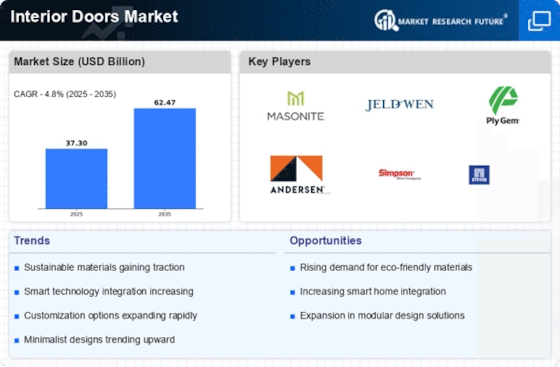
    As per MRFR analysis, the Interior Doors Market Size was estimated at 37.3 USD Billion in 2024. The Interior Doors industry is projected to grow from 39.09 USD Billion in 2025 to 62.47 USD Billion by 2035, exhibiting a compound annual growth rate (CAGR) of 4.8 during the forecast period 2025 - 2035.

    Key Market Trends & Highlights

    The Interior Doors Market is experiencing a dynamic shift towards sustainability and technology integration.

    • The North American region remains the largest market for interior doors, driven by robust construction activities.
    • Asia-Pacific is emerging as the fastest-growing region, fueled by rapid urbanization and increasing disposable incomes.
    • Wood doors continue to dominate the market, while glass doors are gaining traction due to their modern aesthetic appeal.
    • Rising construction activities and a growing focus on aesthetics and design are key drivers propelling market growth.

    Market Size & Forecast

    2024 Market Size 37.3 (USD Billion)
    2035 Market Size 62.47 (USD Billion)
    CAGR (2025 - 2035) 4.8%
    Largest Regional Market Share in 2024 Asia Pacific

    Major Players

    <p>Masonite International (CA), Jeld-Wen (US), Ply Gem (US), Andersen Corporation (US), Simpson Door Company (US), Steves & Sons (US), Therma-Tru Doors (US), Pella Corporation (US), Biesse Group (IT)</p>

    Market Trends

    The Interior Doors Market is currently experiencing a dynamic evolution, driven by various factors including design innovation, sustainability concerns, and changing consumer preferences. As homeowners increasingly seek to enhance their living spaces, the demand for aesthetically pleasing and functional interior doors is on the rise. This market encompasses a diverse range of materials, styles, and finishes, catering to a wide array of tastes and requirements. Furthermore, the integration of smart technology into door systems is becoming more prevalent, reflecting a broader trend towards home automation and energy efficiency. In addition to aesthetic considerations, sustainability plays a crucial role in shaping the Interior Doors Market. Manufacturers are increasingly focusing on eco-friendly materials and production processes, responding to consumer demand for environmentally responsible products. This shift not only addresses ecological concerns but also aligns with regulatory frameworks aimed at reducing carbon footprints. As the market continues to evolve, it appears poised for growth, with innovations in design and technology likely to drive further interest and investment in the sector.

    Sustainable Materials

    The trend towards sustainability is gaining momentum within the Interior Doors Market. Manufacturers are increasingly utilizing eco-friendly materials, such as reclaimed wood and recycled composites, to meet consumer demand for environmentally responsible products. This shift not only addresses ecological concerns but also aligns with regulatory frameworks aimed at reducing carbon footprints.

    Smart Technology Integration

    The incorporation of smart technology into interior door systems is becoming more prevalent. Features such as keyless entry, automated locking mechanisms, and integrated sensors are appealing to consumers seeking convenience and enhanced security. This trend reflects a broader movement towards home automation, where technology enhances everyday living.

    Customization and Personalization

    There is a growing inclination among consumers for customized and personalized interior doors. Homeowners are increasingly looking for unique designs that reflect their individual styles and preferences. This trend encourages manufacturers to offer a wider range of options, including bespoke sizes, finishes, and decorative elements, catering to diverse aesthetic tastes.

    Interior Doors Market Market Drivers

    Rising Construction Activities

    The increasing number of construction activities across various sectors appears to be a primary driver for the Interior Doors Market. As urbanization continues to expand, the demand for residential and commercial buildings rises, leading to a heightened need for interior doors. In recent years, the construction sector has experienced a notable growth rate, with projections indicating a compound annual growth rate of approximately 4.5% through 2026. This growth is likely to stimulate the Interior Doors Market, as builders and developers seek to enhance the aesthetic and functional aspects of their projects. Furthermore, the trend towards open floor plans in modern architecture necessitates the use of interior doors to create defined spaces, thereby further propelling market demand.

    Expansion of the Real Estate Sector

    The expansion of the real estate sector is a crucial driver for the Interior Doors Market. As property development accelerates, there is a corresponding increase in the demand for interior doors in both residential and commercial properties. The real estate market has shown resilience, with new housing projects and commercial spaces being developed to accommodate growing populations. This trend is expected to continue, with forecasts suggesting a steady increase in real estate investments. Consequently, the Interior Doors Market stands to benefit from this expansion, as developers and contractors seek to source high-quality doors that meet the demands of modern architecture and design.

    Increased Focus on Aesthetics and Design

    The growing emphasis on aesthetics and interior design significantly influences the Interior Doors Market. Consumers are increasingly seeking doors that not only serve functional purposes but also enhance the overall visual appeal of their spaces. This trend is particularly evident in the residential sector, where homeowners are willing to invest in high-quality, stylish doors that reflect their personal tastes. Market data suggests that the demand for decorative and designer doors has surged, with a notable increase in sales of custom and premium products. As interior design trends evolve, the Interior Doors Market is likely to adapt, offering a wider variety of styles, finishes, and materials to meet consumer preferences.

    Growing Demand for Energy-Efficient Solutions

    The rising awareness of energy efficiency and sustainability is driving demand within the Interior Doors Market. Consumers are increasingly seeking products that contribute to energy conservation and reduce environmental impact. Interior doors that offer better insulation and energy-saving features are becoming more popular among homeowners and builders alike. Market analysis indicates that energy-efficient doors can significantly reduce heating and cooling costs, making them an attractive option for environmentally conscious consumers. As regulations regarding energy efficiency become more stringent, the Interior Doors Market is likely to see a shift towards products that meet these new standards, further boosting market growth.

    Technological Advancements in Door Manufacturing

    Technological innovations in door manufacturing processes are transforming the Interior Doors Market. The introduction of advanced materials and production techniques has led to the development of doors that are not only more durable but also energy-efficient. For instance, the use of composite materials and smart technology integration in door designs is becoming increasingly prevalent. These advancements not only enhance the functionality of interior doors but also contribute to sustainability efforts within the industry. As manufacturers continue to invest in research and development, the Interior Doors Market is expected to witness a surge in innovative products that cater to the evolving needs of consumers.

    Market Segment Insights

    By Material: Wood (Largest) vs. Glass (Fastest-Growing)

    <p>The Interior Doors Market is primarily driven by the demand for wood doors, which dominate the market due to their durability, aesthetic appeal, and customization options for homeowners. They hold a significant portion of the overall market share, appreciated for their natural finish and versatility in various interior design themes. Following wood, glass doors are gaining traction, known for their modern look and ability to enhance natural light in spaces, appealing to contemporary design preferences. In recent years, there has been an observable shift towards glass doors as homeowners and builders seek to create open and airy spaces. This trend is fueled by a growing inclination towards eco-friendly and space-efficient designs. Furthermore, innovations in glass technology, such as enhanced insulation and safety features, are propelling their popularity, marking them as the fastest-growing segment in the market, with increasing acceptance across residential and commercial applications.</p>

    <p>Wood (Dominant) vs. Glass (Emerging)</p>

    <p>Wood doors have established themselves as a dominant choice in the Interior Doors Market due to their robustness, insulation qualities, and timeless appearance. Their ability to be crafted in an array of styles and finishes makes them highly customizable, catering to diverse consumer preferences. On the other hand, glass doors, while still emerging, are rapidly discovering their niche in modern construction and renovation projects. Their elegant design not only provides aesthetic appeal but also promotes efficiency by allowing natural light to permeate spaces. As manufacturers innovate with techniques such as frosted or etched glass, the market for glass doors is expanding, affirming their status as an appealing alternative, especially in contemporary settings.</p>

    By End-Use: Residential (Largest) vs. Commercial (Fastest-Growing)

    <p>The Interior Doors Market is segmented into three key end-use categories: residential, commercial, and industrial. Among these, the residential segment holds the largest market share, driven by demand for home improvement and renovation activities. This segment capitalizes on the growing trend of building sustainable and aesthetically pleasing spaces, where the choice of interior doors plays a crucial role in both functionality and design aesthetics. The commercial segment, meanwhile, is witnessing rapid growth due to increased investments in infrastructure and commercial real estate development, reflecting a growing preference for modern designs and durable materials.</p>

    <p>Residential: Dominant vs. Commercial: Emerging</p>

    <p>The residential segment of the Interior Doors Market is characterized by diverse design options, catering to various consumer preferences and styles. This segment benefits from trends emphasizing home personalization, with many homeowners seeking unique designs that complement their interiors. In contrast, the commercial segment is emerging rapidly, driven by the demand for functional, durable doors that can withstand high traffic and meet safety standards. This segment typically features doors made from robust materials that offer both security and aesthetic value, making them suitable for offices, retail spaces, and public buildings.</p>

    Get more detailed insights about Interior Doors Market Research Report – Global Forecast till 2035

    Regional Insights

    North America : Market Leader in Innovation

    North America is the largest market for interior doors, holding approximately 40% of the global share. The region's growth is driven by a booming construction sector, increasing home renovations, and a rising demand for energy-efficient products. Regulatory support for sustainable building practices further fuels this demand, making it a key player in the market. The U.S. and Canada are the primary contributors, with the U.S. alone accounting for about 35% of the market share. The competitive landscape in North America is characterized by the presence of major players such as Masonite International, Jeld-Wen, and Andersen Corporation. These companies are focusing on innovation and sustainability to meet consumer demands. The market is also witnessing a trend towards customization and smart home integration, which is reshaping product offerings. The strong presence of these key players ensures a dynamic and competitive environment.

    Europe : Emerging Market with Potential

    Europe is witnessing significant growth in the interior doors market, holding approximately 30% of the global share. The demand is primarily driven by ongoing renovation projects and a shift towards modern designs. Regulatory frameworks promoting energy efficiency and sustainability are also influencing market dynamics. Germany and the UK are the largest markets in Europe, together accounting for nearly 50% of the region's market share, reflecting a strong demand for high-quality interior doors. Leading countries in Europe are focusing on innovation and design, with companies like Biesse Group and others leading the charge. The competitive landscape is marked by a mix of established brands and emerging players, all vying for market share. The emphasis on eco-friendly materials and smart technology integration is shaping product offerings, making the European market a hub for innovation in the interior doors sector.

    Asia-Pacific : Rapid Growth and Urbanization

    Asia-Pacific is rapidly emerging as a significant player in the interior doors market, holding around 25% of the global share. The region's growth is fueled by urbanization, rising disposable incomes, and an increasing focus on home improvement. Countries like China and India are leading this growth, with China alone accounting for nearly 60% of the region's market share. Government initiatives promoting housing development and infrastructure projects are further driving demand for interior doors. The competitive landscape in Asia-Pacific is diverse, with both local and international players competing for market share. Key companies are focusing on affordability and design to cater to the growing middle class. The presence of major manufacturers and a shift towards modern aesthetics are reshaping the market. As urbanization continues, the demand for innovative and stylish interior doors is expected to rise significantly, making this region a focal point for future growth.

    Middle East and Africa : Emerging Market with Challenges

    The Middle East and Africa region is gradually developing its interior doors market, currently holding about 5% of the global share. The growth is primarily driven by increasing urbanization, infrastructure development, and a rising demand for residential and commercial properties. However, challenges such as economic fluctuations and regulatory hurdles can impact market growth. Countries like the UAE and South Africa are leading the market, with the UAE accounting for a significant portion of the regional share due to its booming construction sector. The competitive landscape in this region is characterized by a mix of local manufacturers and international brands. Key players are focusing on quality and design to meet the evolving consumer preferences. The market is also witnessing a trend towards sustainable practices, with companies exploring eco-friendly materials. As the region continues to develop, the demand for innovative interior doors is expected to grow, presenting opportunities for both local and international players.

    Key Players and Competitive Insights

    The Interior Doors Market is currently characterized by a dynamic competitive landscape, driven by factors such as increasing residential construction, renovation activities, and a growing emphasis on aesthetic appeal and energy efficiency. Major players like Masonite International (CA), Jeld-Wen (US), and Andersen Corporation (US) are strategically positioned to leverage these trends. Masonite International (CA) focuses on innovation in design and materials, aiming to enhance product offerings that cater to diverse consumer preferences. Jeld-Wen (US) emphasizes regional expansion and sustainability, aligning its operations with eco-friendly practices. Andersen Corporation (US) is heavily investing in digital transformation, enhancing customer engagement through advanced online platforms. Collectively, these strategies contribute to a competitive environment that is increasingly focused on innovation and sustainability.

    Key business tactics within the Interior Doors Market include localizing manufacturing and optimizing supply chains to enhance efficiency and reduce costs. The market structure appears moderately fragmented, with several key players exerting influence while also allowing for niche manufacturers to thrive. This fragmentation fosters a competitive atmosphere where innovation and customer-centric approaches are paramount, as companies strive to differentiate themselves in a crowded marketplace.

    In August 2025, Masonite International (CA) announced the launch of a new line of eco-friendly interior doors made from sustainable materials. This strategic move not only aligns with the growing consumer demand for environmentally responsible products but also positions Masonite as a leader in sustainability within the industry. By prioritizing eco-friendly options, the company enhances its brand image and appeals to a broader customer base.

    In September 2025, Jeld-Wen (US) expanded its manufacturing capabilities by opening a new facility in Texas, aimed at increasing production efficiency and meeting rising demand in the southern U.S. This expansion reflects Jeld-Wen's commitment to regional growth and its strategy to optimize supply chains. The new facility is expected to significantly reduce lead times and improve service levels, thereby strengthening Jeld-Wen's competitive position in the market.

    In July 2025, Andersen Corporation (US) launched an innovative online platform that integrates augmented reality (AR) technology, allowing customers to visualize door options in their own spaces before making a purchase. This digital transformation initiative not only enhances customer experience but also positions Andersen at the forefront of technological integration in the industry. By leveraging AR, Andersen is likely to attract tech-savvy consumers and differentiate itself from competitors.

    As of October 2025, current competitive trends in the Interior Doors Market are increasingly defined by digitalization, sustainability, and the integration of advanced technologies such as AI. Strategic alliances among key players are shaping the landscape, fostering collaboration that enhances innovation and market reach. Looking ahead, competitive differentiation is expected to evolve from traditional price-based competition to a focus on innovation, technology, and supply chain reliability, as companies seek to meet the changing demands of consumers and the market.

    Key Companies in the Interior Doors Market market include

    Industry Developments

      • The rising degree of demand for the market products like the wood-based products occupied the largest market during the historic forecast period that had ended in 2019. There has been an increased degree of preference for aesthetically pleasing and premium interior products is anticipated to drive the demand for wood-based interior doors over the forecast period that will be ending in 2030.

      • The fiberboard segment of the global market is projected to grow at the highest CAGR from 2021 onwards due to its moisture-resistant properties, high mechanical strength, and low cost as compared to wood. This is likely to present the market with excellent attributes for growth.

      • The rising demand for interior doors in the residential sector is projected to grow at a higher market CAGR in the Middle East and Asia-Pacific region in the period. Easy availability of housing loans followed by a strong degree of investments in the real estate sector is anticipated to augment demand over the coming years.

    Future Outlook

    Interior Doors Market Future Outlook

    <p>The Interior Doors Market is projected to grow at a 4.8% CAGR from 2024 to 2035, driven by urbanization, rising disposable incomes, and innovative design trends.</p>

    New opportunities lie in:

    • <p>Expansion into smart door technology for enhanced security features.</p>
    • <p>Development of eco-friendly materials to meet sustainability demands.</p>
    • <p>Strategic partnerships with real estate developers for bulk supply contracts.</p>

    <p>By 2035, the market is expected to achieve robust growth, driven by innovation and strategic collaborations.</p>

    Market Segmentation

    Interior Doors Market End-Use Outlook

    • residential
    • commercial
    • industrial

    Interior Doors Market Material Outlook

    • wood
    • glass
    • metal
    • fiberglass
    • fiberboard
    • vinyl
    • others

    Report Scope

    MARKET SIZE 202437.3(USD Billion)
    MARKET SIZE 202539.09(USD Billion)
    MARKET SIZE 203562.47(USD Billion)
    COMPOUND ANNUAL GROWTH RATE (CAGR)4.8% (2024 - 2035)
    REPORT COVERAGERevenue Forecast, Competitive Landscape, Growth Factors, and Trends
    BASE YEAR2024
    Market Forecast Period2025 - 2035
    Historical Data2019 - 2024
    Market Forecast UnitsUSD Billion
    Key Companies ProfiledMarket analysis in progress
    Segments CoveredMarket segmentation analysis in progress
    Key Market OpportunitiesIntegration of smart technology in the Interior Doors Market enhances security and convenience for consumers.
    Key Market DynamicsRising consumer preference for sustainable materials drives innovation and competition in the interior doors market.
    Countries CoveredNorth America, Europe, APAC, South America, MEA

    FAQs

    What is the interior door market growth scope?

    Interior Doors Market is projected to grow at a CAGR of 4.8% during the forecast period, 2025-2035

    What are the propellers of the global interior door market?

    Increase in the number of construction projects and escalation in the sales of customized interior doors are potential propellers of the global interior door market.

    What materials are used in the fabrication of interior doors?

    Wood, glass, metal, fiberglass, fiberboard, vinyl, and others are commonly used materials for the fabrication of interior doors. The selection of interior door material is based on the type of construction in which they are to fit in. Wood and fiberglass are often used in the fabrication of interior doors.

    Which application segment is expected to show the highest growth?

    Expansion of the global population and increase in industrialization are factors that are boosting the sales of interior doors for residential, followed by commercial applications.

    Who are well-established interior door vendors?

    Colonial Elegance Inc., Artisan Hardware, Masonite International Corporation, Jeld-Wen Holding Inc., Bayer Built WoodWorks Inc., YKK AP Inc., and Marvin Cos. are well-known interior door vendors.

    1. SECTION I: EXECUTIVE SUMMARY AND KEY HIGHLIGHTS
      1. | 1.1 EXECUTIVE SUMMARY
      2. | | 1.1.1 Market Overview
      3. | | 1.1.2 Key Findings
      4. | | 1.1.3 Market Segmentation
      5. | | 1.1.4 Competitive Landscape
      6. | | 1.1.5 Challenges and Opportunities
      7. | | 1.1.6 Future Outlook
    2. SECTION II: SCOPING, METHODOLOGY AND MARKET STRUCTURE
      1. | 2.1 MARKET INTRODUCTION
      2. | | 2.1.1 Definition
      3. | | 2.1.2 Scope of the study
      4. | | | 2.1.2.1 Research Objective
      5. | | | 2.1.2.2 Assumption
      6. | | | 2.1.2.3 Limitations
      7. | 2.2 RESEARCH METHODOLOGY
      8. | | 2.2.1 Overview
      9. | | 2.2.2 Data Mining
      10. | | 2.2.3 Secondary Research
      11. | | 2.2.4 Primary Research
      12. | | | 2.2.4.1 Primary Interviews and Information Gathering Process
      13. | | | 2.2.4.2 Breakdown of Primary Respondents
      14. | | 2.2.5 Forecasting Model
      15. | | 2.2.6 Market Size Estimation
      16. | | | 2.2.6.1 Bottom-Up Approach
      17. | | | 2.2.6.2 Top-Down Approach
      18. | | 2.2.7 Data Triangulation
      19. | | 2.2.8 Validation
    3. SECTION III: QUALITATIVE ANALYSIS
      1. | 3.1 MARKET DYNAMICS
      2. | | 3.1.1 Overview
      3. | | 3.1.2 Drivers
      4. | | 3.1.3 Restraints
      5. | | 3.1.4 Opportunities
      6. | 3.2 MARKET FACTOR ANALYSIS
      7. | | 3.2.1 Value chain Analysis
      8. | | 3.2.2 Porter's Five Forces Analysis
      9. | | | 3.2.2.1 Bargaining Power of Suppliers
      10. | | | 3.2.2.2 Bargaining Power of Buyers
      11. | | | 3.2.2.3 Threat of New Entrants
      12. | | | 3.2.2.4 Threat of Substitutes
      13. | | | 3.2.2.5 Intensity of Rivalry
      14. | | 3.2.3 COVID-19 Impact Analysis
      15. | | | 3.2.3.1 Market Impact Analysis
      16. | | | 3.2.3.2 Regional Impact
      17. | | | 3.2.3.3 Opportunity and Threat Analysis
    4. SECTION IV: QUANTITATIVE ANALYSIS
      1. | 4.1 Packaging & Transport, BY Material (USD Billion)
      2. | | 4.1.1 wood
      3. | | 4.1.2 glass
      4. | | 4.1.3 metal
      5. | | 4.1.4 fiberglass
      6. | | 4.1.5 fiberboard
      7. | | 4.1.6 vinyl
      8. | | 4.1.7 others
      9. | 4.2 Packaging & Transport, BY End-Use (USD Billion)
      10. | | 4.2.1 residential
      11. | | 4.2.2 commercial
      12. | | 4.2.3 industrial
      13. | 4.3 Packaging & Transport, BY Region (USD Billion)
      14. | | 4.3.1 North America
      15. | | | 4.3.1.1 US
      16. | | | 4.3.1.2 Canada
      17. | | 4.3.2 Europe
      18. | | | 4.3.2.1 Germany
      19. | | | 4.3.2.2 UK
      20. | | | 4.3.2.3 France
      21. | | | 4.3.2.4 Russia
      22. | | | 4.3.2.5 Italy
      23. | | | 4.3.2.6 Spain
      24. | | | 4.3.2.7 Rest of Europe
      25. | | 4.3.3 APAC
      26. | | | 4.3.3.1 China
      27. | | | 4.3.3.2 India
      28. | | | 4.3.3.3 Japan
      29. | | | 4.3.3.4 South Korea
      30. | | | 4.3.3.5 Malaysia
      31. | | | 4.3.3.6 Thailand
      32. | | | 4.3.3.7 Indonesia
      33. | | | 4.3.3.8 Rest of APAC
      34. | | 4.3.4 South America
      35. | | | 4.3.4.1 Brazil
      36. | | | 4.3.4.2 Mexico
      37. | | | 4.3.4.3 Argentina
      38. | | | 4.3.4.4 Rest of South America
      39. | | 4.3.5 MEA
      40. | | | 4.3.5.1 GCC Countries
      41. | | | 4.3.5.2 South Africa
      42. | | | 4.3.5.3 Rest of MEA
    5. SECTION V: COMPETITIVE ANALYSIS
      1. | 5.1 Competitive Landscape
      2. | | 5.1.1 Overview
      3. | | 5.1.2 Competitive Analysis
      4. | | 5.1.3 Market share Analysis
      5. | | 5.1.4 Major Growth Strategy in the Packaging & Transport
      6. | | 5.1.5 Competitive Benchmarking
      7. | | 5.1.6 Leading Players in Terms of Number of Developments in the Packaging & Transport
      8. | | 5.1.7 Key developments and growth strategies
      9. | | | 5.1.7.1 New Product Launch/Service Deployment
      10. | | | 5.1.7.2 Merger & Acquisitions
      11. | | | 5.1.7.3 Joint Ventures
      12. | | 5.1.8 Major Players Financial Matrix
      13. | | | 5.1.8.1 Sales and Operating Income
      14. | | | 5.1.8.2 Major Players R&D Expenditure. 2023
      15. | 5.2 Company Profiles
      16. | | 5.2.1 Masonite International (CA)
      17. | | | 5.2.1.1 Financial Overview
      18. | | | 5.2.1.2 Products Offered
      19. | | | 5.2.1.3 Key Developments
      20. | | | 5.2.1.4 SWOT Analysis
      21. | | | 5.2.1.5 Key Strategies
      22. | | 5.2.2 Jeld-Wen (US)
      23. | | | 5.2.2.1 Financial Overview
      24. | | | 5.2.2.2 Products Offered
      25. | | | 5.2.2.3 Key Developments
      26. | | | 5.2.2.4 SWOT Analysis
      27. | | | 5.2.2.5 Key Strategies
      28. | | 5.2.3 Ply Gem (US)
      29. | | | 5.2.3.1 Financial Overview
      30. | | | 5.2.3.2 Products Offered
      31. | | | 5.2.3.3 Key Developments
      32. | | | 5.2.3.4 SWOT Analysis
      33. | | | 5.2.3.5 Key Strategies
      34. | | 5.2.4 Andersen Corporation (US)
      35. | | | 5.2.4.1 Financial Overview
      36. | | | 5.2.4.2 Products Offered
      37. | | | 5.2.4.3 Key Developments
      38. | | | 5.2.4.4 SWOT Analysis
      39. | | | 5.2.4.5 Key Strategies
      40. | | 5.2.5 Simpson Door Company (US)
      41. | | | 5.2.5.1 Financial Overview
      42. | | | 5.2.5.2 Products Offered
      43. | | | 5.2.5.3 Key Developments
      44. | | | 5.2.5.4 SWOT Analysis
      45. | | | 5.2.5.5 Key Strategies
      46. | | 5.2.6 Steves & Sons (US)
      47. | | | 5.2.6.1 Financial Overview
      48. | | | 5.2.6.2 Products Offered
      49. | | | 5.2.6.3 Key Developments
      50. | | | 5.2.6.4 SWOT Analysis
      51. | | | 5.2.6.5 Key Strategies
      52. | | 5.2.7 Therma-Tru Doors (US)
      53. | | | 5.2.7.1 Financial Overview
      54. | | | 5.2.7.2 Products Offered
      55. | | | 5.2.7.3 Key Developments
      56. | | | 5.2.7.4 SWOT Analysis
      57. | | | 5.2.7.5 Key Strategies
      58. | | 5.2.8 Pella Corporation (US)
      59. | | | 5.2.8.1 Financial Overview
      60. | | | 5.2.8.2 Products Offered
      61. | | | 5.2.8.3 Key Developments
      62. | | | 5.2.8.4 SWOT Analysis
      63. | | | 5.2.8.5 Key Strategies
      64. | | 5.2.9 Biesse Group (IT)
      65. | | | 5.2.9.1 Financial Overview
      66. | | | 5.2.9.2 Products Offered
      67. | | | 5.2.9.3 Key Developments
      68. | | | 5.2.9.4 SWOT Analysis
      69. | | | 5.2.9.5 Key Strategies
      70. | 5.3 Appendix
      71. | | 5.3.1 References
      72. | | 5.3.2 Related Reports
    6. LIST OF FIGURES
      1. | 6.1 MARKET SYNOPSIS
      2. | 6.2 NORTH AMERICA MARKET ANALYSIS
      3. | 6.3 US MARKET ANALYSIS BY MATERIAL
      4. | 6.4 US MARKET ANALYSIS BY END-USE
      5. | 6.5 CANADA MARKET ANALYSIS BY MATERIAL
      6. | 6.6 CANADA MARKET ANALYSIS BY END-USE
      7. | 6.7 EUROPE MARKET ANALYSIS
      8. | 6.8 GERMANY MARKET ANALYSIS BY MATERIAL
      9. | 6.9 GERMANY MARKET ANALYSIS BY END-USE
      10. | 6.10 UK MARKET ANALYSIS BY MATERIAL
      11. | 6.11 UK MARKET ANALYSIS BY END-USE
      12. | 6.12 FRANCE MARKET ANALYSIS BY MATERIAL
      13. | 6.13 FRANCE MARKET ANALYSIS BY END-USE
      14. | 6.14 RUSSIA MARKET ANALYSIS BY MATERIAL
      15. | 6.15 RUSSIA MARKET ANALYSIS BY END-USE
      16. | 6.16 ITALY MARKET ANALYSIS BY MATERIAL
      17. | 6.17 ITALY MARKET ANALYSIS BY END-USE
      18. | 6.18 SPAIN MARKET ANALYSIS BY MATERIAL
      19. | 6.19 SPAIN MARKET ANALYSIS BY END-USE
      20. | 6.20 REST OF EUROPE MARKET ANALYSIS BY MATERIAL
      21. | 6.21 REST OF EUROPE MARKET ANALYSIS BY END-USE
      22. | 6.22 APAC MARKET ANALYSIS
      23. | 6.23 CHINA MARKET ANALYSIS BY MATERIAL
      24. | 6.24 CHINA MARKET ANALYSIS BY END-USE
      25. | 6.25 INDIA MARKET ANALYSIS BY MATERIAL
      26. | 6.26 INDIA MARKET ANALYSIS BY END-USE
      27. | 6.27 JAPAN MARKET ANALYSIS BY MATERIAL
      28. | 6.28 JAPAN MARKET ANALYSIS BY END-USE
      29. | 6.29 SOUTH KOREA MARKET ANALYSIS BY MATERIAL
      30. | 6.30 SOUTH KOREA MARKET ANALYSIS BY END-USE
      31. | 6.31 MALAYSIA MARKET ANALYSIS BY MATERIAL
      32. | 6.32 MALAYSIA MARKET ANALYSIS BY END-USE
      33. | 6.33 THAILAND MARKET ANALYSIS BY MATERIAL
      34. | 6.34 THAILAND MARKET ANALYSIS BY END-USE
      35. | 6.35 INDONESIA MARKET ANALYSIS BY MATERIAL
      36. | 6.36 INDONESIA MARKET ANALYSIS BY END-USE
      37. | 6.37 REST OF APAC MARKET ANALYSIS BY MATERIAL
      38. | 6.38 REST OF APAC MARKET ANALYSIS BY END-USE
      39. | 6.39 SOUTH AMERICA MARKET ANALYSIS
      40. | 6.40 BRAZIL MARKET ANALYSIS BY MATERIAL
      41. | 6.41 BRAZIL MARKET ANALYSIS BY END-USE
      42. | 6.42 MEXICO MARKET ANALYSIS BY MATERIAL
      43. | 6.43 MEXICO MARKET ANALYSIS BY END-USE
      44. | 6.44 ARGENTINA MARKET ANALYSIS BY MATERIAL
      45. | 6.45 ARGENTINA MARKET ANALYSIS BY END-USE
      46. | 6.46 REST OF SOUTH AMERICA MARKET ANALYSIS BY MATERIAL
      47. | 6.47 REST OF SOUTH AMERICA MARKET ANALYSIS BY END-USE
      48. | 6.48 MEA MARKET ANALYSIS
      49. | 6.49 GCC COUNTRIES MARKET ANALYSIS BY MATERIAL
      50. | 6.50 GCC COUNTRIES MARKET ANALYSIS BY END-USE
      51. | 6.51 SOUTH AFRICA MARKET ANALYSIS BY MATERIAL
      52. | 6.52 SOUTH AFRICA MARKET ANALYSIS BY END-USE
      53. | 6.53 REST OF MEA MARKET ANALYSIS BY MATERIAL
      54. | 6.54 REST OF MEA MARKET ANALYSIS BY END-USE
      55. | 6.55 KEY BUYING CRITERIA OF PACKAGING & TRANSPORT
      56. | 6.56 RESEARCH PROCESS OF MRFR
      57. | 6.57 DRO ANALYSIS OF PACKAGING & TRANSPORT
      58. | 6.58 DRIVERS IMPACT ANALYSIS: PACKAGING & TRANSPORT
      59. | 6.59 RESTRAINTS IMPACT ANALYSIS: PACKAGING & TRANSPORT
      60. | 6.60 SUPPLY / VALUE CHAIN: PACKAGING & TRANSPORT
      61. | 6.61 PACKAGING & TRANSPORT, BY MATERIAL, 2024 (% SHARE)
      62. | 6.62 PACKAGING & TRANSPORT, BY MATERIAL, 2024 TO 2035 (USD Billion)
      63. | 6.63 PACKAGING & TRANSPORT, BY END-USE, 2024 (% SHARE)
      64. | 6.64 PACKAGING & TRANSPORT, BY END-USE, 2024 TO 2035 (USD Billion)
      65. | 6.65 BENCHMARKING OF MAJOR COMPETITORS
    7. LIST OF TABLES
      1. | 7.1 LIST OF ASSUMPTIONS
      2. | | 7.1.1
      3. | 7.2 North America MARKET SIZE ESTIMATES; FORECAST
      4. | | 7.2.1 BY MATERIAL, 2025-2035 (USD Billion)
      5. | | 7.2.2 BY END-USE, 2025-2035 (USD Billion)
      6. | 7.3 US MARKET SIZE ESTIMATES; FORECAST
      7. | | 7.3.1 BY MATERIAL, 2025-2035 (USD Billion)
      8. | | 7.3.2 BY END-USE, 2025-2035 (USD Billion)
      9. | 7.4 Canada MARKET SIZE ESTIMATES; FORECAST
      10. | | 7.4.1 BY MATERIAL, 2025-2035 (USD Billion)
      11. | | 7.4.2 BY END-USE, 2025-2035 (USD Billion)
      12. | 7.5 Europe MARKET SIZE ESTIMATES; FORECAST
      13. | | 7.5.1 BY MATERIAL, 2025-2035 (USD Billion)
      14. | | 7.5.2 BY END-USE, 2025-2035 (USD Billion)
      15. | 7.6 Germany MARKET SIZE ESTIMATES; FORECAST
      16. | | 7.6.1 BY MATERIAL, 2025-2035 (USD Billion)
      17. | | 7.6.2 BY END-USE, 2025-2035 (USD Billion)
      18. | 7.7 UK MARKET SIZE ESTIMATES; FORECAST
      19. | | 7.7.1 BY MATERIAL, 2025-2035 (USD Billion)
      20. | | 7.7.2 BY END-USE, 2025-2035 (USD Billion)
      21. | 7.8 France MARKET SIZE ESTIMATES; FORECAST
      22. | | 7.8.1 BY MATERIAL, 2025-2035 (USD Billion)
      23. | | 7.8.2 BY END-USE, 2025-2035 (USD Billion)
      24. | 7.9 Russia MARKET SIZE ESTIMATES; FORECAST
      25. | | 7.9.1 BY MATERIAL, 2025-2035 (USD Billion)
      26. | | 7.9.2 BY END-USE, 2025-2035 (USD Billion)
      27. | 7.10 Italy MARKET SIZE ESTIMATES; FORECAST
      28. | | 7.10.1 BY MATERIAL, 2025-2035 (USD Billion)
      29. | | 7.10.2 BY END-USE, 2025-2035 (USD Billion)
      30. | 7.11 Spain MARKET SIZE ESTIMATES; FORECAST
      31. | | 7.11.1 BY MATERIAL, 2025-2035 (USD Billion)
      32. | | 7.11.2 BY END-USE, 2025-2035 (USD Billion)
      33. | 7.12 Rest of Europe MARKET SIZE ESTIMATES; FORECAST
      34. | | 7.12.1 BY MATERIAL, 2025-2035 (USD Billion)
      35. | | 7.12.2 BY END-USE, 2025-2035 (USD Billion)
      36. | 7.13 APAC MARKET SIZE ESTIMATES; FORECAST
      37. | | 7.13.1 BY MATERIAL, 2025-2035 (USD Billion)
      38. | | 7.13.2 BY END-USE, 2025-2035 (USD Billion)
      39. | 7.14 China MARKET SIZE ESTIMATES; FORECAST
      40. | | 7.14.1 BY MATERIAL, 2025-2035 (USD Billion)
      41. | | 7.14.2 BY END-USE, 2025-2035 (USD Billion)
      42. | 7.15 India MARKET SIZE ESTIMATES; FORECAST
      43. | | 7.15.1 BY MATERIAL, 2025-2035 (USD Billion)
      44. | | 7.15.2 BY END-USE, 2025-2035 (USD Billion)
      45. | 7.16 Japan MARKET SIZE ESTIMATES; FORECAST
      46. | | 7.16.1 BY MATERIAL, 2025-2035 (USD Billion)
      47. | | 7.16.2 BY END-USE, 2025-2035 (USD Billion)
      48. | 7.17 South Korea MARKET SIZE ESTIMATES; FORECAST
      49. | | 7.17.1 BY MATERIAL, 2025-2035 (USD Billion)
      50. | | 7.17.2 BY END-USE, 2025-2035 (USD Billion)
      51. | 7.18 Malaysia MARKET SIZE ESTIMATES; FORECAST
      52. | | 7.18.1 BY MATERIAL, 2025-2035 (USD Billion)
      53. | | 7.18.2 BY END-USE, 2025-2035 (USD Billion)
      54. | 7.19 Thailand MARKET SIZE ESTIMATES; FORECAST
      55. | | 7.19.1 BY MATERIAL, 2025-2035 (USD Billion)
      56. | | 7.19.2 BY END-USE, 2025-2035 (USD Billion)
      57. | 7.20 Indonesia MARKET SIZE ESTIMATES; FORECAST
      58. | | 7.20.1 BY MATERIAL, 2025-2035 (USD Billion)
      59. | | 7.20.2 BY END-USE, 2025-2035 (USD Billion)
      60. | 7.21 Rest of APAC MARKET SIZE ESTIMATES; FORECAST
      61. | | 7.21.1 BY MATERIAL, 2025-2035 (USD Billion)
      62. | | 7.21.2 BY END-USE, 2025-2035 (USD Billion)
      63. | 7.22 South America MARKET SIZE ESTIMATES; FORECAST
      64. | | 7.22.1 BY MATERIAL, 2025-2035 (USD Billion)
      65. | | 7.22.2 BY END-USE, 2025-2035 (USD Billion)
      66. | 7.23 Brazil MARKET SIZE ESTIMATES; FORECAST
      67. | | 7.23.1 BY MATERIAL, 2025-2035 (USD Billion)
      68. | | 7.23.2 BY END-USE, 2025-2035 (USD Billion)
      69. | 7.24 Mexico MARKET SIZE ESTIMATES; FORECAST
      70. | | 7.24.1 BY MATERIAL, 2025-2035 (USD Billion)
      71. | | 7.24.2 BY END-USE, 2025-2035 (USD Billion)
      72. | 7.25 Argentina MARKET SIZE ESTIMATES; FORECAST
      73. | | 7.25.1 BY MATERIAL, 2025-2035 (USD Billion)
      74. | | 7.25.2 BY END-USE, 2025-2035 (USD Billion)
      75. | 7.26 Rest of South America MARKET SIZE ESTIMATES; FORECAST
      76. | | 7.26.1 BY MATERIAL, 2025-2035 (USD Billion)
      77. | | 7.26.2 BY END-USE, 2025-2035 (USD Billion)
      78. | 7.27 MEA MARKET SIZE ESTIMATES; FORECAST
      79. | | 7.27.1 BY MATERIAL, 2025-2035 (USD Billion)
      80. | | 7.27.2 BY END-USE, 2025-2035 (USD Billion)
      81. | 7.28 GCC Countries MARKET SIZE ESTIMATES; FORECAST
      82. | | 7.28.1 BY MATERIAL, 2025-2035 (USD Billion)
      83. | | 7.28.2 BY END-USE, 2025-2035 (USD Billion)
      84. | 7.29 South Africa MARKET SIZE ESTIMATES; FORECAST
      85. | | 7.29.1 BY MATERIAL, 2025-2035 (USD Billion)
      86. | | 7.29.2 BY END-USE, 2025-2035 (USD Billion)
      87. | 7.30 Rest of MEA MARKET SIZE ESTIMATES; FORECAST
      88. | | 7.30.1 BY MATERIAL, 2025-2035 (USD Billion)
      89. | | 7.30.2 BY END-USE, 2025-2035 (USD Billion)
      90. | 7.31 PRODUCT LAUNCH/PRODUCT DEVELOPMENT/APPROVAL
      91. | | 7.31.1
      92. | 7.32 ACQUISITION/PARTNERSHIP
      93. | | 7.32.1

    Interior Doors Market Segmentation

    Market Segmentation Overview

    • Detailed segmentation data will be available in the full report
    • Comprehensive analysis by multiple parameters
    • Regional and country-level breakdowns
    • Market size forecasts by segment
    Infographic

    Free Sample Request

    Kindly complete the form below to receive a free sample of this Report

    Get Free Sample

    Customer Strories

    “I am very pleased with how market segments have been defined in a relevant way for my purposes (such as "Portable Freezers & refrigerators" and "last-mile"). In general the report is well structured. Thanks very much for your efforts.”

    Victoria Milne

    Founder
    Case Study
    Chemicals and Materials

    Compare Licence

    ×
    Features License Type
    Single User Multiuser License Enterprise User
    Price $4,950 $5,950 $7,250
    Maximum User Access Limit 1 User Upto 10 Users Unrestricted Access Throughout the Organization
    Free Customization
    Direct Access to Analyst
    Deliverable Format
    Platform Access
    Discount on Next Purchase 10% 15% 15%
    Printable Versions