×
Hero Background
English
Chinese
French
Japanese
Korean
German
Spanish

Intelligent Railway Transport System Market Trends

ID: MRFR/SEM/1587-HCR
110 Pages
Ankit Gupta
October 2025

Intelligent Railway Transport System Market Research Report By Devices & Components (Rail Sensors, Smart Cards, Video Surveillance Cameras), By Solutions (Passenger Information System (PIS), Advanced Security Management System) - Industry Size, Share and Forecast 2032

Share:
Download PDF ×

We do not share your information with anyone. However, we may send you emails based on your report interest from time to time. You may contact us at any time to opt-out.

Intelligent Railway Transport System Market Infographic
Purchase Options

Market Trends

Key Emerging Trends in the Intelligent Railway Transport System Market

The Intelligent Railway Transport System (IRTS) market is witnessing dynamic trends that are reshaping the future of rail transportation. One prominent trend is the rapid integration of digital technologies, such as Internet of Things (IoT) sensors and data analytics, to enhance operational efficiency. Railways around the world are increasingly adopting smart systems that enable real-time monitoring of train performance, track conditions, and passenger flow. This data-driven approach allows for predictive maintenance, minimizing downtime, and optimizing overall system reliability. A key point in the IRTS market is putting more focus on being environmentally friendly. With attention around the world on cutting down carbon emissions and supporting green ways, railway companies are adding in energy-saving tools to their systems. For example, trains can use a system called regenerative braking to get back and reuse energy when slowing down. This helps make train travel better for the environment. This change goes along with the bigger plans to make cities' transportation better for nature and more eco-friendly.

Automation and smart technology are important changes that make the IRTS market better. Automation makes train stuff like buying tickets and planning trips easier. It also helps with taking care of trains and keeping them safe to use. AI-made rules help guess what might happen in the future. This lets train workers see upcoming problems and solve them before they become a concern, making trains more trustworthy and safe overall. As these technologies keep getting better, more automated train operations will happen. This way we can have smart and automatic railway systems in the future.

The IRTS world is being changed by a major trend called interconnectivity. The connection of talk tools and the Internet things (IoT) is helping easy links between parts of train systems. This connected system makes it easy for trains, stations and control centers to talk. It helps them make better choices quickly which improves how everything works together in the overall plan. The change to a more linked train system is important for making an easy-to-use and adjustable travel network.

In answer to the growing need for services that focus on customers, the IRTS market is seeing a shift towards improving how passengers feel all together. Train companies are adding things like Wi-Fi, entertainment systems and smart passenger info to make travel more fun and easier. Also, using mobile apps for buying tickets and planning trips makes it easy and user-friendly for passengers. This thing shows that people are starting to understand how important it is for customers to be happy with smart train systems. However, challenges persist within the market, including the high initial costs of implementing intelligent railway solutions, interoperability issues, and the need for skilled personnel to operate and maintain advanced systems. Overcoming these challenges will be crucial for the widespread adoption of intelligent technologies within the railway sector.

Author
Ankit Gupta
Senior Research Analyst

Ankit Gupta is an analyst in market research industry in ICT and SEMI industry. With post-graduation in "Telecom and Marketing Management" and graduation in "Electronics and Telecommunication" vertical he is well versed with recent development in ICT industry as a whole. Having worked on more than 150+ reports including consultation for fortune 500 companies such as Microsoft and Rio Tinto in identifying solutions with respect to business problems his opinions are inclined towards mixture of technical and managerial aspects.

Leave a Comment

FAQs

Which are the main companies in this industry?

● Hitachi, Ltd. (Japan), ● International Business Machines Corporation (U.S.), ● Cisco Systems, Inc. (U.S.), ● Huawei Technologies Co. Ltd. (China) ● Siemens AG (Munich).

Which regions are industry leaders?

The European Union

Which segments support this industry?

Services, devices and components, and solutions

What are the growth predictions for this market?

The industry is expected to be worth 90 billion US Dollars by the end of 2032. The CAGR is 26.6%. There are many technological factors including the Internet of Things (IoT) that are driving this growth.

Market Summary

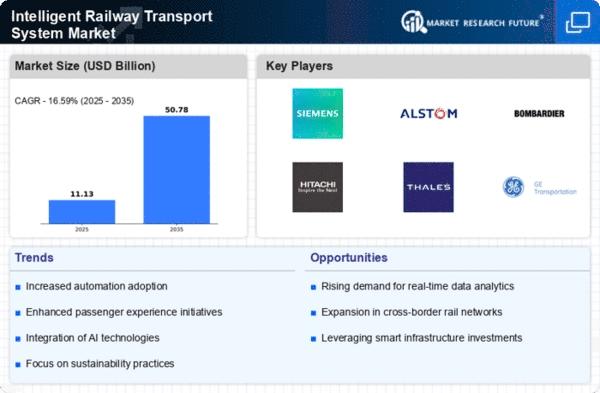
As per MRFR analysis, the Intelligent Railway Transport System Market was estimated at 9.55 USD Billion in 2024. The Intelligent Railway Transport System industry is projected to grow from 10.93 USD Billion in 2025 to 50.78 USD Billion by 2035, exhibiting a compound annual growth rate (CAGR) of 16.59 during the forecast period 2025 - 2035.

Key Market Trends & Highlights

The Intelligent Railway Transport System Market is poised for substantial growth driven by technological advancements and sustainability initiatives.

  • Technological integration is transforming railway operations, enhancing efficiency and safety across the sector.
  • Sustainability initiatives are increasingly influencing investment decisions, aligning with global environmental goals.
  • North America remains the largest market, while Asia-Pacific is emerging as the fastest-growing region in intelligent railway solutions.
  • Key market drivers include technological advancements and increased investment in infrastructure, responding to urbanization and the demand for sustainable transport.

Market Size & Forecast

2024 Market Size 9.55 (USD Billion)
2035 Market Size 50.78 (USD Billion)
CAGR (2025 - 2035) 16.59%
Largest Regional Market Share in 2024 North America

Major Players

<p>Siemens (DE), Alstom (FR), Bombardier (CA), Hitachi (JP), Thales (FR), GE Transportation (US), Kawasaki Heavy Industries (JP), CRRC Corporation Limited (CN), Mitsubishi Electric (JP)</p>

Market Trends

The Intelligent Railway Transport System Market is currently experiencing a transformative phase, driven by advancements in technology and increasing demand for efficient transportation solutions. The integration of smart technologies, such as Internet of Things (IoT) devices, artificial intelligence, and big data analytics, is reshaping the landscape of railway operations. These innovations enhance safety, optimize scheduling, and improve overall passenger experience. Furthermore, the growing emphasis on sustainability and reducing carbon footprints is prompting railway operators to adopt greener practices, which aligns with global environmental goals. As urbanization continues to rise, the need for reliable and efficient public transport systems becomes more pressing, thereby propelling the Intelligent Railway Transport System Market forward. In addition, government initiatives aimed at modernizing infrastructure and promoting public transport are likely to bolster market growth. Investments in high-speed rail networks and smart ticketing systems are becoming more prevalent, indicating a shift towards more integrated and user-friendly transport solutions. The collaboration between public and private sectors is also fostering innovation, as stakeholders seek to enhance operational efficiency and customer satisfaction. Overall, the Intelligent Railway Transport System Market appears poised for substantial growth, driven by technological advancements and a commitment to sustainable transport solutions.

Technological Integration

The Intelligent Railway Transport System Market is witnessing a surge in the adoption of advanced technologies. Innovations such as IoT, AI, and machine learning are being integrated into railway operations, enhancing efficiency and safety. This trend indicates a shift towards more automated and data-driven decision-making processes, which could lead to improved service delivery.

Sustainability Initiatives

There is a growing focus on sustainability within the Intelligent Railway Transport System Market. Railway operators are increasingly adopting eco-friendly practices and technologies to reduce their environmental impact. This trend suggests a commitment to aligning with global sustainability goals, potentially attracting environmentally conscious consumers.

Public-Private Partnerships

The collaboration between public and private sectors is becoming more pronounced in the Intelligent Railway Transport System Market. These partnerships are fostering innovation and investment in infrastructure development. This trend may lead to enhanced operational efficiency and improved customer experiences, as stakeholders work together to modernize transport systems.

Intelligent Railway Transport System Market Market Drivers

Growing Urbanization

Urbanization is a significant driver of the Global Intelligent Railway Transport System Market Industry, as increasing populations in urban areas necessitate efficient public transport solutions. Cities worldwide are adopting intelligent railway systems to alleviate congestion and reduce travel times. For instance, cities like Tokyo and London have integrated smart technologies into their rail networks, enhancing passenger experience through real-time updates and seamless transfers. This trend indicates a shift towards sustainable urban mobility, which is likely to propel the market forward, with a projected CAGR of 32.89% from 2025 to 2035.

Market Growth Projections

The Global Intelligent Railway Transport System Market Industry is poised for remarkable growth, with projections indicating a substantial increase in market value. By 2024, the market is expected to reach 8 USD Billion, with further expansion anticipated as the industry adapts to emerging technologies and evolving consumer demands. The forecasted CAGR of 32.89% from 2025 to 2035 underscores the potential for innovation and investment in intelligent railway systems. This growth trajectory reflects the increasing recognition of rail transport as a vital component of sustainable urban mobility and infrastructure development.

Technological Advancements

The Global Intelligent Railway Transport System Market Industry is experiencing rapid technological advancements, particularly in automation and digitalization. Innovations such as predictive maintenance, real-time data analytics, and advanced signaling systems enhance operational efficiency and safety. For instance, the implementation of Internet of Things (IoT) devices allows for continuous monitoring of train conditions, potentially reducing downtime and maintenance costs. As a result, the market is projected to reach 8 USD Billion in 2024, reflecting the growing reliance on technology to streamline railway operations and improve passenger experiences.

Enhanced Safety and Security

Safety and security concerns are paramount in the Global Intelligent Railway Transport System Market Industry. The integration of advanced safety technologies, such as automated train control systems and surveillance mechanisms, is crucial in mitigating risks associated with railway operations. For instance, countries are implementing systems that allow for real-time monitoring of train movements, significantly reducing the likelihood of accidents. This focus on safety not only protects passengers but also enhances the overall reliability of rail services. As safety becomes a priority, the market is likely to expand, driven by the demand for safer transportation solutions.

Environmental Sustainability

The emphasis on environmental sustainability is reshaping the Global Intelligent Railway Transport System Market Industry. As nations strive to meet climate goals, rail transport is increasingly viewed as a greener alternative to road and air travel. Intelligent railway systems contribute to reduced greenhouse gas emissions through energy-efficient operations and optimized routing. For example, the adoption of electric trains and renewable energy sources is gaining traction globally. This shift towards sustainable transport solutions is expected to drive market growth, aligning with global efforts to combat climate change and promote eco-friendly practices.

Government Initiatives and Investments

Government initiatives play a pivotal role in the expansion of the Global Intelligent Railway Transport System Market Industry. Numerous countries are investing heavily in modernizing their railway infrastructure to enhance connectivity and reduce carbon emissions. For example, initiatives in Europe and Asia focus on developing high-speed rail networks and integrating smart technologies. These investments not only improve service quality but also stimulate economic growth. As governments prioritize sustainable transport solutions, the market is expected to witness substantial growth, potentially reaching 182.6 USD Billion by 2035.

Market Segment Insights

By Application: Passenger Transport (Largest) vs. Freight Transport (Fastest-Growing)

<p>In the Intelligent Railway Transport System Market, the application segment exhibits a diverse distribution of market share among its key categories: Passenger Transport, Freight Transport, Infrastructure Management, and Traffic Management. Passenger Transport currently leads the market, driven by an increase in urban populations and a push for more efficient public transportation systems. On the other hand, Freight Transport is gaining traction, witnessing significant investments from logistics companies aiming to enhance supply chain efficiencies through advanced rail systems. Both segments are witnessing transformative shifts, influenced by technological advancements and a growing need for sustainable transport solutions. The emphasis on smart transportation is propelling investments in Infrastructure and Traffic Management systems, which are crucial for improving operational efficiency and safety. Emerging technologies such as IoT and data analytics are key drivers facilitating the growth of Freight Transport, making it the fastest-growing segment within this arena.</p>

<p>Passenger Transport: Dominant vs. Freight Transport: Emerging</p>

<p>Passenger Transport, characterized by high demand due to urbanization and a global emphasis on sustainability, remains the dominant application in the Intelligent Railway Transport System Market. This segment benefits from advanced technologies aimed at enhancing passenger experience, such as real-time information systems and high-capacity trains. Meanwhile, Freight Transport is emerging rapidly, bolstered by investments in automation and seamless tracking systems. It addresses the logistics sector's needs for efficiency and reliability. Both segments are crucial for the evolution of intelligent rail systems; however, Passenger Transport currently leads in overall acceptance and operational deployment, while Freight Transport is swiftly catching up as industries seek innovative solutions to optimize cargo transportation.</p>

By Technology: Communication-Based Train Control (Largest) vs. Automatic Train Protection (Fastest-Growing)

<p>The Intelligent Railway Transport System Market exhibits a diverse landscape, with key segments including Communication-Based Train Control, Automatic Train Protection, Train Control and Monitoring System, and Passenger Information System. Communication-Based Train Control holds the largest market share, attributed to its critical role in enhancing operational efficiency and ensuring passenger safety. Similarly, Automatic Train Protection is gaining momentum, reflecting increasing regulatory demands for enhanced safety protocols and monitoring capabilities.</p>

<p>Technology: CBTC (Dominant) vs. ATP (Emerging)</p>

<p>Communication-Based Train Control (CBTC) stands out as the dominant technology within the Intelligent Railway Transport System, providing precise train positioning and improved scheduling, crucial for urban rail systems. The system's reliance on real-time communication between trains and control centers maximizes efficiency and minimizes delays. In contrast, Automatic Train Protection (ATP) is emerging as a vital segment, driven by an increasing emphasis on safety and accident prevention within the railway infrastructure. ATP systems are designed to automatically control train speeds and prevent collisions, thus meeting the rising standards for operational safety. This segment experiences rapid advancements, thanks to technological innovations and a heightened focus on smart rail solutions.</p>

By End Use: Public Transport (Largest) vs. Logistics and Supply Chain (Fastest-Growing)

<p>In the Intelligent Railway Transport System Market, the end use segment is notably diversified, encompassing Public Transport, Logistics and Supply Chain, Urban Transit, and Long-Distance Travel. Among these, Public Transport commands the largest share, reflecting the continued investment in urban mobility solutions. Meanwhile, Logistics and Supply Chain is emerging as a strong contender, driven by the increasing demand for efficient freight transport systems that enhance supply chain reliability and reduce transit times.</p>

<p>Public Transport: Dominant vs. Logistics and Supply Chain: Emerging</p>

<p>Public Transport is highly established within the Intelligent Railway Transport System, characterized by its extensive infrastructure and significant government support aimed at modernizing transport networks. Its integration with smart technologies to enhance commuter experience and operational efficiency marks its dominance. Conversely, the Logistics and Supply Chain segment is rapidly gaining momentum, propelled by the e-commerce boom which necessitates agile and reliable transport solutions. This segment is particularly focused on adopting advanced technologies like predictive analytics and real-time tracking, thus positioning itself as a pivotal player in the transportation landscape.</p>

By Component: Sensors (Largest) vs. Software Solutions (Fastest-Growing)

<p>The 'Intelligent Railway Transport System Market' is significantly shaped by its component segment, where sensors hold the largest market share. Sensors contribute substantially to the efficiency and safety of railway systems, providing real-time data for monitoring and analysis. Following closely are software solutions that are rapidly gaining traction due to advancements in artificial intelligence and data analytics, which enhance operational efficiencies and decision-making capabilities in rail transportation.</p>

<p>Components: Sensors (Dominant) vs. Software Solutions (Emerging)</p>

<p>Sensors play a pivotal role in the intelligent railway transport system, ensuring safety, enhancing operational efficiency, and facilitating predictive maintenance. With their ability to monitor track conditions, train health, and environmental factors, sensors have become integral to modern railway systems. In contrast, software solutions are emerging powerfully in this market by leveraging data analytics and AI algorithms to optimize scheduling, forecasting, and resource allocation. The increasing demand for automated solutions positions software as a transformative force in the sector, fostering agility and innovation in railway transport.</p>

By Service Type: Maintenance Services (Largest) vs. Integration Services (Fastest-Growing)

<p>In the Intelligent Railway Transport System Market, the service type segment is diverse, with Maintenance Services holding the largest market share due to the essential nature of ongoing support for railway operations. Following closely, Consulting Services provide critical expertise that aids in the strategic deployment of technology and services. Integration Services, while smaller in share currently, are experiencing rapid growth as rail companies seek seamless technology incorporation to enhance operational efficiency. Training Services also play an integral role, equipping staff with the necessary skills to adapt to new systems and technologies.</p>

<p>Maintenance Services (Dominant) vs. Integration Services (Emerging)</p>

<p>Maintenance Services are a cornerstone of the Intelligent Railway Transport System, ensuring the longevity and reliability of infrastructure. This dominant segment focuses on regular inspections, repairs, and refurbishment to prevent disruptions in service. In contrast, Integration Services are emerging rapidly as rail operators embrace technology's transformative potential. These services facilitate the effective combination of new and existing systems, enabling real-time data sharing and improved operational performance. As railways modernize their systems, the demand for integration services is set to increase significantly, highlighting the trends towards digital transformation and automation.</p>

Get more detailed insights about Global Intelligent Railway Transport System (IRTS) Market Research Report- Forecast 2035

Regional Insights

North America : Market Leader in Innovation

North America is poised to maintain its leadership in the Intelligent Railway Transport System market, holding a significant share of 4.8 in 2025. The region's growth is driven by increasing investments in infrastructure modernization, coupled with a strong push for sustainable transport solutions. Regulatory support, particularly from federal and state agencies, is fostering innovation and adoption of smart technologies in rail systems. The competitive landscape is characterized by major players such as Siemens, GE Transportation, and Bombardier, who are actively involved in developing cutting-edge solutions. The U.S. and Canada are leading the charge, with substantial government funding aimed at enhancing rail safety and efficiency. This focus on technological advancement positions North America as a hub for intelligent transport solutions.

Europe : Emerging Hub for Smart Railways

Europe is rapidly evolving into a key player in the Intelligent Railway Transport System market, with a market size of 2.8 in 2025. The region's growth is significantly influenced by stringent environmental regulations and a commitment to reducing carbon emissions. Initiatives like the European Green Deal are catalyzing investments in smart rail technologies, enhancing operational efficiency and sustainability across member states. Leading countries such as Germany, France, and the UK are at the forefront of this transformation, with companies like Alstom and Thales spearheading innovation. The competitive landscape is robust, with a mix of established firms and emerging startups focusing on digital solutions. As Europe continues to prioritize sustainable transport, the demand for intelligent railway systems is expected to surge, supported by favorable policies and funding.

Asia-Pacific : Rapid Growth in Emerging Markets

Asia-Pacific is witnessing a burgeoning market for Intelligent Railway Transport Systems, projected to reach a size of 1.8 in 2025. The region's growth is fueled by urbanization, increasing population density, and government initiatives aimed at enhancing public transport infrastructure. Countries like China and India are investing heavily in smart rail technologies to improve connectivity and reduce congestion in urban areas. China, in particular, is a leader in this space, with CRRC Corporation Limited and Hitachi leading the charge in innovation. The competitive landscape is diverse, with both domestic and international players vying for market share. As the region continues to prioritize modernization of its rail networks, the demand for intelligent systems is expected to rise significantly, driven by both public and private sector investments.

Middle East and Africa : Emerging Market with Growth Potential

The Middle East and Africa region is gradually emerging in the Intelligent Railway Transport System market, with a market size of 0.15 in 2025. The growth is primarily driven by increasing investments in rail infrastructure, particularly in countries like the UAE and South Africa. Governments are recognizing the importance of efficient transport systems to support economic growth and urban development, leading to a surge in projects aimed at modernizing rail networks. Countries in this region are beginning to adopt intelligent transport solutions, with key players like Siemens and Bombardier exploring opportunities. The competitive landscape is still developing, but the potential for growth is significant as governments prioritize infrastructure development. As investments continue to flow, the region is expected to see a gradual increase in the adoption of smart railway technologies.

Key Players and Competitive Insights

The Intelligent Railway Transport System Market is currently characterized by a dynamic competitive landscape, driven by technological advancements and increasing demand for efficient transportation solutions. Key players such as Siemens (DE), Alstom (FR), and CRRC Corporation Limited (CN) are strategically positioned to leverage innovation and digital transformation. Siemens (DE) focuses on integrating AI and IoT technologies into their systems, enhancing operational efficiency and safety. Alstom (FR) emphasizes sustainability, aiming to reduce carbon emissions through electrification and energy-efficient solutions. Meanwhile, CRRC Corporation Limited (CN) is expanding its global footprint, particularly in emerging markets, thereby intensifying competition.

The market structure appears moderately fragmented, with several players vying for market share. Companies are adopting various business tactics, such as localizing manufacturing and optimizing supply chains, to enhance competitiveness. This collective approach not only strengthens their operational capabilities but also allows for more responsive service delivery to regional markets. The influence of these key players is significant, as they shape market trends and set benchmarks for innovation and service quality.

In November 2025, Siemens (DE) announced a partnership with a leading tech firm to develop a next-generation signaling system that utilizes AI for predictive maintenance. This strategic move is likely to enhance the reliability of railway operations, reduce downtime, and improve overall safety. By integrating advanced technologies, Siemens (DE) positions itself as a frontrunner in the digital transformation of railway systems, potentially setting new industry standards.

In October 2025, Alstom (FR) unveiled its new hydrogen-powered train prototype, marking a significant step towards sustainable rail transport. This initiative aligns with global efforts to reduce greenhouse gas emissions and demonstrates Alstom's commitment to innovation in eco-friendly technologies. The introduction of hydrogen trains could revolutionize the market, offering a viable alternative to traditional diesel engines and appealing to environmentally conscious consumers and governments alike.

In September 2025, CRRC Corporation Limited (CN) secured a major contract to supply high-speed trains to a Southeast Asian country, further solidifying its presence in international markets. This contract not only enhances CRRC's revenue potential but also showcases its capability to meet the growing demand for advanced rail solutions in developing regions. Such strategic expansions are indicative of CRRC's aggressive growth strategy and its intent to dominate the global market.

As of December 2025, current competitive trends in the Intelligent Railway Transport System Market are heavily influenced by digitalization, sustainability, and AI integration. Strategic alliances among key players are increasingly shaping the landscape, fostering innovation and collaborative advancements. The shift from price-based competition to a focus on technology, reliability, and sustainability is evident, suggesting that future differentiation will hinge on the ability to innovate and adapt to evolving market demands.

Key Companies in the Intelligent Railway Transport System Market market include

Industry Developments

The Thales Group is developing green technologies that will make trains more environmentally friendly in the future

Companies are investing in and developing new technologies that will streamline the entire train riding experience

Video analytics technologies will help operators manage passengers better and make the train riding experience as comfortable and pleasant as possible

Technologies are being devised to make metro-signaling faster and more efficient

The Thales Group has recently introduced the TransVerse Digital Service Platform. This promises to put customers in control by making train services and options much more visible and by allowing customers to access and use the Internet of Things (IoT) much faster and easier.

Future Outlook

Intelligent Railway Transport System Market Future Outlook

<p>The Intelligent Railway Transport System Market is projected to grow at a 16.59% CAGR from 2024 to 2035, driven by technological advancements, urbanization, and sustainability initiatives.</p>

New opportunities lie in:

  • <p>Integration of AI-driven predictive maintenance solutions</p>
  • <p>Development of smart ticketing systems leveraging blockchain</p>
  • <p>Expansion of real-time passenger information platforms</p>

<p>By 2035, the market is expected to achieve substantial growth, driven by innovation and increased demand.</p>

Market Segmentation

Intelligent Railway Transport System Market End Use Outlook

  • Public Transport
  • Logistics and Supply Chain
  • Urban Transit
  • Long-Distance Travel

Intelligent Railway Transport System Market Component Outlook

  • Sensors
  • Software Solutions
  • Control Systems
  • Communication Equipment

Intelligent Railway Transport System Market Technology Outlook

  • Communication-Based Train Control
  • Automatic Train Protection
  • Train Control and Monitoring System
  • Passenger Information System

Intelligent Railway Transport System Market Application Outlook

  • Passenger Transport
  • Freight Transport
  • Infrastructure Management
  • Traffic Management

Intelligent Railway Transport System Market Service Type Outlook

  • Maintenance Services
  • Consulting Services
  • Integration Services
  • Training Services

Report Scope

MARKET SIZE 20249.55(USD Billion)
MARKET SIZE 202510.93(USD Billion)
MARKET SIZE 203550.78(USD Billion)
COMPOUND ANNUAL GROWTH RATE (CAGR)16.59% (2024 - 2035)
REPORT COVERAGERevenue Forecast, Competitive Landscape, Growth Factors, and Trends
BASE YEAR2024
Market Forecast Period2025 - 2035
Historical Data2019 - 2024
Market Forecast UnitsUSD Billion
Key Companies ProfiledSiemens (DE), Alstom (FR), Bombardier (CA), Hitachi (JP), Thales (FR), GE Transportation (US), Kawasaki Heavy Industries (JP), CRRC Corporation Limited (CN), Mitsubishi Electric (JP)
Segments CoveredApplication, Technology, End Use, Component, Service Type
Key Market OpportunitiesIntegration of advanced analytics and artificial intelligence enhances operational efficiency in the Intelligent Railway Transport System Market.
Key Market DynamicsTechnological advancements and regulatory changes drive innovation and competition in the Intelligent Railway Transport System market.
Countries CoveredNorth America, Europe, APAC, South America, MEA

FAQs

Which are the main companies in this industry?

● Hitachi, Ltd. (Japan), ● International Business Machines Corporation (U.S.), ● Cisco Systems, Inc. (U.S.), ● Huawei Technologies Co. Ltd. (China) ● Siemens AG (Munich).

Which regions are industry leaders?

The European Union

Which segments support this industry?

Services, devices and components, and solutions

What are the growth predictions for this market?

The industry is expected to be worth 90 billion US Dollars by the end of 2032. The CAGR is 26.6%. There are many technological factors including the Internet of Things (IoT) that are driving this growth.

  1. MARKET INTRODUCTION
    1. INTRODUCTION
    2. SCOPE OF STUDY
      1. RESEARCH OBJECTIVE
      2. ASSUMPTIONS
      3. LIMITATIONS
    3. MARKET STRUCTURE
  2. RESEARCH METHODOLOGY
    1. RESEARCH NETWORK SOLUTION
    2. PRIMARY RESEARCH
    3. SECONDARY RESEARCH
    4. FORECAST MODEL
      1. MARKET DATA COLLECTION, ANALYSIS & FORECAST
      2. MARKET SIZE ESTIMATION
  3. MARKET DYNAMICS
    1. INTRODUCTION
    2. MARKET DRIVERS
    3. MARKET CHALLENGES
    4. MARKET OPPORTUNITIES
    5. MARKET RESTRAINTS
  4. EXECUTIVE SUMMARY
  5. MARKET FACTOR ANALYSIS
    1. PORTER’S FIVE FORCES ANALYSIS
    2. SUPPLY CHAIN ANALYSIS
  6. GLOBAL INTELLIGENT RAILWAY TRANSPORT SYSTEM MARKET, BY SEGMENTS
    1. INTRODUCTION
    2. MARKET STATISTICS
      1. BY DEVICES & COMPONENTS
      2. BY SERVICES
      3. BY SOLUTIONS
      4. BY GEOGRAPHY
  7. COMPETITIVE ANALYSIS
    1. MARKET SHARE ANALYSIS
    2. COMPANY PROFILES
      1. ABB GROUP (SWITZERLAND),
      2. INDRA SISTEMAS, S.A. (SPAIN)
      3. ALSTOM S.A. (SAINT-OUEN)
      4. ALCATEL-LUCENT S.A. (FRANCE)
      5. BOMBARDIER INC.(CANADA)
      6. HUAWEI TECHNOLOGIES CO. LTD. (CHINA)
      7. HITACHI, LTD. (JAPAN)
      8. CISCO SYSTEMS, INC. (U.S.)
      9. SIEMENS AG (MUNICH)
      10. INTERNATIONAL BUSINESS MACHINES CORPORATION (U.S.)
      11. GENERAL ELECTRIC COMPANY (U.S.)
      12. ANSALDO SIGNALLING AND TRANSPORTATION SYSTEMS (ITLAY)
      13. OTHERS
  8. LIST OF TABLES
  9. GLOBAL INTELLIGENT RAILWAY TRANSPORT SYSTEM MARKET, BY DEVICES & COMPONENTS
  10. GLOBAL INTELLIGENT RAILWAY TRANSPORT SYSTEM MARKET, BY SERVICES
  11. GLOBAL INTELLIGENT RAILWAY TRANSPORT SYSTEM MARKET, BY SOLUTIONS
  12. GLOBAL INTELLIGENT RAILWAY TRANSPORT SYSTEM MARKET, BY REGIONS
  13. NORTH AMERICA INTELLIGENT RAILWAY TRANSPORT SYSTEM MARKET, BY DEVICES & COMPONENTS
  14. NORTH AMERICA INTELLIGENT RAILWAY TRANSPORT SYSTEM MARKET, BY SERVICES
  15. NORTH AMERICA INTELLIGENT RAILWAY TRANSPORT SYSTEM MARKET, BY SOLUTIONS
  16. U.S. INTELLIGENT RAILWAY TRANSPORT SYSTEM MARKET, BY DEVICES & COMPONENTS
  17. U.S. INTELLIGENT RAILWAY TRANSPORT SYSTEM MARKET, BY SERVICES
  18. U.S. INTELLIGENT RAILWAY TRANSPORT SYSTEM MARKET, BY SOLUTIONS
  19. CANADA INTELLIGENT RAILWAY TRANSPORT SYSTEM MARKET, BY DEVICES & COMPONENTS
  20. CANADA INTELLIGENT RAILWAY TRANSPORT SYSTEM MARKET, BY SERVICES
  21. CANADA INTELLIGENT RAILWAY TRANSPORT SYSTEM MARKET, BY SOLUTIONS
  22. EUROPE INTELLIGENT RAILWAY TRANSPORT SYSTEM MARKET, BY DEVICES & COMPONENTS
  23. EUROPE INTELLIGENT RAILWAY TRANSPORT SYSTEM MARKET, BY SERVICES
  24. EUROPE INTELLIGENT RAILWAY TRANSPORT SYSTEM MARKET, BY SOLUTIONS
  25. GERMANY INTELLIGENT RAILWAY TRANSPORT SYSTEM MARKET, BY DEVICES & COMPONENTS
  26. GERMANY INTELLIGENT RAILWAY TRANSPORT SYSTEM MARKET, BY SERVICES
  27. GERMANY INTELLIGENT RAILWAY TRANSPORT SYSTEM MARKET, BY SOLUTIONS
  28. FRANCE INTELLIGENT RAILWAY TRANSPORT SYSTEM MARKET, BY DEVICES & COMPONENTS
  29. FRANCE INTELLIGENT RAILWAY TRANSPORT SYSTEM MARKET, BY SERVICES
  30. FRANCE INTELLIGENT RAILWAY TRANSPORT SYSTEM MARKET, BY SOLUTIONS
  31. U.K. INTELLIGENT RAILWAY TRANSPORT SYSTEM MARKET, BY DEVICES & COMPONENTS
  32. U.K. INTELLIGENT RAILWAY TRANSPORT SYSTEM MARKET, BY SERVICES
  33. U.K. INTELLIGENT RAILWAY TRANSPORT SYSTEM MARKET, BY SOLUTIONS
  34. REST OF EUROPE INTELLIGENT RAILWAY TRANSPORT SYSTEM MARKET, BY DEVICES & COMPONENTS
  35. REST OF EUROPE INTELLIGENT RAILWAY TRANSPORT SYSTEM MARKET, BY SERVICES
  36. REST OF EUROPE INTELLIGENT RAILWAY TRANSPORT SYSTEM MARKET, BY SOLUTIONS
  37. ASIA-PACIFIC INTELLIGENT RAILWAY TRANSPORT SYSTEM MARKET, BY DEVICES & COMPONENTS
  38. ASIA-PACIFIC INTELLIGENT RAILWAY TRANSPORT SYSTEM MARKET, BY SERVICES
  39. ASIA-PACIFIC INTELLIGENT RAILWAY TRANSPORT SYSTEM MARKET, BY SOLUTIONS
  40. MIDDLE EAST & AFRICA INTELLIGENT RAILWAY TRANSPORT SYSTEM MARKET, BY DEVICES & COMPONENTS
  41. MIDDLE EAST & AFRICA INTELLIGENT RAILWAY TRANSPORT SYSTEM MARKET, BY SERVICES
  42. MIDDLE EAST & AFRICA INTELLIGENT RAILWAY TRANSPORT SYSTEM MARKET, BY SOLUTIONS
  43. LIST OF FIGURES
  44. RESEARCH TYPE
  45. GLOBAL INTELLIGENT RAILWAY TRANSPORT SYSTEM MARKET: BY DEVICES & COMPONENTS (%)
  46. GLOBAL INTELLIGENT RAILWAY TRANSPORT SYSTEM MARKET: BY SERVICES (%)
  47. GLOBAL INTELLIGENT RAILWAY TRANSPORT SYSTEM MARKET: BY SOLUTIONS (%)
  48. GLOBAL INTELLIGENT RAILWAY TRANSPORT SYSTEM MARKET: BY REGION
  49. NORTH AMERICA INTELLIGENT RAILWAY TRANSPORT SYSTEM MARKET, BY DEVICES & COMPONENTS (%)
  50. NORTH AMERICA INTELLIGENT RAILWAY TRANSPORT SYSTEM MARKET, BY SERVICES (%)
  51. NORTH AMERICA INTELLIGENT RAILWAY TRANSPORT SYSTEM MARKET, BY SOLUTIONS (%)
  52. EUROPE INTELLIGENT RAILWAY TRANSPORT SYSTEM MARKET, BY DEVICES & COMPONENTS (%)
  53. EUROPE INTELLIGENT RAILWAY TRANSPORT SYSTEM MARKET, BY SERVICES (%)
  54. EUROPE INTELLIGENT RAILWAY TRANSPORT SYSTEM MARKET, BY SOLUTIONS (%)
  55. ASIA-PACIFIC INTELLIGENT RAILWAY TRANSPORT SYSTEM MARKET, BY DEVICES & COMPONENTS (%)
  56. ASIA-PACIFIC INTELLIGENT RAILWAY TRANSPORT SYSTEM MARKET, BY SERVICES (%)
  57. ASIA-PACIFIC INTELLIGENT RAILWAY TRANSPORT SYSTEM MARKET, BY SOLUTIONS (%)
  58. ROW INTELLIGENT RAILWAY TRANSPORT SYSTEM MARKET, BY DEVICES & COMPONENTS (%)
  59. ROW INTELLIGENT RAILWAY TRANSPORT SYSTEM MARKET, BY SERVICES (%)
  60. ROW INTELLIGENT RAILWAY TRANSPORT SYSTEM MARKET, BY SOLUTIONS (%)

Global Intelligent Railway Transport System (IRTS) Market Segmentation

Market Segmentation Overview

  • Detailed segmentation data will be available in the full report
  • Comprehensive analysis by multiple parameters
  • Regional and country-level breakdowns
  • Market size forecasts by segment
Infographic

Free Sample Request

Kindly complete the form below to receive a free sample of this Report

Get Free Sample

Customer Strories

Compare Licence

×
Features License Type
Single User Multiuser License Enterprise User
Price $4,950 $5,950 $7,250
Maximum User Access Limit 1 User Upto 10 Users Unrestricted Access Throughout the Organization
Free Customization
Direct Access to Analyst
Deliverable Format
Platform Access
Discount on Next Purchase 10% 15% 15%
Printable Versions