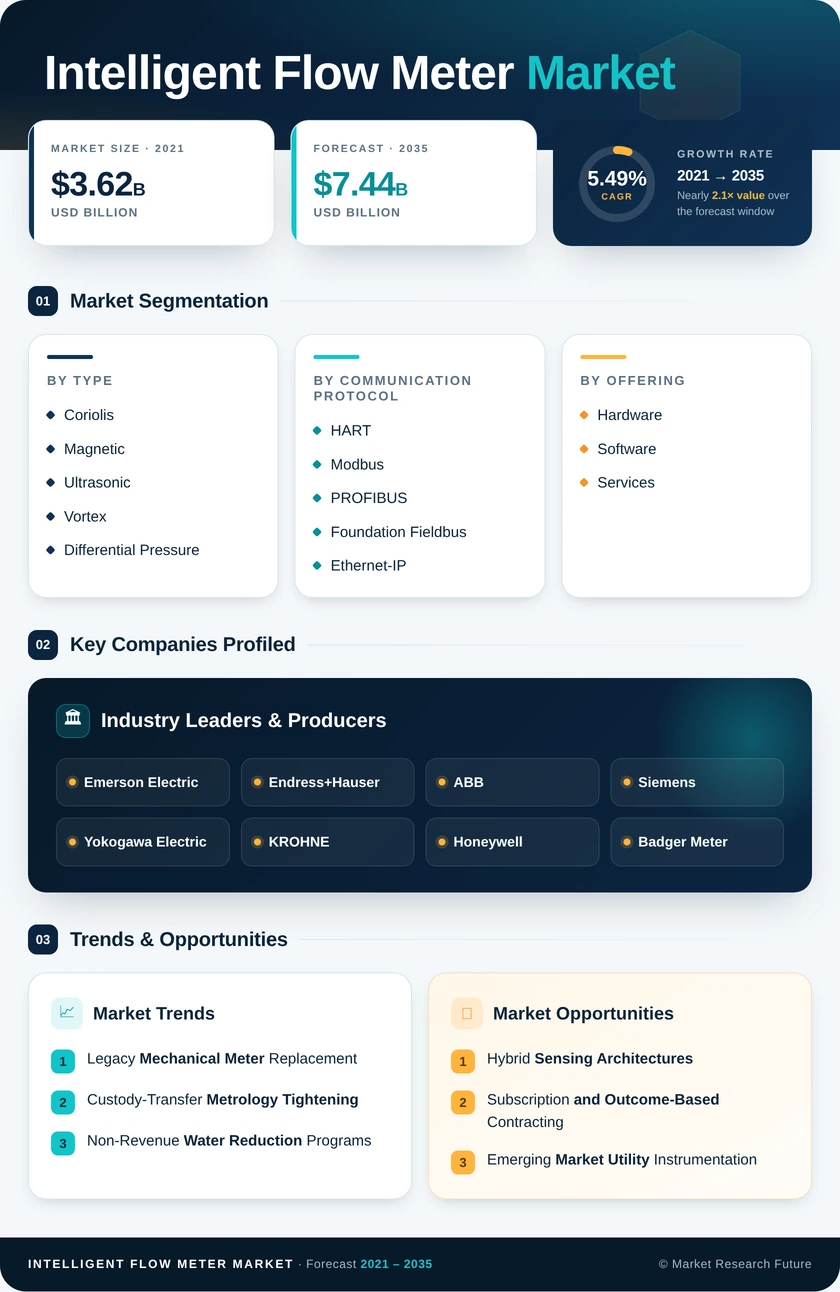
Segmentation Quick Reference
| Dimension | Sub-Segments | Dominant Segment | Fastest Growing Segment |
| By Type | Coriolis, Magnetic, Ultrasonic, Vortex, Differential Pressure, Turbine, Thermal, Multiphase, Others | Magnetic (24.4% share, 2025) | Multiphase (8.29% CAGR, 2026–2035) |
| By Communication Protocol | HART, Modbus, PROFIBUS, Foundation Fieldbus, Ethernet-IP, Others | HART (28.7% share, 2025) | Ethernet-IP (8.61% CAGR, 2026–2035) |
| By Offering | Hardware, Software, Services | Hardware (68.4% share, 2025) | Software (9.33% CAGR, 2026–2035) |
| By End-User Industry | Oil and Gas, Water and Wastewater, Pharmaceuticals and Life Sciences, Power Generation, Chemicals and Petrochemicals, Food and Beverage, Pulp and Paper, Metals and Mining, Others | Water and Wastewater (23.5% share, 2025) | Power Generation (7.94% CAGR, 2026–2035) |
Market Segmentation Overview
By Type
| Sub-Segment | Key Trend |
| Coriolis | Single-body mass, density, and temperature capture reduces leak paths in fiscal skids |
| Magnetic | Obstruction-free bore tolerates abrasive slurries without pressure loss |
| Ultrasonic | Clamp-on retrofit avoids shutdown on large-bore mains |
| Vortex | Wide 30:1 turndown with built-in energy calculation for steam service |
| Differential Pressure | Retained in refinery service where engineering practice is entrenched |
| Turbine | Clean-liquid batching and aviation fuel handling duty |
| Thermal | Compressed air auditing and flare gas monitoring |
| Multiphase | Wellhead three-phase measurement eliminating separator infrastructure |
| Others | Open-channel and leak-detection niches sustaining supplier diversity |
Magnetic devices lead this dimension at 24.4% of 2025 revenue because utilities standardised on them for potable-water billing and wastewater aeration basins, where a rugged, unobstructed bore survives grit that would destroy a turbine rotor. Multiphase grows fastest at an 8.29% CAGR, driven by offshore operators removing test separators from platforms where deck area carries extreme cost. Coriolis holds the highest value density in custody-transfer skids, since regulators tightening liquid hydrocarbon uncertainty toward ±0.15% leave mechanical alternatives unqualified. Hybrid mag-ultrasonic bodies are the innovation to watch, holding specification across both laminar and turbulent regimes.
By Communication Protocol
| Sub-Segment | Key Trend |
| HART | Diagnostics layered onto existing 4–20 mA loops without rewiring |
| Modbus | Straightforward integration with legacy PLC and SCADA infrastructure |
| PROFIBUS | Certified intrinsic-safety barriers already in place at European chemical sites |
| Foundation Fieldbus | Complex distributed control arrangements requiring additional crew training |
| Ethernet-IP | Flattened networks routing contextualised data into enterprise systems |
| Others | Wireless mesh and proprietary utility telemetry for remote assets |
HART holds 28.7% of 2025 revenue purely on installed-base inertia: millions of devices already speak it, and brownfield owners can add diagnostics without pulling a single new cable. Ethernet-IP is the fastest riser at an 8.61% CAGR as manufacturers collapse network layers and feed measurement directly into resource-planning suites. PROFIBUS persists in German and Benelux chemical parks where intrinsic-safety barrier certification is sunk cost that owners are reluctant to abandon. Ethernet-APL, offering 10 Mbit/s with Zone 0 compliance, will tip most new project bids toward IP-native connections during the forecast window.
By Offering
| Sub-Segment | Key Trend |
| Hardware | Meter bodies retained 10–15 years while electronics refresh every three to five |
| Software | Cloud analytics converting high-frequency samples into maintenance orders |
| Services | Remote calibration, spare-part pooling, and performance-based agreements |
Hardware anchors this dimension at 68.4% of 2025 revenue because meter bodies, sensors, and primary elements are long-lived capital assets that buyers depreciate over a decade or more. Software grows fastest at a 9.33% CAGR, since flow-computer applications reconciling readings against contractual tolerances now protect revenue directly rather than merely informing operations. Services sit between the two, expanding as plant managers outsource calibration scheduling instead of staffing it, particularly where instrumentation technician vacancies exceed 12%. The mix shift toward recurring revenue reshapes supplier valuation more than it changes unit shipments.
By End-User Industry
| Sub-Segment | Key Trend |
| Oil and Gas | Custody-transfer skid modernisation under tightened uncertainty limits |
| Water and Wastewater | Electromagnetic meters linked to GIS platforms flagging abnormal consumption |
| Pharmaceuticals and Life Sciences | Single-use Coriolis probes eliminating cleaning validation from changeover |
| Power Generation | Multivariable vortex and ultrasonic devices tuning steam and condenser performance |
| Chemicals and Petrochemicals | Reactor dosing precision supporting batch reproducibility |
| Food and Beverage | Hygienic design meeting recipe consistency and traceability requirements |
| Pulp and Paper | Stock consistency control and white-water recovery accounting |
| Metals and Mining | Abrasive slurry handling and process water balance reporting |
| Others | District heating, semiconductor ultrapure water, and marine bunkering |
Water and wastewater leads at 23.5% of 2025 spending, since leak-loss programmes and tightening discharge limits convert regulatory obligation into district-level meter counts that no other industry matches on volume. Power generation grows fastest at a 7.94% CAGR, installing multivariable devices in combined-cycle plants to fine-tune steam flows, maximise condenser vacuum, and support hydrogen-ready turbines. Oil and gas retains the highest average selling price on fiscal duty, while pharmaceutical clean-rooms adopt single-use probes that remove cross-batch contamination risk entirely. Renewables-linked demand from pumped storage and electrolyser membranes is the emerging swing factor.


 Noah Malgeri
Co-Founder

 Peter Groot koerkamp
Account and Business Manager

 Younghwan Choi
Senior Retail Manager

 Mark Irwin
Management Consultant

 Akif Moroglu
Strategy & Business Development Director

 Guilherme Gomes Martins
Product Management Director

 Joseph Aguayo
Sales Operations & Pricing Manager

 La Terria Dodd
Program Support Specialist

 Rob Kooiker
Group Product Manager HVAC & Fire Protection GMA