Request Free Sample ×

Kindly complete the form below to receive a free sample of this Report

* Please use a valid business email

Leading companies partner with us for data-driven Insights

clients tt-cursor
Hero Background
English
Chinese
French
Japanese
Korean
German
Spanish

Insulin Pump Market Analysis

ID: MRFR/HC/1106-CR
200 Pages
Nidhi Mandole
Last Updated: April 06, 2026

Insulin Pumps Market Research Report By Type (Tethered Insulin Pumps, Patch Insulin Pumps, Implantable Insulin Pumps), By Technology (Continuous Glucose Monitoring, Smart Insulin Pumps, Automated Insulin Delivery Systems), By End User (Adults, Children, Healthcare Providers), By Component (Insulin Delivery Devices, Infusion Sets, Software and Accessories) and By Regional (North America, Europe, South America, Asia Pacific, Middle East and Africa) -Forecast to 2035

Share:
Download PDF ×

We do not share your information with anyone. However, we may send you emails based on your report interest from time to time. You may contact us at any time to opt-out.

Insulin Pump Market Infographic
Purchase Options

Market Analysis

In-depth Analysis of Insulin Pump Market Industry Landscape

The market dynamics of insulin pumps are influenced by various factors that impact supply, demand, pricing, innovation, and regulation within the healthcare industry. Insulin pumps are medical devices used by individuals with diabetes to deliver insulin continuously, mimicking the function of the pancreas and helping to manage blood sugar levels effectively.

Supply in the insulin pumps market is primarily driven by advancements in technology, manufacturing capabilities, and regulatory compliance. Medical device companies invest in research and development to create innovative insulin pump systems that offer improved accuracy, convenience, and user experience. These companies also focus on ensuring the availability of high-quality pumps by adhering to stringent quality control standards and regulatory requirements, ensuring a steady supply of insulin pumps to meet the needs of individuals with diabetes worldwide.

On the demand side, several factors contribute to the need for insulin pumps. The increasing prevalence of diabetes, particularly type 1 diabetes, drives the demand for insulin pump therapy as an alternative to traditional insulin injections. Moreover, the rising awareness of the benefits of continuous glucose monitoring and insulin pump therapy among healthcare providers and patients encourages the adoption of insulin pumps as a preferred treatment option for better diabetes management. Additionally, advancements in insulin pump technology, such as integration with continuous glucose monitoring systems and smartphone connectivity, enhance the appeal and utility of insulin pumps, driving demand in the market.

Pricing dynamics in the insulin pumps market are influenced by factors such as pump features, brand reputation, competition, and healthcare economics. Advanced insulin pump systems with additional features such as automated insulin delivery, closed-loop systems, and remote monitoring capabilities may command higher prices due to their enhanced functionality and convenience. However, pricing pressures from healthcare payers, including insurers and government agencies, may impact reimbursement rates and limit the affordability of insulin pumps for individuals with diabetes.

Innovation plays a crucial role in shaping the market dynamics of insulin pumps. Medical device companies continually invest in research and development to develop new insulin pump technologies that address evolving clinical needs and patient preferences. Technological advancements such as artificial intelligence, machine learning algorithms, and sensor technologies enable the development of innovative insulin pump systems with improved accuracy, customization, and user interface, driving innovation within the industry and expanding the scope of insulin pump therapy.

Regulatory compliance is a significant consideration for companies operating in the insulin pumps market. Insulin pumps are classified as medical devices and are subject to regulatory oversight by agencies such as the FDA in the United States and similar authorities worldwide. Compliance with regulatory requirements ensures the safety, efficacy, and quality of insulin pump systems, instilling confidence in healthcare providers and patients.

Market competition in the insulin pumps industry is intense, with several established players and emerging companies vying for market share. Established insulin pump manufacturers leverage their experience, brand reputation, and global distribution networks to maintain a competitive edge. Meanwhile, smaller companies focus on niche markets, innovative product offerings, and strategic partnerships to differentiate themselves and gain market traction.

Geopolitical factors also influence the market dynamics of insulin pumps. Healthcare policies, government funding, and public health initiatives impact the demand for diabetes management solutions and insulin pumps in different regions. Moreover, regional variations in diabetes prevalence, healthcare infrastructure, and regulatory environments create diverse market conditions and opportunities for insulin pump manufacturers.


Author
Author Profile
Nidhi Mandole
Senior Research Analyst

She is an extremely curious individual currently working in Healthcare and Medical Devices Domain. Nidhi is comfortably versed in data centric research backed by healthcare educational background. She leverages extensive data mining and analytics tools such as Primary and Secondary Research, Statistical Analysis, Machine Learning, Data Modelling. Her key role also involves Technical Sales Support, Client Interaction and Project management within the Healthcare team. Lastly, she showcases extensive affinity towards learning new skills and remain fascinated in implementing them.

Leave a Comment

FAQs

What is the current valuation of the Insulin Pumps Market as of 2024?

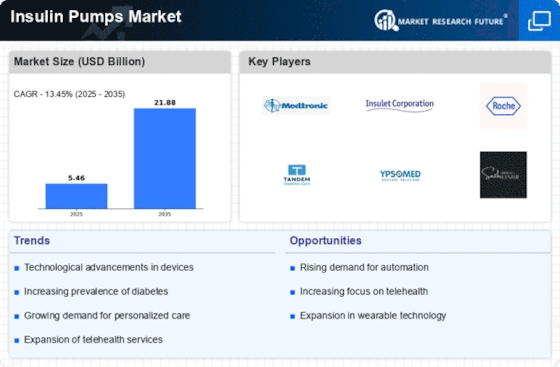
The market was valued at 5.46 USD Billion in 2024.

What is the projected market size for the Insulin Pumps Market by 2035?

<p>The market is projected to reach 21.88 USD Billion by 2035.</p>

What is the expected CAGR for the market during the forecast period 2025 - 2035?

The expected CAGR for the Insulin Pumps Market during 2025 - 2035 is 13.45%.

Which companies are considered key players in the market?

Key players include Medtronic, Insulet Corporation, Roche Diabetes Care, Tandem Diabetes Care, Ypsomed, Smiths Medical, A. Menarini Diagnostics, and B. Braun Melsungen AG.

What are the market segments for Insulin Pumps based on type?

<p>The market segments based on type include Tethered Insulin Pumps, Patch Insulin Pumps, and Implantable Insulin Pumps.</p>

What was the market valuation for Tethered Insulin Pumps in 2024?

<p>The market valuation for Tethered Insulin Pumps was 2.18 USD Billion in 2024.</p>

How much is the market for Smart Insulin Pumps expected to grow by 2035?

<p>The market for Smart Insulin Pumps is projected to grow to 9.12 USD Billion by 2035.</p>

What is the expected market size for Continuous Glucose Monitoring technology by 2035?

<p>The expected market size for Continuous Glucose Monitoring technology is 6.72 USD Billion by 2035.</p>

What segment of end users is projected to have the highest market valuation by 2035?

<p>Adults are projected to have the highest market valuation at 10.95 USD Billion by 2035.</p>

What components are included in the Insulin Pumps Market?

<p>Components include Insulin Delivery Devices, Infusion Sets, and Software and Accessories.</p>

Market Summary

According to Market Research Future Reports analysis, the Insulin Pumps Market size was valued at USD 6.4 Billion in 2024. The market is projected to grow from USD 6.194 Billion in 2025 to USD 7.0 Billion by 2035, registering a CAGR of 9.0% during the forecast 2025–2035. North America led the market with a 39% share, generating around USD 2.5 billion in revenue.
 
Rising global prevalence of diabetes and increasing demand for advanced, user-friendly insulin delivery systems are key growth drivers in the market. Technological innovations and improved patient awareness are accelerating adoption of continuous and automated insulin management solutions worldwide.
 
According to the International Diabetes Federation, over 537 million adults live with diabetes globally, projected to reach 643 million by 2030, significantly increasing demand for insulin delivery technologies like pumps to improve glycemic control and long-term health outcomes.

Key Market Trends & Highlights

The Insulin Pumps Market is experiencing robust growth driven by technological advancements and increasing demand for personalized diabetes management.

  • North America leads with 39% share in 2024, supported by high diabetes prevalence and strong healthcare infrastructure. Europe valued at USD 1.8 billion in 2024, projected to reach USD 3.5 billion by 2035. Over 537 million adults globally live with diabetes, significantly driving demand for advanced insulin pump technologies and automated delivery systems. Continuous glucose monitoring adoption increased by over 40%, accelerating integration with smart insulin pumps for improved diabetes management outcomes.

Market Size & Forecast

2025 Market Size 6.4 (USD Billion)
2035 Market Size 7.0 (USD Billion)
CAGR (2025 - 2035) 9.0%
Largest Regional Market Share in 2025 North America

Major Players

Companies such as <a href="https://www.medtronic.com/en-us/healthcare-professionals/products.html">Medtronic </a>(US), Insulet Corporation (US), <a href="https://www.roche.com/innovation/partnering/areas-of-interest/diabetes-management">Roche Diabetes Care</a> (DE), Tandem Diabetes Care (US), Ypsomed (CH), Smiths Medical (US), A. Menarini Diagnostics (IT), B. Braun Melsungen AG (DE) are some of the major participants in the global market.

Market Trends

The Insulin Pumps Market is currently experiencing a transformative phase, characterized by advancements in technology and a growing emphasis on personalized diabetes management. The integration of smart technology into insulin delivery systems appears to enhance user experience, providing real-time data and improved insulin dosing accuracy.

This shift towards more sophisticated devices suggests a potential increase in patient adherence and overall health outcomes. Furthermore, the rising prevalence of diabetes globally is likely to drive demand for innovative solutions, as individuals seek more effective ways to manage their condition. 

In addition, the market is witnessing a trend towards increased accessibility and affordability. Diabetes pump companies are exploring various strategies to reduce insulin machine prices, making these devices more attainable for a broader range of patients. This focus on affordability, coupled with educational initiatives aimed at raising awareness about the benefits of insulin pumps, may contribute to a more informed patient population. As the insulin patch pumps market evolves, it seems poised for significant growth, driven by technological advancements and a commitment to improving diabetes care.

Technological Advancements

The Insulin Pumps Market is seeing rapid technological innovations, including the development of hybrid closed-loop systems. These devices automatically adjust insulin delivery based on continuous glucose monitoring, potentially improving glycemic control and reducing the burden on users.

Data from the Centers for Disease Control and Prevention indicates that continuous glucose monitoring adoption has increased by over 40% among diabetes patients, supporting integration with automated insulin pumps and improving glycemic control, reducing complications and enhancing patient outcomes.

Personalized Diabetes Management

There is a noticeable shift towards personalized approaches in diabetes care. Insulin pumps are increasingly being tailored to meet individual patient needs, allowing for customized insulin delivery patterns that align with lifestyle and dietary habits.

According to the World Health Organization, diabetes affects over 422 million people globally, encouraging personalized treatment approaches, where customized insulin delivery systems improve adherence, optimize glucose control, and reduce risks of complications through patient-specific therapy plans.

Increased Accessibility

Efforts to enhance accessibility are becoming more pronounced within the Insulin Pumps Market. Manufacturers are focusing on reducing costs and improving insurance coverage, which may facilitate wider adoption among diverse patient populations.

The Pan American Health Organization reports expanding universal health coverage initiatives across the Americas, with over 70% population coverage in several countries, improving access to essential diabetes care technologies such as insulin pumps and enhancing treatment adoption rates.

Insulin Pump Market Market Drivers

Rising Prevalence of Diabetes

The increasing incidence of diabetes worldwide is a primary driver for the Insulin Pumps Market. According to recent statistics, the number of individuals diagnosed with diabetes is projected to reach 700 million by 2045. This alarming trend necessitates effective management solutions, such as insulin pumps, which offer precise insulin delivery and improved glycemic control.
 
As more patients seek advanced treatment options, the demand for insulin pumps is likely to surge. Furthermore, the growing awareness of diabetes management among healthcare professionals and patients alike contributes to the expansion of the market. The need for innovative solutions to combat diabetes complications further emphasizes the importance of insulin pumps in modern healthcare.

Increasing Healthcare Expenditure

The rise in healthcare expenditure across various regions is propelling the Insulin Pumps Market. Governments and private sectors are investing more in diabetes care, recognizing the long-term benefits of effective management solutions. In many countries, healthcare spending on diabetes management is expected to increase by 5% annually, reflecting a growing commitment to improving patient outcomes.
 
This financial support facilitates access to advanced treatment options, including insulin pumps, which are often more expensive than traditional insulin delivery methods. As healthcare systems prioritize chronic disease management, the market is likely to benefit from increased funding and resources dedicated to diabetes care.

Growing Demand for Personalized Medicine

The shift towards personalized medicine is a notable driver for the Insulin Pumps Market. Patients are increasingly seeking tailored treatment plans that cater to their specific needs and lifestyles. Insulin pumps offer customizable settings, allowing users to adjust insulin delivery based on their daily activities, dietary habits, and glucose levels.
 
This personalization enhances patient adherence and satisfaction, leading to better health outcomes. The market for personalized diabetes management solutions is projected to grow significantly, with insulin pumps playing a crucial role in this transformation. As healthcare providers embrace individualized treatment approaches, the market is expected to expand in response to this demand.

Rising Awareness and Education Initiatives

The growing awareness of diabetes management and education initiatives is driving the Insulin Pumps Market. Various organizations and healthcare providers are actively promoting diabetes education, emphasizing the importance of effective management strategies. Increased awareness leads to higher rates of diagnosis and treatment, as patients become more informed about their options.
 
In recent years, educational programs have reached millions, highlighting the benefits of insulin pumps in achieving better glycemic control. As more individuals recognize the advantages of using insulin pumps, the demand for these devices is likely to rise. This trend underscores the critical role of education in shaping the market.

Technological Innovations in Insulin Delivery

Technological advancements in insulin delivery systems are significantly influencing the Insulin Pumps Market. Innovations such as smart insulin pumps, which integrate continuous glucose monitoring (CGM) systems, are enhancing patient experience and outcomes. These devices allow for real-time data analysis and automated insulin delivery adjustments, thereby reducing the risk of hypoglycemia and hyperglycemia.
 
The market for insulin pumps is expected to grow as manufacturers invest in research and development to create more sophisticated devices. In 2023, the insulin pump segment accounted for approximately 30% of the overall diabetes care market, indicating a robust demand for these advanced technologies. As technology continues to evolve, the market is poised for further growth.

Market Segment Insights

By Type: Tethered Insulin Pumps (Largest) vs. Patch Insulin Pumps (Fastest-Growing)

In the Insulin Pumps Market, tethered insulin pumps account for the largest share at 58%, reflecting their strong adoption and consistent performance in insulin delivery. This traditional type of pump connects to the patient through a tube and has been the preferred choice among many users due to its reliability and continuous performance. In contrast, patch insulin pumps, which are worn on the skin and deliver insulin without external tubing, are emerging swiftly, capturing a growing portion of the insulin pump market as users seek more convenient options.

Tethered (Dominant) vs. Patch (Emerging)

Tethered insulin pumps are characterized by their established presence in the insulin pump market, offering features such as customizable basal rates and bolus delivery, making them ideal for patients requiring rigorous insulin management. Meanwhile, patch insulin pumps are gaining traction due to their ease of use and discretion, appealing to users who prioritize mobility and a less obtrusive insulin delivery method. As these devices evolve, innovations in design and technology are positioning patches as a formidable competitor, especially among younger demographics.

By Technology: Smart Insulin Pumps (Largest) vs. Automated Insulin Delivery Systems (Fastest-Growing)

In the Insulin Pumps Market, the technology segment reveals distinct preferences among users. Smart insulin pumps lead the market with a 52% share, driven by strong demand for their advanced features, user-friendly design, and seamless connectivity capabilities. These pumps seamlessly integrate with <a href="https://captainhook.onshape.com/reports/mobile-application-market-4497" target="_blank" title="mobile application">mobile applications</a>, enhancing user experience. On the other hand, Automated Insulin Delivery Systems are emerging rapidly, catering to advanced patient needs with automated functions that ensure better glucose control. This growing popularity highlights a significant shift towards technology-driven solutions in diabetes management. The growth trends in this segment are influenced by several factors, including increased diabetes prevalence and advancements in technology. As patients seek more efficient management tools, the demand for both Smart Insulin Pumps and Automated Insulin Delivery Systems is expected to surge. The collaboration between technology companies and healthcare providers is further driving innovation, leading to the development of smarter, more effective solutions to improve patient outcomes in insulin delivery systems.

Technology: Smart Insulin Pumps (Dominant) vs. Automated Insulin Delivery Systems (Emerging)

Smart Insulin Pumps are currently the dominant technology in the insulin delivery market due to their cutting-edge features, such as wireless connectivity and data sharing capabilities. These pumps enable users to track glucose levels effectively and make real-time adjustments to their insulin intake. They cater to the lifestyle needs of users, promoting adherence and improving overall diabetes management. On the other hand, Automated Insulin Delivery Systems represent an emerging market trend focused on enhancing patient autonomy. These systems utilize sophisticated algorithms to automatically adjust insulin delivery based on continuous glucose monitoring data. As technology evolves, healthcare providers are increasingly incorporating these automated systems in treatment plans, given their potential to minimize human error and optimize diabetes management.

By End User: Adults (Largest) vs. Children (Fastest-Growing)

The Insulin Pumps Market is significantly influenced by its end-user segments, primarily comprising Adults, Children, and Healthcare Providers. Adults account for the largest segment with a 64% share, driven by the rising prevalence of diabetes and the growing need for effective glucose management solutions. As adult patients prioritize convenient and technologically advanced insulin delivery options, this segment enjoys a substantial share of the insulin pump market, catering to a broad demographic that values independence and efficacy in managing their condition.<br>On the other hand, the Children segment is emerging as the fastest-growing category within the Insulin Pumps Market. This growth can be attributed to the rising awareness among parents and healthcare systems about the benefits of insulin pumps for pediatric patients. As diabetes cases in children surge, coupled with innovations designed specifically for younger users, this segment is witnessing rapid adoption, paving the way for new product developments tailored to their unique needs

Adults (Dominant) vs. Children (Emerging)

The Adults segment in the Insulin Pumps Market is characterized by a diverse group of users ranging from young adults to seniors. This segment's dominant position is bolstered by the availability of advanced insulin pump technologies that cater to the specific needs of adults, such as customizable insulin delivery and continuous glucose monitoring. Additionally, adult users often prefer devices that offer a blend of functionality, comfort, and lifestyle compatibility, making them more likely to choose insulin pumps over traditional methods. In contrast, the Children segment is rapidly emerging as a crucial focus area for manufacturers of insulin pumps. Designed for younger patients, these pumps often come with features that cater to the needs of children and their parents, including easier navigation, fun designs, and educational components. The growing prevalence of Type 1 diabetes in children is driving demand for these products, leading insulin pumps companies to innovate and adapt their offerings to attract this vital demographic.

By Component: Insulin Delivery Devices (Largest) vs. Infusion Sets (Fastest-Growing)

The Insulin Pumps Market is experiencing a dynamic distribution among its core components, namely <a title="insulin delivery devices" href="https://www.marketresearchfuture.com/reports/insulin-delivery-devices-market-851" target="_blank" rel="noopener">Insulin Delivery Devices</a>, Infusion Sets, and Software and Accessories. Insulin Delivery devices lead the market with a 55% share, driven by their essential role in diabetes management through consistent, precise, and controlled insulin delivery. Infusion Sets are rapidly gaining traction, recognized for their convenience and improved patient adherence, while software and accessories represent a smaller yet essential segment, enhancing the functionality of insulin pumps.

Insulin Delivery Devices (Dominant) vs. Infusion Sets (Emerging)

Insulin Delivery Devices serve as the backbone of the insulin pump ecosystem, incorporating advanced technologies that ensure precise dosages and timely administration of insulin, appealing to both Type 1 and Type 2 diabetes patients. The devices continue to evolve with integration of wireless communication capabilities, making them more user-friendly. Conversely, Infusion Sets, while considered emerging in comparison, are experiencing accelerated growth. They provide critical connectivity for insulin delivery and are witnessing innovations aimed at improving comfort and minimizing complications. The emphasis on ease of use and reduced risk of infection enhances their appeal, making them an attractive option for patients and providers alike.

Get more detailed insights about Insulin Pumps Market Research Report-Forecast to 2035

Regional Insights

The Insulin Pumps Market exhibits a notable regional distribution, with North America leading the insulin patch pump market valuation at 3.2 USD Billion in 2024 and projected to reach 6.0 USD Billion by 2035, reflecting the region's majority holding due to high diabetes prevalence and advanced healthcare infrastructure. Europe follows, valued at 1.8 USD Billion in 2024 and anticipated to grow to 3.5 USD Billion by 2035, influenced by increasing awareness of diabetes management.

The APAC region is witnessing significant growth, valued at 1.25 USD Billion in 2024 and expected to reach 2.4 USD Billion by 2035, driven by rising healthcare investments and a growing diabetic population.

South America and the MEA regions represent smaller market shares, with valuations of 0.15 USD Billion and 0.17 USD Billion in 2024, respectively, although both areas are expected to double by 2035. The growth drivers across these regions include technological advancements in insulin pump devices, increasing adoption rates, and favorable reimbursement policies. However, challenges such as reducing insulin machine prices and varying healthcare standards exist, especially in emerging markets. Opportunities lie in the expansion of distribution networks and increasing collaborations among insulin pumps brands, contributing to overall Insulin Pumps Market revenue growth.

Key Players and Competitive Insights

The Insulin Pumps Market demonstrates a dynamic landscape characterized by continuous innovation and competition among various insulin pump manufacturers. As the prevalence of diabetes continues to increase globally, the demand for advanced insulin delivery systems grows correspondingly.
 
This surge has prompted insulin pumps brands to invest in research and development to provide more efficient and user-friendly products, such as smart insulin pumps that integrate with mobile applications and continuous glucose monitoring systems. The competitive insights reveal not only the innovative strides taken by these insulin pumps brands but also the various strategies employed to secure a larger market share.
 
Collaborations, strategic alliances, and an emphasis on customer feedback play crucial roles in enhancing product offerings. At the same time, regulatory compliance and market entry barriers significantly influence competitive dynamics as insulin pump companies strive to establish their presence across different geographic regions.
 
Abbott Laboratories, a key insulin pump company, has established a significant footprint in the Insulin Pumps Market with its advanced medical technology and strong commitment to innovation. The company is well-respected for its focus on improving diabetes management through novel product offerings that promote better glycemic control. Abbott Laboratories leverages its robust research capabilities to deliver cutting-edge insulin delivery systems that cater to diverse patient needs, enhancing user experience and compliance.
 
Their strategic marketing efforts and dedication to customer education further bolster their position in the insulin patch pump market, enabling them to cultivate meaningful relationships with healthcare providers and patients alike.
By capitalizing on its brand strength and technological prowess, Abbott Laboratories continues to be a formidable player in the global arena of insulin pump technology.
 
Insulet Corporation has carved out a strong presence within the Insulin Pumps Market, primarily known for its Omnipod Insulin Management System, which is recognized for its innovative design and user-friendly features. The company's focus on creating tubeless insulin delivery solutions has positioned it favorably among users looking for ease and flexibility. Insulet Corporation's growth is driven by continuous product enhancements and a commitment to customer needs, leading to high user satisfaction and loyalty.
 
The company's strategic partnerships and collaborations with healthcare professionals allow it to stay ahead of market trends and integrate feedback into product development effectively.
Moreover, Insulet has actively pursued mergers and acquisitions to expand its capabilities and product offerings, enhancing its competitive edge in the global marketplace. This approach not only fuels its innovation pipeline but also cements its status as a key player in the diabetes management landscape on a global scale.

Key Companies in the Insulin Pump Market include

Industry Developments

Recent developments in the market have showcased significant advancements and expansions. For instance, in September 2023, Medtronic, an important insulin pump company, announced the expansion of its insulin pump portfolio, featuring enhanced features aimed at improving diabetes management for users globally. Additionally, in August 2023, Insulet Corporation reported strong financial growth, attributing its success to the increasing adoption of its Omnipod insulin management systems, which exemplifies the rising demand for convenient diabetes care solutions.

In terms of mergers and acquisitions, in April 2023, Eli Lilly and Company acquired a stake in a digital health company focused on diabetes management apps, strategic for synergizing technologies in this competitive market. This year also observed Abbott Laboratories strengthening collaboration with various healthcare providers to advance diabetes care technology.

Increasing valuations of insulin pumps brands such as Dexcom and Medtronic underline the growing insulin patch pump market potential, with projected valuations expected to rise due to advancements in technology and the increasing prevalence of diabetes globally. Over the last few years, notable events have included the launch of innovative features in insulin delivery devices, enhancing patient experiences and outcomes.

Future Outlook

Insulin Pump Market Future Outlook

The Insulin Pumps Market size is projected to reach USD 7.0 Billion by 2035, growing at a CAGR of 9.0%, driven by technological advancements, increasing diabetes prevalence, and rising patient awareness.

New opportunities lie in:

  • <p>Development of integrated digital health platforms for real-time monitoring. Expansion into emerging markets with affordable insulin pump solutions. Partnerships with healthcare providers for comprehensive diabetes management programs.</p>

By 2035, the Insulin Pumps Market is expected to be robust, reflecting substantial growth and innovation.

Market Segmentation

Insulin Pump Market Type Outlook

  • Tethered Insulin Pumps
  • Patch Insulin Pumps
  • Implantable Insulin Pumps

Insulin Pump Market Product Outlook

  • MiniMed
  • Accu-Chek
  • Tandem
  • Omnipod
  • MyLife Omnipod
  • Others

Insulin Pump Market End User Outlook

  • Hospitals & clinics
  • Homecare
  • Laboratories

Insulin Pump Market Regional Outlook

  • North America
  • Europe
  • Asia-Pacific
  • Latin America
  • Middle East & Africa

Insulin Pump Market Component Outlook

  • Insulin Delivery Devices
  • Infusion Sets
  • Software and Accessories

Insulin Pump Market Technology Outlook

  • Continuous Glucose Monitoring
  • Smart Insulin Pumps
  • Automated Insulin Delivery Systems

Insulin Pump Market Accessories Outlook

  • Insulin reservoir or cartridges
  • Insulin set insertion devices
  • Battery

Report Scope

MARKET SIZE 2025  6.4 (USD Billion)
MARKET SIZE 2025 6.194(USD Billion)
MARKET SIZE 2035 7.0 (USD Billion)
COMPOUND ANNUAL GROWTH RATE (CAGR) 9.0% (2025 - 2035)
REPORT COVERAGE Revenue Forecast, Competitive Landscape, Growth Factors, and Trends
BASE YEAR 2025 
Market Forecast Period 2025 - 2035
Historical Data 2019 - 2025 
Market Forecast Units USD Billion
Key Companies Profiled Medtronic (US), Insulet Corporation (US), Roche Diabetes Care (DE), Tandem Diabetes Care (US), Ypsomed (CH), Smiths Medical (US), A. Menarini Diagnostics (IT), B. Braun Melsungen AG (DE)
Segments Covered Type, Technology, End User, Component, Regional
Key Market Opportunities Integration of advanced digital health technologies enhances patient engagement in the market.
Key Market Dynamics Technological advancements and regulatory changes drive innovation and competition in the market.
Countries Covered North America, Europe, APAC, South America, MEA

FAQs

What is the current valuation of the Insulin Pumps Market as of 2024?

The market was valued at 5.46 USD Billion in 2024.

What is the projected market size for the Insulin Pumps Market by 2035?

<p>The market is projected to reach 21.88 USD Billion by 2035.</p>

What is the expected CAGR for the market during the forecast period 2025 - 2035?

The expected CAGR for the Insulin Pumps Market during 2025 - 2035 is 13.45%.

Which companies are considered key players in the market?

Key players include Medtronic, Insulet Corporation, Roche Diabetes Care, Tandem Diabetes Care, Ypsomed, Smiths Medical, A. Menarini Diagnostics, and B. Braun Melsungen AG.

What are the market segments for Insulin Pumps based on type?

<p>The market segments based on type include Tethered Insulin Pumps, Patch Insulin Pumps, and Implantable Insulin Pumps.</p>

What was the market valuation for Tethered Insulin Pumps in 2024?

<p>The market valuation for Tethered Insulin Pumps was 2.18 USD Billion in 2024.</p>

How much is the market for Smart Insulin Pumps expected to grow by 2035?

<p>The market for Smart Insulin Pumps is projected to grow to 9.12 USD Billion by 2035.</p>

What is the expected market size for Continuous Glucose Monitoring technology by 2035?

<p>The expected market size for Continuous Glucose Monitoring technology is 6.72 USD Billion by 2035.</p>

What segment of end users is projected to have the highest market valuation by 2035?

<p>Adults are projected to have the highest market valuation at 10.95 USD Billion by 2035.</p>

What components are included in the Insulin Pumps Market?

<p>Components include Insulin Delivery Devices, Infusion Sets, and Software and Accessories.</p>

  1. SECTION I: EXECUTIVE SUMMARY AND KEY HIGHLIGHTS |
    1. EXECUTIVE SUMMARY | |
      1. Market Overview | |
      2. Key Findings | |
      3. Market Segmentation | |
      4. Competitive Landscape | |
      5. Challenges and Opportunities | |
      6. Future Outlook 2
  2. SECTION II: SCOPING, METHODOLOGY AND MARKET STRUCTURE |
    1. MARKET INTRODUCTION | |
      1. Definition | |
      2. Scope of the study | | |
    2. RESEARCH METHODOLOGY | |
      1. Overview | |
      2. Data Mining | |
      3. Secondary Research | |
      4. Primary Research | | |
      5. Forecasting Model | |
      6. Market Size Estimation | | |
      7. Data Triangulation | |
      8. Validation 3
  3. SECTION III: QUALITATIVE ANALYSIS |
    1. MARKET DYNAMICS | |
      1. Overview | |
      2. Drivers | |
      3. Restraints | |
      4. Opportunities |
    2. MARKET FACTOR ANALYSIS | |
      1. Value chain Analysis | |
      2. Porter's Five Forces Analysis | | |
      3. COVID-19 Impact Analysis | | |
  4. SECTION IV: QUANTITATIVE ANALYSIS |
    1. Healthcare, BY Type (USD Billion) | |
      1. Tethered Insulin Pumps | |
      2. Patch Insulin Pumps | |
      3. Implantable Insulin Pumps |
    2. Healthcare, BY Technology (USD Billion) | |
      1. Continuous Glucose Monitoring | |
      2. Smart Insulin Pumps | |
      3. Automated Insulin Delivery Systems |
    3. Healthcare, BY End User (USD Billion) | |
      1. Adults | |
      2. Children | |
      3. Healthcare Providers |
    4. Healthcare, BY Component (USD Billion) | |
      1. Insulin Delivery Devices | |
      2. Infusion Sets | |
      3. Software and Accessories |
    5. Healthcare, BY Region (USD Billion) | |
      1. North America | | |
      2. Europe | | |
      3. APAC | | |
      4. South America | | |
      5. MEA | | |
  5. SECTION V: COMPETITIVE ANALYSIS |
    1. Competitive Landscape | |
      1. Overview | |
      2. Competitive Analysis | |
      3. Market share Analysis | |
      4. Major Growth Strategy in the Healthcare | |
      5. Competitive Benchmarking | |
      6. Leading Players in Terms of Number of Developments in the Healthcare | |
      7. Key developments and growth strategies | | |
      8. Major Players Financial Matrix | | |
    2. Company Profiles | |
      1. Medtronic (US) | | |
      2. Insulet Corporation (US) | | |
      3. Roche Diabetes Care (DE) | | |
      4. Tandem Diabetes Care (US) | | |
      5. Ypsomed (CH) | | |
      6. Smiths Medical (US) | | |
      7. A. Menarini Diagnostics (IT) | | |
      8. B. Braun Melsungen AG (DE) | | |
    3. Appendix | |
      1. References | |
      2. Related Reports 6 LIST OF FIGURES |
    4. MARKET SYNOPSIS |
    5. NORTH AMERICA MARKET ANALYSIS |
    6. US MARKET ANALYSIS BY TYPE |
    7. US MARKET ANALYSIS BY TECHNOLOGY |
    8. US MARKET ANALYSIS BY END USER |
    9. US MARKET ANALYSIS BY COMPONENT |
    10. CANADA MARKET ANALYSIS BY TYPE |
    11. CANADA MARKET ANALYSIS BY TECHNOLOGY |
    12. CANADA MARKET ANALYSIS BY END USER |
    13. CANADA MARKET ANALYSIS BY COMPONENT |
    14. EUROPE MARKET ANALYSIS |
    15. GERMANY MARKET ANALYSIS BY TYPE |
    16. GERMANY MARKET ANALYSIS BY TECHNOLOGY |
    17. GERMANY MARKET ANALYSIS BY END USER |
    18. GERMANY MARKET ANALYSIS BY COMPONENT |
    19. UK MARKET ANALYSIS BY TYPE |
    20. UK MARKET ANALYSIS BY TECHNOLOGY |
    21. UK MARKET ANALYSIS BY END USER |
    22. UK MARKET ANALYSIS BY COMPONENT |
    23. FRANCE MARKET ANALYSIS BY TYPE |
    24. FRANCE MARKET ANALYSIS BY TECHNOLOGY |
    25. FRANCE MARKET ANALYSIS BY END USER |
    26. FRANCE MARKET ANALYSIS BY COMPONENT |
    27. RUSSIA MARKET ANALYSIS BY TYPE |
    28. RUSSIA MARKET ANALYSIS BY TECHNOLOGY |
    29. RUSSIA MARKET ANALYSIS BY END USER |
    30. RUSSIA MARKET ANALYSIS BY COMPONENT |
    31. ITALY MARKET ANALYSIS BY TYPE |
    32. ITALY MARKET ANALYSIS BY TECHNOLOGY |
    33. ITALY MARKET ANALYSIS BY END USER |
    34. ITALY MARKET ANALYSIS BY COMPONENT |
    35. SPAIN MARKET ANALYSIS BY TYPE |
    36. SPAIN MARKET ANALYSIS BY TECHNOLOGY |
    37. SPAIN MARKET ANALYSIS BY END USER |
    38. SPAIN MARKET ANALYSIS BY COMPONENT |
    39. REST OF EUROPE MARKET ANALYSIS BY TYPE |
    40. REST OF EUROPE MARKET ANALYSIS BY TECHNOLOGY |
    41. REST OF EUROPE MARKET ANALYSIS BY END USER |
    42. REST OF EUROPE MARKET ANALYSIS BY COMPONENT |
    43. APAC MARKET ANALYSIS |
    44. CHINA MARKET ANALYSIS BY TYPE |
    45. CHINA MARKET ANALYSIS BY TECHNOLOGY |
    46. CHINA MARKET ANALYSIS BY END USER |
    47. CHINA MARKET ANALYSIS BY COMPONENT |
    48. INDIA MARKET ANALYSIS BY TYPE |
    49. INDIA MARKET ANALYSIS BY TECHNOLOGY |
    50. INDIA MARKET ANALYSIS BY END USER |
    51. INDIA MARKET ANALYSIS BY COMPONENT |
    52. JAPAN MARKET ANALYSIS BY TYPE |
    53. JAPAN MARKET ANALYSIS BY TECHNOLOGY |
    54. JAPAN MARKET ANALYSIS BY END USER |
    55. JAPAN MARKET ANALYSIS BY COMPONENT |
    56. SOUTH KOREA MARKET ANALYSIS BY TYPE |
    57. SOUTH KOREA MARKET ANALYSIS BY TECHNOLOGY |
    58. SOUTH KOREA MARKET ANALYSIS BY END USER |
    59. SOUTH KOREA MARKET ANALYSIS BY COMPONENT |
    60. MALAYSIA MARKET ANALYSIS BY TYPE |
    61. MALAYSIA MARKET ANALYSIS BY TECHNOLOGY |
    62. MALAYSIA MARKET ANALYSIS BY END USER |
    63. MALAYSIA MARKET ANALYSIS BY COMPONENT |
    64. THAILAND MARKET ANALYSIS BY TYPE |
    65. THAILAND MARKET ANALYSIS BY TECHNOLOGY |
    66. THAILAND MARKET ANALYSIS BY END USER |
    67. THAILAND MARKET ANALYSIS BY COMPONENT |
    68. INDONESIA MARKET ANALYSIS BY TYPE |
    69. INDONESIA MARKET ANALYSIS BY TECHNOLOGY |
    70. INDONESIA MARKET ANALYSIS BY END USER |
    71. INDONESIA MARKET ANALYSIS BY COMPONENT |
    72. REST OF APAC MARKET ANALYSIS BY TYPE |
    73. REST OF APAC MARKET ANALYSIS BY TECHNOLOGY |
    74. REST OF APAC MARKET ANALYSIS BY END USER |
    75. REST OF APAC MARKET ANALYSIS BY COMPONENT |
    76. SOUTH AMERICA MARKET ANALYSIS |
    77. BRAZIL MARKET ANALYSIS BY TYPE |
    78. BRAZIL MARKET ANALYSIS BY TECHNOLOGY |
    79. BRAZIL MARKET ANALYSIS BY END USER |
    80. BRAZIL MARKET ANALYSIS BY COMPONENT |
    81. MEXICO MARKET ANALYSIS BY TYPE |
    82. MEXICO MARKET ANALYSIS BY TECHNOLOGY |
    83. MEXICO MARKET ANALYSIS BY END USER |
    84. MEXICO MARKET ANALYSIS BY COMPONENT |
    85. ARGENTINA MARKET ANALYSIS BY TYPE |
    86. ARGENTINA MARKET ANALYSIS BY TECHNOLOGY |
    87. ARGENTINA MARKET ANALYSIS BY END USER |
    88. ARGENTINA MARKET ANALYSIS BY COMPONENT |
    89. REST OF SOUTH AMERICA MARKET ANALYSIS BY TYPE |
    90. REST OF SOUTH AMERICA MARKET ANALYSIS BY TECHNOLOGY |
    91. REST OF SOUTH AMERICA MARKET ANALYSIS BY END USER |
    92. REST OF SOUTH AMERICA MARKET ANALYSIS BY COMPONENT |
    93. MEA MARKET ANALYSIS |
    94. GCC COUNTRIES MARKET ANALYSIS BY TYPE |
    95. GCC COUNTRIES MARKET ANALYSIS BY TECHNOLOGY |
    96. GCC COUNTRIES MARKET ANALYSIS BY END USER |
    97. GCC COUNTRIES MARKET ANALYSIS BY COMPONENT |
    98. SOUTH AFRICA MARKET ANALYSIS BY TYPE |
    99. SOUTH AFRICA MARKET ANALYSIS BY TECHNOLOGY |
    100. SOUTH AFRICA MARKET ANALYSIS BY END USER |
    101. SOUTH AFRICA MARKET ANALYSIS BY COMPONENT |
    102. REST OF MEA MARKET ANALYSIS BY TYPE |
    103. REST OF MEA MARKET ANALYSIS BY TECHNOLOGY |
    104. REST OF MEA MARKET ANALYSIS BY END USER |
    105. REST OF MEA MARKET ANALYSIS BY COMPONENT |
    106. KEY BUYING CRITERIA OF HEALTHCARE |
    107. RESEARCH PROCESS OF MRFR |
    108. DRO ANALYSIS OF HEALTHCARE |
    109. DRIVERS IMPACT ANALYSIS: HEALTHCARE |
    110. RESTRAINTS IMPACT ANALYSIS: HEALTHCARE |
    111. SUPPLY / VALUE CHAIN: HEALTHCARE |
    112. HEALTHCARE, BY TYPE, 2024 (% SHARE) |
    113. HEALTHCARE, BY TYPE, 2024 TO 2035 (USD Billion) |
    114. HEALTHCARE, BY TECHNOLOGY, 2024 (% SHARE) |
    115. HEALTHCARE, BY TECHNOLOGY, 2024 TO 2035 (USD Billion) |
    116. HEALTHCARE, BY END USER, 2024 (% SHARE) |
    117. HEALTHCARE, BY END USER, 2024 TO 2035 (USD Billion) |
    118. HEALTHCARE, BY COMPONENT, 2024 (% SHARE) |
    119. HEALTHCARE, BY COMPONENT, 2024 TO 2035 (USD Billion) |
    120. BENCHMARKING OF MAJOR COMPETITORS 7 LIST OF TABLES |
    121. LIST OF ASSUMPTIONS | |
      1. |
    122. North America MARKET SIZE ESTIMATES; FORECAST | |
      1. BY TYPE, 2025-2035 (USD Billion) | |
      2. BY TECHNOLOGY, 2025-2035 (USD Billion) | |
      3. BY END USER, 2025-2035 (USD Billion) | |
      4. BY COMPONENT, 2025-2035 (USD Billion) |
    123. US MARKET SIZE ESTIMATES; FORECAST | |
      1. BY TYPE, 2025-2035 (USD Billion) | |
      2. BY TECHNOLOGY, 2025-2035 (USD Billion) | |
      3. BY END USER, 2025-2035 (USD Billion) | |
      4. BY COMPONENT, 2025-2035 (USD Billion) |
    124. Canada MARKET SIZE ESTIMATES; FORECAST | |
      1. BY TYPE, 2025-2035 (USD Billion) | |
      2. BY TECHNOLOGY, 2025-2035 (USD Billion) | |
      3. BY END USER, 2025-2035 (USD Billion) | |
      4. BY COMPONENT, 2025-2035 (USD Billion) |
    125. Europe MARKET SIZE ESTIMATES; FORECAST | |
      1. BY TYPE, 2025-2035 (USD Billion) | |
      2. BY TECHNOLOGY, 2025-2035 (USD Billion) | |
      3. BY END USER, 2025-2035 (USD Billion) | |
      4. BY COMPONENT, 2025-2035 (USD Billion) |
    126. Germany MARKET SIZE ESTIMATES; FORECAST | |
      1. BY TYPE, 2025-2035 (USD Billion) | |
      2. BY TECHNOLOGY, 2025-2035 (USD Billion) | |
      3. BY END USER, 2025-2035 (USD Billion) | |
      4. BY COMPONENT, 2025-2035 (USD Billion) |
    127. UK MARKET SIZE ESTIMATES; FORECAST | |
      1. BY TYPE, 2025-2035 (USD Billion) | |
      2. BY TECHNOLOGY, 2025-2035 (USD Billion) | |
      3. BY END USER, 2025-2035 (USD Billion) | |
      4. BY COMPONENT, 2025-2035 (USD Billion) |
    128. France MARKET SIZE ESTIMATES; FORECAST | |
      1. BY TYPE, 2025-2035 (USD Billion) | |
      2. BY TECHNOLOGY, 2025-2035 (USD Billion) | |
      3. BY END USER, 2025-2035 (USD Billion) | |
      4. BY COMPONENT, 2025-2035 (USD Billion) |
    129. Russia MARKET SIZE ESTIMATES; FORECAST | |
      1. BY TYPE, 2025-2035 (USD Billion) | |
      2. BY TECHNOLOGY, 2025-2035 (USD Billion) | |
      3. BY END USER, 2025-2035 (USD Billion) | |
      4. BY COMPONENT, 2025-2035 (USD Billion) |
    130. Italy MARKET SIZE ESTIMATES; FORECAST | |
      1. BY TYPE, 2025-2035 (USD Billion) | |
      2. BY TECHNOLOGY, 2025-2035 (USD Billion) | |
      3. BY END USER, 2025-2035 (USD Billion) | |
      4. BY COMPONENT, 2025-2035 (USD Billion) |
    131. Spain MARKET SIZE ESTIMATES; FORECAST | |
      1. BY TYPE, 2025-2035 (USD Billion) | |
      2. BY TECHNOLOGY, 2025-2035 (USD Billion) | |
      3. BY END USER, 2025-2035 (USD Billion) | |
      4. BY COMPONENT, 2025-2035 (USD Billion) |
    132. Rest of Europe MARKET SIZE ESTIMATES; FORECAST | |
      1. BY TYPE, 2025-2035 (USD Billion) | |
      2. BY TECHNOLOGY, 2025-2035 (USD Billion) | |
      3. BY END USER, 2025-2035 (USD Billion) | |
      4. BY COMPONENT, 2025-2035 (USD Billion) |
    133. APAC MARKET SIZE ESTIMATES; FORECAST | |
      1. BY TYPE, 2025-2035 (USD Billion) | |
      2. BY TECHNOLOGY, 2025-2035 (USD Billion) | |
      3. BY END USER, 2025-2035 (USD Billion) | |
      4. BY COMPONENT, 2025-2035 (USD Billion) |
    134. China MARKET SIZE ESTIMATES; FORECAST | |
      1. BY TYPE, 2025-2035 (USD Billion) | |
      2. BY TECHNOLOGY, 2025-2035 (USD Billion) | |
      3. BY END USER, 2025-2035 (USD Billion) | |
      4. BY COMPONENT, 2025-2035 (USD Billion) |
    135. India MARKET SIZE ESTIMATES; FORECAST | |
      1. BY TYPE, 2025-2035 (USD Billion) | |
      2. BY TECHNOLOGY, 2025-2035 (USD Billion) | |
      3. BY END USER, 2025-2035 (USD Billion) | |
      4. BY COMPONENT, 2025-2035 (USD Billion) |
    136. Japan MARKET SIZE ESTIMATES; FORECAST | |
      1. BY TYPE, 2025-2035 (USD Billion) | |
      2. BY TECHNOLOGY, 2025-2035 (USD Billion) | |
      3. BY END USER, 2025-2035 (USD Billion) | |
      4. BY COMPONENT, 2025-2035 (USD Billion) |
    137. South Korea MARKET SIZE ESTIMATES; FORECAST | |
      1. BY TYPE, 2025-2035 (USD Billion) | |
      2. BY TECHNOLOGY, 2025-2035 (USD Billion) | |
      3. BY END USER, 2025-2035 (USD Billion) | |
      4. BY COMPONENT, 2025-2035 (USD Billion) |
    138. Malaysia MARKET SIZE ESTIMATES; FORECAST | |
      1. BY TYPE, 2025-2035 (USD Billion) | |
      2. BY TECHNOLOGY, 2025-2035 (USD Billion) | |
      3. BY END USER, 2025-2035 (USD Billion) | |
      4. BY COMPONENT, 2025-2035 (USD Billion) |
    139. Thailand MARKET SIZE ESTIMATES; FORECAST | |
      1. BY TYPE, 2025-2035 (USD Billion) | |
      2. BY TECHNOLOGY, 2025-2035 (USD Billion) | |
      3. BY END USER, 2025-2035 (USD Billion) | |
      4. BY COMPONENT, 2025-2035 (USD Billion) |
    140. Indonesia MARKET SIZE ESTIMATES; FORECAST | |
      1. BY TYPE, 2025-2035 (USD Billion) | |
      2. BY TECHNOLOGY, 2025-2035 (USD Billion) | |
      3. BY END USER, 2025-2035 (USD Billion) | |
      4. BY COMPONENT, 2025-2035 (USD Billion) |
    141. Rest of APAC MARKET SIZE ESTIMATES; FORECAST | |
      1. BY TYPE, 2025-2035 (USD Billion) | |
      2. BY TECHNOLOGY, 2025-2035 (USD Billion) | |
      3. BY END USER, 2025-2035 (USD Billion) | |
      4. BY COMPONENT, 2025-2035 (USD Billion) |
    142. South America MARKET SIZE ESTIMATES; FORECAST | |
      1. BY TYPE, 2025-2035 (USD Billion) | |
      2. BY TECHNOLOGY, 2025-2035 (USD Billion) | |
      3. BY END USER, 2025-2035 (USD Billion) | |
      4. BY COMPONENT, 2025-2035 (USD Billion) |
    143. Brazil MARKET SIZE ESTIMATES; FORECAST | |
      1. BY TYPE, 2025-2035 (USD Billion) | |
      2. BY TECHNOLOGY, 2025-2035 (USD Billion) | |
      3. BY END USER, 2025-2035 (USD Billion) | |
      4. BY COMPONENT, 2025-2035 (USD Billion) |
    144. Mexico MARKET SIZE ESTIMATES; FORECAST | |
      1. BY TYPE, 2025-2035 (USD Billion) | |
      2. BY TECHNOLOGY, 2025-2035 (USD Billion) | |
      3. BY END USER, 2025-2035 (USD Billion) | |
      4. BY COMPONENT, 2025-2035 (USD Billion) |
    145. Argentina MARKET SIZE ESTIMATES; FORECAST | |
      1. BY TYPE, 2025-2035 (USD Billion) | |
      2. BY TECHNOLOGY, 2025-2035 (USD Billion) | |
      3. BY END USER, 2025-2035 (USD Billion) | |
      4. BY COMPONENT, 2025-2035 (USD Billion) |
    146. Rest of South America MARKET SIZE ESTIMATES; FORECAST | |
      1. BY TYPE, 2025-2035 (USD Billion) | |
      2. BY TECHNOLOGY, 2025-2035 (USD Billion) | |
      3. BY END USER, 2025-2035 (USD Billion) | |
      4. BY COMPONENT, 2025-2035 (USD Billion) |
    147. MEA MARKET SIZE ESTIMATES; FORECAST | |
      1. BY TYPE, 2025-2035 (USD Billion) | |
      2. BY TECHNOLOGY, 2025-2035 (USD Billion) | |
      3. BY END USER, 2025-2035 (USD Billion) | |
      4. BY COMPONENT, 2025-2035 (USD Billion) |
    148. GCC Countries MARKET SIZE ESTIMATES; FORECAST | |
      1. BY TYPE, 2025-2035 (USD Billion) | |
      2. BY TECHNOLOGY, 2025-2035 (USD Billion) | |
      3. BY END USER, 2025-2035 (USD Billion) | |
      4. BY COMPONENT, 2025-2035 (USD Billion) |
    149. South Africa MARKET SIZE ESTIMATES; FORECAST | |
      1. BY TYPE, 2025-2035 (USD Billion) | |
      2. BY TECHNOLOGY, 2025-2035 (USD Billion) | |
      3. BY END USER, 2025-2035 (USD Billion) | |
      4. BY COMPONENT, 2025-2035 (USD Billion) |
    150. Rest of MEA MARKET SIZE ESTIMATES; FORECAST | |
      1. BY TYPE, 2025-2035 (USD Billion) | |
      2. BY TECHNOLOGY, 2025-2035 (USD Billion) | |
      3. BY END USER, 2025-2035 (USD Billion) | |
      4. BY COMPONENT, 2025-2035 (USD Billion) |
    151. PRODUCT LAUNCH/PRODUCT DEVELOPMENT/APPROVAL | |
      1. |
    152. ACQUISITION/PARTNERSHIP | |

Healthcare Market Segmentation

Healthcare By Type (USD Billion, 2025-2035)

  • Tethered Insulin Pumps
  • Patch Insulin Pumps
  • Implantable Insulin Pumps

Healthcare By Technology (USD Billion, 2025-2035)

  • Continuous Glucose Monitoring
  • Smart Insulin Pumps
  • Automated Insulin Delivery Systems

Healthcare By End User (USD Billion, 2025-2035)

  • Adults
  • Children
  • Healthcare Providers

Healthcare By Component (USD Billion, 2025-2035)

  • Insulin Delivery Devices
  • Infusion Sets
  • Software and Accessories
Infographic

Free Sample Request

Kindly complete the form below to receive a free sample of this Report

Get Free Sample

Customer Strories

Compare Licence

×
Features License Type
Single User Multiuser License Enterprise User
Price $4,950 $5,950 $7,250
Maximum User Access Limit 1 User Upto 10 Users Unrestricted Access Throughout the Organization
Free Customization
Direct Access to Analyst
Deliverable Format
Platform Access
Discount on Next Purchase 10% 15% 15%
Printable Versions