Insulation Market (2026 - 2035)

ID: MRFR/CnM/1123-HCR 111 Pages Chitranshi Jaiswal Last Updated: October 21, 2026
Insulation Market Research Report Information By Material (Fiberglass, Mineral Wool, Plastic Foam, Cellulose and Natural Fibers, and Other Materials), By Insulation Function (Thermal Insulation, Acoustic Insulation, and Other Insulation Functions), By Application (Roof Insulation, Wall Insulation, Floor and Basement Insulation, and Other Applications), By End-User (Residential and Non-Residential), And By Region (North America, Europe, Asia-Pacific, and Rest of the World) – Market Forecast Till 2035.
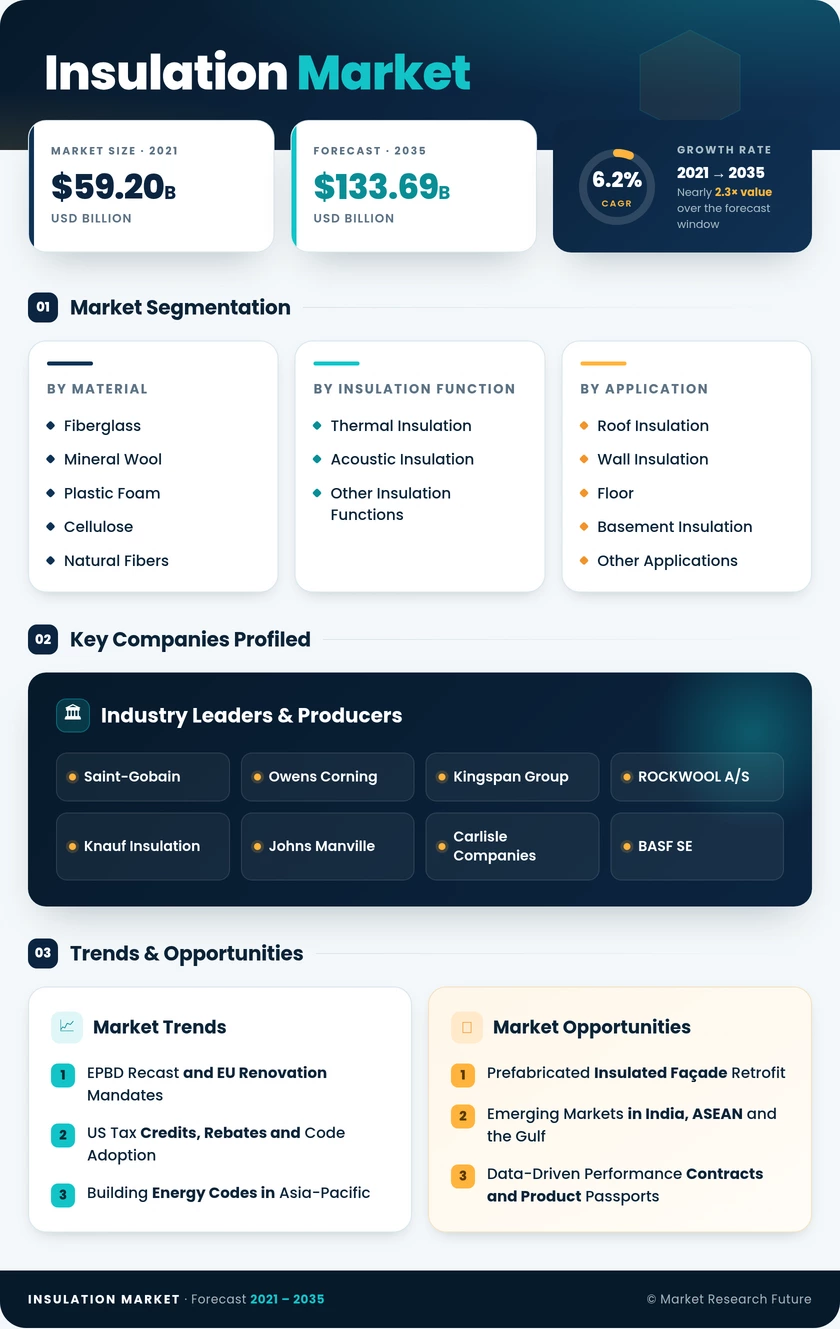
Insulation Market
Market Size
Forecast Period2026-2035
CAGR (2026-2035)6.2%
2025 Market SizeUSD 73.40 Billion
2035 Market SizeUSD 133.69 Billion
Key Players
Saint-Gobain
Owens Corning
Kingspan Group
ROCKWOOL A/S
Knauf Insulation
Johns Manville
Opportunities
  • Prefabricated Insulated Façade Retrofit
  • Emerging Markets in India, ASEAN and the Gulf
  • Data-Driven Performance Contracts and Product Passports
  1. 1 Market Summary | |
  2. 2 Key Report Takeaways | |
    1. 2.1 By Material | |
    2. 2.2 By Insulation Function | |
    3. 2.3 By Application | |
    4. 2.4 By End-user | |
    5. 2.5 By Region | |
  3. 3 Market Size and Forecast (2021–2035) | |
    1. 3.1 Historical Market Size (2021–2025) | |
    2. 3.2 Forecast Market Size (2026–2035) | |
    3. 3.3 Year-over-Year Growth Analysis | |
  4. 4 Driver Impact Analysis | |
    1. 4.1 EPBD Recast and EU Renovation Mandates | |
    2. 4.2 US Tax Credits, Rebates and Code Adoption | |
    3. 4.3 Building Energy Codes in Asia-Pacific | |
    4. 4.4 Industrial Decarbonization and Process Efficiency | |
    5. 4.5 Data Center and Cold-Chain Construction | |
    6. 4.6 Urban Noise Control and Multifamily Density | |
    7. 4.7 EV Battery Thermal Management | |
  5. 5 Restraints Impact Analysis | |
    1. 5.1 Raw Material and Energy Cost Volatility | |
    2. 5.2 HFC Phase-Down and Blowing Agent Transition | |
    3. 5.3 Fire Safety Scrutiny of Combustible Products | |
    4. 5.4 Installer and Construction Labor Shortages | |
    5. 5.5 Housing Slowdown and High Interest Rates | |
  6. 6 Opportunities | |
    1. 6.1 Prefabricated Insulated Façade Retrofit | |
    2. 6.2 Emerging Markets in India, ASEAN and the Gulf | |
    3. 6.3 Data-Driven Performance Contracts and Product Passports | |
    4. 6.4 Bio-Based and Circular Products | |
    5. 6.5 Cryogenic and Hydrogen Infrastructure | |
  7. 7 Regional Market Share and Country-Level Analysis | |
    1. 7.1 North America | | |
      1. 7.1.1 US | | |
      2. 7.1.2 Canada | | |
      3. 7.1.3 Mexico | |
    2. 7.2 Europe | | |
      1. 7.2.1 Germany | | |
      2. 7.2.2 UK | | |
      3. 7.2.3 France | | |
      4. 7.2.4 Italy | | |
      5. 7.2.5 Spain | | |
      6. 7.2.6 Nordic Countries | | |
      7. 7.2.7 Russia | | |
      8. 7.2.8 Rest of Europe | |
    3. 7.3 Asia-Pacific | | |
      1. 7.3.1 China | | |
      2. 7.3.2 India | | |
      3. 7.3.3 Japan | | |
      4. 7.3.4 South Korea | | |
      5. 7.3.5 ASEAN | | |
      6. 7.3.6 Rest of Asia-Pacific | |
    4. 7.4 South America | | |
      1. 7.4.1 Brazil | | |
      2. 7.4.2 Argentina | | |
      3. 7.4.3 Rest of South America | |
    5. 7.5 Middle East & Africa | | |
      1. 7.5.1 Saudi Arabia | | |
      2. 7.5.2 UAE | | |
      3. 7.5.3 South Africa | | |
      4. 7.5.4 Egypt | | |
      5. 7.5.5 Rest of MEA | |
  8. 8 Future Outlook (2026–2035) | |
    1. 8.1 Embodied Carbon Becomes a Specification Criterion | |
    2. 8.2 Industrialized Construction and Prefabrication | |
    3. 8.3 Envelope-First Electrification | |
    4. 8.4 Digital Verification and Performance Data | |
  9. 9 Segmentation Analysis | |
    1. 9.1 By Material | | |
      1. 9.1.1 Fiberglass | | |
      2. 9.1.2 Mineral Wool | | |
      3. 9.1.3 Plastic Foam | | |
      4. 9.1.4 Cellulose and Natural Fibers | | |
      5. 9.1.5 Other Materials | |
    2. 9.2 By Insulation Function | | |
      1. 9.2.1 Thermal Insulation | | |
      2. 9.2.2 Acoustic Insulation | | |
      3. 9.2.3 Other Insulation Functions | |
    3. 9.3 By Application | | |
      1. 9.3.1 Roof Insulation | | |
      2. 9.3.2 Wall Insulation | | |
      3. 9.3.3 Floor and Basement Insulation | | |
      4. 9.3.4 Other Applications | |
    4. 9.4 By End-user | | |
      1. 9.4.1 Residential | | |
      2. 9.4.2 Non-Residential | |
  10. 10 Competitive Landscape | |
    1. 10.1 Market Concentration Analysis | |
    2. 10.2 Competitive Benchmarking Matrix | |
    3. 10.3 Company Profiles | | |
      1. 10.3.1 Saint-Gobain | | |
      2. 10.3.2 Owens Corning | | |
      3. 10.3.3 Kingspan Group | | |
      4. 10.3.4 ROCKWOOL A/S | | |
      5. 10.3.5 Knauf Insulation | | |
      6. 10.3.6 Johns Manville | | |
      7. 10.3.7 Carlisle Companies | | |
      8. 10.3.8 BASF SE | | |
      9. 10.3.9 Huntsman Corporation | | |
      10. 10.3.10 Armacell | | |
      11. 10.3.11 GAF Materials | | |
      12. 10.3.12 Atlas Roofing | |
  11. 11 Recent News & Developments | |
  12. 12 Report Scope and Methodology | |
  13. 13 Detailed Sources and Citations | |
  14. 14 Frequently Asked Questions (FAQs) | | LIST OF TABLES | |
  15. TABLE 1 Global Insulation Market Summary Snapshot, 2025–2035 | |
  16. TABLE 2 Global Insulation Market Size & Forecast, by Revenue (USD Billion), 2021–2035 | |
  17. TABLE 3 Global Insulation Market – Year-over-Year Growth Analysis, 2021–2035 | |
  18. TABLE 4 Driver Impact Analysis – Global Insulation Market | |
  19. TABLE 5 Restraints Impact Analysis – Global Insulation Market | |
  20. TABLE 6 Global Insulation Market Size, by Region, 2025 (USD Billion) | |
  21. TABLE 7 North America Insulation Market, by Country, 2025 | |
  22. TABLE 8 Europe Insulation Market, by Country, 2025 | |
  23. TABLE 9 Asia-Pacific Insulation Market, by Country, 2025 | |
  24. TABLE 10 South America Insulation Market, by Country, 2025 | |
  25. TABLE 11 Middle East & Africa Insulation Market, by Country, 2025 | |
  26. TABLE 12 Global Insulation Market, by Material, 2025 | |
  27. TABLE 13 Global Insulation Market, by Insulation Function, 2025 | |
  28. TABLE 14 Global Insulation Market, by Application, 2025 | |
  29. TABLE 15 Global Insulation Market, by End-user, 2025 | |
  30. TABLE 16 Competitive Benchmarking Matrix – Global Insulation Market, 2025 | |
  31. TABLE 17 Report Scope and Methodology | |
  32. TABLE 18 Detailed Sources and Citations | | LIST OF FIGURES | |
  33. FIGURE 1 Global Insulation Market Dynamics – Drivers, Restraints and Opportunities | |
  34. FIGURE 2 Insulation Industry Value Chain Analysis | |
  35. FIGURE 3 Porter's Five Forces Analysis – Global Insulation Market | |
  36. FIGURE 4 Global Insulation Market Size Trend, 2021–2035 (USD Billion) | |
  37. FIGURE 5 Global Insulation Market Share, by Material, 2025 (%) | |
  38. FIGURE 6 Global Insulation Market Share, by Insulation Function, 2025 (%) | |
  39. FIGURE 7 Global Insulation Market Share, by Application, 2025 (%) | |
  40. FIGURE 8 Global Insulation Market Share, by End-user, 2025 (%) | |
  41. FIGURE 9 Global Insulation Market Share, by Region, 2025 (%) | |
  42. FIGURE 10 Competitive Landscape – Estimated Revenue Share of Key Players, 2025

Segmentation Quick Reference

DimensionSub-SegmentsDominant SegmentFastest Growing Segment
By MaterialFiberglass, Mineral Wool, Plastic Foam, Cellulose and Natural Fibers, Other MaterialsFiberglass (34.0% share)Plastic Foam (6.7% CAGR)
By Insulation FunctionThermal Insulation, Acoustic Insulation, Other Insulation FunctionsThermal Insulation (57.0% share)Acoustic Insulation (7.2% CAGR)
By ApplicationRoof Insulation, Wall Insulation, Floor and Basement Insulation, Other ApplicationsRoof Insulation (27.8% share)Wall Insulation (6.9% CAGR)
By End-userResidential, Non-ResidentialResidential (52.8% share)Non-Residential (7.4% CAGR)
By RegionNorth America, Europe, Asia-Pacific, South America, Middle East & AfricaEurope (35.0% share)Asia-Pacific (7.5% CAGR)

Market Segmentation Overview

By Material

Sub-SegmentKey Trend
FiberglassBio-based binders and higher recycled glass content in batts and loose-fill
Mineral WoolRising use in non-combustible façades after fire code reforms
Plastic FoamShift to HFO blowing agents in polyiso and XPS boards
Cellulose and Natural FibersGrowth in wood fiber and hemp for low-carbon renovation
Other MaterialsAerogel and vacuum panels for space-constrained and EV applications

Fiberglass leads with a 34.0% share because its batts and blown-in formats remain the lowest-cost route to code compliance in residential attics and walls. Plastic Foam grows fastest at a 6.7% CAGR, since polyisocyanurate and extruded polystyrene deliver the R-value per inch that continuous exterior wall layers require. Mineral Wool holds its position where fire regulations exclude combustible products, while Cellulose and Natural Fibers benefit from embodied carbon disclosure rules.

By Insulation Function

Sub-SegmentKey Trend
Thermal InsulationTighter energy codes and binding renovation milestones
Acoustic InsulationStricter sound standards for multifamily housing
Other Insulation FunctionsCryogenic and fire-protective systems for LNG and industry

Thermal Insulation dominates with a 57.0% share, as energy codes and retrofit mandates make heat-flow control the baseline requirement in nearly every project. Acoustic Insulation expands fastest at a 7.2% CAGR because dense urban housing and European noise exposure data push developers toward sound-rated floors and party walls. Other Insulation Functions remain specialized but carry high value per unit in cryogenic and fire-protection work.

By Application

Sub-SegmentKey Trend
Roof InsulationReroofing cycles drive rigid board upgrades on flat roofs
Wall InsulationContinuous exterior layers enter baseline specifications
Floor and Basement InsulationSlab-edge requirements in European codes
Other ApplicationsDuct, pipe and appliance insulation tied to HVAC growth

Roof Insulation leads with a 27.8% share because roofs lose the most heat and reroofing creates a natural trigger for adding thickness. Wall Insulation grows fastest at a 6.9% CAGR as exterior continuous layers become standard in multifamily and commercial codes to eliminate thermal bridging at studs. Floor and Basement Insulation grows steadily as slab-edge rules spread, while Other Applications track HVAC and industrial equipment demand.

By End-user

Sub-SegmentKey Trend
ResidentialRebate-funded retrofits and code-driven new housing in Asia
Non-ResidentialData centers, cold-chain warehouses and industrial efficiency

Residential leads with a 52.8% share, supported by tax credits and rebate programs aimed at homeowners and by large housing pipelines in Asia-Pacific. Non-Residential grows fastest at a 7.4% CAGR because commercial codes, data center construction, and industrial decarbonization projects require higher-value rigid boards and fire-rated systems. That mix shift raises average revenue per square meter across the market.


Download PDF ×

We do not share your information with anyone. However, we may send you emails based on your report interest from time to time. You may contact us at any time to opt-out.