Request Free Sample ×

Kindly complete the form below to receive a free sample of this Report

* Please use a valid business email

Leading companies partner with us for data-driven Insights

clients tt-cursor
Hero Background
English
Chinese
French
Japanese
Korean
German
Spanish

Inorganic Fluorides Market Analysis

ID: MRFR/CnM/1104-HCR
140 Pages
Anshula Mandaokar
March 2026

Inorganic Fluorides Market Research Report Information By Product (Calcium Fluoride, Hydrogen Fluoride, Sodium Fluoride and others), End-Use (Agrochemicals, Water Treatment, Aluminum, Orthodontic Consumables, Electronics and others) and Region (Asia-Pacific, North America, Europe, Latin America and Middle East & Africa) - Forecast till 2035

Share:
Download PDF ×

We do not share your information with anyone. However, we may send you emails based on your report interest from time to time. You may contact us at any time to opt-out.

Inorganic Fluorides Market Infographic
Purchase Options

Market Analysis

In-depth Analysis of Inorganic Fluorides Market Industry Landscape

The Inorganic fluoride market is certainly dynamic with regard to the factors affecting its growth, as there are a wide range of industries to which applications span, from steel metallurgy, chemistry to electronics and medicine. The fluorine compound family, that is inorganic fluorides, is commonly used in different industries, giving it a major role in many industrial operations and applications. As one of the main driving forces, market dynamics include industrial markets with demands on metallurgy. Heterogen fluorides, especially aluminum fluoride, are which are used for to refine alumina, and feed the process of anodic oxidation, which helps to extract aluminum from a molten bath. In turn, the development and larger proportions of the metallurgical industry, plus the need for aluminum that is stable, light, and resistant to corrosion, all are reasons for the increasely higher need for inorganic fluorides.

The chemical firms utilize Inorganic Fluorides widely affecting the market dynamics of Inorganic Fluorides. Different inorganic fluorides, like hydrogen fluoride and sulfur hexafluoride, are used in different chemical process steps, such as the production of fluoro-compound and pharmaceutics. The abundance of versatile inorganic fluoride composition in syntheses and their distinctive attributes push them into wide range chemical application.

Regulations and environmental issues are based on global activities, resulting in the unique dynamics of Inorganic Fluorides market. Legality of rules necessary for protecting workers safety, nature as well as quality of products can have considerable effect on the choice of manufacturers. Environmental reactivity is an industry trait working with sustainable methods, responsible sourcing of raw materials and development of inorganic fluoride formulas ecofriendly enough.

Cost efficacy represents a vital balancing element in the dynamics of the fluorides market sector. Industries search for the cheap alternatives but do not compromise on quality and performance of inorganic fluorides. While on the other hand manufacturers always like to achieve the right product price with the highest efficacy. Such low costs which are crucial for both the producers and consumers, becomes true for keeps and stimulates innovation and competition as well.

The international relations have profound implications for the backward and forward linkages of the Inorganic Fluorides also. The economic situation directly controls the operations of industry, facilitates infrastructure development and thus determines the demand for inorganic fluorides by different appications. The performance of certain markets reflect the character and trends of the economy, since industries will either increase or decrease production depending on the economic situation at hand.

With innovations in technology as engines of inorganic fluorides market, it is dealing with the ever-changing market landscape. Continuous research and the development of new methods help process better extraction and contamination elimination, whereas new applications are worked out for inorganic fluorides. The introduction of more innovative technologies to create an interplay with production processes, product quality, and hopefully the exploration of the inorganic fluoride possibilities in different sectors would be very instrumental.

Author
Author Profile
Anshula Mandaokar
Team Lead - Research

Anshula Mandaokar holds an academic degree in Chemical Engineering and has been contributing to the field for more than 5 years. She has expertise in Market Research and Business Consulting and serves as a Team Lead for a reputed Market Research firm under the Chemicals and Materials domain spectrum. She has worked on multiple projects, generating explicit results in a quick turnaround time. Her understanding of data interpretation justifies her role as a leader.

Leave a Comment

FAQs

What is the projected market valuation of the Inorganic Fluorides Market by 2035?

<p>The Inorganic Fluorides Market is projected to reach a valuation of 27.9 USD Billion by 2035.</p>

What was the market valuation of the Inorganic Fluorides Market in 2024?

<p>In 2024, the market valuation of Inorganic Fluorides was 11.9 USD Billion.</p>

What is the expected CAGR for the Inorganic Fluorides Market during the forecast period 2025 - 2035?

<p>The expected CAGR for the Inorganic Fluorides Market during the forecast period 2025 - 2035 is 8.06%.</p>

Which companies are considered key players in the Inorganic Fluorides Market?

<p>Key players in the Inorganic Fluorides Market include Honeywell International Inc., Solvay S.A., and Mitsubishi Chemical Corporation.</p>

What are the main applications of Inorganic Fluorides and their market values?

<p>Main applications include Chemical Synthesis valued at 3.0 to 7.0 USD Billion and Aluminum Production valued at 2.5 to 5.8 USD Billion.</p>

How does the Electronics segment perform in the Inorganic Fluorides Market?

<p>The Electronics segment is projected to grow from 2.4 USD Billion in 2024 to 5.5 USD Billion by 2035.</p>

What is the market value range for Calcium Fluoride in the Inorganic Fluorides Market?

Calcium Fluoride is valued between 3.0 and 7.0 USD Billion in the Inorganic Fluorides Market.

What end-use industries are driving the demand for Inorganic Fluorides?

End-use industries such as Electronics and Agriculture are driving demand, with Electronics valued at 3.0 to 7.0 USD Billion.

What is the market value range for Sodium Fluoride in the Inorganic Fluorides Market?

Sodium Fluoride is valued between 2.5 and 5.8 USD Billion in the Inorganic Fluorides Market.

How does the Construction segment contribute to the Inorganic Fluorides Market?

The Construction segment contributes a market value range of 1.8 to 4.2 USD Billion.

Market Summary

As per MRFR analysis, the Inorganic Fluorides Market Size was estimated at 11.9 USD Billion in 2024. The Inorganic Fluorides industry is projected to grow from 12.85 USD Billion in 2025 to 27.9 USD Billion by 2035, exhibiting a compound annual growth rate (CAGR) of 8.06% during the forecast period 2025 - 2035.

Key Market Trends & Highlights

The Inorganic Fluorides Market is poised for growth driven by technological advancements and increasing applications across various sectors.

  • Sustainable practices in production are becoming increasingly prevalent in the Inorganic Fluorides Market, particularly in North America. Technological advancements are enhancing the efficiency of production methods, contributing to market expansion in the Asia-Pacific region. Regulatory compliance and standards are shaping the market dynamics, especially in the aluminum production segment, which remains the largest. Rising demand in electronics manufacturing and expanding applications in agrochemicals are key drivers propelling market growth.

Market Size & Forecast

2024 Market Size 11.9 (USD Billion)
2035 Market Size 27.9 (USD Billion)
CAGR (2025 - 2035) 8.06%
Largest Regional Market Share in 2024 North America

Major Players

<p>Honeywell International Inc. (US), Solvay S.A. (BE), Mitsubishi Chemical Corporation (JP), Albemarle Corporation (US), BASF SE (DE), Kanto Chemical Co., Inc. (JP), Fujifilm Corporation (JP), Stella Chemifa Corporation (JP), Chemours Company (US)</p>

Market Trends

The Inorganic Fluorides Market is currently experiencing a notable transformation, driven by various factors that influence demand and supply dynamics. The increasing utilization of inorganic fluorides in diverse applications, such as aluminum production, agrochemicals, and pharmaceuticals, appears to be a primary catalyst for market growth. Furthermore, the rising awareness regarding the environmental impact of certain chemicals has led to a shift towards more sustainable alternatives, thereby enhancing the appeal of inorganic fluorides. This shift is likely to foster innovation and development within the sector, as manufacturers seek to align their products with evolving regulatory standards and consumer preferences. In addition, the Inorganic Fluorides Market is characterized by a growing emphasis on research and development activities. Companies are investing in advanced technologies to improve the efficiency and safety of fluoride production processes. This trend suggests a potential for enhanced product offerings that meet the stringent requirements of various industries. Moreover, the global push for cleaner energy solutions may further augment the demand for inorganic fluorides, particularly in applications related to battery technology and renewable energy systems. As the market continues to evolve, stakeholders must remain vigilant to emerging trends and adapt their strategies accordingly.

Sustainable Practices in Production

There is a noticeable trend towards adopting sustainable practices in the production of inorganic fluorides. Manufacturers are increasingly focusing on reducing waste and minimizing environmental impact, which aligns with global sustainability goals. This shift not only enhances corporate responsibility but also meets the growing consumer demand for eco-friendly products.

Technological Advancements

Technological advancements are playing a crucial role in shaping the Inorganic Fluorides Market. Innovations in production techniques and processing methods are likely to improve efficiency and reduce costs. These advancements may also lead to the development of new applications, further expanding the market's potential.

Regulatory Compliance and Standards

The Inorganic Fluorides Market is witnessing heightened scrutiny regarding regulatory compliance and safety standards. As governments implement stricter regulations, companies are compelled to ensure their products meet these requirements. This trend may drive innovation as firms seek to develop safer and more compliant alternatives.

Inorganic Fluorides Market Market Drivers

Growing Demand in Electronics

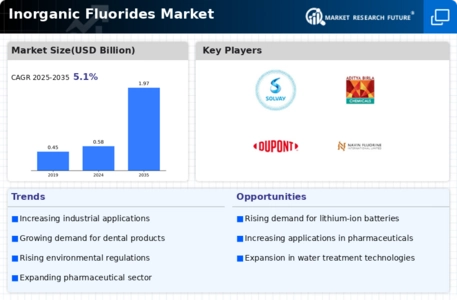
The Global Inorganic Fluorides Market Industry is experiencing a surge in demand driven by the electronics sector. Fluorides are essential in the production of semiconductors and other electronic components, which are increasingly utilized in various devices. As technology advances, the need for high-purity inorganic fluorides is likely to rise, contributing to market growth. In 2024, the market is projected to reach 0.58 USD Billion, reflecting the increasing integration of electronics in daily life. This trend indicates a robust trajectory for the industry as it adapts to the evolving technological landscape.

Rising Demand in Pharmaceuticals

The Global Inorganic Fluorides Market Industry is witnessing an uptick in demand from the pharmaceutical sector. Inorganic fluorides are utilized in the synthesis of various medicinal compounds, enhancing their efficacy and stability. As the global population ages and the need for innovative healthcare solutions grows, the pharmaceutical industry is likely to expand its use of these fluorides. This trend suggests a promising future for the market, with projections indicating a significant increase in demand, thereby reinforcing the industry's position in the broader chemical landscape.

Expansion in Chemical Manufacturing

The Global Inorganic Fluorides Market Industry is benefiting from the expansion of chemical manufacturing processes. Inorganic fluorides serve as critical intermediates in the synthesis of various chemicals, including fluoropolymers and agrochemicals. As industries seek to enhance production efficiency and develop innovative products, the demand for these fluorides is expected to rise. The market is projected to grow significantly, with estimates suggesting it could reach 1.97 USD Billion by 2035. This growth reflects the increasing reliance on inorganic fluorides in diverse applications, positioning the industry for sustained expansion.

Emerging Applications in Renewable Energy

The Global Inorganic Fluorides Market Industry is exploring emerging applications in the renewable energy sector. Inorganic fluorides are being investigated for their potential use in solar cells and energy storage systems, which are crucial for sustainable energy solutions. As the global focus shifts towards renewable energy sources, the demand for materials that enhance energy efficiency is likely to rise. This trend could contribute to the market's growth trajectory, with the industry poised to adapt to the evolving energy landscape.

Regulatory Support for Fluoride Applications

The Global Inorganic Fluorides Market Industry is likely to benefit from regulatory support aimed at promoting the safe use of fluorides in various applications. Governments worldwide are implementing guidelines that encourage the use of inorganic fluorides in sectors such as water treatment and dental care. This regulatory framework not only enhances consumer confidence but also stimulates market growth. As awareness of the benefits of fluoride increases, the industry may see a corresponding rise in demand, contributing to a projected CAGR of 11.79% from 2025 to 2035.

Market Segment Insights

By Application: Aluminum Production (Largest) vs. Pharmaceuticals (Fastest-Growing)

<p>The Inorganic Fluorides Market showcases a diverse range of applications, with Aluminum Production leading the sector due to its extensive use of fluorides in the production process. This segment dominates the market and is characterized by its significant consumption of fluorides, required for various production steps. Meanwhile, the Pharmaceuticals sector is emerging as the fastest-growing segment, driven by the increasing demand for pharmaceutical products incorporating fluorinated compounds for enhanced efficacy and stability.</p>

<p>Aluminum Production (Dominant) vs. Pharmaceuticals (Emerging)</p>

<p>Aluminum Production is the dominant application in the Inorganic Fluorides Market, largely due to its integral role in the aluminum smelting process where fluorides improve efficiency and reduce energy consumption. This segment benefits from longstanding industry practices and established supply chains. On the other hand, the Pharmaceuticals sector is an emerging powerhouse, capitalizing on a growing trend towards the development of specialized drugs and therapies involving fluorinated compounds. This growth is fueled by advances in medicinal chemistry, where fluorides are used to modify drug properties, leading to improved absorption and effectiveness in treatments.</p>

By End Use Industry: Metallurgy (Largest) vs. Electronics (Fastest-Growing)

<p>The Inorganic Fluorides Market is characterized by diverse applications across various end-use industries, with metallurgy commanding the largest market share. This segment leverages the unique properties of inorganic fluorides, particularly in steel production, aluminum processing, and other metallurgical applications. Following metallurgy, sectors such as agriculture and pharmaceuticals also hold substantial shares, driven by growing demand for fluoride compounds in pesticides and medicinal formulations. Additionally, the electronics industry is rapidly emerging as a significant player in this market, reflecting the increasing use of inorganic fluorides in the manufacturing of semiconductors and electronic components. Growth trends in the inorganic fluorides market are influenced by several factors, including technological advancements and expanding industrial applications. The metallurgy sector is significantly bolstered by the rising demand for high-performance materials and innovative manufacturing techniques. Meanwhile, the electronics segment is experiencing the fastest growth, propelled by the digital transformation and the rising trend of miniaturization in electronic devices. Innovation and regulatory developments aiming at enhancing efficiency and sustainability are also expected to support market growth across all segments.</p>

<p>Metallurgy (Dominant) vs. Electronics (Emerging)</p>

<p>The metallurgy segment of the Inorganic Fluorides Market plays a crucial role in the production of metals, utilizing fluoride compounds as fluxing agents that improve the quality and yield of metals. This dominant segment benefits from longstanding industrial practices and an established customer base, emphasizing the importance of fluorides in metallurgical processes. In contrast, the electronics segment, while emerging, is rapidly gaining traction due to the increasing integration of inorganic fluorides in semiconductor manufacturing and enhancing electronic component durability. The demand for high-purity fluoride compounds is also on the rise, signifying the growing importance of this segment in meeting the technological advancements in consumer electronics and various high-tech applications.</p>

By Product Type: Sodium Fluoride (Largest) vs. Calcium Fluoride (Fastest-Growing)

<p>In the Inorganic Fluorides Market, Sodium Fluoride holds the largest market share, attributed to its extensive application in pharmaceuticals and dental care products. Meanwhile, Calcium Fluoride, though smaller in share, is positioned as the fastest-growing segment due to its rising demand in the metallurgy and glass manufacturing industries. The increasing preference for sustainable and eco-friendly materials is also boosting interest in Calcium Fluoride, helping to reshape market dynamics. Notably, market drivers for these product types include the growing awareness of dental health, leading to increased consumption of Sodium Fluoride in oral hygiene products. Furthermore, innovations in glass manufacturing processes and the expansion of the metallurgy sector are fueling the growth of Calcium Fluoride. This trend signifies a shift towards more specialized applications, contributing to the overall expansion of the Inorganic Fluorides Market.</p>

<p>Sodium Fluoride (Dominant) vs. Potassium Fluoride (Emerging)</p>

<p>Sodium Fluoride is a dominant player in the Inorganic Fluorides Market, recognized for its critical role in promoting oral health and ensuring safe dental practices. Its regular usage in dental products like toothpaste and mouth rinses highlights its established market position. On the other hand, Potassium Fluoride is emerging as a notable contender, primarily due to its potential application in flame retardants and natural pesticide formulations. As industries pivot towards sustainable practices, Potassium Fluoride is capturing attention, indicating a burgeoning market share that reflects growing environmental considerations. Both products exhibit unique characteristics—Sodium Fluoride's strength in consumer health solutions contrasts with Potassium Fluoride's versatility in agrochemicals and safety applications.</p>

By Form: Powder (Largest) vs. Granules (Fastest-Growing)

<p>The Inorganic Fluorides Market showcases a diverse distribution of segments based on form, with Powder leading in market share due to its extensive applications across various industries, including metallurgy and pharmaceuticals. Granules, though currently smaller in market share, have been rapidly gaining traction, driven by their ease of handling and application in various chemical processes and formulations.</p>

<p>Granules (Dominant) vs. Crystals (Emerging)</p>

<p>In the Inorganic Fluorides Market, Granules have emerged as a dominant form due to their favorable characteristics for end-users, including improved flow properties and ease of use in various applications. The ability of Granules to dissolve effectively in water makes them especially appealing in sectors such as agriculture and water treatment. Conversely, Crystals are seen as an emerging segment, appealing primarily in high-purity applications like pharmaceuticals and specialty chemicals. Their crystalline form allows for controlled dosing and specific reaction characteristics, making them valuable in precise chemical processes.</p>

Get more detailed insights about Inorganic Fluorides Market Research Report - Global Forecast till 2035

Regional Insights

North America : Market Leader in Inorganic Fluorides

North America is poised to maintain its leadership in the Inorganic Fluorides Market, holding a significant market share of 5.95 in 2024. The region's growth is driven by increasing demand in sectors such as pharmaceuticals, electronics, and agriculture. Regulatory support for sustainable practices and innovations in chemical manufacturing further catalyze market expansion. The focus on environmental compliance and safety regulations also plays a crucial role in shaping market dynamics. The competitive landscape in North America is characterized by the presence of major players like Honeywell International Inc., Albemarle Corporation, and Chemours Company. These companies are investing in R&D to enhance product offerings and meet the evolving needs of various industries. The U.S. remains the leading country, supported by a robust industrial base and technological advancements, ensuring a steady demand for inorganic fluorides across multiple applications.

Europe : Emerging Market with Growth Potential

Europe's Inorganic Fluorides Market is on an upward trajectory, with a market size of 3.57 in 2024. The region benefits from stringent regulations promoting the use of eco-friendly chemicals, which drives demand for inorganic fluorides in various applications, including water treatment and pharmaceuticals. The European Union's commitment to sustainability and innovation is a key catalyst for market growth, encouraging investments in cleaner technologies and processes. Leading countries in this region include Germany, France, and the UK, where companies like Solvay S.A. and BASF SE are prominent players. The competitive landscape is marked by a focus on innovation and compliance with environmental regulations. The presence of established chemical manufacturers and a growing emphasis on research and development further enhance the market's potential, positioning Europe as a significant player in the global inorganic fluorides sector. "The European market is increasingly prioritizing sustainable chemical solutions to meet regulatory standards and consumer demand," European Chemicals Agency.

Asia-Pacific : Rapid Growth in Emerging Economies

The Asia-Pacific region is witnessing rapid growth in the Inorganic Fluorides Market, with a market size of 2.8 in 2024. This growth is fueled by increasing industrialization, urbanization, and rising demand for fluorinated products in sectors such as electronics and automotive. Countries like China and Japan are leading the charge, supported by government initiatives aimed at boosting chemical production and innovation. The region's regulatory environment is evolving, promoting safer and more sustainable practices. China stands out as a dominant player, with significant investments in chemical manufacturing and a growing focus on R&D. Key companies such as Mitsubishi Chemical Corporation and Kanto Chemical Co., Inc. are expanding their operations to meet the rising demand. The competitive landscape is characterized by a mix of local and international players, all vying for market share in this dynamic and rapidly evolving sector.

Middle East and Africa : Emerging Market with Untapped Potential

The Middle East and Africa region is gradually emerging in the Inorganic Fluorides Market, with a market size of 0.48 in 2024. The growth is primarily driven by increasing industrial activities and the need for fluorinated compounds in various applications, including oil and gas, and water treatment. The region's rich natural resources and ongoing investments in infrastructure are expected to further stimulate market growth. Regulatory frameworks are also evolving to support sustainable practices in chemical production. Countries like South Africa and the UAE are at the forefront of this growth, with local companies beginning to establish a foothold in the market. The competitive landscape is still developing, with opportunities for both local and international players to expand their presence. As the region continues to invest in industrial capabilities, the demand for inorganic fluorides is expected to rise, presenting significant opportunities for growth.

Key Players and Competitive Insights

The Inorganic Fluorides Market is currently characterized by a dynamic competitive landscape, driven by increasing demand across various sectors, including pharmaceuticals, agrochemicals, and electronics. Key players such as Honeywell International Inc. (US), Solvay S.A. (BE), and Chemours Company (US) are strategically positioned to leverage their technological capabilities and extensive distribution networks. Honeywell International Inc. (US) focuses on innovation and sustainability, aiming to enhance its product offerings while reducing environmental impact. In contrast, Solvay S.A. (BE) emphasizes regional expansion and partnerships to strengthen its market presence, particularly in emerging economies. Collectively, these strategies contribute to a moderately fragmented market structure, where competition is intensifying as companies seek to differentiate themselves through advanced technologies and sustainable practices.In terms of business tactics, companies are increasingly localizing manufacturing to mitigate supply chain disruptions and optimize operational efficiency. This approach not only reduces transportation costs but also allows for quicker response times to market demands. The competitive structure of the Inorganic Fluorides Market appears to be moderately fragmented, with several key players exerting influence over pricing and product availability. The collective actions of these companies indicate a trend towards consolidation, as they seek to enhance their competitive edge through strategic collaborations and mergers.


In November Chemours Company (US) announced a significant investment in expanding its production capacity for high-purity fluorides. This strategic move is expected to cater to the growing demand from the semiconductor industry, which relies heavily on high-quality fluorinated compounds. The expansion not only positions Chemours to capture a larger market share but also underscores its commitment to meeting the evolving needs of its customers in a rapidly changing technological landscape.


In October Solvay S.A. (BE) entered into a partnership with a leading technology firm to develop innovative fluorinated materials for sustainable applications. This collaboration aims to enhance the performance of materials used in renewable energy technologies, thereby aligning with global sustainability goals. The strategic importance of this partnership lies in Solvay's ability to leverage cutting-edge technology to create products that meet the increasing regulatory demands for environmentally friendly solutions.


In September Honeywell International Inc. (US) launched a new line of eco-friendly fluorinated products designed to reduce greenhouse gas emissions. This initiative reflects Honeywell's proactive approach to sustainability and its commitment to addressing climate change. The introduction of these products is likely to enhance the company's reputation as a leader in sustainable practices within the Inorganic Fluorides Market, potentially attracting environmentally conscious customers and investors.


As of December current trends in the Inorganic Fluorides Market indicate a strong emphasis on digitalization, sustainability, and the integration of artificial intelligence (AI) in production processes. Strategic alliances are increasingly shaping the competitive landscape, as companies recognize the value of collaboration in driving innovation and efficiency. Looking ahead, competitive differentiation is expected to evolve, with a notable shift from price-based competition to a focus on technological advancements, product innovation, and supply chain reliability. This transition suggests that companies that prioritize these aspects will likely gain a competitive advantage in the market.

Key Companies in the Inorganic Fluorides Market include

Industry Developments

- researchers from Osaka University have successfully developed the first organic reaction across the globe, which includes the selective conversion of a particular carbon-fluorine (C-F) bond in perfluorinated compounds to several other functional groups.Fluorinated compounds are a vital group of compounds broadly used in organic electronic materials, functional resins, agricultural chemicals, and pharmaceuticals. Particularly, perfluorinated compounds consisting of several carbon-fluorine bonds are grabbing traction due to their high chemical and thermal stability and several brilliant characteristics like chemical resistance and water and oil repellency. The author of the study, Prof. Makoto Yasuda, explained that C-F bonds are very strong.

Therefore, the transformation under mild conditions of these bonds is quite tricky, and selective activation of a particular C-F bond from among several C-F bonds in perfluorinated compounds has not been accomplished. The study concluded that a site-selective C-F bond transformation to valuable functional groups operates through a photocatalyst and organotin compounds in the presence of visible light irradiation. The theoretical and experimental results disclosed the importance of the assistance of organotin compounds and a photocatalyst during this transformation.

One of the most popular key players

, Solvay increased its production capacity into a double for the High-Performance Polymer SOLEF-polyvinylidene fluoride (PVDF) in China at their plant which results in the company reinforcing its leadership in lithium-ion batteries.


Future Outlook

Inorganic Fluorides Market Future Outlook

<p>The Inorganic Fluorides Market is projected to grow at an 8.06% CAGR from 2025 to 2035, driven by increasing demand in pharmaceuticals, agrochemicals, and electronics.</p>

New opportunities lie in:

  • <p>Development of eco-friendly fluorine extraction technologies. Expansion into emerging markets with tailored product offerings. Investment in R&amp;D for innovative applications in battery technology.</p>

<p>By 2035, the market is expected to achieve robust growth, solidifying its position in various industrial sectors.</p>

Market Segmentation

Inorganic Fluorides Market Form Outlook

  • Powder
  • Granules
  • Liquid
  • Crystals
  • Tablets

Inorganic Fluorides Market Type Outlook

  • Sodium Fluoride
  • Calcium Fluoride
  • Potassium Fluoride
  • Ammonium Fluoride
  • Barium Fluoride

Inorganic Fluorides Market End Use Outlook

  • Metallurgy
  • Agriculture
  • Water Treatment
  • Manufacturing
  • Construction

Inorganic Fluorides Market Application Outlook

  • Aluminum Production
  • Chemical Synthesis
  • Glass Manufacturing
  • Pharmaceuticals
  • Electronics

Report Scope

MARKET SIZE 2024 11.9(USD Billion)
MARKET SIZE 2025 12.85(USD Billion)
MARKET SIZE 2035 27.9(USD Billion)
COMPOUND ANNUAL GROWTH RATE (CAGR) 8.06% (2025 - 2035)
REPORT COVERAGE Revenue Forecast, Competitive Landscape, Growth Factors, and Trends
BASE YEAR 2024
Market Forecast Period 2025 - 2035
Historical Data 2019 - 2024
Market Forecast Units USD Billion
Key Companies Profiled Honeywell International Inc. (US), Solvay S.A. (BE), Mitsubishi Chemical Corporation (JP), Albemarle Corporation (US), BASF SE (DE), Kanto Chemical Co., Inc. (JP), Fujifilm Corporation (JP), Stella Chemifa Corporation (JP), Chemours Company (US)
Segments Covered Application, End Use, Type, Form
Key Market Opportunities Growing demand for sustainable fluorine-based products in various industrial applications presents opportunities in the Inorganic Fluorides Market.
Key Market Dynamics Rising demand for fluorinated compounds drives innovation and competition in the Inorganic Fluorides Market.
Countries Covered North America, Europe, APAC, South America, MEA

FAQs

What is the projected market valuation of the Inorganic Fluorides Market by 2035?

<p>The Inorganic Fluorides Market is projected to reach a valuation of 27.9 USD Billion by 2035.</p>

What was the market valuation of the Inorganic Fluorides Market in 2024?

<p>In 2024, the market valuation of Inorganic Fluorides was 11.9 USD Billion.</p>

What is the expected CAGR for the Inorganic Fluorides Market during the forecast period 2025 - 2035?

<p>The expected CAGR for the Inorganic Fluorides Market during the forecast period 2025 - 2035 is 8.06%.</p>

Which companies are considered key players in the Inorganic Fluorides Market?

<p>Key players in the Inorganic Fluorides Market include Honeywell International Inc., Solvay S.A., and Mitsubishi Chemical Corporation.</p>

What are the main applications of Inorganic Fluorides and their market values?

<p>Main applications include Chemical Synthesis valued at 3.0 to 7.0 USD Billion and Aluminum Production valued at 2.5 to 5.8 USD Billion.</p>

How does the Electronics segment perform in the Inorganic Fluorides Market?

<p>The Electronics segment is projected to grow from 2.4 USD Billion in 2024 to 5.5 USD Billion by 2035.</p>

What is the market value range for Calcium Fluoride in the Inorganic Fluorides Market?

Calcium Fluoride is valued between 3.0 and 7.0 USD Billion in the Inorganic Fluorides Market.

What end-use industries are driving the demand for Inorganic Fluorides?

End-use industries such as Electronics and Agriculture are driving demand, with Electronics valued at 3.0 to 7.0 USD Billion.

What is the market value range for Sodium Fluoride in the Inorganic Fluorides Market?

Sodium Fluoride is valued between 2.5 and 5.8 USD Billion in the Inorganic Fluorides Market.

How does the Construction segment contribute to the Inorganic Fluorides Market?

The Construction segment contributes a market value range of 1.8 to 4.2 USD Billion.

  1. SECTION I: EXECUTIVE SUMMARY AND KEY HIGHLIGHTS
    1. | 1.1 EXECUTIVE SUMMARY
    2. | | 1.1.1 Market Overview
    3. | | 1.1.2 Key Findings
    4. | | 1.1.3 Market Segmentation
    5. | | 1.1.4 Competitive Landscape
    6. | | 1.1.5 Challenges and Opportunities
    7. | | 1.1.6 Future Outlook
  2. SECTION II: SCOPING, METHODOLOGY AND MARKET STRUCTURE
    1. | 2.1 MARKET INTRODUCTION
    2. | | 2.1.1 Definition
    3. | | 2.1.2 Scope of the study
    4. | | | 2.1.2.1 Research Objective
    5. | | | 2.1.2.2 Assumption
    6. | | | 2.1.2.3 Limitations
    7. | 2.2 RESEARCH METHODOLOGY
    8. | | 2.2.1 Overview
    9. | | 2.2.2 Data Mining
    10. | | 2.2.3 Secondary Research
    11. | | 2.2.4 Primary Research
    12. | | | 2.2.4.1 Primary Interviews and Information Gathering Process
    13. | | | 2.2.4.2 Breakdown of Primary Respondents
    14. | | 2.2.5 Forecasting Model
    15. | | 2.2.6 Market Size Estimation
    16. | | | 2.2.6.1 Bottom-Up Approach
    17. | | | 2.2.6.2 Top-Down Approach
    18. | | 2.2.7 Data Triangulation
    19. | | 2.2.8 Validation
  3. SECTION III: QUALITATIVE ANALYSIS
    1. | 3.1 MARKET DYNAMICS
    2. | | 3.1.1 Overview
    3. | | 3.1.2 Drivers
    4. | | 3.1.3 Restraints
    5. | | 3.1.4 Opportunities
    6. | 3.2 MARKET FACTOR ANALYSIS
    7. | | 3.2.1 Value chain Analysis
    8. | | 3.2.2 Porter's Five Forces Analysis
    9. | | | 3.2.2.1 Bargaining Power of Suppliers
    10. | | | 3.2.2.2 Bargaining Power of Buyers
    11. | | | 3.2.2.3 Threat of New Entrants
    12. | | | 3.2.2.4 Threat of Substitutes
    13. | | | 3.2.2.5 Intensity of Rivalry
    14. | | 3.2.3 COVID-19 Impact Analysis
    15. | | | 3.2.3.1 Market Impact Analysis
    16. | | | 3.2.3.2 Regional Impact
    17. | | | 3.2.3.3 Opportunity and Threat Analysis
  4. SECTION IV: QUANTITATIVE ANALYSIS
    1. | 4.1 Chemicals and Materials, BY Application (USD Billion)
    2. | | 4.1.1 Aluminum Production
    3. | | 4.1.2 Glass Manufacturing
    4. | | 4.1.3 Chemical Synthesis
    5. | | 4.1.4 Electronics
    6. | | 4.1.5 Pharmaceuticals
    7. | 4.2 Chemicals and Materials, BY End Use Industry (USD Billion)
    8. | | 4.2.1 Metallurgy
    9. | | 4.2.2 Construction
    10. | | 4.2.3 Electronics
    11. | | 4.2.4 Pharmaceuticals
    12. | | 4.2.5 Agriculture
    13. | 4.3 Chemicals and Materials, BY Product Type (USD Billion)
    14. | | 4.3.1 Sodium Fluoride
    15. | | 4.3.2 Calcium Fluoride
    16. | | 4.3.3 Potassium Fluoride
    17. | | 4.3.4 Ammonium Fluoride
    18. | | 4.3.5 Barium Fluoride
    19. | 4.4 Chemicals and Materials, BY Region (USD Billion)
    20. | | 4.4.1 North America
    21. | | | 4.4.1.1 US
    22. | | | 4.4.1.2 Canada
    23. | | 4.4.2 Europe
    24. | | | 4.4.2.1 Germany
    25. | | | 4.4.2.2 UK
    26. | | | 4.4.2.3 France
    27. | | | 4.4.2.4 Russia
    28. | | | 4.4.2.5 Italy
    29. | | | 4.4.2.6 Spain
    30. | | | 4.4.2.7 Rest of Europe
    31. | | 4.4.3 APAC
    32. | | | 4.4.3.1 China
    33. | | | 4.4.3.2 India
    34. | | | 4.4.3.3 Japan
    35. | | | 4.4.3.4 South Korea
    36. | | | 4.4.3.5 Malaysia
    37. | | | 4.4.3.6 Thailand
    38. | | | 4.4.3.7 Indonesia
    39. | | | 4.4.3.8 Rest of APAC
    40. | | 4.4.4 South America
    41. | | | 4.4.4.1 Brazil
    42. | | | 4.4.4.2 Mexico
    43. | | | 4.4.4.3 Argentina
    44. | | | 4.4.4.4 Rest of South America
    45. | | 4.4.5 MEA
    46. | | | 4.4.5.1 GCC Countries
    47. | | | 4.4.5.2 South Africa
    48. | | | 4.4.5.3 Rest of MEA
  5. SECTION V: COMPETITIVE ANALYSIS
    1. | 5.1 Competitive Landscape
    2. | | 5.1.1 Overview
    3. | | 5.1.2 Competitive Analysis
    4. | | 5.1.3 Market share Analysis
    5. | | 5.1.4 Major Growth Strategy in the Chemicals and Materials
    6. | | 5.1.5 Competitive Benchmarking
    7. | | 5.1.6 Leading Players in Terms of Number of Developments in the Chemicals and Materials
    8. | | 5.1.7 Key developments and growth strategies
    9. | | | 5.1.7.1 New Product Launch/Service Deployment
    10. | | | 5.1.7.2 Merger & Acquisitions
    11. | | | 5.1.7.3 Joint Ventures
    12. | | 5.1.8 Major Players Financial Matrix
    13. | | | 5.1.8.1 Sales and Operating Income
    14. | | | 5.1.8.2 Major Players R&D Expenditure. 2023
    15. | 5.2 Company Profiles
    16. | | 5.2.1 Honeywell International Inc. (US)
    17. | | | 5.2.1.1 Financial Overview
    18. | | | 5.2.1.2 Products Offered
    19. | | | 5.2.1.3 Key Developments
    20. | | | 5.2.1.4 SWOT Analysis
    21. | | | 5.2.1.5 Key Strategies
    22. | | 5.2.2 Solvay S.A. (BE)
    23. | | | 5.2.2.1 Financial Overview
    24. | | | 5.2.2.2 Products Offered
    25. | | | 5.2.2.3 Key Developments
    26. | | | 5.2.2.4 SWOT Analysis
    27. | | | 5.2.2.5 Key Strategies
    28. | | 5.2.3 Mitsubishi Chemical Corporation (JP)
    29. | | | 5.2.3.1 Financial Overview
    30. | | | 5.2.3.2 Products Offered
    31. | | | 5.2.3.3 Key Developments
    32. | | | 5.2.3.4 SWOT Analysis
    33. | | | 5.2.3.5 Key Strategies
    34. | | 5.2.4 Albemarle Corporation (US)
    35. | | | 5.2.4.1 Financial Overview
    36. | | | 5.2.4.2 Products Offered
    37. | | | 5.2.4.3 Key Developments
    38. | | | 5.2.4.4 SWOT Analysis
    39. | | | 5.2.4.5 Key Strategies
    40. | | 5.2.5 BASF SE (DE)
    41. | | | 5.2.5.1 Financial Overview
    42. | | | 5.2.5.2 Products Offered
    43. | | | 5.2.5.3 Key Developments
    44. | | | 5.2.5.4 SWOT Analysis
    45. | | | 5.2.5.5 Key Strategies
    46. | | 5.2.6 Kanto Chemical Co., Inc. (JP)
    47. | | | 5.2.6.1 Financial Overview
    48. | | | 5.2.6.2 Products Offered
    49. | | | 5.2.6.3 Key Developments
    50. | | | 5.2.6.4 SWOT Analysis
    51. | | | 5.2.6.5 Key Strategies
    52. | | 5.2.7 Fujifilm Corporation (JP)
    53. | | | 5.2.7.1 Financial Overview
    54. | | | 5.2.7.2 Products Offered
    55. | | | 5.2.7.3 Key Developments
    56. | | | 5.2.7.4 SWOT Analysis
    57. | | | 5.2.7.5 Key Strategies
    58. | | 5.2.8 Stella Chemifa Corporation (JP)
    59. | | | 5.2.8.1 Financial Overview
    60. | | | 5.2.8.2 Products Offered
    61. | | | 5.2.8.3 Key Developments
    62. | | | 5.2.8.4 SWOT Analysis
    63. | | | 5.2.8.5 Key Strategies
    64. | | 5.2.9 Chemours Company (US)
    65. | | | 5.2.9.1 Financial Overview
    66. | | | 5.2.9.2 Products Offered
    67. | | | 5.2.9.3 Key Developments
    68. | | | 5.2.9.4 SWOT Analysis
    69. | | | 5.2.9.5 Key Strategies
    70. | 5.3 Appendix
    71. | | 5.3.1 References
    72. | | 5.3.2 Related Reports
  6. LIST OF FIGURES
    1. | 6.1 MARKET SYNOPSIS
    2. | 6.2 NORTH AMERICA MARKET ANALYSIS
    3. | 6.3 US MARKET ANALYSIS BY APPLICATION
    4. | 6.4 US MARKET ANALYSIS BY END USE INDUSTRY
    5. | 6.5 US MARKET ANALYSIS BY PRODUCT TYPE
    6. | 6.6 CANADA MARKET ANALYSIS BY APPLICATION
    7. | 6.7 CANADA MARKET ANALYSIS BY END USE INDUSTRY
    8. | 6.8 CANADA MARKET ANALYSIS BY PRODUCT TYPE
    9. | 6.9 EUROPE MARKET ANALYSIS
    10. | 6.10 GERMANY MARKET ANALYSIS BY APPLICATION
    11. | 6.11 GERMANY MARKET ANALYSIS BY END USE INDUSTRY
    12. | 6.12 GERMANY MARKET ANALYSIS BY PRODUCT TYPE
    13. | 6.13 UK MARKET ANALYSIS BY APPLICATION
    14. | 6.14 UK MARKET ANALYSIS BY END USE INDUSTRY
    15. | 6.15 UK MARKET ANALYSIS BY PRODUCT TYPE
    16. | 6.16 FRANCE MARKET ANALYSIS BY APPLICATION
    17. | 6.17 FRANCE MARKET ANALYSIS BY END USE INDUSTRY
    18. | 6.18 FRANCE MARKET ANALYSIS BY PRODUCT TYPE
    19. | 6.19 RUSSIA MARKET ANALYSIS BY APPLICATION
    20. | 6.20 RUSSIA MARKET ANALYSIS BY END USE INDUSTRY
    21. | 6.21 RUSSIA MARKET ANALYSIS BY PRODUCT TYPE
    22. | 6.22 ITALY MARKET ANALYSIS BY APPLICATION
    23. | 6.23 ITALY MARKET ANALYSIS BY END USE INDUSTRY
    24. | 6.24 ITALY MARKET ANALYSIS BY PRODUCT TYPE
    25. | 6.25 SPAIN MARKET ANALYSIS BY APPLICATION
    26. | 6.26 SPAIN MARKET ANALYSIS BY END USE INDUSTRY
    27. | 6.27 SPAIN MARKET ANALYSIS BY PRODUCT TYPE
    28. | 6.28 REST OF EUROPE MARKET ANALYSIS BY APPLICATION
    29. | 6.29 REST OF EUROPE MARKET ANALYSIS BY END USE INDUSTRY
    30. | 6.30 REST OF EUROPE MARKET ANALYSIS BY PRODUCT TYPE
    31. | 6.31 APAC MARKET ANALYSIS
    32. | 6.32 CHINA MARKET ANALYSIS BY APPLICATION
    33. | 6.33 CHINA MARKET ANALYSIS BY END USE INDUSTRY
    34. | 6.34 CHINA MARKET ANALYSIS BY PRODUCT TYPE
    35. | 6.35 INDIA MARKET ANALYSIS BY APPLICATION
    36. | 6.36 INDIA MARKET ANALYSIS BY END USE INDUSTRY
    37. | 6.37 INDIA MARKET ANALYSIS BY PRODUCT TYPE
    38. | 6.38 JAPAN MARKET ANALYSIS BY APPLICATION
    39. | 6.39 JAPAN MARKET ANALYSIS BY END USE INDUSTRY
    40. | 6.40 JAPAN MARKET ANALYSIS BY PRODUCT TYPE
    41. | 6.41 SOUTH KOREA MARKET ANALYSIS BY APPLICATION
    42. | 6.42 SOUTH KOREA MARKET ANALYSIS BY END USE INDUSTRY
    43. | 6.43 SOUTH KOREA MARKET ANALYSIS BY PRODUCT TYPE
    44. | 6.44 MALAYSIA MARKET ANALYSIS BY APPLICATION
    45. | 6.45 MALAYSIA MARKET ANALYSIS BY END USE INDUSTRY
    46. | 6.46 MALAYSIA MARKET ANALYSIS BY PRODUCT TYPE
    47. | 6.47 THAILAND MARKET ANALYSIS BY APPLICATION
    48. | 6.48 THAILAND MARKET ANALYSIS BY END USE INDUSTRY
    49. | 6.49 THAILAND MARKET ANALYSIS BY PRODUCT TYPE
    50. | 6.50 INDONESIA MARKET ANALYSIS BY APPLICATION
    51. | 6.51 INDONESIA MARKET ANALYSIS BY END USE INDUSTRY
    52. | 6.52 INDONESIA MARKET ANALYSIS BY PRODUCT TYPE
    53. | 6.53 REST OF APAC MARKET ANALYSIS BY APPLICATION
    54. | 6.54 REST OF APAC MARKET ANALYSIS BY END USE INDUSTRY
    55. | 6.55 REST OF APAC MARKET ANALYSIS BY PRODUCT TYPE
    56. | 6.56 SOUTH AMERICA MARKET ANALYSIS
    57. | 6.57 BRAZIL MARKET ANALYSIS BY APPLICATION
    58. | 6.58 BRAZIL MARKET ANALYSIS BY END USE INDUSTRY
    59. | 6.59 BRAZIL MARKET ANALYSIS BY PRODUCT TYPE
    60. | 6.60 MEXICO MARKET ANALYSIS BY APPLICATION
    61. | 6.61 MEXICO MARKET ANALYSIS BY END USE INDUSTRY
    62. | 6.62 MEXICO MARKET ANALYSIS BY PRODUCT TYPE
    63. | 6.63 ARGENTINA MARKET ANALYSIS BY APPLICATION
    64. | 6.64 ARGENTINA MARKET ANALYSIS BY END USE INDUSTRY
    65. | 6.65 ARGENTINA MARKET ANALYSIS BY PRODUCT TYPE
    66. | 6.66 REST OF SOUTH AMERICA MARKET ANALYSIS BY APPLICATION
    67. | 6.67 REST OF SOUTH AMERICA MARKET ANALYSIS BY END USE INDUSTRY
    68. | 6.68 REST OF SOUTH AMERICA MARKET ANALYSIS BY PRODUCT TYPE
    69. | 6.69 MEA MARKET ANALYSIS
    70. | 6.70 GCC COUNTRIES MARKET ANALYSIS BY APPLICATION
    71. | 6.71 GCC COUNTRIES MARKET ANALYSIS BY END USE INDUSTRY
    72. | 6.72 GCC COUNTRIES MARKET ANALYSIS BY PRODUCT TYPE
    73. | 6.73 SOUTH AFRICA MARKET ANALYSIS BY APPLICATION
    74. | 6.74 SOUTH AFRICA MARKET ANALYSIS BY END USE INDUSTRY
    75. | 6.75 SOUTH AFRICA MARKET ANALYSIS BY PRODUCT TYPE
    76. | 6.76 REST OF MEA MARKET ANALYSIS BY APPLICATION
    77. | 6.77 REST OF MEA MARKET ANALYSIS BY END USE INDUSTRY
    78. | 6.78 REST OF MEA MARKET ANALYSIS BY PRODUCT TYPE
    79. | 6.79 KEY BUYING CRITERIA OF CHEMICALS AND MATERIALS
    80. | 6.80 RESEARCH PROCESS OF MRFR
    81. | 6.81 DRO ANALYSIS OF CHEMICALS AND MATERIALS
    82. | 6.82 DRIVERS IMPACT ANALYSIS: CHEMICALS AND MATERIALS
    83. | 6.83 RESTRAINTS IMPACT ANALYSIS: CHEMICALS AND MATERIALS
    84. | 6.84 SUPPLY / VALUE CHAIN: CHEMICALS AND MATERIALS
    85. | 6.85 CHEMICALS AND MATERIALS, BY APPLICATION, 2024 (% SHARE)
    86. | 6.86 CHEMICALS AND MATERIALS, BY APPLICATION, 2024 TO 2035 (USD Billion)
    87. | 6.87 CHEMICALS AND MATERIALS, BY END USE INDUSTRY, 2024 (% SHARE)
    88. | 6.88 CHEMICALS AND MATERIALS, BY END USE INDUSTRY, 2024 TO 2035 (USD Billion)
    89. | 6.89 CHEMICALS AND MATERIALS, BY PRODUCT TYPE, 2024 (% SHARE)
    90. | 6.90 CHEMICALS AND MATERIALS, BY PRODUCT TYPE, 2024 TO 2035 (USD Billion)
    91. | 6.91 BENCHMARKING OF MAJOR COMPETITORS
  7. LIST OF TABLES
    1. | 7.1 LIST OF ASSUMPTIONS
    2. | | 7.1.1
    3. | 7.2 North America MARKET SIZE ESTIMATES; FORECAST
    4. | | 7.2.1 BY APPLICATION, 2025-2035 (USD Billion)
    5. | | 7.2.2 BY END USE INDUSTRY, 2025-2035 (USD Billion)
    6. | | 7.2.3 BY PRODUCT TYPE, 2025-2035 (USD Billion)
    7. | 7.3 US MARKET SIZE ESTIMATES; FORECAST
    8. | | 7.3.1 BY APPLICATION, 2025-2035 (USD Billion)
    9. | | 7.3.2 BY END USE INDUSTRY, 2025-2035 (USD Billion)
    10. | | 7.3.3 BY PRODUCT TYPE, 2025-2035 (USD Billion)
    11. | 7.4 Canada MARKET SIZE ESTIMATES; FORECAST
    12. | | 7.4.1 BY APPLICATION, 2025-2035 (USD Billion)
    13. | | 7.4.2 BY END USE INDUSTRY, 2025-2035 (USD Billion)
    14. | | 7.4.3 BY PRODUCT TYPE, 2025-2035 (USD Billion)
    15. | 7.5 Europe MARKET SIZE ESTIMATES; FORECAST
    16. | | 7.5.1 BY APPLICATION, 2025-2035 (USD Billion)
    17. | | 7.5.2 BY END USE INDUSTRY, 2025-2035 (USD Billion)
    18. | | 7.5.3 BY PRODUCT TYPE, 2025-2035 (USD Billion)
    19. | 7.6 Germany MARKET SIZE ESTIMATES; FORECAST
    20. | | 7.6.1 BY APPLICATION, 2025-2035 (USD Billion)
    21. | | 7.6.2 BY END USE INDUSTRY, 2025-2035 (USD Billion)
    22. | | 7.6.3 BY PRODUCT TYPE, 2025-2035 (USD Billion)
    23. | 7.7 UK MARKET SIZE ESTIMATES; FORECAST
    24. | | 7.7.1 BY APPLICATION, 2025-2035 (USD Billion)
    25. | | 7.7.2 BY END USE INDUSTRY, 2025-2035 (USD Billion)
    26. | | 7.7.3 BY PRODUCT TYPE, 2025-2035 (USD Billion)
    27. | 7.8 France MARKET SIZE ESTIMATES; FORECAST
    28. | | 7.8.1 BY APPLICATION, 2025-2035 (USD Billion)
    29. | | 7.8.2 BY END USE INDUSTRY, 2025-2035 (USD Billion)
    30. | | 7.8.3 BY PRODUCT TYPE, 2025-2035 (USD Billion)
    31. | 7.9 Russia MARKET SIZE ESTIMATES; FORECAST
    32. | | 7.9.1 BY APPLICATION, 2025-2035 (USD Billion)
    33. | | 7.9.2 BY END USE INDUSTRY, 2025-2035 (USD Billion)
    34. | | 7.9.3 BY PRODUCT TYPE, 2025-2035 (USD Billion)
    35. | 7.10 Italy MARKET SIZE ESTIMATES; FORECAST
    36. | | 7.10.1 BY APPLICATION, 2025-2035 (USD Billion)
    37. | | 7.10.2 BY END USE INDUSTRY, 2025-2035 (USD Billion)
    38. | | 7.10.3 BY PRODUCT TYPE, 2025-2035 (USD Billion)
    39. | 7.11 Spain MARKET SIZE ESTIMATES; FORECAST
    40. | | 7.11.1 BY APPLICATION, 2025-2035 (USD Billion)
    41. | | 7.11.2 BY END USE INDUSTRY, 2025-2035 (USD Billion)
    42. | | 7.11.3 BY PRODUCT TYPE, 2025-2035 (USD Billion)
    43. | 7.12 Rest of Europe MARKET SIZE ESTIMATES; FORECAST
    44. | | 7.12.1 BY APPLICATION, 2025-2035 (USD Billion)
    45. | | 7.12.2 BY END USE INDUSTRY, 2025-2035 (USD Billion)
    46. | | 7.12.3 BY PRODUCT TYPE, 2025-2035 (USD Billion)
    47. | 7.13 APAC MARKET SIZE ESTIMATES; FORECAST
    48. | | 7.13.1 BY APPLICATION, 2025-2035 (USD Billion)
    49. | | 7.13.2 BY END USE INDUSTRY, 2025-2035 (USD Billion)
    50. | | 7.13.3 BY PRODUCT TYPE, 2025-2035 (USD Billion)
    51. | 7.14 China MARKET SIZE ESTIMATES; FORECAST
    52. | | 7.14.1 BY APPLICATION, 2025-2035 (USD Billion)
    53. | | 7.14.2 BY END USE INDUSTRY, 2025-2035 (USD Billion)
    54. | | 7.14.3 BY PRODUCT TYPE, 2025-2035 (USD Billion)
    55. | 7.15 India MARKET SIZE ESTIMATES; FORECAST
    56. | | 7.15.1 BY APPLICATION, 2025-2035 (USD Billion)
    57. | | 7.15.2 BY END USE INDUSTRY, 2025-2035 (USD Billion)
    58. | | 7.15.3 BY PRODUCT TYPE, 2025-2035 (USD Billion)
    59. | 7.16 Japan MARKET SIZE ESTIMATES; FORECAST
    60. | | 7.16.1 BY APPLICATION, 2025-2035 (USD Billion)
    61. | | 7.16.2 BY END USE INDUSTRY, 2025-2035 (USD Billion)
    62. | | 7.16.3 BY PRODUCT TYPE, 2025-2035 (USD Billion)
    63. | 7.17 South Korea MARKET SIZE ESTIMATES; FORECAST
    64. | | 7.17.1 BY APPLICATION, 2025-2035 (USD Billion)
    65. | | 7.17.2 BY END USE INDUSTRY, 2025-2035 (USD Billion)
    66. | | 7.17.3 BY PRODUCT TYPE, 2025-2035 (USD Billion)
    67. | 7.18 Malaysia MARKET SIZE ESTIMATES; FORECAST
    68. | | 7.18.1 BY APPLICATION, 2025-2035 (USD Billion)
    69. | | 7.18.2 BY END USE INDUSTRY, 2025-2035 (USD Billion)
    70. | | 7.18.3 BY PRODUCT TYPE, 2025-2035 (USD Billion)
    71. | 7.19 Thailand MARKET SIZE ESTIMATES; FORECAST
    72. | | 7.19.1 BY APPLICATION, 2025-2035 (USD Billion)
    73. | | 7.19.2 BY END USE INDUSTRY, 2025-2035 (USD Billion)
    74. | | 7.19.3 BY PRODUCT TYPE, 2025-2035 (USD Billion)
    75. | 7.20 Indonesia MARKET SIZE ESTIMATES; FORECAST
    76. | | 7.20.1 BY APPLICATION, 2025-2035 (USD Billion)
    77. | | 7.20.2 BY END USE INDUSTRY, 2025-2035 (USD Billion)
    78. | | 7.20.3 BY PRODUCT TYPE, 2025-2035 (USD Billion)
    79. | 7.21 Rest of APAC MARKET SIZE ESTIMATES; FORECAST
    80. | | 7.21.1 BY APPLICATION, 2025-2035 (USD Billion)
    81. | | 7.21.2 BY END USE INDUSTRY, 2025-2035 (USD Billion)
    82. | | 7.21.3 BY PRODUCT TYPE, 2025-2035 (USD Billion)
    83. | 7.22 South America MARKET SIZE ESTIMATES; FORECAST
    84. | | 7.22.1 BY APPLICATION, 2025-2035 (USD Billion)
    85. | | 7.22.2 BY END USE INDUSTRY, 2025-2035 (USD Billion)
    86. | | 7.22.3 BY PRODUCT TYPE, 2025-2035 (USD Billion)
    87. | 7.23 Brazil MARKET SIZE ESTIMATES; FORECAST
    88. | | 7.23.1 BY APPLICATION, 2025-2035 (USD Billion)
    89. | | 7.23.2 BY END USE INDUSTRY, 2025-2035 (USD Billion)
    90. | | 7.23.3 BY PRODUCT TYPE, 2025-2035 (USD Billion)
    91. | 7.24 Mexico MARKET SIZE ESTIMATES; FORECAST
    92. | | 7.24.1 BY APPLICATION, 2025-2035 (USD Billion)
    93. | | 7.24.2 BY END USE INDUSTRY, 2025-2035 (USD Billion)
    94. | | 7.24.3 BY PRODUCT TYPE, 2025-2035 (USD Billion)
    95. | 7.25 Argentina MARKET SIZE ESTIMATES; FORECAST
    96. | | 7.25.1 BY APPLICATION, 2025-2035 (USD Billion)
    97. | | 7.25.2 BY END USE INDUSTRY, 2025-2035 (USD Billion)
    98. | | 7.25.3 BY PRODUCT TYPE, 2025-2035 (USD Billion)
    99. | 7.26 Rest of South America MARKET SIZE ESTIMATES; FORECAST
    100. | | 7.26.1 BY APPLICATION, 2025-2035 (USD Billion)
    101. | | 7.26.2 BY END USE INDUSTRY, 2025-2035 (USD Billion)
    102. | | 7.26.3 BY PRODUCT TYPE, 2025-2035 (USD Billion)
    103. | 7.27 MEA MARKET SIZE ESTIMATES; FORECAST
    104. | | 7.27.1 BY APPLICATION, 2025-2035 (USD Billion)
    105. | | 7.27.2 BY END USE INDUSTRY, 2025-2035 (USD Billion)
    106. | | 7.27.3 BY PRODUCT TYPE, 2025-2035 (USD Billion)
    107. | 7.28 GCC Countries MARKET SIZE ESTIMATES; FORECAST
    108. | | 7.28.1 BY APPLICATION, 2025-2035 (USD Billion)
    109. | | 7.28.2 BY END USE INDUSTRY, 2025-2035 (USD Billion)
    110. | | 7.28.3 BY PRODUCT TYPE, 2025-2035 (USD Billion)
    111. | 7.29 South Africa MARKET SIZE ESTIMATES; FORECAST
    112. | | 7.29.1 BY APPLICATION, 2025-2035 (USD Billion)
    113. | | 7.29.2 BY END USE INDUSTRY, 2025-2035 (USD Billion)
    114. | | 7.29.3 BY PRODUCT TYPE, 2025-2035 (USD Billion)
    115. | 7.30 Rest of MEA MARKET SIZE ESTIMATES; FORECAST
    116. | | 7.30.1 BY APPLICATION, 2025-2035 (USD Billion)
    117. | | 7.30.2 BY END USE INDUSTRY, 2025-2035 (USD Billion)
    118. | | 7.30.3 BY PRODUCT TYPE, 2025-2035 (USD Billion)
    119. | 7.31 PRODUCT LAUNCH/PRODUCT DEVELOPMENT/APPROVAL
    120. | | 7.31.1
    121. | 7.32 ACQUISITION/PARTNERSHIP
    122. | | 7.32.1

Chemicals and Materials Market Segmentation

Chemicals and Materials By Application (USD Billion, 2025-2035)

  • Aluminum Production
  • Glass Manufacturing
  • Chemical Synthesis
  • Electronics
  • Pharmaceuticals

Chemicals and Materials By End Use Industry (USD Billion, 2025-2035)

  • Metallurgy
  • Construction
  • Electronics
  • Pharmaceuticals
  • Agriculture

Chemicals and Materials By Product Type (USD Billion, 2025-2035)

  • Sodium Fluoride
  • Calcium Fluoride
  • Potassium Fluoride
  • Ammonium Fluoride
  • Barium Fluoride
Infographic

Free Sample Request

Kindly complete the form below to receive a free sample of this Report

Get Free Sample

Customer Strories

Compare Licence

×
Features License Type
Single User Multiuser License Enterprise User
Price $4,950 $5,950 $7,250
Maximum User Access Limit 1 User Upto 10 Users Unrestricted Access Throughout the Organization
Free Customization
Direct Access to Analyst
Deliverable Format
Platform Access
Discount on Next Purchase 10% 15% 15%
Printable Versions