Ink Solvent Market (2026 - 2035)

ID: MRFR/CnM/3687-HCR 138 Pages Priya Nagrale Last Updated: November 17, 2026
Ink Solvent Market Research Report Information By Chemistry Type (Alcohols, Acetates, Hydrocarbons, and Other Chemistries), By Product Type (Conventional, Green, and Bio-Based), By Process (Flexographic, Gravure, and Other Processes), By Application (Flexible Packaging, Corrugated Cardboard and Folding Cartons, Publication, and Other Applications), And By Region (North America, Europe, Asia-Pacific, and Rest of the World) – Market Forecast Till 2035.
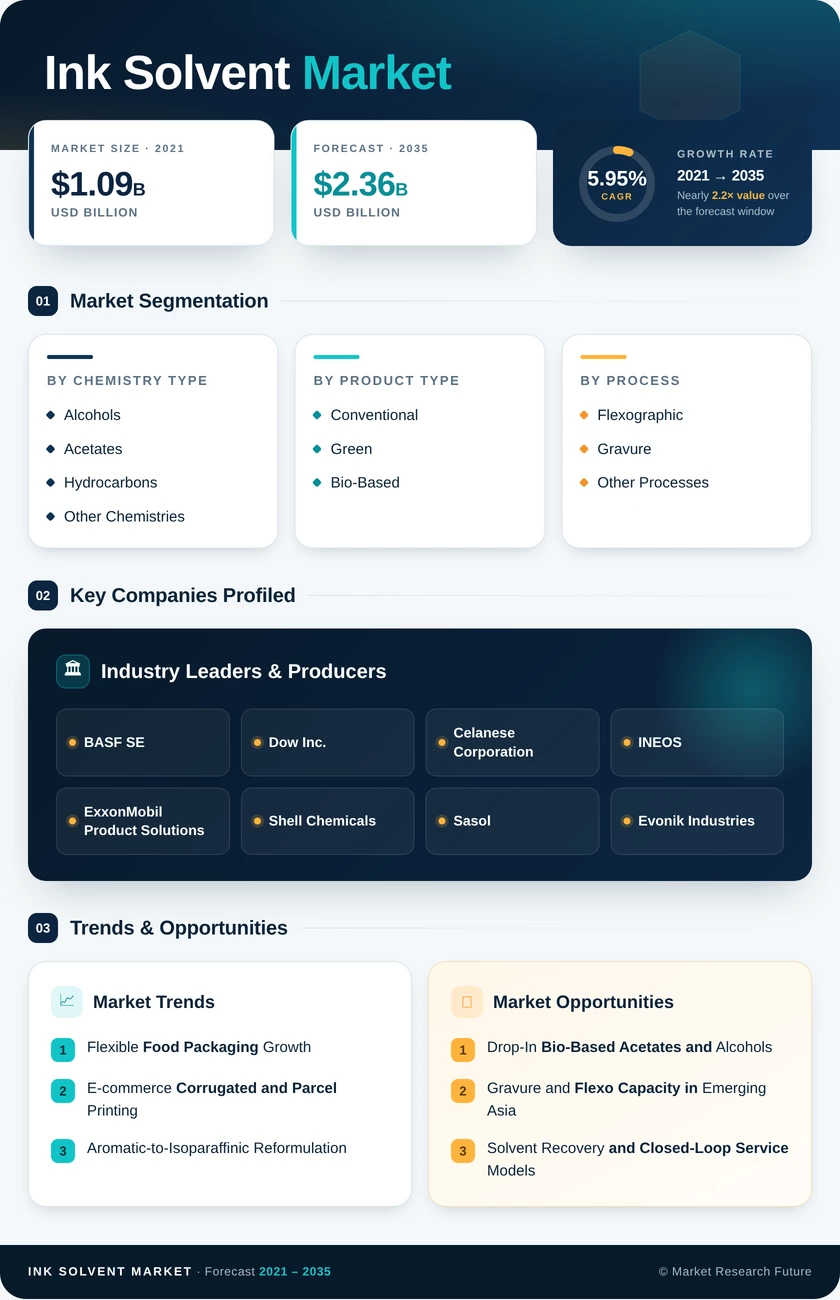
Ink Solvent Market
Market Size
Forecast Period2026-2035
CAGR (2026-2035)5.95%
2025 Market SizeUSD 1.34 Billion
2035 Market SizeUSD 2.36 Billion
Key Players
BASF SE
Dow Inc.
Celanese Corporation
INEOS
ExxonMobil Product Solutions
Shell Chemicals
Opportunities
  • Drop-In Bio-Based Acetates and Alcohols
  • Gravure and Flexo Capacity in Emerging Asia
  • Solvent Recovery and Closed-Loop Service Models
  1. 1 Market Summary | |
  2. 2 Key Report Takeaways | |
    1. 2.1 By Chemistry Type | |
    2. 2.2 By Product Type | |
    3. 2.3 By Process | |
    4. 2.4 By Application | |
    5. 2.5 By Region | |
  3. 3 Market Size and Forecast (2021–2035) | |
    1. 3.1 Historical Market Size (2021–2025) | |
    2. 3.2 Forecast Market Size (2026–2035) | |
    3. 3.3 Year-over-Year Growth Analysis | |
  4. 4 Driver Impact Analysis | |
    1. 4.1 Flexible Food Packaging Growth | |
    2. 4.2 E-commerce Corrugated and Parcel Printing | |
    3. 4.3 Aromatic-to-Isoparaffinic Reformulation | |
    4. 4.4 VOC Content Limits Favoring Compliant Blends | |
    5. 4.5 Food-Contact Ink Compliance Requirements | |
    6. 4.6 Asia-Pacific Petrochemical Capacity Build-Out | |
  5. 5 Restraints Impact Analysis | |
    1. 5.1 Water-Based and UV-Curable Ink Substitution | |
    2. 5.2 Feedstock and Energy Price Volatility | |
    3. 5.3 Tightening Industrial Emissions Permitting | |
    4. 5.4 Structural Decline in Publication Printing | |
    5. 5.5 Chemical Risk Evaluations and Reporting Burden | |
  6. 6 Opportunities | |
    1. 6.1 Drop-In Bio-Based Acetates and Alcohols | |
    2. 6.2 Gravure and Flexo Capacity in Emerging Asia | |
    3. 6.3 Solvent Recovery and Closed-Loop Service Models | |
    4. 6.4 Data-Driven Formulation and Press-Side Monitoring | |
    5. 6.5 Food-Contact Certified Specialty Grades | |
  7. 7 Regional Market Share and Country-Level Analysis | |
    1. 7.1 North America | | |
      1. 7.1.1 US | | |
      2. 7.1.2 Canada | | |
      3. 7.1.3 Mexico | |
    2. 7.2 Europe | | |
      1. 7.2.1 Germany | | |
      2. 7.2.2 UK | | |
      3. 7.2.3 France | | |
      4. 7.2.4 Italy | | |
      5. 7.2.5 Spain | | |
      6. 7.2.6 Nordic Countries | | |
      7. 7.2.7 Russia | | |
      8. 7.2.8 Rest of Europe | |
    3. 7.3 Asia-Pacific | | |
      1. 7.3.1 China | | |
      2. 7.3.2 India | | |
      3. 7.3.3 Japan | | |
      4. 7.3.4 South Korea | | |
      5. 7.3.5 ASEAN | | |
      6. 7.3.6 Rest of Asia-Pacific | |
    4. 7.4 South America | | |
      1. 7.4.1 Brazil | | |
      2. 7.4.2 Argentina | | |
      3. 7.4.3 Rest of South America | |
    5. 7.5 Middle East & Africa | | |
      1. 7.5.1 Saudi Arabia | | |
      2. 7.5.2 UAE | | |
      3. 7.5.3 South Africa | | |
      4. 7.5.4 Egypt | | |
      5. 7.5.5 Rest of MEA | |
  8. 8 Future Outlook (2026–2035) | |
    1. 8.1 Digital Press Control and Predictive Formulation | |
    2. 8.2 Petrochemical Demand and Feedstock Security | |
    3. 8.3 Circular Packaging and Recyclability Design | |
    4. 8.4 Renewable Content and Scope 3 Reporting | |
  9. 9 Segmentation Analysis | |
    1. 9.1 By Chemistry Type | | |
      1. 9.1.1 Alcohols | | |
      2. 9.1.2 Acetates | | |
      3. 9.1.3 Hydrocarbons | | |
      4. 9.1.4 Other Chemistries | |
    2. 9.2 By Product Type | | |
      1. 9.2.1 Conventional | | |
      2. 9.2.2 Green | | |
      3. 9.2.3 Bio-Based | |
    3. 9.3 By Process | | |
      1. 9.3.1 Flexographic | | |
      2. 9.3.2 Gravure | | |
      3. 9.3.3 Other Processes | |
    4. 9.4 By Application | | |
      1. 9.4.1 Flexible Packaging | | |
      2. 9.4.2 Corrugated Cardboard and Folding Cartons | | |
      3. 9.4.3 Publication | | |
      4. 9.4.4 Other Applications | |
  10. 10 Competitive Landscape | |
    1. 10.1 Market Concentration Analysis | |
    2. 10.2 Competitive Benchmarking Matrix | |
    3. 10.3 Company Profiles | | |
      1. 10.3.1 BASF SE | | |
      2. 10.3.2 Dow Inc. | | |
      3. 10.3.3 Eastman Chemical Company | | |
      4. 10.3.4 Celanese Corporation | | |
      5. 10.3.5 INEOS | | |
      6. 10.3.6 ExxonMobil Product Solutions | | |
      7. 10.3.7 Shell Chemicals | | |
      8. 10.3.8 Sasol | | |
      9. 10.3.9 Evonik Industries | | |
      10. 10.3.10 Solvay | | |
      11. 10.3.11 Arkema | |
  11. 11 Recent News & Developments | |
  12. 12 Report Scope and Methodology | |
  13. 13 Detailed Sources and Citations | |
  14. 14 Frequently Asked Questions (FAQs) | | LIST OF TABLES | |
  15. TABLE 1 Global Ink Solvent Market Summary, 2025–2035 | |
  16. TABLE 2 Global Market Size & Forecast, by Revenue (USD Billion), 2021–2035 | |
  17. TABLE 3 Driver Impact Analysis | |
  18. TABLE 4 Restraints Impact Analysis | |
  19. TABLE 5 Regional Summary, 2025 | |
  20. TABLE 6 North America Market, by Country, 2025 | |
  21. TABLE 7 Europe Market, by Country, 2025 | |
  22. TABLE 8 Asia-Pacific Market, by Country, 2025 | |
  23. TABLE 9 South America Market, by Country, 2025 | |
  24. TABLE 10 Middle East & Africa Market, by Country, 2025 | |
  25. TABLE 11 Global Market, by Chemistry Type, 2025 | |
  26. TABLE 12 Global Market, by Product Type, 2025 | |
  27. TABLE 13 Global Market, by Process, 2025 | |
  28. TABLE 14 Global Market, by Application, 2025 | |
  29. TABLE 15 Competitive Benchmarking Matrix | |
  30. TABLE 16 Report Scope and Methodology | |
  31. TABLE 17 Detailed Sources and Citations | |
  32. TABLE 18 Segmentation Quick Reference | | LIST OF FIGURES | |
  33. FIGURE 1 Market Dynamics Overview (Drivers, Restraints, Opportunities) | |
  34. FIGURE 2 Industry Value Chain Analysis | |
  35. FIGURE 3 Porter's Five Forces Analysis | |
  36. FIGURE 4 Global Market Size Trend, 2021–2035 (USD Billion) | |
  37. FIGURE 5 Market Share by Chemistry Type, 2025 | |
  38. FIGURE 6 Market Share by Product Type, 2025 | |
  39. FIGURE 7 Market Share by Process, 2025 | |
  40. FIGURE 8 Market Share by Application, 2025 | |
  41. FIGURE 9 Regional Market Share, 2025 | |
  42. FIGURE 10 Country-Level Market Share by Region, 2025 | |
  43. FIGURE 11 Competitive Landscape and Market Concentration, 2025

Segmentation Quick Reference

DimensionSub-SegmentsDominant SegmentFastest Growing Segment
By Chemistry TypeAlcohols, Acetates, Hydrocarbons, Other ChemistriesAlcohols (41.5%)Hydrocarbons (6.6% CAGR)
By Product TypeConventional, Green, Bio-BasedConventional (68.6%)Bio-Based (6.8% CAGR)
By ProcessFlexographic, Gravure, Other ProcessesFlexographic (49.9%)Gravure (6.9% CAGR)
By ApplicationFlexible Packaging, Corrugated Cardboard and Folding Cartons, Publication, Other ApplicationsFlexible Packaging (52.4%)Corrugated Cardboard and Folding Cartons (7.1% CAGR)
By RegionNorth America, Europe, Asia-Pacific, South America, Middle East & AfricaAsia-Pacific (42.5%)North America (6.6% CAGR)

Market Segmentation Overview

By Chemistry Type

Sub-SegmentKey Trend
AlcoholsEthanol and n-propanol remain core carriers for nitrocellulose packaging inks
AcetatesEthyl and n-propyl acetate gain in food-contact gravure blends
HydrocarbonsShift from aromatics to low-odor isoparaffinic fluids
Other ChemistriesGlycol ethers and diacetone alcohol used as slow-evaporating tails

Alcohols lead because they dissolve the nitrocellulose and polyamide resins that dominate packaging inks and evaporate fast on film. Hydrocarbons grow fastest as HAP and VOC rules push formulators from toluene and xylene to dearomatized isoparaffins. Acetates track food-contact gravure demand closely.

By Product Type

Sub-SegmentKey Trend
ConventionalRetains cost and compatibility advantage on installed presses
GreenAdopted where procurement screens hazardous substances
Bio-BasedDrop-in bio-acetates and bio-ethanol scale with renewable-content contracts

Conventional grades lead because converters can use them without requalifying presses, dryers or recovery units. Bio-Based grades grow fastest since identical molecules from renewable feedstock let brand owners meet renewable-content clauses without process changes. Green solvents sit between the two, gaining where buyers prioritize low toxicity over renewable origin.

By Process

Sub-SegmentKey Trend
FlexographicCentral-impression presses expand in food packaging and corrugated
GravureNew lines in India and ASEAN for premium laminates
Other ProcessesScreen and letterpress stay niche and stable

Flexographic leads on accessibility, lower plate cost and substrate range, making it the default for mid-sized converters. Gravure grows fastest because long-run, high-density laminates for food and cosmetics justify its cylinder costs in fast-growing Asian markets. Other Processes remain specialty uses with little change ahead.

By Application

Sub-SegmentKey Trend
Flexible PackagingFilm packaging for snacks, dairy and personal care keeps expanding
Corrugated Cardboard and Folding CartonsHigh-graphics e-commerce boxes lift solvent flexo use
PublicationHeat-set magazine and catalogue print continues to decline
Other ApplicationsLabels and decorative laminates provide stable demand

Flexible Packaging leads because printed films need solvent inks for adhesion on non-porous substrates. Corrugated Cardboard and Folding Cartons grows fastest as online retail turns shipping boxes into branded media, especially on coated liners where water-based inks dry too slowly. Publication declines with print advertising.


Download PDF ×

We do not share your information with anyone. However, we may send you emails based on your report interest from time to time. You may contact us at any time to opt-out.