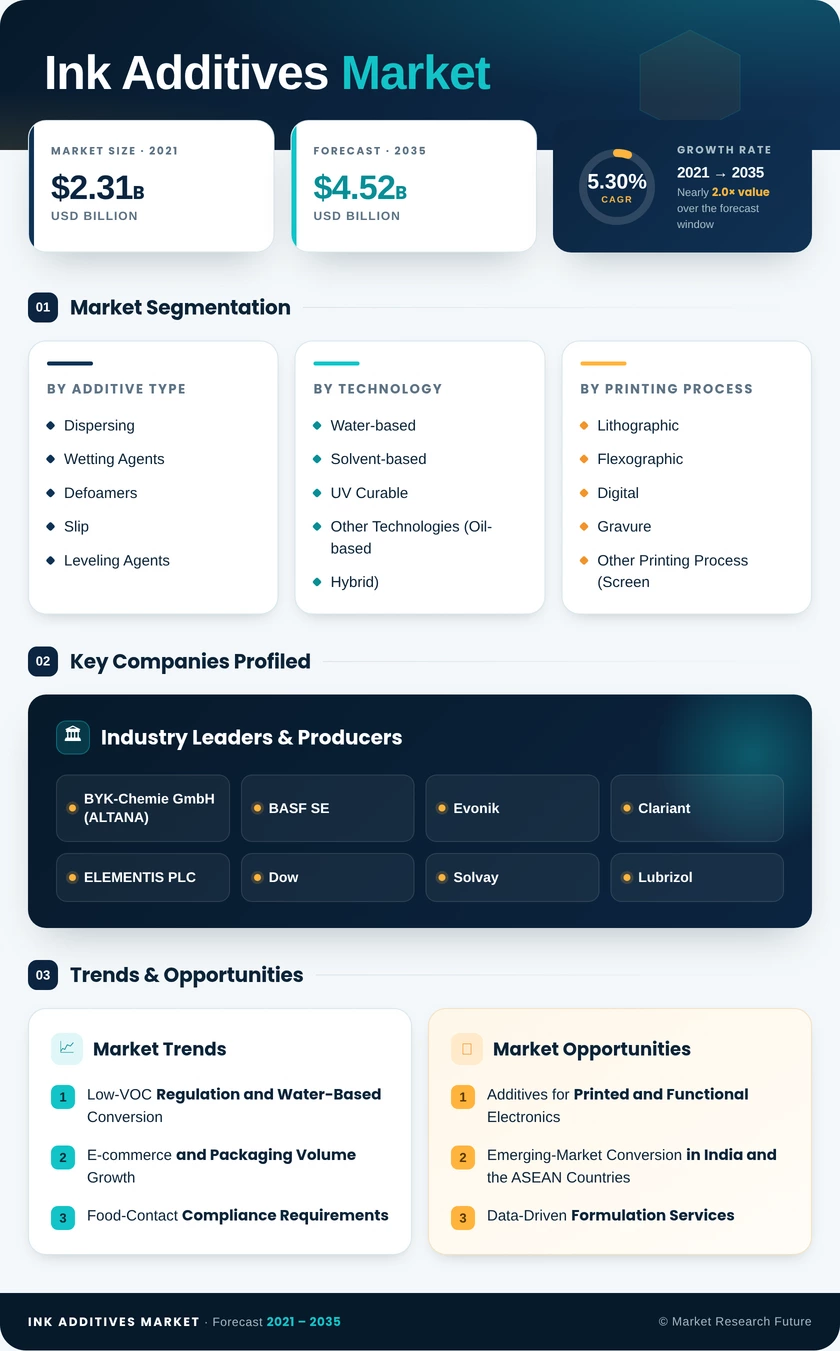
Segmentation Quick Reference
| Dimension | Sub-Segments | Dominant Segment | Fastest Growing Segment |
|---|
| By Additive Type | Dispersing and Wetting Agents; Defoamers; Slip and Leveling Agents; Rheology Modifiers; Other Additive Types (Adhesion Promoters, etc.) | Dispersing and Wetting Agents (34.2% share) | Other Additive Types (Adhesion Promoters, etc.) (6.1% CAGR) |
| By Technology | Water-based; Solvent-based; UV Curable; Other Technologies (Oil-based, Hybrid) | Water-based (49.8% share) | UV Curable (6.0% CAGR) |
| By Printing Process | Lithographic; Flexographic; Digital; Gravure; Other Printing Process (Screen, etc) | Lithographic (37.3% share) | Digital (6.2% CAGR) |
| By Application | Packaging; Printing; Other Applications (Functional Electronics, etc.) | Packaging (55.2% share) | Packaging (55.2% share) |
| By Region | North America; Europe; Asia-Pacific; South America; Middle East and Africa | Asia-Pacific (44.5% share) | Asia-Pacific (44.5% share) |
Market Segmentation Overview
| Sub-Segment | Key Trend |
|---|
| Dispersing and Wetting Agents | Lower-viscosity mill bases and universal pigment systems |
| Defoamers | Silicone-free grades for recyclable packaging |
| Slip and Leveling Agents | Fluorine-free replacements for leveling aids |
| Rheology Modifiers | Anti-settling control for inkjet and water-based inks |
| Other Additive Types (Adhesion Promoters, etc.) | Primerless adhesion on films, glass and ceramics |
Dispersing and Wetting Agents lead because no pigmented ink reaches target colour strength without them. Other Additive Types (Adhesion Promoters, etc.) grow fastest as converters print directly onto co-extruded barrier films and ceramics without primers. Defoamers gain steadily from the water-based shift, while PFAS restrictions reshape Slip and Leveling Agents.
| Sub-Segment | Key Trend |
|---|
| Water-based | Food-safe, odour-neutral platforms replace solvent inks |
| Solvent-based | Retained for chemical-resistant industrial printing |
| UV Curable | LED-UV curing and tin-free photoinitiators |
| Other Technologies (Oil-based, Hybrid) | Hybrid UV/EB layers for shrink sleeves and pouches |
Water-based inks lead because VOC limits in China and Europe leave converters few alternatives, and they carry the heaviest additive load. UV Curable systems grow fastest as LED-UV lamps cut energy costs and enable compact presses. Solvent-based inks hold on only where chemical resistance outweighs emission concerns.
| Sub-Segment | Key Trend |
|---|
| Lithographic | Standardised emulsification and fountain-solution additives |
| Flexographic | Water-based and UV-flexo inks for flexible packaging |
| Digital | High-performance dispersants for inkjet stability |
| Gravure | High-volume décor and laminate printing |
| Other Printing Process (Screen, etc) | Functional and textile printing |
Lithographic printing remains the largest process thanks to long-run cost efficiency, though publication decline caps its growth. Digital grows fastest on demand for short runs and personalised packaging, which require dispersants that hold sub-micron pigment particles stable in print heads. Flexographic printing gains from its central role in flexible packaging.
| Sub-Segment | Key Trend |
|---|
| Packaging | Corrugated, Flexible and Food formats with low-migration demands |
| Printing | Ceramics, Glass, Paper and Plastics requiring heat and solvent resistance |
| Other Applications (Functional Electronics, etc.) | Conductive and luminescent inks for smart packaging |
Packaging both leads and grows fastest, because e-commerce shippers and food-safe flexible formats consume the most engineered additive packages. Printing, covering Ceramics, Glass, Paper and Plastics, grows more slowly as publication volumes fall. Other Applications (Functional Electronics, etc.) remains small but carries the highest value per kilogram.


 Noah Malgeri
Co-Founder

 Peter Groot koerkamp
Account and Business Manager

 Younghwan Choi
Senior Retail Manager

 Mark Irwin
Management Consultant

 Akif Moroglu
Strategy & Business Development Director

 Guilherme Gomes Martins
Product Management Director

 Joseph Aguayo
Sales Operations & Pricing Manager

 La Terria Dodd
Program Support Specialist

 Rob Kooiker
Group Product Manager HVAC & Fire Protection GMA