
Request Free Sample ×

Kindly complete the form below to receive a free sample of this Report

* Please use a valid business email

Leading companies partner with us for data-driven Insights

clients tt-cursor
Hero Background
English
Chinese
French
Japanese
Korean
German
Spanish

Industrial Safety Market Trends

ID: MRFR/SEM/6493-HCR
200 Pages
Nirmit Biswas
April 2026

Industrial Safety Market Size, Share & Industry Analysis: By Type (Emergency Shutdown Systems (ESD), Fire & Gas Monitoring Systems, High Integrity Pressure Protection Systems (HIPPS), Burner Management Systems (BMS), Turbomachinery Control (TMC), Others), By Component (Safety Sensors, Programmable Safety Systems, Safety Controllers/Module/Relays, Safety Switches, Safety Valves, Others), By Industry Vertical (Chemicals, Refining, Oil & Gas, Metal & Mining, Water & Wastewater, Energy & Power, Manufacturing) and Region - Industry Forecast Till 2035

Share:
Download PDF ×

We do not share your information with anyone. However, we may send you emails based on your report interest from time to time. You may contact us at any time to opt-out.

Industrial Safety Market Infographic
Purchase Options

Market Trends

Key Emerging Trends in the Industrial Safety Market

Striking advancements in the industrial safety industry are changing the scene of work environment security. One vital pattern is the rising use of brilliant advancements and the IoT in modern security arrangements. Organizations are making progressively complex security frameworks that utilize information examination and sensor advances to screen, anticipate, and forestall mishaps. This shift toward keen industrial safety urges a proactive strategy to take a chance with the executives and builds the general viability of security safeguards. The developing utilization of wearable innovation in modern security is another significant turn of events. Wearables that give continuous information on specialist wellbeing and ecological circumstances, as associated gloves, security vests with worked in sensors, and shrewd caps, are turning out to be increasingly famous. By advancing laborers of potential risks, these gadgets further develop specialist security as well as empower bosses to follow and assess the total wellbeing execution of their workers. This example shows a developing spotlight on redid wellbeing arrangements that address the one-of-a-kind necessities of individual workers. Moreover, mechanical technology and mechanization are altogether affecting business sector patterns. Mechanical security arrangements have been created because of the mechanization of modern cycles. Cobots, or cooperative robots, are fit for working one next to the other with people and are equipped with refined security highlights like power restriction and impact recognition. This pattern decreases the opportunity of mishaps while at the same time expanding modern tasks' effectiveness by cultivating a more secure working environment where individuals and machines can team up calmly. Prescient support is turning out to be increasingly more well known in industrial safety. Using sensors and checking gadget information, organizations can expect gear disappointments and complete support undertakings before issues deteriorate. This proactive methodology ensures that fundamental security frameworks and hardware are in ideal condition, which forestalls impromptu free time as well as adds to general work environment security. Patterns in modern security are starting to accentuate natural supportability. Organizations are embracing reasonable and harmless to the ecosystem wellbeing arrangements that diminish their effect on the climate to an ever-increasing extent. This covers the formation of PPE that is recyclable, energy-effective wellbeing frameworks, and harmless to the ecosystem creation procedures. The joining of biologically mindful security measures is in accordance with more extensive supportability targets as organizations focus on corporate social obligation. How security information is dissected and utilized is being upset by the mix of man-made intelligence. Enormous volumes of information can be handled by simulated intelligence-controlled calculations, which can then be utilized to recognize patterns, predict potential dangers, and give direction to deterrent security measures. This pattern works with better navigation and makes it conceivable to move toward modern wellbeing in a more proficient and adaptable way. The strength of the store network is turning into a vital calculate the industrial safety patterns. The Coronavirus pandemic and other overall occasions have caused disturbances, which has made it basic to ensure the adaptability of supply chains and the accessibility of wellbeing assets and hardware. Organizations are reevaluating their store network plans to ensure areas of strength for an adaptable response to unexpected challenges, safeguarding the continuous execution of security conventions.


Author
Author Profile
Nirmit Biswas
Senior Research Analyst

With 5+ years of expertise in Market Intelligence and Strategic Research, Nirmit Biswas specializes in ICT, Semiconductors, and BFSI. Backed by an MBA in Financial Services and a Computer Science foundation, Nirmit blends technical depth with business acumen. He has successfully led 100+ projects for global enterprises and startups, including Amazon, Cisco, L&T and Huawei, delivering market estimations, competitive benchmarking, and GTM strategies. His focus lies in transforming complex data into clear, actionable insights that drive growth, innovation, and investment decisions. Recognized for bridging engineering innovation with executive strategy, Nirmit helps businesses navigate dynamic markets with confidence.

Leave a Comment

FAQs

What is the current valuation of the Industrial Safety Market?

<p>The Industrial Safety Market was valued at approximately 2912.35 USD Million in 2024.</p>

What is the projected market valuation for the Industrial Safety Market in 2035?

<p>The market is projected to reach approximately 6862.98 USD Million by 2035.</p>

What is the expected CAGR for the Industrial Safety Market from 2025 to 2035?

<p>The expected CAGR for the Industrial Safety Market during the forecast period 2025 - 2035 is 8.19%.</p>

Which companies are considered key players in the Industrial Safety Market?

<p>Key players in the market include Honeywell, 3M, DuPont, MSA Safety, and Kimberly-Clark.</p>

What are the main segments of the Industrial Safety Market by application?

<p>The main segments by application include Personal Protective Equipment, Safety Management Systems, and Industrial Safety Training.</p>

How does the valuation of Personal Protective Equipment compare to other segments?

Personal Protective Equipment is valued between 800.0 and 1800.0 USD Million, indicating a strong market presence.

What is the projected growth for the Safety Management Systems segment?

The Safety Management Systems segment is projected to grow from 600.0 to 1400.0 USD Million.

Which end-use sector shows the highest valuation in the Industrial Safety Market?

The Manufacturing sector shows the highest valuation, ranging from 800.0 to 1800.0 USD Million.

What types of products are included in the Industrial Safety Market?

Product types include Safety Gloves, Safety Helmets, Safety Footwear, Fall Protection Equipment, and Fire Safety Equipment.

What services are offered within the Industrial Safety Market?

Services include Consulting Services, Training Services, Maintenance Services, Inspection Services, and Emergency Response Services.

Market Summary

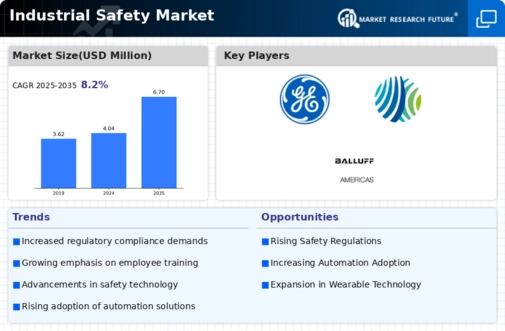
As per MRFR analysis, the Industrial Safety Market Size was estimated at 2912.35 USD Million in 2024. The Industrial Safety industry is projected to grow from 3120.61 USD Million in 2025 to 6862.98 USD Million by 2035, exhibiting a compound annual growth rate (CAGR) of 8.19% during the forecast period 2025 - 2035.

Key Market Trends & Highlights

The Industrial Safety Market is experiencing a transformative shift driven by technological advancements and evolving safety practices.

  • Technological integration is reshaping safety protocols, enhancing efficiency and compliance across industries. A cultural shift towards prioritizing safety is evident, particularly in North America, where awareness is at an all-time high. Sustainability is increasingly intertwined with safety measures, reflecting a growing commitment to environmental responsibility. Regulatory compliance pressure and increased awareness of workplace safety are key drivers propelling growth in the Personal Protective Equipment and Construction segments.

Market Size & Forecast

2024 Market Size 2912.35 (USD Million)
2035 Market Size 6862.98 (USD Million)
CAGR (2025 - 2035) 8.19%
Largest Regional Market Share in 2024 North America

Major Players

Honeywell (US), 3M (US), DuPont (US), MSA Safety (US), Kimberly-Clark (US), Dräger (DE), SABIC (SA), Ansell (AU), Allegro Industries (US)

Market Trends

The Industrial Safety Market is currently experiencing a transformative phase, driven by an increasing emphasis on workplace safety and regulatory compliance. Organizations across various sectors are prioritizing the implementation of safety measures to mitigate risks associated with industrial operations. This heightened focus is likely influenced by a growing awareness of the potential consequences of workplace accidents, which can lead to significant financial losses and reputational damage. As a result, companies are investing in advanced safety technologies and training programs to enhance their safety protocols. Furthermore, the integration of digital solutions, such as IoT and AI, appears to be reshaping the landscape of industrial safety, enabling real-time monitoring and predictive analytics to prevent incidents before they occur. In addition to technological advancements, the Industrial Safety Market is also witnessing a shift towards a more proactive safety culture. Organizations are increasingly fostering environments where safety is a shared responsibility among all employees. This cultural shift may lead to improved communication and collaboration regarding safety practices, ultimately resulting in a more resilient workforce. Moreover, the emphasis on sustainability and environmental safety is becoming intertwined with industrial safety initiatives, suggesting that companies are recognizing the interconnectedness of these domains. As the market evolves, it is anticipated that the focus on comprehensive safety strategies will continue to grow, reflecting a broader commitment to protecting both workers and the environment.

Technological Integration

The Industrial Safety Market is seeing a notable trend towards the integration of advanced technologies. Innovations such as IoT devices and AI-driven analytics are being adopted to enhance safety measures. These technologies facilitate real-time monitoring of workplace conditions, allowing for immediate responses to potential hazards. This trend indicates a shift from reactive to proactive safety management, where data-driven insights play a crucial role in preventing accidents.

Cultural Shift in Safety Practices

There is a growing emphasis on cultivating a safety-oriented culture within organizations. Companies are increasingly recognizing that safety is not solely the responsibility of management but requires active participation from all employees. This cultural shift fosters open communication about safety concerns and encourages collaborative efforts to improve safety practices, potentially leading to a more engaged and vigilant workforce.

Sustainability and Safety Interconnection

The relationship between sustainability and safety is becoming more pronounced in the Industrial Safety Market. Organizations are beginning to understand that effective safety measures can contribute to environmental protection. This trend suggests that companies are integrating safety protocols with sustainability initiatives, aiming to create safer workplaces while also minimizing their ecological footprint.

Industrial Safety Market Market Drivers

Regulatory Compliance

The Global Industrial Safety Market Industry is significantly influenced by stringent regulatory frameworks established by governmental bodies. These regulations mandate organizations to implement safety protocols and equipment to protect workers and minimize hazards. For instance, the Occupational Safety and Health Administration (OSHA) in the United States enforces standards that require employers to provide a safe working environment. As a result, companies are increasingly investing in safety training and equipment, contributing to the market's growth. The industry's value is projected to reach 4.04 USD Billion in 2024, reflecting the heightened emphasis on compliance and safety standards.

Market Growth Projections

The Global Industrial Safety Market Industry is projected to experience substantial growth over the coming years. With a market value anticipated to reach 4.04 USD Billion in 2024 and further expand to 6.7 USD Billion by 2035, the industry is poised for a robust trajectory. The compound annual growth rate (CAGR) of 4.71% from 2025 to 2035 suggests a sustained demand for safety solutions across various sectors. This growth is likely driven by increasing regulatory pressures, technological advancements, and a heightened focus on workplace safety, indicating a dynamic landscape for industrial safety.

Technological Advancements

Technological innovations play a pivotal role in shaping the Global Industrial Safety Market Industry. The integration of advanced safety equipment, such as smart helmets and wearable technology, enhances worker safety by providing real-time data and alerts. For example, sensors that detect hazardous gases or monitor fatigue levels are becoming commonplace in various industries. These advancements not only improve safety outcomes but also drive market growth as organizations seek to adopt cutting-edge solutions. The anticipated growth trajectory, with a projected market value of 6.7 USD Billion by 2035, underscores the potential of technology to revolutionize safety practices.

Globalization of Supply Chains

The globalization of supply chains has introduced complexities that necessitate robust safety measures, thereby influencing the Global Industrial Safety Market Industry. As companies expand their operations internationally, they encounter diverse regulatory environments and safety challenges. This has led to an increased demand for comprehensive safety solutions that can be adapted to various contexts. Organizations are investing in safety audits and compliance training to ensure adherence to local regulations. Consequently, the market is poised for growth, with projections indicating a value of 4.04 USD Billion in 2024, driven by the need for standardized safety practices across borders.

Focus on Employee Health and Well-being

The emphasis on employee health and well-being is increasingly shaping the Global Industrial Safety Market Industry. Organizations recognize that a safe work environment is integral to employee satisfaction and productivity. This realization has prompted investments in ergonomic equipment, mental health resources, and comprehensive safety training programs. By fostering a culture of safety, companies not only comply with regulations but also enhance their reputation and employee retention. The market's growth trajectory, with an expected value of 6.7 USD Billion by 2035, reflects the long-term commitment to prioritizing employee health and safety.

Increased Awareness of Workplace Safety

There is a growing awareness regarding workplace safety among organizations globally, which is a key driver for the Global Industrial Safety Market Industry. This heightened consciousness stems from various factors, including high-profile accidents and the increasing focus on employee well-being. Companies are now prioritizing safety training programs and investing in safety management systems to mitigate risks. This trend is reflected in the market's expected compound annual growth rate (CAGR) of 4.71% from 2025 to 2035, indicating a sustained commitment to enhancing safety measures across industries.

Market Segment Insights

By Application: Personal Protective Equipment (Largest) vs. Safety Management Systems (Fastest-Growing)

The Industrial Safety Market exhibits a diverse segmentation, with Personal Protective Equipment (PPE) commanding the largest share due to its critical role in ensuring worker safety across various industries. Following PPE, Safety Management Systems are rapidly gaining traction, representing the fastest-growing segment as organizations increasingly prioritize comprehensive safety protocols and data-driven decision-making. Other segments, such as Industrial Safety Training, Safety Audits, and Emergency Response Equipment, also hold significant positions within the market, contributing to a holistic safety culture. Growth trends indicate that the Industrial Safety Market is evolving in response to regulations and the rising awareness of workplace safety. Moreover, technological advancements in safety management and a heightened focus on training programs are driving growth in Safety Management Systems and Industrial Safety Training. The emphasis on emergency preparedness has also spurred demand for Emergency Response Equipment, while Safety Audits are increasingly recognized as essential for ongoing compliance and risk mitigation.

Personal Protective Equipment (Dominant) vs. Safety Training (Emerging)

Personal Protective Equipment (PPE) stands as the dominant force in the Industrial Safety Market due to its essential function in safeguarding employees from hazards across varied work environments. This segment encompasses an array of products, including helmets, gloves, protective clothing, and respirators, which serve to mitigate risks associated with physical, chemical, and environmental threats. As regulations tighten and workplace safety becomes a priority, the demand for PPE continues to rise. On the other hand, Safety Training emerges as a crucial investment for organizations striving to cultivate a safety-conscious workforce. This segment focuses on equipping employees with knowledge and skills to recognize hazards, implement safety protocols, and respond effectively during emergencies, thus creating a robust safety culture that complements the use of PPE.

By End Use: Manufacturing (Largest) vs. Construction (Fastest-Growing)

The Industrial Safety Market exhibits a diverse landscape, with significant market share distribution across various end-use sectors. Manufacturing stands out as the largest segment, driven by stringent safety regulations and a consistent demand for protective equipment to safeguard workers in factories. This sector's emphasis on optimizing productivity while ensuring employee safety contributes to its substantial market presence. Conversely, the Construction sector is witnessing rapid expansion, spurred by booming infrastructure projects and increasing emphasis on worker safety standards. The rapid influx of investment in construction activities further propels growth in this area, making it a vital contributor to the overall safety market.

Manufacturing (Dominant) vs. Construction (Emerging)

Manufacturing is recognized as the dominant segment within the Industrial Safety Market due to the necessity for advanced safety measures across production environments. This sector benefits from large-scale investments in personal protective equipment (PPE) and automated safety systems, catering to the need for risk mitigation in high-demand settings. Meanwhile, the Construction sector emerges as a significant player, characterized by its swift adaptation to new safety technologies and compliance with evolving regulations. This emerging sector is particularly responsive to innovations such as smart helmets, wearable safety devices, and real-time hazard monitoring systems, positioning itself as a key driver of growth in the industrial safety landscape.

By Product Type: Safety Gloves (Largest) vs. Fall Protection Equipment (Fastest-Growing)

<p>The Industrial Safety Market showcases a diverse range of product types, with Safety Gloves commanding the largest market share, reflecting their essential role in personal safety across various industries. Following closely are Safety Helmets and Safety Footwear, which also play pivotal roles in ensuring worker protection. In contrast, Fall Protection Equipment and Fire Safety Equipment are gaining traction, indicating an evolving focus on comprehensive safety measures in hazardous environments.</p>

<p>Safety Gloves (Dominant) vs. Fall Protection Equipment (Emerging)</p>

<p>Safety Gloves remain a dominant force in the Industrial Safety Market, primarily due to their versatility and adaptability across numerous applications, from construction to manufacturing. They are designed to protect against a variety of hazards, including cuts, abrasions, and chemicals. In contrast, Fall Protection Equipment is emerging as a critical segment as industries emphasize prevention measures for working at heights. This equipment includes harnesses, lanyards, and safety nets, which are increasingly recognized for their role in reducing workplace injuries. The rapid advancements in material technology are further boosting the performance and acceptance of these products.</p>

By Service Type: Consulting Services (Largest) vs. Training Services (Fastest-Growing)

In the Industrial Safety Market, Consulting Services hold the largest market share, primarily driven by the increasing need for expert guidance in compliance and safety management. Training Services, while smaller in share, are emerging as the fastest-growing segment due to heightened awareness about workplace safety and regulatory requirements, leading organizations to invest in training their workforce to adhere to safety standards. Maintenance Services, Inspection Services, and Emergency Response Services follow with crucial roles in sustaining safety protocols but do not exhibit growth rates as high as Training Services.

Consulting Services (Dominant) vs. Training Services (Emerging)

Consulting Services in the Industrial Safety Market are characterized by their critical role in advising companies on best practices and compliance with safety regulations. These services leverage industry expertise to help organizations mitigate risks and enhance safety protocols. On the other hand, Training Services are rapidly emerging as a vital segment, reflecting the increasing emphasis on workforce education regarding safety practices. As regulatory pressures mount, businesses prioritize training programs that not only fulfill compliance but also foster a culture of safety, hence driving the growth of Training Services within the market.

Get more detailed insights about Industrial Safety Market Research Report - Forecast till 2035

Regional Insights

North America : Market Leader in Safety Solutions

North America continues to lead the Industrial Safety Market, holding a significant share of 1450.0 million. The region's growth is driven by stringent safety regulations, increasing workplace safety awareness, and technological advancements in safety equipment. The demand for personal protective equipment (PPE) is on the rise, fueled by regulatory requirements and a focus on employee well-being. Companies are investing in innovative safety solutions to comply with regulations and enhance operational efficiency. The competitive landscape in North America is robust, featuring key players such as Honeywell, 3M, and DuPont. These companies are at the forefront of developing advanced safety technologies and products. The U.S. is the leading country in this region, with a strong emphasis on workplace safety standards. The presence of major manufacturers and a growing emphasis on safety training programs further bolster the market's growth prospects.

Europe : Regulatory-Driven Market Growth

Europe's Industrial Safety Market is projected to reach 800.0 million, driven by stringent regulations and a strong emphasis on workplace safety. The European Union's commitment to enhancing occupational safety standards has led to increased investments in safety equipment and training. The demand for innovative safety solutions is further fueled by the growing awareness of workplace hazards and the need for compliance with regulations. This regulatory landscape is a key driver of market growth in the region. Leading countries in Europe include Germany, France, and the UK, where major players like Dräger and Kimberly-Clark are actively contributing to market expansion. The competitive environment is characterized by a focus on innovation and sustainability, with companies investing in research and development to meet evolving safety standards. The presence of established manufacturers and a growing emphasis on safety culture among organizations are expected to drive further growth in the coming years.

Asia-Pacific : Emerging Market with Growth Potential

The Asia-Pacific region is witnessing significant growth in the Industrial Safety Market, projected to reach 550.0 million. This growth is driven by rapid industrialization, increasing awareness of workplace safety, and government initiatives aimed at improving safety standards. Countries like China and India are leading the charge, with rising investments in safety equipment and training programs. The demand for PPE is escalating as industries strive to comply with safety regulations and enhance employee protection. In this competitive landscape, key players such as Ansell and Allegro Industries are making strides in the market. The presence of local manufacturers is also increasing, contributing to a diverse product offering. As the region continues to develop, the focus on safety culture and regulatory compliance is expected to drive further market growth, making Asia-Pacific a vital area for industrial safety advancements.

Middle East and Africa : Growing Focus on Safety Standards

The Middle East and Africa (MEA) region is gradually emerging in the Industrial Safety Market, with a projected size of 112.35 million. The growth is primarily driven by increasing industrial activities and a rising awareness of safety standards. Governments in the region are beginning to implement regulations aimed at improving workplace safety, which is fostering demand for safety equipment and training. The focus on enhancing safety measures is becoming a priority for many organizations, leading to a gradual shift in market dynamics. Countries like South Africa and Saudi Arabia are at the forefront of this growth, with key players such as SABIC actively participating in the market. The competitive landscape is evolving, with both local and international companies vying for market share. As the region continues to develop its industrial base, the emphasis on safety compliance and training is expected to drive further growth in the Industrial Safety Market.

Key Players and Competitive Insights

The Industrial Safety Market is currently characterized by a dynamic competitive landscape, driven by increasing regulatory requirements and a heightened focus on workplace safety. Key players such as Honeywell (US), 3M (US), and DuPont (US) are strategically positioned to leverage innovation and technological advancements. Honeywell (US) emphasizes digital transformation, integrating IoT solutions into its safety products, while 3M (US) focuses on expanding its product portfolio through strategic acquisitions. DuPont (US) is enhancing its operational focus on sustainable materials, which aligns with the growing demand for environmentally friendly safety solutions. Collectively, these strategies not only enhance their market presence but also shape a competitive environment that prioritizes safety and innovation.
In terms of business tactics, companies are increasingly localizing manufacturing to reduce lead times and optimize supply chains. The market structure appears moderately fragmented, with several key players holding substantial market shares. This fragmentation allows for a diverse range of products and services, fostering competition that drives innovation. The collective influence of these major players is significant, as they set industry standards and influence market trends through their strategic initiatives.
In November 2025, Honeywell (US) announced the launch of a new line of smart personal protective equipment (PPE) that integrates real-time monitoring capabilities. This strategic move is pivotal as it addresses the growing demand for connected safety solutions, enabling organizations to enhance worker safety through data-driven insights. The introduction of such innovative products positions Honeywell (US) as a leader in the digital safety space, potentially reshaping customer expectations and industry standards.
In October 2025, 3M (US) completed the acquisition of a leading safety technology firm, which is expected to bolster its capabilities in developing advanced safety solutions. This acquisition is strategically important as it allows 3M (US) to enhance its technological expertise and expand its product offerings, thereby strengthening its competitive edge in the market. The integration of new technologies into its existing portfolio could lead to more comprehensive safety solutions that meet evolving customer needs.
In September 2025, DuPont (US) unveiled a new range of sustainable safety products made from recycled materials. This initiative reflects a growing trend towards sustainability in the Industrial Safety Market, as companies increasingly seek to minimize their environmental impact. By prioritizing sustainability, DuPont (US) not only meets regulatory demands but also appeals to environmentally conscious consumers, potentially gaining a competitive advantage in a market that is shifting towards greener solutions.
As of December 2025, current competitive trends in the Industrial Safety Market are heavily influenced by digitalization, sustainability, and the integration of AI technologies. Strategic alliances among key players are becoming more prevalent, as companies seek to enhance their technological capabilities and expand their market reach. The competitive differentiation is likely to evolve from traditional price-based competition to a focus on innovation, technology, and supply chain reliability. This shift indicates a future where companies that prioritize advanced safety solutions and sustainable practices will likely lead the market.

Key Companies in the Industrial Safety Market include

Industry Developments

  • Q2 2024: Honeywell to acquire Compressor Controls Corporation for $670 million Honeywell announced the acquisition of Compressor Controls Corporation, a provider of turbomachinery control and optimization solutions, to expand its industrial safety and automation portfolio.
  • Q2 2024: Siemens Launches New Industrial Safety Market Platform for Manufacturing Sector Siemens introduced a new digital safety platform designed to enhance real-time monitoring and risk mitigation in industrial manufacturing environments.
  • Q3 2024: Rockwell Automation Announces Partnership with Microsoft to Advance Industrial Safety Market Solutions Rockwell Automation and Microsoft entered a strategic partnership to develop cloud-based industrial safety applications leveraging AI and IoT technologies.
  • Q2 2024: ABB opens new robotics and safety solutions facility in Sweden ABB inaugurated a new facility in Västerås, Sweden, focused on developing advanced robotics and industrial safety systems for European markets.
  • Q1 2024: Yokogawa Launches OpreX Safety Instrumented System for Oil & Gas Sector Yokogawa introduced its latest OpreX Safety Instrumented System, targeting enhanced process safety in oil and gas operations.
  • Q2 2025: MSA Safety appoints new CEO as part of leadership transition MSA Safety announced the appointment of a new Chief Executive Officer, effective July 2025, to lead the company’s next phase of growth in industrial safety equipment.
  • Q1 2025: Emerson Unveils Next-Generation Gas Detection System for Industrial Facilities Emerson launched a new gas detection system designed to improve worker safety and regulatory compliance in hazardous industrial environments.
  • Q3 2024: DuPont completes acquisition of SafeTrak, expanding industrial safety portfolio DuPont finalized its acquisition of SafeTrak, a company specializing in digital safety inspection and compliance solutions for industrial workplaces.
  • Q2 2024: Schneider Electric and Honeywell form alliance to develop integrated industrial safety platforms Schneider Electric and Honeywell announced a strategic alliance to co-develop integrated safety platforms for industrial automation and process industries.
  • Q1 2025: MSA Safety launches new connected PPE platform for industrial workers MSA Safety introduced a connected personal protective equipment (PPE) platform that enables real-time monitoring of worker safety in hazardous environments.
  • Q2 2025: Siemens opens new safety technology R&D center in Singapore Siemens inaugurated a research and development center in Singapore dedicated to advancing industrial safety technologies for the Asia-Pacific region.
  • Q3 2024: ABB wins contract to supply safety automation systems for major Middle East refinery ABB secured a contract to deliver safety automation and emergency shutdown systems for a large-scale refinery project in the Middle East.

Future Outlook

Industrial Safety Market Future Outlook

The Industrial Safety Market is projected to grow at an 8.19% CAGR from 2025 to 2035, driven by technological advancements, regulatory compliance, and increased safety awareness.

New opportunities lie in:

  • Integration of AI-driven safety monitoring systems
  • Development of advanced personal protective equipment (PPE)
  • Expansion of safety training programs leveraging virtual reality

By 2035, the Industrial Safety Market is expected to be robust, reflecting substantial growth and innovation.

Market Segmentation

Industrial Safety Market End Use Outlook

  • Manufacturing
  • Construction
  • Oil and Gas
  • Mining
  • Chemical Processing

Industrial Safety Market Application Outlook

  • Personal Protective Equipment
  • Safety Management Systems
  • Industrial Safety Training
  • Safety Audits
  • Emergency Response Equipment

Industrial Safety Market Product Type Outlook

  • Safety Gloves
  • Safety Helmets
  • Safety Footwear
  • Fall Protection Equipment
  • Fire Safety Equipment

Industrial Safety Market Service Type Outlook

  • Consulting Services
  • Training Services
  • Maintenance Services
  • Inspection Services
  • Emergency Response Services

Report Scope

MARKET SIZE 2024 2912.35(USD Million)
MARKET SIZE 2025 3120.61(USD Million)
MARKET SIZE 2035 6862.98(USD Million)
COMPOUND ANNUAL GROWTH RATE (CAGR) 8.19% (2025 - 2035)
REPORT COVERAGE Revenue Forecast, Competitive Landscape, Growth Factors, and Trends
BASE YEAR 2024
Market Forecast Period 2025 - 2035
Historical Data 2019 - 2024
Market Forecast Units USD Million
Key Companies Profiled Honeywell (US), 3M (US), DuPont (US), MSA Safety (US), Kimberly-Clark (US), Dräger (DE), SABIC (SA), Ansell (AU), Allegro Industries (US)
Segments Covered Application, End Use, Product Type, Service Type
Key Market Opportunities Integration of advanced wearable technology enhances real-time monitoring in the Industrial Safety Market.
Key Market Dynamics Rising regulatory standards and technological advancements drive innovation and competition in the Industrial Safety Market.
Countries Covered North America, Europe, APAC, South America, MEA

FAQs

What is the current valuation of the Industrial Safety Market?

<p>The Industrial Safety Market was valued at approximately 2912.35 USD Million in 2024.</p>

What is the projected market valuation for the Industrial Safety Market in 2035?

<p>The market is projected to reach approximately 6862.98 USD Million by 2035.</p>

What is the expected CAGR for the Industrial Safety Market from 2025 to 2035?

<p>The expected CAGR for the Industrial Safety Market during the forecast period 2025 - 2035 is 8.19%.</p>

Which companies are considered key players in the Industrial Safety Market?

<p>Key players in the market include Honeywell, 3M, DuPont, MSA Safety, and Kimberly-Clark.</p>

What are the main segments of the Industrial Safety Market by application?

<p>The main segments by application include Personal Protective Equipment, Safety Management Systems, and Industrial Safety Training.</p>

How does the valuation of Personal Protective Equipment compare to other segments?

Personal Protective Equipment is valued between 800.0 and 1800.0 USD Million, indicating a strong market presence.

What is the projected growth for the Safety Management Systems segment?

The Safety Management Systems segment is projected to grow from 600.0 to 1400.0 USD Million.

Which end-use sector shows the highest valuation in the Industrial Safety Market?

The Manufacturing sector shows the highest valuation, ranging from 800.0 to 1800.0 USD Million.

What types of products are included in the Industrial Safety Market?

Product types include Safety Gloves, Safety Helmets, Safety Footwear, Fall Protection Equipment, and Fire Safety Equipment.

What services are offered within the Industrial Safety Market?

Services include Consulting Services, Training Services, Maintenance Services, Inspection Services, and Emergency Response Services.

  1. SECTION I: EXECUTIVE SUMMARY AND KEY HIGHLIGHTS
    1. | 1.1 EXECUTIVE SUMMARY
    2. | | 1.1.1 Market Overview
    3. | | 1.1.2 Key Findings
    4. | | 1.1.3 Market Segmentation
    5. | | 1.1.4 Competitive Landscape
    6. | | 1.1.5 Challenges and Opportunities
    7. | | 1.1.6 Future Outlook
  2. SECTION II: SCOPING, METHODOLOGY AND MARKET STRUCTURE
    1. | 2.1 MARKET INTRODUCTION
    2. | | 2.1.1 Definition
    3. | | 2.1.2 Scope of the study
    4. | | | 2.1.2.1 Research Objective
    5. | | | 2.1.2.2 Assumption
    6. | | | 2.1.2.3 Limitations
    7. | 2.2 RESEARCH METHODOLOGY
    8. | | 2.2.1 Overview
    9. | | 2.2.2 Data Mining
    10. | | 2.2.3 Secondary Research
    11. | | 2.2.4 Primary Research
    12. | | | 2.2.4.1 Primary Interviews and Information Gathering Process
    13. | | | 2.2.4.2 Breakdown of Primary Respondents
    14. | | 2.2.5 Forecasting Model
    15. | | 2.2.6 Market Size Estimation
    16. | | | 2.2.6.1 Bottom-Up Approach
    17. | | | 2.2.6.2 Top-Down Approach
    18. | | 2.2.7 Data Triangulation
    19. | | 2.2.8 Validation
  3. SECTION III: QUALITATIVE ANALYSIS
    1. | 3.1 MARKET DYNAMICS
    2. | | 3.1.1 Overview
    3. | | 3.1.2 Drivers
    4. | | 3.1.3 Restraints
    5. | | 3.1.4 Opportunities
    6. | 3.2 MARKET FACTOR ANALYSIS
    7. | | 3.2.1 Value chain Analysis
    8. | | 3.2.2 Porter's Five Forces Analysis
    9. | | | 3.2.2.1 Bargaining Power of Suppliers
    10. | | | 3.2.2.2 Bargaining Power of Buyers
    11. | | | 3.2.2.3 Threat of New Entrants
    12. | | | 3.2.2.4 Threat of Substitutes
    13. | | | 3.2.2.5 Intensity of Rivalry
    14. | | 3.2.3 COVID-19 Impact Analysis
    15. | | | 3.2.3.1 Market Impact Analysis
    16. | | | 3.2.3.2 Regional Impact
    17. | | | 3.2.3.3 Opportunity and Threat Analysis
  4. SECTION IV: QUANTITATIVE ANALYSIS
    1. | 4.1 Semiconductor & Electronics, BY Application (USD Million)
    2. | | 4.1.1 Personal Protective Equipment
    3. | | 4.1.2 Safety Management Systems
    4. | | 4.1.3 Industrial Safety Training
    5. | | 4.1.4 Emergency Response Equipment
    6. | | 4.1.5 Safety Audits
    7. | 4.2 Semiconductor & Electronics, BY End Use (USD Million)
    8. | | 4.2.1 Manufacturing
    9. | | 4.2.2 Construction
    10. | | 4.2.3 Oil and Gas
    11. | | 4.2.4 Mining
    12. | | 4.2.5 Chemical Processing
    13. | 4.3 Semiconductor & Electronics, BY Product Type (USD Million)
    14. | | 4.3.1 Safety Gloves
    15. | | 4.3.2 Safety Helmets
    16. | | 4.3.3 Safety Footwear
    17. | | 4.3.4 Fall Protection Equipment
    18. | | 4.3.5 Fire Safety Equipment
    19. | 4.4 Semiconductor & Electronics, BY Service Type (USD Million)
    20. | | 4.4.1 Consulting Services
    21. | | 4.4.2 Training Services
    22. | | 4.4.3 Maintenance Services
    23. | | 4.4.4 Inspection Services
    24. | | 4.4.5 Emergency Response Services
    25. | 4.5 Semiconductor & Electronics, BY Region (USD Million)
    26. | | 4.5.1 North America
    27. | | | 4.5.1.1 US
    28. | | | 4.5.1.2 Canada
    29. | | 4.5.2 Europe
    30. | | | 4.5.2.1 Germany
    31. | | | 4.5.2.2 UK
    32. | | | 4.5.2.3 France
    33. | | | 4.5.2.4 Russia
    34. | | | 4.5.2.5 Italy
    35. | | | 4.5.2.6 Spain
    36. | | | 4.5.2.7 Rest of Europe
    37. | | 4.5.3 APAC
    38. | | | 4.5.3.1 China
    39. | | | 4.5.3.2 India
    40. | | | 4.5.3.3 Japan
    41. | | | 4.5.3.4 South Korea
    42. | | | 4.5.3.5 Malaysia
    43. | | | 4.5.3.6 Thailand
    44. | | | 4.5.3.7 Indonesia
    45. | | | 4.5.3.8 Rest of APAC
    46. | | 4.5.4 South America
    47. | | | 4.5.4.1 Brazil
    48. | | | 4.5.4.2 Mexico
    49. | | | 4.5.4.3 Argentina
    50. | | | 4.5.4.4 Rest of South America
    51. | | 4.5.5 MEA
    52. | | | 4.5.5.1 GCC Countries
    53. | | | 4.5.5.2 South Africa
    54. | | | 4.5.5.3 Rest of MEA
  5. SECTION V: COMPETITIVE ANALYSIS
    1. | 5.1 Competitive Landscape
    2. | | 5.1.1 Overview
    3. | | 5.1.2 Competitive Analysis
    4. | | 5.1.3 Market share Analysis
    5. | | 5.1.4 Major Growth Strategy in the Semiconductor & Electronics
    6. | | 5.1.5 Competitive Benchmarking
    7. | | 5.1.6 Leading Players in Terms of Number of Developments in the Semiconductor & Electronics
    8. | | 5.1.7 Key developments and growth strategies
    9. | | | 5.1.7.1 New Product Launch/Service Deployment
    10. | | | 5.1.7.2 Merger & Acquisitions
    11. | | | 5.1.7.3 Joint Ventures
    12. | | 5.1.8 Major Players Financial Matrix
    13. | | | 5.1.8.1 Sales and Operating Income
    14. | | | 5.1.8.2 Major Players R&D Expenditure. 2023
    15. | 5.2 Company Profiles
    16. | | 5.2.1 Honeywell (US)
    17. | | | 5.2.1.1 Financial Overview
    18. | | | 5.2.1.2 Products Offered
    19. | | | 5.2.1.3 Key Developments
    20. | | | 5.2.1.4 SWOT Analysis
    21. | | | 5.2.1.5 Key Strategies
    22. | | 5.2.2 3M (US)
    23. | | | 5.2.2.1 Financial Overview
    24. | | | 5.2.2.2 Products Offered
    25. | | | 5.2.2.3 Key Developments
    26. | | | 5.2.2.4 SWOT Analysis
    27. | | | 5.2.2.5 Key Strategies
    28. | | 5.2.3 DuPont (US)
    29. | | | 5.2.3.1 Financial Overview
    30. | | | 5.2.3.2 Products Offered
    31. | | | 5.2.3.3 Key Developments
    32. | | | 5.2.3.4 SWOT Analysis
    33. | | | 5.2.3.5 Key Strategies
    34. | | 5.2.4 MSA Safety (US)
    35. | | | 5.2.4.1 Financial Overview
    36. | | | 5.2.4.2 Products Offered
    37. | | | 5.2.4.3 Key Developments
    38. | | | 5.2.4.4 SWOT Analysis
    39. | | | 5.2.4.5 Key Strategies
    40. | | 5.2.5 Kimberly-Clark (US)
    41. | | | 5.2.5.1 Financial Overview
    42. | | | 5.2.5.2 Products Offered
    43. | | | 5.2.5.3 Key Developments
    44. | | | 5.2.5.4 SWOT Analysis
    45. | | | 5.2.5.5 Key Strategies
    46. | | 5.2.6 Dräger (DE)
    47. | | | 5.2.6.1 Financial Overview
    48. | | | 5.2.6.2 Products Offered
    49. | | | 5.2.6.3 Key Developments
    50. | | | 5.2.6.4 SWOT Analysis
    51. | | | 5.2.6.5 Key Strategies
    52. | | 5.2.7 National Safety Council (US)
    53. | | | 5.2.7.1 Financial Overview
    54. | | | 5.2.7.2 Products Offered
    55. | | | 5.2.7.3 Key Developments
    56. | | | 5.2.7.4 SWOT Analysis
    57. | | | 5.2.7.5 Key Strategies
    58. | | 5.2.8 SABIC (SA)
    59. | | | 5.2.8.1 Financial Overview
    60. | | | 5.2.8.2 Products Offered
    61. | | | 5.2.8.3 Key Developments
    62. | | | 5.2.8.4 SWOT Analysis
    63. | | | 5.2.8.5 Key Strategies
    64. | | 5.2.9 Ansell (AU)
    65. | | | 5.2.9.1 Financial Overview
    66. | | | 5.2.9.2 Products Offered
    67. | | | 5.2.9.3 Key Developments
    68. | | | 5.2.9.4 SWOT Analysis
    69. | | | 5.2.9.5 Key Strategies
    70. | | 5.2.10 Allegro Industries (US)
    71. | | | 5.2.10.1 Financial Overview
    72. | | | 5.2.10.2 Products Offered
    73. | | | 5.2.10.3 Key Developments
    74. | | | 5.2.10.4 SWOT Analysis
    75. | | | 5.2.10.5 Key Strategies
    76. | 5.3 Appendix
    77. | | 5.3.1 References
    78. | | 5.3.2 Related Reports
  6. LIST OF FIGURES
    1. | 6.1 MARKET SYNOPSIS
    2. | 6.2 NORTH AMERICA MARKET ANALYSIS
    3. | 6.3 US MARKET ANALYSIS BY APPLICATION
    4. | 6.4 US MARKET ANALYSIS BY END USE
    5. | 6.5 US MARKET ANALYSIS BY PRODUCT TYPE
    6. | 6.6 US MARKET ANALYSIS BY SERVICE TYPE
    7. | 6.7 CANADA MARKET ANALYSIS BY APPLICATION
    8. | 6.8 CANADA MARKET ANALYSIS BY END USE
    9. | 6.9 CANADA MARKET ANALYSIS BY PRODUCT TYPE
    10. | 6.10 CANADA MARKET ANALYSIS BY SERVICE TYPE
    11. | 6.11 EUROPE MARKET ANALYSIS
    12. | 6.12 GERMANY MARKET ANALYSIS BY APPLICATION
    13. | 6.13 GERMANY MARKET ANALYSIS BY END USE
    14. | 6.14 GERMANY MARKET ANALYSIS BY PRODUCT TYPE
    15. | 6.15 GERMANY MARKET ANALYSIS BY SERVICE TYPE
    16. | 6.16 UK MARKET ANALYSIS BY APPLICATION
    17. | 6.17 UK MARKET ANALYSIS BY END USE
    18. | 6.18 UK MARKET ANALYSIS BY PRODUCT TYPE
    19. | 6.19 UK MARKET ANALYSIS BY SERVICE TYPE
    20. | 6.20 FRANCE MARKET ANALYSIS BY APPLICATION
    21. | 6.21 FRANCE MARKET ANALYSIS BY END USE
    22. | 6.22 FRANCE MARKET ANALYSIS BY PRODUCT TYPE
    23. | 6.23 FRANCE MARKET ANALYSIS BY SERVICE TYPE
    24. | 6.24 RUSSIA MARKET ANALYSIS BY APPLICATION
    25. | 6.25 RUSSIA MARKET ANALYSIS BY END USE
    26. | 6.26 RUSSIA MARKET ANALYSIS BY PRODUCT TYPE
    27. | 6.27 RUSSIA MARKET ANALYSIS BY SERVICE TYPE
    28. | 6.28 ITALY MARKET ANALYSIS BY APPLICATION
    29. | 6.29 ITALY MARKET ANALYSIS BY END USE
    30. | 6.30 ITALY MARKET ANALYSIS BY PRODUCT TYPE
    31. | 6.31 ITALY MARKET ANALYSIS BY SERVICE TYPE
    32. | 6.32 SPAIN MARKET ANALYSIS BY APPLICATION
    33. | 6.33 SPAIN MARKET ANALYSIS BY END USE
    34. | 6.34 SPAIN MARKET ANALYSIS BY PRODUCT TYPE
    35. | 6.35 SPAIN MARKET ANALYSIS BY SERVICE TYPE
    36. | 6.36 REST OF EUROPE MARKET ANALYSIS BY APPLICATION
    37. | 6.37 REST OF EUROPE MARKET ANALYSIS BY END USE
    38. | 6.38 REST OF EUROPE MARKET ANALYSIS BY PRODUCT TYPE
    39. | 6.39 REST OF EUROPE MARKET ANALYSIS BY SERVICE TYPE
    40. | 6.40 APAC MARKET ANALYSIS
    41. | 6.41 CHINA MARKET ANALYSIS BY APPLICATION
    42. | 6.42 CHINA MARKET ANALYSIS BY END USE
    43. | 6.43 CHINA MARKET ANALYSIS BY PRODUCT TYPE
    44. | 6.44 CHINA MARKET ANALYSIS BY SERVICE TYPE
    45. | 6.45 INDIA MARKET ANALYSIS BY APPLICATION
    46. | 6.46 INDIA MARKET ANALYSIS BY END USE
    47. | 6.47 INDIA MARKET ANALYSIS BY PRODUCT TYPE
    48. | 6.48 INDIA MARKET ANALYSIS BY SERVICE TYPE
    49. | 6.49 JAPAN MARKET ANALYSIS BY APPLICATION
    50. | 6.50 JAPAN MARKET ANALYSIS BY END USE
    51. | 6.51 JAPAN MARKET ANALYSIS BY PRODUCT TYPE
    52. | 6.52 JAPAN MARKET ANALYSIS BY SERVICE TYPE
    53. | 6.53 SOUTH KOREA MARKET ANALYSIS BY APPLICATION
    54. | 6.54 SOUTH KOREA MARKET ANALYSIS BY END USE
    55. | 6.55 SOUTH KOREA MARKET ANALYSIS BY PRODUCT TYPE
    56. | 6.56 SOUTH KOREA MARKET ANALYSIS BY SERVICE TYPE
    57. | 6.57 MALAYSIA MARKET ANALYSIS BY APPLICATION
    58. | 6.58 MALAYSIA MARKET ANALYSIS BY END USE
    59. | 6.59 MALAYSIA MARKET ANALYSIS BY PRODUCT TYPE
    60. | 6.60 MALAYSIA MARKET ANALYSIS BY SERVICE TYPE
    61. | 6.61 THAILAND MARKET ANALYSIS BY APPLICATION
    62. | 6.62 THAILAND MARKET ANALYSIS BY END USE
    63. | 6.63 THAILAND MARKET ANALYSIS BY PRODUCT TYPE
    64. | 6.64 THAILAND MARKET ANALYSIS BY SERVICE TYPE
    65. | 6.65 INDONESIA MARKET ANALYSIS BY APPLICATION
    66. | 6.66 INDONESIA MARKET ANALYSIS BY END USE
    67. | 6.67 INDONESIA MARKET ANALYSIS BY PRODUCT TYPE
    68. | 6.68 INDONESIA MARKET ANALYSIS BY SERVICE TYPE
    69. | 6.69 REST OF APAC MARKET ANALYSIS BY APPLICATION
    70. | 6.70 REST OF APAC MARKET ANALYSIS BY END USE
    71. | 6.71 REST OF APAC MARKET ANALYSIS BY PRODUCT TYPE
    72. | 6.72 REST OF APAC MARKET ANALYSIS BY SERVICE TYPE
    73. | 6.73 SOUTH AMERICA MARKET ANALYSIS
    74. | 6.74 BRAZIL MARKET ANALYSIS BY APPLICATION
    75. | 6.75 BRAZIL MARKET ANALYSIS BY END USE
    76. | 6.76 BRAZIL MARKET ANALYSIS BY PRODUCT TYPE
    77. | 6.77 BRAZIL MARKET ANALYSIS BY SERVICE TYPE
    78. | 6.78 MEXICO MARKET ANALYSIS BY APPLICATION
    79. | 6.79 MEXICO MARKET ANALYSIS BY END USE
    80. | 6.80 MEXICO MARKET ANALYSIS BY PRODUCT TYPE
    81. | 6.81 MEXICO MARKET ANALYSIS BY SERVICE TYPE
    82. | 6.82 ARGENTINA MARKET ANALYSIS BY APPLICATION
    83. | 6.83 ARGENTINA MARKET ANALYSIS BY END USE
    84. | 6.84 ARGENTINA MARKET ANALYSIS BY PRODUCT TYPE
    85. | 6.85 ARGENTINA MARKET ANALYSIS BY SERVICE TYPE
    86. | 6.86 REST OF SOUTH AMERICA MARKET ANALYSIS BY APPLICATION
    87. | 6.87 REST OF SOUTH AMERICA MARKET ANALYSIS BY END USE
    88. | 6.88 REST OF SOUTH AMERICA MARKET ANALYSIS BY PRODUCT TYPE
    89. | 6.89 REST OF SOUTH AMERICA MARKET ANALYSIS BY SERVICE TYPE
    90. | 6.90 MEA MARKET ANALYSIS
    91. | 6.91 GCC COUNTRIES MARKET ANALYSIS BY APPLICATION
    92. | 6.92 GCC COUNTRIES MARKET ANALYSIS BY END USE
    93. | 6.93 GCC COUNTRIES MARKET ANALYSIS BY PRODUCT TYPE
    94. | 6.94 GCC COUNTRIES MARKET ANALYSIS BY SERVICE TYPE
    95. | 6.95 SOUTH AFRICA MARKET ANALYSIS BY APPLICATION
    96. | 6.96 SOUTH AFRICA MARKET ANALYSIS BY END USE
    97. | 6.97 SOUTH AFRICA MARKET ANALYSIS BY PRODUCT TYPE
    98. | 6.98 SOUTH AFRICA MARKET ANALYSIS BY SERVICE TYPE
    99. | 6.99 REST OF MEA MARKET ANALYSIS BY APPLICATION
    100. | 6.100 REST OF MEA MARKET ANALYSIS BY END USE
    101. | 6.101 REST OF MEA MARKET ANALYSIS BY PRODUCT TYPE
    102. | 6.102 REST OF MEA MARKET ANALYSIS BY SERVICE TYPE
    103. | 6.103 KEY BUYING CRITERIA OF SEMICONDUCTOR & ELECTRONICS
    104. | 6.104 RESEARCH PROCESS OF MRFR
    105. | 6.105 DRO ANALYSIS OF SEMICONDUCTOR & ELECTRONICS
    106. | 6.106 DRIVERS IMPACT ANALYSIS: SEMICONDUCTOR & ELECTRONICS
    107. | 6.107 RESTRAINTS IMPACT ANALYSIS: SEMICONDUCTOR & ELECTRONICS
    108. | 6.108 SUPPLY / VALUE CHAIN: SEMICONDUCTOR & ELECTRONICS
    109. | 6.109 SEMICONDUCTOR & ELECTRONICS, BY APPLICATION, 2024 (% SHARE)
    110. | 6.110 SEMICONDUCTOR & ELECTRONICS, BY APPLICATION, 2024 TO 2035 (USD Million)
    111. | 6.111 SEMICONDUCTOR & ELECTRONICS, BY END USE, 2024 (% SHARE)
    112. | 6.112 SEMICONDUCTOR & ELECTRONICS, BY END USE, 2024 TO 2035 (USD Million)
    113. | 6.113 SEMICONDUCTOR & ELECTRONICS, BY PRODUCT TYPE, 2024 (% SHARE)
    114. | 6.114 SEMICONDUCTOR & ELECTRONICS, BY PRODUCT TYPE, 2024 TO 2035 (USD Million)
    115. | 6.115 SEMICONDUCTOR & ELECTRONICS, BY SERVICE TYPE, 2024 (% SHARE)
    116. | 6.116 SEMICONDUCTOR & ELECTRONICS, BY SERVICE TYPE, 2024 TO 2035 (USD Million)
    117. | 6.117 BENCHMARKING OF MAJOR COMPETITORS
  7. LIST OF TABLES
    1. | 7.1 LIST OF ASSUMPTIONS
    2. | | 7.1.1
    3. | 7.2 North America MARKET SIZE ESTIMATES; FORECAST
    4. | | 7.2.1 BY APPLICATION, 2025-2035 (USD Million)
    5. | | 7.2.2 BY END USE, 2025-2035 (USD Million)
    6. | | 7.2.3 BY PRODUCT TYPE, 2025-2035 (USD Million)
    7. | | 7.2.4 BY SERVICE TYPE, 2025-2035 (USD Million)
    8. | 7.3 US MARKET SIZE ESTIMATES; FORECAST
    9. | | 7.3.1 BY APPLICATION, 2025-2035 (USD Million)
    10. | | 7.3.2 BY END USE, 2025-2035 (USD Million)
    11. | | 7.3.3 BY PRODUCT TYPE, 2025-2035 (USD Million)
    12. | | 7.3.4 BY SERVICE TYPE, 2025-2035 (USD Million)
    13. | 7.4 Canada MARKET SIZE ESTIMATES; FORECAST
    14. | | 7.4.1 BY APPLICATION, 2025-2035 (USD Million)
    15. | | 7.4.2 BY END USE, 2025-2035 (USD Million)
    16. | | 7.4.3 BY PRODUCT TYPE, 2025-2035 (USD Million)
    17. | | 7.4.4 BY SERVICE TYPE, 2025-2035 (USD Million)
    18. | 7.5 Europe MARKET SIZE ESTIMATES; FORECAST
    19. | | 7.5.1 BY APPLICATION, 2025-2035 (USD Million)
    20. | | 7.5.2 BY END USE, 2025-2035 (USD Million)
    21. | | 7.5.3 BY PRODUCT TYPE, 2025-2035 (USD Million)
    22. | | 7.5.4 BY SERVICE TYPE, 2025-2035 (USD Million)
    23. | 7.6 Germany MARKET SIZE ESTIMATES; FORECAST
    24. | | 7.6.1 BY APPLICATION, 2025-2035 (USD Million)
    25. | | 7.6.2 BY END USE, 2025-2035 (USD Million)
    26. | | 7.6.3 BY PRODUCT TYPE, 2025-2035 (USD Million)
    27. | | 7.6.4 BY SERVICE TYPE, 2025-2035 (USD Million)
    28. | 7.7 UK MARKET SIZE ESTIMATES; FORECAST
    29. | | 7.7.1 BY APPLICATION, 2025-2035 (USD Million)
    30. | | 7.7.2 BY END USE, 2025-2035 (USD Million)
    31. | | 7.7.3 BY PRODUCT TYPE, 2025-2035 (USD Million)
    32. | | 7.7.4 BY SERVICE TYPE, 2025-2035 (USD Million)
    33. | 7.8 France MARKET SIZE ESTIMATES; FORECAST
    34. | | 7.8.1 BY APPLICATION, 2025-2035 (USD Million)
    35. | | 7.8.2 BY END USE, 2025-2035 (USD Million)
    36. | | 7.8.3 BY PRODUCT TYPE, 2025-2035 (USD Million)
    37. | | 7.8.4 BY SERVICE TYPE, 2025-2035 (USD Million)
    38. | 7.9 Russia MARKET SIZE ESTIMATES; FORECAST
    39. | | 7.9.1 BY APPLICATION, 2025-2035 (USD Million)
    40. | | 7.9.2 BY END USE, 2025-2035 (USD Million)
    41. | | 7.9.3 BY PRODUCT TYPE, 2025-2035 (USD Million)
    42. | | 7.9.4 BY SERVICE TYPE, 2025-2035 (USD Million)
    43. | 7.10 Italy MARKET SIZE ESTIMATES; FORECAST
    44. | | 7.10.1 BY APPLICATION, 2025-2035 (USD Million)
    45. | | 7.10.2 BY END USE, 2025-2035 (USD Million)
    46. | | 7.10.3 BY PRODUCT TYPE, 2025-2035 (USD Million)
    47. | | 7.10.4 BY SERVICE TYPE, 2025-2035 (USD Million)
    48. | 7.11 Spain MARKET SIZE ESTIMATES; FORECAST
    49. | | 7.11.1 BY APPLICATION, 2025-2035 (USD Million)
    50. | | 7.11.2 BY END USE, 2025-2035 (USD Million)
    51. | | 7.11.3 BY PRODUCT TYPE, 2025-2035 (USD Million)
    52. | | 7.11.4 BY SERVICE TYPE, 2025-2035 (USD Million)
    53. | 7.12 Rest of Europe MARKET SIZE ESTIMATES; FORECAST
    54. | | 7.12.1 BY APPLICATION, 2025-2035 (USD Million)
    55. | | 7.12.2 BY END USE, 2025-2035 (USD Million)
    56. | | 7.12.3 BY PRODUCT TYPE, 2025-2035 (USD Million)
    57. | | 7.12.4 BY SERVICE TYPE, 2025-2035 (USD Million)
    58. | 7.13 APAC MARKET SIZE ESTIMATES; FORECAST
    59. | | 7.13.1 BY APPLICATION, 2025-2035 (USD Million)
    60. | | 7.13.2 BY END USE, 2025-2035 (USD Million)
    61. | | 7.13.3 BY PRODUCT TYPE, 2025-2035 (USD Million)
    62. | | 7.13.4 BY SERVICE TYPE, 2025-2035 (USD Million)
    63. | 7.14 China MARKET SIZE ESTIMATES; FORECAST
    64. | | 7.14.1 BY APPLICATION, 2025-2035 (USD Million)
    65. | | 7.14.2 BY END USE, 2025-2035 (USD Million)
    66. | | 7.14.3 BY PRODUCT TYPE, 2025-2035 (USD Million)
    67. | | 7.14.4 BY SERVICE TYPE, 2025-2035 (USD Million)
    68. | 7.15 India MARKET SIZE ESTIMATES; FORECAST
    69. | | 7.15.1 BY APPLICATION, 2025-2035 (USD Million)
    70. | | 7.15.2 BY END USE, 2025-2035 (USD Million)
    71. | | 7.15.3 BY PRODUCT TYPE, 2025-2035 (USD Million)
    72. | | 7.15.4 BY SERVICE TYPE, 2025-2035 (USD Million)
    73. | 7.16 Japan MARKET SIZE ESTIMATES; FORECAST
    74. | | 7.16.1 BY APPLICATION, 2025-2035 (USD Million)
    75. | | 7.16.2 BY END USE, 2025-2035 (USD Million)
    76. | | 7.16.3 BY PRODUCT TYPE, 2025-2035 (USD Million)
    77. | | 7.16.4 BY SERVICE TYPE, 2025-2035 (USD Million)
    78. | 7.17 South Korea MARKET SIZE ESTIMATES; FORECAST
    79. | | 7.17.1 BY APPLICATION, 2025-2035 (USD Million)
    80. | | 7.17.2 BY END USE, 2025-2035 (USD Million)
    81. | | 7.17.3 BY PRODUCT TYPE, 2025-2035 (USD Million)
    82. | | 7.17.4 BY SERVICE TYPE, 2025-2035 (USD Million)
    83. | 7.18 Malaysia MARKET SIZE ESTIMATES; FORECAST
    84. | | 7.18.1 BY APPLICATION, 2025-2035 (USD Million)
    85. | | 7.18.2 BY END USE, 2025-2035 (USD Million)
    86. | | 7.18.3 BY PRODUCT TYPE, 2025-2035 (USD Million)
    87. | | 7.18.4 BY SERVICE TYPE, 2025-2035 (USD Million)
    88. | 7.19 Thailand MARKET SIZE ESTIMATES; FORECAST
    89. | | 7.19.1 BY APPLICATION, 2025-2035 (USD Million)
    90. | | 7.19.2 BY END USE, 2025-2035 (USD Million)
    91. | | 7.19.3 BY PRODUCT TYPE, 2025-2035 (USD Million)
    92. | | 7.19.4 BY SERVICE TYPE, 2025-2035 (USD Million)
    93. | 7.20 Indonesia MARKET SIZE ESTIMATES; FORECAST
    94. | | 7.20.1 BY APPLICATION, 2025-2035 (USD Million)
    95. | | 7.20.2 BY END USE, 2025-2035 (USD Million)
    96. | | 7.20.3 BY PRODUCT TYPE, 2025-2035 (USD Million)
    97. | | 7.20.4 BY SERVICE TYPE, 2025-2035 (USD Million)
    98. | 7.21 Rest of APAC MARKET SIZE ESTIMATES; FORECAST
    99. | | 7.21.1 BY APPLICATION, 2025-2035 (USD Million)
    100. | | 7.21.2 BY END USE, 2025-2035 (USD Million)
    101. | | 7.21.3 BY PRODUCT TYPE, 2025-2035 (USD Million)
    102. | | 7.21.4 BY SERVICE TYPE, 2025-2035 (USD Million)
    103. | 7.22 South America MARKET SIZE ESTIMATES; FORECAST
    104. | | 7.22.1 BY APPLICATION, 2025-2035 (USD Million)
    105. | | 7.22.2 BY END USE, 2025-2035 (USD Million)
    106. | | 7.22.3 BY PRODUCT TYPE, 2025-2035 (USD Million)
    107. | | 7.22.4 BY SERVICE TYPE, 2025-2035 (USD Million)
    108. | 7.23 Brazil MARKET SIZE ESTIMATES; FORECAST
    109. | | 7.23.1 BY APPLICATION, 2025-2035 (USD Million)
    110. | | 7.23.2 BY END USE, 2025-2035 (USD Million)
    111. | | 7.23.3 BY PRODUCT TYPE, 2025-2035 (USD Million)
    112. | | 7.23.4 BY SERVICE TYPE, 2025-2035 (USD Million)
    113. | 7.24 Mexico MARKET SIZE ESTIMATES; FORECAST
    114. | | 7.24.1 BY APPLICATION, 2025-2035 (USD Million)
    115. | | 7.24.2 BY END USE, 2025-2035 (USD Million)
    116. | | 7.24.3 BY PRODUCT TYPE, 2025-2035 (USD Million)
    117. | | 7.24.4 BY SERVICE TYPE, 2025-2035 (USD Million)
    118. | 7.25 Argentina MARKET SIZE ESTIMATES; FORECAST
    119. | | 7.25.1 BY APPLICATION, 2025-2035 (USD Million)
    120. | | 7.25.2 BY END USE, 2025-2035 (USD Million)
    121. | | 7.25.3 BY PRODUCT TYPE, 2025-2035 (USD Million)
    122. | | 7.25.4 BY SERVICE TYPE, 2025-2035 (USD Million)
    123. | 7.26 Rest of South America MARKET SIZE ESTIMATES; FORECAST
    124. | | 7.26.1 BY APPLICATION, 2025-2035 (USD Million)
    125. | | 7.26.2 BY END USE, 2025-2035 (USD Million)
    126. | | 7.26.3 BY PRODUCT TYPE, 2025-2035 (USD Million)
    127. | | 7.26.4 BY SERVICE TYPE, 2025-2035 (USD Million)
    128. | 7.27 MEA MARKET SIZE ESTIMATES; FORECAST
    129. | | 7.27.1 BY APPLICATION, 2025-2035 (USD Million)
    130. | | 7.27.2 BY END USE, 2025-2035 (USD Million)
    131. | | 7.27.3 BY PRODUCT TYPE, 2025-2035 (USD Million)
    132. | | 7.27.4 BY SERVICE TYPE, 2025-2035 (USD Million)
    133. | 7.28 GCC Countries MARKET SIZE ESTIMATES; FORECAST
    134. | | 7.28.1 BY APPLICATION, 2025-2035 (USD Million)
    135. | | 7.28.2 BY END USE, 2025-2035 (USD Million)
    136. | | 7.28.3 BY PRODUCT TYPE, 2025-2035 (USD Million)
    137. | | 7.28.4 BY SERVICE TYPE, 2025-2035 (USD Million)
    138. | 7.29 South Africa MARKET SIZE ESTIMATES; FORECAST
    139. | | 7.29.1 BY APPLICATION, 2025-2035 (USD Million)
    140. | | 7.29.2 BY END USE, 2025-2035 (USD Million)
    141. | | 7.29.3 BY PRODUCT TYPE, 2025-2035 (USD Million)
    142. | | 7.29.4 BY SERVICE TYPE, 2025-2035 (USD Million)
    143. | 7.30 Rest of MEA MARKET SIZE ESTIMATES; FORECAST
    144. | | 7.30.1 BY APPLICATION, 2025-2035 (USD Million)
    145. | | 7.30.2 BY END USE, 2025-2035 (USD Million)
    146. | | 7.30.3 BY PRODUCT TYPE, 2025-2035 (USD Million)
    147. | | 7.30.4 BY SERVICE TYPE, 2025-2035 (USD Million)
    148. | 7.31 PRODUCT LAUNCH/PRODUCT DEVELOPMENT/APPROVAL
    149. | | 7.31.1
    150. | 7.32 ACQUISITION/PARTNERSHIP
    151. | | 7.32.1

Semiconductor & Electronics Market Segmentation

Semiconductor & Electronics By Application (USD Million, 2025-2035)

  • Personal Protective Equipment
  • Safety Management Systems
  • Industrial Safety Training
  • Emergency Response Equipment
  • Safety Audits

Semiconductor & Electronics By End Use (USD Million, 2025-2035)

  • Manufacturing
  • Construction
  • Oil and Gas
  • Mining
  • Chemical Processing

Semiconductor & Electronics By Product Type (USD Million, 2025-2035)

  • Safety Gloves
  • Safety Helmets
  • Safety Footwear
  • Fall Protection Equipment
  • Fire Safety Equipment

Semiconductor & Electronics By Service Type (USD Million, 2025-2035)

  • Consulting Services
  • Training Services
  • Maintenance Services
  • Inspection Services
  • Emergency Response Services
Infographic

Free Sample Request

Kindly complete the form below to receive a free sample of this Report

Get Free Sample

Customer Strories

Compare Licence

×
Features License Type
Single User Multiuser License Enterprise User
Price $4,950 $5,950 $7,250
Maximum User Access Limit 1 User Upto 10 Users Unrestricted Access Throughout the Organization
Free Customization
Direct Access to Analyst
Deliverable Format
Platform Access
Discount on Next Purchase 10% 15% 15%
Printable Versions