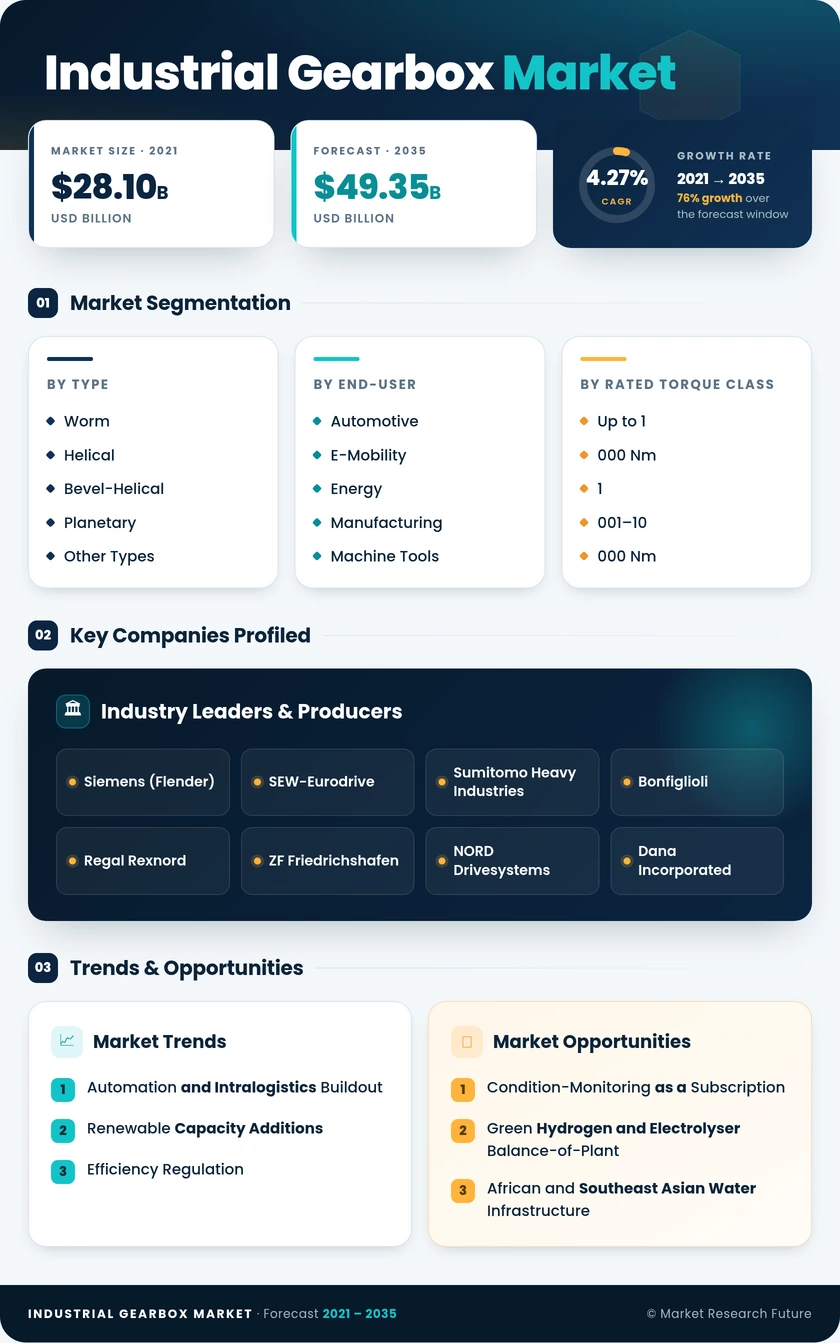
Segmentation Quick Reference
| Dimension | Sub-Segments | Dominant Segment | Fastest Growing Segment |
| By Type | Worm, Helical, Bevel-Helical, Planetary, Other Types | Helical | Planetary |
| By End-User | Automotive and E-Mobility, Energy, Manufacturing and Machine Tools, Mining & Metallurgy, Water and Wastewater Treatment, Other End-Users | Manufacturing and Machine Tools | Energy |
| By Rated Torque Class | Up to 1,000 Nm, 1,001–10,000 Nm, 10,001–50,000 Nm, Above 50,000 Nm | 1,001–10,000 Nm | 10,001–50,000 Nm |
| By Geography | North America, Europe, Asia-Pacific, South America, Middle East and Africa | Asia-Pacific | Asia-Pacific |
Market Segmentation Overview
By Type
| Sub-Segment | Key Trend |
| Worm | Holding niche share on self-locking duty; pressured by efficiency rules |
| Helical | Volume backbone for conveying and mixing; benefiting from modular platform design |
| Bevel-Helical | Preferred right-angle solution in heavy process and bulk-handling lines |
| Planetary | Torque density and low backlash drive robotics and solar-tracker adoption |
| Other Types | Cycloidal and specialty geometries serving shock-load and precision niches |
Type selection is increasingly decided by lifecycle efficiency rather than first cost, which favours helical and planetary architectures while gradually narrowing the addressable space for worm gearing outside price-sensitive applications.
By End-User
| Sub-Segment | Key Trend |
| Automotive and E-Mobility | Battery and body-shop line investment sustaining compact drive demand |
| Energy | Wind, hydrogen, and thermal balance-of-plant delivering fastest vertical growth |
| Manufacturing and Machine Tools | Broadest installed base; retrofit and automation upgrades dominate spend |
| Mining & Metallurgy | Large-torque mill and conveyor duty with long service-contract tails |
| Water and Wastewater Treatment | Public infrastructure funding supporting steady aeration and clarifier demand |
| Other End-Users | Food, cement, and pulp applications with hygienic and abrasive-duty specifications |
End-user diversification is reducing cyclicality. Suppliers that once rode mining and machine-tool cycles now balance those swings against energy and water projects funded on longer public timelines.
By Rated Torque Class
| Sub-Segment | Key Trend |
| Up to 1,000 Nm | Highest unit volumes; standardisation and short lead times decisive |
| 1,001–10,000 Nm | Largest revenue pool; general process machinery workhorse range |
| 10,001–50,000 Nm | Fastest growth on mining and marine duty; engineering-intensive sales |
| Above 50,000 Nm | Project-driven, forging-capacity constrained, longest delivery cycles |
Torque banding explains supply-chain behaviour better than any other cut. Low-torque volumes reward inventory strategy and configurator speed, while high-torque orders hinge on forging slot availability and application engineering depth.
By Geography
| Sub-Segment | Key Trend |
| North America | Incentive-backed plant construction lifting order intake above replacement baseline. |
| Europe | Efficiency regulation and remanufacturing reshaping specification standards |
| Asia-Pacific | Largest and fastest-growing pool of smelter, wind, and robotics investment |
| South America | Copper and lithium processing anchoring heavy-duty demand |
| Middle East and Africa | Diversification programmes and desalination expanding a small but resilient base |
Geography now correlates more tightly with industrial policy cycles than with regional GDP, which means suppliers increasingly plan capacity against announced project pipelines rather than macroeconomic forecasts.


 Noah Malgeri
Co-Founder

 Peter Groot koerkamp
Account and Business Manager

 Younghwan Choi
Senior Retail Manager

 Mark Irwin
Management Consultant

 Akif Moroglu
Strategy & Business Development Director

 Guilherme Gomes Martins
Product Management Director

 Joseph Aguayo
Sales Operations & Pricing Manager

 La Terria Dodd
Program Support Specialist

 Rob Kooiker
Group Product Manager HVAC & Fire Protection GMA