×
Request Free Sample ×

Kindly complete the form below to receive a free sample of this Report

* Please use a valid business email

Leading companies partner with us for data-driven Insights

clients tt-cursor
Hero Background
English
Chinese
French
Japanese
Korean
German
Spanish

Industrial Fermentation Chemicals Market Trends

ID: MRFR/CnM/10793-CR
128 Pages
Anshula Mandaokar
October 2023

Industrial Fermentation Chemicals Market Research Report Information By Type (Alcohols [Ethanol, Others], Amino Acids, Enzymes, Organic Acids, Others) and By Region -Global Forecast to 2035

Share:
Download PDF ×

We do not share your information with anyone. However, we may send you emails based on your report interest from time to time. You may contact us at any time to opt-out.

Industrial Fermentation Chemicals Market Infographic
×
Industrial Fermentation Chemicals Market Infographic Full View
Purchase Options

Market Trends

Key Emerging Trends in the Industrial Fermentation Chemicals Market

The Industrial Fermentation Chemicals market is undergoing significant trends that highlight the pivotal role of fermentation in various industrial processes, ranging from food and beverages to pharmaceuticals and biofuels. Industrial fermentation chemicals play a crucial role in facilitating and optimizing fermentation processes, contributing to the production of a wide array of valuable products.

One noteworthy trend in the Industrial Fermentation Chemicals market is the increasing demand for bio-based and sustainable products. As the global focus on sustainability intensifies, industries are seeking eco-friendly alternatives to traditional chemical processes. Industrial fermentation offers a sustainable pathway, and the demand for fermentation chemicals derived from renewable sources is on the rise. This trend aligns with the broader push toward green and environmentally conscious practices in manufacturing.

The food and beverage industry is a major consumer of Industrial Fermentation Chemicals, particularly in the production of various additives, flavors, and preservatives. Fermentation is a key process in the development of food ingredients such as enzymes, amino acids, and vitamins. The market is witnessing a trend toward natural and clean-label products, prompting manufacturers to explore fermentation as a natural and sustainable method for ingredient production.

The pharmaceutical and healthcare sectors are experiencing growth in the Industrial Fermentation Chemicals market. Fermentation processes are integral to the production of antibiotics, vaccines, and therapeutic proteins. The pharmaceutical industry's emphasis on biopharmaceuticals and personalized medicine is driving the demand for fermentation-derived chemicals that meet stringent quality and regulatory standards.

The Asia-Pacific region is emerging as a key player in the global Industrial Fermentation Chemicals market. Countries such as China and India are witnessing rapid industrialization and economic growth, leading to increased demand for fermentation-based products. The region's expanding population and rising consumer awareness contribute to the growth of fermentation-related industries, propelling the demand for fermentation chemicals.

Technological advancements in fermentation processes are shaping trends in the Industrial Fermentation Chemicals market. Continuous research and development efforts focus on improving the efficiency, yield, and scalability of fermentation processes. Innovations such as strain engineering, process optimization, and the use of advanced bioreactors contribute to the advancement of fermentation technologies, influencing the overall market dynamics.

The production of biofuels is driving the demand for Industrial Fermentation Chemicals in the energy sector. Fermentation is a key process in the conversion of biomass into biofuels such as ethanol and biodiesel. With increasing emphasis on renewable energy sources and the desire to reduce reliance on fossil fuels, the demand for fermentation chemicals in biofuel production is expected to grow, contributing to the market's expansion.

Market trends indicate a growing interest in specialty and high-value products derived from fermentation. As industries seek to diversify their product portfolios and meet evolving consumer preferences, there is an increased focus on the production of specialty chemicals, enzymes, and bio-based polymers through fermentation processes. This trend underscores the versatility of fermentation in generating a wide range of valuable compounds.

The Industrial Fermentation Chemicals market is witnessing strategic collaborations and partnerships among key players. Companies are entering into alliances to leverage each other's strengths, share resources, and enhance their capabilities in research and development. These collaborations aim to accelerate innovations, improve market competitiveness, and address the diverse needs of end-users across different industries.

Market participants are exploring the potential of synthetic biology in fermentation processes. Synthetic biology techniques, including the design and engineering of microorganisms for enhanced performance, offer opportunities to optimize fermentation pathways and increase the production of desired chemicals. The integration of synthetic biology principles into industrial fermentation is expected to drive advancements in the field.

Fluctuations in raw material prices, particularly those related to feedstocks for fermentation, impact the Industrial Fermentation Chemicals market. The availability and cost of sugars, grains, and other raw materials influence the overall cost structure of fermentation processes. Market participants are closely monitoring these raw material dynamics to manage potential cost fluctuations and maintain competitiveness.

Author
Anshula Mandaokar
Team Lead - Research

Anshula Mandaokar holds an academic degree in Chemical Engineering and has been contributing to the field for more than 5 years. She has expertise in Market Research and Business Consulting and serves as a Team Lead for a reputed Market Research firm under the Chemicals and Materials domain spectrum. She has worked on multiple projects, generating explicit results in a quick turnaround time. Her understanding of data interpretation justifies her role as a leader.

Leave a Comment

FAQs

How much is the Industrial Fermentation Chemicals Market?

Industrial Fermentation Chemicals Market size was US$ 69,598.66 Mn in 2022

What is the growth rate of the Industrial Fermentation Chemicals Market?

Industrial Fermentation Chemicals Market is projected to grow 6.40% CAGR from 2025-2035

Which region held the largest market share in the Industrial Fermentation Chemicals Market?

North America can register a large share in the global Industrial Fermentation Chemicals Market

Who are the key players in the Industrial Fermentation Chemicals Market?

BASF SE (Germany), Cargill, Incorporated (US), AB Enzymes (Germany), Amano Enzyme Inc. (Japan), ADM (US), Ajinomoto Co., Inc (Japan), Novozymes (Denmark), Chr. Hansen A/S (Denmark), DuPont de Nemours, Inc, (US), Evonik Industries AG (Germany)

Which Type had the largest market share in the Industrial Fermentation Chemicals Market?

Alcohols Segment has the potential to dominate the Industrial Fermentation Chemicals Market

Market Summary

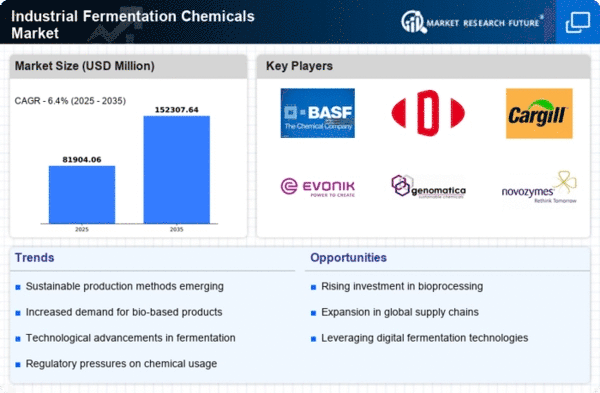
As per MRFR analysis, the Industrial Fermentation Chemicals Market Size was estimated at 76977.5 USD Million in 2024. The Industrial Fermentation Chemicals industry is projected to grow from 81904.05 in 2025 to 152307.64 by 2035, exhibiting a compound annual growth rate (CAGR) of 6.4 during the forecast period 2025 - 2035.

Key Market Trends & Highlights

The Industrial Fermentation Chemicals Market is poised for robust growth driven by sustainability and technological advancements.

  • North America remains the largest market for industrial fermentation chemicals, reflecting a strong demand across various sectors.
  • Asia-Pacific is identified as the fastest-growing region, with increasing investments in bio-based industries and fermentation technologies.
  • The Food and Beverage segment dominates the market, while the Biofuels segment is experiencing rapid growth due to rising environmental concerns.
  • Key market drivers include the rising demand for biodegradable products and advancements in fermentation technology, particularly in the healthcare and food industries.

Market Size & Forecast

2024 Market Size 76977.5 (USD Million)
2035 Market Size 152307.64 (USD Million)
CAGR (2025 - 2035) 6.4%
Largest Regional Market Share in 2024 North America

Major Players

BASF SE (DE), DuPont de Nemours Inc (US), Cargill Inc (US), Evonik Industries AG (DE), Genomatica Inc (US), Novozymes A/S (DK), DSM Nutritional Products (CH), Lonza Group AG (CH), Kraft Heinz Company (US)

Market Trends

The Industrial Fermentation Chemicals Market is currently experiencing a dynamic evolution, driven by a confluence of technological advancements and shifting consumer preferences. The increasing demand for bio-based products is prompting manufacturers to explore innovative fermentation processes, which may enhance efficiency and sustainability. Furthermore, the growing awareness regarding environmental concerns is likely to propel the adoption of fermentation technologies that minimize waste and reduce carbon footprints. As industries seek to align with sustainable practices, the market appears poised for substantial growth, with a focus on developing eco-friendly alternatives to traditional chemical processes. In addition, the rise of biopharmaceuticals and the food and beverage sector is contributing to the expansion of the Industrial Fermentation Chemicals Market. Companies are investing in research and development to create novel fermentation-derived products that cater to diverse applications. This trend suggests a potential shift towards more specialized and high-value fermentation chemicals, which could redefine market dynamics. Overall, the landscape of the Industrial Fermentation Chemicals Market is characterized by innovation, sustainability, and a commitment to meeting evolving consumer demands.

Sustainability Initiatives

The emphasis on sustainable practices is reshaping the Industrial Fermentation Chemicals Market. Companies are increasingly adopting fermentation processes that utilize renewable resources, thereby reducing reliance on fossil fuels. This trend indicates a broader commitment to environmental stewardship, as businesses seek to minimize their ecological impact while meeting regulatory requirements.

Technological Advancements

Innovations in fermentation technology are driving efficiency and productivity within the Industrial Fermentation Chemicals Market. Enhanced fermentation techniques, such as continuous fermentation and advanced bioreactor designs, are enabling manufacturers to optimize production processes. This evolution suggests a potential for increased output and reduced operational costs.

Diversification of Applications

The Industrial Fermentation Chemicals Market is witnessing a diversification of applications across various sectors. From pharmaceuticals to food additives, the versatility of fermentation-derived products is expanding. This trend highlights the potential for new market opportunities as industries explore the benefits of fermentation in their respective fields.

Industrial Fermentation Chemicals Market Market Drivers

Rising Demand for Biodegradable Products

The increasing global emphasis on sustainability drives the demand for biodegradable products, which are often produced using industrial fermentation chemicals. As consumers and industries alike seek eco-friendly alternatives, the Global Industrial Fermentation Chemicals Market Industry is poised to benefit significantly. For instance, the production of bioplastics through fermentation processes is gaining traction, reflecting a shift towards sustainable materials. This trend is expected to contribute to the market's growth, with projections indicating a market value of 74.5 USD Billion in 2024, highlighting the potential for expansion in the coming years.

Market Segment Insights

By Application: Food and Beverage (Largest) vs. Biofuels (Fastest-Growing)

The Industrial Fermentation Chemicals Market showcases a diverse application landscape, with significant contributions from the Food and Beverage sector, which holds the largest share. This segment benefits from the ongoing demand for natural flavors, preservatives, and functional ingredients derived from fermentation processes. Following closely are Pharmaceuticals, which leverage fermentation for drug production and therapeutic substances, reflecting a substantial share as well. Agriculture and Bioplastics also play critical roles, catering to various needs in sustainable practices and crop enhancement.

Food and Beverage (Dominant) vs. Biofuels (Emerging)

The Food and Beverage application in the Industrial Fermentation Chemicals Market is characterized by its reliance on microbial processes to produce a variety of essential ingredients, including enzymes, organic acids, and alcohols. This segment remains dominant due to the rising consumer preference for natural and minimally processed foods, fostering innovation in product formulations. Conversely, the Biofuels segment has emerged rapidly, driven by the global push for sustainable energy sources and reduced carbon emissions. Utilizing fermentation technology, biofuels present a promising alternative to fossil fuels, supported by advancements in biotechnology that enhance yield and efficiency. These dynamics illustrate the contrast in maturity between the established Food and Beverage sector and the rapidly evolving Biofuels market.

By End Use: Food Industry (Largest) vs. Healthcare (Fastest-Growing)

The Industrial Fermentation Chemicals Market showcases a significant distribution among its end-use segments, with the food industry leading in market share. This dominance stems from the high demand for fermentation products in food preservation, flavor enhancement, and production of functional foods. The healthcare segment is gaining traction rapidly, driven by increasing applications of fermentation-derived compounds in pharmaceuticals and biopharmaceuticals, and innovative advancements in microbial therapeutics. In terms of growth trends, the food industry’s stability is bolstered by consumer preferences for natural and organic products, while the healthcare sector is experiencing the fastest growth fueled by innovations in biotechnology and regenerative medicine. The growing emphasis on health and wellness continues to propel the demand for fermentation-based healthcare solutions, marking a paradigm shift towards sustainable and effective medical therapies.

Food Industry (Dominant) vs. Healthcare (Emerging)

The food industry remains a dominant force within the Industrial Fermentation Chemicals Market, relying heavily on traditional fermentation methods to produce essential ingredients such as amino acids, vitamins, and enzymes that enhance food quality and safety. This segment's strength is attributed to the entrenched consumer demand for fermented products like yogurt, beer, and probiotics, as well as the trend towards plant-based alternatives. Conversely, the healthcare sector is emerging as a pivotal player in this market, driven by advancements in fermentation technology that enable the production of complex biopharmaceuticals and nutraceuticals. The increasing prevalence of chronic diseases and the demand for personalized medicine are propelling growth in this segment, making it a critical area of focus for innovation and investment.

By Type of Fermentation: Aerobic Fermentation (Largest) vs. Anaerobic Fermentation (Fastest-Growing)

In the Industrial Fermentation Chemicals Market, Aerobic Fermentation holds a significant share as the largest segment, primarily due to its wide application in the production of essential chemicals and biofuels. This method, which relies on oxygen to convert substrates into valuable products, has become a staple for large-scale production facilities looking to optimize efficiency and yield. In contrast, Anaerobic Fermentation, which occurs in the absence of oxygen, is rapidly gaining traction, especially in the production of biogas and other renewable energy sources, leading to a surge in its market presence.

Aerobic Fermentation (Dominant) vs. Fed-Batch Fermentation (Emerging)

Aerobic Fermentation is recognized as the dominant method in the market due to its ability to produce large volumes of biomass and metabolites swiftly, making it an ideal choice for industries focused on high output. This method is favored for its efficiency in converting organic materials into products like alcohols, acids, and enzymes. On the other hand, Fed-Batch Fermentation is emerging as a noteworthy contender, particularly in niche applications where precise control over the nutrient feed can enhance yield and product quality. This method allows for better management of metabolic processes and product formation rates, positioning it uniquely in sectors that require adaptability and innovation.

By Microorganism Type: Bacteria (Largest) vs. Yeast (Fastest-Growing)

In the Industrial Fermentation Chemicals Market, the microorganism type segment showcases a diverse distribution among its key categories. Bacteria hold the largest share due to their versatility and efficiency in producing a wide range of chemicals. Yeast, on the other hand, has emerged rapidly, driven by its applicability in various fermentation processes and increasing demand in industries such as food and beverages. Other segments like fungi and algae are also witnessing attention, but they command a smaller market presence in comparison. Growth trends in this segment reveal a compelling narrative for both bacteria and yeast. Advances in biotechnology are enabling the development of more efficient strains of bacteria that can produce higher yields of desired chemicals. Simultaneously, yeast is gaining popularity in the production of biofuels and specialty chemicals, supported by shifts towards sustainable practices across industries. The focus on cleaner and more efficient fermentation processes is fuelling the growth potential of these microorganisms, making them central to the future of industrial fermentation.

Bacteria (Dominant) vs. Yeast (Emerging)

Bacteria are at the forefront of the Industrial Fermentation Chemicals Market due to their high efficiency and ability to produce a variety of chemicals, from organic acids to enzymes. Their robust nature makes them suitable for large-scale fermentation processes, thereby solidifying their dominant market position. Conversely, yeast is emerging as a significant player with its rapid growth in applications related to bioethanol production and its increasing relevance in food industries. The adaptability of yeast strains and advancements in genetic engineering are paving the way for new applications, enhancing their market appeal. This trajectory positions yeast as an important and emerging alternative in the fermentation landscape, aiming to meet the evolving demands of sustainable chemical production.

Get more detailed insights about Industrial Fermentation Chemicals Market Research Report—Global Forecast till 2035

Regional Insights

North America : Market Leader in Fermentation

North America is poised to maintain its leadership in the Industrial Fermentation Chemicals Market, holding a significant market share of $38,400M in 2024. The region's growth is driven by increasing demand for bio-based chemicals, stringent environmental regulations, and advancements in fermentation technology. The push for sustainable practices and renewable resources further catalyzes market expansion, making it a hub for innovation in the sector. The United States stands out as the leading country, hosting major players like DuPont, Cargill, and BASF. The competitive landscape is characterized by significant investments in R&D and strategic partnerships aimed at enhancing production efficiency. The presence of established companies and a robust supply chain infrastructure solidify North America's position as a key player in the global market.

Europe : Emerging Market with Potential

Europe is witnessing a burgeoning Industrial Fermentation Chemicals Market, valued at $23,000M in 2024. The region's growth is fueled by increasing consumer demand for sustainable products and stringent EU regulations promoting green chemistry. Initiatives aimed at reducing carbon footprints and enhancing resource efficiency are pivotal in driving market dynamics, positioning Europe as a leader in sustainable industrial practices. Germany and France are at the forefront, with a strong presence of key players like BASF and Evonik. The competitive landscape is marked by innovation and collaboration among companies to develop advanced fermentation technologies. The European market is also supported by government initiatives that encourage research and development in bio-based chemicals, enhancing its attractiveness for investment.

Asia-Pacific : Rapidly Growing Market

Asia-Pacific is rapidly emerging as a significant player in the Industrial Fermentation Chemicals Market, with a market size of $13,000M in 2024. The region's growth is driven by rising industrialization, increasing demand for biofuels, and government initiatives promoting sustainable practices. The shift towards eco-friendly production methods is expected to further boost market growth, making Asia-Pacific a focal point for investment in fermentation technologies. China and India are leading the charge, with substantial investments in biotechnology and fermentation processes. The competitive landscape features both local and international players, including Genomatica and Novozymes, who are actively expanding their operations. The region's diverse market dynamics and growing consumer awareness about sustainability are key factors contributing to its rapid growth in the sector.

Middle East and Africa : Emerging Market Opportunities

The Middle East and Africa represent an emerging market for Industrial Fermentation Chemicals, with a market size of $5,777.5M in 2024. The region's growth is driven by increasing investments in biotechnology and a rising demand for sustainable chemicals. Government initiatives aimed at diversifying economies and promoting industrial growth are pivotal in shaping the market landscape, creating opportunities for fermentation technologies. Countries like South Africa and the UAE are leading the way, with a growing number of local and international players entering the market. The competitive landscape is characterized by collaborations and partnerships aimed at enhancing production capabilities. As the region continues to develop its industrial base, the demand for fermentation chemicals is expected to rise significantly, positioning it as a key player in the global market.

Key Players and Competitive Insights

The Industrial Fermentation Chemicals Market is characterized by a dynamic competitive landscape, driven by increasing demand for sustainable and bio-based products. Key players are actively engaging in innovation and strategic partnerships to enhance their market positioning. For instance, BASF SE (DE) has been focusing on expanding its portfolio of bio-based chemicals, which aligns with the growing consumer preference for environmentally friendly products. Similarly, DuPont de Nemours Inc (US) is leveraging its extensive research capabilities to develop advanced fermentation technologies, thereby reinforcing its competitive edge in the market.In terms of business tactics, companies are increasingly localizing manufacturing to reduce supply chain vulnerabilities and optimize operational efficiency. The market structure appears moderately fragmented, with several players vying for market share. However, the collective influence of major companies like Cargill Inc (US) and Novozymes A/S (DK) is significant, as they continue to set industry standards through their innovative approaches and strategic initiatives.

In November Cargill Inc (US) announced a partnership with a leading biotechnology firm to develop a new line of fermentation-derived ingredients aimed at the food and beverage sector. This collaboration is expected to enhance Cargill's product offerings and strengthen its position in the market, particularly as consumer demand for natural ingredients continues to rise. The strategic importance of this partnership lies in its potential to accelerate product development cycles and improve market responsiveness.

In October Novozymes A/S (DK) launched a new enzyme product designed to optimize fermentation processes in the production of biofuels. This innovation not only enhances efficiency but also reduces waste, aligning with the industry's shift towards sustainability. The introduction of this product underscores Novozymes' commitment to leading the market in enzyme technology, which is crucial for maintaining competitive differentiation in a rapidly evolving landscape.

In September Evonik Industries AG (DE) expanded its fermentation capabilities by investing in a new production facility in North America. This strategic move is anticipated to bolster Evonik's supply chain resilience and enhance its ability to meet the growing demand for specialty chemicals derived from fermentation processes. The establishment of this facility reflects Evonik's proactive approach to scaling operations and responding to market trends.

As of December the competitive trends in the Industrial Fermentation Chemicals Market are increasingly defined by digitalization, sustainability, and the integration of artificial intelligence in production processes. Strategic alliances are becoming more prevalent, as companies recognize the value of collaboration in driving innovation and efficiency. Looking ahead, it is likely that competitive differentiation will evolve from traditional price-based strategies to a focus on technological advancements, sustainable practices, and reliable supply chains, thereby reshaping the market landscape.

Key Companies in the Industrial Fermentation Chemicals Market include

Industry Developments

July 2022: Novozymes introduced Innova Apex and Innova Turbo to the Innova platform. Innova Apex and Turbo are tailored to work in specific fermentation times, enabling ethanol producers to maximize their fermentation process to achieve their desired production targets and business goals.

October 2021: ADM announced making a leading equity investment in Acies Bio, a Slovenia-based biotechnology company specializing in R&D and manufacturing services for developing and scaling synthetic biology and precision fermentation technologies for food, agriculture and industrial applications.

Future Outlook

Industrial Fermentation Chemicals Market Future Outlook

The Industrial Fermentation Chemicals Market is projected to grow at a 6.4% CAGR from 2024 to 2035, driven by increasing demand for bio-based products and advancements in fermentation technology.

New opportunities lie in:

  • Development of customized fermentation solutions for niche markets.
  • Expansion into emerging economies with tailored product offerings.
  • Investment in R&D for innovative fermentation processes and sustainable practices.

By 2035, the market is expected to achieve robust growth, positioning itself as a leader in sustainable chemical production.

Market Segmentation

Industrial Fermentation Chemicals Market End Use Outlook

  • Food Industry
  • Healthcare
  • Agricultural Sector
  • Energy Sector
  • Chemical Manufacturing

Industrial Fermentation Chemicals Market Application Outlook

  • Food and Beverage
  • Pharmaceuticals
  • Agriculture
  • Biofuels
  • Bioplastics

Industrial Fermentation Chemicals Market Microorganism Type Outlook

  • Bacteria
  • Yeast
  • Fungi
  • Algae
  • Molds

Industrial Fermentation Chemicals Market Type of Fermentation Outlook

  • Aerobic Fermentation
  • Anaerobic Fermentation
  • Batch Fermentation
  • Continuous Fermentation
  • Fed-Batch Fermentation

Report Scope

MARKET SIZE 202476977.5(USD Million)
MARKET SIZE 202581904.05(USD Million)
MARKET SIZE 2035152307.64(USD Million)
COMPOUND ANNUAL GROWTH RATE (CAGR)6.4% (2025 - 2035)
REPORT COVERAGERevenue Forecast, Competitive Landscape, Growth Factors, and Trends
BASE YEAR2024
Market Forecast Period2025 - 2035
Historical Data2019 - 2024
Market Forecast UnitsUSD Million
Key Companies ProfiledBASF SE (DE), DuPont de Nemours Inc (US), Cargill Inc (US), Evonik Industries AG (DE), Genomatica Inc (US), Novozymes A/S (DK), DSM Nutritional Products (CH), Lonza Group AG (CH), Kraft Heinz Company (US)
Segments CoveredApplication, End Use, Type of Fermentation, Microorganism Type
Key Market OpportunitiesGrowing demand for sustainable biochemicals drives innovation in the Industrial Fermentation Chemicals Market.
Key Market DynamicsRising demand for sustainable production methods drives innovation in industrial fermentation chemicals and enhances competitive dynamics.
Countries CoveredNorth America, Europe, APAC, South America, MEA

FAQs

How much is the Industrial Fermentation Chemicals Market?

Industrial Fermentation Chemicals Market size was US$ 69,598.66 Mn in 2022

What is the growth rate of the Industrial Fermentation Chemicals Market?

Industrial Fermentation Chemicals Market is projected to grow 6.40% CAGR from 2025-2035

Which region held the largest market share in the Industrial Fermentation Chemicals Market?

North America can register a large share in the global Industrial Fermentation Chemicals Market

Who are the key players in the Industrial Fermentation Chemicals Market?

BASF SE (Germany), Cargill, Incorporated (US), AB Enzymes (Germany), Amano Enzyme Inc. (Japan), ADM (US), Ajinomoto Co., Inc (Japan), Novozymes (Denmark), Chr. Hansen A/S (Denmark), DuPont de Nemours, Inc, (US), Evonik Industries AG (Germany)

Which Type had the largest market share in the Industrial Fermentation Chemicals Market?

Alcohols Segment has the potential to dominate the Industrial Fermentation Chemicals Market

  1. SECTION I: EXECUTIVE SUMMARY AND KEY HIGHLIGHTS
    1. | 1.1 EXECUTIVE SUMMARY
  2. SECTION II: SCOPING, METHODOLOGY AND MARKET STRUCTURE
    1. | 2.1 MARKET INTRODUCTION
    2. | 2.2 RESEARCH METHODOLOGY
  3. SECTION III: QUALITATIVE ANALYSIS
    1. | 3.1 MARKET DYNAMICS
    2. | 3.2 MARKET FACTOR ANALYSIS
  4. SECTION IV: QUANTITATIVE ANALYSIS
    1. | 4.1 Chemicals and Materials, BY Application (USD Million)
    2. | 4.2 Chemicals and Materials, BY End Use (USD Million)
    3. | 4.3 Chemicals and Materials, BY Type of Fermentation (USD Million)
    4. | 4.4 Chemicals and Materials, BY Microorganism Type (USD Million)
    5. | 4.5 Chemicals and Materials, BY Region (USD Million)
  5. SECTION V: COMPETITIVE ANALYSIS
    1. | 5.1 Competitive Landscape
    2. | 5.2 Company Profiles
    3. | 5.3 Appendix

Industrial Fermentation Chemicals Market Segmentation

Market Segmentation Overview

  • Detailed segmentation data will be available in the full report
  • Comprehensive analysis by multiple parameters
  • Regional and country-level breakdowns
  • Market size forecasts by segment
Infographic

Free Sample Request

Kindly complete the form below to receive a free sample of this Report

Get Free Sample

Customer Strories

Compare Licence

×
Features License Type
Single User Multiuser License Enterprise User
Price $4,950 $5,950 $7,250
Maximum User Access Limit 1 User Upto 10 Users Unrestricted Access Throughout the Organization
Free Customization
Direct Access to Analyst
Deliverable Format
Platform Access
Discount on Next Purchase 10% 15% 15%
Printable Versions