×
Hero Background
English
Chinese
French
Japanese
Korean
German
Spanish

Industrial Enzymes Market Share

ID: MRFR/FnB/6622-CR
110 Pages
Snehal Singh
November 2022

Industrial Enzymes Market Research Report Information by Source (Plant and Animal), Type (Chocolate, Proteases, and Lipases), Application (Food & Beverages, Animal Feed, Detergent & Cleaners, Personal Care, and Pharmaceuticals & Nutraceuticals), and Region (North America, Europe, Asia-Pacific & Rest of the World) -Forecast till 2030

Share:
Download PDF ×

We do not share your information with anyone. However, we may send you emails based on your report interest from time to time. You may contact us at any time to opt-out.

Industrial Enzymes Market Infographic
Purchase Options

Market Share

Industrial Enzymes Market Share Analysis

The Industrial Enzymes Market is a dynamic and competitive landscape where companies employ various market share positioning strategies to gain a competitive edge. These strategies are essential for businesses operating in the sector to expand their reach, increase profitability, and establish a robust market presence. The Asia-Pacific market is forecasted to exhibit the most substantial Compound Annual Growth Rate (CAGR) throughout the projected period. This dynamic trajectory is notably driven by robust growth anticipated in key markets within the region, namely China, Japan, and Australia. These nations are poised to record remarkable and sustained rates of expansion during the forecasted period. The heightened growth rates in these markets can be attributed to a confluence of factors, including evolving consumer preferences, increasing disposable incomes, and a growing awareness of product quality and safety.

China, as a pivotal player in the Asia-Pacific landscape, is expected to contribute significantly to the regional upswing. The burgeoning middle-class population in China, coupled with a heightened emphasis on food safety and quality, is fostering a substantial demand for products with protective cultures. Similarly, Japan and Australia are also anticipated to exhibit strong growth, propelled by a combination of factors such as changing dietary preferences and a discernible shift towards healthier and safer food options.

This outlook underscores the significance of the Asia-Pacific market in the global landscape of protective cultures, emphasizing its role as a major growth engine. The region's potential for robust expansion signifies its pivotal position in shaping the trajectory of the protective cultures market on a global scale. One prevalent strategy employed by companies in the Industrial Enzymes Market is product differentiation. Enzyme manufacturers often invest in research and development to create unique and innovative products that cater to specific industry needs. By offering enzymes with distinct characteristics or enhanced functionalities, companies can carve out a niche for themselves, attracting customers seeking specialized solutions. This not only helps in building customer loyalty but also reduces the intensity of competition, as customers are more likely to stick with products that precisely meet their requirements.

Another crucial aspect of market share positioning in the Industrial Enzymes Market is pricing strategy. Companies need to strike a balance between offering competitive prices and maintaining profitability. Pricing decisions can significantly impact market share, as customers are often price-sensitive, especially in industries where enzymes are used as raw materials in large-scale processes. Some companies may adopt a cost leadership strategy, aiming to provide enzymes at lower prices than their competitors through economies of scale or efficient production processes. On the other hand, premium pricing strategies may be adopted by companies focusing on high-quality, specialized enzymes that command a premium in the market.

Strategic partnerships and collaborations play a pivotal role in market share positioning in the Industrial Enzymes Market. Companies often form alliances with research institutions, universities, or other industry players to access new technologies, share resources, and enhance their overall capabilities. Collaborative efforts can lead to the development of cutting-edge products, giving the partnering companies a competitive advantage. Additionally, strategic partnerships enable companies to expand their market reach by leveraging each other's distribution networks and customer bases.

Geographic expansion is another key market share positioning strategy in the Industrial Enzymes Market. As industries requiring enzymes are spread across the globe, companies often seek to establish a presence in different regions. This could involve setting up production facilities in strategic locations to reduce transportation costs, ensuring timely delivery to customers, and complying with regional regulations. Localized production also allows companies to be more responsive to regional market demands and preferences, further strengthening their market position.

Moreover, effective marketing and branding strategies are essential for market share positioning. Creating a strong brand image, backed by effective marketing campaigns, helps companies differentiate themselves from competitors. This can be achieved through highlighting the unique features of their products, emphasizing quality, and showcasing successful applications in various industries. A well-established brand not only attracts new customers but also fosters trust and loyalty among existing ones.


Author
Snehal Singh
Assistant Manager - Research

High acumen in analyzing complex macro & micro markets with more than 6 years of work experience in the field of market research. By implementing her analytical skills in forecasting and estimation into market research reports, she has expertise in Packaging, Construction, and Equipment domains. She handles a team size of 20-25 resources and ensures smooth running of the projects, associated marketing activities, and client servicing.

Leave a Comment

FAQs

How Industrial enzymes market Is Growing Globally ?

Industrial Enzymes Market Size is Anticipated to at Reach CAGR of 6.27% with USD 10,807.10 million by 2022-2030.

Who are the major key players of the global industrial enzymes market?

Incorporated (US), Codexis Incorporated (US), BASF SE (Germany), Associated British Foods PLC (UK), Chr. Hansen Holding A/S (Denmark), Koninklijke DSM N.V. (Netherlands), Dyadic International Inc. (US), Advanced Enzyme Technologies Ltd (India), Lesaffre (France), Adisseo (China), Amano Enzyme Inc. (Japan), AB Enzymes (Germany), Novozymes A/S (Denmark), BioResource International Inc. (US), Cargill, and DowDuPont (US).

What are the various types of applications of the global industrial enzymes market?

Textiles, feed, pharmaceuticals & nutraceuticals, food & beverages, detergents & cleaning, and others.

Which region is leading the global industrial enzymes market analysis?

North America is Dominated Region In Industrial enzymes market

Market Summary

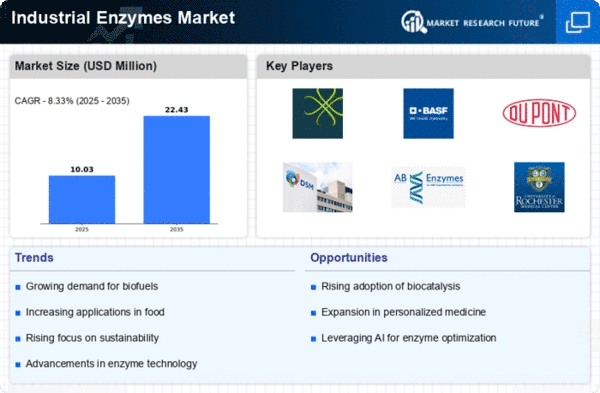
As per MRFR analysis, the Industrial Enzymes Market Size was estimated at 9.26 USD Million in 2024. The Industrial Enzymes industry is projected to grow from 10.14 USD Million in 2025 to 22.43 USD Million by 2035, exhibiting a compound annual growth rate (CAGR) of 8.33 during the forecast period 2025 - 2035.

Key Market Trends & Highlights

The Industrial Enzymes Market is poised for robust growth driven by sustainability and technological advancements.

  • The market is increasingly characterized by a strong focus on sustainability initiatives across various sectors.
  • Technological advancements are enhancing enzyme efficiency and expanding their applications in diverse industries.
  • North America remains the largest market, while Asia-Pacific is recognized as the fastest-growing region in the industrial enzymes sector.
  • The rising demand in the food and beverage sector, along with regulatory support for biotechnological solutions, drives market growth, particularly in the amylase and biofuels segments.

Market Size & Forecast

2024 Market Size 9.26 (USD Million)
2035 Market Size 22.43 (USD Million)
CAGR (2025 - 2035) 8.33%
Largest Regional Market Share in 2024 North America

Major Players

<p>Novozymes (DK), BASF (DE), DuPont (US), DSM (NL), AB Enzymes (DE), Roche (CH), Amano Enzyme (JP), Kraft Heinz (US), Enzyme Development Corporation (US)</p>

Market Trends

The Industrial Enzymes Market is currently experiencing a dynamic evolution, driven by various factors that influence its growth trajectory. The increasing demand for sustainable and eco-friendly solutions across multiple industries, including food and beverages, textiles, and biofuels, appears to be a primary catalyst. Companies are increasingly recognizing the potential of enzymes to enhance efficiency, reduce waste, and minimize environmental impact. This shift towards greener practices is likely to foster innovation and development within the sector, as organizations seek to leverage enzymatic processes for improved productivity. Moreover, advancements in biotechnology and genetic engineering are paving the way for the creation of more effective and specialized enzymes. These innovations may lead to the emergence of novel applications, further expanding the scope of the Industrial Enzymes Market. As industries continue to prioritize efficiency and sustainability, the integration of enzymes into production processes is expected to gain momentum. The ongoing research and development efforts in enzyme technology suggest a promising future for this market, with potential growth opportunities across various sectors.

Sustainability Focus

The emphasis on sustainable practices is reshaping the Industrial Enzymes Market. Companies are increasingly adopting enzymes to reduce environmental footprints, aligning with global sustainability goals. This trend reflects a broader commitment to eco-friendly production methods.

Technological Advancements

Innovations in biotechnology are driving the development of specialized enzymes. Enhanced genetic engineering techniques enable the creation of more efficient enzymes, which could lead to new applications and improved performance in various industries.

Diverse Applications

The versatility of enzymes is expanding their use across multiple sectors. From food processing to biofuels, the Industrial Enzymes Market is witnessing a growing demand for enzymes tailored to specific applications, indicating a trend towards customization.

Industrial Enzymes Market Market Drivers

Market Growth Projections

The Global Industrial Enzymes Industry is poised for substantial growth, with projections indicating a rise from 12.2 USD Billion in 2024 to 23.7 USD Billion by 2035. This growth is underpinned by a compound annual growth rate of 6.27% from 2025 to 2035. Various factors contribute to this upward trend, including increasing demand across multiple sectors such as food and beverage, biofuels, and pharmaceuticals. The continuous innovation in enzyme technology and the expanding range of applications further enhance the market's potential. These projections highlight the dynamic nature of the industrial enzymes sector and its capacity to adapt to evolving market demands.

Rising Demand for Biofuels

The Global Industrial Enzymes Industry experiences a surge in demand for biofuels, driven by the need for sustainable energy sources. Enzymes play a crucial role in the conversion of biomass into biofuels, enhancing efficiency and reducing costs. As governments worldwide implement policies to promote renewable energy, the market for industrial enzymes is projected to grow significantly. In 2024, the market is valued at 12.2 USD Billion, with expectations to reach 23.7 USD Billion by 2035. This growth reflects a compound annual growth rate of 6.27% from 2025 to 2035, indicating a robust future for enzyme applications in biofuel production.

Advancements in Biotechnology

Advancements in biotechnology contribute to the expansion of the Global Industrial Enzymes Industry. Innovations in enzyme engineering and production techniques enhance the performance and specificity of enzymes, making them more effective in various industrial applications. For instance, the development of genetically modified microorganisms allows for the production of enzymes that can operate under extreme conditions, thereby broadening their applicability. This trend is likely to drive market growth as industries seek more efficient and cost-effective solutions. The increasing focus on research and development in biotechnology suggests a promising trajectory for the industrial enzymes sector.

Growing Food and Beverage Sector

The Global Industrial Enzymes Industry benefits from the growing food and beverage sector, where enzymes are integral to various processes such as brewing, baking, and dairy production. Enzymes enhance product quality, improve yield, and reduce processing times, making them indispensable in food manufacturing. As consumer preferences shift towards healthier and more natural products, the demand for enzyme-based solutions is likely to increase. This trend is reflected in the market's projected growth, with a valuation of 12.2 USD Billion in 2024 and an anticipated rise to 23.7 USD Billion by 2035, driven by the food industry's evolving needs.

Emerging Applications in Pharmaceuticals

Emerging applications in pharmaceuticals are reshaping the Global Industrial Enzymes Industry. Enzymes are increasingly utilized in drug formulation, synthesis, and production processes, enhancing efficacy and reducing side effects. The pharmaceutical sector's demand for biocatalysts is on the rise, driven by the need for more efficient and sustainable manufacturing methods. As the industry evolves, the integration of enzymes into pharmaceutical processes is likely to expand, contributing to market growth. The anticipated increase in market value from 12.2 USD Billion in 2024 to 23.7 USD Billion by 2035 reflects the potential of enzymes in addressing the pharmaceutical industry's challenges.

Environmental Regulations and Sustainability

Environmental regulations and a growing emphasis on sustainability are pivotal drivers of the Global Industrial Enzymes Industry. Industries are increasingly adopting enzyme-based processes to minimize waste and reduce environmental impact. Enzymes facilitate greener production methods, aligning with regulatory requirements and consumer expectations for sustainable practices. This shift is particularly evident in sectors such as textiles and detergents, where enzymes replace harsh chemicals, leading to eco-friendly alternatives. The market's growth trajectory, from 12.2 USD Billion in 2024 to 23.7 USD Billion by 2035, underscores the importance of sustainability in shaping the future of industrial enzymes.

Market Segment Insights

By Application: Food and Beverage (Largest) vs. Biofuels (Fastest-Growing)

<p>In the Industrial Enzymes Market, the application segment exhibits a robust distribution across various sectors. The Food and Beverage sector stands out as the largest, capturing a significant market share owing to the growing demand for processed foods and beverages that require enzyme-based solutions for increased efficiency and product enhancement. Following closely, sectors such as Detergents and Animal Feed also contribute meaningfully, while Biofuels is gaining traction, indicating a shift towards sustainable energy sources and environmental concerns.</p>

<p>Food and Beverage: Dominant vs. Biofuels: Emerging</p>

<p>The Food and Beverage sector dominates the Industrial Enzymes Market due to its extensive utilization of enzymes to improve food quality, shelf life, and production efficiency. Enzymes like amylases, proteases, and lipases are essential in various processes such as brewing, baking, and dairy production. Conversely, the Biofuels sector, though currently smaller, is rapidly emerging as a key player, driven by the increasing adoption of renewable energy and governmental regulations promoting sustainable practices. Enzymes in this sector facilitate the conversion of biomass to biofuels, significantly enhancing yield and efficiency. As consumer awareness towards green energy solutions grows, Biofuels is expected to witness robust growth in the coming years.</p>

By Type: Amylase (Largest) vs. Protease (Fastest-Growing)

<p>The Industrial Enzymes Market is characterized by a diverse range of enzyme types, with amylase holding the largest market share due to its extensive application in various industries, including food and beverage, textiles, and pharmaceuticals. Protease, while smaller in market share compared to amylase, is rapidly gaining traction as demand for protein-based solutions increases in sectors such as animal feed and biopharmaceuticals. This dynamic balance shapes the competitive landscape within the market.</p>

<p>Amylase (Dominant) vs. Protease (Emerging)</p>

<p>Amylase is recognized as a dominant enzyme in the Industrial Enzymes Market, primarily due to its critical role in breaking down starches into sugars, facilitating numerous industrial processes. Its applications range from textile processing to food manufacturing, contributing to its strong market presence. On the other hand, protease is an emerging player, increasingly utilized in the biopharmaceutical sector for its ability to enhance protein digestion, making it vital for digestive health products and nutritional supplements. As innovation fuels the development of specialized protease formulations, this enzyme is expected to carve a significant niche in the market.</p>

By Source: Microbial (Largest) vs. Plant (Fastest-Growing)

<p>In the Industrial Enzymes Market, the source segment is crucial in determining the functional capabilities and market potential of the enzymes produced. Currently, microbial sources hold the largest share, attributed to their cost-effectiveness and adaptability across various industries. This dominance reflects the increasing reliance on microbial enzymes in applications such as detergents, biofuels, and food processing, which are vital for meeting global demand. On the other hand, plant-based enzymes are witnessing rapid growth as consumers and industries shift towards sustainable and natural solutions. This rise is fueled by the demand for cleaner labels in food products and the expanding interest in plant-based alternatives across sectors. As a result, the plant segment is anticipated to show the fastest growth in the foreseeable future, indicating a strong trend toward eco-friendly enzymatic solutions.</p>

<p>Microbial (Dominant) vs. Plant (Emerging)</p>

<p>Microbial enzymes dominate the Industrial Enzymes Market due to their wide-ranging applications and economic viability. These enzymes are highly efficient and versatile, making them ideal for use in diverse sectors, including industrial cleaning and food production. The established infrastructure for microbial enzyme production has further solidified their market position. Conversely, plant-based enzymes are emerging as a significant player, appealing to a growing consumer base that prioritizes sustainability. With advancements in extraction and processing technologies, plant enzymes are becoming more competitive in terms of cost and efficiency, thus expanding their applications in food, pharmaceuticals, and biofuels.</p>

By Form: Liquid (Largest) vs. Powder (Fastest-Growing)

<p>In the Industrial Enzymes Market, the form segment is characterized by three main categories: liquid, powder, and granular. Liquid forms hold the largest share due to their ease of use and integration into various industrial processes. They are commonly employed in sectors such as food processing, pharmaceuticals, and biofuels, where they facilitate better enzymatic reactions and product consistency. On the other hand, powder enzymes, while currently smaller in market share, are gaining traction across industries like agricultural and textile applications, thanks to their longer shelf life and easier storage capabilities. The growth trends in the form segment are influenced by various factors, including technological advancements and increasing application ranges. Liquid enzymes are leveraging innovations in formulation technology to enhance stability and performance in dynamic industrial settings. Conversely, powder enzymes are witnessing significant growth driven by the rising demand for more concentrated forms of enzymes that can provide cost-effective solutions in diverse applications. These trends indicate a robust and evolving landscape for the different forms of industrial enzymes, with both liquid and powder formats likely to continue their respective trajectories in the market.</p>

<p>Liquid (Dominant) vs. Powder (Emerging)</p>

<p>The liquid form of industrial enzymes remains the dominant choice due to its versatility and adaptability across numerous applications. This form is preferred in sectors requiring efficient enzymatic activity and quick integration into processes. Liquid enzymes are particularly favored in the food and beverage industry, where they enhance flavor, texture, and shelf life of products. In contrast, powder enzymes represent an emerging category that is rapidly gaining popularity. They offer advantages like reduced transportation costs and longer shelf stability, making them an ideal choice for industries seeking efficiency and effectiveness. Additionally, the ease of measuring and dosing powder enzymes contributes significantly to their appeal in various applications, encouraging their growing adoption.</p>

Get more detailed insights about Industrial Enzymes Market Research Report-Global Forecast till 2035

Regional Insights

North America : Market Leader in Enzymes

North America is poised to maintain its leadership in the industrial enzymes market, holding a significant share of 4.0 in 2025. The region's growth is driven by increasing demand for bio-based products, stringent environmental regulations, and advancements in biotechnology. The push for sustainable practices in industries such as food and beverage, textiles, and biofuels further fuels this demand. Regulatory support for green technologies enhances market dynamics, making North America a hub for innovation in enzyme applications. The competitive landscape in North America is robust, featuring key players like Novozymes, DuPont, and BASF. These companies are investing heavily in R&D to develop innovative enzyme solutions tailored to various industries. The U.S. stands out as a major contributor, with its advanced manufacturing capabilities and strong focus on sustainability. The presence of established firms and a growing number of startups indicates a vibrant ecosystem that fosters growth and innovation in the industrial enzymes sector.

Europe : Innovation and Sustainability Focus

Europe's industrial enzymes market is projected to reach 2.5 by 2025, driven by a strong emphasis on sustainability and eco-friendly practices. The region is witnessing a surge in demand for enzymes in sectors like food processing, detergents, and biofuels, propelled by stringent EU regulations aimed at reducing environmental impact. The European Green Deal and other initiatives are catalyzing investments in biotechnological innovations, further enhancing market growth. Leading countries such as Germany, France, and the UK are at the forefront of this market, with a competitive landscape featuring major players like BASF and DSM. These companies are leveraging advanced technologies to create high-performance enzymes that meet the evolving needs of various industries. The presence of a well-established regulatory framework supports innovation, ensuring that Europe remains a key player in The Industrial Enzymes.

Asia-Pacific : Emerging Market Potential

The Asia-Pacific region is experiencing significant growth in the industrial enzymes market, projected to reach 2.5 by 2025. This growth is driven by increasing industrialization, rising disposable incomes, and a growing awareness of sustainable practices. Countries like China and India are leading the charge, with expanding food and beverage, textile, and biofuel industries that demand innovative enzyme solutions. Regulatory frameworks are gradually evolving to support the adoption of biotechnological advancements, further propelling market growth. China stands out as a major player, with numerous local and international companies investing in enzyme production. The competitive landscape is characterized by both established firms and emerging startups, creating a dynamic environment for innovation. Key players such as Amano Enzyme and Roche are actively expanding their presence in the region, focusing on developing enzymes tailored to local market needs and preferences, thus enhancing their competitive edge.

Middle East and Africa : Untapped Market Opportunities

The Middle East and Africa (MEA) region, while currently holding a smaller market share of 0.26, presents significant growth potential in the industrial enzymes market by 2025. The region's increasing focus on industrial diversification and sustainable practices is driving demand for enzymes across various sectors, including food processing and agriculture. Government initiatives aimed at enhancing local production capabilities and reducing reliance on imports are also contributing to market growth. Countries like South Africa and the UAE are emerging as key players in the enzyme market, with investments in biotechnology and research. The competitive landscape is gradually evolving, with both local and international companies exploring opportunities in this untapped market. As awareness of the benefits of enzymes grows, the MEA region is expected to attract more investments, paving the way for future growth in the industrial enzymes sector.

Key Players and Competitive Insights

The Industrial Enzymes Market is characterized by a dynamic competitive landscape, driven by innovation, sustainability, and the increasing demand for bio-based solutions across various industries. Key players such as Novozymes (Denmark), BASF (Germany), and DuPont (US) are strategically positioned to leverage their extensive research and development capabilities, focusing on enhancing enzyme efficiency and expanding their product portfolios. These companies are actively pursuing partnerships and collaborations to foster innovation, which collectively shapes a competitive environment that is increasingly focused on technological advancements and sustainable practices.

In terms of business tactics, companies are localizing manufacturing to reduce costs and improve supply chain efficiency. The market appears moderately fragmented, with several players vying for market share. However, the collective influence of major companies like DSM (Netherlands) and AB Enzymes (Germany) is notable, as they implement strategies that enhance their operational capabilities and market reach, thereby intensifying competition.

In November 2025, Novozymes (Denmark) announced a strategic partnership with a leading agricultural firm to develop enzyme solutions aimed at improving crop yields. This collaboration is significant as it not only diversifies Novozymes' product offerings but also aligns with the growing trend towards sustainable agriculture, potentially enhancing their market position in the agricultural sector.

In October 2025, BASF (Germany) launched a new line of enzymes specifically designed for the food and beverage industry, focusing on improving product quality and reducing waste. This move underscores BASF's commitment to innovation and sustainability, as it seeks to address consumer demands for cleaner and more efficient production processes, thereby reinforcing its competitive edge in the market.

In September 2025, DuPont (US) expanded its enzyme production facility in the Midwest, a strategic decision aimed at increasing capacity to meet rising global demand. This expansion not only enhances DuPont's operational efficiency but also positions the company to better serve its customers, reflecting a proactive approach to market dynamics and customer needs.

As of December 2025, current competitive trends in the Industrial Enzymes Market are heavily influenced by digitalization, sustainability initiatives, and the integration of artificial intelligence in enzyme development. Strategic alliances are increasingly shaping the landscape, as companies recognize the value of collaboration in driving innovation. Looking ahead, competitive differentiation is likely to evolve from traditional price-based competition towards a focus on technological innovation, supply chain reliability, and sustainable practices, indicating a transformative shift in how companies position themselves in the market.

Key Companies in the Industrial Enzymes Market market include

Industry Developments

Few developments that occurred in recent times influencing the market growth of Industrial Enzymes Market are listed below:

In April 2021, BASF SE decided to collaborate with Sandoz GmbH, a subsidiary of Novartis AG, to invest initsKundl/Schaftenau Campus in Austria. This move will lead to an increase in the production capacity and biotechnology and enzyme product lines of BASF SE.

In February 20, 2020, BEC Feed Solutions stated it had commenced work to redevelop its Carole Park location into a new state-of-the-art manufacturing facility. The new facility will feature a manufacturing plant equipped with integrated technology unique to the premix industry, a new warehouse, and adjoining contemporary two-story office building, which will significantly increase their production.

In November 2020, DuPont Nutrition & Biosciences (DuPont) undertook a new partnership between its Food & Beverage platform and the Institute for the Future (IFTF), the world's leading future organization. The collaboration seeks to drive far-sighted food and beverage innovation that anticipates shifts in market needs

Scope of the Report

Global Industrial Enzymes Market, by Source

Plant

Animal

Microorganisms

Global Industrial Enzymes Market, By Type

Carbohydrases

Proteases

Lipases

Others

Global Industrial Enzymes Market, by Application

Food & Beverages

Animal Feed

Detergent & Cleaners

Personal Care

Pharmaceuticals and Nutraceuticals

Others

Global Industrial Enzymes Market, by Region

North America

US

Canada

Mexico

Europe

Germany

UK

France

Spain

Italy

Rest of Europe

Asia-Pacific

China

India

Japan

Australia & New Zealand

Rest of Asia-Pacific

Rest of the World

Middle East

Africa

South America

Intended Audience

Food and Beverages Manufacturers

Ingredient Industry

Detergent and Cleaners manufacturers

Personal Care industries

Animal Feed Manufacturer

Pharmaceuticals & Nutraceuticals

Retailers and Wholesalers

Government policy makers and Investors

Future Outlook

Industrial Enzymes Market Future Outlook

<p>The Industrial Enzymes Market is projected to grow at an 8.33% CAGR from 2024 to 2035, driven by increasing demand for sustainable solutions and advancements in biotechnology.</p>

New opportunities lie in:

  • <p>Development of enzyme-based biocatalysts for green chemistry applications.</p>
  • <p>Expansion into emerging markets with tailored enzyme solutions.</p>
  • <p>Investment in R&D for enzyme innovations in food and beverage industries.</p>

<p>By 2035, the Industrial Enzymes Market is expected to achieve substantial growth, driven by innovation and strategic investments.</p>

Market Segmentation

Industrial Enzymes Market Form Outlook

  • Liquid
  • Powder
  • Granular

Industrial Enzymes Market Type Outlook

  • Amylase
  • Protease
  • Lipase
  • Cellulase
  • Lactase

Industrial Enzymes Market Source Outlook

  • Microbial
  • Plant
  • Animal

Industrial Enzymes Market Application Outlook

  • Food and Beverage
  • Biofuels
  • Textiles
  • Detergents
  • Animal Feed

Report Scope

MARKET SIZE 20249.26(USD Million)
MARKET SIZE 202510.14(USD Million)
MARKET SIZE 203522.43(USD Million)
COMPOUND ANNUAL GROWTH RATE (CAGR)8.33% (2024 - 2035)
REPORT COVERAGERevenue Forecast, Competitive Landscape, Growth Factors, and Trends
BASE YEAR2024
Market Forecast Period2025 - 2035
Historical Data2019 - 2024
Market Forecast UnitsUSD Million
Key Companies ProfiledNovozymes (DK), BASF (DE), DuPont (US), DSM (NL), AB Enzymes (DE), Roche (CH), Amano Enzyme (JP), Kraft Heinz (US), Enzyme Development Corporation (US)
Segments CoveredApplication, Type, Source, Form
Key Market OpportunitiesAdvancements in biotechnology enhance efficiency and sustainability in the Industrial Enzymes Market.
Key Market DynamicsRising demand for sustainable solutions drives innovation and competition in the industrial enzymes market.
Countries CoveredNorth America, Europe, APAC, South America, MEA

FAQs

How Industrial enzymes market Is Growing Globally ?

Industrial Enzymes Market Size is Anticipated to at Reach CAGR of 6.27% with USD 10,807.10 million by 2022-2030.

Who are the major key players of the global industrial enzymes market?

Incorporated (US), Codexis Incorporated (US), BASF SE (Germany), Associated British Foods PLC (UK), Chr. Hansen Holding A/S (Denmark), Koninklijke DSM N.V. (Netherlands), Dyadic International Inc. (US), Advanced Enzyme Technologies Ltd (India), Lesaffre (France), Adisseo (China), Amano Enzyme Inc. (Japan), AB Enzymes (Germany), Novozymes A/S (Denmark), BioResource International Inc. (US), Cargill, and DowDuPont (US).

What are the various types of applications of the global industrial enzymes market?

Textiles, feed, pharmaceuticals &amp; nutraceuticals, food &amp; beverages, detergents &amp; cleaning, and others.

Which region is leading the global industrial enzymes market analysis?

North America is Dominated Region In Industrial enzymes market

  1. EXECUTIVE SUMMARY
    1. GLOBAL INDUSTRIAL ENZYMES MARKET, BY SOURCE
    2. GLOBAL INDUSTRIAL ENZYMES MARKET, BY TYPE
    3. GLOBAL INDUSTRIAL ENZYMES MARKET, BY APPLICATION
    4. GLOBAL INDUSTRIAL ENZYMES MARKET, BY REGION
  2. MARKET INTRODUCTION
    1. DEFINITION
    2. SCOPE OF THE STUDY
    3. MARKET STRUCTURE
  3. RESEARCH METHODOLOGY
    1. RESEARCH PROCESS
    2. PRIMARY RESEARCH
    3. SECONDARY RESEARCH
    4. MARKET MATERIAL ESTIMATION
    5. TOP DOWN & BOTTOM-UP APPROACH
    6. FORECAST MODEL
    7. LIST OF ASSUMPTIONS
  4. MARKET DYNAMICS
    1. INTRODUCTION
    2. DRIVERS
      1. GROWING DEMAND FROM FOOD AND BEVERAGE APPLICATIONS
      2. MAKING INDUSTRIES MORE ENVIRONMENTALLY FRIENDLY
      3. DRIVERS IMPACT ANALYSIS
    3. RESTRAINT
      1. LACK OF STANDARD REGULATORY SCENARIO
      2. HIGH PRICES OF RAW MATERIALS AND PRODUCTS
      3. RESTRAINT IMPACT ANALYSIS
    4. OPPORTUNITIES
      1. DEMAND FOR NATURAL SUBSTITUTES OF SYNTHETIC CHEMICALS
    5. ENZYME REGULATION AND QUALITY ASSURANCE
      1. DETERGENT ENZYMES
      2. FOOD ENZYMES
    6. IMPACT OF COVID-19 ON THE GLOBAL ECONOMY
    7. IMPACT OF COVID-19 ON THE GLOBAL INDUSTRIAL ENZYMES MARKET
  5. MARKET FACTOR ANALYSIS
    1. SUPPLY/VALUE CHAIN ANALYSIS
      1. RAW MATERIALS
      2. INDUSTRIAL ENZYMES MARKET MANUFACTURING
      3. DISTRIBUTION & SALES
      4. END-USER
    2. PORTER’S FIVE FORCES MODEL
    3. THREAT OF NEW ENTRANTS
      1. BARGAINING POWER OF SUPPLIERS
    4. BARGAINING POWER OF BUYERS
    5. THREAT OF SUBSTITUTES
    6. INTENSITY OF RIVALRY
  6. GLOBAL INDUSTRIAL ENZYMES MARKET, BY SOURCE
    1. OVERVIEW
    2. PLANT
    3. ANIMAL 43
    4. MICROORGANISMS
  7. GLOBAL INDUSTRIAL ENZYMES MARKET, BY TYPE
    1. OVERVIEW
    2. CARBOHYDRASES
    3. PROTEASES 47
    4. LIPASES 48
    5. OTHERS 49
  8. GLOBAL INDUSTRIAL ENZYMES MARKET, BY APPLICATION
    1. OVERVIEW
    2. FOOD & BEVERAGES 51
    3. ANIMAL FEED 52
    4. DETERGENT & CLEANERS
    5. PERSONAL CARE
    6. PHARMACEUTICALS AND NUTRACEUTICALS
    7. OTHERS 55
  9. GLOBAL INDUSTRIAL ENZYMES MARKET, BY REGION 56
    1. OVERVIEW 56
    2. NORTH AMERICA
      1. US 60
      2. CANADA
      3. MEXICO 63
    3. EUROPE 64
      1. GERMANY 67
      2. UK 68
      3. FRANCE 69
      4. SPAIN 70
      5. ITALY 71
      6. REST OF EUROPE 72
    4. ASIA PACIFIC 73
      1. CHINA 75
      2. INDIA 77
      3. JAPAN 78
      4. AUSTRALIA & NEW ZEALAND
      5. REST OF ASIA-PACIFIC 80
    5. REST OF THE WORLD 81
      1. MIDDLE EAST 84
      2. AFRICA 85
      3. SOUTH AMERICA 86
  10. COMPETITIVE LANDSCAPE 87
    1. COMPETITIVE OVERVIEW 87
    2. MAJOR GROWTH STRATEGY IN THE GLOBAL INDUSTRIAL ENZYMES MARKET 87
    3. COMPETITIVE BENCHMARKING 89
  11. COMPANY PROFILES 90
    1. CHR. HANSEN HOLDING A/S 90
      1. COMPANY OVERVIEW 90
      2. FINANCIAL OVERVIEW 91
      3. PRODUCTS OFFERED 91
      4. KEY DEVELOPMENTS 92
      5. SWOT ANALYSIS 93
      6. KEY STRATEGIES 93
    2. BASF SE 94
      1. COMPANY OVERVIEW 94
      2. FINANCIAL OVERVIEW 95
      3. PRODUCTS OFFERED 95
      4. KEY DEVELOPMENTS 96
      5. SWOT ANALYSIS 97
      6. KEY STRATEGIES 97
    3. DUPONT DE NEMOURS, INC 98
      1. COMPANY OVERVIEW 98
      2. FINANCIAL OVERVIEW
      3. PRODUCTS OFFERED
      4. KEY DEVELOPMENTS 100
      5. SWOT ANALYSIS 102
      6. KEY STRATEGIES 102
    4. KONINKLIJKE DSM N.V. 103
      1. COMPANY OVERVIEW 103
      2. FINANCIAL OVERVIEW 104
      3. PRODUCTS OFFERED 104
      4. KEY DEVELOPMENTS 105
      5. SWOT ANALYSIS 106
      6. KEY STRATEGIES 106
    5. NOVOZYMES A/S 107
      1. COMPANY OVERVIEW 107
      2. FINANCIAL OVERVIEW
      3. PRODUCTS OFFERED
      4. KEY DEVELOPMENTS 109
      5. SWOT ANALYSIS 110
      6. KEY STRATEGIES 110
    6. ADVANCED ENZYME TECHNOLOGIES LTD 111
      1. COMPANY OVERVIEW 111
      2. FINANCIAL OVERVIEW 112
      3. PRODUCTS OFFERED 112
      4. KEY DEVELOPMENTS 113
      5. KEY STRATEGIES 113
    7. ADISSEO 114
      1. COMPANY OVERVIEW 114
      2. FINANCIAL OVERVIEW 115
      3. PRODUCTS OFFERED 116
      4. KEY DEVELOPMENTS 116
      5. KEY STRATEGIES 116
    8. DYADIC INTERNATIONAL INC. 117
      1. COMPANY OVERVIEW 117
      2. FINANCIAL OVERVIEW 117
      3. PRODUCTS OFFERED 118
      4. KEY DEVELOPMENTS 118
    9. KERRY GROUP PLC 119
      1. COMPANY OVERVIEW 119
      2. FINANCIAL OVERVIEW 120
      3. PRODUCTS OFFERED 120
      4. KEY DEVELOPMENTS 121
      5. KEY STRATEGIES 122
    10. AMANO ENZYME INC 123
      1. COMPANY OVERVIEW 123
      2. FINANCIAL OVERVIEW 123
      3. PRODUCTS OFFERED 123
      4. KEY DEVELOPMENTS 123
  12. LIST OF TABLES
  13. LIST OF ASSUMPTIONS 26
  14. REAL GDP GROWTH (ANNUAL PERCENTAGE CHANGE):
  15. CONFIRMED COVID-19 GLOBAL DEATHS
  16. GLOBAL INDUSTRIAL ENZYMES MARKET, BY SOURCE, 2022–20 (USD MILLION)
  17. PLANT: MARKET ESTIMATES & FORECAST, BY REGION, 2022-20 (USD MILLION) 42
  18. ANIMAL: MARKET ESTIMATES & FORECAST, BY REGION, 2022-20 (USD MILLION) 43
  19. MICROORGANISMS: MARKET ESTIMATES & FORECAST, BY REGION, 2022-20 (USD MILLION)
  20. GLOBAL INDUSTRIAL ENZYMES MARKET, BY TYPE, 2022–20 (USD MILLION)
  21. CARBOHYDRASES: MARKET ESTIMATES & FORECAST, BY REGION, 2022-20 (USD MILLION)
  22. PROTEASES: MARKET ESTIMATES & FORECAST, BY REGION, 2022-20 (USD MILLION) 47
  23. LIPASES: MARKET ESTIMATES & FORECAST, BY REGION, 2022-20 (USD MILLION) 48
  24. OTHERS: MARKET ESTIMATES & FORECAST, BY REGION, 2022-20 (USD MILLION) 49
  25. GLOBAL INDUSTRIAL ENZYMES MARKET, BY APPLICATION, 2022–20 (USD MILLION) 51
  26. FOOD AND BEVERAGES: MARKET ESTIMATES & FORECAST, BY REGION, 2022-20 (USD MILLION) 52
  27. ANIMAL FEED: MARKET ESTIMATES & FORECAST, BY REGION, 2022-20 (USD MILLION) 52
  28. DETERGENT & CLEANERS: MARKET ESTIMATES & FORECAST, BY REGION, 2022-20 (USD MILLION)
  29. PERSONAL CARE: MARKET ESTIMATES & FORECAST, BY REGION, 2022-20 (USD MILLION)
  30. PHARMACEUTICALS AND NUTRACEUTICALS: MARKET ESTIMATES & FORECAST, BY REGION, 2022-20 (USD MILLION) 55
  31. OTHERS: MARKET ESTIMATES & FORECAST, BY REGION, 2022-20 (USD MILLION) 55
  32. GLOBAL INDUSTRIAL ENZYMES MARKET, BY REGION, 2022-20 (USD MILLION) 57
  33. NORTH AMERICA: INDUSTRIAL ENZYMES MARKET, BY COUNTRY, 2022-20 (USD MILLION) 59
  34. NORTH AMERICA: INDUSTRIAL ENZYMES MARKET, BY SOURCE, 2022–20 (USD MILLION) 59
  35. NORTH AMERICA: INDUSTRIAL ENZYMES MARKET, BY TYPE, 2022–20 (USD MILLION) 59
  36. NORTH AMERICA: INDUSTRIAL ENZYMES MARKET, BY APPLICATION, 2022–20 (USD MILLION) 60
  37. US: INDUSTRIAL ENZYMES MARKET, BY SOURCE, 2022–20 (USD MILLION) 60
  38. US: INDUSTRIAL ENZYMES MARKET, BY TYPE, 2022–20 (USD MILLION) 61
  39. TABLE US: INDUSTRIAL ENZYMES MARKET, BY APPLICATION, 2022–20 (USD MILLION) 61
  40. TABLE CANADA: INDUSTRIAL ENZYMES MARKET, BY SOURCE, 2022–20 (USD MILLION)
  41. TABLE CANADA: INDUSTRIAL ENZYMES MARKET, BY TYPE, 2022–20 (USD MILLION)
  42. TABLE CANADA: INDUSTRIAL ENZYMES MARKET, BY APPLICATION, 2022–20 (USD MILLION)
  43. TABLE MEXICO: INDUSTRIAL ENZYMES MARKET, BY SOURCE, 2022–20 (USD MILLION) 63
  44. TABLE MEXICO: INDUSTRIAL ENZYMES MARKET, BY TYPE, 2022–20 (USD MILLION) 63
  45. MEXICO: INDUSTRIAL ENZYMES MARKET, BY APPLICATION, 2022–20 (USD MILLION) 63
  46. TABLE EUROPE: INDUSTRIAL ENZYMES MARKET, BY COUNTRY, 2022-20 (USD MILLION) 65
  47. EUROPE: INDUSTRIAL ENZYMES MARKET, BY SOURCE, 2022–20 (USD MILLION) 65
  48. TABLE EUROPE: INDUSTRIAL ENZYMES MARKET, BY TYPE, 2022–20 (USD MILLION) 66
  49. TABLE EUROPE: INDUSTRIAL ENZYMES MARKET, BY APPLICATION, 2022–20 (USD MILLION) 66
  50. TABLE GERMANY: INDUSTRIAL ENZYMES MARKET, BY SOURCE, 2022–20 (USD MILLION) 67
  51. TABLE GERMANY: INDUSTRIAL ENZYMES MARKET, BY TYPE, 2022–20 (USD MILLION) 67
  52. TABLE GERMANY: INDUSTRIAL ENZYMES MARKET, BY APPLICATION, 2022–20 (USD MILLION) 67
  53. TABLE UK: INDUSTRIAL ENZYMES MARKET, BY SOURCE, 2022–20 (USD MILLION) 68
  54. UK: INDUSTRIAL ENZYMES MARKET, BY TYPE, 2022–20 (USD MILLION) 68
  55. UK: INDUSTRIAL ENZYMES MARKET, BY APPLICATION, 2022–20 (USD MILLION) 68
  56. TABLE FRANCE: INDUSTRIAL ENZYMES MARKET, BY SOURCE, 2022–20 (USD MILLION) 69
  57. TABLE FRANCE: INDUSTRIAL ENZYMES MARKET, BY TYPE, 2022–20 (USD MILLION) 69
  58. TABLE FRANCE: INDUSTRIAL ENZYMES MARKET, BY APPLICATION, 2022–20 (USD MILLION) 69
  59. SPAIN: INDUSTRIAL ENZYMES MARKET, BY SOURCE, 2022–20 (USD MILLION) 70
  60. SPAIN: INDUSTRIAL ENZYMES MARKET, BY TYPE, 2022–20 (USD MILLION) 70
  61. SPAIN: INDUSTRIAL ENZYMES MARKET, BY APPLICATION, 2022–20 (USD MILLION) 70
  62. TABLE ITALY: INDUSTRIAL ENZYMES MARKET, BY SOURCE, 2022–20 (USD MILLION) 71
  63. ITALY: INDUSTRIAL ENZYMES MARKET, BY TYPE, 2022–20 (USD MILLION) 71
  64. ITALY: INDUSTRIAL ENZYMES MARKET, BY APPLICATION, 2022–20 (USD MILLION) 71
  65. TABLE REST OF EUROPE: INDUSTRIAL ENZYMES MARKET, BY SOURCE, 2022–20 (USD MILLION) 72
  66. TABLE REST OF EUROPE: INDUSTRIAL ENZYMES MARKET, BY TYPE, 2022–20 (USD MILLION) 72
  67. REST OF EUROPE: INDUSTRIAL ENZYMES MARKET, BY APPLICATION, 2022–20 (USD MILLION) 72
  68. ASIA PACIFIC: INDUSTRIAL ENZYMES MARKET, BY COUNTRY, 2022-20 (USD MILLION) 74
  69. ASIA PACIFIC: INDUSTRIAL ENZYMES MARKET, BY SOURCE, 2022–20 (USD MILLION) 74
  70. TABLE ASIA PACIFIC: INDUSTRIAL ENZYMES MARKET, BY TYPE, 2022–20 (USD MILLION) 74
  71. ASIA PACIFIC: INDUSTRIAL ENZYMES MARKET, BY APPLICATION, 2022–20 (USD MILLION) 75
  72. CHINA: INDUSTRIAL ENZYMES MARKET, BY SOURCE, 2022–20 (USD MILLION) 75
  73. CHINA: INDUSTRIAL ENZYMES MARKET, BY TYPE, 2022–20 (USD MILLION) 76
  74. TABLE CHINA: INDUSTRIAL ENZYMES MARKET, BY APPLICATION, 2022–20 (USD MILLION) 76
  75. INDIA: INDUSTRIAL ENZYMES MARKET, BY SOURCE, 2022–20 (USD MILLION) 77
  76. INDIA: INDUSTRIAL ENZYMES MARKET, BY TYPE, 2022–20 (USD MILLION) 77
  77. INDIA: INDUSTRIAL ENZYMES MARKET, BY APPLICATION, 2022–20 (USD MILLION) 77
  78. JAPAN: INDUSTRIAL ENZYMES MARKET, BY SOURCE, 2022–20 (USD MILLION) 78
  79. JAPAN: INDUSTRIAL ENZYMES MARKET, BY TYPE, 2022–20 (USD MILLION) 78
  80. JAPAN: INDUSTRIAL ENZYMES MARKET, BY APPLICATION, 2022–20 (USD MILLION) 78
  81. AUSTRALIA & NEW ZEALAND: INDUSTRIAL ENZYMES MARKET, BY SOURCE, 2022–20 (USD MILLION)
  82. AUSTRALIA & NEW ZEALAND: INDUSTRIAL ENZYMES MARKET, BY TYPE, 2022–20 (USD MILLION)
  83. AUSTRALIA & NEW ZEALAND: INDUSTRIAL ENZYMES MARKET, BY APPLICATION, 2022–20 (USD MILLION)
  84. REST OF ASIA PACIFIC: INDUSTRIAL ENZYMES MARKET, BY SOURCE, 2022–20 (USD MILLION) 80
  85. REST OF ASIA PACIFIC: INDUSTRIAL ENZYMES MARKET, BY TYPE, 2022–20 (USD MILLION) 80
  86. REST OF ASIA PACIFIC: INDUSTRIAL ENZYMES MARKET, BY APPLICATION, 2022–20 (USD MILLION) 80
  87. REST OF THE WORLD: INDUSTRIAL ENZYMES MARKET, BY REGION, 2022-20 (USD MILLION) 82
  88. REST OF WORLD: INDUSTRIAL ENZYMES MARKET, BY SOURCE, 2022–20 (USD MILLION) 82
  89. REST OF WORLD: INDUSTRIAL ENZYMES MARKET, BY TYPE, 2022–20 (USD MILLION) 83
  90. REST OF WORLD: INDUSTRIAL ENZYMES MARKET, BY APPLICATION, 2022–20 (USD MILLION) 83
  91. TABLE MIDDLE EAST: INDUSTRIAL ENZYMES MARKET, BY SOURCE, 2022–20 (USD MILLION) 84
  92. MIDDLE EAST: INDUSTRIAL ENZYMES MARKET, BY TYPE, 2022–20 (USD MILLION) 84
  93. MIDDLE EAST: INDUSTRIAL ENZYMES MARKET, BY APPLICATION, 2022–20 (USD MILLION) 84
  94. AFRICA: INDUSTRIAL ENZYMES MARKET, BY SOURCE, 2022–20 (USD MILLION) 85
  95. AFRICA: INDUSTRIAL ENZYMES MARKET, BY TYPE, 2022–20 (USD MILLION) 85
  96. AFRICA: INDUSTRIAL ENZYMES MARKET, BY APPLICATION, 2022–20 (USD MILLION) 85
  97. SOUTH AMERICA: INDUSTRIAL ENZYMES MARKET, BY SOURCE, 2022–20 (USD MILLION) 86
  98. SOUTH AMERICA: INDUSTRIAL ENZYMES MARKET, BY TYPE, 2022–20 (USD MILLION) 86
  99. SOUTH AMERICA: INDUSTRIAL ENZYMES MARKET, BY APPLICATION, 2022–20 (USD MILLION) 86
  100. CHR. HANSEN HOLDING A/S: PRODUCTS OFFERED 91
  101. CHR. HANSEN HOLDING A/S: KEY DEVELOPMENTS 92
  102. BASF: PRODUCTS OFFERED 95
  103. BASF: KEY DEVELOPMENTS 96
  104. DUPONT DE NEMOURS, INC: PRODUCTS OFFERED
  105. DUPONT DE NEMOURS, INC: KEY DEVELOPMENTS 100
  106. KONINKLIJKE DSM N.V: PRODUCTS OFFERED 104
  107. KONINKLIJKE DSM N.V: KEY DEVELOPMENTS 105
  108. NOVOZYMES A/S: PRODUCTS OFFERED
  109. NOVOZYMES A/S: SWOT ANALYSIS 109
  110. ADVANCED ENZYME TECHNOLOGIES LTD: PRODUCTS OFFERED 112
    1. TABLE ADISSEO: PRODUCTS OFFERED 116
  111. DYADIC INTERNATIONAL INC: PRODUCTS OFFERED 118
  112. KERRY GROUP PLC: PRODUCTS OFFERED 120
  113. KERRY GROUP PLC: KEY DEVELOPMENTS 121
  114. AMANO ENZYME INC: PRODUCTS OFFERED 123
  115. LIST OF FIGURES
  116. MARKET SYNOPSIS 14
  117. GLOBAL INDUSTRIAL ENZYMES MARKET ANALYSIS BY SOURCE (2022) 15
  118. GLOBAL INDUSTRIAL ENZYMES, BY SOURCE, 2022 & 20 (USD MILLION) 15
  119. GLOBAL INDUSTRIAL ENZYMES MARKET ANALYSIS BY TYPE, 2022 16
  120. GLOBAL INDUSTRIAL ENZYMES, BY TYPE, 2022 & 20 (USD MILLION) 16
  121. GLOBAL INDUSTRIAL ENZYMES MARKET ANALYSIS BY APPLICATION, 2022 17
  122. GLOBAL INDUSTRIAL ENZYMES, BY APPLICATION, 2022 & 20 (USD MILLION) 17
  123. GLOBAL INDUSTRIAL ENZYMES MARKET SHARE ANALYSIS BY REGION (2022) 18
  124. GLOBAL INDUSTRIAL ENZYMES MARKET: MARKET STRUCTURE 20
  125. RESEARCH PROCESS OF MRFR 21
  126. DRO ANALYSIS OF GLOBAL INDUSTRIAL ENZYMES MARKET
  127. DRIVERS IMPACT ANALYSIS: INDUSTRIAL ENZYMES MARKET
  128. RESTRAINT IMPACT ANALYSIS: INDUSTRIAL ENZYMES MARKET
    1. '

Industrial Enzymes Market Segmentation

Market Segmentation Overview

  • Detailed segmentation data will be available in the full report
  • Comprehensive analysis by multiple parameters
  • Regional and country-level breakdowns
  • Market size forecasts by segment
Infographic

Free Sample Request

Kindly complete the form below to receive a free sample of this Report

Get Free Sample

Customer Strories

Compare Licence

×
Features License Type
Single User Multiuser License Enterprise User
Price $4,950 $5,950 $7,250
Maximum User Access Limit 1 User Upto 10 Users Unrestricted Access Throughout the Organization
Free Customization
Direct Access to Analyst
Deliverable Format
Platform Access
Discount on Next Purchase 10% 15% 15%
Printable Versions