
Request Free Sample ×

Kindly complete the form below to receive a free sample of this Report

* Please use a valid business email

Leading companies partner with us for data-driven Insights

clients tt-cursor
Hero Background
English
Chinese
French
Japanese
Korean
German
Spanish

Industrial Ceiling Fan Market Share

ID: MRFR/CG/11054-HCR
128 Pages
Pradeep Nandi
March 2026

Industrial Ceiling Fan Market Size, Share, Industry Trend & Analysis Research Report Information By Type (AC Ceiling Fans and DC Ceiling Fans), By Application (Warehouse, Factory, and Others), And By Region (North America, Europe, Asia-Pacific, And Rest Of The World) – Forecast Till 2035

Share:
Download PDF ×

We do not share your information with anyone. However, we may send you emails based on your report interest from time to time. You may contact us at any time to opt-out.

Industrial Ceiling Fan Market Infographic
Purchase Options

Market Share

Industrial Ceiling Fan Market Share Analysis

The Industrial Ceiling Fan Market is a highly competitive space where businesses' success and popularity are largely determined by their market share positioning tactics. Product specialization is one of the main tactics used by businesses. Brands frequently set themselves apart from the competition by providing ceiling fans made especially for industrial environments, highlighting attributes like strong construction, improved durability, and high performance capabilities. These brands differ from those that predominantly serve residential or commercial sectors because of their specialty in meeting the specific requirements of industrial areas. Another important component of market share tactics in the industrial ceiling fan industry is price positioning. Some companies use a cost leadership approach, hoping to get a large market share by providing industrial fans at a price that is competitive. These goods are aimed at sectors searching for dependable, cost-effective air circulation and temperature management solutions. Premium brands, on the other hand, concentrate on establishing themselves as suppliers of high-end industrial ceiling fans, frequently combining cutting-edge technology, energy efficiency, and customization. This strategy targets markets ready to spend money on high-end goods for maximum efficiency. In the industrial ceiling fan market, reputation management and branding are important. Brands frequently aim to build a solid reputation for dependability, effectiveness, and creativity. This entails supplying top-notch goods in addition to putting out marketing campaigns that emphasize the brand's proficiency in addressing the particular difficulties presented by industrial settings. Industrial site managers and owners' purchasing decisions can be influenced by a favorable brand image, building trust and loyalty. In order to reach the industrial customer, distribution channels are essential, and businesses carefully consider their distribution options. To make sure their goods are easily accessible to companies in need of dependable ceiling fans, some choose to sell directly to customers and form alliances with industrial suppliers. Others can concentrate on joint ventures with industrial equipment distributors and merchants, reaching a broader market while staying connected to the particular requirements of industrial clients.


Author
Author Profile
Pradeep Nandi
Senior Research Analyst

I have a bachelor's degree in mechanical engineering and an MBA. I have more than two years of expertise in the retail, food, and beverage, chemical, and material industries, and hence have developed a sound cross-domain expertise. A firm believer in lifelong learning and sharing of knowledge. Having a proclivity for hatching ideas and trying to absorb as much information as possible in a short amount of time. Introducing corporates to the data and insight, which enables them to move from probability to possibility, has been my key areas of interest. 

Leave a Comment

FAQs

What is the current valuation of the Industrial Ceiling Fan Market?

<p>As of 2024, the Industrial Ceiling Fan Market was valued at 4.645 USD Billion.</p>

What is the projected market valuation for the Industrial Ceiling Fan Market in 2035?

<p>The market is projected to reach a valuation of 8.82 USD Billion by 2035.</p>

What is the expected CAGR for the Industrial Ceiling Fan Market from 2025 to 2035?

<p>The expected CAGR for the Industrial Ceiling Fan Market during the forecast period 2025 - 2035 is 6.0%.</p>

Which application segments are driving the Industrial Ceiling Fan Market?

<p>The key application segments include Warehouse, Factory, and Others, with Factory fans valued at 2.5 to 4.5 USD Billion.</p>

What are the types of ceiling fans contributing to market growth?

<p>The market includes AC Ceiling Fans, valued at 2.5 to 4.5 USD Billion, and DC Ceiling Fans, valued at 2.145 to 4.32 USD Billion.</p>

Who are the leading players in the Industrial Ceiling Fan Market?

<p>Key players include Hunter Fan Company, Big Ass Fans, Emerson Electric Co., and Minka Aire, among others.</p>

How does the performance of DC Ceiling Fans compare to AC Ceiling Fans?

DC Ceiling Fans show a valuation range of 2.145 to 4.32 USD Billion, which is competitive with AC Ceiling Fans valued at 2.5 to 4.5 USD Billion.

What factors are likely to influence the growth of the Industrial Ceiling Fan Market?

Factors such as increasing industrialization and energy efficiency demands may influence market growth during the forecast period.

What is the significance of the Factory segment in the Industrial Ceiling Fan Market?

The Factory segment is significant, with a valuation range of 2.5 to 4.5 USD Billion, indicating strong demand in industrial applications.

How are the market dynamics expected to evolve by 2035?

By 2035, the market dynamics may evolve with increased competition and innovation among key players, potentially enhancing product offerings.

Market Summary

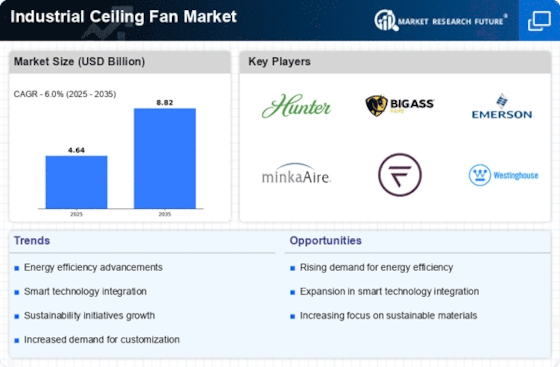
As per Market Research Future analysis, the Industrial Ceiling Fan Market Size was estimated at 4.645 USD Billion in 2024. The Industrial Ceiling Fan industry is projected to grow from 4.924 USD Billion in 2025 to 8.82 USD Billion by 2035, exhibiting a compound annual growth rate (CAGR) of 6.0% during the forecast period 2025 - 2035

Key Market Trends & Highlights

The Industrial Ceiling Fan Market is poised for growth driven by technological advancements and sustainability initiatives.

  • North America remains the largest market for industrial ceiling fans, reflecting a strong demand across various sectors. The Asia-Pacific region is emerging as the fastest-growing market, fueled by rapid industrialization and urbanization. Warehouse applications dominate the market, while factory settings are witnessing the fastest growth in demand for ceiling fans. Energy efficiency demand and technological advancements are key drivers propelling the market forward.

Market Size & Forecast

2024 Market Size 4.645 (USD Billion)
2035 Market Size 8.82 (USD Billion)
CAGR (2025 - 2035) 6.0%
Largest Regional Market Share in 2024 North America

Major Players

<a href="https://www.hunterfan.com/">Hunter Fan Company (US)</a>, Big Ass Fans (US), <a href="https://www.emerson.com/en-in">Emerson Electric Co. (US)</a>, Minka Aire (US), Fanimation (US), Westinghouse Lighting Corporation (US), Breezair (AU), Crompton Greaves Consumer Electricals Limited (IN), Havells India Limited (IN), Orient Electric Limited (IN)

Market Trends

The Industrial Ceiling Fan Market is currently experiencing a notable transformation, driven by advancements in technology and a growing emphasis on energy efficiency. Manufacturers are increasingly focusing on creating products that not only enhance airflow but also reduce energy consumption. This shift aligns with global sustainability goals, as businesses and industries seek to minimize their carbon footprints. Furthermore, the integration of smart technology into ceiling fans is becoming more prevalent, allowing for enhanced control and customization. This trend appears to resonate well with consumers who prioritize convenience and efficiency in their purchasing decisions. In addition to technological advancements, the Industrial Ceiling Fan Market is witnessing a diversification of applications across various sectors. From warehouses to large retail spaces, the demand for effective air circulation solutions is rising. This trend suggests that businesses are recognizing the importance of maintaining comfortable environments for both employees and customers. Moreover, the increasing focus on aesthetic appeal is influencing design choices, as companies aim to blend functionality with style. As the market evolves, it seems poised for further growth, driven by innovation and changing consumer preferences.

Technological Integration

The incorporation of smart technology into industrial ceiling fans is gaining traction. This trend allows users to control fan settings remotely, enhancing convenience and energy management. As industries adopt more automated solutions, the demand for technologically advanced fans is likely to increase.

Sustainability Focus

There is a growing emphasis on energy-efficient products within the Industrial Ceiling Fan Market. Companies are increasingly seeking solutions that reduce energy consumption while maintaining performance. This trend aligns with broader environmental goals and reflects a shift towards sustainable practices.

Design and Aesthetics

The market is witnessing a shift towards more aesthetically pleasing designs in industrial ceiling fans. Businesses are recognizing the importance of visual appeal in their environments, leading to a demand for fans that not only perform well but also enhance the overall ambiance of spaces.

Industrial Ceiling Fan Market Market Drivers

Energy Efficiency Demand

The increasing emphasis on energy efficiency is a pivotal driver for the Industrial ceiling fan Market. As industries strive to reduce operational costs and carbon footprints, energy-efficient ceiling fans are becoming essential. These fans utilize advanced motor technology and aerodynamic designs to optimize airflow while consuming less energy. According to recent data, energy-efficient fans can reduce energy consumption by up to 50% compared to traditional models. This shift not only aligns with regulatory standards but also appeals to environmentally conscious businesses. Consequently, the demand for energy-efficient solutions is likely to propel growth in the industrial ceiling fan Market, as companies seek to enhance sustainability while maintaining productivity.

Rising Industrialization

The ongoing trend of industrialization across various sectors is significantly influencing the Industrial Ceiling Fan Market. As manufacturing and warehousing facilities expand, the need for effective ventilation and cooling solutions becomes paramount. Industrial ceiling fans are designed to circulate air efficiently in large spaces, ensuring optimal working conditions. Data indicates that the manufacturing sector is projected to grow at a compound annual growth rate of 4.5% over the next five years, which could lead to increased demand for industrial ceiling fans. This growth is likely to drive investments in infrastructure, thereby enhancing the market potential for ceiling fan manufacturers and suppliers.

Technological Advancements

Technological advancements are revolutionizing the Industrial Ceiling Fan Market. Innovations such as smart fans equipped with IoT capabilities allow for remote monitoring and control, enhancing operational efficiency. These fans can adjust their speed based on real-time temperature and occupancy data, leading to optimized energy use. The integration of advanced materials and designs also contributes to improved performance and durability. As industries increasingly adopt smart technologies, the demand for technologically advanced ceiling fans is likely to surge. This trend not only enhances user experience but also positions manufacturers favorably in a competitive market, driving growth in the Industrial Ceiling Fan Market.

Customization and Versatility

Customization and versatility are emerging as key drivers in the Industrial Ceiling Fan Market. Businesses are seeking solutions that cater to specific operational needs, leading to a demand for customizable ceiling fans. These fans can be tailored in terms of size, design, and functionality to suit various industrial applications, from warehouses to manufacturing plants. The ability to adapt to different environments enhances their appeal, as companies look for solutions that integrate seamlessly into their operations. This trend towards customization is likely to foster innovation among manufacturers, encouraging them to develop a diverse range of products that meet the evolving demands of the Industrial Ceiling Fan Market.

Health and Safety Regulations

Health and safety regulations are increasingly shaping the Industrial Ceiling Fan Market. Organizations are mandated to provide safe working environments, which includes adequate ventilation. Industrial ceiling fans play a crucial role in maintaining air quality and temperature control, thereby contributing to employee well-being. Compliance with occupational health standards often necessitates the installation of effective ventilation systems, including ceiling fans. As industries face stricter regulations, the demand for reliable and efficient ceiling fans is expected to rise. This regulatory landscape not only drives sales but also encourages innovation in fan design and technology, further enhancing the Industrial Ceiling Fan Market.

Market Segment Insights

By Application: Warehouse (Largest) vs. Factory (Fastest-Growing)

The Industrial Ceiling Fan Market is segmented by application into Warehouse, Factory, and Others, with Warehouse holding the largest share. This segment dominates due to its vast floor space and need for effective air circulation, especially in larger storage areas. Warehouses require fans that can operate efficiently while maintaining a comfortable environment for employees and preserving stored goods. On the other hand, the Factory segment is the fastest-growing as manufacturers focus on operational efficiency and employee comfort. The increase in automated processes and workforce numbers in factories necessitates effective ventilation solutions. Innovations in fan technology that promote energy efficiency and enhanced functionality are driving growth in this segment as companies seek to optimize performance and reduce costs.

Application: Warehouse (Dominant) vs. Factory (Emerging)

The Warehouse application segment is dominant in the Industrial Ceiling Fan Market due to its significant reliance on large-scale cooling solutions. These fans are designed to provide extensive coverage and effective air circulation across wide spaces, which is crucial for maintaining product integrity and employee comfort in such environments. Additionally, these fans often feature robust construction to withstand the rigors of industrial use. In contrast, the Factory application segment is emerging rapidly, fueled by manufacturers' increasing focus on worker welfare and energy efficiency. Factories are incorporating advanced ceiling fan systems that support automation and smart technology, leading to enhanced operational efficiencies. The shift towards sustainable practices and energy savings positions factory fans as an innovative alternative, catering to modern manufacturing requirements.

By Type: AC Ceiling Fans (Largest) vs. DC Ceiling Fans (Fastest-Growing)

The Industrial Ceiling Fan Market is witnessing a significant divide between AC and DC ceiling fans, with AC ceiling fans holding the largest share. AC fans are popular for their robust performance and cost-effectiveness, making them a go-to choice for large industrial spaces. In contrast, DC ceiling fans are gaining traction due to their energy efficiency and advanced features, carving a niche in modern industrial applications. As awareness of energy consumption rises, the adoption of these fans is on the rise among industries looking for sustainable solutions. In terms of growth trends, the industrial sector is increasingly driven by the need for energy-efficient solutions, propelling the demand for DC ceiling fans. Their design allows for quieter operation and lower energy bills, making them appealing in a market that is becoming progressively eco-conscious. Meanwhile, traditional AC fans remain essential due to their reliability and established presence in the market. The transition towards a more energy-efficient infrastructure continues to create opportunities for both segment types, showcasing a dynamic shift in consumer preferences.

AC Ceiling Fans (Dominant) vs. DC Ceiling Fans (Emerging)

AC ceiling fans dominate the Industrial Ceiling Fan Market due to their widespread acceptance and reliability in large-scale operations. These fans are typically more affordable and have been the traditional choice for industrial settings due to their powerful air movement capabilities. They are particularly suited for environments requiring consistent airflow over significant areas. On the other hand, DC ceiling fans are emerging as a formidable competitor, characterized by their energy efficiency and modern designs. With advanced motor technology, DC fans consume significantly less electricity while providing quiet and effective cooling. As industries increasingly focus on reducing energy costs and enhancing sustainability, DC ceiling fans are expected to carve out a growing market presence, appealing especially to eco-conscious consumers.

Get more detailed insights about Industrial Ceiling Fan Market Research Report – Forecast till 2035

Regional Insights

North America : Market Leader in Innovation

North America is the largest market for industrial ceiling fans, holding approximately 45% of the global market share. The region's growth is driven by increasing demand for energy-efficient solutions and advancements in fan technology. Regulatory support for energy efficiency standards further catalyzes market expansion. The U.S. leads this market, followed closely by Canada, which contributes around 15% to the overall market share. The competitive landscape in North America is robust, featuring key players such as Hunter Fan Company, Big Ass Fans, and Emerson Electric Co. These companies are at the forefront of innovation, offering a range of products that cater to various industrial applications. The presence of established brands and a strong distribution network enhances market accessibility, ensuring that consumers have a wide array of options to choose from.

Europe : Emerging Market with Growth Potential

Europe is witnessing a growing demand for industrial ceiling fans, accounting for approximately 25% of the global market share. The region's growth is fueled by increasing industrial activities and a shift towards sustainable energy solutions. Regulatory frameworks promoting energy efficiency and environmental sustainability are significant catalysts for market growth. Germany and the UK are the largest markets in Europe, together holding about 40% of the region's market share. Leading countries in Europe include Germany, the UK, and France, with a competitive landscape featuring both local and international players. Companies like Minka Aire and Fanimation are expanding their presence in this region, focusing on innovative designs and energy-efficient products. The market is characterized by a mix of established brands and emerging players, contributing to a dynamic competitive environment.

Asia-Pacific : Rapid Growth in Emerging Economies

Asia-Pacific is rapidly emerging as a significant player in the industrial ceiling fan market, holding approximately 20% of the global market share. The region's growth is driven by industrialization, urbanization, and increasing energy demands. Countries like India and China are leading this growth, with India alone contributing around 10% to the market. Government initiatives promoting energy-efficient technologies are also pivotal in driving demand. The competitive landscape in Asia-Pacific is diverse, with key players such as Crompton Greaves and Havells India Limited leading the market. The presence of local manufacturers alongside international brands fosters a competitive environment. As the region continues to industrialize, the demand for efficient cooling solutions is expected to rise, further enhancing market opportunities for existing and new players.

Middle East and Africa : Untapped Potential in Emerging Markets

The Middle East and Africa region is gradually emerging in the industrial ceiling fan market, currently holding about 10% of the global market share. The growth is primarily driven by increasing industrial activities and a rising focus on energy efficiency. Countries like South Africa and the UAE are leading the market, with South Africa contributing approximately 5% to the overall share. Regulatory initiatives aimed at promoting energy-efficient solutions are also gaining traction. The competitive landscape in this region is still developing, with a mix of local and international players. Companies are increasingly focusing on expanding their product offerings to meet the growing demand for industrial ceiling fans. As infrastructure development continues, the market is expected to witness significant growth, providing opportunities for both established and emerging brands.

Key Players and Competitive Insights

The Industrial Ceiling Fan Market is currently characterized by a dynamic competitive landscape, driven by factors such as energy efficiency, technological advancements, and a growing emphasis on sustainable solutions. Key players like Hunter Fan Company (US), Big Ass Fans (US), and Crompton Greaves Consumer Electricals Limited (IN) are strategically positioned to leverage these trends. Hunter Fan Company (US) focuses on innovation, particularly in smart ceiling fan technology, which integrates IoT capabilities to enhance user experience. Meanwhile, Big Ass Fans (US) emphasizes large-scale industrial applications, promoting energy-efficient solutions that cater to commercial and industrial sectors. Crompton Greaves Consumer Electricals Limited (IN) is expanding its footprint in emerging markets, capitalizing on the rising demand for affordable yet efficient ceiling fans.
The market structure appears moderately fragmented, with numerous players vying for market share. Companies are increasingly localizing manufacturing to reduce costs and optimize supply chains. This tactic not only enhances operational efficiency but also allows for quicker response times to market demands. The collective influence of these key players shapes a competitive environment where innovation and customer-centric strategies are paramount.
In August 2025, Hunter Fan Company (US) launched a new line of smart ceiling fans that utilize advanced sensors to adjust speed based on room occupancy and temperature. This strategic move underscores the company's commitment to integrating technology into its product offerings, potentially setting a new standard in the market for energy efficiency and user convenience. The introduction of such innovative products may enhance Hunter's competitive edge, appealing to environmentally conscious consumers.
In September 2025, Big Ass Fans (US) announced a partnership with a leading energy management firm to develop a new range of ceiling fans designed specifically for large commercial spaces. This collaboration aims to optimize energy consumption and reduce operational costs for businesses. By aligning with an energy management expert, Big Ass Fans (US) not only strengthens its product portfolio but also positions itself as a thought leader in energy efficiency within the industrial ceiling fan sector.
In July 2025, Crompton Greaves Consumer Electricals Limited (IN) expanded its manufacturing capabilities by investing in a new facility in India, aimed at increasing production capacity for its ceiling fan range. This strategic investment reflects the company's intent to meet the growing domestic demand while also enhancing its export potential. Such moves are likely to bolster Crompton's market presence and competitiveness in both local and international markets.
As of October 2025, the competitive trends in the Industrial Ceiling Fan Market are increasingly defined by digitalization, sustainability, and the integration of artificial intelligence. Companies are forming strategic alliances to enhance their technological capabilities and market reach. The shift from price-based competition to a focus on innovation and supply chain reliability is evident, suggesting that future competitive differentiation will hinge on the ability to deliver advanced, energy-efficient solutions that resonate with consumer values.

Key Companies in the Industrial Ceiling Fan Market include

Industry Developments

For Instance, May 2023 Big Ass Fans announced a partnership with Mitsubishi Electric to develop and distribute new industrial ceiling fan products. The partnership will combine Big Ass Fans' expertise in HVLS fan design and manufacturing with Mitsubishi Electric's reach and sales network.

For Instance, February 2023 Westinghouse Lighting announced a partnership with MacroAir to distribute MacroAir's industrial ceiling fans in the United States and Canada. The partnership will give Westinghouse Lighting access to MacroAir's innovative HVLS fan technology and expand its product portfolio.

For Instance, January 2023 The Green Fan Company acquired The HVLS Fan Company, a manufacturer of industrial ceiling fans. The acquisition will expand The Green Fan Company's product portfolio and expand their presence in the UK and European industrial fan markets.

Future Outlook

Industrial Ceiling Fan Market Future Outlook

The Industrial Ceiling Fan Market is projected to grow at a 6.0% CAGR from 2025 to 2035, driven by energy efficiency, industrial automation, and increasing demand for ventilation solutions.

New opportunities lie in:

  • Development of smart ceiling fans with IoT integration for enhanced energy management.
  • Expansion into emerging markets with tailored product offerings for local industries.
  • Partnerships with HVAC companies to create integrated climate control solutions.

By 2035, the market is expected to solidify its position as a leader in energy-efficient industrial solutions.

Market Segmentation

Industrial Ceiling Fan Market Type Outlook

  • AC Ceiling Fans
  • DC Ceiling Fans

Industrial Ceiling Fan Market Application Outlook

  • Warehouse
  • Factory
  • Others

Report Scope

MARKET SIZE 2024 4.645(USD Billion)
MARKET SIZE 2025 4.924(USD Billion)
MARKET SIZE 2035 8.82(USD Billion)
COMPOUND ANNUAL GROWTH RATE (CAGR) 6.0% (2025 - 2035)
REPORT COVERAGE Revenue Forecast, Competitive Landscape, Growth Factors, and Trends
BASE YEAR 2024
Market Forecast Period 2025 - 2035
Historical Data 2019 - 2024
Market Forecast Units USD Billion
Key Companies Profiled Hunter Fan Company (US), Big Ass Fans (US), Emerson Electric Co. (US), Minka Aire (US), Fanimation (US), Westinghouse Lighting Corporation (US), Breezair (AU), Crompton Greaves Consumer Electricals Limited (IN), Havells India Limited (IN), Orient Electric Limited (IN)
Segments Covered Type, Application, Region
Key Market Opportunities Integration of smart technology in the Industrial Ceiling Fan Market enhances energy efficiency and user control.
Key Market Dynamics Rising demand for energy-efficient solutions drives innovation and competition in the industrial ceiling fan market.
Countries Covered North America, Europe, APAC, South America, MEA

FAQs

What is the current valuation of the Industrial Ceiling Fan Market?

<p>As of 2024, the Industrial Ceiling Fan Market was valued at 4.645 USD Billion.</p>

What is the projected market valuation for the Industrial Ceiling Fan Market in 2035?

<p>The market is projected to reach a valuation of 8.82 USD Billion by 2035.</p>

What is the expected CAGR for the Industrial Ceiling Fan Market from 2025 to 2035?

<p>The expected CAGR for the Industrial Ceiling Fan Market during the forecast period 2025 - 2035 is 6.0%.</p>

Which application segments are driving the Industrial Ceiling Fan Market?

<p>The key application segments include Warehouse, Factory, and Others, with Factory fans valued at 2.5 to 4.5 USD Billion.</p>

What are the types of ceiling fans contributing to market growth?

<p>The market includes AC Ceiling Fans, valued at 2.5 to 4.5 USD Billion, and DC Ceiling Fans, valued at 2.145 to 4.32 USD Billion.</p>

Who are the leading players in the Industrial Ceiling Fan Market?

<p>Key players include Hunter Fan Company, Big Ass Fans, Emerson Electric Co., and Minka Aire, among others.</p>

How does the performance of DC Ceiling Fans compare to AC Ceiling Fans?

DC Ceiling Fans show a valuation range of 2.145 to 4.32 USD Billion, which is competitive with AC Ceiling Fans valued at 2.5 to 4.5 USD Billion.

What factors are likely to influence the growth of the Industrial Ceiling Fan Market?

Factors such as increasing industrialization and energy efficiency demands may influence market growth during the forecast period.

What is the significance of the Factory segment in the Industrial Ceiling Fan Market?

The Factory segment is significant, with a valuation range of 2.5 to 4.5 USD Billion, indicating strong demand in industrial applications.

How are the market dynamics expected to evolve by 2035?

By 2035, the market dynamics may evolve with increased competition and innovation among key players, potentially enhancing product offerings.

  1. SECTION I: EXECUTIVE SUMMARY AND KEY HIGHLIGHTS
    1. | 1.1 EXECUTIVE SUMMARY
    2. | | 1.1.1 Market Overview
    3. | | 1.1.2 Key Findings
    4. | | 1.1.3 Market Segmentation
    5. | | 1.1.4 Competitive Landscape
    6. | | 1.1.5 Challenges and Opportunities
    7. | | 1.1.6 Future Outlook
  2. SECTION II: SCOPING, METHODOLOGY AND MARKET STRUCTURE
    1. | 2.1 MARKET INTRODUCTION
    2. | | 2.1.1 Definition
    3. | | 2.1.2 Scope of the study
    4. | | | 2.1.2.1 Research Objective
    5. | | | 2.1.2.2 Assumption
    6. | | | 2.1.2.3 Limitations
    7. | 2.2 RESEARCH METHODOLOGY
    8. | | 2.2.1 Overview
    9. | | 2.2.2 Data Mining
    10. | | 2.2.3 Secondary Research
    11. | | 2.2.4 Primary Research
    12. | | | 2.2.4.1 Primary Interviews and Information Gathering Process
    13. | | | 2.2.4.2 Breakdown of Primary Respondents
    14. | | 2.2.5 Forecasting Model
    15. | | 2.2.6 Market Size Estimation
    16. | | | 2.2.6.1 Bottom-Up Approach
    17. | | | 2.2.6.2 Top-Down Approach
    18. | | 2.2.7 Data Triangulation
    19. | | 2.2.8 Validation
  3. SECTION III: QUALITATIVE ANALYSIS
    1. | 3.1 MARKET DYNAMICS
    2. | | 3.1.1 Overview
    3. | | 3.1.2 Drivers
    4. | | 3.1.3 Restraints
    5. | | 3.1.4 Opportunities
    6. | 3.2 MARKET FACTOR ANALYSIS
    7. | | 3.2.1 Value chain Analysis
    8. | | 3.2.2 Porter's Five Forces Analysis
    9. | | | 3.2.2.1 Bargaining Power of Suppliers
    10. | | | 3.2.2.2 Bargaining Power of Buyers
    11. | | | 3.2.2.3 Threat of New Entrants
    12. | | | 3.2.2.4 Threat of Substitutes
    13. | | | 3.2.2.5 Intensity of Rivalry
    14. | | 3.2.3 COVID-19 Impact Analysis
    15. | | | 3.2.3.1 Market Impact Analysis
    16. | | | 3.2.3.2 Regional Impact
    17. | | | 3.2.3.3 Opportunity and Threat Analysis
  4. SECTION IV: QUANTITATIVE ANALYSIS
    1. | 4.1 Consumer and Retail, BY Application (USD Billion)
    2. | | 4.1.1 Warehouse
    3. | | 4.1.2 Factory
    4. | | 4.1.3 Others
    5. | 4.2 Consumer and Retail, BY Type (USD Billion)
    6. | | 4.2.1 AC Ceiling Fans
    7. | | 4.2.2 DC Ceiling Fans
    8. | 4.3 Consumer and Retail, BY Region (USD Billion)
    9. | | 4.3.1 North America
    10. | | | 4.3.1.1 US
    11. | | | 4.3.1.2 Canada
    12. | | 4.3.2 Europe
    13. | | | 4.3.2.1 Germany
    14. | | | 4.3.2.2 UK
    15. | | | 4.3.2.3 France
    16. | | | 4.3.2.4 Russia
    17. | | | 4.3.2.5 Italy
    18. | | | 4.3.2.6 Spain
    19. | | | 4.3.2.7 Rest of Europe
    20. | | 4.3.3 APAC
    21. | | | 4.3.3.1 China
    22. | | | 4.3.3.2 India
    23. | | | 4.3.3.3 Japan
    24. | | | 4.3.3.4 South Korea
    25. | | | 4.3.3.5 Malaysia
    26. | | | 4.3.3.6 Thailand
    27. | | | 4.3.3.7 Indonesia
    28. | | | 4.3.3.8 Rest of APAC
    29. | | 4.3.4 South America
    30. | | | 4.3.4.1 Brazil
    31. | | | 4.3.4.2 Mexico
    32. | | | 4.3.4.3 Argentina
    33. | | | 4.3.4.4 Rest of South America
    34. | | 4.3.5 MEA
    35. | | | 4.3.5.1 GCC Countries
    36. | | | 4.3.5.2 South Africa
    37. | | | 4.3.5.3 Rest of MEA
  5. SECTION V: COMPETITIVE ANALYSIS
    1. | 5.1 Competitive Landscape
    2. | | 5.1.1 Overview
    3. | | 5.1.2 Competitive Analysis
    4. | | 5.1.3 Market share Analysis
    5. | | 5.1.4 Major Growth Strategy in the Consumer and Retail
    6. | | 5.1.5 Competitive Benchmarking
    7. | | 5.1.6 Leading Players in Terms of Number of Developments in the Consumer and Retail
    8. | | 5.1.7 Key developments and growth strategies
    9. | | | 5.1.7.1 New Product Launch/Service Deployment
    10. | | | 5.1.7.2 Merger & Acquisitions
    11. | | | 5.1.7.3 Joint Ventures
    12. | | 5.1.8 Major Players Financial Matrix
    13. | | | 5.1.8.1 Sales and Operating Income
    14. | | | 5.1.8.2 Major Players R&D Expenditure. 2023
    15. | 5.2 Company Profiles
    16. | | 5.2.1 Hunter Fan Company (US)
    17. | | | 5.2.1.1 Financial Overview
    18. | | | 5.2.1.2 Products Offered
    19. | | | 5.2.1.3 Key Developments
    20. | | | 5.2.1.4 SWOT Analysis
    21. | | | 5.2.1.5 Key Strategies
    22. | | 5.2.2 Big Ass Fans (US)
    23. | | | 5.2.2.1 Financial Overview
    24. | | | 5.2.2.2 Products Offered
    25. | | | 5.2.2.3 Key Developments
    26. | | | 5.2.2.4 SWOT Analysis
    27. | | | 5.2.2.5 Key Strategies
    28. | | 5.2.3 Emerson Electric Co. (US)
    29. | | | 5.2.3.1 Financial Overview
    30. | | | 5.2.3.2 Products Offered
    31. | | | 5.2.3.3 Key Developments
    32. | | | 5.2.3.4 SWOT Analysis
    33. | | | 5.2.3.5 Key Strategies
    34. | | 5.2.4 Minka Aire (US)
    35. | | | 5.2.4.1 Financial Overview
    36. | | | 5.2.4.2 Products Offered
    37. | | | 5.2.4.3 Key Developments
    38. | | | 5.2.4.4 SWOT Analysis
    39. | | | 5.2.4.5 Key Strategies
    40. | | 5.2.5 Fanimation (US)
    41. | | | 5.2.5.1 Financial Overview
    42. | | | 5.2.5.2 Products Offered
    43. | | | 5.2.5.3 Key Developments
    44. | | | 5.2.5.4 SWOT Analysis
    45. | | | 5.2.5.5 Key Strategies
    46. | | 5.2.6 Westinghouse Lighting Corporation (US)
    47. | | | 5.2.6.1 Financial Overview
    48. | | | 5.2.6.2 Products Offered
    49. | | | 5.2.6.3 Key Developments
    50. | | | 5.2.6.4 SWOT Analysis
    51. | | | 5.2.6.5 Key Strategies
    52. | | 5.2.7 Breezair (AU)
    53. | | | 5.2.7.1 Financial Overview
    54. | | | 5.2.7.2 Products Offered
    55. | | | 5.2.7.3 Key Developments
    56. | | | 5.2.7.4 SWOT Analysis
    57. | | | 5.2.7.5 Key Strategies
    58. | | 5.2.8 Crompton Greaves Consumer Electricals Limited (IN)
    59. | | | 5.2.8.1 Financial Overview
    60. | | | 5.2.8.2 Products Offered
    61. | | | 5.2.8.3 Key Developments
    62. | | | 5.2.8.4 SWOT Analysis
    63. | | | 5.2.8.5 Key Strategies
    64. | | 5.2.9 Havells India Limited (IN)
    65. | | | 5.2.9.1 Financial Overview
    66. | | | 5.2.9.2 Products Offered
    67. | | | 5.2.9.3 Key Developments
    68. | | | 5.2.9.4 SWOT Analysis
    69. | | | 5.2.9.5 Key Strategies
    70. | | 5.2.10 Orient Electric Limited (IN)
    71. | | | 5.2.10.1 Financial Overview
    72. | | | 5.2.10.2 Products Offered
    73. | | | 5.2.10.3 Key Developments
    74. | | | 5.2.10.4 SWOT Analysis
    75. | | | 5.2.10.5 Key Strategies
    76. | 5.3 Appendix
    77. | | 5.3.1 References
    78. | | 5.3.2 Related Reports
  6. LIST OF FIGURES
    1. | 6.1 MARKET SYNOPSIS
    2. | 6.2 NORTH AMERICA MARKET ANALYSIS
    3. | 6.3 US MARKET ANALYSIS BY APPLICATION
    4. | 6.4 US MARKET ANALYSIS BY TYPE
    5. | 6.5 CANADA MARKET ANALYSIS BY APPLICATION
    6. | 6.6 CANADA MARKET ANALYSIS BY TYPE
    7. | 6.7 EUROPE MARKET ANALYSIS
    8. | 6.8 GERMANY MARKET ANALYSIS BY APPLICATION
    9. | 6.9 GERMANY MARKET ANALYSIS BY TYPE
    10. | 6.10 UK MARKET ANALYSIS BY APPLICATION
    11. | 6.11 UK MARKET ANALYSIS BY TYPE
    12. | 6.12 FRANCE MARKET ANALYSIS BY APPLICATION
    13. | 6.13 FRANCE MARKET ANALYSIS BY TYPE
    14. | 6.14 RUSSIA MARKET ANALYSIS BY APPLICATION
    15. | 6.15 RUSSIA MARKET ANALYSIS BY TYPE
    16. | 6.16 ITALY MARKET ANALYSIS BY APPLICATION
    17. | 6.17 ITALY MARKET ANALYSIS BY TYPE
    18. | 6.18 SPAIN MARKET ANALYSIS BY APPLICATION
    19. | 6.19 SPAIN MARKET ANALYSIS BY TYPE
    20. | 6.20 REST OF EUROPE MARKET ANALYSIS BY APPLICATION
    21. | 6.21 REST OF EUROPE MARKET ANALYSIS BY TYPE
    22. | 6.22 APAC MARKET ANALYSIS
    23. | 6.23 CHINA MARKET ANALYSIS BY APPLICATION
    24. | 6.24 CHINA MARKET ANALYSIS BY TYPE
    25. | 6.25 INDIA MARKET ANALYSIS BY APPLICATION
    26. | 6.26 INDIA MARKET ANALYSIS BY TYPE
    27. | 6.27 JAPAN MARKET ANALYSIS BY APPLICATION
    28. | 6.28 JAPAN MARKET ANALYSIS BY TYPE
    29. | 6.29 SOUTH KOREA MARKET ANALYSIS BY APPLICATION
    30. | 6.30 SOUTH KOREA MARKET ANALYSIS BY TYPE
    31. | 6.31 MALAYSIA MARKET ANALYSIS BY APPLICATION
    32. | 6.32 MALAYSIA MARKET ANALYSIS BY TYPE
    33. | 6.33 THAILAND MARKET ANALYSIS BY APPLICATION
    34. | 6.34 THAILAND MARKET ANALYSIS BY TYPE
    35. | 6.35 INDONESIA MARKET ANALYSIS BY APPLICATION
    36. | 6.36 INDONESIA MARKET ANALYSIS BY TYPE
    37. | 6.37 REST OF APAC MARKET ANALYSIS BY APPLICATION
    38. | 6.38 REST OF APAC MARKET ANALYSIS BY TYPE
    39. | 6.39 SOUTH AMERICA MARKET ANALYSIS
    40. | 6.40 BRAZIL MARKET ANALYSIS BY APPLICATION
    41. | 6.41 BRAZIL MARKET ANALYSIS BY TYPE
    42. | 6.42 MEXICO MARKET ANALYSIS BY APPLICATION
    43. | 6.43 MEXICO MARKET ANALYSIS BY TYPE
    44. | 6.44 ARGENTINA MARKET ANALYSIS BY APPLICATION
    45. | 6.45 ARGENTINA MARKET ANALYSIS BY TYPE
    46. | 6.46 REST OF SOUTH AMERICA MARKET ANALYSIS BY APPLICATION
    47. | 6.47 REST OF SOUTH AMERICA MARKET ANALYSIS BY TYPE
    48. | 6.48 MEA MARKET ANALYSIS
    49. | 6.49 GCC COUNTRIES MARKET ANALYSIS BY APPLICATION
    50. | 6.50 GCC COUNTRIES MARKET ANALYSIS BY TYPE
    51. | 6.51 SOUTH AFRICA MARKET ANALYSIS BY APPLICATION
    52. | 6.52 SOUTH AFRICA MARKET ANALYSIS BY TYPE
    53. | 6.53 REST OF MEA MARKET ANALYSIS BY APPLICATION
    54. | 6.54 REST OF MEA MARKET ANALYSIS BY TYPE
    55. | 6.55 KEY BUYING CRITERIA OF CONSUMER AND RETAIL
    56. | 6.56 RESEARCH PROCESS OF MRFR
    57. | 6.57 DRO ANALYSIS OF CONSUMER AND RETAIL
    58. | 6.58 DRIVERS IMPACT ANALYSIS: CONSUMER AND RETAIL
    59. | 6.59 RESTRAINTS IMPACT ANALYSIS: CONSUMER AND RETAIL
    60. | 6.60 SUPPLY / VALUE CHAIN: CONSUMER AND RETAIL
    61. | 6.61 CONSUMER AND RETAIL, BY APPLICATION, 2024 (% SHARE)
    62. | 6.62 CONSUMER AND RETAIL, BY APPLICATION, 2024 TO 2035 (USD Billion)
    63. | 6.63 CONSUMER AND RETAIL, BY TYPE, 2024 (% SHARE)
    64. | 6.64 CONSUMER AND RETAIL, BY TYPE, 2024 TO 2035 (USD Billion)
    65. | 6.65 BENCHMARKING OF MAJOR COMPETITORS
  7. LIST OF TABLES
    1. | 7.1 LIST OF ASSUMPTIONS
    2. | | 7.1.1
    3. | 7.2 North America MARKET SIZE ESTIMATES; FORECAST
    4. | | 7.2.1 BY APPLICATION, 2025-2035 (USD Billion)
    5. | | 7.2.2 BY TYPE, 2025-2035 (USD Billion)
    6. | 7.3 US MARKET SIZE ESTIMATES; FORECAST
    7. | | 7.3.1 BY APPLICATION, 2025-2035 (USD Billion)
    8. | | 7.3.2 BY TYPE, 2025-2035 (USD Billion)
    9. | 7.4 Canada MARKET SIZE ESTIMATES; FORECAST
    10. | | 7.4.1 BY APPLICATION, 2025-2035 (USD Billion)
    11. | | 7.4.2 BY TYPE, 2025-2035 (USD Billion)
    12. | 7.5 Europe MARKET SIZE ESTIMATES; FORECAST
    13. | | 7.5.1 BY APPLICATION, 2025-2035 (USD Billion)
    14. | | 7.5.2 BY TYPE, 2025-2035 (USD Billion)
    15. | 7.6 Germany MARKET SIZE ESTIMATES; FORECAST
    16. | | 7.6.1 BY APPLICATION, 2025-2035 (USD Billion)
    17. | | 7.6.2 BY TYPE, 2025-2035 (USD Billion)
    18. | 7.7 UK MARKET SIZE ESTIMATES; FORECAST
    19. | | 7.7.1 BY APPLICATION, 2025-2035 (USD Billion)
    20. | | 7.7.2 BY TYPE, 2025-2035 (USD Billion)
    21. | 7.8 France MARKET SIZE ESTIMATES; FORECAST
    22. | | 7.8.1 BY APPLICATION, 2025-2035 (USD Billion)
    23. | | 7.8.2 BY TYPE, 2025-2035 (USD Billion)
    24. | 7.9 Russia MARKET SIZE ESTIMATES; FORECAST
    25. | | 7.9.1 BY APPLICATION, 2025-2035 (USD Billion)
    26. | | 7.9.2 BY TYPE, 2025-2035 (USD Billion)
    27. | 7.10 Italy MARKET SIZE ESTIMATES; FORECAST
    28. | | 7.10.1 BY APPLICATION, 2025-2035 (USD Billion)
    29. | | 7.10.2 BY TYPE, 2025-2035 (USD Billion)
    30. | 7.11 Spain MARKET SIZE ESTIMATES; FORECAST
    31. | | 7.11.1 BY APPLICATION, 2025-2035 (USD Billion)
    32. | | 7.11.2 BY TYPE, 2025-2035 (USD Billion)
    33. | 7.12 Rest of Europe MARKET SIZE ESTIMATES; FORECAST
    34. | | 7.12.1 BY APPLICATION, 2025-2035 (USD Billion)
    35. | | 7.12.2 BY TYPE, 2025-2035 (USD Billion)
    36. | 7.13 APAC MARKET SIZE ESTIMATES; FORECAST
    37. | | 7.13.1 BY APPLICATION, 2025-2035 (USD Billion)
    38. | | 7.13.2 BY TYPE, 2025-2035 (USD Billion)
    39. | 7.14 China MARKET SIZE ESTIMATES; FORECAST
    40. | | 7.14.1 BY APPLICATION, 2025-2035 (USD Billion)
    41. | | 7.14.2 BY TYPE, 2025-2035 (USD Billion)
    42. | 7.15 India MARKET SIZE ESTIMATES; FORECAST
    43. | | 7.15.1 BY APPLICATION, 2025-2035 (USD Billion)
    44. | | 7.15.2 BY TYPE, 2025-2035 (USD Billion)
    45. | 7.16 Japan MARKET SIZE ESTIMATES; FORECAST
    46. | | 7.16.1 BY APPLICATION, 2025-2035 (USD Billion)
    47. | | 7.16.2 BY TYPE, 2025-2035 (USD Billion)
    48. | 7.17 South Korea MARKET SIZE ESTIMATES; FORECAST
    49. | | 7.17.1 BY APPLICATION, 2025-2035 (USD Billion)
    50. | | 7.17.2 BY TYPE, 2025-2035 (USD Billion)
    51. | 7.18 Malaysia MARKET SIZE ESTIMATES; FORECAST
    52. | | 7.18.1 BY APPLICATION, 2025-2035 (USD Billion)
    53. | | 7.18.2 BY TYPE, 2025-2035 (USD Billion)
    54. | 7.19 Thailand MARKET SIZE ESTIMATES; FORECAST
    55. | | 7.19.1 BY APPLICATION, 2025-2035 (USD Billion)
    56. | | 7.19.2 BY TYPE, 2025-2035 (USD Billion)
    57. | 7.20 Indonesia MARKET SIZE ESTIMATES; FORECAST
    58. | | 7.20.1 BY APPLICATION, 2025-2035 (USD Billion)
    59. | | 7.20.2 BY TYPE, 2025-2035 (USD Billion)
    60. | 7.21 Rest of APAC MARKET SIZE ESTIMATES; FORECAST
    61. | | 7.21.1 BY APPLICATION, 2025-2035 (USD Billion)
    62. | | 7.21.2 BY TYPE, 2025-2035 (USD Billion)
    63. | 7.22 South America MARKET SIZE ESTIMATES; FORECAST
    64. | | 7.22.1 BY APPLICATION, 2025-2035 (USD Billion)
    65. | | 7.22.2 BY TYPE, 2025-2035 (USD Billion)
    66. | 7.23 Brazil MARKET SIZE ESTIMATES; FORECAST
    67. | | 7.23.1 BY APPLICATION, 2025-2035 (USD Billion)
    68. | | 7.23.2 BY TYPE, 2025-2035 (USD Billion)
    69. | 7.24 Mexico MARKET SIZE ESTIMATES; FORECAST
    70. | | 7.24.1 BY APPLICATION, 2025-2035 (USD Billion)
    71. | | 7.24.2 BY TYPE, 2025-2035 (USD Billion)
    72. | 7.25 Argentina MARKET SIZE ESTIMATES; FORECAST
    73. | | 7.25.1 BY APPLICATION, 2025-2035 (USD Billion)
    74. | | 7.25.2 BY TYPE, 2025-2035 (USD Billion)
    75. | 7.26 Rest of South America MARKET SIZE ESTIMATES; FORECAST
    76. | | 7.26.1 BY APPLICATION, 2025-2035 (USD Billion)
    77. | | 7.26.2 BY TYPE, 2025-2035 (USD Billion)
    78. | 7.27 MEA MARKET SIZE ESTIMATES; FORECAST
    79. | | 7.27.1 BY APPLICATION, 2025-2035 (USD Billion)
    80. | | 7.27.2 BY TYPE, 2025-2035 (USD Billion)
    81. | 7.28 GCC Countries MARKET SIZE ESTIMATES; FORECAST
    82. | | 7.28.1 BY APPLICATION, 2025-2035 (USD Billion)
    83. | | 7.28.2 BY TYPE, 2025-2035 (USD Billion)
    84. | 7.29 South Africa MARKET SIZE ESTIMATES; FORECAST
    85. | | 7.29.1 BY APPLICATION, 2025-2035 (USD Billion)
    86. | | 7.29.2 BY TYPE, 2025-2035 (USD Billion)
    87. | 7.30 Rest of MEA MARKET SIZE ESTIMATES; FORECAST
    88. | | 7.30.1 BY APPLICATION, 2025-2035 (USD Billion)
    89. | | 7.30.2 BY TYPE, 2025-2035 (USD Billion)
    90. | 7.31 PRODUCT LAUNCH/PRODUCT DEVELOPMENT/APPROVAL
    91. | | 7.31.1
    92. | 7.32 ACQUISITION/PARTNERSHIP
    93. | | 7.32.1

Consumer and Retail Market Segmentation

Consumer and Retail By Application (USD Billion, 2025-2035)

  • Warehouse
  • Factory
  • Others

Consumer and Retail By Type (USD Billion, 2025-2035)

  • AC Ceiling Fans
  • DC Ceiling Fans
Infographic

Free Sample Request

Kindly complete the form below to receive a free sample of this Report

Get Free Sample

Customer Strories

Compare Licence

×
Features License Type
Single User Multiuser License Enterprise User
Price $4,950 $5,950 $7,250
Maximum User Access Limit 1 User Upto 10 Users Unrestricted Access Throughout the Organization
Free Customization
Direct Access to Analyst
Deliverable Format
Platform Access
Discount on Next Purchase 10% 15% 15%
Printable Versions