Request Free Sample ×

Kindly complete the form below to receive a free sample of this Report

* Please use a valid business email

Leading companies partner with us for data-driven Insights

clients tt-cursor
Hero Background
English
Chinese
French
Japanese
Korean
German
Spanish

India Sustainable Aviation Fuel Market Size

ID: MRFR/EnP/12416-HCR
128 Pages
Anshula Mandaokar
April 2026

India Sustainable Aviation Fuel Market Research Report Information By Fuel Type (Biofuel, Hydrogen Fuel, Power to Liquid, and Gas to Liquid), By Manufacturing Technology (FT-SPK, HEFA-SPK, HFS-SIP, ATJ-SPK, CHJ, FT-SPK/A, and HC-HEFA-SPK), By Blending Capacity (Below 30%, 30% to 50%, and Above 50%), By Platform (Commercial Aviation, Military Aviation, Business & General Aviation, and Unmanned Aerial Vehicles) - Growth & Industry Forecast to 2035

Share:
Download PDF ×

We do not share your information with anyone. However, we may send you emails based on your report interest from time to time. You may contact us at any time to opt-out.

India Sustainable Aviation fuel Market Infographic
Purchase Options

India Sustainable Aviation Fuel Size

India Sustainable Aviation fuel Market Growth Projections and Opportunities

The India Sustainable Aviation Fuel (SAF) market is currently undergoing significant transformations driven by various market factors. One crucial factor is the increasing global awareness and commitment to environmental sustainability. With the aviation industry being a notable contributor to carbon emissions, there is a growing emphasis on adopting sustainable alternatives, including SAF. This shift is reflected in India's aviation sector, where the demand for SAF is steadily rising.

Government initiatives and policies play a pivotal role in shaping the market landscape. In India, policymakers have recognized the importance of reducing the carbon footprint of the aviation industry. The government's support through incentives, subsidies, and regulatory frameworks has created a favorable environment for the growth of the SAF market. This includes measures such as tax incentives for SAF production and blending mandates for airlines to incorporate a certain percentage of SAF in their fuel mix.

Investments in research and development (R&D) are instrumental in advancing the production and utilization of sustainable aviation fuels. India has seen increased investments in R&D to enhance the efficiency and scalability of SAF production processes. This includes exploring innovative feedstock sources, such as agricultural residues, algae, and waste materials, to make the production of SAF more economically viable and environmentally friendly.

Collaborations and partnerships between government bodies, industry players, and research institutions contribute to the market's growth. These partnerships facilitate knowledge exchange, technology transfer, and the establishment of a robust supply chain for sustainable aviation fuels. As a result, the market benefits from the combined expertise and resources of various stakeholders, leading to accelerated advancements in SAF technology and market expansion.

Consumer awareness and preferences are shaping the demand for sustainable products, and the aviation industry is no exception. Passengers are increasingly considering the environmental impact of their travel choices. Airlines that adopt sustainable practices, including the use of SAF, can gain a competitive edge in the market. This consumer-driven demand encourages airlines to invest in and adopt sustainable aviation fuels, further propelling the market forward.

Global market trends and dynamics also influence the India SAF market. As the international aviation industry embraces sustainable practices, there is a ripple effect on India's market. Collaboration and alignment with global sustainability goals and standards position India as a responsible player in the international aviation community, fostering market growth and enhancing the country's reputation in the global context.

Challenges such as the high production costs and limited scalability of SAF production remain, but ongoing advancements and investments are addressing these issues. As technology evolves and economies of scale are achieved, the cost-effectiveness of SAF production is expected to improve, making it a more attractive option for airlines in India.

The India Sustainable Aviation Fuel market is experiencing significant growth driven by a confluence of market factors. Government support, R&D investments, collaborations, consumer preferences, and global trends collectively contribute to the expansion of the SAF market. As India continues to prioritize sustainability in its aviation sector, the market is poised for further development, with the potential to become a key player in the global push towards greener aviation solutions.
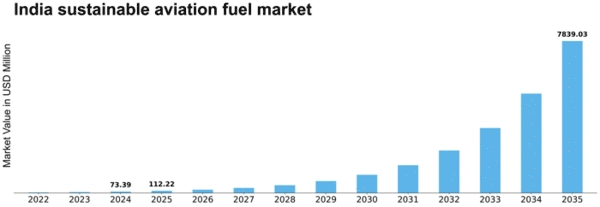
India Sustainable Aviation fuel Market Size Graph
Author
Author Profile
Anshula Mandaokar
Team Lead - Research

Anshula Mandaokar holds an academic degree in Chemical Engineering and has been contributing to the field for more than 5 years. She has expertise in Market Research and Business Consulting and serves as a Team Lead for a reputed Market Research firm under the Chemicals and Materials domain spectrum. She has worked on multiple projects, generating explicit results in a quick turnaround time. Her understanding of data interpretation justifies her role as a leader.

Leave a Comment

FAQs

What is the current valuation of the sustainable aviation-fuel market in India as of 2024?

<p>The market valuation was $73.39 Million in 2024.</p>

What is the projected market valuation for sustainable aviation fuel in India by 2035?

<p>The projected valuation for 2035 is $7839.03 Million.</p>

What is the expected CAGR for the sustainable aviation-fuel market in India during the forecast period 2025 - 2035?

<p>The expected CAGR during this period is 52.91%.</p>

Which fuel type segment holds the highest valuation in the sustainable aviation-fuel market in India?

<p>The Biofuels segment holds the highest valuation at $2000.0 Million.</p>

What are the key applications of sustainable aviation fuel in India?

<p>Key applications include Cargo Airlines, which has a valuation of $2500.0 Million.</p>

Which production method is projected to have the highest valuation in the sustainable aviation-fuel market in India?

<p>The Power-to-Liquid production method is projected to have the highest valuation at $3439.03 Million.</p>

Who are the leading players in the sustainable aviation-fuel market in India?

<p>Key players include Neste, Gevo, and Shell, among others.</p>

What is the valuation of the Hydrogen-Based Fuels segment in the sustainable aviation-fuel market in India?

<p>The Hydrogen-Based Fuels segment has a valuation of $1000.0 Million.</p>

How does the valuation of the Alcohols segment compare to other fuel types in the sustainable aviation-fuel market in India?

<p>The Alcohols segment has a valuation of $1200.0 Million, indicating a competitive position among fuel types.</p>

What is the valuation of the Business Aviation application in the sustainable aviation-fuel market in India?

<p>The Business Aviation application has a valuation of $2339.03 Million.</p>

Market Summary

As per Market Research Future analysis, the India Sustainable Aviation Fuel Market Size was estimated at 0.039 USD Billion in 2024. The India Sustainable Aviation Fuel industry is projected to grow from USD 0.0634 Billion in 2025 to USD 8.138 Billion by 2035, exhibiting a compound annual growth rate (CAGR) of 62.5% during the forecast period 2025 - 2035

Key Market Trends & Highlights

The India Sustainable Aviation Fuel Market is poised for substantial growth driven by regulatory support and technological advancements.

  • Regulatory support and policy frameworks are increasingly shaping the landscape of sustainable aviation fuel in India. Technological innovations in fuel production are enhancing the efficiency and viability of biofuels, particularly in the largest segment. Growing environmental awareness among consumers is driving demand for sustainable aviation solutions, especially in the Asia-Pacific region. Investment opportunities in sustainable aviation, alongside international collaboration, are key drivers propelling the market forward.

Market Size & Forecast

2024 Market Size 0.039 (USD Billion)
2035 Market Size 8.138 (USD Billion)
CAGR (2025 - 2035) 62.50%
Largest Regional Market Share in 2024 Asia Pacific

Major Players

Indian Oil Corporation Limited (IN), <a href="https://www.bharatpetroleum.in/our-businesses/aviation">Bharat Petroleum Corporation Limited </a>(IN), Hindustan Petroleum Corporation Limited (IN), Air India Limited (IN), Deccan Charters Limited (IN), Tata Advanced Systems Limited (IN), Aviation Fuel Services (IN), <a href="https://greenkogroup.com/IR2020-21/new-energy-value-pools.php">Greenko Group</a> (IN)

Market Trends

The India Sustainable Aviation Fuel Market is currently experiencing a transformative phase, driven by a confluence of regulatory support, technological advancements, and increasing environmental awareness. The government has implemented various initiatives aimed at promoting the use of sustainable aviation fuels, which are perceived as essential for reducing the carbon footprint of the aviation sector. This shift is not merely a response to global trends but reflects a growing recognition of the need for sustainable practices within the country. As stakeholders across the aviation industry engage in collaborative efforts, the market is poised for substantial growth, with investments in research and development likely to yield innovative solutions. Moreover, the increasing demand for cleaner energy sources is propelling the market forward. Airlines are actively seeking alternatives to traditional fossil fuels, which are becoming less viable due to environmental concerns. The emergence of biofuels and other sustainable options appears to be a promising avenue for meeting these demands. Additionally, partnerships between government entities and private companies may facilitate the establishment of a robust supply chain for sustainable aviation fuels. This collaborative approach could enhance the overall efficiency and sustainability of the aviation sector in India, positioning it as a leader in the global transition towards greener aviation practices.

Regulatory Support and Policy Framework

The Indian government is actively formulating policies that encourage the adoption of sustainable aviation fuels. This regulatory support is crucial for creating a conducive environment for investment and innovation in the sector. As policies evolve, they are likely to provide incentives for airlines and fuel producers, thereby fostering a more sustainable aviation ecosystem.

Technological Innovations in Fuel Production

Advancements in technology are playing a pivotal role in the development of sustainable aviation fuels. Innovations in production processes, such as the conversion of waste materials into fuel, are emerging as viable solutions. These technologies not only enhance fuel efficiency but also contribute to reducing greenhouse gas emissions, aligning with global sustainability goals.

Growing Environmental Awareness Among Consumers

There is a noticeable shift in consumer attitudes towards environmental sustainability. Passengers are increasingly prioritizing airlines that demonstrate a commitment to reducing their carbon footprint. This trend is prompting airlines to invest in sustainable aviation fuels, as they seek to meet the expectations of environmentally conscious travelers.

India Sustainable Aviation fuel Market Market Drivers

Regulatory Support and Policy Framework

The India Sustainable Aviation Fuel Market is experiencing a robust push due to favorable regulatory frameworks. The Indian government has introduced various policies aimed at promoting the use of sustainable aviation fuels. These initiatives include tax incentives, subsidies, and mandates for blending sustainable fuels with conventional aviation fuels. As a result, the market is projected to grow significantly, with estimates suggesting a compound annual growth rate of over 20% in the coming years. This regulatory support not only encourages investment in sustainable fuel technologies but also aligns with India's commitment to reducing carbon emissions in the aviation sector. Furthermore, the government's focus on achieving net-zero emissions by 2070 further solidifies the importance of sustainable aviation fuels in the national energy strategy.

Technological Innovations in Fuel Production

Technological advancements play a crucial role in the India Sustainable Aviation Fuel Market. Innovations in fuel production processes, such as the development of advanced biofuels and synthetic fuels, are enhancing the efficiency and sustainability of aviation fuels. Companies are investing in research and development to create more efficient conversion technologies, which could potentially lower production costs and improve fuel performance. For instance, the use of waste feedstocks for fuel production is gaining traction, which not only reduces waste but also provides a sustainable source of energy. The market is likely to benefit from these technological innovations, as they can lead to a more competitive landscape and increased adoption of sustainable aviation fuels across the aviation sector.

Growing Environmental Awareness Among Consumers

Consumer awareness regarding environmental issues is significantly influencing the India Sustainable Aviation Fuel Market. As travelers become more conscious of their carbon footprints, there is a rising demand for airlines to adopt sustainable practices, including the use of sustainable aviation fuels. This shift in consumer behavior is prompting airlines to invest in sustainable fuel options to meet customer expectations and enhance their brand image. Reports indicate that a substantial percentage of travelers are willing to pay a premium for flights that utilize sustainable fuels, which could drive market growth. Airlines that prioritize sustainability may gain a competitive edge, thereby accelerating the transition towards a more sustainable aviation sector in India.

Investment Opportunities in Sustainable Aviation

The India Sustainable Aviation Fuel Market is witnessing a surge in investment opportunities as stakeholders recognize the potential of sustainable aviation fuels. Venture capitalists, private equity firms, and government bodies are increasingly channeling funds into research, development, and production of sustainable fuels. This influx of capital is expected to stimulate innovation and accelerate the commercialization of sustainable aviation technologies. Furthermore, partnerships between airlines and fuel producers are becoming more common, facilitating the development of supply chains for sustainable fuels. The market's growth trajectory appears promising, with projections indicating that investments in sustainable aviation fuels could reach several billion dollars over the next decade, thereby transforming the aviation landscape in India.

International Collaboration and Knowledge Sharing

International collaboration is emerging as a vital driver for the India Sustainable Aviation Fuel Market. Partnerships between Indian companies and international organizations are fostering knowledge sharing and technology transfer, which are essential for advancing sustainable aviation fuel initiatives. Collaborative efforts can lead to the development of best practices and innovative solutions tailored to the Indian context. Additionally, participation in global forums and initiatives focused on sustainable aviation fuels allows India to align its strategies with international standards and benchmarks. This collaborative approach not only enhances the credibility of India's sustainable aviation efforts but also positions the country as a key player in the global sustainable aviation fuel landscape.

Market Segment Insights

By Fuel Type: Biofuels (Largest) vs. Hydrogen-Based Fuels (Fastest-Growing)

<p>In the India sustainable aviation-fuel market, the distribution among fuel types shows that biofuels dominate with a significant market share due to established production processes and government support. Synthetic fuels follow but are gradually gaining traction as technology advances and regulatory frameworks favor their adoption. Hydrogen-based fuels, while currently smaller, demonstrate a growing interest as innovations emerge to improve their feasibility for aviation. The growth trends in this market segment reflect a rapid evolution of consumer preferences and regulatory mandates aimed at minimizing carbon emissions. Biofuels maintain a stronghold, yet hydrogen-based fuels are positioned as the fastest-growing option, buoyed by increasing investment in research and development. This trend underscores a significant shift towards cleaner technologies in aviation, with stakeholders keen to explore sustainable alternatives.</p>

<p>Biofuels (Dominant) vs. Hydrogen-Based Fuels (Emerging)</p>

<p>Biofuels represent the dominant fuel type in the market, leveraging existing agricultural sectors and established supply chains for production. Their compatibility with current aviation infrastructure and regulatory endorsement further solidify their leading position. In contrast, hydrogen-based fuels emerge as a vital alternative, driven by technological advancements and the push towards zero-emission aviation. Although still in the early stages of commercial viability, ongoing research promises to enhance their performance and integration into existing frameworks, positioning them as a key player in the future of sustainable aviation.</p>

By Application: Commercial Aviation (Largest) vs. Cargo Airlines (Fastest-Growing)

<p>In the India sustainable aviation-fuel market, the application segment displays a diverse distribution, with commercial aviation holding the largest share. This segment is significantly driven by the growing demand for sustainable practices in aviation, as airlines strive to reduce their carbon footprints. Conversely, cargo airlines are witnessing rapid growth, fueled by the rise of e-commerce and the need for efficient logistics solutions that utilize sustainable fuels. The growth trends in this market segment indicate an increasing shift towards cleaner fuel options, with regulatory policies and consumer preferences steering the industry's direction. Commercial aviation remains stable, while cargo airlines are emerging as a significant force, indicating a transition in operational paradigms. Factors such as rising fuel costs and environmental consciousness further enhance the adoption of sustainable aviation fuels across applications.</p>

<p>Commercial Aviation (Dominant) vs. Business Aviation (Emerging)</p>

<p>The commercial aviation segment dominates the application landscape in the India sustainable aviation-fuel market, characterized by significant investments in fleet modernization and a strong push towards sustainability. Major airlines are adopting renewable fuels as part of their operational strategies, ensuring compliance with environmental regulations. On the other hand, business aviation is emerging, driven by an increasing number of affluent individuals seeking private flights with reduced environmental impact. This segment's growth is facilitated by a burgeoning market for private air travel in India, as more operators begin to incorporate sustainable aviation fuels into their offerings. Together, these segments represent a dynamic interplay of established and emerging applications key to the industry's sustainable transformation.</p>

By Production Method: Hydroprocessed Esters and Fatty Acids (Largest) vs. Fischer-Tropsch Synthesis (Fastest-Growing)

<p>In the India sustainable aviation-fuel market, the production method segment is marked by distinct technologies that cater to various feedstocks and processes. Hydroprocessed Esters and Fatty Acids (HEFA) leads the segment in market share, primarily due to its compatibility with existing infrastructure and regulatory support promoting sustainable fuel options. Meanwhile, Fischer-Tropsch Synthesis holds a notable position and is rapidly gaining traction as an innovative solution for aviation fuel production with emerging applications. The growth trends in this segment are driven by advancing technologies and increasing investment in renewable energy sources. Hydroprocessed Esters and Fatty Acids continue to dominate due to established processes and reliability. In contrast, Fischer-Tropsch Synthesis is becoming the fastest-growing segment, fueled by its potential for scalability and efficiency, reflecting the industry's transition towards more sustainable fuel alternatives. The focus on reducing carbon footprints and enhancing energy security continues to propel these production methods forward.</p>

<p>Hydroprocessed Esters and Fatty Acids (Dominant) vs. Fischer-Tropsch Synthesis (Emerging)</p>

<p>Hydroprocessed Esters and Fatty Acids (HEFA) serves as the dominant production method in the India sustainable aviation-fuel market due to its technological maturity and established supply chains. HEFA utilizes a variety of feedstocks, including vegetable oils and animal fats, ensuring flexibility and reliability in production. It benefits from regulatory incentives and a collaborative ecosystem that encourages investment. On the other hand, Fischer-Tropsch Synthesis (FT) is emerging, showcasing its ability to convert synthetic gas derived from biomass or coal into jet fuel. While currently less established, FT is gaining attention for its potential to produce sustainable aviation fuels at scale, driven by innovation and increasing recognition of its role in decarbonizing the aviation sector.</p>

By End Use: Passenger Flights (Largest) vs. Freight Transport (Fastest-Growing)

<p>In the India sustainable aviation-fuel market, the distribution among end-use segments shows a significant preference for passenger flights, which account for the majority of the market share. As air travel continues to rebound post-pandemic, passenger flights are expected to dominate discussions around sustainable fuel adoption, driven by increasing environmental awareness and policy requirements. Conversely, the freight transport segment is emerging as the fastest-growing area within this market. The rise in e-commerce and the global shift towards sustainable logistics have prompted logistics companies to seek greener alternatives, resulting in a rapid increase in the use of sustainable aviation fuels. The increasing volume of air cargo paired with regulatory support is expected to bolster this growth trend.</p>

<p>Passenger Flights (Dominant) vs. Freight Transport (Emerging)</p>

<p>Passenger flights remain the dominant segment in the India sustainable aviation-fuel market, characterized by established demand and significant investments in fuel alternatives. Airlines are prioritizing sustainable fuels to meet regulatory targets and customer expectations, making this segment a critical area for innovation and growth. On the other hand, the freight transport segment is emerging, driven by the accelerating growth of online shopping and a strong emphasis on sustainability within supply chains. This segment is rapidly adopting sustainable aviation fuel technologies as logistics companies seek to minimize their carbon footprint, positioning themselves competitively in a transforming market landscape.</p>

Get more detailed insights about India Sustainable Aviation Fuel Market Research Report – Forecast till 2035

Regional Insights

North America : Innovation Hub for Aviation Fuels

North America is witnessing significant growth in the Sustainable Aviation Fuel (SAF) market, driven by stringent regulations and increasing demand for eco-friendly aviation solutions. The U.S. holds the largest market share at approximately 65%, followed by Canada at 20%. Regulatory catalysts, such as the Renewable Fuel Standard, are propelling investments in SAF production and infrastructure, making the region a leader in sustainable aviation initiatives. The competitive landscape is characterized by major players like American Airlines and Delta Air Lines, alongside fuel producers such as Neste and Gevo. These companies are actively collaborating with government bodies to enhance SAF production capabilities. The presence of advanced research institutions further supports innovation in SAF technologies, positioning North America as a key player in the global market.

Europe : Regulatory Leader in Sustainability

Europe is emerging as a regulatory leader in the Sustainable Aviation Fuel (SAF) market, driven by ambitious climate goals and EU regulations. The region's largest market, Germany, holds about 30% of the SAF market share, followed closely by France at 25%. The European Union's Fit for 55 package aims to reduce greenhouse gas emissions, creating a favorable environment for SAF investments and innovations in aviation fuel technologies. Key players in the European market include Airbus, Shell, and TotalEnergies, which are actively investing in SAF production and partnerships. Countries like Sweden and the Netherlands are also making strides in SAF initiatives, supported by government incentives and funding. The competitive landscape is robust, with numerous startups and established companies working towards sustainable aviation solutions, enhancing Europe's position in The India Sustainable Aviation Fuel.

Asia-Pacific : Emerging Powerhouse for SAF

The Asia-Pacific region is rapidly emerging as a powerhouse in the Sustainable Aviation Fuel (SAF) market, driven by increasing air travel demand and supportive government policies. India, holding a significant market share of around 30%, is the largest market in the region, followed by Australia at 20%. The Indian government is actively promoting SAF through initiatives like the National Biofuel Policy, which aims to enhance the production and use of sustainable fuels in aviation. Leading players in the Asia-Pacific SAF market include Indian Oil Corporation and Bharat Petroleum, which are investing in SAF production facilities. The competitive landscape is evolving, with collaborations between airlines and fuel producers to develop sustainable aviation solutions. As the region focuses on reducing carbon emissions, the SAF market is expected to grow significantly, supported by technological advancements and regulatory frameworks.

Middle East and Africa : Resource-Rich Frontier for SAF

The Middle East and Africa region is recognized as a resource-rich frontier for the Sustainable Aviation Fuel (SAF) market, with significant potential for growth driven by abundant natural resources and increasing demand for sustainable aviation solutions. The United Arab Emirates (UAE) is the largest market in the region, holding approximately 40% of the SAF market share, followed by South Africa at 15%. The UAE government is actively investing in renewable energy projects, including SAF production, to diversify its economy and reduce carbon emissions. Key players in the region include Emirates Airlines and Abu Dhabi National Oil Company (ADNOC), which are exploring partnerships to enhance SAF production capabilities. The competitive landscape is characterized by a mix of established companies and emerging startups focused on sustainable aviation solutions. As the region seeks to position itself as a leader in sustainable energy, the SAF market is poised for significant growth.


Key Players and Competitive Insights

The sustainable aviation-fuel market is currently characterized by a dynamic competitive landscape, driven by increasing regulatory pressures and a growing emphasis on environmental sustainability. Key players are actively pursuing innovative strategies to enhance their market positioning. Neste (FI) has established itself as a leader through its commitment to advanced biofuels, focusing on expanding its production capacity and enhancing its technological capabilities. Meanwhile, Gevo (US) is concentrating on the commercialization of its proprietary technology for producing sustainable aviation fuel, which positions it favorably in the market. LanzaTech (US) is leveraging its unique gas fermentation technology to convert waste carbon into fuels, indicating a strong focus on circular economy principles. Collectively, these strategies contribute to a competitive environment that is increasingly centered around innovation and sustainability. In terms of business tactics, companies are localizing manufacturing and optimizing supply chains to enhance efficiency and reduce costs. The market appears moderately fragmented, with several players vying for market share. However, the influence of major companies like Neste and Gevo is substantial, as they set benchmarks for technological advancements and operational excellence. This competitive structure suggests that while there is room for new entrants, established players are likely to maintain a significant edge due to their resources and expertise. In October 2025, Neste (FI) announced the opening of a new production facility in India, aimed at increasing its output of sustainable aviation fuel. This strategic move is expected to enhance its supply chain capabilities and meet the rising demand for eco-friendly aviation solutions in the region. The establishment of this facility not only signifies Neste's commitment to expanding its footprint in the Indian market but also reflects a broader trend of localization in production to better serve regional markets. In September 2025, Gevo (US) entered into a partnership with a major airline to supply sustainable aviation fuel, marking a significant step in its commercialization strategy. This collaboration is likely to bolster Gevo's market presence and provide a steady revenue stream, as airlines increasingly seek to meet sustainability targets. The partnership underscores the importance of strategic alliances in driving growth and innovation within the sector. In August 2025, LanzaTech (US) secured funding to scale its carbon capture technology, which is pivotal for its sustainable aviation fuel production. This funding will enable LanzaTech to enhance its technological capabilities and expand its operations, potentially positioning it as a key player in the transition to sustainable aviation fuels. The investment reflects a growing recognition of the importance of innovative technologies in addressing climate change and advancing sustainability goals. As of November 2025, the competitive trends in the sustainable aviation-fuel market are increasingly defined by digitalization, sustainability initiatives, and the integration of advanced technologies such as AI. Strategic alliances are becoming more prevalent, as companies recognize the value of collaboration in achieving shared sustainability objectives. Looking ahead, competitive differentiation is likely to evolve, shifting from traditional price-based competition to a focus on innovation, technological advancements, and supply chain reliability. This transition suggests that companies that prioritize these aspects will be better positioned to thrive in an increasingly competitive landscape.

Key Companies in the India Sustainable Aviation fuel Market include

Industry Developments

July 2023:GAIL has joined forces with Lanza Tech Global, a US-based company, to investigate the establishment of a pilot project focused on capturing and converting CO2 into valuable materials. This collaboration aims to explore cutting-edge technology solutions aligning with GAIL's Net Zero 2040 objectives and has the potential to contribute to broader global decarbonization initiatives, as stated by India's largest gas utility.

In May 2023, GPS Renewables, a biofuel company located in Bengaluru, announced a collaboration with SAF One, a sustainable aviation fuel solutions supplier based in Dubai. The alliance aims to facilitate the building and advancement of sustainable aviation fuel projects in India. As to the official announcement, GPS' project platform, ARYA, and SAF One will collaborate to build a sustainable aviation fuel (SAF) facility with a capacity of 20 to 30 million litres per year. The facility will utilize lignocellulosic waste feedstock, which refers to residual dry plant matter.

GPSR asserts that it has expanded its operations from small biogas facilities to establish some of the largest Renewable Natural Gas (RNG) plants globally.

In 2022, GPS Renewables established GPSR Arya, a subsidiary that is fully owned by the company, with the purpose of initiating BOO (Build-Own-Operate) projects to further its efforts in addressing climate change. GPS Renewables has been a leader in the advancement of biofuel technology and the creation of projects in various areas, including compressed biogas (CBG), renewable natural gas (RNG), 2G ethanol, and green hydrogen. They also prioritize the production of sustainable aviation fuels. GPS Renewables has successfully constructed over 100 biogas plants, including the largest Renewable Natural Gas (RNG) facility in Asia.

This facility, located in Indore, utilizes municipal solid waste (MSW) as its primary feedstock. The company is at the forefront of producing environmentally-friendly fuels. In January 2024, Airbus announced its collaboration to help the Indian aerospace industry achieve its goal of reducing carbon emissions. This collaboration aims to enable the manufacturing and commercialization of Sustainable Aviation Fuel (SAF) by utilizing a novel technology called HEFA (hydrotreated esters and fatty acids) and locally sourced raw materials. Both entities will collaborate in conducting technical assessments, granting approvals, facilitating market access, and obtaining sustainability accreditation for the manufacture of SAF.

Future Outlook

India Sustainable Aviation fuel Market Future Outlook

The India Sustainable Aviation Fuel Market is poised for remarkable growth, driven by regulatory support and technological advancements, with a projected 62.5% CAGR from 2025 to 2035.

New opportunities lie in:

  • <p>Development of biofuel production facilities in strategic locations Partnerships with airlines for exclusive fuel supply agreements Investment in R&amp;D for advanced fuel technologies and feedstock alternatives</p>

By 2035, the market is expected to achieve substantial growth, positioning India as a leader in sustainable aviation fuel.

Market Segmentation

India Sustainable Aviation fuel Market Type Outlook

  • Biofuel
  • Hydrogen Fuel
  • Power to Liquid
  • Gas to Liquid

India Sustainable Aviation fuel Market Platform Outlook

  • Commercial Aviation
  • Military Aviation
  • Business & General Aviation
  • Unmanned Aerial Vehicles

India Sustainable Aviation fuel Market Blending Capacity Outlook

  • Below 30%
  • 30% to 50%
  • Above 50%

India Sustainable Aviation fuel Market Manufacturing Technology Outlook

  • FT-SPK
  • HEFA-SPK
  • HFS-SIP
  • ATJ-SPK
  • CHJ
  • FT-SPK/A
  • HC-HEFA-SPK

Report Scope

MARKET SIZE 2024 0.039(USD Billion)
MARKET SIZE 2025 0.0634(USD Billion)
MARKET SIZE 2035 8.138(USD Billion)
COMPOUND ANNUAL GROWTH RATE (CAGR) 62.5% (2025 - 2035)
REPORT COVERAGE Revenue Forecast, Competitive Landscape, Growth Factors, and Trends
BASE YEAR 2024
Market Forecast Period 2025 - 2035
Historical Data 2019 - 2024
Market Forecast Units USD Billion
Key Companies Profiled Indian Oil Corporation Limited (IN), Bharat Petroleum Corporation Limited (IN), Hindustan Petroleum Corporation Limited (IN), Air India Limited (IN), Deccan Charters Limited (IN), Tata Advanced Systems Limited (IN), Aviation Fuel Services (IN), Greenko Group (IN)
Segments Covered Fuel Type, Manufacturing Technology, Blending Capacity, Platform
Key Market Opportunities Emerging regulatory frameworks and technological advancements drive growth in the India Sustainable Aviation Fuel Market.
Key Market Dynamics Rising regulatory support and technological advancements drive growth in India's Sustainable Aviation Fuel market.
Countries Covered North America, Europe, APAC, South America, MEA

FAQs

What is the current valuation of the sustainable aviation-fuel market in India as of 2024?

<p>The market valuation was $73.39 Million in 2024.</p>

What is the projected market valuation for sustainable aviation fuel in India by 2035?

<p>The projected valuation for 2035 is $7839.03 Million.</p>

What is the expected CAGR for the sustainable aviation-fuel market in India during the forecast period 2025 - 2035?

<p>The expected CAGR during this period is 52.91%.</p>

Which fuel type segment holds the highest valuation in the sustainable aviation-fuel market in India?

<p>The Biofuels segment holds the highest valuation at $2000.0 Million.</p>

What are the key applications of sustainable aviation fuel in India?

<p>Key applications include Cargo Airlines, which has a valuation of $2500.0 Million.</p>

Which production method is projected to have the highest valuation in the sustainable aviation-fuel market in India?

<p>The Power-to-Liquid production method is projected to have the highest valuation at $3439.03 Million.</p>

Who are the leading players in the sustainable aviation-fuel market in India?

<p>Key players include Neste, Gevo, and Shell, among others.</p>

What is the valuation of the Hydrogen-Based Fuels segment in the sustainable aviation-fuel market in India?

<p>The Hydrogen-Based Fuels segment has a valuation of $1000.0 Million.</p>

How does the valuation of the Alcohols segment compare to other fuel types in the sustainable aviation-fuel market in India?

<p>The Alcohols segment has a valuation of $1200.0 Million, indicating a competitive position among fuel types.</p>

What is the valuation of the Business Aviation application in the sustainable aviation-fuel market in India?

<p>The Business Aviation application has a valuation of $2339.03 Million.</p>

  1. SECTION I: EXECUTIVE SUMMARY AND KEY HIGHLIGHTS
    1. | 1.1 EXECUTIVE SUMMARY
    2. | | 1.1.1 Market Overview
    3. | | 1.1.2 Key Findings
    4. | | 1.1.3 Market Segmentation
    5. | | 1.1.4 Competitive Landscape
    6. | | 1.1.5 Challenges and Opportunities
    7. | | 1.1.6 Future Outlook
  2. SECTION II: SCOPING, METHODOLOGY AND MARKET STRUCTURE
    1. | 2.1 MARKET INTRODUCTION
    2. | | 2.1.1 Definition
    3. | | 2.1.2 Scope of the study
    4. | | | 2.1.2.1 Research Objective
    5. | | | 2.1.2.2 Assumption
    6. | | | 2.1.2.3 Limitations
    7. | 2.2 RESEARCH METHODOLOGY
    8. | | 2.2.1 Overview
    9. | | 2.2.2 Data Mining
    10. | | 2.2.3 Secondary Research
    11. | | 2.2.4 Primary Research
    12. | | | 2.2.4.1 Primary Interviews and Information Gathering Process
    13. | | | 2.2.4.2 Breakdown of Primary Respondents
    14. | | 2.2.5 Forecasting Model
    15. | | 2.2.6 Market Size Estimation
    16. | | | 2.2.6.1 Bottom-Up Approach
    17. | | | 2.2.6.2 Top-Down Approach
    18. | | 2.2.7 Data Triangulation
    19. | | 2.2.8 Validation
  3. SECTION III: QUALITATIVE ANALYSIS
    1. | 3.1 MARKET DYNAMICS
    2. | | 3.1.1 Overview
    3. | | 3.1.2 Drivers
    4. | | 3.1.3 Restraints
    5. | | 3.1.4 Opportunities
    6. | 3.2 MARKET FACTOR ANALYSIS
    7. | | 3.2.1 Value chain Analysis
    8. | | 3.2.2 Porter's Five Forces Analysis
    9. | | | 3.2.2.1 Bargaining Power of Suppliers
    10. | | | 3.2.2.2 Bargaining Power of Buyers
    11. | | | 3.2.2.3 Threat of New Entrants
    12. | | | 3.2.2.4 Threat of Substitutes
    13. | | | 3.2.2.5 Intensity of Rivalry
    14. | | 3.2.3 COVID-19 Impact Analysis
    15. | | | 3.2.3.1 Market Impact Analysis
    16. | | | 3.2.3.2 Regional Impact
    17. | | | 3.2.3.3 Opportunity and Threat Analysis
  4. SECTION IV: QUANTITATIVE ANALYSIS
    1. | 4.1 Healthcare, BY Fuel Type (USD Million)
    2. | | 4.1.1 Biofuels
    3. | | 4.1.2 Synthetic Fuels
    4. | | 4.1.3 Hydrogen-Based Fuels
    5. | | 4.1.4 Alcohols
    6. | | 4.1.5 Esters
    7. | 4.2 Healthcare, BY Application (USD Million)
    8. | | 4.2.1 Commercial Aviation
    9. | | 4.2.2 Military Aviation
    10. | | 4.2.3 Cargo Airlines
    11. | | 4.2.4 Business Aviation
    12. | 4.3 Healthcare, BY Production Method (USD Million)
    13. | | 4.3.1 Fischer-Tropsch Synthesis
    14. | | 4.3.2 Hydroprocessed Esters and Fatty Acids
    15. | | 4.3.3 Alcohol-to-Jet
    16. | | 4.3.4 Power-to-Liquid
    17. | 4.4 Healthcare, BY End Use (USD Million)
    18. | | 4.4.1 Passenger Flights
    19. | | 4.4.2 Freight Transport
    20. | | 4.4.3 Charter Services
  5. SECTION V: COMPETITIVE ANALYSIS
    1. | 5.1 Competitive Landscape
    2. | | 5.1.1 Overview
    3. | | 5.1.2 Competitive Analysis
    4. | | 5.1.3 Market share Analysis
    5. | | 5.1.4 Major Growth Strategy in the Healthcare
    6. | | 5.1.5 Competitive Benchmarking
    7. | | 5.1.6 Leading Players in Terms of Number of Developments in the Healthcare
    8. | | 5.1.7 Key developments and growth strategies
    9. | | | 5.1.7.1 New Product Launch/Service Deployment
    10. | | | 5.1.7.2 Merger & Acquisitions
    11. | | | 5.1.7.3 Joint Ventures
    12. | | 5.1.8 Major Players Financial Matrix
    13. | | | 5.1.8.1 Sales and Operating Income
    14. | | | 5.1.8.2 Major Players R&D Expenditure. 2023
    15. | 5.2 Company Profiles
    16. | | 5.2.1 Neste (FI)
    17. | | | 5.2.1.1 Financial Overview
    18. | | | 5.2.1.2 Products Offered
    19. | | | 5.2.1.3 Key Developments
    20. | | | 5.2.1.4 SWOT Analysis
    21. | | | 5.2.1.5 Key Strategies
    22. | | 5.2.2 Gevo (US)
    23. | | | 5.2.2.1 Financial Overview
    24. | | | 5.2.2.2 Products Offered
    25. | | | 5.2.2.3 Key Developments
    26. | | | 5.2.2.4 SWOT Analysis
    27. | | | 5.2.2.5 Key Strategies
    28. | | 5.2.3 LanzaTech (US)
    29. | | | 5.2.3.1 Financial Overview
    30. | | | 5.2.3.2 Products Offered
    31. | | | 5.2.3.3 Key Developments
    32. | | | 5.2.3.4 SWOT Analysis
    33. | | | 5.2.3.5 Key Strategies
    34. | | 5.2.4 World Energy (US)
    35. | | | 5.2.4.1 Financial Overview
    36. | | | 5.2.4.2 Products Offered
    37. | | | 5.2.4.3 Key Developments
    38. | | | 5.2.4.4 SWOT Analysis
    39. | | | 5.2.4.5 Key Strategies
    40. | | 5.2.5 Fulcrum BioEnergy (US)
    41. | | | 5.2.5.1 Financial Overview
    42. | | | 5.2.5.2 Products Offered
    43. | | | 5.2.5.3 Key Developments
    44. | | | 5.2.5.4 SWOT Analysis
    45. | | | 5.2.5.5 Key Strategies
    46. | | 5.2.6 Sustainable Aviation Fuel (SAF) (US)
    47. | | | 5.2.6.1 Financial Overview
    48. | | | 5.2.6.2 Products Offered
    49. | | | 5.2.6.3 Key Developments
    50. | | | 5.2.6.4 SWOT Analysis
    51. | | | 5.2.6.5 Key Strategies
    52. | | 5.2.7 Air BP (GB)
    53. | | | 5.2.7.1 Financial Overview
    54. | | | 5.2.7.2 Products Offered
    55. | | | 5.2.7.3 Key Developments
    56. | | | 5.2.7.4 SWOT Analysis
    57. | | | 5.2.7.5 Key Strategies
    58. | | 5.2.8 Shell (GB)
    59. | | | 5.2.8.1 Financial Overview
    60. | | | 5.2.8.2 Products Offered
    61. | | | 5.2.8.3 Key Developments
    62. | | | 5.2.8.4 SWOT Analysis
    63. | | | 5.2.8.5 Key Strategies
    64. | 5.3 Appendix
    65. | | 5.3.1 References
    66. | | 5.3.2 Related Reports
  6. LIST OF FIGURES
    1. | 6.1 MARKET SYNOPSIS
    2. | 6.2 INDIA MARKET ANALYSIS BY FUEL TYPE
    3. | 6.3 INDIA MARKET ANALYSIS BY APPLICATION
    4. | 6.4 INDIA MARKET ANALYSIS BY PRODUCTION METHOD
    5. | 6.5 INDIA MARKET ANALYSIS BY END USE
    6. | 6.6 KEY BUYING CRITERIA OF HEALTHCARE
    7. | 6.7 RESEARCH PROCESS OF MRFR
    8. | 6.8 DRO ANALYSIS OF HEALTHCARE
    9. | 6.9 DRIVERS IMPACT ANALYSIS: HEALTHCARE
    10. | 6.10 RESTRAINTS IMPACT ANALYSIS: HEALTHCARE
    11. | 6.11 SUPPLY / VALUE CHAIN: HEALTHCARE
    12. | 6.12 HEALTHCARE, BY FUEL TYPE, 2024 (% SHARE)
    13. | 6.13 HEALTHCARE, BY FUEL TYPE, 2024 TO 2035 (USD Million)
    14. | 6.14 HEALTHCARE, BY APPLICATION, 2024 (% SHARE)
    15. | 6.15 HEALTHCARE, BY APPLICATION, 2024 TO 2035 (USD Million)
    16. | 6.16 HEALTHCARE, BY PRODUCTION METHOD, 2024 (% SHARE)
    17. | 6.17 HEALTHCARE, BY PRODUCTION METHOD, 2024 TO 2035 (USD Million)
    18. | 6.18 HEALTHCARE, BY END USE, 2024 (% SHARE)
    19. | 6.19 HEALTHCARE, BY END USE, 2024 TO 2035 (USD Million)
    20. | 6.20 BENCHMARKING OF MAJOR COMPETITORS
  7. LIST OF TABLES
    1. | 7.1 LIST OF ASSUMPTIONS
    2. | | 7.1.1
    3. | 7.2 India MARKET SIZE ESTIMATES; FORECAST
    4. | | 7.2.1 BY FUEL TYPE, 2025-2035 (USD Million)
    5. | | 7.2.2 BY APPLICATION, 2025-2035 (USD Million)
    6. | | 7.2.3 BY PRODUCTION METHOD, 2025-2035 (USD Million)
    7. | | 7.2.4 BY END USE, 2025-2035 (USD Million)
    8. | 7.3 PRODUCT LAUNCH/PRODUCT DEVELOPMENT/APPROVAL
    9. | | 7.3.1
    10. | 7.4 ACQUISITION/PARTNERSHIP
    11. | | 7.4.1

India Healthcare Market Segmentation

Healthcare By Fuel Type (USD Million, 2025-2035)

  • Biofuels
  • Synthetic Fuels
  • Hydrogen-Based Fuels
  • Alcohols
  • Esters

Healthcare By Application (USD Million, 2025-2035)

  • Commercial Aviation
  • Military Aviation
  • Cargo Airlines
  • Business Aviation

Healthcare By Production Method (USD Million, 2025-2035)

  • Fischer-Tropsch Synthesis
  • Hydroprocessed Esters and Fatty Acids
  • Alcohol-to-Jet
  • Power-to-Liquid

Healthcare By End Use (USD Million, 2025-2035)

  • Passenger Flights
  • Freight Transport
  • Charter Services
Infographic

Free Sample Request

Kindly complete the form below to receive a free sample of this Report

Get Free Sample

Customer Strories

Compare Licence

×
Features License Type
Single User Multiuser License Enterprise User
Price $4,950 $5,950 $7,250
Maximum User Access Limit 1 User Upto 10 Users Unrestricted Access Throughout the Organization
Free Customization
Direct Access to Analyst
Deliverable Format
Platform Access
Discount on Next Purchase 10% 15% 15%
Printable Versions
%>