Request Free Sample ×

Kindly complete the form below to receive a free sample of this Report

* Please use a valid business email

Leading companies partner with us for data-driven Insights

clients tt-cursor
Hero Background
English
Chinese
French
Japanese
Korean
German
Spanish

India Meat Packaging Market Size

ID: MRFR/PCM/12399-HCR
111 Pages
Snehal Singh
Last Updated: April 06, 2026

India Meat Packaging Market Research Report Information By Meat Type (Poultry, Pork, Seafood, and Others), By Material (Polyethylene (PE), Polyamide (PA), Polyvinyl Chloride (PVC), Ethylene Vinyl Alcohol (EVOH), Biaxially Oriented Polypropylene Films (BOPP), and Others), By Packaging Technology (Modified Atmosphere Packaging (MAP), Vacuum Skin Packaging (VSP), Vacuum Thermoformed Packaging (VTP), and Others), - Market Forecast Till 2035.

Share:
Download PDF ×

We do not share your information with anyone. However, we may send you emails based on your report interest from time to time. You may contact us at any time to opt-out.

India Meat Packaging Market Infographic
Purchase Options

India Meat Packaging Size

India Meat Packaging Market Growth Projections and Opportunities

Indian meat packaging market is affected by a plethora of factors that contribute to the market dynamics, such as the growth in sales of processed meat products, increased disposable income, and the emphasis on product safety and quality. One of the key reasons is the fact that the population of the country is not only increasing at rates much higher than that of Western societies, but is also very fast urbanizing. With the increase of people from villages to cities, there is a greater tendency for packaging and process meat products. This has been driven by changing lifestyle needs and the need for convenience. Because of this change in the consumer behavior, meat packing industry has been flooded by the bulk order for efficent and fast product packaging.

Subsequently, the augmentation in the disposal income of the middle-class people which is the main contributor of high consumption of meat in the Indian market is another factor which results in the rapid growth of the meat packaging industry in India. In opting for higher financial means consumers will be more willing to acquire packages of premium meat products as well as with superior packaging. Hence, the meat producers are in a race with each other so as to become the most favored by the consumers who are looking for differentiated meat packaging solutions. Longer shelf life, better hygiene, and appealing presentation are now a priority among meat packaging solutions. This has led to mature improvements, which are now taking place in meat package solutions.

Along with this, The Government Regulations and initiatives too are one of the major influences in India Meat Packaging Market. The regulatory system in India is being changed quite differently, and so the food safety and hygiene code is being strengthened. There have been so many laws pertaining to the packaging of the meat products and this has consequently, led companies to chose investing in technologies for maintaining safety and integrity of packaged meats. In addition, the government efforts which aim to enhance the food processing industry in the nation have enabled the market autochthonous meat packaging market to grow as well.

The attitude of the majority of consumers to environmental issues and their desire to live a sustainable life is one of the significant factors behind the increasing demand for green energy. As a result, more eco-friendly and recyclable packaging materials have become an essential choice in a growing number of cases among firms. Companies function in the packaging industry are now investing into the development of sustainable counterparts to traditional packaging products in line with eco-issues and shifting desires of consumers. It is this transition towards inclusivity as well as growing trend of international practices that highlights the need for environmentally friendly activities, which is the driving force of consumer demand.

Along with sector competitiveness and consolidation some other factors influencing the scenario of the Indian Meat Packaging market. The competition among packaging firms is getting higher and with continuous innovations and improvement in packaging solutions, the market is witnessing the battle of organizational strength. M&A in the area has become the nature of things, as the goal to extend product assortment and operate in different geographies is now the order of the day.

India Meat Packaging Market Size Graph
Author
Author Profile
Snehal Singh
Manager - Research

High acumen in analyzing complex macro & micro markets with more than 6 years of work experience in the field of market research. By implementing her analytical skills in forecasting and estimation into market research reports, she has expertise in Packaging, Construction, and Equipment domains. She handles a team size of 20-25 resources and ensures smooth running of the projects, associated marketing activities, and client servicing.

Leave a Comment

FAQs

What is the current valuation of the India meat packaging market?

<p>The India meat packaging market was valued at 2.65 USD Billion in 2024.</p>

What is the projected market size for the India meat packaging market by 2035?

<p>The projected valuation for the India meat packaging market is 4.05 USD Billion by 2035.</p>

What is the expected CAGR for the India meat packaging market during the forecast period?

<p>The expected CAGR for the India meat packaging market from 2025 to 2035 is 3.94%.</p>

Which segments are included in the India meat packaging market?

<p>The segments in the India meat packaging market include Fresh Meat Packaging, Processed Meat Packaging, Frozen Meat Packaging, and Chilled Meat Packaging.</p>

What are the projected values for Fresh Meat Packaging by 2035?

<p>The projected value for Fresh Meat Packaging is expected to range from 1.2 USD Billion by 2035.</p>

How does the market for biodegradable materials compare to other material types?

<p>The market for biodegradable materials is projected to reach 0.9 USD Billion by 2035, indicating a growing preference for sustainable packaging.</p>

What are the key end-use segments in the India meat packaging market?

<p>The key end-use segments include Retail, Food Service, Household, and Export.</p>

What is the projected value for the Food Service segment by 2035?

<p>The Food Service segment is projected to reach 0.9 USD Billion by 2035.</p>

Who are the key players in the India meat packaging market?

<p>Key players in the market include Brahmanand Himghar, Venky's, Godrej Tyson Foods, and Al Kabeer Group.</p>

What is the projected value for the Household segment by 2035?

<p>The Household segment is expected to reach 1.1 USD Billion by 2035.</p>

Market Summary

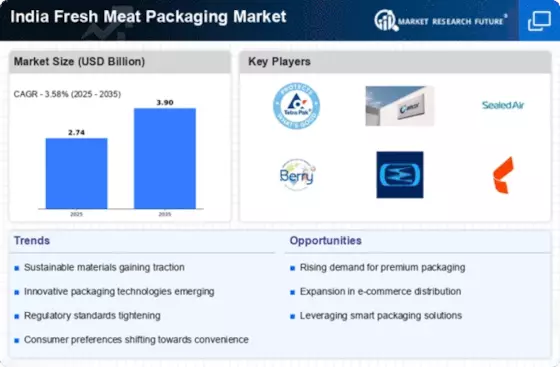
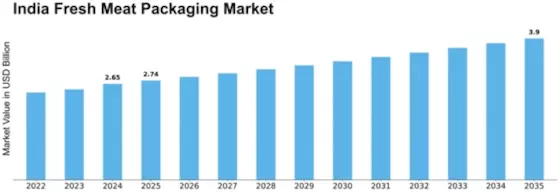
As per analysis, the India Fresh Meat Packaging Market is projected to grow from USD 2.75 Billion in 2025 to USD 3.9 Billion by 2035, exhibiting a compound annual growth rate (CAGR) of 3.58% during the forecast period (2025 - 2035).

Key Market Trends & Highlights

The India Fresh Meat Packaging Market is experiencing a dynamic shift towards sustainability and technological innovation.

  • Retail packaging remains the largest segment, driven by increasing consumer demand for convenience and quality.
  • Food service packaging is the fastest-growing segment, reflecting the rising trend of dining out and food delivery services.
  • Plastic packaging continues to dominate the market, while biodegradable options are rapidly gaining traction among environmentally conscious consumers.
  • Key market drivers include the growing demand for processed meat products and regulatory support for food safety standards.

Market Size & Forecast

2024 Market Size 2.65 (USD Billion)
2035 Market Size 3.9 (USD Billion)
CAGR (2025 - 2035) 3.58%

Major Players

<p>Tetra Pak (IN), Amcor (IN), Sealed Air (IN), Berry Global (IN), Smurfit Kappa (IN), Mondi Group (IN), Crown Holdings (IN), Visy Industries (IN), Huhtamaki (IN)</p>

Market Trends

The India Fresh Meat Packaging Market is currently experiencing a transformative phase, driven by evolving consumer preferences and increasing awareness regarding food safety. As urbanization accelerates, there is a noticeable shift towards packaged meat products, which are perceived as more hygienic and convenient. This trend is further supported by the rise of e-commerce platforms that facilitate the distribution of fresh meat, allowing consumers to access a variety of options from the comfort of their homes. Additionally, the growing middle-class population in India is likely to influence demand for premium packaging solutions that enhance product appeal and extend shelf life. Moreover, sustainability is becoming a focal point within the India Fresh Meat Packaging Market. Consumers are increasingly concerned about environmental impacts, prompting manufacturers to explore eco-friendly materials and practices. This shift towards sustainable packaging not only aligns with consumer values but also addresses regulatory pressures aimed at reducing plastic waste. As the market evolves, it appears that innovation in packaging technology will play a crucial role in meeting both consumer expectations and environmental standards, potentially leading to a more responsible and efficient meat supply chain in India.

Rise of E-commerce in Meat Distribution

The expansion of online grocery shopping is reshaping the India Fresh Meat Packaging Market. Consumers are increasingly opting for home delivery services, which necessitates efficient and secure packaging solutions to maintain product freshness during transit.

Sustainability in Packaging Materials

There is a growing emphasis on sustainable packaging within the India Fresh Meat Packaging Market. Manufacturers are exploring biodegradable and recyclable materials to meet consumer demand for environmentally friendly options, reflecting a broader trend towards sustainability.

Technological Advancements in Packaging

Innovations in packaging technology are becoming prevalent in the India Fresh Meat Packaging Market. Techniques such as vacuum sealing and modified atmosphere packaging are being adopted to enhance product longevity and safety, catering to the needs of health-conscious consumers.

India Meat Packaging Market Market Drivers

Growing Demand for Processed Meat Products

The India Fresh Meat Packaging Market is experiencing a notable increase in demand for processed meat products. This trend is driven by changing consumer preferences towards convenience and ready-to-eat options. According to recent data, the processed meat segment is projected to grow at a CAGR of approximately 10% over the next five years. This growth is likely to stimulate innovations in packaging solutions that enhance shelf life and maintain product quality. As consumers become more health-conscious, the demand for high-quality, hygienically packaged meat products is expected to rise, prompting manufacturers to invest in advanced packaging technologies. Consequently, the industry is likely to witness a shift towards vacuum packaging and modified atmosphere packaging, which are essential for preserving the freshness and safety of processed meats.

Expansion of Retail and E-commerce Channels

The India Fresh Meat Packaging Market is significantly impacted by the expansion of retail and e-commerce channels. The growth of online grocery shopping has transformed the way consumers purchase meat products, leading to an increased demand for packaging that ensures product integrity during transportation. E-commerce platforms require packaging solutions that not only protect the meat from contamination but also maintain its freshness throughout the delivery process. This shift is prompting manufacturers to develop packaging that is both durable and visually appealing, as presentation plays a crucial role in online sales. Furthermore, the rise of organized retail chains is likely to drive the demand for standardized packaging solutions that comply with quality and safety regulations. As a result, the industry may experience a surge in collaborations between packaging manufacturers and e-commerce platforms to create tailored solutions that meet the unique challenges of online meat distribution.

Rising Urbanization and Changing Lifestyles

The India Fresh Meat Packaging Market is poised for growth due to the rapid urbanization and evolving lifestyles of the Indian population. As more individuals migrate to urban areas, there is a marked shift in dietary habits, with an increasing preference for meat products. Urban consumers are often pressed for time, leading to a higher demand for conveniently packaged meat that is ready for consumption. This demographic shift is expected to drive innovations in packaging that cater to the needs of busy urban dwellers. Furthermore, the rise of nuclear families and dual-income households is likely to contribute to the demand for smaller, portion-controlled packaging solutions. Consequently, the industry may see a surge in the development of single-serve packaging options that align with the convenience-driven preferences of urban consumers.

Regulatory Support for Food Safety Standards

The India Fresh Meat Packaging Market is significantly influenced by the regulatory framework governing food safety and quality standards. The Food Safety and Standards Authority of India (FSSAI) has implemented stringent guidelines that necessitate proper packaging to ensure the safety and hygiene of meat products. Compliance with these regulations is crucial for market players, as it not only enhances consumer trust but also facilitates smoother market access. The emphasis on traceability and transparency in the supply chain is likely to drive the adoption of advanced packaging solutions that meet these regulatory requirements. As a result, companies are expected to invest in packaging technologies that not only comply with FSSAI standards but also promote sustainability, thereby aligning with global trends in food safety and environmental responsibility.

Technological Innovations in Packaging Solutions

The India Fresh Meat Packaging Market is witnessing a wave of technological innovations that are transforming packaging solutions. Advances in materials science and packaging technology are enabling the development of smarter packaging that enhances product safety and extends shelf life. For instance, the introduction of active and intelligent packaging systems is gaining traction, as these solutions can monitor the freshness of meat products and provide real-time information to consumers. Additionally, the integration of biodegradable materials into packaging is becoming increasingly important, as consumers are more environmentally conscious. This trend is likely to drive manufacturers to adopt sustainable practices while ensuring that their packaging meets the functional requirements of preserving meat quality. As a result, the industry is expected to see a rise in investments in research and development to create innovative packaging solutions that cater to both consumer preferences and environmental concerns.

Market Segment Insights

By Application: Fresh Meat Packaging (Largest) vs. Processed Meat Packaging (Fastest-Growing)

<p>The application segment of the India meat packaging market is characterized by a diverse distribution among various categories, with fresh meat packaging leading in market share. This dominant segment highlights consumer preferences for fresh, minimally processed meats. Processed meat packaging, on the other hand, is rapidly gaining traction due to increasing urbanization and changing lifestyles that favor convenience. The chilled and frozen meat packaging segments also contribute significantly, catering to specific consumer demands for extended shelf-life and seasonal preferences.</p>

<p>Fresh Meat Packaging (Dominant) vs. Processed Meat Packaging (Emerging)</p>

<p>Fresh meat packaging remains the cornerstone of the India meat packaging market, driven by traditional consumption habits and a growing inclination towards freshness in meat products. The packaging options for fresh meat emphasize sustainability and freshness, appealing to health-conscious consumers. Conversely, processed meat packaging is emerging robustly, spurred by busy lifestyles and a rising demand for ready-to-eat meal solutions. With innovative packaging technologies enhancing product appeal and preserving flavor, processed meats are attracting a younger demographic, positioning them as an essential growth driver within the overall market.</p>

By Material Type: Plastic (Largest) vs. Biodegradable Materials (Fastest-Growing)

<p>In the India meat packaging market, the distribution of material types reveals that <a href="https://www.marketresearchfuture.com/reports/plastic-packaging-market-1688" target="_blank" title="plastic packaging">plastic packaging</a> holds the largest share due to its durability, flexibility, and cost-effectiveness. It is commonly used across various meat products, providing excellent barrier properties that ensure freshness and safety. Conversely, biodegradable materials are gaining traction, reflecting a significant shift towards sustainable packaging solutions. They currently hold a smaller share but are rapidly expanding as consumers and regulations increasingly favor eco-friendly alternatives.</p>

<p>Plastic (Dominant) vs. Biodegradable Materials (Emerging)</p>

<p>Plastic packaging stands out in the India meat packaging market, being preferred for its versatility and efficiency in preserving meat quality. Its dominance is underscored by its affordability and the ability to mold into various shapes, catering to different meat products. On the other hand, biodegradable materials are emerging as a viable alternative, driven by heightened awareness of environmental concerns. These materials are designed to break down naturally, reducing environmental impact and appealing to eco-conscious consumers. As regulations on plastic usage tighten, biodegradable options are expected to grow, positioning them as a strong contender in the future of meat packaging.</p>

By End Use: Retail (Largest) vs. Food Service (Fastest-Growing)

<p>In the India meat packaging market, the 'End Use' segment is primarily driven by retail channels, which hold the largest market share. Retail packaging of meat products allows consumers convenient access to a variety of options, catering to evolving consumer preferences for ready-to-eat meals and convenience foods. On the other hand, food service is rapidly gaining traction as more restaurants and eateries emphasize quality packaging to preserve the freshness and safety of meat products offered to customers. This shift is reshaping purchasing patterns in the market.</p>

<p>Retail (Dominant) vs. Food Service (Emerging)</p>

<p>The retail segment continues to dominate the meat packaging market in India due to its extensive distribution network and consumer accessibility. Retail packaging focuses on individual portioning and branding, facilitating easy handling for consumers. In contrast, the food service sector is emerging, fueled by the demand for high-quality and innovative packaging solutions that safeguard meat freshness during transportation and storage. Restaurants are increasingly adopting sustainable packaging options that not only enhance their brand image but also cater to health-conscious consumers. As food service evolves, it presents a unique opportunity for packaging innovations, driven by consumer demand for quality, convenience, and sustainability overall.</p>

By Meat Type: Poultry (Largest) vs. Beef (Fastest-Growing)

<p>In the India Fresh Meat Packaging Market, the segment for meat type showcases a diverse distribution, primarily dominated by poultry, which occupies the largest market share due to its widespread consumption and favorable pricing. Beef, while historically less popular due to cultural preferences, has emerged as a significant segment experiencing rapid growth thanks to changing consumer dietary habits and increased acceptance. Pork and lamb follow, attracting niche markets with specific culinary preferences. Growth trends in this segment are influenced by several factors, including rising disposable incomes, an expanding urban population, and heightened health awareness among consumers. Poultry continues to captivate the market owing to its versatility in culinary applications and perceived health benefits, while beef is increasingly popular among millennials seeking diverse protein sources. These trends suggest a dynamic change in consumer preferences, pushing the meat packaging market towards innovation and adaptation to meet evolving demands.</p>

<p>Poultry (Dominant) vs. Lamb (Emerging)</p>

<p>In the India Fresh Meat Packaging Market, poultry has established itself as the dominant player due to its broad appeal and accessibility, catering to a wide demographic range. Its packaging innovations focus on freshness and convenience, making it a favorable choice for busy consumers. Conversely, lamb, though considered an emerging segment, is gaining traction among affluent consumers and culinary enthusiasts who seek premium meat experiences. The increasing popularity of international cuisines and gourmet trends is fueling lamb's market growth, prompting investments in specialized packaging that preserves flavor and enhances presentation. Consequently, even as poultry remains the market leader, lamb is poised to carve out a more prominent niche in the coming years.</p>

By Packaging Technology: Modified Atmosphere Packaging (Largest) vs. Vacuum Packaging (Fastest-Growing)

<p>In the India Fresh Meat Packaging Market, Modified Atmosphere Packaging (MAP) is the leading segment, commanding a significant share due to its ability to extend the shelf life of fresh meat products. This technology employs gas mixtures to slow down spoilage, making it a preferred choice among manufacturers and retailers. Vacuum Packaging follows as a strong contender, offering advantages in product preservation, but it has a smaller market share compared to MAP. Skin Packaging, while valuable, occupies a lesser position in terms of overall market share, focusing on niche applications within the industry. The growth of MAP is driven by increasing consumer demand for fresh meat products and a rising awareness of food preservation technologies. Moreover, the convenience of ready-to-cook meat packaged under MAP is resonating well with the modern consumer. Vacuum Packaging, recognized as the fastest-growing segment, is gaining traction due to its versatility and effectiveness in maintaining meat quality during storage and transportation. As health consciousness rises among consumers, the demand for technologically advanced packaging solutions continues to propel industry growth.</p>

<p>Packaging Technology: Modified Atmosphere Packaging (Dominant) vs. Vacuum Packaging (Emerging)</p>

<p>Modified Atmosphere Packaging (MAP) has established itself as the dominant technology in the India Fresh Meat Packaging Market, primarily due to its efficiency in preserving the quality and freshness of meat products. This method utilizes a controlled atmospheric composition to slow down spoilage and extend shelf life, appealing to both manufacturers and consumers seeking quality assurance. On the other hand, Vacuum Packaging, although emerging, is showing rapid growth owing to its effectiveness in preventing spoilage and maintaining flavor and texture. This method entails removing air from packaging to create a vacuum seal, which significantly enhances product longevity. Technology advancements and increasing consumer preferences for packaged meats are driving these segments, highlighting MAP's prominent role while also showcasing the rising popularity of Vacuum Packaging.</p>

Get more detailed insights about India Meat Packaging Market Research Report - Forecast by 2035

Regional Insights

Key Players and Competitive Insights

The Fresh Meat Packaging Market in India is characterized by a dynamic competitive landscape, driven by increasing consumer demand for convenience and sustainability. Key players are actively innovating and expanding their operational capabilities to capture market share. Companies such as Tetra Pak (Sweden), Amcor (Australia), and Sealed Air (USA) are at the forefront, focusing on advanced packaging solutions that enhance product shelf life and reduce environmental impact. Their strategies, which include technological advancements and strategic partnerships, collectively shape a competitive environment that is increasingly focused on sustainability and efficiency.

In terms of business tactics, localizing manufacturing and optimizing supply chains are pivotal for companies operating in this market. The competitive structure appears moderately fragmented, with several players vying for dominance. However, the influence of major companies is significant, as they set industry standards and drive innovation. This competitive interplay fosters an environment where smaller players must adapt quickly to remain relevant, often leading to collaborations or niche market strategies.

In December 2025, Tetra Pak (Sweden) announced a partnership with a leading Indian meat processing company to develop eco-friendly packaging solutions tailored for the local market. This strategic move underscores Tetra Pak's commitment to sustainability while addressing the specific needs of Indian consumers. By leveraging local insights, Tetra Pak aims to enhance its market presence and align with the growing demand for environmentally responsible packaging.

In November 2025, Amcor (Australia) launched a new line of biodegradable packaging specifically designed for fresh meat products. This initiative reflects Amcor's strategic focus on sustainability and innovation, positioning the company as a leader in eco-friendly packaging solutions. The introduction of biodegradable options is likely to resonate well with environmentally conscious consumers, potentially increasing market share in a competitive landscape.

In October 2025, Sealed Air (USA) expanded its operations in India by investing in a state-of-the-art manufacturing facility dedicated to fresh meat packaging. This expansion not only enhances Sealed Air's production capabilities but also signifies a long-term commitment to the Indian market. The facility is expected to utilize advanced technologies, thereby improving efficiency and reducing costs, which could provide a competitive edge in pricing and service delivery.

As of January 2026, current trends in the Fresh Meat Packaging Market indicate a strong emphasis on digitalization, sustainability, and the integration of AI technologies. Strategic alliances are increasingly shaping the competitive landscape, allowing companies to pool resources and expertise. The shift from price-based competition to a focus on innovation and supply chain reliability is evident, suggesting that future differentiation will hinge on technological advancements and sustainable practices. Companies that can effectively navigate these trends are likely to emerge as leaders in this evolving market.

Key Companies in the India Meat Packaging Market include

Industry Developments

July 2023: The premium cured meats brand Volpi Foods just introduced Eco-Pack, a revolutionary packaging design that uses less plastic. With the same shelf life as the prior packaging, the package makes use of curbside recyclable paper material.

June 2022: With a new packaging design, FreshToHome, an online fresh fish and meat e-commerce firm with its headquarters in Bengaluru, introduced the first Ready-To-Fry (RTF) meat snacks in India on its platform.

Year of Launch: 2023 ITC expanded its line of packaged meat products under its current trademarks in an effort to meet consumer demand for sanitary and convenient meat options.

Year of Launch: 2022 To improve product freshness and shelf life, Licious, a well-known online meat and seafood business in India, introduced cutting-edge packaging options.

Future Outlook

India Meat Packaging Market Future Outlook

The India Fresh Meat Packaging Market is projected to grow at a 3.58% CAGR from 2025 to 2035, driven by increasing consumer demand and advancements in packaging technology.

New opportunities lie in:

  • Development of biodegradable packaging solutions for sustainability
  • Integration of smart packaging technologies for freshness monitoring
  • Expansion of e-commerce platforms for direct-to-consumer meat sales

By 2035, the market is expected to achieve robust growth, driven by innovation and evolving consumer preferences.

Market Segmentation

India Meat Packaging Market Meat Type Outlook

  • Poultry
  • Beef
  • Pork
  • Lamb

India Meat Packaging Market Application Outlook

  • Retail Packaging
  • Food Service Packaging
  • Consumer Packaging

India Meat Packaging Market Closure Type Outlook

  • Heat Sealed
  • Snap-On
  • Zipper
  • Vacuum Sealed

India Meat Packaging Market Material Type Outlook

  • Plastic
  • Paper
  • Metal
  • Biodegradable

India Meat Packaging Market Packaging Technology Outlook

  • Modified Atmosphere Packaging
  • Vacuum Packaging
  • Skin Packaging

Report Scope

MARKET SIZE 2024 2.65(USD Billion)
MARKET SIZE 2025 2.75(USD Billion)
MARKET SIZE 2035 3.9(USD Billion)
COMPOUND ANNUAL GROWTH RATE (CAGR) 3.58% (2024 - 2035)
REPORT COVERAGE Revenue Forecast, Competitive Landscape, Growth Factors, and Trends
BASE YEAR 2024
Market Forecast Period 2025 - 2035
Historical Data 2019 - 2024
Market Forecast Units USD Billion
Key Companies Profiled Tetra Pak (IN), Amcor (IN), Sealed Air (IN), Berry Global (IN), Smurfit Kappa (IN), Mondi Group (IN), Crown Holdings (IN), Visy Industries (IN), Huhtamaki (IN)
Segments Covered Application, Material Type, Closure Type, Meat Type, Packaging Technology
Key Market Opportunities Adoption of sustainable packaging solutions driven by increasing consumer awareness and regulatory support in India.
Key Market Dynamics Rising consumer demand for sustainable packaging drives innovation in India's fresh meat packaging sector.
Countries Covered India

FAQs

What is the current valuation of the India meat packaging market?

<p>The India meat packaging market was valued at 2.65 USD Billion in 2024.</p>

What is the projected market size for the India meat packaging market by 2035?

<p>The projected valuation for the India meat packaging market is 4.05 USD Billion by 2035.</p>

What is the expected CAGR for the India meat packaging market during the forecast period?

<p>The expected CAGR for the India meat packaging market from 2025 to 2035 is 3.94%.</p>

Which segments are included in the India meat packaging market?

<p>The segments in the India meat packaging market include Fresh Meat Packaging, Processed Meat Packaging, Frozen Meat Packaging, and Chilled Meat Packaging.</p>

What are the projected values for Fresh Meat Packaging by 2035?

<p>The projected value for Fresh Meat Packaging is expected to range from 1.2 USD Billion by 2035.</p>

How does the market for biodegradable materials compare to other material types?

<p>The market for biodegradable materials is projected to reach 0.9 USD Billion by 2035, indicating a growing preference for sustainable packaging.</p>

What are the key end-use segments in the India meat packaging market?

<p>The key end-use segments include Retail, Food Service, Household, and Export.</p>

What is the projected value for the Food Service segment by 2035?

<p>The Food Service segment is projected to reach 0.9 USD Billion by 2035.</p>

Who are the key players in the India meat packaging market?

<p>Key players in the market include Brahmanand Himghar, Venky's, Godrej Tyson Foods, and Al Kabeer Group.</p>

What is the projected value for the Household segment by 2035?

<p>The Household segment is expected to reach 1.1 USD Billion by 2035.</p>

  1. SECTION I: EXECUTIVE SUMMARY AND KEY HIGHLIGHTS
    1. | 1.1 EXECUTIVE SUMMARY
    2. | | 1.1.1 Market Overview
    3. | | 1.1.2 Key Findings
    4. | | 1.1.3 Market Segmentation
    5. | | 1.1.4 Competitive Landscape
    6. | | 1.1.5 Challenges and Opportunities
    7. | | 1.1.6 Future Outlook
  2. SECTION II: SCOPING, METHODOLOGY AND MARKET STRUCTURE
    1. | 2.1 MARKET INTRODUCTION
    2. | | 2.1.1 Definition
    3. | | 2.1.2 Scope of the study
    4. | | | 2.1.2.1 Research Objective
    5. | | | 2.1.2.2 Assumption
    6. | | | 2.1.2.3 Limitations
    7. | 2.2 RESEARCH METHODOLOGY
    8. | | 2.2.1 Overview
    9. | | 2.2.2 Data Mining
    10. | | 2.2.3 Secondary Research
    11. | | 2.2.4 Primary Research
    12. | | | 2.2.4.1 Primary Interviews and Information Gathering Process
    13. | | | 2.2.4.2 Breakdown of Primary Respondents
    14. | | 2.2.5 Forecasting Model
    15. | | 2.2.6 Market Size Estimation
    16. | | | 2.2.6.1 Bottom-Up Approach
    17. | | | 2.2.6.2 Top-Down Approach
    18. | | 2.2.7 Data Triangulation
    19. | | 2.2.8 Validation
  3. SECTION III: QUALITATIVE ANALYSIS
    1. | 3.1 MARKET DYNAMICS
    2. | | 3.1.1 Overview
    3. | | 3.1.2 Drivers
    4. | | 3.1.3 Restraints
    5. | | 3.1.4 Opportunities
    6. | 3.2 MARKET FACTOR ANALYSIS
    7. | | 3.2.1 Value chain Analysis
    8. | | 3.2.2 Porter's Five Forces Analysis
    9. | | | 3.2.2.1 Bargaining Power of Suppliers
    10. | | | 3.2.2.2 Bargaining Power of Buyers
    11. | | | 3.2.2.3 Threat of New Entrants
    12. | | | 3.2.2.4 Threat of Substitutes
    13. | | | 3.2.2.5 Intensity of Rivalry
    14. | | 3.2.3 COVID-19 Impact Analysis
    15. | | | 3.2.3.1 Market Impact Analysis
    16. | | | 3.2.3.2 Regional Impact
    17. | | | 3.2.3.3 Opportunity and Threat Analysis
  4. SECTION IV: QUANTITATIVE ANALYSIS
    1. | 4.1 Packaging & Transport, BY Application (USD Billion)
    2. | | 4.1.1 Fresh Meat Packaging
    3. | | 4.1.2 Processed Meat Packaging
    4. | | 4.1.3 Frozen Meat Packaging
    5. | | 4.1.4 Chilled Meat Packaging
    6. | 4.2 Packaging & Transport, BY Material Type (USD Billion)
    7. | | 4.2.1 Plastic
    8. | | 4.2.2 Paper
    9. | | 4.2.3 Metal
    10. | | 4.2.4 Biodegradable Materials
    11. | 4.3 Packaging & Transport, BY End Use (USD Billion)
    12. | | 4.3.1 Retail
    13. | | 4.3.2 Food Service
    14. | | 4.3.3 Household
    15. | | 4.3.4 Export
  5. SECTION V: COMPETITIVE ANALYSIS
    1. | 5.1 Competitive Landscape
    2. | | 5.1.1 Overview
    3. | | 5.1.2 Competitive Analysis
    4. | | 5.1.3 Market share Analysis
    5. | | 5.1.4 Major Growth Strategy in the Packaging & Transport
    6. | | 5.1.5 Competitive Benchmarking
    7. | | 5.1.6 Leading Players in Terms of Number of Developments in the Packaging & Transport
    8. | | 5.1.7 Key developments and growth strategies
    9. | | | 5.1.7.1 New Product Launch/Service Deployment
    10. | | | 5.1.7.2 Merger & Acquisitions
    11. | | | 5.1.7.3 Joint Ventures
    12. | | 5.1.8 Major Players Financial Matrix
    13. | | | 5.1.8.1 Sales and Operating Income
    14. | | | 5.1.8.2 Major Players R&D Expenditure. 2023
    15. | 5.2 Company Profiles
    16. | | 5.2.1 Brahmanand Himghar (IN)
    17. | | | 5.2.1.1 Financial Overview
    18. | | | 5.2.1.2 Products Offered
    19. | | | 5.2.1.3 Key Developments
    20. | | | 5.2.1.4 SWOT Analysis
    21. | | | 5.2.1.5 Key Strategies
    22. | | 5.2.2 Venky's (IN)
    23. | | | 5.2.2.1 Financial Overview
    24. | | | 5.2.2.2 Products Offered
    25. | | | 5.2.2.3 Key Developments
    26. | | | 5.2.2.4 SWOT Analysis
    27. | | | 5.2.2.5 Key Strategies
    28. | | 5.2.3 Godrej Tyson Foods (IN)
    29. | | | 5.2.3.1 Financial Overview
    30. | | | 5.2.3.2 Products Offered
    31. | | | 5.2.3.3 Key Developments
    32. | | | 5.2.3.4 SWOT Analysis
    33. | | | 5.2.3.5 Key Strategies
    34. | | 5.2.4 Al Kabeer Group (AE)
    35. | | | 5.2.4.1 Financial Overview
    36. | | | 5.2.4.2 Products Offered
    37. | | | 5.2.4.3 Key Developments
    38. | | | 5.2.4.4 SWOT Analysis
    39. | | | 5.2.4.5 Key Strategies
    40. | | 5.2.5 Sankalp Group (IN)
    41. | | | 5.2.5.1 Financial Overview
    42. | | | 5.2.5.2 Products Offered
    43. | | | 5.2.5.3 Key Developments
    44. | | | 5.2.5.4 SWOT Analysis
    45. | | | 5.2.5.5 Key Strategies
    46. | | 5.2.6 Prabhat Dairy (IN)
    47. | | | 5.2.6.1 Financial Overview
    48. | | | 5.2.6.2 Products Offered
    49. | | | 5.2.6.3 Key Developments
    50. | | | 5.2.6.4 SWOT Analysis
    51. | | | 5.2.6.5 Key Strategies
    52. | | 5.2.7 Venkateshwara Hatcheries (IN)
    53. | | | 5.2.7.1 Financial Overview
    54. | | | 5.2.7.2 Products Offered
    55. | | | 5.2.7.3 Key Developments
    56. | | | 5.2.7.4 SWOT Analysis
    57. | | | 5.2.7.5 Key Strategies
    58. | | 5.2.8 Karnataka Cooperative Milk Producers Federation (IN)
    59. | | | 5.2.8.1 Financial Overview
    60. | | | 5.2.8.2 Products Offered
    61. | | | 5.2.8.3 Key Developments
    62. | | | 5.2.8.4 SWOT Analysis
    63. | | | 5.2.8.5 Key Strategies
    64. | | 5.2.9 Nandini (IN)
    65. | | | 5.2.9.1 Financial Overview
    66. | | | 5.2.9.2 Products Offered
    67. | | | 5.2.9.3 Key Developments
    68. | | | 5.2.9.4 SWOT Analysis
    69. | | | 5.2.9.5 Key Strategies
    70. | 5.3 Appendix
    71. | | 5.3.1 References
    72. | | 5.3.2 Related Reports
  6. LIST OF FIGURES
    1. | 6.1 MARKET SYNOPSIS
    2. | 6.2 INDIA MARKET ANALYSIS BY APPLICATION
    3. | 6.3 INDIA MARKET ANALYSIS BY MATERIAL TYPE
    4. | 6.4 INDIA MARKET ANALYSIS BY END USE
    5. | 6.5 KEY BUYING CRITERIA OF PACKAGING & TRANSPORT
    6. | 6.6 RESEARCH PROCESS OF MRFR
    7. | 6.7 DRO ANALYSIS OF PACKAGING & TRANSPORT
    8. | 6.8 DRIVERS IMPACT ANALYSIS: PACKAGING & TRANSPORT
    9. | 6.9 RESTRAINTS IMPACT ANALYSIS: PACKAGING & TRANSPORT
    10. | 6.10 SUPPLY / VALUE CHAIN: PACKAGING & TRANSPORT
    11. | 6.11 PACKAGING & TRANSPORT, BY APPLICATION, 2024 (% SHARE)
    12. | 6.12 PACKAGING & TRANSPORT, BY APPLICATION, 2024 TO 2035 (USD Billion)
    13. | 6.13 PACKAGING & TRANSPORT, BY MATERIAL TYPE, 2024 (% SHARE)
    14. | 6.14 PACKAGING & TRANSPORT, BY MATERIAL TYPE, 2024 TO 2035 (USD Billion)
    15. | 6.15 PACKAGING & TRANSPORT, BY END USE, 2024 (% SHARE)
    16. | 6.16 PACKAGING & TRANSPORT, BY END USE, 2024 TO 2035 (USD Billion)
    17. | 6.17 BENCHMARKING OF MAJOR COMPETITORS
  7. LIST OF TABLES
    1. | 7.1 LIST OF ASSUMPTIONS
    2. | | 7.1.1
    3. | 7.2 India MARKET SIZE ESTIMATES; FORECAST
    4. | | 7.2.1 BY APPLICATION, 2026-2035 (USD Billion)
    5. | | 7.2.2 BY MATERIAL TYPE, 2026-2035 (USD Billion)
    6. | | 7.2.3 BY END USE, 2026-2035 (USD Billion)
    7. | 7.3 PRODUCT LAUNCH/PRODUCT DEVELOPMENT/APPROVAL
    8. | | 7.3.1
    9. | 7.4 ACQUISITION/PARTNERSHIP
    10. | | 7.4.1

India Packaging & Transport Market Segmentation

Packaging & Transport By Application (USD Billion, 2022-2035)

  • Fresh Meat Packaging
  • Processed Meat Packaging
  • Frozen Meat Packaging
  • Chilled Meat Packaging

Packaging & Transport By Material Type (USD Billion, 2022-2035)

  • Plastic
  • Paper
  • Metal
  • Biodegradable Materials

Packaging & Transport By End Use (USD Billion, 2022-2035)

  • Retail
  • Food Service
  • Household
  • Export
Infographic

Free Sample Request

Kindly complete the form below to receive a free sample of this Report

Get Free Sample

Customer Strories

Compare Licence

×
Features License Type
Single User Multiuser License Enterprise User
Price $4,950 $5,950 $7,250
Maximum User Access Limit 1 User Upto 10 Users Unrestricted Access Throughout the Organization
Free Customization
Direct Access to Analyst
Deliverable Format
Platform Access
Discount on Next Purchase 10% 15% 15%
Printable Versions