×
Hero Background
English
Chinese
French
Japanese
Korean
German
Spanish

India Leather Apparel Market Trends

ID: MRFR/CG/63836-HCR
128 Pages
Snehal Singh
October 2025

India Leather Apparel Market Research Report Information By Type (Genuine Leather (Handbags, Small Leather Goods/ Accessories, Apparel, Footwear, Home Décor and Furnishing), Synthetic Leather (Polyurethane Leather, PVC Leather, Others), and Vegan Leather (Handbags, Apparel, Footwear, Small Leather Goods/ Accessories, Home Décor and Furnishing)), By Product (Handbags (Tote Bag, Clutch, Others), Leather Goods & Accessories (Wallets, Pouches, Others), Apparel, Footwear, Home Décor and Furnishing, and Others) –Market Forecast Till 2035

Share:
Download PDF ×

We do not share your information with anyone. However, we may send you emails based on your report interest from time to time. You may contact us at any time to opt-out.

India Leather Apparel Market Infographic
Purchase Options

Market Trends

Key Emerging Trends in the India Leather Apparel Market

The distinctive culture of the country, evolving consumer preferences, and changing global influences are all factors influencing fashion trends in the Indian leather apparel market. Indian fashion often combines elements of the native culture with western designs. Jackets with intricate embroidery or leather accessories with classical motifs are two examples of this fusion trend. Additionally, Bollywood and other celebrities have a significant influence on fashion trends. When a famous individual is seen wearing leather apparel, it often becomes very popular. Indian fashion producers and designers draw inspiration from overseas runways to create their own leather masterpieces, using recent trends. This ensures that leather apparel made in India stays fashionable. In addition, the different climates in India may induce variations in leather apparel trends throughout the year. While lighter leather products are chosen in the summer, bulkier jackets and boots are in style during the winter.

The leather apparel market in India is undergoing significant trends influenced by cultural preferences, changing consumer behaviors, and a growing focus on sustainable fashion. One notable trend is the increasing demand for cruelty-free and sustainable leather alternatives. As awareness of environmental and ethical concerns rises, consumers in India are seeking leather apparel made from alternative materials such as vegan leather, mushroom leather, and other plant-based substitutes. This trend reflects a shift towards ethical and sustainable fashion choices, aligning with the global movement towards cruelty-free products and a desire for environmentally responsible clothing options.

Moreover, there is a growing emphasis on traditional craftsmanship and indigenous leather techniques in the Indian leather apparel market. Consumers are appreciating the rich heritage and skilled craftsmanship of Indian leather artisans, leading to a resurgence of interest in traditional leathercraft. Brands that highlight the authenticity and craftsmanship of their products, incorporating traditional Indian leatherworking techniques, are gaining favor among consumers who value unique, handcrafted pieces that showcase the country's cultural richness.

Additionally, customization is emerging as a key trend in the Indian leather apparel market. Consumers are seeking personalized and tailor-made leather products that cater to their individual preferences and style. Brands offering made-to-order services, allowing customers to choose colors, designs, and even incorporate personalized details, are gaining traction. This trend reflects the desire for unique and bespoke leather apparel, allowing consumers to express their individuality through their fashion choices.

Furthermore, the growing influence of e-commerce is significantly impacting the Indian leather apparel market. With the rise of online shopping, consumers have access to a wide range of leather products from both local and international brands. E-commerce platforms are becoming key players in the leather apparel market, offering convenience, variety, and the ability to reach a broader consumer base. This trend is reshaping the retail landscape, prompting traditional brick-and-mortar stores to enhance their online presence and adopt digital strategies to stay competitive in the evolving market.

The sustainability movement is also influencing the Indian leather apparel market, with an increasing demand for eco-friendly and ethically sourced leather. Consumers are seeking products that adhere to responsible production practices, such as using vegetable-tanned leather, recycled materials, and minimizing environmental impact. Brands that prioritize sustainability in their sourcing and manufacturing processes are gaining popularity among environmentally conscious Indian consumers, signaling a growing awareness of the importance of sustainable practices in the fashion industry.

Author
Snehal Singh
Assistant Manager - Research

High acumen in analyzing complex macro & micro markets with more than 6 years of work experience in the field of market research. By implementing her analytical skills in forecasting and estimation into market research reports, she has expertise in Packaging, Construction, and Equipment domains. She handles a team size of 20-25 resources and ensures smooth running of the projects, associated marketing activities, and client servicing.

Leave a Comment

FAQs

What is the current valuation of the India Leather Apparel Market?

The India Leather Apparel Market was valued at 2.938 USD Billion in 2024.

What is the projected market valuation for the India Leather Apparel Market by 2035?

The market is projected to reach 21.83 USD Billion by 2035.

What is the expected CAGR for the India Leather Apparel Market during the forecast period?

The expected CAGR for the India Leather Apparel Market from 2025 to 2035 is 20.0%.

Which segments are included in the India Leather Apparel Market?

The market includes segments such as Genuine Leather, Synthetic Leather, and Vegan Leather.

What are the valuations for the Genuine Leather segment in 2024?

The Genuine Leather segment was valued at 1.175 USD Billion in 2024.

Market Summary

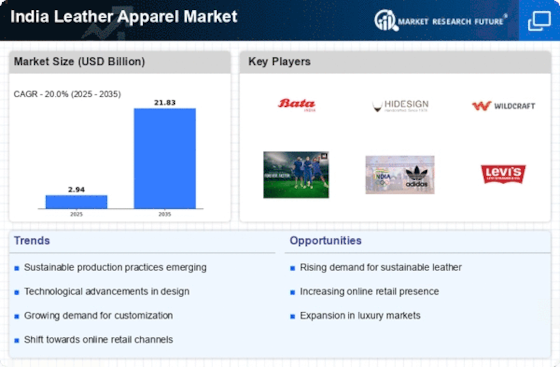
As per MRFR analysis, the India Leather Apparel Market was estimated at 2.938 USD Billion in 2024. The India Leather Apparel industry is projected to grow from 3.525 USD Billion in 2025 to 21.83 USD Billion by 2035, exhibiting a compound annual growth rate (CAGR) of 20.0 during the forecast period 2025 - 2035.

Key Market Trends & Highlights

The India Leather Apparel Market is poised for growth driven by sustainability and technological advancements.

  • Sustainability in production is becoming a pivotal trend, influencing consumer preferences across the market. E-commerce expansion is reshaping the distribution landscape, particularly in the Asia-Pacific region. Customization and personalization are gaining traction, especially within the genuine leather apparel segment. Rising disposable income and fashion trends are major drivers, propelling growth in both the genuine leather and handbags segments.

Market Size & Forecast

2024 Market Size 2.938 (USD Billion)
2035 Market Size 21.83 (USD Billion)
CAGR (2025 - 2035) 20.0%
Largest Regional Market Share in 2024 Asia Pacific

Major Players

<p>Bata India (IN), Hidesign (IN), Wildcraft (IN), Puma India (IN), Adidas India (IN), Levi Strauss India (IN), Allen Solly (IN), Tata International (IN), Khadim India (IN)</p>

Market Trends

The India Leather Apparel Market is currently experiencing a dynamic evolution, driven by a confluence of factors that shape consumer preferences and industry practices. The market appears to be influenced by a growing awareness of sustainable fashion, prompting brands to adopt eco-friendly materials and ethical production methods. This shift not only caters to the environmentally conscious consumer but also aligns with global trends towards sustainability. Furthermore, the rise of e-commerce platforms has transformed the way consumers access leather apparel, providing them with a wider array of choices and convenience. As online shopping continues to gain traction, brands are likely to enhance their digital presence to capture this expanding market segment. In addition to sustainability and e-commerce, the leather market in India seems to be witnessing a surge in demand for customized and personalized products. Consumers are increasingly seeking unique items that reflect their individual style, leading to a rise in bespoke leather apparel offerings. This trend indicates a potential shift in consumer behavior, where personalization becomes a key differentiator in a competitive landscape. Overall, the leather market in India is poised for growth, with evolving consumer preferences and technological advancements shaping its future trajectory.

Sustainability in Production

The trend towards sustainable practices in the India Leather Apparel Market is gaining momentum. Brands are increasingly focusing on eco-friendly materials and ethical production methods, responding to consumer demand for environmentally responsible products. This shift not only enhances brand reputation but also aligns with global sustainability initiatives.

E-commerce Expansion

The rise of e-commerce is significantly impacting the India Leather Apparel Market. Consumers are now able to access a broader range of products online, leading to increased convenience and choice. As online shopping continues to grow, brands are likely to invest in their digital strategies to reach a wider audience.

Customization and Personalization

There is a noticeable trend towards customization in the India Leather Apparel Market. Consumers are seeking unique, personalized items that reflect their individual style. This demand for bespoke products suggests a shift in consumer behavior, where personalization becomes a crucial factor in purchasing decisions.

India Leather Apparel Market Market Drivers

Rising Disposable Income

The increasing disposable income among the Indian population appears to be a pivotal driver for the India Leather Apparel Market. As consumers experience enhanced financial freedom, they are more inclined to invest in premium leather products. This trend is particularly evident in urban areas, where a burgeoning middle class is emerging. According to recent data, the disposable income in India has been on an upward trajectory, which correlates with a growing demand for high-quality leather apparel. This shift in consumer behavior suggests that the market could witness a significant expansion, as individuals prioritize quality and brand over mere functionality. The leather market in India is likely to benefit from this trend, as consumers seek out products that reflect their lifestyle choices and aspirations.

Growing Export Opportunities

The India Leather Apparel Market is witnessing a surge in export opportunities, driven by the increasing global demand for leather products. India has established itself as a key player in the leather export market, with a diverse range of products catering to various international markets. Recent data indicates that leather exports from India have shown a consistent growth rate, reflecting the country's competitive advantage in terms of quality and craftsmanship. This trend suggests that Indian manufacturers are likely to expand their reach, tapping into new markets and enhancing their global presence. The growing export opportunities could significantly contribute to the overall growth of the India Leather Apparel Market, as brands seek to capitalize on international demand.

Sustainability and Ethical Sourcing

Sustainability has emerged as a crucial consideration for consumers in the India Leather Apparel Market. As awareness regarding environmental issues grows, consumers are increasingly seeking products that are ethically sourced and produced. This shift in consumer mindset is prompting brands to adopt sustainable practices, such as using eco-friendly materials and ensuring fair labor conditions. Market data suggests that a significant portion of consumers is willing to pay a premium for sustainable leather products. This trend indicates a potential for growth in the market, as brands that prioritize sustainability may attract a loyal customer base. The leather market in India  is likely to see a rise in demand for products that align with these values, reflecting a broader global movement towards responsible consumption.

Fashion Trends and Influencer Impact

The influence of fashion trends and social media personalities is increasingly shaping consumer preferences within the India Leather Apparel Market. As fashion becomes more accessible through digital platforms, consumers are exposed to a plethora of styles and designs. Influencers and celebrities often endorse leather apparel, which can lead to a surge in demand for specific products. This phenomenon is particularly pronounced among younger demographics, who are more likely to follow trends set by their favorite personalities. The market data indicates that the youth segment is a significant contributor to the overall growth of the leather apparel sector. Consequently, brands that effectively leverage influencer marketing strategies may find themselves at a competitive advantage in the India Leather Apparel Market.

Technological Advancements in Production

Technological advancements in production processes are playing a transformative role in the leather market in India. Innovations such as automated cutting, 3D printing, and advanced tanning techniques are enhancing efficiency and reducing production costs. These technologies not only streamline operations but also improve the quality of leather products. Market data indicates that companies adopting these technologies are experiencing increased productivity and reduced waste, which can lead to higher profit margins. As the industry embraces these advancements, it is likely to attract investment and foster competitiveness. The India Leather Apparel Market stands to benefit from these technological improvements, as they enable brands to meet consumer demands for quality and sustainability.

Market Segment Insights

By Type: Genuine Leather (Largest) vs. Synthetic Leather (Fastest-Growing)

<p>In the India Leather Apparel Market, Genuine Leather holds the largest share, recognized for its durability, luxury appeal, and consumer preference. This segment benefits from a well-established tradition of craftsmanship and a growing demand for high-quality products that resonate with the luxury market. In contrast, Synthetic Leather is gaining momentum and is quickly becoming a popular alternative, particularly among cost-conscious consumers and those prioritizing ethical considerations. Its affordability and variety in styles contribute to its rapid adoption.</p>

<p>Genuine Leather (Dominant) vs. Synthetic Leather (Emerging)</p>

<p>Genuine Leather is positioned as the dominant segment in the India Leather Apparel Market, celebrated for its exceptional quality and timeless appeal. This segment caters to a niche market willing to invest in premium products, ensuring its sustained position. On the other hand, Synthetic Leather represents an emerging segment that offers versatility and has aligned well with consumers seeking cruelty-free alternatives. The innovation in manufacturing these materials results in a range of textures and finishes that mimic traditional leather, meeting an expanding target market that values both style and sustainability.</p>

By Product: Apparel (Largest) vs. Handbags (Fastest-Growing)

<p>The India Leather Apparel Market exhibits a dynamic distribution of market share across various product segments. Apparel currently stands as the dominant segment, leading in market share, driven by rising fashion consciousness and the increasing adoption of leather garments among consumers. Handbags, on the other hand, have carved a niche for themselves, reflecting a surging demand that propels them to become the fastest-growing segment within this market, appealing particularly to fashion-forward individuals.</p>

<p>Apparel: Dominant vs. Handbags: Emerging</p>

<p>The Apparel segment within the India Leather Apparel Market is characterized by a wide range of leather clothing, including jackets, skirts, and trousers, catering to the growing consumer preference for stylish and durable garments. As fashion trends evolve, consumers are increasingly looking for high-quality, trendy leather apparel that combines aesthetics with functionality. Conversely, the Handbags segment, though emerging, reflects a rapid uptick in popularity, thanks to the expanding luxury market and changing consumer preferences towards premium accessories. Brands are focusing on innovative designs and sustainable practices, which enhance the appeal of handbags, making them a must-have accessory for many consumers.</p>

Get more detailed insights about India Leather Apparel Market Research Report-Forecast till 2035

Regional Insights

North America : Market Growth and Trends

The North American leather apparel market is witnessing a steady growth driven by increasing consumer demand for sustainable and ethically sourced products. Regulatory support for eco-friendly practices is also a significant catalyst. The United States holds the largest market share at approximately 65%, followed by Canada at 20%. This growth is further supported by rising disposable incomes and a shift towards premium products. Leading countries in this region include the United States and Canada, with a competitive landscape featuring major players like Levi Strauss and Puma. The presence of established brands and a growing trend towards online shopping are reshaping the market dynamics. Companies are increasingly focusing on innovation and sustainability to capture consumer interest, making the market highly competitive.

Europe : Sustainability and Innovation Focus

The European leather apparel market is characterized by a strong emphasis on sustainability and innovation, driven by stringent regulations and consumer preferences for eco-friendly products. Germany and Italy are the largest markets, holding approximately 30% and 25% market shares, respectively. The EU's Green Deal and various sustainability initiatives are key regulatory catalysts that are shaping the market landscape. Countries like France and Spain are also significant players, contributing to a competitive environment. Major brands such as Hidesign and Allen Solly are focusing on sustainable practices to meet regulatory requirements and consumer expectations. The market is evolving with a blend of traditional craftsmanship and modern technology, enhancing product offerings and consumer engagement.

Asia-Pacific : Rapid Growth and Demand Surge

The Asia-Pacific leather apparel market is experiencing rapid growth, fueled by increasing urbanization and rising disposable incomes. India and China are the largest markets, with India holding approximately 40% of the market share, followed closely by China at 30%. The demand for leather products is further supported by a growing middle class and changing fashion trends, making this region a key player in the global market. India is home to several key players, including Bata India and Wildcraft, which are capitalizing on the growing demand for leather apparel. The competitive landscape is marked by a mix of local and international brands, with companies focusing on innovation and quality to differentiate themselves. The region's potential for growth is immense, driven by both domestic consumption and export opportunities.

Middle East and Africa : Emerging Market Potential

The Middle East and Africa leather apparel market is on the rise, driven by increasing consumer awareness and demand for quality products. The region is characterized by a growing interest in fashion and lifestyle products, with South Africa and the UAE being the largest markets, holding approximately 35% and 25% market shares, respectively. Regulatory frameworks are gradually evolving to support sustainable practices in the industry. Countries like Nigeria and Kenya are also emerging as significant players in the market. The competitive landscape features both local brands and international players, with companies like Tata International making strides in the region. The market is witnessing a shift towards premium products, driven by changing consumer preferences and a growing middle class, presenting numerous growth opportunities.

Key Players and Competitive Insights

The India Leather Apparel Market is characterized by a dynamic competitive landscape, driven by a blend of traditional craftsmanship and modern consumer preferences. Key players such as Bata India (IN), Hidesign (IN), and Puma India (IN) are at the forefront, each adopting distinct strategies to enhance their market presence. Bata India (IN) focuses on innovation in product design and sustainability, aiming to appeal to environmentally conscious consumers. Hidesign (IN), known for its artisanal leather goods, emphasizes craftsmanship and premium quality, positioning itself as a luxury brand. Meanwhile, Puma India (IN) leverages its global brand recognition to introduce cutting-edge sportswear, integrating technology into its products to cater to the active lifestyle segment. Collectively, these strategies contribute to a competitive environment that balances heritage with modernity.

The business tactics employed by these companies reflect a nuanced understanding of the market's structure, which is moderately fragmented. Localizing manufacturing has become a common tactic, allowing companies to reduce costs and enhance supply chain efficiency. This approach not only supports quicker response times to market demands but also aligns with the growing trend of sustainability, as companies seek to minimize their carbon footprints. The collective influence of these key players shapes a competitive landscape where innovation and operational efficiency are paramount.

In August 2025, Bata India (IN) announced the launch of its new eco-friendly leather collection, which utilizes sustainable materials and processes. This strategic move underscores the company's commitment to environmental responsibility and positions it favorably among eco-conscious consumers. By integrating sustainability into its core product offerings, Bata India (IN) not only enhances its brand image but also taps into a growing market segment that prioritizes ethical consumption.

In September 2025, Hidesign (IN) unveiled a collaboration with a renowned designer to create a limited-edition line of luxury leather bags. This partnership is significant as it not only elevates the brand's prestige but also attracts a new demographic of affluent consumers. By aligning with high-profile designers, Hidesign (IN) reinforces its position in the luxury segment, potentially increasing its market share in a competitive landscape where exclusivity is highly valued.

In October 2025, Puma India (IN) launched an innovative line of smart sports apparel that integrates wearable technology. This strategic initiative reflects the brand's commitment to staying ahead of market trends and catering to tech-savvy consumers. By incorporating technology into its product offerings, Puma India (IN) not only differentiates itself from competitors but also addresses the growing demand for multifunctional apparel in the sportswear market.

As of October 2025, the competitive trends in the leather market in India are increasingly defined by digitalization, sustainability, and the integration of artificial intelligence. Strategic alliances are becoming more prevalent, as companies recognize the value of collaboration in enhancing innovation and market reach. Looking ahead, competitive differentiation is likely to evolve from traditional price-based competition to a focus on innovation, technology integration, and supply chain reliability. This shift suggests that companies that prioritize these aspects will be better positioned to thrive in an ever-evolving market.

Key Companies in the India Leather Apparel Market market include

Industry Developments

Future Outlook

India Leather Apparel Market Future Outlook

<p>The India Leather Apparel Market is projected to grow at a 20.0% CAGR from 2024 to 2035, driven by rising consumer demand, sustainable practices, and technological advancements.</p>

New opportunities lie in:

  • <p>Expansion into eco-friendly leather alternatives</p><p>Development of smart leather apparel integrating wearable technology</p><p>Establishment of direct-to-consumer online platforms for niche markets</p>

<p>By 2035, the market is expected to solidify its position as a leader in innovative leather apparel.</p>

Market Segmentation

India Leather Apparel Market Type Outlook

  • Genuine Leather
  • Synthetic Leather
  • Vegan Leather

India Leather Apparel Market Product Outlook

  • Handbags
  • Leather Goods & Accessories
  • Apparel
  • Footwear
  • Home Décor and Furnishing

Report Scope

MARKET SIZE 20242.938(USD Billion)
MARKET SIZE 20253.525(USD Billion)
MARKET SIZE 203521.83(USD Billion)
COMPOUND ANNUAL GROWTH RATE (CAGR)20.0% (2024 - 2035)
REPORT COVERAGERevenue Forecast, Competitive Landscape, Growth Factors, and Trends
BASE YEAR2024
Market Forecast Period2025 - 2035
Historical Data2019 - 2024
Market Forecast UnitsUSD Billion
Key Companies ProfiledMarket analysis in progress
Segments CoveredMarket segmentation analysis in progress
Key Market OpportunitiesGrowing demand for sustainable and ethically produced leather apparel in the India Leather Apparel Market.
Key Market DynamicsRising consumer preference for sustainable leather products drives innovation and competition in the India Leather Apparel Market.
Countries CoveredNorth America, Europe, APAC, South America, MEA

FAQs

What is the current valuation of the India Leather Apparel Market?

The India Leather Apparel Market was valued at 2.938 USD Billion in 2024.

What is the projected market valuation for the India Leather Apparel Market by 2035?

The market is projected to reach 21.83 USD Billion by 2035.

What is the expected CAGR for the India Leather Apparel Market during the forecast period?

The expected CAGR for the India Leather Apparel Market from 2025 to 2035 is 20.0%.

Which segments are included in the India Leather Apparel Market?

The market includes segments such as Genuine Leather, Synthetic Leather, and Vegan Leather.

What are the valuations for the Genuine Leather segment in 2024?

The Genuine Leather segment was valued at 1.175 USD Billion in 2024.

  1. SECTION I: EXECUTIVE SUMMARY AND KEY HIGHLIGHTS
    1. EXECUTIVE SUMMARY
      1. Market Overview
      2. Key Findings
      3. Market Segmentation
      4. Competitive Landscape
      5. Challenges and Opportunities
      6. Future Outlook 2
  2. SECTION II: SCOPING, METHODOLOGY AND MARKET STRUCTURE
    1. MARKET INTRODUCTION
      1. Definition
      2. Scope of the study
    2. RESEARCH METHODOLOGY
      1. Overview
      2. Data Mining
      3. Secondary Research
      4. Primary Research
      5. Forecasting Model
      6. Market Size Estimation
      7. Data Triangulation
      8. Validation 3
  3. SECTION III: QUALITATIVE ANALYSIS
    1. MARKET DYNAMICS
      1. Overview
      2. Drivers
      3. Restraints
      4. Opportunities
    2. MARKET FACTOR ANALYSIS
      1. Value chain Analysis
      2. Porter's Five Forces Analysis
      3. COVID-19 Impact Analysis
  4. SECTION IV: QUANTITATIVE ANALYSIS
    1. Consumer and Retail, BY Type (USD Billion)
      1. Genuine Leather
      2. Synthetic Leather
      3. Vegan Leather
    2. Consumer and Retail, BY Product (USD Billion)
      1. Handbags
      2. Leather Goods & Accessories
      3. Apparel
      4. Footwear
      5. Home Décor and Furnishing
    3. Consumer and Retail, BY Region (USD Billion)
      1. North America
      2. Europe
      3. APAC
      4. South America
      5. MEA
  5. SECTION V: COMPETITIVE ANALYSIS
    1. Competitive Landscape
      1. Overview
      2. Competitive Analysis
      3. Market share Analysis
      4. Major Growth Strategy in the Consumer and Retail
      5. Competitive Benchmarking
      6. Leading Players in Terms of Number of Developments in the Consumer and Retail
      7. Key developments and growth strategies
      8. Major Players Financial Matrix
    2. Company Profiles
      1. Bata India (IN)
      2. Hidesign (IN)
      3. Wildcraft (IN)
      4. Puma India (IN)
      5. Adidas India (IN)
      6. Levi Strauss India (IN)
      7. Allen Solly (IN)
      8. Tata International (IN)
      9. Khadim India (IN)
    3. Appendix
      1. References
      2. Related Reports 6 LIST OF FIGURES
    4. MARKET SYNOPSIS
    5. NORTH AMERICA MARKET ANALYSIS
    6. US MARKET ANALYSIS BY TYPE
    7. US MARKET ANALYSIS BY PRODUCT
    8. CANADA MARKET ANALYSIS BY TYPE
    9. CANADA MARKET ANALYSIS BY PRODUCT
    10. EUROPE MARKET ANALYSIS
    11. GERMANY MARKET ANALYSIS BY TYPE
    12. GERMANY MARKET ANALYSIS BY PRODUCT
    13. UK MARKET ANALYSIS BY TYPE
    14. UK MARKET ANALYSIS BY PRODUCT
    15. FRANCE MARKET ANALYSIS BY TYPE
    16. FRANCE MARKET ANALYSIS BY PRODUCT
    17. RUSSIA MARKET ANALYSIS BY TYPE
    18. RUSSIA MARKET ANALYSIS BY PRODUCT
    19. ITALY MARKET ANALYSIS BY TYPE
    20. ITALY MARKET ANALYSIS BY PRODUCT
    21. SPAIN MARKET ANALYSIS BY TYPE
    22. SPAIN MARKET ANALYSIS BY PRODUCT
    23. REST OF EUROPE MARKET ANALYSIS BY TYPE
    24. REST OF EUROPE MARKET ANALYSIS BY PRODUCT
    25. APAC MARKET ANALYSIS
    26. CHINA MARKET ANALYSIS BY TYPE
    27. CHINA MARKET ANALYSIS BY PRODUCT
    28. INDIA MARKET ANALYSIS BY TYPE
    29. INDIA MARKET ANALYSIS BY PRODUCT
    30. JAPAN MARKET ANALYSIS BY TYPE
    31. JAPAN MARKET ANALYSIS BY PRODUCT
    32. SOUTH KOREA MARKET ANALYSIS BY TYPE
    33. SOUTH KOREA MARKET ANALYSIS BY PRODUCT
    34. MALAYSIA MARKET ANALYSIS BY TYPE
    35. MALAYSIA MARKET ANALYSIS BY PRODUCT
    36. THAILAND MARKET ANALYSIS BY TYPE
    37. THAILAND MARKET ANALYSIS BY PRODUCT
    38. INDONESIA MARKET ANALYSIS BY TYPE
    39. INDONESIA MARKET ANALYSIS BY PRODUCT
    40. REST OF APAC MARKET ANALYSIS BY TYPE
    41. REST OF APAC MARKET ANALYSIS BY PRODUCT
    42. SOUTH AMERICA MARKET ANALYSIS
    43. BRAZIL MARKET ANALYSIS BY TYPE
    44. BRAZIL MARKET ANALYSIS BY PRODUCT
    45. MEXICO MARKET ANALYSIS BY TYPE
    46. MEXICO MARKET ANALYSIS BY PRODUCT
    47. ARGENTINA MARKET ANALYSIS BY TYPE
    48. ARGENTINA MARKET ANALYSIS BY PRODUCT
    49. REST OF SOUTH AMERICA MARKET ANALYSIS BY TYPE
    50. REST OF SOUTH AMERICA MARKET ANALYSIS BY PRODUCT
    51. MEA MARKET ANALYSIS
    52. GCC COUNTRIES MARKET ANALYSIS BY TYPE
    53. GCC COUNTRIES MARKET ANALYSIS BY PRODUCT
    54. SOUTH AFRICA MARKET ANALYSIS BY TYPE
    55. SOUTH AFRICA MARKET ANALYSIS BY PRODUCT
    56. REST OF MEA MARKET ANALYSIS BY TYPE
    57. REST OF MEA MARKET ANALYSIS BY PRODUCT
    58. KEY BUYING CRITERIA OF CONSUMER AND RETAIL
    59. RESEARCH PROCESS OF MRFR
    60. DRO ANALYSIS OF CONSUMER AND RETAIL
    61. DRIVERS IMPACT ANALYSIS: CONSUMER AND RETAIL
    62. RESTRAINTS IMPACT ANALYSIS: CONSUMER AND RETAIL
    63. SUPPLY / VALUE CHAIN: CONSUMER AND RETAIL
    64. CONSUMER AND RETAIL, BY TYPE, 2024 (% SHARE)
    65. CONSUMER AND RETAIL, BY TYPE, 2024 TO 2035 (USD Billion)
    66. CONSUMER AND RETAIL, BY PRODUCT, 2024 (% SHARE)
    67. CONSUMER AND RETAIL, BY PRODUCT, 2024 TO 2035 (USD Billion)
    68. BENCHMARKING OF MAJOR COMPETITORS 7 LIST OF TABLES
    69. LIST OF ASSUMPTIONS
    70. North America MARKET SIZE ESTIMATES; FORECAST
      1. BY TYPE, 2025-2035 (USD Billion)
      2. BY PRODUCT, 2025-2035 (USD Billion)
    71. US MARKET SIZE ESTIMATES; FORECAST
      1. BY TYPE, 2025-2035 (USD Billion)
      2. BY PRODUCT, 2025-2035 (USD Billion)
    72. Canada MARKET SIZE ESTIMATES; FORECAST
      1. BY TYPE, 2025-2035 (USD Billion)
      2. BY PRODUCT, 2025-2035 (USD Billion)
    73. Europe MARKET SIZE ESTIMATES; FORECAST
      1. BY TYPE, 2025-2035 (USD Billion)
      2. BY PRODUCT, 2025-2035 (USD Billion)
    74. Germany MARKET SIZE ESTIMATES; FORECAST
      1. BY TYPE, 2025-2035 (USD Billion)
      2. BY PRODUCT, 2025-2035 (USD Billion)
    75. UK MARKET SIZE ESTIMATES; FORECAST
      1. BY TYPE, 2025-2035 (USD Billion)
      2. BY PRODUCT, 2025-2035 (USD Billion)
    76. France MARKET SIZE ESTIMATES; FORECAST
      1. BY TYPE, 2025-2035 (USD Billion)
      2. BY PRODUCT, 2025-2035 (USD Billion)
    77. Russia MARKET SIZE ESTIMATES; FORECAST
      1. BY TYPE, 2025-2035 (USD Billion)
      2. BY PRODUCT, 2025-2035 (USD Billion)
    78. Italy MARKET SIZE ESTIMATES; FORECAST
      1. BY TYPE, 2025-2035 (USD Billion)
      2. BY PRODUCT, 2025-2035 (USD Billion)
    79. Spain MARKET SIZE ESTIMATES; FORECAST
      1. BY TYPE, 2025-2035 (USD Billion)
      2. BY PRODUCT, 2025-2035 (USD Billion)
    80. Rest of Europe MARKET SIZE ESTIMATES; FORECAST
      1. BY TYPE, 2025-2035 (USD Billion)
      2. BY PRODUCT, 2025-2035 (USD Billion)
    81. APAC MARKET SIZE ESTIMATES; FORECAST
      1. BY TYPE, 2025-2035 (USD Billion)
      2. BY PRODUCT, 2025-2035 (USD Billion)
    82. China MARKET SIZE ESTIMATES; FORECAST
      1. BY TYPE, 2025-2035 (USD Billion)
      2. BY PRODUCT, 2025-2035 (USD Billion)
    83. India MARKET SIZE ESTIMATES; FORECAST
      1. BY TYPE, 2025-2035 (USD Billion)
      2. BY PRODUCT, 2025-2035 (USD Billion)
    84. Japan MARKET SIZE ESTIMATES; FORECAST
      1. BY TYPE, 2025-2035 (USD Billion)
      2. BY PRODUCT, 2025-2035 (USD Billion)
    85. South Korea MARKET SIZE ESTIMATES; FORECAST
      1. BY TYPE, 2025-2035 (USD Billion)
      2. BY PRODUCT, 2025-2035 (USD Billion)
    86. Malaysia MARKET SIZE ESTIMATES; FORECAST
      1. BY TYPE, 2025-2035 (USD Billion)
      2. BY PRODUCT, 2025-2035 (USD Billion)
    87. Thailand MARKET SIZE ESTIMATES; FORECAST
      1. BY TYPE, 2025-2035 (USD Billion)
      2. BY PRODUCT, 2025-2035 (USD Billion)
    88. Indonesia MARKET SIZE ESTIMATES; FORECAST
      1. BY TYPE, 2025-2035 (USD Billion)
      2. BY PRODUCT, 2025-2035 (USD Billion)
    89. Rest of APAC MARKET SIZE ESTIMATES; FORECAST
      1. BY TYPE, 2025-2035 (USD Billion)
      2. BY PRODUCT, 2025-2035 (USD Billion)
    90. South America MARKET SIZE ESTIMATES; FORECAST
      1. BY TYPE, 2025-2035 (USD Billion)
      2. BY PRODUCT, 2025-2035 (USD Billion)
    91. Brazil MARKET SIZE ESTIMATES; FORECAST
      1. BY TYPE, 2025-2035 (USD Billion)
      2. BY PRODUCT, 2025-2035 (USD Billion)
    92. Mexico MARKET SIZE ESTIMATES; FORECAST
      1. BY TYPE, 2025-2035 (USD Billion)
      2. BY PRODUCT, 2025-2035 (USD Billion)
    93. Argentina MARKET SIZE ESTIMATES; FORECAST
      1. BY TYPE, 2025-2035 (USD Billion)
      2. BY PRODUCT, 2025-2035 (USD Billion)
    94. Rest of South America MARKET SIZE ESTIMATES; FORECAST
      1. BY TYPE, 2025-2035 (USD Billion)
      2. BY PRODUCT, 2025-2035 (USD Billion)
    95. MEA MARKET SIZE ESTIMATES; FORECAST
      1. BY TYPE, 2025-2035 (USD Billion)
      2. BY PRODUCT, 2025-2035 (USD Billion)
    96. GCC Countries MARKET SIZE ESTIMATES; FORECAST
      1. BY TYPE, 2025-2035 (USD Billion)
      2. BY PRODUCT, 2025-2035 (USD Billion)
    97. South Africa MARKET SIZE ESTIMATES; FORECAST
      1. BY TYPE, 2025-2035 (USD Billion)
      2. BY PRODUCT, 2025-2035 (USD Billion)
    98. Rest of MEA MARKET SIZE ESTIMATES; FORECAST
      1. BY TYPE, 2025-2035 (USD Billion)
      2. BY PRODUCT, 2025-2035 (USD Billion)
    99. PRODUCT LAUNCH/PRODUCT DEVELOPMENT/APPROVAL
    100. ACQUISITION/PARTNERSHIP

India Leather Apparel Market Segmentation

Market Segmentation Overview

  • Detailed segmentation data will be available in the full report
  • Comprehensive analysis by multiple parameters
  • Regional and country-level breakdowns
  • Market size forecasts by segment
Infographic

Free Sample Request

Kindly complete the form below to receive a free sample of this Report

Get Free Sample

Customer Strories

Compare Licence

×
Features License Type
Single User Multiuser License Enterprise User
Price $4,950 $5,950 $7,250
Maximum User Access Limit 1 User Upto 10 Users Unrestricted Access Throughout the Organization
Free Customization
Direct Access to Analyst
Deliverable Format
Platform Access
Discount on Next Purchase 10% 15% 15%
Printable Versions