Request Free Sample ×

Kindly complete the form below to receive a free sample of this Report

* Please use a valid business email

Leading companies partner with us for data-driven Insights

clients tt-cursor
Hero Background
English
Chinese
French
Japanese
Korean
German
Spanish

India Green Hydrogen Market Analysis

ID: MRFR/EnP/14553-HCR
128 Pages
Garvit Vyas
April 2026

India Green Hydrogen Market Research Report Information By Technology (Proton Exchange Membrane Electrolyzer, Alkaline Electrolyzer, Solid Oxide Electrolyzer and Others), By Energy Source (Solar, Wind and Others), By End-Users (Power Generation & Energy Storage, Automotive & Transportation, Refineries & Petrochemicals and Others (Food & Beverages, Steel, Cement Industries etc)) – Growth & Industry Forecast to 2035

Share:
Download PDF ×

We do not share your information with anyone. However, we may send you emails based on your report interest from time to time. You may contact us at any time to opt-out.

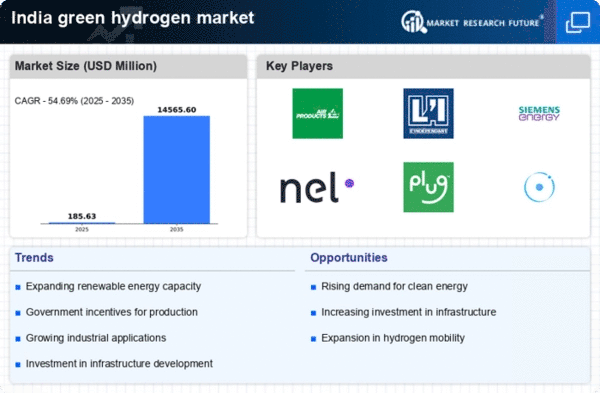
India Green Hydrogen Market Infographic
Purchase Options

Market Analysis

India Green Hydrogen Market (Global, 2023)

Introduction

The India Green Hydrogen Market is poised to play a pivotal role in the country's transition towards a sustainable energy future, driven by a combination of government initiatives, technological advancements, and increasing environmental awareness. As India seeks to reduce its carbon footprint and enhance energy security, green hydrogen emerges as a viable alternative to fossil fuels, offering a clean and renewable energy source that can be utilized across various sectors, including transportation, industry, and power generation. The market is characterized by a growing interest from both public and private sectors, with investments in research and development, infrastructure, and production technologies gaining momentum. Furthermore, the alignment of green hydrogen production with India's abundant renewable energy resources, particularly solar and wind, positions the country as a potential leader in the global green hydrogen landscape. This report delves into the current state of the India Green Hydrogen Market, exploring key drivers, challenges, and opportunities that will shape its evolution in the coming years.

PESTLE Analysis

Political
The Indian government has set an ambitious target to produce 5 million tonnes of green hydrogen annually by 2030, as part of its National Hydrogen Mission. This initiative is supported by a budget allocation of ₹19,744 crore (approximately $2.4 billion) aimed at promoting research, development, and deployment of hydrogen technologies. Additionally, the government is actively engaging with various stakeholders, including state governments and private sector players, to create a conducive policy environment for green hydrogen production and utilization.
Economic
India's green hydrogen market is expected to attract investments of around ₹8 trillion (approximately $100 billion) by 2030, driven by both domestic and international players. The country aims to reduce its reliance on fossil fuels and enhance energy security, which is projected to create approximately 1 million jobs in the renewable energy sector by 2025. This economic shift is further supported by the rising cost of renewable energy, which has decreased by 89% since 2010, making green hydrogen a more viable option for energy production.
Social
Public awareness and acceptance of green hydrogen as a clean energy source are growing in India, with surveys indicating that over 70% of the population supports the transition to renewable energy sources. Educational institutions are increasingly incorporating renewable energy topics into their curricula, with over 200 universities offering specialized programs in renewable energy and sustainability. This societal shift is crucial for fostering a workforce skilled in green technologies, which is essential for the growth of the green hydrogen market.
Technological
India is witnessing rapid advancements in hydrogen production technologies, with the cost of electrolysis technology expected to drop by 30% by 2025. The country is also investing in research and development, with the Indian Institute of Technology (IIT) receiving ₹500 crore (approximately $60 million) for projects focused on hydrogen production and storage technologies. Furthermore, collaborations with international firms are enhancing technological capabilities, enabling India to leverage cutting-edge innovations in the green hydrogen sector.
Legal
The regulatory framework for green hydrogen in India is evolving, with the Ministry of Power issuing guidelines for the implementation of green hydrogen projects. These guidelines include provisions for the establishment of renewable energy purchase obligations (RPOs) that mandate a minimum percentage of energy to be sourced from renewable sources, including green hydrogen. Additionally, the government is working on a comprehensive hydrogen policy that is expected to be finalized by mid-2024, which will provide clarity on incentives and compliance requirements for stakeholders.
Environmental
The transition to green hydrogen is expected to significantly reduce carbon emissions in India, with estimates suggesting a potential reduction of 33 million tonnes of CO2 emissions annually by 2030. This aligns with India's commitment to achieving net-zero emissions by 2070. Furthermore, the production of green hydrogen from renewable sources can help mitigate air pollution, which is a major concern in urban areas, where air quality indices often exceed safe limits by more than 50%.

Porter's Five Forces

Threat of New Entrants
Medium - The India Green Hydrogen Market has moderate barriers to entry due to the significant capital investment required for technology and infrastructure development. However, the increasing government support and favorable policies for renewable energy create opportunities for new players. Established companies may have advantages in terms of technology and market presence, but the growing interest in green hydrogen can attract new entrants.
Bargaining Power of Suppliers
Low - The bargaining power of suppliers in the green hydrogen market is relatively low. This is primarily due to the availability of multiple sources for key inputs such as renewable energy and electrolyzers. As the market expands, the number of suppliers is likely to increase, further reducing their power. Additionally, advancements in technology may lead to more cost-effective production methods, diminishing supplier influence.
Bargaining Power of Buyers
Medium - Buyers in the India Green Hydrogen Market possess moderate bargaining power. As the market matures, buyers are likely to have more options and alternatives, which can increase their negotiating power. However, the unique benefits of green hydrogen, such as sustainability and compliance with environmental regulations, may limit their ability to switch to other energy sources easily.
Threat of Substitutes
High - The threat of substitutes in the green hydrogen market is high due to the availability of alternative energy sources such as natural gas, battery storage, and other renewable energy technologies. As these alternatives continue to evolve and become more cost-competitive, they pose a significant challenge to the adoption of green hydrogen. The market must demonstrate clear advantages in terms of efficiency and environmental impact to mitigate this threat.
Competitive Rivalry
High - Competitive rivalry in the India Green Hydrogen Market is high, driven by the presence of numerous players, including established energy companies and new entrants. The race to innovate and capture market share is intense, with companies investing heavily in research and development. Additionally, the urgency to meet sustainability goals and government mandates further fuels competition, making it a dynamic and rapidly evolving market.

SWOT Analysis

Strengths

  • Abundant renewable energy resources, particularly solar and wind, facilitating green hydrogen production.
  • Government support and favorable policies aimed at promoting clean energy and reducing carbon emissions.
  • Growing investments from both domestic and international players in green hydrogen technology and infrastructure.

Weaknesses

  • High initial capital costs associated with green hydrogen production and infrastructure development.
  • Limited awareness and understanding of green hydrogen applications among potential end-users.
  • Challenges in scaling up production and distribution networks to meet future demand.

Opportunities

  • Increasing global demand for clean energy solutions and hydrogen as a fuel source.
  • Potential for India to become a leading exporter of green hydrogen to international markets.
  • Technological advancements in electrolysis and fuel cell technologies enhancing efficiency and reducing costs.

Threats

  • Intense competition from other countries investing heavily in green hydrogen technologies.
  • Regulatory and policy uncertainties that could impact investment and development timelines.
  • Market volatility in renewable energy prices affecting the cost competitiveness of green hydrogen.

Summary

The India Green Hydrogen Market in 2023 presents a promising landscape characterized by strong government support and abundant renewable resources, positioning the country as a potential leader in the global green hydrogen sector. However, challenges such as high initial costs and limited market awareness must be addressed to fully capitalize on emerging opportunities. The market's growth will depend on overcoming competitive pressures and ensuring regulatory stability to attract sustained investments.

Author
Author Profile
Garvit Vyas
Vice President - Operations

Garvit Vyas is a Research Analyst with experience in working across multiple industry domains in the market research sector. Over the past four years, he has been actively involved in analyzing diverse markets, gathering industry insights, and contributing to the development of comprehensive research reports. His work includes studying market trends, evaluating competitive landscapes, and supporting data-driven business insights. In the early phase of his career, Garvit worked on cross-domain research projects, which helped him build a strong foundation in market analysis, data interpretation, and industry intelligence across various sectors. Later, he transitioned into the Quality Control (QC) function, where he focuses on reviewing and refining research reports and marketing collaterals to ensure accuracy, consistency, and high editorial standards. His responsibilities include validating research data, improving report structure, and maintaining the overall quality of published content. Garvit is committed to maintaining strong research integrity and delivering reliable insights that support informed business decision-making.

Leave a Comment

FAQs

What is the current valuation of the India green hydrogen market?

<p>The market valuation was $120.0 Million in 2024.</p>

What is the projected market size for the India green hydrogen market by 2035?

<p>The projected valuation for 2035 is $14,565.6 Million.</p>

What is the expected CAGR for the India green hydrogen market during the forecast period 2025 - 2035?

<p>The expected CAGR is 54.69%.</p>

Which application segments are driving the India green hydrogen market?

<p>Key application segments include Hydrogen Fuel Cell Vehicles at $5,000 Million and Industrial Processes at $4,000 Million.</p>

What technologies are being utilized in the India green hydrogen market?

<p>Electrolysis leads with a valuation of $5,800 Million, followed by Thermochemical Water Splitting at $3,000 Million.</p>

What are the primary end-use applications for green hydrogen in India?

<p>Chemical Production is a major end-use application, valued at $5,000 Million.</p>

Who are the key players in the India green hydrogen market?

<p>Prominent players include Air Products, Linde, Siemens Energy, and Nel ASA.</p>

What production methods are being employed in the India green hydrogen market?

<p>Alkaline Electrolysis is the leading production method, valued at $8,000 Million.</p>

How does the aerospace sector contribute to the India green hydrogen market?

<p>The aerospace sector is valued at $1,065.6 Million, indicating its growing relevance.</p>

What is the significance of energy storage in the India green hydrogen market?

<p>Energy Storage is valued at $4,000 Million, highlighting its potential in the market.</p>

Market Summary

As per Market Research Future analysis, the India Green Hydrogen Market Size was estimated at 5.594 USD Billion in 2024. The India Green Hydrogen industry is projected to grow from 6.216 USD Billion in 2025 to 17.84 USD Billion by 2035, exhibiting a compound annual growth rate (CAGR) of 11.1% during the forecast period 2025 - 2035

Key Market Trends & Highlights

The India Green Hydrogen Market is poised for substantial growth driven by government initiatives and technological advancements.

  • Government initiatives and policy frameworks are catalyzing the growth of the green hydrogen sector in India. Proton Exchange Membrane Electrolyzers dominate the market, while Alkaline Electrolyzers are emerging as the fastest-growing segment. The Asia-Pacific region is witnessing rapid expansion in green hydrogen adoption, contrasting with North America's established market leadership. Rising energy demand and government support are key drivers propelling investment and innovation in India's green hydrogen landscape.

Market Size & Forecast

2024 Market Size 5.594 (USD Billion)
2035 Market Size 17.84 (USD Billion)
CAGR (2025 - 2035) 11.12%
Largest Regional Market Share in 2024 Asia Pacific

Major Players

Reliance Industries Limited (IN), Tata Group (IN), <a href="https://www.adani.com/businesses/energy-utilities/green-hydrogen">Adani Group</a> (IN), NTPC Limited (IN), Indian Oil Corporation Limited (IN), Bharat Petroleum Corporation Limited (IN), <a href="https://www.larsentoubro.com/pressreleases/2025-07-21-lt-energy-greentech-to-establish-india-s-largest-green-hydrogen-plant">Larsen &amp; Toubro Limited</a> (IN), Greenko Group (IN), Hindustan Aeronautics Limited (IN)

Market Trends

The India Green Hydrogen Market is currently experiencing a transformative phase, driven by a confluence of policy support, technological advancements, and increasing environmental awareness. The government has initiated various programs aimed at promoting hydrogen as a clean energy source, which appears to be fostering a conducive environment for investment and innovation. Furthermore, the growing emphasis on reducing carbon emissions and transitioning to sustainable energy solutions is likely to propel the demand for green hydrogen across multiple sectors, including transportation, industry, and power generation. As stakeholders recognize the potential of hydrogen to decarbonize the economy, collaborations between public and private entities are becoming more prevalent, suggesting a robust ecosystem for growth. In addition, the India Green Hydrogen Market seems poised for expansion as advancements in electrolyzer technology and renewable energy integration continue to evolve. The increasing efficiency and decreasing costs of production methods may enhance the feasibility of green hydrogen projects. Moreover, the strategic positioning of India in the global energy landscape, coupled with its abundant renewable resources, indicates a promising future for hydrogen initiatives. As the market matures, it is anticipated that innovative business models and financing mechanisms will emerge, further stimulating growth and adoption of green hydrogen solutions across the nation.

Government Initiatives and Policy Framework

The Indian government is actively promoting green hydrogen through various initiatives and policy frameworks. This support is likely to create a favorable environment for investment and development in the sector, encouraging both domestic and international players to participate.

Technological Advancements in Production

Recent advancements in hydrogen production technologies, particularly in electrolyzers, are expected to enhance efficiency and reduce costs. These improvements may facilitate the scaling up of green hydrogen projects, making them more economically viable.

Growing Demand Across Multiple Sectors

The increasing focus on sustainability and carbon neutrality is driving demand for green hydrogen in various sectors, including transportation, industrial processes, and energy generation. This trend suggests a broadening application landscape for hydrogen solutions in India.

India Green Hydrogen Market Market Drivers

Government Support and Policy Framework

The India Green Hydrogen Market is currently experiencing a robust push from government initiatives aimed at promoting renewable energy sources. The Indian government has set ambitious targets, including the National Hydrogen Mission, which aims to produce 5 million tonnes of green hydrogen annually by 2030. This policy framework not only provides financial incentives but also establishes a regulatory environment conducive to investment in green hydrogen technologies. The government's commitment to reducing carbon emissions and enhancing energy security further solidifies the market's potential. With a projected investment of over USD 8 billion in green hydrogen projects, the India Green Hydrogen Market is poised for substantial growth, attracting both domestic and international players.

Technological Innovations in Electrolysis

Technological advancements in electrolysis are pivotal for the India Green Hydrogen Market. Innovations in proton exchange membrane (PEM) and alkaline electrolysis technologies are enhancing efficiency and reducing costs. As of 2025, the cost of producing green hydrogen through electrolysis is expected to decrease significantly, potentially reaching USD 1.5 per kilogram. This reduction in production costs is likely to make green hydrogen more competitive with fossil fuels, thereby increasing its adoption across various sectors, including transportation and industrial applications. The ongoing research and development efforts in this domain suggest that the India Green Hydrogen Market will benefit from improved technologies that facilitate large-scale production and distribution.

Investment Opportunities and Economic Growth

The India Green Hydrogen Market is witnessing a surge in investment opportunities, driven by both public and private sector interest. With the government targeting a USD 8 billion investment in green hydrogen projects, numerous companies are exploring partnerships and collaborations to capitalize on this emerging market. The potential for job creation in manufacturing, research, and infrastructure development is substantial, with estimates suggesting that the green hydrogen sector could create over 1 million jobs by 2030. This influx of capital and talent is likely to stimulate economic growth and innovation within the India Green Hydrogen Market, positioning it as a key player in the global energy landscape.

International Collaboration and Trade Potential

The India Green Hydrogen Market is increasingly benefiting from international collaboration and trade opportunities. Countries with advanced hydrogen technologies are looking to partner with India to leverage its vast renewable energy resources. Collaborative projects, such as joint ventures and technology transfers, are emerging, which could enhance India's capabilities in green hydrogen production. Furthermore, as nations strive to meet their climate commitments, the demand for green hydrogen is expected to rise, creating export opportunities for India. The potential for India to become a leading exporter of green hydrogen in the coming years could significantly impact the India Green Hydrogen Market, fostering economic ties and enhancing energy security.

Rising Energy Demand and Transition to Renewables

The India Green Hydrogen Market is being driven by the increasing energy demand coupled with a global transition towards renewable energy sources. As India aims to achieve 500 GW of renewable energy capacity by 2030, the role of green hydrogen as an energy carrier becomes increasingly vital. The International Energy Agency projects that hydrogen could account for 18% of the global energy demand by 2050, indicating a substantial market opportunity for India. This transition not only aligns with India's climate goals but also offers a pathway to energy independence. The growing recognition of green hydrogen's potential in decarbonizing hard-to-abate sectors further enhances its relevance in the India Green Hydrogen Market.

Market Segment Insights

By Application: Power Generation (Largest) vs. Hydrogen Fuel Cell Vehicles (Fastest-Growing)

<p>In the India green hydrogen market, the application segment showcases varied distribution among its components. Power generation stands out as the largest segment, solidifying its position with a significant share of the market. Hydrogen fuel cell vehicles, on the other hand, showcase an increasing market presence, leveraging advancements in technology and growing consumer acceptance, which accelerates their share in the sector. The growth trends in the application segment are driven by rising energy demands and environmental concerns, prompting investments in hydrogen infrastructure. Power generation continues to benefit from government support and incentives, whereas the rapid growth of hydrogen fuel cell vehicles is fueled by a shift in transportation preferences towards cleaner energy solutions. This shift is essential in achieving sustainability goals and fostering innovation in the green hydrogen space.</p>

<p>Power Generation: Dominant vs. Hydrogen Fuel Cell Vehicles: Emerging</p>

<p>Power generation remains the dominant application in the India green hydrogen market due to its critical role in ensuring a sustainable energy future. This segment encompasses various technologies that convert hydrogen into electricity, thereby reducing reliance on fossil fuels. Meanwhile, hydrogen fuel cell vehicles are an emerging segment, contributing significantly to the decarbonization of transportation. These vehicles utilize hydrogen as a clean fuel source, offering superior efficiency and environmental benefits compared to traditional options. As technological advancements continue to enhance fuel cell performance and infrastructure develops, both segments are poised for growth, with power generation leading the way and hydrogen fuel cell vehicles rapidly gaining momentum.</p>

By Technology: Electrolysis (Largest) vs. Biomass Gasification (Fastest-Growing)

<p>In the India green hydrogen market, the technology segment showcases notable distribution among various methods. Electrolysis currently takes the largest share, driven by advancements in renewable energy integration and its increasing reliability. Biomass gasification, while smaller in its market presence, is emerging rapidly due to its sustainable approach and potential for efficient hydrogen production from organic materials. Growth trends indicate a significant shift towards embracing sustainable technologies in hydrogen production. Electrolysis remains dominant, bolstered by government incentives and rising investments in renewable resources. Meanwhile, biomass gasification is gaining traction as industries look for alternatives that minimize carbon footprints, aligning with global sustainability goals. As technology develops, these segment values are expected to see further enhancements in efficiency and cost-effectiveness.</p>

<p>Technology: Electrolysis (Dominant) vs. Biomass Gasification (Emerging)</p>

<p>Electrolysis has established itself as the dominant technology in the India green hydrogen market, primarily due to its efficiency and compatibility with renewable energy sources such as solar and wind. This segment benefits from technological advancements that enhance its operational performance while reducing costs, making it an attractive option for hydrogen production. On the other hand, biomass gasification represents an emerging trend, tapping into diverse feedstocks from agricultural waste and forests. This method not only promotes waste utilization but also aligns with circular economy principles, creating opportunities for businesses that prioritize sustainability. As demand for green hydrogen escalates, these technologies are likely to evolve further, reinforcing their significance in achieving energy transition goals.</p>

By End Use: Transportation (Largest) vs. Chemical Production (Fastest-Growing)

<p>In the India green hydrogen market, the segment distribution reveals that Transportation takes the lead as the largest end use, commanding a significant share of the market. This dominance is primarily driven by the increasing adoption of hydrogen fuel cell vehicles and the government's push towards sustainable transport solutions. Meanwhile, Chemical Production is observing rapid growth, as industries shift towards greener production methods, leading to a surge in hydrogen demand for varied chemical applications. The growth trends in this segment are promising, with Transportation benefiting from regulatory incentives and technological advancements in fuel cell technology. Conversely, Chemical Production is emerging as the fastest-growing segment due to the rising need for sustainable chemicals and processes, propelled by both environmental regulations and the industry's move towards decarbonization. As investments increase and technology matures, these segments are expected to evolve further, shaping the future of the India green hydrogen market.</p>

<p>Transportation: Dominant vs. Chemical Production: Emerging</p>

<p>Transportation stands as the dominant end-use segment in the India green hydrogen market, characterized by its robust infrastructure development and strong governmental support for cleaner transportation alternatives. Hydrogen fuel cell technology is becoming increasingly viable, as automotive manufacturers invest heavily in research and deployment. On the other hand, Chemical Production is an emerging segment, gaining traction owing to the urgent industry shift towards sustainability. This segment requires hydrogen for processes like ammonia synthesis and as a reducing agent in various applications. As businesses respond to climate pressures and regulatory changes, both segments will continue to reshape their market landscape, with Transportation maintaining its lead while Chemical Production accelerates its growth.</p>

By Production Method: Proton Exchange Membrane Electrolysis (Largest) vs. Alkaline Electrolysis (Fastest-Growing)

<p>In the India green hydrogen market, the distribution of market share among production methods reveals that Proton Exchange Membrane (PEM) Electrolysis holds the largest share due to its high efficiency and suitability for renewable energy integration. Alkaline Electrolysis follows, demonstrating notable growth driven by its reliability and cost-effectiveness in production processes. Solid Oxide Electrolysis is emerging but currently holds a smaller percentage of the market share as it is still in the developmental phase, primarily utilized in specific applications. The growth trends in this segment are influenced by several factors, including the increasing demand for clean energy and government policies promoting hydrogen production. PEM Electrolysis is primarily driven by advancements in technology that enhance its performance and reduce operational costs. Meanwhile, Alkaline Electrolysis is witnessing rapid growth as industries seek sustainable alternatives to fossil fuels. Investment in research and development for Solid Oxide Electrolysis is expected to boost its market share in the future, as it may meet high-temperature hydrogen production needs.</p>

<p>Proton Exchange Membrane Electrolysis (Dominant) vs. Alkaline Electrolysis (Emerging)</p>

<p>Proton Exchange Membrane Electrolysis is currently the dominant method in the India green hydrogen market, known for its high efficiency and quick response times, making it suitable for integration with renewable energy sources. Its compact size and versatility enable deployment across various applications, from small-scale to large industrial operations. In contrast, Alkaline Electrolysis is emerging as a strong competitor, leveraging its cost-effectiveness and durability. While it may not provide the rapid responses that PEM offers, its proven track record in large-scale hydrogen production is making it increasingly attractive to renewable energy projects. The continued technological advancements in both methods are fostering healthy competition, pushing innovation and cost reductions across the industry.</p>

Get more detailed insights about India Green Hydrogen Market Research Report – Forecast till 2035

Regional Insights

Key Players and Competitive Insights

The green hydrogen market in India is currently characterized by a dynamic competitive landscape, driven by a confluence of technological advancements, regulatory support, and increasing demand for sustainable energy solutions. Major players such as Air Products (US), Linde (DE), and Siemens Energy (DE) are actively positioning themselves through strategic partnerships and innovative technologies. For instance, Air Products (US) has focused on expanding its production capabilities, while Linde (DE) emphasizes its expertise in gas processing and distribution, thereby enhancing its market presence. Siemens Energy (DE) is leveraging its technological prowess to develop efficient electrolyzers, which are crucial for green hydrogen production. Collectively, these strategies contribute to a competitive environment that is increasingly oriented towards sustainability and technological innovation. In terms of business tactics, companies are localizing manufacturing and optimizing supply chains to enhance operational efficiency. The market structure appears moderately fragmented, with several key players vying for market share. This fragmentation is indicative of a landscape where innovation and strategic collaborations are paramount, as companies seek to differentiate themselves in a rapidly evolving sector. In October 2025, Linde (DE) announced a partnership with a leading Indian renewable energy firm to develop a large-scale green hydrogen production facility. This strategic move is significant as it not only expands Linde's operational footprint in India but also aligns with the country's ambitious renewable energy targets. The collaboration is expected to leverage local resources and expertise, thereby enhancing the efficiency and sustainability of hydrogen production. In September 2025, Siemens Energy (DE) unveiled a new electrolyzer technology that promises to reduce production costs by up to 20%. This innovation is particularly relevant in the context of increasing competition, as it positions Siemens Energy as a leader in cost-effective green hydrogen solutions. The potential for lower production costs could significantly influence market dynamics, encouraging wider adoption of green hydrogen technologies across various sectors. In August 2025, Air Products (US) secured a major contract to supply green hydrogen to a prominent industrial customer in India. This contract is noteworthy as it underscores the growing demand for green hydrogen in industrial applications, which could drive further investments in production infrastructure. The strategic focus on securing long-term contracts may provide Air Products with a competitive edge in a market that is increasingly prioritizing sustainability. As of November 2025, current trends in the green hydrogen market indicate a strong emphasis on digitalization, sustainability, and the integration of advanced technologies such as AI. Strategic alliances are becoming increasingly important, as companies recognize the value of collaboration in achieving shared sustainability goals. Looking ahead, competitive differentiation is likely to evolve from traditional price-based competition to a focus on innovation, technological advancements, and supply chain reliability. This shift suggests that companies that prioritize R&D and strategic partnerships will be better positioned to thrive in the future.

Key Companies in the India Green Hydrogen Market include

Industry Developments

  • Q2 2025: India awards $261 mil for 450000 mt/year renewable hydrogen production in 2024-25 India awarded Rupees 22.39 billion ($261 million) in incentives for the production of 450,000 metric tons per year of renewable hydrogen for 2024-25, as part of its National Green Hydrogen Mission to boost domestic production.
  • Q2 2025: Govt. Opens Second Funding Round for Green Hydrogen Testing Facilities Under NGHM The Indian government opened a second funding round for green hydrogen testing facilities under the National Green Hydrogen Mission, with an overall outlay of INR 200 crore for 2024–26 to support infrastructure and R&D.

Future Outlook

India Green Hydrogen Market Future Outlook

The India Green Hydrogen Market is poised for growth at 11.12% CAGR from 2025 to 2035, driven by policy support, technological advancements, and increasing energy demands.

New opportunities lie in:

  • <p>Development of hydrogen refueling infrastructure for transportation Investment in electrolyzer manufacturing for cost reduction Partnerships with industrial sectors for hydrogen adoption in processes</p>

By 2035, the market is expected to be a pivotal player in India's energy transition.

Market Segmentation

India Green Hydrogen Market End-users Outlook

  • Power Generation & Energy Storage
  • Automotive & Transportation
  • Refineries & Pharmaceuticals
  • Others (Food & Beverages
  • Steel
  • Cement Industries
  • etc.)

India Green Hydrogen Market Technology Outlook

  • Proton Exchange Membrane Electrolyzers
  • Alkaline Electrolyzers
  • Solid Oxide Electrolyzers
  • Others

India Green Hydrogen Market Energy Source Outlook

  • Solar
  • Wind
  • Others

Report Scope

MARKET SIZE 2024 5.594(USD Billion)
MARKET SIZE 2025 6.216(USD Billion)
MARKET SIZE 2035 17.84(USD Billion)
COMPOUND ANNUAL GROWTH RATE (CAGR) 11.12% (2025 - 2035)
REPORT COVERAGE Revenue Forecast, Competitive Landscape, Growth Factors, and Trends
BASE YEAR 2024
Market Forecast Period 2025 - 2035
Historical Data 2019 - 2024
Market Forecast Units USD Billion
Key Companies Profiled Reliance Industries Limited (IN), Tata Group (IN), Adani Group (IN), NTPC Limited (IN), Indian Oil Corporation Limited (IN), Bharat Petroleum Corporation Limited (IN), Larsen & Toubro Limited (IN), Greenko Group (IN), Hindustan Aeronautics Limited (IN)
Segments Covered Technology, Energy Source, End-Users
Key Market Opportunities Expansion of renewable energy infrastructure enhances potential for India Green Hydrogen Market growth.
Key Market Dynamics Rising investments in Research and Development are driving innovation in India's green hydrogen production technologies.
Countries Covered North America, Europe, APAC, South America, MEA

FAQs

What is the current valuation of the India green hydrogen market?

<p>The market valuation was $120.0 Million in 2024.</p>

What is the projected market size for the India green hydrogen market by 2035?

<p>The projected valuation for 2035 is $14,565.6 Million.</p>

What is the expected CAGR for the India green hydrogen market during the forecast period 2025 - 2035?

<p>The expected CAGR is 54.69%.</p>

Which application segments are driving the India green hydrogen market?

<p>Key application segments include Hydrogen Fuel Cell Vehicles at $5,000 Million and Industrial Processes at $4,000 Million.</p>

What technologies are being utilized in the India green hydrogen market?

<p>Electrolysis leads with a valuation of $5,800 Million, followed by Thermochemical Water Splitting at $3,000 Million.</p>

What are the primary end-use applications for green hydrogen in India?

<p>Chemical Production is a major end-use application, valued at $5,000 Million.</p>

Who are the key players in the India green hydrogen market?

<p>Prominent players include Air Products, Linde, Siemens Energy, and Nel ASA.</p>

What production methods are being employed in the India green hydrogen market?

<p>Alkaline Electrolysis is the leading production method, valued at $8,000 Million.</p>

How does the aerospace sector contribute to the India green hydrogen market?

<p>The aerospace sector is valued at $1,065.6 Million, indicating its growing relevance.</p>

What is the significance of energy storage in the India green hydrogen market?

<p>Energy Storage is valued at $4,000 Million, highlighting its potential in the market.</p>

  1. SECTION I: EXECUTIVE SUMMARY AND KEY HIGHLIGHTS
    1. | 1.1 EXECUTIVE SUMMARY
    2. | | 1.1.1 Market Overview
    3. | | 1.1.2 Key Findings
    4. | | 1.1.3 Market Segmentation
    5. | | 1.1.4 Competitive Landscape
    6. | | 1.1.5 Challenges and Opportunities
    7. | | 1.1.6 Future Outlook
  2. SECTION II: SCOPING, METHODOLOGY AND MARKET STRUCTURE
    1. | 2.1 MARKET INTRODUCTION
    2. | | 2.1.1 Definition
    3. | | 2.1.2 Scope of the study
    4. | | | 2.1.2.1 Research Objective
    5. | | | 2.1.2.2 Assumption
    6. | | | 2.1.2.3 Limitations
    7. | 2.2 RESEARCH METHODOLOGY
    8. | | 2.2.1 Overview
    9. | | 2.2.2 Data Mining
    10. | | 2.2.3 Secondary Research
    11. | | 2.2.4 Primary Research
    12. | | | 2.2.4.1 Primary Interviews and Information Gathering Process
    13. | | | 2.2.4.2 Breakdown of Primary Respondents
    14. | | 2.2.5 Forecasting Model
    15. | | 2.2.6 Market Size Estimation
    16. | | | 2.2.6.1 Bottom-Up Approach
    17. | | | 2.2.6.2 Top-Down Approach
    18. | | 2.2.7 Data Triangulation
    19. | | 2.2.8 Validation
  3. SECTION III: QUALITATIVE ANALYSIS
    1. | 3.1 MARKET DYNAMICS
    2. | | 3.1.1 Overview
    3. | | 3.1.2 Drivers
    4. | | 3.1.3 Restraints
    5. | | 3.1.4 Opportunities
    6. | 3.2 MARKET FACTOR ANALYSIS
    7. | | 3.2.1 Value chain Analysis
    8. | | 3.2.2 Porter's Five Forces Analysis
    9. | | | 3.2.2.1 Bargaining Power of Suppliers
    10. | | | 3.2.2.2 Bargaining Power of Buyers
    11. | | | 3.2.2.3 Threat of New Entrants
    12. | | | 3.2.2.4 Threat of Substitutes
    13. | | | 3.2.2.5 Intensity of Rivalry
    14. | | 3.2.3 COVID-19 Impact Analysis
    15. | | | 3.2.3.1 Market Impact Analysis
    16. | | | 3.2.3.2 Regional Impact
    17. | | | 3.2.3.3 Opportunity and Threat Analysis
  4. SECTION IV: QUANTITATIVE ANALYSIS
    1. | 4.1 Construction, BY Application (USD Million)
    2. | | 4.1.1 Power Generation
    3. | | 4.1.2 Hydrogen Fuel Cell Vehicles
    4. | | 4.1.3 Industrial Processes
    5. | | 4.1.4 Transportation
    6. | | 4.1.5 Aerospace
    7. | 4.2 Construction, BY Technology (USD Million)
    8. | | 4.2.1 Electrolysis
    9. | | 4.2.2 Thermochemical Water Splitting
    10. | | 4.2.3 Biomass Gasification
    11. | | 4.2.4 Photoelectrochemical Water Splitting
    12. | 4.3 Construction, BY End Use (USD Million)
    13. | | 4.3.1 Transportation
    14. | | 4.3.2 Chemical Production
    15. | | 4.3.3 Energy Storage
    16. | | 4.3.4 Heating
    17. | | 4.3.5 Refineries
    18. | 4.4 Construction, BY Production Method (USD Million)
    19. | | 4.4.1 Proton Exchange Membrane Electrolysis
    20. | | 4.4.2 Alkaline Electrolysis
    21. | | 4.4.3 Solid Oxide Electrolysis
  5. SECTION V: COMPETITIVE ANALYSIS
    1. | 5.1 Competitive Landscape
    2. | | 5.1.1 Overview
    3. | | 5.1.2 Competitive Analysis
    4. | | 5.1.3 Market share Analysis
    5. | | 5.1.4 Major Growth Strategy in the Construction
    6. | | 5.1.5 Competitive Benchmarking
    7. | | 5.1.6 Leading Players in Terms of Number of Developments in the Construction
    8. | | 5.1.7 Key developments and growth strategies
    9. | | | 5.1.7.1 New Product Launch/Service Deployment
    10. | | | 5.1.7.2 Merger & Acquisitions
    11. | | | 5.1.7.3 Joint Ventures
    12. | | 5.1.8 Major Players Financial Matrix
    13. | | | 5.1.8.1 Sales and Operating Income
    14. | | | 5.1.8.2 Major Players R&D Expenditure. 2023
    15. | 5.2 Company Profiles
    16. | | 5.2.1 Air Products (US)
    17. | | | 5.2.1.1 Financial Overview
    18. | | | 5.2.1.2 Products Offered
    19. | | | 5.2.1.3 Key Developments
    20. | | | 5.2.1.4 SWOT Analysis
    21. | | | 5.2.1.5 Key Strategies
    22. | | 5.2.2 Linde (DE)
    23. | | | 5.2.2.1 Financial Overview
    24. | | | 5.2.2.2 Products Offered
    25. | | | 5.2.2.3 Key Developments
    26. | | | 5.2.2.4 SWOT Analysis
    27. | | | 5.2.2.5 Key Strategies
    28. | | 5.2.3 Siemens Energy (DE)
    29. | | | 5.2.3.1 Financial Overview
    30. | | | 5.2.3.2 Products Offered
    31. | | | 5.2.3.3 Key Developments
    32. | | | 5.2.3.4 SWOT Analysis
    33. | | | 5.2.3.5 Key Strategies
    34. | | 5.2.4 Nel ASA (NO)
    35. | | | 5.2.4.1 Financial Overview
    36. | | | 5.2.4.2 Products Offered
    37. | | | 5.2.4.3 Key Developments
    38. | | | 5.2.4.4 SWOT Analysis
    39. | | | 5.2.4.5 Key Strategies
    40. | | 5.2.5 Plug Power (US)
    41. | | | 5.2.5.1 Financial Overview
    42. | | | 5.2.5.2 Products Offered
    43. | | | 5.2.5.3 Key Developments
    44. | | | 5.2.5.4 SWOT Analysis
    45. | | | 5.2.5.5 Key Strategies
    46. | | 5.2.6 ITM Power (GB)
    47. | | | 5.2.6.1 Financial Overview
    48. | | | 5.2.6.2 Products Offered
    49. | | | 5.2.6.3 Key Developments
    50. | | | 5.2.6.4 SWOT Analysis
    51. | | | 5.2.6.5 Key Strategies
    52. | | 5.2.7 Hydrogenics (CA)
    53. | | | 5.2.7.1 Financial Overview
    54. | | | 5.2.7.2 Products Offered
    55. | | | 5.2.7.3 Key Developments
    56. | | | 5.2.7.4 SWOT Analysis
    57. | | | 5.2.7.5 Key Strategies
    58. | | 5.2.8 Ballard Power Systems (CA)
    59. | | | 5.2.8.1 Financial Overview
    60. | | | 5.2.8.2 Products Offered
    61. | | | 5.2.8.3 Key Developments
    62. | | | 5.2.8.4 SWOT Analysis
    63. | | | 5.2.8.5 Key Strategies
    64. | | 5.2.9 Enel Green Power (IT)
    65. | | | 5.2.9.1 Financial Overview
    66. | | | 5.2.9.2 Products Offered
    67. | | | 5.2.9.3 Key Developments
    68. | | | 5.2.9.4 SWOT Analysis
    69. | | | 5.2.9.5 Key Strategies
    70. | 5.3 Appendix
    71. | | 5.3.1 References
    72. | | 5.3.2 Related Reports
  6. LIST OF FIGURES
    1. | 6.1 MARKET SYNOPSIS
    2. | 6.2 INDIA MARKET ANALYSIS BY APPLICATION
    3. | 6.3 INDIA MARKET ANALYSIS BY TECHNOLOGY
    4. | 6.4 INDIA MARKET ANALYSIS BY END USE
    5. | 6.5 INDIA MARKET ANALYSIS BY PRODUCTION METHOD
    6. | 6.6 KEY BUYING CRITERIA OF CONSTRUCTION
    7. | 6.7 RESEARCH PROCESS OF MRFR
    8. | 6.8 DRO ANALYSIS OF CONSTRUCTION
    9. | 6.9 DRIVERS IMPACT ANALYSIS: CONSTRUCTION
    10. | 6.10 RESTRAINTS IMPACT ANALYSIS: CONSTRUCTION
    11. | 6.11 SUPPLY / VALUE CHAIN: CONSTRUCTION
    12. | 6.12 CONSTRUCTION, BY APPLICATION, 2024 (% SHARE)
    13. | 6.13 CONSTRUCTION, BY APPLICATION, 2024 TO 2035 (USD Million)
    14. | 6.14 CONSTRUCTION, BY TECHNOLOGY, 2024 (% SHARE)
    15. | 6.15 CONSTRUCTION, BY TECHNOLOGY, 2024 TO 2035 (USD Million)
    16. | 6.16 CONSTRUCTION, BY END USE, 2024 (% SHARE)
    17. | 6.17 CONSTRUCTION, BY END USE, 2024 TO 2035 (USD Million)
    18. | 6.18 CONSTRUCTION, BY PRODUCTION METHOD, 2024 (% SHARE)
    19. | 6.19 CONSTRUCTION, BY PRODUCTION METHOD, 2024 TO 2035 (USD Million)
    20. | 6.20 BENCHMARKING OF MAJOR COMPETITORS
  7. LIST OF TABLES
    1. | 7.1 LIST OF ASSUMPTIONS
    2. | | 7.1.1
    3. | 7.2 India MARKET SIZE ESTIMATES; FORECAST
    4. | | 7.2.1 BY APPLICATION, 2025-2035 (USD Million)
    5. | | 7.2.2 BY TECHNOLOGY, 2025-2035 (USD Million)
    6. | | 7.2.3 BY END USE, 2025-2035 (USD Million)
    7. | | 7.2.4 BY PRODUCTION METHOD, 2025-2035 (USD Million)
    8. | 7.3 PRODUCT LAUNCH/PRODUCT DEVELOPMENT/APPROVAL
    9. | | 7.3.1
    10. | 7.4 ACQUISITION/PARTNERSHIP
    11. | | 7.4.1

India Construction Market Segmentation

Construction By Application (USD Million, 2025-2035)

  • Power Generation
  • Hydrogen Fuel Cell Vehicles
  • Industrial Processes
  • Transportation
  • Aerospace

Construction By Technology (USD Million, 2025-2035)

  • Electrolysis
  • Thermochemical Water Splitting
  • Biomass Gasification
  • Photoelectrochemical Water Splitting

Construction By End Use (USD Million, 2025-2035)

  • Transportation
  • Chemical Production
  • Energy Storage
  • Heating
  • Refineries

Construction By Production Method (USD Million, 2025-2035)

  • Proton Exchange Membrane Electrolysis
  • Alkaline Electrolysis
  • Solid Oxide Electrolysis
Infographic

Free Sample Request

Kindly complete the form below to receive a free sample of this Report

Get Free Sample

Customer Strories

Compare Licence

×
Features License Type
Single User Multiuser License Enterprise User
Price $4,950 $5,950 $7,250
Maximum User Access Limit 1 User Upto 10 Users Unrestricted Access Throughout the Organization
Free Customization
Direct Access to Analyst
Deliverable Format
Platform Access
Discount on Next Purchase 10% 15% 15%
Printable Versions