×
Request Free Sample ×

Kindly complete the form below to receive a free sample of this Report

* Please use a valid business email

Leading companies partner with us for data-driven Insights

clients tt-cursor
Hero Background
English
Chinese
French
Japanese
Korean
German
Spanish

India Electric Car Market Trends

ID: MRFR/AT/11159-HCR
128 Pages
Sejal Akre
October 2025

India Electric Car Market Size, Share & Growth Analysis Report By Propulsion Type (Battery Electric Car (BEV) and Hybrid Electric Car (HEV)), By Drive Type (All Wheel Drive, Front Wheel Drive and Rear Wheel Drive), By Range (Up to 150 Miles, 151-300 Miles and Above 300 Miles) – Industry Growth & Forecast to 2035

Share:
Download PDF ×

We do not share your information with anyone. However, we may send you emails based on your report interest from time to time. You may contact us at any time to opt-out.

India Electric Car Market Infographic
Purchase Options

Market Trends

Key Emerging Trends in the India Electric Car Market

In recent years, the Indian electric car market has witnessed a notable surge in activity, reflecting both global trends towards sustainable transportation and India's own push for cleaner energy solutions. One prominent trend is the increasing consumer interest in electric vehicles (EVs) due to growing environmental awareness and concerns over air pollution. This shift in consumer preferences has been bolstered by government initiatives aimed at promoting EV adoption, such as subsidies, tax incentives, and infrastructure development. As a result, major automakers have begun to introduce a variety of electric car models tailored to the Indian market, offering consumers more choices and driving competition within the industry.

Moreover, technological advancements and decreasing battery costs have played a crucial role in driving the market trends of electric cars in India. With improvements in battery technology, EVs are becoming more affordable and capable of longer ranges, addressing two major concerns among potential buyers—cost and range anxiety. This has led to increased confidence in electric vehicles as viable alternatives to traditional internal combustion engine vehicles. Additionally, the availability of charging infrastructure has expanded rapidly across major cities in India, further bolstering consumer confidence in the practicality of electric cars for everyday use.

Another significant trend in the Indian electric car market is the rise of electric two-wheelers and three-wheelers. These smaller electric vehicles have gained popularity due to their affordability, efficiency, and suitability for urban commuting. With congested city streets and rising fuel prices, electric scooters and rickshaws offer a compelling alternative for short-distance travel, contributing to the overall electrification of the transportation sector in India.

Furthermore, the government's ambitious targets for electric mobility have provided a strong policy framework to drive market growth. Initiatives such as the Faster Adoption and Manufacturing of Electric Vehicles (FAME) scheme aim to accelerate the adoption of EVs by providing subsidies and incentives for both consumers and manufacturers. Additionally, regulatory measures such as stricter emissions standards and mandates for electrifying public transportation fleets are further incentivizing the transition towards electric mobility.

Collaborations and partnerships between domestic and international players have also become prevalent in the Indian electric car market. Indian automakers are forming alliances with global EV manufacturers to leverage their expertise in electric vehicle technology and accelerate product development. These partnerships not only facilitate technology transfer but also enhance market penetration through established distribution networks and brand recognition.

Despite these positive developments, challenges remain in scaling up the electric car market in India. High upfront costs, limited charging infrastructure in rural areas, and concerns over battery recycling and disposal present significant hurdles to widespread adoption. Addressing these challenges will require continued investment in research and development, infrastructure deployment, and public awareness campaigns.

In conclusion, the Indian electric car market is witnessing dynamic growth driven by evolving consumer preferences, technological advancements, supportive government policies, and industry collaborations. While significant progress has been made, concerted efforts are needed to overcome remaining barriers and realize the full potential of electric mobility in India. With continued innovation and investment, electric vehicles are poised to play a pivotal role in shaping the future of transportation in the country.

Author
Sejal Akre
Senior Research Analyst

She has over 5 years of rich experience, in market research and consulting providing valuable market insights to client. Hands on expertise in management consulting, and extensive knowledge in domain including ICT, Automotive & Transportation and Aerospace & Defense. She is skilled in Go-to market strategy, industry analysis, market sizing, in depth company profiling, competitive intelligence & benchmarking and value chain amongst others.

Leave a Comment

FAQs

What is the current valuation of the India Electric Car Market?

As of 2024, the India Electric Car Market was valued at 33.75 USD Billion.

What is the projected market size for the India Electric Car Market by 2035?

The market is projected to reach 119.0 USD Billion by 2035.

What is the expected CAGR for the India Electric Car Market during the forecast period 2025 - 2035?

The expected CAGR for the market during 2025 - 2035 is 12.14%.

Which companies are the key players in the India Electric Car Market?

Key players include Tata Motors, Mahindra Electric, MG Motor, Hyundai Motor, Kia Motors, Tesla, Nissan, BMW, and Volkswagen.

What are the main segments of the India Electric Car Market?

The main segments include Battery Electric Vehicles, Plug-in Hybrid Electric Vehicles, and Hybrid Electric Vehicles.

How much is the Battery Electric Vehicle segment valued at?

The Battery Electric Vehicle segment was valued at 20.25 USD Billion in 2024 and is projected to reach 75.0 USD Billion by 2035.

What is the valuation of the charging infrastructure segment in the market?

The charging infrastructure segment was valued at 33.75 USD Billion in 2024, with projections of 50.0 USD Billion by 2035.

What demographic factors influence the India Electric Car Market?

Demographic factors include age group, income level, and urban versus rural distribution, with valuations ranging from 10.0 to 42.0 USD Billion.

What are the usage patterns for electric cars in India?

Usage patterns include daily commuting, long-distance travel, and commercial use, with valuations from 10.0 to 48.0 USD Billion.

What government incentives are available for electric car adoption in India?

Government incentives include tax rebates, subsidies, and regulatory support, with a total valuation ranging from 5.0 to 59.0 USD Billion.

Market Summary

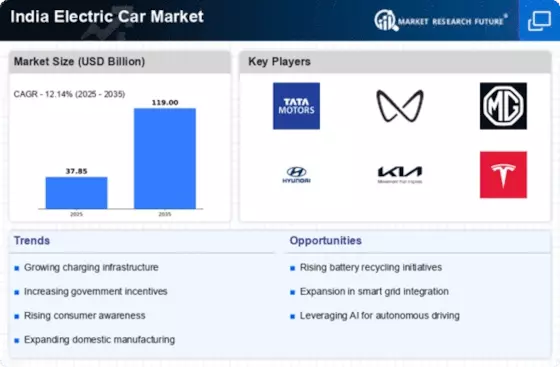
As per analysis, the India Electric Car Market is projected to grow from USD 33.75 Billion in 2024 to USD 119.0 Billion by 2035, exhibiting a compound annual growth rate (CAGR) of 12.14% during the forecast period (2025 - 2035).

Key Market Trends & Highlights

The India Electric Car Market is poised for substantial growth driven by technological advancements and supportive government policies.

  • Battery Electric Vehicles dominate the market, representing the largest segment in terms of sales and adoption.
  • Plug-in Hybrid Electric Vehicles are emerging as the fastest-growing segment, appealing to consumers seeking flexibility.
  • Home Charging solutions remain the largest infrastructure segment, while Fast Charging Networks are rapidly expanding to meet increasing demand.
  • Government initiatives and rising fuel prices are key drivers propelling the electric vehicle market forward.

Market Size & Forecast

2024 Market Size 33.75 (USD Billion)
2035 Market Size 119.0 (USD Billion)
CAGR (2025 - 2035) 12.14%

Major Players

<p>Tata Motors (IN), Mahindra Electric (IN), MG Motor (IN), Hyundai Motor (KR), Kia Motors (KR), Tesla (US), Nissan (JP), BMW (DE), Volkswagen (DE)</p>

Market Trends

The India Electric Car Market is currently experiencing a transformative phase, characterized by a growing emphasis on sustainable transportation solutions. Government initiatives, such as incentives for electric vehicle adoption and the establishment of charging infrastructure, are fostering a conducive environment for the proliferation of electric cars. This shift is not merely a response to environmental concerns but also reflects a strategic move towards energy independence and reduced reliance on fossil fuels. As the market evolves, consumer awareness and acceptance of electric vehicles are steadily increasing, driven by advancements in technology and a broader range of available models. In January 2026, the landscape of the India Electric Car Market appears promising, with various stakeholders, including manufacturers, policymakers, and consumers, actively participating in this transition. The integration of electric vehicles into the mainstream automotive sector is likely to accelerate, supported by ongoing research and development efforts. Furthermore, the potential for job creation in the electric vehicle supply chain and related sectors may contribute to economic growth. Overall, the India Electric Car Market is poised for significant expansion, reflecting a collective commitment to sustainable mobility and innovation.

Government Incentives and Policies

The Indian government has implemented various incentives to promote electric vehicle adoption. These include subsidies for electric car purchases, tax exemptions, and investments in charging infrastructure. Such measures aim to reduce the initial cost barrier for consumers and encourage manufacturers to invest in electric vehicle technology.

Technological Advancements in Battery Technology

Innovations in battery technology are playing a crucial role in enhancing the performance and affordability of electric vehicles in India. Developments in lithium-ion batteries and alternative energy storage solutions are likely to improve vehicle range and reduce charging times, making electric cars more appealing to consumers.

Growing Consumer Awareness and Acceptance

There is a noticeable increase in consumer awareness regarding the benefits of electric vehicles, including lower operating costs and environmental advantages. This growing acceptance is expected to drive demand, as more individuals recognize the long-term advantages of transitioning to electric mobility.

India Electric Car Market Market Drivers

Technological Innovations in EVs

Technological advancements play a crucial role in shaping the India Electric Car Market. Innovations in battery technology, such as increased energy density and faster charging capabilities, are enhancing the appeal of electric vehicles. As of January 2026, several Indian manufacturers are investing in research and development to produce more efficient batteries, which could lead to longer ranges and reduced charging times. Furthermore, the integration of smart technologies, such as connected car features and autonomous driving capabilities, is attracting tech-savvy consumers. These advancements not only improve the user experience but also position electric vehicles as a viable alternative to conventional cars, thereby driving growth in the India Electric Car Market.

Government Initiatives and Subsidies

The India Electric Car Market is significantly influenced by government initiatives aimed at promoting electric vehicles (EVs). The Faster Adoption and Manufacturing of Hybrid and Electric Vehicles (FAME) scheme has been pivotal, providing financial incentives to both manufacturers and consumers. As of January 2026, the government has allocated substantial funds to enhance EV infrastructure, including charging stations, which is expected to increase consumer confidence. Additionally, various state governments have introduced their own policies, offering tax rebates and subsidies for electric car purchases. This multifaceted approach not only stimulates demand but also encourages manufacturers to invest in the electric vehicle sector, thereby fostering growth in the India Electric Car Market.

Rising Fuel Prices and Economic Factors

The India Electric Car Market is also driven by the rising fuel prices, which have made electric vehicles an increasingly attractive alternative. As petrol and diesel prices continue to fluctuate, consumers are seeking cost-effective transportation solutions. The total cost of ownership for electric vehicles is becoming more favorable, as they typically incur lower running costs compared to traditional internal combustion engine vehicles. In January 2026, the average cost of electricity for charging EVs remains significantly lower than that of fossil fuels, further incentivizing consumers to consider electric options. This economic shift is likely to propel the growth of the India Electric Car Market as more individuals and businesses recognize the long-term savings associated with electric vehicles.

Environmental Concerns and Sustainability

The growing awareness of environmental issues is a significant driver for the India Electric Car Market. As climate change becomes an increasingly pressing concern, consumers are more inclined to choose sustainable transportation options. The Indian government has set ambitious targets for reducing carbon emissions, which includes a substantial increase in electric vehicle adoption. In January 2026, public sentiment is shifting towards eco-friendly practices, with many consumers actively seeking to reduce their carbon footprint. This trend is likely to encourage more individuals to consider electric vehicles as a responsible choice, thereby contributing to the expansion of the India Electric Car Market.

Urbanization and Infrastructure Development

Urbanization is rapidly transforming the landscape of the India Electric Car Market. As cities expand, the demand for efficient and sustainable transportation solutions is increasing. The government is investing in infrastructure development, including dedicated EV charging stations and improved public transport systems. By January 2026, urban areas are witnessing a surge in electric vehicle adoption, driven by the convenience of charging facilities and the need for cleaner air. This urban shift is likely to create a favorable environment for electric vehicles, as consumers seek alternatives to traditional vehicles that contribute to pollution. Consequently, the India Electric Car Market is poised for growth as urbanization continues to drive demand for electric mobility.

Market Segment Insights

By Vehicle Type: Battery Electric Vehicle (Largest) vs. Plug-in Hybrid Electric Vehicle (Fastest-Growing)

<p>In the India Electric Car Market, the Battery Electric Vehicle (BEV) segment holds the largest market share, driven by increased consumer preference for fully electric cars due to rising environmental concerns and government incentives. On the other hand, the Plug-in Hybrid Electric Vehicle (PHEV) segment is quickly gaining traction, appealing to consumers who value flexibility in charging and range, thus contributing to a rapidly growing part of the market.</p>

<p>Battery Electric Vehicle (Dominant) vs. Plug-in Hybrid Electric Vehicle (Emerging)</p>

<p>Battery Electric Vehicles are the dominant force in the Indian electric car landscape, benefiting from advancements in battery technology and supportive government policies aimed at boosting electric mobility. Their appeal lies in zero emissions and lower operational costs, positioning them as the primary choice among environmentally conscious buyers. In contrast, Plug-in Hybrid Electric Vehicles represent an emerging segment, meeting the needs of consumers who want the benefits of electric driving without the limitations of charging infrastructure. With increasing awareness and advancements in hybrid technology, PHEVs are expected to capture a growing share of the market, particularly in urban areas.</p>

By Charging Infrastructure: Home Charging (Largest) vs. Fast Charging Networks (Fastest-Growing)

<p>In the India Electric Car Market, the charging infrastructure plays a crucial role in enhancing electric vehicle adoption. Among the segment values, Home Charging emerges as the largest segment due to its convenience and cost-effectiveness for consumers. In contrast, Fast Charging Networks are becoming increasingly prominent as they cater to the need for quicker charging solutions for consumers who prioritize time efficiency. Overall, Public Charging Stations represent a critical support structure for EV users, ensuring accessibility and reliability across urban centers. As the demand for electric vehicles continues to rise, the growth trends in the charging infrastructure segment are driven by increasing consumer awareness of the benefits of EVs. Home Charging is favored by early adopters and residents of urban areas, while Fast Charging Networks are rapidly expanding to alleviate range anxiety. The government initiatives promoting EV usage, coupled with private investments in infrastructure development, are anticipated to fuel these growth trajectories in the Indian market.</p>

<p>Home Charging (Dominant) vs. Fast Charging Networks (Emerging)</p>

<p>Home Charging is currently the dominant force in the Indian Electric Car Market, favored for its practicality, providing car owners with a convenient and economical charging solution at home. It allows users to charge their vehicles overnight, thus circumventing the hassle of finding public charging stations. On the other hand, Fast Charging Networks represent an emerging segment that offers rapid charging solutions for those on the go. Supported by advancements in battery technology and infrastructure investments, Fast Charging Networks are becoming vital in enhancing the electric vehicle ownership experience, particularly for long-distance travelers. Both segments play important roles, but their characteristics cater to different consumer needs, which will shape the market dynamics in the coming years.</p>

By Consumer Demographics: Age Group (Largest) vs. Income Level (Fastest-Growing)

<p>In the India Electric Car Market, consumer demographics show a significant skew towards younger age groups, particularly those between 25 to 35 years old, who represent the largest segment of buyers. This age cohort is drawn to electric vehicles not only for their environmental benefits but also for the innovative technology and modern features that appeal to tech-savvy consumers. In contrast, the income levels indicate a diverse market, with increasing interest from middle-income customers, which is driving the fastest growth as more individuals in this bracket seek affordable electric vehicle options.</p>

<p>Age Group: 25-35 (Dominant) vs. Income Level: Middle-Income (Emerging)</p>

<p>The 25-35 age group stands as the dominant consumer base in the electric car market, characterized by their penchant for sustainability and technological advances. This demographic is often more environmentally conscious and open to adopting new technologies, making them a key driver for electric vehicle adoption. On the other hand, the middle-income segment represents an emerging market that is rapidly growing as electric vehicle options become more affordable. These consumers prioritize value and cost-efficiency, creating a dynamic where manufacturers need to innovate and offer competitive pricing to capture this burgeoning demand.</p>

By Usage Patterns: Daily Commuting (Largest) vs. Long-Distance Travel (Fastest-Growing)

<p>In the India Electric Car Market, usage patterns reveal that daily commuting accounts for the largest share, as most consumers opt for electric cars for their everyday travel needs. Long-distance travel, while currently smaller in market share, is emerging rapidly, driven by advancements in battery technology and growing EV infrastructure. Commercial use also holds a significant position, although it is often overshadowed by the higher consumer preference for daily commuting.</p>

<p>Daily Commuting (Dominant) vs. Long-Distance Travel (Emerging)</p>

<p>Daily commuting in India’s electric car market represents the dominant usage pattern, primarily fueled by urbanization and the increasing need for eco-friendly transportation solutions. Consumers are attracted to electric vehicles for daily use due to lower operational costs and government incentives. In contrast, long-distance travel is an emerging segment that is gaining traction as infrastructure improves and more automakers introduce high-capacity EVs. This segment is characterized by consumers looking for efficient travel solutions for weekend getaways or long trips, and growth is bolstered by charging station expansions along highways.</p>

By Government Incentives: Tax Rebates (Largest) vs. Subsidies (Fastest-Growing)

<p>In the India Electric Car Market, the distribution of government incentives shows that tax rebates hold the largest share among various incentives, significantly supporting electric vehicle adoption. Subsidies, although currently a smaller portion, are on the rise and are projected to experience rapid growth as the government intensifies efforts to promote electric mobility and reduce emissions, which is becoming a priority in national policy formulation.</p>

<p>Tax Rebates (Dominant) vs. Regulatory Support (Emerging)</p>

<p>Tax rebates in India stand as the dominant form of government incentive, offering substantial financial relief to electric car buyers and establishing a strong foothold in the market. Meanwhile, regulatory support is emerging as a critical incentive, focusing on policies that facilitate electric vehicle adoption through infrastructural improvements and compliance measures. As regulatory frameworks evolve, including stricter emissions standards and enhanced charging infrastructure, they are poised to shape market dynamics further. Together, these incentives reflect a comprehensive strategy to promote electric mobility in India, emphasizing both financial benefits and essential structural support.</p>

Get more detailed insights about India Electric Car Market Research Report—Forecast till 2035

Regional Insights

North America : Innovation Hub for EVs

North America is a pivotal region for the electric vehicle (EV) market, driven by technological advancements and strong consumer demand. The U.S. holds the largest market share at approximately 60%, followed by Canada at around 25%. Regulatory incentives, such as tax credits and emissions standards, are significant catalysts for growth, encouraging manufacturers to invest in EV technology and infrastructure. The competitive landscape features major players like Tesla, Ford, and General Motors, alongside international brands like Hyundai and Kia. The presence of established automotive companies and new entrants fosters innovation and competition. As consumer awareness of sustainability increases, the demand for electric vehicles is expected to rise, further solidifying North America's position in the global market.

Europe : Sustainable Mobility Leader

Europe is at the forefront of the electric vehicle market, driven by stringent environmental regulations and a strong commitment to sustainability. The European Union aims for a 55% reduction in greenhouse gas emissions by 2030, significantly boosting EV adoption. Germany and France are the largest markets, holding approximately 30% and 20% market shares, respectively. The regulatory framework, including incentives for EV purchases, plays a crucial role in shaping consumer behavior. Leading countries like Germany, France, and the Netherlands are home to key players such as Volkswagen, BMW, and Renault. The competitive landscape is characterized by a mix of traditional automakers and innovative startups. As infrastructure for charging stations expands, the market is poised for rapid growth, with consumers increasingly opting for electric vehicles as a viable alternative to traditional combustion engines.

Asia-Pacific : Emerging Powerhouse for EVs

Asia-Pacific is emerging as a powerhouse in the electric vehicle market, primarily driven by increasing urbanization and government initiatives. India and China are the largest markets, with China holding approximately 50% of The India Electric Car Market share, while India is rapidly catching up with a projected market share of around 10%. Government policies, such as subsidies and incentives for EV manufacturers, are crucial in fostering growth and consumer adoption. China's dominance is supported by major players like BYD and NIO, while India sees significant contributions from Tata Motors and Mahindra & Mahindra. The competitive landscape is evolving, with both domestic and international brands vying for market share. As battery technology improves and charging infrastructure expands, the region is set for exponential growth in electric vehicle adoption.

Middle East and Africa : Resource-Rich Frontier for EVs

The Middle East and Africa region is gradually emerging as a frontier for electric vehicles, driven by increasing awareness of sustainability and government initiatives. Countries like South Africa and the UAE are leading the charge, with South Africa holding approximately 5% of the market share. The region's vast oil reserves are prompting a shift towards renewable energy and electric mobility, supported by various government incentives aimed at reducing carbon footprints. The competitive landscape is still developing, with local players like BAIC and international brands such as Nissan and BMW entering the market. As infrastructure for charging stations improves and consumer interest grows, the region is poised for significant growth in electric vehicle adoption. The transition to electric mobility is seen as a crucial step towards sustainable development in the region.

Key Players and Competitive Insights

The Electric Car Market in India is currently characterized by a dynamic competitive landscape, driven by increasing consumer demand for sustainable transportation solutions and supportive government policies. Major players such as Tata Motors (India), Mahindra Electric (India), and Hyundai Motor (South Korea) are actively shaping the market through innovative strategies and operational focuses. Tata Motors (India) has positioned itself as a leader in the electric vehicle (EV) segment, emphasizing local manufacturing and extensive charging infrastructure development. Meanwhile, Mahindra Electric (India) is focusing on expanding its product portfolio and enhancing battery technology to improve vehicle range and performance. Hyundai Motor (South Korea) is leveraging its global expertise in EV technology to introduce competitive models tailored to Indian consumers, thereby enhancing its market presence.

The business tactics employed by these companies include localizing manufacturing to reduce costs and optimize supply chains, which is crucial in a moderately fragmented market. The collective influence of these key players is significant, as they not only compete on product offerings but also on the establishment of robust service networks and charging solutions, which are essential for consumer adoption of electric vehicles.

In December 2025, Tata Motors (India) announced a strategic partnership with a leading battery manufacturer to enhance its EV production capabilities. This collaboration is expected to streamline the supply chain and reduce production costs, thereby allowing Tata to offer more competitively priced models. The strategic importance of this move lies in its potential to solidify Tata's market leadership by ensuring a steady supply of high-quality batteries, which are critical for EV performance and consumer satisfaction.

In November 2025, Mahindra Electric (India) unveiled its latest electric SUV, which features advanced battery technology and a longer range. This launch is significant as it reflects Mahindra's commitment to innovation and its response to growing consumer expectations for performance and sustainability. By enhancing its product offerings, Mahindra aims to capture a larger share of the market and compete effectively against established players.

In January 2026, Hyundai Motor (South Korea) revealed plans to invest $1 billion in expanding its EV manufacturing facility in India. This investment is poised to increase production capacity and accelerate the introduction of new models tailored to local preferences. The strategic importance of this expansion is underscored by Hyundai's intent to strengthen its foothold in the Indian market, particularly as competition intensifies.

As of January 2026, current trends in the Electric Car Market are increasingly defined by digitalization, sustainability, and the integration of artificial intelligence (AI) in vehicle design and manufacturing processes. Strategic alliances among key players are shaping the competitive landscape, fostering innovation and enhancing supply chain reliability. The shift from price-based competition to a focus on technological advancement and sustainable practices is evident, suggesting that future competitive differentiation will hinge on the ability to innovate and adapt to evolving consumer demands.

Key Companies in the India Electric Car Market include

Industry Developments

The Chengdu International Trade Fair for Automotive Parts and Aftermarket Services (CAPAS) held its tenth edition from May 16 to 18, 2024. The fair's exhibition space ranges from 50,000 sqm to 690 domestic and foreign exhibitors, and it features the latest achievements and trends in new energy vehicles, aftersales services, and connected mobility. A variety of peripheral activities are planned to boost talent development in support of the region's automotive industry's long-term development, with a focus on the growing role of industry and education integration.

In April 2024, DENSO demonstrated expertise in idea development, software and hardware design, system engineering and integration, and testing and analysis. The company's growing array of smart mobility solutions and services demonstrates its commitment to providing seamless, sustainable, digital-first capabilities that improve the safety of people and commodities in transit. DENSO is a well-known supplier of OEM safety and communication technology. The company's cutting-edge networking products feature revolutionary infrastructure sensor technologies designed to reduce traffic congestion and collisions, improve car and pedestrian safety, and highlight emergency vehicles.

Lumax Auto Technologies' aftermarket segment joined forces with German company Bluechem Group in the automotive car-care sector in February 2024. This cooperation will provide domestic clients with access to automotive car-care goods for cleaning, servicing, and maintenance across domains.

In January 2024, Valeo expanded its R&D, manufacturing, and aftermarket operations in Tamil Nadu, India. Valeo's aftermarket business is expected to develop significantly as the company's distribution networks and service facilities in Tamil Nadu expand. Valeo intends to improve customer service by making its high-end automotive goods and services more accessible to the region's residents.

In March 2024, Bosch introduced a suite of enhanced diagnostic tools designed specifically for the electric vehicle (EV) aftermarket. This comprises a new portable high-voltage (HV) module charger/discharger, an HV cell equalization, and a leak tester, all geared to meet the growing demand for efficient EV servicing. These tools are designed to optimize and manage high-voltage battery systems, which are a critical component of electric cars.

Future Outlook

India Electric Car Market Future Outlook

The India Electric Car Market is projected to grow at a 12.14% CAGR from 2025 to 2035, driven by government incentives, technological advancements, and increasing consumer demand.

New opportunities lie in:

  • Development of battery-swapping infrastructure for urban areas.
  • Expansion of electric vehicle charging networks in rural regions.
  • Partnerships with tech firms for autonomous electric vehicle solutions.

By 2035, the market is expected to be robust, reflecting substantial growth and innovation.

Market Segmentation

India Electric Car Market Vehicle Type Outlook

  • Battery Electric Vehicle
  • Plug-in Hybrid Electric Vehicle
  • Hybrid Electric Vehicle

India Electric Car Market Usage Patterns Outlook

  • Daily Commuting
  • Long-Distance Travel
  • Commercial Use

India Electric Car Market Consumer Demographics Outlook

  • Age Group
  • Income Level
  • Urban vs Rural

India Electric Car Market Government Incentives Outlook

  • Tax Rebates
  • Subsidies
  • Regulatory Support

India Electric Car Market Charging Infrastructure Outlook

  • Home Charging
  • Public Charging Stations
  • Fast Charging Networks

Report Scope

MARKET SIZE 202433.75(USD Billion)
MARKET SIZE 202538.28(USD Billion)
MARKET SIZE 2035119.0(USD Billion)
COMPOUND ANNUAL GROWTH RATE (CAGR)12.14% (2024 - 2035)
REPORT COVERAGERevenue Forecast, Competitive Landscape, Growth Factors, and Trends
BASE YEAR2024
Market Forecast Period2025 - 2035
Historical Data2019 - 2024
Market Forecast UnitsUSD Billion
Key Companies ProfiledTata Motors (IN), Mahindra Electric (IN), MG Motor (IN), Hyundai Motor (KR), Kia Motors (KR), Tesla (US), Nissan (JP), BMW (DE), Volkswagen (DE)
Segments CoveredVehicle Type, Charging Infrastructure, Consumer Demographics, Usage Patterns, Government Incentives
Key Market OpportunitiesGrowing demand for sustainable transportation solutions drives innovation in the India Electric Car Market.
Key Market DynamicsRising consumer demand for electric vehicles drives competition and innovation in India's electric car market.
Countries CoveredIndia

FAQs

What is the current valuation of the India Electric Car Market?

As of 2024, the India Electric Car Market was valued at 33.75 USD Billion.

What is the projected market size for the India Electric Car Market by 2035?

The market is projected to reach 119.0 USD Billion by 2035.

What is the expected CAGR for the India Electric Car Market during the forecast period 2025 - 2035?

The expected CAGR for the market during 2025 - 2035 is 12.14%.

Which companies are the key players in the India Electric Car Market?

Key players include Tata Motors, Mahindra Electric, MG Motor, Hyundai Motor, Kia Motors, Tesla, Nissan, BMW, and Volkswagen.

What are the main segments of the India Electric Car Market?

The main segments include Battery Electric Vehicles, Plug-in Hybrid Electric Vehicles, and Hybrid Electric Vehicles.

How much is the Battery Electric Vehicle segment valued at?

The Battery Electric Vehicle segment was valued at 20.25 USD Billion in 2024 and is projected to reach 75.0 USD Billion by 2035.

What is the valuation of the charging infrastructure segment in the market?

The charging infrastructure segment was valued at 33.75 USD Billion in 2024, with projections of 50.0 USD Billion by 2035.

What demographic factors influence the India Electric Car Market?

Demographic factors include age group, income level, and urban versus rural distribution, with valuations ranging from 10.0 to 42.0 USD Billion.

What are the usage patterns for electric cars in India?

Usage patterns include daily commuting, long-distance travel, and commercial use, with valuations from 10.0 to 48.0 USD Billion.

What government incentives are available for electric car adoption in India?

Government incentives include tax rebates, subsidies, and regulatory support, with a total valuation ranging from 5.0 to 59.0 USD Billion.

  1. SECTION I: EXECUTIVE SUMMARY AND KEY HIGHLIGHTS
    1. | 1.1 EXECUTIVE SUMMARY
  2. SECTION II: SCOPING, METHODOLOGY AND MARKET STRUCTURE
    1. | 2.1 MARKET INTRODUCTION
    2. | 2.2 RESEARCH METHODOLOGY
  3. SECTION III: QUALITATIVE ANALYSIS
    1. | 3.1 MARKET DYNAMICS
    2. | 3.2 MARKET FACTOR ANALYSIS
  4. SECTION IV: QUANTITATIVE ANALYSIS
    1. | 4.1 Automobile, BY Vehicle Type (USD Billion)
    2. | 4.2 Automobile, BY Charging Infrastructure (USD Billion)
    3. | 4.3 Automobile, BY Consumer Demographics (USD Billion)
    4. | 4.4 Automobile, BY Usage Patterns (USD Billion)
    5. | 4.5 Automobile, BY Government Incentives (USD Billion)
  5. SECTION V: COMPETITIVE ANALYSIS
    1. | 5.1 Competitive Landscape
    2. | 5.2 Company Profiles
    3. | 5.3 Appendix

India Electric Car Market Segmentation

Market Segmentation Overview

  • Detailed segmentation data will be available in the full report
  • Comprehensive analysis by multiple parameters
  • Regional and country-level breakdowns
  • Market size forecasts by segment
Infographic

Free Sample Request

Kindly complete the form below to receive a free sample of this Report

Get Free Sample

Customer Strories

Compare Licence

×
Features License Type
Single User Multiuser License Enterprise User
Price $4,950 $5,950 $7,250
Maximum User Access Limit 1 User Upto 10 Users Unrestricted Access Throughout the Organization
Free Customization
Direct Access to Analyst
Deliverable Format
Platform Access
Discount on Next Purchase 10% 15% 15%
Printable Versions