×
Request Free Sample ×

Kindly complete the form below to receive a free sample of this Report

Leading companies partner with us for data-driven Insights

clients tt-cursor
Hero Background

South Korea Kids Tablet Market

ID: MRFR/SEM/55734-HCR
200 Pages
Aarti Dhapte
October 2025

South Korea Kids’ Tablet Market Research Report By Connectivity (Wi-Fi Enabled, SIM Enabled), By RAM Size (Less than 1 GB, 1 GB, and Above), By Purpose (Entertainment, Educational), and By End User (Less Than 5 Years, 5 to 10 Years, 10 to 15 Years) - Forecast to 2035

Share:
Download PDF ×

We do not share your information with anyone. However, we may send you emails based on your report interest from time to time. You may contact us at any time to opt-out.

South Korea Kids Tablet Market Infographic
Purchase Options

South Korea Kids Tablet Market Summary

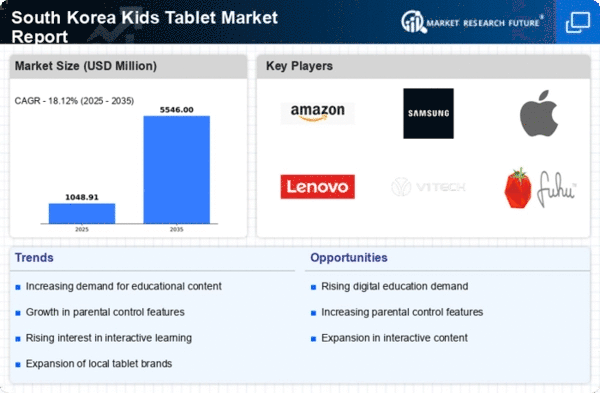
As per MRFR analysis, the South Korea kids tablet market size was estimated at 888.0 USD Million in 2024. The South Korea kids tablet market is projected to grow from 1048.91 USD Million in 2025 to 5546.0 USD Million by 2035, exhibiting a compound annual growth rate (CAGR) of 18.12% during the forecast period 2025 - 2035.

Key Market Trends & Highlights

The South Korea kids tablet market is experiencing robust growth driven by educational content and technological advancements.

  • The market is witnessing a rising demand for educational content, particularly in the largest segment of educational tablets.
  • Safety and durability are becoming increasingly prioritized features among parents in the fastest-growing segment of interactive tablets.
  • Integration of interactive features is enhancing user engagement, making tablets more appealing to children.
  • Key market drivers include increased digital learning adoption and parental concerns over screen time, which are shaping purchasing decisions.

Market Size & Forecast

2024 Market Size 888.0 (USD Million)
2035 Market Size 5546.0 (USD Million)

Major Players

Amazon (US), Samsung (KR), Apple (US), Lenovo (CN), VTech (HK), Fuhu (US), LeapFrog (US), Nabi (US)

South Korea Kids Tablet Market Trends

The kids tablet market in South Korea is currently experiencing notable growth. This growth is driven by increasing digital engagement among children and a rising demand for educational content. Parents are increasingly recognizing the value of technology in enhancing learning experiences, leading to a surge in tablet adoption for educational purposes. This trend is further supported by the proliferation of child-friendly applications and content tailored to various age groups, which cater to both entertainment and educational needs. As a result, manufacturers are focusing on developing devices that are not only user-friendly but also equipped with features that promote learning and creativity. Moreover, the competitive landscape of the kids tablet market is evolving, with both established brands and new entrants vying for market share. Companies are investing in research and development to create innovative products that meet the specific needs of children. Safety features, such as parental controls and durable designs, are becoming increasingly important to parents, influencing purchasing decisions. The emphasis on creating a safe and engaging digital environment for children is likely to shape future product offerings and marketing strategies in this sector.

Rising Demand for Educational Content

There is a growing interest among parents in providing their children with access to educational resources through tablets. This trend is reflected in the increasing availability of apps and content designed to enhance learning and cognitive development.

Focus on Safety and Durability

Manufacturers are prioritizing the development of tablets that are both safe for children and durable enough to withstand rough handling. This focus on safety features, such as parental controls, is becoming a key selling point.

Integration of Interactive Features

The incorporation of interactive elements, such as touch screens and voice recognition, is becoming more prevalent in the kids tablet market. These features are designed to engage children and facilitate a more immersive learning experience.

South Korea Kids Tablet Market Drivers

Expansion of E-Commerce Platforms

The kids tablet market in South Korea is benefiting from the expansion of e-commerce platforms, which provide parents with convenient access to a wide range of products. Online shopping has become increasingly popular, allowing consumers to compare prices and read reviews before making purchases. This trend is particularly relevant for parents seeking the best tablets for their children, as they can easily find devices that meet their specific needs. The growth of e-commerce is likely to enhance market accessibility, enabling more families to invest in tablets that support educational and entertainment purposes. As online shopping continues to thrive, the kids tablet market is expected to see increased sales and a broader customer base.

Growing Interest in STEM Education

The kids tablet market is experiencing growth driven by a rising interest in STEM (Science, Technology, Engineering, and Mathematics) education among parents and educators in South Korea. As the government emphasizes the importance of STEM skills for future job markets, there is a corresponding demand for educational tools that facilitate learning in these areas. Tablets that offer STEM-focused applications and resources are becoming increasingly popular, as they provide interactive and engaging ways for children to explore these subjects. This trend suggests that the kids tablet market will continue to expand as more parents seek devices that align with educational priorities and support their children's development in critical skill areas.

Parental Concerns Over Screen Time

In the context of the kids tablet market, parental concerns regarding screen time have prompted manufacturers to develop devices that promote healthy usage habits. Many parents in South Korea are increasingly aware of the potential negative effects of excessive screen time on children's development. As a result, there is a growing demand for tablets that offer features such as time management tools and educational content that encourages productive use. This shift in consumer behavior suggests that the market is evolving to address these concerns, with companies focusing on creating tablets that not only entertain but also educate, thereby enhancing their appeal to parents.

Increased Digital Learning Adoption

The kids tablet market in South Korea experiences a notable surge due to the increasing adoption of digital learning tools. Educational institutions are integrating technology into their curricula, which has led to a heightened demand for tablets designed specifically for children. According to recent data, approximately 70% of schools in South Korea have incorporated digital learning platforms, which often require devices like tablets. This trend indicates a shift towards interactive and engaging learning experiences, making tablets an essential tool for both educators and students. As parents recognize the benefits of digital learning, they are more inclined to invest in tablets that support educational content, thereby driving growth in the kids tablet market.

Technological Advancements in Child-Friendly Devices

The kids tablet market is significantly influenced by rapid technological advancements that enhance the functionality and appeal of child-friendly devices. Innovations such as improved battery life, enhanced durability, and advanced parental control features are becoming standard in tablets designed for children. In South Korea, the introduction of artificial intelligence and augmented reality applications in educational content is particularly noteworthy. These advancements not only make learning more engaging but also ensure that tablets can withstand the rigors of daily use by children. As technology continues to evolve, the kids tablet market is likely to see increased competition among manufacturers striving to offer the most innovative and user-friendly devices.


Market Segment Insights

By Connectivity: Wi-Fi Enabled (Dominant) vs. SIM Enabled (Fastest-Growing)

In the South Korea kids tablet market, the market share is primarily dominated by Wi-Fi Enabled devices, which cater to the growing need for consistent internet access for educational apps and streaming content. SIM Enabled tablets, while smaller in overall share, are rapidly gaining popularity due to their flexibility and the increasing mobile data availability. Brands are focusing on enhancing user experience through various connectivity options to meet diverse consumer demands. Growth trends indicate a significant shift towards more mobile solutions, with SIM Enabled tablets emerging as a choice for parents seeking devices that offer both portability and connectivity on-the-go. The rise in digital learning and online engagements among children drives this demand, while manufacturers are also investing in improving the technology and features of these tablets, making them more appealing to tech-savvy families.

Connectivity: Wi-Fi Enabled (Dominant) vs. SIM Enabled (Emerging)

Wi-Fi Enabled tablets are prevalent in the South Korea kids tablet market due to their cost-effectiveness and the abundance of wireless networks, making them the preferred choice for home and school use. These devices provide a stable connection for educational resources, thus solidifying their dominant position. In contrast, SIM Enabled tablets are attracting attention as an emerging category, appealing to families that prioritize mobility and uninterrupted access to online content regardless of location. This segment benefits from advancements in mobile data technology and competitive data plans, offering enhanced user experiences for active learners. Together, these connectivity options illustrate the diverse preferences of consumers in the market.

By RAM Size: 1 GB and Above (Largest) vs. Less Than 1 GB (Fastest-Growing)

In the South Korea kids tablet market, the distribution of RAM size reflects a significant preference for higher capacity options. Currently, tablets featuring 1 GB and above RAM dominate the market, attributed to their enhanced performance capabilities suitable for running educational applications and multimedia. Meanwhile, the segment of tablets with less than 1 GB RAM is witnessing increasing interest, particularly among budget-conscious consumers looking for economical choices. The growth trends in this segment are driven largely by the rising demand for educational content and interactive applications that require more processing power. As parents prioritize quality and performance in their children's devices, tablets with 1 GB and above RAM are expected to maintain their lead. Conversely, the less than 1 GB RAM segment is becoming popular for entry-level products, appealing to first-time tablet users or those seeking simple functionalities.

1 GB and Above (Dominant) vs. Less Than 1 GB (Emerging)

Tablets with 1 GB and above RAM are positioned as the dominant choice in the South Korea kids tablet market, providing users with superior multitasking capabilities and a smoother experience when navigating educational applications and games. This segment caters to tech-savvy parents seeking efficient devices for their children. Conversely, the less than 1 GB RAM segment, while classified as emerging, is gaining traction among budget-friendly consumers and is pivotal for entry-level tablets. These devices often serve as introductory platforms for young children to experience technology, but may face limitations in performance compared to their higher-capacity counterparts. As educational needs evolve, both segments will continue to find their respective market footholds.

By Purpose: Entertainment (Largest) vs. Educational (Fastest-Growing)

In the South Korea kids tablet market, the entertainment segment holds the largest share, driven by the increasing demand for interactive games, videos, and streaming services tailored for children. This segment appeals to both kids and parents seeking engaging content that not only entertains but also offers educational value. Conversely, the educational segment has been gaining traction, boosted by parents' growing recognition of the importance of learning through technology. Platforms designed for learning and skill development have become increasingly popular, contributing to its rapid expansion. Growth in these segments is influenced by advancements in technology and the proliferation of high-quality content available on tablets. The educational segment, in particular, is rapidly evolving, with innovations in educational apps and resources that cater to various learning styles. The push for digital learning solutions, especially post-pandemic, has led to a surge in demand for educational tablets. Providers are also focusing on creating user-friendly interfaces and interactive features that enhance the learning experience, further fueling growth in this area.

Entertainment: Dominant vs. Educational: Emerging

The entertainment segment in the South Korea kids tablet market is characterized by a robust selection of apps, games, and content that appeal to young audiences, making it the dominant force. It includes popular streaming services and interactive games, ensuring that kids are engaged while also often being educational. On the other hand, the educational segment represents an emerging area, with a growing number of apps focused on enhancing children's learning experiences through interactive and gamified content. As educational technology advances, platforms designed for learning are refining their offerings to provide better engagement and user experience. Parents are increasingly seeking out tablets that balance both entertainment and education, leading to a dynamic landscape where these segments continually adapt to meet the evolving needs of children.

By End User: 5 to 10 Years (Largest) vs. Less Than 5 Years (Fastest-Growing)

In the South Korea kids tablet market, the segment distribution shows that '5 to 10 Years' holds the largest share of the market, appealing to a significant portion of young learners who utilize tablets for educational and entertainment purposes. This demographic has been pivotal in driving sales, as parents increasingly recognize the advantages of digital learning at this age compared to traditional methods. On the other hand, 'Less Than 5 Years' is capturing market attention as the fastest-growing segment, driven by advancements in child-friendly technology and parents' growing acceptance of tablets as educational tools. This age group is seeing an influx of age-appropriate content, and the increasing digital literacy among younger children is likely to boost this segment's growth in the coming years.

5 to 10 Years (Dominant) vs. Less Than 5 Years (Emerging)

The '5 to 10 Years' segment is the dominant force in the South Korea kids tablet market, characterized by a solid demand for interactive learning applications and games that cater to this age group's educational needs. Tablets designed for this age range typically feature robust parental controls and educational content, making them appealing to parents. Conversely, the 'Less Than 5 Years' segment is emerging rapidly, marked by user-friendly interfaces and educational content tailored for early learners. This segment benefits from innovations that allow for engaging and interactive experiences, and as more families invest in technology for younger children, this segment is positioned for substantial growth.

Get more detailed insights about South Korea Kids Tablet Market

Key Players and Competitive Insights

The kids tablet market in South Korea is characterized by a dynamic competitive landscape, driven by rapid technological advancements and evolving consumer preferences. Major players such as Samsung (KR), Apple (US), and Lenovo (CN) are at the forefront, each adopting distinct strategies to capture market share. Samsung (KR) focuses on innovation and regional expansion, leveraging its strong brand presence and local manufacturing capabilities to cater to the unique needs of South Korean families. Apple (US), on the other hand, emphasizes premium product offerings and ecosystem integration, appealing to tech-savvy parents seeking high-quality educational content. Lenovo (CN) appears to be concentrating on affordability and accessibility, targeting budget-conscious consumers with competitively priced devices that do not compromise on features. Collectively, these strategies contribute to a moderately fragmented market, where competition is fierce yet collaborative, as companies often engage in partnerships to enhance their product offerings.

In terms of business tactics, companies are increasingly localizing manufacturing and optimizing supply chains to reduce costs and improve responsiveness to market demands. The competitive structure of the market is moderately fragmented, with several key players influencing trends and consumer choices. This fragmentation allows for a diverse range of products, catering to various segments of the market, from high-end devices to more affordable options. The collective influence of these key players fosters an environment where innovation and customer-centric strategies are paramount.

In October 2025, Samsung (KR) announced the launch of its latest kids tablet, which features enhanced parental controls and educational apps tailored for the South Korean curriculum. This strategic move not only reinforces Samsung's commitment to innovation but also positions the company as a leader in providing educational solutions that resonate with local consumers. By integrating culturally relevant content, Samsung (KR) aims to strengthen its market position and appeal to parents seeking devices that support their children's learning.

In September 2025, Apple (US) unveiled a new initiative aimed at expanding its educational content library for kids, partnering with local educational institutions to develop age-appropriate learning materials. This collaboration underscores Apple's strategy to deepen its engagement with the South Korean market, enhancing its ecosystem's value proposition. By aligning its offerings with local educational standards, Apple (US) seeks to attract more families to its platform, thereby increasing customer loyalty and retention.

In August 2025, Lenovo (CN) launched a promotional campaign targeting families, highlighting the affordability and educational benefits of its kids tablets. This campaign is indicative of Lenovo's strategy to penetrate the budget segment of the market, appealing to cost-conscious parents. By emphasizing value and accessibility, Lenovo (CN) aims to differentiate itself from competitors and capture a larger share of the market.

As of November 2025, current trends in the kids tablet market include a strong emphasis on digitalization, sustainability, and the integration of artificial intelligence (AI) into educational content. Companies are increasingly forming strategic alliances to enhance their technological capabilities and expand their product offerings. The competitive landscape is shifting from price-based competition to a focus on innovation, technology, and supply chain reliability. As these trends continue to evolve, companies that prioritize differentiation through unique features and sustainable practices are likely to thrive in this competitive environment.

Key Companies in the South Korea Kids Tablet Market market include

Industry Developments

The South Korea Kids’ Tablet Market has recently witnessed significant developments, particularly with major players like Samsung and LG Electronics focusing on innovative designs and enhanced educational features aimed at younger users. In August 2023, Samsung launched a new line of tablets incorporating advanced parental controls and the latest educational applications tailored for children. 

Concurrently, LG Electronics is investing heavily in Research and Development to incorporate artificial intelligence into its devices, providing personalized learning experiences for kids. Furthermore, in October 2022, Huawei expanded its offerings within the market by introducing affordable yet sophisticated tablets that cater specifically to educational needs, positioning itself strongly among competitors.On the acquisitions front, in July 2023, Lenovo announced its acquisition of a smaller tech startup that specializes in educational software, complementing its existing hardware by enhancing user experience for young learners. 

Recent market valuations indicate a growing trend, with a reported increase in the kid's tablet sector by approximately 15% from 2022 to 2023, largely attributed to the rising demand for digital learning tools in South Korea. The awareness around digital literacy continues to drive sales and innovation in this segment.

South Korea Kids’ Tablet Market Segmentation Insights

Kids’ Tablet Market Connectivity Outlook

  • Wi-Fi Enabled
  • SIM Enabled

Kids’ Tablet Market RAM Size Outlook

  • Less than 1 GB
  • 1 GB and Above

Kids’ Tablet Market Purpose Outlook

  • Entertainment
  • Educational

Kids’ Tablet Market End User Outlook

  • Less Than 5 Years
  • 5 to 10 Years
  • 10 to 15 Years

Future Outlook

South Korea Kids Tablet Market Future Outlook

The kids tablet market is projected to grow at 18.12% CAGR from 2024 to 2035, driven by technological advancements, increasing digital learning, and rising demand for educational content.

New opportunities lie in:

  • Development of subscription-based educational content platforms
  • Partnerships with schools for bulk tablet procurement
  • Integration of augmented reality features for enhanced learning experiences

By 2035, the market is expected to achieve substantial growth, positioning itself as a leader in educational technology.

Market Segmentation

South Korea Kids Tablet Market Purpose Outlook

  • Entertainment
  • Educational

South Korea Kids Tablet Market End User Outlook

  • Less Than 5 Years
  • 5 to 10 Years
  • 10 to 15 Years

South Korea Kids Tablet Market RAM Size Outlook

  • Less Than 1 GB
  • 1 GB and Above

South Korea Kids Tablet Market Connectivity Outlook

  • Wi-Fi Enabled
  • SIM Enabled

Report Scope

MARKET SIZE 2024 888.0(USD Million)
MARKET SIZE 2025 1048.91(USD Million)
MARKET SIZE 2035 5546.0(USD Million)
COMPOUND ANNUAL GROWTH RATE (CAGR) 18.12% (2024 - 2035)
REPORT COVERAGE Revenue Forecast, Competitive Landscape, Growth Factors, and Trends
BASE YEAR 2024
Market Forecast Period 2025 - 2035
Historical Data 2019 - 2024
Market Forecast Units USD Million
Key Companies Profiled Amazon (US), Samsung (KR), Apple (US), Lenovo (CN), VTech (HK), Fuhu (US), LeapFrog (US), Nabi (US)
Segments Covered Connectivity, RAM Size, Purpose, End User
Key Market Opportunities Integration of educational content with interactive features enhances engagement in the kids tablet market.
Key Market Dynamics Rising demand for educational content drives innovation in the kids tablet market, enhancing user engagement and learning outcomes.
Countries Covered South Korea

Leave a Comment

FAQs

What is the projected market size of the South Korea Kids Tablet Market in 2024?

The South Korea Kids Tablet Market is projected to be valued at 1.12 USD Billion in 2024.

What is the expected market growth rate for the South Korea Kids Tablet Market from 2025 to 2035?

The expected CAGR for the South Korea Kids Tablet Market from 2025 to 2035 is 20.102%.

How is the market value of Wi-Fi Enabled Kids Tablets projected to change from 2024 to 2035?

The market value for Wi-Fi Enabled Kids Tablets is expected to grow from 0.75 USD Billion in 2024 to 5.25 USD Billion in 2035.

What is the projected market size for SIM Enabled Kids Tablets by 2035?

The projected market size for SIM Enabled Kids Tablets is expected to reach 3.15 USD Billion by 2035.

Who are the key players in the South Korea Kids Tablet Market?

Key players in the South Korea Kids Tablet Market include Xiaoxi, Lenovo, Fuhu, Asus, Huawei, Vtech, LG Electronics, Microsoft, Kidoz, Amazon, Apple, Jumper, Nabi, and Samsung.

What market size is expected for the South Korea Kids Tablet Market in 2035?

The overall market is expected to be valued at 8.4 USD Billion by the year 2035.

What is the market value of SIM Enabled Kids Tablets in 2024?

The market value for SIM Enabled Kids Tablets is estimated to be 0.37 USD Billion in 2024.

How does the market for Kids Tablets in South Korea compare for Wi-Fi and SIM Enabled devices?

In 2024, the Wi-Fi Enabled market is larger at 0.75 USD Billion compared to the SIM Enabled market at 0.37 USD Billion.

What are the anticipated growth drivers for the South Korea Kids Tablet Market?

Anticipated growth drivers for the market include increasing digital engagement among children and advancements in educational technology.

What opportunities exist within the South Korea Kids Tablet Market?

Opportunities within the market include the growing demand for educational content and increased adoption of technology among younger demographics.

Download Free Sample

Kindly complete the form below to receive a free sample of this Report

Compare Licence

×
Features License Type
Single User Multiuser License Enterprise User
Price $4,950 $5,950 $7,250
Maximum User Access Limit 1 User Upto 10 Users Unrestricted Access Throughout the Organization
Free Customization
Direct Access to Analyst
Deliverable Format
Platform Access
Discount on Next Purchase 10% 15% 15%
Printable Versions