Request Free Sample ×

Kindly complete the form below to receive a free sample of this Report

* Please use a valid business email

Leading companies partner with us for data-driven Insights

clients tt-cursor
Hero Background
English
Chinese
French
Japanese
Korean
German
Spanish

Immersive Technology in Mining Sector Market Trends

ID: MRFR/ICT/10684-HCR
128 Pages
Ankit Gupta
December 2024

Immersive Technology in Mining Sector Market Research Report: Information By Component (Hardware (Head-Mounted Display (HMD), Gesture Tracking Devices (GTD), Projectors & Display Walls (PDW)), Software/Platform, Services (Professional and Managed)), By Technology (Mixed Reality (MR), Virtual Reality (VR), Augmented Reality (AR) and 360 Film), By Application (Training & Learning, Emergency Services, Product Development and Sales & Marketing) And By Region (North America, Europe, Asia-Pacific, And Rest Of The World) –Market Forecast Till 2035.

Share:
Download PDF ×

We do not share your information with anyone. However, we may send you emails based on your report interest from time to time. You may contact us at any time to opt-out.

Immersive Technology in Mining Sector Market Infographic
Purchase Options

Market Trends

Key Emerging Trends in the Immersive Technology in Mining Sector Market

The market for Immersive Technology in the Mining Sector is an emerging industry that could change the global mining sector by improving safety standards and increasing efficiency in operations at different levels of productivity. In this regard, some of these companies seek to occupy leading positions by using various methods, such as market share positioning strategies within this context. The first approach involves safety and training, which is one of the primary strategies used by firms involved in Immersive Technology within Mining Sector Market today. Solving this challenge requires realistic experiences that only virtual reality(VR )and augmented reality(AR) can provide for staff working underground within mines as well as extraterrestrial human beings on other planets. Mining simulators that provide real-world scenarios are essential for ensuring that trainees gain practical knowledge about how they operate safely under these hazardous conditions. Immersive technologies like virtual reality can simulate dangerous mining situations where employees can practice emergency actions, thereby enhancing their preparedness. In addition, AR overlays digital information onto real-world mining environments so that workers get ongoing safety alerts, instructions for operating equipment, or warnings of dangers. Another aspect of Immersive Technology in Mining Sector that must not be ignored is remote monitoring and control. Remote locations with harsh terrains are the usual environments where mining activities take place, hence making it difficult for people to reach these sites and monitor their operations in real time. In this context, immersive technologies combined with advanced connectivity will enable companies to monitor and control their mining operations from a distance. These corporations can attract customers who value operational efficiency and cost-effectiveness by positioning themselves as providers of advanced remote monitoring and control solutions. Mining firms also embrace collaboration and partnerships as key strategies in the Immersive Technology within the Mining Sector Market. As a result, most mining companies form relationships with technology providers, software developers, or research institutions to boost their immersion capabilities. In turn, this enables them to leverage cutting-edge technologies provided by established players while at the same time taking advantage of existing research networks through accessing sophisticated simulation software. Additionally, market share positioning requires productivity optimization in the Immersive Technology in Mining Sector market. Numerous applications can help optimize mining workflow using virtual reality technology, thus leading to increased operational efficiencies coupled with reduced downtimes. A good example is VR, which provides miners with an opportunity to emulate the extraction process, thus identifying areas that need improvement, such as the location of machines or workflow optimization. Furthermore; AR offers real-time instructions instead of having operators go back to manuals so that they make efficient assessments. Another application could be given by employing immersive solutions for better work performance, which would mean added output, reduced costs incurred during processes, and more competitive standing among other players. By offering productivity enhancement products, producers can improve output capacity while decreasing input costs, thereby enhancing competitiveness amongst them.


Author
Author Profile
Ankit Gupta
Team Lead - Research

Ankit Gupta is a seasoned market intelligence and strategic research professional with over six plus years of experience in the ICT and Semiconductor industries. With academic roots in Telecom, Marketing, and Electronics, he blends technical insight with business strategy. Ankit has led 200+ projects, including work for Fortune 500 clients like Microsoft and Rio Tinto, covering market sizing, tech forecasting, and go-to-market strategies. Known for bridging engineering and enterprise decision-making, his insights support growth, innovation, and investment planning across diverse technology markets.

Leave a Comment

FAQs

What is the projected market valuation for immersive technology in the mining sector by 2035?

<p>The projected market valuation for immersive technology in the mining sector is expected to reach 3.969 USD Billion by 2035.</p>

What was the market valuation for immersive technology in the mining sector in 2024?

<p>The overall market valuation for immersive technology in the mining sector was 0.8933 USD Billion in 2024.</p>

What is the expected compound annual growth rate (CAGR) for the immersive technology in mining sector from 2025 to 2035?

<p>The expected CAGR for the immersive technology in the mining sector during the forecast period 2025 - 2035 is 14.52%.</p>

Which companies are considered key players in the immersive technology mining sector?

<p>Key players in the immersive technology mining sector include Hexagon AB, Siemens AG, Caterpillar Inc, Komatsu Ltd, Sandvik AB, Epiroc AB, ABB Ltd, Rockwell Automation Inc, VRSim Inc, and Immersive Technologies Pty Ltd.</p>

What are the main components of the immersive technology market in mining, and their valuations?

<p>The main components include Hardware valued at 1.1935 USD Billion, Software/Platform at 1.5965 USD Billion, and Services at 1.179 USD Billion.</p>

How does the market for mixed reality (MR) technology in mining compare to virtual reality (VR) technology?

<p>Both mixed reality (MR) and virtual reality (VR) technologies are valued at 1.1935 USD Billion in the immersive technology mining sector.</p>

What applications are driving growth in the immersive technology mining sector?

Key applications driving growth include Training &amp; Learning valued at 1.1935 USD Billion, Emergency Services at 0.7935 USD Billion, and Sales &amp; Marketing at 1.1885 USD Billion.

What is the valuation of 360 Film technology in the immersive mining sector?

The valuation of 360 Film technology in the immersive mining sector is 0.3885 USD Billion.

How does the immersive technology market in mining reflect on the overall industry trends?

The immersive technology market in mining reflects a growing trend towards digital transformation, with a projected increase in valuation indicating a shift in operational methodologies.

What potential does immersive technology hold for enhancing safety in mining operations?

Immersive technology holds substantial potential for enhancing safety in mining operations, particularly through applications in Training &amp; Learning and Emergency Services.

Market Summary

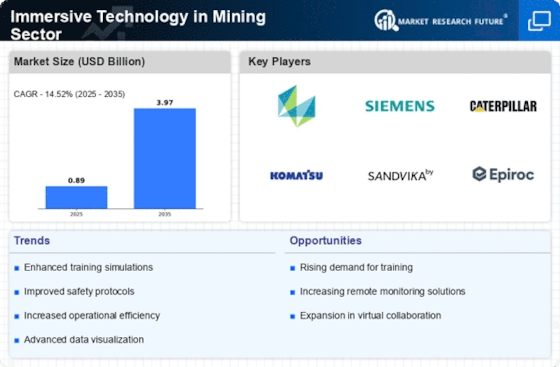
As per Market Research Future analysis, the Immersive Technology in Mining Sector Market Size was estimated at 0.8933 USD Billion in 2024. The Immersive Technology in Mining industry is projected to grow from USD 1.023 Billion in 2025 to USD 3.969 Billion by 2035, exhibiting a compound annual growth rate (CAGR) of 14.52% during the forecast period 2025 - 2035

Key Market Trends & Highlights

The market for immersive technology in the mining sector is experiencing robust growth driven by advancements in training and operational efficiency.

  • North America remains the largest market for immersive technology in mining, driven by significant investments in safety and training solutions. The Asia-Pacific region is emerging as the fastest-growing market, fueled by increasing demand for innovative mining practices and technologies. Hardware continues to dominate the market, while software and platform solutions are rapidly gaining traction as the fastest-growing segment. Key market drivers include enhanced operational efficiency and regulatory compliance, which are essential for meeting safety standards and improving resource management.

Market Size & Forecast

2024 Market Size 0.8933 (USD Billion)
2035 Market Size 3.969 (USD Billion)
CAGR (2025 - 2035) 14.52%
Largest Regional Market Share in 2024 North America

Major Players

Hexagon AB (SE), Siemens AG (DE), Caterpillar Inc (US), Komatsu Ltd (JP), Sandvik AB (SE), Epiroc AB (SE), ABB Ltd (CH), Rockwell Automation Inc (US), VRSim Inc (US), Immersive Technologies Pty Ltd (AU)

Market Trends

The Immersive Technology in Mining Sector Market is currently experiencing a transformative phase, characterized by the integration of advanced technologies such as virtual reality, augmented reality, and mixed reality. These innovations are reshaping traditional mining practices, enhancing safety protocols, and improving operational efficiency. By simulating real-world environments, immersive technologies allow for comprehensive training programs, enabling workers to gain hands-on experience without the associated risks. Furthermore, these technologies facilitate remote collaboration, allowing experts to engage with on-site teams in real-time, thereby streamlining decision-making processes and reducing downtime. In addition to training and collaboration, the Immersive Technology in Mining Sector Market is also fostering advancements in exploration and resource management. By utilizing immersive simulations, companies can visualize geological data more effectively, leading to better resource allocation and extraction strategies. This not only optimizes productivity but also minimizes environmental impact. As the industry continues to evolve, the potential for immersive technologies to drive innovation and sustainability appears promising, suggesting a future where mining operations are safer, more efficient, and environmentally conscious.

Enhanced Training and Safety

Immersive Technology in Mining Sector Market is revolutionizing training methodologies, allowing workers to engage in realistic simulations. This approach enhances safety by providing a risk-free environment for skill development, ensuring that personnel are well-prepared for real-world challenges.

Remote Collaboration and Support

The integration of immersive technologies facilitates remote collaboration, enabling experts to assist on-site teams in real-time. This capability not only improves communication but also enhances problem-solving efficiency, reducing operational delays.

Improved Resource Visualization

Immersive Technology in Mining Sector Market allows for advanced visualization of geological data. By creating immersive simulations, companies can better understand resource distribution, leading to more informed decision-making and optimized extraction processes.

Immersive Technology in Mining Sector Market Market Drivers

Data-Driven Decision Making

The rise of data analytics within the Immersive Technology in Mining Sector Market is reshaping decision-making processes. Immersive technologies facilitate the integration of large datasets into visual formats, allowing stakeholders to interpret complex information more intuitively. This capability is particularly valuable in resource exploration and extraction, where data-driven insights can lead to more informed strategic decisions. Companies that adopt immersive technologies for data visualization may find themselves at a competitive advantage, as they can respond more swiftly to market changes. The trend suggests that as data becomes increasingly central to mining operations, immersive technology will play a crucial role in enhancing analytical capabilities.

Enhanced Operational Efficiency

The Immersive Technology in Mining Sector Market appears to be driven by the need for enhanced operational efficiency. Technologies such as virtual reality (VR) and augmented reality (AR) facilitate real-time data visualization and simulation, which can lead to improved decision-making processes. For instance, immersive training programs can reduce the time required for new employees to become proficient, potentially decreasing operational downtime. According to recent data, companies that have integrated immersive technologies report a 20% increase in productivity. This trend suggests that as mining operations seek to optimize their processes, the adoption of immersive technology will likely continue to rise.

Cost Reduction and Resource Management

Cost reduction remains a pivotal driver within the Immersive Technology in Mining Sector Market. By utilizing immersive technologies, mining companies can minimize expenses related to training, equipment maintenance, and safety compliance. For example, AR applications can provide real-time guidance for equipment repairs, reducing the need for costly expert consultations. Furthermore, immersive simulations can help in resource management by allowing companies to visualize and analyze resource extraction processes more effectively. Reports indicate that organizations leveraging these technologies may experience a 15% reduction in operational costs, underscoring the financial benefits of adopting immersive solutions.

Sustainability and Environmental Impact

Sustainability concerns are becoming a significant driver in the Immersive Technology in Mining Sector Market. As mining operations face increasing scrutiny regarding their environmental impact, immersive technologies offer innovative solutions for monitoring and managing ecological footprints. For instance, AR can be employed to visualize the effects of mining activities on surrounding ecosystems, enabling companies to implement more sustainable practices. Additionally, immersive simulations can aid in planning and executing environmentally responsible extraction methods. The emphasis on sustainability is likely to propel the adoption of immersive technologies, as companies strive to align their operations with environmental standards and community expectations.

Regulatory Compliance and Safety Standards

The Immersive Technology in Mining Sector Market is increasingly influenced by the need for compliance with stringent safety regulations. Immersive technologies, such as VR training modules, enable workers to engage in realistic simulations of hazardous scenarios without the associated risks. This proactive approach to safety training not only enhances worker preparedness but also aids companies in meeting regulatory requirements. As safety standards evolve, the integration of immersive technology is likely to become a critical component in ensuring compliance, potentially reducing workplace accidents by up to 30%. This trend indicates a growing recognition of the role immersive technology plays in fostering a safer mining environment.

Market Segment Insights

By Component: Hardware (Largest) vs. Software/Platform (Fastest-Growing)

In the Immersive Technology in Mining Sector Market, the component segment exhibits a diverse distribution among hardware, software/platform, and services. Hardware emerges as the largest segment, leveraging advanced technologies such as virtual reality (VR) and augmented reality (AR) devices to enhance operational efficiency and safety in mining operations. Software and platform solutions have gained significant traction, presenting innovative applications and integration capabilities that cater to the evolving needs of the industry.

Immersive Solutions: Hardware (Dominant) vs. Software/Platform (Emerging)

The hardware segment remains dominant in the Immersive Technology in Mining Sector Market, characterized by the integration of cutting-edge devices like VR headsets and AR overlays that facilitate real-time collaboration and immersive training. On the other hand, the software/platform segment is emerging rapidly, characterized by advanced analytical tools and platforms that streamline data management, enhance user experience, and integrate seamlessly with hardware. This combination of robust hardware capability and innovative software solutions positions the sector for significant growth, as firms increasingly look to technology to improve efficiencies and safety within their operations.

By Technology: Virtual Reality (Largest) vs. Augmented Reality (Fastest-Growing)

In the Immersive Technology in Mining Sector Market, Virtual Reality (VR) has emerged as the largest segment, primarily due to its extensive adoption for training and simulation purposes. Mixed Reality (MR) and 360 Film also contribute significantly but are currently behind VR in terms of market share. Augmented Reality (AR), while maintaining a smaller market share, is rapidly gaining traction as more companies recognize its potential for real-time data visualization and operational enhancement on-site.

Technology: Virtual Reality (Dominant) vs. Augmented Reality (Emerging)

Virtual Reality (VR) stands out as the dominant technology in the mining sector, providing immersive training environments that enhance skill acquisition and safety awareness. It enables miners to simulate hazardous conditions without physical risks, which is invaluable for preparing them for real-life challenges. On the other hand, Augmented Reality (AR) is positioned as an emerging technology, leveraging mobile devices and smart glasses to overlay critical data onto physical environments. AR is particularly appealing as it assists in real-time decision-making and improves operational efficiency by allowing workers to visualize complex data seamlessly as they perform tasks on-site.

By Application: Training & Learning (Largest) vs. Emergency Services (Fastest-Growing)

In the Immersive Technology in Mining Sector Market, the application segment is robustly diversified with significant market share across various values. Training &amp; Learning emerges as the largest segment, driven by mining companies focusing on employee skill enhancement and safety training through immersive simulations. This application captures a significant portion of the market as it caters to the increasing need for effective training solutions that minimize real-world risks while maximizing learning outcomes. Emergency Services is quickly becoming the fastest-growing application within this sector. The need for immediate and realistic training for crisis management in mines has surged, prompting mining operations to invest heavily in immersive technologies. This rapid growth is propelled by advancements in virtual reality and augmented reality solutions, allowing emergency scenarios to be simulated for preparedness without endangering actual personnel, thus revolutionizing the way emergency services are trained in mining environments.

Training &amp; Learning (Dominant) vs. Product Development (Emerging)

The Training &amp; Learning segment is currently the dominant application within the Immersive Technology in Mining Sector Market, primarily due to its comprehensive approach to enhancing worker safety and operational competence. This segment utilizes virtual simulations to create realistic training environments, which have proven invaluable in reducing accidents and improving employee readiness. In contrast, the Product Development segment is emerging as a crucial value, leveraging immersive technology to develop new mining products or improve existing ones. Firms are increasingly adopting virtual prototyping and testing through immersive platforms, allowing for expedited development timelines and reduced costs. This dynamic interplay between training and product innovation underscores the shifting priorities within the mining industry towards leveraging technology for operational excellence.

Get more detailed insights about Immersive Technology in Mining Sector Market Research Report – Forecast till 2035

Regional Insights

North America : Innovation and Technology Leader

North America is the largest market for immersive technology in the mining sector, holding approximately 45% of the global market share. The region's growth is driven by advancements in technology, increased investment in automation, and a strong regulatory framework promoting safety and efficiency. The demand for immersive solutions is further fueled by the need for enhanced training and operational efficiency in mining operations. The United States and Canada are the leading countries in this sector, with major players like Caterpillar Inc, Hexagon AB, and Rockwell Automation Inc establishing a strong presence. The competitive landscape is characterized by continuous innovation and partnerships among key players, ensuring that North America remains at the forefront of immersive technology applications in mining.

Europe : Regulatory Framework and Innovation

Europe is the second-largest market for immersive technology in mining, accounting for around 30% of the global share. The region's growth is supported by stringent regulations aimed at improving safety and operational efficiency, alongside a strong emphasis on sustainability. Countries like Germany and Sweden are leading the charge, with increasing investments in digital transformation and immersive training solutions. Germany, Sweden, and Finland are key players in this market, with companies such as Siemens AG and Sandvik AB driving innovation. The competitive landscape is marked by collaborations between technology providers and mining companies, enhancing the adoption of immersive technologies. The European Union's commitment to digitalization in mining further propels market growth, ensuring a robust future for immersive solutions in the sector.

Asia-Pacific : Rapidly Growing Market Potential

Asia-Pacific is witnessing rapid growth in the immersive technology sector for mining, holding approximately 20% of the global market share. The region's growth is driven by increasing mining activities, particularly in countries like Australia and China, where there is a strong push for modernization and efficiency. Regulatory support for technological advancements is also a significant catalyst for market expansion. Australia and China are the leading countries in this region, with key players like Komatsu Ltd and Epiroc AB actively investing in immersive technologies. The competitive landscape is evolving, with local companies emerging alongside established global players. The focus on enhancing safety and training through immersive solutions is expected to drive further adoption in the coming years, positioning Asia-Pacific as a key player in the global market.

Middle East and Africa : Emerging Opportunities in Mining

The Middle East and Africa region is gradually emerging as a market for immersive technology in mining, currently holding about 5% of the global market share. The growth is primarily driven by increasing investments in mining infrastructure and a growing recognition of the benefits of immersive technologies for training and operational efficiency. Countries like South Africa and the UAE are beginning to adopt these technologies, supported by favorable government initiatives. South Africa is the leading country in this region, with a focus on enhancing safety and productivity in mining operations. The competitive landscape is characterized by a mix of local and international players, with companies like Immersive Technologies Pty Ltd gaining traction. As the region continues to develop its mining sector, the adoption of immersive technologies is expected to grow, presenting significant opportunities for innovation and investment.

Key Players and Competitive Insights

Leading market players are investing heavily in research and development in order to expand their product lines, which will help the Immersive Technology in Mining Sector Market, grow even more. Market participants are also undertaking a variety of strategic activities to expand their footprint, with important market developments including new product launches, contractual agreements, mergers and acquisitions, higher investments, and collaboration with other organizations. To expand and survive in a more competitive and rising market climate, Immersive Technology in Mining Sector industry must offer cost-effective items. Manufacturing locally to minimize operational costs is one of the key business tactics used by manufacturers in the Immersive Technology in Mining Sector industry to benefit clients and increase the market sector. In recent years, the Immersive Technology in Mining Sector industry has offered some of the most significant advantages to medicine. Major players in the Immersive Technology in Mining Sector Market, including Acer Inc., Atheer, Inc., AVEVA Group PLC, Barco NV, Blippar Ltd., Carl Zeiss AG, CM Labs Simulations Inc., EON Reality, Inc., FAAC Incorporated, Google, LLC, HCL Technologies Limited, Honeywell International, Inc., HTC Corporation, Immersive Media Company, Immersive Technologies Pty Limited, Lockheed Martin Corporation, Magic Leap, Inc., NCTech Limited, Oculus (Facebook Technologies, LLC.), Samsung Group, Sony Corporation, Unity Software Inc., Varjo Technologies Oy, VI-grade GmbH, Zeality Inc. and others, are attempting to increase market demand by investing in research and development operations. Barco NV (Barco) develops, produces, and sells products for networked visualization. Displays, workstation platforms, monitors, image processors, LED displays, visual display systems, projectors, and video walls are among the company's products. Additionally, it provides networked solutions, AV streaming goods, presentation and collaboration systems, 3D sound systems, and related software products. Among other things, Barco offers systems for simulation, boardrooms, network operation centers, meeting spaces, and classrooms. The business is run through a network of independent sales and marketing, customer service, R&D, and production facilities spread across Europe, the Middle East, Africa, the Americas, and Asia-Pacific. The headquarters of Barco are located in Kortrijk, Flandre Orientale, Belgium. The medical technology company Carl Zeiss AG (Carl Zeiss), a division of Carl Zeiss Stiftung AG, manufactures and markets optical and optoelectronic devices. Binoculars, camera and cine lenses, eyeglass lenses, measuring technologies, photomask systems, microscopes, and medical technology products, such as ophthalmic diagnostic and therapeutic devices, are all part of the company's product portfolio. Additionally, it offers planetarium software for use with small, medium, and large projection equipment in sky theaters, star theaters, and universe theaters. Numerous sectors, including those in semiconductor, automotive, mechanical, biomedical, and medical technology, are served by it. The corporation has operations in EMEA, the Americas, and APAC. Oberkochen, Germany is home to Carl Zeiss's corporate headquarters.

Key Companies in the Immersive Technology in Mining Sector Market include

Industry Developments

Future Outlook

Immersive Technology in Mining Sector Market Future Outlook

The Immersive Technology in Mining Sector Market is projected to grow at a 14.52% CAGR from 2025 to 2035, driven by advancements in safety, efficiency, and training methodologies.

New opportunities lie in:

  • <p>Development of augmented reality training modules for operational safety. Integration of virtual reality simulations for equipment maintenance training. Implementation of immersive data visualization tools for real-time decision-making.</p>

By 2035, the market is expected to be robust, driven by innovative applications and increased adoption.

Market Segmentation

Immersive Technology in Mining Sector Market Component Outlook

  • Hardware
  • Software/Platform
  • Services

Immersive Technology in Mining Sector Market Technology Outlook

  • Mixed Reality (MR)
  • Virtual Reality (VR)
  • Augmented Reality (AR)
  • 360 Film

Immersive Technology in Mining Sector Market Application Outlook

  • Training & Learning
  • Emergency Services
  • Product Development
  • Sales & Marketing

Report Scope

MARKET SIZE 2024 0.8933(USD Billion)
MARKET SIZE 2025 1.023(USD Billion)
MARKET SIZE 2035 3.969(USD Billion)
COMPOUND ANNUAL GROWTH RATE (CAGR) 14.52% (2025 - 2035)
REPORT COVERAGE Revenue Forecast, Competitive Landscape, Growth Factors, and Trends
BASE YEAR 2024
Market Forecast Period 2025 - 2035
Historical Data 2019 - 2024
Market Forecast Units USD Billion
Key Companies Profiled Hexagon AB (SE), Siemens AG (DE), Caterpillar Inc (US), Komatsu Ltd (JP), Sandvik AB (SE), Epiroc AB (SE), ABB Ltd (CH), Rockwell Automation Inc (US), VRSim Inc (US), Immersive Technologies Pty Ltd (AU)
Segments Covered Component, Technology, Application, Region
Key Market Opportunities Integration of augmented reality for enhanced training and operational efficiency in the Immersive Technology in Mining Sector.
Key Market Dynamics Rising adoption of immersive technology enhances operational efficiency and safety in mining operations worldwide.
Countries Covered North America, Europe, APAC, South America, MEA

FAQs

What is the projected market valuation for immersive technology in the mining sector by 2035?

<p>The projected market valuation for immersive technology in the mining sector is expected to reach 3.969 USD Billion by 2035.</p>

What was the market valuation for immersive technology in the mining sector in 2024?

<p>The overall market valuation for immersive technology in the mining sector was 0.8933 USD Billion in 2024.</p>

What is the expected compound annual growth rate (CAGR) for the immersive technology in mining sector from 2025 to 2035?

<p>The expected CAGR for the immersive technology in the mining sector during the forecast period 2025 - 2035 is 14.52%.</p>

Which companies are considered key players in the immersive technology mining sector?

<p>Key players in the immersive technology mining sector include Hexagon AB, Siemens AG, Caterpillar Inc, Komatsu Ltd, Sandvik AB, Epiroc AB, ABB Ltd, Rockwell Automation Inc, VRSim Inc, and Immersive Technologies Pty Ltd.</p>

What are the main components of the immersive technology market in mining, and their valuations?

<p>The main components include Hardware valued at 1.1935 USD Billion, Software/Platform at 1.5965 USD Billion, and Services at 1.179 USD Billion.</p>

How does the market for mixed reality (MR) technology in mining compare to virtual reality (VR) technology?

<p>Both mixed reality (MR) and virtual reality (VR) technologies are valued at 1.1935 USD Billion in the immersive technology mining sector.</p>

What applications are driving growth in the immersive technology mining sector?

Key applications driving growth include Training &amp; Learning valued at 1.1935 USD Billion, Emergency Services at 0.7935 USD Billion, and Sales &amp; Marketing at 1.1885 USD Billion.

What is the valuation of 360 Film technology in the immersive mining sector?

The valuation of 360 Film technology in the immersive mining sector is 0.3885 USD Billion.

How does the immersive technology market in mining reflect on the overall industry trends?

The immersive technology market in mining reflects a growing trend towards digital transformation, with a projected increase in valuation indicating a shift in operational methodologies.

What potential does immersive technology hold for enhancing safety in mining operations?

Immersive technology holds substantial potential for enhancing safety in mining operations, particularly through applications in Training &amp; Learning and Emergency Services.

  1. SECTION I: EXECUTIVE SUMMARY AND KEY HIGHLIGHTS
    1. | 1.1 EXECUTIVE SUMMARY
    2. | | 1.1.1 Market Overview
    3. | | 1.1.2 Key Findings
    4. | | 1.1.3 Market Segmentation
    5. | | 1.1.4 Competitive Landscape
    6. | | 1.1.5 Challenges and Opportunities
    7. | | 1.1.6 Future Outlook
  2. SECTION II: SCOPING, METHODOLOGY AND MARKET STRUCTURE
    1. | 2.1 MARKET INTRODUCTION
    2. | | 2.1.1 Definition
    3. | | 2.1.2 Scope of the study
    4. | | | 2.1.2.1 Research Objective
    5. | | | 2.1.2.2 Assumption
    6. | | | 2.1.2.3 Limitations
    7. | 2.2 RESEARCH METHODOLOGY
    8. | | 2.2.1 Overview
    9. | | 2.2.2 Data Mining
    10. | | 2.2.3 Secondary Research
    11. | | 2.2.4 Primary Research
    12. | | | 2.2.4.1 Primary Interviews and Information Gathering Process
    13. | | | 2.2.4.2 Breakdown of Primary Respondents
    14. | | 2.2.5 Forecasting Model
    15. | | 2.2.6 Market Size Estimation
    16. | | | 2.2.6.1 Bottom-Up Approach
    17. | | | 2.2.6.2 Top-Down Approach
    18. | | 2.2.7 Data Triangulation
    19. | | 2.2.8 Validation
  3. SECTION III: QUALITATIVE ANALYSIS
    1. | 3.1 MARKET DYNAMICS
    2. | | 3.1.1 Overview
    3. | | 3.1.2 Drivers
    4. | | 3.1.3 Restraints
    5. | | 3.1.4 Opportunities
    6. | 3.2 MARKET FACTOR ANALYSIS
    7. | | 3.2.1 Value chain Analysis
    8. | | 3.2.2 Porter's Five Forces Analysis
    9. | | | 3.2.2.1 Bargaining Power of Suppliers
    10. | | | 3.2.2.2 Bargaining Power of Buyers
    11. | | | 3.2.2.3 Threat of New Entrants
    12. | | | 3.2.2.4 Threat of Substitutes
    13. | | | 3.2.2.5 Intensity of Rivalry
    14. | | 3.2.3 COVID-19 Impact Analysis
    15. | | | 3.2.3.1 Market Impact Analysis
    16. | | | 3.2.3.2 Regional Impact
    17. | | | 3.2.3.3 Opportunity and Threat Analysis
  4. SECTION IV: QUANTITATIVE ANALYSIS
    1. | 4.1 Information and Communications Technology, BY Component (USD Billion)
    2. | | 4.1.1 Hardware
    3. | | 4.1.2 Software/Platform
    4. | | 4.1.3 Services
    5. | 4.2 Information and Communications Technology, BY Technology (USD Billion)
    6. | | 4.2.1 Mixed Reality (MR)
    7. | | 4.2.2 Virtual Reality (VR)
    8. | | 4.2.3 Augmented Reality (AR)
    9. | | 4.2.4 360 Film
    10. | 4.3 Information and Communications Technology, BY Application (USD Billion)
    11. | | 4.3.1 Training & Learning
    12. | | 4.3.2 Emergency Services
    13. | | 4.3.3 Product Development
    14. | | 4.3.4 Sales & Marketing
    15. | 4.4 Information and Communications Technology, BY Region (USD Billion)
    16. | | 4.4.1 North America
    17. | | | 4.4.1.1 US
    18. | | | 4.4.1.2 Canada
    19. | | 4.4.2 Europe
    20. | | | 4.4.2.1 Germany
    21. | | | 4.4.2.2 UK
    22. | | | 4.4.2.3 France
    23. | | | 4.4.2.4 Russia
    24. | | | 4.4.2.5 Italy
    25. | | | 4.4.2.6 Spain
    26. | | | 4.4.2.7 Rest of Europe
    27. | | 4.4.3 APAC
    28. | | | 4.4.3.1 China
    29. | | | 4.4.3.2 India
    30. | | | 4.4.3.3 Japan
    31. | | | 4.4.3.4 South Korea
    32. | | | 4.4.3.5 Malaysia
    33. | | | 4.4.3.6 Thailand
    34. | | | 4.4.3.7 Indonesia
    35. | | | 4.4.3.8 Rest of APAC
    36. | | 4.4.4 South America
    37. | | | 4.4.4.1 Brazil
    38. | | | 4.4.4.2 Mexico
    39. | | | 4.4.4.3 Argentina
    40. | | | 4.4.4.4 Rest of South America
    41. | | 4.4.5 MEA
    42. | | | 4.4.5.1 GCC Countries
    43. | | | 4.4.5.2 South Africa
    44. | | | 4.4.5.3 Rest of MEA
  5. SECTION V: COMPETITIVE ANALYSIS
    1. | 5.1 Competitive Landscape
    2. | | 5.1.1 Overview
    3. | | 5.1.2 Competitive Analysis
    4. | | 5.1.3 Market share Analysis
    5. | | 5.1.4 Major Growth Strategy in the Information and Communications Technology
    6. | | 5.1.5 Competitive Benchmarking
    7. | | 5.1.6 Leading Players in Terms of Number of Developments in the Information and Communications Technology
    8. | | 5.1.7 Key developments and growth strategies
    9. | | | 5.1.7.1 New Product Launch/Service Deployment
    10. | | | 5.1.7.2 Merger & Acquisitions
    11. | | | 5.1.7.3 Joint Ventures
    12. | | 5.1.8 Major Players Financial Matrix
    13. | | | 5.1.8.1 Sales and Operating Income
    14. | | | 5.1.8.2 Major Players R&D Expenditure. 2023
    15. | 5.2 Company Profiles
    16. | | 5.2.1 Hexagon AB (SE)
    17. | | | 5.2.1.1 Financial Overview
    18. | | | 5.2.1.2 Products Offered
    19. | | | 5.2.1.3 Key Developments
    20. | | | 5.2.1.4 SWOT Analysis
    21. | | | 5.2.1.5 Key Strategies
    22. | | 5.2.2 Siemens AG (DE)
    23. | | | 5.2.2.1 Financial Overview
    24. | | | 5.2.2.2 Products Offered
    25. | | | 5.2.2.3 Key Developments
    26. | | | 5.2.2.4 SWOT Analysis
    27. | | | 5.2.2.5 Key Strategies
    28. | | 5.2.3 Caterpillar Inc (US)
    29. | | | 5.2.3.1 Financial Overview
    30. | | | 5.2.3.2 Products Offered
    31. | | | 5.2.3.3 Key Developments
    32. | | | 5.2.3.4 SWOT Analysis
    33. | | | 5.2.3.5 Key Strategies
    34. | | 5.2.4 Komatsu Ltd (JP)
    35. | | | 5.2.4.1 Financial Overview
    36. | | | 5.2.4.2 Products Offered
    37. | | | 5.2.4.3 Key Developments
    38. | | | 5.2.4.4 SWOT Analysis
    39. | | | 5.2.4.5 Key Strategies
    40. | | 5.2.5 Sandvik AB (SE)
    41. | | | 5.2.5.1 Financial Overview
    42. | | | 5.2.5.2 Products Offered
    43. | | | 5.2.5.3 Key Developments
    44. | | | 5.2.5.4 SWOT Analysis
    45. | | | 5.2.5.5 Key Strategies
    46. | | 5.2.6 Epiroc AB (SE)
    47. | | | 5.2.6.1 Financial Overview
    48. | | | 5.2.6.2 Products Offered
    49. | | | 5.2.6.3 Key Developments
    50. | | | 5.2.6.4 SWOT Analysis
    51. | | | 5.2.6.5 Key Strategies
    52. | | 5.2.7 ABB Ltd (CH)
    53. | | | 5.2.7.1 Financial Overview
    54. | | | 5.2.7.2 Products Offered
    55. | | | 5.2.7.3 Key Developments
    56. | | | 5.2.7.4 SWOT Analysis
    57. | | | 5.2.7.5 Key Strategies
    58. | | 5.2.8 Rockwell Automation Inc (US)
    59. | | | 5.2.8.1 Financial Overview
    60. | | | 5.2.8.2 Products Offered
    61. | | | 5.2.8.3 Key Developments
    62. | | | 5.2.8.4 SWOT Analysis
    63. | | | 5.2.8.5 Key Strategies
    64. | | 5.2.9 VRSim Inc (US)
    65. | | | 5.2.9.1 Financial Overview
    66. | | | 5.2.9.2 Products Offered
    67. | | | 5.2.9.3 Key Developments
    68. | | | 5.2.9.4 SWOT Analysis
    69. | | | 5.2.9.5 Key Strategies
    70. | | 5.2.10 Immersive Technologies Pty Ltd (AU)
    71. | | | 5.2.10.1 Financial Overview
    72. | | | 5.2.10.2 Products Offered
    73. | | | 5.2.10.3 Key Developments
    74. | | | 5.2.10.4 SWOT Analysis
    75. | | | 5.2.10.5 Key Strategies
    76. | 5.3 Appendix
    77. | | 5.3.1 References
    78. | | 5.3.2 Related Reports
  6. LIST OF FIGURES
    1. | 6.1 MARKET SYNOPSIS
    2. | 6.2 NORTH AMERICA MARKET ANALYSIS
    3. | 6.3 US MARKET ANALYSIS BY COMPONENT
    4. | 6.4 US MARKET ANALYSIS BY TECHNOLOGY
    5. | 6.5 US MARKET ANALYSIS BY APPLICATION
    6. | 6.6 CANADA MARKET ANALYSIS BY COMPONENT
    7. | 6.7 CANADA MARKET ANALYSIS BY TECHNOLOGY
    8. | 6.8 CANADA MARKET ANALYSIS BY APPLICATION
    9. | 6.9 EUROPE MARKET ANALYSIS
    10. | 6.10 GERMANY MARKET ANALYSIS BY COMPONENT
    11. | 6.11 GERMANY MARKET ANALYSIS BY TECHNOLOGY
    12. | 6.12 GERMANY MARKET ANALYSIS BY APPLICATION
    13. | 6.13 UK MARKET ANALYSIS BY COMPONENT
    14. | 6.14 UK MARKET ANALYSIS BY TECHNOLOGY
    15. | 6.15 UK MARKET ANALYSIS BY APPLICATION
    16. | 6.16 FRANCE MARKET ANALYSIS BY COMPONENT
    17. | 6.17 FRANCE MARKET ANALYSIS BY TECHNOLOGY
    18. | 6.18 FRANCE MARKET ANALYSIS BY APPLICATION
    19. | 6.19 RUSSIA MARKET ANALYSIS BY COMPONENT
    20. | 6.20 RUSSIA MARKET ANALYSIS BY TECHNOLOGY
    21. | 6.21 RUSSIA MARKET ANALYSIS BY APPLICATION
    22. | 6.22 ITALY MARKET ANALYSIS BY COMPONENT
    23. | 6.23 ITALY MARKET ANALYSIS BY TECHNOLOGY
    24. | 6.24 ITALY MARKET ANALYSIS BY APPLICATION
    25. | 6.25 SPAIN MARKET ANALYSIS BY COMPONENT
    26. | 6.26 SPAIN MARKET ANALYSIS BY TECHNOLOGY
    27. | 6.27 SPAIN MARKET ANALYSIS BY APPLICATION
    28. | 6.28 REST OF EUROPE MARKET ANALYSIS BY COMPONENT
    29. | 6.29 REST OF EUROPE MARKET ANALYSIS BY TECHNOLOGY
    30. | 6.30 REST OF EUROPE MARKET ANALYSIS BY APPLICATION
    31. | 6.31 APAC MARKET ANALYSIS
    32. | 6.32 CHINA MARKET ANALYSIS BY COMPONENT
    33. | 6.33 CHINA MARKET ANALYSIS BY TECHNOLOGY
    34. | 6.34 CHINA MARKET ANALYSIS BY APPLICATION
    35. | 6.35 INDIA MARKET ANALYSIS BY COMPONENT
    36. | 6.36 INDIA MARKET ANALYSIS BY TECHNOLOGY
    37. | 6.37 INDIA MARKET ANALYSIS BY APPLICATION
    38. | 6.38 JAPAN MARKET ANALYSIS BY COMPONENT
    39. | 6.39 JAPAN MARKET ANALYSIS BY TECHNOLOGY
    40. | 6.40 JAPAN MARKET ANALYSIS BY APPLICATION
    41. | 6.41 SOUTH KOREA MARKET ANALYSIS BY COMPONENT
    42. | 6.42 SOUTH KOREA MARKET ANALYSIS BY TECHNOLOGY
    43. | 6.43 SOUTH KOREA MARKET ANALYSIS BY APPLICATION
    44. | 6.44 MALAYSIA MARKET ANALYSIS BY COMPONENT
    45. | 6.45 MALAYSIA MARKET ANALYSIS BY TECHNOLOGY
    46. | 6.46 MALAYSIA MARKET ANALYSIS BY APPLICATION
    47. | 6.47 THAILAND MARKET ANALYSIS BY COMPONENT
    48. | 6.48 THAILAND MARKET ANALYSIS BY TECHNOLOGY
    49. | 6.49 THAILAND MARKET ANALYSIS BY APPLICATION
    50. | 6.50 INDONESIA MARKET ANALYSIS BY COMPONENT
    51. | 6.51 INDONESIA MARKET ANALYSIS BY TECHNOLOGY
    52. | 6.52 INDONESIA MARKET ANALYSIS BY APPLICATION
    53. | 6.53 REST OF APAC MARKET ANALYSIS BY COMPONENT
    54. | 6.54 REST OF APAC MARKET ANALYSIS BY TECHNOLOGY
    55. | 6.55 REST OF APAC MARKET ANALYSIS BY APPLICATION
    56. | 6.56 SOUTH AMERICA MARKET ANALYSIS
    57. | 6.57 BRAZIL MARKET ANALYSIS BY COMPONENT
    58. | 6.58 BRAZIL MARKET ANALYSIS BY TECHNOLOGY
    59. | 6.59 BRAZIL MARKET ANALYSIS BY APPLICATION
    60. | 6.60 MEXICO MARKET ANALYSIS BY COMPONENT
    61. | 6.61 MEXICO MARKET ANALYSIS BY TECHNOLOGY
    62. | 6.62 MEXICO MARKET ANALYSIS BY APPLICATION
    63. | 6.63 ARGENTINA MARKET ANALYSIS BY COMPONENT
    64. | 6.64 ARGENTINA MARKET ANALYSIS BY TECHNOLOGY
    65. | 6.65 ARGENTINA MARKET ANALYSIS BY APPLICATION
    66. | 6.66 REST OF SOUTH AMERICA MARKET ANALYSIS BY COMPONENT
    67. | 6.67 REST OF SOUTH AMERICA MARKET ANALYSIS BY TECHNOLOGY
    68. | 6.68 REST OF SOUTH AMERICA MARKET ANALYSIS BY APPLICATION
    69. | 6.69 MEA MARKET ANALYSIS
    70. | 6.70 GCC COUNTRIES MARKET ANALYSIS BY COMPONENT
    71. | 6.71 GCC COUNTRIES MARKET ANALYSIS BY TECHNOLOGY
    72. | 6.72 GCC COUNTRIES MARKET ANALYSIS BY APPLICATION
    73. | 6.73 SOUTH AFRICA MARKET ANALYSIS BY COMPONENT
    74. | 6.74 SOUTH AFRICA MARKET ANALYSIS BY TECHNOLOGY
    75. | 6.75 SOUTH AFRICA MARKET ANALYSIS BY APPLICATION
    76. | 6.76 REST OF MEA MARKET ANALYSIS BY COMPONENT
    77. | 6.77 REST OF MEA MARKET ANALYSIS BY TECHNOLOGY
    78. | 6.78 REST OF MEA MARKET ANALYSIS BY APPLICATION
    79. | 6.79 KEY BUYING CRITERIA OF INFORMATION AND COMMUNICATIONS TECHNOLOGY
    80. | 6.80 RESEARCH PROCESS OF MRFR
    81. | 6.81 DRO ANALYSIS OF INFORMATION AND COMMUNICATIONS TECHNOLOGY
    82. | 6.82 DRIVERS IMPACT ANALYSIS: INFORMATION AND COMMUNICATIONS TECHNOLOGY
    83. | 6.83 RESTRAINTS IMPACT ANALYSIS: INFORMATION AND COMMUNICATIONS TECHNOLOGY
    84. | 6.84 SUPPLY / VALUE CHAIN: INFORMATION AND COMMUNICATIONS TECHNOLOGY
    85. | 6.85 INFORMATION AND COMMUNICATIONS TECHNOLOGY, BY COMPONENT, 2024 (% SHARE)
    86. | 6.86 INFORMATION AND COMMUNICATIONS TECHNOLOGY, BY COMPONENT, 2024 TO 2035 (USD Billion)
    87. | 6.87 INFORMATION AND COMMUNICATIONS TECHNOLOGY, BY TECHNOLOGY, 2024 (% SHARE)
    88. | 6.88 INFORMATION AND COMMUNICATIONS TECHNOLOGY, BY TECHNOLOGY, 2024 TO 2035 (USD Billion)
    89. | 6.89 INFORMATION AND COMMUNICATIONS TECHNOLOGY, BY APPLICATION, 2024 (% SHARE)
    90. | 6.90 INFORMATION AND COMMUNICATIONS TECHNOLOGY, BY APPLICATION, 2024 TO 2035 (USD Billion)
    91. | 6.91 BENCHMARKING OF MAJOR COMPETITORS
  7. LIST OF TABLES
    1. | 7.1 LIST OF ASSUMPTIONS
    2. | | 7.1.1
    3. | 7.2 North America MARKET SIZE ESTIMATES; FORECAST
    4. | | 7.2.1 BY COMPONENT, 2025-2035 (USD Billion)
    5. | | 7.2.2 BY TECHNOLOGY, 2025-2035 (USD Billion)
    6. | | 7.2.3 BY APPLICATION, 2025-2035 (USD Billion)
    7. | 7.3 US MARKET SIZE ESTIMATES; FORECAST
    8. | | 7.3.1 BY COMPONENT, 2025-2035 (USD Billion)
    9. | | 7.3.2 BY TECHNOLOGY, 2025-2035 (USD Billion)
    10. | | 7.3.3 BY APPLICATION, 2025-2035 (USD Billion)
    11. | 7.4 Canada MARKET SIZE ESTIMATES; FORECAST
    12. | | 7.4.1 BY COMPONENT, 2025-2035 (USD Billion)
    13. | | 7.4.2 BY TECHNOLOGY, 2025-2035 (USD Billion)
    14. | | 7.4.3 BY APPLICATION, 2025-2035 (USD Billion)
    15. | 7.5 Europe MARKET SIZE ESTIMATES; FORECAST
    16. | | 7.5.1 BY COMPONENT, 2025-2035 (USD Billion)
    17. | | 7.5.2 BY TECHNOLOGY, 2025-2035 (USD Billion)
    18. | | 7.5.3 BY APPLICATION, 2025-2035 (USD Billion)
    19. | 7.6 Germany MARKET SIZE ESTIMATES; FORECAST
    20. | | 7.6.1 BY COMPONENT, 2025-2035 (USD Billion)
    21. | | 7.6.2 BY TECHNOLOGY, 2025-2035 (USD Billion)
    22. | | 7.6.3 BY APPLICATION, 2025-2035 (USD Billion)
    23. | 7.7 UK MARKET SIZE ESTIMATES; FORECAST
    24. | | 7.7.1 BY COMPONENT, 2025-2035 (USD Billion)
    25. | | 7.7.2 BY TECHNOLOGY, 2025-2035 (USD Billion)
    26. | | 7.7.3 BY APPLICATION, 2025-2035 (USD Billion)
    27. | 7.8 France MARKET SIZE ESTIMATES; FORECAST
    28. | | 7.8.1 BY COMPONENT, 2025-2035 (USD Billion)
    29. | | 7.8.2 BY TECHNOLOGY, 2025-2035 (USD Billion)
    30. | | 7.8.3 BY APPLICATION, 2025-2035 (USD Billion)
    31. | 7.9 Russia MARKET SIZE ESTIMATES; FORECAST
    32. | | 7.9.1 BY COMPONENT, 2025-2035 (USD Billion)
    33. | | 7.9.2 BY TECHNOLOGY, 2025-2035 (USD Billion)
    34. | | 7.9.3 BY APPLICATION, 2025-2035 (USD Billion)
    35. | 7.10 Italy MARKET SIZE ESTIMATES; FORECAST
    36. | | 7.10.1 BY COMPONENT, 2025-2035 (USD Billion)
    37. | | 7.10.2 BY TECHNOLOGY, 2025-2035 (USD Billion)
    38. | | 7.10.3 BY APPLICATION, 2025-2035 (USD Billion)
    39. | 7.11 Spain MARKET SIZE ESTIMATES; FORECAST
    40. | | 7.11.1 BY COMPONENT, 2025-2035 (USD Billion)
    41. | | 7.11.2 BY TECHNOLOGY, 2025-2035 (USD Billion)
    42. | | 7.11.3 BY APPLICATION, 2025-2035 (USD Billion)
    43. | 7.12 Rest of Europe MARKET SIZE ESTIMATES; FORECAST
    44. | | 7.12.1 BY COMPONENT, 2025-2035 (USD Billion)
    45. | | 7.12.2 BY TECHNOLOGY, 2025-2035 (USD Billion)
    46. | | 7.12.3 BY APPLICATION, 2025-2035 (USD Billion)
    47. | 7.13 APAC MARKET SIZE ESTIMATES; FORECAST
    48. | | 7.13.1 BY COMPONENT, 2025-2035 (USD Billion)
    49. | | 7.13.2 BY TECHNOLOGY, 2025-2035 (USD Billion)
    50. | | 7.13.3 BY APPLICATION, 2025-2035 (USD Billion)
    51. | 7.14 China MARKET SIZE ESTIMATES; FORECAST
    52. | | 7.14.1 BY COMPONENT, 2025-2035 (USD Billion)
    53. | | 7.14.2 BY TECHNOLOGY, 2025-2035 (USD Billion)
    54. | | 7.14.3 BY APPLICATION, 2025-2035 (USD Billion)
    55. | 7.15 India MARKET SIZE ESTIMATES; FORECAST
    56. | | 7.15.1 BY COMPONENT, 2025-2035 (USD Billion)
    57. | | 7.15.2 BY TECHNOLOGY, 2025-2035 (USD Billion)
    58. | | 7.15.3 BY APPLICATION, 2025-2035 (USD Billion)
    59. | 7.16 Japan MARKET SIZE ESTIMATES; FORECAST
    60. | | 7.16.1 BY COMPONENT, 2025-2035 (USD Billion)
    61. | | 7.16.2 BY TECHNOLOGY, 2025-2035 (USD Billion)
    62. | | 7.16.3 BY APPLICATION, 2025-2035 (USD Billion)
    63. | 7.17 South Korea MARKET SIZE ESTIMATES; FORECAST
    64. | | 7.17.1 BY COMPONENT, 2025-2035 (USD Billion)
    65. | | 7.17.2 BY TECHNOLOGY, 2025-2035 (USD Billion)
    66. | | 7.17.3 BY APPLICATION, 2025-2035 (USD Billion)
    67. | 7.18 Malaysia MARKET SIZE ESTIMATES; FORECAST
    68. | | 7.18.1 BY COMPONENT, 2025-2035 (USD Billion)
    69. | | 7.18.2 BY TECHNOLOGY, 2025-2035 (USD Billion)
    70. | | 7.18.3 BY APPLICATION, 2025-2035 (USD Billion)
    71. | 7.19 Thailand MARKET SIZE ESTIMATES; FORECAST
    72. | | 7.19.1 BY COMPONENT, 2025-2035 (USD Billion)
    73. | | 7.19.2 BY TECHNOLOGY, 2025-2035 (USD Billion)
    74. | | 7.19.3 BY APPLICATION, 2025-2035 (USD Billion)
    75. | 7.20 Indonesia MARKET SIZE ESTIMATES; FORECAST
    76. | | 7.20.1 BY COMPONENT, 2025-2035 (USD Billion)
    77. | | 7.20.2 BY TECHNOLOGY, 2025-2035 (USD Billion)
    78. | | 7.20.3 BY APPLICATION, 2025-2035 (USD Billion)
    79. | 7.21 Rest of APAC MARKET SIZE ESTIMATES; FORECAST
    80. | | 7.21.1 BY COMPONENT, 2025-2035 (USD Billion)
    81. | | 7.21.2 BY TECHNOLOGY, 2025-2035 (USD Billion)
    82. | | 7.21.3 BY APPLICATION, 2025-2035 (USD Billion)
    83. | 7.22 South America MARKET SIZE ESTIMATES; FORECAST
    84. | | 7.22.1 BY COMPONENT, 2025-2035 (USD Billion)
    85. | | 7.22.2 BY TECHNOLOGY, 2025-2035 (USD Billion)
    86. | | 7.22.3 BY APPLICATION, 2025-2035 (USD Billion)
    87. | 7.23 Brazil MARKET SIZE ESTIMATES; FORECAST
    88. | | 7.23.1 BY COMPONENT, 2025-2035 (USD Billion)
    89. | | 7.23.2 BY TECHNOLOGY, 2025-2035 (USD Billion)
    90. | | 7.23.3 BY APPLICATION, 2025-2035 (USD Billion)
    91. | 7.24 Mexico MARKET SIZE ESTIMATES; FORECAST
    92. | | 7.24.1 BY COMPONENT, 2025-2035 (USD Billion)
    93. | | 7.24.2 BY TECHNOLOGY, 2025-2035 (USD Billion)
    94. | | 7.24.3 BY APPLICATION, 2025-2035 (USD Billion)
    95. | 7.25 Argentina MARKET SIZE ESTIMATES; FORECAST
    96. | | 7.25.1 BY COMPONENT, 2025-2035 (USD Billion)
    97. | | 7.25.2 BY TECHNOLOGY, 2025-2035 (USD Billion)
    98. | | 7.25.3 BY APPLICATION, 2025-2035 (USD Billion)
    99. | 7.26 Rest of South America MARKET SIZE ESTIMATES; FORECAST
    100. | | 7.26.1 BY COMPONENT, 2025-2035 (USD Billion)
    101. | | 7.26.2 BY TECHNOLOGY, 2025-2035 (USD Billion)
    102. | | 7.26.3 BY APPLICATION, 2025-2035 (USD Billion)
    103. | 7.27 MEA MARKET SIZE ESTIMATES; FORECAST
    104. | | 7.27.1 BY COMPONENT, 2025-2035 (USD Billion)
    105. | | 7.27.2 BY TECHNOLOGY, 2025-2035 (USD Billion)
    106. | | 7.27.3 BY APPLICATION, 2025-2035 (USD Billion)
    107. | 7.28 GCC Countries MARKET SIZE ESTIMATES; FORECAST
    108. | | 7.28.1 BY COMPONENT, 2025-2035 (USD Billion)
    109. | | 7.28.2 BY TECHNOLOGY, 2025-2035 (USD Billion)
    110. | | 7.28.3 BY APPLICATION, 2025-2035 (USD Billion)
    111. | 7.29 South Africa MARKET SIZE ESTIMATES; FORECAST
    112. | | 7.29.1 BY COMPONENT, 2025-2035 (USD Billion)
    113. | | 7.29.2 BY TECHNOLOGY, 2025-2035 (USD Billion)
    114. | | 7.29.3 BY APPLICATION, 2025-2035 (USD Billion)
    115. | 7.30 Rest of MEA MARKET SIZE ESTIMATES; FORECAST
    116. | | 7.30.1 BY COMPONENT, 2025-2035 (USD Billion)
    117. | | 7.30.2 BY TECHNOLOGY, 2025-2035 (USD Billion)
    118. | | 7.30.3 BY APPLICATION, 2025-2035 (USD Billion)
    119. | 7.31 PRODUCT LAUNCH/PRODUCT DEVELOPMENT/APPROVAL
    120. | | 7.31.1
    121. | 7.32 ACQUISITION/PARTNERSHIP
    122. | | 7.32.1

Information and Communications Technology Market Segmentation

Information and Communications Technology By Component (USD Billion, 2025-2035)

  • Hardware
  • Software/Platform
  • Services

Information and Communications Technology By Technology (USD Billion, 2025-2035)

  • Mixed Reality (MR)
  • Virtual Reality (VR)
  • Augmented Reality (AR)
  • 360 Film

Information and Communications Technology By Application (USD Billion, 2025-2035)

  • Training & Learning
  • Emergency Services
  • Product Development
  • Sales & Marketing
Infographic

Free Sample Request

Kindly complete the form below to receive a free sample of this Report

Get Free Sample

Customer Strories

Compare Licence

×
Features License Type
Single User Multiuser License Enterprise User
Price $4,950 $5,950 $7,250
Maximum User Access Limit 1 User Upto 10 Users Unrestricted Access Throughout the Organization
Free Customization
Direct Access to Analyst
Deliverable Format
Platform Access
Discount on Next Purchase 10% 15% 15%
Printable Versions