
Request Free Sample ×

Kindly complete the form below to receive a free sample of this Report

* Please use a valid business email

Leading companies partner with us for data-driven Insights

clients tt-cursor
Hero Background
English
Chinese
French
Japanese
Korean
German
Spanish

Immersive Technology in Military & Defense Market Size

ID: MRFR/ICT/10629-HCR
128 Pages
Ankit Gupta
March 2026

Immersive Technology in Military & Defense Market Research Report Information By Component (Hardware (Head-Mounted Display (HMD), Gesture Tracking Devices (GTD), Projectors & Display Walls (PDW)), Software/Platform, Services (Professional and Managed)), Technology (Mixed Reality (MR), Virtual Reality (VR), Augmented Reality (AR) and 360 Film), Application (Training & Learning, Emergency Services, Product Development and Sales & Marketing) And By Region (North America, Europe, Asia-Pacific, And Rest Of The World) – Forecast Till 2035.

Share:
Download PDF ×

We do not share your information with anyone. However, we may send you emails based on your report interest from time to time. You may contact us at any time to opt-out.

Immersive Technology in Military & Defense Market Infographic
Purchase Options

Immersive Technology In Military Defense Size

Immersive Technology in Military & Defense Market Growth Projections and Opportunities

The market dynamics of immersive technology in the military and defense sector have witnessed a significant evolution, shaping the way armed forces train, operate, and strategize. Immersive technologies, such as virtual reality (VR) and augmented reality (AR), are increasingly becoming integral components of military training programs. The use of VR ensures that military personnel receive training in scenarios resembling real combat and training occasions which are very life-like and hence being completely immersed, their mind-sets, decision making skills and combat readiness for real missions are greatly enhanced. As a result of this disconcerting effect, the military around the world gradually are faced with a major change in technological training.

The core stimulus of the global military and defense purchasership is the inevitable need for modernization and the application of these features to the rapidly changing notions of combat. Immersive technology is made up of virtual reality and other hardware and software products that can do things like build simulations or virtual worlds to show battlefield realism that soldiers train on to get ready and improve their skills in a secure and realistic environment. Therefore, this aptitude to plan that is vital when preparing soldiers for the unpredictable world filled with novel challenges they may encounter in the past. The integration of modern technologies into the training primarily leads to the increasing of demand for more realistic kinds of trainings.

Besides this, the involvement of these technologies in mission preparation and running plans is not less important. AR applications, and accurate as they are, bring to the table real-time Data overlay. Data stapled over the physical environment gives soldiers increased Situational awareness. With these, decision makers on the battlefield can now utilize critical information, for instance, maps, enemy positions and tactical data after the requisite information has been projected specially designed display and faces no obstructions. It is worth noting that mixed reality technology integration in military missions leads to a better communication, improves tactical coordination and the strategic planning is enhanced.

This field sees military and defense adopting virtual technology too to cut down the risk of actual accidents in training sessions and fields of combat operations. Computer-based simulations may be utilized by a military personnel and for support of high-risk scenarios without the exposure to harsh environments conditions of a real-world but hazardous environment. Additionally, hands-on practical training where you hardly sustain any injuries will save you more costs, but will also be a better training method that is easy to achieve. Moreover, this feature allows us to evaluate and debrief on those drills and develop both tactical and strategic faculties.

Despite that, the use of immersive technology in the military and defense industry poses a significant number of difficulties. As cyber- insecurity as well as the fact that antagonists can use immersion systems loopholes are the particular areas that deserve taking in hand. The military must balance the benefits of immersive technology with the need to safeguard sensitive information and maintain the integrity of their operations. Additionally, there are logistical challenges, such as the need for robust and field-deployable hardware, that must be addressed to ensure the seamless integration of immersive technology into military applications.
Immersive Technology in Military & Defense Market Size Graph
Author
Author Profile
Ankit Gupta
Team Lead - Research

Ankit Gupta is a seasoned market intelligence and strategic research professional with over six plus years of experience in the ICT and Semiconductor industries. With academic roots in Telecom, Marketing, and Electronics, he blends technical insight with business strategy. Ankit has led 200+ projects, including work for Fortune 500 clients like Microsoft and Rio Tinto, covering market sizing, tech forecasting, and go-to-market strategies. Known for bridging engineering and enterprise decision-making, his insights support growth, innovation, and investment planning across diverse technology markets.

Leave a Comment

FAQs

What is the current market valuation of immersive technology in military and defense as of 2024?

<p>The market valuation of immersive technology in military and defense was 10.29 USD Billion in 2024.</p>

What is the projected market size for immersive technology in military and defense by 2035?

<p>The projected market size for immersive technology in military and defense is 114.78 USD Billion by 2035.</p>

What is the expected compound annual growth rate (CAGR) for the immersive technology market from 2025 to 2035?

<p>The expected CAGR for the immersive technology market during the forecast period 2025 - 2035 is 24.52%.</p>

Which companies are considered key players in the immersive technology market for military and defense?

<p>Key players in the market include Lockheed Martin, Northrop Grumman, Raytheon Technologies, BAE Systems, Thales Group, General Dynamics, L3Harris Technologies, Leonardo S.p.A., and Elbit Systems.</p>

What are the main components of the immersive technology market in military and defense?

<p>The main components include hardware, software/platform, and services, with valuations of 3.09, 4.12, and 3.08 USD Billion respectively in 2024.</p>

How does the market for mixed reality compare to virtual and augmented reality in military applications?

<p>In 2024, the market for mixed reality was valued at 2.07 USD Billion, while virtual reality and augmented reality were valued at 3.09 and 3.03 USD Billion respectively.</p>

What applications are driving the growth of immersive technology in military and defense?

Key applications driving growth include training &amp; learning, product development, sales &amp; marketing, and emergency services, with training valued at 2.57 USD Billion in 2024.

What is the valuation of the services segment within the immersive technology market?

The services segment within the immersive technology market was valued at 3.08 USD Billion in 2024.

How does the immersive technology market's growth potential impact defense strategies?

The growth potential of the immersive technology market may enhance defense strategies by providing advanced training and operational capabilities, projected to expand significantly by 2035.

What trends are emerging in the use of immersive technology for military training?

Emerging trends in military training include increased adoption of virtual and augmented reality technologies, which are expected to enhance training effectiveness and operational readiness.

Market Summary

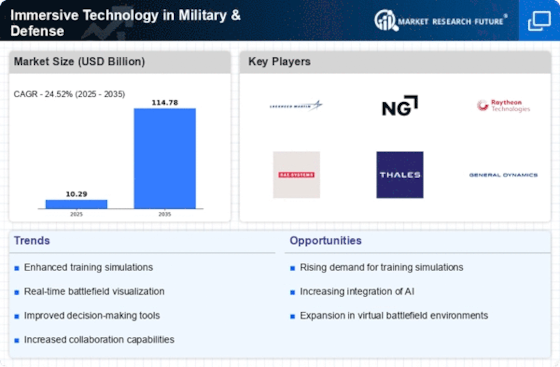
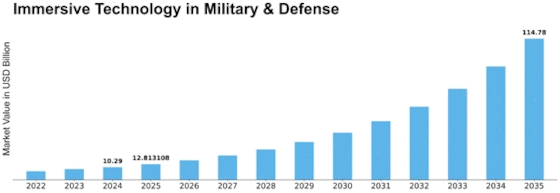
As per Market Research Future analysis, the Immersive Technology in Military & Defense Market Size was estimated at 10.29 Billion USD in 2024. The Immersive Technology industry is projected to grow from 12.81 Billion USD in 2025 to 114.78 Billion USD by 2035, exhibiting a compound annual growth rate (CAGR) of 24.52% during the forecast period 2025 - 2035

Key Market Trends & Highlights

The market for immersive technology in military and defense is experiencing robust growth driven by advancements in training and operational efficiency.

  • North America remains the largest market for immersive technology in military and defense, reflecting a strong investment in advanced training solutions. The Asia-Pacific region is emerging as the fastest-growing market, driven by increasing defense budgets and modernization efforts. Hardware continues to dominate the market, while software and platform solutions are witnessing rapid growth due to the demand for enhanced capabilities. Key market drivers include enhanced situational awareness and improved soldier readiness, which are critical for effective tactical planning.

Market Size & Forecast

2024 Market Size 10.29 (USD Billion)
2035 Market Size 114.78 (USD Billion)
CAGR (2025 - 2035) 24.52%
Largest Regional Market Share in 2024 North America

Major Players

<a href="https://www.ibm.com/quantum/blog/lockheed-martin-sqd">Lockheed Martin</a> (US), Northrop Grumman (US), Raytheon Technologies (US), BAE Systems (GB), Thales Group (FR), General Dynamics (US), <a href="https://www.insidermonkey.com/blog/l3harris-technologies-inc-nyselhx-q3-2025-earnings-call-transcript-1638782/">L3Harris Technologies</a> (US), Leonardo S.p.A. (IT), Elbit Systems (IL)

Market Trends

The landscape of Immersive Technology in Military & Defense Market is evolving rapidly, driven by advancements in virtual reality, augmented reality, and mixed reality applications. These technologies are increasingly integrated into training programs, simulations, and operational planning, enhancing the effectiveness of military personnel. The ability to create realistic environments allows for improved decision-making and strategic planning, which is crucial in high-stakes scenarios. Furthermore, the use of immersive technology facilitates remote collaboration, enabling teams to work together seamlessly, regardless of geographical barriers. This trend appears to be reshaping traditional military training methodologies, making them more adaptable and efficient. In addition to training applications, Immersive Technology in Military & Defense Market is also finding utility in maintenance and logistics. By employing augmented reality, technicians can visualize complex systems and receive real-time guidance, potentially reducing downtime and increasing operational readiness. The integration of these technologies into various military functions suggests a broader shift towards digital transformation within defense sectors. As the demand for innovative solutions continues to grow, the future of Immersive Technology in Military & Defense Market seems promising, with ongoing investments likely to drive further advancements in this field.

Enhanced Training Simulations

Immersive Technology in Military & Defense Market is revolutionizing training simulations, allowing personnel to engage in realistic scenarios without the risks associated with live exercises. This approach enhances learning outcomes and retention, as soldiers can practice decision-making in a controlled environment.

Remote Collaboration and Planning

The integration of immersive technologies facilitates remote collaboration among military units, enabling real-time planning and strategy development. This capability is particularly valuable in complex operations where coordination across distances is essential.

Maintenance and Logistics Optimization

Augmented reality applications are streamlining maintenance and logistics processes within military operations. By providing technicians with visual aids and real-time data, these technologies enhance efficiency and reduce the likelihood of errors during critical tasks.

Immersive Technology in Military & Defense Market Market Drivers

Enhanced Tactical Planning

The Immersive Technology in Military & Defense Industry is increasingly facilitating enhanced tactical planning. By employing 3D modeling and simulation tools, military strategists can visualize operations in a virtual environment, allowing for more effective planning and execution. These technologies enable teams to collaborate remotely, sharing insights and strategies in real-time. Data indicates that immersive planning tools can improve mission success rates by providing comprehensive situational analysis. As military operations become more complex, the reliance on immersive technologies for tactical planning is expected to grow, fostering more effective and coordinated responses.

Improved Soldier Readiness

The Immersive Technology in Military & Defense Industry is also driven by the imperative of improving soldier readiness. Training programs utilizing VR simulations allow soldiers to engage in realistic combat scenarios without the associated risks. This method of training not only enhances skills but also builds confidence among troops. Reports indicate that immersive training can reduce the time required for soldiers to reach operational readiness by up to 25%. As militaries seek to maintain a competitive edge, the adoption of immersive technologies for training purposes is likely to expand, ensuring that personnel are better prepared for real-world challenges.

Enhanced Situational Awareness

The Immersive Technology in Military & Defense Industry appears to be significantly influenced by the need for enhanced situational awareness among military personnel. Technologies such as augmented reality (AR) and virtual reality (VR) are being integrated into training and operational environments to provide real-time data overlays. This integration allows soldiers to visualize complex battlefield scenarios, improving decision-making processes. According to recent data, the use of AR in military applications is projected to grow at a compound annual growth rate of over 30% in the coming years. This trend suggests that immersive technologies are becoming essential tools for situational awareness, enabling forces to respond more effectively to dynamic threats.

Cost-Effective Training Solutions

Cost considerations are a pivotal driver in the Immersive Technology in Military & Defense Industry. Traditional training methods often involve significant expenditures related to personnel, equipment, and logistics. In contrast, immersive technologies offer a more cost-effective alternative by reducing the need for physical resources. For instance, VR training environments can simulate various scenarios without the costs associated with live exercises. Estimates suggest that military organizations could save millions annually by transitioning to immersive training solutions. This financial incentive is likely to accelerate the adoption of immersive technologies, as defense budgets continue to face scrutiny.

Integration of Artificial Intelligence

The integration of artificial intelligence (AI) within the Immersive Technology in Military & Defense Industry is emerging as a crucial driver. AI enhances immersive experiences by providing adaptive learning environments and predictive analytics. For example, AI algorithms can analyze training data to tailor simulations to individual soldier needs, optimizing learning outcomes. Furthermore, AI can assist in real-time decision-making during operations by processing vast amounts of data quickly. This synergy between AI and immersive technologies is likely to redefine training and operational strategies, making military forces more agile and responsive to evolving threats.

Market Segment Insights

By Component: Hardware (Largest) vs. Software/Platform (Fastest-Growing)

The Immersive Technology in Military &amp; Defense Market segment is primarily driven by hardware, which holds the largest share in the market. Key components such as virtual reality headsets and augmented reality systems have become integral to training and operational needs. Software and platform solutions, while currently smaller in share, are rapidly gaining traction due to advancements in user interfaces and interactive simulations. As defense organizations adapt to technological evolution, the importance of these software solutions remains critical in enhancing operational effectiveness.

Hardware (Dominant) vs. Software/Platform (Emerging)

The hardware segment remains the dominant force in the Immersive Technology in Military &amp; Defense Market, characterized by high investments in devices capable of delivering cutting-edge training experiences. This includes head-mounted displays, haptic feedback devices, and high-fidelity simulators that provide realistic training environments. On the other hand, the software/platform segment is emerging as a crucial player, leveraging advancements in artificial intelligence and data analytics to develop sophisticated training programs and tactical applications. While hardware establishes the foundation for immersive experiences, software solutions are driving innovation, providing enhanced interactivity and performance metrics, ultimately supporting defense operations more effectively.

By Technology: Mixed Reality (MR) (Largest) vs. Virtual Reality (VR) (Fastest-Growing)

In the Immersive Technology sector for Military &amp; Defense, Mixed Reality (MR) continues to dominate the landscape, providing a seamless integration of digital and physical environments. This segment occupies the largest share, driven by its utility in training simulations and mission planning. Its ability to enhance situational awareness and improve decision-making in complex environments solidifies MR's position as the leading technology in this domain. Meanwhile, Virtual Reality (VR) is rapidly gaining traction as the fastest-growing segment. VR's immersive training capabilities and its application in scenarios like combat simulations and equipment handling are propelling its adoption, drawing attention from defense agencies seeking innovative solutions.

Technology: MR (Dominant) vs. VR (Emerging)

Mixed Reality (MR) is recognized for its ability to blend real and virtual elements, making it an invaluable tool for military training and operations. Its applications within the defense sector include real-time data visualization and enhanced collaborative training environments. Defense organizations leverage MR technology to improve combat readiness and adaptability. On the other hand, Virtual Reality (VR) stands as an emerging contender, gaining momentum due to its immersive training experiences. VR simulations allow military personnel to experience high-stakes scenarios in a safe environment, fostering better preparedness. As organizations recognize the importance of realistic training, VR's significance continues to escalate, positioning it as a key area of investment in the coming years.

By Application: Training & Learning (Largest) vs. Emergency Services (Fastest-Growing)

In the Immersive Technology in Military &amp; Defense Market, the 'Training &amp; Learning' application captures the largest share due to its fundamental role in skill development and mission preparedness. Enhanced training through virtual reality and simulation has become indispensable, allowing personnel to practice in a risk-free environment. Other applications, while significant, do not match the scale of training use, which incorporates realistic scenarios to enhance decision-making and operational effectiveness. On the growth front, 'Emergency Services' is emerging as the fastest-growing segment, driven by the increasing adoption of immersive technologies for rapid response training. As defense forces aim to improve their preparedness for crisis situations, virtual simulation tools are being utilized to enhance situational awareness and strategic planning. This growth is supported by advancements in technology, including real-time data integration and realistic modeling, making training more efficient and impactful.

Training &amp; Learning (Dominant) vs. Emergency Services (Emerging)

The 'Training &amp; Learning' segment in immersive technology is characterized by its comprehensive approach to preparing military and defense personnel for real-world scenarios. This application dominates the market as it focuses on interactive learning experiences through simulations and virtual environments. By enabling realistic situational training, it enhances retention and skills application in the field. Conversely, 'Emergency Services' is an emerging segment that leverages immersive technology to prepare teams for high-stress, dynamic situations. This application is gaining traction as it offers innovative solutions for crisis response training, including VR drills and simulations tailored to emergency protocols, helping professionals to enhance their response times and decision-making under pressure.

Get more detailed insights about Immersive Technology in Military & Defense Market Research Report – Forecast till 2035

Regional Insights

North America : Innovation and Leadership Hub

North America is the largest market for immersive technology in military and defense, holding approximately 45% of the global market share. The region's growth is driven by significant investments in R&D, advancements in simulation technologies, and increasing demand for training solutions. Regulatory support from government agencies, including the Department of Defense, further catalyzes market expansion, ensuring compliance with safety and operational standards. The United States leads the market, with key players like Lockheed Martin, Northrop Grumman, and Raytheon Technologies dominating the landscape. These companies are at the forefront of developing cutting-edge immersive solutions, including virtual and augmented reality applications for training and operational purposes. The competitive environment is characterized by strategic partnerships and collaborations aimed at enhancing technological capabilities and meeting evolving defense needs.

Europe : Emerging Market with Potential

Europe is witnessing a growing interest in immersive technology for military applications, accounting for approximately 30% of the global market share. The region's growth is fueled by increasing defense budgets, collaborative projects among EU nations, and a focus on enhancing soldier training and operational efficiency. Regulatory frameworks, such as the European Defense Fund, are pivotal in promoting innovation and ensuring interoperability among member states. Leading countries in this region include the United Kingdom, France, and Germany, where companies like BAE Systems and Thales Group are making significant strides. The competitive landscape is marked by a mix of established defense contractors and innovative startups, all vying to capture market share through advanced immersive solutions. The emphasis on joint military exercises and cross-border collaborations further enhances the region's capabilities in this domain.

Asia-Pacific : Rapidly Growing Defense Sector

Asia-Pacific is rapidly emerging as a significant player in the immersive technology market for military and defense, holding about 20% of the global market share. The region's growth is driven by increasing defense expenditures, modernization of armed forces, and a rising focus on advanced training methodologies. Countries like India and Japan are investing heavily in immersive technologies to enhance their military capabilities, supported by favorable government policies and initiatives. Key players in this region include companies like Elbit Systems and Leonardo S.p.A., which are actively developing immersive solutions tailored to the unique needs of their respective markets. The competitive landscape is characterized by a mix of domestic and international firms, with collaborations and partnerships being essential for technology transfer and innovation. The region's strategic importance is further underscored by ongoing geopolitical tensions, driving demand for advanced defense technologies.

Middle East and Africa : Emerging Market with Challenges

The Middle East and Africa region is gradually recognizing the potential of immersive technology in military applications, currently holding about 5% of the global market share. The growth is primarily driven by increasing defense budgets, regional conflicts, and a focus on modernizing military training programs. However, challenges such as political instability and varying levels of technological adoption can hinder rapid growth. Governments are beginning to invest in immersive technologies to enhance operational readiness and effectiveness. Countries like the United Arab Emirates and South Africa are leading the charge, with local firms and international players exploring opportunities in this space. The competitive landscape is evolving, with a mix of established defense contractors and emerging tech companies. Collaborative efforts and partnerships are crucial for overcoming challenges and leveraging immersive technology to meet the unique defense needs of the region.

Key Players and Competitive Insights

Leading market players are investing heavily in research and development in order to expand their product lines, which will help the Immersive Technology in Military & Defense Market, grow even more. Market participants are also undertaking a variety of strategic activities to expand their global footprint, with important market developments including new product launches, contractual agreements, mergers and acquisitions, higher investments, and collaboration with other organizations. To expand and survive in a more competitive and rising market climate, Immersive Technology in Military & Defense market industry must offer cost-effective items. Manufacturing locally to minimize operational costs is one of the key business tactics used by manufacturers in the global Immersive Technology in Military & Defense market industry to benefit clients and increase the market sector. In recent years, the Immersive Technology in Military & Defense market industry has offered some of the most significant advantages to medicine. Major players in the Immersive Technology in Military & Defense Market, including Acer Inc., Atheer, Inc., AVEVA Group PLC, Barco NV, Blippar Ltd., Carl Zeiss AG, CM Labs Simulations Inc., EON Reality, Inc., FAAC Incorporated, Google, LLC, HCL Technologies Limited, Honeywell International, Inc., HTC Corporation, Immersive Media Company, Immersive Technologies Pty Limited, Lockheed Martin Corporation, Magic Leap, Inc., NCTech Limited, Oculus (Facebook Technologies, LLC.), Samsung Group, Sony Corporation, Unity Software Inc., Varjo Technologies Oy, VI-grade GmbH, Zeality Inc., are attempting to increase market demand by investing in research and development operations. Acer Inc. has a major impact on the market for immersive technology in the Military & Defence industry, a leading global technology company. Acer provides cutting-edge immersive technology solutions suited for defence applications by using its expertise in hardware and computer solutions. Acer offers crucial hardware components that improve the functionality of virtual reality (VR) and augmented reality (AR) systems, such as high-performance processing systems, cutting-edge displays, and graphics solutions. Acer equips defence organisations to use immersive technology for training, mission planning, and situational awareness, enhancing the preparedness and effectiveness of armed personnel. Acer is dedicated to innovation and personalization. Atheer, Inc. is a well-known participant in the Military & Defence sector for immersive technology. Atheer, a company that specialises in augmented reality (AR) solutions, provides cutting-edge technology that revolutionises how military forces function. Their AR platform greatly improves situational awareness and field decision-making by providing military personnel with real-time data, training, and maintenance support via smart glasses or wearable devices. The solutions from Atheer enable remote collaboration, simplify training, and enhance maintenance procedures, making them indispensable tools for defence organisations looking to boost operational effectiveness and preparedness.

Key Companies in the Immersive Technology in Military & Defense Market include

Industry Developments

May 2021: A group of programmes that offer stereoscopic 3D experiences while bringing the digital world into a story in a fresh, natural way. Cutting-edge visual technologies, together with screen and sensing technology, are what power SpatialLabs. Due to the data floating in front of the display, creators can assess their ideas in real-time and at 360 ° without the need for special glasses.

March 2021: In order to help the architectural features, technology, and infrastructure sectors cut costs and increase efficiency, Harmony, a company that provides multiple 3D media planning and management solutions globally, has announced the acquisition of VisualLive.

Future Outlook

Immersive Technology in Military & Defense Market Future Outlook

The Immersive Technology in Military &amp; Defense Market is projected to grow at a 24.52% CAGR from 2025 to 2035, driven by advancements in training simulations, enhanced situational awareness, and increased defense budgets.

New opportunities lie in:

  • <p>Development of augmented reality training platforms for real-time combat scenarios. Integration of virtual reality for remote mission planning and execution. Creation of immersive environments for psychological resilience training.</p>

By 2035, the market is expected to be robust, driven by innovative applications and strategic investments.

Market Segmentation

Immersive Technology in Military & Defense Market Component Outlook

  • Hardware
  • Software/Platform
  • Services

Immersive Technology in Military & Defense Market Technology Outlook

  • Mixed Reality (MR)
  • Virtual Reality (VR)
  • Augmented Reality (AR)
  • 360 Film

Immersive Technology in Military & Defense Market Application Outlook

  • Training & Learning
  • Emergency Services
  • Product Development
  • Sales & Marketing

Report Scope

MARKET SIZE 2024 10.29 (USD Billion)
MARKET SIZE 2025 12.81 (USD Billion)
MARKET SIZE 2035 114.78 (USD Billion)
COMPOUND ANNUAL GROWTH RATE (CAGR) 24.52% (2025 - 2035)
REPORT COVERAGE Revenue Forecast, Competitive Landscape, Growth Factors, and Trends
BASE YEAR 2024
Market Forecast Period 2025 - 2035
Historical Data 2019 - 2024
Market Forecast Units USD Billion
Key Companies Profiled Lockheed Martin (US), Northrop Grumman (US), Raytheon Technologies (US), BAE Systems (GB), Thales Group (FR), General Dynamics (US), L3Harris Technologies (US), Leonardo S.p.A. (IT), Elbit Systems (IL)
Segments Covered Component, Region
Key Market Opportunities Integration of augmented reality for enhanced training simulations in Immersive Technology in Military and Defense.
Key Market Dynamics Rising demand for immersive training solutions drives innovation and competition in military and defense sectors.
Countries Covered North America, Europe, APAC, South America, MEA

FAQs

What is the current market valuation of immersive technology in military and defense as of 2024?

<p>The market valuation of immersive technology in military and defense was 10.29 USD Billion in 2024.</p>

What is the projected market size for immersive technology in military and defense by 2035?

<p>The projected market size for immersive technology in military and defense is 114.78 USD Billion by 2035.</p>

What is the expected compound annual growth rate (CAGR) for the immersive technology market from 2025 to 2035?

<p>The expected CAGR for the immersive technology market during the forecast period 2025 - 2035 is 24.52%.</p>

Which companies are considered key players in the immersive technology market for military and defense?

<p>Key players in the market include Lockheed Martin, Northrop Grumman, Raytheon Technologies, BAE Systems, Thales Group, General Dynamics, L3Harris Technologies, Leonardo S.p.A., and Elbit Systems.</p>

What are the main components of the immersive technology market in military and defense?

<p>The main components include hardware, software/platform, and services, with valuations of 3.09, 4.12, and 3.08 USD Billion respectively in 2024.</p>

How does the market for mixed reality compare to virtual and augmented reality in military applications?

<p>In 2024, the market for mixed reality was valued at 2.07 USD Billion, while virtual reality and augmented reality were valued at 3.09 and 3.03 USD Billion respectively.</p>

What applications are driving the growth of immersive technology in military and defense?

Key applications driving growth include training &amp; learning, product development, sales &amp; marketing, and emergency services, with training valued at 2.57 USD Billion in 2024.

What is the valuation of the services segment within the immersive technology market?

The services segment within the immersive technology market was valued at 3.08 USD Billion in 2024.

How does the immersive technology market's growth potential impact defense strategies?

The growth potential of the immersive technology market may enhance defense strategies by providing advanced training and operational capabilities, projected to expand significantly by 2035.

What trends are emerging in the use of immersive technology for military training?

Emerging trends in military training include increased adoption of virtual and augmented reality technologies, which are expected to enhance training effectiveness and operational readiness.

  1. SECTION I: EXECUTIVE SUMMARY AND KEY HIGHLIGHTS
    1. | 1.1 EXECUTIVE SUMMARY
    2. | | 1.1.1 Market Overview
    3. | | 1.1.2 Key Findings
    4. | | 1.1.3 Market Segmentation
    5. | | 1.1.4 Competitive Landscape
    6. | | 1.1.5 Challenges and Opportunities
    7. | | 1.1.6 Future Outlook
  2. SECTION II: SCOPING, METHODOLOGY AND MARKET STRUCTURE
    1. | 2.1 MARKET INTRODUCTION
    2. | | 2.1.1 Definition
    3. | | 2.1.2 Scope of the study
    4. | | | 2.1.2.1 Research Objective
    5. | | | 2.1.2.2 Assumption
    6. | | | 2.1.2.3 Limitations
    7. | 2.2 RESEARCH METHODOLOGY
    8. | | 2.2.1 Overview
    9. | | 2.2.2 Data Mining
    10. | | 2.2.3 Secondary Research
    11. | | 2.2.4 Primary Research
    12. | | | 2.2.4.1 Primary Interviews and Information Gathering Process
    13. | | | 2.2.4.2 Breakdown of Primary Respondents
    14. | | 2.2.5 Forecasting Model
    15. | | 2.2.6 Market Size Estimation
    16. | | | 2.2.6.1 Bottom-Up Approach
    17. | | | 2.2.6.2 Top-Down Approach
    18. | | 2.2.7 Data Triangulation
    19. | | 2.2.8 Validation
  3. SECTION III: QUALITATIVE ANALYSIS
    1. | 3.1 MARKET DYNAMICS
    2. | | 3.1.1 Overview
    3. | | 3.1.2 Drivers
    4. | | 3.1.3 Restraints
    5. | | 3.1.4 Opportunities
    6. | 3.2 MARKET FACTOR ANALYSIS
    7. | | 3.2.1 Value chain Analysis
    8. | | 3.2.2 Porter's Five Forces Analysis
    9. | | | 3.2.2.1 Bargaining Power of Suppliers
    10. | | | 3.2.2.2 Bargaining Power of Buyers
    11. | | | 3.2.2.3 Threat of New Entrants
    12. | | | 3.2.2.4 Threat of Substitutes
    13. | | | 3.2.2.5 Intensity of Rivalry
    14. | | 3.2.3 COVID-19 Impact Analysis
    15. | | | 3.2.3.1 Market Impact Analysis
    16. | | | 3.2.3.2 Regional Impact
    17. | | | 3.2.3.3 Opportunity and Threat Analysis
  4. SECTION IV: QUANTITATIVE ANALYSIS
    1. | 4.1 Information and Communications Technology, BY Component (USD Billion)
    2. | | 4.1.1 Hardware
    3. | | 4.1.2 Software/Platform
    4. | | 4.1.3 Services
    5. | 4.2 Information and Communications Technology, BY Technology (USD Billion)
    6. | | 4.2.1 Mixed Reality (MR)
    7. | | 4.2.2 Virtual Reality (VR)
    8. | | 4.2.3 Augmented Reality (AR)
    9. | | 4.2.4 360 Film
    10. | 4.3 Information and Communications Technology, BY Application (USD Billion)
    11. | | 4.3.1 Training & Learning
    12. | | 4.3.2 Emergency Services
    13. | | 4.3.3 Product Development
    14. | | 4.3.4 Sales & Marketing
    15. | 4.4 Information and Communications Technology, BY Region (USD Billion)
    16. | | 4.4.1 North America
    17. | | | 4.4.1.1 US
    18. | | | 4.4.1.2 Canada
    19. | | 4.4.2 Europe
    20. | | | 4.4.2.1 Germany
    21. | | | 4.4.2.2 UK
    22. | | | 4.4.2.3 France
    23. | | | 4.4.2.4 Russia
    24. | | | 4.4.2.5 Italy
    25. | | | 4.4.2.6 Spain
    26. | | | 4.4.2.7 Rest of Europe
    27. | | 4.4.3 APAC
    28. | | | 4.4.3.1 China
    29. | | | 4.4.3.2 India
    30. | | | 4.4.3.3 Japan
    31. | | | 4.4.3.4 South Korea
    32. | | | 4.4.3.5 Malaysia
    33. | | | 4.4.3.6 Thailand
    34. | | | 4.4.3.7 Indonesia
    35. | | | 4.4.3.8 Rest of APAC
    36. | | 4.4.4 South America
    37. | | | 4.4.4.1 Brazil
    38. | | | 4.4.4.2 Mexico
    39. | | | 4.4.4.3 Argentina
    40. | | | 4.4.4.4 Rest of South America
    41. | | 4.4.5 MEA
    42. | | | 4.4.5.1 GCC Countries
    43. | | | 4.4.5.2 South Africa
    44. | | | 4.4.5.3 Rest of MEA
  5. SECTION V: COMPETITIVE ANALYSIS
    1. | 5.1 Competitive Landscape
    2. | | 5.1.1 Overview
    3. | | 5.1.2 Competitive Analysis
    4. | | 5.1.3 Market share Analysis
    5. | | 5.1.4 Major Growth Strategy in the Information and Communications Technology
    6. | | 5.1.5 Competitive Benchmarking
    7. | | 5.1.6 Leading Players in Terms of Number of Developments in the Information and Communications Technology
    8. | | 5.1.7 Key developments and growth strategies
    9. | | | 5.1.7.1 New Product Launch/Service Deployment
    10. | | | 5.1.7.2 Merger & Acquisitions
    11. | | | 5.1.7.3 Joint Ventures
    12. | | 5.1.8 Major Players Financial Matrix
    13. | | | 5.1.8.1 Sales and Operating Income
    14. | | | 5.1.8.2 Major Players R&D Expenditure. 2023
    15. | 5.2 Company Profiles
    16. | | 5.2.1 Lockheed Martin (US)
    17. | | | 5.2.1.1 Financial Overview
    18. | | | 5.2.1.2 Products Offered
    19. | | | 5.2.1.3 Key Developments
    20. | | | 5.2.1.4 SWOT Analysis
    21. | | | 5.2.1.5 Key Strategies
    22. | | 5.2.2 Northrop Grumman (US)
    23. | | | 5.2.2.1 Financial Overview
    24. | | | 5.2.2.2 Products Offered
    25. | | | 5.2.2.3 Key Developments
    26. | | | 5.2.2.4 SWOT Analysis
    27. | | | 5.2.2.5 Key Strategies
    28. | | 5.2.3 Raytheon Technologies (US)
    29. | | | 5.2.3.1 Financial Overview
    30. | | | 5.2.3.2 Products Offered
    31. | | | 5.2.3.3 Key Developments
    32. | | | 5.2.3.4 SWOT Analysis
    33. | | | 5.2.3.5 Key Strategies
    34. | | 5.2.4 BAE Systems (GB)
    35. | | | 5.2.4.1 Financial Overview
    36. | | | 5.2.4.2 Products Offered
    37. | | | 5.2.4.3 Key Developments
    38. | | | 5.2.4.4 SWOT Analysis
    39. | | | 5.2.4.5 Key Strategies
    40. | | 5.2.5 Thales Group (FR)
    41. | | | 5.2.5.1 Financial Overview
    42. | | | 5.2.5.2 Products Offered
    43. | | | 5.2.5.3 Key Developments
    44. | | | 5.2.5.4 SWOT Analysis
    45. | | | 5.2.5.5 Key Strategies
    46. | | 5.2.6 General Dynamics (US)
    47. | | | 5.2.6.1 Financial Overview
    48. | | | 5.2.6.2 Products Offered
    49. | | | 5.2.6.3 Key Developments
    50. | | | 5.2.6.4 SWOT Analysis
    51. | | | 5.2.6.5 Key Strategies
    52. | | 5.2.7 L3Harris Technologies (US)
    53. | | | 5.2.7.1 Financial Overview
    54. | | | 5.2.7.2 Products Offered
    55. | | | 5.2.7.3 Key Developments
    56. | | | 5.2.7.4 SWOT Analysis
    57. | | | 5.2.7.5 Key Strategies
    58. | | 5.2.8 Leonardo S.p.A. (IT)
    59. | | | 5.2.8.1 Financial Overview
    60. | | | 5.2.8.2 Products Offered
    61. | | | 5.2.8.3 Key Developments
    62. | | | 5.2.8.4 SWOT Analysis
    63. | | | 5.2.8.5 Key Strategies
    64. | | 5.2.9 Elbit Systems (IL)
    65. | | | 5.2.9.1 Financial Overview
    66. | | | 5.2.9.2 Products Offered
    67. | | | 5.2.9.3 Key Developments
    68. | | | 5.2.9.4 SWOT Analysis
    69. | | | 5.2.9.5 Key Strategies
    70. | 5.3 Appendix
    71. | | 5.3.1 References
    72. | | 5.3.2 Related Reports
  6. LIST OF FIGURES
    1. | 6.1 MARKET SYNOPSIS
    2. | 6.2 NORTH AMERICA MARKET ANALYSIS
    3. | 6.3 US MARKET ANALYSIS BY COMPONENT
    4. | 6.4 US MARKET ANALYSIS BY TECHNOLOGY
    5. | 6.5 US MARKET ANALYSIS BY APPLICATION
    6. | 6.6 CANADA MARKET ANALYSIS BY COMPONENT
    7. | 6.7 CANADA MARKET ANALYSIS BY TECHNOLOGY
    8. | 6.8 CANADA MARKET ANALYSIS BY APPLICATION
    9. | 6.9 EUROPE MARKET ANALYSIS
    10. | 6.10 GERMANY MARKET ANALYSIS BY COMPONENT
    11. | 6.11 GERMANY MARKET ANALYSIS BY TECHNOLOGY
    12. | 6.12 GERMANY MARKET ANALYSIS BY APPLICATION
    13. | 6.13 UK MARKET ANALYSIS BY COMPONENT
    14. | 6.14 UK MARKET ANALYSIS BY TECHNOLOGY
    15. | 6.15 UK MARKET ANALYSIS BY APPLICATION
    16. | 6.16 FRANCE MARKET ANALYSIS BY COMPONENT
    17. | 6.17 FRANCE MARKET ANALYSIS BY TECHNOLOGY
    18. | 6.18 FRANCE MARKET ANALYSIS BY APPLICATION
    19. | 6.19 RUSSIA MARKET ANALYSIS BY COMPONENT
    20. | 6.20 RUSSIA MARKET ANALYSIS BY TECHNOLOGY
    21. | 6.21 RUSSIA MARKET ANALYSIS BY APPLICATION
    22. | 6.22 ITALY MARKET ANALYSIS BY COMPONENT
    23. | 6.23 ITALY MARKET ANALYSIS BY TECHNOLOGY
    24. | 6.24 ITALY MARKET ANALYSIS BY APPLICATION
    25. | 6.25 SPAIN MARKET ANALYSIS BY COMPONENT
    26. | 6.26 SPAIN MARKET ANALYSIS BY TECHNOLOGY
    27. | 6.27 SPAIN MARKET ANALYSIS BY APPLICATION
    28. | 6.28 REST OF EUROPE MARKET ANALYSIS BY COMPONENT
    29. | 6.29 REST OF EUROPE MARKET ANALYSIS BY TECHNOLOGY
    30. | 6.30 REST OF EUROPE MARKET ANALYSIS BY APPLICATION
    31. | 6.31 APAC MARKET ANALYSIS
    32. | 6.32 CHINA MARKET ANALYSIS BY COMPONENT
    33. | 6.33 CHINA MARKET ANALYSIS BY TECHNOLOGY
    34. | 6.34 CHINA MARKET ANALYSIS BY APPLICATION
    35. | 6.35 INDIA MARKET ANALYSIS BY COMPONENT
    36. | 6.36 INDIA MARKET ANALYSIS BY TECHNOLOGY
    37. | 6.37 INDIA MARKET ANALYSIS BY APPLICATION
    38. | 6.38 JAPAN MARKET ANALYSIS BY COMPONENT
    39. | 6.39 JAPAN MARKET ANALYSIS BY TECHNOLOGY
    40. | 6.40 JAPAN MARKET ANALYSIS BY APPLICATION
    41. | 6.41 SOUTH KOREA MARKET ANALYSIS BY COMPONENT
    42. | 6.42 SOUTH KOREA MARKET ANALYSIS BY TECHNOLOGY
    43. | 6.43 SOUTH KOREA MARKET ANALYSIS BY APPLICATION
    44. | 6.44 MALAYSIA MARKET ANALYSIS BY COMPONENT
    45. | 6.45 MALAYSIA MARKET ANALYSIS BY TECHNOLOGY
    46. | 6.46 MALAYSIA MARKET ANALYSIS BY APPLICATION
    47. | 6.47 THAILAND MARKET ANALYSIS BY COMPONENT
    48. | 6.48 THAILAND MARKET ANALYSIS BY TECHNOLOGY
    49. | 6.49 THAILAND MARKET ANALYSIS BY APPLICATION
    50. | 6.50 INDONESIA MARKET ANALYSIS BY COMPONENT
    51. | 6.51 INDONESIA MARKET ANALYSIS BY TECHNOLOGY
    52. | 6.52 INDONESIA MARKET ANALYSIS BY APPLICATION
    53. | 6.53 REST OF APAC MARKET ANALYSIS BY COMPONENT
    54. | 6.54 REST OF APAC MARKET ANALYSIS BY TECHNOLOGY
    55. | 6.55 REST OF APAC MARKET ANALYSIS BY APPLICATION
    56. | 6.56 SOUTH AMERICA MARKET ANALYSIS
    57. | 6.57 BRAZIL MARKET ANALYSIS BY COMPONENT
    58. | 6.58 BRAZIL MARKET ANALYSIS BY TECHNOLOGY
    59. | 6.59 BRAZIL MARKET ANALYSIS BY APPLICATION
    60. | 6.60 MEXICO MARKET ANALYSIS BY COMPONENT
    61. | 6.61 MEXICO MARKET ANALYSIS BY TECHNOLOGY
    62. | 6.62 MEXICO MARKET ANALYSIS BY APPLICATION
    63. | 6.63 ARGENTINA MARKET ANALYSIS BY COMPONENT
    64. | 6.64 ARGENTINA MARKET ANALYSIS BY TECHNOLOGY
    65. | 6.65 ARGENTINA MARKET ANALYSIS BY APPLICATION
    66. | 6.66 REST OF SOUTH AMERICA MARKET ANALYSIS BY COMPONENT
    67. | 6.67 REST OF SOUTH AMERICA MARKET ANALYSIS BY TECHNOLOGY
    68. | 6.68 REST OF SOUTH AMERICA MARKET ANALYSIS BY APPLICATION
    69. | 6.69 MEA MARKET ANALYSIS
    70. | 6.70 GCC COUNTRIES MARKET ANALYSIS BY COMPONENT
    71. | 6.71 GCC COUNTRIES MARKET ANALYSIS BY TECHNOLOGY
    72. | 6.72 GCC COUNTRIES MARKET ANALYSIS BY APPLICATION
    73. | 6.73 SOUTH AFRICA MARKET ANALYSIS BY COMPONENT
    74. | 6.74 SOUTH AFRICA MARKET ANALYSIS BY TECHNOLOGY
    75. | 6.75 SOUTH AFRICA MARKET ANALYSIS BY APPLICATION
    76. | 6.76 REST OF MEA MARKET ANALYSIS BY COMPONENT
    77. | 6.77 REST OF MEA MARKET ANALYSIS BY TECHNOLOGY
    78. | 6.78 REST OF MEA MARKET ANALYSIS BY APPLICATION
    79. | 6.79 KEY BUYING CRITERIA OF INFORMATION AND COMMUNICATIONS TECHNOLOGY
    80. | 6.80 RESEARCH PROCESS OF MRFR
    81. | 6.81 DRO ANALYSIS OF INFORMATION AND COMMUNICATIONS TECHNOLOGY
    82. | 6.82 DRIVERS IMPACT ANALYSIS: INFORMATION AND COMMUNICATIONS TECHNOLOGY
    83. | 6.83 RESTRAINTS IMPACT ANALYSIS: INFORMATION AND COMMUNICATIONS TECHNOLOGY
    84. | 6.84 SUPPLY / VALUE CHAIN: INFORMATION AND COMMUNICATIONS TECHNOLOGY
    85. | 6.85 INFORMATION AND COMMUNICATIONS TECHNOLOGY, BY COMPONENT, 2024 (% SHARE)
    86. | 6.86 INFORMATION AND COMMUNICATIONS TECHNOLOGY, BY COMPONENT, 2024 TO 2035 (USD Billion)
    87. | 6.87 INFORMATION AND COMMUNICATIONS TECHNOLOGY, BY TECHNOLOGY, 2024 (% SHARE)
    88. | 6.88 INFORMATION AND COMMUNICATIONS TECHNOLOGY, BY TECHNOLOGY, 2024 TO 2035 (USD Billion)
    89. | 6.89 INFORMATION AND COMMUNICATIONS TECHNOLOGY, BY APPLICATION, 2024 (% SHARE)
    90. | 6.90 INFORMATION AND COMMUNICATIONS TECHNOLOGY, BY APPLICATION, 2024 TO 2035 (USD Billion)
    91. | 6.91 BENCHMARKING OF MAJOR COMPETITORS
  7. LIST OF TABLES
    1. | 7.1 LIST OF ASSUMPTIONS
    2. | | 7.1.1
    3. | 7.2 North America MARKET SIZE ESTIMATES; FORECAST
    4. | | 7.2.1 BY COMPONENT, 2025-2035 (USD Billion)
    5. | | 7.2.2 BY TECHNOLOGY, 2025-2035 (USD Billion)
    6. | | 7.2.3 BY APPLICATION, 2025-2035 (USD Billion)
    7. | 7.3 US MARKET SIZE ESTIMATES; FORECAST
    8. | | 7.3.1 BY COMPONENT, 2025-2035 (USD Billion)
    9. | | 7.3.2 BY TECHNOLOGY, 2025-2035 (USD Billion)
    10. | | 7.3.3 BY APPLICATION, 2025-2035 (USD Billion)
    11. | 7.4 Canada MARKET SIZE ESTIMATES; FORECAST
    12. | | 7.4.1 BY COMPONENT, 2025-2035 (USD Billion)
    13. | | 7.4.2 BY TECHNOLOGY, 2025-2035 (USD Billion)
    14. | | 7.4.3 BY APPLICATION, 2025-2035 (USD Billion)
    15. | 7.5 Europe MARKET SIZE ESTIMATES; FORECAST
    16. | | 7.5.1 BY COMPONENT, 2025-2035 (USD Billion)
    17. | | 7.5.2 BY TECHNOLOGY, 2025-2035 (USD Billion)
    18. | | 7.5.3 BY APPLICATION, 2025-2035 (USD Billion)
    19. | 7.6 Germany MARKET SIZE ESTIMATES; FORECAST
    20. | | 7.6.1 BY COMPONENT, 2025-2035 (USD Billion)
    21. | | 7.6.2 BY TECHNOLOGY, 2025-2035 (USD Billion)
    22. | | 7.6.3 BY APPLICATION, 2025-2035 (USD Billion)
    23. | 7.7 UK MARKET SIZE ESTIMATES; FORECAST
    24. | | 7.7.1 BY COMPONENT, 2025-2035 (USD Billion)
    25. | | 7.7.2 BY TECHNOLOGY, 2025-2035 (USD Billion)
    26. | | 7.7.3 BY APPLICATION, 2025-2035 (USD Billion)
    27. | 7.8 France MARKET SIZE ESTIMATES; FORECAST
    28. | | 7.8.1 BY COMPONENT, 2025-2035 (USD Billion)
    29. | | 7.8.2 BY TECHNOLOGY, 2025-2035 (USD Billion)
    30. | | 7.8.3 BY APPLICATION, 2025-2035 (USD Billion)
    31. | 7.9 Russia MARKET SIZE ESTIMATES; FORECAST
    32. | | 7.9.1 BY COMPONENT, 2025-2035 (USD Billion)
    33. | | 7.9.2 BY TECHNOLOGY, 2025-2035 (USD Billion)
    34. | | 7.9.3 BY APPLICATION, 2025-2035 (USD Billion)
    35. | 7.10 Italy MARKET SIZE ESTIMATES; FORECAST
    36. | | 7.10.1 BY COMPONENT, 2025-2035 (USD Billion)
    37. | | 7.10.2 BY TECHNOLOGY, 2025-2035 (USD Billion)
    38. | | 7.10.3 BY APPLICATION, 2025-2035 (USD Billion)
    39. | 7.11 Spain MARKET SIZE ESTIMATES; FORECAST
    40. | | 7.11.1 BY COMPONENT, 2025-2035 (USD Billion)
    41. | | 7.11.2 BY TECHNOLOGY, 2025-2035 (USD Billion)
    42. | | 7.11.3 BY APPLICATION, 2025-2035 (USD Billion)
    43. | 7.12 Rest of Europe MARKET SIZE ESTIMATES; FORECAST
    44. | | 7.12.1 BY COMPONENT, 2025-2035 (USD Billion)
    45. | | 7.12.2 BY TECHNOLOGY, 2025-2035 (USD Billion)
    46. | | 7.12.3 BY APPLICATION, 2025-2035 (USD Billion)
    47. | 7.13 APAC MARKET SIZE ESTIMATES; FORECAST
    48. | | 7.13.1 BY COMPONENT, 2025-2035 (USD Billion)
    49. | | 7.13.2 BY TECHNOLOGY, 2025-2035 (USD Billion)
    50. | | 7.13.3 BY APPLICATION, 2025-2035 (USD Billion)
    51. | 7.14 China MARKET SIZE ESTIMATES; FORECAST
    52. | | 7.14.1 BY COMPONENT, 2025-2035 (USD Billion)
    53. | | 7.14.2 BY TECHNOLOGY, 2025-2035 (USD Billion)
    54. | | 7.14.3 BY APPLICATION, 2025-2035 (USD Billion)
    55. | 7.15 India MARKET SIZE ESTIMATES; FORECAST
    56. | | 7.15.1 BY COMPONENT, 2025-2035 (USD Billion)
    57. | | 7.15.2 BY TECHNOLOGY, 2025-2035 (USD Billion)
    58. | | 7.15.3 BY APPLICATION, 2025-2035 (USD Billion)
    59. | 7.16 Japan MARKET SIZE ESTIMATES; FORECAST
    60. | | 7.16.1 BY COMPONENT, 2025-2035 (USD Billion)
    61. | | 7.16.2 BY TECHNOLOGY, 2025-2035 (USD Billion)
    62. | | 7.16.3 BY APPLICATION, 2025-2035 (USD Billion)
    63. | 7.17 South Korea MARKET SIZE ESTIMATES; FORECAST
    64. | | 7.17.1 BY COMPONENT, 2025-2035 (USD Billion)
    65. | | 7.17.2 BY TECHNOLOGY, 2025-2035 (USD Billion)
    66. | | 7.17.3 BY APPLICATION, 2025-2035 (USD Billion)
    67. | 7.18 Malaysia MARKET SIZE ESTIMATES; FORECAST
    68. | | 7.18.1 BY COMPONENT, 2025-2035 (USD Billion)
    69. | | 7.18.2 BY TECHNOLOGY, 2025-2035 (USD Billion)
    70. | | 7.18.3 BY APPLICATION, 2025-2035 (USD Billion)
    71. | 7.19 Thailand MARKET SIZE ESTIMATES; FORECAST
    72. | | 7.19.1 BY COMPONENT, 2025-2035 (USD Billion)
    73. | | 7.19.2 BY TECHNOLOGY, 2025-2035 (USD Billion)
    74. | | 7.19.3 BY APPLICATION, 2025-2035 (USD Billion)
    75. | 7.20 Indonesia MARKET SIZE ESTIMATES; FORECAST
    76. | | 7.20.1 BY COMPONENT, 2025-2035 (USD Billion)
    77. | | 7.20.2 BY TECHNOLOGY, 2025-2035 (USD Billion)
    78. | | 7.20.3 BY APPLICATION, 2025-2035 (USD Billion)
    79. | 7.21 Rest of APAC MARKET SIZE ESTIMATES; FORECAST
    80. | | 7.21.1 BY COMPONENT, 2025-2035 (USD Billion)
    81. | | 7.21.2 BY TECHNOLOGY, 2025-2035 (USD Billion)
    82. | | 7.21.3 BY APPLICATION, 2025-2035 (USD Billion)
    83. | 7.22 South America MARKET SIZE ESTIMATES; FORECAST
    84. | | 7.22.1 BY COMPONENT, 2025-2035 (USD Billion)
    85. | | 7.22.2 BY TECHNOLOGY, 2025-2035 (USD Billion)
    86. | | 7.22.3 BY APPLICATION, 2025-2035 (USD Billion)
    87. | 7.23 Brazil MARKET SIZE ESTIMATES; FORECAST
    88. | | 7.23.1 BY COMPONENT, 2025-2035 (USD Billion)
    89. | | 7.23.2 BY TECHNOLOGY, 2025-2035 (USD Billion)
    90. | | 7.23.3 BY APPLICATION, 2025-2035 (USD Billion)
    91. | 7.24 Mexico MARKET SIZE ESTIMATES; FORECAST
    92. | | 7.24.1 BY COMPONENT, 2025-2035 (USD Billion)
    93. | | 7.24.2 BY TECHNOLOGY, 2025-2035 (USD Billion)
    94. | | 7.24.3 BY APPLICATION, 2025-2035 (USD Billion)
    95. | 7.25 Argentina MARKET SIZE ESTIMATES; FORECAST
    96. | | 7.25.1 BY COMPONENT, 2025-2035 (USD Billion)
    97. | | 7.25.2 BY TECHNOLOGY, 2025-2035 (USD Billion)
    98. | | 7.25.3 BY APPLICATION, 2025-2035 (USD Billion)
    99. | 7.26 Rest of South America MARKET SIZE ESTIMATES; FORECAST
    100. | | 7.26.1 BY COMPONENT, 2025-2035 (USD Billion)
    101. | | 7.26.2 BY TECHNOLOGY, 2025-2035 (USD Billion)
    102. | | 7.26.3 BY APPLICATION, 2025-2035 (USD Billion)
    103. | 7.27 MEA MARKET SIZE ESTIMATES; FORECAST
    104. | | 7.27.1 BY COMPONENT, 2025-2035 (USD Billion)
    105. | | 7.27.2 BY TECHNOLOGY, 2025-2035 (USD Billion)
    106. | | 7.27.3 BY APPLICATION, 2025-2035 (USD Billion)
    107. | 7.28 GCC Countries MARKET SIZE ESTIMATES; FORECAST
    108. | | 7.28.1 BY COMPONENT, 2025-2035 (USD Billion)
    109. | | 7.28.2 BY TECHNOLOGY, 2025-2035 (USD Billion)
    110. | | 7.28.3 BY APPLICATION, 2025-2035 (USD Billion)
    111. | 7.29 South Africa MARKET SIZE ESTIMATES; FORECAST
    112. | | 7.29.1 BY COMPONENT, 2025-2035 (USD Billion)
    113. | | 7.29.2 BY TECHNOLOGY, 2025-2035 (USD Billion)
    114. | | 7.29.3 BY APPLICATION, 2025-2035 (USD Billion)
    115. | 7.30 Rest of MEA MARKET SIZE ESTIMATES; FORECAST
    116. | | 7.30.1 BY COMPONENT, 2025-2035 (USD Billion)
    117. | | 7.30.2 BY TECHNOLOGY, 2025-2035 (USD Billion)
    118. | | 7.30.3 BY APPLICATION, 2025-2035 (USD Billion)
    119. | 7.31 PRODUCT LAUNCH/PRODUCT DEVELOPMENT/APPROVAL
    120. | | 7.31.1
    121. | 7.32 ACQUISITION/PARTNERSHIP
    122. | | 7.32.1

Information and Communications Technology Market Segmentation

Information and Communications Technology By Component (USD Billion, 2025-2035)

  • Hardware
  • Software/Platform
  • Services

Information and Communications Technology By Technology (USD Billion, 2025-2035)

  • Mixed Reality (MR)
  • Virtual Reality (VR)
  • Augmented Reality (AR)
  • 360 Film

Information and Communications Technology By Application (USD Billion, 2025-2035)

  • Training & Learning
  • Emergency Services
  • Product Development
  • Sales & Marketing
Infographic

Free Sample Request

Kindly complete the form below to receive a free sample of this Report

Get Free Sample

Customer Strories

Compare Licence

×
Features License Type
Single User Multiuser License Enterprise User
Price $4,950 $5,950 $7,250
Maximum User Access Limit 1 User Upto 10 Users Unrestricted Access Throughout the Organization
Free Customization
Direct Access to Analyst
Deliverable Format
Platform Access
Discount on Next Purchase 10% 15% 15%
Printable Versions